




Abstract
Background and Aims:
FLAIR vessel hyperintensities (FVH)-Alberta Stroke Program Early CT Score (ASPECTS) is an imaging marker but its clinical implications remain unclear. We estimated the correlation between FVH-ASPECTS and clinical outcomes in patients with wake-up stroke or unknown time of stroke onset.
Methods:
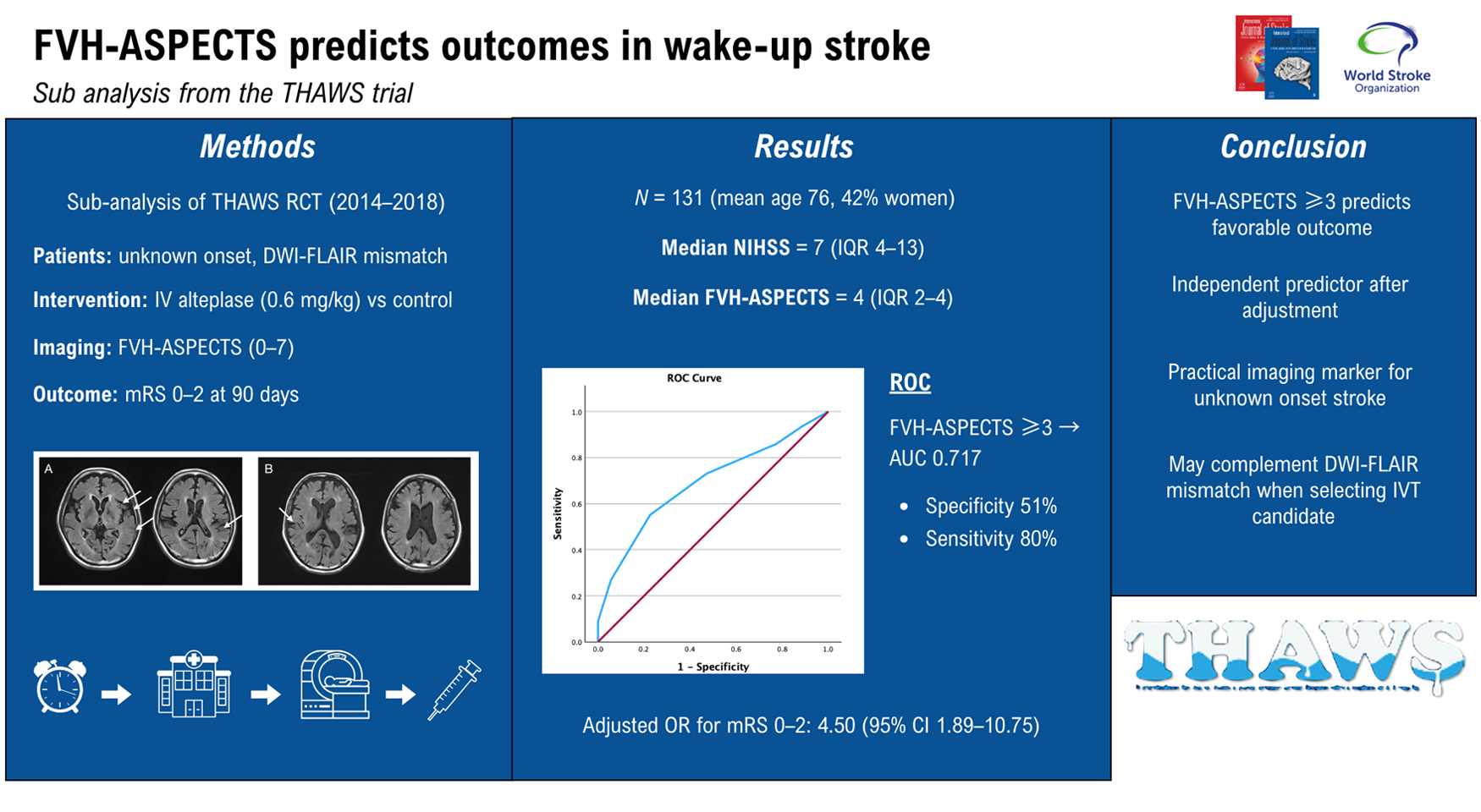
The THrombolysis for Acute Wake-up and Unclear-onset Strokes with Alteplase at 0.6 mg/kg (THAWS) trial was a multicenter, randomized controlled trial conducted at 40 sites in Japan between 2014 and 2018. Patients with unknown stroke onset and diffusion-weighted imaging (DWI)-FLAIR mismatch were randomly assigned to receive either intravenous alteplase (0.6 mg/kg) or standard medical treatment. FVH-ASPECTS, a semiquantitative scoring system assessing FVH prominence in the seven cortical ASPECTS regions, was evaluated for its association with favorable outcomes (modified Rankin Scale 0–2 at 90 days). The optimal FVH-ASPECTS threshold was determined using receiver operating characteristic (ROC) analysis and its correlation with favorable outcomes was assessed.
Results:
Among 131 patients (mean age, 76 ± 13 years; 42% women), 71 received alteplase and 60 did not. Median NIHSS score was 7 (interquartile range [IQR] 4–13), and median FVH-ASPECTS was 4 (IQR 2–4). ROC analysis identified FVH-ASPECTS 3 or more as predictive of favorable outcomes (sensitivity 80%, specificity 51%, area under the ROC curve [AUC] 0.717). A significant correlation was observed between FVH-ASPECTS 3 or more and favorable outcomes (adjusted odds ratio [OR] 4.50, 95% confidence interval [CI] 1.89–10.75; p < 0.001).
Conclusion:
FVH-ASPECTS could offer an indicator for achieving favorable clinical outcomes among stroke patients with unknown time of onset, with a threshold of 3 or more.
Get full access to this article
View all access options for this article.
References
Supplementary Material
Please find the following supplemental material available below.
For Open Access articles published under a Creative Commons License, all supplemental material carries the same license as the article it is associated with.
For non-Open Access articles published, all supplemental material carries a non-exclusive license, and permission requests for re-use of supplemental material or any part of supplemental material shall be sent directly to the copyright owner as specified in the copyright notice associated with the article.
