




Abstract
Background and Objectives:
Race and ethnicity have been shown to affect healthcare outcomes among patients diagnosed with cerebral aneurysms. Our study analyzes baseline demographics, lifestyle, healthcare resource utilization, and perception of health status among patients with ruptured and unruptured cerebral aneurysms based on race and ethnicity.
Methods:
This was a cross-sectional study that utilized survey data and electronic health record (EHR) data from the All of Us Research Program. Patients with unruptured and ruptured aneurysms were identified using ICD-9/10 codes. Cohorts were classified into three categories based on self-reported race/ethnicity: Black, Hispanic, or White.
Results:
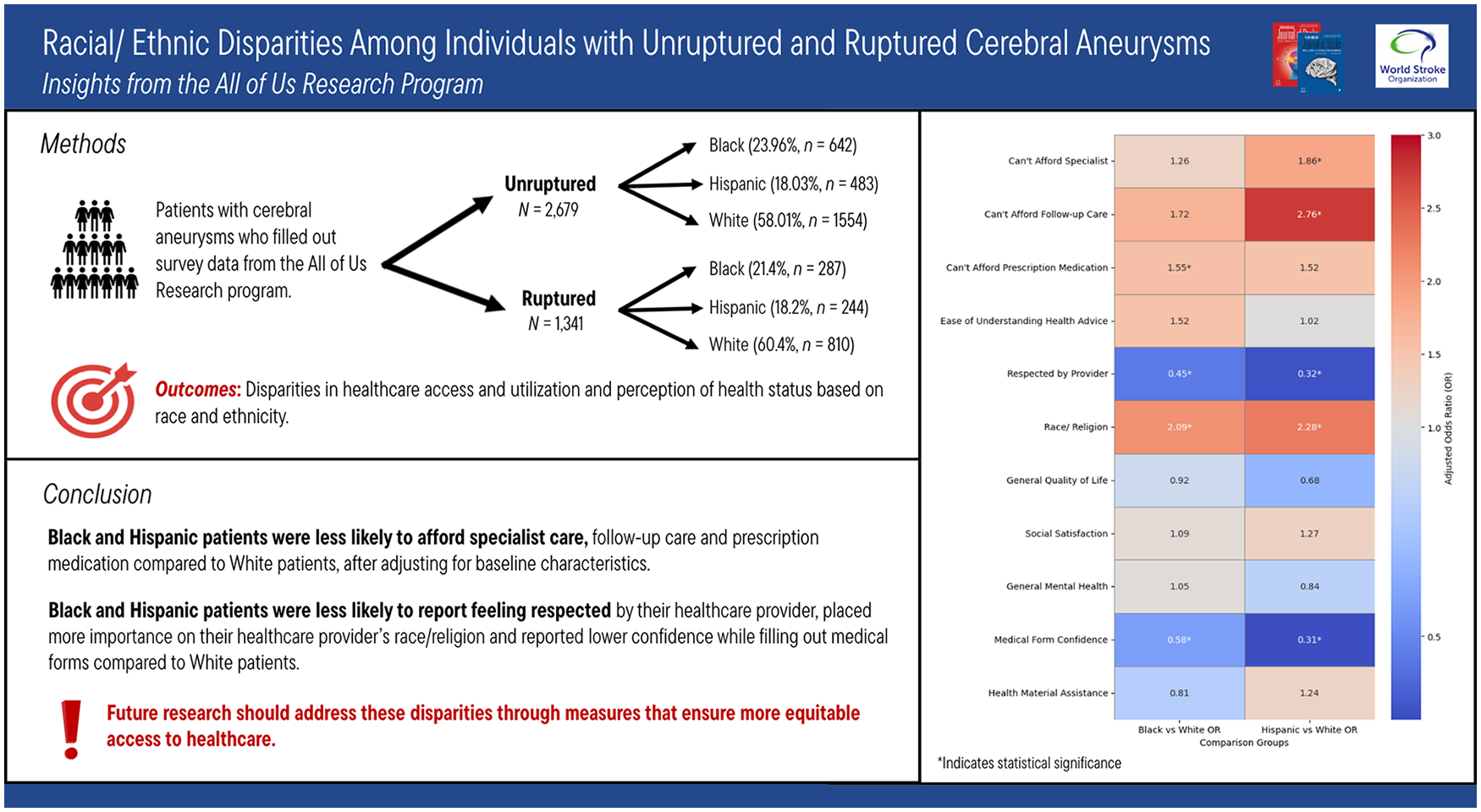
A total of 2975 patients with unruptured cerebral aneurysms and 1498 ruptured cerebral aneurysms were included. Black and Hispanic patients with cerebral aneurysms reported lower income, education, and employment rates, in addition to higher rates of daily cigarette smoking compared to White patients (P < 0.001). After adjusting for confounders, Hispanic patients reported higher odds of being unable to afford specialist care (odd ratio (OR) = 1.86 [1.02–3.37], P = 0.04) and follow-up care (OR = 2.76 [1.52–5.00], P < 0.001), while Black patients reported higher odds of being unable to afford prescription medications (OR = 1.55 [1.03–2.33], P = 0.03) compared to White patients. Black and Hispanic patients reported lower odds of feeling respected by their healthcare provider (OR = 0.45 [0.21–0.94], P = 0.03 and OR = 0.32 [0.15–0.67], P < 0.01), demonstrated lower confidence in completing medical forms independently (OR = 0.58 [0.37–0.89], P = 0.01 and OR = 0.31 [0.20–0.47], P < 0.001) and were more likely to consider their provider’s race/religion important compared to White patients (OR = 2.09 [1.51–2.88], P < 0.001 and OR = 2.28 [1.56–3.34], P < 0.001).
Discussion:
Our study identified disparities in baseline characteristics, healthcare access, and perception of health status among racial/ethnic minorities with unruptured and ruptured aneurysms. Future research could emphasize on addressing these disparities by ensuring more equitable access to healthcare.
Get full access to this article
View all access options for this article.