




Abstract
Background:
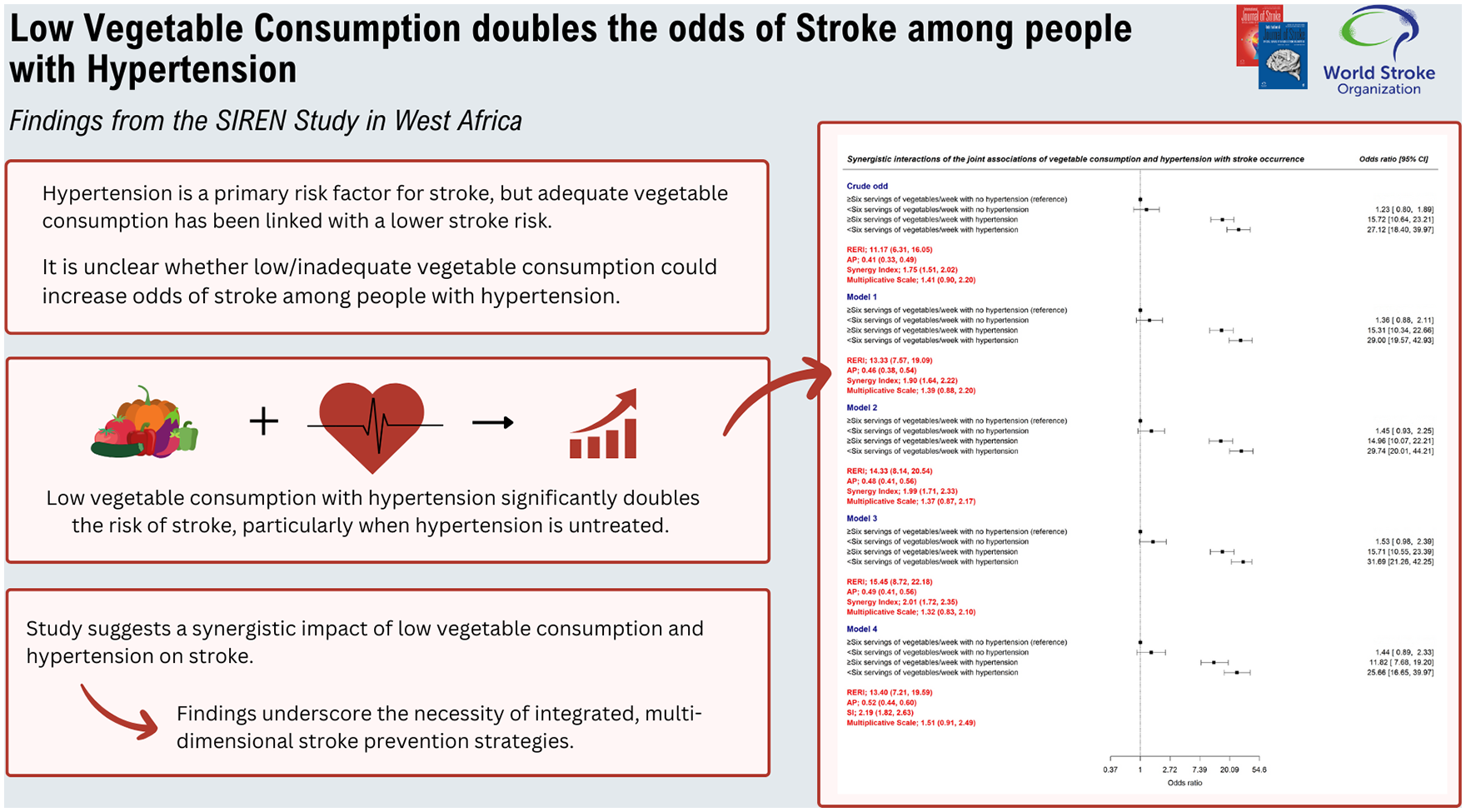
While hypertension is a primary risk factor for higher stroke risk, adequate vegetable consumption has been linked with a lower odds of stroke. However, it is unclear whether low/inadequate vegetable consumption could aggravate the odds of stroke among people with hypertension. This study assessed the interaction of low vegetable consumption and hypertension with stroke among West Africans.
Methods:
In this case–control study, 3684 stroke cases (aged ⩾ 18 years) matched for age ±5 years, sex, and ethnicity, with 3684 healthy controls were recruited across multiple sites in Nigeria and Ghana. Hypertension was defined using standard guidelines, and vegetable consumption was assessed with a food frequency questionnaire. Multivariable-adjusted conditional logistic regression and interaction models were used to estimate the odds ratios (OR) with a 95% confidence interval (CI) of stroke and the synergistic interaction of both low vegetable consumption (< 6 servings per week) and hypertension. The attributable proportion (AP), relative excess risk due to interaction (RERI), and synergy index (SI) were estimated at a two-sided P < 0.05.
Results:
Overall, the mean age was 59.0 ± 14.9 years, and 45.8% (3376) were female. Among stroke cases, the prevalence of low vegetable consumption and hypertension was 68.1% (2508) and 95.9% (3480), respectively. The multivariable-adjusted odds of stroke, given low vegetable consumption with hypertension, were OR = 25.66 (95% CI = 16.65, 39.54) with an RERI of 13.40 (95% CI = 7.21, 19.59), AP of 0.52 (95% CI = 0.44, 0.60), SI of 2.19 (95% CI = 1.82, 2.63), and a multiplicative interaction of about 50%; 1.51 (95% CI = 0.91, 2.49).
Conclusion:
The odds of stroke double with low vegetable consumption among people with hypertension in this population.
Get full access to this article
View all access options for this article.
References
Supplementary Material
Please find the following supplemental material available below.
For Open Access articles published under a Creative Commons License, all supplemental material carries the same license as the article it is associated with.
For non-Open Access articles published, all supplemental material carries a non-exclusive license, and permission requests for re-use of supplemental material or any part of supplemental material shall be sent directly to the copyright owner as specified in the copyright notice associated with the article.
