



Abstract
Background:
Real-world data on the long-term trends in risk factors, acute antithrombotic strategies, medication adherence, and their impact on the prognosis of minor ischemic stroke (MIS) or transient ischemic attack (TIA) are limited.
Methods:
We analyzed cases of acute MIS (National Institutes of Health Stroke Scale score ⩽ 3) and TIA from the China National Stroke Registries (CNSRs), a series of multicenter, nationwide hospital-based registries in China. Stroke risk factors, acute antithrombotic strategies, and adherence to secondary prevention were compared between CNSR I (2007–2008) and CNSR III (2015–2018). The main outcomes were stroke recurrence, disability (modified Rankin Scale 3–5), and all-cause mortality at 3, 6, and 12 months of follow-up.
Results:
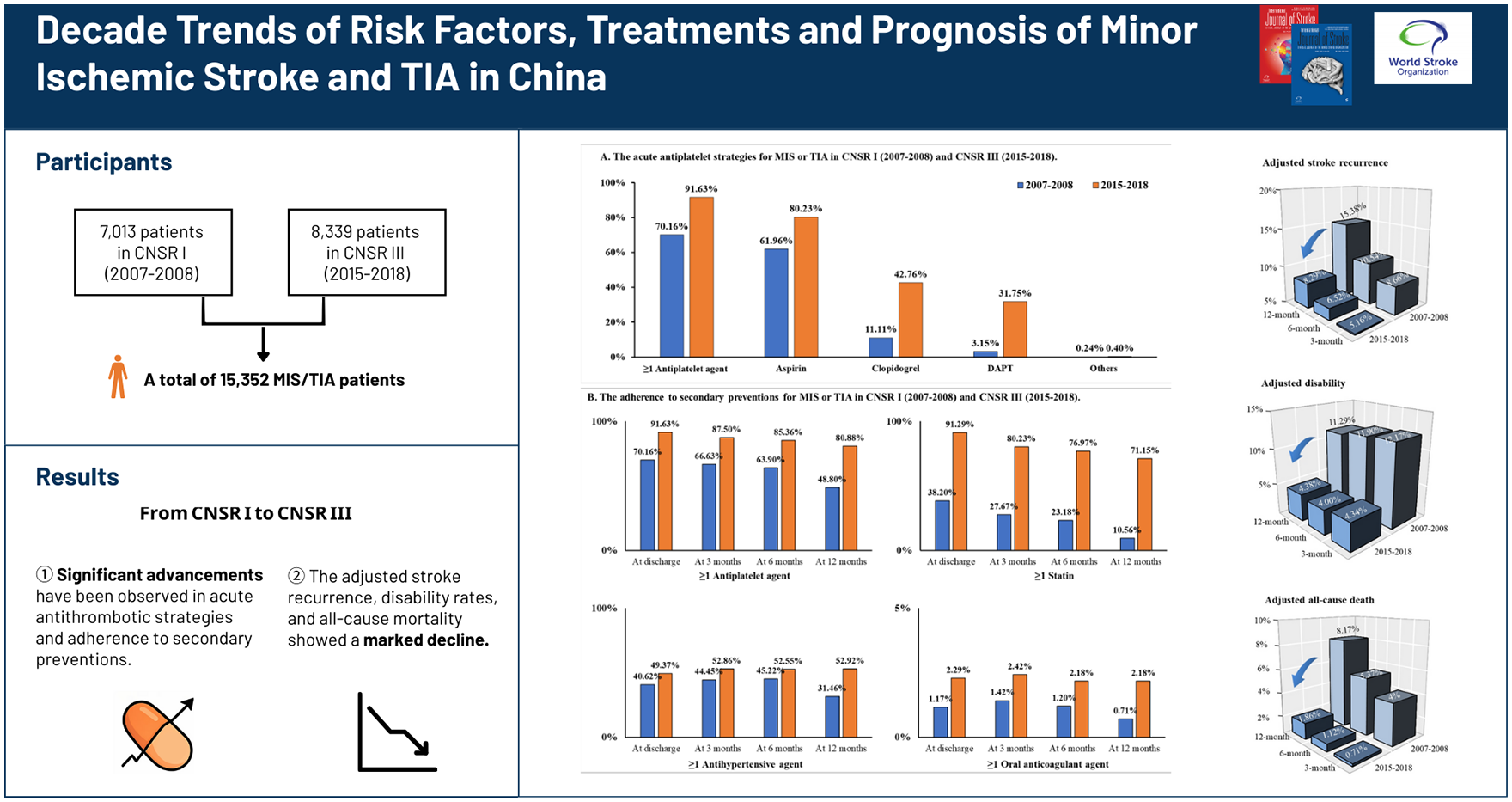
In total, 15,352 patients with acute MIS or TIA were included, including 7,013 patients from CNSR I and 8,339 patients from CNSR III. Over the past decade, there has been a 10-fold increase in the acute use of dual antiplatelet therapy (3.15% in CNSR I vs 31.75% in CNSR III) and a seven-fold increase in statin adherence at the 12 month follow-up (10.56% in CNSR I vs 71.15% in CNSR III). It was also observed that the adjusted cumulative incidence of stroke recurrence (15.38% [15.29%–15.47%] vs 8.29% [8.27%–8.32%]), disability rates (11.29% [11.12%–11.46%] vs 4.38% [4.32%–4.44%]), and all-cause mortality (8.17% [8.04%–8.30%] vs 1.86% [1.83%–1.89%]) at the 12-month follow-up showed a marked decline over the decade. Risk factors such as age (per 10 years), diabetes, and prior stroke were linked to a higher risk of 12-month stroke recurrence in CNSR I (CNSR I: odds ratio (OR) and 95% confidence interval (CI), 1.25 [1.17–1.33] for age per 10 years; 1.40 [1.18–1.66] for diabetes; and 1.96 [1.68–2.27] for prior stroke), and these associations remained significant after 10 years (CNSR III: OR and 95% CI, 1.15 [1.08–1.24] for age per 10 years; 1.35 [1.13–1.61] for diabetes; and 1.54 [1.29–1.84] for prior stroke).
Conclusion:
The past decade has witnessed significant advancements in both acute antithrombotic strategies and medication adherence, accompanied by marked reductions in stroke recurrence, disability, and mortality. These improvements highlight a positive shift toward more effective evidence-based care for patients with MIS or TIA.
Keywords
Get full access to this article
View all access options for this article.