



Abstract
Background:
Endovascular therapy (EVT) has been proved beneficial in patients with acute large vessel occlusion (LVO) with large infarcts, but it is unknown whether the benefit would be affected by the interhospital-transfer status. We investigated the efficacy of EVT according to the interhospital-transfer status in such patients.
Methods:
This was a secondary analysis of the ANGEL-ASPECT trial. Patients with acute anterior-circulation LVO and large infarcts, defined by Alberta stroke program early CT score (ASPECTS) 3–5 or infarct core volume 70–100 mL, were enrolled from 46 centers across China and randomized (1:1) to receive EVT with medical management (MM) versus MM alone. We dichotomized patients into two subgroups based on whether admitted directly to the EVT-capable center or transferred from a primary center. The primary outcome was the 90-day modified Rankin Scale (mRS).
Results:
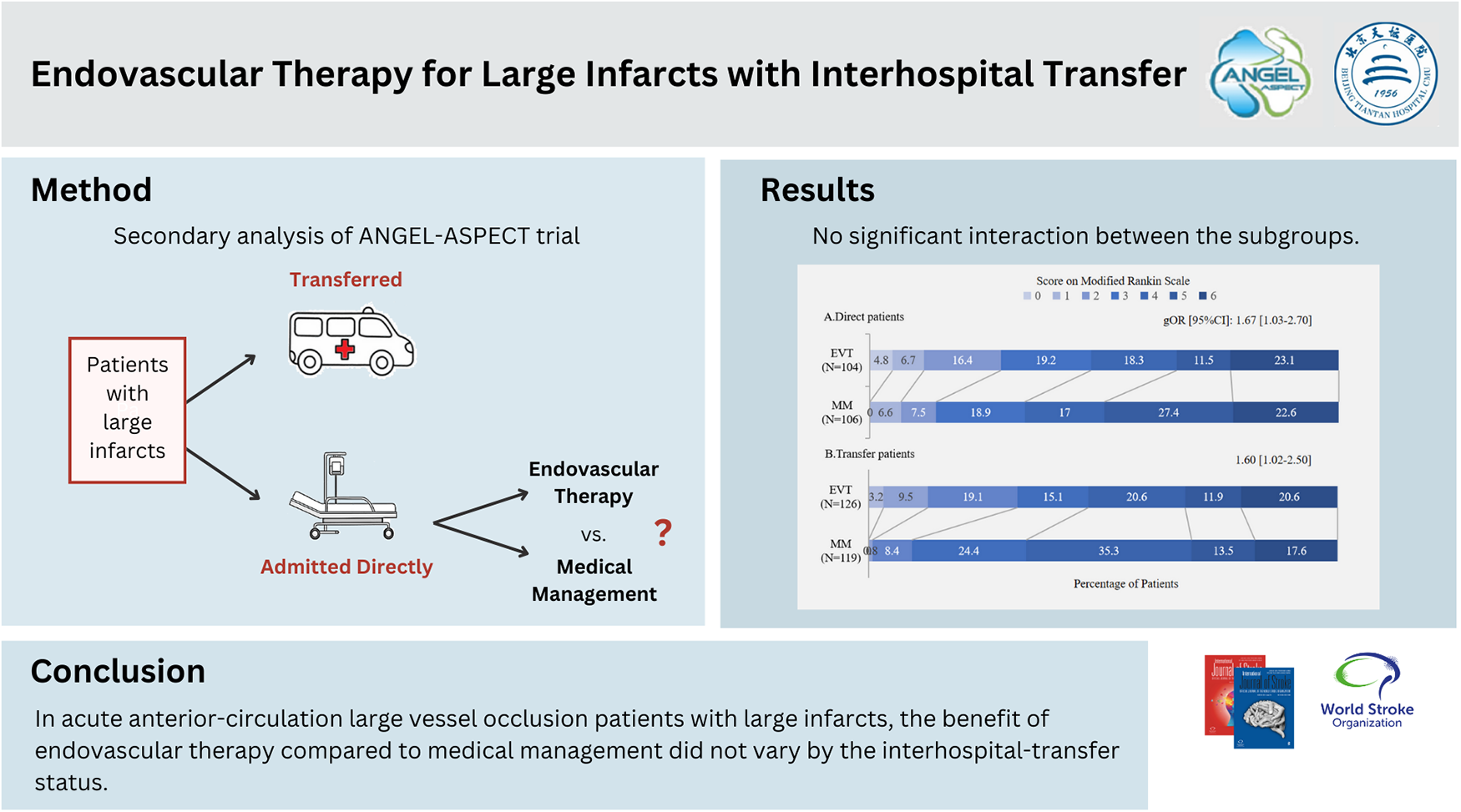
From October 2020 to May 2022, 456 patients were recruited and one withdrew consent. So, 455 patients were included in this analysis, with 210 (46.2%) in the direct subgroup and 245 (53.8%) in the transfer subgroup. The transfer subgroup had longer median onset-to-arrival time than the direct patients (379 vs 279 mins, p < 0.001), while there was no significant difference in the arrival-to-recanalization time (197 vs 205 mins, p = 0.087) between the two subgroups. A significant ordinal shift of 90-day mRS toward a better functional outcome in EVT than MM (generalized odds ratio [gOR] = 1.67; 95% confidence interval (CI) = 1.03–2.70, p = 0.036 versus gOR = 1.60; 95% CI = 1.02–2.50, p = 0.039) was found in the direct and transfer group, respectively. There was no significant interaction of the two subgroups over the treatment effect of EVT versus MM on the primary outcome (p for interaction = 0.706).
Conclusions:
In acute anterior-circulation LVO patients with large infarcts, the benefit of EVT compared to MM did not vary by the interhospital-transfer status.
Get full access to this article
View all access options for this article.
References
Supplementary Material
Please find the following supplemental material available below.
For Open Access articles published under a Creative Commons License, all supplemental material carries the same license as the article it is associated with.
For non-Open Access articles published, all supplemental material carries a non-exclusive license, and permission requests for re-use of supplemental material or any part of supplemental material shall be sent directly to the copyright owner as specified in the copyright notice associated with the article.
