




Abstract
Background:
It is acknowledged that penumbra can exist beyond 24 h after stroke onset.
Aims:
The aim of this study was to explore the association between penumbral persistence at 24–72 h and clinical outcomes in patients who did not achieve major reperfusion.
Methods:
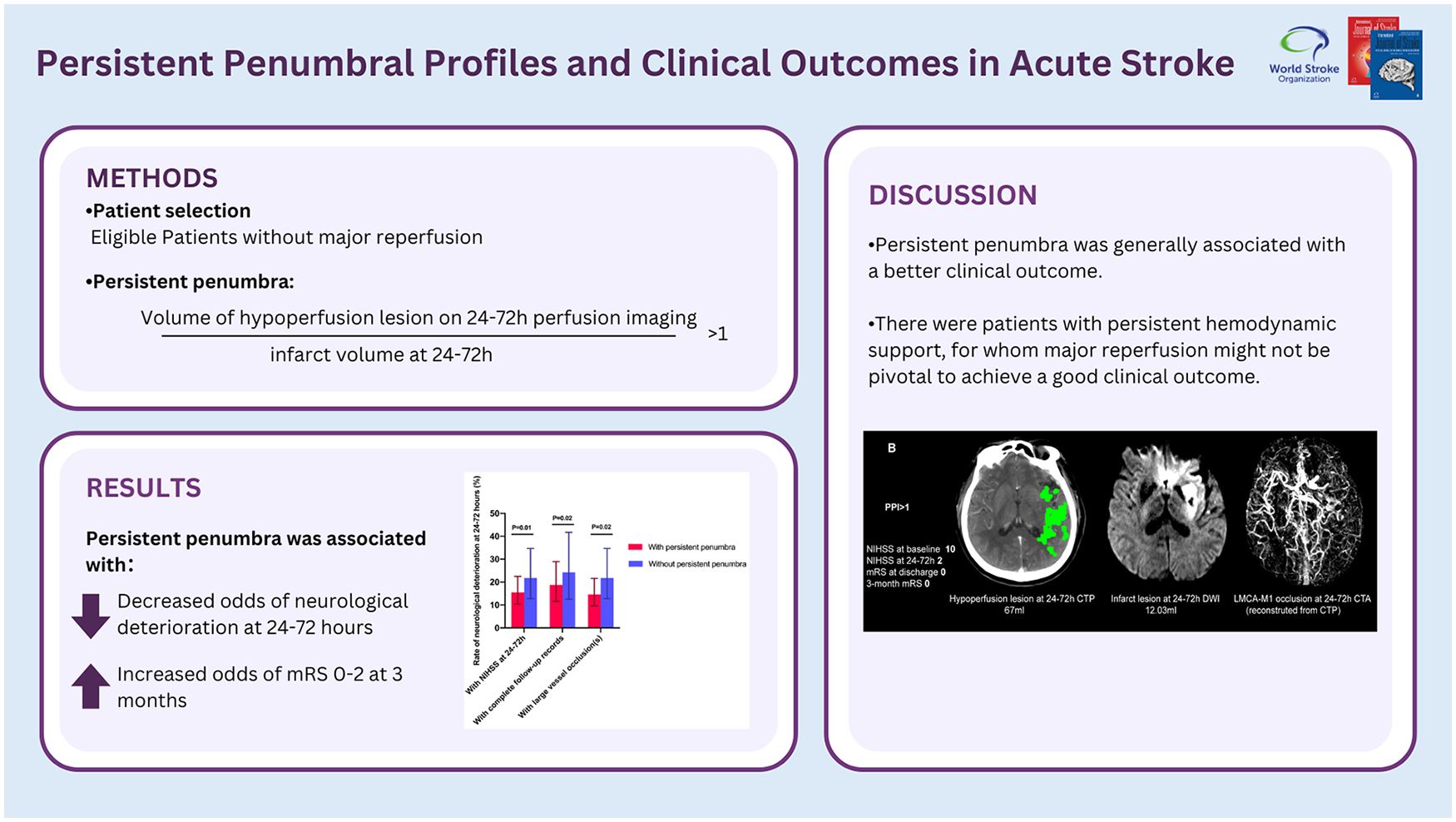
Eligible patients participating in the International Stroke Perfusion Imaging Registry with repeated 24–72 h perfusion imaging were retrospectively included in this study. Persistent penumbra was evaluated as the volume of hypoperfusion lesion on repeated perfusion imaging divided by infarct volume on the follow-up imaging at 24–72 h post arrival. Short-term clinical outcomes were defined as neurological deterioration at 24–72 h and modified Rankin Scale (mRS) 0–2 at discharge. Long-term outcome was defined as mRS 0–2 at 3 months. The association between persistent penumbra and clinical outcomes was explored using multivariable-adjusted logistic regression models.
Results:
A total number of 203 patients were included in this study. Persistent penumbra was associated with decreased odds of neurological deterioration at 24–72 h (multivariable-adjusted odds ratio (OR) = 0.3, 95% confidence interval (CI) = 0.1–0.8, p = 0.01) and increased odds of mRS 0–2 at 3 months (multivariable-adjusted OR = 2.7, 95% CI = 1.1–6.8, p = 0.03). Persistent penumbra was not associated with mRS 0–2 at discharge (multivariable-adjusted OR = 2.5, 95% CI = 0.4–14.7, p = 0.30).
Conclusions:
Persistent penumbra in acute stroke patients without major reperfusion was generally associated with a better clinical outcome. This evidence suggested that there were patients with persistent hemodynamic support, for whom major reperfusion might not be pivotal to achieve a good clinical outcome. How to identify these patients and what treatment strategy can be made to stabilize the hemodynamics need future investigation.
Data access statement:
Anonymized data not published within this article will be made available at the request of qualified investigators whose proposal of data use has been approved by an independent review committee.
Get full access to this article
View all access options for this article.
References
Supplementary Material
Please find the following supplemental material available below.
For Open Access articles published under a Creative Commons License, all supplemental material carries the same license as the article it is associated with.
For non-Open Access articles published, all supplemental material carries a non-exclusive license, and permission requests for re-use of supplemental material or any part of supplemental material shall be sent directly to the copyright owner as specified in the copyright notice associated with the article.
