




Abstract

Dear Editor,
The optimal preventive screening strategy for intracranial aneurysms in first-degree relatives (FDRs) of patients with aneurysmal subarachnoid hemorrhage (aSAH) remains unclear. We evaluated the correlation of age at time of aSAH in FDRs to assess whether age at time of aSAH may be a factor to consider in determining the optimal screening strategy.
Baseline characteristics.
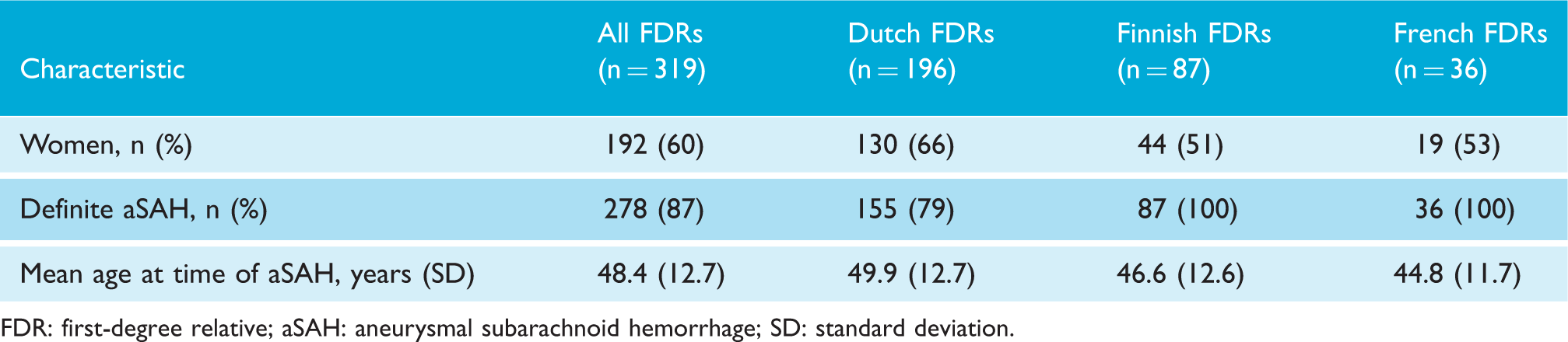
FDR: first-degree relative; aSAH: aneurysmal subarachnoid hemorrhage; SD: standard deviation.
The ICC for age at time of aSAH in all 146 families was 0.21 (p < 0.01). The correlation remained essentially the same in the subanalyses. An age difference at time of aSAH of 20 years or less was observed in 84% of all FDRs (Figure 1). This age difference remained comparable in the subanalyses.
Cumulative percentage of families per difference of age at time of aSAH. Results for all FDRs (a) and for subanalyses (b). FDR: first-degree relative; aSAH: aneurysmal subarachnoid hemorrhage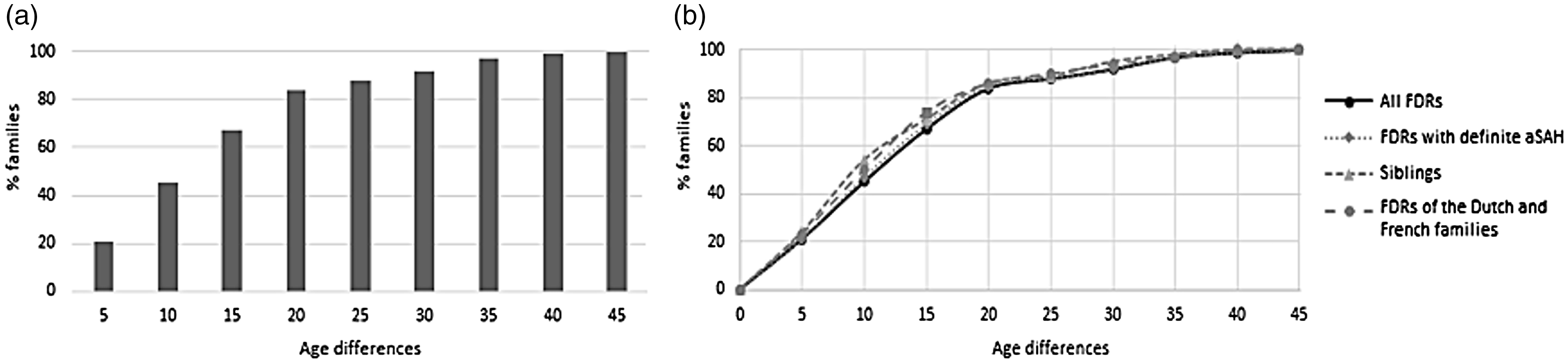
In conclusion, our study showed a poor correlation of age at time of aSAH in FDRs. Therefore, we did not find evidence that age at time of aSAH is a contributing factor in determining the optimal screening strategy for intracranial aneurysm.
Footnotes
Declaration of conflicting interests
The author(s) declared no potential conflicts of interest with respect to the research, authorship, and/or publication of this article.
Funding
The author(s) received no financial support for the research, authorship, and/or publication of this article.