



Abstract
This study examines the influence of commas and line breaks on attachment preferences in Spanish preverbal relative clauses with two potential antecedents (e.g., The colleague of the violinist who is a far-right supporter performed with the orchestra yesterday). Previous research in Spanish, which focused on postverbal relative clauses, provided evidence that commas introduce an implicit prosodic boundary that encourages attachment to the higher determiner phrase (DP1, the colleague). Here, we assess the separate and combined effects of commas and line breaks in three offline studies in Spanish. First, we assess attachment preferences of sentences with relative clauses preceded by commas and without commas in the under-researched preverbal position. Then, we test whether line breaks could have the same effect as commas in determining attachment. Our findings suggest that only commas consistently and significantly impact attachment preferences, favoring high attachment, and that visual segmentation through line breaks is not enough to obtain the same effect.
Keywords
Introduction
Commas are a relatively recent development in modern writing systems. Ancient systems like Egyptian hieroglyphs and Sumerian cuneiform used context and layout to indicate pauses or breaks. Although most contemporary writing systems now incorporate some sort of punctuation, alternative methods still exist in certain contexts. For example, poetry often uses line breaks to convey pauses and rhythm, serving a function similar to commas. In fact, commas were originally used for rhetorical effect in oral speech and as breathing marks to break up long passages into manageable units, making it easier for orators and readers to deliver speeches or recitations. It was only in later stages that commas acquired a syntactic function in specific contexts, contributing to indicate the structural organization of sentences. Both commas and line breaks share certain similarities and have been employed to structure and organize text as well as to signal pauses, but do modern readers interpret a line break in ambiguous sentences in the same way they would interpret a comma? In this work, we focus on the disambiguating role of commas and line breaks in sentences containing an attachment ambiguity.
The comma that orthographically differentiates the sentences in (1) prompts the reader to make a pause and, with this pause, brings about a prosodic break in implicit prosody.
(1) a. George is married to the linguist who won the tennis tournament. b. George is married to the linguist, who won the tennis tournament. c. *George is married to Mary who won the tennis tournament. d. George is married to Mary, who won the tennis tournament.
The sentence in (1a) without commas is a restrictive relative clause (restrictive RC), which is usually interpreted as a property that serves to further restrict the set denoted by the nominal head they modify (e.g., the set of linguists). In this example, the restrictive RC restricts the set of linguists to the unique one who won the tennis tournament. The same sentence with a comma (1b) can have an appositive interpretation. Contrary to restrictive RCs, appositive RCs do not restrict the reference of the antecedent and can modify proper names. This contrast becomes clearer when comparing examples (1c) and (1d), where (1c) sounds odd without a pause, since Mary denotes a unique individual that cannot be modified by a restrictive RC. However, when we add a comma as in (1d), the sentence is accepted as an appositive RC. There are different types of appositives, but generally, and contrary to restrictive RCs, appositives provide additional background information (e.g., Marie Curie, the first woman to win a Nobel Prize, made groundbreaking discoveries in radioactivity).
In Spanish, the language examined in this study, the correct use of commas is regulated by the Real Academia Española (RAE, The Royal Spanish Academy), an institution whose primary mission is to provide standardized rules and guidelines to ensure consistency in the use of Spanish grammar, spelling, orthography, and punctuation. In the particular case of commas and relative clauses, the RAE states the following: appositive (explanatory) relative clauses with an explicitly expressed antecedent are set off by commas whenever they provide non-essential, explanatory information (see example [2a]). In contrast, restrictive relative clauses are not set off by commas from the rest of the sentence as in (2b). For more information and examples, see sections 3.4.2.2.4.2.1 ‘Oraciones de relativo con antecedente expreso’ and 3.4.2.2.1.1 ‘Incisos’, from Real Academia Española and Asociación de Academias de la Lengua Española (2010).
(2) a. El nuevo empleado, que habla cuatro idiomas, se incorporará el lunes. ‘The new employee, who speaks four languages, will start on Monday’. b. Necesitamos un empleado que sepa idiomas. ‘We need an employee who knows languages’.
Appositives, in comparison to restrictive RCs, have been understudied in the field of psycholinguistics, although they have been widely studied in linguistics because of their particular relation to the main clause. The assertions in (1b) and (1d) can be thought of as articulated in two parts: the primary assertion (that is, the matrix predicate: George is married to the linguist or to Mary) and the secondary assertion (the appositive: who won the tennis tournament). Contrary to restrictive RCs, which provide essential information about the noun they modify, helping to define or identify it more specifically, appositives are characterized as contributing content that is not directly relevant to the main assertion or issue of the containing sentence. Rather, they provide extra or supplementary information and exhibit relative autonomy from their host clause (De Vries, 2006; Potts, 2005; Tonhauser, 2012). One example of this autonomy is that appositives can be canceled or negated without implying a change in their referent (e.g., George would still be married to Mary even if it is not true that she won the tennis tournament). Unlike restrictive RCs, appositives contribute to meaning in a way that is separate from the main truth-conditional content of their host clause. For instance, George would be married to a different linguist if we change the content of the RC in (1a; e.g., George is married to the linguist who lost the tennis tournament, not the one who won). In contrast, George would still be married to the same linguist in (1b) regardless of whether she truly won the tennis tournament or not. These observations made linguists claim that appositive and restrictive RCs are probably computed differently semantically and syntactically (Potts, 2005). Importantly, appositives and restrictive RCs are also differentiated prosodically. Appositives are prosodically demarcated from their host clause by an independent intonational phrase with comma intonation (Auran & Loock, 2011; Dehé, 2009). While this separation from the head by prosodic boundaries is mandatory in appositives, it is only optional in restrictives, where it can also occur, especially as the length of the clause increases. These differences have been shown to affect the processing and interpretation of both RCs in a different way. Given that the only orthographic difference between both is the presence of a comma, in this work, we study the role of this comma in disambiguating appositive/restrictive ambiguous RCs and determining attachment preferences. The first goal is to investigate whether the comma that differentiates both RCs can determine attachment preferences in sentences containing two possible DP hosts (DP1 of DP2 + RC) in an understudied preverbal position. The second goal is to see whether the same effect can be obtained using line breaks instead of commas.
Attachment Preferences in Relative Clauses
Previous research on the resolution of attachment ambiguities mainly focused on sentence-final RCs such as in (3):
(3) a. George is married to [the friend1 [of [the linguist2 [who won2 the tennis match]]]]. b. George is married to [[the friend1 [of the linguist2]] [who won1 the tennis match]].
This type of ambiguity became extensively studied since Cuetos and Mitchell (1988) discovered different attachment preferences across languages. This was unexpected since following principles of locality (Frazier, 1978; Gibson, 2000; Kimball, 1973) longer dependencies lead to increased parsing difficulty, which favors low attachment to DP2 as in example (3a; i.e., attachment to the linguist, so as it was the linguist who won the tennis tournament and not her friend). However, some studies have shown that a subset of languages in certain conditions preferred high attachment to DP1 as in example (3b) challenging locality principles (Grillo & Costa, 2014, for a review of this literature). The literature on RC attachment is extensive and complex, with contradictory results depending on the experimenter’s control of different variables, making it difficult to pinpoint exactly what determines attachment.
Two recent developments put the focus on the main verb and its importance in shaping both semantic and syntactic projections (Grillo & Costa, 2014; Rohde et al., 2011). Some previous publications in Spanish showed that it is important to control the nature of the main verb as it modulates attachment preferences (Aguilar & Grillo, 2021; Aguilar et al., 2021; Alonso-Pascua, 2020; Branco-Moreno, 2014). The focus of the current study is preverbal RCs, benefiting from the fact that they fall outside the scope of the main verb’s projections, and the role of implicit prosody on attachment preferences.
There is a broad consensus that prosody plays a crucial role in sentence disambiguation. Research on prosodic phrasing has shown that listeners rely on prosodic boundary cues to parse syntactic structure and resolve ambiguity. A similar disambiguating role has been proposed for silent reading. According to the Implicit Prosody Hypothesis (Fodor, 2002), readers project a default prosodic contour onto the text, generating both a prosodic and syntactic structure. This is because the prosodic parser interprets prosodic breaks as a marker of a larger syntactic boundary to split the sentence into packages that help identify sentence constituents, clarifying syntactic organization. In the case of syntactic ambiguity, it can determine or bias attachment preferences. To explain some results reported in the RC attachment literature, Fodor proposed the same-size sister constraint (Fodor, 1998), a rule that guides the parser to package sentence material into phrases balanced in length, or in other words, a constituent prefers to have a sister of a similar size. If we force a prosodic boundary after DP1 (DP1 // of DP2 + RC) by means of a comma or a pause, the prosodic parser would chunk together DP2 and the RC, while a prosodic boundary after DP2 (DP1 of DP2 // RC) would chunk DP1 and DP2 into the same prosodic phrase, favoring attachment to the head of the phrase, DP1. The effect is well-known in the literature and has been reported across domains in auditorily presented sentences with prosodic boundaries (see Fromont et al., 2017; Teira & Igoa, 2007, 2022 for examples in Spanish) and in production studies (Bergmann et al., 2008; Jun & Koike, 2003). Reading studies that investigated the effect of commas on attachment preferences reported a strong tendency toward the highest DP when the clauses are preceded by a comma (Carreiras, 1992; Dillon et al., 2018; Jun & Bishop, 2015). These studies provided an explanation for the observed results based on the impact of prosodic junctures prompted by commas.
The Current Study
The main focus of this study is to investigate the effect of commas and line breaks on the attachment preferences of RCs in preverbal position in Spanish. This syntactic position offers some distinctive characteristics in relation to postverbal position. For instance, with respect to the properties of focus, objects tend to contain new and focused information, while nominal preverbal subjects are commonly interpreted as sentential topics (Alonso-Ovalle et al., 2002). The salience or prominence of the focused elements has been shown to attract syntactic attachment (Schafer, 1996). We hypothesize that preverbal RCs also offer a more balanced salience level for topical subjects.
At the prosodic level, Fernández (2005) observed differential prosodic patterns depending on position. When RCs were long (e.g., who often unknowingly snores), speakers tended to lengthen DP2 in postverbal position, and the RC verb in preverbal position. Speakers also produced different pitch movement patterns: intonation boundary rises at DP2 and falls at the verb in postverbal RCs, whereas in preverbal RCs, there is a tone fall at DP2 and a rise at the RC verb. Moreover, and of particular relevance to the current study, preverbal RCs have the advantage of falling out of the scope of the matrix verb semantic and syntactic projections. This is important as some previous research has been confounded by effects stemming from the verbal semantics of the matrix verb (Grillo & Costa, 2014; Rohde et al., 2011). Commas are the written manifestation of implicit prosodic boundaries (Breen, 2014, p. 44) and are placed at locations where the reader would normally place a prosodic boundary when reading. Indeed, there is evidence that readers produce the corresponding to a prosodic boundary in implicit prosody when finding a comma in silent reading. Studies using Event Related Potentials (ERPs) discovered a component associated with the presence of commas: the Closure Positive Shift (Steinhauer, 2003; Steinhauer et al., 1999). Although not all subsequent studies could replicate these findings for visually presented sentences (Kerkhofs et al., 2008), they observed that commas and prosodic breaks disambiguate sentences in equivalent ways, suggesting that both serve analogous roles. In Kerkhofs et al. (2008)’s study, temporarily ambiguous S-coordination sentences (e.g., The sheriff protected the farmer(,) and the farm hand defended bravely the ranch against Johnson’s gang) were tested in two modalities. The visual modality disambiguated the sentence using a comma, and the auditory modality using a prosodic break. Although different ERP signatures were registered across modalities, both commas and prosodic breaks showed evidence of an early disambiguation.
While this evidence suggests that commas uniquely mirror cognitive processes for perceiving spoken language boundaries, other studies have tested different visual cues for text organization and clause separation. In this work, we focus on line breaks as a form of visual text segmentation. Line breaks are a pervasive feature of written text, whether in digital or print format. Each time we read, we encounter breaks in the text imposed by the physical constraints of screens or pages. Despite their constant presence in our reading experience, line breaks have received surprisingly little attention in research. The effects of line breaks and frame breaks in sentence disambiguation have been documented in a limited number of studies (Hirotani et al., 2016; Swets et al., 2007; Tsoukala et al., 2025).
Hirotani et al. (2016) tested ambiguous English wh-questions in a self-paced reading (with frame breaks) and a questionnaire study (with line breaks). The results showed that alignment of line breaks with syntactic units reduces processing effort and helps disambiguation in online processing, and biases final offline attachment decisions. They argued that line breaks act as prosodic cues guiding readers toward specific parse structures by prosodically packaging together elements within a sentence. These findings endorse the Implicit Prosody Hypothesis, highlighting the crucial role of line breaks in processing written text. In the same vein, Tsoukala et al. (2025) found that breaks helped avoid garden path effects in ambiguous direct object/subject garden sentences in a self-paced reading task with frame breaks. The interpretation of the results in Tsoukala et al. (2025) considered together the implicit prosody explanation but also the potential use of line breaks as a signal for clause ending. Readers would expect line breaks to coincide with clause boundaries, which probably leads readers to pause. More closely to our study, Swets et al. (2007) tested the effect of breaks in ambiguous preverbal RCs presented in three timed chunks on separate successive screens as in Example (4), where brackets indicate segmentation:
(4) [The friend of the writer] [who arrived late at the ceremony] [is a classical violinist].
The results comparing two experiments with native Dutch and English speakers showed that sentences with this particular visual segmentation yielded more high attachment. The authors concluded that readers introduced a prosodic break at the edge of non-cumulative segments.
Here, we aim to examine how commas and line breaks influence readers’ final structuring decisions using multi-line sentences with line breaks. We argue that this mode of presentation is more natural than the framed or segmented one used in self-paced reading studies as it better reflects ecological reading conditions for studying line breaks and, moreover, the reader is not forced to remember the two DPs in the first segment along the following screens, which, arguably, may add a load on working memory.
We first present the results of a forced-choice questionnaire to explore the effect of comma on attachment preferences of globally ambiguous preverbal RCs with two antecedents. The question we aim to answer is whether readers consistently prefer high attachment when a comma precedes the RC, as would be expected in appositive RCs. In the condition without comma, we anticipate a tendency toward low attachment, assuming that principles of locality govern parsing, although this principle has been shown to exert a more dominant influence on online processing (see, for instance, Aguilar et al., 2022). The second experiment presents an acceptability judgment task that serves as a complementary measure of attachment preferences in disambiguated sentences. We expect higher acceptability rates of high-attached in comparison to low-attached sentences with commas, and the reverse pattern is expected in sentences without commas, that is, a higher acceptability of low-attached in comparison to high-attached RCs. Lastly, the third experiment tests the joint and separate effects of commas and line breaks in attachment in a forced-choice questionnaire. If line breaks have an effect similar to commas, a pattern of results comparable to that observed with commas is expected, that is, increased high attachment in sentences with line breaks in comparison to sentences without line breaks. Moreover, we expect an interaction whereby the effect of line breaks is expected to exert an influence in sentences without commas, but no effect is expected in sentences with commas as both cues would serve the same function. Therefore, we anticipate an interaction in which the presence of line breaks has a significant effect only in sentences without commas.
Experiment 1
Method
Materials
Norming Study
Plausibility of a preliminary set of 110 experimental items was assessed to ensure that both high and low interpretations were equally plausible. Each item was presented in two versions as in (5). Version A contained the first DP of the complex DP followed by the content of the RC as its main predicate, corresponding to the interpretation obtained as a result of the high attachment disambiguation. Version B contained the same sentence but with the second DP, which corresponds to a low attachment interpretation. Both the DPs and the adjective were in singular form.
(5) a. El editor estaba muy decepcionado. The editor was very disappointed. b. El escritor estaba muy decepcionado. The writer was very disappointed.
Sixty-one undergraduate Spanish native speakers, who did not participate in the main experiment, evaluated the plausibility of each sentence on a Likert scale from 1 (not plausible) to 5 (very plausible). The participants evaluated the plausibility of only one version of each item. Only pairs of sentences with scores >3 (i.e., rated as ‘fairly plausible’) were preselected. The final selection of sentence pairs (N = 80) was equally plausible, that is, the plausibility of the final selection of items did not differ significantly in versions A and B (p > .05).
Final List of Materials
Eighty experimental sentences were built in two conditions. One condition contains a comma that delimits the beginning and end of the RC (6-a), and the other condition lacked any comma (6-b; the list of materials is available in this OSF repository). The sentences were globally ambiguous as gender morphology was kept the same across the DP antecedents and the embedded adjective in the RC, which was feminine in half of the materials and masculine in the other half. The length of the clauses had an average of eight syllables (ranging from 6 to 10), which falls into an intermediate to medium length. Additional 80 filler items of various forms including active and passive sentences were created, avoiding syntactic ambiguities.
(6) a. El editor del escritor, que estaba muy decepcionado, fumaba mucho tabaco. ‘The editor of the writer, who was very disappointed, smoked a lot of tobacco’. b. El editor del escritor que estaba muy decepcionado fumaba mucho tabaco. ‘The editor of the writer who was very disappointed smoked a lot of tobacco’.
Participants
Fifty-two undergraduate students (Mage = 20.69, SD = 5.24, 44 females) participated in the study for course credit. All participants were Spanish-native speakers and gave informed consent before participating in the study. The study was approved by the Ethics Committee of the Universidad Complutense de Madrid (CE 20240912 SOC 04).
Procedure
The experimental items were presented in the two conditions in two different lists counterbalanced across participants. The lists contained half of the materials in the condition with commas and the other half in the condition without commas, in a way that every item was presented in the two conditions in a different list. Stimuli were presented sentence by sentence at the center of the screen. Each target sentence was followed by two options corresponding to the two possible disambiguation options: high attachment (e.g., The editor was very disappointed) or low attachment (e.g., The writer was very disappointed). Filler items were also followed by two options, only one of which corresponded to the content of the filler, in order to gauge participants’ attention and accuracy throughout the experiment. Participants were instructed to read the sentences at their normal pace and press the space bar to move onto the next screen, where the two choices were displayed and then choose one of the two options. The order of presentation of the items was pseudo-randomized to make sure a target item was not presented twice in a row. Fillers were interspersed with target items. The order of presentation of the two choices (left or right side) presented after the sentences was randomized across participants and items. The experiment was displayed, and the responses were collected using the Gorilla Experiment Builder (Anwyl-Irvine et al., 2020). The experiment lasted around 15 to 20 min.
Data Analysis and Results
No participant was excluded from analyses because all accuracy rates on filler items were above 80%. Data were analyzed with R (R Core Team, 2021) fitting Generalized Linear Mixed-Effects Models with binomial distribution using the package lme4 (Bates et al., 2015). The fixed effect factor was Comma (with vs without), and participants and items were included as random effects, including random slopes for participants and items (Attachment ∼ Comma + (1+Comma |subject) + (1+Comma|item). Comma was sum-coded (without as −0.5 and with as 0.5).
The analysis showed a main effect of Comma on attachment (
Discussion
The results of Experiment 1 showed a strong preference for the first DP in appositive RCs (91% of high attachment), aligned with previous results in postverbal RCs (Dillon et al., 2018 reported 71% in English, and Carreiras, 1992 92% in Spanish). In the case of restrictive RCs, there was not a clear preference (46% high attachment), with a moderate bias for local attachment. The previous literature with preverbal RCs is confusing. Some studies found a general preference for low attachment (Aguilar et al., 2022; Hemforth et al., 2015), others for high attachment (Branco-Moreno, 2014), and others without a clear preference or preference near chance level (Alonso-Pascua, 2020). There is broad agreement in the literature that attachment is a multifactorial phenomenon, making it challenging to control for all potentially influencing variables. For example, in our study, we cannot guarantee that readers did not introduce pauses in restrictive sentences, which could have increased the number of high-attachment responses. Nevertheless, the presence of commas emerged as a strong influencing factor: appositive RCs showed approximately twice the rate of high attachment compared to restrictive RCs.
In line with Dillon et al. (2018), we interpret the strong influence of commas as a result of a phrasal boundary induced by a prosodic break at the places where the commas are. Commas induce a prosodic break that influences the packaging of structural information in a way that a break after DP2 packages DP1 and DP2 together, which favors attachment to the head of the complex DP, that is, DP1.
Previous research in Spanish with this type of ambiguity showed that prosodic breaks before the RC in auditorily presented sentences do indeed influence attachment (Fromont et al., 2017; Teira & Igoa, 2007). 1 However, although commas are an important factor, not all sentences with commas were highly attached, meaning that other factors overrode the effect of commas in some cases.
Experiment 1 established the baseline attachment preferences in sentences with preverbal RCs with and without commas. In the following experiment, we conduct an acceptability judgment task to obtain a complementary measure of attachment preferences using temporarily ambiguous sentences, which were disambiguated by means of gender morphology.
Experiment 2
Method
Participants
Eighty undergraduate students (Mage = 18.97, SD = 2.46, 67 female) participated for course credit. All participants were Spanish-native speakers and gave informed consent before taking part in the study. Seven participants were excluded from the analyses because the accuracy rates for filler items did not reach 80%. The study was approved by the Ethics Committee of the Universidad Complutense de Madrid (CE 20240912 SOC 04).
Materials
The sentences from Experiment 1 were disambiguated toward low or high attachment by means of gender agreement between the DP antecedent and the embedded adjective, so as DP1 was masculine and DP2 feminine or vice-versa (see example of materials in [7]). The gender of the two antecedent DPs was counterbalanced, with the [fem-masc] combination occurring in half of the cases and the [masc-fem] combination in the remaining half. Likewise, the gender of the embedded adjective was feminine half of the times and masculine the other half. Target items were interspersed with 70 filler items. The filler items comprised 45 grammatical sentences (which included sentences with clitics, small clauses, and passive sentences) and 25 ungrammatical sentences with wrong prepositions (e.g., El sastre contrató al mañoso hombre a través de pintar su casa en el pueblo/The tailor hired the crafty man through paint his house in the village) or number agreement errors (e.g., El terapeuta descubrió en el paciente los miedos que han soportado/The therapist discovered in the patient the fears they have endured).
(7) a. El ‘The ophthalmologistMASC of the writerFEM, who was very unfriendlyMASC, performed the cataract operation’. b. El ‘The ophthalmologistMASC of the writerFEM who was very unfriendlyMASC performed the cataract operation’. c. El ‘The ophthalmologistMASC of the writerFEM, who was very unfriendlyFEM, performed the cataract operation’. d. El ‘The ophthalmologistMASC of the writerFEM who was very unfriendlyFEM performed the cataract operation’.
Procedure
The experiment was displayed and the responses were collected using the Gorilla Experiment Builder (Anwyl-Irvine et al., 2020). Stimuli were presented one by one at the center of the screen. Participants were instructed to read the sentences at their normal pace and select a punctuation in a 7-point Likert scale (1—not acceptable, 7—very acceptable), then press the space bar and answer a yes/no comprehension question to check participant’s attention. Comprehension questions on target items tackled DP1 half of the time and DP2 the other half (e.g., Was the ophthalmologist/the writer very unfriendly?). The correct answer was counterbalanced across items for both targets and fillers, so as the correct answer was ‘yes’ in half of the time and ‘no’ in the other half. Before the start, participants were presented with six practice sentences to become familiar with the procedure. The experiment lasted around 15 to 20 min.
Data Analysis and Results
Ratings were analyzed with R (R Core Team, 2021) fitting Cumulative link models for ordinal data using the package ‘ordinal’ (Christensen, 2019). Comma (with vs. without) and Attachment (high vs. low) were introduced as fixed factors, with the interaction term into the model, and participants and items as random effects, and random slopes for both participants and items (Rating ∼ Comma * Attachment + (1 + Comma * Attachment | Subject) + (1 + Comma * Attachment | Item). The level of factors was determined using sum coding for Comma (with 0.5, without −0.5) and Attachment (high 0.5, low −0.5).
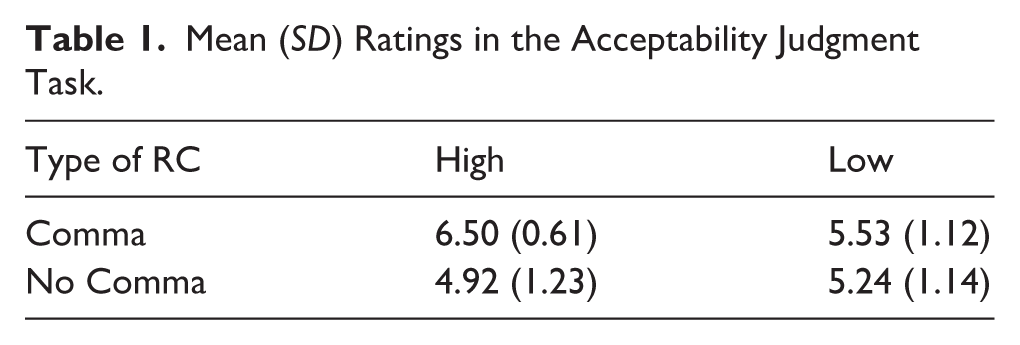
There was a main effect of Comma, whereby appositive RCs were rated with higher acceptability overall, and a main effect of Attachment, whereby high-attached sentences were rated as more acceptable across the board than low-attached sentences. Importantly, there was a significant interaction between Comma and Attachment (see Table 1 for the descriptive statistics and Table 2 for the inferential statistics). Planned comparisons showed that appositive RCs were preferably attached high (
Mean (SD) Ratings in the Acceptability Judgment Task.
Ordered Regression Model Fitted With Cumulative Link Mixed Model on the 1–7 Likert Scale Ratings.
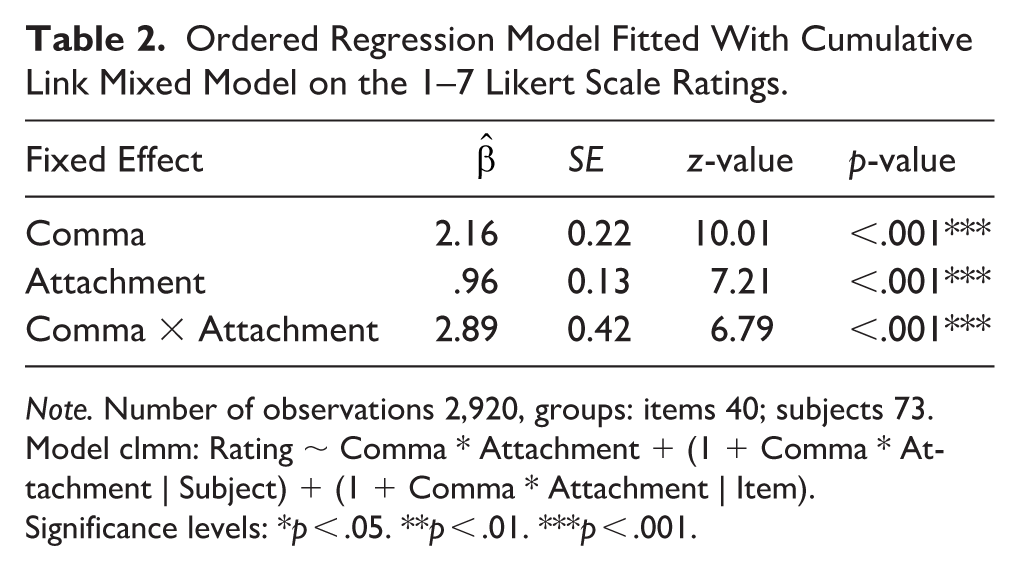
Note. Number of observations 2,920, groups: items 40; subjects 73. Model clmm: Rating ∼ Comma * Attachment + (1 + Comma * Attachment | Subject) + (1 + Comma * Attachment | Item).
Significance levels: *p < .05. **p < .01. ***p < .001.
Discussion
The results of Experiment 2 showed a degraded acceptability for low-attached RCs with commas and high-attached RCs without commas. Following previous studies (Pozniak et al., 2019), we interpret the degradation of acceptability as implying a higher processing cost. Putting the results of Experiment 1 and 2 together, commas strongly bias RCs to attach high and there was a cost when they were grammatically forced to attach low. In the absence of commas, there is a moderate bias for low attachment. Furthermore, although not the focus of this paper, high-attached RCs with commas were rated as more acceptable across the board, which matches previous claims that appositives are easier to parse (Dillon et al., 2017, 2018).
The next experiment investigates the potential impact of visual segmentation on syntactic parsing through the use of line breaks. Visual segmentation of sentences has been explored in other studies using double spacing (Hill & Murray, 2000), brackets (Kroll & Wagers, 2019), or presenting sentences on different frames (Hirotani et al., 2016; Swets et al., 2007; Tsoukala et al., 2025). In this study, we use line breaks at strategic points where a comma would typically appear, in our case, before and after the RC. Line breaks, commonly used in poetry to shape rhythm and structure, are also an inherent feature of reading on paper and digital screens, where they often occur due to space constraints. We examine whether a line break at a syntactically relevant position can function similarly to a comma in guiding structural interpretation, potentially by introducing a prosodic break. If this is the case, we predict that line breaks will increase high attachment in segmented RCs without commas. In contrast, no substantial effect is expected for appositive RCs, as the presence of commas already enforces a natural break.
Experiment 3
Method
Participants
Seventy-six undergraduate Spanish-native speakers (Mage = 18.7, SD = 1.24, 5 men) participated in the study for course credit. All participants were born and raised in Spain and gave informed consent before taking part in the study. Eight participants were excluded because their accuracy rates in filler items were below 80%. The study was approved by the Ethics Committee of the Universidad Complutense de Madrid (CE 20240912 SOC 04).
Materials
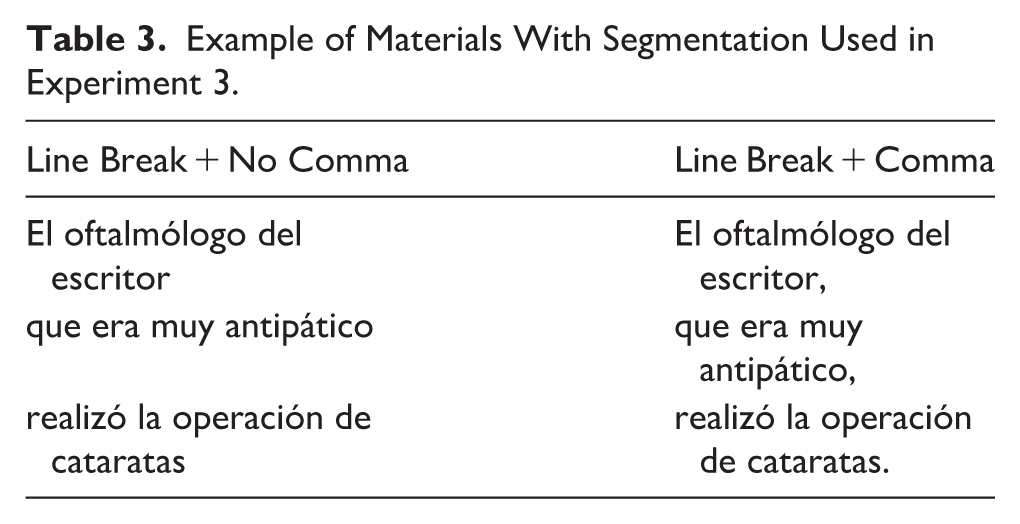
The materials contained the same list of target and filler items as in Experiment 1. The experimental items were arranged in a 2 by 2 within-subjects design, with Comma (with vs. without) and segmentation (segmented vs unsegmented) as factors, and were distributed across four lists in a Latin Square design. In filler items, segmentation manipulation was implemented by introducing line breaks at major syntactic boundaries in a way that sentences were segmented in two or three frames, which were syntactically and semantically appropriate, roughly equal in size, corresponding to linguistic units.
Target items were segmented into three lines where line breaks marked RC boundaries. In the case of Appositive Relative Clauses, the break followed the comma as shown in Table 3.
Example of Materials With Segmentation Used in Experiment 3.
Procedure
The procedure was the same as in Experiment 1. Stimuli were presented sentence by sentence at the center of the screen. Each sentence was displayed on a single screen, with or without line breaks. Sentences with line breaks were divided into three segments on one screen, while sentences without line breaks were shown as a single continuous line. Each item was followed by two options corresponding to the two possible disambiguation options: high attachment or low attachment, to gauge participant’s preferences of attachment in target items. Filler sentences were also followed by two options, but only one of them was correct in relation to the content of the sentence. Responses to filler items were collected and analyzed to gauge participant’s attention and accuracy throughout the experiment.
The order of presentation of the items was pseudo-randomized to make sure target items were not presented twice in a row. Fillers were interspersed with target items. The order of presentation of the two choices (left or right side) presented after the sentences was randomized across participants and items. The experiment was displayed, and the responses were collected using the Gorilla Experiment Builder (Anwyl-Irvine et al., 2020). The experiment lasted around 15 to 20 min.
Data Analysis and Results
Data were analyzed with R Core Team (2021) fitting generalized linear mixed-effects models with binomial distribution using the package lme4 (Bates et al., 2015). The fixed effect factors were Comma (with vs. without) and Segmentation (w/ vs. w/o), and participants and items were included as random effects. Initial model included random slopes for participants and items, but the maximal model did not converge. The final model that successfully converged with lower AIC values was: Attachment ∼ Comma*Segmentation+ (1 + Comma * Segmentation| Subject) + (1| Item). The factors Comma (without −0.5, with 0.5) and Segmentation (with −0.5, without 0.5) were sum-coded.
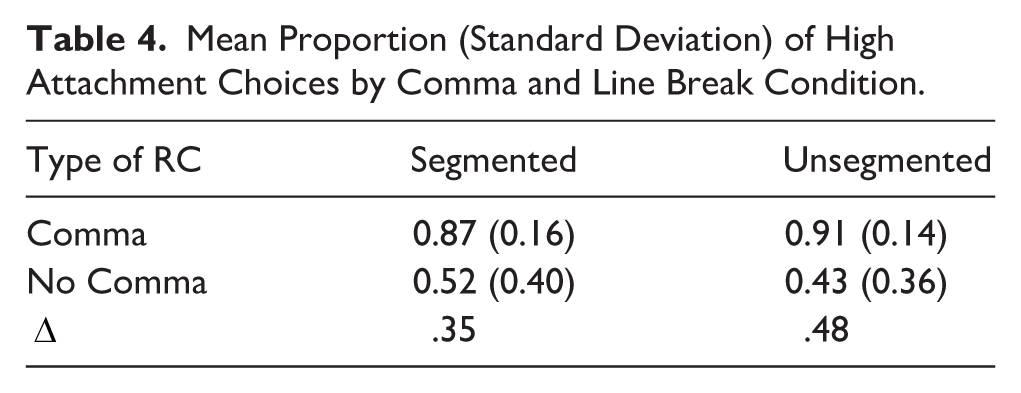
The analysis showed a main effect of Comma whereby ARCs preferred to attach high compared to RCs. No main effect of Segmentation was found, and the interaction was not statistically significant (see Tables 4 and 5).
Mean Proportion (Standard Deviation) of High Attachment Choices by Comma and Line Break Condition.
Summary of Generalized Linear Mixed-Effects Model Fitted on Attachment Choices.
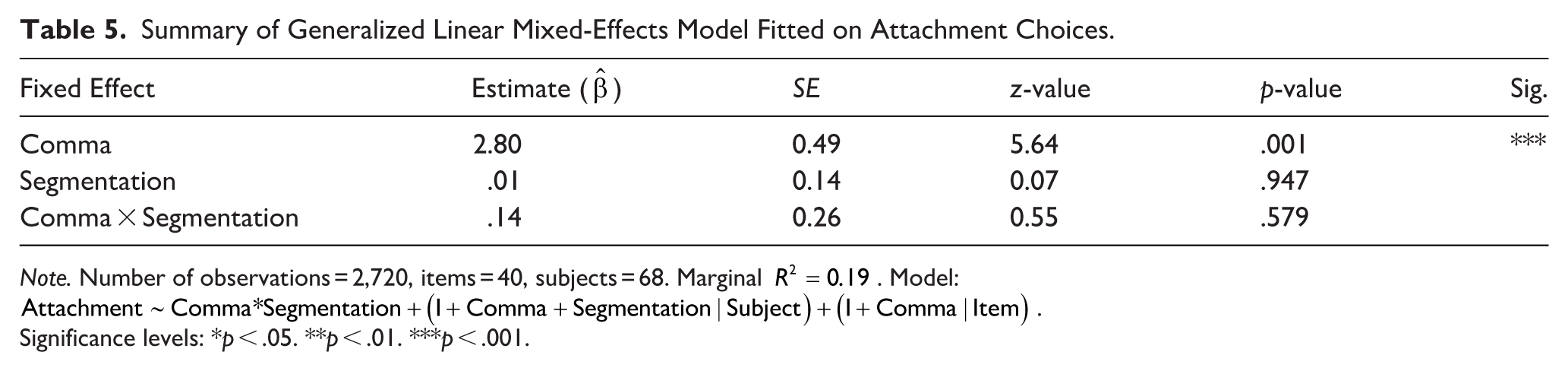
Note. Number of observations = 2,720, items = 40, subjects = 68. Marginal
Significance levels: *p < .05. **p < .01. ***p < .001.
Discussion
Overall, appositive RCs showed a strong preference to attach high and restrictive RCs showed no preference or a modest bias to local attachment. Comparing with Experiment 1, the results of Experiment 3 replicate the findings in unsegmented sentences with comma (91% of high attachment in both experiments) and unsegmented sentences without comma (43% of high attachment in Experiment 3 and 46% in Experiment 1). In segmented sentences with line breaks, a strong preference for high attachment was also observed in appositive RCs (87%). In the case of restrictive RCs, where we anticipated the impact of line breaks, the preference moved toward high attachment closer to the chance level (from 43% without line breaks to 52% with line breaks). Although the effect of comma was reduced in segmented sentences, the effect was not enough to produce a significant difference. These results lead to two immediate conclusions. First, the presence of commas strongly influences attachment preferences. Second, line breaks do not have the same effect as commas.
Regarding the strong high-attachment bias in appositive RCs, we propose that this effect is largely explained by prosodic breaks. Although a comma in parsing involves more than just a pause (e.g., changes in the intonational contour), research has shown that the prosodic break alone can be sufficient to influence attachment preferences. Teira and Igoa (2022) investigated whether the role of breaks and fundamental frequency separately played comparable roles in the comprehension of sentences. This was tested in a comprehension study in which auditorily presented sentences with RCs were disambiguated toward high or low attachment using number agreement. The authors found that the roles of both breaks and fundamental frequency played comparable roles in facilitating (in the case of congruent prosody) and disrupting (in the case of incongruent prosody) the interpretation of the sentences.
Another central question raised in this paper is whether line breaks introduced through visual segmentation could induce a prosodic break and influence attachment in a manner similar to that of commas. Our findings suggest that this is not the case; only commas exert a significant effect on attachment. However, to fully explore this question, production studies analyzing participants’ overt prosody are needed. We hypothesize that, even if readers pause when moving from one line to the next, commas serve a greater function than mere visual segmentation. While they do not carry inherent meaning, commas play a crucial role in structuring sentences and guiding interpretation. They provide cues that help readers identify phrasal boundaries and construct the constituent structure of a sentence. In contrast, line breaks lack a defined linguistic function.
General Discussion
We conducted three offline experiments to study how commas and line breaks influence final attachment preferences in preverbal RCs. Although commas are one of the most frequent punctuation marks, their use and function are quite variable, and range from a key structural cue to a redundant orthographic convention, being frequently ignored or misused. In fact, the effect and function of commas are context-dependent. While Hill and Murray (2000) observed early processing benefits in early/late closure (e.g., Once the dog stopped scratching(,) the nice vet laughed out loud before sitting down) and reduced RC constructions (e.g., The critic(,) played the music(,) listened very attentively before saying no), no such facilitation occurred in prepositional phrase ambiguities (e.g., The vet injected the cat(,) with the needle/collar(,) before leaving for a rather late lunch). In unambiguous sentences, commas show minimal impact on reading ease (Angele et al., 2024). In this study, we examine the disambiguating comma that distinguishes appositive from restrictive RCs.
The first experiment, a forced-choice questionnaire, revealed a strong high-attachment bias for appositive RCs and no clear preference or just a moderate bias toward low attachment in restrictive RCs. This is consistent with prior work on commas in postverbal RCs (Carreiras, 1992; Dillon et al., 2018). An acceptability judgment task confirmed these patterns in disambiguated sentences: high-forced attachment was rated more acceptable with commas, while low-forced attachment was preferred without commas.
We propose that prosodic breaks largely explain the strong high-attachment preference in appositive RCs. Commas induce phrasal boundaries even in silent reading, packaging DP1 and DP2 together. This particular packaging of structural information favors attachment to DP1 following Fodor’s same-size sister constraint (Fodor, 1998). Supporting this, Carreiras (1992) found a 92% high attachment with commas in Spanish postverbal RCs. Although we have followed prior work in emphasizing prosody as a driver of the high-attachment bias in appositives, the literature on relative clauses shows there is a multifactorial interplay of syntactic, semantic, and prosodic factors (and their interfaces). We propose that while prosody plays a prominent role, the multifactorial nature of this phenomenon explains why attachment never reaches categorical (100%) preference for either high or low sites. The comma’s robust effect may thus partly reflect syntactic or semantic contributions (e.g., referentiality) beyond prosodic packaging. While both appositive and restrictive relative clauses favor referential antecedents, the demand may be stronger for appositives. As an anonymous reviewer noted, this could lead readers to prefer a more specific antecedent (e.g., el editor del escritor) for an appositive clause. The relative weight of each factor awaits further investigation.
Contrary to commas, line breaks had little influence. A forced-choice task showed that visual segmentation with line breaks does not mirror commas’ effect on attachment. We offer three complementary explanations. First, readers may not pause at line breaks. Readers are highly accustomed to arbitrary line breaks in both printed and digital text, and may have adapted their reading strategies to maintain fluency across such disruptions. Line breaks often occur at the end of a physical line for layout reasons, unrelated to syntactic or prosodic structure. Second, commas’ strong effect may partly reflect syntactic or semantic factors tied to the appositive status, as discussed above. Third, commas contribute uniquely to the organization of constituent structure, and their role goes beyond mere visual segmentation. While commas are a meaningful processing cue, line breaks may be treated as just a formatting artifact.
A general concern in studies using subject-gap RCs is the potential for structural priming, whereby the main clause subject may be primed as the subject of the embedded clause. However, this priming mechanism would encourage high attachment regardless of punctuation or RC type, thus operating symmetrically across conditions: it would apply equally to both appositive and restrictive RCs. Consequently, any priming-induced boost in high attachment would exert a uniform and transversal effect on attachment preferences across the board. It cannot, by itself, explain the differential patterns observed between appositive and restrictive RCs. Thus, while structural priming may contribute to increasing the overall high attachment rates, it does not undermine the key contrast between RC types, which is the primary focus of this study.
In conclusion, the findings of this study suggest that commas play a critical role in resolving structural ambiguity and that their influence extends beyond the mere visuo-spatial arrangement of textual stimuli. These insights may ultimately contribute to the development of tools aimed at enhancing comprehension, particularly among less skilled readers.
Limitations and Future Directions
The present findings primarily inform the final stages of sentence processing. These later phases, which involve processes such as reanalysis, integration, and final interpretation, are particularly susceptible to participants’ conscious or strategic influences, especially in the context of globally ambiguous sentences and repeated-measures designs, where the same participants encounter multiple trials with structural repetition across sentences. This can induce learning effects or expectancy biases that can influence final interpretations. Consequently, the current results may reflect not only automatic linguistic processing but also some task-induced or artifactual processing strategies, limiting their generalizability to natural reading. To address this limitation, future research should examine the early online stages of sentence comprehension using time-sensitive methods such as eye-tracking while reading or ERPs to complement and extend the present findings to automatic processes that are less prone to top-down strategic modulation. Integrating early online evidence with the current late-stage insights would provide a more comprehensive perspective on how punctuation and formatting shape real-time sentence comprehension.
Although comma usage and punctuation rules are part of the secondary education curriculum in Spanish language and literature classes, university students may apply the norms established by the Real Academia Española inconsistently in practice. A previous study in Spanish found out that the correct use of non-restrictive (appositive) relative clauses, referred to as ‘bracketing commas’ in the study, reached approximately 88% accuracy (Marcet et al., 2022). The authors examined the correlation between reading comprehension and the accurate placement of commas across various sentence types. University students were asked to insert commas where required according to Spanish punctuation norms. This 88% accuracy rate for appositive commas is notably high, although it remains lower than the accuracy observed for other types, such as listing commas (Marcet et al., 2022). Nevertheless, the prescriptive use of commas in writing is distinct from their effective processing during reading. Writers may apply comma norms inconsistently in their own writing, yet this does not imply that they are unable to correctly interpret commas during reading. Would participants with stronger mastery of comma conventions exhibit a more robust disambiguation bias? The correlation between individual punctuation awareness and attachment preferences is an open empirical question for future investigation.
Finally, we encourage research on the role of prosodic packaging induced by commas and line breaks across various types of syntactic ambiguity in order to identify the contexts in which these cues reliably facilitate processing. This line of research will benefit from systematically testing the role of punctuation and formatting in a broader range of constructions to pinpoint the specific linguistic contexts in which punctuation and formatting have a reliable impact on processing.
Footnotes

Author Contributions
MA conceptualized the study, curated the data, performed formal analysis, wrote the original draft, the review, and edited the manuscript. JD provided resources, validated the overall reproducibility of the experiments, and reviewed and edited the manuscript. PF provided resources and reviewed and edited the manuscript. JAH acquired funding, provided resources, and reviewed and edited the manuscript. All authors have read and approved the final version of the manuscript. Author contributions are reported according to the CRediT (Contributor Roles Taxonomy) system.
Funding
The authors disclosed receipt of the following financial support for the research, authorship, and/or publication of this article: This work was supported by the State Research Agency (AEI) -Juan de la Cierva Training Program, Ministerio de Ciencia, Innovación y Universidades of the Government of Spain [FJC2021-047114-I, 2023].
Declaration of Conflicting Interests
The authors declared no potential conflicts of interest with respect to the research, authorship, and/or publication of this article.