



Abstract
This study examined the effect of time delay on prospective memory (PM) by manipulating the interval between encoding and retrieval of an event-based PM task. Seventy-four participants were randomly assigned to one of three delay conditions (immediate, 1-day, and 1-week) and were instructed on a classic dual event-based PM task during the first online experimental session. They were then asked to undertake the PM task after the designated delay period based on their assigned experimental condition in the second online session. Significant main effects of delay on PM performance (measured in terms of remembrance and accuracy) were found. Post hoc test results revealed that, when compared to the no-delay condition, the 1-week delay condition impacted both remembrance as well as accuracy of the PM task, while the 1-day delay condition affected only accuracy but not remembrance. This study provides a unique contribution to the PM literature by including longer delay intervals between PM encoding and retrieval to improve ecological validity. In future research, this factor should be considered when studying PM in different groups of participants, including children, older individuals, and clinical populations.
Prospective memory (PM) is the ability to carry out intentions at an appropriate moment in the future (Brandimonte et al., 2014). Impaired PM functioning may lead to safety and health issues. Compared with the more extensively studied retrospective memory, PM is a relatively new construct that has been less well researched. There are three types of PM, based on when the intended actions will be performed: time-based (at a specific time), event-based (at the occurrence of a specific cue), and activity-based (at the end of a specific activity) (Einstein & McDaniel, 1990; McDaniel & Einstein, 2007). The stages of PM include intention encoding, intention retention during an ongoing activity, delayed retrieval of intention, and execution (McDaniel & Einstein, 2007). Three key theories have been proposed to explain PM performance according to a capacity-sharing approach between ongoing and PM tasks. The preparatory attentional and memory (PAM) theory assumes that PM success can only happen when attention is devoted to continuous monitoring of PM cues. In contrast, the multi-process view posits that although monitoring is required, PM retrieval can sometimes be spontaneous (Bayen et al., 2022; McDaniel & Einstein, 2007). Several studies have found poor performance with slower reaction times (RTs) and decreased accuracy on ongoing tasks when a PM task was included, further supporting the PAM theory’s emphasis on attention allocation (Smith, 2003; Smith & Bayen, 2004). Moreover, the multi-process view is supported by findings of slower RTs in ongoing tasks due to monitoring, with reduced monitoring for longer delays (Einstein & McDaniel, 2005; McBride et al., 2011). In addition, the delay theory suggests that individuals purposely slow responses during an ongoing task to provide more time for PM retrieval, implying that longer RTs for ongoing tasks are associated with the presence of a PM task (Heathcote et al., 2015).
One of the variables that may affect PM performance is the time delay between encoding and retrieval. Time delay is usually manipulated by changing the length of the period between PM instructions (encoding) and PM trials (retrieval; Hicks et al., 2000; Meier et al., 2006), or by adjusting the placement of PM cues in ongoing tasks blocks (see Brandimonte & Passolunghi, 1994; McBride et al., 2011). In this context, PM cues are identified as two types: focal (a cue naturally integrated into the ongoing task, noticed without extra effort) and non-focal (a cue requiring additional attention or processing beyond the ongoing task; Scullin et al., 2010). Grant and Roberts’s (1973) interference theory proposes an inverse relationship between memory trace strength and delays or distractions, potentially reducing task accuracy. However, studies examining the effect of delays of short durations on PM have produced mixed results, particularly with non-focal PM cues. McBride et al. (2011) placed both focal and non-focal PM cues in different positions (from 2 to 20 min) and found that non-focal PM performance accuracy declined rapidly for shorter delays and more slowly for longer delays. Conversely, Hicks et al. (2000) found an improvement in adults’ PM when the delay increased from 2.5 to 15 min, based on three experiments using a non-focal event-based PM task. Mahy and Moses (2011) found no-delay effect on the PM of 4- to 5-year-olds, but the 5-year-old group showed a significant improvement in non-focal PM with a longer delay (1 min vs. 5 min) when working memory (WM) capacity was controlled.
Most event-based PM laboratory studies have adopted the dual-task paradigm (Einstein & McDaniel, 1990), in which a PM task is embedded in an ongoing attention-demanding task. The standard measurement of PM performance is percentage accuracy. While laboratory paradigms offer better control, their ecological validity is limited due to shorter delay intervals. Conversely, the naturalistic paradigm (e.g., posting a letter back to the experimenter after a month; McDaniel & Einstein, 2007) allows longer retention intervals but is limited by the lack of control over confounding variables (Bayen et al., 2022). Therefore, a protocol addressing the limitations of both paradigms is needed for a better understanding of the time delay effect on PM.
To bridge this knowledge gap, the aim of this study was to examine the effect of time delay on event-based PM in young adults (Einstein & McDaniel, 1990). To increase the ecological validity of existing laboratory PM research and address the potential pitfalls of the naturalistic approach, we adopted the classic dual-task paradigm of a PM task with non-focal cues embedded in a WM ongoing task and extended retention intervals from no delay to 1 day and 1 week. Based on the previous studies and theories on PM, we proposed four hypotheses. First, we predicted that more participants would forget the PM tasks (i.e., zero correct responses on the PM task) in the longer delay conditions. Second, participants in the longer delay conditions would show overall lower PM task accuracy than those in the no-delay condition. Third, those participants who exhibited recall of the PM task (i.e., having at least one correct response) would show weakened performance on the ongoing WM task, particularly within the shorter delay groups. This might be evident as reduced accuracy and an increase in RT were caused by the redirection of attentional resources toward the PM task according to the PAM theory, multi-process view, and delay theory. Fourth, when comparing the WM task before and after the delay, groups with shorter delays would be likely to show an increase in RT and a decrease in the accuracy of the ongoing WM task.
Method
Participants
Ninety-eight young adults (69.7% female, Mage = 25.55 years, SDage = 3.62 years, range = 19–30 years) participated in this study. The participants were recruited through social media and word-of-mouth and met the following inclusion criteria: aged 18 to 30 years, no history of neurological or psychiatric problems, familiar with the English alphabet, and no significant uncorrected visual impairment. The participants were randomly assigned to three delay conditions (Immediate vs. 1-day vs. 1-week) based on a pilot study. Data collection was performed from January to June 2022. This was originally face-to-face but was switched to online mode due to the COVID-19 pandemic. To minimize the possible confounding effect of the experimental mode, only data collected from the online mode (n = 74) were included in our final data analysis.
Experiment task
The experiment task was developed based on Einstein and McDaniel’s dual-task paradigm (1990). Figure 1 provides a schematic illustration of the ongoing and PM tasks.
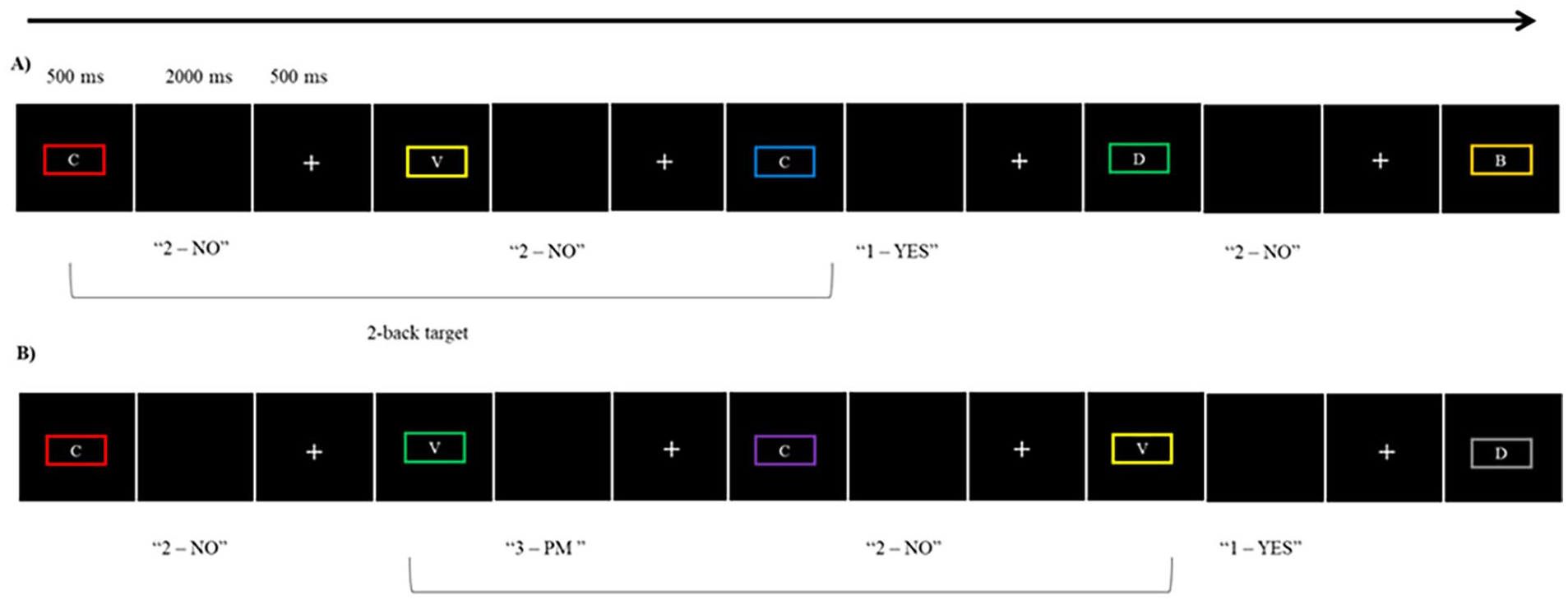
The schematic illustration of the two experimental conditions. (A) Ongoing WM task only, (B) dual-task condition: ongoing WM task embedded with PM task.
Ongoing WM task: 2-back letter working memory task
The ongoing WM task was a 2-back letter task adapted from West et al. (2006). The participants were presented with a series of letters one by one on the screen and had to determine whether the letter presented was the same as the second letter preceding it (pressing “1” on a keyboard for yes and “2” for no). The target stimuli were 12 capital letters (B, C, F, G, H, J, L, M, R, V, X, and Z). During each trial, a letter stimulus was displayed centrally onscreen for 500 ms before a blank screen was presented for responses. Hence, the interval between stimuli was 2,500 ms. Each letter appeared within a rectangular border that could be one of 10 colors (olive, yellow, cyan, red, purple, magenta, gray, green, blue, or maroon). Task outcomes were tracked in terms of average accuracy and RT. The task structure included an initial practice block of 20 trials (7 target trials, 13 nontarget trials), followed by 2 blocks of 36 trials per block (each with 12 target trials and 24 nontarget trials).
Dual-task condition: ongoing WM task embedded into PM task
A non-focal PM task was embedded into the above ongoing WM task to form a classic dual-task paradigm. The participants were instructed to press the “3” key, instead of “1” or “2,” when they saw a green border (the non-focal PM cue), regardless of the letter. This dual-task condition consisted of a practice block with 20 trials (2 PM cues, 8 WM target trials, 10 nontarget trials), followed by 2 blocks of 36 trials (5 PM cues, 12 WM target trials, 19 nontarget trials). The dependent variables for this condition were PM remembrance (scoring 1 for any correct response to the PM cue and 0 otherwise), PM accuracy (proportion correct for PM cues), PM average RT (average RT of correct PM responses), WM ongoing task accuracy (proportion correct), and WM ongoing average RT.
Data collection procedure
This between-subjects design study was reviewed by and received ethics clearance from the University Research Committee (approval number: HSEARS20211029004). All participants provided electronic consent and demographic information through the Qualtrics online survey platform (Qualtrics; https://www.qualtrics.com). Experimental stimuli were presented electronically using online E-Prime Go software (Psychology Software Tools: Solutions for Research, Assessment, and Education, 2017).
The experimenters (A. H. T. L., C. C. S. C., and C. M. Y. K.) inspected the testing environment via virtual meetings to ensure a quiet and undistracted environment. To ensure adequate preparation time, participants received a reminder message within 30 min before the commencement of each session of the experiment. In addition, participants will be directed to configure the computer based on the computer setup guide. The experimenter would verify the computer setup completion and then share the link for each experiment session with the participants via an instant messenger app. This process ensured that no participants completely forgot to connect online. The participants were asked to attach “Yes” and “No” labels to the “1” and “2” number keys of the keyboard, respectively, before performing each session task. The experiment encompassed two sessions with three delay intervals (immediate, 1-day, and 1-week). Each session took approximately 20 min to complete. Session 1 consisted of Parts A and B, featuring both practice trial and real test blocks of the ongoing WM task, and the practice trial block of the dual-task condition, respectively. Before Part B, the participants were asked to remember the instruction to press “3” as this would not be shown in the next experiment session. After the designated delay intervals, the participants began Session 2, which consisted of two real test blocks of the dual-task condition. They were instructed to complete the computer task in the same way as for Part B of Session 1, and no reminder of the PM task would be given even upon request. The experiment comprised 184 trials: 40 practice and 72 actual trials in Session 1, and 72 actual trials, including 10 PM cues, in Session 2.
The instructions were display-based, with experimenters available to offer assistance. After completing Session 2, the participants learned the experiment’s true purpose and received a shopping coupon worth HK$100. Data were stored on the E-Prime cloud drive for future analysis.
Data analysis
Before the data were analyzed, exclusion criteria were set. Data from participants deviating by ±2.5 SD from the group mean RTs for correct trials in any task were excluded (Cohen et al., 2012). All data were analyzed using IBM SPSS 25. The chi-square test of independence was used for inter-group comparison of PM remembrance, using the phi coefficient for effect size analysis. One-way analyses of variance (ANOVAs) were used for inter-group comparison of numeric scores (i.e., mean RTs and accuracies of PM and WM tasks), using partial eta squared for effect size analysis. Fisher’s least significant difference (LSD) post hoc test was used when any main effects were significant. Bonferroni-adjusted paired-sample t-tests were used to compare the RTs and accuracies of the WM tasks before and after delays. Cohen’s d was used to calculate effect sizes. The Bonferroni correction was used to adjust the significance level according to the number of tests to control the family wise error rate from multiple comparisons (Napierala, 2012).
Results
Group raw data comparison
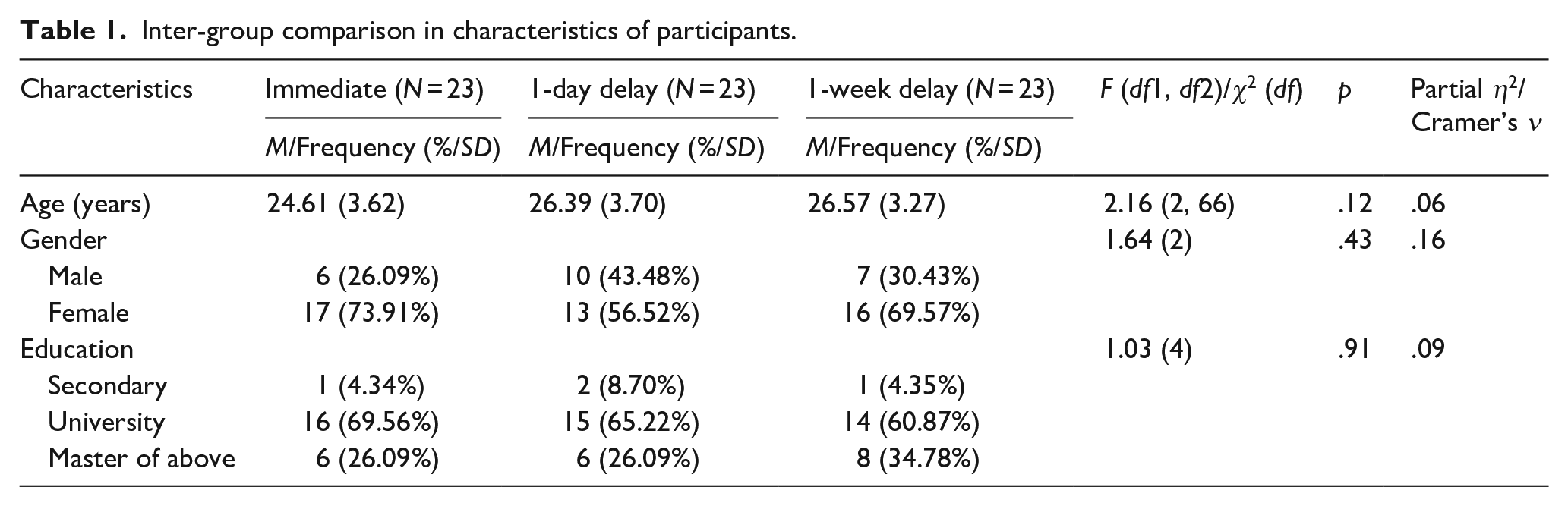
From the original 74 participants, 5 univariate outliers, 5 in the WM task, and 3 in the PM task were identified and excluded from the subsequent analyses. Table 1 presents the characteristics of the final 69 participants (66.7% female, Mage = 25.86 years, SDage = 3.59 years, range = 19–30 years). The results of the chi-square test and one-way ANOVA were also included. The individuals in the three delay conditions did not differ in age, gender ratio, or educational level (all ps > .05).
Inter-group comparison in characteristics of participants.
Comparison of experiment task performances
PM task
The results of a chi-square test showed that there was a significant association between PM task remembrance (at least one correct response to PM cues) and delay duration, χ2 (2, N = 69) = 12.73, p < .01 with median effect size, ϕ = .43. Fewer people remembered the PM task in the longer delay conditions. Post hoc comparisons indicated that PM remembrance for the 1-week delay condition was significantly lower than for both the immediate and 1-day delay conditions. However, the results for the 1-day delay condition did not significantly differ from those for the immediate condition. The numbers of participants who remembered the PM tasks across delay conditions are shown in Figure 2.
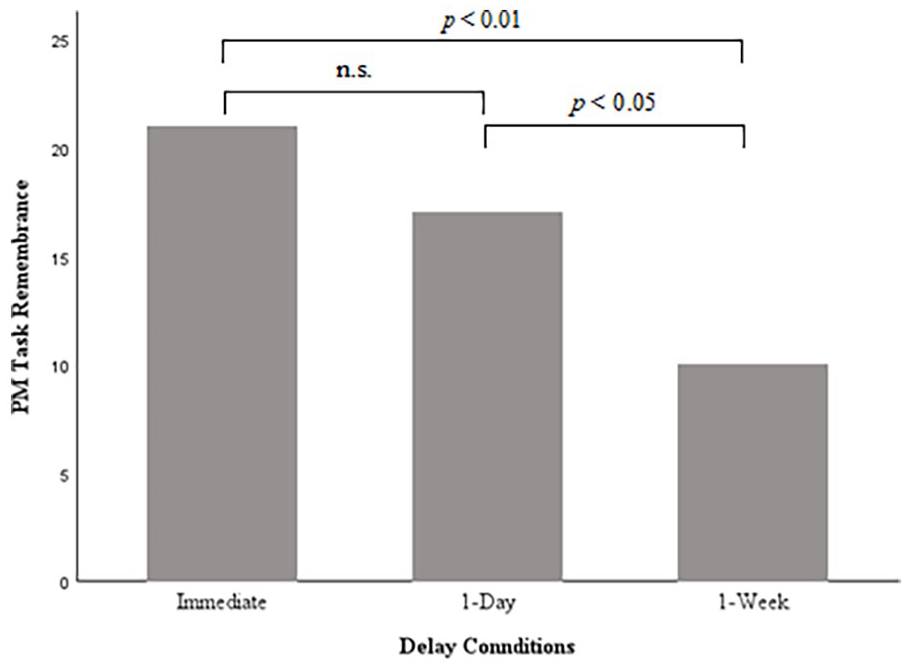
PM task remembrance after delay across groups.
To examine the effect of time delay on PM accuracy, a one-way ANOVA (with three levels of delay) was performed. The results of the ANOVA are presented in Table 2. Overall, the main effect of time delay was statistically significant, F(2,66) = 14.75, p < .001, with a large effect size (partial η2 = .31) and a power level greater than 99%. Scatter plots with a box chart comparison of PM accuracy across delay conditions are shown in Figure 3.
ANOVA analysis of PM performance.
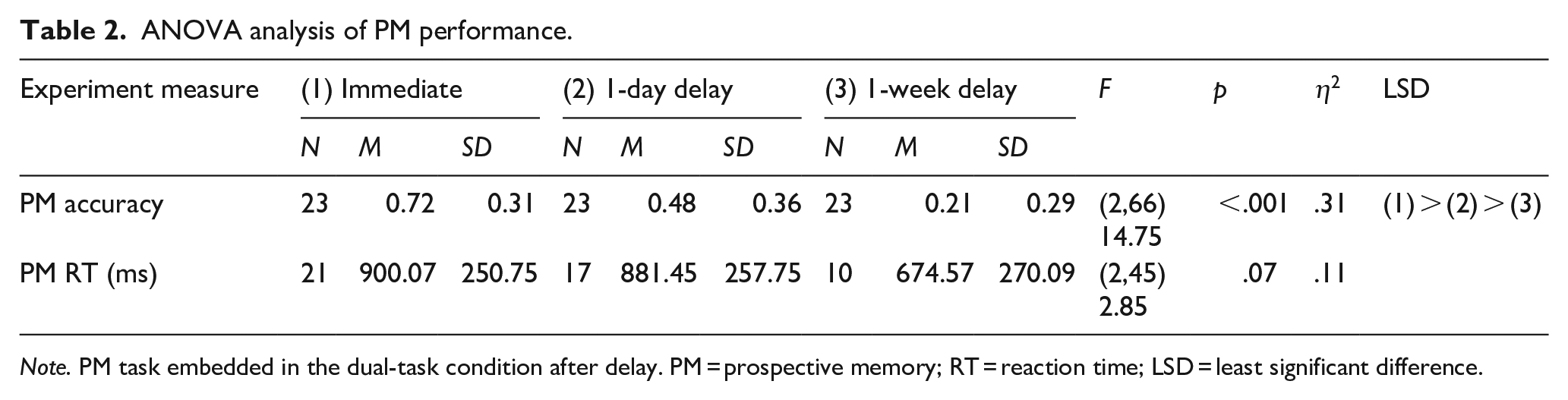
Note. PM task embedded in the dual-task condition after delay. PM = prospective memory; RT = reaction time; LSD = least significant difference.
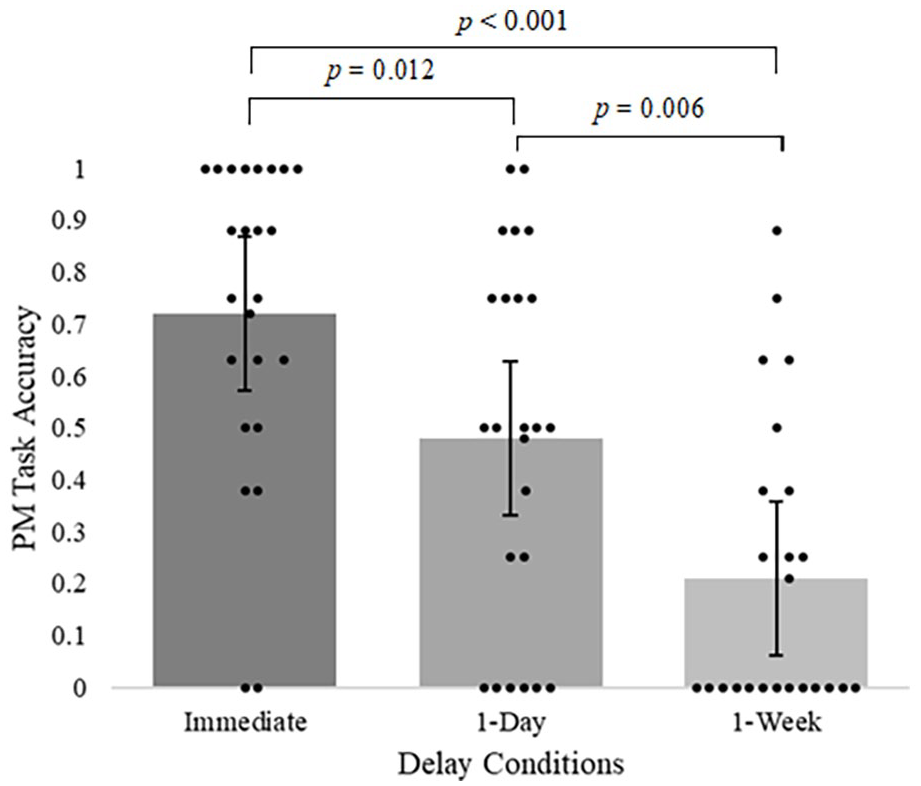
PM task accuracy across conditions.
Post hoc comparisons indicated that the mean accuracy for the 1-week delay condition (M = 0.21, SD = 0.29) was significantly lower than those for the immediate (M = 0.72, SD = 0.31; p < .001, d = 1.71) and 1-day delay conditions (M = 0.48, SD = 0.36; p = .006, d = 0.82). Moreover, the 1-day delay condition was found to be significantly lower than the immediate condition (p = .012, d = 0.73). The comparisons maintained between 0.79 and 0.99 power levels, showing sufficient power to detect significant differences between each condition. To examine the speed/accuracy trade-off, ANOVA was conducted for RT of PM cues across conditions. Among those who remembered the PM task, the mean RT in the 1-day condition seems to be longer than that in the 1-week condition. Nevertheless, the result of an ANOVA suggested that there were no significant differences in PM RT across delay conditions, F(2,45) = 2.85, p = .07. Given the low power of this analysis (power = 0.54), however, more participants are needed in future research to conclude that there was no trade-off.
Ongoing WM task
In investigating the PM trade-off effect on the ongoing WM task, data from participants with zero PM performance were excluded. This approach ensures that the analysis focuses on how successful PM impacts the ongoing WM task. The results of a one-way ANOVA for the ongoing WM task results among the three conditions, including LSD post hoc analyses, are presented in Table 3. Among those who remembered the PM task, only the RT (not accuracy) of the WM task after the delay showed significant differences overall, F(2,45) = 3.42, p = .04. The effect size was small, as indicated by a partial η2 of .13, and the analysis had a low statistical power of 0.61. Post hoc comparisons indicated that the RT for the 1-week delay condition was significantly shorter than that of the immediate group (p = .02, d = 1.11, power = 0.88). However, the power levels for both analyses were low (Accuracy = 0.37; RT = 0.61), indicating insufficient power to detect differences in WM accuracy and RT between each delay period.
ANOVA analysis of WM task performance among those who remembered PM tasks after delay.
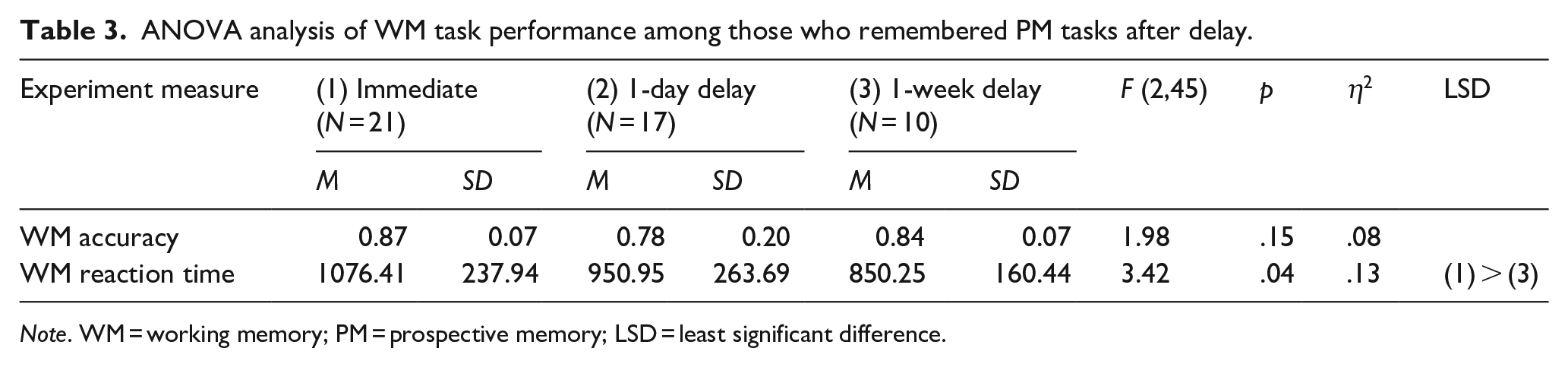
Note. WM = working memory; PM = prospective memory; LSD = least significant difference.
Bonferroni-adjusted paired-sample t-tests were used to further evaluate the change in WM task performance between Session 1 and 2 among participants who remembered the PM tasks, with the significance level (.05) being divided by 3 (the number of tests) to yield .017. A significant increase in RT was observed in the immediate condition (t = −2.61, p = .01, d = −0.57) and after 1-day’s delay (t = −4.18, p < .001, d = −1.02). However, no difference was found in WM task accuracy (all ps > .017). The results are presented in Table 4. Scatter plots with box chart comparisons of RT across delay conditions are shown in Figure 4. Although there was strong power (0.81 and 0.99) supporting the significant differences in the change of WM RT in shorter delay conditions, the power was weak (0.06) for the t-test in the 1-week condition.
WM task performance results before and after delay in participants who remembered PM tasks.
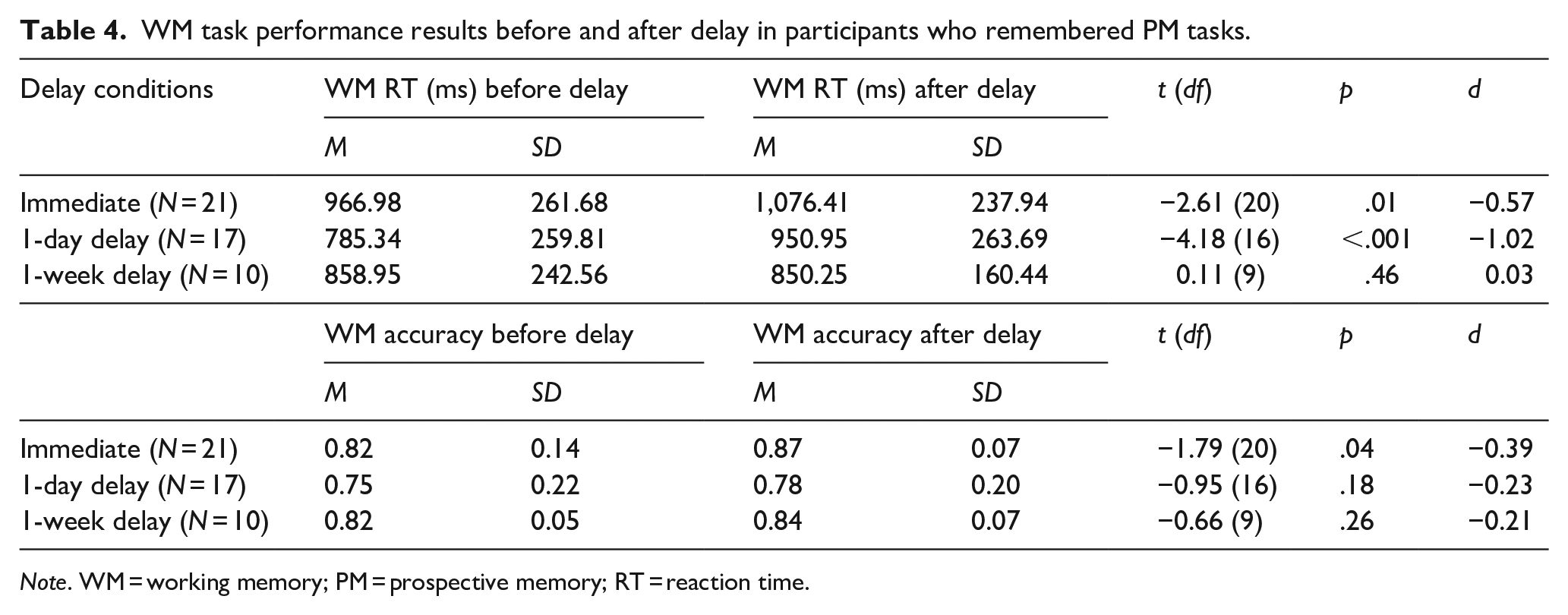
Note. WM = working memory; PM = prospective memory; RT = reaction time.
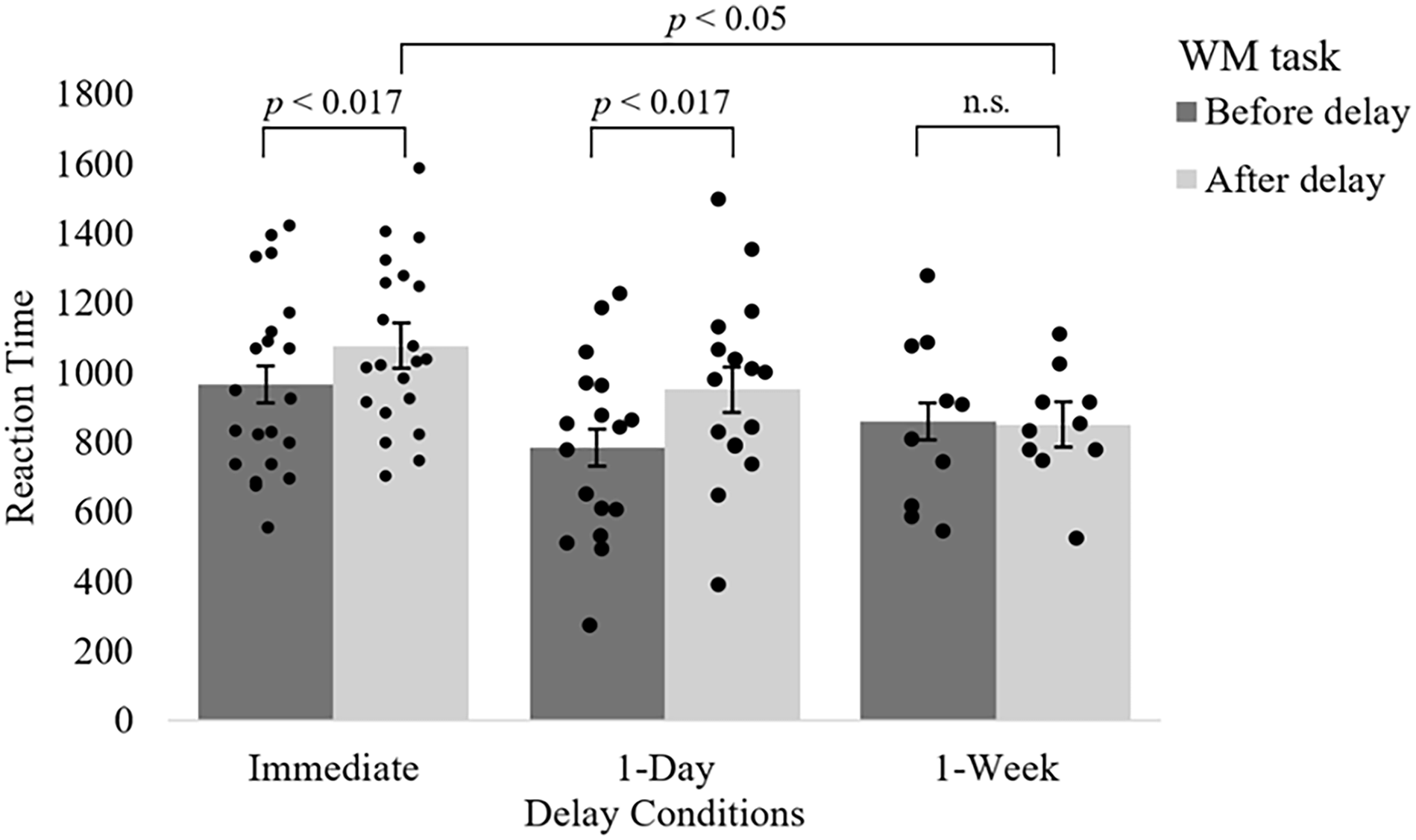
WM task reaction time before and after the delay among those who remembered PM tasks across conditions.
Discussion
The aim of this study was to investigate the effect of time delay on PM in young adults using the dual-task paradigm. Our findings broadly support all four hypotheses: participants in longer delay conditions exhibited a higher rate of forgetting the PM task and lower accuracy. Regarding the impact of delay on ongoing task performance, among participants who did recall the PM task, there was a significant difference in the RT of the ongoing WM task post-delay overall. In addition, upon comparing the performance of the WM task between Session 1 and 2 (i.e., before and after the delay), we identified a significant increase in the RT for the ongoing WM task in conditions with shorter delays. Below, we discuss how these results contribute to our understanding of the impact of delay duration on PM performance for applying in an everyday context.
The results support our hypothesis concerning PM performance, revealing a progressive delay effect influenced by the duration of the delay. Specifically, we observed the impact of time delay on both remembrance and accuracy, with the effect becoming more pronounced as the delay duration increases. Post hoc analyses revealed that a delay of 1 week resulted in a significant reduction in both PM remembrance and accuracy compared to no delay, indicating a strong delay effect. In contrast, a 1-day delay did not significantly reduce PM remembrance but did lead to a decrease in PM accuracy, suggesting a smaller delay effect. These findings align with studies highlighting the importance of delay duration in assessing PM performance (Brandimonte & Passolunghi, 1994; Conte & McBride, 2018). However, some studies have reported conflicting results, suggesting nonsignificance of limited delays in PM performance (Hicks et al., 2000; Mahy & Moses, 2011). Our results support this possibility, indicating that a 1-day delay does not significantly reduce PM remembrance compared with the immediate conditions. According to interference theory, individuals might encounter less interference during a shorter time delay, and as a result, the delay does not significantly affect their performance (Grant & Robert, 1973). This insight may explain the discrepancies observed in previous research that examined delay periods shorter than 1 hr (e.g., Hicks et al., 2000; Mahy & Moses, 2011; McBride et al., 2011). However, the delay effect was observed in PM accuracy, suggesting that a 1-day delay, while not sufficient to cause total forgetting, does reduce accuracy in the PM task. In contrast, a 1-week delay may introduce more interference with the PM task, leading to both forgetting and poorer PM performance. These findings underscore that the effect of time delay on PM is progressive, with a small effect observed at 1-day delay and a strong effect at a 1-week delay, and should be considered in research, theories, or models.
Our results partially support our third and fourth hypotheses. A significant main effect was found in the RT of the WM task overall after the delay. Further investigation of the changes in WM performance before and after the delay revealed that the PM task affected the RT of the WM task in the shorter delay conditions. However, no effect on accuracy was observed. According to Heathcote et al.,’s (2015) delay theory, the RT for an ongoing task increases when a PM task demanding attention is added. The significant findings from the immediate and 1-day conditions suggest that only a shorter delay duration allowed for a pronounced attention influence of the PM task on the ongoing task, as evidenced by the increase in the RT of the ongoing task. Regarding accuracy, several studies have found that a PM task does not affect the accuracy of ongoing tasks. This has been demonstrated in ongoing tasks such as categorization (McDaniel et al., 2011), color matching (Boywitt & Rummel, 2012), and lexical decisions (Loft & Remington, 2013). The current study supports delay theory and these previous findings. However, the statistical power associated with these findings was relatively low (0.37 for accuracy; 0.61 for RT), suggesting that the evidence lacks robustness, underscoring the necessity for additional research to strengthen this conclusion.
In the change of WM task performance before and after delay (i.e., between Session 1 and 2), an increase in RT was found among both the immediate and 1-day delay groups, corresponding to the attentional demands of the PM task, although there was no significant effect on the accuracy of the WM task. However, the RT for the WM task in the 1-week delay group remained consistent. Notably, the RT for the WM task post-delay in the 1-week delay group was significantly shorter than in the immediate group, potentially due to less attention being allocated to the PM task. According to PAM theory, successful PM outcomes can only occur when continuous attention is dedicated to monitoring PM cues (Bayen et al., 2022; McDaniel & Einstein, 2007). Therefore, the low PM task accuracy observed in the 1-week delay condition (0.49) might have resulted from less focus on the PM task. Consistent with Heathcote et al.,’s (2015) delay theory, the unaffected level of RT of the WM task in the 1-week delay condition might be a consequence of a smaller allocation of attentional resources to the PM task, leading to a more stable focus on the WM task. However, the statistical power of this finding was quite low (0.06).
In this study, the use of a non-focal event-based PM task has theoretical implications, particularly in light of one benchmark effect on PM, the target-focality effect, discussed by Rummel and Kvavilashvili (2023). The target-focality effect suggests that focal targets are more likely to elicit a PM response than non-focal targets, with focality-associated PM improvements often accompanied by smaller or even negligible costs to ongoing task performance (Scullin et al., 2010). By employing a non-focal PM task, this study provides an opportunity to better investigate the influence of PM on ongoing tasks without the facilitating effects of focality. This approach allows for a clearer examination of how non-focal PM tasks impact ongoing task performance, contributing to a deeper understanding of the cognitive processes underlying PM and the potential trade-offs involved. Moreover, studying the delay effect on PM is relevant for understanding PM forgetting, and it strengthens the application of PM in real-life contexts. However, the mixed results of past studies have made it difficult to understand the time course of PM decline. Our findings indicate that the effect of the delay was captured in our 1-day and 1-week delay conditions, highlighting a limitation of previous studies. Theoretical accounts proposed to explain PM failures have centered on their interrelations with individual cognitive abilities, motivation, context, and task complexity (Bayen et al., 2022; Bujang & Baharum, 2016; Horn & Bayen, 2015; Smith, 2017). Our results may suggest that PM theory should be updated and a longer delay period should be considered. In the context of PM research, extending the duration from less than 1 hr (previous studies) to 1 day and 1 week (current study) significantly enhances the ecological validity of studying everyday PM. PM is crucial for managing daily activities. Previous studies often focused on short-term delays (e.g., Hicks et al., 2000; McBride et al., 2011), which do not accurately reflect real-world scenarios where planned actions may be executed after several days or even weeks. For instance, real-life tasks such as attending a meeting scheduled 3 days in advance or meeting assessment deadlines the following week require longer-term PM. Rummel and Kvavilashvili (2019) emphasize the importance of ecological validity in PM research, noting that real-life PM tasks often involve longer delays than those typically used in laboratory settings with inconsistent results. Similarly, Kvavilashvili and Ellis (1996) argue that the study of PM should incorporate more realistic time frames to better understand how PM functions in everyday life. Zuber et al. (2021) support this notion by demonstrating that procrastinating behaviors over durations exceeding 3 days positively predict PM performance. This finding aligns with our current study, which provides evidence that longer delay durations significantly influence PM performance. By extending the delay duration, our study better mirrors real-life contexts where the interval between intention formation and execution is typically longer. This approach not only improves the ecological validity of PM research but also offers insights into how PM functions in everyday life over extended periods.
Our findings have implications for PM studies in clinical populations. Although some studies have found no-PM impairments in their targeted clinical groups (Kazui et al., 2005; Zhou et al., 2012), this could be due to the short delay between encoding and retrieval. Widely used measures of PM, such as the Rivermead Behavioral Memory Battery (Kurtz, 2011), Memory for Intentions Test (Raskin et al., 2010), and Miami Prospective Memory Test (Hernandez Cardenache et al., 2014), all include tasks assessing event-based PM functions completed within 1 hr. Our results highlight that a longer delay may be necessary to elicit PM impairments in different clinical groups.
Limitations and future directions
Due to the COVID-19 pandemic, our study design had to be changed from face-to-face to online mode. Despite our efforts to provide virtual supervision for the setup of an undistracted test environment, individual differences in the experimental environment were unavoidable. Although the inclusion of a long delay could improve the study’s ecological validity, uncontrollable activities or environments during the 1-day and 1-week delay induce a potential limitation. In terms of generalizability, we only considered the effect of delay on event-based PM tasks. The effect on time- and activity-based PM might be different. Moreover, due to the reduction in sample size in the analysis of PM RT and WM performance—resulting from the exclusion of no-PM response data—there was insufficient power to properly test the trade-off effect. A larger sample size is needed to draw firm conclusions about this effect.
To further study the time course of PM forgetting, it would be worthwhile to replicate this study with additional delay durations, especially for delay lengths between 1 and 7 days. This would allow for a more comprehensive and accurate understanding of how different delay lengths impact PM performance. Moreover, expanding the target populations beyond young adults to include children, older adults, and other clinical populations could provide insights into age-related and clinical differences in PM performance. Furthermore, it would be beneficial to carry out the same experiment using neuroimaging techniques, such as functional near-infrared spectroscopy and functional magnetic resonance imaging. This would provide an exploration of the brain functions and structures that support PM performance in response to varying delay conditions.
Conclusion
This study investigated the effect of time delay on event-based PM. The results indicated a significant progressive effect of delay duration on PM performance. Specifically, participants exhibited decreased accuracy in the 1-day delay condition compared to the immediate group, while those in the 1-week delay condition showed worse PM remembrance as well as accuracy than participants in both the immediate and 1-day delay conditions. Regarding the WM task, a significant difference in the RT of the ongoing WM task overall, with no effect on accuracy. An increase in RT after a delay compared with the prior WM task was found in the shorter delay groups. These findings highlight the importance of including longer delay durations in PM research and theory and suggest a number of directions for future research in this area.
Footnotes
Author contributions
April H T Leung: data collection and analysis, writing—original draft, writing—review & editing. Chelsea C S Chan: data collection, writing—original draft, writing—review & editing. Celia M Y Kwong: data collection, writing—original draft, writing—review & editing. Carole Leung: Software, writing—review & editing. Yuan Cao: conceptualization, methodology, project administration, writing—review & editing, supervision. Mandy H M Yu: data analysis, writing—review & editing. Raymond C K Chan: writing—review & editing. David H K Shum: conceptualization, methodology, funding acquisition, writing—review & editing, supervision.
Data availabilty
Data are available upon reasonable request from the first authors.
Declaration of conflicting interests
The author(s) declared no potential conflicts of interest with respect to the research, authorship, and/or publication of this article.
Funding
The author(s) disclosed receipt of the following financial support for the research, authorship, and/or publication of this article: Preparation of this manuscript was supported by a Hong Kong University Grants Council, General Research Fund (15604723), and by the Yeung Tsang Wing Yee and Tsang Wing Hing Endowed Professorship for David Shum.
