




Abstract
Aesthetic Cognitivism posits that artworks have the potential to enhance open-mindedness. However, this claim has not yet been explored empirically. Here, we present two experiments that investigate the extent to which two formal features of the film – temporal and perspectival complexity – can ‘open our minds’. In Experiment 1, we manipulated the temporal complexity of the film. Participants (Ntotal = 100) watched a film (Memento) either in its original non-chronological order or the same film in chronological order. In Experiment 2, we manipulated perspectival complexity in film. Participants (Ntotal = 100) watched an excerpt from a film (Jackie Brown) that either included the perspectives of multiple characters on an event or a single character’s perspective on the same event. Film conditions in both experiments were further compared with a control condition in which participants did not watch a film (N = 50). Participants’ open-mindedness was assessed in both experiments through four empirical indicators (creativity, imaginability, cognitive flexibility, openness to new evidence) and in Experiment 2, participants’ eye movements, heart rate and electrodermal activity were measured while watching the film. Results showed that watching films, regardless of their temporal or perspectival complexity, modulated only one facet of open-mindedness – cognitive flexibility – when compared to the no-film control condition, providing only limited support for the aesthetic cognitivist claim that artistic films can ‘open our minds’. Real-time measures in Experiment 2 revealed that pupil size and number of fixations were modulated by perspectival complexity: both were smaller when watching a film from multiple perspectives compared to a single perspective. Possible explanations for this difference are examined in relation to the viewers’ cognitive processes involved in understanding and interpreting film content.
The cognitive value of art has long been debated by scholars in the humanities, and in recent years has attracted attention from experimental psychologists who have begun to test the cognitive effects of engaging with artworks. The idea that art can have beneficial cognitive impacts is also widespread in popular culture, supporting everything from art therapy to advice for business leaders. A common claim across these contexts is that art has the potential to open people’s minds by reframing and reshaping their experience and perception of the world (Lopes, 2005; Smith, 2017). One way in which it might do so is via ‘defamiliarization’, a core feature of art characterised by rendering the familiar strange, thereby opening our minds to new aspects of the world (Shklovsky, 1917–1922/1991, Thompson, 1988; Van Den Oever, 2010). ‘Defamiliarization’ can be achieved through formal complexity and innovation, whereby events and characters are presented in unconventional and thought-provoking ways, such as through complex temporal patterning or multiple perspectives. However, very little empirical work has examined how the formal features of artworks can foster open-mindedness. Notably, no study to date has specifically addressed this question in relation to film – a widely accessible medium of art, consumed across a variety of age groups. In this paper, we report two experiments that investigated the extent to which two key strategies of ‘defamiliarization’ – realised by temporal and perspectival complexity – impact different characteristics of open-mindedness.
We construe open-mindedness as a capacity to transcend our own limited perspectives, enabling us to take a wider view (adapted from Baehr, 2011). Baehr (2011) characterises open-mindedness as the capacity to transcend one’s default cognitive standpoint to seriously engage with the merits of alternative perspectives. According to Baehr, open-mindedness is a virtue that enables individuals to set aside their doxastic attitudes (epistemic goods held in relation to a proposition) to fairly consider opposing intellectual positions. While Baehr’s account is epistemically focused, we extend this definition to encompass facets that are plausibly integral to open-mindedness and amenable to reliable measurement. Because this is a broad conception, we break open-mindedness down into a variety of different facets, each of which has been theoretically and empirically linked to the capacity to engage with alternative viewpoints and revise beliefs in light of new information (Baron, 1993; Kaufman & Beghetto, 2009; Stanovich & West, 1997; Vago & Silbersweig, 2012): creativity, imaginability, openness to new evidence, cognitive flexibility and self-transcendence. Creativity was measured in terms of divergent thinking –the ability to generate numerous or alternative responses based on available information, and to merge seemingly unrelated elements into coherent and useful concepts (Guilford, 1950). Imaginability in this case refers to the ability to create mental images, which is crucial for generating innovative and original concepts (e.g. Pelaprat & Cole, 2011). Openness to new evidence pertains to an individual’s inclination or readiness to contemplate and integrate fresh information, data, or evidence into their current beliefs, attitudes or hypotheses (Galinsky & Moskowitz, 2000). Cognitive flexibility refers to the ability to switch our thoughts or behaviours in line with changes in our goals or the environment (Chevalier et al., 2012). Self-transcendence refers to an ego-dissolution process and absorption in the story and characters (adapted from Nour et al., 2016).
While studies examining the cognitive effects of watching films are limited, a great deal of past empirical research has tested socio-cognitive outcomes resulting from reading literature as a medium of art (e.g. Dodell-Feder & Tamir, 2018; Mumper & Gerrig, 2017; Wimmer, Currie, et al., 2021; Wimmer et al., 2022). These studies have largely focused on how reading can influence beliefs and attitudes, affective empathy and the understanding of others’ mental states (Theory of Mind). In a set of meta-analyses, Wimmer et al. (2024) synthesised the cognitive effects of reading short fictional narratives and the correlates of lifetime exposure to fiction texts. They revealed significant cognitive benefits of reading fiction, though aggregate effect sizes were small, with some experiments failing to detect any significant socio-cognitive effects of reading short fictional stories (e.g. Panero et al., 2016; Samur et al., 2018; Wimmer, Friend, et al., 2021). Analyses of the moderators revealed that inconsistent findings might be at least partially attributable to the different categories of text being tested (e.g. fiction vs. non-fiction, or literary vs. popular fiction), and the cognitive outcome variable being tested. Specifically, the effect of a fiction-reading intervention was only significant on measures of empathy and mentalising, but not on knowledge, moral cognition, outgroup judgements and other thinking processes. Although these meta-analyses provide robust evidence for a small-sized positive relationship between reading fiction and certain cognitive benefits, it remains unclear which specific features of texts are responsible for these effects (Wimmer et al., 2024).
Formal characteristics of texts might be crucial in explaining this relationship. Based on a series of experiments, Kidd and Castano (2013) claimed that reading literary fiction led to better performance on tests of affective and cognitive Theory of Mind compared with reading non-fiction, popular fiction, or nothing at all (but see e.g. Panero et al., 2016; Van Kuijk et al., 2018). They argued that literary fiction, compared to non-fiction and popular fiction, has specific formal characteristics that might stimulate readers’ socio-cognitive functions. Literary fiction can be considered ‘polyphonic’ (Bakhtin, 1984), weaving together the perspectives of many characters in complex ways, or as ‘writerly’ (Barthes, 1974), in the sense that they engage readers as creatively as ‘writers’ by presenting multiple voices and perspectives that prompt readers to fill in the gaps and search for meanings. In contrast, according to this view, popular genre fictions are ‘readerly’ (Barthes, 1974), in that they are designed to engage with readers as passive recipients of meaning. The features of literary fiction plausibly engage different psychological processes, prompting readers to devote more cognitive effort to comprehending such works compared with popular fiction. By immersing readers in a multifaceted hermeneutic process, the ‘polyphonic’ nature of literary fiction compels them to navigate and interpret multiple, often conflicting, perspectives, each embedded with distinct beliefs, intentions and emotions. This cognitive engagement not only refines their interpretative skills but also enriches their capacity for social reasoning and perspective-taking.
In contrast to the large volume of research that has tested the socio-cognitive effects of engaging with the arts, only a very limited number of studies have explored this question in relation to open-mindedness. In Wimmer et al.’s (2024) meta-analysis, there was an insufficient number of reading intervention studies testing characteristics of open-mindedness as an outcome variable to consider it as a moderator in the meta-analysis. Importantly, however, the meta-analysis of lifetime correlates revealed a significant effect of fiction reading on creativity, a facet of open-mindedness.
Two studies to date have directly tested the empirical effects of reading fiction: one focused on readers’ open-mindedness as a personality trait and the other on specific facets of open-mindedness. Djikic et al. (2013) investigated the impact of reading short fiction stories on participants’ need for cognitive closure, a personality trait associated with a preference for quick decision-making and discomfort with ambiguity, and thus low open-mindedness. The study revealed that after reading a short fiction story, participants showed a decreased need for cognitive closure compared to those who read a non-fiction essay, suggesting that fiction stories enhanced readers’ open-mindedness trait.
Subsequently, Wimmer et al. (2022) tested the effects of reading fiction stories on a broader range of open-mindedness characteristics, including creativity, imaginability, cognitive complexity and openness to experience. No significant differences were found in these outcome measures between participants assigned to read a fiction story and those assigned to read a non-fiction essay, thus conflicting with the hypothesis that reading literary fiction increases open-mindedness. It is possible that the duration of the reading experience was not sufficient to influence characteristics of open-mindedness since participants read short fiction stories (approximately 5,000 words in length) rather than complete literary works. This limited exposure to the artistic experience may be insufficient to trigger measurable effects on facets of open-mindedness such as creativity and imagination. Furthermore, Wimmer et al.’s study did not replicate Dijkic’s findings on the need for cognitive closure, calling into question the influence of short reading exposure on the open-mindedness trait.
Studies examining the effects of watching films on open-mindedness are virtually non-existent. However, a related line of studies has investigated the relationship between television viewing and cognitive outcomes including creativity (Anderson et al., 2001; Iu, 2003; Kant, 2012; Roberts et al., 1978; Runco & Pezdek, 1984; Odewumi et al., 2018) and executive functions, such as cognitive flexibility (Barr et al., 2010; Eisen & Lillard, 2020; Lillard & Peterson, 2011; Lillard, Drell, et al., 2015; Lillard, Li, et al., 2015; Nathanson et al., 2014), primarily among children and adolescents. Some of these studies have indicated a positive association between television viewing and creativity (e.g. Anderson et al., 2001) or cognitive flexibility (e.g. Nathanson et al., 2014, specifically in the case of educational programmes), while others suggest the opposite relationship (e.g. Iu, 2003 for creativity; Lillard & Peterson, 2011 for cognitive flexibility). These inconsistent findings have led to two competing arguments about the cognitive effects of watching television. According to the stimulation hypothesis (Laird, 1985; van der Voort & Valkenburg, 1994), television viewing might be a tool that promotes cognitive abilities, since it incorporates audio-visual features (such as images and sounds) that lead to increased arousal and attention and, thus, to easier processing of information. Conversely, the reduction hypothesis (Valkenburg, 1999; van der Voort & Valkenburg, 1994) posits that the passive nature of television viewing and/or overwhelming rapid stimuli might negatively impact viewers’ cognitive skills. Notably, the type of television programmes and their formal features likely play a pivotal role in mediating the relationship between television viewing and cognitive abilities. Indeed, some studies have shown that educational television positively influences creativity and cognitive flexibility, while other types of television programmes (e.g. fast-paced television) have a negative impact (Lillard & Peterson, 2011; Lillard, Drell, et al., 2015; Lillard, Li, et al., 2015). This observed effect may stem from the slower pace that is typical of educational television, which encourages reflection and deeper engagement with the material. In contrast, fast-paced television often utilises rapid scene changes that capture attention with constantly shifting stimuli, potentially hindering self-directed learning opportunities (Zimmerman & Christakis, 2007).
It is unclear whether the effects seen in studies on television extend to the typically more immersive experience of watching film, and the specific artistic features that modulate effects remain unexplored. At the same time, more people watch films than read literature (e.g. Azizi et al., 2023). This widespread engagement with films means they have a significant cultural impact, making them an important medium for studying how artistic experiences can shape people’s open-mindedness.
The current experiments
In this paper, we report two pre-registered experiments (conducted concurrently) that investigated whether two formal artistic features of film – temporal and perspectival complexity – influence open-mindedness. We tested the prediction that artistic films incorporating more complex temporal and perspectival structures would foster greater open-mindedness. Our focus on temporal and perspectival complexity is motivated by their role as key strategies of ‘defamiliarization’, which can prompt viewers to perceive familiar situations in new ways (Shklovsky, 1917–1922/1991; Thompson, 1988). These techniques are also central aesthetic and narrative techniques in cinematic art, designed to engage viewers actively, challenge conventional expectations, and encourage flexible thinking (Bordwell, 1985; Buckland, 2008; Willemsen & Kiss, 2022). In both experiments, we applied a broad definition of open-mindedness adapted from Baehr (2011), using a battery of established measures that tap multiple facets (creativity, imaginability, openness to new evidence, cognitive flexibility and self-transcendence).
In Experiment 1, we explored the relationship between defamiliarization in film and open-mindedness via temporal complexity. Films presenting narrative events in a non-chronological form are thought to offer a greater challenge to understanding and a greater reward for exercising imagination. In this way, non-chronological timelines may elicit a heightened cognitive and emotional engagement from viewers.
In Experiment 2, we manipulated a second aspect of artistic film form, the complexity of perspectival structure, encompassing the number, range and shifting of character perspectives. Films can depict story worlds from the narrative and visual perspective of single or multiple characters and narrators, which prompts viewers to adopt the mindsets of a wider and more diverse array of agents than they are likely to encounter directly (Smith, 1995/2022). This claim is implicit in the tradition of modernist experimentation, particularly through the influential writings of Brecht (1964; Smith, 1996) and echoed in the psychological literature on public narratives, which suggests that immersion in a single perspective inhibits the ability to perceive and weigh other perspectives (Green & Brock, 1996). We tested the hypothesis that narrative films embodying multiple perspectives on the same events enhance characteristics of open-mindedness relative to works embodying a single, dominant perspective. In addition, in this experiment, we examined the real-time attentional and affective responses of audiences watching films to better understand the underlying cognitive mechanisms through which aesthetic experience can influence characteristics of open-mindedness. In both experiments, film content was carefully controlled by using a single film in each condition, with only the order of scenes (Experiment 1) or the number of character perspectives that precede a target scene (Experiment 2) differing between film conditions.
Experiment 1 – temporal complexity
In Experiment 1, we investigated whether watching a film exhibiting a more complex temporal structure enhances characteristics of open-mindedness, indexed by creativity, imaginability, openness to new evidence, cognitive flexibility and self-transcendence. We also sought to explore whether these characteristics were related to open-mindedness personality traits (openness to experience, need for cognitive closure) and film expertise. To test this assumption, we used a between-subjects design in which participants were randomly assigned to watch a film, Memento either in its original non-linear chronological order or the same film in a re-ordered linear chronology (for discussion of the film, see Ghislotti, 2009; Kania, 2009). Film conditions were further compared with a control condition in which participants did not watch a film.
We predicted that participants in the two film conditions would display enhanced performance on the open-mindedness measures (creativity, imaginability, openness to new evidence, cognitive flexibility and self-transcendence) compared to participants in the no-film control group. We also expected that open-mindedness scores would be higher for participants in the non-chronological film condition compared to those in the chronological film condition. Finally, we expected that participants with higher film expertise, higher openness to experience and lower need for cognitive closure would perform better on the open-mindedness measures than those with lower film expertise and openness to experience, and higher need for cognitive closure.
Method
Full ethical approval was obtained prior to data collection from the Research Ethics Committee of the School of Psychology at the University of Kent. All methodological procedures, manipulations, and exclusion criteria were pre-registered on the Open Science Framework, https://osf.io/jftdn. 1 The experiment employed a between-subjects design with three levels (no film, non-chronological or chronological film conditions).
Participants
A target sample size of N = 150 (50 participants in each condition) was selected to match that used by Djikic et al. (2013), who studied the effects of reading fiction versus non-fiction on a related concept of cognitive closure. Initially, 155 participants were recruited from the undergraduate population of the University of Kent and received course credit and/or cash for taking part. Participants were excluded from analyses if they reported any of the following: (a) a diagnosis of Autism Spectrum Disorder, (b) non-fluent in English, (c) having seen the film Memento before, or (d) did not complete all tasks and/or (e) failed more than two (out of four) attention checks. When these exclusion criteria were applied, five participants were excluded (one participant due to incomplete answers; two participants failed the film comprehension questions; two failed the attention checks), thus the final sample included 50 participants in each of the two experimental conditions (non-chronological and chronological film) and 50 control (no film) participants. On average, participants were aged 19.7 years old (range: 18–34 years old), 79.3% were female, 16.6% were male and 4% selected ‘other’ or ‘prefer not to say’.
Measures and procedure
The study took place in a quiet laboratory with surveys completed on a computer; participants provided fully informed consent before taking part in the study. Those in the experimental conditions first created a unique identifier code and then completed the trait measures of film expertise, need for cognitive closure, and openness to experience on the online survey. They then watched either the film in non-chronological or chronological order and finally completed the rest of the survey items. Those who were in the control group did not watch the film and instead completed the online survey without measures of self-transcendence and ratings of the artistic merit of the film. After completing all elements of the survey, participants were thanked for their time, fully debriefed and awarded their compensation (participation credits plus £10 payment for passing attention checks in the experimental conditions, £5 in the control condition).
Film stimuli
Two versions of the film Memento (both with a running time of 1 hr and 44 min) were used as film stimuli. The film was identical in content across the two versions but differed in its temporal sequence such that it was either presented in its original, non-chronological order or in chronological order, with the former serving as a more formally complex stimulus. The chronologically ordered film was obtained using an existing extra feature from the Memento DVD. In its original (non-chronological) version, Memento alternates colour sequences and black and white sequences. In the colour sequences, the main narrative unfolds in reverse chronological order, with each scene leapfrogging backwards to the action preceding the scene we have most recently witnessed, moving backwards in time. In the chronological version, all the events unfold chronologically in every sequence (with the exception of brief insert shots representing the memory of the central character).
Trait measures
Film expertise
Film expertise was measured using the revised version of the 22-item Aesthetic Fluency in Film scale (Cotter et al., 2023; Silvia & Berg, 2011). Participants are presented with important figures and concepts in film history, theory and practice such as ‘French New Wave’ and ‘John Ford’. They indicate their knowledge of each item on a revised 3-point Likert scale from 0 (I don’t really know anything about this artist or term) to 2 (I know a lot about this artist or term), with higher sum scores indicating higher film expertise (range 0–44).
In addition, participants indicated their frequency of film and TV viewing and the range of genres they commonly watched. Frequency questions included: ‘On average, how much television do you watch per week?’, ranging from 0 to 6 (0 = Less than 1 hr; 6 = Over 7 hr); ‘On average, how many films do you watch per month?’, ranging from 0 to 6 (0 = Less than 1; 6 = More than 7). Genre questions included: ‘Which genres of television do you most often watch?’, where participants chose one or more options from a given list of 10 genres; ‘Which genres of film do you most often watch?’, where participants chose one or more options from a given list of 9 genres. An index of frequency of film and TV viewing was calculated by adding both frequency question scores, with higher scores indicating higher film expertise. Similarly, an index of the range of film and TV genres was calculated by adding both genre question scores, with higher scores reflecting greater film experience.
Openness to experience
Trait openness to experience was assessed using the 8-item openness subscale of the International English Big-Five Mini-Markers (Thompson, 2008). In this validated self-report questionnaire, participants rate the accuracy with which adjectives describe themselves using a 5-point Likert scale ranging from 1 (very inaccurate) to 5 (very accurate). A higher sum score indicates higher openness (range 8–40).
Need for cognitive closure
The revised version of The Need for Closure Scale (Kruglanski et al., 1993; Roets & Van Hiel, 2011), a validated self-report instrument, was applied to assess individual differences in the need for cognitive closure. Participants respond to 15 items to rate the extent to which they agree with statements reflecting a preference for closure (e.g. ‘I don’t like situations that are uncertain’) on a 6-point Likert scale ranging from 1 (strongly disagree) to 6 (strongly agree). A composite need for closure score is computed by summing across responses to each item, with higher scores indicating a greater preference for closure.
Open-mindedness assessment tasks
Participants completed the tasks described below within a survey on Qualtrics, except for the Wisconsin Card Sorting Test (Miyake et al., 2000), which was run through Pavlovia. The tasks were presented in four different orders to avoid fatigue effects.
Creativity
The revised version of the Alternative Uses Test (AUT; George & Wiley, 2019; Guildford, 1967) provided a creativity indicator for each participant. Participants provide one alternative/creative use for each of 10 common household items presented (e.g. a paperclip, shoe or coffee mug). Responses are later coded for originality, determined as whether the response meets the following categories defined by George and Wiley (2019): the response is (1) uncommon (not thought of or mentioned by many other people), (2) remote (differs from the obvious use of the object) and (3) clever (an appropriate and insightful use). Creativity scores for each alternative use range from 1 (not at all novel/remote/clever) to 5 (highly novel/clever/remote). A sum score was calculated for each participant, where higher scores indicated enhanced creativity (range 10–50).
Imaginability
Hassabis et al.’s (2007) imaginability paradigm was employed, whereby participants were asked to imagine a beach scene in their mind’s eye and write a detailed description of their imagined scene within a textbox. The descriptions are coded on four dimensions, including the number of people/objects mentioned (entities present), sensory descriptions, spatial references and actions, emotions and mental states described, to create a content index. Following Hassabis et al.’s guidelines, the scores on each of the four dimensions are capped at seven details per category (range 0–28). Participants are also required to answer several additional questions regarding their imagined scene. These additional responses are coded based on participants’ reports of sense of presence, perceived salience and spatial coherence. Finally, a coder rates the overall quality of the description on a scale of 0 to 10. The sum of all scores is then used to calculate the Experiential Index, with a higher sum score indicating higher imaginability (range 1–60).
Openness to new evidence
We administered Galinsky and Moskowitz’s (2000) trait hypothesis-testing task, which is designed to measure how open participants are to seeking and considering hypothesis-disconfirming evidence after being given an initial, biasing piece of information. In the task, participants are presented with initial biasing evidence about an individual who is said to be an extrovert. Respondents then choose 12 questions to ask this individual from a list of 25 possible questions, including hypothesis-confirming (extroversion; e.g. ‘Tell me what you enjoy about being with other people’) and hypothesis-disconfirming (introversion; e.g. ‘What makes it difficult to make new friends?’) items. An openness to new evidence score is calculated as the difference in the proportion of hypothesis-confirming (extroversion) and hypothesis-disconfirming (introversion) questions selected (range −1 to 1). A positive score indicates a preference to ask hypothesis-confirming (extroversion) questions and therefore lower openness to new evidence, and a negative score indicates a preference to ask hypothesis-disconfirming (introversion) questions and thus higher openness to new evidence.
Cognitive flexibility
A computerised Wisconsin Card Sorting Task (WCST; Miyake et al., 2000) was implemented to evaluate cognitive flexibility. Participants are asked to sort cards according to one of three classification rules: colour, shape or number of symbols. The sorting rule changes throughout the task. The dependent variable is the number of perseverative errors (i.e. sum of trials on which participants persisted with an incorrect sorting rule), with a higher number of perseverative errors indicating lower cognitive flexibility.
Self-transcendence
Participants in the experimental conditions completed an adapted version of the Self-Disillusionment scale (Nour et al., 2016). Items include: ‘I felt a sense of union with the film characters’ and ‘I felt far less absorbed by my own issues and concerns’. Participants rate their agreement with eight statements on a visual analogue scale from 1 (not at all) to 100 (yes, completely). Sum scores are calculated from this scale, with a higher sum indicating a higher experience of self-transcendence while watching the film.
Film measures
Participants in the two experimental conditions were asked to score the film based on artistic merit and level of interest in the film, with a higher score indicating a higher assignment of artistic merit/interest in the film. They were also asked four multiple-choice questions regarding key characters and events in the film (‘What was the name of the main character in Memento?’, ‘What is Leonard seeking revenge for?’, ‘What tattoo did Leonard have in the film?’, ‘What did the manager do to Leonard at the Discount Inn?’), to assess film comprehension, which helped to provide exclusion criteria for those who did not attend sufficiently to the film.
Data analysis
Analyses were pre-registered, and the full datasets and analysis scripts are available on the Open Science Framework web pages (see https://osf.io/rmgbt). We adopted the standard significance level of ps < .05 for all inferential tests. The Shapiro-Wilk tests were significant for all measures (p < .001), except imaginability (p = .34), self-transcendence (p = .06) and need for closure (p = .70), suggesting that our dependent variables were predominantly not normally distributed. Non-parametric analyses were employed for measures that violated the normality assumption. These non-parametric tests were not pre-registered, since we had no a priori reason to expect the data to violate normality. However, the structure of statistical tests matches the pre-registered plans (we planned to use linear mixed models instead of general linear mixed models).
First, to test whether there were any baseline differences between the three condition groups in film expertise or open-mindedness traits (openness to experience, need for cognitive closure), we used five (general) linear mixed-effects models (one for each of aesthetic fluency, frequency of film and TV viewing, range of film and TV genres, openness to experience and need for cognitive closure), with the condition as the fixed factor and random effects for participant and task order. To accommodate the three levels of condition, we used Helmert contrast coding schemes to first compare the no-film control condition to the two film conditions (i.e. no film vs. film contrast), then compare the non-chronological versus chronological film conditions (without the control condition).
Second, to test whether there were significant differences in levels of artistic merit and interest between two film conditions, two Mann-Whitney-Wilcoxon tests were conducted, with the condition as the independent variable (non-chronological film vs. chronological) and the average artistic merit rating and interest rating over the two presented film conditions as the outcome variables.
Third, to test the central hypothesis, each of the five dependent measures (open-mindedness assessment tasks) was analysed separately, by means of (general) linear mixed-effects models, with condition (no film vs. non-chronological vs. chronological) as the between-groups independent variable. As above, Helmert contrast coding was used to accommodate the three levels of condition. For the self-transcendence measure, which was only completed in the two film conditions, we used contrast coding to compare the two levels (non-chronological film vs. chronological). In addition, glmer models included the need for cognitive closure, openness to experience and film expertise (scores from the Aesthetic Fluency in Film scale) as fixed effect predictors, and random effects for participant and task order.
Finally, we ran a correlation analysis to examine relationships between the five assessment measures of open-mindedness, two trait measures of open-mindedness and three measures of film expertise. Since measures of self-transcendence, interest and artistic rating of film were only assessed among participants who watched a film, these correlations exclude participants in the no-film condition. Given the number of variables included in the correlation, the alpha level for significance was set to .01.
Results
The key effects are plotted in Figure 1. Descriptive data for each measure and condition and statistics for the relevant fixed effect contrasts are summarised in Table 1.
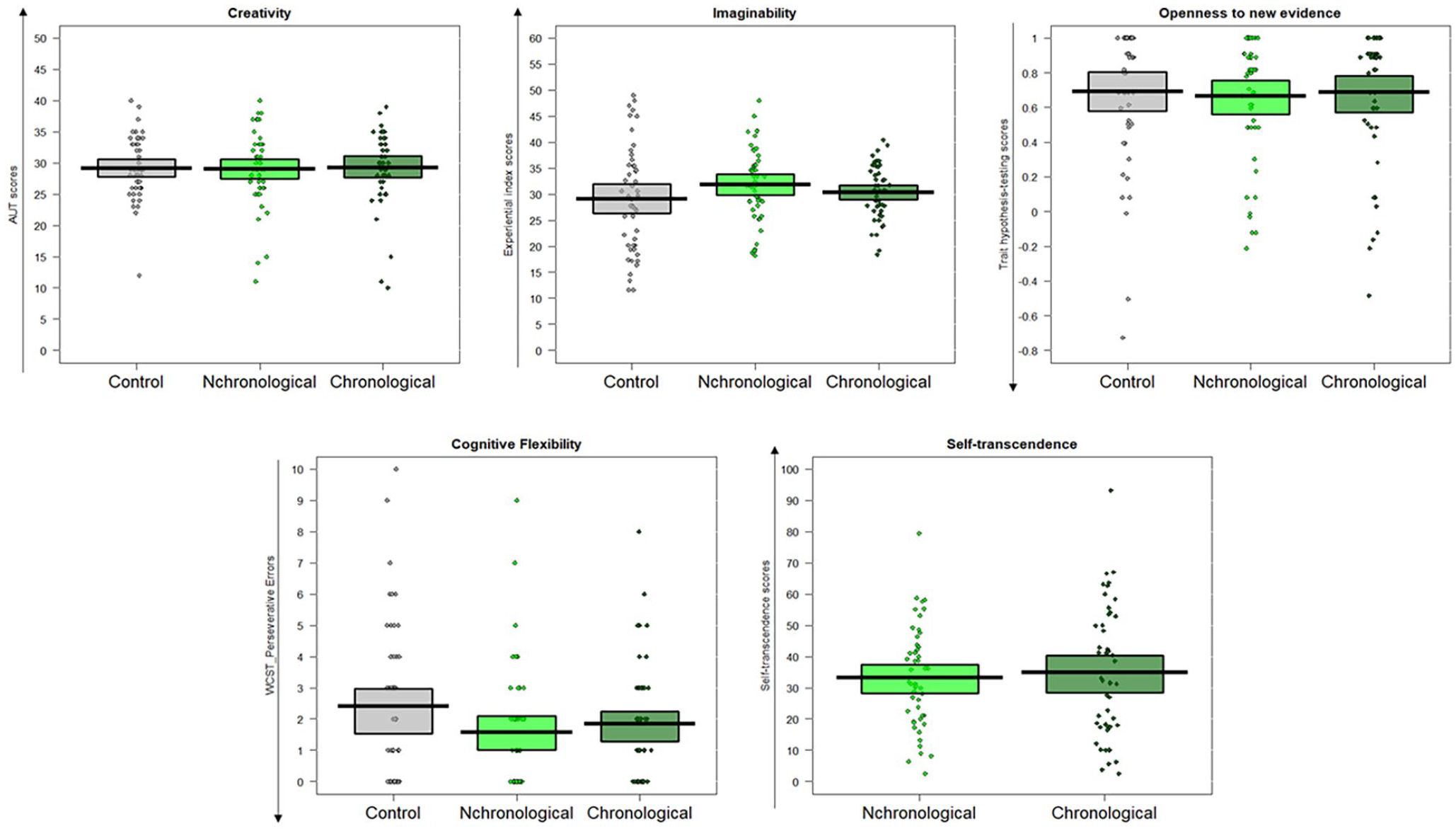
Plots for the effect of condition (Control = no film; Nchronological = non-chronological film; Chronological = chronological film) on each of the five open-mindedness assessment tasks in Experiment 1, showing raw data points, a horizontal line reflecting the mean and a rectangle around the mean representing the 95% Confidence Intervals. The arrow refers to the direction of the open-mindedness characteristics: creativity and imaginability higher scores denote greater open-mindedness (upward arrow), while for openness to new evidence and cognitive flexibility, lower scores denote greater open-mindedness (downward arrow).
Descriptive statistics (mean and standard deviations in parenthesis) and output of the statistical models for each measure and condition in Experiment 1.
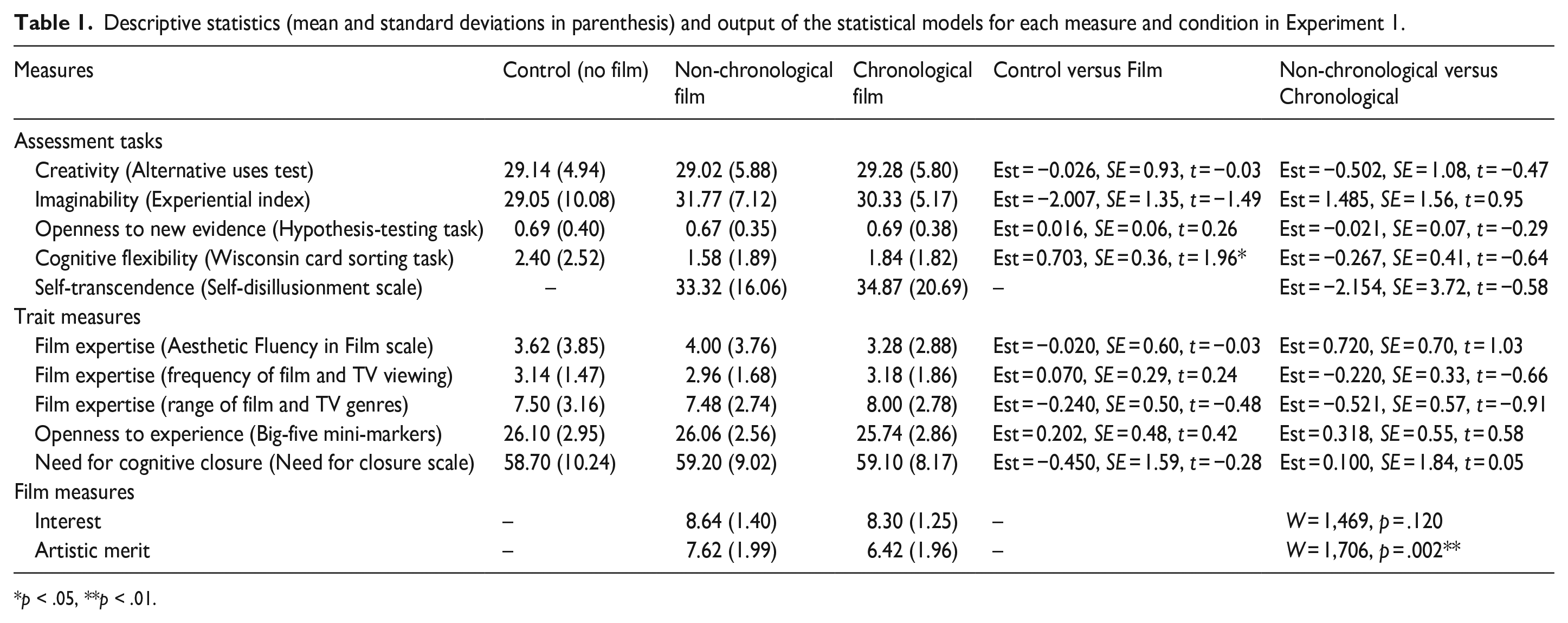
p < .05, **p < .01.
The five (general) linear mixed-effects models showed that the three conditions did not differ in baseline measures of film expertise or open-mindedness traits (see Table 1).
The two Mann-Whitney-Wilcoxon tests showed that the artistic merit of the film was rated higher in the non-chronological versus chronological film group, but ratings of interest in the film did not differ between the non-chronological versus chronological film groups (see Table 1).
Regarding our central hypothesis, the (general) linear mixed models showed that participants in the no-film condition made a greater number of perseverative errors (indicating reduced cognitive flexibility) compared to participants in the film conditions (see Table 1); cognitive flexibility did not differ between the non-chronological and chronological film conditions. No condition effects were observed across the remaining four measures of open-mindedness – creativity, imaginability, openness to new evidence and self-transcendence. The predictors (film expertise, trait open-mindedness and need for cognitive closure) were not significantly related to any open-mindedness measures (ts < 1.38, ps > .17), except for a significant effect of film expertise (aesthetic fluency in film) on creativity (Est = 0.31, SE = 0.13, t = 2.44, p = .015).
Correlation analyses
A series of non-parametric correlations (Kendall’s Rank Correlation) were used to examine associations between film expertise measures (aesthetic fluency, frequency of film and TV viewing and range of film genres), trait measures (openness to experience, need for cognitive closure) and assessment measures of open-mindedness (creativity, imaginability, openness to new evidence, cognitive flexibility and self-transcendence). Outcome scores for the need for cognitive closure, openness to new evidence and cognitive flexibility (WCST) were reverse-coded so that a higher score consistently reflected greater open-mindedness across all measures. Correlations were limited to the 100 participants who completed the film conditions to maximise the comparability of measures. The resulting correlation matrix is plotted in Figure 2.
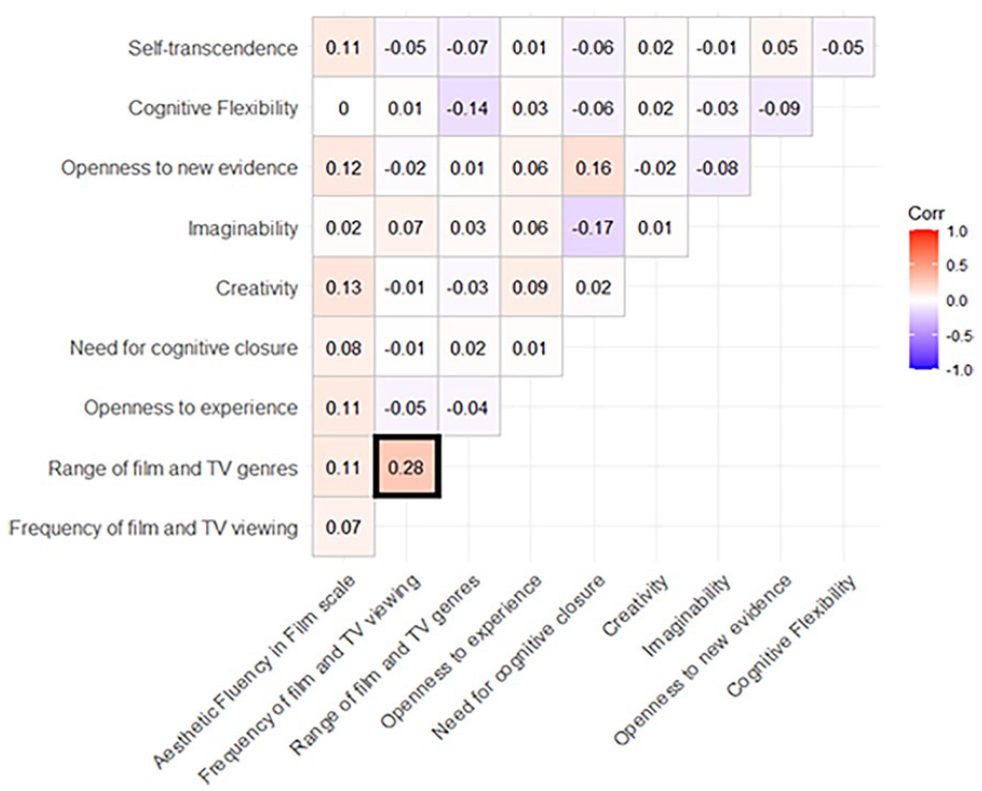
Correlation matrices between measures in Experiment 1. Cells bordered in bold indicate a significant correlation (p < .01), and values show Kendall’s tau-b correlation coefficient.
The correlation analysis showed a significant correlation between the frequency of film and TV viewing and the range of film and TV genres (rτ = .28, p < .01), indicating that participants who watched a greater number of films and TV programmes also reported watching a wider range of film and TV genres. None of the film expertise measures correlated with open-mindedness measures, and none of the open-mindedness measures correlated with each other.
Summary – Experiment 1
Experiment 1 investigated whether watching a film exhibiting a more complex temporal structure enhances characteristics of open-mindedness such as creativity, imaginability, openness to new evidence, cognitive flexibility and self-transcendence. In addition, it sought to explore how these characteristics were related to open-mindedness personality traits and film expertise. Our findings revealed a significant effect of film viewing (regardless of the chronological order present in the film) on cognitive flexibility, showing enhanced cognitive flexibility after watching a film compared to no film. No significant effect of film viewing or temporal complexity in the film was found for the remaining open-mindedness measures. Furthermore, we found a predictive effect of film expertise (aesthetic fluency in film) on creativity, suggesting that individuals with greater cinematic knowledge performed better in the creativity task; this effect was not replicated in the correlations due to the more conservative significance threshold we employed for the multiple correlations. In addition, participants rated the non-chronological version of the film as more artistic than the chronological version, meaning that temporal complexity in the film may be considered an artistic attribute.
Overall, findings from Experiment 1 show that watching a film modulated only one of the facets of open-mindedness – cognitive flexibility. Importantly, the complexity of the film’s temporal structure did not emerge as a key mechanism for effects on open-mindedness. Therefore, Experiment 1 provides only limited support to the aesthetic cognitivist claim that art (film) can ‘open our minds’.
Experiment 2 – perspectival complexity
Experiment 2 investigated whether narrative films that embody multiple perspectives on an event enhance characteristics of open-mindedness compared to narrative films that embody a single, dominant perspective. Using a design similar to Experiment 1, participants were randomly assigned to watch an excerpt of a film, Jackie Brown, depicting either a single character’s perspective on an event or multiple characters’ perspectives on the same event. Behavioural responses on measures of open-mindedness were compared after watching these two types of film excerpts with those in the no-film control group from Experiment 1. In Experiment 2, we additionally recorded online measures of participants’ responses to the film (eye movements, heart rate and electrodermal activity). This enabled us to assess participants’ attentional and affective responses and to test whether these real-time responses to the film predicted later effects on open-mindedness.
Experiment 2 was conducted before the data from Experiment 1 were analysed; therefore, our predictions were based on aesthetic cognitivist accounts rather than the results from Experiment 1. We predicted that participants in the two film conditions would exhibit enhanced performance on the open-mindedness measures (creativity, imaginability, openness to new evidence and cognitive flexibility) compared to participants in the no-film control group. We also expected that open-mindedness scores would be higher for participants in the multiple-perspective film condition compared to those in the single-perspective film condition. Similarly, we expected participants to show greater online attentional and affective responses (i.e. a higher number of eye movements, greater pupil dilation, electrodermal activity and heart rate) when watching a film embodying multiple perspectives on an event compared to watching a film embodying a single perspective on the same event. Finally, we expected that participants with higher film expertise and higher openness to experience would exhibit enhanced performance on the open-mindedness measures and greater attentional and affective responses than those with lower film expertise and openness to experience.
Method
Full ethical approval was obtained prior to data collection from the Research Ethics Committee of the School of Psychology at the University of Kent. All hypotheses, methodological procedures, manipulations and exclusion criteria were pre-registered on the Open Science Framework, https://osf.io/xe7ju. 2 The experiment employed a between-subjects design with three levels (no film, single-perspective or multiple-perspectives film conditions).
Participants
A total sample size of N = 150 (50 participants in each condition) was included in this experiment. For the experimental conditions, 108 new participants were recruited from the undergraduate population of the University of Kent and were randomly allocated to one of the two film conditions (single-perspective or multiple perspectives). They received course credit and/or cash for taking part. Participants were excluded from analyses according to the same exclusion criteria as for Experiment 1, and, additionally, if they had watched the film Jackie Brown before the study, or in case of technical problems during the recording of online measures. When these exclusion criteria were applied, eight participants were excluded (all due to technical problems during the recording of the online measures), thus, the final sample included 50 participants in each of the two experimental conditions (single-perspective and multiple perspectives) and 50 control (no film) participants. The control group from Experiment 1 was reused as the control group in Experiment 2. On average, participants were 19.6 years old (range: 18–32 years old), 80% were female, 16.6% were male and 3.3% selected ‘other’ or ‘prefer not to say’.
Materials and procedure
The study took place in a quiet University laboratory. Participants provided fully informed consent before taking part in the study, then created a unique identifier code before completing the trait measures of film expertise and openness to experience on Qualtrics.
Next, participants were linked up to the eye-tracker and BIOPAC system, as described below, and watched their allocated film excerpt (single or multiple perspectives). During film viewing, participants’ online responses (eye movements, heart rate and electrodermal activity) were recorded. Stimuli were presented on a 22-inch colour monitor screen, with a screen resolution of 1,920 × 1,080 pixels, positioned approximately 60 cm from the participant. At the beginning of the experiment, a nine-point calibration was used to calibrate and validate participants’ eye movements, and a drift correction check (central fixation point on the screen) was displayed at the start of each film scene using the standard EyeLink calibration procedure.
After watching the film, participants completed the comprehension questions and open-mindedness assessment measures. They were then thanked for their participation, fully debriefed and awarded their compensation.
Film stimuli
Two edited excerpts of the film Jackie Brown were used as film stimuli (each with a matched running time of 44 min), presented to participants through SR Research’s Experiment Builder software (SR Research Ltd., Version 2.3.1). Both excerpts featured the ‘money exchange’ scene as the target scene. In this scene, Jackie Brown arranges to hand over $500,000 to Ordell’s partner, Louis, as part of a deal with the police to incriminate Ordell. In a twist, Jackie tricks both Ordell and the police: she only gives Louis $50,000 and hides the remaining cash for Max (Ordell’s bail bondsman with whom she starts an alliance) to retrieve later.
In the single-perspective film condition, the film excerpt featured the ‘money exchange’ exclusively from Jackie’s narrative and visual perspective. Specifically, in this condition, participants saw only the point of view of Jackie, who prepares two bags, hands the bag containing the $50,000 to Louis and warns the police. The truth is disclosed to the participants in the final scene (scene 7; see Figure 3), which reveals Jackie’s alliance with Max. In the multiple-perspectives film condition, the film excerpt featured the same event from the narrative and audio-visual perspectives of three different characters: Louis, Max and then Jackie (in reverse order compared to the original film to ensure that Jackie’s ‘target scene’ was always presented last). In this condition, participants saw Louis unknowingly taking the bag containing the $50,000 and Max retrieving the larger sum, but remained unaware of Jackie and Max’s partnership. As for the single-perspective condition, the alliance between Jackie and Max is only fully revealed in the final scene (scene 7; see Figure 3).
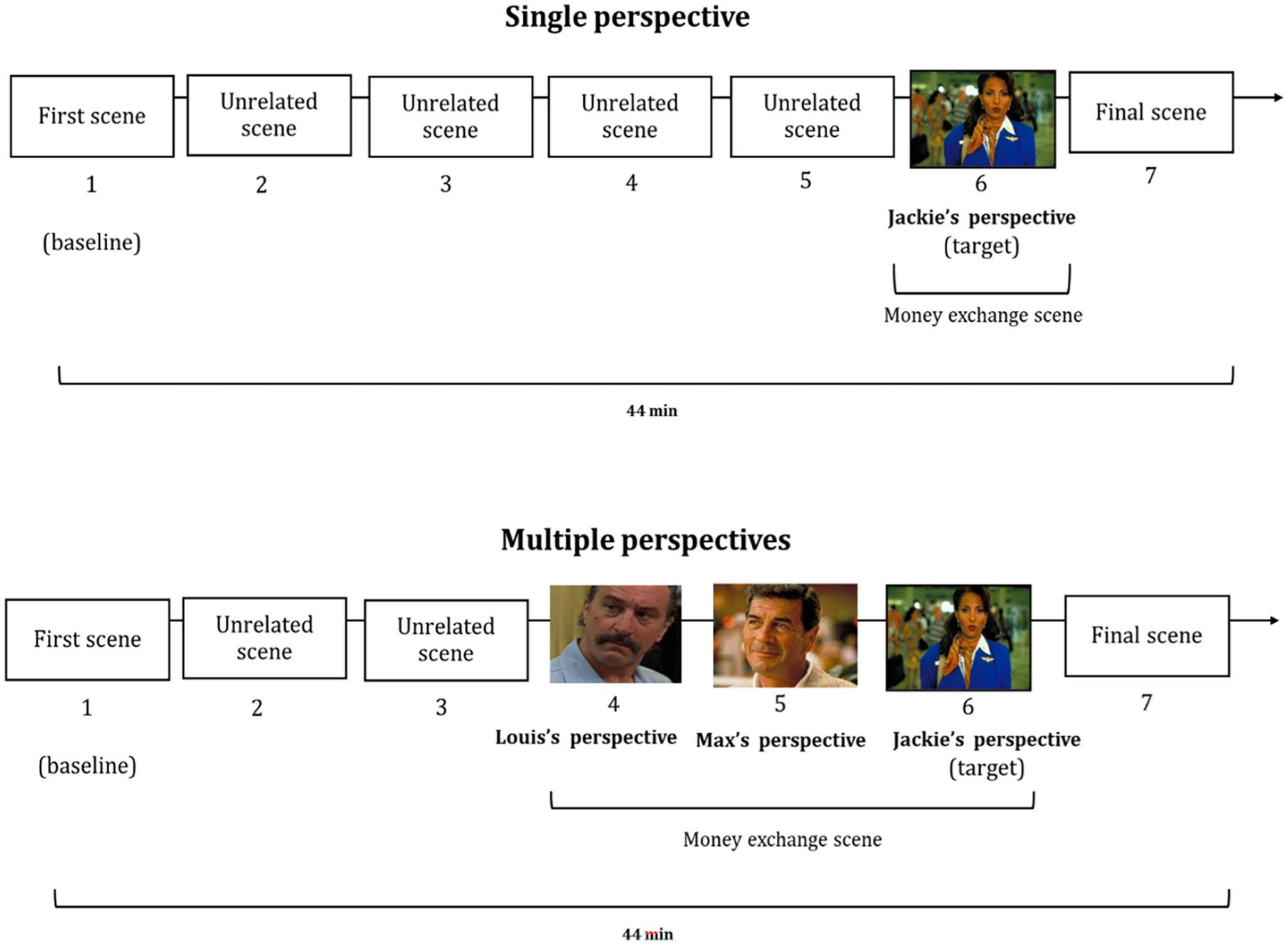
Schematic representation of the structure of the film excerpts employed in the single-perspective (top) and multiple-perspectives (bottom) film conditions in Experiment 2.
Before watching the film excerpts, participants were given a written prologue (identical across conditions) that introduced key characters and plot context to ensure that the plotline was understandable to viewers of the edited excerpts. As shown in Figure 3, both film excerpts began with the same 3-min introductory scene that provided an overview of the characters and ended with the same 6-min scene depicting the ‘money exchange’ from Jackie’s perspective (plus a final wrap-up scene). These scenes served as baseline and target scenes, respectively, to compare the online measures. Additional scenes from the film were included between the baseline and target scenes to maintain narrative coherence and context. In the single-perspective condition, all of these scenes were unrelated to the ‘money exchange’ plotline, and in the multiple-perspectives condition, two of these additional scenes (out of seven scenes) were unrelated (albeit slightly different from those in the single-perspective condition) and two depicted the money exchange from the perspectives of two other characters (Louis and Max). The duration of film content between the baseline and target scenes was matched across single- and multiple-perspective film conditions.
Trait measures
As in Experiment 1, film expertise was assessed using the revised version of the Aesthetic Fluency in Film scale (Cotter et al., 2023; Silvia & Berg, 2011) and participants indicated their frequency of film and TV viewing and the range of genres they commonly watched. Openness to experience was assessed using the subscale of the International English Big-Five Mini-Markers (Thompson, 2008). The need for cognitive closure measure was not included in this experiment since it was deemed less relevant for the shorter film excerpts. Specifically, the need for cognitive closure reflects a desire for certainty, typically elicited by extended narratives. Sustaining coherence in an extended plot is more likely to intensify this need, whereas shorter films may lack sufficient narrative depth to evoke it significantly.
Open-mindedness assessment tasks
As in Experiment 1, creativity was assessed using the AUT (George and Wiley, 2019; Guildford, 1967), imaginability using Hassabis et al.’s scene construction task (2007), openness to new evidence using a trait hypothesis-testing task (Galinsky & Moskowitz, 2000), and cognitive flexibility using the WCST (Miyake et al., 2000). The self-transcendence measure was not included in this experiment because, like the need for cognitive closure, it was deemed less relevant for the shorter film excerpts. The short duration of the excerpts may limit viewers’ ability to experience an intense cinematic impact, as there may be too little context or emotional buildup to elicit self-transcendent processes. Extended narratives typically foster deeper involvement that supports self-transcendence, which may be less attainable in shorter sessions. Assessment tasks were presented in four different orders to avoid fatigue effects.
Film measures
Participants were asked four film comprehension questions (multiple-choice questions) regarding key characters and events in the film, which helped to provide exclusion criteria for those who did not attend sufficiently to the film (i.e. ‘What was Jackie Brown’s job?’, ‘Where did the exchange money scene take place?’, ‘In the money exchange scene, what does Jackie Brown put in the bag over the money?’, ‘Why does Jackie get arrested?’). In contrast to Experiment 1, participants did not rate the artistic merit and level of interest in the film since they did not watch the entire film.
Online measures
Eye movements
Eye movements were recorded while participants watched the film using an EyeLink 1000 Plus desktop-mounted SR Research eye-tracker in remote mode, with eye movements sampled at a frequency of 500 Hz, which allowed free movement of the head. Viewing was binocular, but only one eye was tracked at a time. The output variables for eye movements were pupil dilation and number of fixations, calculated as the % change in average pupil dilation between the baseline scene and target scene (Jackie’s perspective), and the % change in number of fixations (per second) between the baseline scene and target scene. The calculation of a % change measure, using ([target – baseline]/baseline) × 100), allowed us to control for individual differences in baseline pupil diameter and fixation behaviour between groups.
Heart rate
Heart rate (HR), measured in beats per minute, was assessed using a BIOPAC MP150 and Acqknowledge 4.4 software (BIOPAC Systems Inc., Goleta, CA, USA). Pre-gelled disposable Kendall H124SG electrodes with a sensor diameter of 24 mm were used. Electrodes were positioned according to a modified chest lead configuration: one below the right clavicle, another below the left clavicle and a third below the left lateral margin of the chest. The signal was recorded at a sampling rate of 1,000 Hz, with a bandpass filter of 0.5–35 Hz applied. Artefacts due to movement were manually identified and excluded from analysis. The output variable for HR was the % change in HR between the baseline and the target scene, which controlled for individual differences in resting HR.
Electrodermal activity
Electrodermal activity was measured using a BIOPAC MP150 system and Acqknowledge 4.4 software (BIOPAC Systems Inc.). Two snap EL507 electrodes with a 16 mm diameter of active area, pre-gelled with isotonic gel, were attached to the volar surface of the medial and distal phalanges of the participant’s nondominant hand, following the procedure described by Dawson et al. (2000). Electrodermal activity was filtered using a low-pass filter with a cutoff frequency of 0.05 Hz to remove high-frequency noise, and down-sampled to 10 Hz sampling rate (Boucsein, 2012). Artefacts due to movement were manually identified and excluded from analysis. The output variable for electrodermal activity was the Skin Conductance Level (SCL), calculated as the % change in SCL between the baseline and the target scene, which controlled for individual differences in electrodermal activity.
Data analysis
Analyses were pre-registered, and the full datasets and analysis scripts are available on the Open Science Framework web pages (see https://osf.io/g8pnm). We adopted the standard significance level of ps < .05 for all inferential tests. Shapiro-Wilk tests were significant for all behavioural and online measures (p < .001), except imaginability (p = .19), suggesting that our dependent variables were predominantly not normally distributed. Non-parametric analyses were employed for measures that violated the normality assumption. As for Experiment 1, these non-parametric tests were not pre-registered, since we had no a priori reason to expect the data to violate normality (as Experiment 2 was run before data from Experiment 1 were analysed); however, the structure of statistical tests matches the pre-registered plans (we planned to use linear mixed models instead of general linear mixed models).
First, to test whether there were any baseline differences between the three condition groups in trait film expertise or open-mindedness, we used four general linear mixed-effects models (one for each of aesthetic fluency, frequency of film and TV viewing, range of film and TV genres and openness to experience), with the condition as the fixed factor and random effects for participant and task order. To accommodate the three levels of condition, we used Helmert contrast coding schemes to first compare the two film conditions to the no-film control condition (i.e. no-film contrast vs. film), then compare the single-perspective versus multiple-perspectives film conditions (without the control condition).
Second, to test the central hypothesis, each of the four dependent measures (creativity, imaginability, openness to new evidence and cognitive flexibility) was analysed separately, by means of (general) linear mixed-effects models, with condition (no film vs. single-perspective vs. multiple perspectives) as the between-groups independent variable. As above, Helmert contrast coding was used to accommodate the three levels of condition. In addition, models included openness to experience and film expertise (aesthetic fluency) as fixed effect predictors, and random effects for participant and task order.
Third, we assessed the effect of film condition on the online measures (pupil dilation, number of fixations, HR and skin conductance). General linear mixed-effects models were used, with the condition as the between-groups independent variable. For each of the online measures, contrast coding was used to compare single-perspective versus multiple-perspectives film conditions. In addition, openness to experience and film expertise (aesthetic fluency) were included as fixed effect predictors, alongside random effects for participant and task order.
Finally, we ran a correlation analysis to examine the relationships between the four assessment measures of open-mindedness, openness to experience, film expertise measures (aesthetic fluency, film frequency and genre) and online measures. Since online measures were only assessed among participants who watched a film, these correlations exclude participants in the no-film condition. Given the number of variables included in the correlation, the alpha level for significance was set to .01.
Results
Condition effects are plotted for behavioural measures in Figure 4 and for online measures in Figure 5. Descriptive data for each measure and condition and statistics for the relevant fixed effect contrasts are summarised in Table 2.
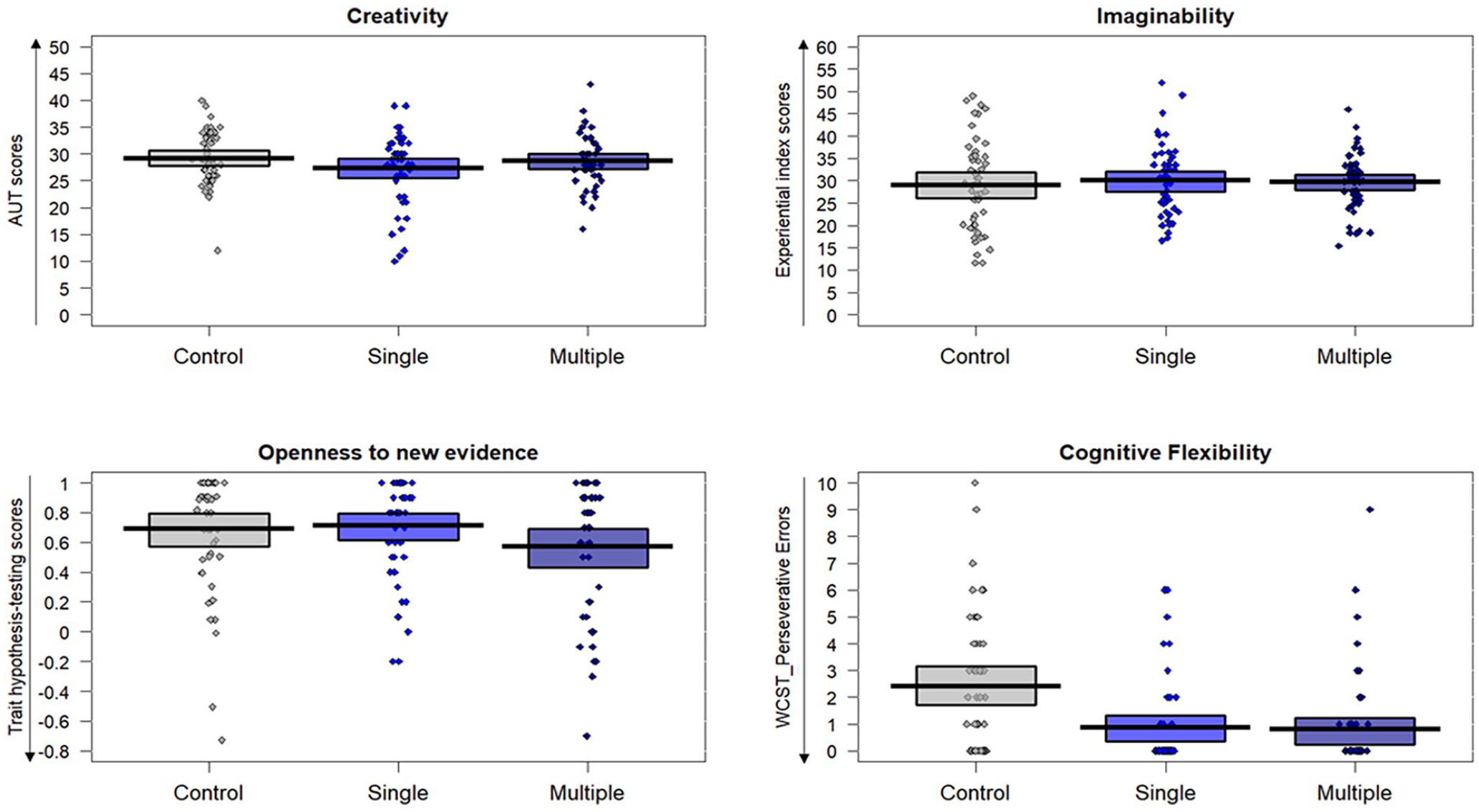
Plots for the effect of condition (Control = no film; Single = single-perspective film; Multiple = multiple-perspective film) on each of the four open-mindedness assessment tasks in Experiment 2, showing raw data points, a horizontal line reflecting the mean and a rectangle around the mean representing the 95% Confidence Intervals. The arrow refers to the direction of the open-mindedness characteristics: creativity and imaginability higher scores denote greater open-mindedness (upward arrow), while for openness to new evidence and cognitive flexibility, lower scores denote greater open-mindedness (downward arrow).
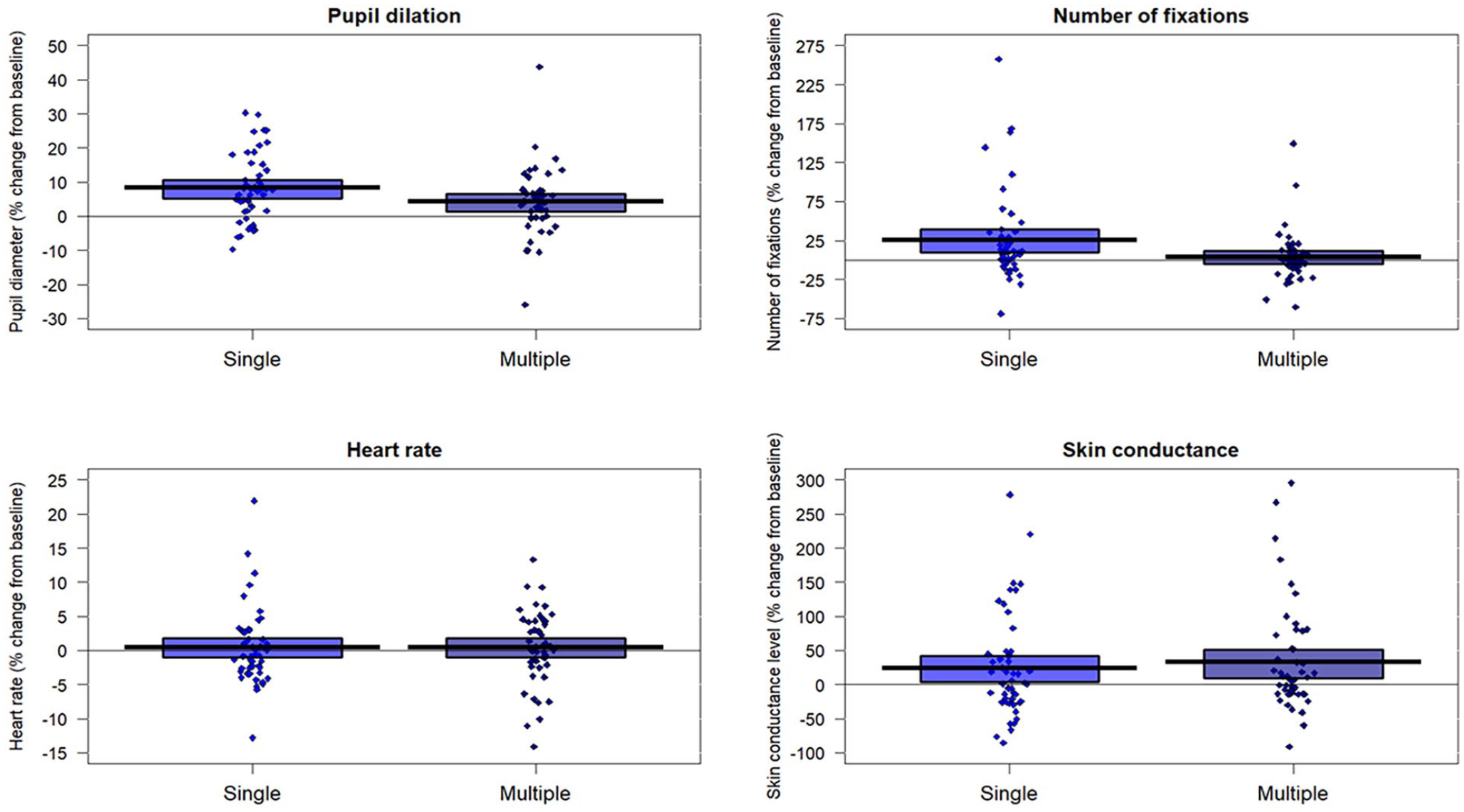
Plots for the effect of condition (Control = no film; Single = single-perspective film; Multiple = multiple-perspective film) on each of the four online measures in Experiment 2, showing raw data points, a horizontal line reflecting the mean and a rectangle around the mean representing the 95% Confidence Intervals. The black horizontal line indicates values corresponding to zero.
Descriptive statistics (mean and standard deviations in parenthesis) and output of the statistical models for each measure and condition in Experiment 2.
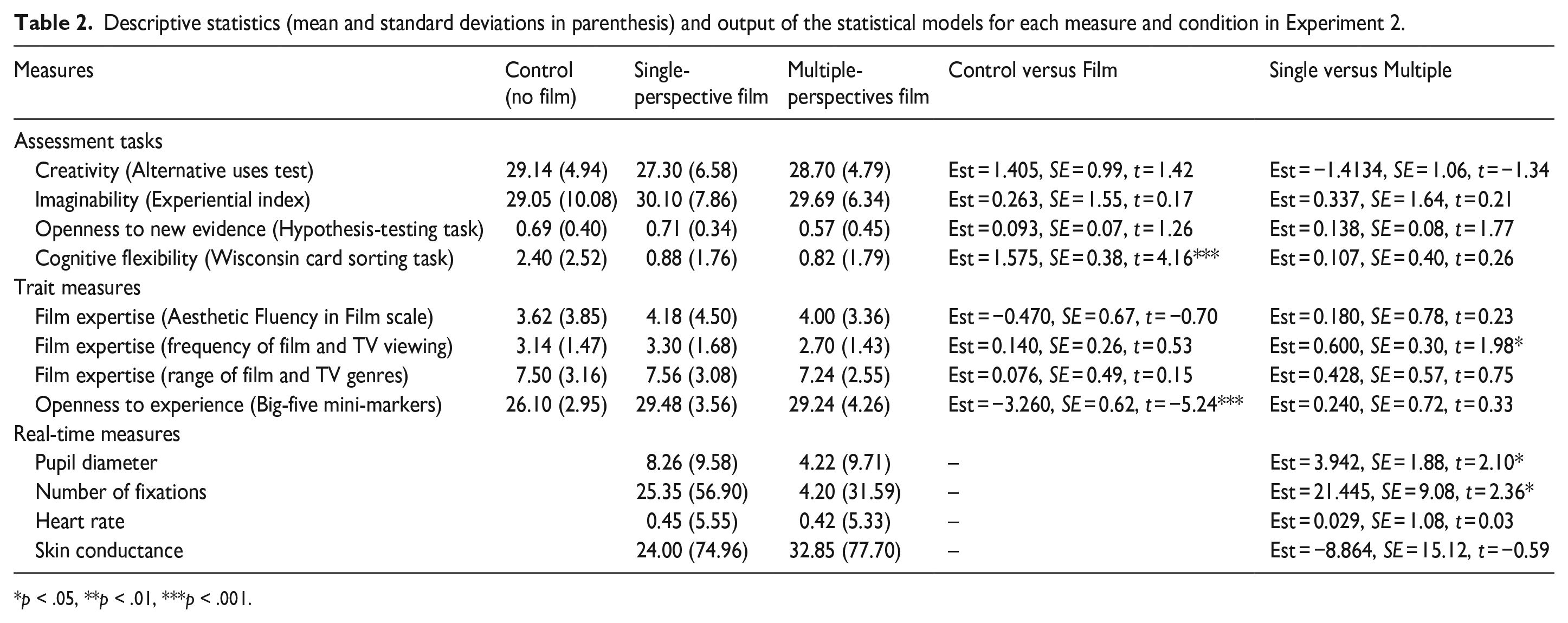
p < .05, **p < .01, ***p < .001.
The general linear mixed-effects models showed that participants in the three conditions did not differ in the film expertise measures of aesthetic fluency in film, or the range of film and TV genres, but participants in the single-perspective film condition reported a higher frequency of film and TV viewing compared to participants in the multiple-perspectives film condition (see Table 2). In addition, participants in the film conditions reported higher trait open-mindedness (i.e. openness to experience) compared to participants in the no-film condition (see Table 2).
Regarding our central hypothesis, the general linear mixed models showed a significant difference in cognitive flexibility between the no-film condition versus the film conditions (see Table 2), with participants in the no-film condition showing a greater number of perseverative errors (indicating reduced cognitive flexibility) compared to those in the film conditions; single- versus multiple-perspectives film conditions did not differ. No condition effects were observed across the remaining three indicators of open-mindedness – creativity, imaginability, openness to new evidence – and no effect of the predictors (trait open-mindedness, film expertise) was found on any of the open-mindedness measures.
Regarding the online measures, the general linear mixed-effects models showed greater pupil dilation and a higher number of fixations among participants in the single-perspective film condition compared to participants in the multiple-perspectives film condition (see Table 2). No condition effect was found for HR or skin conductance. No effect of the predictors (open-mindedness traits and film expertise) was found for any of the online measures.
Correlation analyses
A series of non-parametric correlations (Kendall’s Rank Correlation) were used to examine associations between film expertise measures (aesthetic fluency, frequency of film and TV viewing, and range of film and TV genres), trait measures (openness to experience) and assessment measures of open-mindedness (creativity, imaginability, openness to new evidence and cognitive flexibility) and online measures (pupil dilation, number of fixations, HR and electrodermal activity). Outcome variables for openness to new evidence and cognitive flexibility (WCST) were reverse-coded so that a higher score consistently reflected greater open-mindedness across all measures. Correlations were limited to the 100 participants who completed the film conditions to maximise the comparability of measures. The resulting correlation matrix is plotted in Figure 6.
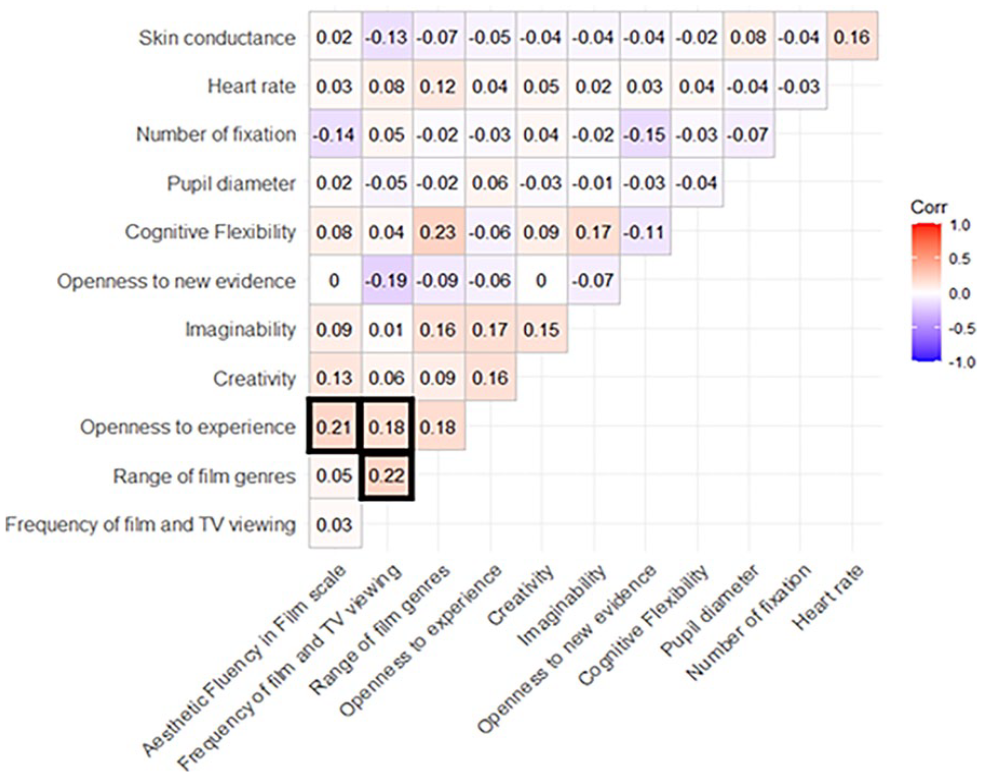
Correlation matrices between all measures in the two film conditions. Cells bordered in bold indicate a significant correlation (p < .01), and values show Kendall’s tau-b correlation coefficient.
The correlation analysis showed that trait open-mindedness (openness to experience) was positively correlated with film expertise (aesthetic fluency; rτ = .21, p = .008), and the frequency of film and TV viewing (rτ = .18, p = .007), suggesting that individuals with greater cinematic knowledge tended to exhibit higher levels of open-mindedness traits. As in Experiment 1, a positive correlation was found between the frequency of film and TV viewing and the range of film and TV genres (rτ = .22, p = .001). None of the online measures correlated with the open-mindedness measures and none of the open-mindedness measures correlated with each other.
Summary – Experiment 2
In Experiment 2, we aimed to determine whether narrative films depicting multiple perspectives on an event enhance characteristics associated with open-mindedness (creativity, imaginability, openness to new evidence, cognitive flexibility) compared to films portraying a single, dominant perspective. In addition, we investigated whether these characteristics were predicted by participants’ personality traits and film expertise.
Consistent with the findings of Experiment 1, our central analysis showed higher scores in cognitive flexibility among participants in the film conditions (regardless of the film clip version) compared to those in the no-film condition. However, film viewing did not affect the other measures of open-mindedness. Furthermore, Experiment 2 recorded real-time measures during film viewing. We predicted that real-time measures would increase for participants watching the target scene from multiple perspectives compared to those watching the same scene from a single perspective. In contrast to the hypothesis made, we found pupil dilation and the number of fixations increased in participants who watched the film clip depicting the money exchange scene from a single perspective compared to those who viewed the same scene from multiple points of view. This heightened eye movement may indicate increased cognitive processing when the scene is narrated exclusively from the main character’s point of view, as opposed to when it is depicted from multiple perspectives (see the detailed discussion below). While participants’ personality traits and film expertise did not affect the open-mindedness scores, the correlation analysis revealed significant relationships among our predictors. Specifically, participants with higher scores in open-mindedness traits reported watching a greater number of films and TV programmes, as well as a wider range of film and TV genres.
Overall, consistent with Experiment 1, the results of Experiment 2 offer limited support for the claim of aesthetic cognitivism that art, particularly film, can open people’s minds. They also suggest that perspectival complexity can modulate viewers’ cognitive processing, shaping how film content is understood and interpreted.
Discussion
The idea that art stimulates people’s imaginative capacities and, hence, opens their minds has a longstanding tradition in philosophy (Friend, 2008; Lopes, 2005; Smith, 2017), and has more recently been taken up by psychologists (e.g. Wimmer et al., 2022). The present study reported two experiments that aimed to investigate whether watching artistic films possessing features theoretically assumed to ‘open our minds’ might in fact enhance viewers’ open-mindedness. Together, our results provide only limited support to the aesthetic cognitivist claim that art can open minds as only one facet of open-mindedness – cognitive flexibility – was affected by film watching. We discuss the results for each experiment in detail below.
Experiment 1 – temporal complexity
Experiment 1 investigated whether watching a film exhibiting temporal complexity (Memento) enhances characteristics of open-mindedness such as creativity, imaginability, openness to new evidence, self-transcendence and cognitive flexibility. In addition, we explored the relationship between these characteristics, open-mindedness personality traits and film expertise. Our central hypothesis was that participants assigned to the film conditions would show enhanced open-mindedness characteristics compared to those in the no-film condition, and that the non-chronological version of the film with a more complex temporal structure would foster open-mindedness more than a chronological version of the film with a less complex temporal structure. These assumptions were only partially supported by the present data since our findings revealed a significant effect of film viewing on cognitive flexibility, but no effect of the temporal complexity in the film. In addition, no significant effect of film viewing, or temporal complexity in film, was found for the remaining open-mindedness measures.
The effect of film viewing on cognitive flexibility aligns with previous literature showing a positive association between exposure to (certain types of) television viewing and cognitive flexibility (e.g. Nathanson et al., 2014). This also aligns with the stimulation hypothesis (Laird, 1985; van der Voort & Valkenburg, 1994), according to which television viewing might promote viewers’ cognitive abilities by stimulating them through its audio-visual features. Furthermore, this increase in cognitive flexibility across both film conditions might depend on the complex story content of Memento. In both versions of Memento (non-chronological and chronological), the film explores the story of the main character (Leonard Shelby) and his struggle to decipher reality due to his short-term memory loss. Although exacerbated in the non-chronological version, this underlying complexity at the level of the story might have obscured any differences in participants across film conditions (chronological vs. non-chronological). Indeed, in both conditions, viewers may have required substantial cognitive effort to piece together the reality of the storyworld and Leonard’s altered perceptions of it. Despite this potential confounding factor, Memento remains an appropriate choice as it is a representative application of temporal complexity in film (Ghislotti, 2009; Kania, 2009), effectively illustrating the concept of ‘defamiliarization’, a key element of art. Furthermore, its artistic value is widely recognised within the world of cinema. It is also noteworthy that participants rated the non-chronological version of the film as more artistic than the chronological version. This suggests that, although the temporal complexity of the non-chronological version of Memento did not affect the cognitive measures in the immediate aftermath of viewing, viewers perceived the non-chronological structure as an artistic attribute.
It is possible that significant effects of film viewing are absent for the majority of open-mindedness measures because these measures are influenced by different film characteristics to the ones we tested. These characteristics might be more effectively stimulated by specific content features within films. Indeed, research on the cognitive impact of television has indicated that only certain types of content in TV programmes stimulate cognitive characteristics like creativity, while others do not (e.g. Kant, 2012). In the case of Memento, the main character displays closed-mindedness as evidenced, for example by his refusal to consider alternative interpretations of information and his tendency to reject evidence contradicting his preconceived notions. A central character embodying closed-mindedness – whose perspective viewers take throughout the film – might have impeded any positive impact of artistic film techniques on aspects of open-mindedness like creativity. Another potential explanation is that the cognitive characteristics examined might not be affected by temporal complexity in the short-term, but may be activated through longer or repeated exposure.
Although our main analysis did not reveal an immediate effect of film watching on creativity, we found a predictive effect of film expertise (aesthetic fluency in film) on creativity. This suggests that individuals with a deeper knowledge of cinema performed better in the creativity task. Film expertise encompasses an understanding of cinematic techniques, storytelling structures and thematic elements (Silvia & Berg, 2011). This depth of knowledge might have provided individuals with a rich reservoir of ideas, references and inspirations to draw upon when engaging in the creativity task, in line with the idea that creativity might be fed by expertise and knowledge, serving as catalysts for the generation of innovative ideas (Campbell, 1960; Mannucci & Yong, 2018; Simonton, 2003).
Experiment 2 – perspectival complexity
In Experiment 2, we investigated whether watching a film (Jackie Brown) that embodies multiple perspectives on an event enhances characteristics of open-mindedness. As in Experiment 1, we predicted that participants in the two film conditions would show enhanced performance on the open-mindedness measures (creativity, imaginability, openness to new evidence and cognitive flexibility) compared to participants in the no-film condition. Consistent with the findings of Experiment 1, our main analysis showed higher scores in cognitive flexibility among participants in the film conditions compared to those in the no-film condition, regardless of whether single or multiple perspectives on an event were presented in the film. No significant effect of film viewing or perspectives in the film was found for the remaining open-mindedness measures.
We replicated the effect of artistic film viewing on cognitive flexibility, thereby further supporting the idea that the experience of film watching may have a positive cognitive impact, in line with the positive association between exposure to high-quality educational television and executive functions found in previous studies (e.g. Nathanson et al., 2014). However, we cannot rule out the possibility that this positive effect on cognitive flexibility could be mediated by specific features of the film watched. Like Memento, Jackie Brown also presents a complex story, plot twists and apparent contradictions. These features might have kept viewers guessing and engaged throughout the film, demanding them to employ their executive functions to understand plot developments (on complex narration in film, see Buckland, 2008; Kiss & Willemsen, 2016; in TV, see Mittell, 2006).
Furthermore, Experiment 2 recorded real-time measures during film viewing (pupil dilation, number of fixations, HR and electrodermal activity). Contrary to our initial hypothesis, pupil dilation and the number of fixations increased in participants who watched the film clip depicting the money exchange scene from a single perspective compared to those who viewed the same scene from multiple points of view. Research shows that eye movements increase as cognitive processing intensifies (Fogarty & Stern, 1989). In our study, this increased cognitive processing in the single-perspective condition may be explained in two possible ways. First, it is plausible that the single-perspective narrative might have prompted participants to focus more intensely on the actions and emotions of the main character (vs. sharing attention across multiple perspectives), leading to greater attentional allocation and transportation (Benesh, 2011; Green & Brock, 2002; Wallengren & Strukelj, 2018). Indeed, transportation is thought to shorten the psychological distance between viewers and story characters, facilitating the understanding of the character’s perspective (Calarco et al., 2017; Consoli, 2018). In line with this claim, literature on narrative reading supports the idea that when a story is told from the protagonist’s subjective point of view (compared to a third-person point of view), readers are more inclined to take on the character’s perspective or experience the feeling of putting themselves in the protagonist’s shoes (e.g. Oatley, 1999). Some studies have experimentally examined this assumption and have provided empirical evidence that supports this notion (Creer et al., 2019; Salem et al., 2017). However, as we did not measure transportation directly, this interpretation remains speculative.
An alternative explanation is that participants in the single-perspective condition found Jackie’s behaviour more ambiguous and challenging to interpret, as the scene leaves unclear who receives the bag of money or whom Jackie is truly deceiving. This uncertainty may have increased cognitive effort, as participants tried to resolve the narrative twist. In contrast, the multiple perspectives provided additional context through the viewpoints of other characters (Louis and Max’s perspectives), which may have aided participants in inferring Jackie’s collaboration with Max and her deception of both Ordell and the police, even though this twist was not explicitly revealed from Louis or Max’s perspectives. Furthermore, the increased pupil movement might be attributed to the fact that participants in the single-perspective condition reported a higher frequency of film and TV viewing compared to those in the multiple-perspective condition. The greater exposure to film and TV viewing could indicate that participants in the single-perspective condition are more accustomed to the film-watching experience and, thereby, potentially more prone to engage with it.
In contrast to the condition effects, we found that HR and electrodermal activity did not differ depending on the film condition. One potential reason for this lack of effects could be the specific nature of the stimuli used in the study. The selected excerpts may not have been sufficiently emotionally arousing to elicit measurable changes in physiological indicators such as electrodermal activity and HR. In addition, individual differences in emotional reactivity and empathy could have increased variability in the data. Participants may have varied in their sensitivity to the stimuli depending on their empathy level, leading to inconsistent changes in HR and electrodermal activity across the sample.
While participants’ personality traits and film expertise did not influence open-mindedness, our correlation analysis revealed significant relationships among our variables. Specifically, participants with higher scores in openness to experience reported watching a greater number of films and TV programmes, and a deeper cinematic knowledge. This finding is consistent with findings from Experiment 1, namely a predictive effect of film expertise (aesthetic in fluency) on creativity. Thus, it suggests that having background knowledge and experience about films and TV programmes may positively impact certain cognitive characteristics associated with open-mindedness. Alternatively, it may indicate the reverse: individuals with greater open-mindedness may be more inclined to seek out and engage with a variety of films and television programmes, thereby cultivating a richer understanding of diverse narratives and perspectives.
Limitations and future directions
While our study considered various characteristics of open-mindedness, including creativity, imaginability, openness to new evidence, self-transcendence and cognitive flexibility, there are other characteristics of open-mindedness, not tested here, that may be more amenable to influence through film viewing and specific film features. Indeed, from a philosophical point of view, the conception of open-mindedness is still subject to debate, making it difficult to translate this concept into empirically validated measures. Future research should explore a more comprehensive array of open-mindedness measures to help clarify its multi-dimensional structure (using principal component analysis) and determine whether certain film features affect open-mindedness and whether the impact varies depending on the characteristics considered. For instance, characteristics like tolerance for ambiguity (Herman et al., 2010), willingness to consider diverse perspectives (Svedholm-Häkkinen & Lindeman, 2017), and receptivity to new ideas (Hurley, 1995) were not included in the present study but might be examined in the future. Moreover, our correlation analysis in both experiments did not show significant associations between the tested measures of open-mindedness (creativity, imaginability, openness to new evidence and cognitive flexibility). This finding raises questions about the nature of the interrelationships among the various components of open-mindedness. Future studies should aim to clarify how these dimensions interact with each other and contribute to the broader definition of open-mindedness.
Furthermore, our study employed only one film for each experiment. While this approach ensured that optimal films were selected to effectively capture the film characteristics under investigation and that viewers spent a considerable amount of time engaging with them (especially in Experiment 1), it may have limited the generalisability of our findings. Memento and Jackie Brown were carefully selected as representative examples of films with specific characteristics—temporal and perspectival complexity, respectively – and edited to retain careful control and comparability of stimuli across film conditions (in contrast to some previous studies that have used different films in different conditions). Despite this, it remains unclear whether our results extend to other films with similar attributes. Therefore, future research should include a more diverse selection of films to determine whether our findings can be generalised across a wider array of individual films and types of films.
It is also important to acknowledge that the same control group was used in both experiments, meaning that the finding on cognitive flexibility, which replicated across both experiments, may have been influenced by the underperformance of this group on the task. We note that the control group was recruited from the same population as the experimental groups (they were matched in demographics and baseline cognitive abilities), and all participants adhered to rigorous criteria to maintain attention (i.e. all participants in the control group passed the attention checks). In addition, their performance on the other tasks was similar to that of the experimental groups, and there were no indications of poor performance on the WCST (the range of perseverative errors in the control group was comparable to other groups and in line with previous literature on adults; cf. Arffa et al., 1998). To further mitigate this concern, future research should replicate these experiments with a different control group to verify the stability and generalisability of our findings. This will help ensure that the observed effects are not specific to a particular sample but are indicative of a broader phenomenon. The current study recruited participants from a university population that offers diversity in terms of ethnicity, socioeconomic background and academic ability. However, it includes a narrow age range, which might reduce the generalisability of our findings across different life stages. Future research should therefore prioritise expanding participant diversity, particularly by including individuals from a wider range of age groups and life experiences to better capture how varied audiences respond to film stimuli.
Finally, in our study, we focused on the short-term effects of watching films with particular features on characteristics associated with open-mindedness. The absence of observed effects on certain measures may be attributed to this brief exposure. Indeed, it is possible that certain changes in open-mindedness may occur gradually or emerge only after sustained exposure to films. In line with this proposal, our correlation analysis showed a positive association between film expertise traits and creativity (Experiment 1) and openness to experience (Experiment 2), supporting the idea that prolonged exposure to film and TV viewing over time may foster certain characteristics of open-mindedness. Future longitudinal studies will help in clarifying whether we should call into question the impact of watching film and engaging with specific film features (such as temporal and perspectival complexity) on open-mindedness or if these characteristics unfold over time.
Conclusion
Two experiments showed that the experience of film watching influences only one facet of open-mindedness – cognitive flexibility. Furthermore, we found differentiated psychophysiological responses depending on film features. Our findings provide limited support for the aesthetic cognitivist claim that art (film) can ‘open our minds’ but suggest that different features of film (i.e. complexity of perspectival structure) can affect viewers’ cognitive processing, thus influencing how film content is understood and interpreted. Future studies should investigate the long-term effects of watching films on viewers’ open-mindedness and clarify whether some facets of open-mindedness might be enhanced over time or with reiterated exposure to film viewing.
Footnotes
Declaration of conflicting interests
The author(s) declared no potential conflicts of interest with respect to the research, authorship and/or publication of this article.
Funding
The author(s) disclosed receipt of the following financial support for the research, authorship and/or publication of this article: This study was supported by a Templeton Religion Trust Project Grant (TRT-2021-10476) to SF, AN, MS and HF.
Data availability statement
The pre-registrations (Experiment 1: https://osf.io/jftdn; Experiment 2: https://osf.io/xe7ju) and datasets and scripts (Experiment 1: https://osf.io/rmgbt; Experiment 2:  ) supporting this article are available on the Open Science Framework.