




Abstract
The sense of agency, which refers to awareness of causing events, is consistently influenced by the time interval between actions and their outcomes such that longer delays diminish the perceived strength of the agency. This study investigated whether the sense of agency is modulated by the distance between experienced delays or by their subjective discriminability, which is known to be subject to Weber’s law (discriminability being a function of ratios rather than absolute differences between time intervals). To this end, participants executed keypress actions leading to outcomes at varying delays. In one experiment, delays were equidistant on a logarithmic scale (constant ratio relationship), while in the other experiment, they were equidistant on a linear scale (constant distance relationship). Our results showed that judgments of the agency were predicted better by actual temporal proximity between actions and outcomes compared with their subjective discriminability. Beyond providing a more complete picture regarding the effect of outcome delays on the sense of agency, these findings have broader implications for the mechanistic underpinnings of the sense of agency. They imply that even explicit judgments of agency can be influenced by certain factors transcending conscious experience.
Individuals continuously need to link their actions with outcomes to control and shape their environment. This awareness of being the cause of an event is called the sense of agency. 1 For instance, when we are typing an email, we recognise and feel that we cause the letters to appear on the screen, rather than a computer glitch generating letters autonomously.
A prominent model on the emergence of sense of agency suggests that individuals execute actions, with a formulated goal and predicted outcomes in their mind (Frith et al., 2000). As a result of their actions (e.g., pressing a key), external effects (e.g., a letter on a screen) occur which is perceived by the agent. These perceived external outcomes are compared with the predicted sensory feedback, which results in sense of agency. In this model, there are various sensory factors that can affect the final strength of sense of agency such as the congruency between predicted and actual outcomes. For example, if one pressed the “R” key, they would expect to see an “R” on the screen instead of an “E”—unless a judgement of wrong keypress is made, which brings another important factor into play.
When making an action, the results are expected to follow the action within a certain time window. Consistently, temporal contiguity (akin to the window of associability in the neurobiology of learning and memory literature) is one of the most robustly replicated factors modulating the strength of sense of agency. For individuals to have a sense of agency over a particular outcome, there must be a close enough temporal proximity between their actions and the subsequent result (e.g., Farrer et al., 2013; Moore et al., 2009; Osumi et al., 2019). The increasing delay between action and outcome weakens the strength of the sense of agency (e.g., Imaizumi & Tanno, 2019; Sato & Yasuda, 2005; Wen et al., 2015), and if the outcome delay exceeds a certain duration, the sense of agency ultimately disappears (Shanks et al., 1989).
However, the subjective time can vary depending on numerous factors and the surrounding temporal context (e.g., Gümüş & Balcı, 2023; Jazayeri & Shadlen, 2010), which could in turn influence the sense of agency.
For instance, the rate of pulse accumulation can be accelerated or decelerated (e.g., Burle & Casini, 2001; Karşılar et al., 2018), or the attentional gating of temporal information can be toggled on and off, leading to different estimates of the same intervals (e.g., Burle & Casini, 2001). To this end, attention (Meck, 1984), emotional state (for a review, see Droit-Volet, 2013), stimulus magnitude (Eagleman, 2008), body temperature (Hancock, 1993), and even actions (e.g., Le Besnerais et al., 2023) have been shown to modulate subjective time in systematic ways. These results together point to the malleability of subjective time.
Time perception is also subject to the limitations that relate to representational imprecision and how it changes with the elapsed time. For instance, the just noticeable difference (JND) between two intervals is known to be proportional to the standard interval (i.e., Weber’s law). In other words, the discriminability of two intervals is a function of their ratio rather than their difference (Getty, 1975, 1976; Thompson et al., 1976), a psychophysical phenomenon that has been reported for various other magnitudes such as size (Mckee & Welch, 1992) and brightness (Ekman, 1959). According to this relation, it is easier to tell apart 220 ms vs. 160 ms than 560 ms vs. 500 ms, although both pairs differ by 60 ms (Getty, 1975). Consequently, even though 560 ms objectively represents a longer duration than 500 ms, our subjective experience may not detect this relationship. This raises the question of whether the strength of sense of agency decreases more when the interval is upshifted by 60 ms from 160 ms than from 500 ms due to lower discriminability in the latter case.
Motivated by the psychophysics of temporal information processing, we investigated whether the temporal modulation of sense of agency follows Weber’s law. In this way, we examined whether the sense of agency is affected by the subjective discriminability of delays between action and outcome or whether it is insensitive to the cognitive discriminability of such delays (i.e., lag). To test this, we designed two experiments that manipulated either the relative discriminability between delays (Experiment 1) or their absolute distance (Experiment 2), and then observed how these two different ways of delaying the outcome of actions affected the strength of the sense of agency. We measured how the decrement in sense of agency ratings from short to long lag within a lag set (referred to as “agency differential”) varied depending on the nature of the difference between those lags (“linear vs. logarithmic lag differential”).
In the first experiment, we examined agency differential across various logarithmically spaced delays (logarithmic lags). Participants were divided into three groups, each experiencing a different set of lags with identical within-set logarithmic relations (medium-short = long-medium = 1.5): (200 ms, 300 ms, 450 ms vs. 300 ms, 450 ms, 675 ms vs. 450 ms, 675 ms, 1012.5 ms).
Participants were asked to make a keypress which caused a visual outcome after a delay (lag) and rated how much they felt they caused the effect. Because the cognitive discriminability of short vs. medium and medium vs. long lags was equal, if the sense of agency depends on cognitive timing and thus follows Weber’s law, we would expect the agency differential between short and medium lags to be similar to the agency differential between medium and long lags. If the sense of agency is, instead, based on physical time, we would expect the agency differential to be significantly weaker between short and medium lags than between medium and long lags. Since the average lags increased from Group 1 to Group 3 (i.e., 100, 150, and 225 ms in short-medium, and 150, 225, and 337.5 ms in medium-long), we could also examine the effect of the lags on the agency differential between experimental groups.
In the second experiment, we conducted the same task but with linearly instead of logarithmically spaced lags: (200 ms, 400 ms, 600 ms vs. 400 ms, 600 ms, 800 ms vs. 600 ms, 800 ms, 1,000 ms). If the sense of agency depends on cognitive timing and thus follows Weber’s law, the discriminability of short vs. medium lag would be higher than of medium vs. long lag and thus we would expect the agency differential between short and medium to be higher than in medium and long lags. However, here, the absolute lag differential between short-medium and medium-long is constant (200 ms for both). If the sense of agency is based on physical rather than cognitive time, the agency differential should not differ significantly between short-medium and medium-long lags.
Moreover, in this design, the perceived lag differential decreased from Group 1 to Group 3 due to increasing intervals and constant lags (both short-medium and medium-long are 200 ms for all groups). This again allowed us to examine the effect of the lag differential on the agency differential between groups as well.
General method
Materials and procedure
The experiment was conducted using PsychoPy3 (Peirce et al., 2019) and implemented as an online study on the platform Pavlovia platform (https://pavlovia.org). The study was approved by the Institution Review Board (IRB) of Koç University (2020.113.IRB3.053). All participants provided written consent before starting the experiment, and all instructions were in Turkish.
Before the testing phase, participants received instructions explaining that their keypresses would sometimes lead to a visual outcome, while other times, the outcome would occur independently of their actions. In addition, they were informed that some trials would not have any causal relationship even though, in reality, every keypress triggered the outcome.
In most trials, the outcome was contingent on participants’ keypresses (test trials). Even though we tried to create ambiguity regarding the causal link between participants’ actions and the outcome with instructions, in a pilot study (not included in our final dataset of the study), we saw that this was not sufficient. Specifically, feedback from several participants in this pilot study revealed that, since the outcome appeared every time, and only, when they pressed the key, they rationally concluded that they caused the outcome consistently, albeit with occasional delays. To address this issue and introduce ambiguity, we presented the outcome even before participants made the keypress in some trials (referred to as “catch trials”). In these catch trials, the outcome was scheduled to appear at a predetermined time after the fixation cross disappeared and was immediately followed by the agency question, as in the test trials (Figure 1). Since we could not precisely predict when participants would press the key, if participants pressed the key before the outcome in catch trials, the outcome would appear with one of the testing delays following the keypress. In this way, from the participant’s perspective, these trials would not differ from test trials, thus they were counted as test trials. This adaptation aimed to prevent unintentional temporal information related to the action/outcome relationship from being formed. In such cases, the catch trial would be repeated in the subsequent trial.
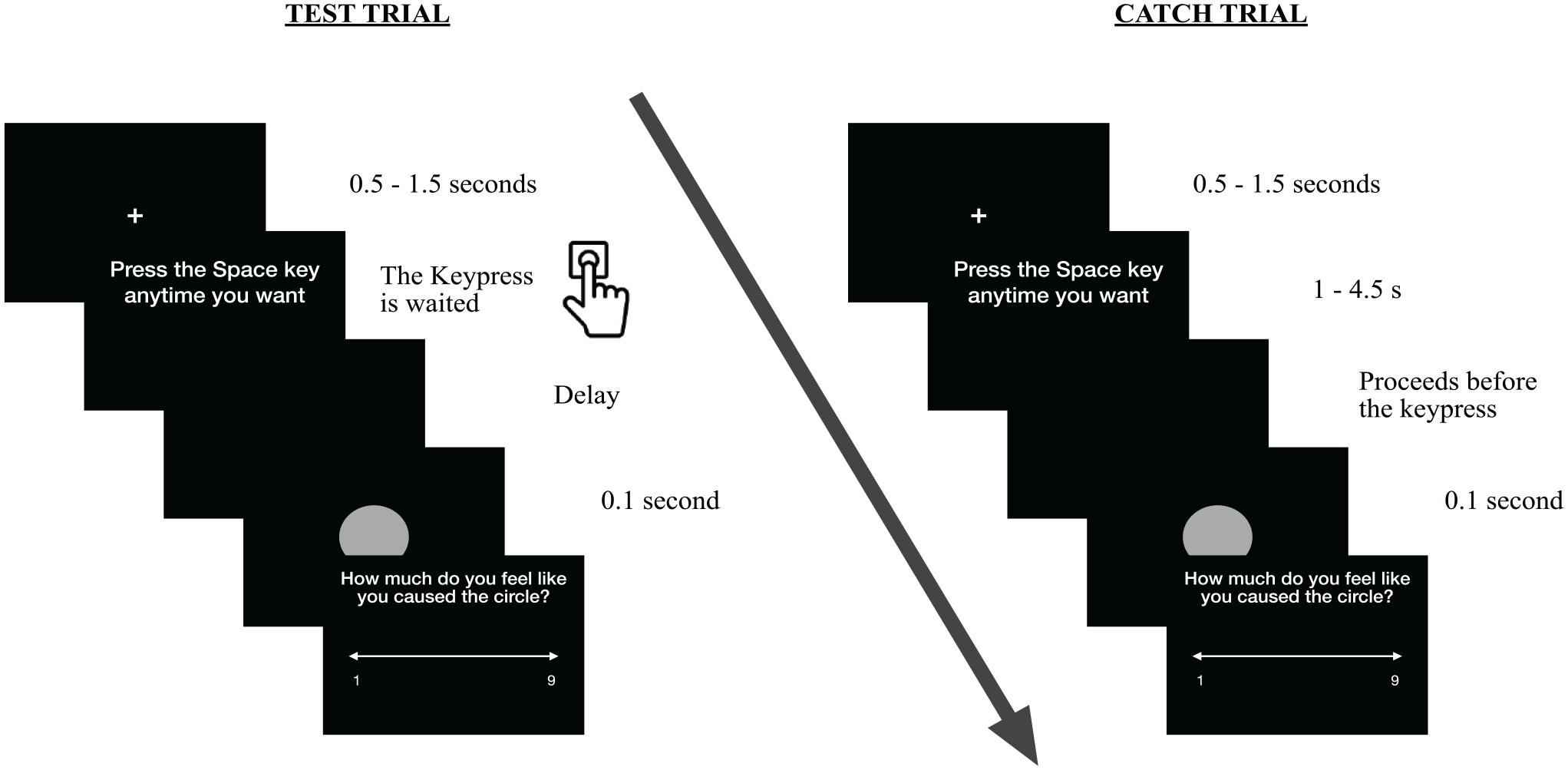
Illustration of the events in test and catch trials.
In the first catch trial, the outcome appeared shortly after the fixation cross disappeared (i.e., 600 ms) to ensure that every participant observed at least one instance of the outcome being generated by the computer. In the second catch trial, the outcome was delayed (3.5 s) to convey variability in the occurrence times. For the remaining catch trials, the outcome was set to appear randomly between 1 and 4.5 s (uniformly distributed) after the fixation cross disappeared. This interval was selected as an approximate range for the outcome appearance in the test trials, considering the keypress times and delays. Although the number of catch and test trials could depend on participants’ response times in the catch trials, there was no significant difference in the number of test trials across delay conditions or groups, as can be seen in detailed reports of trial numbers in the supplementary material. Each trial commenced with an instruction reminding participants that they could press the key at any time. Following this instruction, a white fixation cross appeared at the centre of the screen for a randomly determined duration (uniformly distributed between 500 and 1,500 ms). Subsequently, an instruction reminding participants to press the key appeared at the top of the screen until the agency rating was provided. After the keypress, a grey circle with a diameter of 12% of the screen height appeared at the centre of the screen for 100 ms after a specific delay. Immediately following the presentation of the outcome, participants were prompted to provide their agency judgement. To measure the sense of agency, participants used a continuous slider scale and marked their subjective feeling of causing the circle’s appearance on the screen by clicking the mouse. The endpoints of the slider were labelled as “none (1)” and “entirely (9)”, with each integer marked by a vertical line.
Transparency and openness
All data and analysis code are available at https://osf.io/xzsfr/. We report how we determined our sample size, all data exclusions, all manipulations, and all measures in the experiments. These studies were not preregistered. Experiments were conducted in 2020 during the COVID-19 pandemic as an online study.
Experiment 1—logarithmic scaling
Method
Prior to conducting the study, a power analysis for a mixed analysis of variance (ANOVA) (repeated measures within-between analysis) test with a within measurement with two levels (Lag: short-medium vs. medium-long) and three between subject groups (Group 1, Group 2, and Group 3) with alpha level of 0.05 in GPower 3.1 (Faul et al., 2009) indicated that a sample size of approximately 66 would be necessary to achieve 80% statistical power, assuming an effect size of 0.20 Cohen’s f. This effect size was determined based on pilot data. However, since the study was run online, we recruited a higher number of participants. In the study, 106 university students (Mage = 20.3, SDage = 2.08, Nfemale = 66, Nmale = 33) participated in return for half-course credit. Participants were randomly assigned to one of the following groups with different delay sets: Group 1 (N = 35): 200, 300, 450 ms; Group 2 (N = 35): 300, 450, 675 ms; Group 3 (N = 36): 450, 675, 1,012.5 ms.
Results and discussion
Trials in which keypress time was two standard deviations away from the mean of all keypress times (21 trials, corresponding to 0.2% of all trials), or the key was pressed faster than 100 ms (considered as too fast for a usual reaction time; Welford et al., 1980, 83 trials, corresponding to 0.8% of all trials) 2 were excluded from the data analysis. After excluding outlier trials, the average keypress time was 2.55 s.
Our focus was on the relationship between agency differential and gap types. Yet, we first checked whether the agency rating indeed decreased with delays. Supplementary Table 1A presents the parameters of the raw rating distributions. These values show that raw ratings were highly negatively skewed, particularly in shorter delays, with an average skewness value of −1.11 across each delay condition in each group. To reduce the effect of skewness on the measure of central tendency, we utilised the median of each participant’s ratings in each condition. Figure 2a illustrates the average of these median ratings across the conditions.
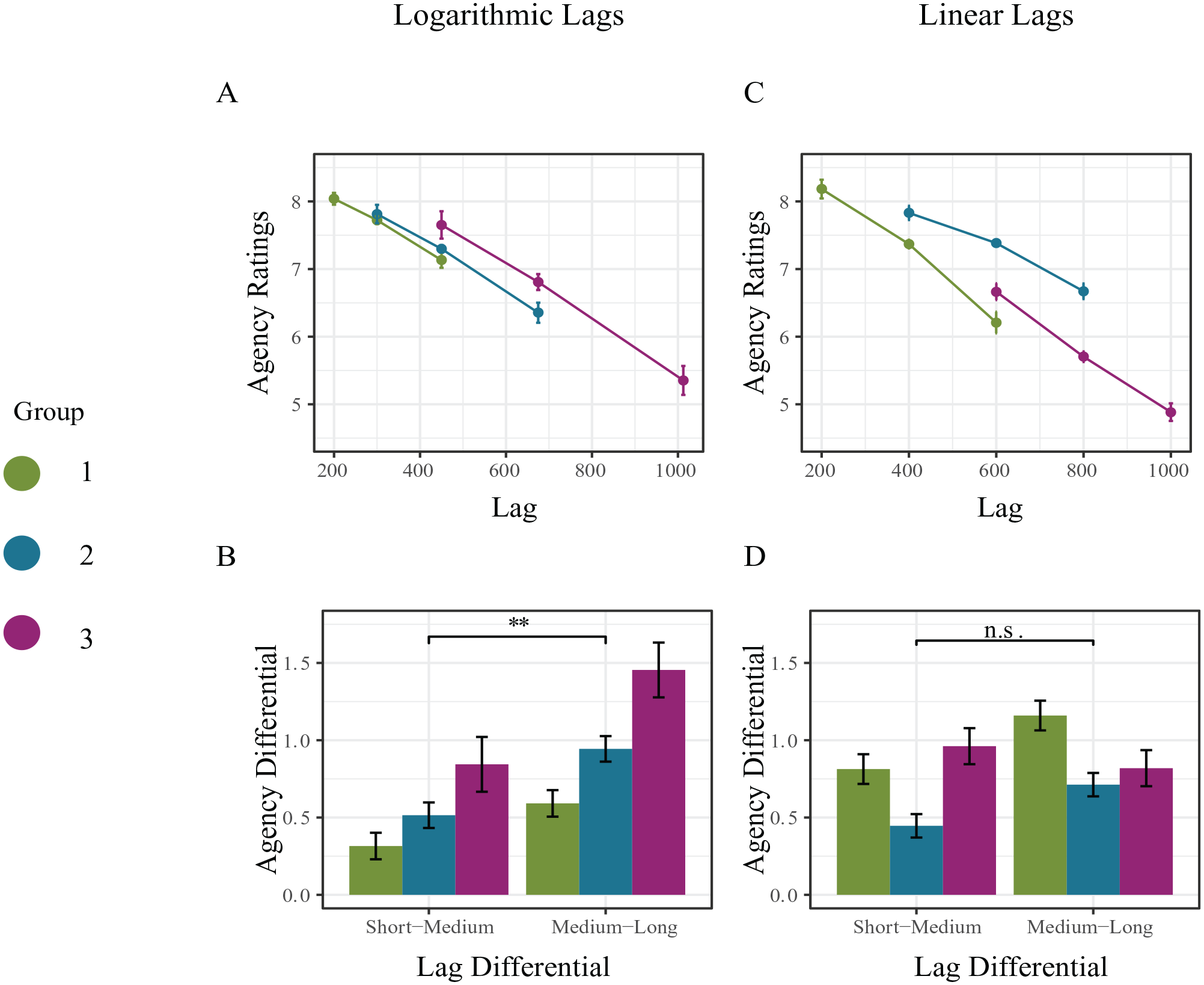
The top row shows the average of the median sense of agency ratings as a function of outcome delay (lag). In the bottom row, the difference between the median sense of agency ratings in consecutive delay conditions is plotted as categorised by the lag differential (short- medium and medium-long) and separate groups.
Figure 2a shows a clear decrease in the average agency ratings with increasing lags. Furthermore, we conducted a 3 × 3 mixed ANOVA on these median ratings, with lag (short, medium, and long) as a within-subjects factor and group (Group 1, Group 2, and Group 3) as a between-subjects factor (with participant included as a random effect to account for individual differences). The results, with Greenhouse–Geisser correction, revealed a significant main effect for lag, F(1.4, 144.62) = 65.38, p < .001, η2 = .388, and group, F(2, 103) = 3.46, p = .035, ηp 2 = .063, as expected. In addition, there was a significant interaction between lag and group, F(2.81, 144) = 4.42, p = .006, η2 = .079, indicating that the agency differential became stronger from Group 1 to Group 3. 3
After confirming the decreasing effect of lag on the sense of agency rating, we investigated whether this agency differential was influenced by the absolute values of the laps. For each participant, we calculated the agency differential as the difference between median ratings in consecutive delay conditions (lag differential: short-medium vs. medium-long). Figure 2b shows the average agency differential across participants in the short-medium and medium-long lag differentials for each group. We conducted a 2 × 3 mixed ANOVA on agency differential with the lag differential as a within-subjects factor and the group as a between-subjects factor by including the participant as a random effect to account for individual differences.
The results showed that in the logarithmically spaced sets, both the lag differential, F(1, 103) = 9.30, p = .003, η2 = .083, and the group had main effects, F(2, 103) = 5.30, p = .006, η2 = .093, on the agency differential while there was no significant interaction F(1, 103) = 0.46, p=.636. Particularly, the agency differential was higher for the medium-long lag differential (M = 1.00, SE = 0.13) than the short-medium lag differential (M = 0.56, SE = 0.10).
Furthermore, Tukey’s post hoc test revealed that although only the difference between Group 1 (M = 0.45, SE = 0.09) and Group 3 (M = 1.15, SE = 0.19) was significant, t(103) = −3.23, p = .005, as Figure 2b shows, the agency differential across lag differentials got systematically stronger from Group 1 to Group 3. The results of the first experiment showed that the sense of agency ratings decreased more strongly between lags with higher differences than the ones with lower differences, even though the subjective discriminability was set to be the same according to Weber’s law. This implies that the sense of agency weakens depending on the objective rather than the cognitive time.
Experiment 2—linear scaling
In the second experiment, we tested whether this conclusion is supported with linearly scaled lag sets. If the sense of agency is modulated by absolute timing, when lags are linearly spaced (i.e., with equal lag differentials), we should see the effect of the lag differential on the agency differential to disappear.
Method
Since the experiment design was identical to the design in Experiment 1, we assumed the same power analysis that we ran in Experiment 1 would apply here. Due to the inherent nature of our online participant recruitment process, we recruited a larger number of participants than originally intended, which led to a discrepancy in sample sizes between the two experiments. Nevertheless, as the purpose of this experiment was to detect a null effect to confirm the results of Experiment 1, the larger sample size here would not alter the implications of the study’s outcomes. In the study, 128 university students (Mage = 21.3, SDage = 1.4, Nfemale = 77, Nmale = 42) participated in return for half-course credit. Participants were randomly assigned to one of three groups with different delay sets. The delay values for each set were as follows: Group 1 (N = 43): 200, 400, 600 ms; Group 2 (N = 42): 400, 600, 800 ms; Group 3 (N = 43): 600, 800, 1,000 ms.
Results and discussion
Trials in which keypress time was two standard deviations away from the mean of all keypress times (79, corresponding to 0.6% of all trials), or the key was pressed faster than 100 ms were excluded from the data (in total of 103 trials, corresponding to 0.8% of all trials). After excluding outlier trials, the average keypress time was 2.43 s.
Before proceeding with our main analysis, we first confirmed that sense of agency ratings decreased with delays. As in Experiment 1, the raw rating distributions were highly negatively skewed, especially for shorter delays, with an average skewness value of −0.94 across each delay condition in each group (Supplementary Table 1B). Given this skewness, we used the median of each participant’s ratings in each condition as the measure of central tendency.
Figure 2c clearly illustrates a decline in ratings with increasing lags. Participants’ median ratings in each condition were then subjected to a 3 × 3 mixed ANOVA, with lag (three levels: short, medium, and long) as a within-subjects and group (three levels: Group 1, Group 2, and Group 3) as a between-subjects factor, by including the participant as a random effect to account for individual differences.
Using the Greenhouse–Geisser correction, the results once again showed a main effect of both lag, F(1.36, 170.43) = 105.59, p < .001, ηp 2 = .458, and group, F(2, 125) = 10.58, p < .001, η2 = .145, on sense of agency ratings, yet this time, without a significant interaction, F(2.73, 170.43) = 2.66, p = .056, η2 = .041. 4
Because our primary research question was particularly whether the agency rating was dependent on the lag differential or not, we again calculated the agency differential for each participant as the difference between median ratings in consecutive lag conditions (lag differentials: short-medium vs. medium-long). Figure 2d demonstrates the average agency differential in each lag differential for each group. We then ran a 2 × 3 mixed ANOVA with lag differential as a within-subject factor and group as a between-subject factor, including participant as a random effect.
As Figure 2d shows, neither the lag differential, F(1, 125) = 1.92, p = .168, η2 = .015, nor the group had main effects, F(2, 125) = 2.83, p = .063, ηp 2 = .043, on the agency differential. The interaction was not significant either, F(2, 125) = 1.80, p = .169, η2 = .028. 5 These results confirmed that the degree of decrease in sense of agency ratings across lags does not significantly differ when the absolute lag differential is kept constant. Corroborating the conclusion of Experiment 1, this finding further supports that the sense of agency weakens depending on the objective rather than subjective time.
General discussion
This study investigated what kind of temporal information (objective or subjective) molds the sense of agency mechanism. Sense of agency ratings in both logarithmically (Experiment 1) and linearly spaced lag sets (Experiment 2) consistently revealed a pattern of decline as a function of objective rather than subjective time. Moreover, this was true for both within-subject (the rating decrease was stronger for the larger lag differential than the smaller lag differential in Experiment 1 and the agency differentials were similar for equal lag differentials in Experiment 2) and between-subject analysis (agency differential was stronger in groups with larger lag differentials in Experiment 1 while there was no such difference across groups when they had constant lag differentials in Experiment 2). Thus, all together, these results imply that the sense of agency is modulated by objective, not cognitive timing.
Numerous studies have delved into the intricate interplay between one’s sense of agency and perception of time. This relationship has been explored from both aspects of how the sense of agency affects time perception as well as how time perception affects sense of agency. For example, on the one hand, it has been consistently demonstrated that individuals tend to perceive the time interval between intentional action and its resulting outcome as shorter compared to an equivalent interval between two external cues (Haggard et al., 2002; see also Le Besnerais et al., 2023 and for objections see Buehner, 2012; Suzuki et al., 2019). On the other hand, the duration of the interval between an intentional action and its subsequent outcome wields a notable influence on both explicit and potentially implicit manifestations of one’s sense of agency (e.g., Dewey & Knoblich, 2014). Nevertheless, to our knowledge, no prior study has investigated how this interval is integrated into the cognitive processes underpinning the formation of one’s sense of agency, either as its objective or perceived value.
The results here replicated the well-known detrimental effect of delay on sense of agency. Interestingly, though, participants not only rated their sense of agency higher in shorter delays but also, apparently, their responses were more consistent as the standard deviations in sense of agency ratings were quite lower in shorter delays while they increased with delays. These results emphasise the importance of exploring standard deviations as another signature of delay’s effect on sense of agency ratings.
The skewness and kurtosis values of the sense of agency ratings showed the opposite pattern of standard deviations: the response distributions for short delay conditions were more skewed than the ones for longer delays. These together (i.e., low standard deviation and larger negative skewness in short delay conditions) indicate that the skewness results from responses being clustered at the high end of the scale.
Alternatively, this observed distribution might indicate a ceiling effect in trials with short delays, which could obscure some variance in sense of agency ratings, especially for short delays. Nevertheless, if the observed skewness for short delays was due to a ceiling effect, we could expect this to be the case across groups for the same delay values. For example, if sense of agency ratings for a trial with 600 ms require a wider response scale as it falls short of capturing the variance, this would be the case regardless of it being a short, medium or long delay in a delay set. Nevertheless, when 600 ms constitutes the long delay (as in Group 3), in contrast to being a medium (Group 2) or short delay (Group 1), ratings are more evenly distributed across the scale. This pattern implies that response certainty increases with shorter delays, and fewer low scores occur in these conditions, resulting in lower standard deviation but higher skewness.
Ultimately, even if skewness results from a ceiling effect, it does not alter the interpretation of the overall findings. Because this phenomenon would be expected in both linear and logarithmic delay scales, the observed differences between these scale types cannot be solely attributed to a potential ceiling effect. Regardless, in future studies using a wider and more granular scale could be a better option especially if the question involves factors modulating the strength of sense of agency slightly to capture variance even at the very high end of the rating scales.
Current findings of objective, rather than perceived time intervals modulating sense of agency ratings, imply a dissociation between the processes of sense of agency and time perception. Similar distinctions were previously postulated between action and perception in the vision literature. It has been claimed that vision-to-act and vision-to-perceive display different patterns in various aspects (Goodale et al., 2004). For example, studies have demonstrated that visual illusions have a limited impact on how individuals configure their fingers before grasping, emphasising a divergence between visually guided actions and visual discrimination. (e.g., Aglioti et al., 1995; Carey, 2001). Consistently, visually guided actions do not present the pattern of Weber’s law while visual discrimination does (Ganel et al., 2014; Hadad et al., 2012).
Importantly, vision-to-act and vision-to-perceive also differ in the metrics they rely on as the former is based on absolute metrics, while the latter does so on relative metrics. These distinctions have been attributed to functional reasons: while visual information used in the action needs to reflect the structure of the real world to be able to act, relative information between the objects is sufficient at the perceptual level. Our finding may imply a potential parallel distinction between temporal information guiding sense of agency processes (i.e., time for agency feeling) and explicit temporal judgments (i.e., time for perception). We may speculate that agents need to perceive temporal relationships between motor actions and their outcomes in an absolute metric to generate causal relationships in the highly dynamic external world, whereas relative temporal information might suffice for perception.
This speculation is particularly relevant to scenarios, such as those explored in this study, involving short delays where interval processing is sensory-based and benefits from automatic processing, as opposed to the ones with longer delays that require the support of cognitive resources (e.g., Lewis & Miall, 2003; Rammsayer & Lima, 1991). Due to such variations between the perception of shorter and longer intervals (see for a review, Grondin, 2010), the reliance on sense of agency to delay information might vary for short and long delays, as well. It might be the case that the automatically processed short delay values are integrated in sense of agency mechanisms with their absolute values whereas longer delays which rely on cognitive resources are processed in the sense of agency mechanism with their perceived values. In future research, it would be worthwhile to explore these questions with a larger delay distribution.
That is why, the results of this study are especially surprising because the type of sense of agency that was the target of this article is explicit and at the judgement level instead of the implicit and automatic feeling. Other explicit cognitive processes, which are known to happen at this reflective level, such as intertemporal decision-making (Yang et al., 2021) and chronologically ordering events (Naim et al., 2021) use cognitive timing. Although this precise question hasn’t been directly investigated previously, there are indirect insights from other studies that suggest the strength of one’s sense of agency is likely linked to the perceived, rather than absolute, time intervals. For example, research indicates that when individuals repeatedly engage in an action/outcome sequence with a specific delay, if the outcome occurs with a shorter delay than the practised delay, it’s perceived as if it happened before the actions (Stetson et al., 2006). In such situations, individuals also tend to feel that they did not cause the outcome due to their expectations regarding the temporal sequence of causes and effects (Timm et al., 2014). In a different study, participants reported a greater sense of agency over outcomes associated with longer and practised delays compared to outcomes with shorter but novel delays (Haering & Kiesel, 2015). However, in both these example cases, the situation might be mostly relevant to the violation of statistical learning and explicit or implicit expectations rather than the direct role of timing mechanisms in the emergence of the sense of agency. In this study, however, the only difference across delay set conditions is directly related to the perceptual mechanisms of interval timing. It is possible that our participants were not even aware of the scaling of intervals to a level that they can develop an expectation, which future studies should address.
Although this study investigated the effect of delay between action and outcome on sense of agency, the agency itself is also known to affect the perception of the interval between the action and outcome. For example, Le Besnerais et al. (2023) have recently found that action influences the perception of the speed of movement pointing to a potential relationship between action and time perception. In support of this rationale, Haggard et al. (2002) found that when a stimulus is caused by an action it is perceived as occurring earlier compared to the absence of an action a phenomenon known as intentional binding. Any effect that action might have on the perceived time can be additive or proportional.
Previous research on this topic has examined how time estimation varies with action compared with a baseline condition (Wen et al., 2015). A regression analysis on participants’ time estimation responses and delay revealed that the regression slope was shallower in the action condition compared with the baseline, while the intercepts remained consistent across both conditions. This suggests that the influence of action on time perception is proportional rather than additive. Future research can focus further on the nature of bi-directional relationship between time intervals and agency.
One limitation of this study is that we did not request participants to explicitly estimate the time intervals; instead, we assumed that discriminability adheres to Weber’s law. We opted for this approach to avoid introducing experimental expectations related to the impact of intervals on the sense of agency, which could have caused participants to link the delays with their agency judgments. In addition, even if we had requested explicit time estimations, this might not have accurately reflected participants’ perceived outcome delays used in agency judgement anyway. Using time as an implicit information for a separate task like making an action has been found as different in various forms than perceptual estimation of the time (Soltanlou et al., 2020). Even though this study did not involve the direct measurement of participants’ time perception, there is ample evidence regarding the ubiquity of Weber’s law in time perception (e.g., Allan & Kristofferson, 1974; Aydoğan et al., 2024; Divenyi & Danner, 1977; Getty, 1975; Killeen & Weiss, 1987; Thompson et al., 1976; Treisman, 1963), including implicit timing (Piras & Coull, 2011).
Alternatively, one could argue that the perceived duration between actions and outcomes follows a distinct pattern than predicted by Weber’s law because making an intentional action itself affects the perceived outcome interval, as mentioned above. For instance, there may be subjective compression of the outcome interval in short durations, with this compression weakening in longer durations (Imaizumi & Tanno, 2019; though look for the opposite findings Wen et al., 2015). Nevertheless, if the perceived duration is compressed based on interval length, which might elucidate the pattern in Experiment 1, one would expect this to be reflected in Experiment 2, as well. Contrarily, the strength of sense of agency exhibits a pattern best explained with absolute temporal scaling: higher differences across delays consistently yield a more pronounced drop in sense of agency ratings in Experiment 1, while a constant delay difference in Experiment 2 results in a more uniform decline in sense of agency ratings. Given that we collected data from more than twice the number suggested by power analysis, overlooking any potential effect of delay difference in Experiment 2 is highly unlikely, while the effect of delay difference on a drop in sense of agency ratings is systematically consistent across three groups in Experiment 1. Consequently, even if the perceived outcome interval deviates from the exact pattern predicted by Weber’s law, the central finding of the study—that absolute rather than perceived interval perception influences the intensity of sense of agency—remains valid.
Perhaps, a more straightforward approach to test whether the strength of sense of agency relies on the perceived or the absolute outcome delay would be manipulating the perceived time, rather than assuming a disparity between the perceived and absolute intervals. Nonetheless, the factors affecting time perception such as attention, mood, task difficulty, or cognitive load also may affect the strength of agency perception. To this end, we chose to try different temporal contexts for outcome intervals (i.e., linear vs. logarithmic interval scaling)—known to effectively modify temporal discriminability—to selectively manipulate perceived time while not directly interfering with agency judgement processes. This study is the first step in an attempt to answer this question. A follow-up study could examine the same question by manipulating time in more direct ways.
Even though the current research question is framed as the relationship between temporal interval perception and sense of agency as a general term, our study specifically investigated this question within the context of a single action. However, it is not certain that mechanisms of sense of agency for single and continuous actions are the same. Although the differentiation between these two types of actions represents an important avenue for future exploration, this study primarily sought to gain insights into how temporal intervals are processed within the mechanisms of the sense of agency. For this purpose, the selected action type needed to be particularly susceptible to the influence of outcome delays. There is evidence that in continuous actions, the delay does not affect the sense of agency to the same extent due to all the differences in the accumulation of information regarding the action/outcome relationship (e.g., Wen, 2019).
Similarly, this study does not say anything about the implicit sense of agency but rather exclusively focuses on the explicit level of sense of agency. One could expect current results more likely to be present in the implicit sense of agency since the implicit level of agency is automatic and is informed by sensorimotor processes (e.g., Synofzik et al., 2008). Having said this the most commonly used measure of implicit sense of agency—looking at the compression of the perceived delay between an action and outcome—involves time perception, itself (Haggard et al., 2002). Having said this, there are criticisms on using temporal binding as a measure of implicit sense of agency, in general, as it has been claimed to exhibit causality (e.g., Buehner & Humphreys, 2009) without necessarily involving intentionality or agency. Furthermore, there is no consensus on whether delay decreases or increases temporal binding in the first place (see Reddy, 2022, for a review). Therefore, it is difficult to make a prediction about the current question for implicit sense of agency, at least based on the existing methods. It is an interesting question, for further studies, to compare whether implicit and explicit sense of agency exhibit different patterns regarding the incorporation of time information into their mechanisms.
The findings of this study not only provide insight into how outcome delay impacts the sense of agency but also offer implications for understanding the broader mechanism of the sense of agency. In our daily lives, a significant portion of our sense of agency operates automatically without requiring conscious effort or explicit judgement. It has been proposed that there are fundamental distinctions between this automatic sense of agency and the conscious, explicit judgement of agency, given that the latter necessitates deliberate effort (Synofzik et al., 2008). However, our study suggests that even explicit judgments of agency could be influenced by factors that extend beyond conscious awareness and cognitive control.
Supplemental Material
sj-pdf-1-qjp-10.1177_17470218241306433 – Supplemental material for Absolute, not perceived, delay modulates agency judgement: Evidence for cognitive impenetrability of sense of agency
Supplemental material, sj-pdf-1-qjp-10.1177_17470218241306433 for Absolute, not perceived, delay modulates agency judgement: Evidence for cognitive impenetrability of sense of agency by Merve Erdoğan and Fuat Balcı in Quarterly Journal of Experimental Psychology
Supplemental Material
sj-pdf-2-qjp-10.1177_17470218241306433 – Supplemental material for Absolute, not perceived, delay modulates agency judgement: Evidence for cognitive impenetrability of sense of agency
Supplemental material, sj-pdf-2-qjp-10.1177_17470218241306433 for Absolute, not perceived, delay modulates agency judgement: Evidence for cognitive impenetrability of sense of agency by Merve Erdoğan and Fuat Balcı in Quarterly Journal of Experimental Psychology
Footnotes
Declaration of conflicting interests
The author(s) declared no potential conflicts of interest with respect to the research, authorship, and/or publication of this article.
Funding
The author(s) received no financial support for the research, authorship, and/or publication of this article.

Data accessibility statement
Supplementary material
The supplementary material is available at: qjep.sagepub.com.
Notes
References
Supplementary Material
Please find the following supplemental material available below.
For Open Access articles published under a Creative Commons License, all supplemental material carries the same license as the article it is associated with.
For non-Open Access articles published, all supplemental material carries a non-exclusive license, and permission requests for re-use of supplemental material or any part of supplemental material shall be sent directly to the copyright owner as specified in the copyright notice associated with the article.
