



Abstract
This study investigates the self-reference effect (SRE) with an ownership memory task across several age groups, providing the first age exploration of implicit ownership memory biases from adolescence to older adulthood (N = 159). Using a well-established ownership task, participants were required to sort images of grocery items as belonging to themselves or to a fictitious unnamed Other. After sorting and a brief distractor task, participants completed a surprise one-step source memory test. Overall, there was a robust SRE, with greater source memory accuracy for self-owned items. The SRE attenuated with age, such that the magnitude of difference between self and other memory diminished into older adulthood. Importantly, these findings were not due to a deterioration of memory for self-owned items, but rather an increase in memory performance for other-owned items. Linear mixed effects analyses showed self-biases in reaction times, such that self-owned items were identified more rapidly compared with other owned items. Again, age interacted with this effect showing that the responses of older adults were slowed, especially for other-owned items. Several theoretical implications were drawn from these findings, but we suggest that older adults may not experience ownership-related biases to the same degree as younger adults. Consequently, SREs through the lens of mere ownership may attenuate with age.
Introduction
Our sense of Self is based on the accumulation of autobiographical memories over time (Conway, 2005; Conway & Pleydell-Pearce, 2000; W. James, 1890) and our understanding of our unique traits and characteristics, values, abilities, and social roles (Harter, 2012; W. James, 1890). Self-representation refers to the mental depiction of ourselves, our experiences (episodic memories), and our connections with others (Markus & Wurf, 1987). The development and consciousness of the Self undergoes transformations in response to new experiences, biological changes, and evolving societal contexts (Pfeifer et al., 2013), raising questions about the cognitive implications of these shifts. Specifically, the current study aims to explore how such changes might influence cognitive mechanisms that underpin memory biases in response to self-relevant information.
A measure of self: the self-reference effect
One way to demonstrate the effect of Self on cognition is to examine its effects through the measurement of the self-reference effect (SRE); a well-established memory bias evidenced by improvement in episodic memory when encoded information is self-relevant (Cunningham et al., 2008; Klein & Loftus, 1988; Rogers et al., 1977; Ross et al., 2011; Symons & Johnson, 1997). Such improvement is seen, for example, through greater accuracy and speed in recall of information processed in relation to the Self, as opposed to Others (see Symons & Johnson, 1997 for a meta-analysis). In a seminal paper, Rogers et al. (1977) presented participants with trait adjectives (e.g., funny, intelligent, friendly) and asked them to determine whether each accurately described their own personality. They then compared this with other types of encoding strategies (structural, phonemic, and semantic encoding). In a subsequent surprise memory test, self-referential encoding led to better word recall compared with all other conditions (Rogers et al., 1977). This improved memory performance was ascribed to the cognitive and neural representations that are activated when the Self is salient, which facilitates the encoding, organisation, and retrieval of such information (Klein & Loftus, 1988).
The SRE is robust and has been demonstrated in various memory contexts (Denny & Hunt, 1992; Kuiper & Derry, 1982; Sanz, 1996; Sedikides & Green, 2000). Many experimental paradigms require participants to retrieve self-knowledge during encoding, a process known as evaluative self-referencing (Ross et al., 2011; Turk et al., 2008). However, self-referencing can also occur implicitly, under conditions of arbitrary stimulus assignment to the Self or the Other, where elements of agency and self-evaluation are removed (Clarkson et al., 2022; Cunningham et al., 2008; Ross et al., 2011; Sparks et al., 2016; Sui et al., 2012; Turk et al., 2008). There is also evidence that shows self-referencing can occur incidentally, even when the trait words did not require evaluation, and were simply placed in proximity to one’s own name (Ross et al., 2011; Turk et al., 2008). In addition, the SRE can be seen in contexts absent of self-cues, as seen when individuals remember birthdays closer to their own versus others,’ including those of newly introduced strangers (Kesebir & Oishi, 2010). In summary, the SRE is well established, whether the information is encoded through deliberate evaluation, implicitly or incidentally.
The SRE across age groups
While most studies have concentrated on younger adults, increasingly research is evaluating the SRE across a range of age groups. For example, Ross et al. (2011) and Cunningham et al. (2014; see also Andrews et al., 2020) established that 3- and 4-year old children show a memory bias for objects shown with the self-image, and this bias persists in later childhood (Bennett & Sani, 2004; Halpin et al., 1984; Pullyblank et al., 1985; Ray et al., 2009). It may still be developing, however, as Hutchison et al. (2021) reported a significant increase in SRE magnitude between 10- and 11-year-old children and adults. The stage between childhood and adulthood (i.e., adolescence) has received less attention. During adolescence, individuals often display increased self-awareness and self-consciousness as the self-concept matures (Beesdo et al., 2009; Beesdo-Baum & Knappe, 2012; Caouette & Guyer, 2014; Elkind & Bowen, 1979; Rankin et al., 2004; Somerville et al., 2013), which may exacerbate SREs. Supporting this suggestion, Moses-Payne et al. (2022) tested females aged 11–30 years on a task that required encoding trait adjectives in relation to either themselves or a well-known stranger. Adolescent girls remembered self-relevant trait words more accurately than their older counterparts, especially when the adjectives were negative. As the authors argued, these findings might reflect the fluctuating development of the self-concept during adolescence, as indicated by the enhanced processing of self-referent information.
In addition to fluctuations during adolescence, there may be SRE changes in later adulthood. The effectiveness of memory-enhancing strategies becomes especially relevant in older age groups, where memory decline is prevalent. The process of ageing is characterised by a decline in various cognitive functions such as working memory, executive function, and processing speed (Murman, 2015; Park et al., 2002; Salthouse, 1996). However, older individuals can still improve their memory using specific encoding techniques (see Craik & Rose, 2012). Studies that employ self-knowledge evaluation frameworks have also explored the SRE in older populations (Gutchess et al., 2007; Hamami et al., 2011; Hou et al., 2019; Leshikar et al., 2015). Some research findings support enhanced memory in response to self-referential encoding in older adults, but these benefits may not enhance their memory capabilities to the level of younger adults (Gutchess et al., 2007, 2010). While Gutchess and colleagues (2007) found only a modest improvement in memory among older adults with the SRE, other research indicates that the benefits are comparable to those experienced by younger adults (Glisky & Marquine, 2009; Hamami et al., 2011; Lalanne et al., 2013; Leshikar, Park & Gutchess, 2015; Mueller et al., 1986; St. Jacques & Levine, 2007; Trelle et al., 2015). The extent to which SREs persist in older adulthood is, however, currently unclear.
SRE measurement: alternative paradigms and methods
Investigating lifespan self-biases in the memory SRE is complicated by the use of trait adjectives: participants must have an established vocabulary to understand the words they are encoding. If the participant is unable to understand the word, or interprets it differently from another participant, this increases the variability in responses. Thus younger children are often omitted from trait adjective paradigms (Cunningham et al., 2013, 2014). Moreover, the developmental period can interact with the valence of the trait words. For example, during adolescence, a period marked by rapid self-concept development, there is a direct influence on the recall of negative trait words compared with adults (Moses-Payne et al., 2022).
To avoid the issues arising from use of stimulus words in SRE tasks, the object ownership paradigm was developed as an alternative way to explore these memory biases. This task is intrinsically linked to the Self but does not require self-evaluation, or conscious awareness. Since individuals need to understand the Self to display these memory self-biases, the age at which ownership self-bias emerges may coincide with the developmental stage where individuals begin to differentiate their sense of Self from others (Rochat, 2009). Ownership understanding manifests at an early age. For example, toddlers can identify their own possessions, as well as those belonging to their parents and others (Brownell, 2013; Fasig, 2000). Ownership disputes are common among young children (Ross, 1996; Shantz, 1987), and ownership evokes higher preferences for those objects (Gelman et al., 2012). Ownership also influences sensorimotor processes in children. This is evident in how children interact with physical objects in their environment, indicating an established association with them. For instance, children as young as 2 years old positioned their own drink bottles (an item they possessed for 2 weeks) significantly closer to themselves compared with an experimenter’s bottle (Kritikos et al., 2020). This sensorimotor component is further complemented by a semantic understanding of ownership. Remarkably, there is evidence that children as young as 12 months old can differentiate possessive pronouns, suggesting that the Self as a distinct concept, encompassing both semantic and sensorimotor components, can emerge during infancy (Saylor et al., 2011).
Instead of encoding trait adjectives, ownership memory tasks require participants to encode information as belonging to the self or an Other, and subsequently testing their memory for these items (Clarkson et al., 2022; Collard et al., 2020; Cunningham et al., 2008; Sparks et al., 2016). Allocation of ownership initiates a variety of psychological processes that may enhance an item’s actual value (see The Endowment Effect; Beggan, 1992; Kahneman et al., 1990; Thaler, 1980) through connection to the Self (Belk, 1988). In such paradigms, owned items have been shown to enhance memory and evoke positive affect (Beggan, 1992; Belk, 1988, 1991; Collard et al., 2020; Cunningham et al., 2008; Sparks et al., 2016; Van den Bos et al., 2010). Response times to owned items are often faster, with participants routinely requiring less information to make a correct decision about a self-owned/self-related stimulus (Golubickis et al., 2018, 2019, 2020; Payne et al., 2021; Sui & Humphreys, 2012). This connection between owned objects and the Self (Beggan, 1992; Belk, 1988, 1991; Collard et al., 2020) results in greater memory accuracy for self-owned compared with other-owned objects, even if ownership is transient, virtual, and arbitrary (Clarkson et al., 2022; Cunningham et al., 2008; Sparks et al., 2016).
Ownership memory effects have been found in children as young as 4 years old (Cunningham et al., 2013; Ross et al., 2011). Ross et al. (2011) found that young children showed a memory bias for images of animals assigned to their own “zoo” rather than the experimenters’ zoo. The effect was evident immediately, and for up to a week after ownership was assigned. Similarly, Cunningham et al. (2013) showed that young children demonstrated more accurate recall of images of toys assigned to them than those given to another child. Importantly, ownership effects could provide a window into the lifespan development of SREs. While there are mixed effects associated with standard SRE trait tasks in old age, the ownership paradigm is suitable for all age groups. Although limited research has explored ownership memory biases in older adults, some studies have used self-referential evaluation of objects to improve memory, suggesting tasks of this nature have potential. For example, in a series of experiments, Hamami et al. (2011) found that self-referencing enhances general and specific recognition of visual details and source details for objects in younger and older adults. Dulas et al. (2011) also found evidence of self-referencing for source memory of objects in both older and younger adults, as well as showing event related potential (ERP) results that revealed earlier old–new effects for self-referentially encoded items in both age groups.
However, memory for visual objects may not be the same as implicit ownership. The process of categorising items as something a participant likes or dislikes involves a degree of agency that may not be present in mere ownership paradigms. Ownership studies are unique in that participants are simply instructed to move items into a symbolic basket or bag that represents ownership and through this agency may be less salient or removed. Few studies have examined the effects of ownership self-referencing in older adults, including Daley and colleagues (2020), who found that both older and younger adults demonstrated the SRE when asked to imagine certain objects as belonging to themselves, or another. Interestingly, Daley and colleagues (2020) also found no significant interaction between the age groups, or any differences in overall memory performance. These findings illustrate the nuanced relationship between age, self-referencing, and ownership, suggesting that while self-referential encoding may generally enhance memory across age groups, the mechanisms underlying these effects can differ, particularly when it comes to the concept of ownership.
Examining the lifespan trajectory of ownership memory effects could reveal differences in the conceptualisation of Self and Other at various developmental stages. Aspects of the Self alter as individuals transition from adolescence and young adulthood into older adulthood (Cotter & Gonzalez, 2009). For instance, many older adults experience significant shifts in their professional and personal lives, such as retirement, changing living arrangements, and changing relationships, which can have profound impacts on Self perceptions and understanding (Kim & Moen, 2002; Wahl et al., 2012). Sometimes, important possessions take on a heightened role in the preservation of memory and identity for older adults (Kleine & Baker, 2004), although some research suggests that as people age, they may become less attached to some material possessions (Lastovicka & Fernandez, 2005). Socioemotional selectivity theory postulates that as people age and perceive their time as limited, they prioritise emotionally meaningful goals and therefore place less importance on personal possessions (Carstensen, 1991). Given these developmental shifts, and their potential impact on Self-referencing, there is much to gain from further interrogating such memory bias on the performance of older, relative to younger, adults. In addition, ownership tasks offer a scalable solution for testing such memory biases across a wide variety of ages.
The current study
The primary objective of this study is to investigate the developmental trajectory of the ownership self-reference effect (OSRE) from adolescence through young adulthood, middle age, and into older adulthood. Although previous research on ownership memory effects has primarily focused on young adults and young children, fewer studies have examined object or ownership effects across the lifespan to be inclusive of older adults (Daley et al., 2020; Dulas & Duarte, 2011; Hamami et al., 2011), and none to date have explored the nature of implicit ownership memory effects in adolescents. In the current design, we purposefully chose to make the “Other” an unknown stranger where participants were only told that they would be participating with “another participant.” This decision was made to maintain neutrality, because relationships with the Other are known to modulate SREs and SPEs reliably (Aron et al., 1991; Mashek et al., 2003; Sui & Humphreys, 2012, and for a more recent example, Rosa et al., 2024). There is also evidence that additional information about a stranger can modulate SRE processes (see Clarkson et al., 2022). A distant other was chosen to control for these influences. In addition, employing a distant other establishes a foundation where any observed effects can be ascribed to self-specific processing. Unlike other SRE studies that compare self-referencing with other encoding strategies (e.g., in a semantic condition, where participants determine whether a word is positive or negative), we minimise the possibility that the effects could be attributed to some other form of social processing responsible for memory enhancement. In our planned (preregistered) hypotheses, we predict a main effect of Self-reference, leading to better source memory accuracy for self-owned items compared with items owned by others (reflected by corrected hit rates). Source memory was selected as the metric for assessing memory biases because it provides strong evidence of self-referential encoding. Unlike recognition memory, which may be influenced by heightened familiarity and does not distinguish whether an item was actually associated with the Self or another (Durbin et al., 2017). In line with the findings from Moses-Payne and colleagues (2022), we anticipate that in adolescents, the magnitude of the SRE will be greater than in older age groups. We expect this to occur given that adolescence is the time in which the cognitive representation of oneself develops and individuates from their parents, and becomes increasingly self-focused (Ray et al., 2009). In older adults, we expect that the degree of self-bias will gradually attenuate. In line with this, we therefore expect an interaction with the degree of self-referencing and age. We also test some exploratory (non-preregistered) hypotheses.
Specifically, we predict a self-bias in reaction times, as demonstrated in previous studies (Cunningham et al., 2008; Golubickis et al., 2019; Sui & Humphreys, 2012). Participants are expected to have the fastest reaction times for self-owned items compared with other-owned items, despite reaction times overall increasing with age (Hardwick et al., 2022; Ratcliff et al., 2001). These results should be demonstrated with main effects of object categorisation.
Method
Participants and design
Recruitment and ethics
Participants for the young adult sample were recruited through the University of Queensland’s SONA Systems from a course credit pool. Healthy older and middle-aged adults were recruited from community Facebook groups and the local community. For the adolescent sample, we worked with a participating school which sent the study to middle and senior school students who volunteered with parental consent. All participants were reimbursed with US$20 gift cards except undergraduate students, who were reimbursed with university course credit. This study was approved by the Human Research Ethics Committee (HREC; #2019001659).
Design
We preregistered the initial design as a 4 (Age: adolescent, young adult, middle aged adult, and older adult) × 2 (Ownership: self and other) mixed design, where Age was a between-groups factor and Ownership was a within-groups factor. However, given the wide spread of our recruited age group (see Figure 1) lending itself to being continuous in nature, and considering the developmental fluctuations that occur between ages 12 and 17 for adolescents (Steinberg, 2005), we treated age as a continuous rather than a categorical factor. We have included the analyses for age treated as a categorical variable in the electronic supplementary materials.
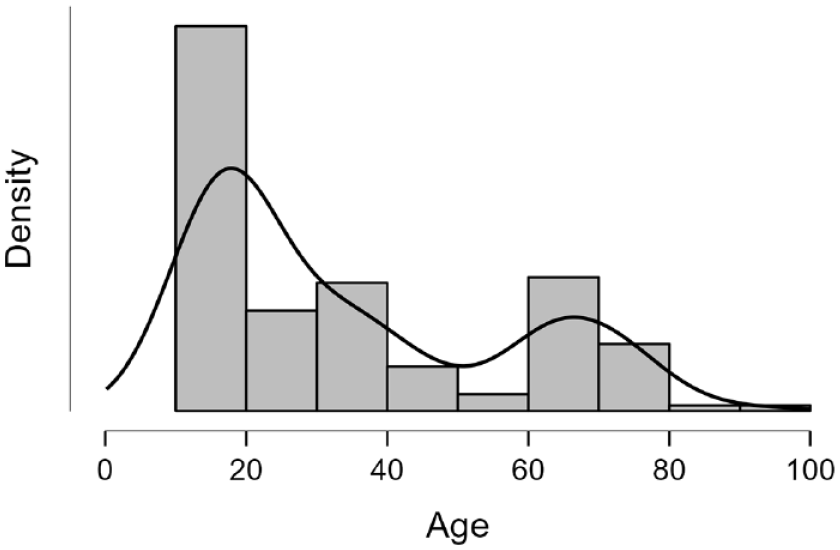
Age distribution across the entire participant sample.
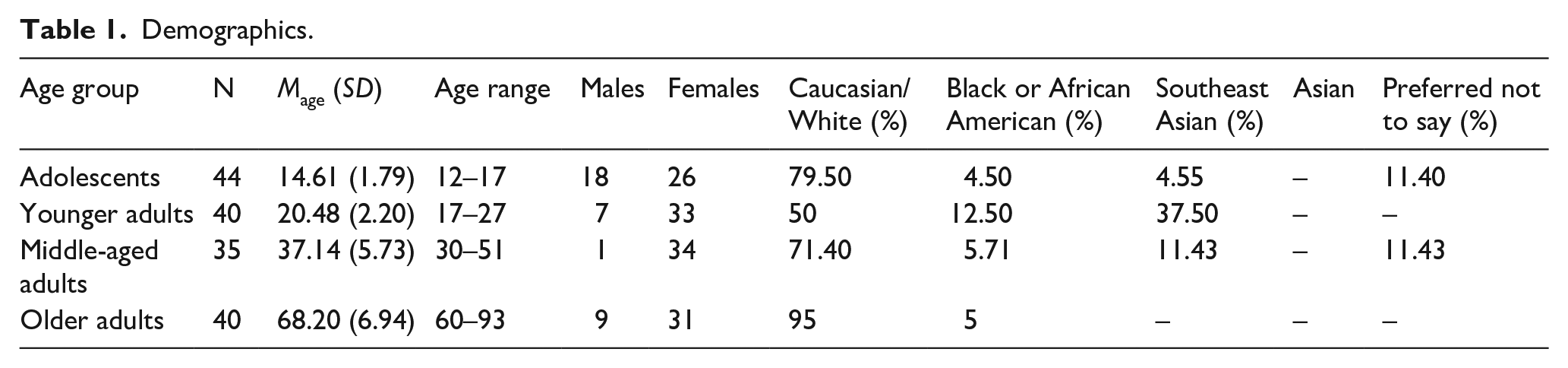
Demographics.
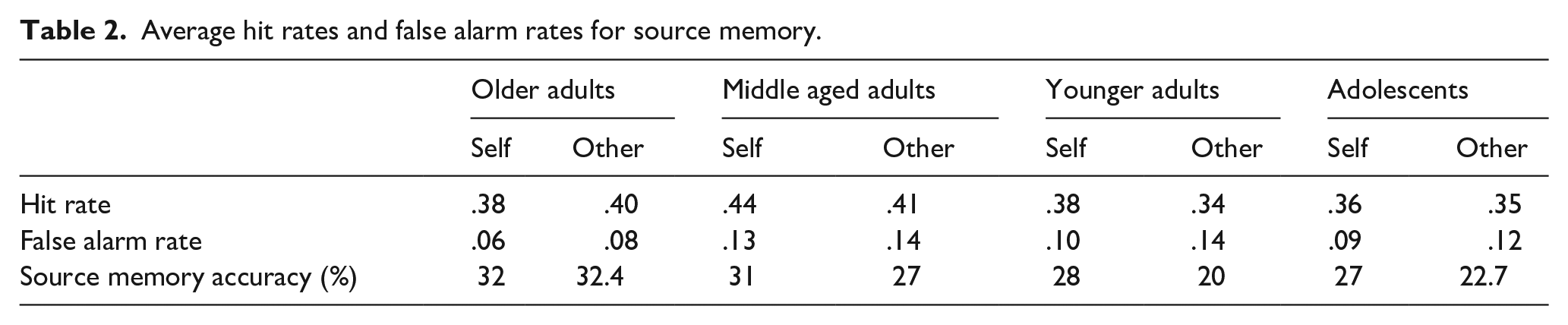
Average hit rates and false alarm rates for source memory.
Apparatus and stimuli
This study was administered online using GORILLA Experiment Builder (Anwyl-Irvine et al., 2020). De-identified data is available on OSF (https://osf.io/t24m5/).
Procedure
All participants gave informed consent before participating, were told that they could withdraw at any time without penalty, and that they had to complete the experiment in one sitting. Older adults were required to confirm that they had no history of neurological disorders, psychiatric or cerebrovascular conditions, and that they had good/corrected vision before completing the experiment. Following this, participants were told they were about to play a “shopping game” and had “won” a set of items with another participant and were required to sort the items. They were randomly allocated a blue or red bag on the left or right side of the screen, with the other participant owning the opposite bag, and were informed they would see items appear sequentially in the centre of the screen (between the bags) and shortly after, a coloured cue would appear (red or blue) indicating the item ownership. Once ownership was identified, participants were required to move the item from the centre of the screen into the corresponding bag using arrow keys on the keyboard.
Participants then needed to respond correctly to multiple manipulation checks to ensure they understood ownership assignment. The practice task consisted of four images of animals (to be distinctly different from the item set in the experimental task). Participants were given feedback on their accuracy in sorting these items, and incorrect responses prompted the participant to repeat the action until they answered correctly.
Once the practice phase was successfully completed, the experimental task began. Participants sorted a total of 100 items that were drawn from two of three item lists and that were counterbalanced across participants. This item set has been used in previous SRE research (Cunningham et al., 2008), and contained objects typically available in shopping centres. The bags appeared for 500 ms on the left and right of the monitor. An object subsequently appeared in the centre of the monitor and between the bags for 2,000 ms, after which coloured lines appeared above and below the object to indicate the owner of the item. These lines remained until the trial was complete. Participants were instructed to use the left or right arrow keys to move the object to the left or right bag, respectively; 2,000 ms was allocated to the participant to begin moving the item from cue colour onset. If they did not respond, the next trial began. If they began to move the item, participants had up to 5,000 ms to complete the trial and move the item completely into the bag using the left and right arrow keys (see Figure 2).
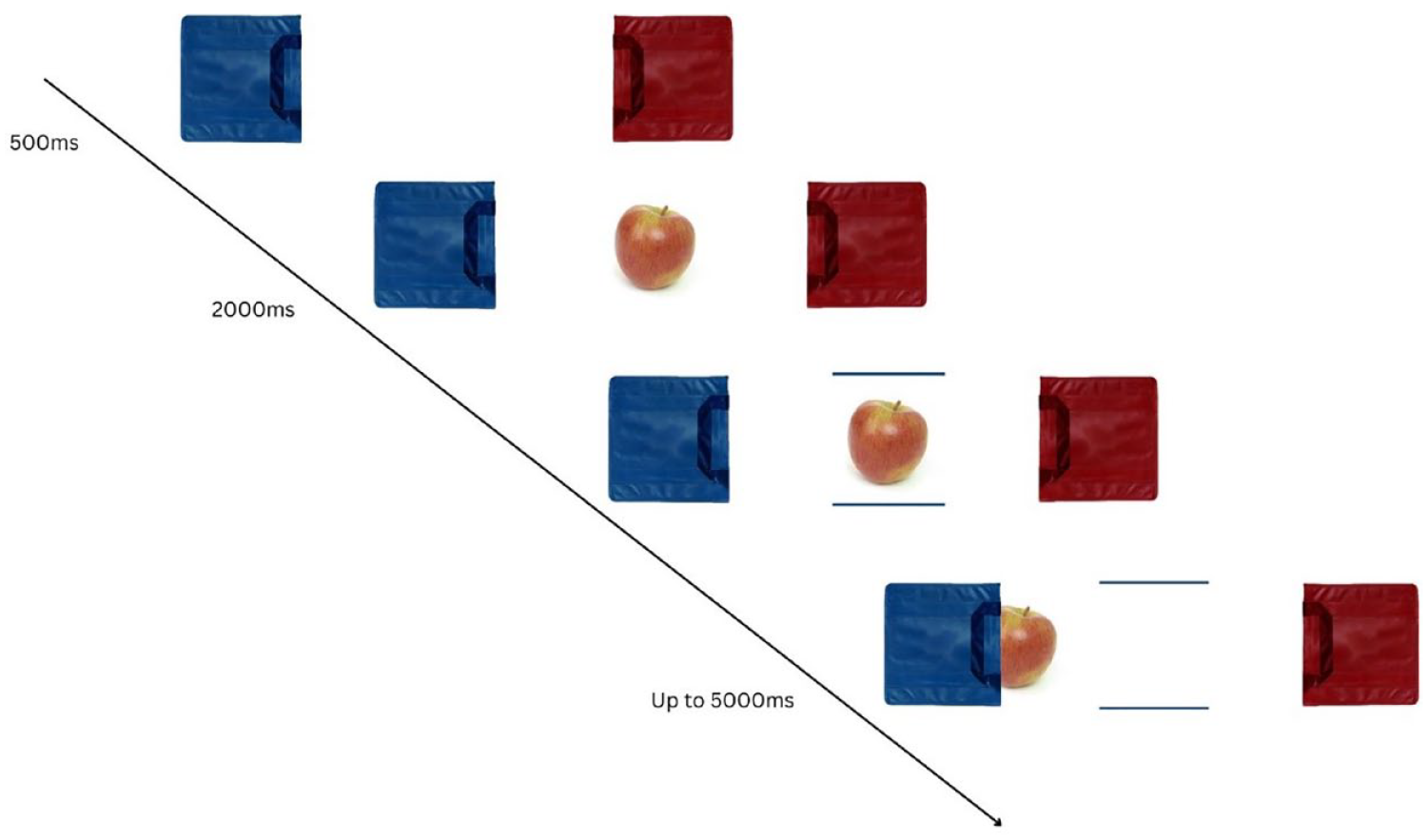
Representation of the encoding task. Items appear sequentially, followed by a colour and reward cue that indicates ownership.
At the end of the allocation component of the task, participants were asked again to identify the owner of each bag, and they received the value of their own items as a final manipulation check. They were then directed to watch a 2:23-min filler video containing images of space and satellites as a distractor task, to prevent any rehearsal of the material, and were asked brief questions about the likeability of the video through a brief survey. Participants were then directed to a surprise one-step source memory test. They were told that they were about to see the same items again, with additional items that they had not seen before. They were asked to identify using their right hand if the item was theirs (I) the other participant’s (O), or one they did not recognise (P). If they were unsure, they were told to take their best guess. This one-step memory test measures both recognition and source memory, replicated from Clarkson et al. (2022) and Collard et al. (2020). Items were presented consecutively at random with all 100 items that they previously allocated to bags, with 50 new (foil) items that they had not seen before, a total of 150 trials (see Figure 3). Participants were given an unlimited amount of time to respond to each time and the next trial would begin once they gave a response, but responses were removed if <150 ms or >10,000 ms. At the completion of the memory test, participants were debriefed.
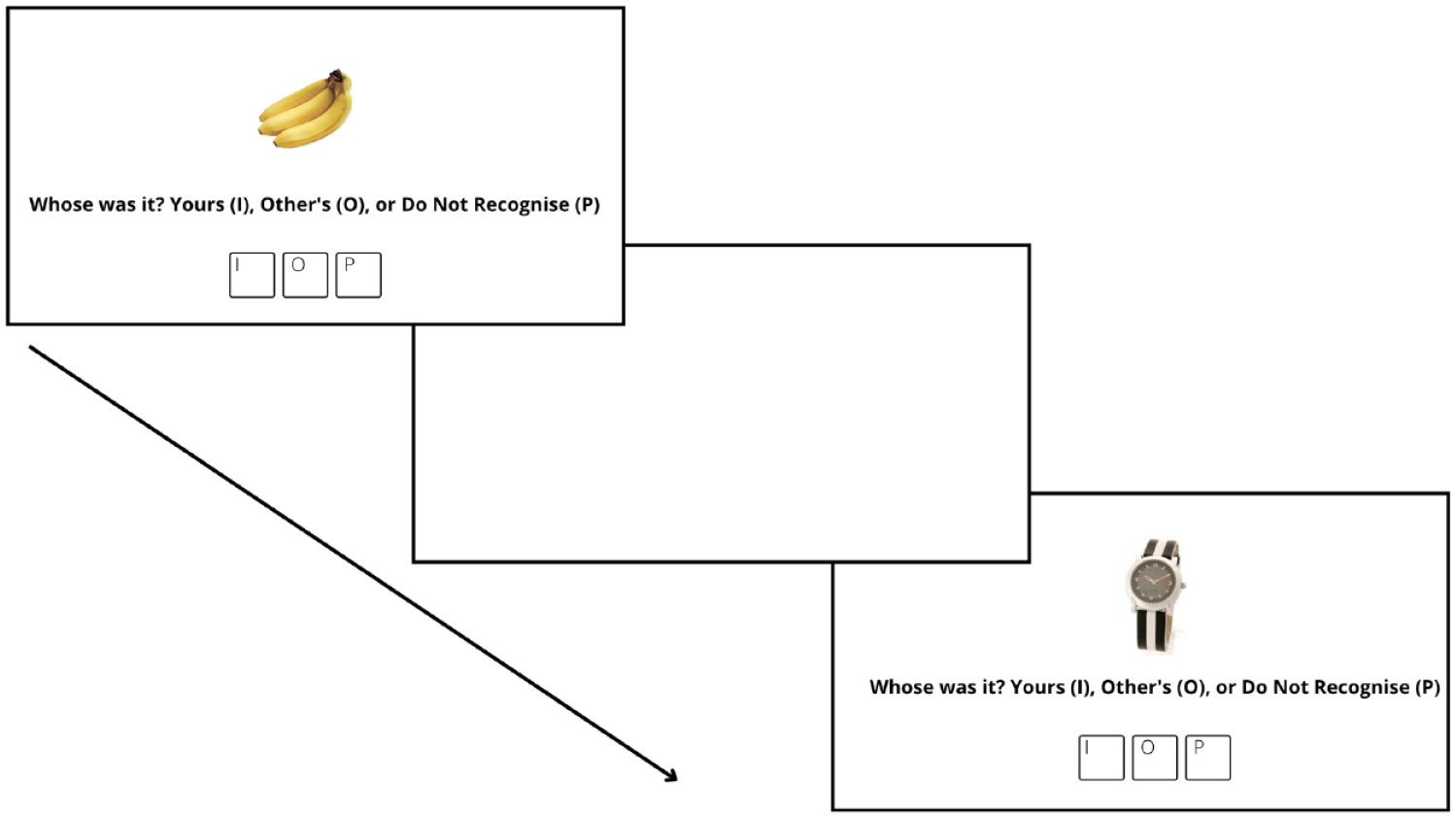
Representation of the memory test. Items appear sequentially at random, and participants respond with one of three options. The stimulus remains on the screen until a response is given. After a response, a blank screen appears for 1,000 ms until the next items appears.
Results
Data and analysis plan
To be included in the group-level analyses, participants had to meet the following criteria. A table including the exclusions can be found in the supplementary materials:
Correctly complete at least 95 out of 100 trials in the object allocation task (sorted the item to the correct colour indicative of the coloured cue).
Correctly identify their own and the other’s bag before and immediately after object allocation.
Completed the memory test in full.
Individual response trials were removed from the memory test data if participants responded to <150 ms or >10,000 ms.
Calculation of corrected hit rates for source memory
The corrected hit rate for source-specific recognition reflects the ability for a participant to identify an old item they had seen before as well as correctly identify the owner of that item. Following the methods of previous work, false alarms were deducted from hits to help correct for random guessing (Clarkson et al., 2022; Cunningham et al., 2011, 2014; Sparks, 2021). We calculated the source-specific hit rate separately for Self and Other. Self-owned item recognition was any self-owned items responded to as being owned by the self, and the false alarm rate was the proportion of new foil items that were responded to as self-owned. Other-owned item recognition was any Other-owned item, claimed as Other-owned and the false alarm rate was the proportion of new foil items that were responded to as Other-owned. To assess whether the participants were performing above chance-level guessing, we took the average hit rate for all participants (Self HR = .388; Other HR = .369) and conducted one-sample t-tests against a chance level guessing hit rate which in a three-choice design would be .3333 (or 33.33%). Both tests showed that the means were significantly higher than chance-level guessing (both ts ⩾ 3.03, both ps ⩽ .002).
Analysis plan
All analyses were conducted using JASP (Love et al., 2019) and RStudio. To analyse source memory accuracy, we conducted an ANCOVA with one repeated measures factor (Ownership: Self-owner, Other-owned), and age treated as a continuous between-groups factor.
As an additional converging method, we submitted our data to a generalised linear mixed model (GLMM) model with accuracy submitted as a categorical outcome, and age, and ownership as fixed factors. Participant ID was submitted as a random grouping factor. GLMMs, unlike ANOVA, make full use of the data by analysing all trials at an individual level, rather than aggregating them. This can lead to more precise estimates and therefore increases statistical power, especially in designs with repeated measures or hierarchical structures, while accounting for the random effects of grouping participants preventing pseudo-replication (Bolker et al., 2009). In these models, false alarms are not subtracted from the hits to create a corrected hit rate. But rather the predicted likelihood is calculated for each response option and allows us to explore how the likelihood of making a hit may improve/decline for each response option as a function of age.
Repeated measures ANCOVA for source memory accuracy
A repeated measures ANCOVA revealed a significant main effect of Ownership while controlling for age, F(1, 157) = 12.975, p < .001, ηp² = .076, such that self-owned items were recalled with higher memory accuracy compared with other-owned items (see Table 1, Figures 4 to 6). Age was significantly positively related to source memory scores, F(1, 157) = 5.405, p = .021. These findings were further qualified by a significant interaction between Ownership and Age, F(1, 157) = 4.060, p = .046, ηp² = .025. showing that the influence of Ownership on memory varied depending on age. To follow-up the direction of the interaction, we computed a continuous difference variable between Self and Other CHRs (Self CHR—Other CHR) and using a Pearson correlation, we correlated this with age to investigate the direction of the interaction. We found a significant negative relationship between these variables r = −.159, p = .046 indicating that self-bias attenuated with age. To explore the potential effects of gender, we conducted a separate analysis, incorporating gender as a between-groups factor in a repeated measures ANOVA. This analysis revealed no significant interaction effects. The results are available in the supplementary materials.
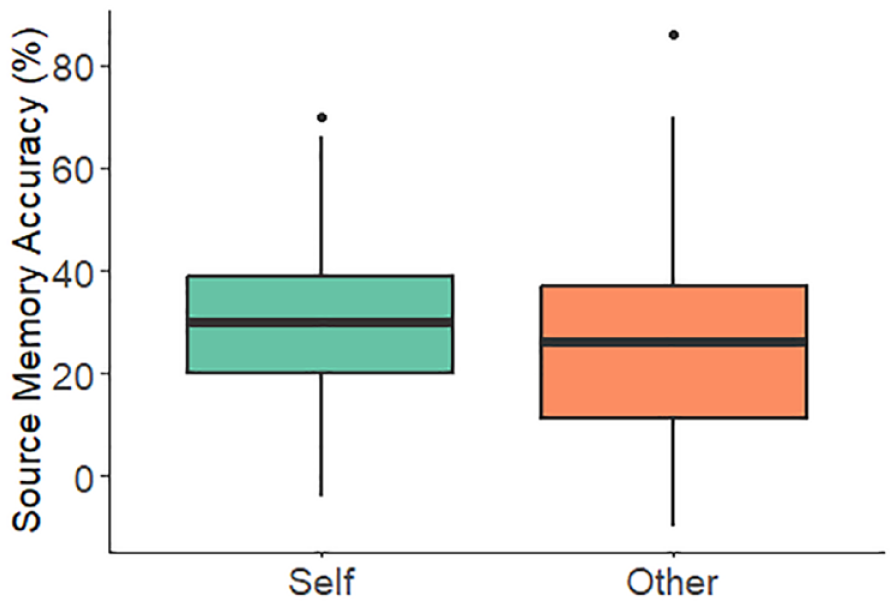
Box plot representing the overall differences between other and self-memory for owned items in a source recognition memory task.
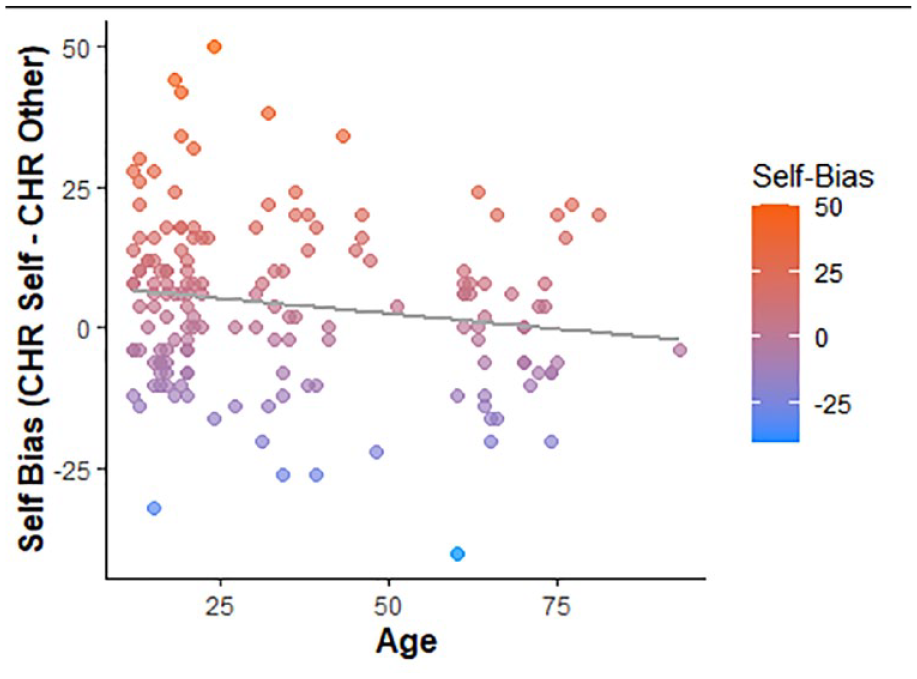
Scatterplot showing the degree of bias towards the Self (above 0 indicates having better memory for self) as a function of age.
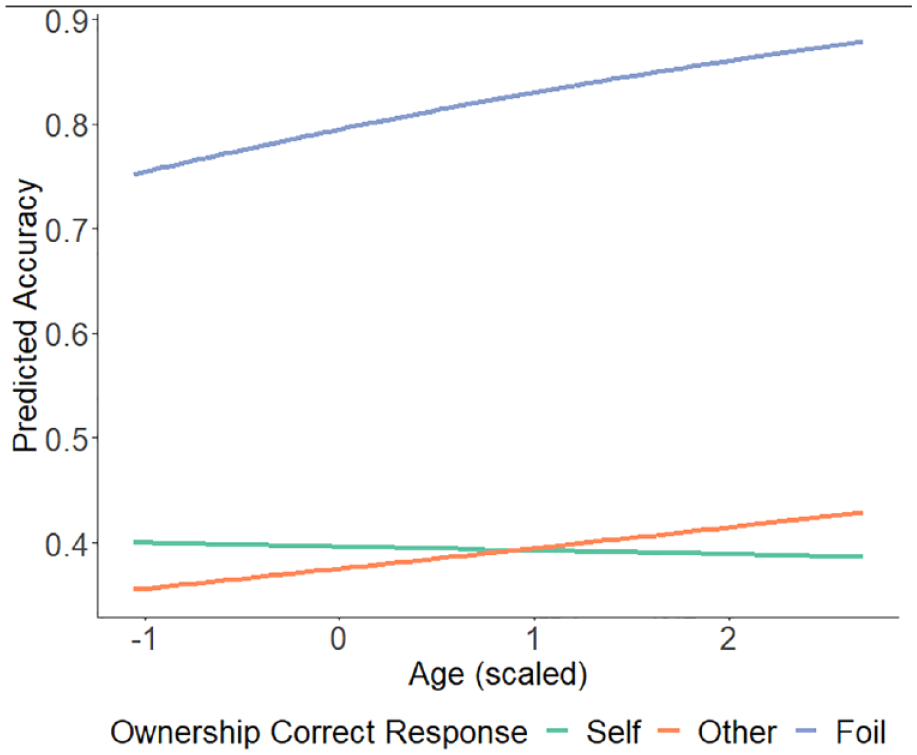
Predicted accuracy for different responses as a function of age. Age is scaleda, range = 12–93 years.
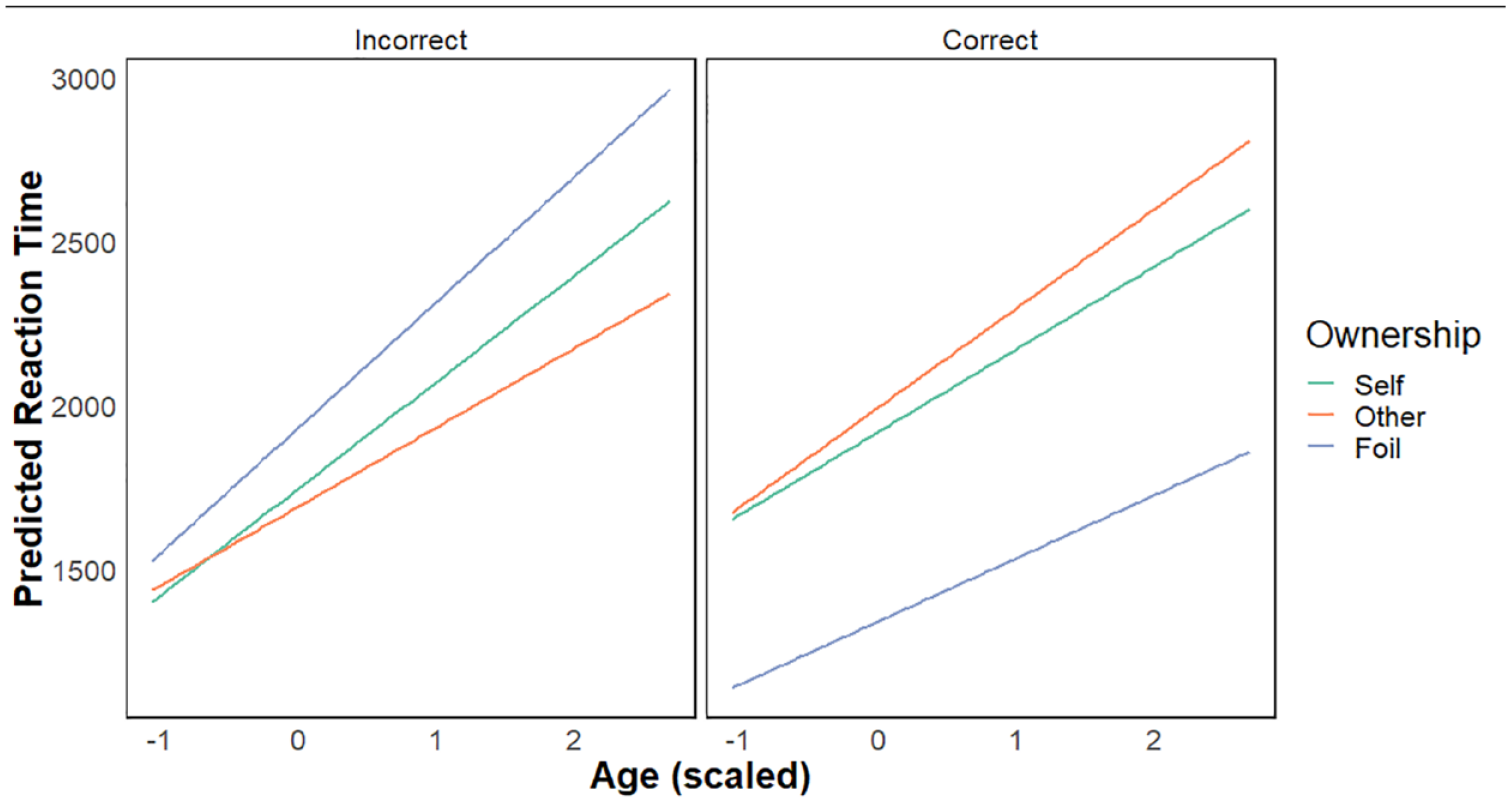
Interaction plot of fixed factors: age, ownership, and accuracy on the outcome variable: reaction time.
GLMM for accuracy
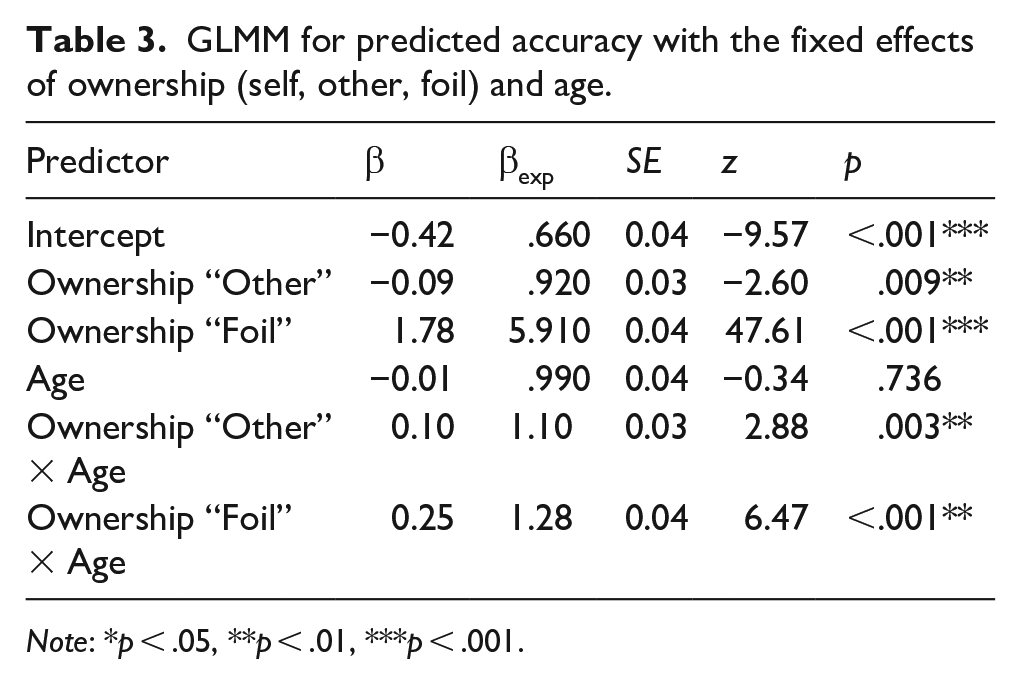
To further investigate the relationship between age and ownership effects on accuracy, a GLMM was fitted to the data using the “lmer” function from the “lme4” package in R (Bates et al., 2015). The model predicted accuracy based on response type (Self, Other, or Foil—items that participants classified as do not recognise), age, and the interaction between response type and age, with a random intercept included for each participant’s ID. Age was scaled prior to model fitting. All statistical results are reported in Table 3 and full model specifications can be found on our OSF page.
GLMM for predicted accuracy with the fixed effects of ownership (self, other, foil) and age.
Note: *p < .05, **p < .01, ***p < .001.
Ownership for Self was used as the reference level for this model. Other was found to be significantly associated with accuracy, compared with Self; Other was associated with lower accuracy for all ages. The correct allocation Foil was also significantly associated with accuracy. Compared with Self, Foil was associated with higher accuracy for all ages. Age was not significantly associated with accuracy at the reference level (Self) when controlling for all other levels, indicating that accuracy for Self did not change as a function of Age. Importantly, the interaction between Other and Age was significantly associated with accuracy, suggesting that accuracy for Other increases as Age increases. The interaction between Foil and Age was significantly associated with accuracy, suggesting that Foil accuracy improves with age.
Linear mixed effects model for reaction time
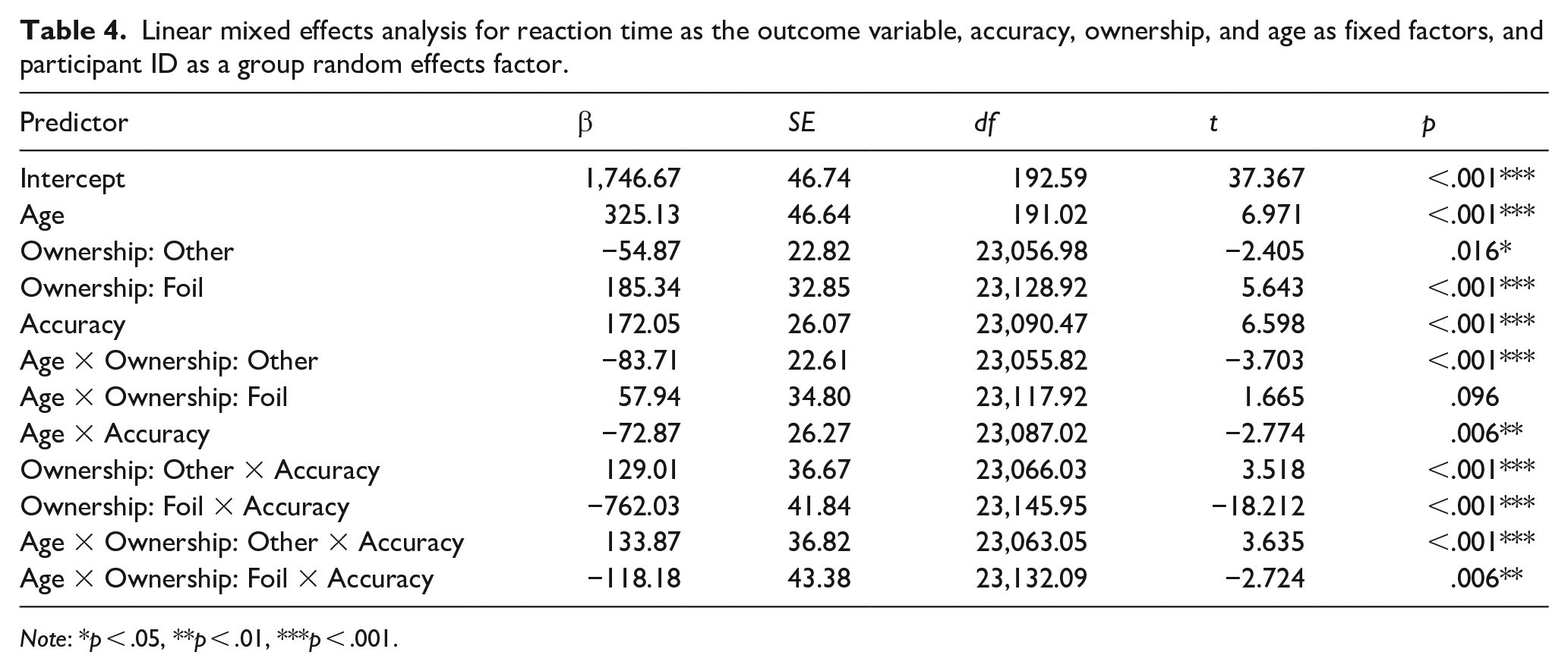
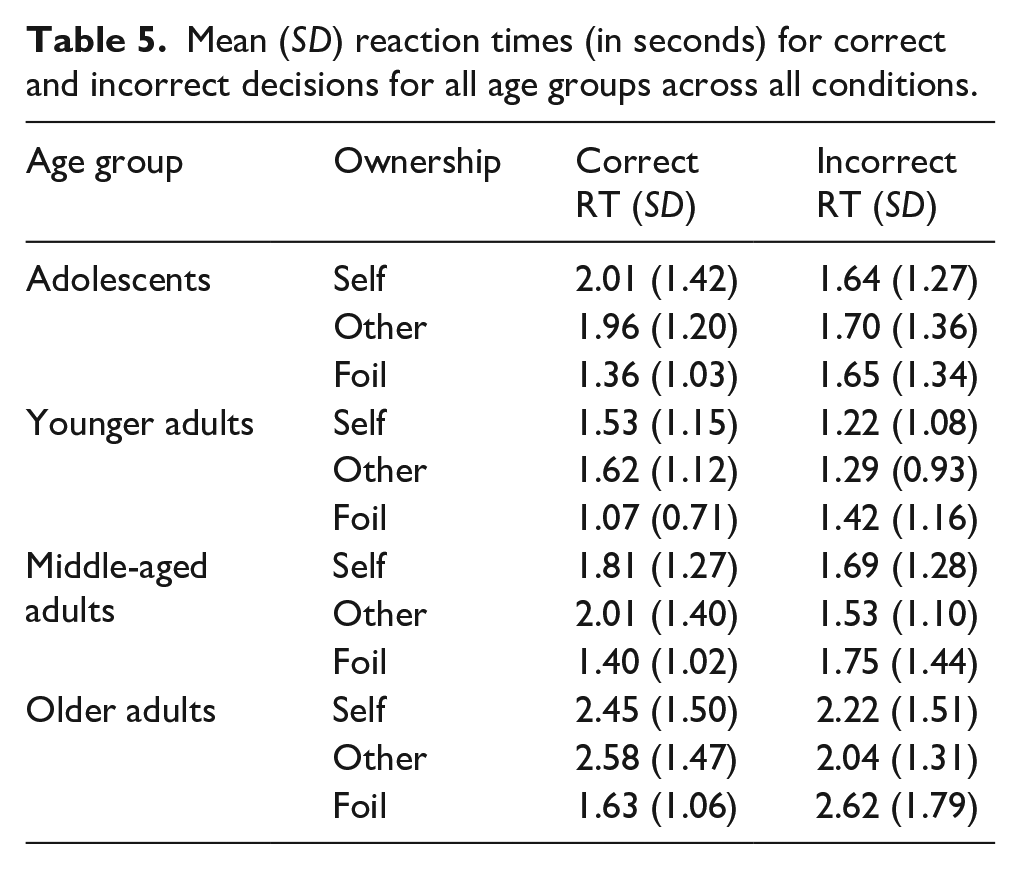
A linear mixed-effects (LME) model was fitted to the data to predict reaction time from Age, Ownership, and Accuracy, including interactions among these predictors, and accounting for the random effects of individual participants. The LME was fitted to the data using the “lmer” function from the “lme4” package in R (Bates et al., 2015). All statistical results are reported in Table 4 and mean reaction times presented in Table 5.
Linear mixed effects analysis for reaction time as the outcome variable, accuracy, ownership, and age as fixed factors, and participant ID as a group random effects factor.
Note: *p < .05, **p < .01, ***p < .001.
Mean (SD) reaction times (in seconds) for correct and incorrect decisions for all age groups across all conditions.
The model revealed a significant effect of Age on reaction time, with reaction time slowing with increasing age. There was also a significant effect of Ownership on reaction time, with faster responses to other-owned items, and slower responses to foil items, both relative to self-owned items. In addition, there was a significant effect of Accuracy, with reaction time increasing with increased Accuracy for Self when all other levels were held constant. Importantly, interaction effects were identified. A significant Age by Ownership: Other interaction indicated that the effect of Age on reaction time differed for other-owned items compared with self-owned items. The Age by Accuracy interaction was also significant, suggesting the effect of Age on reaction time differed with Accuracy.
Significant interactions were also found between Ownership and Accuracy on reaction time. For other-owned items, an increase in Accuracy led to an increase in reaction time, and for foil items, an increase in Accuracy led to a decrease in reaction time.
The three-way interactions for Age, Ownership, and Accuracy were also significant. For other-owned items, the influence of Age on Accuracy was more pronounced. This suggests that reaction time for other-owned items increases with accuracy, but especially among older participants. Conversely, for foil items, the relationship between Age and Accuracy was less strong, implying that as age increases, the positive association between accuracy and reaction time for foil items weakens.
Discussion
Overview of key findings
The aim of this study was to assess the effect of the OSRE on source memory across age, from adolescence to older adulthood. We measured both accuracy and response times to gauge these biases. Supporting our hypotheses, we found an overall main effect of ownership, such that self-owned items were remembered with higher accuracy compared with other-owned items. There was also a main effect of Age, such that memory accuracy increased with age. Importantly, both main effects were qualified by the presence of an ownership by age interaction, such that other-owned items were recalled with higher accuracy in the older participants, and this was further confirmed by the results of a GLMM that showed accuracy for both other-owned and foil items significantly improved with age. These findings show that an attenuated self-bias with increasing age does not imply an age-related decline for self-memory. Rather, memory for other-owned items improved, while memory for Self remained stable across the sample age span. In line with memory accuracy results, we found evidence of self-biases in reaction time, with participants more rapidly and correctly categorising self- than other-owned information. We also found a three-way interaction that showed older adults demonstrated significantly slower reaction times for other-owned items when their decisions were accurate.
Self-ownership memory across age groups
Some of our findings align with previous research, while others offer a counter-narrative. First, this study demonstrates a robust ownership memory bias towards Self-owned items, aligning with previous research (Clarkson et al., 2022; Collard et al., 2020; Cunningham et al., 2008; Sparks et al., 2016). Owned objects elicit the self-processing biases that drive other SREs in memory, and the current study adds to the literature on the robustness of this effect. Second, we confirmed the presence of self-referencing in adolescents reported by Moses-Payne et al. (2022) and extended these findings by demonstrating that implicit ownership biases can be observed in adolescent samples. Consistent with Moses-Payne et al. (2022), we observed an improvement in memory for other-related stimuli as age increased. However, we found this age-related increase not just in adolescent samples but across a wide adult age range, extending to older adulthood.
Previous research denotes that the SRE tends to attenuate with age in conjunction with the decline of episodic memory processes (Gutchess et al., 2007; Levine et al., 2002), but that the SRE that remains intact (Carson et al., 2016; Glisky & Marquine, 2009; Gutchess et al., 2007; Hamami et al., 2011). While our results agree with this attenuation, the reason for this effect was not attributable to compromised memory for self-owned items, but due to enhanced memory for other-owned items. Our findings are more consistent with the findings of Moses-Payne et al. (2022), who reported both increasing memory for other related words and decreasing memory for self-referenced words as a function of age in their exclusively female sample, leading to attenuation of the SRE from adolescence to early adulthood. While we did not find differences in SREs between adolescence and adulthood, it is possible that this was due to our use of an ownership, rather than trait adjective paradigm. In a more recently published study, Rosa et al. (2024) found that adolescents and adults showed comparable SREs in memory for objects, which also corresponds with our current findings. As adolescent self-identity is being developed, ownership may play a significant role as young people begin to develop stylistic tastes (e.g., they begin to decorate their personal spaces more; Fidzani & Read, 2014; K. James, 2001; Kamptner, 1995). Comparable SREs between adolescence and adulthood may reflect how personal ownership provides a different mechanistic experience for self-referencing, compared with the processing of trait adjectives.
Previous research with children has suggested that compared with evaluative SRE tasks, more incidental SRE tasks may be largely driven by developmentally stable self-biases, such as attentional prioritisation (Cunningham et al., 2014; Hutchison et al., 2021). This mechanism may demonstrate key differences between incidental and ownership SREs and suggest that ownership SREs may require at least some self-evaluation, since older adults also show reduced SREs when evaluative self-tasks are used (Gutchess et al., 2007, 2010), given they benefit from episodic enrichment of memory at encoding. The increase in memory for other-referenced items with age was unexpected and interesting, with several potential explanations. It is consistent with a change in social prioritisation across the lifespan, perhaps with a more stable self-construct and increasingly other-focused social roles (e.g., as parent and partner). Self-prioritisation effects can be overridden by competing current goals (Cunningham et al., 2022), which may increase attention to other-referenced material.
Another possibility is that older adults do not exhibit the same intensity of endowment due to mere ownership as younger adults. Their attachment to personal items may diminish with age. While older adults often display a heightened attachment to sentimental items, such as photographs or objects with significant personal importance (Cookman, 1996; Wapner et al., 1990), they may show less interest in arbitrary objects that lack meaningfulness and are therefore less motivationally driven to exhibit endowment effects (in line with socioemotional selectivity theory; Carstensen, 1992). Given that we presented participants with common grocery items, it seems plausible that older adults are less likely than younger adults and adolescents to project mechanisms of mere ownership onto the stimuli set used in the current study.
A consequence of the increase in memory for other-owned items with age is that older adults performed with high accuracy compared with younger adults overall. While this may seem unusual, older adults do not always underperform on memory tasks compared with younger adults. In fact, in a study examining the effects of self-referencing and emotional memory in older and younger adults, found no difference in older and younger adults memory scores (Daley et al., 2020). It is worth noting that older adults often perform well on pictorial memory tasks that emphasise recognition over free recall (Craik & Rose, 2012). There may also be motivational factors. The older adults may be aware of the effects of age on tasks that directly assess memory (Mazerolle et al., 2017) and therefore take more time and effort over their responses. Our study design did not impose speeded responses, allowing older adults to take the time needed to respond across all conditions. Should we have emphasised the need for speeded responses, we predict that this would have affected the performance of our participants, and likely produced lower accuracy in older adults. All participants except adolescents exhibited a self-bias in reaction times, consistent with previous research showing faster responses for identification of self-owned items (Cunningham et al., 2008; Golubickis et al., 2018, 2019, 2020). Self-prioritisation in response times for accurate classification could also result from participants over-identifying items as their own, reflecting a response bias, unless prior expectations suggest otherwise. Ownership effects have been known to be attenuated or even reversed when prior knowledge updates participants’ expectations about the prevalence rates of to-be-shown stimuli (see Falbén et al., 2020 for an example with an ownership classification task, and Clarkson et al., 2022 for an example in a memory task). It is possible that as participants age, their expectations in claiming items as self-owned shifts reflect attenuation in ownership effects, an avenue future research should explore.
The three-way interaction between age, object ownership, and accuracy revealed that, for correct responses, older participants’ responses were slowed for all items, but particularly so for items belonging to the other. We suggest that the slowed responses for other-owned items may complement the enhanced accuracy for other-owned items that was observed for older adults, in line with a speed–accuracy trade-off.
A limitation to our conclusions from the speed–accuracy effects in older adults is that our study is not exempt from challenges posed by sampling bias. It is possible that older adults (community volunteers) were more motivated to participate in the task compared with younger adults (students participating for course credit). Differences in how motivated these participants were to complete the study may have contributed to the greater number of false alarms observed in younger adults, contributing to older adults’ slightly better performance on the task for specific conditions. Nonetheless, the fact that we elicited different age effects for self-referenced and other-referenced items suggests that task engagement in general does not explain our findings. Another limitation from this study is that the current findings are based on analysis of the SRE in the context of a “distant other” control rather than a semantic or other encoding condition, so future research using alternative encoding strategies may identify additional developmental patterns.
Conclusion
In conclusion, we found robust support for an ownership SRE, corroborating, and extending previous SRE research to encompass a wide age range from adolescence to old age. Importantly, we found that while the SRE was attenuated in older adults, this was not due to reduced memory for self-owned items. Instead, memory accuracy for other-owned items was enhanced in older adults, perhaps reflecting changing social priorities across the lifespan. Our study also examined response times and complex interactions with accuracy, which revealed that while older adults’ responses were slowed across all conditions, accuracy was greater for other-owned items. This may suggest a speed–accuracy trade-off among older adults, which aligns with existing literature on ageing and cognitive performance in decision making (Ratcliff et al., 2007).
In summary, the current study provides evidence that the OSRE exists across different life stages and adds to our understanding of how self-referencing biases interact with age. Given the complexity of the factors at play, our study emphasises the need for continued research to further unravel the relationship between ownership, memory, and ageing.
Supplemental Material
sj-docx-1-qjp-10.1177_17470218241254119 – Supplemental material for Mine for life: Charting ownership effects in memory from adolescence to old age
Supplemental material, sj-docx-1-qjp-10.1177_17470218241254119 for Mine for life: Charting ownership effects in memory from adolescence to old age by Tessa R Clarkson, Harrison A Paff, Sheila J Cunningham, Josephine Ross, Catherine Haslam and Ada Kritikos in Quarterly Journal of Experimental Psychology
Footnotes
Declaration of conflicting interests
The author(s) declared no potential conflicts of interest with respect to the research, authorship, and/or publication of this article.
Funding
The author(s) received no financial support for the research, authorship, and/or publication of this article.

Supplemental material
The supplementary material is available at qjep.sagepub.com.
References
Supplementary Material
Please find the following supplemental material available below.
For Open Access articles published under a Creative Commons License, all supplemental material carries the same license as the article it is associated with.
For non-Open Access articles published, all supplemental material carries a non-exclusive license, and permission requests for re-use of supplemental material or any part of supplemental material shall be sent directly to the copyright owner as specified in the copyright notice associated with the article.
