




Abstract
Cognitive control is the ability to allocate attention away from stimuli that are irrelevant to achieving a goal, towards stimuli that are. When conflict is anticipated, attention is biased in a global, top-down manner called proactive control and this effortful type of cognitive control is engaged before stimulus onset. The list-wise congruency proportion (LWPC) effect, where the Stroop congruency effect is reduced when there are more incongruent than congruent trials compared to vice versa, has been viewed as one of the prime signatures of this type of cognitive control. However, there has been recent debate about the extent to which this effect should be attributed to proactive control instead of alternative explanations such as simpler associative learning or reactive control. Thus, by using pupillometry (i.e., an indicator of cognitive effort), the present study investigated the extent to which LWPC effects result from effortful proactive control. Experiment 1 employed a classic proportion congruency manipulation, while Experiment 2 replaced congruent trials with neutral trials to control for potential effects of associative learning. While in line with past findings, proportion congruency effects were obtained in response times of both experiments and pupillometry showed both proportion congruency and Stroop effects after stimulus onset, no differences in pupil sizes were found during the preparatory phase. Therefore, these results do not support the idea that the observed LWPC effects are due to participants engaging in effortful proactive control.
Cognitive control is the ability to orient our thoughts and actions towards an internal goal (Miller & Cohen, 2001). One of the most popular laboratory tasks that experimental psychologists use to study this ability is the Stroop task (Stroop, 1935; see MacLeod, 1991; Parris et al., 2022 for reviews) in which the goal is to identify the colour in which different colour words are printed. Because for incongruent stimuli (e.g., the word “blue” printed in green), attention needs to be shifted away from reading the word and applied to identifying the colour, poorer performance (e.g., slower responses, and more errors) is typically observed for these items as compared to control stimuli (e.g., congruent stimuli such as “blue” printed in blue).
The efficiency of cognitive control is inferred from differences in magnitudes of this latter difference—referred to as the Stroop congruency effect such that smaller magnitudes are thought to reflect more efficient cognitive control (Braem et al., 2019). These differences can be observed both between participants (i.e., as a function of age for instance, see, for example, Bugg et al., 2007; Burca et al., 2022) and within participants. Indeed, magnitudes of the Stroop congruency effect are known to be substantially smaller when participants go through a block of trials which are mostly incongruent (e.g., 20% congruent and 80% incongruent) than when they go through a mostly congruent block (e.g., 80% congruent and 20% incongruent; see e.g., Lindsay & Jacoby, 1994; Logan & Zbrodoff, 1979).
This so-called list-wise congruency proportion effect (LWPC) along with other proportion congruency (PC) effects (see e.g., Bugg et al., 2008; Crump et al., 2006) suggests that cognitive control can be triggered in a top-down manner. Therefore, studies of these effects were crucial for subsequent theoretical development of cognitive control (e.g., Botvinick et al., 2001; Braver et al., 2007; Norman & Shallice, 1986; Posner, 2012). Recently, however, there is a debate about the extent to which these effects can actually be accounted for in a simpler, perhaps a more parsimonious way (see below). Therefore, by shedding some additional light on the list-wise congruency proportion effect (LWPC), the present study aims to contribute to this ongoing debate.
Alternative accounts to proactive control
Prominent theories of cognitive control often view LWPC (and other PC) effects as prime signatures of proactive control (e.g., Botvinick et al., 2001; Braver et al., 2007; Norman & Shallice, 1986; Posner, 2012). This type of attentional control—triggered by participants’ expectancies and motivations in response to different task environments—biases attention system in a global, top-down manner. For example, in an environment where conflicting information (e.g., an incongruent Stroop trial) is frequently encountered (in mostly incongruent or MI block), the conflict monitoring system (Botvinick et al., 2001) will signal a shift towards greater proactive control (and away from reactive control) where more attentional resources to be utilised so as to aid task performance. The cognitive system will then react by engaging greater global cognitive control to bias attention away from the word, and towards the colour instead (Cheesman & Merikle, 1986; Lindsay & Jacoby, 1994; Lowe & Mitterer, 1982; West & Baylis, 1998). Since the influence of the word is consequently lessened, smaller magnitudes of the Stroop congruency effect are observed than in situations where conflict is not frequently encountered (i.e., in a mostly congruent or MC block) and the conflict monitoring system is not triggered.
However, there are also control accounts that do not assume a proactive component but posits the application of control can be stimulus-driven instead. Much of the work comes from the demonstration of context-specific (e.g., fonts or locations, Bugg et al., 2008) and item-specific proportion congruency effects (see Bugg & Crump, 2012, for a review of PC effects). Although cognitive control is still assumed, these accounts state that it is applied at the trial level, and not sustained at the global level.
Since the frequencies of colour-word pairings in typical PC manipulations are not equal (e.g., in MC blocks, the colour-word appears in the corresponding colour most often), proponents of alternatives to cognitive control argue that this may explain LWPC and other PC effects instead. For example, Schmidt and Besner (2008) proposed a contingency learning explanation, driven by the fact that the frequencies of the colour-word pairs making up the Stroop stimuli are confounded in several PC paradigms (see also Schmidt, 2013, 2019). Because each colour-word is more frequently paired with its corresponding colour (e.g., “blue” in blue) than the other colours (e.g., “blue” in red, yellow, etc.), MC blocks lead to stronger (explicitly or implicitly) learned stimulus-response contingencies and aiding participants’ ability to predict responses to more frequent word/colour pairs.
The idea of how the imbalance of the word-colour pairings makes the word dimension informative is not a new one as it had previously been proposed by Dishon-Berkovits and Algom (2000). Unlike Schmidt and Besner’s account that works via pure associative learning, Dishon-Berkovits and Algom’s model works via adaptation. Since the colour-word correlation results in the word dimension of the Stroop stimuli being informative of which potential response is more likely, this encourages word reading, which is the process that we assume participants are trying to suppress. In line with this reasoning, pairing frequencies of the stimuli has been shown to reduce (and in some cases eliminate) PC effects, and Stroop effects in general (see Algom & Chajut, 2019 and Schmidt, 2013, 2019 for reviews of the topic, Spinelli & Lupker, 2023, and Hasshim & Parris, 2021) for a direct comparison of the two accounts).
In short, associative learning can explain PC effects such as LWPC without the need to evoke control accounts. Therefore, there has been growing acknowledgement that control processes are not always engaged or even necessary (see Algom & Chajut, 2019; Algom et al., 2022; Schmidt, 2013, 2019). In an attempt to reconcile these different explanations, Bugg (2014) tested the idea that top-down proactive control is a process that the cognitive system can engage, depending on the environmental context. This “associations as antagonists to top-down control” (also called “last-resort”) account posits that proactive control does occur, but only in certain situations. Specifically, it was not observed when responses can be predicted via learned associations, but the cognitive system reverts to top-down control in situations when such reliable stimulus-response cues are unavailable.
Pertinent to the current research, Spinelli and Lupker (2021) modified the proportion congruency manipulation in LWPC by replacing congruent trials with neutral ones to isolate the effects of conflict within the task, as without congruent trials the word dimension never predicts the response. By demonstrating that in such an environment, global level control is still engaged, they provided further evidence that not only does proactive control exist, but it can be invoked even in case of unpredictable word-response relationships (but see Bugg, 2014 above). In their more recent work, Spinelli and Lupker (2022) provided additional evidence for the existence of cognitive control by demonstrating its engagement even in situations where contingency learning was encouraged.
To sum up, the aforementioned lines of work are asking the question of whether proactive cognitive control exists and if so, when exactly it is triggered and engaged. This question is still subject to much ongoing debate (see Abrahamse et al., 2016; Egner, 2008; and Henik et al., 2018; for reviews on the general topic of cognitive control) with one of the reasons for this being that the arguments tend to be relatively circulatory (i.e., going back and forth from constant, conditional and no proactive control). One possible reason for this is the fact that the vast majority of studies mentioned simply infer cognitive control and its different features from the modulation of the Stroop congruency effects (although see, for example, Blais & Bunge, 2010 for the use of fMRI and West & Alain, 2000 for the use of EEG to address these issues). Since proactive control is thought to be a resource-demanding, engagement of effortful proactive control can be measured more directly and more sensitively via pupillometry. This was precisely the goal of the current study.
Current study
Pupillometry has previously been used as a measure of cognitive effort (Kahneman & Beatty, 1966; Laeng et al., 2012) in selective attention tasks such as Stroop paradigms (e.g., Hasshim & Parris, 2015; Hershman & Henik, 2019; Laeng et al., 2011) where more effort is typically exerted in trials that have more conflict (e.g., incongruent trials compared to congruent) leading to larger pupil sizes.
The current study is specifically looking into the effortful and proactive aspect of cognitive control, as described in the previous section, and past research have used pupillometry to achieve this goal. For example, Parris at al. (2021) showed that the attenuation of Stroop interference when participants were under post-hypnotic suggestion corresponded with larger pupil sizes, which was interpreted as the improvement in performance being due to participants engaging in more effortful control, a form of demand characteristic. While Parris et al. (2021) measured effort throughout the task, Chiew and Braver (2013) had a similar interest to the current study, in proactive control prior to target onset. They found pupil sizes within a pre-trial time window were larger on trials in which participants were expecting a reward for performing well—demonstrating that pupillometry measures just before the onset of a target reflect top-down activation of effort.
Another example of the use of pupillometry in PC Stroop designs is Diede and Bugg (2017) who used pupillometry to specifically demonstrate context-specific proportion congruency manipulation (CSPC), where congruent and incongruent trials each reliably appear in specific contexts. In this study using a Flanker task, targets appeared in locations where trials were MI or MC and indeed, larger pupil sizes were observed in the MI location 1 where more cognitive effort was expected. Somewhat similarly, the current study used pupillometry to measure effortful control in LWPC paradigms.
However, it is important to understand that the goal of the present study is not to simply extend the results of Diede and Bugg (2017) to another PC paradigm (applied in the Stroop task). Indeed, CSPC manipulation used in their study provides evidence for control being exerted at the item level instead of (or in addition to) globally throughout the block as described in the proactive control accounts of the LWPC effect. Since the application of proactive control prior to target onset cannot account for these latter effects, attentional processes are likely to be activated after the target is presented (i.e., after stimulus onset). The proactive account of LWPC effect on the other hand clearly anticipates effortful control to be engaged before the target is present (i.e., before stimulus onset, e.g., Botvinick et al., 2001; Braver et al., 2007; Kane & Engle, 2003), especially when conflict is anticipated (Braver et al., 2007; Gonthier et al., 2016; Spinelli & Lupker, 2021). Therefore, the current study investigated whether and the extent to which the expected smaller Stroop congruency effects MI blocks (as compared to MC blocks) were indeed preceded by effortful proactive control engaged during the preparatory phase (i.e., before target onset). To this end, in Experiment 1, participants’ pupil sizes before target onset were compared in MI as compared with MC block of the classic LWPC paradigm using congruent and incongruent trials (e.g., Lindsay & Jacoby, 1994). In Experiment 2, neutral trials replaced congruent trials as per Spinelli and Lupker (2021), so the influence of stimulus-response contingencies and the informativeness of the word—operating in Experiment 1—were both removed.
Experiment 1
Method
Ethical approval
Ethical approval for this study was granted by the Faculty Research Ethics Committee, Faculty of Health & Life Sciences, De Montfort University; Reference:3427.
Participants
Forty-four individuals recruited from the university community participated in the experiment (data from 7 participants were excluded as they did not meet the pre-defined minimum accuracy of 90%) and received either course credit for their undergraduate course or £10 shopping vouchers. The intention was to recruit a minimum of 44 participants which was the suggested sample size calculated through the jpower module of jamovi software (The jamovi project, 2020). The parameters of a minimally interesting effect size (δ) of 0.5, power of 0.9, and type 1 error rate of 0.05 were based on the sizes of the effects of interest in previous laboratory Stroop research that utilised behavioural responses. This target sample size is larger than the sample sizes used in Blais and Bunge (2010) with 16 participants, and West and Alain (2000) with 18 participants, studies of similar designs that informed the current research. As mentioned above, both studies investigated similar research questions to the current experiments, but with the use of EEG and fMRI methodology.
While the sample size was estimated from behavioural measures of the PC effect, it is also larger than those reported in the earlier mentioned research that measured cognitive effort using pupillometry. Parris et al. (2021) reported a difference in pupil sizes averaged throughout trials with 16 participants, while Chiew and Braver (2013) showed pre-trial pupillary differences with 33 participants. If we were to assume that effortful proactive control was to be present in the current design and would have a similarly sized effect as these two studies, a Bayesian power analysis (estimating a minimum sample size required, if we expect to observe an effect of the same size as in the literature) suggests that the sample size required to show a BF > 3 to be 6 participants and for a BF > 6, to be 15 participants.
Apparatus
Stimuli were presented to the participants using a standard PC (screen dimensions: 530 mm × 300 mm) running Experiment Builder software (SR Research Ltd.), which was displayed on a colour monitor displaying at 1920 px × 1080 px with a refresh rate of 60 Hz. Pupillary data consisting of pupil and corneal reflection, as well as sampling at 1,000 Hz was recorded using the EyeLink 1000 Plus eye-tracker (SR Research Ltd.) running in monocular mode. Data were processed offline using Data Viewer (SR Research Ltd.) Blinks were automatically identified by the EyeLink Online Parser used by the EyeLink 1000 eye-tracker (SR Research). Data during blinks were ignored, as were the data within 10ms before and 10ms after each blink, as recommended by Mathôt and Vilotijević (2023).
Design
The experiment was a 2 (block type: mostly congruent vs mostly incongruent) × 2 (trial condition: congruent vs incongruent) fully within-participant design. In the MC block, 80% of the trials were congruent trials, while the remaining 20% were incongruent trials, with these proportions reversed in the MI block. The stimuli consisted of two sets of colours (see Material section below) and participants encountered a different set in each block. The presentation order of the MC and MI blocks, and the colour set used in each block was randomly determined using a four-sided die. The presentation order of the trials within each block was randomised by the computer.
Material
Two sets of colours and their corresponding words were used as targets for the experiment: yellow, green, and red in one set, and blue, pink, and white in the other. The visual angle of each of the words on the screen were as follows: yellow (2.08° x 0.78°), green (1.89° x 0.65°), red (1.04° x 0.59°); and blue (1.17° x 0.52°), pink (1.11° x 0.65°), white (1.95° x 0.65°). The RGB values of each colour were: yellow – (208, 255, 93), green (0, 255,0), red (255, 0, 0), blue (0, 0, 255), pink (204, 0, 204) and white (255, 255, 255). 2 The background of the screen was black (0, 0, 0) throughout the experiment.
Participants encountering colours from different sets in the two blocks. Congruent trials were made up of words spelling out the colour, it appears in, while incongruent trials were made up of a word appearing in one colour but spelling out a different colour. Each word appears in its congruent colour on congruent trials and can appear in either of the two other colours in the set. As mentioned above, Experiment 1 was meant to follow the classic PC paradigm that does not control for stimulus contingencies. Indeed, each word stimulus appears more (less) often in its corresponding colour during the MC (MI) blocks. All visual stimuli were presented in the centre of the screen.
Procedure
Participants performed a manual version of the Stroop task, where they were asked to respond to the target by pressing keys on a full-sized QWERTY keyboard corresponding to the colour. The keys used were 1, 2, and 3, keys of the number pad of a standard keyboard. During eye-tracking participants positioned their heads on a headrest placed at an eye-to-screen distance of 880 mm.
For the experiment, participants underwent 330 trials. In the first half of the experiment, participants underwent a block consisting of 15 practice trials (either MC or MI) followed by the corresponding experimental block of 150 trials, with the stimuli made up of one of the two aforementioned sets. The second half of the experiment repeats this process with the second set of stimuli presented. A break was administered in between the four blocks, and each block was preceded by a 5-point calibration and validation.
Each trial began with a 500-ms blank screen, followed by a grey fixation cross presented for 800 ms, before being replaced by the target. The target stayed in view for 500 ms followed by a blank screen until the participant responded up to a maximum of 1,000 ms, when the trial would then be classified as a non-response and recycled as an upcoming trial. Another blank screen followed which was displayed for 1,000 ms. The time windows for sampling pupil size are defined as follows: baseline pupil size was the average pupil size within 500 ms before the onset of the fixation, and proactive control was the average pupil size within 500 ms before the target onset (see Figure 1). Since proactive control is a tonic response that is assumed to be activated generally during the block, pupillometry readings were measured as the average pupil size during the proactive time window.
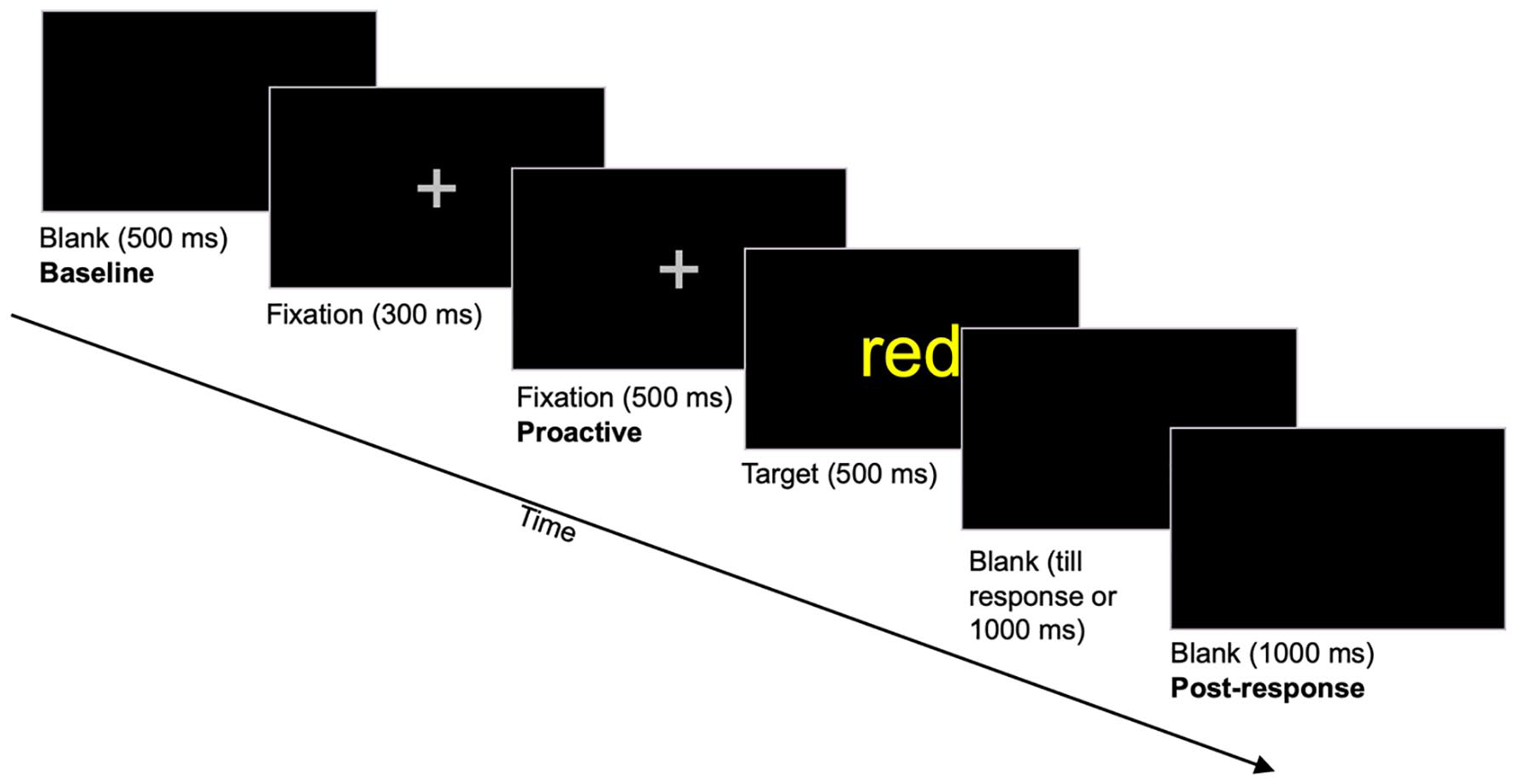
Series of events during a single trial.
To reduce noise in the pupillary measure, recommendations from Mathôt et al. (2018) that could be implemented, were reflected in the procedure. For example, all stimuli were presented in the centre of the screen to minimise artefacts from pupil foreshortening and to ensure that participants were looking at the centre of the screen during the critical time windows. On trials where the total fixation time on the fixation cross (as determined by an invisible circular interest area subtending 2.1°) was <300 ms, a drift correction was conducted and the trial restarted as this indicated that either the participant was not focusing on the centre of the screen or accurate calibration was not maintained. Recalibration and validation were conducted in more severe cases. Furthermore, to reduce pupillary effects due to differences in exposure time to the visual stimuli, the duration for which each stimulus was presented was kept consistent for all trials.
The details of the procedure were carefully considered to accommodate the use of pupillometry in the PC Stroop paradigm. While a longer inter-trial-interval (ITI) is recommended to allow for pupil dilation to go back to a baseline level after each trial, long ITIs (e.g., >2,000 ms) have been shown to be detrimental to performance in the Stroop task by reducing participants’ ability to focus on the goal/task (De Jong et al., 1999; see also, for example, Augustinova et al., 2018; Parris, 2014). This would arguably affect maintaining proactive control since it would need to be effortfully sustained over a longer period in between trials. Thus, an interval of 1,500 ms was chosen as a compromise between these two concerns (also note that the pupillometry study of Chiew & Braver, 2013 reported only minimal behavioural differences between ITIs of 250 vs 4,000 ms). A baseline correction was also done to reduce carryover effects from the previous trial, where pupillometry was taken as the percentage change compared to the baseline period (Mathôt et al., 2018). To further elicit potential proactive control, the fixation cross acts as an implicit cue to anticipate the impending trial. The potential effects of these design choices are discussed with the findings. 3
The preregistered design and analysis plans are available at the following OSF registrations page: https://osf.io/syzhx/?view_only=21613b8e058941758e43681337e7aa8c. The raw data (.edf and .csv formats), analysis files (JASP file format) are available at the following OSF project page: https://osf.io/bweg8/?view_only=36ab2ae24ad949d7ab09b26992fd9c77.
Results
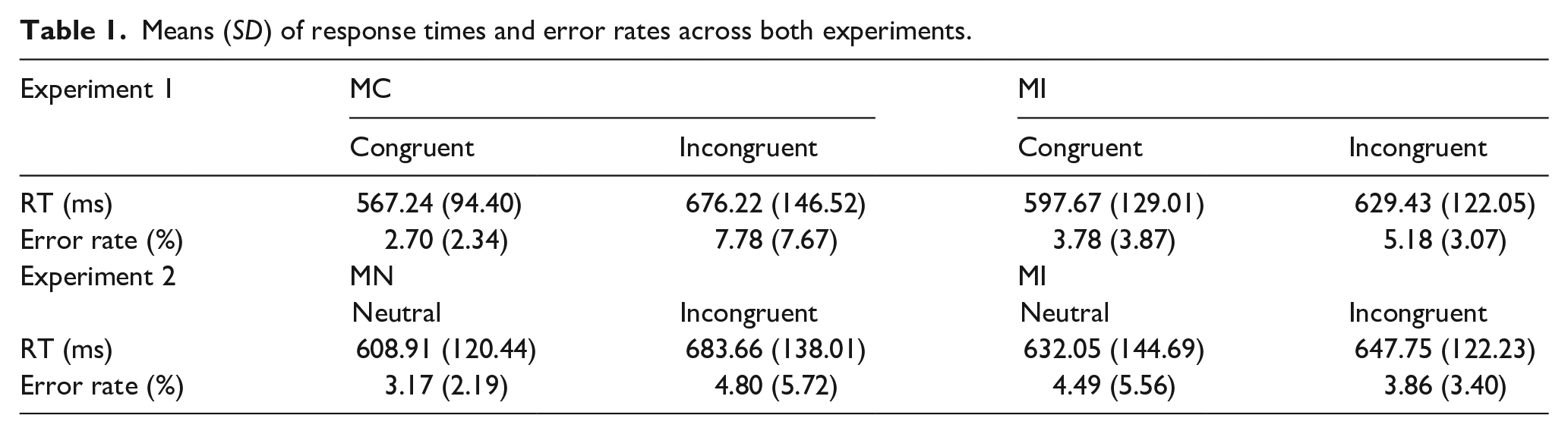
Trials consisting of incorrect responses, or correct responses where responses were not within 200–1,500 ms of target onset, or with more than 30% missing pupil data were excluded from the analysis (only gaze data within the invisible central interest area defined above were considered “valid”). Also, data from 7 participants who did not attain at least 90% accuracy was excluded from the analysis. Since the main analyses of interest are the comparison of pupil sizes between the MI and MC blocks with two directly competing predictions (i.e., proactive control accounts predict larger pupil sizes in MI, while other accounts do not), a Bayesian t-test was performed to complement the frequentist analysis. Bayes factors were calculated in JASP (JASP Team, 2022), using a half-Cauchy prior distribution (i.e., pupil size in MI > MC) scaled to 0.707 and robustness regions were reported to determine whether any interpretation from the Bayes factors were sensitive to the choice of prior distribution. The default prior specifications in JASP were also used for the Bayesian ANOVA analyses (i.e., r-scale fixed, random, and covariates values of 0.5, 1, and 0.354, respectively). For replicability of the analyses reported in this article, the random seeds were specified to be “999.” Table 1 summarises the RT and error data for both experiments.
Means (SD) of response times and error rates across both experiments.
Response times
Response times were analysed to determine whether the pattern of results was in line with the expectations from research that use similar techniques, namely the classic LWPC effect.
The 2 (block: MC vs MI) × 2 (trial condition: congruent vs incongruent) analysis of variance (ANOVA) of RT showed the block × trial condition interaction, F(1, 36) = 34.94, p < .001, ηp2 = 0.49, and main effect of trial condition, F(1, 36) = 58.38, p < .001, ηp2 = 0.62, to be statistically significant. This meant that while the Stroop congruency effect was statistically significant in both MI, t(36) = 3.85, p < .001, d = 0.63, and MC, t(36) = 7.97, p < .001, d = 1.31, blocks, it was significantly reduced in the former; a result that is consistent with the classic LWPC effect (see Figure 2 for a visualisation of the RTs). The main effect of block was not statistically significant, F(1, 36) = 0.551, p = .463, ηp2 = 0.015.
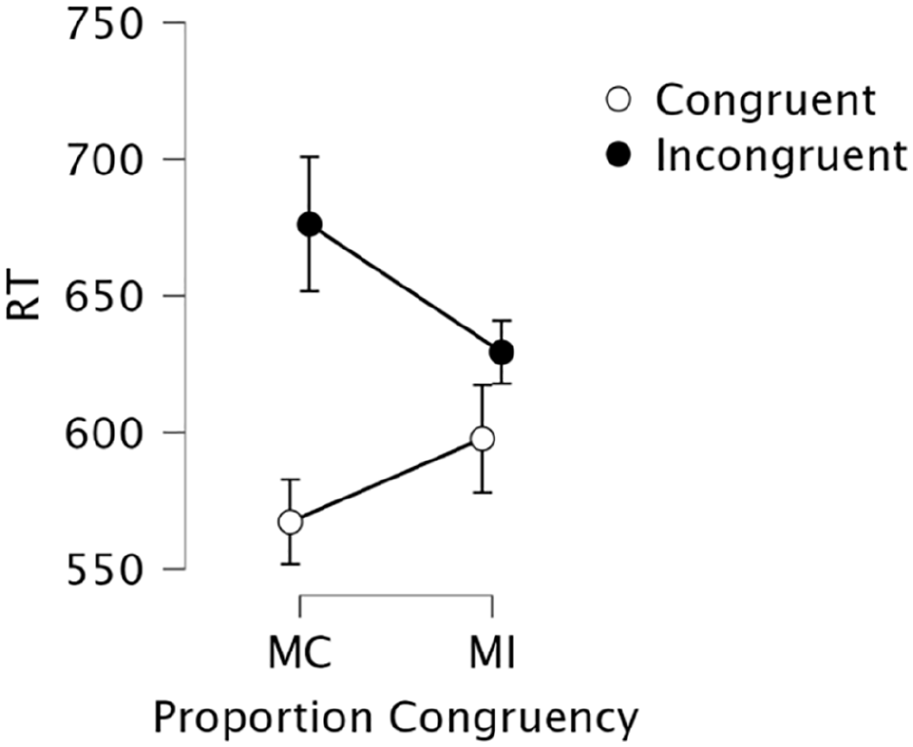
Mean response times for each condition in Experiment 1. Error bars represent 95% confidence intervals.
The corresponding Bayesian ANOVA analysis showed that the model which included block, trial condition, and the interaction between the two, to be the best model with BF10 = 8.0e + 9 when compared to the null model. The analysis of effects comparing this model to one without the interaction showed decisive evidence in favour of including it with a BFinclusion of 407.08.
Error rates
The 2 × 2 ANOVA for error rates revealed a statistically significant block × trial condition interaction F(1, 36) = 8.74, p = .005, ηp2 = 0.20, and the main effect of trial condition, F(1, 36) = 22.85, p < .001, ηp2 = 0.39, while the main effect of block was nonsignificant, F(1, 36) = 1.31, p = .260, ηp2 = 0.035. This meant that although the Stroop congruency effect was significant in the error rates for both MC, t(36) = 4.36, p < .001, d = 0.717, and MI, t(36) = 2.41, p = .021, d = 0.397, blocks, the effect in the former was larger. The results from the error rates mirrored that of the RT analysis.
Pre-target pupillometry
The comparison of preparatory pupil diameter between the two blocks is the primary analysis of interest of this research. The results showed that the difference in dilation between MI (0.44%) and MC (0.66%) blocks was statistically non-significant, t(36) = −0.690, p = .495, d = −0.113, BF01 = 8.91. The Bayes factor showed evidence supporting the null hypothesis and robustness check showed that for the BF to fall below 3, an interpretation of only anecdotal support for the null, the prior distribution would have to be scaled to be narrower than 0.193. 4
Post-response pupillometry (exploratory analysis)
Although congruency effects in pupillometry are well established, predictions for reactive control accounts on LWPC effects have been less researched. Thus, post-response pupil sizes 5 were examined as exploratory analyses. The average pupil size during the 1000-ms blank screen at the end of the trial (see “Post-response” in Figure 1) were sampled for each of the four conditions and compared, with the same baseline as the one used in the pre-response measures. This post-response time window should be sensitive to congruency effects, following the time-series findings of Hershman and Henik (2019) who indicated pupil effects begin to emerge around 500 ms (between neutral and incongruent trials) and 1000 ms (between congruent and incongruent trials) post-stimulus onset.
As this was not the main analysis of interest and the design of the experiment was geared towards the pre-target analysis, it should be noted that some conditions (e.g., congruent trials in a Mostly Incongruent block) have a maximum of 30 trials presented to participants which meant that some conditions had very few valid observations. Thus, in addition to the trial and participant exclusion criteria that were previously specified, participants who did not have at least 10 valid trials for each condition (a further 7 participants) were also excluded from the analyses. 6
The 2 (block: MC vs MI) × 2 (trial condition: congruent vs incongruent) ANOVAs of the mean pupil size showed the main effect of block to be statistically significant, F(1, 29) = 4.66, p = .039, ηp2 = 0.14, as was the main effect of trial condition, F(1, 29) = 9.61, p = .004, ηp2 = 0.25. This suggests larger post-response pupil dilation occurred during the MC block, and on incongruent trials (see Figure 3 for a visualisation of post-response pupil change). The block × trial condition interaction was non-significant, F(1, 29) = 0.834, p = .369, ηp2 = 0.028. The Bayesian analysis indicated the model containing the two factors was the best model, with a BF10 of 12.05 when compared to the null model. Compared to the null model, models including only the block; only trial condition; and both factors and their interaction returned BFs10 of 4.69, 2.13, and 4.12 respectively.
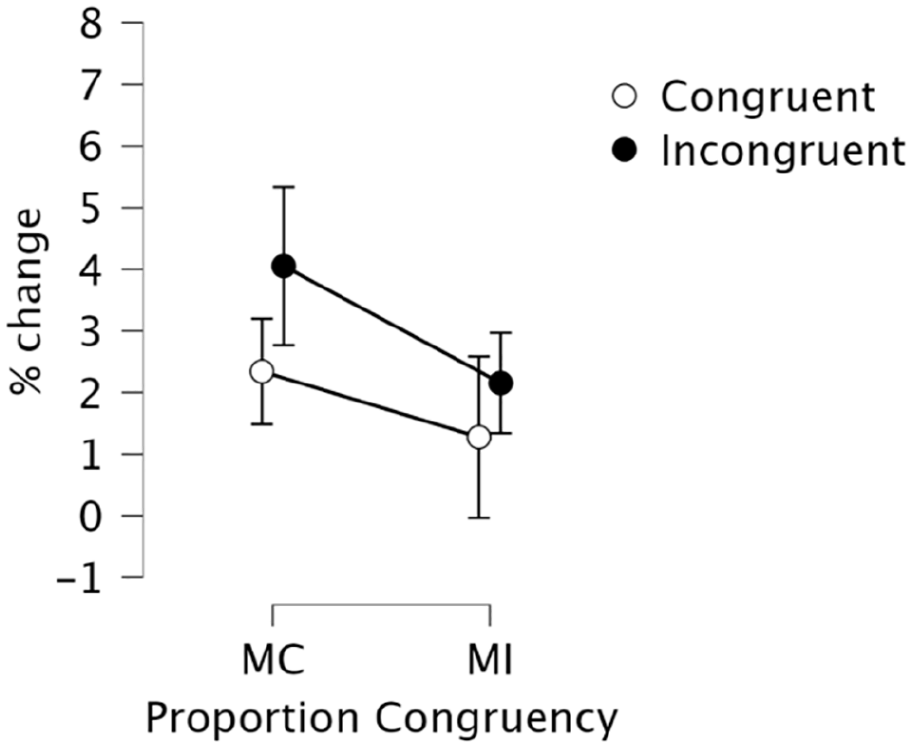
Mean increase in pupil size after response was made, for each condition in Experiment 1. Error bars represent 95% confidence intervals.
Time-course pupillary changes
More recent research using pupillometry has moved to favour temporal analysis of pupil size changes (e.g., Hershman & Henik, 2019; Hershman et al., 2023) as it has several advantages, such as revealing when effects differ in their onset instead of magnitude, or those that only appear in a very small time-period compared to the overall time window that is analysed. However, these are not the characteristics of the proactive control effect that the current research endeavours to detect, but instead the effortful proactive control is hypothesised to be sustained throughout the preparatory period. Thus taking the average pupil sizes across the specified time windows were preferred instead.
Nonetheless, it is possible that the temporal dynamics might reveal additional insights beyond what was hypothesised. Thus, Figure 4 shows visualisations of pupil size during the critical pre-target period, from the two experiments. The initial pupil size is larger than baseline, which is likely attributed to a phasic response to the fixation cross. The overall pattern does not suggest any hidden small effects within the time-period. Although there is a visual difference between the two lines, note that the analyses showed no significant differences between the blocks, and that the pattern on neither graph is consistent with the hypothesis of generally larger pupil sizes under the MI condition.
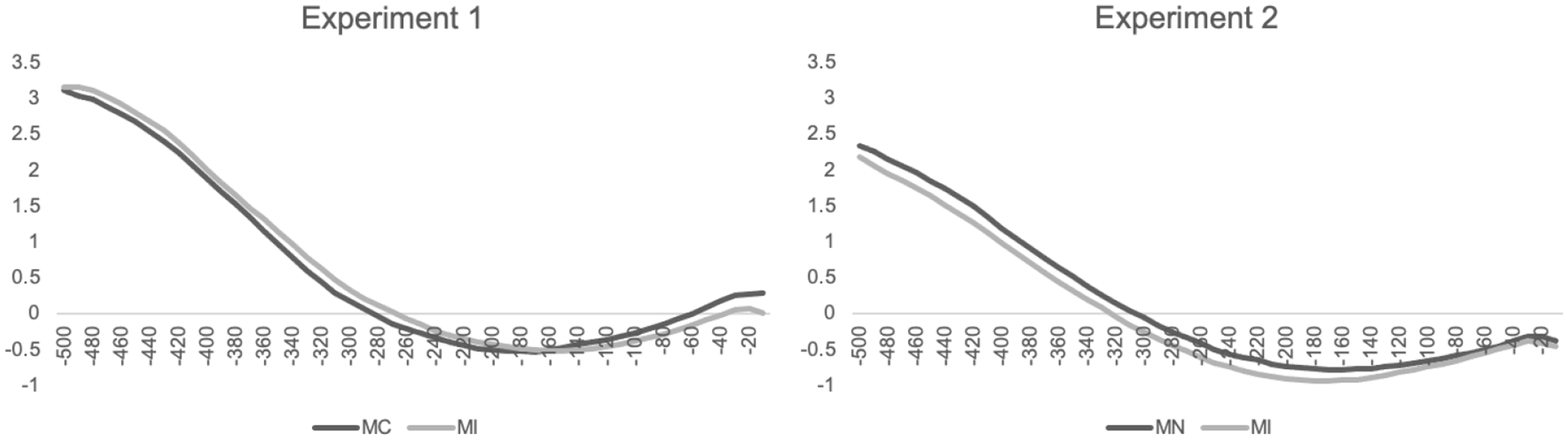
Pupil size (percentage change) relative to baseline. Note: The data were downsampled to 100 Hz as recommended by Mathôt and Vilotijević (2023); and excludes samples not within 2.5 SD following Hershman and Henik (2019). The vertical axes represent the percentage change relative to baseline, while the horizontal axes show the time, in milliseconds, to target onset (0 representing onset).
Discussion
The RT data from the experiment replicated the classic PC effect, where Stroop interference was smaller in the MI block compared to the MC block. The post-response pupillometry analysis showed a congruency effect of larger pupil dilation after accurately responding to incongruent trials compared to congruent ones, replicating typical pupillary Stroop effects. The main effect of block was also significant with generally larger post-response pupil dilation during the MC block which is the opposite of what would be expected if more effort was exerted in the MI blocks. It is possible that post-response pupil sizes reflect the amount of conflict encountered in the trial. That is, pupil Stroop effects are commonly observed ~500–600 ms after participants make a response (see e.g., Hershman & Henik, 2019, 2020; Laeng et al., 2011), indicating that pupils reflect a delayed reaction to the conflict encountered when attempting to respond (Simpson, 1969), and thus, pupil sizes would be overall larger in the MC block in which the RT congruency effect was larger. However, if pupil sizes were a delayed reflection of pre-response conflict encountered, we might expect to see a main effect of block in the RT data, but this was not observed (see also the lack of main effects in the pupil data in Experiment 2). Thus, unfortunately, the results from this exploratory analysis were not consistent with either account.
For the main analysis of interest, the pre-target pupillometry data showed evidence for no difference in pupil dilation during the preparatory phase between MI and MC blocks. This means that while the LWPC effect was observed in the behavioural data, it was not accompanied by a pupillary marker of effortful attention control in anticipation of conflict.
While a pupillary effect would have suggested that proactive control is still engaged in the classic LWPC paradigm despite the associative learning confounds highlighted earlier, the results from Experiment 1 do not necessarily provide evidence against the proactive control account. As proponents of proactive control accounts have argued, it might be a process that only emerges when other more effective strategies are unavailable (e.g., Bugg, 2014; Spinelli & Lupker, 2021).
Experiment 2
Experiment 2 aimed at tackling one of the major associative learning confounds found in the classic LWPC paradigm, the effect of word-response contingency (Schmidt, 2013, 2019) This was done by modifying the design of the experiment in two main ways. First, the congruent trials were used in Experiment 1 were replaced by neutral trials (e.g., string of “ssss” in red). As suggested by Spinelli and Lupker (2021), the advantage of utilising neutral trials over congruent ones in this context is that the former reduces the informativeness of the word/letter-string and negates any advantage of gleaning information from the text. In addition, the effect of word-response contingency was further controlled for by mapping each (non)word equally often to two of the response options (and never to the third). This meant that for each letter-string and word making up the neutral and incongruent trials, there was an equal probability of it appearing in one of two colours (and never the third).
Method
Participants
Forty-one individuals recruited from the university community participated in the experiment (data from 5 participants were excluded as they did not meet the pre-defined minimum accuracy of 90%) and received either course credit for their undergraduate course or £10 shopping vouchers.
Design, procedure, and material
The design and procedure were identical to that of Experiment 1. The material was similar except that that congruent trials were replaced by repeated-letter neutral trials. Thus, instead of an MC block, participants went through a mostly neutral (MN) block. The repeated-letter sequences were zzzzzz (2.28° x 0.46° of visual angle), xxx (1.17° x 0.39°), jjjjj (0.91° x 0.78°) for one half of the trials, and the other half involved the targets ssss (1.30° x 0.39°), qqqq (1.43° x 0.52°), and hhhhh (1.69° x 0.52°).
To control for contingency effects, each repeated-letter string only appeared in two of the three colours, and equally often in each (e.g., “xxx” appeared in green and yellow equally often, but never in red; “jjjjj” appeared equally often in yellow and red, but never green; etc.). This mirrors the properties of incongruent trials.
Results
Data were processed in the same way as in Experiment 1, with data from 5 participants excluded for not meeting the 90% minimum accuracy threshold.
Response times
The 2 (block: MN vs MI) × 2 (trial condition: neutral vs incongruent) ANOVA of RT showed the block × trial condition interaction, F(1, 35) = 25.09, p < .001, ηp2 = 0.42, and main effect of trial condition, F(1, 35) = 44.15, p < .001, ηp2 = 0.56, to be statistically significant. The main effect of block was not statistically significant, F(1, 35) = 0.314, p = .579, ηp2 = 0.009. This meant that while the Stroop interference effect was statistically significant in both MI, t(35) = 2.49, p = .018, d = 0.42, and MN, t(35) = 6.76, p < .001, d = 1.13, blocks, it was significantly reduced in the former. Similar to Experiment 1 this is consistent with the classic LWPC effect (see Table 1 for the descriptive statistics, and Figure 5 for a visualisation).
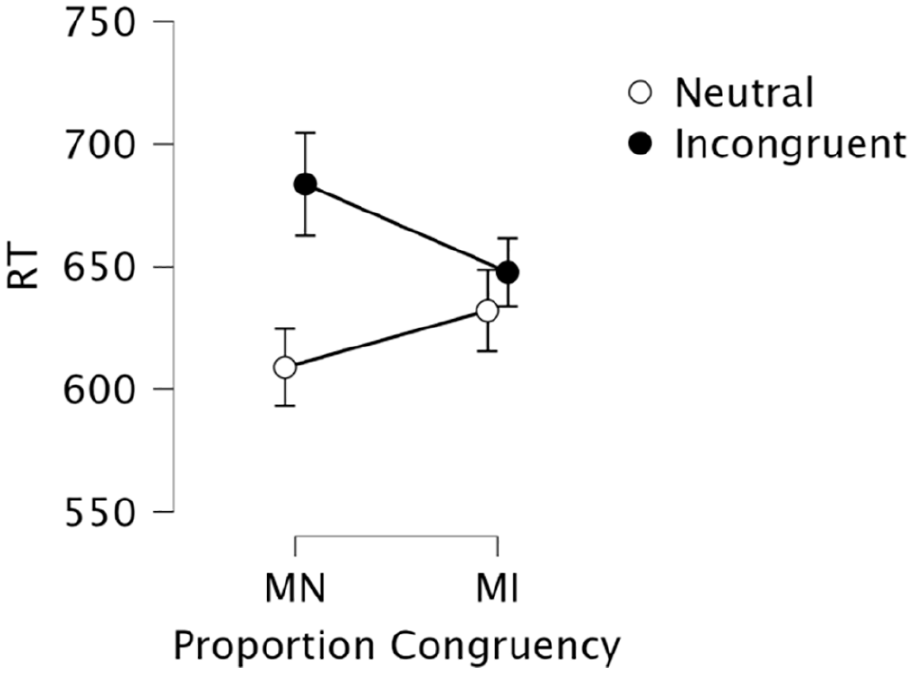
Mean response times for each condition in experiment 2. Error bars represent 95% confidence intervals.
The Bayesian ANOVA analysis revealed the model which included block, trial condition, and the interaction between the two, to be the best model with BF10 = 99,658.60 when compared to the null model. The analysis of effects comparing this model to one without the interaction showed strong evidence in favour of including it with a BFinclusion of 44.03.
Error rates
Unlike the RT data, none of the effects in the error rate analysis were statistically significant, interaction: F(1, 35) = 3.33, p = .077, ηp2 = 0.087, main effect of block: F(1, 35) = 0.070, p = .794, ηp2 = 0.002, and trial condition: F(1, 35) = 0.732, p = .401, ηp2 = 0.020. This could be due to lower error rates in the incongruent trials, compared the incongruent trials in Experiment 1.
Pre-target pupillometry
The comparison of preparatory pupil sizes showed that difference in dilation between MI (−0.01%) and MN (0.15%) were statistically non-significant, t(35) = −0.468, p = .639, d = −0.078, BF01 = 7.72. Similar to the results from Experiment 1, the Bayes factor showed evidence supporting the null hypothesis with a robustness check showing that for the BF to fall below 3, the prior distribution would have to be scaled to be narrower than 0.228.
Post-response pupillometry (exploratory analysis)
Following the same exclusion criteria as in Experiment 1, a further four participants were excluded from this analysis. The 2 (block: MC/MN vs MI) × 2 (trial condition: congruent vs incongruent) ANOVAs of the mean pupil size showed only the main effect of trial-condition was statistically significant, F(1, 31) = 8.12, p = .008, ηp2 = 0.21, with incongruent trials displaying larger pupil dilations compared to neutral trials. Neither the main effect of block, F(1, 31) = 1.44, p = .240, ηp2 = 0.044, nor the block × trial-condition interaction, F(1, 31) = 1.24, p = .274, ηp2 = 0.038, were statistically significant. Although the pattern of results is similar to that of Experiment 1 (see Figure 6), the main effect of block was non-significant (unlike in Experiment 1), while the Bayesian analysis indicated the null model to be the best model with a model that included only trial condition having a BF10 = 0.935. This suggests that this exploratory analysis was underpowered and conclusions should not be drawn from this specific analysis.
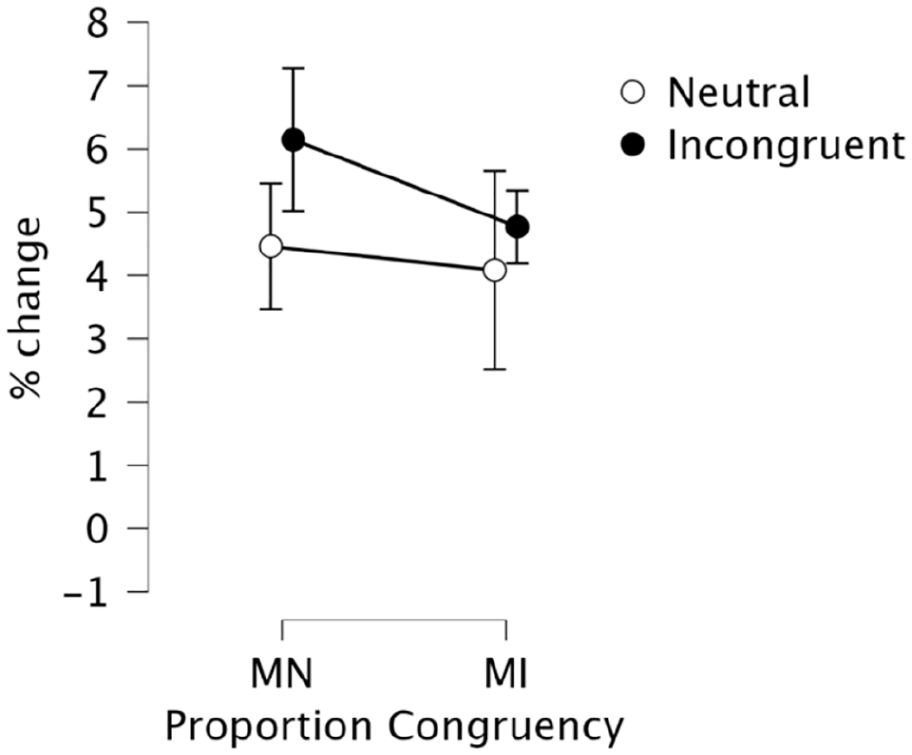
Mean increase in pupil size in the exploratory post-response analysis in Experiment 2. Error bars represent 95% confidence intervals.
Discussion
The primary results of interest from Experiment 2 closely followed those of Experiment 1, showing that although the LWPC effect was reflected in participants’ RT, where the Stroop effect was larger in the MI compared to the MN block (replicating the results of Spinelli & Lupker, 2021), this was not accompanied by larger pupil dilation in the former. The analysis of the pupillometry data showed evidence for the null hypothesis. However, it should be noted that in the exploratory post-response pupillometry analysis, although trial congruency effects were shown in the frequentist analysis, the data were not sensitive enough to show similar evidence in the Bayesian analysis.
General discussion
The current research investigated whether there is evidence of effortful control of attention being proactively applied when conflict is expected in a selective attention task. Following previous work utilising pupillometry to evidence proactive control (Chiew & Braver, 2013; Parris et al., 2021), the intention was to demonstrate a putative marker of proactive control in the time frame just before the presentation of the target. If the attention control mechanism is engaged effortfully in anticipation of conflict, larger pupil sizes were expected before the Stroop stimulus was presented during the MI block, where most of the trials were conflicting—providing convincing evidence for proactive control. We did not observe this effect in our data.
In both experiments, while RTs displayed the classic LWPC effect of a smaller Stroop congruency effect in the MI block, no pupillary effects were observed prior to target onset. Experiment 1 used the typical LWPC paradigm of comparing an MI block to an MC block (Lindsay & Jacoby, 1994), while Experiment 2 aimed at addressing the potential confound of contingency effects by comparing an MI block to an MN block. The results in the RT data are consistent with Botvinick et al.’s (2001) model of proactive control since replacing congruent trials with neutral trials will not affect the PC effect because the conflict monitoring module works via sensitivity to the frequency of conflict trials (i.e., incongruent). The pattern of results is also consistent with Tzelgov et al. (1992) who found larger interference effects with increased proportion of neutral trials. However, the pupillometry results failed to detect an accompanying marker for increased effort when participants were anticipating target onset in the MI blocks. Indeed, descriptive statistics showed that the amount of pupil dilation in general to be very small and even in the opposite direction (albeit non-significant) to that which proactive control accounts would predict. In addition, the Bayes factors for both experiments favoured evidence against the hypothesis of larger pupil sizes in the MI (as compared to MC/MN) block.
Interestingly, it is notable that the exploratory analysis showed that the pattern of results from the (post-response) pupil sizes data do not mirror that of participants RTs (non-significant block × trial condition interaction in pupil sizes) or conform to the expectation of more effort required in the MI block. This suggests that the post-response pupil size might be sensitive to block-level effects in addition to trial-level ones, something that future research using an appropriately powered design should explore.
Limitations of the current research
In isolation, interpretation of the findings from the two experiments seems straightforward: while the LWPC effect was observed in the RTs, the absence of pupillary differences in the preparatory phase suggests that the effect was not due to more proactive control processes being engaged when conflict was more likely. However, although demonstrating an effect would have provided evidence for proactive control, the converse does not necessarily mean evidence against it as even though pupillary effects have been used in similar investigations (e.g., Chiew & Braver, 2013; Parris et al., 2021), they might not be sensitive enough to index effortful proactive control in the current study. Relatedly, the lack of effects could also be due to a lack of power for the analysis. However, the sample sizes were larger than studies that demonstrated pupillometry effects comparable to the ones of interest, and the BFs reported do not suggest an issue with sensitivity. Even if the results were to be taken at face value, i.e., evidence against greater effort, the only conclusion that can be made is that the mechanism (control or otherwise) behind the LWPC effect does not involve sustained effort.
Another potential limitation of the present study is the use of only manual (button-press) responses. Larger Stroop effects are typically found in vocal, compared to manual, versions of the task (e.g., Augustinova et al., 2019; White, 1969) and can differently affect processes within Stroop task performance (e.g., Sharma & McKenna, 1998). However, behavioural LWPC effects were observed in both experiments as were the typical pupillary Stroop effects, suggesting that the paradigm did manage to capture the effects of interest. Although there is no strong indication that different anticipatory control mechanisms should be involved when the subsequent response is vocal vs manual, response modality should be something that future research should consider as well.
Also, and importantly, control accounts (such as Braver et al., 2007; Crump et al., 2006) do highlight control that is applied reactively during the task. Somewhat in line with reactive control, the secondary, exploratory analyses of post-response pupil sizes hint at the influence of proportion congruency on the effort applied after the target is presented. However, the data from the current study, which was primarily aimed at detecting the larger block-level effects, were not sensitive enough to examine the interactive effects of trial condition and proportion congruency on post-response pupil dilation. Given this important limitation, further research is also required to tease apart these processes that can independently affect pupil sizes. In doing so, these studies also need to integrate pupillometry to other variations that target reactive control (e.g., context-specific PC, Crump et al., 2006).
Conclusion
The current research intended to examine often assumed, but largely untested idea that effortful, proactive control is engaged prior to the presentation of stimulus in the LWPC Stroop paradigm. This was done using pupillometry as a direct measure of cognitive effort during the preparatory phase of the task. It is important to acknowledge that the rich literature within the wider debate about the role of control in the PC paradigm has involved more elaborate designs, the current research is an initial exploration utilising pupillometry, and any conclusions are limited to the classic version of the task. Therefore, it is hoped that the results from the two experiments demonstrate a simple point: the nature of the processes that results in the LWPC effect, at least for those observed in the classic PC paradigm, was not shown to involve effortful control engaged in anticipation of conflict.
Supplemental Material
sj-docx-1-qjp-10.1177_17470218241235671 – Supplemental material for No pupillometric evidence for effortful proactive control in the proportion-congruent Stroop paradigm
Supplemental material, sj-docx-1-qjp-10.1177_17470218241235671 for No pupillometric evidence for effortful proactive control in the proportion-congruent Stroop paradigm by Nabil Hasshim, Molly Carruthers, Ludovic Ferrand, Maria Augustinova and Benjamin A Parris in Quarterly Journal of Experimental Psychology
Footnotes
Declaration of conflicting interests
The author(s) declared no potential conflicts of interest with respect to the research, authorship, and/or publication of this article.
Funding
The author(s) disclosed receipt of the following financial support for the research, authorship, and/or publication of this article: This research was supported by the Experimental Psychology Society via the EPS Small Grants Scheme. The writing of the report and the process related to submission of this article for publication was additionally supported by Agence nationale de la recherche (ANR Grant ANR-19-CE28-0013) et Réseau d’Intérêt Normandie (RIN Tremplin Grant 19E00851).
Data availability statement
The preregistered design and analysis plans are available at the following OSF registrations page: https://osf.io/syzhx/?view_only=21613b8e058941758e43681337e7aa8c. The raw data (.edf and .csv formats), analysis files (JASP file format) are available at the following OSF project page:  .
.
Notes
References
Supplementary Material
Please find the following supplemental material available below.
For Open Access articles published under a Creative Commons License, all supplemental material carries the same license as the article it is associated with.
For non-Open Access articles published, all supplemental material carries a non-exclusive license, and permission requests for re-use of supplemental material or any part of supplemental material shall be sent directly to the copyright owner as specified in the copyright notice associated with the article.
