



Abstract
There is a growing body of evidence that higher-value information can be prioritised for both visual and auditory working memory. The present study examines whether valuable items can similarly be prioritised for the tactile domain. Employing an immediate serial recall procedure (ISR), participants reconstructed a 6-item tactile sequence by moving their fingers in the order of original stimulation. Participants were informed either that one serial position was worth notionally more points (prioritisation condition) or that all items were of equal value (control condition). For Experiment 1 (N = 48), significant boosts in correct recall were evident when serial positions 4 or 5 were more valuable (i.e., prioritisation effects). Experiment 2 (N = 24) demonstrated that the prioritisation effect persisted with concurrent articulation, suggesting that task performance was not a function of verbal recoding and rehearsal of the tactile information. Importantly, a significant recall cost for low-value (non-prioritised) items within the sequence was evident for both experiments. Taken together, these findings demonstrate that (1) prioritisation effects transfer to the tactile domain and (2) finite attentional resources can be deliberately and strategically redistributed to specific items within a sequence, dependent upon the prevailing task demands.
The present study examines whether representations for tactile stimuli (e.g., touch, Roe et al., 2017) can be prioritised in working memory, providing a recall benefit for those representations. Although extensive work has been conducted examining the functional similarity between verbal and visual working memory (Logie et al., 2020), less is known about the extent to which tactile memory operates in an analogous manner. Here, we examine whether prioritisation effects (e.g., Hu et al., 2014) extend to tactile memory and, if so, what we can infer about the cross-modal functionality of working memory.
Tactile memory has been assessed previously via immediate serial recall (ISR) in a task that applies a series of touches to the visually obscured fingers of participants and, at the test, requires participants to move their fingers in the order of original presentation (Johnson et al., 2016, 2019; Mahrer & Miles, 1999; Roe et al., 2017; Watkins & Watkins, 1974). Tactile ISR demonstrates a bowed serial position function (primacy and a lesser, but still evident, recency effect (Johnson et al., 2016; Mahrer & Miles, 1999)), consistent with the canonical serial position function observed for other modalities (e.g., auditory, Avons, 1998; spatial, Guérard & Tremblay, 2008; visual-spatial with faces, Smyth et al., 2005; visual and verbal, Ward et al., 2005), suggesting a common processing mechanism across stimulus types.
Serial recall for tactile stimuli exhibits a pattern of errors consistent with other stimulus types. For instance, positional recall errors in an ISR task for tactile stimuli showed that participants frequently produced transposition errors for adjacent positions and that the number of errors reduced as a function of transposition distance (Johnson et al., 2016), a finding that is common across visual (e.g., Farrell & Lewandowsky, 2004) and spatial stimuli (e.g., Guérard & Tremblay, 2008). Moreover, two common serial recall benchmark phenomena are evident for tactile ISR. First, the Hebb repetition effect, characterised by a gradual improvement in serial recall following the surreptitious repetition of the same sequence, has been shown for verbal (e.g., Page et al., 2013), visual (e.g., Horton et al., 2008; Johnson et al., 2017) spatial (e.g., Tremblay & Saint-Aubin, 2009), odours (Johnson et al., 2013) and tactile stimuli (Mahrer & Miles, 1999). Second, the Ranschburg effect, where spaced within-sequence repetitions result in recall inhibition for the repeated item, has been demonstrated with verbal (e.g., Henson, 1998), auditory-visual (e.g., Mewaldt & Hinrichs, 1973), and tactile stimuli (Johnson et al., 2019; Roe et al., 2017). Taken together, these findings suggest that tactile memory functions in a manner qualitatively similar to that of other stimulus types (see Hurlstone et al., 2014 for a review; see also Vandierendonck, 2016).
Here, we report two experiments that examine a finding that has been consistently observed in visual and verbal working memory tasks: the value-directed prioritisation effect (Atkinson, Berry, Waterman, et al., 2018; Atkinson et al., 2021; Baddeley et al., 2021; Hu et al., 2014), extends to tactile stimuli. Prioritisation effects are presumed to result from re-directing attention to a specific item within a sequence, thus increasing correct recall for that item when compared with non-prioritised items (Hu et al., 2014). Given the limited capacity of working memory (Cowan, 2001), the ability to re-allocate processing resources to specific items (at a cost to task-irrelevant distractors, e.g., Allen et al., 2017) is important for facilitating task performance (Atkinson, Baddeley, & Allen, 2018).
The reallocation of attention in a typical value-directed prioritisation task involves informing participants that one serial position in a to-be-remembered sequence is notionally more valuable than others in the sequence (e.g., worth more points if correctly recalled). Findings principally from the visual domain consistently demonstrate that correct recall is superior for the high-value items that participants are encouraged to prioritise (Allen & Ueno, 2018; Atkinson, Berry, Waterman, et al., 2018; Atkinson et al., 2019, 2022; Hitch et al., 2018; Hu et al., 2014, 2016, 2023; Infanti et al., 2015; Sandry & Ricker, 2020; Sandry et al., 2014).
The enhanced memory for prioritised items is associated with a reduction in correct recall for items in the non-prioritised positions within the sequence, with no overall changes in performance typically observed (Atkinson, Berry, Waterman, et al., 2018; Hu et al., 2014; Sandry et al., 2014). This finding is taken to reflect the redistribution of a limited pool of attentional resources (Allen & Ueno, 2018; Hitch et al., 2020). That is, the deliberate and strategic process of prioritisation redistributes attention towards the prioritised item and away from non-prioritised items. The process of prioritising valuable items has been attributed to the operation of a focus of attention within working memory that serves to hold a subset of information in a readily accessible state (FoA: Astle et al., 2012; Cowan, 2001, 2005; Oberauer, 2002). The FoA is thought to be modality independent (see also Hitch et al., 2018; Hu et al., 2014; Oberauer, 2013) and able to hold an item (typically the most recently presented) in a privileged, readily accessible state until it is displaced by a subsequent item. However, a “prioritised” older list item achieves a similar privileged state within the focus of attention via the strategic allocation and refreshing of the representation within the FoA (Hitch et al., 2020).
Although most studies have investigated this question in the visual domain, Atkinson et al. (2021) demonstrated prioritisation effects for auditory-verbal stimuli. Here, participants were directed to recall a sequence of nine auditory items, and prior to recall, they were directed to prioritise a serial position (3, 5, or 7) by making the serial position high value (prioritised items worth 4 points at recall and low-value items worth one point). Results showed a recall spike in the serial position curve for valuable items compared with matched (non-prioritised) control positions. In addition, prioritisation effects survived concurrent articulation, thus demonstrating that aurally presented prioritisation effects cannot be attributed to verbal recoding and verbal rehearsal. Furthermore, concomitant recall costs occurred for low-value items, suggesting that concurrent articulation may have selectively interrupted rehearsal of non-valuable items.
Thus, value-driven prioritisation appears to reliably generate benefits for high-value items, alongside some costs for lower-value items, in visual and auditory domains. However, there is currently little research extending this question to other domains that are less extensively studied. One study that attempted to examine this was carried out by Johnson and Allen (2023, Experiment 2), in which colour-olfactory pairings were presented with each worth either the same point values or with the first pairing being of higher value. There was some evidence that participants attempted to prioritise the first pairing, with a pattern of increased primacy and reduced recency, but the positive change observed at the high-value condition was small. This might indicate that the effectiveness of strategic prioritisation varies with task and type of material.
Evidence for generality would indicate common processes across different forms of working memory and would fit with the assumption of strategic prioritisation within a modality-general focus of attention. To date, no research exists regarding whether participants can strategically prioritise tactile information. The present study is designed to address this gap in our understanding. We followed a procedure based on that implemented Atkinson et al. (2021) in which ISR is undertaken with different positional prioritisation instructions. Participants received a sequence of six tactile stimuli presented to their fingers and were asked to recall in the order of original presentation by lifting their fingers (an ISR procedure previously employed by Johnson et al., 2016, 2019; Roe et al., 2017). Prioritisation was manipulated by allocating a higher value (3 points if correctly recalled) for recall of specific serial positions, compared with control positions. Given that ISR for tactile stimuli has shown similarities to other modalities (e.g., error distributions and the Hebb repetition effect, Johnson et al., 2016), we predicted that recall would be improved for prioritised serial positions. Consistent with the findings reported elsewhere (e.g., Atkinson et al., 2021; Hu et al., 2014), we further predicted that the recall improvement for prioritised serial positions would be associated with reduced recall for non-prioritised serial positions, consistent with the strategic distribution of finite attentional resources.
Experiment 1
Method
Participants
The study was pre-registered on the OSF (https://osf.io/j3bc5). Forty-eight Bournemouth University students (11 males, 35 females, and 2 non-binary, mean age = 21.29, SD = 4.89) participated in exchange for course credits.
A power analysis determined the appropriate sample size using the “SuperPower” package in R (Lakens & Caldwell, 2021). The power analysis was undertaken on data from Atkinson et al. (2021, Experiment 1a), in which prioritisation was tested at serial positions 3, 5, and 7 in a 9-item sequence using a repeated measures design. We adopted a conservative approach, powering for the difference between the no prioritisation control condition, and the prioritisation condition at each of the three prioritised positions. To obtain a significant difference at 90% with α < .05, 36 participants were needed at position 3, 14 participants were needed at position 5, and 12 participants were needed at position 7. To maximise the likelihood of finding the effect, we then selected the smallest effect reported by Atkinson et al. (2021) and powered based on getting a difference at serial position 3. The final sample size selected was 48, with the twofold rationale of (1) exceeding the aforementioned n = 36 and (2) being a multiple of 24, thereby enabling full counterbalancing of the conditions.
Two exclusion criteria were applied to the data. First, participants who scored above 85% (correct) were excluded because their performance was close to ceiling. Second, participants who scored less than 35% (correct) were excluded on the assumption that they were not engaging in the study (i.e., recalling, on average, fewer than 2 out of 6 items per list). The percentage correct score that determined whether a participant’s data were excluded was calculated by averaging performance across all control (i.e., no prioritisation) trials. The application of the two resulted in three participants being excluded and replaced.
Ethical approval was obtained by the Bournemouth University Psychology Ethics Committee (approval code: 40458).
Materials
Participants were prevented from viewing the tactile stimulations by an obfuscation screen. A plastic pen probe was used to administer a single tactile stimulation to the intermediary phalange of the digitus secondus, digitus thertius, and digitus quartus on the dorsal aspect of both the right and left hands. Participants’ finger movements were recorded using a video camera (Panasonic V750, Japan). Consistent with COVID-19 operating procedures, anti-bacterial wipes were used to sanitise equipment between participants.
Design
A 4 × 6 within-participant design was adopted, where the first factor was prioritisation condition (no prioritisation, prioritise position 3, prioritise position 4, and prioritise position 5), and the second factor was serial positions (1–6). Each participant completed 48 trials (4 blocks of 12 trials) with 2 practice trials at the start of each block. The prioritisation condition was blocked, and the order of block presentation was fully counterbalanced.
Random generation of the numbers 1–6 determined sequence construction (with these numbers corresponding to the aforementioned fingers on the left and right hand). Sequences were excluded if they involved touching three adjacent fingers sequentially.
Procedure
Participants were tested individually in a quiet laboratory and sat at a table facing the experimenter with their hands placed palm down on the table. Participant’s forearms were placed beneath the wooden obfuscation screen such that the presentation of the tactile sequences was visually obscured from the participant. Practice trials were used to mitigate the possibility of poor tactile memory scores due to task unfamiliarity (Bliss & Hämäläinen, 2005). Each trial comprised the experimenter tapping participants’ fingers below the knuckle. For each prioritisation condition, participants were instructed verbally at the start of each 12-trial block which position in the sequence to prioritise, with instructions that the prioritised position was worth three points and every other position was worth one point. Participants were reminded of the prioritised position at the midpoint of each block. For the control conditions, participants were instructed verbally that all positions were worth one point and were reminded of this halfway through the block. Tactile stimulations were presented at an approximate rate of 1/s. Following the presentation of the sixth tactile stimulation, participants were required to immediately reconstruct the preceding sequence by lifting each finger in the order of original stimulation. There was an approximate 5 s inter-trial interval, with a 2 min break offered after the completion of each block. Participants’ finger movements were video-recorded throughout the experiment and were coded and scored offline. The experiment lasted approximately 35 min.
Results
Figure 1 shows the mean proportion correct serial recall for each prioritisation conditions and demonstrates position-specific increases in recall for prioritised positions.
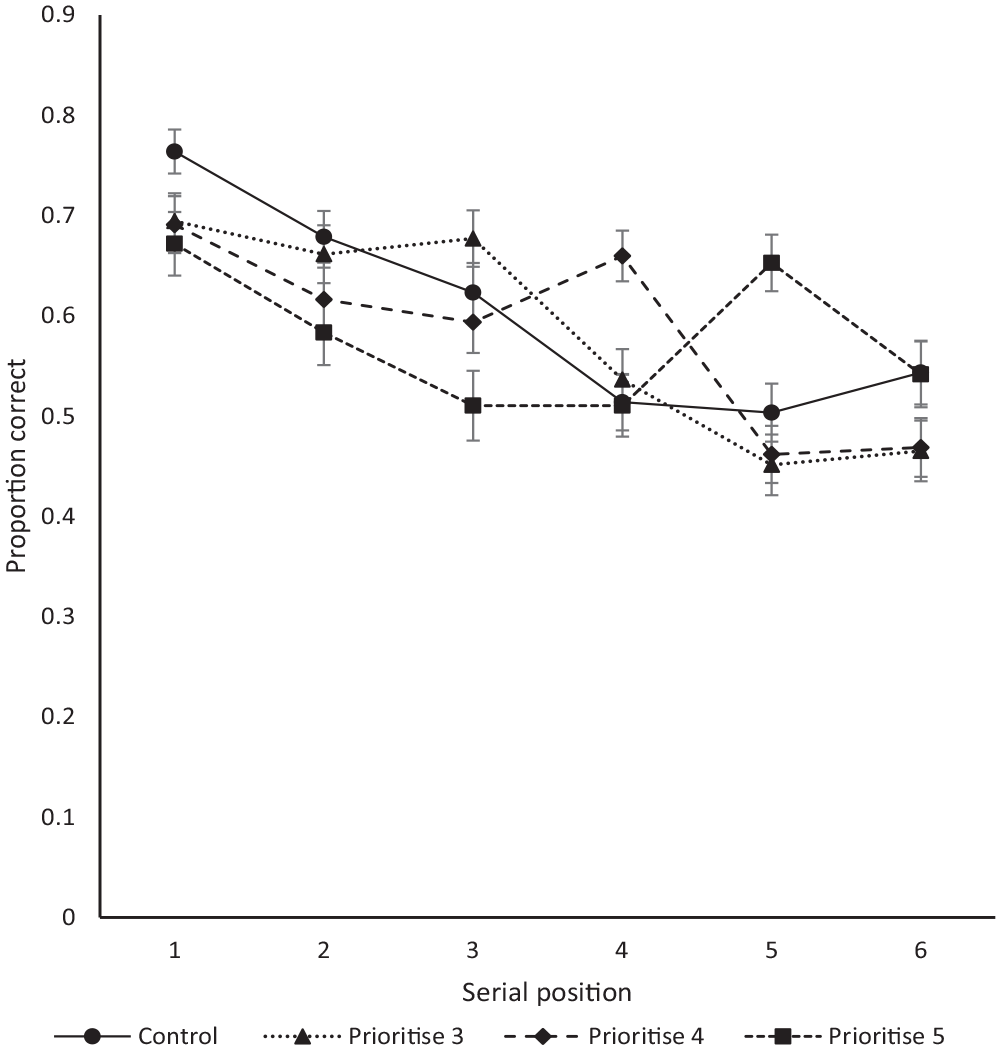
Mean proportion correct serial recall for the no prioritisation, prioritise position 3, prioritise position 4, and prioritise position 5 conditions, as a function of serial position.
The data analysis for this experiment was pre-registered (https://osf.io/j3bc5). The dependent variable was correct serial recall. The effect of prioritisation as a function of serial position was tested via a 2-factor (4 × 6) repeated measures analysis of variance (ANOVA), where the first factor was prioritisation condition (no prioritisation control, prioritise position 3, prioritise position 4, and prioritise position 5), and the second factor was the serial position (1–6). The main effect of prioritisation was non-significant, F(3, 141) = 0.92, MSE = 0.05, p = .433, η p 2 = .02. The main effect of serial position was significant (Greenhouse-Geisser corrected), F(2.24, 104.98) = 32.84, MSE = 0.08, p < .001, η p 2 = .41. As denoted in Figure 1, both strong primacy and slight recency are evident. Importantly, the interaction between prioritisation and serial position was significant (Greenhouse-Geisser corrected) F(7.68, 360.90) = 11.84, MSE = 0.04, p < .001, η p 2 = .20.
We were particularly interested in the extent to which prioritisation facilitated the recall of these serial positions compared with the same serial position in the control conditions. Therefore, to explore the interaction, targeted analyses of the prioritised serial positions were computed. This comprised of (Bonferroni corrected α = .017) paired t-tests comparing correct recall for each prioritised position with the corresponding (matched) non-prioritised position in the control condition (as described by Atkinson et al., 2021). For serial position 3, recall for the prioritised condition was marginally higher (M = 0.68, SD = 0.20) compared with the control condition (M = 0.62, SD = 0.20), however this was not significant, t(47) = 1.92, p = .03, d = 0.28. For serial position 4, recall for the prioritised condition was significantly higher (M = 0.66, SD = 0.18) compared with the control (M = 0.51, SD = 0.20), W = 797, p < .001, rrb = 0.77. For serial position 5, recall for the prioritised condition was significantly higher i (M = 0.65, SD = 0.20) compared with the control condition (M = 0.50, SD = 0.20), t(47) = 5.43, p < .001, d = 0.74.
Effects on less valuable items
Finally, as described in Atkinson et al. (2021), we investigated whether prioritisation exhibited a detrimental effect on recall for the non-prioritised positions. To this end, we calculated composite scores for the non-prioritised positions (e.g., for the prioritise 3 condition the composite score comprised an average of positions 1, 2, 4, 5, and 6). This was then compared with the composite scores from the control conditions (computed by averaging the same serial positions) via paired sample t-tests (Bonferroni corrected α = .017). There was no significant difference between the composite scores in control (non-prioritised) condition (M = 0.60, SE = 0.02) and the composite scores for prioritise position 3 condition (M = 0.56, SE = 0.02), t(47) = 1.93, p = .06, d = 0.28. There was a significantly higher recall for the composite scores for control (non-prioritised: M = 0.62, SE = 0.02) compared with the composite scores for prioritise position 4 condition (M = 0.56, SE = 0.02), t(47) = 3.33, p = .002, d = 0.48. Similarly, there was also significantly higher recall for the control (non-prioritised) condition composite scores (M = 0.63, SE = 0.02) compared with the composite scores for prioritise position 5 condition (M = 0.56, SE = 0.03), t(47) = 3.08, p = .003, d = 0.44.
Discussion
This study is the first to examine working memory prioritisation effects for tactile stimuli. The findings showed no significant main effect of prioritisation, which is consistent with both the visual (e.g., Hu et al., 2014) and auditory-verbal domain (Atkinson et al., 2021), suggesting that participants can strategically direct a limited capacity focus of attention to different positions within the to-be-remembered item set, without incurring any increased costs overall. Importantly, the interaction between serial position and prioritisation demonstrates that prioritisation boosts recall at positions 4 and 5. A finding consistent with that for auditory stimuli (Atkinson et al., 2021), visually presented verbal information (WM tasks: Sandry & Ricker, 2020; Sandry et al., 2014 and LTM: Middlebrooks et al., 2017) and visual information (Atkinson, Berry, Waterman, et al., 2018; Hitch et al., 2018; Hu et al., 2014, 2016).
In addition to the recall facilitation for prioritised positions, our data reflect a significant cost to performance for less valuable items when participants were required to prioritise position 4 or 5. This suggests that prioritisation effects for tactile memory trade-off with a recall cost for non-valuable items. This finding supports previous research showing increased costs to non-valuable items in the visual domain (Hu et al., 2014, 2016) but differs from Atkinson et al. (2021, Experiment 1) who found recall costs only when serial position 7 was the prioritised. Notwithstanding this minor discrepancy, taken together the data, are consistent with the proposition that attentional resources are finite, and that the process of strategic redistribution to specific positions within the to-be-remembered sequence results in a reduction in recall for items at non-prioritised positions (Hu et al., 2014).
It might be argued that our data, rather than reflecting the operation of tactile memory, are the product of participants verbally recoding and rehearsing the locations of the tactile stimuli. We think this is unlikely because tactile ISR is not abolished with concurrent articulation (CA) (Johnson et al., 2019; Mahrer & Miles, 1999). Nevertheless, Experiment 2 was designed to test directly the proposition that the prioritisation effect observed in Experiment 1 was dependent upon the verbal recoding and rehearsal of the tactile stimuli. Atkinson and colleagues found that verbal prioritisation effects not only survived CA but were larger relative to a control no-CA condition. Similarly, visual prioritisation studies (e.g., Hitch et al., 2018; Hu et al., 2014; Sandry et al., 2014) have shown that prioritisation effects remain under CA. This suggests that such effects rely on mechanisms other than verbal labelling and rehearsal (indeed Atkinson et al., 2021, speculated that prioritised items are supported by attentional refreshing and non-prioritised items via rehearsal).
Experiment 2
Experiment 2 is a partial replication of Experiment 1 but focusses on prioritisation at serial position 5, as this is where the prioritisation effect was strongest in Experiment 1. Participants completed 4 blocks of 12 trials, with 2 control (no prioritisation) blocks and 2 prioritisation blocks, each under conditions of both quiet and CA. Following Atkinson et al. (2021), the concurrent task required participants to repeat aloud the phrase “Monday, July” during sequence presentation and to remain silent during recall. Replication of the prioritisation effect shown in Experiment 1 would be evidenced by a two-way interaction between serial position and prioritisation, such that recall is elevated at serial position 5 following prioritisation. If this effect is reduced following CA, we would expect a three-way interaction between CA, serial position, and prioritisation. As reported in Experiment 1, we also predicted a recall cost in the prioritisation condition for the low value (non-prioritised) positions.
Method
Participants
The study was pre-registered on the OSF (https://osf.io/wnmva). Twenty-four Bournemouth University students (20 females, 3 males, and 1 non-binary, mean age = 24.42, SD = 7.99) participated in exchange for course credits.
A power analysis determined the appropriate sample size using the “SuperPower” package in R (Lakens & Caldwell, 2021). The power analysis was undertaken on data from Experiment 1 taken from the control condition and prioritise position 5 condition. We therefore powered for a difference between recall at serial position 5 for the control and prioritise position 5 conditions. To obtain a significant difference at 90% with α < .05, 20 participants were needed. The present study employed a sample size of 24 to enable full counterbalancing of the four 12 trial blocks. Exclusion criteria were applied as described for Experiment 1. This resulted in four participants being excluded and replaced. The study received ethical approval from the Bournemouth University Psychology ethics committee (ethics approval code: 45468).
Materials
The materials were as described for Experiment 1.
Design
The study employed a 2 × 2 × 6 within-participants design, with the first factor the prioritisation condition (no prioritisation versus prioritise position 5), the second-factor concurrent task (quiet versus CA), and the third-factor serial position (1-6). As in Experiment 1, each participant completed 48 trials (4 blocks of 12 trials), and each block was preceded by 2 practice trials. The prioritisation and concurrent task trials were blocked, and the presentation order of the 4 blocks was fully counterbalanced across participants.
As described for Experiment 1, prioritisation of position 5 was operationalised by informing participants that correct responses for that position would receive 3 points (versus 1 point for correct recall of non-prioritised positions). As in Atkinson et al. (2021, Experiment 1), the CA manipulation involved the repetition of the phrase “Monday, July” out loud during the presentation of the sequence at a rate of approximately two words per second, monitored by the experimenter.
Procedure
The procedure was as described for Experiment 1, with the exception that (1) in the concurrent task condition, participants were informed that they should repeat the phrase “Monday, July” with each tap to their fingers and remain silent when recreating the sequence, and (2) only the prioritise position 5 condition was tested.
Results
Figure 2a and b shows the mean proportion serial recall accuracy for the prioritisation conditions under conditions of quiet (Figure 2a) and CA (Figure 2b). Both figures show an increase in recall at the prioritised position.
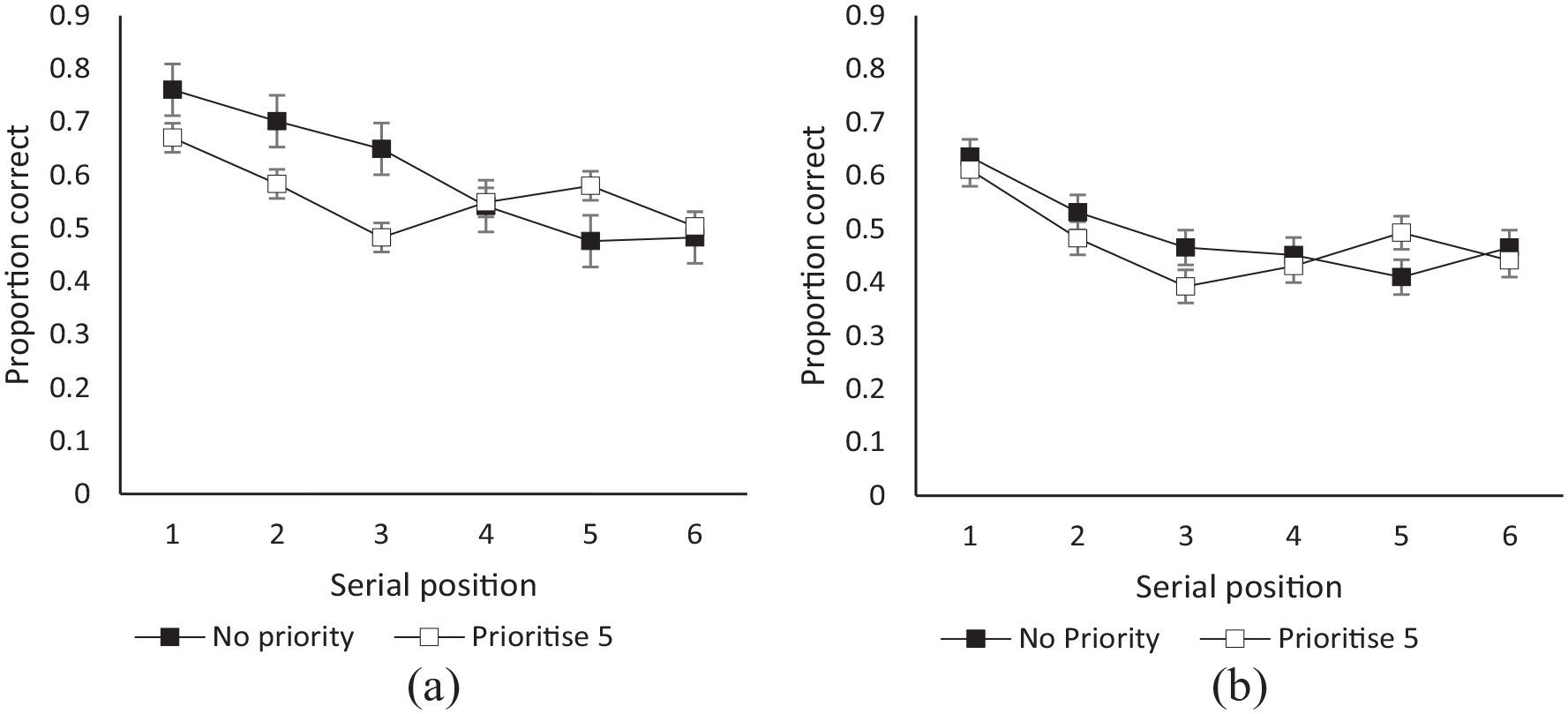
Mean proportion serial recall accuracy for the no prioritisation and prioritise position 5 conditions as a function of the serial position under condition of quiet (a) and CA (b).
The analysis was pre-registered (https://osf.io/wnmva). As in Experiment 1, the dependent variable was the mean correct serial recall. We computed a 3-factor (2 × 2 × 6) repeated measures ANOVA with the factors prioritisation (no prioritisation or prioritise position 5), concurrent task (quiet and CA), and serial position (1–6). The main effect of prioritisation was non-significant, F(1, 23) = 1.70, MSE = 0.07, p = .205, η p 2 = .07, indicating that prioritisation did not affect recall of the complete sequence. The main effect of concurrent task was significant, F(1, 23) = 14.042, MSE = 0.10, p = .001, η p 2 = .38, such that CA reduced serial recall accuracy (CA, M = 0.48, SD = 0.23; quiet, M = 0.58, SD = 0.21). The main effect of serial position was significant (Greenhouse-Geisser corrected), F(2.866, 65.917) = 21.899, MSE = 0.04, p < .001, η p 2 = .49. Figure 2a and b reflecting strong primacy and some recency, consistent with Experiment 1. Importantly, the interaction between prioritisation and serial position was significant (Greenhouse-Geisser corrected), F(3.092, 71.124) = 6.059, MSE = 0.04, p < .001, η p 2 = .21, reflecting superior recall at serial position 5 (the prioritisation effect). The interaction between concurrent task and serial position was not significant, F(5, 115) = 1.288, MSE = 0.03, p = .274, η p 2 = .05. Crucially, the three-way interaction between prioritisation, concurrent task, and serial position was not significant (Greenhouse-Geisser corrected) F(4.022, 82.804) = 0.903, MSE = 0.03, p = .458, η p 2 = .04. To explore the interaction between prioritisation and serial position, performance was averaged across the quiet and CA conditions, with the prioritisation and no prioritisation conditions compared at each serial position via (Bonferroni corrected, α = .008) paired sample t-tests (or Wilcoxon signed-ranks where normality was violated). Recall at serial position 1 did not significantly differ between the control (non-prioritise) condition (M = 0.70, SD = 0.13) and the prioritisation condition (M = 0.64, SD = 0.14), t(23) = 1.69, d = 0.34, p = .106, d = 0.34. Recall accuracy at serial position 2 was significantly higher in the control (non-prioritise) condition (M = 0.62, SD = 0.12) compared with the prioritisation condition (M = 0.53, SD = 0.14), t(23) = 2.97, p = .007, d = 0.61. The difference in recall accuracy at serial position 3 between the control (non-prioritise) condition (M = 0.56, SD = 0.15) and the prioritisation condition (M = 0.44, SD = 0.15) did not reach the threshold for statistical significance, t(23) = 3.42 p = .06, d = 0.70. Recall accuracy at serial position 4 did not significantly differ between the control (non-prioritise) condition (M = 0.50, SD = 0.16) and the prioritisation condition (M = 0.49, SD = 0.19), W = 172, p = .538, rrb = 0.15. The predicted elevated recall for position 5 following prioritisation (M = 0.54, SD = 0.19) compared with the control (non-prioritise) condition (M = 0.44, SD = 0.17) did not reach statistical significance following Bonferroni correction, t(23) = 2.66, p = .014, d = 0.54. Finally, recall accuracy for position 6 in the control (non-prioritise) (M = 0.47, SD = 0.20) and prioritisation condition (M = 0.47, SD = 0.16) did not statistically differ, t(23) = 0.05, p = .958, d = 0.01.
To focus on the effects of prioritisation and concurrent articulation at serial position 5, we computed a 2 × 2 within-subjects ANOVA on the prioritised fifth position only, with the first factor being prioritisation (no prioritisation and prioritise position 5) and the second factor being concurrent task (quiet and CA). The main effect of concurrent task was not significant, F(1, 23) = 3.015, MSE = 0.05, p = .096, η p 2 = .12. The main effect of prioritisation was significant, F(1, 23) = 7.084, MSE = 0.03, p = .014, η p 2 = .24, with recall higher in the prioritise condition (M = 0.53, SD = 0.26) compared with no prioritisation (M = 0.44, SD = 0.19). Importantly, the interaction between prioritisation and concurrent task was not significant, F(1,23) = 0.077, MSE = 0.03, p = .784, η p 2 = .003.
Effects on less valuable items
As in Experiment 1, to examine the effect of prioritisation on recall for the non-prioritised positions, we computed composite scores. A 2×2 repeated measures ANOVA was conducted with the factors prioritisation (no prioritisation and prioritise position 5) and concurrent task (quiet and CA). There was a significant main effect of concurrent task, F(1, 23) = 14.63, MSE = 0.02, p < .001, η p 2 = .389, with recall lower under conditions of CA (M = 0.49, SD = 0.18) compared with quiet (M = 0.59, SD = 0.13). There was also a significant main effect of prioritisation, F(1, 23) = 5.22, MSE = 0.01, p = .032, η p 2 = .185, with recall lower in the prioritisation (M = 0.51, SD = 0.17) compared with no prioritisation condition (M = 0.57, SD = 0.15). Importantly, the interaction between prioritisation and concurrent task was not significant, F(1, 23) = 0.35, MSE = 0.02, p = .560, η p 2 = .015.
Discussion
Experiment 2 replicated the tactile prioritisation effect shown in Experiment 1 and demonstrated that this effect remained under CA. The predicted interaction between prioritisation and serial position remained, but importantly, it did not interact with CA. Although the predicted elevated recall at position 5 was significant (p = .014), it did not meet the strict correction criteria (p < .008). The persistence of prioritisation with CA is consistent with findings both in the visual domain (Hu et al., 2014, 2016; Sandry et al., 2014) and in the auditory-verbal domain (Atkinson et al., 2021). That the tactile prioritisation effect was not disrupted by CA suggests that the prioritisation effect demonstrated in Experiment 1 is not a product of verbal recoding. Indeed, this finding is consistent with previous research demonstrating that tactile serial recall effects remain under conditions of CA (e.g., the Ranschburg effect, Johnson et al., 2019; tactile ISR, Mahrer & Miles, 1999). Taken together, we argue that our findings provide strong evidence for a tactile prioritisation effect.
Experiment 2 replicated Experiment 1, demonstrating a significant cost of prioritisation to the recall of non-prioritised items, supporting the notion that tactile prioritisation effects come at a recall cost to non-prioritised items due to the strategic allocation of attentional resources. These findings support Atkinson et al.’s (2021) observation of recall costs for non-valuable items under conditions of low concurrent load, which they argue is due to the concurrent task interrupting the rehearsal of non-valuable items. Indeed, that rehearsal might be used for low-value (but not high-value) items in the present study is supported by the differing main effects of the secondary task. When the analysis focussed on only the prioritised position, there was no main effect of CA. However, when the analysis included the low-value items, a main effect of the secondary task was present, consistent with CA disrupting rehearsal of low-value items.
General discussion
This study is the first to demonstrate that items within a tactile sequence can be attentionally prioritised, benefitting recall for those items. Experiment 1 showed a WM prioritisation effect for recall of a tactile sequence, in line with research from the visual (Atkinson, Baddeley, & Allen, et al., 2018; Hitch et al., 2018; Hu et al., 2014, 2016; Sandry et al., 2014) and auditory-verbal domain (Atkinson et al., 2021), and this effect was strongest for prioritised items towards the end of the tactile sequence (i.e., positions 4 and 5). Tactile prioritisation effects persisted (Experiment 2) despite the concurrent task, which is consistent with the findings of Atkinson et al. (2021, Experiment 2). Therefore, the present study adds to the small but growing body of evidence that for the visual, auditory, and tactile domains, a fixed capacity attention mechanism can be strategically re-directed to items in a sequence, improving recall of those prioritised items.
The fact that the prioritisation effect remained with CA provides evidence that tactile information was being prioritised, rather than a representation of verbal recoding. Indeed, other order memory effects within the verbal memory domain are found with tactile memory, for example, the Ranschburg effect (Johnson et al., 2019; Roe et al., 2017), the Hebb repetition effect (Johnson et al., 2017), and both canonical serial position effects (Johnson et al., 2016, 2019; Mahrer & Miles, 1999; Roe et al., 2017) and error distributions (Johnson et al., 2016). Taken together, this suggests that tactile memory works in a manner functionally similar to that of visual and auditory memory and provides further evidence of cross-modal equivalence in serial-order memory (e.g., Vandierendonck, 2016; Ward et al., 2005).
The tactile prioritisation effects demonstrated came at a recall cost to non-prioritised items within the sequence under both CA and quiet. This supports core findings from the visual domain (Atkinson, Baddeley, & Allen, et al., 2018; Hu et al., 2014; Sandry et al., 2014). It is also broadly in line with what has been reported in the auditory-verbal domain (Atkinson et al., 2021), though with some minor differences. In that paradigm, there were costs to less valuable items when prioritisation was directed at serial position 7 (though not positions 3 or 5) under no-task conditions. Under CA, prioritisation produced low-value item costs at each serial position. Atkinson et al. explained these results by speculating that CA disrupts sub-vocal rehearsal of the non-prioritised items. We saw no evidence of this in the present study. Nevertheless, our findings are generally consistent with evidence from other domains showing that the differing value of items results in a strategic re-direction of attention towards high value and away from low value without increasing overall attentional resources or WM capacity.
In Experiment 2, we selected the CA “Monday, July” to replicate Atkinson et al.’s (2021) low-cognitive load condition. Our decision to adopt a low-cognitive load CA task was based on the requirement to minimise sub-vocal rehearsal, while not simultaneously over-taxing attentional resources (Camos & Barrouillet, 2014; Camos et al., 2011). The findings support Atkinson et al.’s (2021) argument that auditory prioritisation effects do not rely on verbal rehearsal and further support evidence from the visual domain (e.g., Hitch et al., 2018; Hu et al., 2014), whereas visual prioritisation effects remain under verbal load. Instead, one possibility is that high-value items are prioritised via a domain-general process of attentional refreshing (Vergauwe et al., 2010; see also Sandry et al., 2014, 2020) through which decaying memory traces are kept active. This process maintains the items in a readily accessible state (Johnson, 1992; Johnson et al., 2002; Sandry & Ricker, 2020), resulting in improved recall. Biased attentional refreshing towards high-value items within the episodic buffer may help keep such items salient within the FoA (Atkinson et al., 2021, 2022) With respect to the maintenance of tactile representations in WM, if, for example, a common process is employed to maintain both prioritised and non-prioritised items (e.g., refreshing), then a reduction in recall for the low-value non-prioritised items will be observed for both quiet and CA conditions, which is what was observed in the present study.
Indeed, given this possibility, it would be worthwhile for future research to investigate the impact of increased cognitive load to test the contribution of general “executive” attention to the maintenance of prioritised and non-prioritised items. This might involve a more complex and demanding verbal task (Atkinson et al., 2021; Hu et al., 2016). If there is an executive control component to strategic prioritisation, this might result in reduced value effects (Hu et al., 2016). Alternatively, participants might continue to strategically prioritise the high-value item for serial recall, while entirely abandoning low value items (Atkinson et al., 2021, Experiment 3). Establishing whether such patterns might extend to tactile serial recall would help establish the generality of outcomes across modalities and paradigms.
Processing and storage of tactile information has traditionally not been well specified within the multicomponent working memory model (Baddeley & Hitch, 1974). One recent suggestion is that a broader specification of the visuospatial sketchpad component might be responsible for the processing and integration of visual, spatial, kinaesthetic, and tactile information in the formation of object representations (see Baddeley et al., 2021), and this may also incorporate motor information (Li et al., 2022). Within the context of the multi-component model (Baddeley et al., 2021), as with other domains, the prioritisation of more valuable information in a tactile sequence would then involve active maintenance and refreshing within the FoA as part of the episodic buffer.
In summary, across two experiments, we provide clear evidence that, within the tactile domain, attention can be focussed on specific items within a sequence, optimising performance for those items. This finding is consistent with both visual (Atkinson, Baddeley, & Allen, et al., 2018; Hitch et al., 2018; Hu et al., 2014, 2015; Sandry et al., 2014) and auditory-verbal stimuli (Atkinson et al., 2021), thus adding to the body of literature suggesting that tactile memory operates in a manner analogous to that for other modalities. Future work could seek to understand the recall costs associated with non-valuable items through investigation of the mechanisms used to maintain tactile prioritised items and the contribution of attentional resources to this process.
Footnotes
Acknowledgements
Dr Andrew J Johnson sadly passed away after the initial submission of this article, which was published in his memory (1980–2023).
Authors’ note

Declaration of conflicting interests
The author(s) declared the following potential conflicts of interest with respect to the research, authorship, and/or publication of this article: Are employed Potential conflict—Prof. Sarah Bates who is an editor of the QJEP is the head of the department of Bournemouth University, where many of the contributors to this article. She is in charge of submitting our REF applications for the department.
Funding
The author(s) received no financial support for the research, authorship, and/or publication of this article.