




Abstract
Non-verbal mimicry (i.e., being posturally similar by copying another person’s body language) has been shown to increase evaluations of the mimicker. Concurrently, extensive research in social psychology has demonstrated a negative effect on interpersonal evaluations when one perceives others as cognitively dissimilar, often resulting in interpersonal conflicts. Across two experiments (Experiment 1: N = 159, Experiment 2: N = 144), we tested our hypotheses that mimicry, compared with no mimicry, will make mimickers come across as more likable and competent regardless of whether they were perceived as cognitively dissimilar or not (Experiment 1) and regardless of the extent to which they were perceived as cognitively dissimilar (Experiment 2). Broadly, we found support for our hypotheses, and via mediation sensitivity analyses, we found that the effect of mimicry, at least for likability, was mediated by participants’ perceived personal similarity to the mimicker. Non-verbal mimicry may thus be one way of alleviating interpersonal conflicts via increasing perceptions of personal similarity regardless of initial cognitive dissimilarity.
We have known for a long time that non-verbal behaviour is important for us to navigate through our social environment (Burgoon et al., 2010). Although the term non-verbal behaviour comprises many different sides of behaviour, researchers became particularly interested in non-verbal mimicry, given its pro-social effects on others (Chartrand & Lakin, 2013; Chartrand & van Baaren, 2009). Non-verbal mimicry (or henceforth termed mimicry) refers to the mirroring of another person’s (the mimickee’s) body movements by a mimicker so that both are posturally similar (Clerke & Heerey, 2021; van Baaren et al., 2009). It has been shown to increase the mimicker’s likeability (Chartrand & Bargh, 1999; Sanchez-Burks et al., 2009; Stel et al., 2011); and, after being mimicked, people tend to display a more interdependent self-construal (Ashton-James et al., 2007) and act more pro-socially towards the mimicker (van Baaren et al., 2004). Mimicry also results in positive outcomes in more practical settings (Hamilton, 2008; Lewis & Dunn, 2017). For example, individuals tend to perform better on social learning tasks (Zhou, 2012), in negotiations with others (Fischer-Lokou et al., 2014), and display more empathy towards the mimicker after they have been mimicked (Duffy & Chartrand, 2015). Moreover, mimicked individuals, compared with non-mimicked individuals, have been shown to agree more to tasks even when these come at significant costs, such as walking the mimicker 15 min to a train station (Müller et al., 2012). In light of the evidence that mimickees perceive the mimicker more positively, it is perhaps not a surprise that mimicry is often referred to as a “social glue” (Lakin et al., 2003, p. 147). In other words, being posturally similar to the mimicker makes the mimickee perceive the mimicker more positively (Clerke & Heerey, 2021; van Baaren et al., 2009).
Extensive research in social psychology has demonstrated the existence of intergroup dynamics where individuals tend to depersonalise others (Abrams & Hogg, 1990; Hogg & Abrams, 1988; Hogg & Terry, 2000; Tajfel & Turner, 1979, 1986) and perceive them on a continuum of cognitive similarity ranging from cognitively similar (i.e., in-group) on the one end to cognitively dissimilar (i.e., out-group) on the other (J. C. Turner et al., 1987, 1994). By perceived cognitive similarity, we mean an individual’s assessment of the extent to which they have overlapping worldviews and traits with others (Hogg et al., 1995). It is therefore inclusive of, but not wholly dependent on, another person’s group membership. These dynamics often result in polarisations and conflicts among different groups (Bretter & Schulz, 2023), ranging from rivalries between opposing soccer fans to more serious conflicts related to religious groups (Hewstone et al., 2014) where more cognitively dissimilar (out-group) individuals are seen more negatively while more cognitively similar (in-group) individuals are seen more positively (Abrams & Hogg, 2010; Hogg, 1992, 1993; Tajfel & Turner, 1979).
Naturally, then, the question arises as to whether the positive effects of mimicry prevail in spite of the initially perceived cognitive dissimilarities created by intergroup dynamics. Answering this question, we believe, is important because we live in a society that gradually creates more intergroup dynamics via the means of, for example, political polarisation where individuals belonging to different groups become increasingly cognitively dissimilar (Axelrod et al., 2021). This creates a problem for democratic societal discourse because cognitively dissimilar individuals try to avoid each other (Bretter & Schulz, 2023; Simas et al., 2020). Accordingly, we need to explore ways that allow individuals to come across positively despite the cognitive dissimilarity caused by intergroup dynamics. We propose non-verbal mimicry to be one way forward, because mimicry itself may be one way of signalling similarity, which we will further elaborate on below. Therefore, mimicry may be a particularly effective way of counteracting cognitive dissimilarities caused by social groups. Moreover, humans often engage with others who they may perceive as cognitively dissimilar in many contexts. For example, research has shown that managers and employees may see themselves as members of different groups, thus perceiving each other as cognitively dissimilar and giving rise to challenges for their working relationship (Cornelis et al., 2011; Dalton & Chrobot-Mason, 2007; Duck & Fielding, 1999). Similarly, patients may perceive their therapist as cognitively dissimilar, particularly at the beginning, which provides challenges not only for their relationship but also for the patient’s progress (Kelly & Strupp, 1992). If we find that mimicry allows the mimicker to come across more positively despite cognitive dissimilarities, these professionals and others may be able to strategically apply our research to improve their relationships.
There is strong evidence to show that, in general, dyadic mimicry leads to positive evaluations of the mimicker (Chartrand & Bargh, 1999; Chartrand & Dalton, 2009; Chartrand & Lakin, 2013). Given that these studies, however, do not prime cognitive (dis)similarity, assumptions as to whether or not mimicry can actually overcome the negative effects associated with cognitive dissimilarities are only speculative. In situations of cognitive similarities, or in-group favouritism (J. C. Turner & Oakes, 1989; J. C. Turner et al., 1994), it is likely that the positive effects of mimicry will occur. However, the situation is less clear when it comes to cognitive dissimilarity. Nonetheless, there is evidence from the dyadic mimicry literature to suggest that mimicry may allow the mimicker to come across positively, even in contexts of cognitive dissimilarities. Using a cyber-psychology experiment, one study found that an interaction with dissimilar avatars was rated as more harmonious after the avatar mimicked participants (Hasler et al., 2014). Here, however, a comparison with a cognitively similar avatar was missing, thus making estimations of such an effect speculative. Furthermore, Inzlicht et al. (2012) examined the effects of mimicry on the mimicker and demonstrated that mimicry can improve attitudes of the mimicker towards dissimilar (out-group) individuals. However, this study focused on the effects of mimicry on the mimicker, as opposed to the mimickee.
It is important to state here that researchers have found that the effects of the related construct of automatic imitation are not moderated by social group membership (De Souter et al., 2021; Genschow et al., 2023). However, these scholars examined the effects of similarity on imitation rather than the effects of imitation on similarity. Moreover, as mimicry and automatic imitation are distinct constructs, both in their definition and in their operationalisation (Heyes, 2011), the literature on the latter has limited applicability for our purposes (Genschow et al., 2017).
Thus, although mimicry also occurs naturally (Capella & Planalp, 1981; Dijksterhuis, 2005; van Baaren et al., 2003), we hypothesise that mimicry can be a particular behaviour that can be utilised deliberately to enhance mimicker evaluations, measured on two dimensions: Likability and competence. We decided to measure likability to make our studies aligned with, and comparable to, the mimicry literature; and competence to add a distinct dimension of social cognition (Fiske et al., 2007). The inclusion of competence is particularly useful to gauge the potential of mimicry in organisational settings such as the manager-employee relationship where competence evaluations of others are important. Based on research that has shown positive effects of mimicry on mimicker evaluations when the mimicker is perceived as cognitively dissimilar (Bretter et al., 2023; Hasler et al., 2014), we thus hypothesise that mimicry enhances mimicker evaluations when the mimickee perceives the mimicker as cognitively dissimilar. Aligned with the consensus of mimicry researchers on the generic positive effects of mimicry on cognition (Chartrand & Bargh, 1999; Chartrand & Lakin, 2013), we also hypothesise that mimicry will also have such positive effects on mimicker evaluations when the mimicker is perceived as cognitively similar. In other words, we hypothesise that individuals who engage in mimicry, compared with no mimicry, will be evaluated as more likable and competent regardless of whether they are initially perceived as cognitively similar or dissimilar.
Hypothesis 1. Mimicry, compared with no mimicry, will increase the mimickee’s perception of the mimicker’s likability and competence regardless of whether they are initially perceived as cognitively similar or dissimilar.
Considering the rich literature on non-verbal mimicry, it is surprising that the link between mimicry and its pro-social outcomes is less explored. One possible mechanism, however, may be perceived personal similarity (Lakin, 2013). Aligned with the literature on mimicry (Clerke & Heerey, 2021), we define personal similarity as a facet of the larger and more inclusive construct of cognitive similarity. Mimicry may engender an assimilative mind-set where being posturally similar results in a perception of being personally similar (Clerke & Heerey, 2021; van Baaren et al., 2009). Perceived personal similarity with the mimicker, in turn, makes the interaction easier to process for the person being mimicked (Whittlesea & Leboe, 2000). In other words, it makes similar attitudes and beliefs more readily accessible (Clerke & Heerey, 2021), thereby facilitating the prediction of the mimicker’s behaviour (Thornton et al., 2019). Given that humans tend to be drawn to others who are perceived to be more personally similar to them (Byrne, 1961, 1971), the mimicry-induced perception of being personally similar may thus ultimately result in more favourable evaluations of the mimicker’s likeability and competence.
Taken together, we hypothesise that mimicry, compared with no mimicry, will increase the perceived personal similarity with the mimicker; and that this occurs regardless of the extent to which the mimicker is initially perceived as cognitively dissimilar. In other words, we hypothesise that mimicry, compared with no mimicry, will counteract initial cognitive dissimilarities in a way that makes mimickers come across as more personally similar. This mimicry-induced personal similarity, in turn, will mediate the relationship between mimicry and enhanced mimicker evaluations of likability and competence.
Hypothesis 2. Regardless of the extent to which the mimicker is initially perceived as cognitively dissimilar, mimicry, compared with no mimicry, will increase the mimickee’s perception of personal similarity with mimicker which, in turn, mediates the effect of mimicry on the mimickee’s perceptions of the mimicker’s likability and competence.
General method
Procedure
All studies reported in this article received ethical approval from the University’s ethics committee after having undergone full ethical review (reference number: AREA 18-059). Across both main studies (Experiment 1 and Experiment 2), participants were students at a UK university and the basic procedure was the same. To eliminate the risks of demand characteristics, a cover story was used for the purpose of the experiment because participants were not supposed to know that the experiment was actually concerned with mimicry, as their mere awareness might have altered the results (Kulesza et al., 2016). Once participants arrived at the laboratory, the male experimenter conducted an introduction in which participants were allowed to ask questions. Then, the experimenter left the room and participants completed the first part of the experiment on the computer. In this phase, the cognitive (dis)similarity priming took place (more detail can be found in the methods of each experiment). After the priming, the experimenter entered the room and had a 5-min interaction with participants as he asked pre-determined questions (see Supplemental Materials or link at the end for the open-access repository). Moreover, the experimenter either mimicked or did not mimic (i.e., sitting in a relaxed, upright position with both feet on the floor and with hands on his lap; Kulesza et al., 2017) the body movements of participants. Importantly, the conversation was video recorded to conduct the manipulation check for our behavioural manipulation (see below). After the interaction, the experimenter left the room and participants continued with the questionnaire on the computer, in which we measured our dependent variables (likability, competence, and personal similarity), demographic information (e.g., gender, age, and ethnicity), and our manipulation check (see “Measures”). Finally, participants were fully debriefed, provided informed consent for their data to be used, and were paid £5 equivalent as compensation for their time. Experiment 1 tested Hypothesis 1, Experiment 2 tested both Hypotheses 1 and 2. Our studies were not pre-registered. The data used for the analyses are made available via an open-access repository (https://osf.io/cpju7). All stimulus materials and the code for the analyses are made available in Supplemental Materials (stimuli are also available here: https://osf.io/cpju7).
Power analysis
We computed the required minimum sample size a priori using G*Power 3.1 (Faul et al., 2007) and did not collect additional data after we finalised our experiments. Considering previous research, we estimated the effect size of mimicry is medium to large (Hale & Hamilton, 2016; Stel et al., 2011). Accordingly, we used f2 = .0625 for our sample size calculation. Furthermore, we included the number of groups n = 4, α = .05, number of predictors = 2 (mimicry and cognitive [dis]similarity), number of response variables = 3 (likability, competence, and personal similarity) and a statistical power of .80 for our calculation. The calculation was based on multivariate analyses of variance (MANOVAs) (allowing for special effects and interactions). The minimum sample size for each Experiment was therefore Nmin = 113 participants.
Experiment 1
Method
We decided a priori to over-recruit the number of participants for two reasons. First, given that individuals who expressed their interest in participating in the experiment frequently dropped out, we needed to book laboratory appointments with more participants than required. Second, our manipulation-check measures (see below) inherently excluded some participants (as elaborated in the materials) and thus we needed to over-recruit to ensure we had a sufficient number of participants in our final sample. In total, we thus recruited Ntotal = 181 participants (for demographic information, see below).
Materials
Priming
To manipulate cognitive similarity, we utilised a local rivalry between two neighbouring UK universities. Given that participants were students at one of these two universities, the experimenter was presented either as a member of the same university (i.e., cognitively similar) or as a member of the rival university (i.e., cognitive dissimilar). Experiment 1 thus followed a 2 (mimicry: mimicry, no mimicry) × 2 (cognitive similarity: similar, dissimilar) between-participant design. Participants were randomly allocated to one of these four conditions. Our priming was enabled by our cover story in which participants were told that the purpose of the experiment was to examine whether students at particular universities tend to have specific social-value orientations because employers supposedly prefer to hire individuals with a particular type of social value-orientation. The information they received stated: It is known that companies aim at recruiting their next generation of successful managers. Based on their experience, they are looking for candidates with a particular type of social value orientation. In fact, it has become apparent that most of the successful managers, tend to have one particular type of social value orientation. Therefore, the aim of this study is to find out whether individuals with the desired social value orientation can be found only at particular universities. In other words, does the social value orientation of students depend on their universities?
Through this cover story, we attempted to create a competitive context in which we told students that, to be successful in their career, a particular type of social-value orientation is desirable. Such context enabled our cognitive (dis)similarity priming which comprised two parts. The first part of the priming occurred before participants interacted with our experimenter. In particular, they were asked to conduct a test examining their social-value orientation. We then showed them ten values stemming from Schwartz’s (1992, 2012) value survey and asked them to rate how important these were to them. On the next page, participants were then presented with the result of the test. Although the questionnaire was real, we manipulated the results so that they were told that their social-value orientation matched 76% with the prototypical social-value-orientation of their university’s students. We selected the number to be high but not too obviously high. Furthermore, they were told that the typical social-value orientation from the rival university is slightly higher and that employers may therefore prefer to hire students from that rival institution. Based on the results of the test, we then asked participants to put on a red wristband which they had to take out of a basket of multiple-coloured wristbands. This, we hoped, strengthened the illusion that differently coloured wristbands were required for different social-value orientations (i.e., that the test and the results were real). The first part of the priming was then complemented by the second part, that is, the encounter with the experimenter. When the experimenter entered the room to have the 5-min interaction with the participants, he was either wearing a red wristband and a red jumper with the clearly visible logo of the participants’ university (i.e., cognitively similar) or he was wearing a blue wristband and a blue jumper, again, with a clearly visible logo of the rival university (i.e., cognitively dissimilar). The interaction followed a scripted questionnaire (see Supplemental Materials).
Measures
Unless otherwise stated, we measured all items on a 7-point Likert-type scale from 1 = Strongly disagree to 7 = Strongly agree. 1
Likability
We measured likability with a five-item scale developed by Ahearne et al. (1999). Example items include “The experimenter appears to be nice” and “The experimenter is easy to like.” The overall reliability of the scale was acceptable (α = .89).
Competence
Competence was measured using the four-item scale by Fiske and Cuddy (2006) which includes items such as “The experimenter is competent.” The scale showed acceptable reliability (α = .83).
Manipulation checks
To check our cognitive similarity manipulation, we adapted the Inclusion of Other in the Self scale by Aron et al. (1992). This is a seven-point response scale showing four circles at each point. In line with our cognitive similarity manipulation, there was one circle each representing either the university of the experimenter, the university of the participant, the experimenter, or the participant. Depending on the response option, these circles overlapped to a different extent with the distance between the two circles representing either university remaining constant. Therefore, the differences in overlap between the circles for the experimenter and the participant represented how cognitively (dis)similar participants perceived the experimenter. This scale has recently been used by Tunçgenç and Cohen (2016) and is made available via the open access repository (see link at the end) and via Supplemental Materials. We asked participants which of the seven options (overlapping circles) best represented their impression of the interaction they had with the experimenter. We also included an eighth option labelled “None of the above” to give participants the opportunity to indicate that none of the options matched their impression. It was decided a priori to exclude participants who selected this eighth option from the analysis because our priming would have been ineffective in such cases. To check our behavioural manipulation, we followed best practice in mimicry research (e.g., Lakin et al., 2008) and presented half randomly selected videos for each of the two behavioural conditions to a researcher blind to the hypotheses. The researcher then rated each of the videos on a 7-point Likert-type scale from no mimicry at all (1) to full mimicry (7).
Aligned with previous research on mimicry (Bailenson et al., 2008), the experimenter verbally asked participants at the end of the experiment “Did anything about the experiment appear suspicious to you?” to give participants the opportunity to flag whether they were aware of the mimicry (Kulesza et al., 2016). This strategy merely served to check whether suspicious participants needed to be excluded, but not as a manipulation check. This was also followed by a question on whether participants could correctly guess the aims of the study as awareness of the study’s hypotheses may change the results.
Results
For additional robustness, we excluded some participants following our checks as we now report. Those who selected None of the above for our manipulation check measure (n = 20) were excluded because our priming may have been ineffective for such individuals and thus, they would skew our results. We also needed to exclude individuals who detected mimicry during the interaction (n = 2). Importantly, however, our results remain when we analyse the data without exclusions. Accordingly, we analysed data of NAnalysis = 159 participants (age: M = 20.08 years, SD = 1.75 years; gender: female = 89; ethnicity: White = 73.6%, Black = 3.8%, Asian = 15.7%, Other = 6.9%).
Manipulation check
To examine whether our cognitive similarity priming was successful, we conducted a one-way between-participants ANOVA with the cognitive similarity conditions as the independent variable and our manipulation check measure as the dependent variable. The results revealed an effect of the manipulation on the self-other overlap that participants had with the experimenter, F(1, 157) = 102.95; p < .001; d = 1.61. As expected, they perceived greater overlap with the experimenter in the cognitively similar condition (M = 5.19; SD = 1.65; 95% CI = [4.82, 5.55]), compared with the cognitively dissimilar condition (M = 2.58; SD = 1.59; 95% CI = [2.23, 2.94]). We conducted the manipulation check for our behavioural conditions similarly. A one-way between-participants ANOVA with the behavioural condition as the independent variable and the mimicry rating as the dependent variable revealed an effect, F(1, 78) = 666.39; p < .001; d = 5.76. As we expected, interactions in the mimicry condition received higher ratings of mimicry (M = 5.80; SD = 1.16; 95% CI = [5.43, 6.17]), compared with interactions in the no mimicry condition (M = 1.03; SD = 0.16; 95% CI = [0.97, 1.08]). Overall, we therefore successfully conducted our cognitive similarity and behavioural manipulations.
Dependent variables
To test our hypotheses, we conducted a 2 (mimicry: mimicry, no mimicry) × 2 (cognitive similarity: similar, dissimilar) between-participants MANOVA with our likability and competence measures as dependent variables. The means and standard deviations per condition are displayed in Table 1. The correlations are provided in Table 3.
Means and standard deviations per condition in Experiment 1.
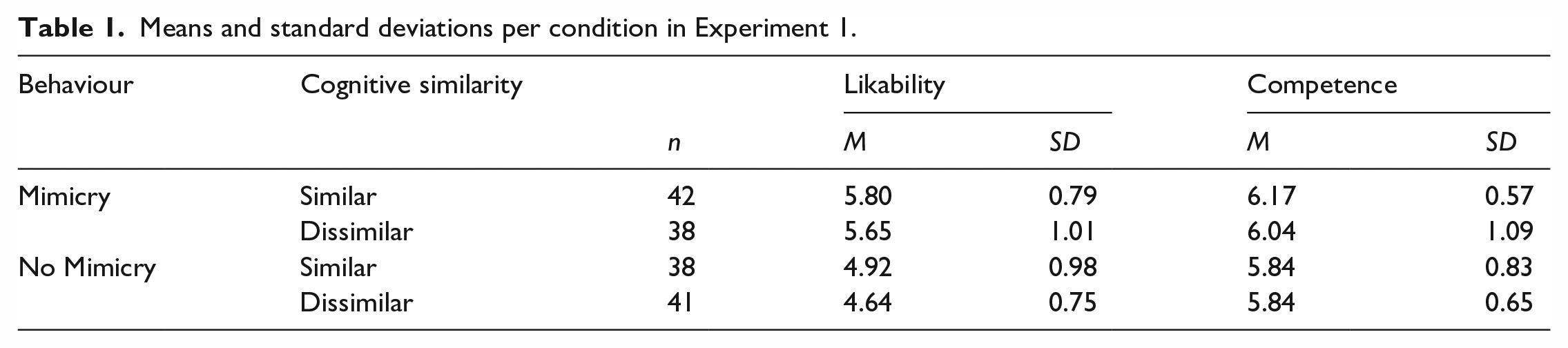
The multivariate tests revealed a main effect of the behavioural manipulation, F(2, 154) = 24.57; p < .001; η2 = .24, as expected, but contrary to our expectations they did not reveal an effect of our cognitive similarity manipulation, F(2, 154) = 1.27; p = .282; η2 = .02. Moreover, we did not find a Mimicry × Cognitive Similarity interaction (F < 1; p = .609; η2 = .01). These results remain when we control for demographics such as age or gender. For our likability measure, subsequent between-participants tests showed a main effect of behavioural condition, F(1, 155) = 45.05; p < .001; η2 = .23. Participants expressed higher likability for the mimicker in the mimicry condition (M = 5.73; SD = 0.90; 95% CI = [5.53, 5.92]), compared with the no mimicry condition (M = 4.78; SD = 0.87; 95% CI = [4.58, 4.98]), regardless of his perceived cognitive similarity status. Between-participants tests also showed an effect of the behavioural manipulation on how competent participants perceived the experimenter, F(1, 155) = 4.29; p = .040; η2 = .03. In the mimicry condition, they perceived the experimenter as more competent (M = 6.11; SD = 0.86; 95% CI = [5.93, 6.28]), compared with the no mimicry condition (M = 5.84; SD = 0.74; 95% CI = [5.66, 6.02]). The main effect of mimicry on both likability and competence is illustrated in Figure 1.
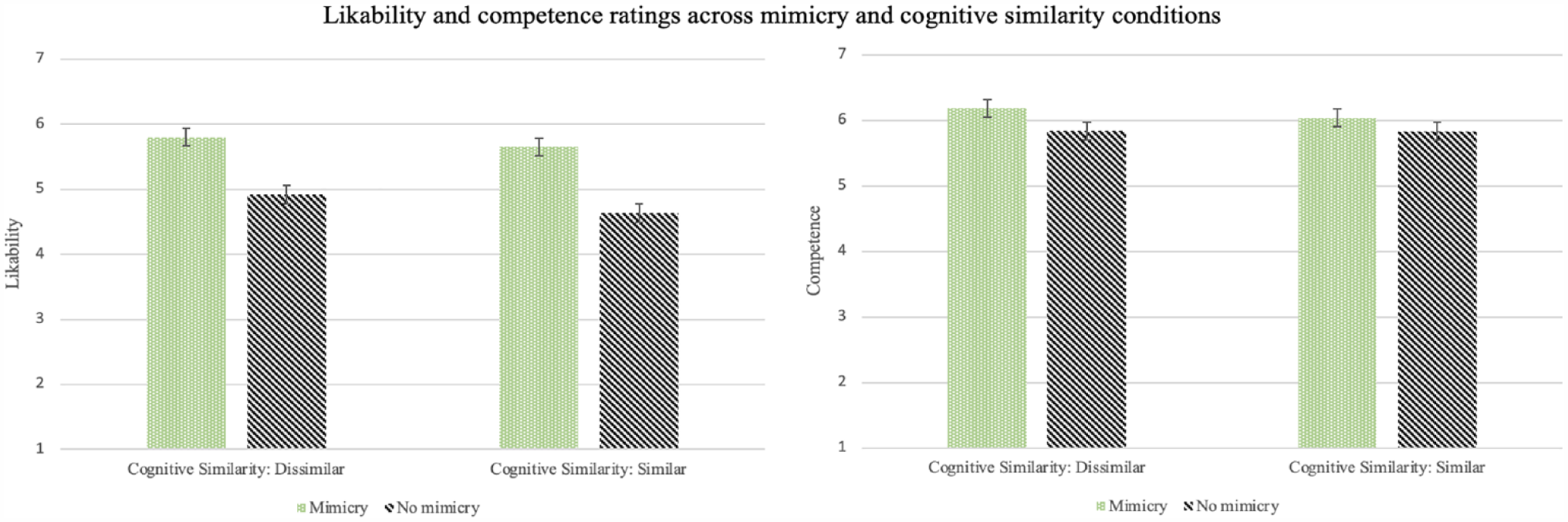
Mean likability (left) and competence (right) ratings as a function of behavioural condition. Error bars represent ±1SE.
We corrected for multiple comparisons following the False Discovery Rate procedure outlined by Benjamini and Hochberg (1995). The p-values relevant to the tests of interests (i.e., in our case, the p-values for the between-participants test for likability and competence) are listed in ascending order. For each of those p-values, starting with the highest, the calculation outlined by Benjamini and Hochberg (1995) is performed, p < (i/m)Q, where p = p-value, i = rank, m = total number of tests (i.e., 2), and Q = false discovery rate set to .05,; and at the point where the equation is satisfied, a new p-value threshold is determined. Given that we only have two p-values, the equation is already satisfied with the first p-value (i.e., p = .040 for competence) and the p-value threshold remains at p = .050. As this procedure controls the error rate of the between-participants tests, it is preferred to other tests which merely determine the probability of making one type I error (Noble, 2009).
Discussion
Using the 2 × 2 experimental design detailed above, Experiment 1 examined whether mimicry can enhance mimicker evaluations regardless of initially perceived cognitive (dis)similarity with the mimicker across two distinct dimensions of social cognition (Fiske et al., 2007), likability and competence. Our results indicate that mimicry, compared with no mimicry, in a dyadic interaction was associated with greater likability and competence evaluations of the mimicker. Importantly, this positive effect of mimicry was independent of the extent to which the mimicker was initially perceived as cognitively dissimilar or similar. In other words, mimicry enhanced evaluations not only of individuals who were already perceived as cognitively similar, but also of individuals who were initially perceived as cognitively dissimilar. Accordingly, mimicry may be a behaviour that enhances likability and competence evaluations despite existing cognitive (dis)similarities related to intergroup dynamics. The results of Experiment 1 therefore support Hypothesis 1. However, it is important to realise that although we successfully manipulated differences in cognitive similarity, these differences did not translate into differences of mimicker evaluations. One reason for these results may be that the differences in cognitive similarity based on university membership were not sufficiently meaningful for participants to affect their likability and competence evaluations of the experimenter. Indeed, research has demonstrated that main effects of cognitive differences as a result of intergroup dynamics do not occur when these are not sufficiently meaningful in the context (Hehman et al., 2010; van Bavel & Cunningham, 2012). Therefore, we examined stronger and weaker cognitive dissimilarities in Experiment 2, allowing us to replicate the results of Experiment 1 in a different context and to test perceived personal similarity as a mediator of the effects of mimicry (H2).
Experiment 2
Method
Aligned with our hypothesising, we wanted to test in this experiment whether we can replicate the effects found in Experiment 1 and whether personal similarity mediates these effects (H2) for different extents of cognitive dissimilarity. Accordingly, we used gender as a category for our dissimilarity manipulation, invited only female participants and given that the gender of the experimenter was male we manipulated the extent to which participants perceive him as cognitively dissimilar by portraying him as either very stereotypically male (stronger cognitive dissimilarity) or less stereotypically male (weaker cognitive dissimilarity) using introductory paragraphs. Before conducting the main experiment, we decided to test whether our introductory paragraphs (i.e., our cognitive dissimilarity manipulation) create such different perceptions. This was the purpose of the pilot study reported in more in detail in Supplemental Materials. Briefly, our female participants (N = 100) perceived a person as more similar to themselves in the less stereotypical male condition, compared with the very stereotypical male condition (p = .002). Moreover, participants rated the person described in the stereotypically male paragraph as more masculine, compared with the person described in the less stereotypically male paragraph (p < .001). Accordingly, our paragraphs successfully manipulated participants’ impression of the person, although in Experiment 2 we will need to control for perceived similarity caused by our manipulation.
For the main experiment, we again needed to over-recruit participants (discussed above). We recruited 160 female participants (for demographics, see below). 2
Materials
Priming
Before our male experimenter entered the room to have a 5-min interaction with the female participants about gender equality using scripted questions (see Supplemental Materials), the pre-tested introductory paragraphs introduced our experimenter as either more stereotypically male (stronger cognitive dissimilarity) or as less stereotypically male (weaker cognitive dissimilarity). In the stronger cognitive dissimilarity condition, the paragraph read: Hi, I am your experimenter for today and I want to briefly introduce myself before we will have a chat. I am currently doing a PhD in Economics. In my spare time, I like to go to the gym, play rugby, and have a pint of beer with my friends at the pub.
In the weaker cognitive dissimilarity condition, the introductory paragraph was worded as follows: Hi, I am your experimenter for today and I want to briefly introduce myself before we will have a chat. I am currently doing a PhD in Psychology. In my spare time, I like to read, go horse riding, and have a cappuccino with my friends at the café.
Experiment 2 thus followed a 2 (mimicry: mimicry, no mimicry) × 2 (cognitive dissimilarity: strong, weak) between-participant design. Participants were randomly allocated to one of these four conditions.
Measures
Unless otherwise stated, we measured all items on a 7-point Likert-type scale from 1 = Strongly disagree to 7 = Strongly agree (see Note 1). The likability (α = .92) and competence (α = .88) measures were the same as in Experiment 1.
Personal similarity
We measured perceived personal similarity with a single-item scale (“To what extent to you feel similar to the experimenter?”) adapted from Valdesolo and Desteno (2011) on a 7-point Likert-type scale from 1 = Not similar at all to 7 = Totally similar.
Manipulation checks
We adapted the manipulation check for our group manipulation from Experiment 1. However, instead of having two circles that represent two universities, one circle stated Masculine and the other stated Feminine. We also adopted the eighth option None of the above. The manipulation check for our mimicry manipulation was the same as in Experiment 1.
Covariates
Results of our pilot study (see Supplemental Materials) have shown that our cognitive dissimilarity manipulation may itself affect the perceived personal similarity measure. To be able to differentiate between the effects of our cognitive and behavioural manipulations on our personal similarity measure, we measured perceived personal similarity after participants read the introduction paragraphs (i.e., after our cognitive dissimilarity manipulation), but before they encountered our experimenter for the interaction (i.e., before our behavioural manipulation) with a single item (“How similar is this person to you?”) on a 7-point Likert-type scale from 1 = Strongly not similar to 7 = Strongly similar . Therefore, we had one personal similarity measure before our behavioural manipulation and one after. We henceforth refer to the former as personal similarity (T1) and to the latter as personal similarity (T2).
Results
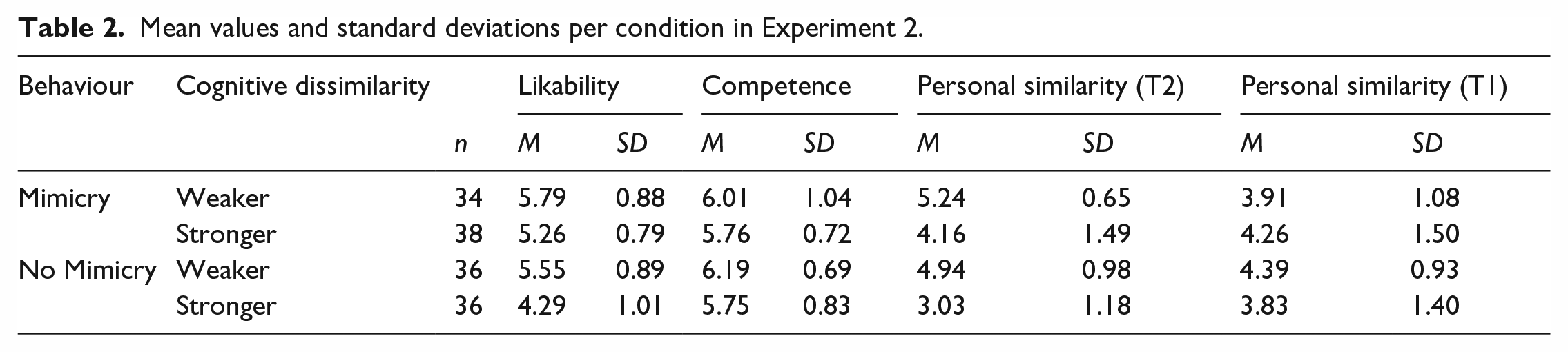
As in Experiment 1, for additional robustness we excluded some participants following our checks, as we now report. We excluded those who selected None of the above for the manipulation check (n = 12) or detected the behavioural manipulation (n = 3). In addition, we also excluded participants who did not provide informed consent (n = 1). Importantly, however, our results remain when we analyse the full sample. Accordingly, we analysed data of NAnalysis = 144 female individuals (age: M = 20.05 years, SD = 1.69 years; ethnicity: White = 66.0%, Black = 3.5%, Asian = 23.6%, Other = 6.9%). The means and standard deviations per condition are displayed in Table 2. The correlations are displayed in Table 3.
Mean values and standard deviations per condition in Experiment 2.
Correlation matrix of Experiment 1 and Experiment 2.
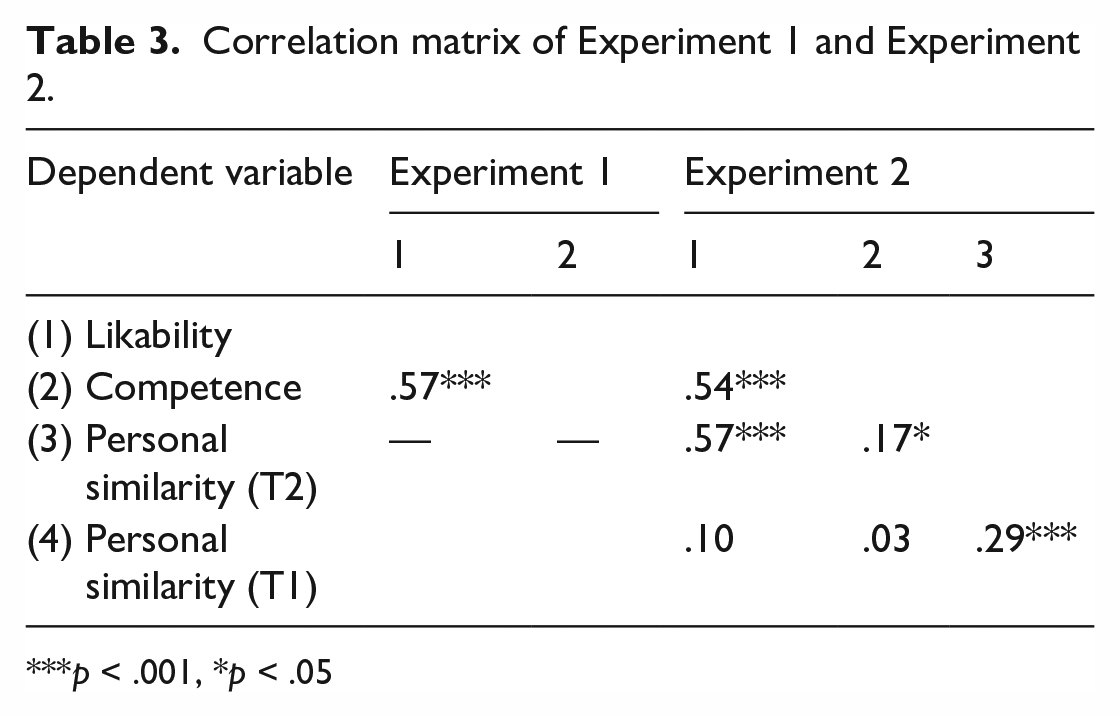
p < .001, *p < .05
Manipulation check
We conducted a one-way between-participant ANOVA with the cognitive dissimilarity conditions as the independent variable and our manipulation check as the dependent variable. The results revealed an effect of our manipulation, F(1, 142) = 103.85; p < .001; d = 1.69. As expected, in the weaker cognitive dissimilarity condition, participants perceived greater overlap with the experimenter (M = 5.23; SD = 1.66; 95% CI = [4.83 5.62]), compared with the stronger cognitive dissimilarity condition (M = 2.68; SD = 1.34; 95% CI = [2.37 2.99]). Accordingly, we successfully manipulated different extents of cognitive dissimilarity. To assess whether our behavioural manipulation was successful, we conducted another one-way between-participants ANOVA with the behavioural conditions as the independent variable and the mimicry ratings as the dependent variable. As expected, results indicated a main effect, F(1, 78) = 231.92; p < .001; d = 3.40. Interactions that included mimicry received higher mimicry ratings (M = 5.03; SD = 1.67; 95% CI = [4.49 5.56]), compared with interactions in the no-mimicry condition (M = 1.00; SD < 0.01; 95% CI = [1.00 1.00]). Accordingly, cognitive dissimilarity and behavioural manipulations were successful.
Dependent variables
To examine our hypotheses, we conducted a 2 (mimicry: mimicry, no mimicry) × 2 (cognitive dissimilarity: strong, weak) between-participants multivariate analysis of covariance (MANCOVA) with our likability, competence, and personal similarity (T2) measures as dependent variables and our personal similarity (T1) measure as a covariate. The results of the multivariate tests indicated a main effect of mimicry, F(3, 137) = 10.75; p < .001; η2 = .19, and cognitive dissimilarity, F(3, 137) = 25.13; p < .001; η2 = .36, but no mimicry × cognitive dissimilarity interaction, F(3, 137) = 1.96; p = .123; η2 = .04. Importantly, these results remain when we do not control for personal similarity (T1) and control for demographics.
Subsequent between-participants tests show a main effect of mimicry for likability, F(1, 139) = 16.31; p < .001; η2 = .11, and personal similarity, T2; F(1, 139) = 15.92; p < .001; η2 = .10, but not for competence (F < 1; p = .550; η2 < .01) as well as a main effect of cognitive dissimilarity for likability, F(1, 139) = 35.31; p < .001; η2 = .20, personal similarity, T2; F(1, 139) = 66.51; p < .001; η2 = .32, and competence, F(1, 139) = 6.27; p = .013; η2 = .04. Participants liked our experimenter more (M = 5.51; SD = 0.87; 95% CI = [5.32, 5.74]) and perceived themselves as more personally similar to him (M = 4.67; SD = 1.29; 95% CI = [4.45, 4.95]) in the mimicry condition, compared with the no mimicry condition, Likability: M = 4.92; SD = 1.14; 95% CI = [4.71, 5.13]; Personal similarity (T2): M = 3.99; SD = 1.45; 95% CI = [3.73, 4.24], regardless of the extent of cognitive dissimilarity. Participants also liked the experimenter more (M = 5.67; SD = 0.89; 95% CI = [5.46, 5.88]) and found him more competent (M = 6.10; SD = 0.88; 95% CI = [5.90, 6.29]) and personally similar to themselves (M = 5.09; SD = 0.85; 95% CI = [4.82, 5.33]) in the weaker cognitive dissimilarity condition, compared with the stronger cognitive dissimilarity condition, Likability: M = 4.79; SD = 1.02; 95% CI = [4.57, 4.99]; Competence: M = 5.75; SD = 0.77; 95% CI = [5.56, 5.95]; Personal similarity (T2): M = 3.61; SD = 1.46; 95% CI = [3.36, 3.86].
Accordingly, Hypothesis 1 is partially supported, and the results are illustrated in Figure 2. As in Experiment 1, we conducted an adjustment for multiple comparisons using False Discovery Rate (Benjamini & Hochberg, 1995). Based on these calculations (the procedure is outlined in Experiment 1), our threshold adjusted for multiple comparisons for our between-participants tests is p = .033. Given that the p-values of our between-participant tests meet this adjusted threshold, our findings remain. We also conducted another sensitivity power analysis using two-tailed tests, α = .05, a statistical power of .80 and our sample size NAnalysis = 144 as input variables for G Power 3.1 (Faul et al., 2007). The analysis revealed that we were able to detect the effect sizes that we found (ρ > .23).
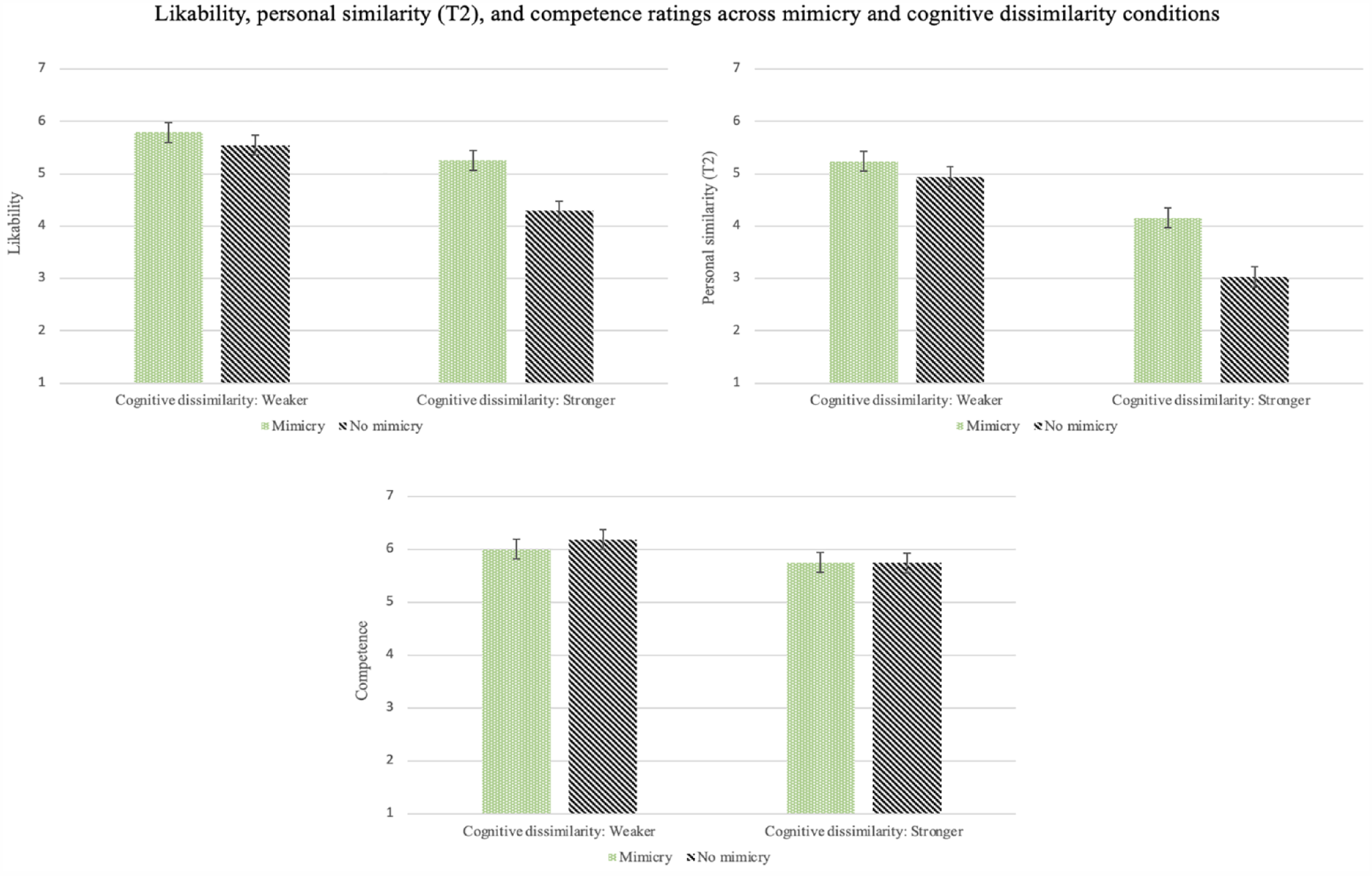
Mean likability (top left), personal similarity (T2; top right), and competence (bottom) ratings as a function of behavioural and cognitive dissimilarity conditions. Error bars represent ±1SE.
To test our mediation hypothesis (H2), we used model 4 in SPSS Process version 3.5.3 (Hayes, 2018) and included mimicry as the independent variable (coded as: 0 = no-mimicry; 1 = mimicry), perceived personal similarity (T2) as the mediator, likability (or competence) as the dependent variable, and the cognitive dissimilarity manipulation (coded as: 0 = stronger cognitive dissimilarity; 1 = weaker cognitive dissimilarity) as an additional predictor. We also included personal similarity (T1) as a covariate for additional robustness, although the results remained the same (see Table 4).
Mediation analyses.
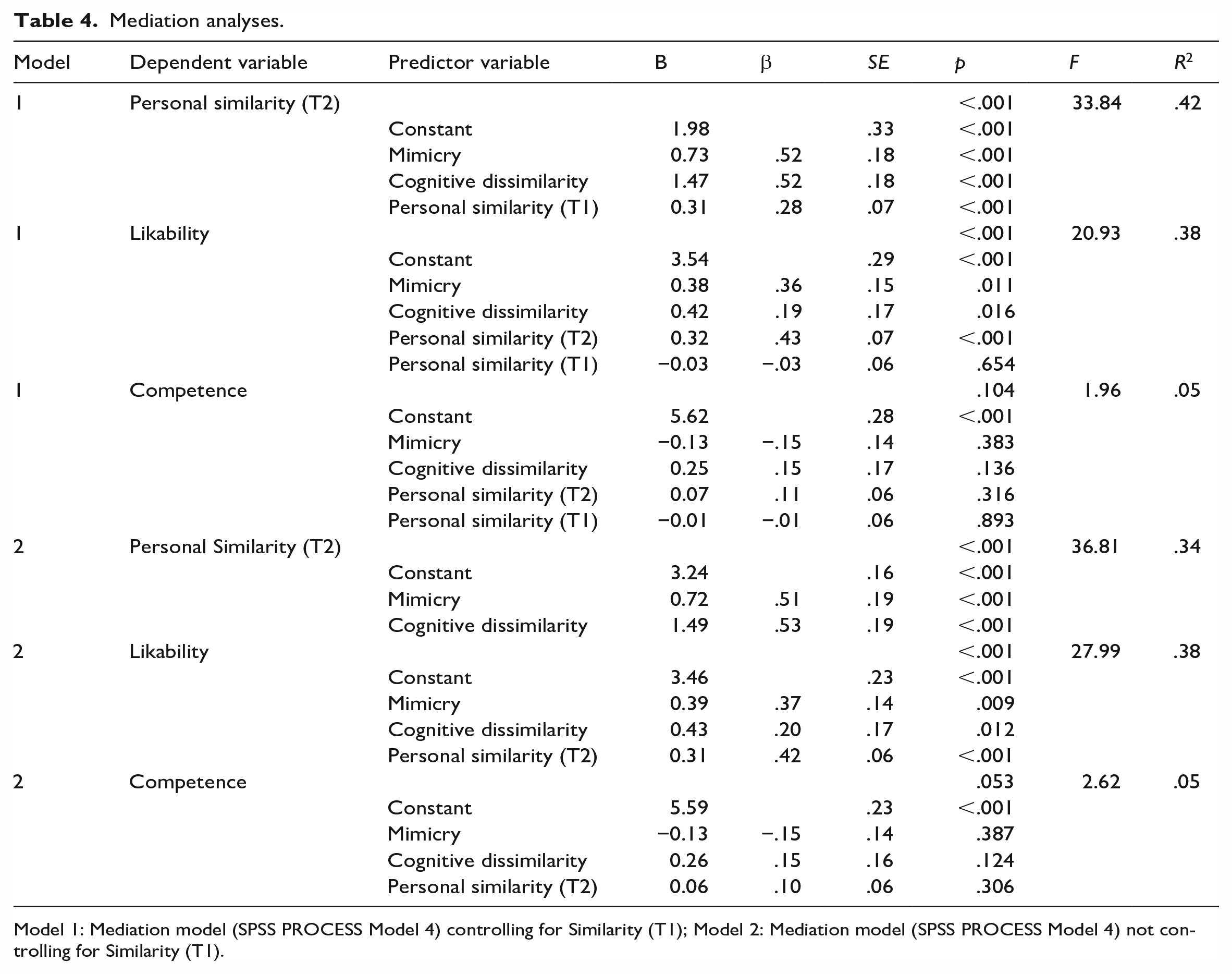
Model 1: Mediation model (SPSS PROCESS Model 4) controlling for Similarity (T1); Model 2: Mediation model (SPSS PROCESS Model 4) not controlling for Similarity (T1).
As already indicated above, the results showed an effect of mimicry on perceived personal similarity (T2; β = .52; p < .001) beyond the effect of initial cognitive dissimilarity caused by intergroup dynamics. Moreover, the results also revealed effect of personal similarity (Τ2) on likability (β = .43; p < .001) alongside a direct effect of mimicry on likability (β = .36; p = .011), thereby indicating a partial mediation (partially standardised indirect effect: β = .22, 95% CI = [.0830; .3915]). For competence, in contrast, we did not find a mediation via personal similarity (T2; β = .11; p = .316), as was already indicated by the lack of a main effect of mimicry. Therefore, H2 is partially supported. We have graphically illustrated Model 1 from Table 4 in Figure 3.
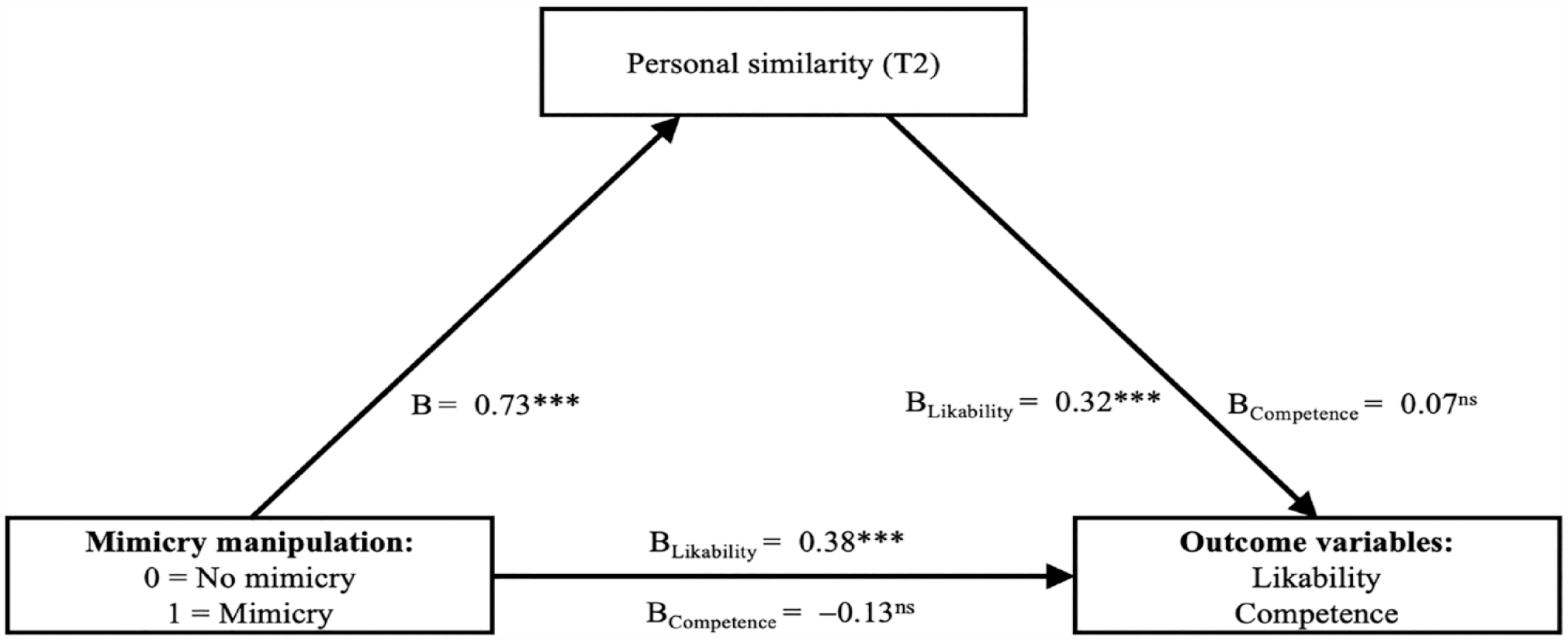
Mediation model controlling for personal similarity (T1) and cognitive dissimilarity (Model 1 in Table 4).
In addition, we conducted a sensitivity analysis in R Studio (v.2022.07.1) for our mediation on likability (model 1 in Table 4) following the procedure outlined by Imai et al. (2010). Briefly, this analysis calculates the degree of variance that additional confounding factors not included in the model need to explain to the mediation no longer to hold. It is therefore a measure from which to infer the robustness of our mediation. The sensitivity parameter ρ is the correlation between the error terms of the mediator and the outcome variable. Sensitivity analysis is conducted by testing the mediation at different values of ρ. The code is made available in Supplemental Materials and the results are illustrated in Figure 4. We found that the mediated effect is 0 at ρ = 0.4, suggesting that confounding factors that were not included in the model need to correlate by r = .40 for the mediation to non-existent. Therefore, our results suggest that our mediation for likability is relatively robust. In general, however, we are cautious to make causal inferences as these cannot be tested.
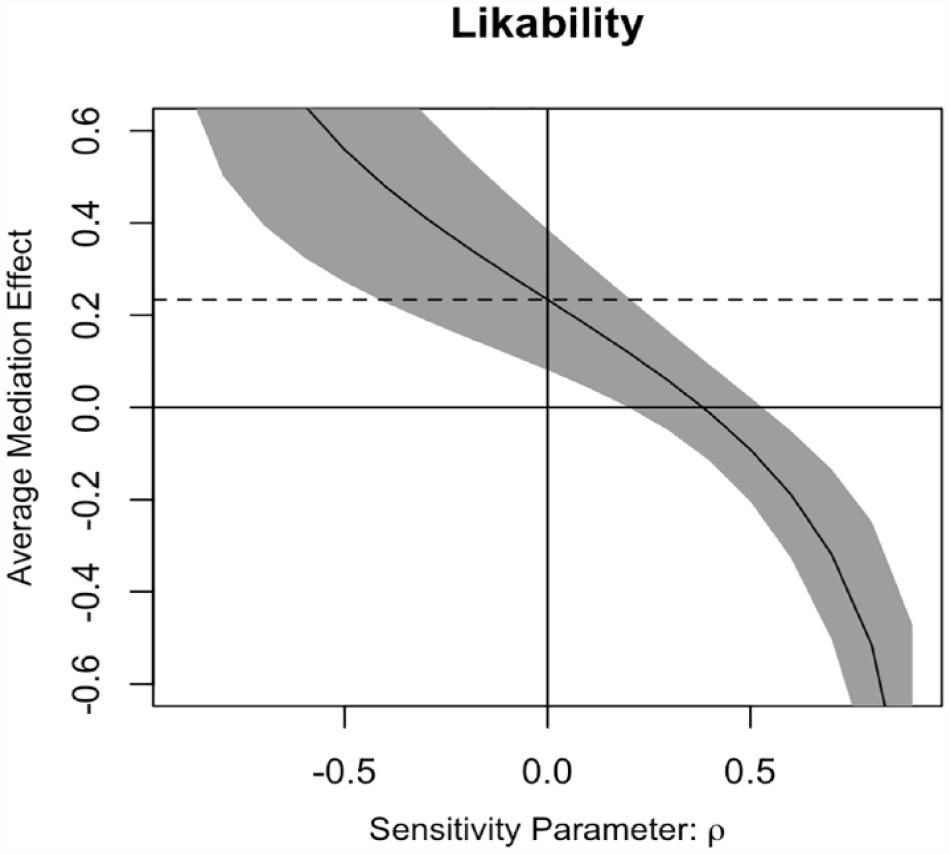
Sensitivity analysis of the mediation model for likability. The continuous line represents the indirect effect at different values of ρ (the correlation between the error terms of the mediator and the outcome variable). The 95% confidence interval is shown in grey. The dotted line represents the average mediated effect.
General discussion
Summary
We conducted two studies to examine whether mimicry, compared with no mimicry, can enhance mimicker evaluations despite the existence of initial cognitive (dis)similarities caused by intergroup dynamics (H1) and whether mimicry-induced personal similarity acts as a mediator of such effects regardless of existing cognitive dissimilarities (H2). Broadly, our results support our hypotheses that mimicry may be one way of enhancing perceptions of one’s likability (Experiment 1 and Experiment 2) and competence (Experiment 1) regardless of the extent to which individuals are perceived as cognitively (dis)similar. In addition, Experiment 2 also revealed support for our hypothesis that mimicry-induced perceived personal similarity (partially) mediates the effect of mimicry on likability. To the best of our knowledge, this is the first indication that dyadic mimicry may help to enhance evaluations mimickers regardless of the extent to which they are perceived as cognitively (dis)similar and that mimicry-induced personal similarity may be a mediator of these effects.
Implications and future research
Our findings have important implications. First of all, we have demonstrated that mimicry, compared with no mimicry, can enhance mimicker evaluations of likability (Experiments 1 and 2), competence (Experiment 1), and personal similarity (Experiment 2). Therefore, our results are well-aligned with the non-verbal behaviour literature that shows positive effects of mimicry for mimicker evaluations (for a review, see Duffy & Chartrand, 2015). Moreover, our analyses have also revealed similar effect sizes to those found in the literature (Hale & Hamilton, 2016); that is, we found a medium sized effect of mimicry on likability (η2 = .11) and on personal similarity (η2 = .10). Accordingly, we believe that the effect of mimicry in dyadic interactions with cognitively (dis)similar individuals is sufficiently large to warrant further research enquiries into whether mimicry can be employed in more applied settings. For example, it may be interesting to examine the potential of mimicry in job interviews or in romantic settings.
One question that remains, however, is why mimicry had a direct positive effect on perceived competence of the mimicker in Experiment 1, but not in Experiment 2. One potential answer may be that mimicry only enhances mimicker evaluations on dimensions relevant to the context of the interaction. In the few studies that examined the effect of mimicry on the perceived competence of the mimicker, this effect was found when mimicry occurred in sales conversations (Jacob et al., 2011) and in job interviews (Kavanagh et al., 2011). Specifically, a mimicking sales representative and a mimicking interviewee were evaluated as more competent than non-mimicking sales representatives and non-mimicking interviewees (Jacob et al., 2011; Kavanagh et al., 2011). However, studies that examined mimicry in conversations about sports and exercising did not find an effect of mimicry on the mimicker’s perceived competence (Kulesza et al., 2017). Therefore, it seems that mimicry may increase competence evaluations in contexts where competence is perceived as relevant (job interviews and sales), but not in contexts where it may be perceived as less relevant (exercising). Applying this line of thinking to our experiments may explain our results. In Experiment 1, we told participants that the purpose of the study was to examine whether individuals who are more capable of being successful in their career were found at particular universities. Hence, competence was a trait that was directly related to the context of the interaction. In Experiment 2, in contrast, the context was centred around feminism and gender equality. Participants may have thus felt that, compared with thinking about career success, competence was a less important trait in conversations about gender equality and thus mimicry did not affect competence evaluations. In general, however, our reasoning is speculative and thus we are cautious to suggest that mimicry can increase competence evaluations of the mimicker because of the mixed results we revealed.
We believe our work to be of particular importance for social psychologists. Although our results do not support the thinking that, in terms of mimicker evaluations, non-verbal mimicry can help to overcome the negative effects of cognitive dissimilarities caused by intergroup dynamics, the results support the argument that it may enhance such evaluations in the presence of initial cognitive dissimilarities. Our results are particularly intriguing because in contrast to the literature concerned with direct intergroup contact which often relies on self-reported measures of contact (e.g., Tausch et al., 2010), we have used actual intergroup contact, thereby answering a recent call made by researchers (see Marinucci et al., 2021). Across both studies, we found that individuals who were perceived as cognitively dissimilar and mimicked the behaviour of participants, received higher likability (and partially competence) ratings, compared with when they did not mimic. Although scholars have found that intergroup contact, even if imagined, can increase evaluations of out-group individuals (see Hewstone et al., 2014; R. N. Turner et al., 2007), our findings contribute to that literature by suggesting that mimicry may be a non-verbal tool that can be used in interactions with cognitively dissimilar individuals to further alleviate the negative effects caused by such initial cognitive dissimilarity. Intergroup contact paired with mimicry enhanced evaluations of a cognitively dissimilar mimicker beyond the perhaps already existing positive effects on such evaluations caused by the mere interaction with an out-group member. Although we did not test this latter effect in our experiment, it is well-established in previous literature (e.g., Hewstone et al., 2014; R. N. Turner et al., 2007). Given the frequency with which we encounter dissimilar others, be it on the basis of religion, sex, or race (Richeson & Sommers, 2016), and the repercussions this has on how we evaluate these individuals, our findings suggest that mimicry employed in dyadic interactions may enhance attitudes towards dissimilar others, thus potentially improving intergroup relations.
In addition, our results revealed perceived personal similarity as one of mimicry’s potential mechanisms, at least for likability evaluations. Although some researchers in the mimicry literature had theoretically suggested the construct as a mediator (Lakin, 2013), our study provides preliminary empirical evidence and is thus aligned with literature that posits personal similarity to be associated with increased perceptions of likability (Alves et al., 2016; Sprecher, 2014). This mediating role of perceived personal similarity reinforces the notion that mimicry may work as a “social glue” (Lakin et al., 2003, p. 147) and that being posturally similar may invoke the perception of being personally (i.e., cognitively) similar (Chartrand et al., 2005). Given the practical importance (see below) of enhancing attitudes towards cognitively dissimilar individuals, our findings seem to be of particular relevance to literature concerned with intergroup dynamics because they not only suggest that increasing perceived personal similarity with a cognitive dissimilar individual may be one way of alleviating the negative effects caused by intergroup dynamics, but also that non-verbal mimicry, compared with no mimicry, may be one way of doing so. In other words, our results suggest that, at least for likability, mimicry-induced personal similarity may counteract the initially perceived cognitive dissimilarity caused by intergroup dynamics. As a consequence, mimicry enhances likability evaluations of individuals who were initially perceived as cognitively dissimilar, although main effects of cognitive dissimilarity continue to exist. We should mention here that the similarity-liking relationship was not causally tested in our experiment and therefore future research should do so.
Given that humans frequently interact with each other in practice, our findings have important implications for applied psychology. In the management and leadership literature, for example, non-verbal behaviour has been of immense interest (Bonaccio et al., 2016; Carney, 2021) due to its consequences for employee well-being and the relationship between employees and supervisors (Jia & Cheng, 2021). The leader’s behaviour and how it shapes such relationships has been under particular investigation in a lot of theoretical approaches (Brower et al., 2000; Liden et al., 1997). Moreover, scholars have demonstrated that managers and employees tend to perceive themselves as cognitively dissimilar (Duck & Fielding, 1999) and that such dissimilarities can significantly challenge their relationships (Dalton & Chrobot-Mason, 2007; van Knippenberg & Hogg, 2003). Although mimicry has received less attention in management studies, given our results that mimicry elicits likability regardless of the extent of cognitive dissimilarity, our studies suggest that non-verbal mimicry may be one way to improve these relationships. For example, managers may decide to deliberately mimic their employees during face-to-face meetings to enhance the quality of their relationship via likability and similarity perceptions. Similarly, given that patients may perceive their therapist as cognitively dissimilar (Kelly & Strupp, 1992), mimicry may also be useful to improve patient-therapist relationships. Here, the therapist may be able to deliberately mimic the patient’s body language during therapy sessions. Our findings imply that this might help the patient to perceive the therapist as more similar and thus more likable. Although our findings provide evidence for the positive effects of mimicry in intergroup contexts, more research is required, particularly in these applied settings. For example, researchers may collaborate with organisations to conduct experimental studies with manager versus peer mimicry to examine whether the positive effects of mimicry on likability hold across different hierarchical levels. Moreover, researchers need to conduct more studies on mimicry in therapy settings to examine whether likability is only increased temporarily or whether the effects endure.
Limitations
Although all experimental designs have limitations, we note three here in particular for the benefit of future research. First, it is important to recognise that some elements of the interaction between the experimenter and participants were uncontrollable. Although we paid attention to keep the interactions as similar as possible from the side of the experimenter by pre-selecting open-ended questions, we could not control participants’ reaction to those questions such as asking the same question back to our experimenter. While such situations seem to be unavoidable in experiments in which a “natural” interaction occurs, the reaction by the experimenter to those questions may have affected participants’ impressions and thus affected our results.
The second limitation regards our experimenter. Due to a number of constraints, our experimenter was simultaneously a member of the research team. As he was thus aware of the hypotheses of this research, the experimenter underwent training so that the only difference between the conditions was his non-verbal behaviour. During the training, our experimenter underwent several videoed mock-interactions, asking the same questions as in our experiments. We then provided feedback based on the videos and on reports from the interaction partners to improve the behaviour of our experimenter such as the timing of postural changes. Yet, we cannot exclude the possibility that his awareness may have led to subtle behavioural changes that may have affected the results.
Finally, the no-mimicry condition requires some consideration. While our experimenter displayed non-verbal mimicry in the mimicry condition, he sat in a relaxed, upright manner with both feet on the floor and both hands on his lap in the no mimicry condition. Although such neutral body language is commonly used as the control condition for the mimicry manipulation (e.g., Chartrand & Bargh, 1999), facial expressions seem to be rarely discussed in this context. While our experimenter, for example, kept their facial expressions neutral in the no-mimicry condition, participants may have perceived this as somewhat awkward, hence affecting our results. Equally, such neutral body language and facial expressions could partly explain the low mean ratings for the no-mimicry condition in our manipulation check. Nonetheless, changing facial expressions in response to what participants say or do is a form of mimicry and thus seemed inappropriate for the no-mimicry condition (Duffy & Chartrand, 2015; Kulesza et al., 2017). Mimicry researchers should address these considerations in future research.
Conclusion
In this article, we have shown that individuals who engage in non-verbal mimicry during a dyadic interaction come across as more likable regardless of whether they were perceived as cognitively similar or dissimilar. Moreover, we have demonstrated that mimickees perceive themselves as more personally similar to the mimicker which then enhances likability perceptions, regardless of the extent of cognitive dissimilarities. Our findings therefore extend existing mimicry research by revealing the persistence of the positive effects of mimicry on likability in situations of cognitive dissimilarities and by showing how personal similarity mediates the effects. Given that non-verbal behaviour is key for navigating our social environment, we believe that our findings have important implications for social psychology, notably the literature on intergroup relations, and we hope that our research provides a starting point for fruitful research and discussions on the importance of non-verbal mimicry for various disciplines.
Supplemental Material
sj-docx-1-qjp-10.1177_17470218231208699 – Supplemental material for The effect of non-verbal mimicry on evaluations in interactions with cognitively (dis)similar individuals
Supplemental material, sj-docx-1-qjp-10.1177_17470218231208699 for The effect of non-verbal mimicry on evaluations in interactions with cognitively (dis)similar individuals by Christian Bretter, Kerrie L Unsworth and Mark A Robinson in Quarterly Journal of Experimental Psychology
Footnotes
Declaration of conflicting interests
The author(s) declared no potential conflicts of interest with respect to the research, authorship, and/or publication of this article.
Funding
The author(s) received no financial support for the research, authorship, and/or publication of this article.
Data accessibility statement
The data are made available via an open-access repository (https://osf.io/cpju7). The stimulus materials are made available via an open-access repository [url: https://osf.io/cpju7] and via  (which also include the code for the analyses). The questionnaire used is widely available. The study design and the hypotheses were not preregistered.
Notes
References
Supplementary Material
Please find the following supplemental material available below.
For Open Access articles published under a Creative Commons License, all supplemental material carries the same license as the article it is associated with.
For non-Open Access articles published, all supplemental material carries a non-exclusive license, and permission requests for re-use of supplemental material or any part of supplemental material shall be sent directly to the copyright owner as specified in the copyright notice associated with the article.
