



Abstract
Although the relation between congruent and incongruent conditions in conflict tasks has been the primary focus of cognitive control studies, the neutral condition is often set as a baseline directly between the two conditions. However, empirical evidence suggests that the average neutral reaction time (RT) is not placed evenly between the two opposing conditions. This article set out to establish two things: First, to reinforce the informative nature of the neutral condition and second, to highlight how it can be useful for modelling. We explored how RT in the neutral condition of conflict tasks (Stroop, Flanker, and Simon Tasks) deviated from the predictions of current diffusion models. Current diffusion models of conflict tasks predict a neutral RT that is the average of the congruent and incongruent RT, called the midpoint assumption. To investigate this, we first conducted a cursory limited search that recorded the average RT’s of conflict tasks with neutral conditions. Upon finding evidence of a midpoint assumption violation which showed a larger disparity between average neutral and incongruent RT, we tested the previously mentioned conflict tasks with two different sets of stimuli to establish the robustness of the effect. The midpoint assumption violation is sometimes inconsistent with the prediction of diffusion models of conflict processing (e.g., the Diffusion Model of Conflict), suggesting possible elaborations of such models.
In many everyday situations, we may be distracted from an action goal by irrelevant information. For example, this is the case when we stop at an intersection and wait for a green light to turn left. If an additional traffic light for going straight turns green (the irrelevant information), this could distract us from our actual action goal, and we could end up in a dangerous traffic situation. Cognitive control is necessary in such cases to process goal-relevant information and to suppress goal-irrelevant information. It is therefore easy to see why the study of cognitive control is an important subject in cognitive psychology (Botvinick et al., 2001; J. D. Cohen, 2017; Norman & Shallice, 1986; Pashler, 1998; Posner & Snyder, 1975).
According to the most popular interpretation, cognitive control is necessary to distinguish between task-relevant and task-irrelevant information (J. D. Cohen, 2017; Kornblum et al., 1990). This is because, in many situations, task-irrelevant information is automatically processed, and thus interferes with the processing of task-relevant information (Posner & Snyder, 1975; W. Schneider & Shiffrin, 1977; Shiffrin & Schneider, 1977). The automatic process typically refers to actions done without directed cognitive effort and initiated by task-irrelevant information. However, controlled processing refers to goal-directed behaviour, such as navigation on dangerous terrain or careful, strategic actions. Thus, automatic processing happens constantly, with controlled processing adjusting or modulating the automatic process depending on the circumstance (van Veen & Carter, 2006). When this intervention happens, cognitive conflict occurs if the automatic response is opposed to the controlled response. This conflict is the basic effect addressed in studies of cognitive control, as it is an indicator of the different processing channels.
Various experimental tasks have been used to study conflict processing. Some of the most prominent tasks are the Eriksen flanker task (B. A. Eriksen & Eriksen, 1974; Miller & Schwarz, 2021; Servant & Logan, 2019), the Stroop task (Hedge et al., 2019; Steinhauser & Hübner, 2009; Stroop, 1935), and the Simon task (Chen et al., 2020; Mittelstädt & Miller, 2020; Simon, 1969; Simon & Rudell, 1967; Wühr & Heuer, 2018), each with different sources of conflict. In these tasks, participants are asked to respond to stimuli wherein two features of the stimuli can prompt opposing responses. For example, in the Eriksen flanker task (B. A. Eriksen & Eriksen, 1974), participants are shown a string of letters (e.g., HH K HH) and must respond to the central letter (i.e., K). In this example, the central letter might either be a “K” or an “H,” the task-relevant information, which is flanked by K’s or H’s, the task-irrelevant information. The task-relevant letters are mapped to the right and left response hands. In the congruent condition, the letter identity of the target letter and the flanking letters match, whereas in the incongruent condition, there is a mismatch. The root of this match or mismatch can be derived from the categorisation of the stimulus (as seen in Kornblum et al., 1990), where the letter string is possibly categorised as in favour of one response or the other. By altering the ease of discrimination between the flanking characters and the target (larger spacing between characters, more novel flankers), the influence of the flankers decreases, making varying congruency effect sizes. Thus, for the flanker task, conflict stems from a mismatch between a stimulus and its environment.
For the Stroop task, participants are shown the name of a colour in coloured font and are asked to respond to the colour of the font. For this task, the colour of the font is the target information, and the named colour is task-irrelevant information. Subsequently, responses are speeded if the named colour and font’s colour match, while they are inhibited if there is a mismatch. Drawing from Kornblum et al., 1990 again, the overlapping features of the stimuli cause the difference in the congruency effect. As the dimensional overlap of the features increases, such as the font of colour words becoming more similar to the semantic meaning, a larger congruency effect is seen. Thus, conflict in the Stroop Task is derived from mismatches between separate characteristics of a stimulus (such as semantic and visual information).
Finally, in the Simon task (Simon & Rudell, 1967), a red or blue dot is shown to the participants on the left or right side of the screen. Participants are asked to respond with the left or right hand to the blue or red stimulus, respectively. Therefore, the colour is the task-relevant stimulus dimension, whereas the dot’s location is task-irrelevant. In the congruent condition, the location of the dot and the response match, while in the incongruent condition, there is a mismatch. Although the location of the dot is task-irrelevant, it nevertheless affects response performance. So, for the Simon task, the response dimension is utilised to prompt the congruency effect. This creates a unique task, as the conflict does not solely rely on conflicting features in the stimulus dimension but across the stimulus-response set (for the Simon task, the location of the dot or sound and the hand which responds). Thus, it is the difference between the response and stimulus location that produces conflict.
Elaborated diffusion models on conflict processing
Several stochastic models have been proposed to describe the underlying conflict process. Specifically, extensions of the standard diffusion model (Ratcliff, 1978; Ratcliff & Rouder, 1998; Smith, 2000) have been recently developed to address these conflict processes. This standard model assumes a noisy accumulation process towards one of two boundaries, each corresponding to a different response. This accumulation process reflects a Wiener Diffusion process with a linear drift towards one of these boundaries. As soon as the accumulation process hits one of the two barriers, a decision is made, and the corresponding response is activated. One conceptual disadvantage of this standard model is that it does not address the specific conflict mechanism. Therefore, extensions of the standard model have incorporated more specific assumptions about how response conflicts could arise. The most recent extensions are the Dual-Stage Two-Phase model (DSTP; Hübner et al., 2010), the Shrinking Spotlight model (SSP; White et al., 2011), and the Diffusion Model of Conflict (DMC; Ulrich et al., 2015).
DSTP takes inspiration from selective attention, with a focus on the idea of early and late selection (Kahneman & Treisman, 1984). It was specifically developed to model the cognitive processes underlying the flanker task. To mimic early selection, the first phase of response selection

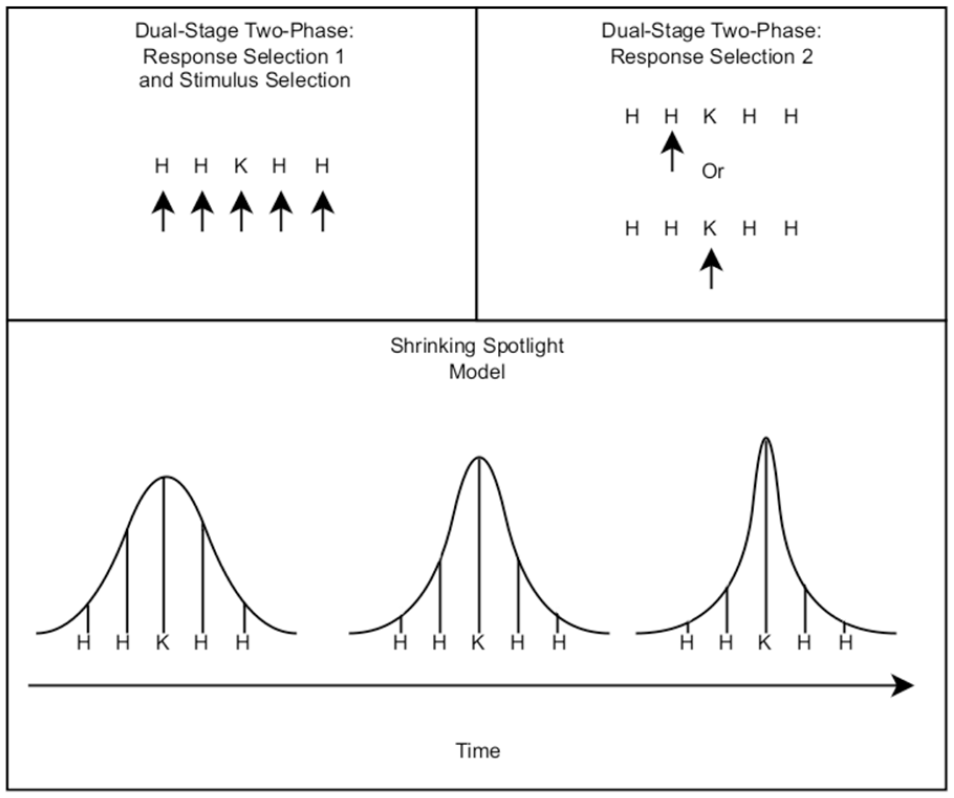
Above: An illustration of how the Dual-Stage Two-Phase operates conceptually. Top Left: The stimulus is shown, with the viewer considering all possible stimuli. As the process continues, the attention of the viewer (indicated by the arrows) may change between the flankers and the target; thus, the sum of the inputs forms the first Response Selection phase drift rate. When a stimulus is selected, Response Selection Phase 2 (Top Right) begins. If the stimulus selected is the flanking stimulus, the new drift rate will shift in favour of its associated response. Otherwise, the target is selected, with the drift rate accruing towards the correct response. Bottom: An illustration of the basic principles regarding the Shrinking Spotlight Model. In the image, the bell curves indicate the amount of visual attention given to each component of the stimulus over time. As time proceeds, the proportion of visual attention given to the outer and inner flankers shrinks, increasing the influence of the target stimulus.
Although

A notable part of this model is that it treats the selection of the target as a discrete process. Thus, the rates are fixed until a period is reached, only changing at the transition point from
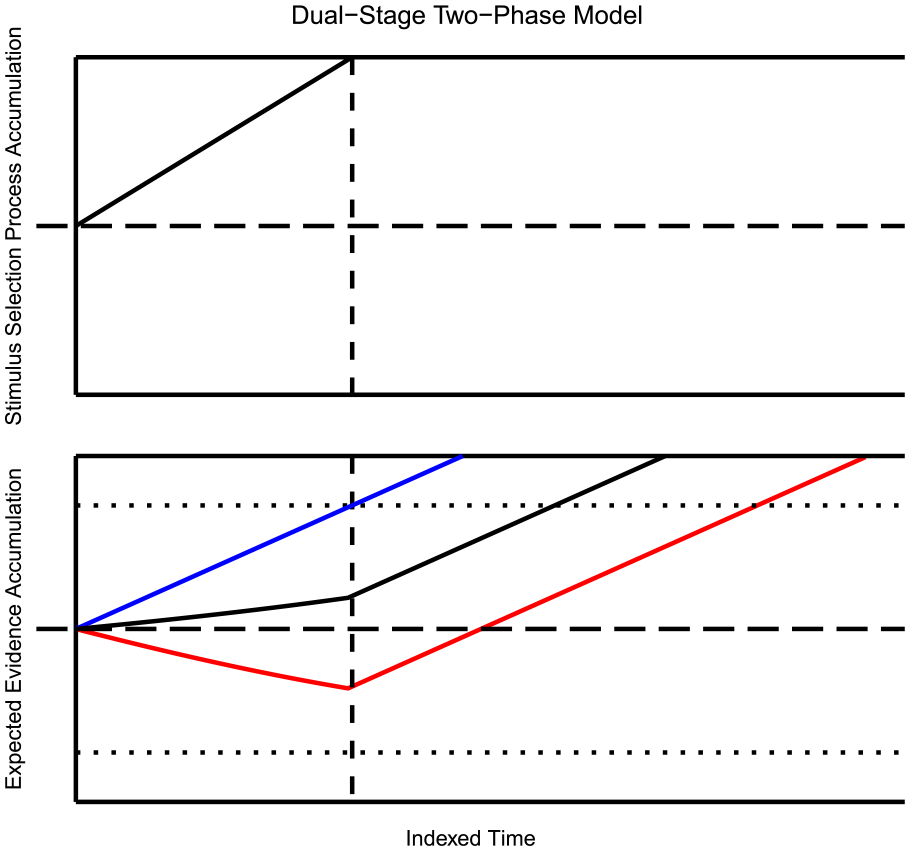
Dual-Stage Two-Phase Model: The top figure displays the deterministic Stimulus Selection process, which accumulates towards either the target or the flanker stimuli. The bottom figure shows the predicted drift of the response selection process as a function of time and for each experimental condition (congruent in blue, neutral in black, and incongruent in red). The horizontal line represents the decision threshold. The change in slope that occurs at the dotted line shows the transition between Response Selection Phase 1 and Response Selection Phase 2.
SSP was designed as an alternative to DSTP, as it simulates the viewer’s attention narrowing from the whole set of stimuli to just the target in a continuous fashion (C. W. Eriksen & Schultz, 1979; C. W. Eriksen & St James, 1986). The model approximates this by taking the Gaussian distribution and slicing its area into three sections: the outer edge, inner edge, and centre. The centre section is the information in favour of the target response area, while the outer and inner edges relate to the flankers’ influence on the information gained. These areas can be found by taking the appropriate integral over the area of interest. For the three area models discussed prior:
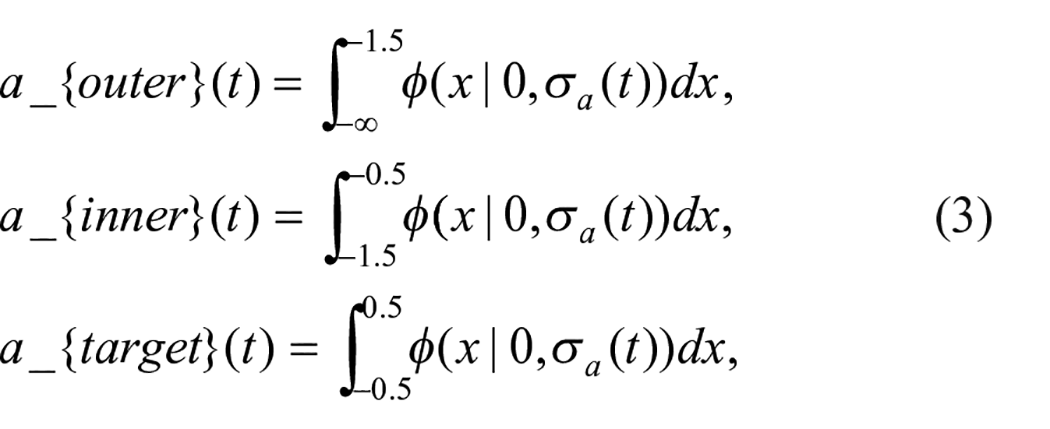
where

Here,

The resulting function adjusts its curve as time progresses, increasing the rate of information gain in favour of the correct response. The predicted drift of the congruent condition, then, is consistently speeded and in favour of the correct response. In contrast, the incongruent condition drift is initially biased against the correct response threshold, then slowly increases as the proportion of selective attention attributed to the flanking stimuli diminishes. Thus, the
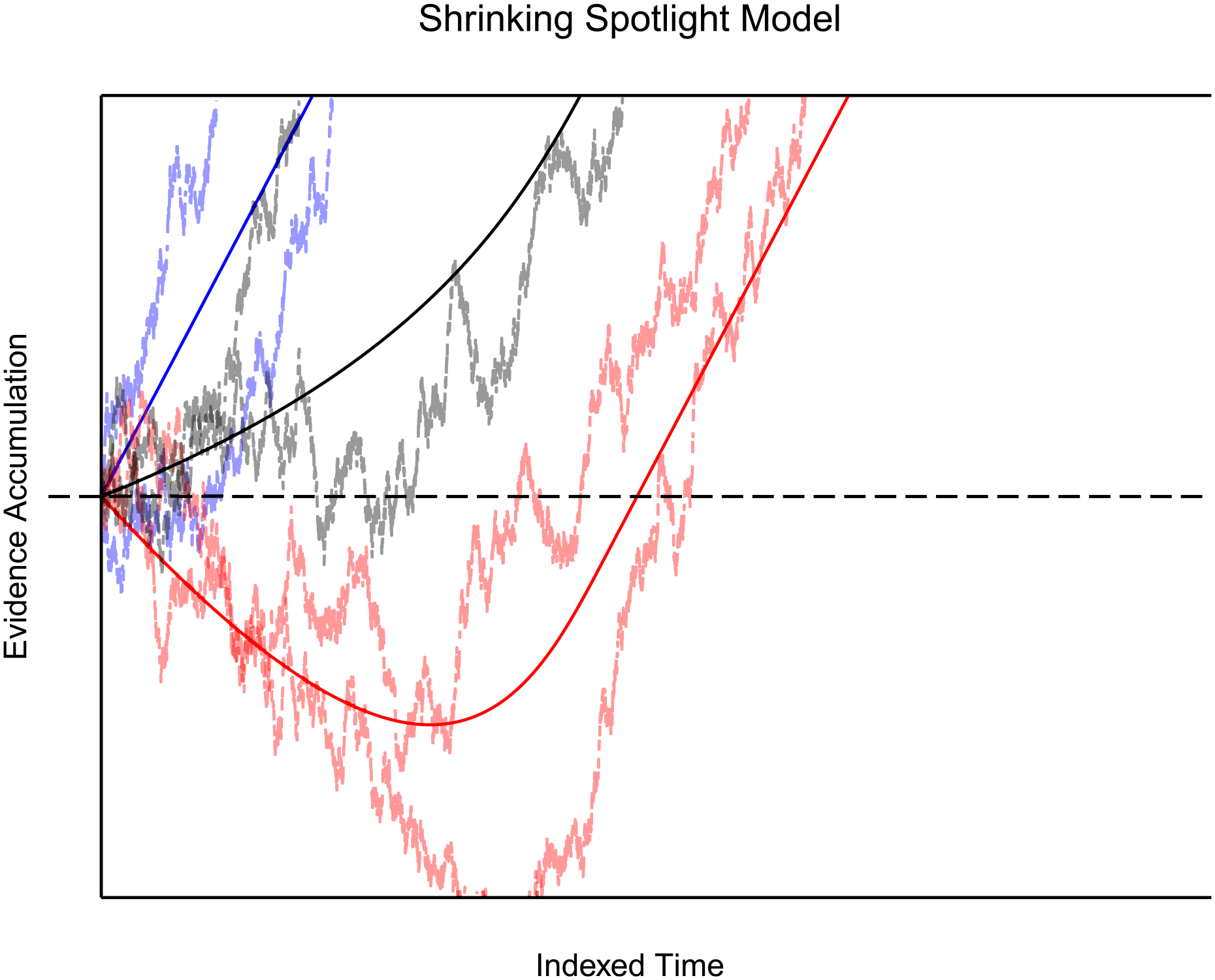
Shrinking Spotlight Model: The figure shows the deterministic time course of the diffusion process a continuous function of time for each experimental condition (congruent in blue, neutral in black, and incongruent in red). As before, the dotted, horizontal lines represent the decision thresholds. The gradual shift in the slope of the neutral and incongruent condition is derived from the gradual increase in attention given to the target stimuli rather than distractors. If stochastic noise is added, variability in the behaviour of these rates increases; however, the primary pattern of behaviour remains the same in the long run. The two runs of the noisy variant of the model (with a diffusion coefficient of
DMC was developed to model the conflict tasks mentioned above, not just the flanker task. To accommodate the different types of tasks, the model focuses on simulating the automatic and controlled processes assumed in cognitive control. The controlled process is driven by task-relevant information (e.g., the central stimulus in the flanker task), while the automatic process is driven by the task-irrelevant information (e.g., the flankers). The controlled process assumes a constant drift rate µc towards the correct boundary. The automatic process generates a pulse-like activation that favours either the correct (congruent trials) or incorrect (incongruent trials) boundary. The drift rate of the automatic process is therefore time dependent, and scaled according to a gamma distribution, often set to the Erlang function. A major premise of this model is that the activation of the controlled process and automatic process are superimposed. Consequently, the drift rate as a function of

where
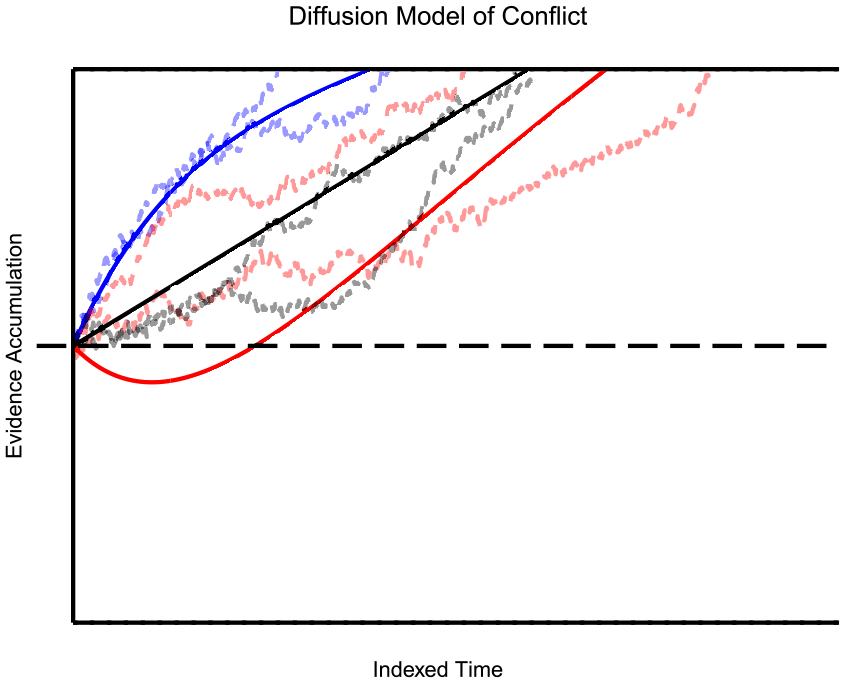
Diffusion Model of Conflict: With this figure, the predicted drift of the diffusion process is presented as a function of time for each experimental condition (congruent in blue, neutral in black, and incongruent in red). The congruent and incongruent time courses are a result of two overlapping processes: the controlled and automatic process. The neutral predicted drift rate utilises only the controlled process. The dotted, horizontal line represents the decision threshold, while the dashed line in the centre refers to the initial state of accrual. The two runs of the non-deterministic variant of the model (with a diffusion coefficient of
The neutral condition as a baseline condition
In most studies investigating the congruency effect in conflict tasks, only the congruent and incongruent conditions are used. This is surprising, as in other cognitive tasks (e.g., visual attention), a neutral condition acts as a baseline condition (cf., Posner & Snyder, 1975). Indeed, the absence of a neutral condition runs counter to some researcher recommendations (MacLeod, 1991). The reason that it is absent might be that it seems difficult to establish such a condition (Besner et al., 1997; Jonides & Mack, 1984; Neely, 1991).
Yet, a neutral condition may allow for additional insights into the underlying conflict mechanism (MacLeod, 1991; Parris, 2014). In such a condition, the stimulus should contain irrelevant information that does not promote either of the two response alternatives or prompts both responses to the same extent. For example, consider the colour Stroop task presenting the words RED or BLUE, where participants are asked to name the print colour of these words but ignore the word information. In a neutral condition, a non-word like XXXXX could be used as it does not present conflicting information (Schroeter et al., 2002). Similarly, for the Simon task, presenting a coloured dot in the centre of the screen should act as a neutral as well. Thus, the negation of any associated information is sufficient for the neutral task (Besner et al., 1997). The other possibility is to use a stimulus that triggers each of the two responses equally, such as a double-headed arrow for the arrow flanker task. Thus, the neutral task is obtained through either a lack of conflicting irrelevant stimuli or through the addition of irrelevant information that is both exciting and inhibiting at the same time. Due to the potential information loss done by neglecting a neutral condition, one is merely ignoring the elephant in the room and eventually hindering theoretical progress.
The most significant problem with neutral conditions is finding a stimulus that shares no similar features with either target stimulus, particularly in conflict tasks where the two information streams strongly interact. For example, the flanker task uses two fields of vision as competing information streams, so the primary mode of negation is to use a neutral that is unique from the target stimulus. However, it can be argued that similarities between visual stimuli may always exist; thus, a true neutral is difficult to obtain (Besner et al., 1997; Neely, 1991). Other issues can arise from the effects of third variable processes interfering with the neutrality condition, such as foveal processing with the Simon task (Mahani et al., 2019). For the Stroop task, different neutral stimuli can result in differing RT results depending on what kind of negation is used and its extent (Klein, 1964), implying certain neutral stimuli may be more or less similar to incongruent or congruent stimuli. Another danger is taking negation too far, substantially removing or altering the amount of information in a stimulus, as it could lead to speeded processing. For example, in the flanker task, one might assume presenting the target stimulus without any flankers would make for a good negation. Yet one could argue that, by removing the information that flanks the target, the stimulus is now rendered simpler. As the amount of information from the stimulus has decreased substantially, the task is fundamentally different from the other conditions, making speed comparisons between this “neutral” condition and the others a biased effort. This was already seen in the original flanker paper by B. A. Eriksen and Eriksen (1974), where responses to the single-letter alone condition were faster than in the congruent condition. Due to the spectrum of neutral possibilities, it is not always evident whether a neutral stimulus really functions as a proper baseline condition. This spectrum partially explains why the neutral condition is not often addressed in models of conflict tasks even though it could be informative, as we will argue below.
By consulting prominent RT models, different implications about the neutral condition’s behaviour are apparent. For example, drawing from established accumulation models (S. D. Brown et al., 2008; Grice et al., 1984) and the diffusion framework (Ratcliff, 1978; Ratcliff & Tuerlinckx, 2002), we can assume that the process of information accrual is roughly linear, with the neutral condition commonly lying between the congruent and incongruent processes. An implication of this property is that the difference between all of the average RTs, at any level of the criterion, will be a constant proportion. This draws from the idea of linearity, and assuming that the conditions begin accumulating at the same time. Specifically, this implication applies to DSTP and SSP (Figures 2 and 3). Moreover, these two models imply that the average RT of the neutral condition should be the average RT of the two opposing conditions. This property can be seen by plugging in a theoretical neutral condition into DSTP and SSP. In DSTP, the neutral condition stimulus selection would follow a standard diffusion model, while phase one of response selection accrues information from the flanking and target information. As the irrelevant information in the neutral condition is uninformative, one could expect a minimal accrual of information towards the correct response. Upon termination of the stimulus selection process, response selection phase two begins, leading most likely to the correct response as a selection of the neutral stimuli should not bias a response negatively. Admittedly, it is unknown if a selection of the neutral condition flanking stimuli is feasible, as that would theoretically lead to a non-response.
Similarly, for SSP, one can imagine that as the selection attention shrinks over time, no excitatory nor inhibitory information will be derived from the flanking stimuli. As with DSTP, the lack of congruent information still delays the accrual of information in comparison to the congruent condition but does not prompt the opposing response. Thus, to produce this effect in either model, one can set the flanking stimulus weights to zero, removing the flanking influence entirely, as seen in Figures 2 and 3. As this analysis shows, the inclusion of a neutral condition in assessing the empirical adequacy of these models appears to be a reasonable enterprise for further theoretical improvements.
If the neutral condition is the midpoint of the two standard conditions in conflict tasks, one should expect certain assumptions to hold. First, one would expect that across different conflict task studies, the difference between the conditions would be identical, that is,

with
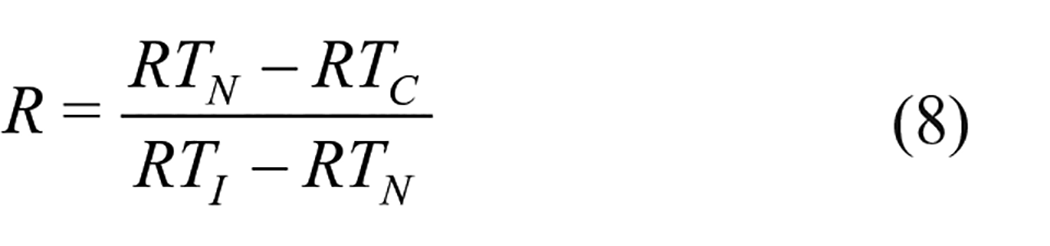
should be equal to 1. Although some variability may alter this proportion, the overall trend should remain, provided the midpoint assumption (or difference symmetry) is maintained. If either the denominator or the numerator of the above proportion were to be larger or smaller than the other, we would state that there was violation of the midpoint assumption.
It is important to note that this proportion is only obtained from DSTP if the following assumptions hold. First, this assumes that the number of responses made in
In regards to SSP, this prediction holds even when variability is introduced to the model. To test this, we consulted the article, White et al. (2011), for proper noise parameters and adjusted them for milliseconds. After running 2,000,000 trials, we found that the mean of these was R ≈ 0.972, leading us to find this result rather robust. The code used to produce these simulations is currently on Github, https://github.com/Parker−Smith−Uni−Tuebingen/NeutralConditionRSimulations.
Interestingly, DMC appears to violate the midpoint assumption. This can be seen in Figure 4, where the incongruent process arrives at the response threshold around 5 ms later than the neutral process, while the congruent process arrives 10 ms earlier than the neutral process. For a large number of parameter settings, DMC predicts a violation in the same direction, with
This deviation from the other models is useful, however, as a growing amount of evidence runs counter to the midpoint assumption, as will become evident in the coming section. For example, Mahani et al. (2019) noted an odd occurrence when attempting to apply DMC and their own extension. Although their extension was able to account for a majority of patterns, it had difficulty handling asymmetrical RT differences in the data. According to them, the difference between the neutral and congruent conditions was smaller than that of the difference between the neutral and incongruent conditions, which the model was unable to predict reliably. Both of these observations clearly run counter to the midpoint assumption (symmetrical difference).
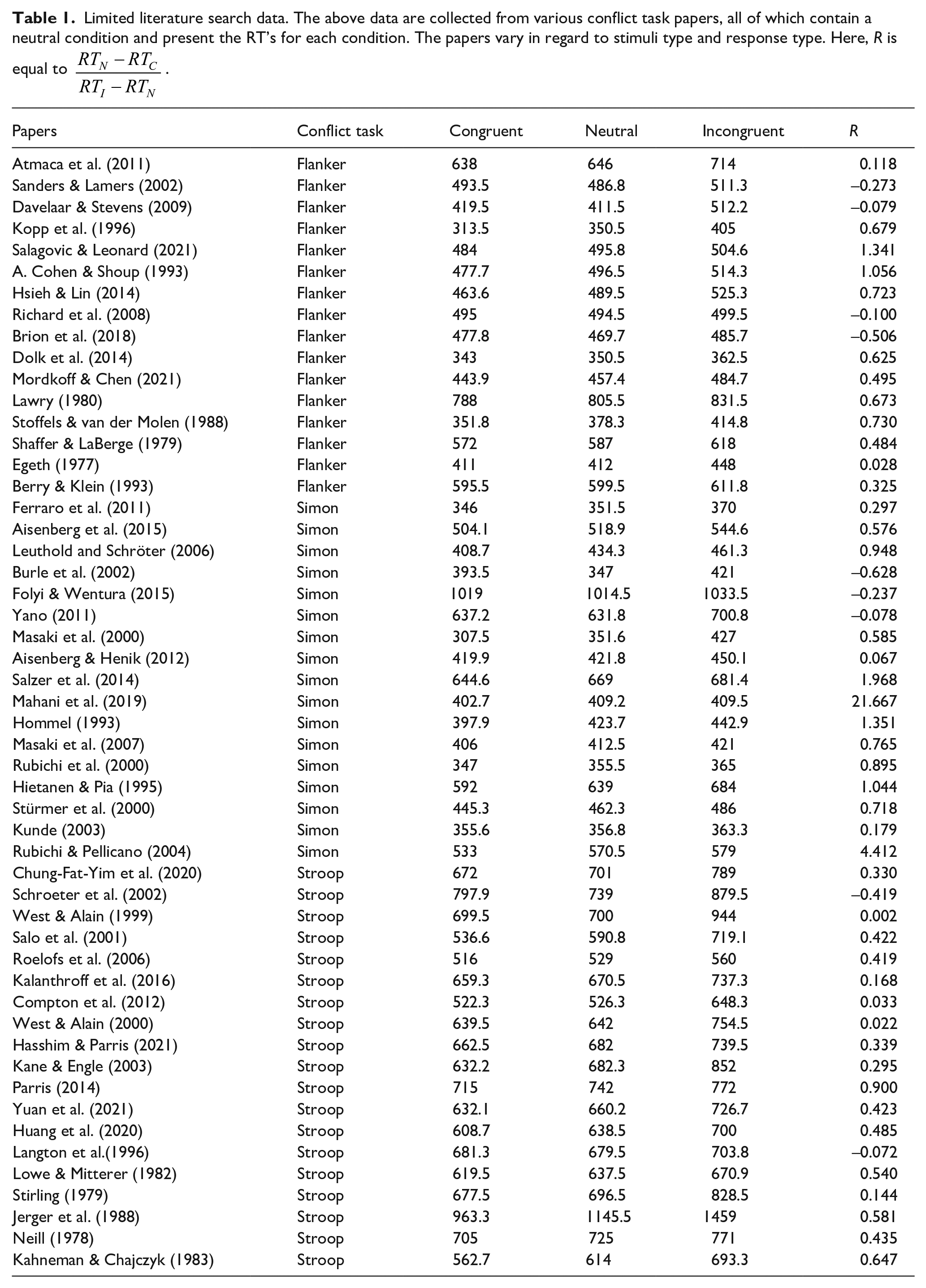
To assess the behaviour of the neutral condition in conflict tasks, a limited search of the literature was performed for the Eriksen flanker, Stroop, and Simon tasks, gathering a convenience sample of the three types. The workflow for selecting papers was as follows. The researchers used Google Scholar to search for papers due to its ability to search for specific words in an article. To search, the researchers entered each conflict task type with either “Neutral,” “Neutral Condition,” or “Neutral Stimuli” added on, and then they searched through the initial pages one by one (e.g., Flanker Task Neutral, Flanker Task Neutral Condition, Flanker Task Neutral Stimuli). Every paper link was then screened for the presence of a neutral condition in the paper. If a neutral condition (regardless of stimulus type) was found, the researchers would add it to a spreadsheet. After collecting the papers, the researchers then reviewed them for complications or issues that would affect the analysis (multiple types of “neutrals,” dual participants, only having neutrals and one type of test condition, etc.) Any paper that does not have a neutral condition was excluded. If the paper failed to report means for all conditions (graphically or in a table), it was excluded. Originally, the first five pages of Google Scholar were searched before another method was tried. However, further searching eventually required an exhaustive method of going through more than five pages. This process was repeated for the flanker, Simon, and Stroop tasks. The search was done from 1 January 2021 until 30 March 2021, then again from 12 February 2023 until 1 March 2023. It is notable that the second search specified papers prior to 1990 to gain a more historical perspective. Fifty-two articles (19 Stroop, 16 Flanker, 17 Simon) were collected, and in each case, the average RT per condition was recorded (Table 1). As is evident, the focus on this and all subsequent work in the paper is on the RTs of the given conflict tasks. The last column of Table 1 shows the outcome of Equation 8 for each article. It is readily apparent that the majority of articles (86.54%) recorded have an outcome
Limited literature search data. The above data are collected from various conflict task papers, all of which contain a neutral condition and present the RT’s for each condition. The papers vary in regard to stimuli type and response type. Here, R is equal to
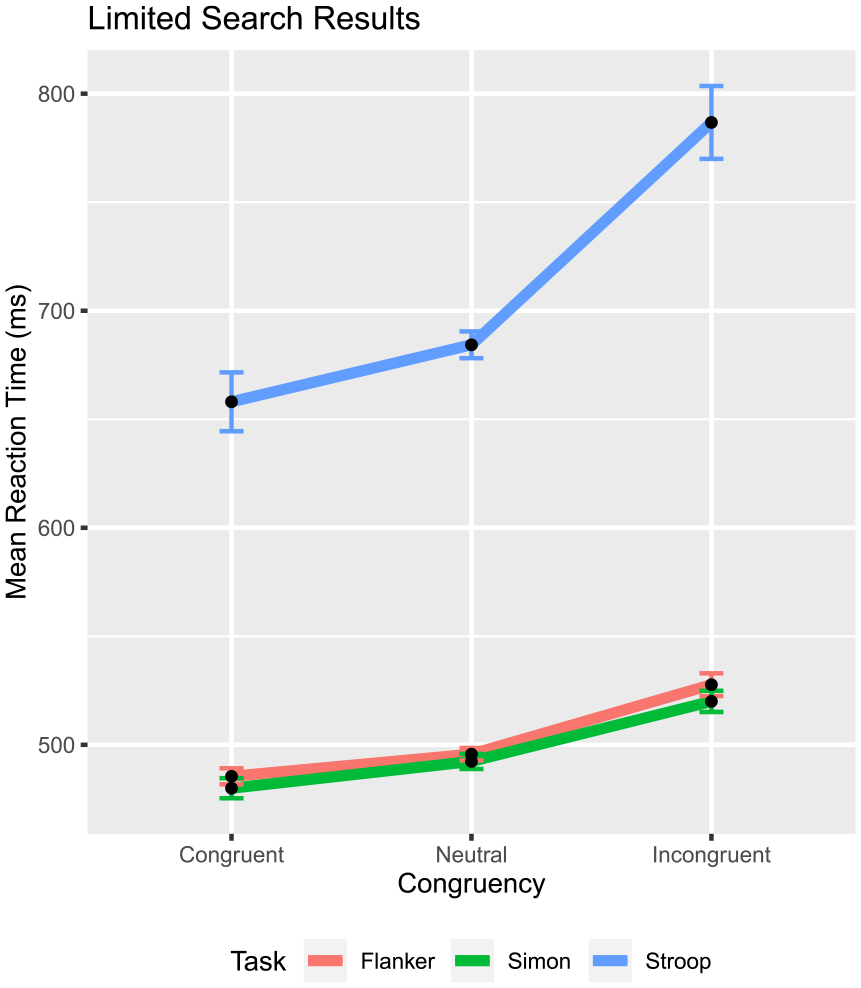
Result of limited search. Mean RT
The results of this analysis are troubling, as DSTP and SSP both expect
This violation of the midpoint assumption is rather consistent throughout the papers that were assessed. Papers with a diverse set of neutral conditions were included, making the skew towards a
One may wonder how stable the pattern of findings suggested by the limited search is. After all, a number of the papers had different types of target and irrelevant stimuli. To address this question, we conducted three pre-registered experiments, each employing a different conflict task (Experiment 1: Eriksen flanker task; Experiment 2: Stroop task; Experiment 3: Simon task). Each experiment included two sets of stimuli presented in separate blocks of each experiment. This was done to test the robustness of the effect, and to mimic the literature search’s variety of stimuli. Thus, we purposefully chose two distinct and separate kinds of stimuli to test the edge conditions of this phenomenon. In one set, the stimuli are composed of letters or words (linguistic set), while the other set contains shapes and symbols (symbolic set). With these two extreme versions of stimuli, we have hoped to cover the range of stimuli that we noticed in the publications that entered the limited search. The purpose of these experiments was to establish trends of the neutral condition rather than using the data to model. Thus, some experiments (such as the linguistic Stroop task) have more than two options. All experiments were performed online utilising Psychopy with Pavlovia (Peirce et al., 2019) and Prolific (2022), with SoSci Survey (Leiner, 2019) to collect participant consent. As these experiments were conducted online, the common concerns about participant motivation, controls, and variability in size are valid. For participant motivation, the use of strict cutoffs and the potential to not be compensated for bad data was used. As a number of papers have already addressed the concerns of online studies and found that controls and errors are within a reasonable range (Semmelmann & Weigelt, 2017), we also feel confident in the data from these experiments.
Experiment 1—Eriksen Flanker Task
Experiment 1 used two variants of the Flanker task, with each variant being a two-choice RT task. In the linguistic variant, the stimuli consisted of letter strings and participants were asked to respond to the target letter (H or K) in the middle of the string (Figure 6). The flankers could be congruent with the target stimulus to prompt the correct response, incongruent if they prompted the alternative response, or neutral if they prompted neither response alternative. In the symbolic variant, the target stimulus was an arrow pointing to the left or right response side (Figure 6). The flankers were also arrows whose direction may be congruent or incongruent with the response side. In the neutral condition, the flankers were double-headed arrows that likely primed both response alternatives, producing a net priming effect of zero in this condition. Each participant performed each alternative in a separate block of trials.
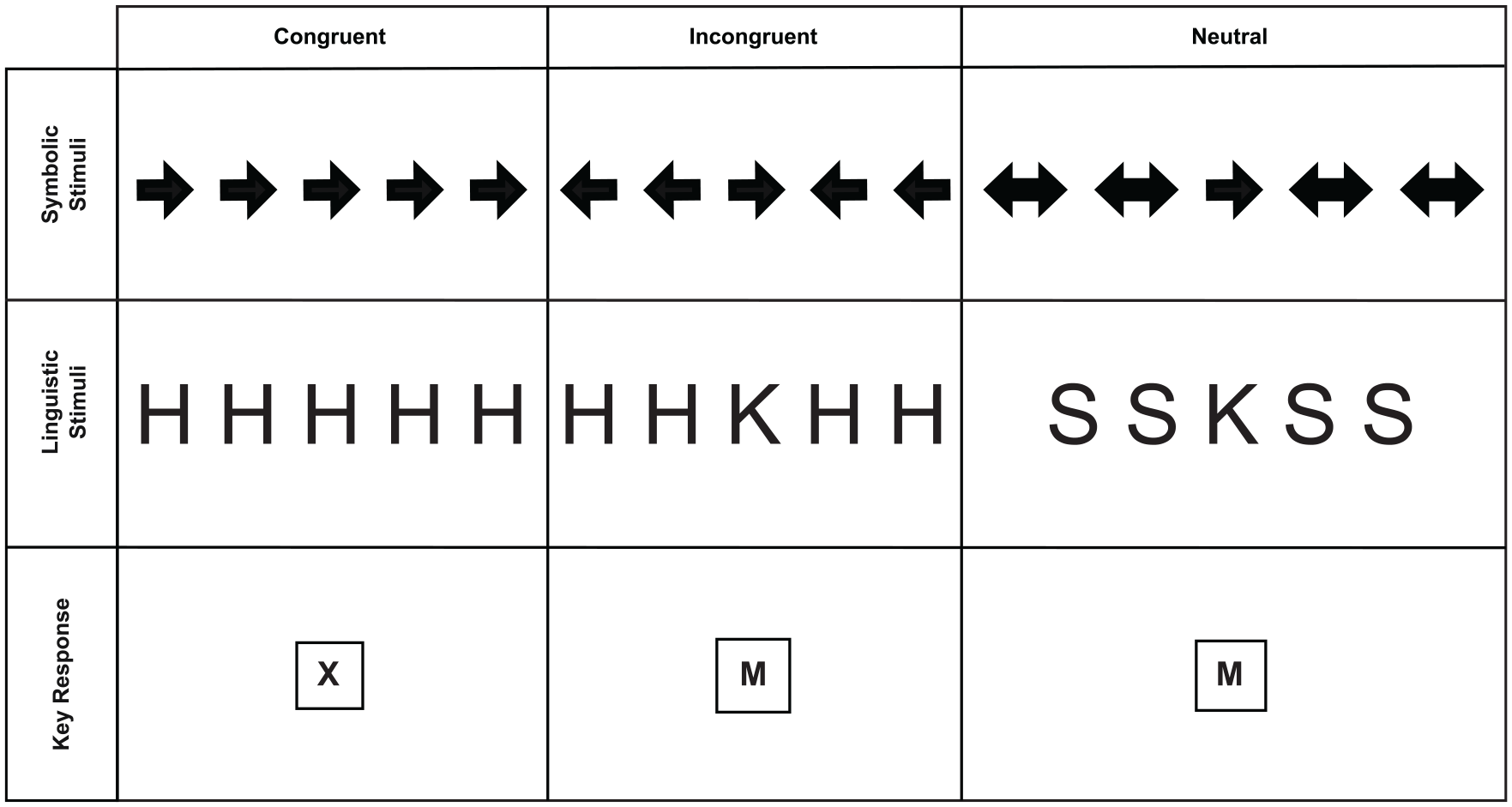
Stimuli Conditions for the Flanker Task: The examples of stimuli are presented in the upper rows, with an example of the response mapping appearing on the bottom row. Each stimulus set was presented in its own block.
Methods
Participants
Participants were required to have a fluent understanding of German and ownership of/access to a computer. We took into account the effect size expected from the limited search (Cohen’s
Stimuli
The experiment was created within PsychoPy, using its experiment creator. Each stimulus set consisted of a string of five images shown in the centre of the screen: the central image as the target (H or K for the linguistic set, a left or right arrow for the symbolic set) with two flanking distractor images to the left and right. Sizing for these stimuli was done using the “height” scaling within PsychoPy, primarily due to the online experiment conditions. The scaling, therefore, is proportional to the screen size of the participant. Three different conditions (congruent, incongruent, and neutral) altered the image strings by changing the flanking images. For the congruent condition, the flanking images and target were the same, the incongruent condition had flanking images signalling the opposing response, and the neutral condition had flanking images signalling neither response (S for the linguistic set, a double-headed arrow for the symbolic set). Each image in the string was presented in a square that was
Procedure
The flanker task experiment was created in PsychoPy and then uploaded to Prolific. Participants were recruited via a posting on Prolific, with a description of the task and requirements presented alongside it. Participant consent was collected upon starting the experiment via the SoSci Survey. Afterwards, participants clicked a link that brought them to the main experiment, wherein their age, gender, and Prolific identification number were requested. After providing the requested information screen, the participants were shown instructions for the first block of flanker stimuli. For the first 25 participants, the first set of instructions presented was for the letter stimuli, while the last 25 saw the symbolic stimuli instructions. For both tasks, the participants were tasked with responding to the central character of a stimulus string. To respond, they laid their left-hand index finger on the “X” key, and their right-hand index finger on the “M” key. For the letter flanker, participants had to respond to “H” with the “X” key, and to “K” with the “M” key. For the arrow flanker, participants responded to a left-facing arrow with the “X” key, and to a right-facing arrow with the “M” key. After reading through the instructions, the participants were instructed to proceed with 18 practice trials. Each trial consisted of a 500 ms presentation of a focus cross, followed by a 500 ms blank screen. Then, the stimuli were presented in the centre of the screen for a maximum of 2,500 ms. If the participants responded correctly, they were given no feedback. In case of an incorrect response, the message reading “falsche Taste” (Wrong Key) was displayed, and if they answered too quickly (less than 150 ms), the message reading “Zu schnell reagiert” (Reacted too quickly) was displayed. If no response occurred within the time frame, “Zu langsam reagiert” (Reacted too slowly) was shown. The stimuli sets were shown in a randomised order (as done by PsychoPy’s “loopType = random” setting), and balanced for an equal number of neutral, congruent, and incongruent trials.
After the practice trials, the participants pressed the “M” key to continue to the main session, 90 trials, for that stimuli block. After finishing these trials, the participants were presented with a screen displaying the set of instructions for the other stimuli (for the first 25 participants, the symbolic flanker instructions, for the latter 25, the letter flanker instructions), then proceeded with the experiment utilising the new instruction set. Thus, the first 25 participants were given the linguistic flanker task in the first block and then the symbolic flanker task in the second. This order was reversed for the last 25 participants in an attempt to counterbalance ordering effects for the different stimuli. The same number of practice trials and main trials were used again, as well as the experiment design. This is a pre-registered study, with the data and pre-registration available at https://osf.io/h3zwb/.
Data analysis
Trials with RTs less than 200 ms or greater than 2,000 ms were removed (linguistic stimuli: 0.2%, symbolic stimuli: 0.2%). These same cutoffs are used across all experiments. Only trials with correct responses were analysed (97.2%) for analysis on RTs. A repeated analysis of variance Congruency (congruent, neutral versus incongruent)
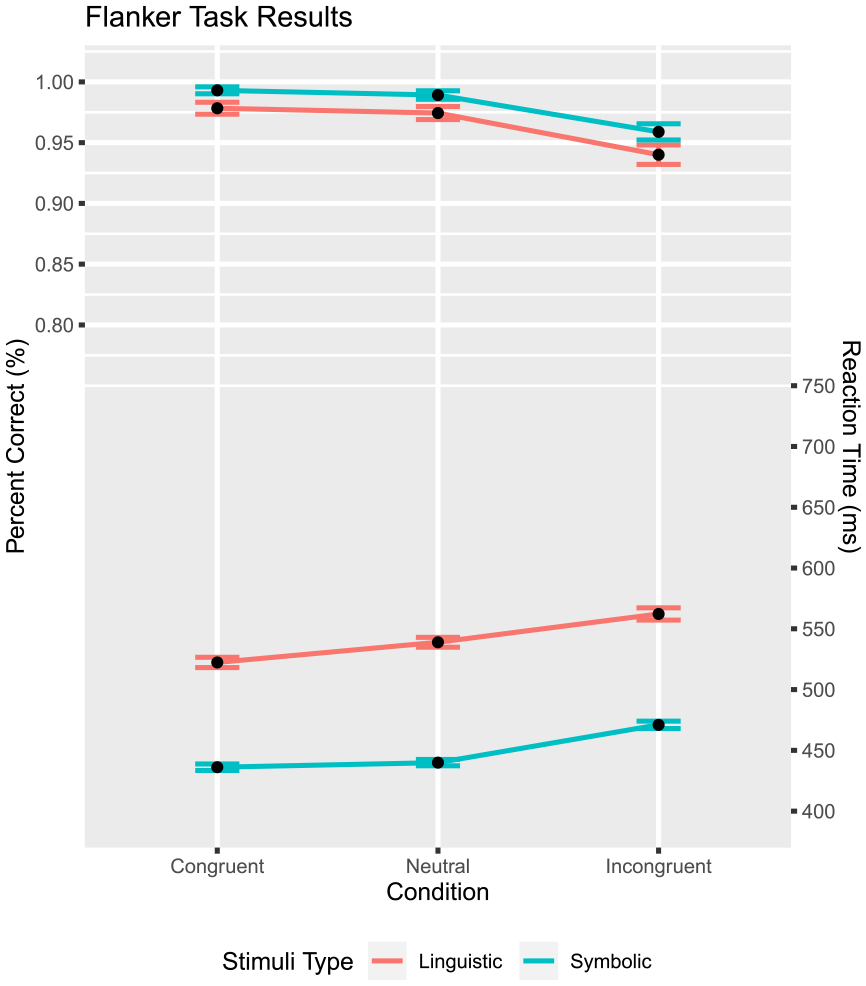
Flanker task: percent correct and Mean RT as a function of congruency and stimulus type. Mean RT is shown on the bottom half, percent correct is on the upper half. The error bar shows
However, upon visual inspection of the data, the symbolic stimuli revealed a possible violation of the midpoint assumption. This assumption was assessed by comparing the mean RT for the neutral condition to the average RT of the congruent and incongruent conditions with a two-sided, paired sample t-test. The difference was significant, with the results of a two-sided t-test being
Discussion
The violation of the midpoint assumption observed within the experiment is consistent with what is seen within the limited search (median R of 0.495). The ratio of RT differences for the symbolic set revealed R ≈ 0.122, coinciding with the limited search’s
Experiment 2—Stroop Task
Experiment 2 used the same 2 stimuli formats as Experiment 1. In the linguistic variant, the stimuli consisted of colour words or a letter string (XXXXX), with participants asked to respond to the colour of the word or letter string (Figure 8). The colour of the word matched the name of the word in the congruent trials, incongruent trials were present if the colour of the ink was difference from the semantic meaning of the word, and neutral trials used a letter string as stimuli, prompting none of the responses. Participants had four response options (red, yellow, green, or blue) mapped to the arrow keys on the keyboard Figure 8. In the symbolic variant, the stimuli consisted of coloured shapes, where the participant responded to the shape (Figure 8). The shapes were presented with a guide at the bottom (a blue square and a red triangle), serving as a source of conflict. Congruent trials presented a shape coloured the same as the guide (blue square), while incongruent trials presented a shape coloured with the opposing response’s colour (red square). In the neutral condition, the shape was not coloured, negating the potential conflicting information. Each participant performed each alternative in a separate block of trials.
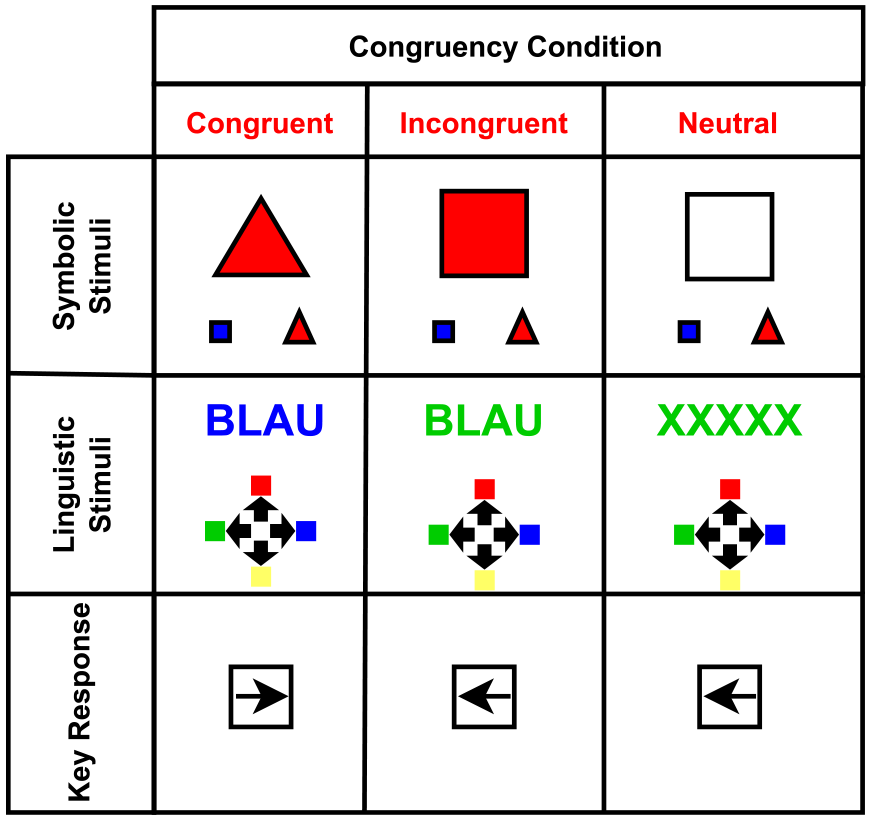
Examples of Stimuli Conditions for the Stroop Tasks: The stimuli examples are presented in the upper rows, with an example of the response mapping appearing on the bottom row. Each stimuli set was presented in its own block. The guide to the response in each stimulus example is shown on the screen consistently, to remind participants of key mappings for each response.
Methods
Participants
The sample size was selected using the same procedure as Experiment 1. Participants were recruited from the same pool of participants as before with the same criterion for rejection participants due low accuracy. The specification of a QWERTY or QWERTZ keyboard was also added to the list of participant requirements to ensure a consistent key mapping. This specification was enacted after concerns over different keyboard layouts were expressed after the first experiment. This problem came about due to the online testing environment of our experiment. Thus, the use of arrow keys for responses was added, rather than alpha-numeric keys. Thus, the final total, then, was 50 participants (22 females, 26 males, 2 others, mean age = 26.31 years, SD = 8.77 years). As before, the base rate was 13 dollars per hour, with the experiment lasting around 15 minutes in total.
Stimuli
We once again used two stimuli sets, each involving a different variation of the Stroop task. The two variants of the task were the colour word Stroop Task and the Bivalent Shape Task (Mueller & Esposito, 2014). For the colour word Stroop task (Figure 8), we used four colour words (ROT, GELB, GRÜN, BLAU) along with a string of characters XXXXX. Each character in the word or string had a character height of
Procedure
Just like the previous experiment, the Stroop task experiment was uploaded to Pavlovia from PsychoPy before being posted on Prolific with a description of the task and requirements presented alongside it. Participant consent was collected upon starting the experiment. Afterwards, participants clicked a link that brought them to the main experiment, wherein their age, gender, and Prolific identification number were requested. Upon starting the experiment, the participants were first presented either the instructions for the linguistic or the symbolic task, depending on which Stroop variation they were enrolled in.
For the linguistic task, they were instructed to respond to the ink of the word/string on the screen, with each colour being mapped to an arrow key (Figure 8). The response options were up for red, right for blue, down for yellow, and left for green. They were to place their fingers on the arrow keys to respond quickly and accurately. As an example, if the word “Blau” (blue) appeared in a red font colour, the participant would respond with the up arrow key. For the symbolic task, they responded to the symbol with either the right arrow key for triangles or the left arrow key for rectangles. Thus, for a blue triangle, the participant would respond with the right arrow key.
The time intervals for the trials regarding fixation cross, blank space, and stimuli presentation as well as the feedback were the same as in Experiment 1. For randomisation, the same procedure was used as Experiment 1, with an equal number of neutral, congruent, and incongruent trials. After the practice trials (36 trials) were over, they then pressed the right arrow key to continue to the primary trials (120 for the linguistic Stroop, 118 for the symbolic Stroop). As in Experiment 1, the two variations of the Stroop task were performed in different blocks of trials.
Data analysis
The same data analysis as in Experiment 1 was performed. As before, trials with RTs less than 200 ms or greater than 2,000 ms were removed (Linguistic Stroop: 0.2%; Symbolic Stroop 0.3%). The analysis was performed on only correct responses (96.8%) from the data. Similarly to the flanker task, the expected accuracy differences were present across congruency conditions
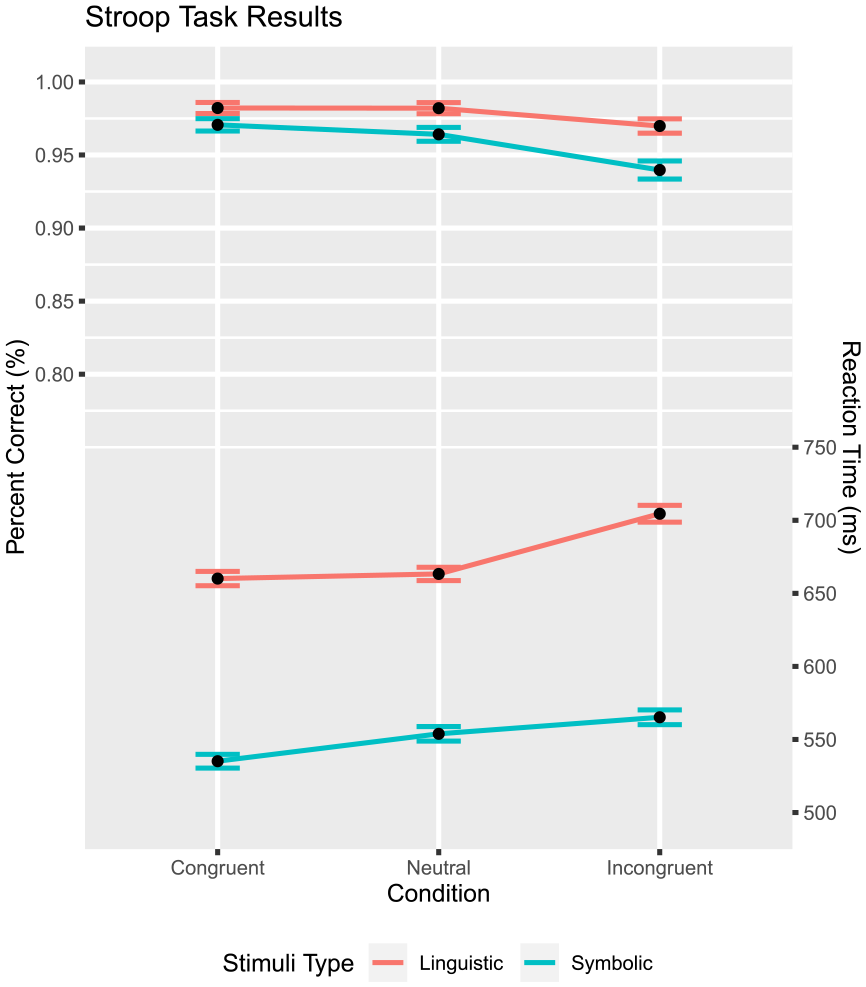
Stroop task: percent correct and mean RT as a function of congruency and stimulus type. Mean RT is shown on the bottom, percent correct is on upper half. The error bar shows
Discussion
Similarly to Experiment 1, a violation of the midpoint assumption is observed. The stimuli set with the statistically significant violation was linguistic
Experiment 3—Simon Task
Experiment 3 used the same 2 stimuli format as the former experiments. For both sets, the stimuli appeared on top of a ring in the centre of the screen. This was done in an attempt to negate the foveal processing concern brought up in the literature (Mahani et al., 2019). In the linguistic variant, the stimuli consisted of two words, “oben” and “unten” (top and below), with participants asked to respond to the word’s meaning regardless of position (Figure 10). The position matched the semantic meaning in congruent trials, incongruent trials presented a mismatch, and neutral trials placed the stimuli at either side of the circle. For the symbolic variant, the stimuli consisted of coloured dots, where the participant responded to the colour of the dot Figure 10. The dots appeared on the right, left, top, or bottom of the ring. Congruent trials occurred when the response mapped to the colour matched the dot position (right arrow on red and left arrow on blue), while incongruent trials had a mismatch between dot placement and correct response (a blue dot presented on the left position). In the neutral condition, the dot was placed at the top or bottom the ring in an attempt to negate positional information. Each participant performed each alternative in a separate block of trials.
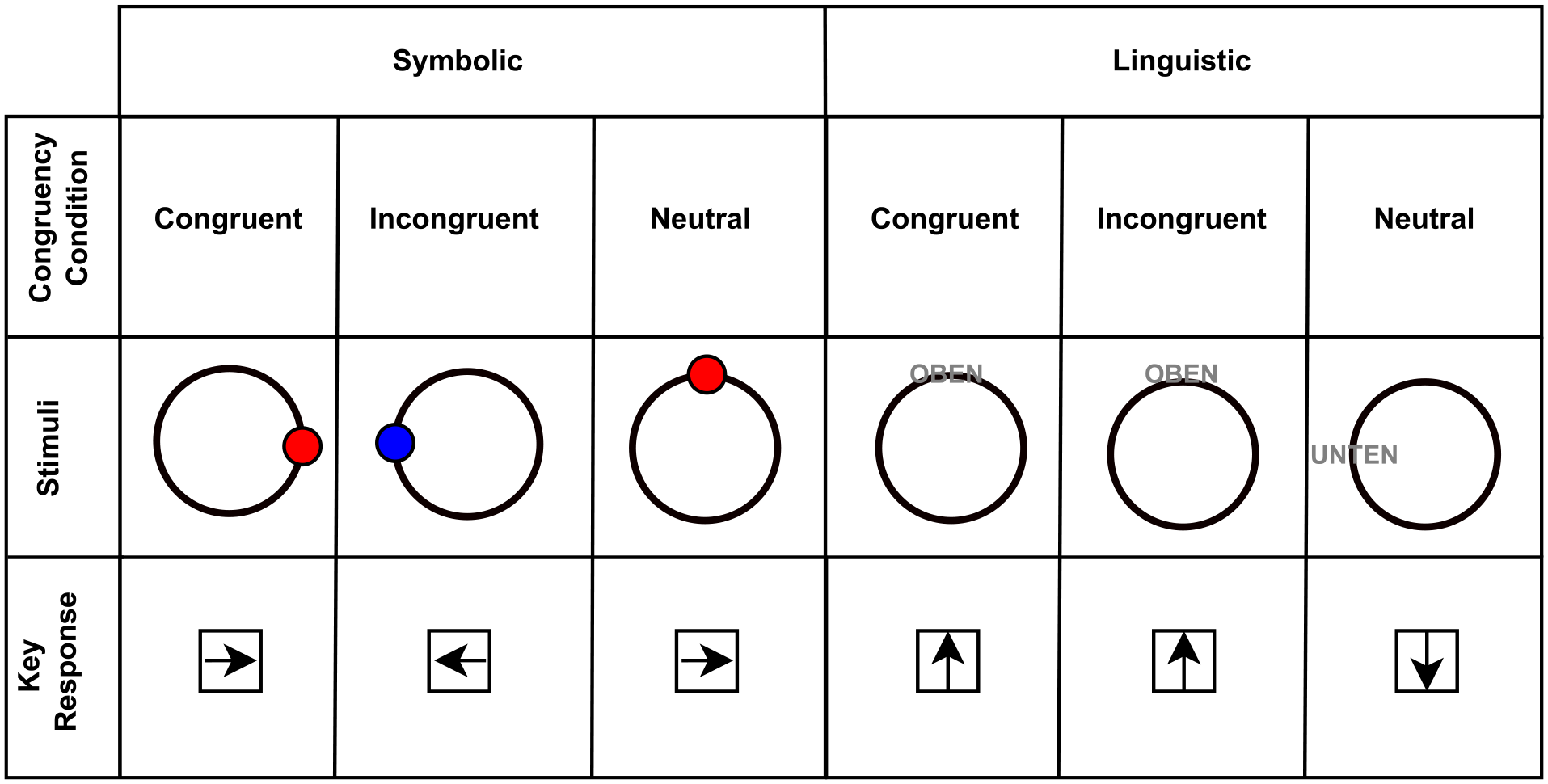
Stimuli Conditions for the Simon Tasks: The stimuli examples are presented in the middle row, with an example of the response mapping appearing in the bottom row. Each stimulus set was presented in its own block. It should be noted that the target stimulus could appear on the top, bottom, left edge, or right edge of the circle.
Methods
Participants
Participants had the same requirements as Experiment 2. Similarly, with the Stroop Experiment, Prolific’s screening procedure allowed for an appropriate rejection and collection of replacement participants. The sample size of 50 was selected using the same procedure as Experiments 1 and 2. Thus, the final total was 50 participants (23 females, 26 males, 1 other, mean age = 25.99 years, SD = 7.79 years). Each received a base rate of 13 dollars per hour, with the experiment lasting around 15 minutes in total.
Stimuli
The third experiment follows the first and second experiment’s two stimulus paradigm, with two sets of stimuli presented in different blocks. The experiment was once again created in PsychoPy, but put online via Pavlovia. Across both sets of stimuli, a ring sized at
For the linguistic set, two words (“oben” or “unten,” meaning “above” or “down”) sized at a letter height of
Procedure
As with the previous experiments, the task was presented as a Simon Task Experiment on Prolific, with a description of the task and requirements presented alongside it. Participant consent was collected upon starting the experiment. Afterwards, participants clicked a link that brought them to the main experiment, wherein their age, gender, and Prolific identification number were requested. Upon starting the experiment, the participants were presented either with the instruction set for the linguistic or the symbolic task, depending on which test set they enrolled in (semantic/symbolic for the first set and symbolic/semantic for the second set). For the linguistic task, participants responded to the word on the screen, with each meaning being mapped to an arrow key (“oben” with the up arrow key and “unten” with the down arrow key). For the symbolic task, they responded to the coloured dot with either the left arrow key for a blue dot or the right arrow key for a red dot. An example of the stimuli and proper responses are shown on the screen for clarity. Afterwards, they were presented with 24 practice trials, where trials had the same setup as the prior experiments. After the practice trials were over, participants then pressed either the right or up arrow key to continue to the 120 primary trials. As with the previous experiments, after they finished these trials, they were given the second set of instructions for the other stimuli. After reading, they continued the experiment with the new stimuli set and instructions for the same number of trials in both the practice and experiment sets.
Data analysis
Slow trials were removed in the same manner as before (Linguistic Simon: 0.2%; Symbolic Simon 0.3%), and only trials with correct responses were analysed (96% of trials). Factor congruency produced again a significant effect on percentage correct,
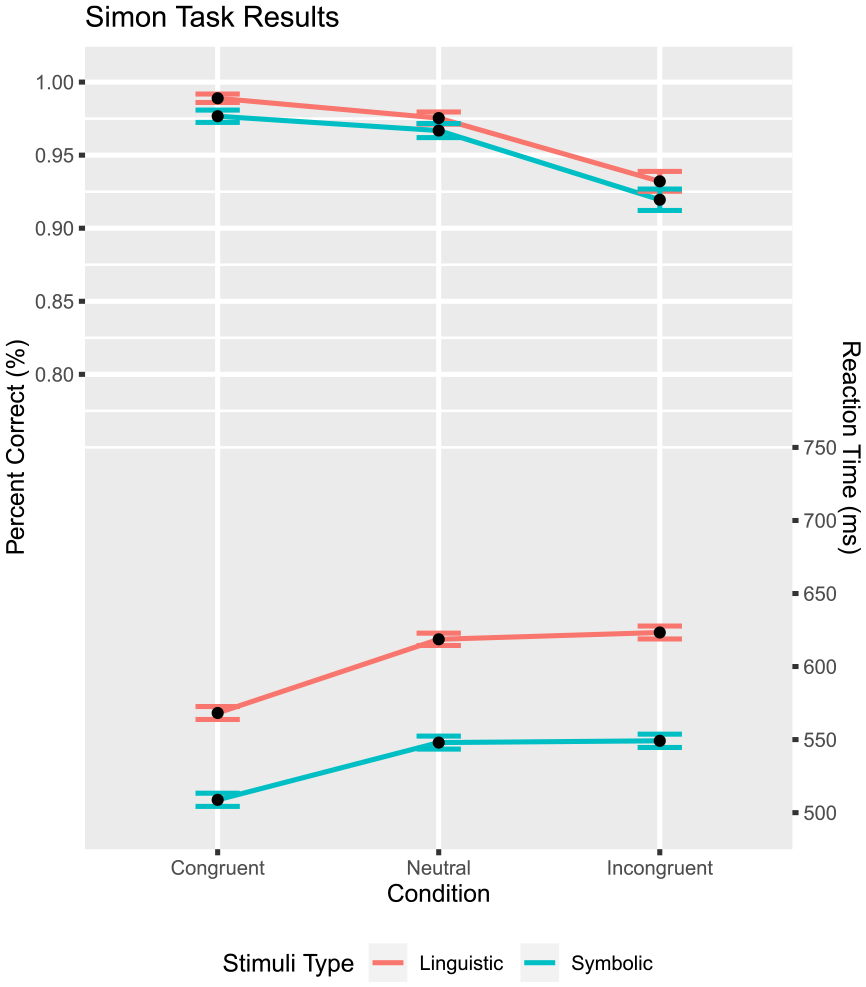
Simon task: percent correct and mean RT as a function of congruency and stimulus type. Mean RT is shown on the bottom, percent correct is on upper half. The error bar shows
Discussion
Both stimuli sets violated the midpoint assumption, albeit in the opposite direction than was expected. The linguistic
General discussion
Experimental psychologists have proposed various conflict tasks (i.e., Stroop task, Eriksen flanker task, and Simon task) to study how irrelevant information affects goal-directed behaviour. These tasks usually focus on situations where the irrelevant information either conflicts with or facilitates the processing of relevant information. Due to this focus, situations where the irrelevant information neither conflicts nor facilitates are usually neglected. In this article, we have argued that the inclusion of such a situation, a neutral condition, can be informative about the mechanism underlying conflict processing. Specifically, the relation between the mean RT in the congruent, neutral, and incongruent conditions often violate the midpoint assumption; according to this assumption, the RT in the neutral condition should reflect the average of the congruent and incongruent condition RT. The prior empirical findings show that the midpoint assumption (symmetrical RT difference between the neutral and other conditions) is not given, as evidenced by the limited search and experimental results. As such, we believe that a more nuanced view of the neutral condition is warranted, as it should correspond to the controlled process.
Due to the unexpected behaviour, the neutral condition also serves as a good test for modelling and testing the veracity of said models, with a number of them only basing predictions off of the test conditions. For example, in the introduction, we have shown that the drift function (determining mean RT) of DSTP and SSP involves the midpoint assumption, whereas DMC does not. More specifically, DSTP and SSP predict an R approximately equal to one, whereas DMC predicts an R greater than one (i.e., a smaller difference in mean RT between the neutral and incongruent than between the congruent and neutral). As DSTP and SSP are solely based on the congruent and incongruent conditions, the midpoint assumption follows naturally. As shown further on in the General Discussion, one can incorporate the current findings of the neutral condition, however, and make model adjustments to account for these. We are particularly interested in the possibility of a nonlinear controlled process trajectory. Although these advances may seem incremental, these findings emphasise a negligence towards informative aspects of experimental design and show how said information can improve current models.
Our limited search of 52 studies revealed that it is common for R to be less than one regardless of task. Given this outcome, we investigated the robustness of this midpoint violation pattern, as some odd nuances were apparent. For example, the highest amount of negative R values appears to be associated with the Eriksen flanker task. Furthermore, previous studies have shown that mean RT for the neutral stimulus can vary widely depending on the type of stimuli used, at least when the Stroop task is concerned (Klein, 1964; Levin & Tzelgov, 2016). Drawing from these observations, we used different types of stimuli for all three conflict tasks to check the generality of the results. As stimuli could vary from levels of symbolic to linguistic in their meaning, we used clear examples of either case. We applied this experimental strategy to each conflict task and found that the results varied across tasks and stimuli types. Nevertheless, a clear effect of congruency was observed for each task and stimuli type. Moreover, there was also a consistent effect of stimulus type on RT, with longer RTs for linguistic rather than symbolic stimuli, presumably reflecting the additional process of reading (Logan, 1997).
However, stimulus type did not have a consistent pattern over how the midpoint assumption was violated across conflict tasks. For the Eriksen flanker task, the midpoint assumption was violated in the symbolic version but not in the linguistic version, while in the Stroop task, the opposite pattern was observed. Moreover, the Simon task exhibited an identical pattern of midpoint assumption violation, regardless of stimuli type. Curiously, the Simon task appeared resilient to stimuli type change, and responses are in line with DMC’s predictions. Even more curiously, the result of this experiment indicates an
When we altered the stimuli for each task, we theoretically stayed within the framework of the conflict task. However, it is possible that by altering the stimuli, the way the conflict task was interacted with was also altered. For example, changing the letters to arrow may have unintentionally prompted the correct response, as having a single arrow pointing in the correct direction may have caused the participant to disregard the other head. Then, in the linguistic Simon task, one could argue that it is more of a spatial Stroop task. If that is the case, then the new neutral bias present there is clearly different from the expected neutral behaviour given our limited search of the literature. Thus, the stimuli type seems to act without a specific pattern on neutral condition bias, at least from our current investigations. This inconsistent effect of stimuli type on the midpoint violation indicates that the type of conflict may play a role. That is, the type of conflict found in each task may affect the way participants respond to different neutrals.
As discussed in the introduction, each conflict task relies on a particular type of conflict to generate the effect. For the flanker task, conflict is generated by the disparity between a stimulus characteristic and its environment. From the data we collected, it appears that the facilitation effect (difference between the congruent and neutral RT) can vary in intensity, resulting in R≤ 1. If one considers the stimulus and its environment to be a singular stimulus set, it is not surprising that the Stroop task also follows a similar pattern. After all, the Stroop task relies on differences in stimulus attributes for conflict, so if the environment and the target in the flanker task are considered different attributes, the two tasks are quite alike. However, in the Simon task, the source of conflict comes from the disparity between the stimulus and the response. It may be the case that the relative positioning of the Simon task stimuli could result in participants treating any stimulus that is not distinctly on the response side as incongruent. For example, if a blue dot assigned the response “Left” appears on the left, the response is congruent, and if it appears on the right side, it is incongruent. However, if the dot appears in the centre, it is relative to the right of the congruent response placement, possibly adding an incongruous element. Thus, depending on the type of conflict, one could imagine different tendencies for the controlled process. However, it is important to note these cases are still based on speculation, and more research is needed.
With the potential variation of neutral condition behaviour based on stimuli or conflict, readers may even question the concept of a neutral condition (Jonides & Mack, 1984). For example, one might assume that the neutral stimulus is sometimes associated with the correct response and thus propose that this should result in speeded RTs preferring the congruent condition (i.e., producing
Although this latter assumption seems reasonable, it does not always line up with the data. For example, in Experiment 1, we used two types of neutrality, with the symbolic priming of both responses and the linguistic priming of neither response. Although this assumption implies both should result in the
Perhaps, then, we have trapped ourselves with the midpoint assumption, while the true mechanism appears to act quite differently than a simple associated priming of responses with the correct or incorrect response. As outlined in the introduction, diffusion models generally assume that the accumulation of task-relevant information involves a linear accrual of information. A plausible alternative is that information accrual involves a diminishing rate of return, resulting in a concave accumulation function (Grice et al., 1982, 1984), allowing for different expectations of R. For example, DMC involves the standard assumption of diffusion models that the accumulation of task-relevant information is linear, implying a constant rate of information. However, DMC primarily expects
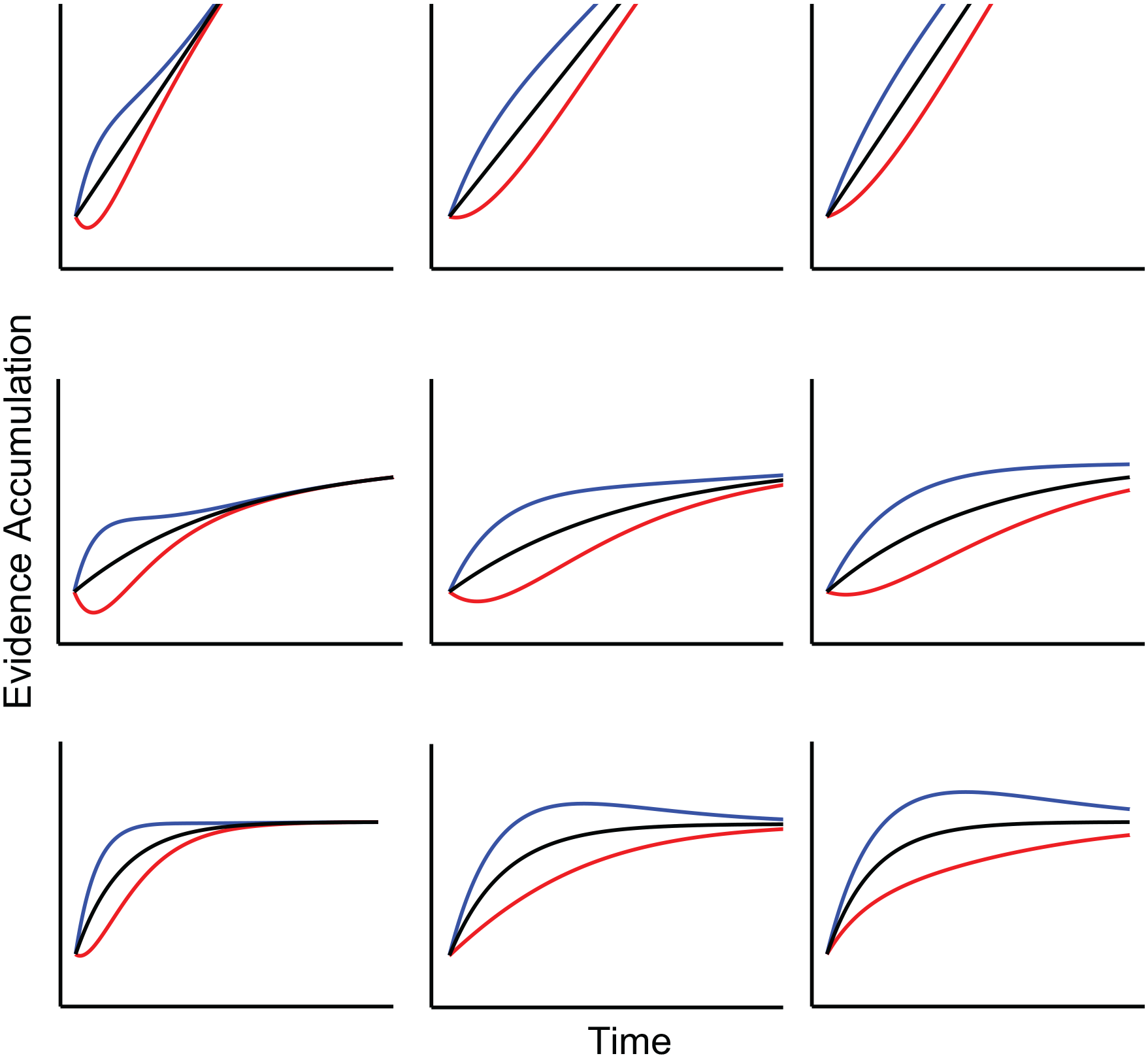
Nonlinear Extension of DMC: The figure shows various possible time courses for the nonlinear extension. Across the images,
For SSP and DSTP, midpoint assumption violations stemming from stimulus processing are presumably the primary concern, as they both relate to a single type of conflict (i.e., the flanker effect). Considering that, for the flanker task,

with the bias
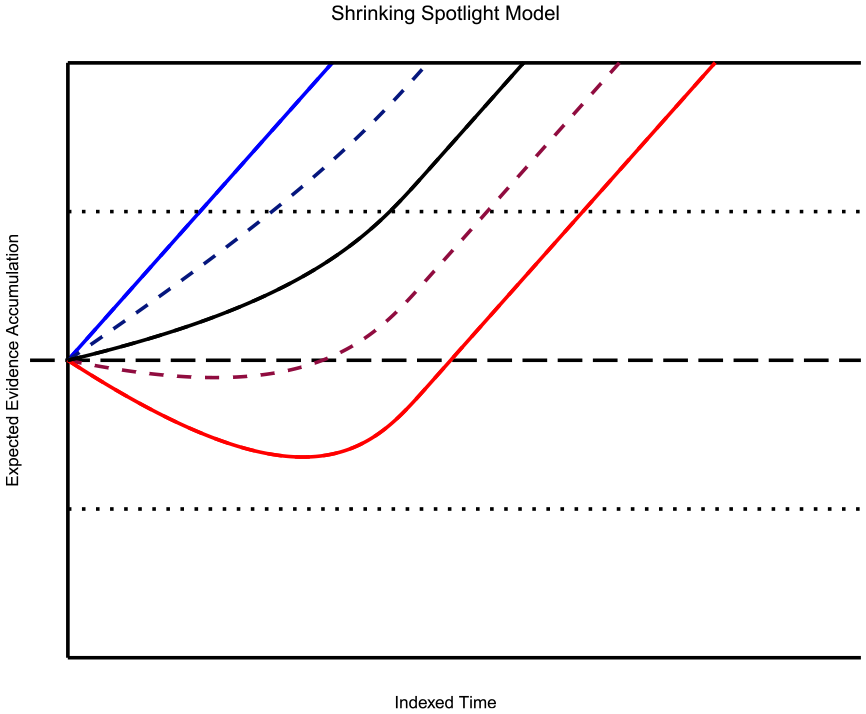
The above graph shows how the addition of a continuous parameter attached to the congruency parameter can allow for a flexible neutral condition RT estimate. By shifting the placement of the theoretically controlled process, different biases can be simulated. For positive values of
In this article, we have focused on the predictions of elaborated diffusion models and how a neutral condition could expand the database for these models to evaluate them even better. For this reason, we have excluded models that do not assume a diffusion process. For example, Miller and Schwarz (2021) have suggested an activation suppression model within the discrete information processing framework. The model assumes a race of two processes: A and B. Process A suppresses task-irrelevant information, which takes time to be successful. Process B operates on task-relevant information. If process A finishes before B, subsequent information processing is not affected by task-irrelevant information. By contrast, if B finishes before A, subsequent information processing interferes with task-irrelevant information. Thus, the congruency effect is crucially dependent on the speed of process A, for if A is always faster than B, no congruency effect will emerge. This model is agnostic with regard to the neutral condition. However, it would assume that the neutral condition is somewhere in between
In summary, the origin of the different
Footnotes
Acknowledgements
We thank two anonymous reviewers and Mathieu Servant for constructive comments. We also thank Victor Mittelstädt for helpful comments on the first draft of this paper. This is a pre-registered study, with the data and pre-registration available at https://osf.io/h3zwb/, https://osf.io/mtwn7/, and  .
.
Declaration of conflicting interests
The author(s) declared no potential conflicts of interest with respect to the research, authorship, and/or publication of this article.
Funding
The author(s) disclosed receipt of the following financial support for the research, authorship, and/or publication of this article: This research was funded by the Deutsche Forschungsgemeinschaft (DFG, German Research Foundation)—GRK 2277 “Statistical Modeling in Psychology.”
Consent to participate
All participants gave appropriate consent in the collection of their data and participation in the experiment.
Consent for publication
All participants consented to the use and potential publication of their anatomised data and the results of any analysis of said data.
Availability of data and materials
All data and code can be found at the OSF links provided in the “Acknowledgements” section.