



Abstract
The retrieval of autobiographical memories involves the construction of mental representations of past personal events. Many researchers examining the processes underlying memory retrieval argue that visual imagery plays a fundamental role. Other researchers, however, have argued that working memory is an integral component involved in memory retrieval. The goal of this study was to resolve these conflicting arguments by comparing the relative contributions of visual imagery and working memory during the retrieval of autobiographical memories in a dual-task paradigm. While following a moving dot, viewing a dynamic visual noise (DVN), or viewing a blank screen, 95 participants recalled their memories and subsequently rated them on different memory characteristics. The results suggest that inhibiting visual imagery by having participants view DVN merely delayed memory retrieval but did not affect the phenomenological quality of the memories retrieved. Taxations to the working memory by having participants follow a moving dot, on the contrary, resulted in only longer retrieval latencies and no reductions in the specificity, vividness, or the emotional intensity of the memories retrieved. Whereas the role of visual imagery during retrieval is clear, future studies could further examine the role of working memory during retrieval by administering a task that is less difficult or by recruiting a larger sample than this study. The results of this study seem to suggest that both visual imagery and working memory play a role during the retrieval of autobiographical memory, but more research needs to be conducted to determine their exact roles.
Autobiographical memory is regarded as a memory system that encompasses a rich database of knowledge about oneself and is an essential component of the human experience (Brewer, 1996; Conway & Pleydell-Pearce, 2000; Rubin et al., 2003). According to Tulving (1972, 1983) autobiographical memory comprises both personal episodic information (i.e., unique information such as your wedding day) and personal semantic information (e.g., knowing where and when you were born).
The functions of autobiographical memories have been well documented (e.g., Bluck, 2003; Bluck & Alea, 2011). Bluck and colleagues (2005) suggested that the functions of autobiographical memory can be organised into three distinct categories: self, social, and directive. First, the self function reflects memories’ role in maintaining the sense of self over time (Baddeley, 1988; Habermas & Bluck, 2000). Second, the social function reflects memories’ role in eliciting empathy and providing information for conversations during social-bonding (Habermas & Bluck, 2000). Third, the directive function reflects memories’ role in directing future behaviour by solving current problems and planning future actions (Pillemer, 2009). However, recent studies have suggested that autobiographical memories may have a fourth function which is emotion-regulation, as their recollection has been reported to protect against mood disorders and depression (Öner & Gülgöz, 2018; Pillemer, 2009; Williams et al., 2015).
Given the importance of autobiographical memory for self-continuity, social-bonding, directing-behaviour, and emotion-regulation purposes, it is imperative to understand how autobiographical memories are recalled. Therefore, this study aimed to understand the mechanisms underlying autobiographical memory retrieval by using a dual-task paradigm. We examined the contributions of visual imagery and working memory, as recent studies have shown that these components play an integral role in the recollection of autobiographical memories (e.g., Greenberg & Knowlton, 2014; van den Hout et al., 2012). While viewing a blank screen, following a dot on a screen, or viewing a screen with dynamic visual noise (DVN; which is a visual interference task known to disrupt visual imagery processing; Quinn & McConnell, 1996), participants retrieved autobiographical memories.
Memory retrieval
When examining memory retrieval, some individuals demonstrate an effortless ability to remember their past experiences. For instance, LePort and colleagues (2012) showed that some people can easily recall vivid events from any point in their lives—otherwise known as highly superior autobiographical memory. Other individuals, however, show a diminished ability to retrieve specific recollections (Palombo et al., 2015). When asked to retrieve specific memories, people with depression often retrieve more categoric memories (i.e., memories for repeated events) or extended memories (i.e., memories that last longer than a day) compared to healthy individuals (Liu et al., 2013; Sumner, 2012). The disparity between the types of recollections during retrieval suggests that autobiographical memories are stored in varying levels of specificity. According to the self-memory system model by Conway and Pleydell-Pearce (2000), autobiographical memories are organised in a hierarchical manner. The top of the hierarchy comprises overarching themes (e.g., education, family, work, and relationships) and lifetime periods (e.g., primary school, secondary school, and university). The intermediary level, however, consists of knowledge of general events, such as specific events (e.g., meeting X for the first time), temporally extended events (e.g., vacation), and repeated events (e.g., Christmas gatherings). The lowest level of the hierarchy stores event-specific knowledge (e.g., the place, the day, or the time of occurrence) and perceptual and sensorial details for those general events.
The retrieval of autobiographical memories was initially viewed as a single cyclical process that begins with cue elaboration, search for the memory, and verification until the memory sought after is found (Norman & Bobrow, 1979). More recent studies, however, have put forward a dual-process account of autobiographical memory retrieval: direct retrieval where memories are retrieved quickly and without apparent effort, and generative or indirect retrieval, where effortful search strategies are employed to search for the memory in the hierarchical structure (Conway, 2005; Conway & Pleydell-Pearce, 2000). More recently, Mace and colleagues (2017) have argued that the recollection of autobiographical memories may involve multiple retrieval strategies, including direct and generative retrieval, as well as a temporal recall strategy (where an individual uses temporal information, such as the day and time of the week, as cues during recall) and a repeating strategy (when cues are repeated internally until the memory sought after comes to mind). The multiple-process account suggests that the strategies employed during memory retrieval are mainly driven by the circumstances (i.e., cue relevance, retrieval intentionality, or monitoring processes) in which the memory is retrieved (Barzykowski et al., 2019; Uzer & Brown, 2017).
This study focused on the retrieval of specific autobiographical memories (i.e., personal events that happened at a particular place and time). According to the Self-Memory System model, the retrieval of specific memories occurs via the dual-process approach: direct and generative processes (Conway, 2005; Conway & Pleydell-Pearce, 2000). Direct retrieval is an effortless process that is said to be spontaneously activated by environmental cues. In contrast, the generative retrieval of memories is an effortful process of memory construction, beginning at the top of the hierarchy which stores overarching themes and lifetime periods, moving through to general memories, and finally, to event-specific knowledge that is stored at the bottom of the hierarchy (Conway & Rubin, 1993). In this study, we examined two mechanisms involved in the retrieval of specific autobiographical memories: working memory and visual imagery.
Working memory and autobiographical memory
Working memory is regarded as a cognitive system with a limited capacity that holds information for short periods of time (Baddeley, 1992). Previous studies have shown that the retrieval of specific memories heavily relies on the control processes of working memory (Baddeley & Wilson, 1986; Conway, 1992; Daselaar et al., 2008). These control processes help establish contexts and are important for cue elaboration during the search for memories in the autobiographical knowledge base (Unsworth et al., 2012).
Support for the role of working memory during retrieval also stems from studies that have reported a strong association between working memory and the retrieval of autobiographical memories (e.g., Kemps & Tiggemann, 2007; Maxfield et al., 2008). For instance, higher levels of overgeneral memories (or the inability to retrieve specific memories) have been observed in individuals with difficulties in updating and maintaining information in the working memory and in individuals with a low working memory capacity (Ros et al., 2010; Yanes et al., 2008). Similarly, Raes and colleagues (2006) also found that individuals with a higher working memory capacity often retrieved more specific memories compared to individuals with a lower working memory capacity.
Previous studies have used a dual-task paradigm to investigate the relationship between working memory and autobiographical memories. Anderson and colleagues (2012) asked participants to retrieve autobiographical memories while completing a random number generator task which engaged working memory. Higher retrieval latencies and reduced specificity were observed for memories in the concurrent task condition than in the control condition. Similarly, Eade and colleagues (2006) reported similar observations when participants were required to retrieve specific memories while completing a random button-pressing task. Based on the aforementioned dual-task paradigms, it is plausible that when the working memory is occupied, the retrieval of specific autobiographical memories is impaired.
Andrade and colleagues (1997) proposed the working memory theory to explain why working memory taxations lead to fewer specific memories during recall. This theory suggests that unlike long-term memory, working memory has a limited capacity to hold information. In a typical dual-task paradigm, working memory is taxed when both tasks compete for the limited working memory capacity. Owing to the competition between the tasks, fewer attentional resources will be available to search for the memory in the hierarchical structure.
The benefits of working memory taxation can also be observed in eye movement desensitisation reprocessing (EMD-R) studies (van den Hout, Engelhard, Rijkeboer, et al., 2011). EMD-R is a psychotherapy that claims to alleviate the vividness and emotional distress brought about by the recollection of traumatic memories (El Haj et al., 2017; Gunter & Bodner, 2008). When an individual is required to recall their traumatic memories while making eye movements, both tasks compete for the limited resources of the working memory (Baddeley, 2007). The simultaneous execution of these dual-attention tasks could therefore impair the recollection of emotional memories, which may in turn, result in the retrieval of memories that are less emotional and less vivid (El Haj et al., 2017; van den Hout & Engelhard, 2012).
Visual imagery and autobiographical memory
Apart from working memory, visual imagery is also regarded by many researchers as one of the components involved in the recollection of specific autobiographical memories (Brewer, 1988, 1996; Brewer & Pani, 1996). Conway (1988) and Pillemer (1984) proposed that specific memories possess a strong sensory-perceptual component as they are often predominantly recalled in the form of visual images. Support for this notion stems from research reporting strong associations between visual imagery and autobiographical memory. First, Rubin and colleagues (2003) found that autobiographical memories with a strong sense of reliving are often accompanied with vivid visual images. Second, high imageability cues have been reported to lead to more specific memories with faster retrieval times than low imageability cues (Williams et al., 1999). Third, researchers have reported an enhanced recollection of autobiographical memories in individuals with a higher ability for mental imagery compared to individuals with a lower ability for mental imagery (Vannucci et al., 2016). Support for the role of visual imagery in the retrieval of specific memories also stems from neuropsychological studies. Greenberg and Rubin (2003) found a reduced ability to construct visual images during memory retrieval in patients with damage to the occipital lobe (which is involved in the processing of visual information).
Studies using dual-task paradigms have shown that the retrieval of specific memories is impaired when participants are required to retrieve memories while completing a secondary task (Anderson et al., 2012; Eade et al., 2006). To illustrate this impairment, Anderson and colleagues (2017) found that when participants attended to DVN that occupied the visual areas, the specificity of the memories retrieved was reduced. The researchers proposed that during generative retrieval, the participants were less efficient at distinguishing between specific and general memories in the hierarchical structure. Furthermore, the participants could not imagine the sensorial and perceptual details of the memory for direct retrieval, because their ability to mentally visualise such details was compromised. Similarly, Sheldon and colleagues (2019) also reported that the ability to form event-specific details was impaired when participants imagined autobiographical scenarios while viewing a DVN. They argued that visual imagery processing allows one to access and link specific episodic details while forming autobiographical representations. Based on the aforementioned findings, it is apparent that visual imagery also plays an important role in the retrieval of autobiographical memories.
The present study
It is difficult to determine whether the higher retrieval latencies and reduced specificity of the memories during retrieval are due to interference in the visual imagery process or working memory. Therefore, this study aims to examine the contribution of visual imagery and working memory during the retrieval of autobiographical memories. Akin to previous research, a dual-task paradigm was administered in this study, and participants were required to retrieve specific memories while attending to a secondary task: following a moving dot, viewing DVN, or viewing a blank screen (control).
As previously reported by Sheldon and colleagues (2017), studies have revealed that the simultaneous presentation of the DVN disrupts performance on visual imagery tasks that require the reconstruction of perceptual information from memory, but not on working memory tasks that require the maintenance of visual information in the working memory (Andrade et al., 2002; Dean et al., 2005). The taxation of the working memory, however, was achieved by asking participants to follow a moving dot on the screen during retrieval. Support for the moving-dot condition stems from EMD-R laboratory analogue studies that have reported that making horizontal eye movements during memory retrieval taxes working memory (van Veen et al., 2016; van Veen et al., 2015).
While attending to the secondary task, participants were presented with a cue word. As soon as they had retrieved a specific memory that was somehow related to the cue word, they pressed a button. The time between the presentation of the cue word and the memory retrieval represents the retrieval latency. The participants then described the memory and rated the memory on several phenomenological characteristics, such as recollective experience and emotional intensity. The description of the memories was later scored on specificity.
Based on the literature, we developed two sets of hypotheses, one set focussing on retrieval time and one set focussing on memory phenomenology: (1) if only visual imagery plays a role in the retrieval of autobiographical memories, then memories retrieved in the DVN condition would be recalled slower than memories retrieved in the moving-dot and control conditions. On the contrary, if only working memory is involved in the retrieval of autobiographical memories, then memories retrieved in the moving-dot condition would be recalled slower than memories retrieved in the DVN and control conditions. However, if both visual imagery and working memory are found to contribute to the memory retrieval process, then memories retrieved in the moving-dot and DVN conditions would be recalled slower than memories retrieved in the control condition. (2) If only visual imagery plays a role in the retrieval of autobiographical memories, then memories retrieved in the DVN condition would be recalled with less recollective experience (and with reduced specificity and less emotion) than memories retrieved in the moving-dot and control conditions. However, if only working memory is involved in the retrieval of autobiographical memories, then memories retrieved in the moving-dot condition would be recalled with less recollective experience (and with reduced specificity and less emotion) than memories retrieved in the DVN and control conditions. If both visual imagery and working memory contribute to the memory retrieval process, then memories retrieved in the moving-dot and DVN conditions would be recalled with less recollective experience (and with reduced specificity and less emotion) compared to memories retrieved in the control condition.
Method
Design
A within-subjects design with one factor was proposed. The independent variable in this study was the experimental conditions during which autobiographical memories were retrieved: DVN, moving-dot, and blank. The dependent variables were the retrieval latencies and the characteristics of the memory retrieved (memory specificity, recollective experience, vividness, vantage perspective, emotional intensity, and emotional valence). For the dependent variables of emotional intensity and emotional valence, there was an additional independent variable when we compared emotions at the time of the experience to emotions at the time of the recollection, because it has been shown that negative memories lose their intensity faster than positive memories (Walker et al., 2003).
Participants
The number of participants required for the present experiment was determined through an a priori power analysis using the software MorePower 6.0 (Campbell & Thompson, 2012). The estimated effect size was medium (f = .25), the alpha was set at .05, and the power at .80. The number of groups was 1, and the number of measurements was 3. The analysis indicated that a sample size of 94 would be sufficient to obtain sufficient statistical power. However, we aimed to recruit a total of 104 participants for the potential exclusion of outliers.
In the end, we tested 116 students from the University of Nottingham Malaysia but because the total gaze sample of six participants fell below 80% of the total trial time (i.e., lost track for more than 12 out of the 60 s of total retrieval time), their datasets were removed from the analyses. Second, the dataset of one participant was also removed because the computer on which the study was presented crashed during the completion of the experiment.
Finally, if participants failed to recall a memory or if the mean reaction time between indicating that they retrieved the memory and describing the memory was greater than 2 standard deviations above the mean reaction time for each participant (~5.11 s), their response would be considered as an omission. Fourteen participants were removed from the analyses because they produced more than three omissions or semantic associations during retrieval. The final sample consisted of 72 female and 23 male participants, who were between 16 and 34 years old (M = 20.00, SD = 2.43).
Materials and apparatus
The DVN
The DVN (see Figure 1) is known to interfere with visual imagery processing and consists of an array of squares that switch between the colours black and white interchangeably, at a rate of 52.5% per second (Anderson et al., 2017; McConnell & Quinn, 2004). Over the course of 1000 ms, about half of the black squares changed to white (and about half of the white squares changed to black) to provide a continuous appearance of change.
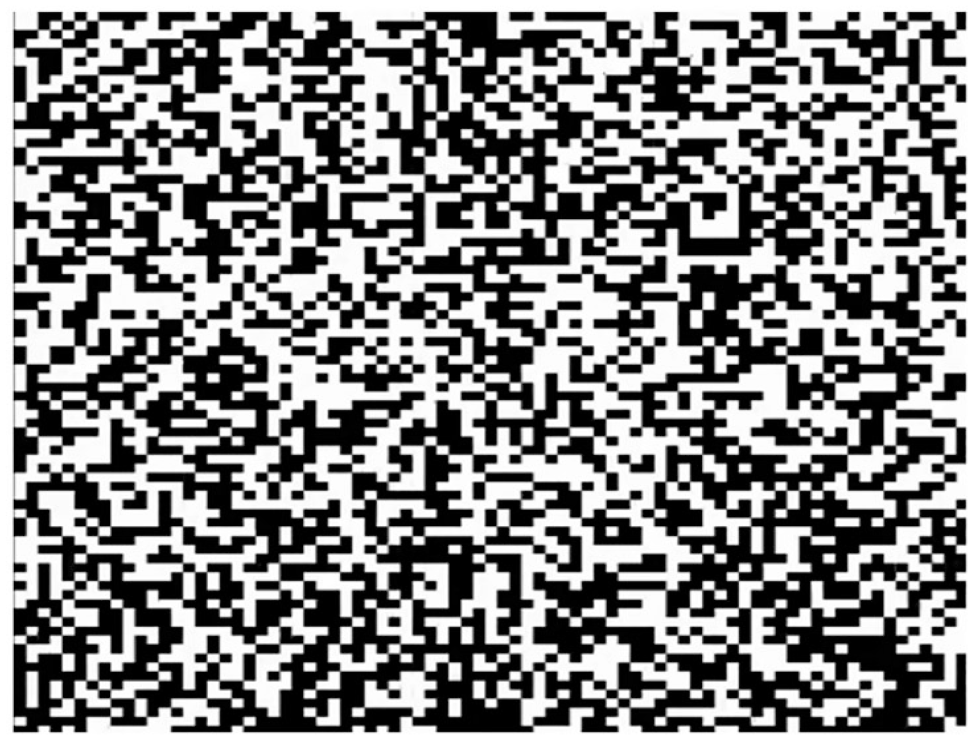
An example of the DVN that was presented during memory retrieval.
Stimuli
Although this study was not designed to test the emotional properties of the cue words systematically, they were controlled to avoid any potential confounds derived from the intensity and valence of the cue words. Table 1 shows 24 single-word cues obtained from previous studies that were used in this study (Talarico et al., 2004; Williams et al., 1996). These cue words consisted of positive (high and low arousal) and negative (high and low arousal) cues.
The emotional valence, emotional intensity, and the mean valence ratings of the stimuli in the pilot study.
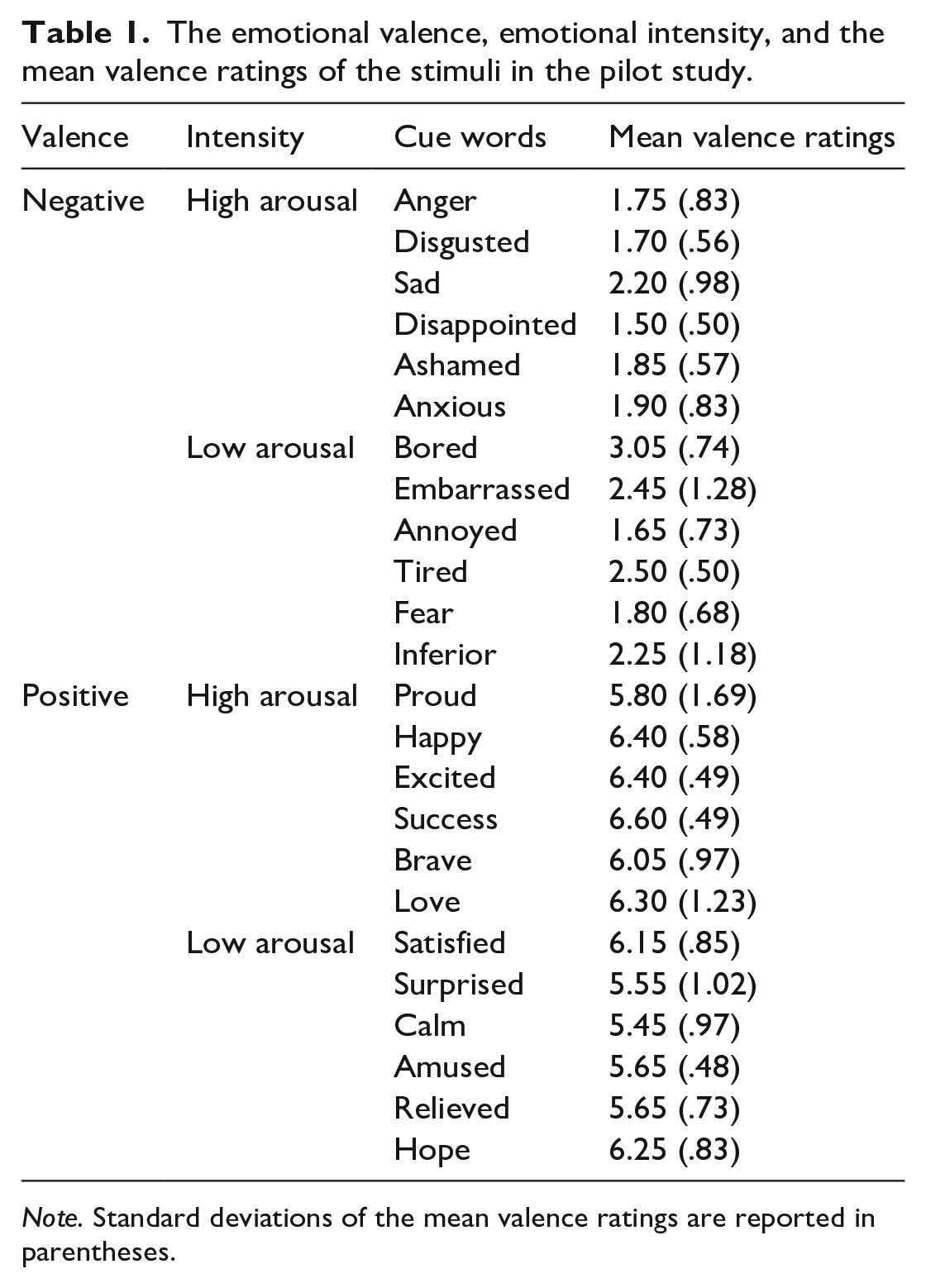
Note. Standard deviations of the mean valence ratings are reported in parentheses.
The emotional valence of the stimuli was validated through a pilot study where participants were required to rate the emotional valence of 36 cue words on a 7-point scale, ranging from 1 (very negative) to 7 (very positive). The pilot study took approximately 5 min to complete. A one-way analysis of variance (ANOVA) was conducted to determine whether the mean emotional valence of the positive, negative, and neutral cue words differed, F(2, 33) = 219.67, p < .001, ηp2 = .930. The analysis revealed that the valence of the positive words (M = 6.02, SD = 0.34) was significantly higher than the negative (M = 2.05, SD = 0.45) and neutral (M = 4.51, SD = 0.55) words, and the negative words received significantly lower ratings of emotional valence than the neutral words, ps < .001.
A 2 × 2 repeated-measures ANOVA was conducted to determine whether the mean emotional valence (positive and negative) and the mean emotional intensity (high arousal and low arousal) of the cue words were different. The analysis showed a main effect of valence, F(1, 11) = 627.67, p < .001, η² = .98, and intensity, F(1, 11) = 122.74, p < .001, η² = .92. These results suggest that positive cue words elicited more positive emotions than negative cue words and that high arousal cue words (M = 3.29, SD = 0.20) elicited more intense memories than low arousal cue words (M = 2.80, SD = 0.39). We also found an interaction effect between the intensity and the valence of the cue words, F(1, 11) = 157.78, p < .001, η² = .94. The interaction effect suggests that as arousal of the cue words becomes higher, the valence of positive cue words becomes higher, but the valence of negative cue words becomes lower.
Eye-tracking apparatus
The experiment was conducted by using an EyeLink Portable Duo 1 (SR Research Ltd., Mississauga, Ontario Canada), a video-based eye-tracking device with a temporal resolution of 1000 Hz and a spatial resolution of 0.01°. The eye tracker followed the participants’ gaze position, and a 21-inch display PC (1920 × 1080 pixels) displayed the experiment via MATLAB (Version R2017a) and Psychtoolbox (Brainard, 1997; Pelli, 1997). Participants’ gaze was calibrated by using the EyeLink 9-point calibration procedure. Calibration was considered successful if each point was in error by less than 1° visual angle. A chin rest was used to stabilise the participant’s heads. The eye-to-screen viewing distance was set at 650 mm.
Procedure
Before the experiment began, participants were provided with information about the study and were asked to complete the consent form and give some demographic information (e.g., age and gender). Upon informed consent, they were seated in front of a computer with a screen distance of 650 mm.
Participants were then given the instructions and told that they would be presented with 12 positive or negative single-word cues (see Table 1). Upon cue presentation, they were instructed to retrieve a specific memory (relevant to the cue) for an event that had been personally experienced in the past. They were also told that the cues would only be presented briefly and would disappear quickly, and they were not to take their eyes off the screen during memory retrieval. Participants were further informed that they would need to attend to either a moving dot, a DVN, or a blank screen (i.e., control condition) during memory retrieval. They were told to fixate on either the moving dot or the DVN during retrieval, and a failure to do so would result in a continuous tone (1000 Hz) being heard. The continuous tone ensured that participants attended to the moving dot, the DVN, or the blank screen while retrieving the memory.
After retrieving the memory, participants were instructed to press the “spacebar” key and subsequently to describe the memory. They were told to provide specific details of the memory (i.e., where and when the event occurred, what they were doing, who was present, what their feelings were). Finally, they were informed that they would be provided with a practice trial with a neutral cue word before the beginning of each block of the experiment. Once the instructions were understood, the experiment began.
There were three blocks in the present experiment, and each trial began with a one-point drift correction procedure to reduce potential noise brought about by drifts in participants’ gaze. Each block represented one condition and the order in which the blocks were presented was counterbalanced across participants to minimise order effects. Before beginning each block, participants completed a practice trial where they were presented with a fixation cross for 3000 ms at the centre of the screen. The fixation cross was then followed by a neutral cue word (e.g., garden, listening, book, city, fire, or flower) that was presented at the centre of the screen for 1000 ms. When the cue was presented, participants were given 1 min (i.e., retrieval phase) to retrieve a specific autobiographical memory for a past personal event. Once a memory had been successfully retrieved, they pressed the “spacebar” key to proceed, whereupon they were prompted to indicate if they had successfully retrieved a memory or not using a binary number to indicate “yes” or “no.” 2 Indicating “yes,” would subsequently prompt them to describe the retrieved memory, while indicating “no” would lead to a new cue word being presented. The time between the cue presentation and memory retrieval represented the retrieval latency. After completing all trials in one block condition, the next block condition would be presented.
In the blank screen condition, participants were presented with a fully black screen during the retrieval phase. In the moving-dot condition, an additional task was administered during the retrieval process, where participants were required to attend to a horizontally moving dot that shifted from the left region to the right region of the monitor and back, at an amplitude of 16°. Furthermore, the radius of the dot was set at 0.5° and the dot’s movement speed was set at a frequency of 0.33 Hz (equivalent to completing 0.33 cycles of left-right-left movement per second). 3 Finally, in the DVN condition, participants retrieved memories while attending to the DVN stimulus.
After participants finished describing the retrieved memory, they were also asked to rate the vividness of the memory (i.e., “How vivid was the memory that you had just recalled?”) on a 7-point Likert-type scale ranging from 1 (not vivid) to 7 (very vivid). Several other memory characteristics (i.e., the recollective experience, vantage perspective, the emotional intensity of the memory then, the emotional intensity of the memory now, the emotional valence of the memory then, and the emotional valence of the memory now) were also rated using similar 7-point scales.
Participants repeated this procedure of retrieving, describing, and rating an autobiographical memory four times: once for a positive, high-arousal cue word; once for a positive, low-arousal cue word; once for a negative, high-arousal cue word; and once for a negative, low-arousal cue word. Each condition received one cue word from each category, so the emotional valence and emotional intensity of the cue words was equally distributed across the conditions. The order of these four kinds of cue words was randomised.
To minimise the number of missing values, if the participant did not recall a memory that was associated with the cue word presented from one category within 1 min, they were presented with another cue word from that pool of six cue words. For instance, if a participant was presented with a negative high arousal cue word (e.g., anger) and was unable to recall a memory for this cue word, they were provided with a different negative high-arousal cue word (e.g., disgusted). However, if they were still unable to recall a memory for the second cue word, the current trial was considered as an omission, and they would proceed to the next trial, which could be either retrieving a memory that was associated with a cue word from a different category or progressing to the next block.
When the participants successfully retrieved and rated memories for all three blocks, the experiment ended. The experiment took about 45 to 60 min to complete. Participants were then provided with a debriefing sheet and were thanked for their contribution. They also received course credit for their participation.
Coding
All the memories in this study were coded by two independent researchers, and the inter-rater reliability was computed using Cohen’s Kappa. The agreement between the researchers was high, k = .94. Disagreements between the researchers were resolved through discussion. The memories retrieved were classified into one of four categories based on their varying levels of specificity: specific (if the event occurred at a particular time or place, and lasted no longer than a day), categoric (if the memory is a repeated event), extended (if the event lasted longer than a day), and semantic associations (a direct verbal association of the cue word). If participants were unable to retrieve a memory or took longer than expected (~5.11 s) between indicating that they had retrieved a memory and describing the memory, their response was considered as an omission.
Results
We first examined the difference in the retrieval latencies and specificity of the memories retrieved between the blank, DVN, and moving-dot conditions by fitting three linear mixed models using the lme4 package in R-Studio (Bates et al., 2015; RStudio Team, 2020). In these analyses, a fixed effect of conditions and a random effect of subjects were included. In the model that compared the proportion of non-specific memories (i.e., categoric, extended, or semantic associations) and omissions between the conditions, an additional fixed effect of memory errors (non-specific memories vs. omissions) was added. The significance of the main effects was tested using the anova package, and the estimated marginal means were computed using the package emmeans (Lenth, 2022). Tukey corrections were applied to account for family-wise errors.
Retrieval latencies
To examine the changes in retrieval latencies across the blank, DVN, and moving-dot conditions, we performed a linear mixed-effect model analysis. The analysis revealed a strong main effect of conditions, F(2, 947.21) = 6.82, p < .001, ηp2 = .001. Pairwise comparisons showed that participants recalled their memories more quickly in the blank condition (M = 16.63 s, SD = 13.48 s), compared to the DVN condition (M = 18.98 s, SD = 13.40 s), t(946) = –3.07, p = .006, d = –0.232, and the moving-dot condition (M = 19.06 s, SD = 13.20), t(947) = –3.30, p = .002, d = –0.253. There was no significant difference in the retrieval latencies between the DVN and moving-dot conditions, t(948) = –0.28, p = .960, d = –0.021.
Memory specificity
In the model that compared the number of specific memories recalled while participants attended to the different secondary tasks, no main effect of conditions was found, F(2, 188) = 2.85, p = .061, ηp2 = .015. Contrary to our expectations, we observed no reductions in memory specificity when participants attended to the different secondary tasks.
To determine whether these results were due to more non-specific responses or more omissions, we again fitted a linear mixed-effect model. Although there was no main effect of conditions, F(2, 470) = 1.85, p = .159, ηp2 = .006, a main effect of memory errors was found, F(1, 470) = 56.54, p < .001, ηp2 = .088. There was also no interaction effect between the different conditions and memory errors, F(2, 470) = 0.79, p = .453, ηp2 = .003. Overall, these results suggest that although participants produced more non-specific responses (M = 20.88, SD = 23.23) than omissions (M = 8.69, SD = 15.46), there was no difference in the type of error produced across the three conditions. The means and standard deviations for the different types of memories retrieved are included in Table 2.
The means (and standard deviations) of the proportions of specific memories, non-specific memories, and omissions across the different conditions.
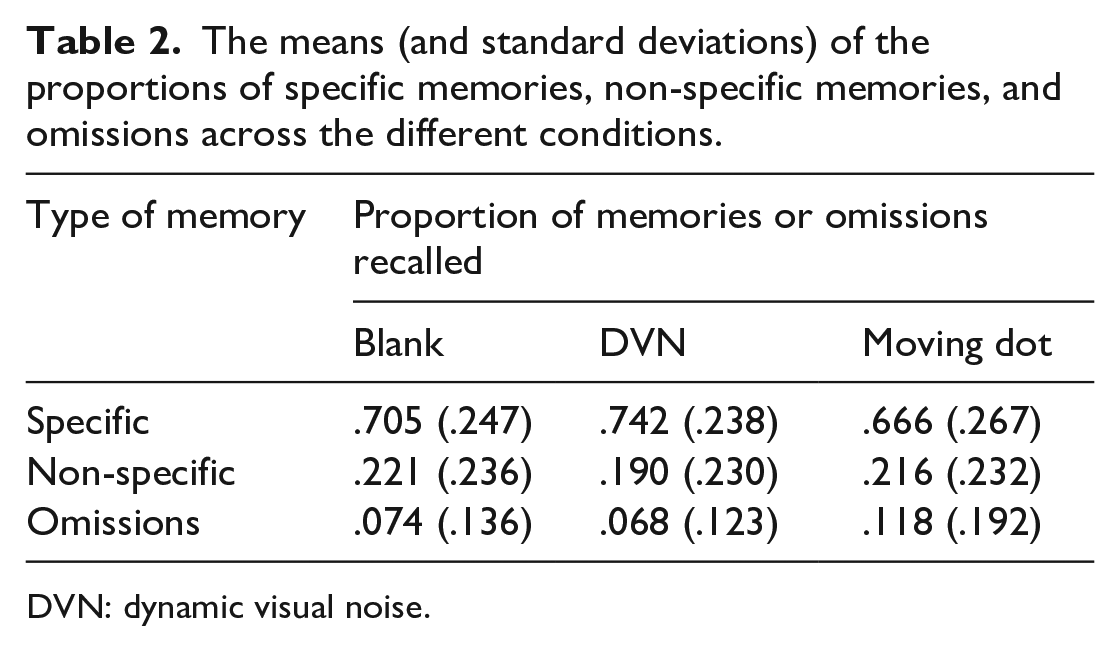
DVN: dynamic visual noise.
Memory characteristics
We also fitted a series of cumulative link mixed (CLM) models using the ordinal package in R (Christensen, 2019) to determine whether there were changes in the characteristics of the memories retrieved (i.e., vividness, recollective experience, vantage perspective, emotional intensity, and emotional valence) across the different conditions (see Table 3). In the two models that explored the emotionality of the memories, an additional fixed effect of time (at experience vs. at recollection) was added.
The means (and standard deviations) of the different memory characteristics as a function of their conditions.
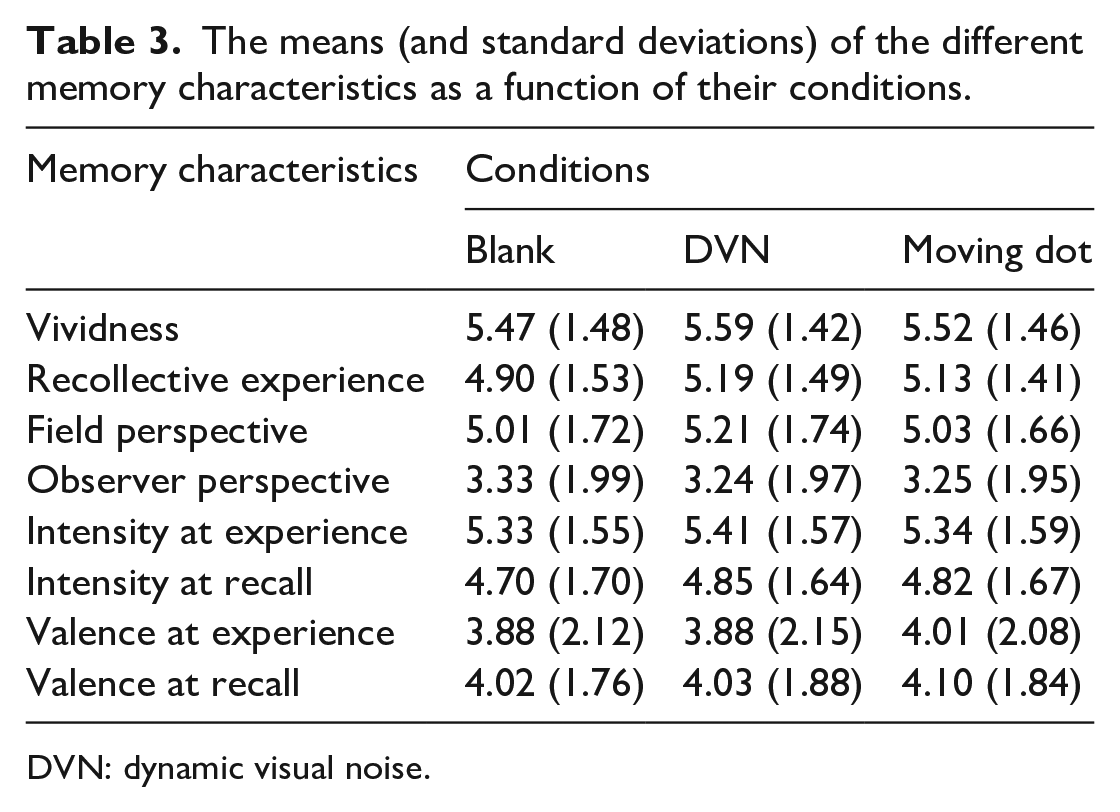
DVN: dynamic visual noise.
Vividness
In the CLM model that compared the ratings of vividness for memories retrieved across the different secondary tasks, we included the variable conditions as the fixed effect and subjects as the random effect. A chi-square (χ2) test revealed that the ratings of vividness did not change when participants attended to the different secondary tasks, χ2(2) = 2.54, p = .281.
Recollective experience
Apart from ratings of vividness, we also performed a CLM model analysis to compare the levels of recollective experiences for memories retrieved across the different conditions. This analysis showed a main effect of conditions, χ2(2) = 10.45, p = .005. Participants experienced the strongest sense of reliving for memories retrieved in the DVN condition compared to the memories retrieved in the moving-dot condition, z-ratio = –50.48, odds ratio (OR) = .647, p < .001, and the blank condition, z-ratio = –35.03, OR = .739, p < .001. They also experienced a stronger sense of reliving in the moving-dot condition than in the blank condition, z-ratio = –10.93, OR = 1.142, p < .001.
Vantage perspective
We also fitted a CLM model to compare the ratings of field perspective for the memories retrieved across the blank, DVN, and moving-dot conditions. In this model, no main effect of conditions was found, χ2(2) = 5.50, p = .064. Our findings revealed no differences in the ratings of field perspective when participants attended to the different secondary tasks. For the observer perspective model, we similarly found that there was no difference between the blank, DVN, and moving-dot conditions, χ2(2) = 0.84, p = .657. Following this analysis, we conducted a Wilcoxon signed-ranks test to determine whether there was an overall difference in the ratings of field and observer perspective across all participants. The analysis revealed that participants tended to retrieve their memories more from a field perspective (M = 5.08, SD = 1.71) than from an observer perspective (M = 3.27, SD = 1.97), Z = –16.56, p < .001.
Emotional intensity
For the emotional intensity CLM model, we included a fixed effect of time in this model to compare the emotional intensity of the memories at two timepoints; at the time the event was experienced and at the time the event was remembered. Although we did not find a main effect of conditions, χ2(2) = 2.63, p = .269, we found a main effect of time, χ2(1) = 88.26, p < .001. Participants often reported that they had felt stronger emotions at the time the event was experienced (M = 5.36, SD = 1.57) than at the time the event was remembered (M = 4.79, SD = 1.67). There was no interaction between the retrieval conditions and time, χ2(2) = 0.23, p = .892.
Emotional valence
Like emotional intensity, we also investigated whether there was a change in the emotional valence of the memories between the two timepoints across the blank, DVN, and moving-dot conditions. In this CLM model, we found no main effect of conditions, χ2(2) = 1.30, p = .522. This model also revealed that the emotional valence of the memories did not change between the time when the event was experienced and the time when the event was remembered, χ2(1) = 2.72, p = .099. We also found no interaction effect between conditions and time, χ2(2) = 0.21, p = .899.
Discussion
This study compared the relative contributions of visual imagery and working memory during the retrieval of autobiographical memories. To make this comparison, we asked participants to retrieve specific memories while following a moving dot, viewing DVN, or viewing a blank screen. When we compared the retrieval latencies between the different conditions, we found that memories in the DVN and moving-dot conditions were recalled slower than the memories in the blank condition but no differences in the retrieval latencies between the DVN and moving-dot conditions. These findings are in line with the literature suggesting that an increase in cognitive load in the moving-dot condition (van Veen et al., 2015) as well as a limitation in the ability to construct mental representations in the DVN condition (Anderson et al., 2017) led participants to experience difficulties in retrieving event-specific information from the autobiographical knowledge base.
When examining the specificity of the memories across the three conditions, we found no difference in the proportion of specific memories recalled between the blank and DVN conditions. Although Anderson et al. (2017) reported that viewing DVN led to reductions in memory specificity, the authors had asked participants to retrieve memories for both high and low imageability cues. Because high imageability cues often invoke memories that are richer in contextual and peripheral details (Rasmussen & Berntsen, 2014; Williams et al., 1999), visual imagery processing may be stronger for high imageability cues compared to low imageability cues. When participants were required to attend to a DVN during retrieval in Anderson et al.’s study, the ability to construct vivid mental representations was compromised, and this, in turn, led to reductions in memory specificity in the DVN condition. We may not have observed similar results in this study because our cues were low imageability cues (e.g., anxious, tired, excited, amused). Because participants retrieved their memories in response to low imageability cues, they may not have relied much on visual imagery processes to generate a specific mental image. The interference caused by the DVN may therefore be weak and could have led to a lack of difference in the proportion of specific memories between the blank and the DVN conditions.
In addition, there was no difference in the proportion of specific memories between the blank and the moving-dot conditions. Our results counter the finding that taxations to the working memory lead to reductions in memory specificity during retrieval (Anderson et al., 2012; Eade et al., 2006), which could be due to methodological differences. For instance, in the study by Anderson et al. (2012), participants continued to attend to the secondary task (i.e., random number generator) while describing their memory to the researchers. This study only presented the moving dot during the memory retrieval phase. When participants had successfully retrieved a memory, the secondary task was terminated. Because the moving dot was absent when the event was being described, participants may have had some additional time to think about other details surrounding their memory, possibly diminishing the effects of the task. Future research can therefore implement a paradigm in which participants are required to describe their memories in verbatim while continuing to follow the moving dot. Retrieval latency would be calculated from the time that the cue word is presented to the time when the participant begins describing the personal event.
Apart from the proportion of specific memories, we also found that participants recalled more non-specific responses (20.9%) than omissions (8.7%) across the different conditions. Because there was no interaction between the memory errors and the conditions, the extent to which the secondary tasks interfered with the hierarchical search for specific memories is unclear.
In terms of the characteristics of the memories retrieved, there was no difference in the ratings of vividness and emotionality of the memories between the DVN and the blank conditions. Similar to the study by Anderson and colleagues (2017), this study found that the DVN only interferes with the memory retrieval process but does not degrade the phenomenological qualities of the retrieved memories. Although we did not find evidence for floor or ceiling effects, the lack of differences could also be attributed to the fact that the ability to retrieve and reconstruct autobiographical memories varied across participants (Sheldon et al., 2017). If the sample in this study would have consisted of participants who tend to have vivid memories, then the DVN might have interfered with the retrieval process, but if the sample would have consisted of participants who do not tend to have vivid memories, then the DVN might not have interfered. By measuring one’s imagery ability before the experiment (with, for example, the Autobiographical Recollection Test, Berntsen et al., 2019), future researchers would be able to confirm the effects of the DVN for participants with different imagery abilities.
Whereas many studies have shown that taxing the working memory reduces the phenomenological quality of the memories retrieved (Kavanagh et al., 2001; Leer et al., 2014; van den Hout et al., 2001; van Veen et al., 2015), this study found no difference in the levels of vividness and emotionality between the memories in the moving-dot and blank conditions. Our null findings align with previous research suggesting that working memory taxation does not affect the vividness and the emotionality of the memories retrieved (van den Hout, Engelhard, Beetsma, et al., 2011). The discrepancy between the findings of these dual-task paradigms may be explained by the inverted U-curve hypothesis by Gunter and Bodner (2008). The hypothesis suggests that when the working memory is weakly taxed during retrieval, enough resources would still be available to retrieve vivid and emotional details surrounding an event and the effects of the task would be undermined. Conversely, when the working memory is taxed too much, all available resources would be depleted, and this depletion would leave very little room for recall. In other words, taxing the working memory too little or too much will yield little or no effect. Although there is evidence to suggest that making faster eye movements during retrieval leads to greater reductions in the vividness and emotionality compared to slower eye movements (van Veen et al., 2015), the moving-dot condition in this study may have been too taxing on participants’ working memory. Because the moving-dot condition depleted all the resources in the working memory during retrieval, there were no reductions in the levels of vividness and emotionality between the memories in the moving-dot and blank condition.
For the emotionality analysis, we further compared the emotional intensity of the memories between the time of experience and the time of recollection and only found a main effect of time. Participants reported that they had experienced stronger emotions at the time the event was experienced than when it was recalled, and this finding was in line with the literature (Levine & Pizarro, 2004).
When examining whether there was a difference in the levels of reliving across the three conditions, we expected to find reductions in ratings of recollective experience for memories retrieved in the DVN and moving-dot conditions. Our results, however, indicated that participants experienced a stronger sense of reliving in the DVN and moving-dot conditions compared to the control condition. This unexpected increase in levels of reliving may be explained by the threshold hypothesis, which suggests that all memories need to pass an awareness threshold to be remembered (Barzykowski & Staugaard, 2016, 2018). These authors suggested that highly accessible memories, such as emotional or recent memories, are often remembered without apparent effort because they pass the awareness threshold easily. Less-accessible memories, on the contrary, have difficulties in passing said threshold. In this study, it is plausible that participants’ memories that were accompanied by strong feelings of recollective experience in the DVN and moving-dot conditions could have passed the threshold. In addition, they might have directed more effort to the retrieval process in the control condition, allowing memories with both stronger and weaker feelings of recollective experience to pass the threshold, resulting in a lower average for recollective experience in the control condition. Although it is unclear why this explanation would apply to recollective experience but not emotional intensity or vividness, our present findings warrant serious consideration for the awareness threshold account than it has so far been given in the literature.
Numerous studies have shown an interplay between recollective experience, emotional intensity, and vantage perspective (Janssen et al., 2022; Libby & Eibach, 2011; Phelps & Sharot, 2008; Sutin & Robins, 2010). Therefore, we explored whether there was a difference in the vantage perspective from which the memories were recalled across the DVN, moving-dot, and control conditions. The analyses were purely exploratory as no specific predictions were made. Our findings suggest that the ratings of both the field and observer perspectives did not change across the three conditions.
Although there were no significant differences, we observed a trend in the memories as the overall ratings for memories retrieved from the field perspective were higher than the overall ratings for memories retrieved from the observer perspective. When retrieving autobiographical memories, participants tend to recall recent memories, such as events that have transpired in the last 5 years, compared to memories from the earlier part of their lives (Rubin & Wenzel, 1996; Sederberg et al., 2008). Memories for recent events, in turn, tend to be recalled from a field perspective than an observer perspective (Nigro & Neisser, 1983; Rice & Rubin, 2009; Robinson & Swanson, 1993). Therefore, it is possible that participants’ preference in recalling more recent events can explain why memories in this study were mostly recalled from a field perspective. Because there was no objective measure to assess the recency of the memories retrieved in the current design, future studies can modify the design of this study to include judgements of temporal distance between encoding and retrieval for each of the memory retrieved or include instructions to retrieve memories from certain lifetime periods.
Implications
Although there is evidence to suggest that the DVN interferes with the processing of visual information in the visual buffer of short-term memory (Quinn & McConnell, 2006), the results in this study revealed that the DVN is a stimulus that does not halt or abort the search for sensorial and perceptual details in the hierarchical base; instead, it delays the process. In other words, participants may take longer to retrieve their memories while viewing the DVN compared to when viewing a blank screen. However, the phenomenological characteristics of the memories will still be preserved (also see Anderson et al., 2017).
When we examined the roles of working memory during retrieval, participants took longer to retrieve their memories in the moving-dot condition compared to the control condition. These results would support the working memory theory which suggests that, unlike long-term memory, working memory is a component that has a limited capacity (Baddeley, 1992), and the simultaneous execution of the memory retrieval and following the moving dot taxed the limited capacity of the working memory, which resulted in the longer retrieval latencies. Although the working memory theory explains why there were delays in the retrieval process, the effects of the working memory on the remaining memory characteristics were unclear. The lack of differences observed may have been due to the fact that the task administered (i.e., the moving-dot condition) was too difficult, and it may have used up all the resources in the working memory. Not enough resources available were available for memory retrieval, and this, in turn, may have resulted in small effect sizes. Future studies should therefore recruit a larger sample than this study to examine whether small differences between the conditions can be observed for each memory characteristic.
Conclusion
In this study, we compared the roles of visual imagery and working memory during the retrieval of autobiographical memories. We asked 95 participants to retrieve their autobiographical memories while viewing a blank screen, viewing a DVN, or following a moving dot. We then compared the retrieval latencies, memory specificity, vividness, recollective experience, vantage perspective, and emotionality across the three conditions. Inhibiting visual imagery during retrieval merely delayed the retrieval process but did not affect the quality of the retrieved memories. The effects of the working memory taxation resulted in only longer retrieval latencies and were not observed for the remaining memory characteristics, possibly because the task administered in this study may have been too difficult or because the study was underpowered. The results of this study seem to suggest that both visual imagery and working memory play a role during the retrieval of autobiographical memory, but more research needs to be conducted to determine their exact roles.
Footnotes
Declaration of conflicting interests
The author(s) declared no potential conflicts of interest with respect to the research, authorship, and/or publication of this article.
Funding
The author(s) disclosed receipt of the following financial support for the research, authorship, and/or publication of this article: The research was supported by a grant from the Ministry of Higher Education (FRGS/1/2020/ss0/UNIM/02/1).
