




Abstract
A growing body of research investigating the relationship between body representation and tool-use has shown that body representation is highly malleable. The nature of the body representation does not consist only of sensory attributes but also of motor action–oriented qualities, which may modulate the subjective experience of our own body. However, how these multisensory factors and integrations may specifically guide and constrain body reorientation’s plasticity has been under-investigated. In this study, we used a forearm bisection task to selectively investigate the contribution of motor, sensory, and attentional aspects in guiding body representation malleability. Results show that the perceived forearm midpoint deviates from the real one. This shift is further modulated by a motor task but not by a sensory task, whereas the attentional task generates more uncertain results. Our findings provide novel insight into the individual role of movement, somatosensation, and attention in modulating body metric representation.
Introduction
How we represent our own body is crucial for everyday actions and for successful interactions with the external environment (Maravita et al., 2003). Although it may appear a fairly simple concept to grasp, the understanding of the underlying cognitive processes and the interaction of various factors is complex and convoluted. Traditionally, the terms body schema and body image have been extensively used to conceptualise one’s own body representation (Gallagher, 1986, 2005); however, different representations have emerged at different times throughout the literature and, despite numerous studies that have been dedicated to investigating body representations, a clear-cut theory or model providing a full explanation of the relationships between the different bodily representations remains difficult to delineate (e.g., de Vignemont, 2010; Longo, 2022). Although the notion of body representation is in itself yet to be unanimously characterised, current literature does offer a critical and reliable body of evidence indicating that body representation is highly plastic and malleable (e.g., Caggiano et al., 2021; Martel et al., 2016, 2021; Medina & Coslett, 2010) and can be affected by pathological conditions, such as acquired brain damage (e.g., Bassolino et al., 2022; Caggiano et al., 2020; Garbarini et al., 2015; Mora et al., 2023; Tosi et al., 2018) and limb amputation (e.g., Canzoneri et al., 2013; Rognini et al., 2019; Sato et al., 2017).
In healthy population, the plasticity and reorganisation of metric body representation has been investigated in the context of ageing (Garbarini et al., 2015; Sorrentino et al., 2021), gestures (Mora et al., 2021), passive and active actions (Bruno et al., 2019), bodily illusions (Tosi et al., 2022), response modality (Tosi & Romano, 2020), and tool-use where the morphology and functional aspects of a tool appear to modulate the subjective experience of our own body metrics (e.g., Galigani et al., 2020; Maravita & Romano, 2018; Romano et al., 2019). Manipulation of tools reshapes the body representation during and after use (Martel et al., 2016) as observed in cases of tool embodiment (e.g., Cardinali et al., 2016; Cardinali et al., 2009; Farnè et al., 2007; Iriki et al., 1996; Maravita & Iriki, 2004; Maravita et al., 2002; Sposito et al., 2012). It seems, therefore, that the continuous reshaping of our perception of body parts is determined by various factors.
Somatosensory attributes are clearly crucial components in the context of body plasticity, as indicated by a number of studies on tool embodiment. For example, in a recent study, Martel and colleagues (2019) have shown that somatosensory signals evoked by tool use alone are sufficient to alter kinematic profiles of reach-to-grasp movements. Similarly, previous studies with brain-damaged patients with unilateral spatial attentional disorders demonstrated that tool-use could lead to crossmodal tactile extinction when a visual stimulus was presented at the extremity of a used (embodied) tool (Farnè et al., 2005; Farnè & Làdavas, 2000, 2007; Maravita et al., 2001), suggesting a predominance of sensory-motor information in determining embodiment and body representation plasticity, a hypothesis that has been recently challenged (Maravita & Romano, 2018). For example, in a recent study (Romano et al., 2019), we observed that active training, requiring movements either of the shoulders (proximal actions) or of the wrist (distal actions), induced a different shift of the perceived forearm’s midpoint. Crucially, the findings suggested that the type of action required while using a tool significantly contributes to modulating the representation of the body part involved. The tool-use-dependent change of body representation would not be a mere morphological change. A further crucial factor that tends to conflate with the motor aspect is attention as the focus of attention tends to be directed to the part of the body that needs to be moved. It seems, therefore, that shift of attentional resources also can conflate with motor and sensory information (Holmes, Calvert, & Spence, 2007; Homes, Sanabria, et al., 2007).
Therefore, the representation of one’s own body part does not depend on one unitary mechanism but on a combination of factors. The aim of this study is to investigate the selective impact of motor and sensory aspects and focus of attention on body metric representation by means of a forearm bisection task.
Materials and methods
Participants
A group of 24 right-handed healthy female adults took part in the study. Their average age was 25.7 years (SD = 3.73) and their average formal education was 17.1 years (SD = 2.9; range: 8–22). The study was approved by the Goldsmiths Departmental Ethics Committee in accordance with the standards of the 1964 Declaration of Helsinki (BMJ 1991; 302: 1194). All participants gave written informed consent before taking part in the study.
Procedure
Participants were blindfolded for the entire experiment and comfortably sat at a table in a floodlit and sound-attenuated room. Their right forearm rested, palm down, on the table in a comfortable position. Participants were asked to perform the Forearm Bisection Task, an experimental procedure frequently used in the context of body-metric representation studies (D’Angelo et al., 2018; Garbarini et al., 2015; Romano et al., 2019; Sposito et al., 2010, 2012; Tosi et al., 2018). In this task, participants are asked to indicate, with their left index finger, the midpoint of a body segment that goes from the tip of the middle finger to the right olecranon (elbow). Ballistic movements of the left-hand index finger indicated the subjective midpoint; corrections were not allowed. Each trial started with the left index finger placed at about 30-cm distance from the participant’s midsagittal plane in a standard point. To avoid tactile feedback by touching the right forearm during the bisection task, a custom-made plastic table ruler was placed a few millimetres above the forearm to be bisected. Once the left finger touched the plastic table ruler, it remained in place for a few seconds, allowing the experimenter to record the position (subjective midpoint). Then the left finger was positioned back at the starting point for the new trial.
Individual’s forearm length (i.e., distance from the elbow to the middle fingertip) was measured at the beginning of the study to calculate the objective forearm midpoint. The zero was set at the most proximal landmark (i.e., elbow). For each participant, the subjective midpoint was calculated by averaging each pointing position across trials (details on the number of trials and conditions are reported in the following sections). We than calculated the subjective midpoint deviation as the difference between the perceived and objective midpoint, as a percentage of the participant’s actual forearm length:

According to this formula, a negative value indicates a proximal subjective deviation (i.e., a shift of the subjective midpoint towards the elbow), a positive value indicates a distal subjective deviation (i.e., a shift of the subjective midpoint towards the wrist), and a value equal to 0% indicates no deviation (i.e., subjective and objective midpoints are identical). Each participant performed the bisections under three different tasks, respectively, named, Motor, Sensory, and Attention (described in the following). The order of the tasks was counterbalanced across participants.
Motor task
Participants were asked to perform the Forearm Bisection Task immediately after a movement of their right middle finger (Distal movement) or their right elbow (Proximal movement). Movements consisted of three relatively rapid taps of the finger or the elbow, maintaining the rest of the forearm as stationary as possible. Each movement condition consists of a block of 12 trials with no movement (baseline), followed by 12 trials with movement (either distal or proximal). Each participant performed both movement conditions for a total of 48 trials: 24 for the two baselines and 24 for the two movement conditions. The order of movement conditions was counterbalanced across participants.
Sensory task
Participants were asked to perform the Forearm Bisection Task immediately after a somatosensory stimulation of their right middle finger (Distal stimulation) or their right elbow (Proximal Stimulation) or both locations as an additional control condition (Distal–Proximal Stimulation). Double stimulation was introduced to distinguish the sensory effect from the possible attentional effect. Supra-threshold somatosensory stimulation (Francis et al., 2000) was induced by means of a vibration stimulator. Two vibration pads (10 mm approximately) were placed on both the elbow and the middle finger. Three keys were used to deliver single stimulation either to the elbow or the middle finger, and double stimulation to both sites (i.e., the elbow and the finger) simultaneously. Vibration frequencies of 50 Hz were delivered by the examiner for approximately 1 s and consisted of a block of 12 trials with no stimulation (baseline) followed by 12 trials of stimulation (either distal, proximal, or double). Each participant performed all the stimulation conditions (order counterbalanced across participants) for a total of 72 trials (i.e., 36 for the three baselines and 36 for three stimulation conditions).
It should be noted that vibrotactile stimulation at the level of the elbow has been reported to induce illusions of limb movement. However, the frequency (50 Hz) and duration of stimulation (~1 s) delivered in this study did not induce any illusory movement as typically higher frequencies (above 90 Hz) and longer stimulation (above 100 s) are needed for vibration-induced illusions to occur (e.g., Burrack & Brugger, 2005; de Vignemont et al., 2005; Lackner, 1988; Purcell et al., 2020).
Attention task
Participants were asked to perform the Forearm Bisection Task (as aforementioned) immediately after focusing their attention on their hand (Distal attention) or on their elbow (Proximal attention). Location of attention was manipulated by asking participants to detect “very light” somatosensory stimulation (i.e., vibrations) under the tip of their middle finger or under their elbow. The same, aforementioned, equipment was used to deliver the vibrations. Participants were told that, in this task, the vibrations could be “extremely” light and possibly under the individual threshold. They were also told that intensity increased across six trials until they could feel it. In reality, during the first five trials, the examiner pretended to deliver the stimulation, but no vibration was given. Under this condition, the participants would have focused their attention on the “stimulated” extremity of their upper limb without interference from sensory information. A supra-threshold stimulation was delivered only on Trial 6 to facilitate participants’ engagement on the task, and data from these trials were not considered in the final analysis. After each trial, they were asked to perform the arm bisection and asked whether they detected the vibration. Each attention condition (Distal or Proximal) consisted of two blocks of 12 trials without stimulation (baseline) followed by four blocks of six trials with distal or proximal stimulations. In total, each participant performed a total of 72 trials: 24 trials for the two baselines and 48 trials for proximal and distal attention stimulations; of these last trials, only those with “simulated stimulations” (n = 40) were entered in the final analysis.
Statistical analysis
Inferential statistics were performed through linear mixed models (LMM) by means of lme4 package implemented in the statistical software R (R Core Team, 2016).
Subjective midpoint deviation was used as the dependent variable (i.e., the discrepancy between the perceived and actual midpoint between the elbow and the tip of the middle finger calculated as indicated in the “Procedure” section), including subjects as the random intercept variable. The fixed effect models tested always included a within-subject factor, Time, with two levels (baseline/post manipulation) and another within-subjects factor, Body Part. The latter has two levels for the motor and attention tasks (distal/proximal), and three levels for the sensory task (distal/proximal/both).
Significant interactions have been explored by the inspection of confidence intervals (CIs) of the different conditions for which we reported mean values and 95% CIs (Cohen, 1990, 1994; Masson & Loftus, 2003).
Results
Motor task
The LMM analysis revealed a significant main effect of Time, F(1, 1020) = 17.719, p < .001, and Body Part, F(1, 1020) = 11.972, p < .001. The interaction was not significant, F(1, 1020) = 0.074, p = .786.
The inspection of CI (Figure 1) shows that moving a body part induces a proximal shift (baseline: –4.25% [–7.34, –1.16]; post-action: –5.32% [–8.42,–2.23]). Moreover, the block involving the elbow shows a more proximal deviation than those involving the index finger (proximal: –5.23% [–8.32,–2.14]; distal: –4.35% [–7.44,–1.25]).
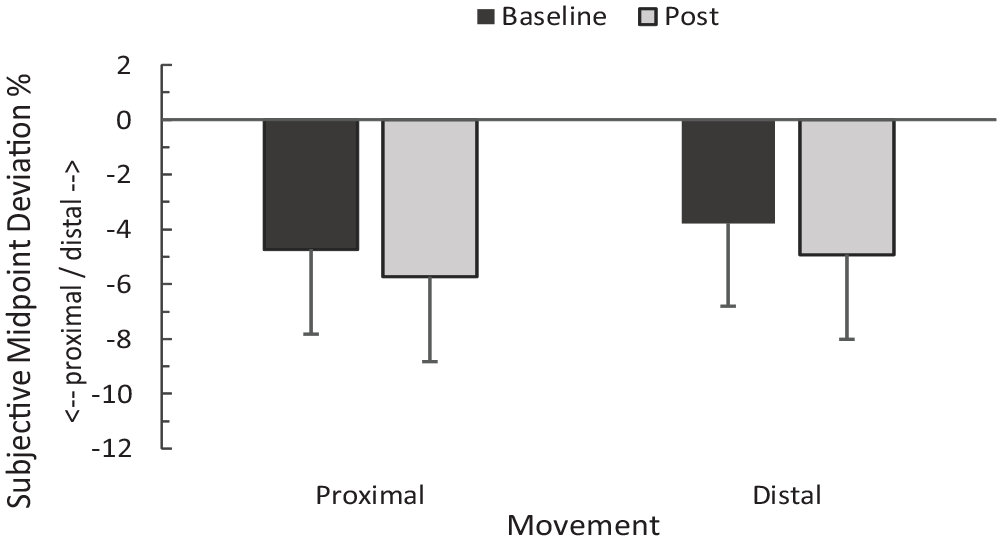
Results from the motor task.
Sensory task
The LMM showed that the main effect of Time, F(1, 1546) = 3.166, p = .075, or Body Part, F(1, 1546) = 0.736, p = .48, or the interaction was not significant, F(1, 1546) = 2.019, p = .133.
For the sake of transparency, Figure 2 reports all the condition averages and the related CIs.
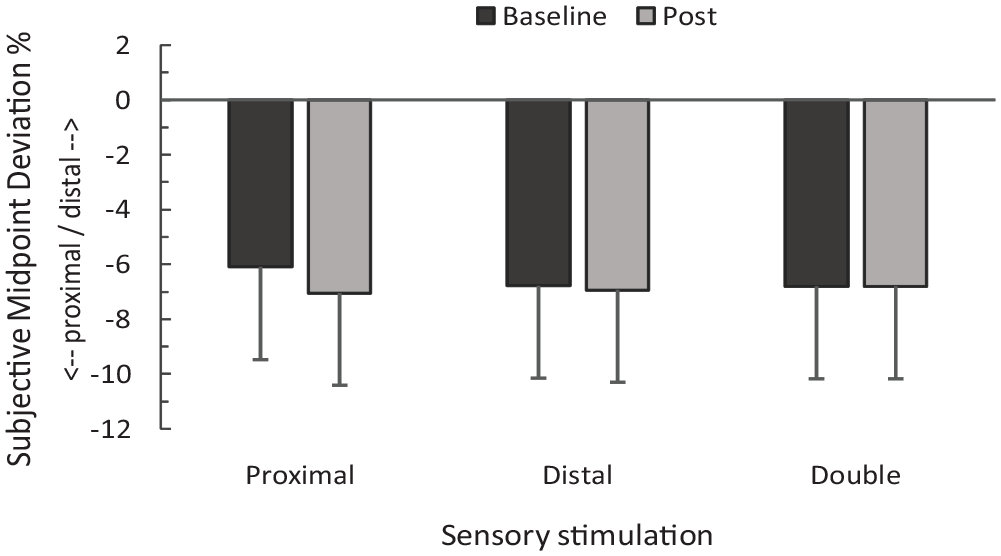
Results from the sensory task.
Attention task
The LMM identified a significant main effect of Body Part, F (1,1020) = 20.354, (p < .001). The interaction between Body Part and Time fall in the grey area of a p value that approaches the significant level without crossing it, F(1,1020) = 3.354, p = .067). The main effect Time was not significant, F(1, 1020) = 0.038, p = .846.
The inspection of CI (Figure 3) shows that the blocks involving the elbow have a more proximal deviation than those involving the index finger (proximal: –7.48% [–11.11, –3.86]; distal: –6.38% [–10.00, –2.76]). Crucially, when considering Time, we observed that attention to the proximal end tends to induce a more proximal shift (baseline proximal: –7.24% [–10.86, –3.61]; post-attention proximal: –7.73% [–11.36, –4.11]) than moving the attention to the distal end finger (baseline distal: –6.58% [–10.21, –2.96]; post-attention distal: –6.18% [–9.80, –2.56]) that instead reduces the proximal shift; however, it is important to consider these latter results cautiously, considering the level of evidence.
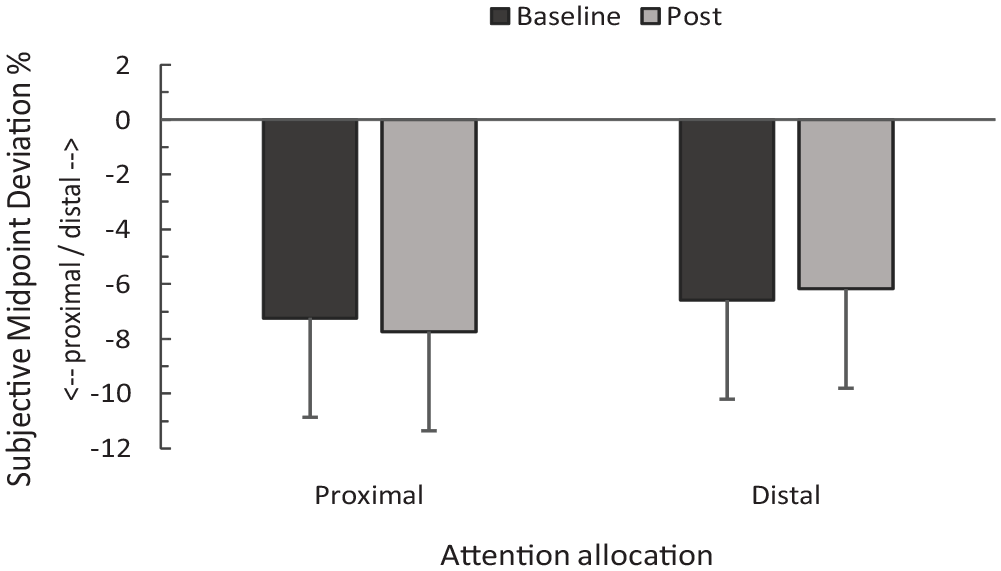
Results from the attention task.
Discussion
Our findings showed that, at baseline, participants tended to perceive their forearm as shorter than its real length, as indicated by the proximal shift of the subjective midpoint. This pattern of data is in line with the studies in the literature, showing that the representation of upper body parts is usually underestimated (e.g., for hands, see Longo, 2022; for arms, see Bolognini et al., 2012; Romano et al., 2019; Tosi et al., 2018; for face, see Mora et al., 2018) although some exceptions have also been reported (Fuentes et al., 2013; Linkenauger et al., 2015; Sadibolova et al., 2019), especially when different aspects of body representation were explored or the use of a tool was required (e.g., Garbarini et al., 2015; Sposito et al., 2012). It has been suggested that the pattern of under/overestimation of body parts may be linked to the specific use of these body parts in everyday life (Caggiano et al., 2021; Caggiano & Cocchini, 2020; Ferretti, 2016) and distortions may be crucial for more efficient and adaptive motor control (Bassolino & Becchio, 2023; Longo, 2022). In our study, the same trend of underestimation was also observed after all three types of manipulation, suggesting a relatively stable underestimation of the representation of one’s own upper limb. However, the impact of each manipulation was different. In detail, the subjective midpoint deviation scores were significantly modulated by the Motor task but not by the Sensory one, whereas in the Attentional task, a close-to-significance interaction between Body Part and Time was observed. These results shed interesting light on the differential contribution of movement and attention in shaping subjective body metric changes.
The Motor task induced an increment, compared with the baseline, of the proximal shift regardless of which body part was moved. At first glance, this seems to contradict evidence from one of our recent studies, which showed proximal shift when active motor training involved shoulder movements and distal shift when active training involved the use of the wrist and fingers (Romano et al., 2019). Critically, the effect observed in our previous study was interpreted as the result of the crucial role of motor patterns in determining the direction of the perceived changes in body metric; therefore, a possible explanation of these findings, is that movement per se, when not goal-directed to any external target in the environment, tends to induce a shift towards the body (proximal), possibly because of the preponderant weight of proprioceptive information in non-goal-directed motor actions. The crucial aspect of goal-direction of purposeful actions was elegantly demonstrated in a study by D’Angelo et al. (2018). The authors showed how the agency of goal-directed movements could induce enlargement or contraction of body representation depending on the location of the target of the action and agency. The lack of a purposeful goal towards an external target may have allowed the isolation of the impact of movement on the representation of one’s own body part.
Focusing attention on a specific body part (i.e., hand or elbow) also seems to potentially moderate body representation even if the results suggest different implications from the Motor task. Although the effect has to be taken cautiously, in the Attention task, we observed a possible interaction effect that seems to suggest that the allocation of attention to the elbow is likely to lead to a further proximal shift, whereas the allocation of attention to the hand is likely to lead to a reduction of the proximal shift. It might be argued that the trend observed in this condition could be the effect of the “stimulation trials” that intermingled with the “neutral trials” (i.e., no stimulation). However, considering the absence of any effect in the Sensory task (where stimulations were delivered consistently across trials), we believe it is unlikely that a single supra-threshold stimulation drives the potential effect observed in the Attention task.
Taking these findings together, they suggest that subjective elongation of the arm observed during tool-use might be the result of an embodiment of the motor characteristics of tool-use guided by an attention shift, towards the body part actively used during the use of the tool, that may trigger the incorporation of the tool (Romano & Maravita, 2021). It has been consistently shown that the modulation of body representation for action and perceived reachable space occurs when individuals use a tool that functionally increases action capabilities (Bourgeois et al., 2014; Patané et al., 2016, 2017). However, the modulation of our subjective body representation is also possible, although diminished, without the tool manipulation (e.g., Bassolino et al., 2015; Caggiano et al., 2021; Romano et al., 2019), suggesting that the presence of the tool is not, strictly speaking, necessary to induce a detectable bisection shift towards the body part manipulated. In light of these considerations, we need to reconsider the aforementioned point about the purpose of a movement. In virtually all studies investigating the malleability of body schema, participants are asked to perform a movement to accomplish a task and, crucially, the internal focus of attention is directed not only to the specific body part but also to the goal-oriented motor patterns required to accomplish the task (Bruno et al., 2019). Indeed, rapid processes of internal concentration and automatic attentional shift on the tool (or the body part) have been shown to guide other sensory integrations in the perception of body representation and the direction of perceived body representation changes (Holmes, Calvert, & Spence, 2007; Holmes, Sanabria, et al., 2007; Reed & Park, 2021). Therefore, a shift in attention seems to be an important modulator of the body metrics change. However, the weak effect that we observed after the manipulation of attention seems to indicate that attention needs to be coupled with motor signals to induce a significant effect (Longo & Haggard, 2010; Medina & Coslett, 2016; Romano et al., 2019).
The lack of any effect of the Sensory task/manipulation on body representation is a bit surprising, but we cannot exclude a lack of sensitivity of our paradigm for this specific factor, considering that the lack of evidence should not be confounded with the evidence of lack of effect in the frequentist inferential framework.
Although, to our knowledge, gender has not been typically reported to be a significant factor modulating body metrics in similar experimental paradigms on healthy individuals (e.g., Bassolino et al., 2015; D’Angelo et al., 2018; Fuentes et al., 2013; Stone et al., 2018), further studies may want to replicate these findings with the inclusion of male participants. Our findings are not conclusive, but they contribute to filling an important gap in the current literature and call for some reconceptualisation of the empirical investigation of body representation. It has often been pointed out that body representation is susceptible to experimental task demand; hence, different experimental conditions may lead to different results (de Vignemont, 2010). Because the body representation is multimodal and extremely complex in its nature, this observation is not entirely surprising but poses a significant question with regard to how to overcome this potential limitation. Often, researchers have tackled the topic of body representation by devising studies that address a specific question with a specific experimental paradigm without necessarily considering the different contributions of cognitive and sensorimotor components that may have in the observed results.
In this study, we adopted a “comparative” approach to isolate and disentangle the role of movement, somatosensation, and attention directed towards the body on the modulation of perceived body metrics by isolating these factors from others. Such comparisons have highlighted that, within the same experimental paradigm (i.e., the forearm bisection task), different manipulations produce different outcomes raising the question of what these differences tell us about the nature of body representation.
Overall, the above considerations and these results suggest that changes in body representation are not simply shaped by motor patterns or attentional factors. These two are not mutually exclusive, and their interaction might be crucial. Future studies should attempt to further elucidate the individual weight of these factors and how they may interact and drive body representation’s plasticity with and without the use of a tool.
Footnotes
Author contributions
G.C. and D.R. contributed to formulation of hypotheses and paradigm, D.R. contributed to data analysis, D.D.S. contributed to data collection and feedback on drafts, and P.C., G.C., and D.R. contributed to interpretation of findings and writing the article. All authors provided relevant contributions to the study.
Declaration of conflicting interests
The author(s) declared no potential conflicts of interest with respect to the research, authorship, and/or publication of this article.
Funding
The author(s) received no financial support for the research, authorship, and/or publication of this article.
Data availability
Readers seeking access to the data sets generated and/or analysed during this study should contact the corresponding author. Access will be granted to named individuals. There are no further conditions. No part of the study procedures and analyses were preregistered prior to the research being conducted.
