




Abstract
This study investigated the cross-language influence of a reader’s first language (L1, German) grammar knowledge on the syntactic processing of sentences in their second language (L2, English), using a grammaticality judgement task and comparing results with monolingual L1 English-speakers. In Experiment 1, unbalanced bilinguals (N = 82) read sentences in their L1 German and L2 English that were either grammatical in German but not English, grammatical in English but not German, or ungrammatical in both languages. Sentences were presented in mixed-language blocks. Grammaticality judgements were less accurate and slower for ungrammatical L2 sentences that were grammatical in their literal L1 translation, compared with sentences that were ungrammatical in both languages. Experiment 2 replicated these findings with an independent German-English bilingual sample (N = 78), using monolingual language blocks. In Experiment 3, effects were absent in decision accuracy and weaker in decision latency for monolingual English readers (N = 54). A post hoc validation study with an independent sample of L1 English-speakers (n = 21) provided further evidence that the ungrammatical English sentences with German word order were indeed less natural and grammatically acceptable to L1 English-speakers than the grammatical English sentences. These findings suggest that, consistent with competition models of language comprehension, multiple languages are simultaneously active and can compete during syntactic processing. However, due to the complex nature of cross-language comparisons, the cross-language transfer effects are likely to be driven by multiple interacting factors, of which one is cross-language transfer.
Being bilingual inevitably involves dealing with a degree of optionality in both language production and comprehension. Different language-specific lexical and grammatical representations must be accessed, depending on language context. However, this does not necessarily mean that the languages a multilingual language-user knows are stored and accessed in separate networks. Lexical entries for different languages are generally assumed to be stored in an integrated mental lexicon (e.g., Dijkstra & Rekké, 2010; Dijkstra & Van Heuven, 2002; Dijkstra et al., 2019). Sentence comprehension also does not necessarily require language-specific processes. Computational models can simulate bilingual sentence processing without the need to specify dedicated language components (Frank, 2021). Instead, computational models of bi- and multilingual sentence processing exploit each language’s statistical regularities, much like monolingual models, and the fact that co-occurrences of words within languages are more frequent than across languages (Frank, 2021).
According to connectionist models of language processing such as the Competition Model (Bates & MacWhinney, 1987, 1989; MacWhinney, 1997) and Unified Competition Model (UCM; Li & MacWhinney, 2013; MacWhinney, 2005, 2012, 2017; Tokowicz & MacWhinney, 2005), language comprehension relies on the detection of cues that allow a language-user to connect linguistic forms with meaning. The influence of specific cues on language comprehension depends on their availability (i.e., the frequency with which they are encountered) and reliability (i.e., the frequency with which they lead to correct interpretations). A strong syntactic cue in English for a grammatically correct sentence is the conventional word order of article before noun, such that the construction “he dropped plate the on the floor” is easily detected as ungrammatical (Tuninetti et al., 2015). In some cases, cues may compete during language comprehension, such as in the sentence “the rock kicks the elephant.” In this example, the word order cue (e.g., subject before object) favours “rock” as the agent of the sentence, whereas the animacy cue favours the elephant (Li et al., 1993). For L1 English-speakers, word order is generally a stronger cue than animacy, resulting in a resolution of “rock” as the agent (Li et al., 1993). The important point here is that when competition between cues arises, language comprehension is driven by the strongest available cue (e.g., Li & MacWhinney, 2013).
For multilingual language-users, the available cues that compete during language comprehension can plausibly originate from different languages. A central assumption of the UCM (MacWhinney, 2005, 2017) is indeed that a multilinguals’ languages are co-activated during language comprehension. This co-activation can lead to cross-language competition if, for instance, syntactic structures differ across languages (e.g., Tuninetti et al., 2015). A further assumption of the UCM is that the cues L2 learners rely on for language comprehension in their L2 are initially derived from their L1. The model therefore predicts that language learners should easily process grammatical patterns in L2 when these patterns are similar in their L1 and L2, but encounter difficulties when they diverge, because reliance on L1 cues will lead to processing errors in their L2 (Tokowicz & Warren, 2010).
However, while there is abundant evidence for the influence of first language (L1) on second language (L2) word processing, the influence at the syntactic level is less clear (for a recent review, see Lago et al., 2021). Cross-language syntactic priming effects in bilingual language production have been found in a range of languages and syntactic structures (e.g., Hartsuiker et al., 2004; Huang et al., 2019; Jacob et al., 2017; Shin & Christianson, 2012). However, cross-language syntactic priming effects in bilingual language comprehension are less consistent (see Declerck et al., 2020). In their study of the influence of shared syntax on sentence comprehension in bilinguals, Declerck et al. (2020) presented French-English bilinguals with four-word sentences consisting of two English and two French words using Rapid Parallel Visual Presentation (RPVP). The sentences were either grammatical literal translations in both English and French (e.g., ses feet sont big, English: their feet are big) or ungrammatical literal translations in both English and French (e.g., sont feet ses big, English: are feet his big). Participants were more accurate when reporting the identity of a target word at a target location for the mixed-language sentences with grammatical word order, demonstrating a bilingual sentence superiority effect. This is consistent with the sentence superiority effect for monolingual readers, who have better recall for target words presented in grammatical sentences, compared with ungrammatical sentences (e.g., Snell & Grainger, 2017; Wen et al., 2019). Bilinguals thus appear able to simultaneously process syntactic information from two languages and connect mixed-language sequences from their known languages through their shared syntactic representations, which Declerck et al. (2020) interpret as evidence for a unified syntax account of bilingualism.
In the study conducted by Declerck et al. (2020), there was no conflict of word order cues between readers’ L1 and L2 in the mixed-language sentences, as the word order was either grammatical in both English and French or ungrammatical in both languages. According to the UCM, this should lead to non-competitive or even positive transfer effects of the readers’ L1 grammar knowledge on L2 language comprehension. A different approach was used in an earlier study by Mack (1986), who investigated the negative transfer of L1 on L2 syntactic processing in French-English bilinguals. Participants were presented English sentences that were (a) grammatical (e.g., she ate less often), (b) had a scrambled word order and were therefore ungrammatical (e.g., we sang quietly rather), or (c) had a word order that was grammatical in French but ungrammatical in English (e.g., he has too much worked, French il a trop travaillé). More errors were made in the grammaticality decision task by French-English bilinguals, but not by English monolinguals for the ungrammatical English sentences that were grammatical in French. The conclusion was that the French-English bilinguals were influenced by their L1 syntax knowledge while performing the L2 grammaticality decision task. The absence of the effect for monolinguals supported this claim, refuting the alternative interpretation that the English sentences with French word order were simply more difficult to judge. Although this experiment indicated that bilinguals’ dominant French syntax knowledge influenced their English reading and grammaticality judgements, the low power of the study (10 English monolinguals, 10 French-English bilinguals) precludes strong conclusions.
In a more recent eye movement study by Vingron et al. (2021), French-English and English-French bilinguals read English sentences containing syntactic constructions that were either partially shared (adjective-noun constructions) or completely unshared across languages (object-pronoun constructions). The authors found evidence of cross-language syntactic activation in L1 and L2 sentence reading for adjective-noun constructions but not for object-pronoun constructions. However, this evidence came with the caveat that a monolingual English-speaking control group exhibited similar reading patterns to those of the bilingual readers, which was unexpected as the monolinguals were unlikely to experience cross-language transfer. Following post hoc analyses of item characteristics, the authors concluded that the reading patterns observed in their three experiments were driven by an interplay of correlated factors, including the presence or absence of cross-language activation and word-transposition characteristics (see Mirault et al., 2018) of the presented stimuli.
In summary, in the case of syntactic processing, computational accounts of multilingual language processing posit cross-language competition between L1 and L2 when cues such as word order lead to diverging judgements of sentence grammaticality. Evidence from grammaticality judgement task experiments (Declerck et al., 2020; Mack, 1986) suggests that cross-language syntactic activation can influence L2 syntactic processing, while the evidence for cross-language influence on sentence processing more generally is less clear (Vingron et al., 2021). It also appears that the type of syntactic manipulation may affect the extent of cross-language activation (e.g., Vingron et al., 2021).
The present study
This study investigated whether L1 grammar knowledge interferes with L2 grammaticality judgements of transposed-word sentences. According to the UCM (MacWhinney, 2005), a reliance on L1 syntactic cues in L2 language comprehension can lead to comprehension errors and longer processing time (e.g., MacWhinney, 2017). The central hypothesis was thus that identifying ungrammatical sentences in L2 is particularly difficult when their literal translation in L1 is grammatical. To test this hypothesis, the experimental design exploited the similarities and idiosyncrasies of English and German word order conventions with regard to the position of adverbs in simple sentences.
Before proceeding with the design of the study, it is important to first specify the relevant aspects of English and German concerning the placement of adverbs. In both English and German adverb phrases, adverbs can be positioned at the beginning, middle, or end of a clause (see Ernst, 2014, for the generic syntax of adverbs and Eisenberg, 2013; Taylor, 2019, and Granzow-Emden, 2019, for the use of adverbs in German). According to Jackendorf (1972) and elaborated in Potsdam (1998), when an adverb is positioned in the middle of a clause in an English sentence, it is usually situated between the subject and verb (e.g., Peter quickly reads the book, Amaral & Roeper, 2003, Example 5a). In contrast, in German, the adverb typically takes position after the verb when it occurs within a clause (e.g., Peter liest schnell das Buch). In English, the literal translation (Peter reads quickly the book, Amaral & Roeper, 2003, Example 5b) is not grammatical, as the adverb cannot normally take position between the verb and object. The reverse is also true, as the literal translation of the English sentence (e.g., Peter quickly reads the book) is ungrammatical in German (e.g., Peter schnell liest das Buch).
The experimental design in this study was only concerned with adverbs positioned within clauses, where there are clear cross-language preferences: English tends to use a within-clause adverb-verb word order and German a verb-adverb word order. According to the UCM, the within-clause adverb and verb position in English and German constitutes a case in which word order cues may conflict during syntactic processing. Specifically, the difference in within-clause position of adverbs in English and German was utilised to investigate whether unbalanced German-English bilinguals have difficulty identifying the syntactic error in the ungrammatical English sentence “Peter reads quickly the book,” which has the same verb-adverb word order as the grammatical, literal translation in German “Peter liest schnell das Buch.” If so, this would suggest that in cases where conflicts arise between the word order between languages known to a multilingual language-user, dominant syntactic constraints of the L1 can influence syntactic parsing in L2, providing support for the unified syntax account of bilingualism (Declerck et al., 2020) and evidence consistent with the assumption of cross-language transfer in the UCM. To test this hypothesis, three online experiments were conducted, in which bilingual and monolingual readers judged the grammaticality of simple sentences. In Experiment 1, unbalanced German-English bilinguals made grammaticality judgements of English and German sentences, which were presented in language-mixed blocks of trials. In Experiment 2, the same procedure was repeated with a larger set of stimuli and monolingual language blocks. Experiment 2 was conducted to provide a replication of the findings in Experiment 1 and to test whether cross-language syntax effects are evident without between-trial language switching. Finally, Experiment 3 was conducted to discount alternative explanations for the observed effects, such as that the English transposed-word sentences were in some way more difficult to process (see Mack, 1986; Vingron et al., 2021). This was tested using a control group of monolingual English L1-speakers who judged the grammaticality of the English version of the sentences.
Data availability
All of the materials for the present study are available on the Open Science Framework (https://osf.io/afs54). The repository contains the stimuli, data, and reproducible R code for Experiments 1 to 3.
Experiment 1
Method
Participants
A total of 120 German L1 speakers studying education at the University of Würzburg participated in the online experiment. In all, 105 participants who stated German to be their L1 and English to be their L2 were considered for analysis. Of these, 17 were excluded from analyses because of low overall accuracy in the grammaticality decision task (<75%), or a high proportion of missing responses after cleaning (>20%). To ensure that results were not driven by participants who were unaware of the correct placement of adverbs in English, a further six participants were excluded who had accuracy scores below 30% for the English sentences with German word order. There remained an effective sample size of N = 82 who were on average 20.5 years old (SD = 2.5 years, range = 18–37) and predominantly female (89%). Table 1 provides an overview of the participants’ language proficiency, proportion of language use, and preferred language, which shows that participants were unbalanced bilinguals, but proficient L2-users. All participants gave informed consent prior to participation and received course credit. The university board of ethics granted ethical approval for this study.
Participants’ language use, preference, and performance.
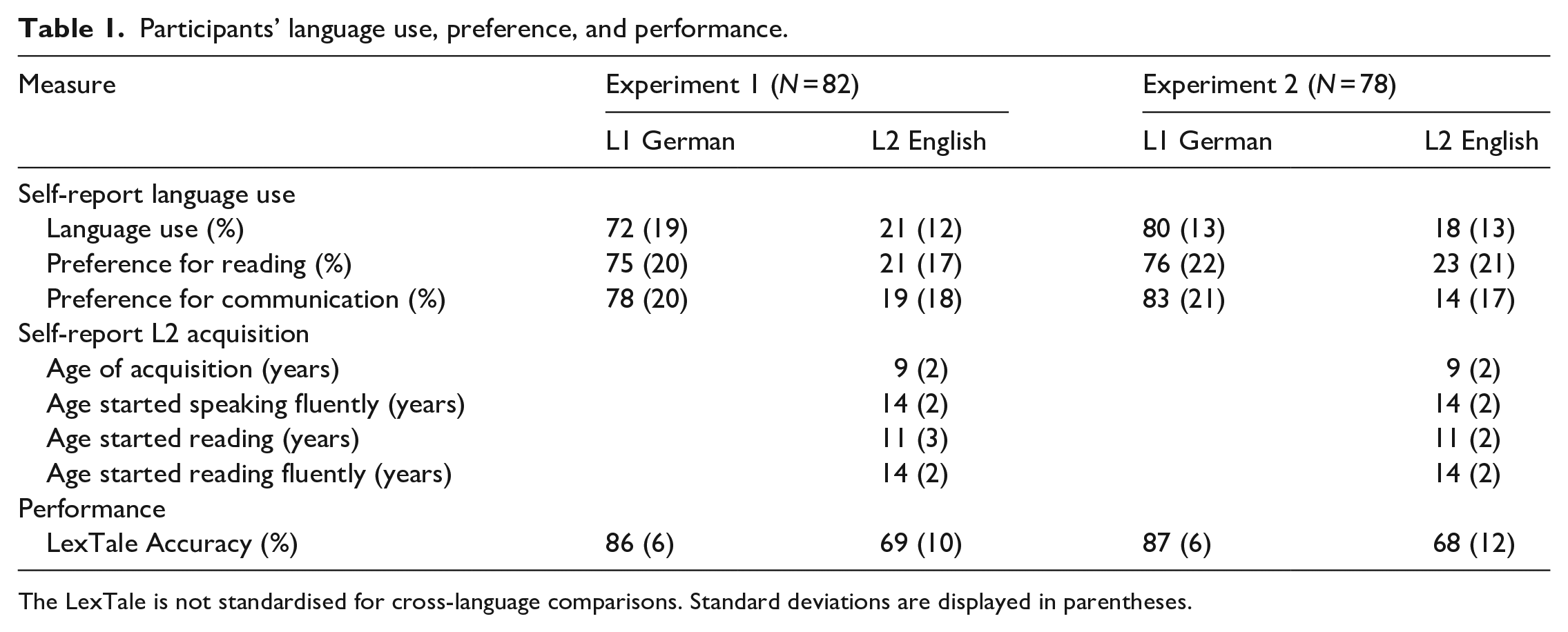
The LexTale is not standardised for cross-language comparisons. Standard deviations are displayed in parentheses.
Syntax task
Sixty 5-word sentences and a set of six versions of each sentence were constructed, resulting in 360 stimulus sentences (see Online Supplementary Material 2). Each set consisted of three sentence pairs (Table 2). The first pair was a grammatical German sentence and its literal English translation, which was ungrammatical in English. The second pair was the grammatical English version of the sentence and the literal German translation, which was ungrammatical in German. The third pair of sentences consisted of English and German versions of the sentence that contained a word transposition of two adjacent words and were ungrammatical in both languages. The grammatical English sentences had an adverb-verb word sequence, while the grammatical German sentences had a verb-adverb sequence. Consequently, the ungrammatical literal translations differed only in the position of two adjacent words. Word transpositions in the ungrammatical conditions never involved sentence-initial or final words.
Examples for conflict and non-conflict L1-German and L2-English sentences in grammatical non-transposed and ungrammatical transposed-word conditions.
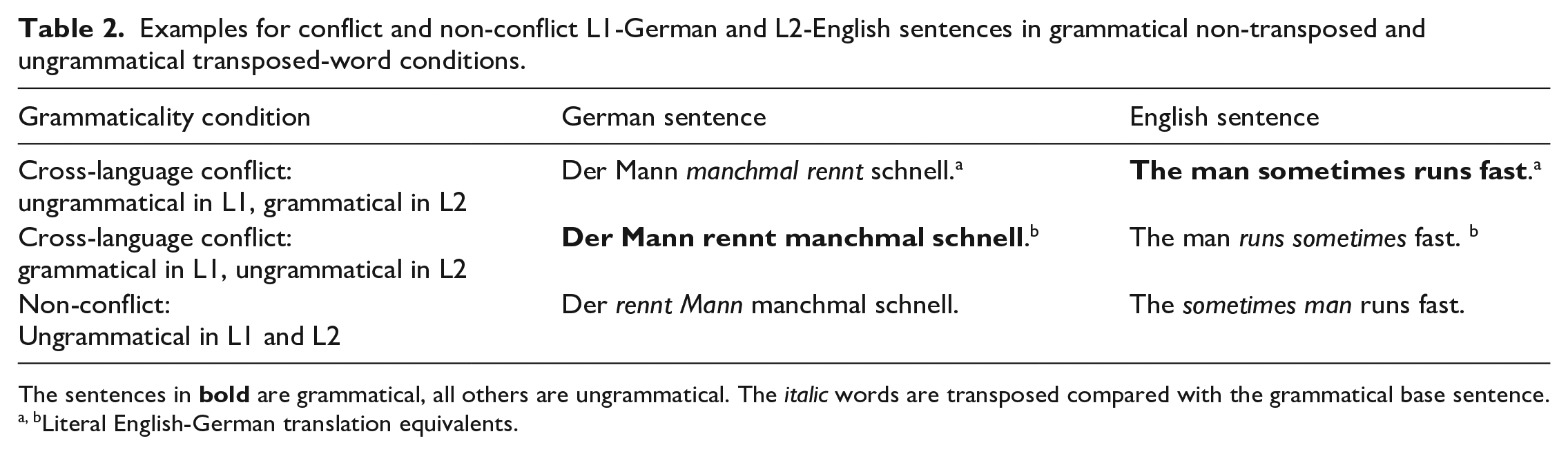
The sentences in
Literal English-German translation equivalents.
The average word length was M = 4.7 letters (SD = 2.0) for the English version of the sentences, and M = 5.3 letters (SD = 2.4) for the German version. Words were on average significantly longer in the German compared with the English version of the sentences (t = 3.36, p < .001). The average SUBTLEX Zipf word frequency (van Heuven et al., 2014) was M = 5.5 (SD = 1.3) in the English version of the sentences, and the SUBTLEX log frequency (Brysbaert et al., 2011) was M = 3.9 (SD = 1.2) in the German version. Readability scores were generated for the sentences using the LATIC application (Neri et al., 2022) indicating moderate difficulty for the English (Flesch score = 75.1) and German (Flesch score = 77.3) sentences.
Procedure
Participants registered for the study using the university’s Sona Systems website. The experiment was conducted using the Milliseconds’ Inquisit 6 Web application (2020). Participants first completed an informed consent form. To assess language dominance and ability, participants completed a language history questionnaire based on the Language Experience and Proficiency Questionnaire (LEAP-Q; Marian et al., 2007), and the lexical decision based LexTale in English and German (Lemhöfer & Broersma, 2012). The grammaticality decision task then followed in which participants saw a fixation cross in the middle of the screen for 500 ms followed by a sentence in either English or German, in random order (see Mirault et al., 2018). The task was to decide as fast and accurately as possible whether the sentence was grammatical by pressing the “d” key for a NO and the “k” key for a YES response. The sentence remained on the screen until participants responded. All stimuli were presented in a black Calibri font on a white background (scalable height, 3.2% of participants’ display screen). Assuming a typical 14-inch laptop screen and comfortable viewing distance of 60 cm, the degree of visual angle to the presented stimulus sentences ranged between 11° and 22°.
Each participant was randomly assigned to one of six lists each comprising 4 practice, 60 target, and 30 filler sentences. Thirty of the target sentences were in L1-German and 30 in L2-English. One third of the targets was grammatical in L1 but not L2 (conflict condition, grammatical in L1), one third was grammatical in L2 but not L1 (conflict condition, grammatical in L2), and one third was ungrammatical in both L1 and L2 (non-conflict, ungrammatical in L1 and L2). The filler sentences were half in German and half in English, had the same length as the target sentences, and had grammatical word orders in both languages. One target sentence contained an error and was dropped from the analysis.
Results
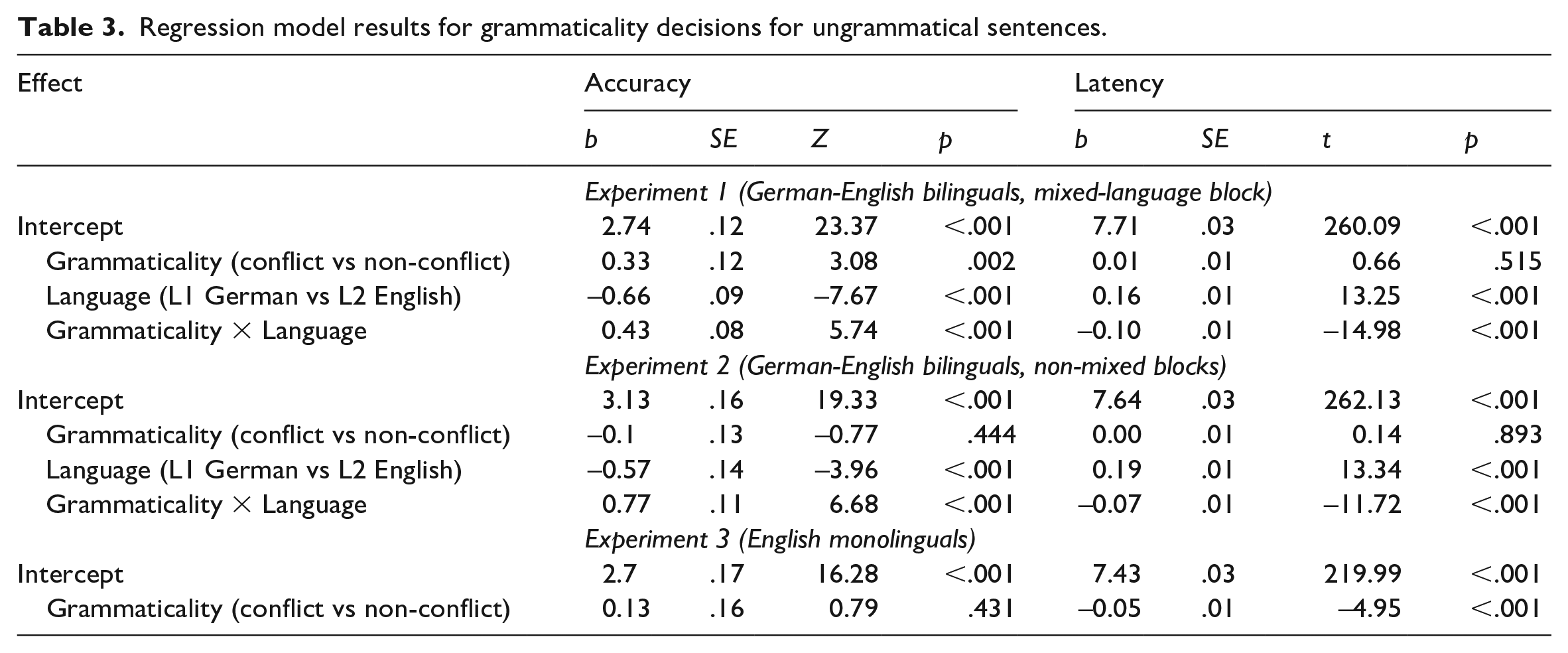
To crop outliers, data were cleaned by removing latencies shorter than 500 ms or longer than 10 s, and/or deviating more than 2.5 SD from mean reading times for sentences or participants (Baayen, 2008). This excluded 2.7% of the data. Data were analysed using linear mixed-effects models with the lme4 package (Bates et al., 2015) in the R environment (R Core Team, 2022). Decision accuracy was analysed using the glmer function for the binomially distributed response data (correct, incorrect). Decision latency was analysed using the lmer function for the log-transformed response time data. Participants and items were included as crossed random effects (Baayen et al., 2008; Barr et al., 2013). The analyses compared decision accuracy and decision latency for the sentences that were ungrammatical in the language they were read in but grammatical in the reader’s other language (conflict condition), with sentences which were ungrammatical in both languages (non-conflict condition). The language of the sentence (L1 = –1, L2 = 1) and grammatical conflict condition (conflict = –1, non-conflict = 1) were included as effect-coded factors, as well as random slopes for items and participants in fully maximal models (Barr et al., 2013). Approximate p values are provided using Satterthwaite’s degrees of freedom method implemented in the lmerTest package (Kuznetsova et al., 2017). The observed decision accuracy and decision latencies for correct responses are displayed in Figure 1 and the (generalized) linear mixed-effects model (G)LMM results in Table 3. An additional Table A containing the descriptive statistics of sentences presented in all the conditions and all three experiments is provided in the Online Supplementary Material 1.
Regression model results for grammaticality decisions for ungrammatical sentences.
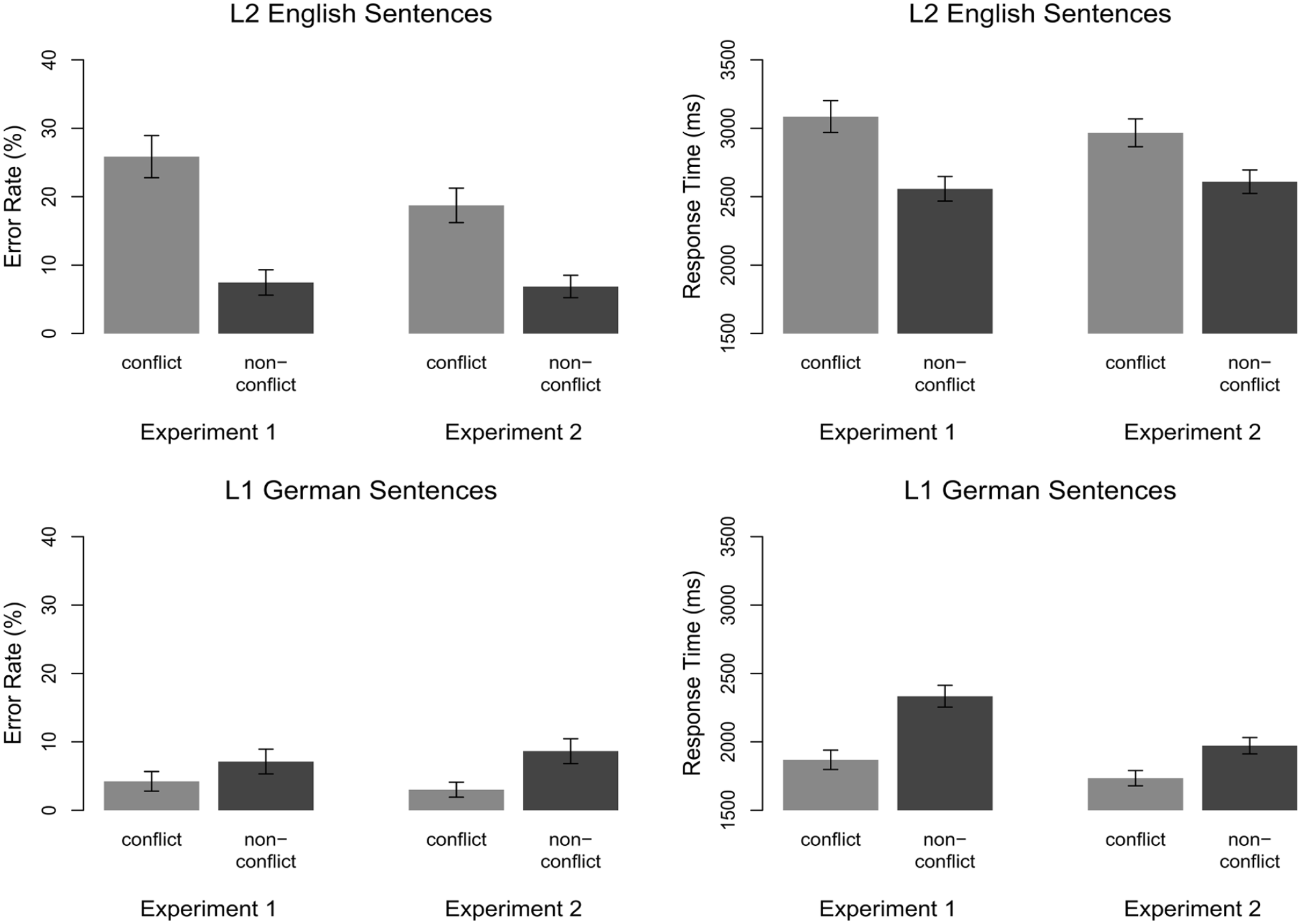
Response latency and accuracy for grammaticality judgements for ungrammatical and grammatical sentences read in L1 German and L2 English.
Decision accuracy
There were significant main effects of language and grammatical conflict conditions and their interaction on decision accuracy. The interaction was decomposed into its simple main effects. For sentences read in the readers’ L2 English, decision accuracy was significantly lower for grammaticality decisions for sentences that were ungrammatical in the readers’ L2 but had a grammatical literal translation in the readers’ L1 (M = .74, SE = .01, conflict condition), compared with sentences that were ungrammatical in both languages (M = .93, SE = .01, non-conflict), b = 1.619, SE = 0.258, z = 6.285, p < .001. There was no significant difference in response accuracy for sentences that were ungrammatical in the readers’ L1 but grammatical in the readers’ L2 (M = .96, SE = .01, conflict), compared with sentences that were ungrammatical in both languages (M = .93, SE = .01, non-conflict), b = –0.108, SE = 0.315, z = –0.343, p = .732.
Decision latency
There were significant main effects of language and a significant interaction effect of language and grammaticality on decision latency. The interaction was again decomposed into its simple main effects. For sentences read in the readers’ L2 English, decision latencies were significantly longer for grammaticality decisions for sentences that were ungrammatical in the readers’ L2 but grammatical in the readers’ L1 (M = 3,085 ms, SE = 58), compared with sentences that were ungrammatical in both languages (M = 2,557 ms, SE = 45), b = –0.194, SE = 0.025, t = –7.921, p < .001. The opposite pattern emerged for sentences read in the readers’ L1, for which decision latencies were significantly shorter for sentences that were ungrammatical in the readers’ L1 but grammatical in the readers’ L2 (M = 1,869 ms, SE = 35), compared with sentences that were ungrammatical in both languages (M = 2,333 ms, SE = 40), b = 0.219, SE = 0.023, t = 9.589, p < .001.
Discussion
In Experiment 1, unbalanced German-English bilingual participants made grammaticality judgements for sentences read in their L1 German and L2 English. Sentences were read in one of three grammaticality conditions: (a) grammatical in L1 but not in L2, (b) grammatical in L2 but not in L1, and (c) ungrammatical in both languages. The sentences were read in a single mixed-language block of trials. Results show that grammaticality judgements made for L2 sentences were more difficult (i.e., more error prone and slower) when the ungrammatical L2 sentence had a valid word order in their literal L1 translation equivalent. This indicates that L2 syntactic processing can be influenced by the readers’ L1 syntax knowledge. Conversely, correct grammaticality judgements made for L1 sentences were faster when the ungrammatical L1 sentence had a valid word order in its literal L2 translation equivalent, presumably because the non-native word order made the grammatical word order easy to identify. The results thus suggest that grammars of both languages were active and influenced syntactic parsing during L1 and L2 sentence reading.
A potential limitation of Experiment 1 relating to its experimental design was the mixed presentation of German and English stimuli, requiring participants to switch between languages across successive trials. To replicate the pattern of results found in Experiment 1 and to rule any influence of between-language switching or cross-language priming between trials on the reported effects, Experiment 2 was conducted using monolingual blocks of stimuli and an independent sample of German-English bilingual readers.
Experiment 2
Method
Participants
Ninety-nine German L1-speakers studying education at the University of Würzburg participated in the second online experiment. Eighty-three participants who stated German to be their L1 and English their L2 were considered for analysis. Two participants were excluded from analyses due to a high proportion of missing responses after cleaning (>20%). To again ensure that results were not driven by participants who were unaware of the difference between adverb placement in English and German, a further three participants were excluded who had accuracy scores below 30% for the English sentences with German word order. There remained an effective sample size of N = 78. 1 Participants were 20.4 years old (SD = 1.9 years, range = 18–31) and predominantly female (79%). Table 1 provides an overview of the participants’ language proficiency and use, and a comparison with the sample in Experiment 1. All participants gave informed consent prior to participation and received course credit. The university board of ethics granted ethical approval for this study.
Syntax task and procedure
Stimuli consisted of 72 five-word sentences and a set of six versions of each sentence, resulting in 432 stimulus sentences (see online Supplementary Material 2). The stimuli were the same as in Experiment 1, with the correction of item 6, and addition of 12 target and 12 filler sentences to increase power. The procedure for Experiment 2 was the same as for Experiment 1, with the exception of the order in which sentences were presented. In Experiment 1, English and German sentences and filler sentences were mixed in a single block of trials. In Experiment 2, stimuli were split into two presentation blocks, in one of which sentences were presented in English and the other in German. For each language block, participants were randomly assigned to one of six lists each comprising 4 practice, 36 target, and 12 filler sentences. The order of presentation of the language blocks was randomised between participants, and the sequence of trials was randomised within each block.
Results
Data cleaning and analyses were conducted as for Experiment 1. The observed decision latencies for correct responses and accuracies are displayed in Figure 1 and the (G)LMM results in Table 3.
Decision accuracy
There were significant main effects of language and grammaticality conditions and their interaction on decision accuracy. For sentences read in the readers’ L2 English, decision accuracy was significantly lower for grammaticality decisions for sentences that were ungrammatical in the readers’ L2, but grammatical in the readers’ L1 (conflict, M = .81, SE = .01), compared with sentences that were ungrammatical in both languages (non-conflict, M = .93, SE = .01), b = 1.336, SE = 0.298, z = 4.476, p < .001. The opposite pattern emerged for sentences read in the readers’ L1, for which decision accuracy was significantly higher for sentences that were ungrammatical in the readers’ L1 but grammatical in the readers’ L2 (conflict, M = .97, SE = .01), compared with sentences that were ungrammatical in both languages (non-conflict, M = .91, SE = .01), b = –1.736, SE = 0.391, z = –4.437, p < .001.
Decision latency
There were significant main effects of language and a significant interaction effect of language and grammaticality on decision latency. For sentences read in the readers’ L2 English, decision latencies were significantly longer for grammaticality decisions for sentences that were ungrammatical in the readers’ L2 but grammatical in the readers’ L1 (M = 2,967 ms, SE = 51), compared with sentences that were ungrammatical in both languages (M = 2,609 ms, SE = 43), b = –0.134, SE = 0.021, t = –6.479, p < .001. The opposite pattern emerged for sentences read in the readers’ L1, for which response latencies were significantly shorter for sentences that were ungrammatical in the readers’ L1 but grammatical in the readers’ L2 (M = 1,734 ms, SE = 28), compared with sentences that were ungrammatical in both languages (M = 1,972 ms, SE = 30), b = 0.138, SE = 0.019, t = 6.944, p < .001.
Discussion
The pattern of findings of Experiment 1 was replicated in Experiment 2, although effects were numerically smaller overall. The mixed-language presentation may have inflated effects in Experiment 1. However, the replication of the pattern of results for both response time and error rates strongly suggests that the poorer performance for rejecting ungrammatical L2 sentences with grammatical L1 word order was not due to language switching or between-trial language priming in Experiment 1.
The pattern of results was remarkably similar in Experiments 1 and 2. However, to rule out the possibility that some aspect of the English stimuli was responsible for the reported effects, Experiment 3 was conducted using the same design as Experiment 2, recruiting an independent sample of monolingual English L1-speakers who read only the English version of the stimuli.
Experiment 3
Method
Participants
Sixty-nine English L1-speakers were recruited using the Prolific online platform. Participants were screened for high participation rate on the site, L1 English, and no high proficiency in any other language. Twelve participants who reported having at least some knowledge of German were excluded from analyses, as were three participants with low accuracy in the judgement task (<75%), leaving an effective sample size of N = 54. Participants were 28.3 years old (SD = 4.4 years, range = 19–35), predominantly female (76%), and scored highly on the English version of the LexTale (M = 0.93, SD = 0.07). Participants were remunerated with a proportionate fee of £6.94 per hour. 2 All participants gave informed consent prior to participation. The university board of ethics granted ethical approval for this study.
Syntax task and procedure
The same 72 five-word sentences were used as in Experiment 2, although only English language versions were presented. The procedure for Experiment 3 was the same as for Experiment 2 with the exception that each participant saw only one block of 72 English language sentences and 24 English fillers, presented in random order.
Results
Data cleaning and analyses were conducted as for Experiments 1 and 2. The observed decision latencies for correct responses and accuracies are displayed in Figure 1 and the (G)LMM results in Table 3.
Decision accuracy
There was no significant main effect of grammaticality on decision accuracy and no significant difference for grammaticality decisions for sentences that were ungrammatical in the readers’ L1 English, but grammatical in German, compared with sentences that were ungrammatical in both languages.
Decision latency
There was, however, a significant main effect of grammaticality on decision latency. Response latencies were significantly longer for grammaticality decisions for sentences that were ungrammatical the readers’ L1 English, but grammatical in German (M = 1,923 ms, SE = 26, conflict), compared with sentences that were ungrammatical in both languages (M = 1,710 ms, SE = 22, non-conflict), b = –0.11, SE = 0.02, t = –4.947, p < .001.
Post hoc task validation
To discount the possibility that the grammaticality of the English sentences in the German word order (conflict) condition was simply more difficult to identify as ungrammatical because the position of adverbs is a weaker grammaticality cue in English than in German, a validation study was run with an independent sample of English L1-speakers. A word order judgement task was employed to obtain an independent measure of how natural and grammatical different placements of the adverbs in the stimuli sentences appeared to English L1-speakers. The full procedure and analyses are reported in the online Supplementary Material 2. Participants (n = 23) were presented with the English sentences, without the adverb (e.g., the dog jumped up), and asked to place an adverb (e.g., suddenly) in each position in the sentence that would result in a natural-sounding and grammatically correct sentence. Participants’ responses were then aggregated across items, with at least 20 responses per item. The adverb position corresponding to the English word order condition (e.g., the dog suddenly jumped up) was selected in 84% of responses (SD = 8%, range = 67%–100%), and the German word-order condition (e.g., the dog jumped suddenly up) was selected in 6% of responses (SD = 6%, range = 0%–19%). The results of the validation study suggest that English L1-speakers clearly considered the position of the adverb in the English word order to be more acceptable than in the German word order (conflict condition), t = 63.69, df = 70, p < .001, mean difference = 0.79, 95% confidence interval (CI) [0.76, 0.81].
Post hoc re-analysis
Results in Experiment 3 were as predicted for grammatical decision accuracy, supporting the conclusions of Experiments 1 and 2 of a negative language-transfer of L1 grammar knowledge on the accuracy of L2 grammar judgements. For decision latency, the monolingual participants exhibited a similar but numerically smaller effect than the bilingual participants (see Table A in the online Supplementary Material 1). To test whether this meant that the effect was due to characteristics of the stimuli rather than the predicted cross-language influence of knowing multiple grammars, an additional post hoc analysis was conducted. Data of Experiments 1, 2, and 3 were combined and analysed in a single model, including only the English versions of the stimuli. Experiment (1, 2, or 3) was included as a dummy coded fixed effect with Experiment 3 as reference group, as well as its interaction with grammaticality condition. Random slopes of grammaticality condition and experiment were included for items and grammaticality condition for participants. For response accuracy, the analysis found significantly larger grammaticality effects for the German-English bilinguals in Experiments 1 and 2, compared with the monolingual English participants in Experiment 3 (see Table 4). For response latency, the grammaticality effect was greater in Experiment 1 compared with Experiment 3, but there was no differences between the grammaticality effect in Experiments 1 and 2, or between Experiments 2 and 3 (Table 4).
Comparison of grammaticality decisions for ungrammatical English sentences across Experiments 1, 2, and 3.
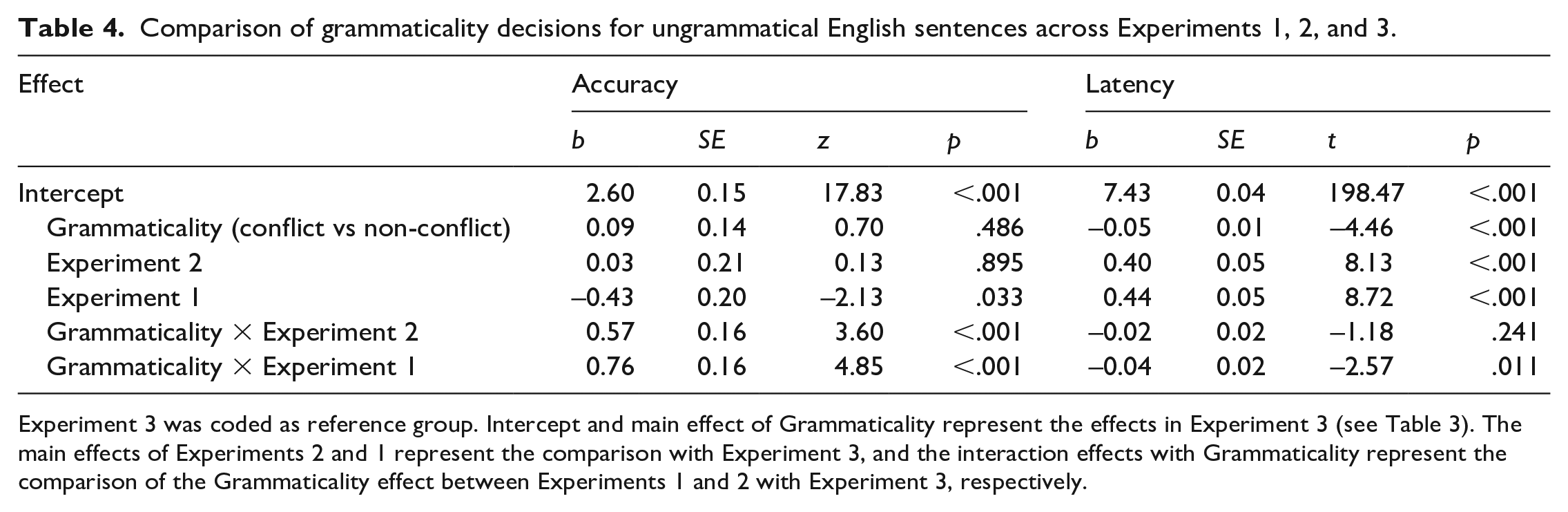
Experiment 3 was coded as reference group. Intercept and main effect of Grammaticality represent the effects in Experiment 3 (see Table 3). The main effects of Experiments 2 and 1 represent the comparison with Experiment 3, and the interaction effects with Grammaticality represent the comparison of the Grammaticality effect between Experiments 1 and 2 with Experiment 3, respectively.
Discussion
As expected, the results of Experiment 3 found that the decision accuracy of monolingual English L1-speakers on the grammaticality of English sentences with word transpositions were not affected by whether the ungrammatical English sentences had a grammatical translation equivalent in German. This supports the interpretation of the findings in decision accuracy in Experiments 1 and 2. However, the English L1-speakers also took longer to reject ungrammatical English sentences that had a grammatical translation equivalent in German. This may be due to these sentences prompting readers to expect a continuation of the five-word sentence, such as “the dog jumped suddenly up onto the bed,” which would be perfectly acceptable. However, the results of the post hoc validation study indicated that English L1-speakers clearly perceive the English sentences with German word order to be less natural and less grammatically acceptable than the English sentences with English word order. English L1-speakers detected the ungrammaticality of the ungrammatical English sentences with equal accuracy, regardless of whether they had a German word order or not, but took longer to reject the sentences that had a German word order (see Figure 2).
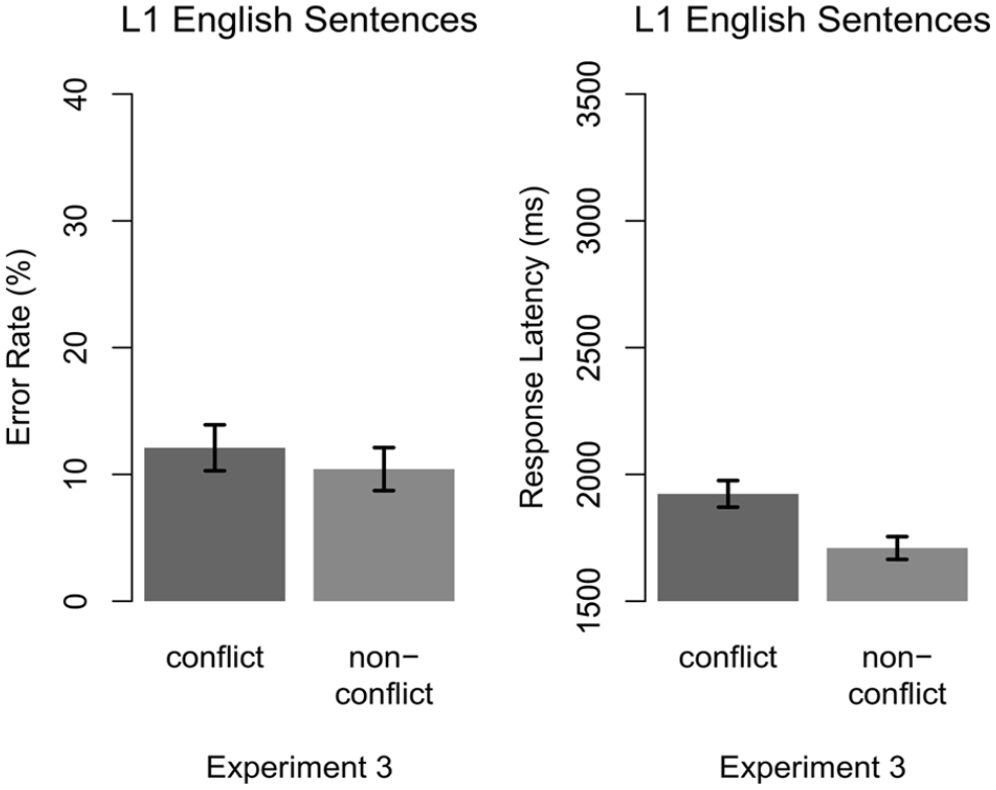
Response latency and accuracy for grammaticality judgements for ungrammatical and grammatical sentences read in L1 English by English L1-speakers.
The re-analysis of all three experiments provided three further insights. First, the pattern of results in decision accuracy did not differ between Experiments 1 and 2, while there were no significant differences between conflict and non-conflict conditions for the English L1-speakers in Experiment 3, suggesting that the difficulty with the conflict conditions was specific to the bilinguals. Second, participants in Experiment 1 had significantly more difficulty correctly rejecting ungrammatical sentences in their L2 with grammatical L1 word order compared with participants in Experiment 2, suggesting that mixed-language trials increased the potential for cross-language transfer. Finally, the cross-language grammaticality conflict effect in decision latency was greater in Experiment 1 than in Experiments 2 and 3, while there was no difference between Experiments 2 and 3. This suggests that some aspects of the English sentences with German word order lead both bilinguals and monolingual English-speakers to take longer to accurately reject them as ungrammatical.
General discussion
This study investigated the cross-language influence of a reader’s L1 on the syntactic processing of sentences in their L2. Cross-language influence was tested using a word-transposition manipulation in a grammaticality decision task in three experiments. Experiment 1 provided evidence that bilingual readers found grammaticality judgements of ungrammatical sentences in their L2 more difficult, if the literal translation equivalents in the readers’ L1 were grammatical, than if the word order of the sentence was ungrammatical in both languages. Experiment 2 replicated the pattern of findings and provided evidence that they were not due to between-trial language-switching costs or cross-language priming. Experiment 3 tested whether the findings could be explained by characteristics of the English sentence stimuli, rather than by cross-language influences. The pattern of results could not be replicated for monolingual English readers in their grammatical decision accuracy, supporting the cross-language transfer interpretation of the pattern of results in Experiments 1 and 2. Part of the effect in decision latency may, however, be attributed to specific characteristics of the English sentences. Nevertheless, the effect in decision latency was smaller for monolingual compared with the bilingual readers when stimuli were presented in language-mixed blocks of trials. A separate validation study conducted with English L1-speakers provided evidence that the English sentences with German word order (i.e., the cross-language grammatical conflict condition) were less natural and grammatically acceptable to English L1-speakers than the English sentences with English word order. Together, the three experiments and validation study present evidence that multilingual language-users have multiple active grammars that influence their L2 syntactic processing, consistent with the UCM (MacWhinney, 2005).
This series of experiments presents two main contributions to the literature on grammaticality judgements and bilingual sentence processing. First, the results support previous findings by Mack (1986) and Declerck et al. (2020) of shared syntactic representations and are consistent with the predictions of cross-language transfer in the UCM (MacWhinney, 2005). The results from this study suggest that in cases where the word order of an ungrammatical L2 sentence corresponds to a grammatical L1 word order, the readers’ L1 grammar knowledge influences their sentence parsing, causing the reader to sometimes falsely accept the sentence as grammatical. The readers’ L1 grammar knowledge thus appears dominant, presumably due to higher exposure to L1 grammatical structures and more frequent use in production. An alternative but similar explanation for this effect is that the unbalanced bilingual readers resort to literally translating sentences from their L2 to their L1 to determine the sentence’s grammaticality (e.g., Goss et al., 1994), which would result in falsely accepting the L2 sentences with L1 syntax as grammatical.
The second contribution is the evidence of a small effect of L2 grammar on L1 grammaticality judgements. While L1 grammar appeared to impair grammaticality judgements for ungrammatical L2 sentences, the opposite was evident for sentences read in L1. Participants found it easier to detect ungrammatical L1 sentences when they had a grammatical, literal L2 translation equivalent, than when they were ungrammatical in both L1 and L2. This suggests that readers’ L2 grammar knowledge facilitated their detection of grammatical errors in L1 sentences. This may be due to readers’ sensitivity to L1 sentences that “sound wrong” in the sense that they are perceived as having a typical L2 sentence structure or contain typical errors made by non-native speakers. This tentative explanation is supported by the finding that Canadian-English-speakers find it easier to detect non-native grammatical errors (e.g., “We heard many news on the radio . . .”) than more common English L1-speaker errors (e.g., “When the professor arrived, there were less students than he expected . . .”) in spoken recordings of a L2 English speaker (Derwing et al., 2002). Indeed, studies with highly proficient bilinguals suggest a bidirectional effect of L1 and L2 during reading 3 (Titone et al., 2011; Van Assche et al., 2009). Nevertheless, the facilitating effect of L2 grammatical knowledge on detecting grammatical errors in L1 sentence reading was not predicted based on assumptions of the UCM and will require further investigation.
The interpretation of these findings should be considered with respect to the design constraints of the study, some of which are inherent in cross-language comparisons. First, the English L1-speakers showed longer decision latencies when rejecting ungrammatical English sentences that had a grammatical literal translation equivalent in German, compared with sentences that were ungrammatical in both languages. This was not as expected, as the monolinguals had very little or no knowledge of German grammar, thus precluding any cross-language influence. One possible explanation is that sentences such as “The man runs sometimes fast” (transposition in italics), which is grammatical in its literal German translation, could conceivably be continued with a comparison, for example, “. . . and sometimes slow” to complete an acceptable English sentence. The sentence “The runs man sometimes fast,” which is also ungrammatical in its literal German translation, cannot be continued in the same way. However, as the sentence length was held constant across all stimuli, each sentence being five words long, participants should have quickly registered that no longer sentences were to be expected. A second explanation could be the location of the word-transposition within the sentences. The transposition in the ungrammatical sentence “The man runs sometimes fast” is between Words 3 and 4, while in the sentence “The runs man sometimes fast” it is earlier in the sentence between Words 2 and 3. However, the nature of the word order in German and English made it necessary to vary the location of the transpositions to avoid transposition of sentence-initial or final words (see Table 2).
A second constraint of the present study lies in the artificial nature of the reading task performed by the participants. As in Mirault et al. (2018), a fixation cross was presented in the middle of the screen before each sentence, leading to participants initially fixating each sentence in the middle, before presumably reading the complete sentence from left to right. Indeed, the visual angle to the presented stimuli (11°–22°) suggests that the whole sentence could not be read without moving the eyes. As pointed out in Huang and Staub (2021), this may lead to inflated error rates. However, Huang and Staub themselves report quite similar error rates for the grammatical decision task when sentences are read more naturally, starting from the beginning of the sentence. The speeded decision task, using only five-word sentence stimuli, is nevertheless quite different from normal reading, and further studies will have to investigate whether cross-language syntactic influences translate to more natural reading of continuous text. The generalisability of the findings in this study to cross-language differences other than adverb phrases will also require similar studies using manipulations of other sentence constituents, such as, for instance, the position of split verbs or sentence-final double infinitives (e.g., Mickan & Lemhöfer, 2020).
In summary, the influence of L1 on L2 in the grammaticality decision task in this study provides evidence that the syntax of multiple languages are active during reading, leading to cross-language transfer effects, consistent with computational models of language comprehension based on the competition of language-specific cues which connect linguistic forms with meaning (MacWhinney, 2005).
Supplemental Material
sj-docx-1-qjp-10.1177_17470218231161433 – Supplemental material for The effect of word transpositions on grammaticality judgements in first and second language sentence reading
Supplemental material, sj-docx-1-qjp-10.1177_17470218231161433 for The effect of word transpositions on grammaticality judgements in first and second language sentence reading by Simon P Tiffin-Richards in Quarterly Journal of Experimental Psychology
Supplemental Material
sj-docx-2-qjp-10.1177_17470218231161433 – Supplemental material for The effect of word transpositions on grammaticality judgements in first and second language sentence reading
Supplemental material, sj-docx-2-qjp-10.1177_17470218231161433 for The effect of word transpositions on grammaticality judgements in first and second language sentence reading by Simon P Tiffin-Richards in Quarterly Journal of Experimental Psychology
Footnotes
Acknowledgements
I thank Ms M. Thomas and Ms J. Schuetz for their assistance in preparing the test materials.
Declaration of conflicting interests
The author(s) declared no potential conflicts of interest with respect to the research, authorship, and/or publication of this article.
Funding
The author(s) disclosed receipt of the following financial support for the research, authorship, and/or publication of this article: This research was funded by a grant from the German Research Foundation (Deutsche Forschungsgemeinschaft, TI 711/1-1).

Data accessibility statement
Notes
References
Supplementary Material
Please find the following supplemental material available below.
For Open Access articles published under a Creative Commons License, all supplemental material carries the same license as the article it is associated with.
For non-Open Access articles published, all supplemental material carries a non-exclusive license, and permission requests for re-use of supplemental material or any part of supplemental material shall be sent directly to the copyright owner as specified in the copyright notice associated with the article.
