



Abstract
Event plausibility facilitates the processing of affirmative sentences, but little is known about how it affects negative sentences. In six behavioural experiments, we investigated negation’s impact on the choice of sentence continuations that differ with respect to event plausibility. In a four-choice cloze task, participants saw affirmative and negative sentence fragments (The child will [not] eat the . . .) in combination with four potential continuations: yoghurt (a plausible word), shellfish (a weak world knowledge violating word), branch (a severe world knowledge violating word), and minivan (a word resulting in a semantic violation). Across all experiments the plausible word was highly preferred in both affirmative and negative sentences. Experiment 2 replicated Experiment 1 while ruling out the possibility that the lack of effect of negation in Experiment 1 stemmed from participants not fully processing the negation. Experiment 3 showed that the observed plausibility effects can be generalised to other aspectual forms (The child has [not] eaten the yoghurt). Experiment 4 ruled out the possibility that the choices were mainly driven by lexical associations and additionally suggested a role for informativity. Experiment 5 replicated Experiment 4 and reinforced the general pattern according to which negative sentences express the denial of plausible positive events. Experiment 6 provided evidence that informativity might be driving patterns of choices in the negative sentences. All in all, these findings suggest that upcoming continuations are chosen to maximise the plausibility of the event in the affirmative sentences and to deny that event in the negative sentences. The observed plausibility effects do not seem to be modulated by the internal representation of events, but they can be modulated by changes to the expected informativity of the sentence.
Introduction
People can form expectations about upcoming words based on a combination of different types of information such as morphosyntactic, semantic and pragmatic properties, real-world knowledge about events and situations, and visual input within a given context (for overviews, see Kuperberg & Jaeger, 2016; Pickering & Gambi, 2018; Solstad et al., 2021). During online sentence comprehension, world knowledge, derived from people’s prior experience with the world, is activated and integrated rapidly alongside other types of information (Hagoort et al., 2004; Kamide et al., 2003; Milburn et al., 2016; Warren & Dickey, 2021). Knowledge about typical events facilitates the processing of words congruent with the event, such as typical agents, patients, instruments, and locations (Ferretti et al., 2007; Matsuki et al., 2011; McRae & Matsuki, 2009, among others). To illustrate, in a self-paced reading paradigm, reading times of congruent patients (the brakes) were faster when the patients were consistent with the event denoted by the agent–verb pair (e.g., the mechanic checked) and slower when the pair was inconsistent with the event (e.g., the journalist checked). These results were confirmed in an event-related potential (ERP) experiment, which showed that different agent–verb combinations on the same patient were processed differently within 300 ms of their appearance (Bicknell et al., 2010). In sum, sentence comprehension relies on a variety of cues which rapidly and interactively combine to interpret the input and anticipate upcoming information. The plausibility of the described events represents one such cue, which is usually correlated with processing ease.
Although there are studies looking at the factors influencing continuations in affirmative sentences (for reviews, see Kuperberg & Jaeger, 2016; Pickering & Gambi, 2018), little is known about how negative sentence fragments 1 are completed (cf. Nieuwland, 2016). Questions about what role negation plays in the choice of continuations and to what factors negation is sensitive are yet to be answered. To investigate these questions, we carried out five experiments in which we manipulated the presence of negation and the degree of the plausibility of the embedded event. The results of this article will provide useful insights into the way in which negation interacts with event plausibility, with an emphasis on which types of events are more likely to be depicted by means of negative sentences. It will also advance our knowledge about what interpretations are assigned to negative sentences. Ultimately, the present article will contribute to open questions in the literature about the informativity of negative sentences.
Negative sentences are usually more difficult to process than affirmative sentences, leading to more errors and prolonged reading and reaction times (for an overview, see Kaup & Dudschig, 2020). 2 Previous work indicates that the processing difficulty associated with negation is sensitive to the truth value of the sentence (Fischler et al., 1983). Affirmative sentences tend to be easier to process when they are true than when they are false, whereas negative sentences tend to be easier to process when they are false (A robin is not a bird) than when they are true (A robin is not a tree). This pattern of an interaction between truth value and sentence polarity (i.e., affirmative vs. negative sentences), which has been observed in both behavioural and electrophysiological measures, is compatible with a two-step account of the interpretation of negation (Kaup et al., 2007). According to this account, when reading or hearing the negative sentence, A robin is not a bird, the positive state of affairs is first represented (a robin is a bird) and only subsequently is negation integrated into the sentence meaning and the truth values of the sentence reversed.
Similar interactions between truth value and sentence polarity are also found in studies that manipulate semantic and world knowledge in true sentences and in sentences expressing either semantic or world knowledge violations (Dudschig et al., 2019). In Dudschig et al. (2019), negation reversed the truth-value of a sentence, turning statements that violate world knowledge (Ladybirds are stripy) into true statements (Ladybirds are not stripy) and true statements (Zebras are stripy) into false ones (Zebras are not stripy), whereas for sentences with a semantic violation (Thoughts are stripy/Thoughts are not stripy) negation does not affect the truth value. The results showed that the N400 complex was unaffected by negation: N400 amplitudes were larger for semantic and world knowledge violations in comparison with correct statements, irrespective of the presence or absence of negation (for affirmative sentences, see Dudschig et al., 2016a, 2016b).
Context can also modulate the processing associated with negation. One example of such context is the context of plausible denial (Glenberg et al., 1999; Lüdtke & Kaup, 2006; Orenes et al., 2016; Wason, 1965). Nieuwland and Kuperberg (2008) investigated the impact that context and world knowledge has on the processing of negative sentences in an ERP study. Negation was considered to be pragmatically licenced when it was presented in a context in which it was used to reject something that plausibly may have been true (With proper equipment, scuba-diving isn’t very dangerous and often good fun) and pragmatically unlicensed when it violated pragmatic principles (Bulletproof vests aren’t very dangerous and used worldwide for security). Negation posed no additional processing cost in pragmatically licenced negative sentences: false words elicited a larger N400 amplitude in affirmative sentences and pragmatically licenced negative sentences compared with pragmatically unlicensed negative sentences. In contrast, true words in pragmatically unlicensed negation and false words in affirmative and unlicensed negative sentences elicited similar N400 responses in comparison with true words in affirmative sentences.
Pragmatic factors like relevance and informativity 3 can also modulate the processing cost associated with negation (Albu et al., 2021; Nordmeyer & Frank, 2014; Tian et al., 2010, 2016; Xiang et al., 2020). Processing difficulty can be reduced when negative sentences are used in a context in which they address a negative question under discussion (QUD) by means of grammatical structures like cleft sentences (Tian et al., 2010, 2016) or wh- questions (Wang et al., 2021). In a visual world paradigm study (Tian et al., 2016), when hearing Bill has not opened his brother’s window, participants look at both the negated (open window) and the actual state of affairs (closed window) for a rather long time (until hearing window), whereas when hearing It was Bill who hasn’t opened his brother’s window, they look significantly faster at the actual state of affairs (closed window).
The processing cost appears to be sensitive to the informativity of negative sentences (Xiang et al., 2020). The results in Xiang et al. (2020) show that true negative utterances (John doesn’t have apples) are informative when they address a polar QUD (Does John have apples?) compared with when they address a QUD with multiple alternatives (What does John have?).
All in all, the processing difficulty associated with negation can be modulated by several factors, such as truth values, context, QUDs, and informativity. Another factor that might be relevant is event plausibility. Plausibility can be defined as the likelihood of a situation given the comprehenders’ world knowledge (Matsuki et al., 2011) and thus refers to properties of the states of affairs in the world that a linguistic stimulus refers to. Plausibility can be distinguished from predictability, which is often defined as the conditional probability that a specific word will occur given the preceding word, sentential fragment, or discourse and thus often refers to properties of the linguistic stimulus. Although plausibility and predictability are sometimes confounded, there is evidence that they are processed differently (DeLong et al., 2014; Federmeier & Kutas, 1999; Thornhill & Van Petten, 2012; van de Meerendonk et al., 2010). For example, DeLong et al. (2014) used sentence fragments (For the snowman’s eyes the kids used two pieces of coal. For his nose they used a. . .) in combination with different continuations: an expected plausible continuation (carrot), unexpected plausible continuations (banana), and unexpected anomalous continuations (groan). The results showed different ERP patterns for unexpected but plausible sentence continuations in constraining contexts in comparison with unexpected semantically anomalous continuations, suggesting a dissociation between the neural processing related to the predictability in comparison with the plausibility of sentence continuations.
The present article aims to investigate the question of how participants continue negative sentence fragments. Although event plausibility seems to influence continuations of affirmative sentence fragments (see above), we know little about what influences the continuations of negative sentence fragments. We consider it likely that continuations of negative sentence fragments are also influenced by the plausibility of the embedded event. Although the literature on negation processing alludes to factors that may influence the processing difficulty associated with negation, the plausibility of the embedded event has not been systematically investigated yet. By interrogating how event plausibility interacts with negation, we will also learn about what interpretations participants assign to negative sentences, as will become clearer below. Experiments 1–3 investigate how negative sentence fragments are completed, while Experiments 4–6 focus more on what interpretations are assigned to negative sentences. 4
We employed a four-choice cloze task in which participants were asked to choose a completion for affirmative and negative sentence fragments from four potential words so that the sentences made sense. Although this is an unusual variant of the usual cloze task, it allows us to restrict the possible continuations to a small set that denote differently plausible events in the affirmative condition. Concretely, the four potential completions caused the sentence to describe events that ranged from highly likely to very unlikely. For example, an affirmative sentence fragment like The child will eat the . . . completed with a word like yoghurt (plausible continuation) describes a very plausible event. In contrast, the same sentence fragment completed with shellfish (weak violation of world knowledge) describes a possible but less plausible event, while completion with branch (severe violation of world knowledge) describes a highly unlikely event. Although branch can, in principle, be a possible patient of the verb eat, the probability of a human child eating a branch is very low. Finally, a completion like minivan (semantic violation) would result in a semantically incoherent sentence because minivan does not satisfy the selectional restrictions of the verb eat (see Warren et al., 2015; Warren & McConnell, 2007). We also manipulated properties of the sentence fragments to investigate whether different sources and degrees of contextual constraint would affect the choice of completions, aspects to which we return when describing the methods in Experiment 1.
For affirmative sentence fragments (The child will eat the . . .), we expect participants to choose the plausible word (yoghurt) because the event denoted by the resulting sentence (The child will eat the yoghurt) is highly plausible. For negative sentence fragments (The child won’t eat the . . .), given the exploratory nature of the study, we did not have a priori predictions regarding the participants’ choices about the types of events expressed. However, three patterns seem possible in principle. Participants might not differentiate between the four options as completions of the negative sentence fragments. This would suggest that negation is used purely logically. We do not consider this to be particularly likely. In contrast, participants might opt for the same choices in both the affirmative and negative conditions. This would indicate that the plausibility of the embedded positive event is relevant in a similar manner for both affirmative and negative sentences. Finally, participants might systematically choose a different continuation in the affirmative and negative conditions. For instance, participants might systematically choose the possible but less likely word (shellfish), the highly implausible word (branch) or the semantic violation word (minivan) to continue the negative sentence fragments. 5 If participants frequently choose the possible but less likely continuation (shellfish) in the negative sentence fragments, this would suggest that participants might be relying on event likelihood in the same way to complete affirmative and negative sentences. If it is more likely that children will eat yoghurt than shellfish, then the most likely states of affairs are that a child will eat yoghurt and won’t eat shellfish. If participants choose the continuation branch it would suggest they are completing the sentence to describe the negation of an implausible event (The child won’t eat the branch). In contrast, the continuation minivan would indicate that negation signals impossibility and semantic incoherence (The child won’t eat the minivan).
Experiment 1
Experiment 1 investigates how affirmative and negative sentence fragments are completed. The participants’ choice of the upcoming word will be informative with respect to how event plausibility interacts with negation and how negative sentences are interpreted.
Method
Participants
Sixty participants from the University of Tübingen took part in the experiment (Mage = 24.37 years, SDage = 7.06, 44 females). They signed informed consent and were compensated with either course credit or payment at the rate of €8/hr. All participants were German native speakers.
Stimuli
We created 48 experimental sentences with the following structure: Gleich + verb in the present tense + agent + (nicht) + definite article den/das/die + patient. 6 Each sentence had an affirmative and negative condition. Each sentence fragment was followed by four potential patients. No filler items were used. We controlled multiple factors when creating the stimuli: the structure of the sentence fragments, the plausibility of the events expressed, the predictability of the plausible patients, and the frequency of the upcoming patients.
First, we had three types of sentence fragments. For the Agent + Verb(Plausible) fragments we used generic animate agents (e.g., das Kind [the child], die Frau [the woman], der Mann [the man]) (Gleich isst das Kind [nicht], den [The child will eat the]). 7 In these items, the combination of the agent and verb constrains the likely upcoming patient. For the Verb (Plausible) fragments the lexical agent was omitted and replaced by the pronoun sie (they) (Gleich verlieren sie das [They will lose the]). 8 In these items, the verb was the only source of constraint on the upcoming patient. For the Agent + Verb(Predictable) fragments we used animate agents, which when combined with the verb, not only constrain, but more strongly predict a particular patient (Gleich frisst der Affe die Banane [The monkey will eat the banana]). 9
Second, for each sentence fragment we provided four patients, each describing different types of events in the affirmative condition, ranging from very plausible to highly implausible. To illustrate, in an affirmative sentence fragment like The child will eat the . . ., a likely continuation is yoghurt (plausible continuation) because it leads to a high probability event cued by encyclopaedic knowledge (Children usually eat yoghurt). A continuation like shellfish (weak world-knowledge violation) expresses a less likely event but it can be pragmatically accommodated. A continuation like branch (severe world-knowledge violation), although in line with the selectional restrictions of the verb (Milburn et al., 2021; Warren et al., 2015), depicts an unlikely event, whereas a continuation like minivan (semantic violation) is semantically incoherent and renders the event impossible (Warren et al., 2015).
Third, we manipulated the extent to which the plausible patients were predictable. The predictability of the upcoming words refers to their expectancy and it is usually operationalised in terms of a word’s cloze probability (Taylor, 1953). We designed the Agent + Verb(Plausible) and the Verb(Plausible) fragments to semantically constrain their patients, but not strongly predict a particular word. We intended their plausible continuations to be plausible, but not highly predictable. In contrast, we designed the Agent + Verb(Predictable) fragments to strongly predict a particular word and intended this word to be their plausible continuation. To make sure this was the case, we relied on data from a non-speeded sentence completion (i.e., cloze) norming task that we ran with three German native speakers who did not take part in the actual experiment. Participants were provided with the affirmative sentence fragments and were asked to provide four words for each that would finish the sentence in a meaningful way. For the Agent + Verb(Plausible) and the Verb(Plausible) fragments, we only chose words for the plausible continuations that had not been provided by any participant; however, we did choose words that were semantically related to the words the participants provided. To illustrate, for a sentence like The woman will peel the . . . words like banana, which were provided by participants, were not used as plausible continuations; instead we used a word for a peel-able object not provided by any participant (orange). This ensured that in the Agent + Verb(Plausible) and Verb(Plausible) categories, the plausible completions are not highly predictable, but when they are chosen as completions the sentences express very plausible events. In contrast, to make the plausible continuations predictable for the Agent + Verb(Predictable) fragments, we chose only continuations that had been provided by all three participants. Imposing this requirement ensured that the plausible continuations were relatively predictable words. Given that the agent and verb were the source of the expectation for the plausible continuation in these fragments, this category of items has stronger semantic associations among the agent, verb, and the plausible continuation than the other categories of items.
For all item categories, the other three continuations, namely the weak world-knowledge violation, the severe world-knowledge violations, and semantic violation, were words that the cloze-norming participants never provided and were thus relatively unpredictable. The weak world-knowledge violation completions were designed to be patients that in the positive condition would create an event that was less likely than the plausible completion, but still somewhat likely. The severe world-knowledge violation completions were designed to be patients that satisfied the minimal semantic requirements of the verb, but in the positive condition created extremely unlikely events. The semantic violation completions were designed to be patients that did not satisfy the minimal semantic requirements of the verb and therefore created anomalous or uninterpretable events. To verify that the different completion conditions created events whose plausibility varied in the intended ways, we ran a norming experiment in which the experimental affirmative sentences were rated for plausibility. We combined each affirmative sentence fragment with each of its four potential continuations, which led to a final set of 192 sentences. These were counterbalanced across four lists, so that each participant saw each sentence fragment in combination with only one of its potential continuations. Twelve naïve German speakers were asked to judge how natural they found these sentences on a scale from 1 to 7: 1 = standing for highly unnatural and 7 = for highly natural. The plausible continuation (Mplausible = 6.18; SDplausible = 1.34) was rated as more plausible than the weak world-knowledge violation (MWKweak = 4.88; SDWKweak = 1.86; t(11) = 14.60, p < .01), which was rated more plausible than the severe world-knowledge violation (MWKsevere = 3.25; SDWKsevere = 1.98; t(11) = 10.34, p < .01), which was rated more plausible than the semantic violation (Msemantic = 1.86; SDsemantic = 0.86; t(11) = 14.37, p < .01). 10 We also used the Leipziger Wortschatzportal 11 to verify that the frequency of the four potential completions was controlled, F(3,141) = 1.81, p = .15. See Online Supplementary Material 1 for all items.
Procedure and design
The experiment took place in a sound-attenuated booth in the laboratory and was run in German. The procedure was controlled by PsychoPy (Peirce et al., 2019). Participants were asked to carefully read the sentence fragments and to complete them with one of the four provided words so that the sentences made sense. In order to go from one screen to another and make their choices, the participants pressed keys on a number pad. The time course of a trial is illustrated in Figure 1. Each trial started with the presentation of a fixation cross displayed in the centre of the screen for 1,000 ms. The sentence fragments were presented in the centre of the screen and after reading and understanding them the participants pressed 5 on the number pad to go to the next screen. Then the four words were displayed. To make a choice, the participants pressed 1, 3, 7 or 9 on the number pad, corresponding to the position of the four words on the screen: lower left, lower right, upper left, and upper right, respectively. We have used this type of response mapping in other experiments in our lab (e.g., Rück et al., 2021) and find that participants experience little difficulty in mapping the location of the stimuli on the screen to the respective locations of the response keys.
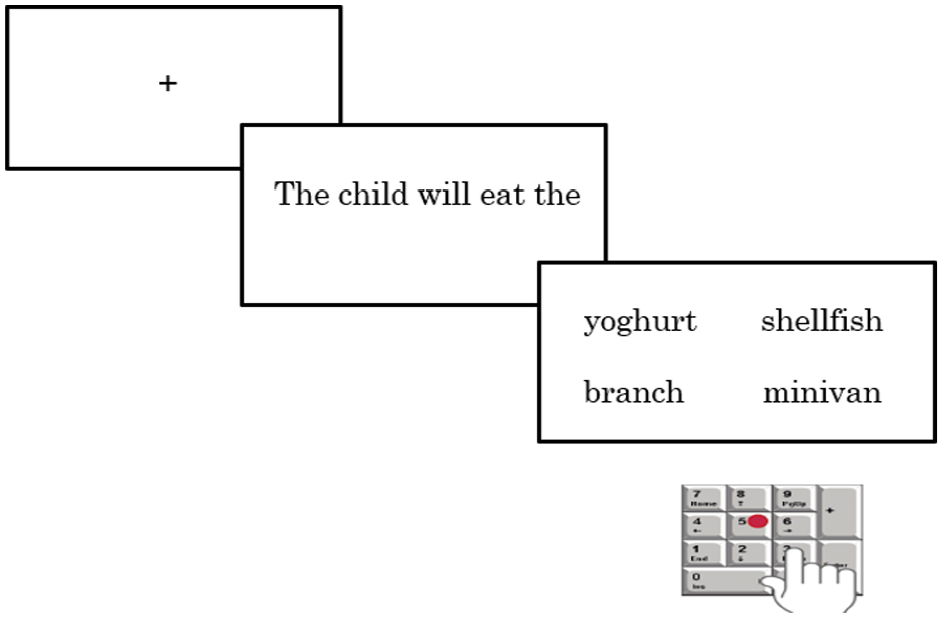
Time course of a typical trial.
The trial order of the experimental sentences as well as the location of the answer words in the displays were randomised for each participant. The experimental items were divided into two lists, so that each participant saw a sentence fragment only in one condition, either affirmative or negative. The experimental trials were preceded by a practice session which consisted of four sentence fragments and their corresponding patients. The entire experiment lasted approximately 10 min.
Results
We analysed the frequency with which the four word-types were chosen as well as the choice response times and sentence fragment reading times. The frequency of choices of the four word-types depending on fragment polarity and sentence fragment category are shown in Table 1 in the appendix and the percentages are depicted in Figure 2.
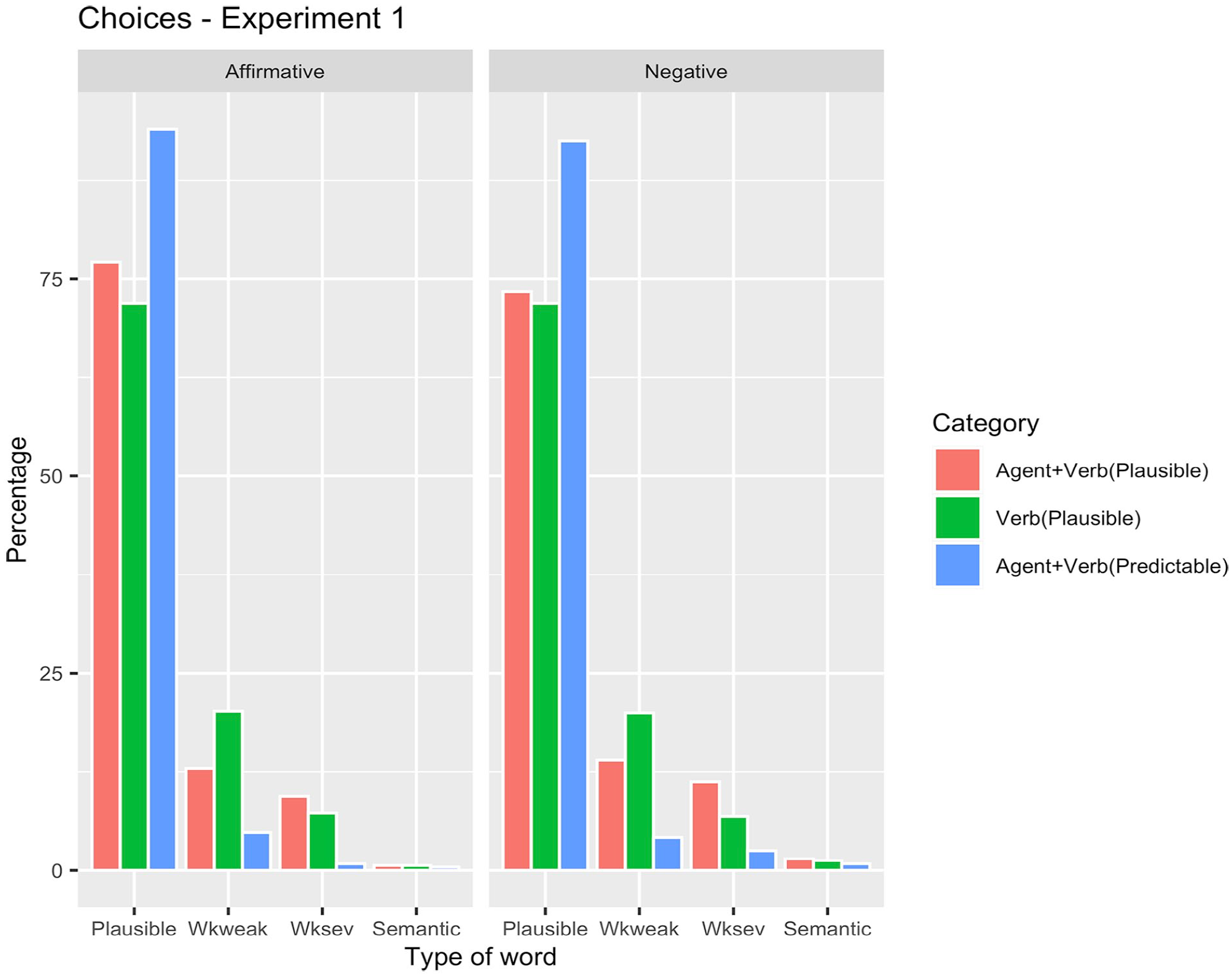
Percentage of choices depending on fragment polarity (aff/neg) and category (Agent + Verb(Plausible), Verb(Plausible), Agent + Verb(Predictable)) in Experiment 1.
Frequency of choices
A Pearson’s chi-square test showed that the choice probabilities were not influenced by polarity, that is, the presence or absence of negation in the sentences, χ2(3) = 4.74, p = .19, (4 × 2 contingency table). We also checked for each word type separately whether the frequencies with which it was chosen differed depending on polarity (four tests with two polarity conditions each). There was no evidence of any effect of polarity on choices analysed individually per word type (plausible word: χ2(1) = 0.27, p = .60; weak world knowledge violating word: χ2(1) = .002, p = .95; severe world knowledge violating word: χ2(1) = 1.22, p = .26; semantic violating word: χ2(1) = 3.24, p = .07).
Next, we analysed whether there was a difference in the frequency with which the four-word types were chosen, irrespective of polarity (one test with four word-types). This was clearly the case (χ2(3) = 4,744.4, p < .001), with the plausible continuation being chosen most frequently. Separate analyses for the two polarity conditions indicated that this was the case for both the affirmative (χ2(3) = 2,448.3, p < .001) and the negative condition (χ2(3) = 2,297.4, p < .001).
We then went on to analyse the differences in the frequencies with which the four word-types were chosen for each of the sentence fragment categories separately (three tests with four word-types). Differences were found for each of the categories: Agent + Verb(Plausible) (χ2(3) = 1,322.6, p < .001), Verb(Plausible) (χ2(3) = 1,198.6, p < .001), Agent + Verb(Predictable) (χ2(3) = 2,386.5, p < .001). Finally, we checked for each of the three sentence fragment categories and each of the four-word types, whether there were differences in the frequency with which they were chosen depending on polarity (12 tests with 2 polarity conditions). No pairwise polarity effect was found in any of the three categories for the plausible word, the weak world knowledge violating word and semantic violating word (all ps > .05). However, the severe world knowledge violating word in the lexical association category showed a significant polarity effect (χ2(1) = 4, p = .04), indicating that this word was chosen more often in the negative than in the affirmative condition.
These results show that participants opt for the same continuation for both affirmative and negative sentence fragments. This pattern suggests that the plausibility of the embedded positive event is relevant in a similar way in both polarity conditions. However, the lack of a polarity effect raises the concern that participants may not have integrated the negation into the sentence meaning before making their decisions.
Reading and choice response times
Participants took significantly longer to read the sentence fragments in the negative (M = 1,740 ms; SD = 0.69) than in the affirmative condition (M = 1,570 ms; SD = 0.65; t(59) = 4.87, p < .05). This could indicate that participants were sensitive to the difference between affirmative and negative sentence fragments when choosing the continuations. However, all negative sentences were longer in length than the affirmative ones, as they contained the negative adverb nicht. Therefore, the extra syllable may be responsible for the reading time difference between the two polarity conditions. The analysis of the time taken to choose a continuation also revealed an effect of polarity: choosing a continuation was significantly slower in the negative (M = 2,330 ms; SD = 0.55) than in the affirmative condition (M = 2,220 ms; SD = 0.49; t(59) = 2.99, p = .004). This is potentially stronger evidence that negation contributed to the participants’ choices.
To sum up, there was a strong effect such that the plausible continuation was chosen most often, but neither the overall choices nor the pairwise comparisons for each of the four continuation words showed an effect of polarity. In contrast, the response times in making the choices were affected by polarity: choices in the negative conditions were made more slowly. Yet, these data leave open the possibility that participants may not have integrated negation into the sentence meaning before choosing their answers. Experiment 2, therefore, had two goals. The first one was to replicate Experiment 1, which had been exploratory. The second was to make sure that participants would read and take negation into account when making their choices. To that end, we introduced filler sentences that had only one sensible completion. Half of these fillers required participants to integrate negation to identify the sensible completion.
Experiment 2
We added 48 fillers (24 negative) of the following form: Zebras usually eat grass/lions/meat/chocolate; Which animals don’t live in dens? sharks/foxes/rabbits/skunks. The filler sentences had a range of different syntactic structures and tenses, including present tense, past tense, present perfect, and passive voice. Some fillers took the form of questions. The negative filler sentences could only be answered correctly if negation was integrated into the sentence meaning. We used accuracy on the filler sentences to verify that participants were paying attention to the task and integrating negation. The experiment was carried out online with English materials presented to American native speakers. 12
Method
Participants. We recruited 95 participants from the Amazon Mechanical Turk platform. The participation in the online experiment was restricted to participants located in the United States and they were compensated with US$2.
Stimuli
The items used in Experiment 1 were translated into English. The experimental sentences had the following structure: agent + modal verb will + (not) + lexical verb + definite article + patient (The child will/won’t eat the yoghurt/shellfish/branch/minivan). Minimal changes were made in translating the items, which did not affect the plausibility of the events described: one sentence was completely replaced, and a few patients were changed to avoid lexical associations between the verb and the patient in the Agent + Verb(Plausible) and Verb(Plausible) categories (see the online Supplementary Material 2 for the English items and for the changes made in comparison to the German stimuli). The English items were controlled for frequency with the Leipziger Wortschatzportal (English news corpus 13 ). The analysis revealed no significant difference between the frequency of the four patient words (F(3,141) = 1.48, p = .22).
Procedure and design
The experiment took place online and the procedure was controlled by JsPsych (de Leeuw, 2015). The design of the experiment was minimally changed to fit the online format. Because many personal computer keyboards do not have a number pad, we switched the response format from the number pad to the keyboard. Participants were asked to press the space bar after reading the sentence fragments, and when making their choices they pressed f for the upper left position, j for the upper right position, v for the lower left position, and n for the lower right position. 14 The experimental trials were preceded by a practice session which consisted of six sentence fragments with potential patients. The experiment took approximately 15 min.
Results
Two participants were excluded from the analysis because they did not indicate English as their mother tongue, reducing the initial set to 93 participants. Based on a threshold of 80% accuracy on the fillers, the set of participants was reduced to a final set of 60 participants (Mage = 41.85 years, SDage = 14.05, 37 women). 15 We analysed the data in the same way as in Experiment 1 with the frequency of the choices of the four word-types, as well as the choice response times and sentence fragment reading times as dependent variables (see Table 1 in the appendix for the frequency of the choices for the four words depending on polarity and sentence fragment category and Figure 3 for the percentages).
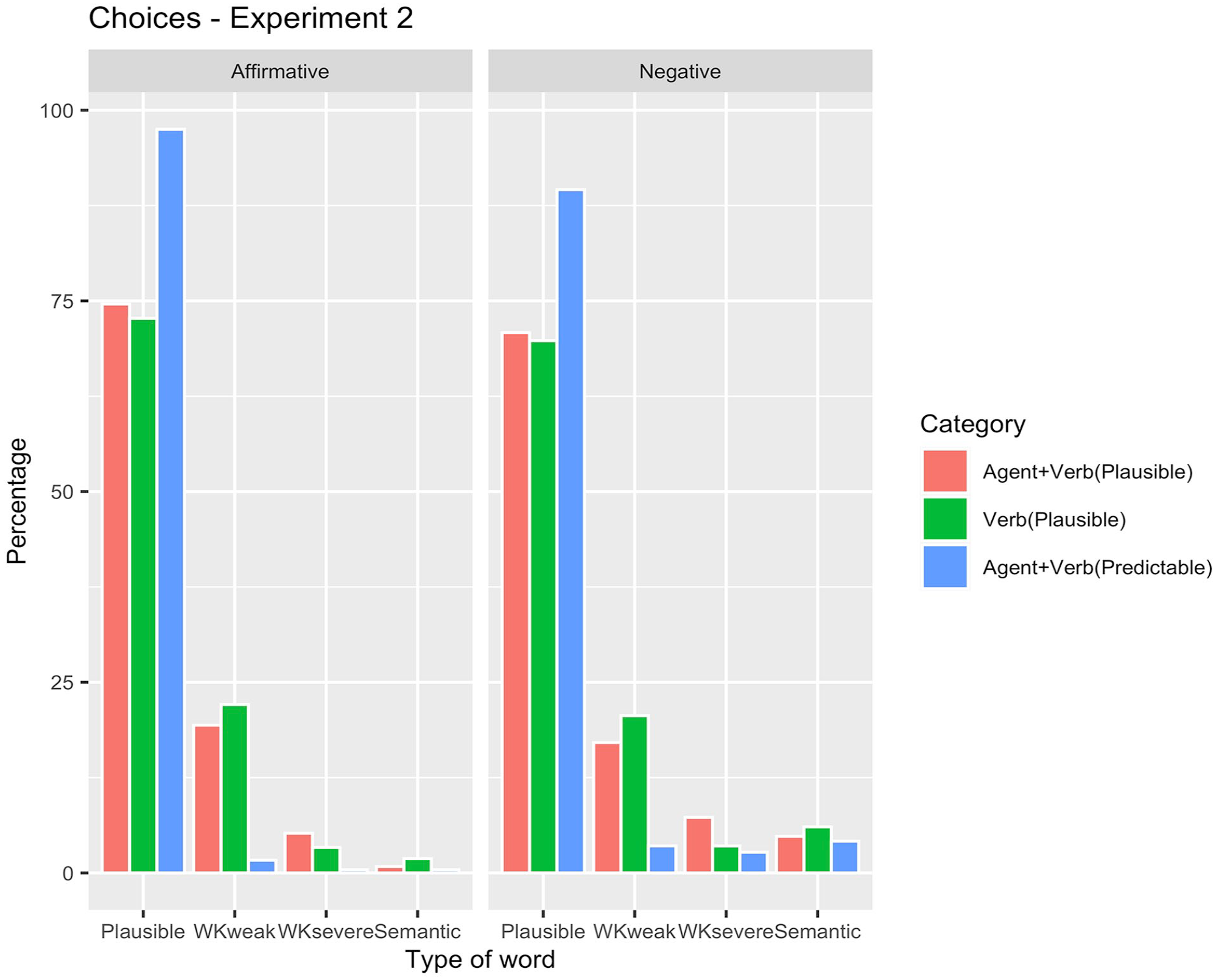
Percentage of choices depending on fragment polarity (aff/neg) and category (Agent + Verb(Plausible), Verb(Plausible), Agent + Verb(Predictable)) in Experiment 2.
Frequency of choices
As in Experiment 1, we conducted a Pearson’s chi-square test to check whether the choice probabilities were influenced by polarity (4 × 2 contingency table). In contrast to Experiment 1, the overall choices of the four word-types were influenced by polarity in Experiment 2 (χ2(3) = 44.17, p < .001). Pairwise comparisons for individual word types showed a significant polarity effect for the severe world-knowledge violation (χ2(1) = 4.48, p = .03) as well as for the semantic violation (χ2(1) = 37.34, p < .001); in both cases these words were chosen more often in the negative than in the affirmative condition. No polarity effect was found for the plausible continuation or the continuation with the weak world-knowledge violation (both ps > .05).
As in Experiment 1, we next checked whether there was a difference in the frequency with which the four word-types were chosen irrespective of polarity (one test with four word-types). This was clearly the case (χ2(3) = 4,594.5, p < .001), with the plausible continuation being the most frequent choice, replicating Experiment 1. As in Experiment 1, separate analyses for each polarity condition showed that this was the case for both affirmative (χ2(3) = 2,519.9, p < .001) and negative sentence fragments (χ2(3) = 2,086.8, p < .001).
Next, we analysed the difference in the frequencies with which the four word-types were chosen for each of the sentence fragment categories separately (three tests with four word-types). Significant differences in the frequency of the four word-types were observed in each of the categories: Agent + Verb(Plausible) (χ2(3) = 1,215.7, p < .001), Verb(Plausible) (χ2(3) = 1,175.1, p < .001), and Agent + Verb(Predictable) (χ2(3) = 2,405.6, p < .001).
Finally, we checked for each of the three sentence fragment categories and each of the four word-types whether there were differences in the frequency with which they were chosen depending on polarity (12 tests with 2 polarity conditions). No polarity effect was found for the plausible or the world knowledge weak continuation in any of the three categories (all ps > .05). However, a polarity effect was found for the severe world knowledge violation in the Agent + Verb(Predictable) category (χ2(1) = 8.06, p = .004) and for the semantic violation in all three categories: Agent + Verb(Plausible) (χ2(1) = 13.37, p < .001), Verb(Plausible) (χ2(1) = 10.52, p = .001), Agent +Verb(Predictable) (χ2(1) = 14.72, p < .001), with both of these continuations being chosen more often in the negative condition.
Although there was a polarity effect for these continuations, they were very rarely chosen by participants. The overall pattern of effects replicated the findings in Experiment 1, suggesting that the plausibility of the embedded positive events is similarly relevant to the processing of affirmative and negative sentences.
Reading and choice response times
Word choice response times were significantly longer in the negative (M = 2,521 ms; SD = 765) than in the affirmative condition (M = 2,314 ms; SD = 585.68; t(59) = 4.44, p < .001). Sentence fragment reading times were also longer for the negative sentence fragments (M = 1,102 ms; SD = 462) than the affirmative ones (M = 1,026 ms; SD = 377; t(59) = 3.11, p = .002). In contrast with the German items, the English items had one more character but the same number of syllables in the two polarity conditions. Therefore, longer reading times for the negative sentence fragments seem unlikely to be related to sentence length and seem more likely to reflect the processing of negation.
Experiment 2 adds to the evidence that participants’ choices of the plausible continuation after both affirmative and negative sentence fragments in Experiment 1 was not driven by a failure to take negation into account. In both experiments, word choice times were longer for negative than positive sentences, suggesting that participants were sensitive to negation when choosing completions. Even stronger evidence comes from the fact that in Experiment 2, we only included data from participants who responded correctly to at least 80% of the filler items, many of which required participants to take the polarity of the sentence fragments into account. All in all, this pattern of findings suggests that the plausibility of the embedded positive event influences continuation choice similarly in the affirmative and negative sentences. In addition, the fact that this experiment showed a polarity effect for the semantic violation completion is consistent with the possibility that the fillers may have pushed participants to be more sensitive to negation than they were in Experiment 1. However, neither experiment showed a significant polarity effect for the plausible continuation.
Experiment 3 was designed to investigate the generality of the strong preference for the plausible continuation that was observed in Experiments 1 and 2. The sentences in all previous experiments included the modal verb will, which triggers a description of future events that have not taken place yet. Given that verb aspect affects event interpretation (e.g., Altmann & Kamide, 2007), it is not clear whether the effects observed in the previous experiments might be driven by this verb choice or whether they might generalise to other verb aspects which express different types of events.
Experiment 3
Across the affirmative and negative conditions in Experiments 1 and 2, participants most frequently chose the continuation that created a plausible event in the affirmative condition. Building on previous evidence showing that linguistic information like verb aspectual forms directly affects the mental representations of described events (Ferretti et al., 2007; Madden & Zwaan, 2003), Experiment 3 investigated whether a change in the aspectual form of the verb might also affect the pattern of word choices in our paradigm. To that end, the modal verb will was replaced by the auxiliary has in order to express a past event that has present consequences: The child has (not) eaten the yoghurt/shellfish/branch/minivan. The present perfect form may change the informativity of the sentence. Whereas the modal will leads to a reading of a generic habitual event projected in the future or to events that are very likely to be encountered in the future, has inspires a reading of a specific event that has recently happened. It is possible that the preference for the most plausible patient in both polarity conditions in the previous experiments might have been strengthened by the expectation for a generic habitual event. If so, changing will to has may lead to stronger activation of a less expected patient, because has leads to an individual reading of the event, which might be more likely to be unexpected.
Method
Participants
A total of 132 participants were recruited from the Amazon Mechanical Turk platform. Participation in the online experiment was restricted to the participants located in the United States who had not participated in the previous experiments. They were compensated with US$2.
Stimuli, procedure, and design
The form of the experimental sentences was changed to agent + has/have + (not) + past participle + definite article + patient in all three sentence fragment categories: The child has (not) eaten the yoghurt/shellfish/branch/minivan (Agent + Verb(Plausible) category); They have (not) burnt the photos/clothes/TV/rain (Verb(Plausible) category); The farmer has (not) driven the tractor/bus/tank/chair (Agent + Verb(Predictable) category). No changes were made to the filler items. The same procedure and experimental design were used as in Experiment 2. The experiment took 15 min on average.
Results
The initial number of participants was reduced to 127 participants because five participants did not indicate English as their native tongue. The 80% accuracy threshold reduced this set to a final one of 66 participants (Mage = 40.95 years, SDage = 11.84; 34 men, 31 women, 1 diverse). The analysis of the data was similar to the previous experiments (see Table 1 in the appendix for the frequency of the choices for the four word-types depending on polarity and sentence fragment category and Figure 4 for the percentages).
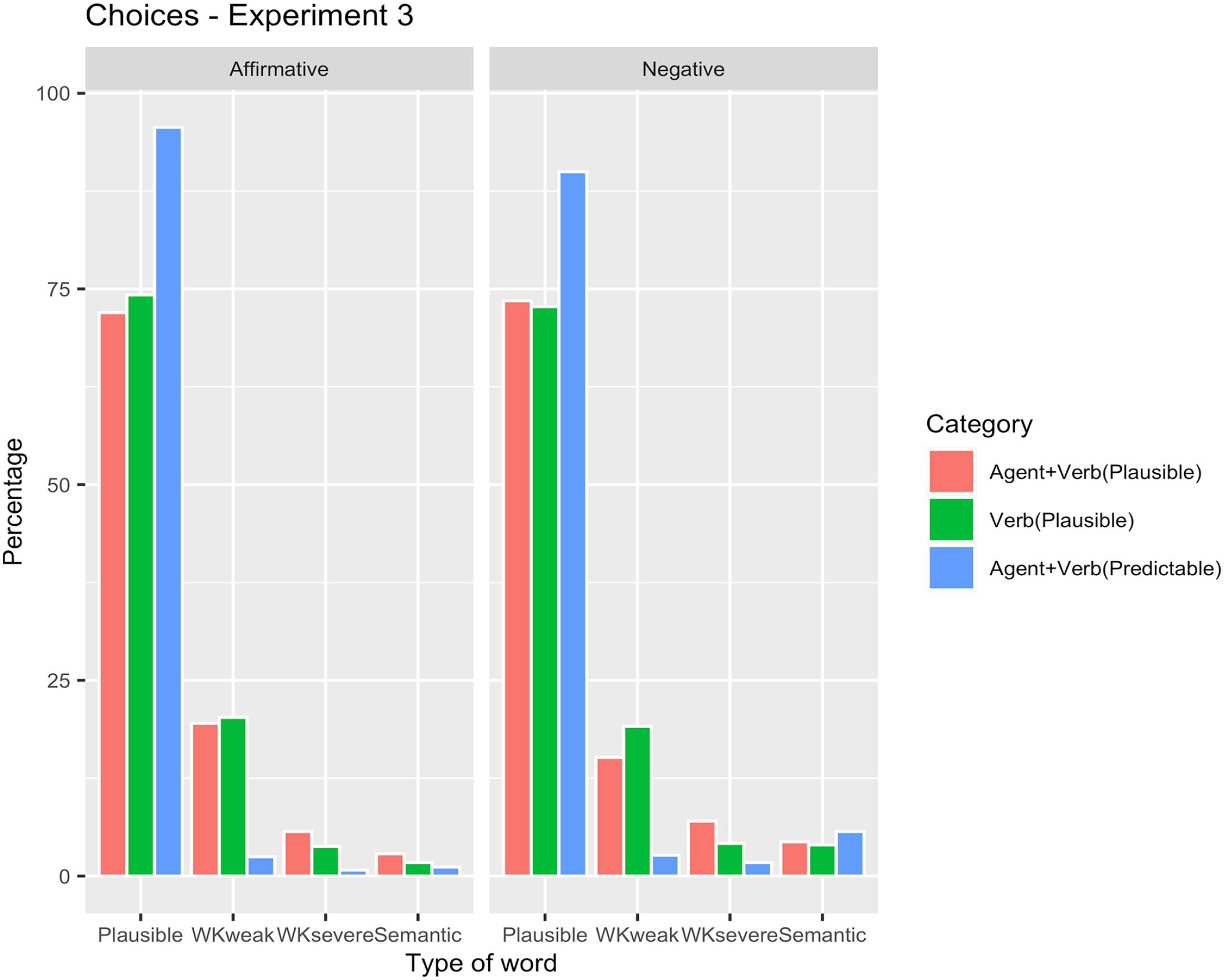
Percentage of choices depending on fragment polarity (aff/neg) and category (Agent + Verb(Plausible), Verb(Plausible), Agent + Verb(Predictable)) in Experiment 3.
Frequency of choices
The results showed that the pattern of choices was similar to Experiments 1 and 2, with the plausible continuation being chosen most frequently in both polarity conditions. The overall analysis (4 × 2 contingency table) indicated that the choices of word types were influenced by polarity (χ2(3) = 22.45, p < .001). Pairwise comparisons for the four word-types revealed an effect of polarity for the semantic violation continuation (χ2(1) = 18.16, p < .001), such that this word was chosen more in the negative than in the affirmative conditions, but there was no effect of polarity for the other three word types (all ps > .05). Next, we analysed whether there were differences in the frequencies with which the four word-types were chosen irrespective of polarity, which again was clearly the case (χ2(3) = 5,128.7, p < .001), with a strong preference for the plausible continuation as in all previous experiments. Separate analyses for the two polarity conditions showed that this was the case for both the affirmative (χ2(3) = 2,669.2, p < .001) and the negative conditions (χ2(3) = 2,464.3, p < .001).
Separate analyses for the three sentence fragment categories, that is, Agent + Verb(Plausible), Verb(Plausible), Agent + Verb(Predictable), furthermore, indicated a significant difference in the frequency of the four word-types in each of the categories: Agent + Verb(Plausible) (χ2(3) = 1,327.5, p < .001), Verb(Plausible) (χ2(3) = 1,398.9, p < .001), Agent + Verb(Predictable) (χ2(3) = 2,590.2, p < .001). Analogous to the previous experiments, no polarity effect was observed for the plausible, the weak world knowledge violation or the severe world knowledge violation continuations in any of the three sentence fragment categories (all ps > .05). A significant polarity effect was found for the semantic violation continuation in the Verb(Plausible) (χ2(1) = 4.8, p = .02) and Agent + Verb(Predictable) categories (χ2(1) = 16, p < .001).
Reading and choice response times
The analysis of word choice times revealed an effect of polarity with significantly longer choice response times in the negative (M = 2,709 ms; SD = 847) than in the affirmative condition (M = 2,612 ms; SD = 733; t(65) = 2.28, p = .02). This suggests that negation was taken into account when the participants made their choices. Sentence fragment reading times were also significantly longer in the negative (M = 1,280 ms; SD = 477) than in the affirmative condition (M = 1,200 ms; SD = 446; t(65) = 4.03, p < .001).
All in all, the use of the present perfect aspectual form did not change the pattern of continuations. Like in Experiments 1 and 2, participants showed an overwhelming preference for the plausible word both in the affirmative and negative conditions. These findings suggest that the observed plausibility effects are not tied to the use of the modal verb will.
Nevertheless, there is another potential explanation for these results. Participants’ choices in the current paradigm could have been primarily driven by lexical properties, rather than by a sentence meaning in which negation is fully integrated. This explanation would be in line with the findings from the ERP studies (e.g., Fischler et al., 1983), where negative false conditions (A robin is not a bird) are associated with relatively easy processing, possibly because of the lexical associations of the content words. Although the plausible words in the Agent + Verb(Plausible) and Verb(Plausible) categories were designed to avoid the presence of strong lexical associations, the extent to which lexical associations were nevertheless relevant to the choices is unclear. Experiment 4 aimed to shed more light on this issue.
Experiment 4
To investigate whether people’s choices were triggered by lexical associations, we added modal adverbials to the experimental sentences (Of course/obviously/certainly/definitely the child will (not) eat the yoghurt/shellfish/branch/minivan). The modal adverbials lowered the expectation that the sentence would be informative (e.g., Rohde et al., 2021), increasing the likelihood that it would express something that is already very likely to happen in the affirmative condition or something that is not very likely to happen in the negative condition. For the affirmative sentence fragments, this means that modal adverbials should reinforce the choice of the plausible continuation. This is because the event that is described by the plausible continuation is more likely to take place than the events described by the other continuations. On the contrary, for the negative sentence fragments, modal adverbials should have the opposite effect. They should increase the proportion of continuations from the three violation-inducing words at the expense of the plausible continuation, because the events described by the sentences with the three violation inducing continuations have a higher likelihood of not happening.
If the modal adverbials reduce the proportion of plausible continuations in the negative condition compared with Experiments 1–3, it would be strong evidence that participants based their choices on a representation of the sentence meaning in which negation was fully integrated. If modal adverbials do not change the pattern of continuation choices relative to Experiments 1–3, that would be consistent with the assumption that the lexical associations between the content words may have played an active role in the participants’ choices. The experiment was carried out online with English materials presented to American native English speakers.
Method
Participants. We recruited 117 participants from the Amazon Mechanical Turk platform. The participation in the online experiment was restricted to the participants located in the United States and not having participated in the previous experiments. They were compensated with US$2.
Stimuli, procedure, and design
The procedure and experimental design were the same as in Experiment 2. Four modal adverbials were added to the experimental items used in Experiment 2: of course, obviously, certainly, and definitely. The same fillers were used. The experiment lasted 15 min on average.
Results
Three participants were excluded from the analysis because they did not indicate English as their mother tongue, reducing the set of participants to 114. Based on an accuracy threshold of 80%, the set of 114 participants was reduced to a final set of 64 participants (Mage = 39.98 years, SDage = 12.56, 26 women, 37 men, and 1 varied).
As before, the dependent measures were the frequency of the choices of the four word-types as well as the choice response times and sentence fragment reading times (see Table 1 in the appendix for the frequency of the choices for the four words depending on polarity and sentence fragment category and Figure 5 for percentages).
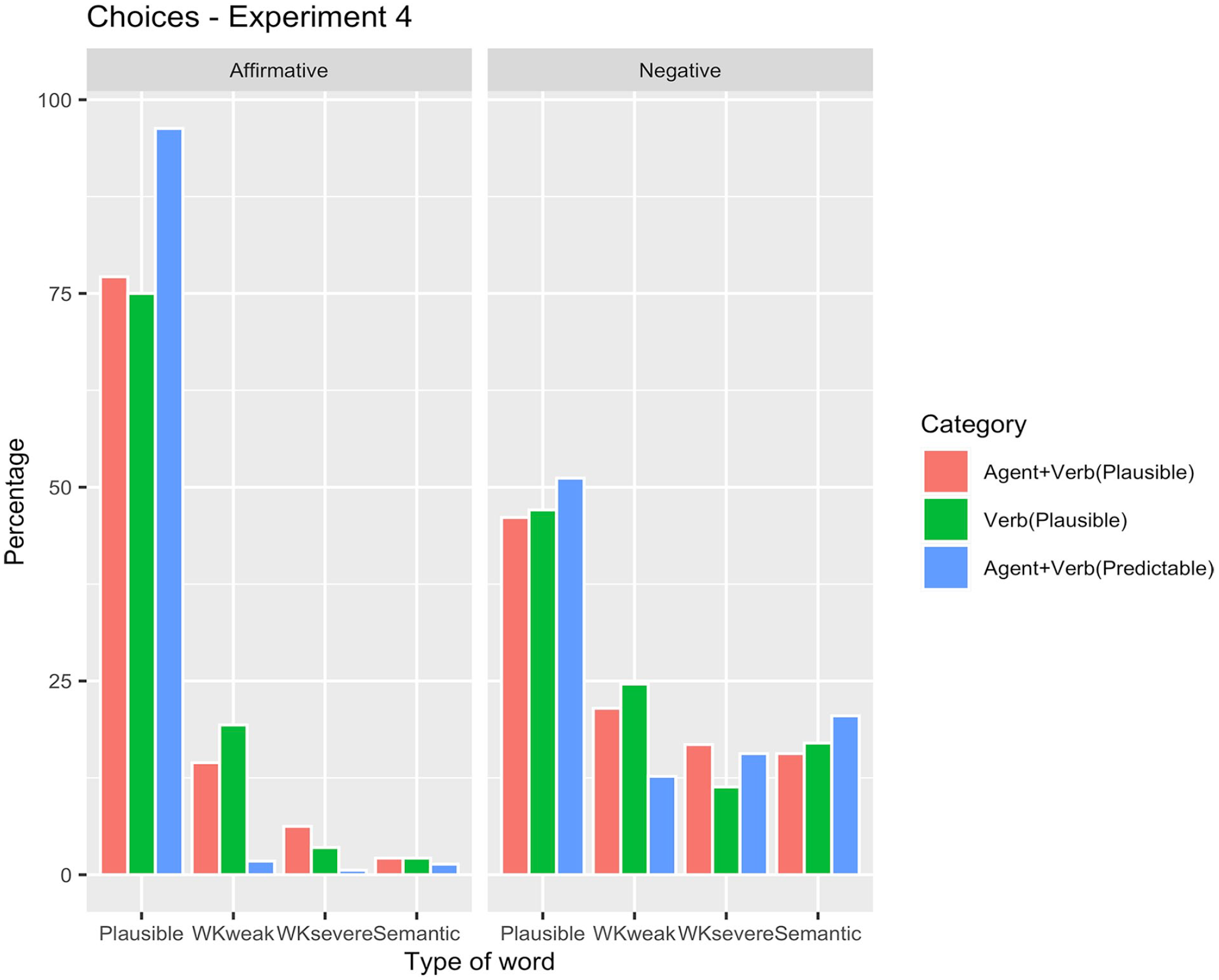
Percentage of choices depending on fragment polarity (aff/neg) and category (Agent + Verb(Plausible), Verb(Plausible), Agent + Verb(Predictable)) in Experiment 4.
Frequency of choices
The results showed that the pattern of choices changed relative to the previous two experiments. The analysis of the 4 × 2 contingency table showed an overall effect of polarity of the four word-types (χ2(3) = 472.33, p < .001). Separate analyses for the four word-types showed a polarity effect, not only for the severe world-knowledge violation and the semantic violation as was the case in Experiment 2, but for all four word-types (plausible: χ2(1) = 141.27, p < .001; weak world-knowledge violation: χ2(1) = 29.31, p < .001; severe world-knowledge violation: χ2(1) = 105.56, p < .001; semantic violation: χ2(1) = 196.18, p < .001). The plausible continuation was chosen more often in the positive condition than in the negative condition, but the other three types of continuations were more often chosen in the negative condition than in the positive condition.
Like in the previous experiments, an analysis of the frequencies with which the four word-types were chosen irrespective of negation (one test with four word-types) indicated a clear difference (χ2(3) = 2,715.4, p < .001). Separate analyses for the two polarity conditions (two tests with four word-types) indicated differences both in the affirmative (χ2(3) = 2,773.3, p < .001) and negative conditions (χ2(3) = 445.46, p < .001). As can be seen in Figure 5, the plausible answer was the most frequent choice in the affirmative conditions, whereas in the negative conditions the distribution of the choices was flatter, more evenly apportioned between the plausible continuation and the three types of violations.
We then went on to analyse the differences in the frequencies with which the four word-types were chosen separately for each of the three sentence fragment categories; that is, Agent + Verb(Plausible), Verb(Plausible), Agent + Verb(Predictable). A significant difference in the frequency of the four word-types was observed for each of the categories: Agent + Verb(Plausible) (χ2(3) = 750.3, p < .001), Verb(Plausible) (χ2(3) = 759.71, p < .001), Agent + Verb(Predictable) (χ2(3) = 1,300, p < .001). Finally, separate analyses for each of the three sentence fragment categories and each of the four word-types showed a significant polarity effect in all cases (all ps < .05) with fewer choices for the plausible continuation and more choices for the other three choices in the negative compared with the affirmative condition.
Overall, these results suggest that participants integrated negation into sentence meaning and based their choices on this sentence meaning rather than on lexical associations alone. Furthermore, it replicates the pattern from the three previous experiments in that the plausible continuation was the most frequent choice in both polarity conditions, but it also suggests that expectations about informativity that were dependent on polarity modulated the degree of this preference.
Reading and choice response times
Like in the previous experiments, there was a significant polarity effect in word choice response times (t(63) = 9.86, p < .001), with longer response times in the negative (M = 3,364; SD = 1,039) than in the affirmation condition (M = 2,665 ms; SD = 705). Sentence fragment reading times also revealed a significant polarity effect (t(63) = 2.46, p = .016), with longer reading times in the negative (M = 1,574 ms; SD = 715) compared with the affirmative condition (M = 1,469 ms; SD = 685), providing additional evidence that negation was processed during the reading of the sentence fragments.
These results provide strong evidence that participants’ choices were not driven by the lexical associations between the content words, but instead by a representation of the sentence meaning in which negation was fully integrated. They also show that the modal adverbials influenced the choices of continuations: in the affirmative condition the adverbials reinforced the choice of the plausible word, whereas in the negative condition they boosted the continuations from the three violation-inducing words. Taken together, this data pattern raises the possibility that negative sentences may be sensitive to expectations of informativity.
It should be noted that, although the distribution of the choices was flatter in the negative condition, the plausible word still represented 50% of the participants’ choices. This suggests that robustly across Experiments 1–4, participants chose the plausible word for negative sentence fragments. The present results could also be explained by the potential ambiguity between generic and non-generic readings of the embedded events. If in the affirmative condition the modal adverbials are expected to emphasise the description of habitual events that occur regularly and are cued by encyclopaedic knowledge (i.e., Children usually eat yoghurt), in the negative condition the choice of the plausible word could lead to an individual reading of the event described, whereas the choice of one of the violation-inducing words could lead to a generic reading. To illustrate, the reading of the sentence, Of course the child won’t eat the yoghurt, may trigger the activation of a particular event, which is applied to that particular agent for a precise reason. The sentences, Of course the child won’t eat the shellfish/ branch/minivan may be more likely to be read generically, expressing events that are not very likely to happen, that is, Children don’t usually eat shellfish/branches/minivans. In sum, in the absence of more explicit contextual cues, the intended communicative intentions may be obscured, which may leave open more potential inferences about the relevance and informativity of the embedded events. Experiment 5 aimed to further explore what types of events are generally prone to be expressed via negative sentences.
Experiment 5
In Experiments 1–4, affirmative and negative sentence fragments were most often completed with the plausible word. Experiment 4, however, showed a different distribution of choices, indicating that expectations of informativity may play a role in the choice of continuations. Although the negative sentences express events that will not happen, the rationale for their potential non-occurrence is different. We consider that the continuation shellfish denotes an event which does not usually happen (because children don’t usually eat shellfish), whereas the continuation yoghurt depicts an event which denies the corresponding positive event (because children do usually eat yoghurt). In contrast, the continuations branch and minivan depict the negation of events that are unlikely (because children never eat branches) or impossible (because of verb’s selectional restrictions). Experiment 5 was designed to investigate which of the four potential negative events participants thought was most expected. To that end, two discourse markers (as expected and as predicted) and two synonymous expressions (as one would expect, as one would predict) were added to the experimental items (As expected,/As predicted,/As one would expect,/As one would predict, the child will (not) eat the yoghurt/shellfish/branch/minivan). These markers are meant to highlight which of the possible interpretations assigned to the negative sentences is the most expected one. More specifically, the markers create a minimal context of interpretation and render the contextual expectation (e.g., It is expected that) more salient. For the affirmative sentence fragments, the markers should reinforce the choice of the plausible word because the most likely event is the most expected one. For the negative sentence fragments, the markers should highlight the type of event participants expect negative sentences to depict. Concretely, if the plausible word (yoghurt) is chosen, this would suggest that comprehenders prefer negative sentences to deny plausible positive events. If the weak world-knowledge violating words (shellfish) are chosen, this would suggest that comprehenders prefer negative sentences to assert events that do not usually happen. Preferences for the strong world-knowledge (branch) or semantic violating words (minivan) would suggest that comprehenders prefer negative sentences to deny unlikely events or signal semantic impossibility. The experiment was carried out online with English materials presented to American and British native English speakers.
Method
Participants. Eighty participants were recruited from the Prolific platform and were compensated with £2.5. The participation in the online experiment was restricted to the participants located in the United States and the United Kingdom.
Stimuli, procedure, and design
The procedure and experimental design were identical to the ones in Experiments 2–4. The experimental items from Experiment 2 were used in combination with four discourse markers: as expected, as predicted, as one would expect, as one would predict. No changes were made to the filler items. The experiment lasted 15 min on average.
Results
All participants indicated English as their native tongue. Based on the accuracy threshold of 80%, the set of 80 participants was reduced to a final set of 79 participants (Mage = 43.06 years, SDage = 13.12; 23 men, 56 women).
As before, the dependent measures were the frequency of the choices of the four word-types as well as the choice response times and sentence fragment reading times (see Table 1 in the appendix for the frequency of choices for the four words depending on polarity and sentence fragment category and Figure 6 for percentages).
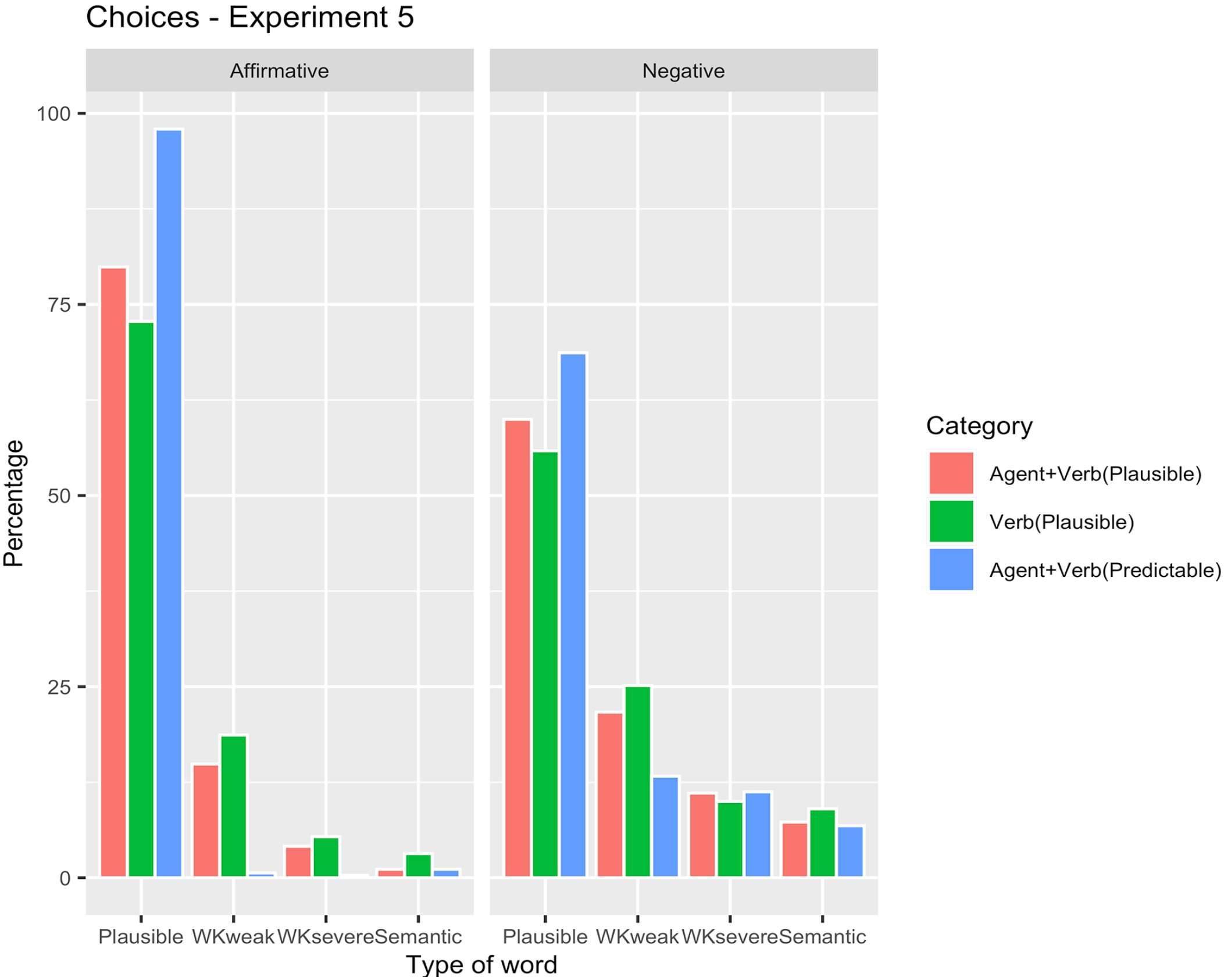
Percentage of choices depending on fragment polarity (aff/neg) and category (Agent + Verb(Plausible), Verb(Plausible), Agent + Verb(Predictable)) in Experiment 5.
Frequency of choices
As in all previous experiments, in Experiment 5 the plausible continuation was the most frequent choice for both affirmative and negative sentence fragments. However, like in Experiment 4, there was more variability in choices for the negative sentence fragments. The analysis of the 4 × 2 contingency table showed that the choices of word types were influenced by polarity (χ2(3) = 254.16, p < .001). Pairwise comparisons for the four word-types revealed an effect of polarity for all word types (plausible: χ2(1) = 63.53, p < .001; weak world-knowledge violation: χ2(1) = 45.12, p < .001; severe world-knowledge violation: χ2(1) = 75.8, p < .001; semantic violation: χ2(1) = 69.68, p < .001). Next, we analysed whether differences in the frequencies with which the four word-types were chosen irrespective of polarity, which again was clearly the case (χ2(3) = 4,668.8, p < .001). Separate analyses for the two polarity conditions (two tests with four word-types) showed that this was again the case for both the affirmative (χ2(3) = 3,506.3, p < .001) and the negative conditions (χ2(3) = 1,409.7, p < .001). As shown in Figure 6, the plausible answer was the most frequent choice in the affirmative condition, whereas in the negative condition the distribution of the four choices was more varied.
Separate analyses for the three sentence fragment categories, that is, Agent + Verb(Plausible), Verb(Plausible), Agent + Verb(Predictable), furthermore, indicated a significant difference in the frequency of the four word-types in each of the categories: Agent + Verb(Plausible) (χ2(3) = 1,415.9, p < .001), Verb(Plausible) (χ2(3) = 1,119, p < .001), Agent + Verb(Predictable) (χ2(3) = 2,294.2, p < .001). Finally, separate analyses for each of the three sentence fragment categories and each of the four word-types showed a significant polarity effect for all cases (all ps < .05), with fewer choices for the plausible word and more choices for the other three words in the negative compared with the affirmative condition.
In sum, these results replicated the findings in Experiment 4 and also replicated the global pattern, namely that people consider the plausible word the most expected continuation for both affirmative and negative sentence fragments. Whereas affirmative sentences denote highly plausible events, negative sentences express the denial of a plausible positive event. Taken together, Experiments 1–5 present evidence that the plausibility of the positive event plays a decisive role in the choice of continuations in the negative condition. Furthermore, Experiments 4 and 5 suggest that participants’ choices may be driven by informativity.
Reading and choice response times
The analysis of word choice times revealed an effect of polarity with significantly longer choice response times in the negative (M = 2,724 ms; SD = 640) than in the affirmative condition (M = 2,357 ms; SD = 528; t(78) = −8.956, p < .001). Like in the previous experiments, this suggests that negation was acknowledged and taken into account when the participants made their choices. In contrast, sentence fragment reading times showed no significant polarity effect this time (M = 1,807 ms; SD = 1,182 in the negative condition and M = 1,731 ms; SD = 1,003 in the affirmative condition; t(78) = −0.923, p = .3).
Overall, a consistent pattern emerged across Experiments 1–5, showing that the plausible words were robustly chosen to complete the negative sentence fragments. This suggests that the plausibility of the positive event plays a dominant role in the choice of continuations irrespective of the polarity of the sentence fragments. The fact that modal adverbials and discourse markers modulated the size of this effect in Experiments 4 and 5 raises the possibility that pragmatic factors such as informativity may also play a role in the choice of continuations in the negative condition. To obtain more information on the interplay between negative sentences and informativity, we carried out a norming study. Using a multiple-choice paradigm, we tested whether informativity might be driving patterns of choices in the negative sentences.
Experiment 6
The results in Experiments 1–5 show that the choice of continuations is triggered by the plausibility of the positive event and lead us to speculate that negative sentences may be sensitive to expectations of informativity. A sentence is informative when it makes a newsworthy and unpredictable contribution to a discourse (Rohde et al., 2021). According to Rohde et al., plausibility and informativity are inversely correlated for affirmative sentences: the more plausible the event described in the sentence is, the less informative the sentence is, and vice versa. To illustrate, a sentence like In order to chop some carrots, John was using a knife depicts a highly plausible event but it is not very informative, because knives are almost always used in carrot-chopping events. In contrast, a sentence like In order to chop some carrots, John was using a shovel is informative because a shovel is a highly unlikely instrument to be used in a carrot-chopping event, and this implausible event renders the situation more newsworthy and, therefore, more appropriate to talk about. However, the interplay between plausibility and informativity may well be different for negative sentences. When an event or aspect of an event in a highly plausible sentence is negated, it conveys the newsworthy information that an expected event or expected aspect of that event did not happen. For example, learning that John was not using a knife when he was chopping carrots is unexpected and therefore highly informative. It is much less informative to learn something that was highly implausible and therefore unlikely to happen indeed did not happen. These considerations would predict that event plausibility and informativity may be positively correlated for negative sentences of the kinds used in Experiments 1–5, and could indicate that participants’ choice of words in the negative conditions in Experiments 1–5 were driven by informativity. The hypothesis that participants’ choices were influenced by informativity finds some support from the fact that in Experiment 4 modifiers which signalled a reduction in expected informativity (e.g., obviously) led participants to increase their rates of choosing the less plausible continuations in the negative conditions (i.e., to assert that extremely unlikely events didn’t happen). Experiment 6 used a multiple-choice paradigm to probe participants’ judgements of our negative items’ informativity. These judgements are critical for evaluating the hypothesis that informativity drove participants’ choices in the negative sentences.
Experiment 6 consisted of two parts. In Part 1, participants were provided with all four versions of a negative item (the negative sentence fragment with each possible completion) and asked to indicate which ones they considered to be informative. Following Rohde et al. (2021), informativity was operationalised in terms of being worth talking about. For instance, an option is worth talking about if the speaker might imagine himself or herself telling someone about it or could imagine someone being interested in hearing about it. In Part 2, participants were provided with each negative fragment completed with the plausible and weak violation continuations and were asked to indicate which of the two sentences was more surprising. “Being surprising” is used to measure the degree of informativity: the more surprising a sentence is, the more informative it is. In Part 1, we expect the plausible and weak world knowledge violating continuations (yoghurt and shellfish) to be rated more informative than the severe world knowledge violation and semantic violation continuations (branch and minivan). In other words, we expect denying a positive plausible event (The child won’t eat the yoghurt) or depicting an event that rarely happens (The child won’t eat the shellfish) to be more informative than denying an unlikely event (The child won’t eat the branch) or signaling semantic impossibility (The child won’t eat the minivan). In Part 2, we expect the continuation with yoghurt to be rated as more informative than the continuation with shellfish. This is because we expect that denying a positive plausible event (The child won’t eat the yoghurt) is more informative than depicting an event that rarely happens (The child won’t eat the shellfish). This investigation will provide an independent set of data about which negative sentences are informative and will further highlight the way that event plausibility might interact with informativity. The experiment was carried out online with English materials presented to American and British native English speakers.
Method
Participants. We recruited 65 participants from the Prolific platform. The participation in this experiment was restricted to participants located in the United States and the United Kingdom who had not participated in the previous experiments. They were paid £1.5 in compensation.
Stimuli
We combined the 48 incomplete negative sentence fragments with each of their four possible completions so that 192 complete negative sentences were formed. No filler sentences were used.
Procedure and design
The experiment took place online and the procedure was controlled by JsPsych (de Leeuw, 2015). In Part 1, sets of four sentences were displayed on the screen. These sets were generated by presenting each negative sentence fragment completed by each of its four possible continuations. Participants were asked to indicate which of these sentences they thought were worth talking about. “Worth talking about” was presented in the instructions as referring to those options that they might imagine themselves telling someone about or that they could imagine someone being interested in hearing about. Participants were instructed that they could indicate more than one sentence. Part 2 was restricted only to the sentences finished by the plausible and weak violation continuations. Participants were asked to indicate which of these two sentences was more surprising. “Being surprising” measured the degree of informativity: the more surprising the sentence was, the more informative it was. The order in which the four sentences were displayed on each screen as well as the presentation of the overall 48 items was randomised for each participant in both parts. In addition, the multiple-choice paradigm was designed in such a way so that participants answered every question. The entire experiment lasted approximately 10 min.
Results
Participants were screened for native language and included in the analysis if their self-reported native tongue was English. All 65 participants self-reported as native English speakers (Mage = 38.66 years, SDage = 14.64; 45 women). We counted the responses for each sentence and calculated the means. Similar to the previous experiments, a Pearson’s chi-square test was conducted to check whether there were statistically significant differences among the observed frequencies. In Part 1, we checked whether there was a difference in the frequency with which the four sentences were chosen. This was clearly the case (χ2(3) = 2,973.7, p < .001); the sentence with the plausible continuation was most frequently indicated to be worth talking about, the sentence with the weak world knowledge violation slightly less so, the sentence with the severe world knowledge violation even less so, and the sentence with the semantic violation was almost never indicated to be worth talking about. We then analysed the differences in the frequencies with which the four sentences were chosen for each of the sentence fragment categories separately. Differences were found for each of the categories: Agent + Verb(Plausible) (χ2(3) = 883.77, p < .001), Verb(Plausible) (χ2(3) = 823.92, p < .001) and Agent + Verb(Predictable) (χ2(3) = 1,360.2, p < .001). This pattern of results suggests that within each category of fragment, the negative sentence completed with the plausible continuation was judged to be more informative compared with the completions with the weak world knowledge violating word, the severe world knowledge violating word and the semantic violating word, as shown in Figure 7.
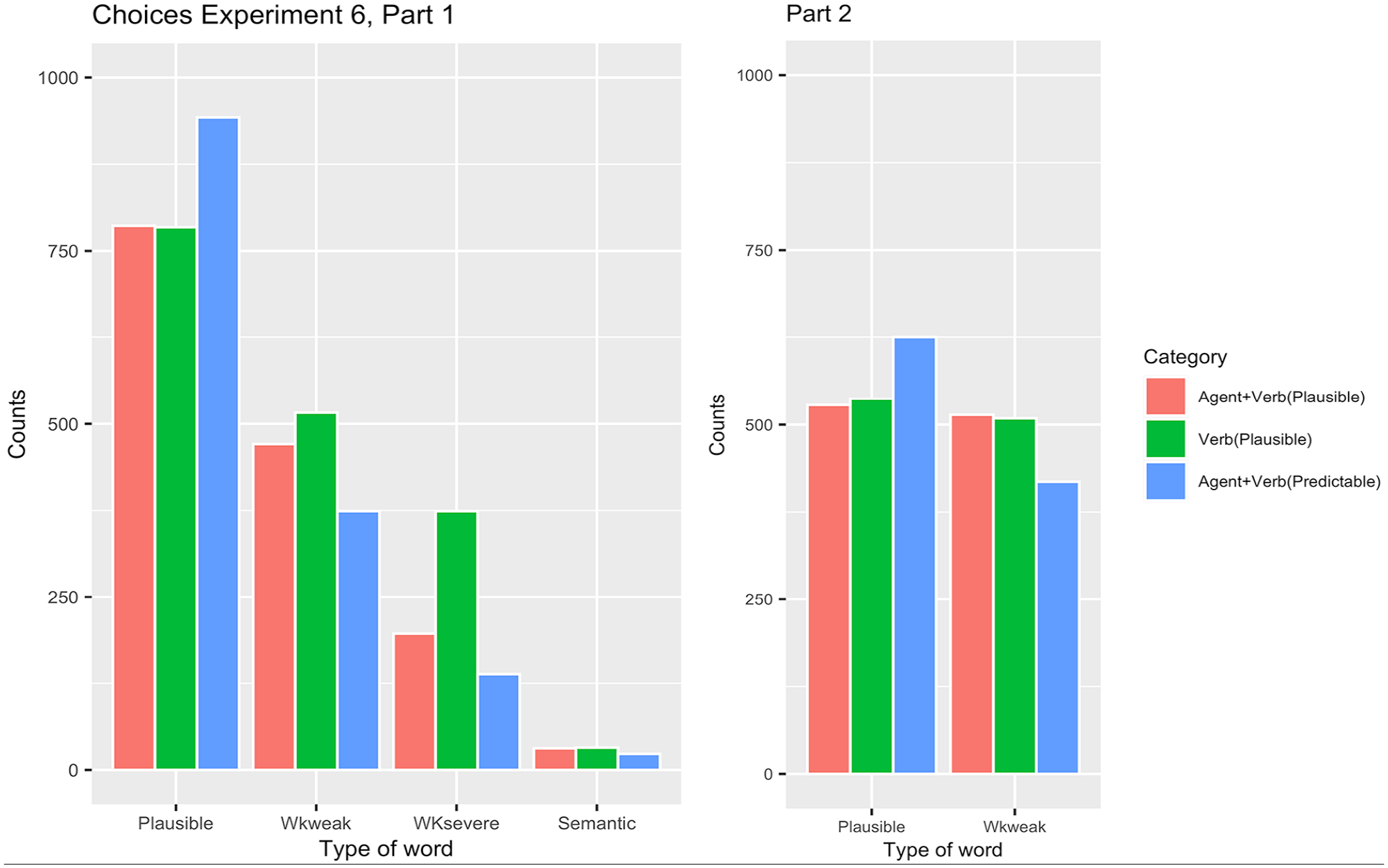
Count of sentences judged to be newsworthy depending on the item category (Agent + Verb(Plausible), Verb(Plausible), Agent + Verb(Predictable)) in Experiment 6, Part 1, and counts of sentences judged to be more surprising depending on item category (Agent+Verb(Plausible), Verb(Plausible), Agent+Verb(Predictable)) in Part 2.
For Part 2, we checked whether there was a difference in the frequency with which the negative sentences completed with the plausible versus weak violation continuations were judged to be more surprising. Frequency counts are presented in Figure 7. The sentences with the plausible continuation were more frequently judged to be more surprising than the sentences with the weak world knowledge violating word continuation (χ2(1) = 19.802, p < .001). We then analysed the differences in the frequencies with which the two sentences were chosen for each of the sentence fragment categories separately. A significant difference was found only for the Agent + Verb(Predictable) category (χ2(1) = 41.082, p < .001): the other two sentence fragment categories showed no significant differences: Verb(Plausible) (χ2(1) = 0.749, p = .3), Agent + Verb(Plausible) (χ2(1) = 0.188, p = .6). This finding is somewhat surprising because it contrasts with the finding in Part 1, which has shown strong effects such that the negative sentence with the plausible continuation was judged more informative across all three item types. However, this difference could be a consequence of the fact that informativity was operationalised in different ways across the two parts of the experiment. Although judgements of newsworthiness and surprisingness align for our negative sentences that predict a specific patient in the affirmative condition, they diverge for our negative sentences that place fewer constraints on their patients. The strength of expectation for a given patient in the positive event seems likely to have driven the pattern of results in Part 2: denying a predictable event is definitely more surprising that denying a somewhat unlikely event, whereas denying a plausible but not necessarily highly likely event is not necessarily more surprising than denying a somewhat unlikely event. It is interesting that judgements of newsworthiness may be sensitive to these distinctions than judgements of surprisingness.
The results of Experiment 6 clearly show that for the Agent + Verb(Predictable) negative sentence fragments, the plausible completion results in a more informative sentence than the other three continuations do. Results are slightly more mixed for the Agent + Verb(Plausible) and Verb (Plausible) negative sentence fragments. The plausible continuation is judged to result in a sentence that is more worth expressing, but perhaps not more surprising, than the sentence completed with the weak world knowledge violation continuation. These findings support the hypothesis that informativity may be driving the choice of continuations in the negative conditions, given that the pattern of worth-talking-about judgements mirrors the pattern of completion choices for negative sentence fragments across Experiments 1–5. These findings also point to difference between the way event plausibility and informativity work for affirmative and negative sentences. When a negative sentence denies a positive event which is highly likely, it is very informative. This finding stands in contrast to affirmative sentences, which Rohde et al. (2021) explain are informative when they depict implausible or unpredicted events. Taken together, the present results suggest that people may be guided more by informativity when completing negative sentences and more by plausibility when completing affirmative sentences.
General discussion
In six behavioural experiments, we investigated how negation influences the choice of sentence continuations that differ with respect to event plausibility. Our four-choice cloze task allowed us to restrict the possible continuations to ones that varied in the degree to which they confirmed or violated world knowledge in the affirmative condition. In the affirmative sentences participants were expected to choose the most plausible word, which leads to a description of the most likely event. In the negative condition, we did not have any a priori predictions regarding the participants’ choices but we delineated three broad possibilities. Participants might choose among the four continuations equally, which would suggest that negation is used from a logical perspective. In contrast, participants could choose the same continuation for both affirmative and negative sentences, which would suggest that the plausibility of the embedded positive event is relevant in a similar way for both polarity conditions. Alternatively, participants could opt for systematically different continuations in the affirmative compared with the negation condition, which would suggest that event plausibility is relevant for negative sentences but in a different manner than for affirmative sentences.
The results showed that in affirmative sentence fragments, as predicted, participants opted for the plausible continuation (yoghurt), which resulted in a highly plausible event (The child will eat the yoghurt). The same word choice was made in the negative condition (The child won’t eat the yoghurt). Experiment 2 provided evidence that this pattern of results was not the result of participants failing to process negation of fully integrate it into the sentence meaning. Experiment 3 demonstrated that the observed plausibility effects are not dependent on the verb being in the future form; they generalise to another aspectual form (The child has (not) eaten the yoghurt/shellfish/branch/minivan). Experiment 4 confirmed the general pattern of results, provided direct evidence from the experimental sentences themselves that participants were sensitive to the negation, and suggested that the expected informativity of a sentence can modulate continuation choices (e.g., Rohde et al., 2021). Experiment 5 again replicated the previous findings and highlighted the type of event participants expected negative sentences to depict, namely the denial of a positive plausible event. Experiment 6 provided evidence consistent with the hypothesis that people base their choices more on plausibility when completing affirmative sentences, but may rely more on informativity when completing negative sentences. These results suggest that the interplay between plausibility and informativity may be different for affirmative and negative sentences. All in all, the present results suggest that choices for upcoming continuations in negative sentence fragments in the current setting may be driven by the perceived plausibility of the completed sentence, which is modulated by the plausibility of the embedded positive event.
The present findings show that comprehenders prefer negative sentences to deny plausible positive events. This interpretation of negative sentences may stem from the fact that participants were presented with a highly restricted context. The lack of more explicit contextual cues may obscure the way in which these sentences may be relevant. Pragmatic theories stipulate that language processes use the information provided in the linguistic input to make inferences about the sentence content and the intended source of relevance (e.g., Breheny, 2019). When negative sentences are not presented in a supportive context, they become relevant in relation to the positive argument (Tian et al., 2016; Wang et al., 2021). According to this explanation, negative sentences without contextual support are more likely to be processed in a two-step fashion (Kaup et al., 2007): the positive argument is first computed and subsequently denied. Given that our studies only measure an ultimate choice, they say nothing about the time course of processing. However, our results are highly consistent with this explanation in that in every one of our studies, the most frequent choice in the negative sentences was the one in which the plausible positive event was prominent (The child will/won’t eat the yoghurt). This explanation would corroborate previous corpus research which considers denial as one of the primary functions of negation (Givón, 1978; Horn, 2001; Tottie, 1991). Furthermore, it would endorse previous experimental studies which stressed the importance of the context of plausible denial in decreasing the processing cost associated with negation (Rees & Rohde, 2022; Wason, 1965; see also Albu et al., 2021). If this interpretation of the results is correct, then little difference is expected between positive and negative sentences, which is the case in our study, but also in other studies (Dudschig et al., 2019; Fischler et al., 1983).
Although the current experiments reveal relatively little difference in the patterns of continuations chosen, for affirmative and negative sentences, it is likely that these similar patterns are driven by different considerations. Consistent with the previous cloze task findings, when completing affirmative sentences, comprehenders make their choices so that the mentioned events describe what is likely to be experienced in the actual world, namely highly plausible and predictable events. In other words, in the current setting, comprehenders may have estimated the likelihood of encountering events in the form of a transparent mapping from real-world events to surface utterances. Estimating the plausibility of the mentioned events is, however, different from the likelihood of uttering such sentences, which is dependent on the felicity of a sentence as an appropriate contribution to a discourse. Following Rohde et al. (2021), the difference between estimating the likelihood of encountering the mentioned events in the real world and estimating the likelihood of talking about such events captures the difference between the plausibility and the informativity of the embedded events. When affirmative sentences express plausible and predictable events, they are not very informative. In contrast, negative sentences are not used in a transparent way, i.e., they do not describe how the world is not. Instead, they achieve their relevance in relation to the corresponding positive event. The present results, in general, and Experiment 5, in particular, support the idea that the default interpretation that negative sentences are associated with in a restricted context is the denial of a positive plausible event. Taken together, event plausibility appears to be interconnected with the informativity of the embedded events in the case of negative sentences.
One might wonder why the weak world knowledge continuation, which is assumed to depict an event which does not usually happen, was not a preferred choice for negative sentence fragments. Indeed, if participants were simply choosing the continuation that describes the most likely (yet somewhat informative) scenario, one could argue that they should. For instance, if children are more likely to eat yoghurt than shellfish, then the most likely scenarios are that a child will eat yoghurt and a child won’t eat shellfish. One possible explanation for this is that this continuation would correspond to a transparent use of negative sentences, namely, to describe how the world is not. And perhaps this is an unusual way of using negation. Another, not mutually exclusive, possibility is that plausibility and informativity may be differently weighted in negative and positive sentences. These open questions would benefit from additional research.
We included a manipulation of the sentence fragments, the Agent + Verb(Plausible), Verb(Plausible) and Agent +Verb(Predictable) categories, to determine whether changes in the source or strength of associations between the agents, verbs, and potential patients might influence choices of continuations. This manipulation also affected the predictability of the plausible continuation, such that it was lower in the Agent + Verb(Plausible) and Verb(Plausible) categories but higher in the Agent + Verb(Predictable) category. The results indicated relatively little influence of this factor on the choice of upcoming words. Numerically, in Experiments 1, 2, and 3, the plausible continuation was chosen more often in the Agent + Verb(Predictable) than in the Agent + Verb(Plausible) and Verb(Plausible) sentence fragments. This pattern was evident in both the positive and negative sentence fragments. The current experiments provide no evidence that differences in the probability of the continuations or the strength or source of lexical associations with the continuations modulated participants’ choices in the negative sentences.
Overall, Experiments 1–4 showed that participants opted for the plausible word to continue both affirmative and negative sentence fragments and ruled out the possibility that this similar behaviour was: due to participants failing to encode or process the negation in the sentence, driven by the lexical associations between content words, or influenced by verb aspect. Experiment 5 further confirmed that the choice of the plausible word was the expected continuation for both affirmative and negative sentences. These findings led us to hypothesise that the interplay between plausibility and informativity might be different for affirmative and negative sentences. Finally, Experiment 6 provided support for this hypothesis, suggesting that people are guided more by informativity when completing negative sentences and more by plausibility when completing affirmative sentences.
In conclusion, the present results suggest that the plausibility of the embedded positive event may interact with expectations of informativity in the choice of continuations in the case of negative sentence fragments. They also suggest that the interplay between informativity and event plausibility in the continuation of negative sentence fragments is different than for affirmative sentence fragments. To the best of our knowledge, this is the first study to investigate the way in which negation interacts with event plausibility and expectations of informativity. If negative sentences are indeed sensitive to event plausibility and informativity, these findings open up a new perspective on the processing and interpretation of negation. Future research is needed to investigate in detail the interaction of pragmatic factors like informativity with negative sentences in different types of contexts.
Supplemental Material
sj-docx-1-qjp-10.1177_17470218231158109 – Supplemental material for Does negation influence the choice of sentence continuations? Evidence from a four-choice cloze task
Supplemental material, sj-docx-1-qjp-10.1177_17470218231158109 for Does negation influence the choice of sentence continuations? Evidence from a four-choice cloze task by Elena Albu, Carolin Dudschig, Tessa Warren and Barbara Kaup in Quarterly Journal of Experimental Psychology
Footnotes
Declaration of conflicting interests
The author(s) declared no potential conflicts of interest with respect to the research, authorship, and/or publication of this article.
Funding
The author(s) disclosed receipt of the following financial support for the research, authorship, and/or publication of this article: This work was supported by the Alexander von Humboldt Foundation through a scholarship awarded to E.A., and by the German Research Foundation in the Priority Programme XPrag.de (SPP1727) with B.K. and C.D. as Principal Investigators, as well as through the Heisenberg programme (C.D.; Project ID 419433647).

Supplementary Material
The Supplementary Material is available at qjep.sagepub.com
Notes
References
Supplementary Material
Please find the following supplemental material available below.
For Open Access articles published under a Creative Commons License, all supplemental material carries the same license as the article it is associated with.
For non-Open Access articles published, all supplemental material carries a non-exclusive license, and permission requests for re-use of supplemental material or any part of supplemental material shall be sent directly to the copyright owner as specified in the copyright notice associated with the article.
