




Abstract
The ability to adopt others’ perspectives—our “Theory of Mind”—underpins social interaction. Nevertheless, adults are imperfect perspective takers, demonstrating egocentric biases. Here, a series of experiments assessed whether (1) embodying an agent’s physical perspective (working out whether he held something in his left or right hand) or (2) being bilingual, would benefit perspective taking. Participants were shown a scenario in which an agent puts a ball in one of four boxes. When he returns later, the boxes have been rearranged. Participants, who additionally know that the ball is now in a different box, then judge how likely the agent is to look for the ball in each of the four boxes first. In Experiments 1–3 participants were not more likely to judge the agent would look where he last saw it as a function of either factor. In Experiments 4 and 5, one group of participants were told where the ball had been moved to, the other only that the ball had been moved to a different box. In Experiment 4, participants in the latter condition assigned higher probability to the boxes that were never mentioned. In Experiment 5 this was replicated and was driven by monolinguals and those who had received the embodiment condition. These results suggest that egocentric biases may be more likely to arise when participants are more deliberative, such as when making a judgement under uncertainty, and that extrinsic factors such as bilingualism and embodiment may influence perspective attributions under such conditions.
Introduction
The ability to impute mental states to others—our “Theory of Mind” or “ToM” (Premack & Woodruff, 1978)—is a critical social skill. It underpins our ability to communicate with others (Brown-Schmidt et al., 2008; Clark & Brennan, 1991; Sperber & Wilson, 1987; Watson et al., 1999), predict what they will do (Cohen et al., 2015; Wimmer & Perner, 1983), and imagine what they perceive (Keysar et al., 2003; Samuel, Frohnwieser, et al., 2020). Nevertheless, adults show surprising variability in the ability to adopt others’ perspectives. Poorer accuracy on ToM tasks in adults has been associated higher social class (Dietze & Knowles, 2021), individualistic rather than collectivistic culture (Wu & Keysar, 2007), greater sub-clinical schizophrenic traits (Langdon et al., 2001), and poorer language skills (Pyers & Senghas, 2009).
In many cases the reason for poorer perspective taking is egocentric bias, manifest as the intrusion of one’s own privileged knowledge when attempting to be objective about others’ point of view (Apperly et al., 2010; Birch & Bloom, 2007; Hinds, 1999; Silani et al., 2013; Van Boven & Loewenstein, 2003). For example, in one study, adults were presented with a scenario in which an agent (Vicki) stores an object (a violin) in one of four boxes in a room, and then leaves the scene. While she is absent, her sister enters the room, moves the violin to a different box, and also rearranges the boxes so that they occupy different locations. When participants were not told where the violin now was, they judged that Vicki was highly likely to look first in the box she last saw the violin in (73%), with the second choice of first look being the box that occupied the last location Vicki saw the violin (23%). However, if participants were explicitly informed of which box the violin was now in, and that box also occupied the last location of the violin, this pattern shifted to 59% and 34%, respectively. The researchers interpreted their findings as evidence that adults suffer from a “curse of knowledge” when they have available a plausible explanation (the violin is at least in the old location) for why an agent might act in accordance with what they themselves know (Birch & Bloom, 2007). This effect has since been reported by other researchers using similar paradigms (Converse et al., 2008; Debska & Komorowska, 2013; Farrar & Ostojić, 2018; though see Ryskin & Brown-Schmidt, 2014, for a different view).
The paradigm developed by Birch and Bloom (2007) is particularly useful because, unlike the classic change-of-location false belief task that is typically given to children (Wimmer & Perner, 1983), it provides a continuous rather than binary response and is usually sensitive enough to reveal differences in perspective taking performance even in adults. The experiments presented here were designed to measure the effect of two factors that have previously shown some evidence of enhancing adults’ ability to adopt another agent’s perspective. The first of these factors is the prior embodiment of that agent, namely adopting their physical perspective just prior to making a prediction based on their mental state. The second factor is bilingualism, specifically whether greater proficiency with a second language (L2) improves performance.
Prior embodiment
Research in visuospatial perspective taking has shown that adults often adopt others’ perspectives by imaginatively “stepping into their shoes” (Deroualle et al., 2015; Kessler & Thomson, 2010; Surtees et al., 2013b; Yu & Zacks, 2017). For example, visual perspective-taking is more difficult when the participant’s body is manoeuvred or fixed to be incongruent with the shortest path required to “reach” a desired perspective location, indexed by longer response times when judging what is on another person’s right or left as a function of the increasing angle of disparity between the perspective-taker’s location and the other agent’s (Erle & Topolinski, 2017; Surtees et al., 2013a, 2013b; Yu & Zacks, 2017). When tasked with taking an avatar’s perspective to locate an object in a grid but making a manual response to indicate where the object is from their own perspective, the most common error is a manual response that would have been correct if the participant had been where the avatar was located (Samuel, Legg, et al., 2020). Such results are typically interpreted in terms of the imagined transformation of one’s own frame of reference to simulate what it would be like to be viewing the scene from the agent’s location; we temporarily assume that the agent’s left and right is our own left and right.
Embodiment has also been studied in relation to its influence on other forms of perspective taking. Most notably, Erle and Topolinski (2017) found that adults approximated another agent’s beliefs more closely after they had made a judgement about what was on that agent’s left or right, a process they called visuospatial induction. In their task, adults saw an agent sitting at one of two angles around a table, with two objects in front of her (a book and a banana). Participants first had to indicate which hand (left or right) the agent would use to reach for one of the objects, and give their response using their own hand, thus promoting an embodiment or “merging” of the participant’s left/right axis with the agent’s. When the agent was only at a 40° angle away from the participant both the agent and participant would use the same hand, and no perspective taking was therefore required. However, when the agent was at a 160° angle from the participant, this embodiment or merging effect should be more likely. Immediately after making their left/right perspective judgement, participants were given a trivia question (e.g., When did Albert Einstein first go to the USA?) along with the agent’s estimate of the answer. The results showed that participants’ answers were closer to the agent’s estimate in the 160° than the 40° condition. Further experiments extended this relationship to feelings of similarity (“How similar do you feel to this person right now?”) and higher liking of the agent (see also Erle et al., 2018). The authors interpreted the effect as evidence of a self–other merging, and indicative of a shared causal mechanism between visuospatial and psychological perspective taking.
These findings demonstrate that making judgements about another person’s left or right can lead to a form of mental approximation to that person. This in turn raises the possibility that embodiment might lead to improved performance on ToM tasks that relate to the target agent. However, feelings of similarity to, liking for, or trust in an agent are not typically thought of as components of ToM, because they do not concern the understanding of their mental state. The approximation of participants’ judgements to the agent’s responses to trivia questions is perhaps a more ToM-like effect, as the agent’s estimate could be considered a form of perspective. However, this is less obviously a mental state than a belief, and the estimates were presented as guesses rather than knowledge. In addition, participants are unlikely to have their own pre-existing answers to these trivia questions. It has long been argued, for example, that the best way to infer that ToM has been engaged in a task is to ensure that a participant’s true belief differs from the agent’s false one (Dennett, 1978). It would thus be interesting to test whether embodiment influences ToM when contrasting something that the participant knows to be true with something the agent believes, but is false.
Bilingualism
Bilingualism has received a great deal of attention in recent years owing to reports of cognitive advantages accruing from the management of more than one language in the brain (e.g., Bialystok, 2009, 2017; Grundy, Chung-Fat-Yim, et al., 2017; though see Lehtonen et al., 2018; Paap et al., 2015; Samuel et al., 2018 for alternative views). In ToM specifically, the first study to report that bilinguals outperformed monolinguals was conducted by Peggy Goetz (2003), who compared English–Mandarin bilingual 3- and 4-year-olds to age-matched monolinguals of each language. The results were mixed. Goetz found that when the children were shown an M&M box but then discovered that inside was a car, for example, the bilingual children were more willing to say that a friend who had not looked inside in the box would still expect M&Ms in it (i.e., successful ToM). However, this result was confined to performance on a second round of the task, 1 week after the first. Goetz also found that the bilinguals were more accurate than the Mandarin-speaking monolingual children at judging whether a picture of a turtle placed between themselves and the experimenter was either “standing on its feet” or “lying on its back” from the latter’s viewpoint. However, the bilinguals did not outperform English-speaking monolingual children, and in contrast to the unexpected contents task this result held only for the first time of testing. Bilinguals and monolinguals also did not differ on a classic false belief task. Goetz concluded that “In general, the monolingual-bilingual comparisons revealed a bilingual advantage,” but perhaps a more accurate interpretation of these results would be to say that the bilinguals were sometimes better and were not outperformed by their monolingual peers. Nevertheless, this pattern of results does suggest that bilinguals may show enhanced ToM. As to why, Goetz suggested three possibilities: an advantage in cognitive control, an advantage handling multiple representations of the same referents, and the understanding that one person’s knowledge (e.g., of a language) is not shared by everyone else. Interestingly, these possibilities remain the most salient explanations for differences to the present day.
Since this work, more evidence has emerged that bilinguals do better at ToM tasks than monolinguals, both in childhood (e.g., Kovács, 2009; Liberman, Woodward, Keysar, & Kinzler, 2017; Liberman, Woodward, & Kinzler, 2017) and adulthood (Rubio-Fernández & Glucksberg, 2012). However, at least as common are absences of differences (e.g., Bialystok & Senman, 2004; Kobayashi et al., 2006, 2007; Ryskin et al., 2014; Samuel et al., 2016). Some studies have even suggested poorer performance in bilinguals. For example, a meta-analysis of studies with more than 3000 Mandarin- and Cantonese-speaking children in the United States, Canada, mainland China, and Hong Kong (Liu et al., 2008) found that the group with the latest-developing false belief task competence was the Hong Kong cohort, despite these being the most likely of all the groups to be bilingual (see also Kyuchukov & DeVilliers, 2009). However, bilingualism was not a variable in the meta-analysis, so this is the limit of the inference that can be drawn from these data.
A recent meta-analysis which was explicitly concerned with the relationship between bilingualism and ToM, conducted by Schroeder (2018), collated results from 16 studies and found a small positive effect of bilingualism (d = .22, p = .05) which grew to a medium effect size after adjusting for weaker language proficiency in bilingual children (d = .58, p < .001). The mean sample size for the experiments in the analysis was 80 (40 monolinguals, 40 bilinguals). Part of the reason for the mixed literature could therefore be due to a deficiency in statistical power: a priori sample-size calculations suggest that between-groups designs require 220 participants (110 per group) to generate a 95% chance of detecting even a medium effect size. Reducing the detection rate to a more manageable 80% still requires 128. Variable results are to be expected when studies are underpowered in terms of the effect they are designed to detect. A more appropriately powered study would thus be better-placed to answer the question of whether bilingualism enhances ToM performance.
The current study
Experiment 1 has two main aims. The first is to further our understanding of the ability of prior embodiment to influence psychological perspective taking by extending the test to mental state reasoning, that is, beliefs. The second is to test the possibility that adult bilinguals are better at perspective taking than their monolingual counterparts, using a design sufficiently powered to detect medium effect sizes. Adult bilinguals will have much more similar language proficiency in their two languages than children, and therefore we can assume that the medium effect size reported by Schroeder (2018) is the more appropriate for adults. To answer these two questions, participants were given a version of the Vicki Violin task created by Birch and Bloom (2007), described earlier.
Experiment 1
Method
The preregistration for this experiment can be found here: https://osf.io/cqm7j
Participants
Participants were recruited on the basis of age (18–35), normal or corrected-to-normal vision and colour vision, and first (native) language (English). A power analysis using G*Power version 3.1.9.5 found 220 participants (110 per group) were required to achieve a 95% chance of detecting a medium effect size using an independent-sample Wilcoxon (Mann–Whitney) test. Note that this sample size exceeds that required for a 95% chance to detect a medium effect size via bivariate correlation (N = 138), as will be done in relation to the analysis with L2 (second language) Proficiency scores (see below). A total of 259 participants were recruited. Of these, and as per the preregistration, 21 were excluded for failing to report the colour of the ball, 11 for providing an incorrect response to the question of which hand the ball was in, 6 for providing probabilities for the four boxes that did not add up to 100%, and 1 as an outlier (over 3 times the standard deviation for Red Box probability in their group). Of the 220 participants remaining (M age = 25 years), 155 identified as female, 59 as male, 5 as non-binary, and 1 as demi-male. L2s reported are listed in the Supplementary Material for this and all subsequent experiments.
Materials and procedure
Participants were recruited using Prolific Academic (www.prolific.co.uk) and the survey was supported by the Qualtrics online participation platform (www.qualtrics.com). After providing informed consent, participants answered questions about their age and gender. They then saw the test screen, which was a single scrollable page with a story, accompanying images, a Condition question, and a table to enter probabilities (see Figure 1). The task was adapted from the design by Birch and Bloom (2007, “Knowledge Plausible” condition). In this version, a man (Paul) has bought a new ball for his children, and puts it in one of four boxes—a blue box. While Paul is away, his children rearrange the boxes and also remove the ball and put it in the red box. Then Paul returns and wants to get the ball. Participants are asked to indicate the probability that Paul will look first in each of the boxes. However, immediately before they did so they were prompted to answer one of two questions. In the Control condition they were asked what colour the ball was (accepted answers were “yellow” and “orange”). In the Embodied condition they were asked which hand Paul had held the ball in (accepted answers were “left” or “right”). In both cases answers were typed into a free text box. Participants were randomly assigned to either Condition, and the stimuli were further subdivided into images in which the ball was in Paul’s left hand or right hand. Only participants who answer these questions correctly were included in the final analysis. Underneath this question and text box was a table where the box colours were presented in the same left-to-right order as in the final image (black, red, white, blue box), and a space for the probabilities to typed. Participants were instructed to ensure that the total added up to 100%, and any who failed were excluded and replaced. There was no time limit to respond. Once the condition question was answered and the table of probabilities completed, participants saw a new screen in which they were instructed to indicate their proficiency in an L2 on a scale from 0 (no knowledge) to 5 (native- or native-like knowledge), as well as to indicate what this language was (optional). Self-reporting is a common means of assessing L2 proficiency, and subjective responses on this 0–5 scale have been shown to correlate with objective methods such as paper-and-pencil testing (correlation of approx .75; see footnote 5 in Samuel et al., 2018). Participants were then debriefed and the experiment ended. All received monetary compensation for their time.
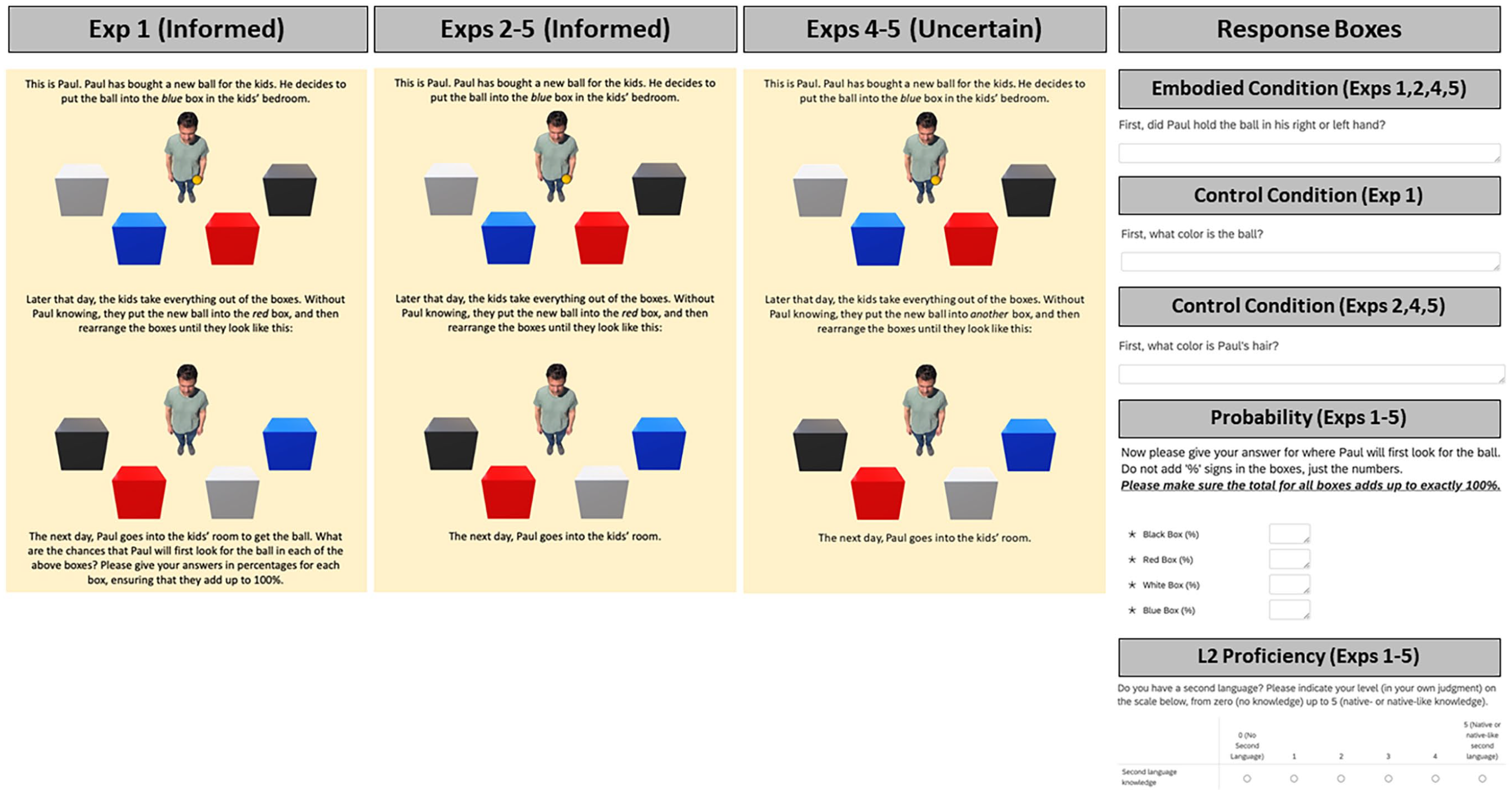
Stimuli and questions for all experiments. Participants in all experiments were randomly assigned to storyboards where Paul held the ball in either his left hand (shown here) or right hand.
Paul only knows the boxes have moved, not their contents, and thus the more parsimonious prediction is that Paul will search in the blue box first. As such, higher probabilities assigned to the blue box would suggest a more accurate prediction about Paul’s behaviour. Assignations to the red box, on the contrary, are likely to index egocentric behaviour, as only the participant knows that the ball is now there. The fact that the red box occupies the location previously held by the blue box enhances this possibility (Birch & Bloom, 2007). Since the blue box is a better measure of perspective taking and the red box a better measure of egocentricity, by-condition comparisons were planned for each box separately. However, since the total probability for all four boxes must sum to 100%, a negative correlation between red and blue box probabilities should be expected—in effect, better perspective-taking (higher probability assigned to the blue box) should “cannibalise” egocentricity (lower Red Box probability), and vice versa, unless the white and black boxes pick up the slack. It was therefore likely that a higher probability for one box should result in a lower probability for the other. Ultimately, however, it remained an empirical question as to whether embodiment or bilingualism influenced responses to one or both boxes.
For the question of L2 proficiency, Spearman’s rho correlations were planned to related judgements for both the blue and red boxes against the L2 Proficiency scale (0–5) to assess whether increased L2 knowledge enhanced perspective taking (higher probabilities assigned to blue box with higher L2 Proficiency) or reduced egocentricity (lower probabilities assigned to the red box with higher L2 Proficiency).
Results (confirmatory)
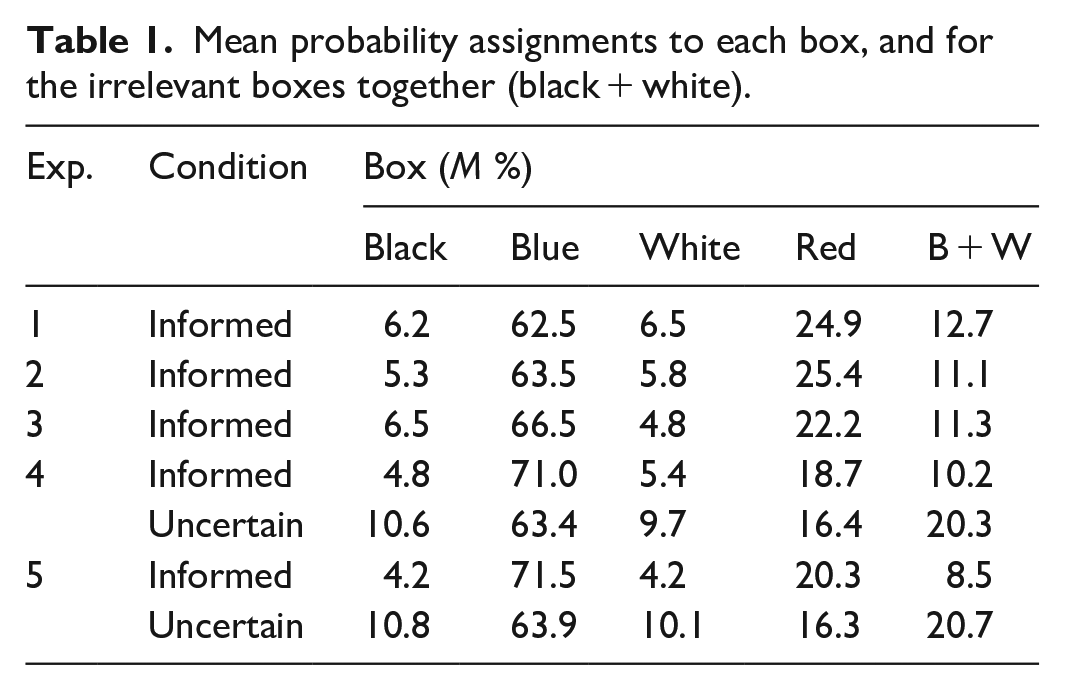
Mean (%) probability assignments to all four boxes for this and all subsequent experiments are displayed in Table 1.
Mean probability assignments to each box, and for the irrelevant boxes together (black + white).
Embodiment versus Control conditions
Probabilities assigned to the blue box, where the agent last saw the ball, did not differ as a function of prior embodiment (both median Embodied and median Control = 60%), U(220) = 6776, p = .12. Probabilities assigned to the red box, where the participant knew the ball to be, also did not differ as a function of prior embodiment (median Embodied = 25%; median Control = 20%), U(220) = 5242.5, p = .09. Bayesian analyses were broadly consistent with these findings in that they favoured an explanation by which the data were more likely under the null than alternative hypothesis (BF10 = 0.39 and .84, respectively), but not by the conventional thresholds of 3 times (Dienes, 2014).
Bilingualism
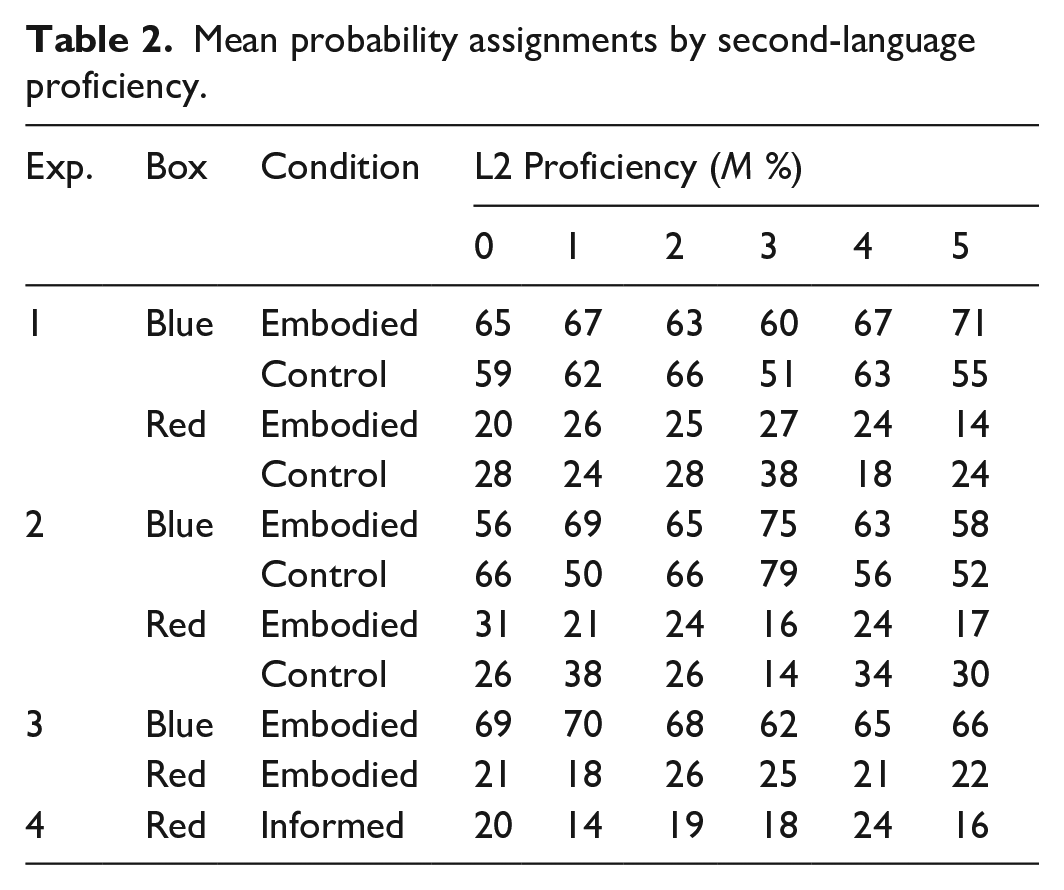
Table 2 displays the mean probability assignments as a function of L2 proficiency for this experiment and all subsequent experiments where correlation analyses were performed. The pattern of L2 Proficiency scores was positively skewed owing to an abundance of monolinguals (0 = 118 participants, 1 = 31, 2 = 26, 3 = 22, 4 = 11, 5 = 12). These results should thus be interpreted with caution. No significant correlations were revealed between L2 Proficiency and probabilities assigned to the blue box or red box in either the Embodied condition (rho = −.00, p = .96; rho = .0, p = .98, respectively) or the Control condition (rho = .01, p = .94; rho = .04, p = .69, respectively). Bayesian analyses found that the data were approximately 4 times more likely under the null hypothesis in all cases (Embodied, blue: BF10 = 0.22; Embodied, red: BF10 = 0.23, Control, blue: BF10 = 0.29; Control, red: BF10 = 0.23).
Mean probability assignments by second-language proficiency.
Discussion
Consistent with the original version of this paradigm (Birch & Bloom, 2007), participants generally assumed that the protagonist would look in the last box he saw the ball in, with the second choice being where they knew the ball to be. That participants were taking the agent’s perspective was evidenced by the fact that, if they had been responding entirely egocentrically, then the red box would always have been assigned 100% probability. However, participants’ predictions about where the agent believed the ball to be were not influenced by their prior judgement about the agent’s left and right, or by L2 proficiency.
A second experiment was designed to assess whether some aspect of the task design may have masked potential effects. One possibility is that the control question concerning the colour of ball had inadvertently drawn attention to the hand in which the ball was held, leading participants in the Control condition to receive the same priming effect as those who saw the embodiment question. Another potential issue was that participants may have formulated their responses early on, before answering the condition question. Although probability assignments were only made at the end of the story and presented after the condition question, Paul’s intention to get the ball and the nature of the probability assignment task were previewed in the storyboards. It is thus possible that participants formulated their responses, then completed the condition question, then stuck to their original judgements, meaning the manipulation may not have worked. Finally, the absence of any effect of bilingualism could have been the result of the weighting of participants towards the monolingual end of the spectrum. In Experiment 2, the recruitment method was changed to obtain more participants with higher L2 Proficiency scores.
Experiment 2
Method
The preregistration for this experiment can be found here: https://osf.io/d6jus
Participants
A total of 246 participants were recruited. Of these, and as per the preregistration, 1 was excluded for failing to correctly report the colour of the protagonist’s hair, 17 for providing an incorrect response to the question of which hand the ball was in, and 8 for providing probabilities for the four boxes that did not add up to 100%. Of the 220 participants remaining (M age = 25 years), 158 identified as female, 52 as male, 8 as nonbinary, 1 as transgender and nonbinary, and 1 as agender.
Materials and procedure
Three changes were made from Experiment 1. First, Paul’s intention to get the ball and the instruction to assign probabilities now came only after the condition questions and any effect of the embodiment question should achieve maximal effect. To this end, Paul was now only described as returning to the kids’ room in the story (see Figure 1). Second, the control question was changed from being about the colour of the ball to being about the colour of the protagonist’s hair. This meant that attention would not be drawn to the protagonist’s hands but to an unlateralised part of his body, minimising the possibility that participants inadvertently take his physical perspective. Finally, participants were recruited in two stages, once advertising for monolingual participants (stopping at 110 participants), and once for bilingual participants (stopping after another 110 participants). This was to provide a more balanced range of L2 Proficiency scores and thus create a more reliable test of the hypothesis relating to bilingualism. In all other aspects Experiment 2 proceeded precisely as Experiment 1.
Results (confirmatory)
Embodiment versus Control conditions
As per Experiment 1, probabilities assigned to the blue box did not differ as a function of prior embodiment (median Embodied = 70%; median Control = 60%), W(220) = 5967, p = .86. Probabilities assigned to the red box also did not differ between conditions (median Embodied = 20%; median Control = 25%), W(220) = 6347.5, p = .53. Bayesian analyses also favoured an explanation by which the data were more likely under the null than alternative hypothesis (BF10 = 0.15 and .25, respectively), each also now exceeding the conventional threshold of 3 times.
Bilingualism
Despite the targeted recruitment of bilinguals for Experiment 2 the pattern of L2 Proficiency scores remained positively skewed, though less so than in Experiment 1 (0 = 86 participants, 1 = 33, 2 = 22, 3 = 38, 4 = 22, 5 = 19). No significant correlations were revealed between L2 Proficiency and probabilities assigned to the blue box in the Embodied condition (rho = .12, p = .23), though the result was marginally significant for the red box (rho = −.18, p = .053), in favour of a reduced egocentricity with greater bilingualism. No significant correlations were revealed between L2 Proficiency and probabilities assigned to either the blue or red box in the Control condition (rho = −.09, p = .36; rho = .08, p = .41, respectively). Bayesian analyses found that the data were more likely under the null hypothesis in all cases except for the marginally significant relationship between L2 Proficiency and Red Box Probabilities, where the effect was three times more likely under the alternative hypothesis that there is a relationship (Embodied, blue: BF10 = 0.56; Embodied, red: BF10 = 3.66, Control, blue: BF10 = 0.29; Control, red: BF10 = 0.22).
Discussion
The results of Experiment 2 largely concurred with those of Experiment 1, namely that embodying an agent first did not influence subsequent judgements based on that agent’s false belief. Importantly, in Experiment 2 the question about which box Paul would search in came only after the condition question, meaning that participants would not have formulated their responses prior to judging which hand Paul had held the ball in, and thus the embodiment manipulation should have the maximal chance of influence. In addition, this time participants in the control condition were asked about the colour of the protagonist’s hair, minimising the potential for inadvertent embodiment. It was also the case that the results favoured the null more strongly than in Experiment 1, for both the red box and blue box predictions, and now exceeded the threshold of being three times more likely under the null than the alternative.
The results concerning the potential for higher L2 Proficiency (i.e., greater bilingualism) to influence judgements were mixed. There was no evidence of a relationship between L2 Proficiency scores and perspective taking (i.e., blue box probability), but there was a hint in the data of lower egocentricity (i.e., lower Red Box Probability) in the embodiment condition only. The correlation (rho = −.18) suggests a small-to-medium effect. It was therefore possible that there was a moderating influence of bilingualism on egocentric bias, one that could appear with the changes made for Experiment 2, but that this experiment may have been underpowered for this effect size. This possibility was tested in Experiment 3.
Experiment 3
The aim of Experiment 3 was to test whether the correlation of .18 between L2 Proficiency and Red Box Probability would be confirmed once adequate statistical power was achieved. A new group of participants were therefore recruited according to a new a priori power test, which suggested that an N of 190 was required for an 80% chance to detect the effect size found in the previous experiment (.18) with a one-tailed test. Since this relationship was only found in the Embodied condition, all participants received this condition only in Experiment 3. Given that our separate recruitment of monolinguals and bilinguals had still not provided a balance of L2 Proficiency scores, in large part because most who were recruited under the monolingual advertisement gave 0 on this scale rather than a 1 or a 2, this time participants were recruited in uneven batches with English speakers with knowledge of an L2 recruited first, then self-declared monolinguals, until the full complement of 190 participants was obtained and at least 25 participants were in each individual point on the L2 Proficiency scale. Experiment 3 was otherwise identical to Experiment 2.
Method
The preregistration for this experiment can be found here: https://osf.io/9r2j6
Participants
A total of 216 participants were recruited. Of these, and as per the preregistration, 14 were excluded providing an incorrect response to the question of which hand the ball was in, 9 for providing probabilities for the four boxes that did not add up to 100%, and 3 for responses that exceeded 3 times the standard deviation of the mean for the red box. Of the 190 participants remaining (M age = 25 years), 134 identified as female, 54 as male, and 2 as nonbinary.
Results (confirmatory)
Bilingualism
The pattern of L2 Proficiency scores was now much more balanced (0 = 39 participants, 1 = 26, 2 = 26, 3 = 40, 4 = 34, 5 = 25). However, no significant correlations were revealed between L2 Proficiency and probabilities assigned to either the blue box (rho = −.05, p = .76) or the red box (rho = 0, p = .51). Bayesian analyses found that the data were more likely under the null hypothesis in both cases (blue: BF10 = 0.24; red: BF10 = 0.18), and exceeded the threshold of being three times more likely under the null. Participants were also allocated to either a Monolingual group (L2 Proficiency scores 0–2) or Bilingual group (L2 Proficiency scores 3–5) for a planned secondary analysis, which was an independent-samples Wilcoxon (Mann–Whitney) test to compare probabilities for the Red and Blue Boxes. The purpose of this test was to assess whether an influence of bilingualism might be a “gross,” non-linear effect that could escape correlation analyses. This analysis also found no significant difference between the two groups on the blue box (median Bilingual = 65%; median Monolingual = 75%), W = 4137.5, p = .33, or red box (median Bilingual and median Monolingual = 20%), W = 4603.5, p = .79. Descriptively, this result patterned in favour of better perspective taking in the more Monolingual group.
Discussion
The aim of Experiment 3 was to test the marginally significant relationship between L2 Proficiency and Red Box Probability found in Experiment 2 with a new, appropriately powered sample. Nevertheless, no evidence for such a relationship appeared; indeed, the rho was zero. There was also no such relationship in Experiment 1, but this could have been because an influence of the left/right question may have been suppressed prior to the changes made for Experiment 2. The absence of an effect of bilingualism again in Experiment 3, however, suggests that it is more likely that the results of Experiment 2 were anomalous, and thus bilinguals are not better able to moderate their egocentricity when perspective taking.
Experiment 4
Experiment 4 was designed to address one potential account for the absence of any effect of bilingualism and embodiment, which is that the privileged information that participants received about the location of the ball may have had no effect. A curse of knowledge is not always found with this paradigm (Ryskin & Brown-Schmidt, 2014), and it could be that this version failed to elicit the expected bias. New participants therefore were recruited according to the same criteria as previous experiments, but this time half of them performed an “Uncertain” version of the task in which they were only told that the children had moved the ball to “another box.” If knowledge of the object’s true location biases participants towards that box, then participants should assign higher probability to that box in the previous “Informed” condition than the new Uncertain condition. Double the number of participants from Experiment 3 were recruited to replicate the number of participants tested there while matching this number for the new Uncertain condition.
Four different analyses were planned, all with Red Box Probability specifically as the dependent measure. First, a comparison between the two new Knowledge conditions with higher scores expected in the Informed than Uncertain versions. Second, a repeat of the previous analyses, where bilingualism scores are correlated with Red Box Probability, but only in those participants who perform the original (Informed) version of the task. Third, a second analysis of bilingualism, but this time to check whether the effect of Knowledge (Uncertain vs. Informed) is smaller for bilinguals than monolinguals, based on the same Monolingual/Bilingual grouping as Experiment 3 (0–2 and 3–5, respectively, on the 0–5 self-report scale). This analysis will take the form of a 2: Language (monolingual vs. bilingual) × 2: Knowledge (uncertain vs. informed) ANOVA. Fourth, to examine once more the potential effect of embodiment a 2: Knowledge (uncertain vs. informed) × 2: Condition (embodiment vs. control) ANOVA was planned, with a smaller effect of Knowledge expected in the Embodiment condition if the latter reduces egocentric bias.
Method
The preregistration for this experiment can be found here: https://osf.io/z6tx5
Participants
A total of 481 participants were recruited. Of these, and as per the preregistration, 22 were excluded for not having English as a first language, 16 for providing an incorrect response to the question of which hand the ball was in/the colour of the protagonist’s hair, and 19 for providing probabilities for the four boxes that did not add up to 100%. A further 44 were excluded due to over-recruitment necessary to ensure at least 25 participants for each condition and bilingualism score. These exclusions were made in reverse chronological order (last recruited, first removed), and based on which scores were over-represented in the data set (L2 Proficiency score 0 = 34 exclusions, 3 = 7 exclusions, 4 = 3 exclusions). Fifteen participants whose scores for the red box exceeded 3 times the standard deviation for that condition were replaced with participants from the chronological exclusion list, with those (1) who participated earliest, (2) who had the same or closest L2 Proficiency score, and (3) who performed the same or closest condition used as replacements. Of the 380 participants remaining (M age = 26 years), 226 identified as female, 150 as male, 3 as nonbinary, and 1 as not applicable.
Results (confirmatory)
Effect of privileged knowledge
Contrary to expectations, probability assignment to the red box was not significantly greater in the Informed condition (M = 19%) than Uncertain condition (M = 16%), W(380) = 16,967, p = .15, one-tailed. Bayes factor analyses were inconclusive but nevertheless favoured the null over the alternative (BF10 = 0.55, one-tailed). In sum, participants were not more likely to suggest the agent would look first in the red box if they were informed the object was in that box than if they were not told where the object was.
Bilingualism
The results are displayed in Figure 2. There was no evidence of a relationship between L2 Proficiency and Red Box Probability (Informed condition only), rho = .035, p = .63. Next, participants were divided into two groups by Bilingual score (0–2 = Monolingual, 3–5 Bilingual). A 2: language (Monolinguals vs. Bilinguals) × 2: knowledge (uncertain vs. informed) ANOVA 1 revealed no evidence of an effect of either knowledge (MInformed = 19%, MUncertain = 16%), F(1, 376) = 1.990, p = .16, ηp2 = .005, or language (MMonolingual = 17%, MBilingual = 18%), F(1, 376) = 0.655, p = .42, ηp2 = .002, and there was no evidence of an interaction, F(1, 376) = 0.012, p = .91, ηp2 = 0.
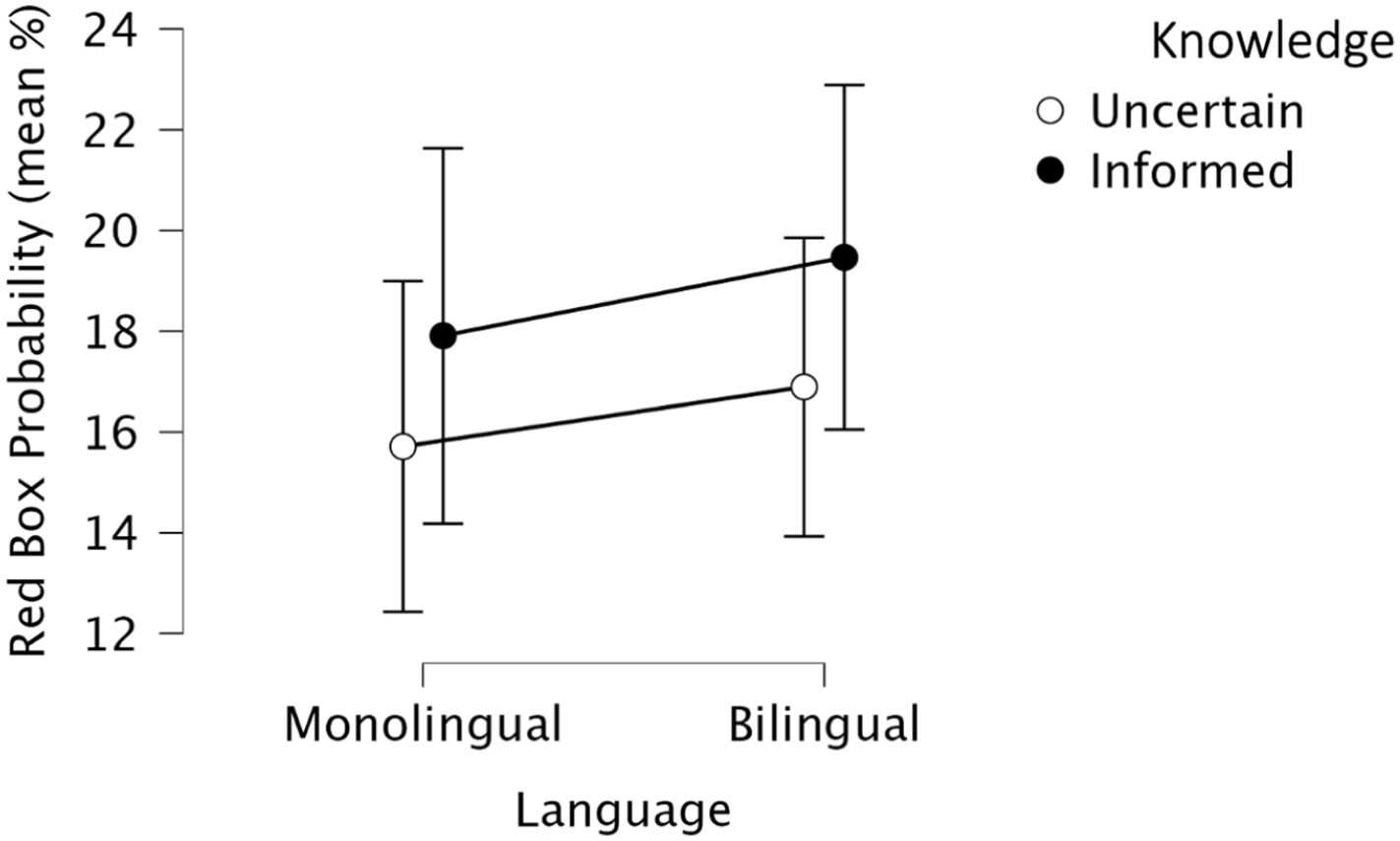
Results of Experiment 4 (analysis by language group), with 95% confidence intervals.
Embodiment
The results are displayed in Figure 3. A fully between-subjects ANOVA 2 revealed no evidence of an effect of either Knowledge (MInformed = 19%, MUncertain = 16%), F(1, 376) = 2.078, p = .15, ηp2 = .005, or Condition (MControl = 16%, MEmbodiment = 18%), F(1, 376) = 0.521, p = .47, ηp2 = .001, and there was no evidence of an interaction, F(1, 376) = 1.718, p = .19, ηp2 = .005.
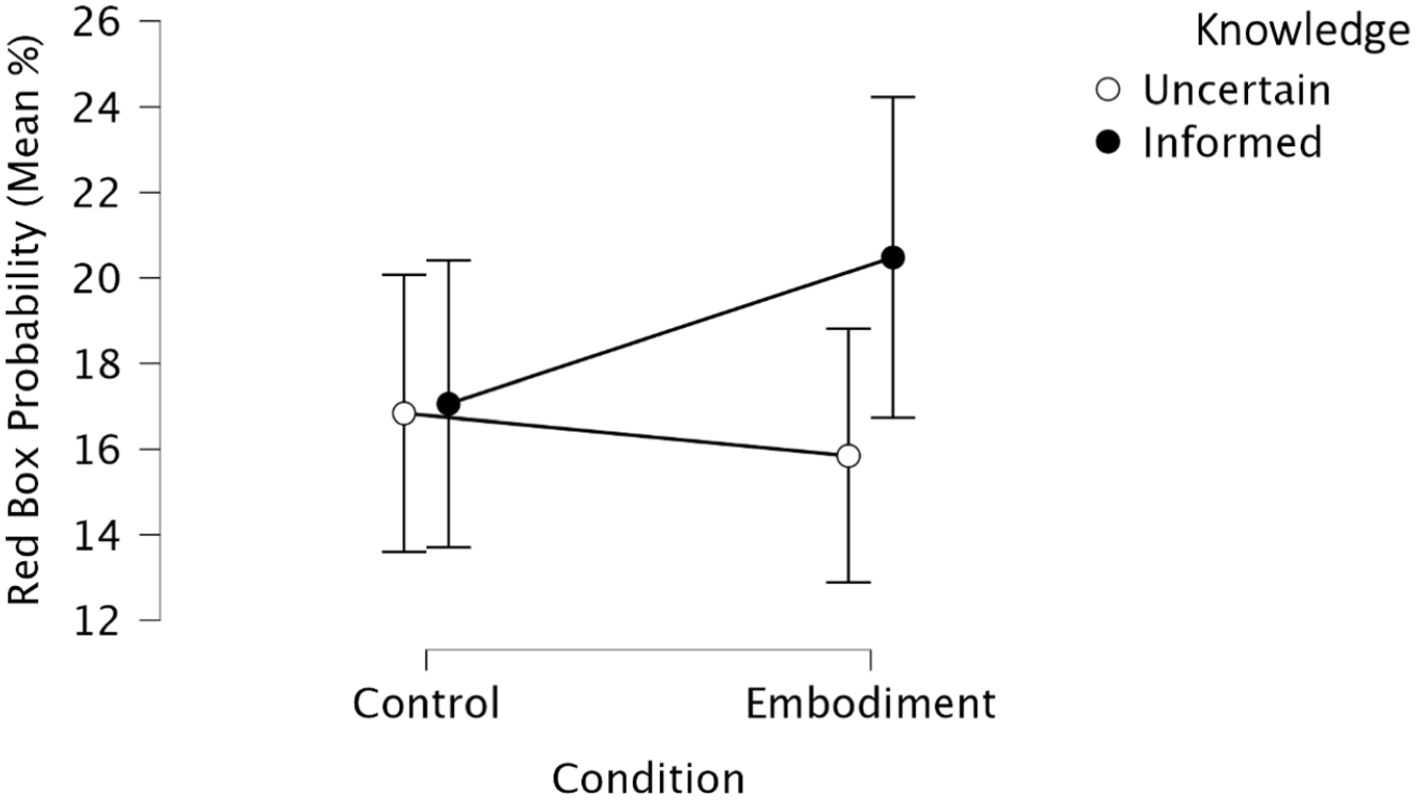
Results of Experiment 4 (analysis by condition), with 95% confidence intervals.
Results (exploratory)
The results had revealed no evidence that informing participants that the object was in the red box made them more likely to suggest that the agent would look there first. However, the data suggested a pattern whereby the black and white boxes, henceforth the irrelevant boxes (as they were never mentioned in the stories or occupied a relevant location in the scene) were processed differently in the Uncertain than Informed condition (see Table 1). Specifically, probability assignments to the irrelevant boxes were higher in the Uncertain condition, both in terms of statistical significance and very high Bayes factors, white box: MUncertain = 10%; MInformed = 5%, U(380) = 22166.5, p = .001, BF10 = 350; black box: MUncertain = 11%; MInformed = 5%, U(380) = 22628.5, p = .001, BF10 = 10226. An explanation for this pattern is that participants’ uncertainty led them to judge that the agent’s search pattern would be more distributed, not restricted only to the box the ball was originally put in or the box now occupying that location. Since this uncertainty is an effect of information only the participant receives (only they know the ball has also moved) it is a form of egocentric bias. Given the strength of the effect, it is also potentially a more reliable form of bias than the curse of knowledge related to the red box, at least for this version of the paradigm. Any influence of bilingualism or embodiment should therefore be to attenuate this effect. To test this possibility, two unplanned tests were conducted.
Bilingualism
If bilingualism attenuates egocentricity in terms of the attribution of one’s own uncertainty to the agent, then it should attenuate the rise in irrelevant box probability in the Uncertain condition. The results are displayed in Figure 4. A fully between-subjects ANOVA on the summed probability attributed to the white and black boxes revealed a main effect of knowledge (MInformed = 10.1%, MUncertain = 20.2%), F(1, 376) = 25.355, p < .001, ηp2 = .063, but no effect of language (MMonolinguals = 13.6%, MBilinguals = 16.7%), F(1, 376) = 2.277, p = .13, ηp2 = .006. Crucially, there was also no evidence of an interaction, F(1, 376) = 0.815, p = .37, ηp2 = .002. In sum, the Uncertain condition did lead to higher probability for the irrelevant boxes, suggesting the overextension of participants’ own privileged information to the agent. Importantly, bilingualism did not attenuate this effect.
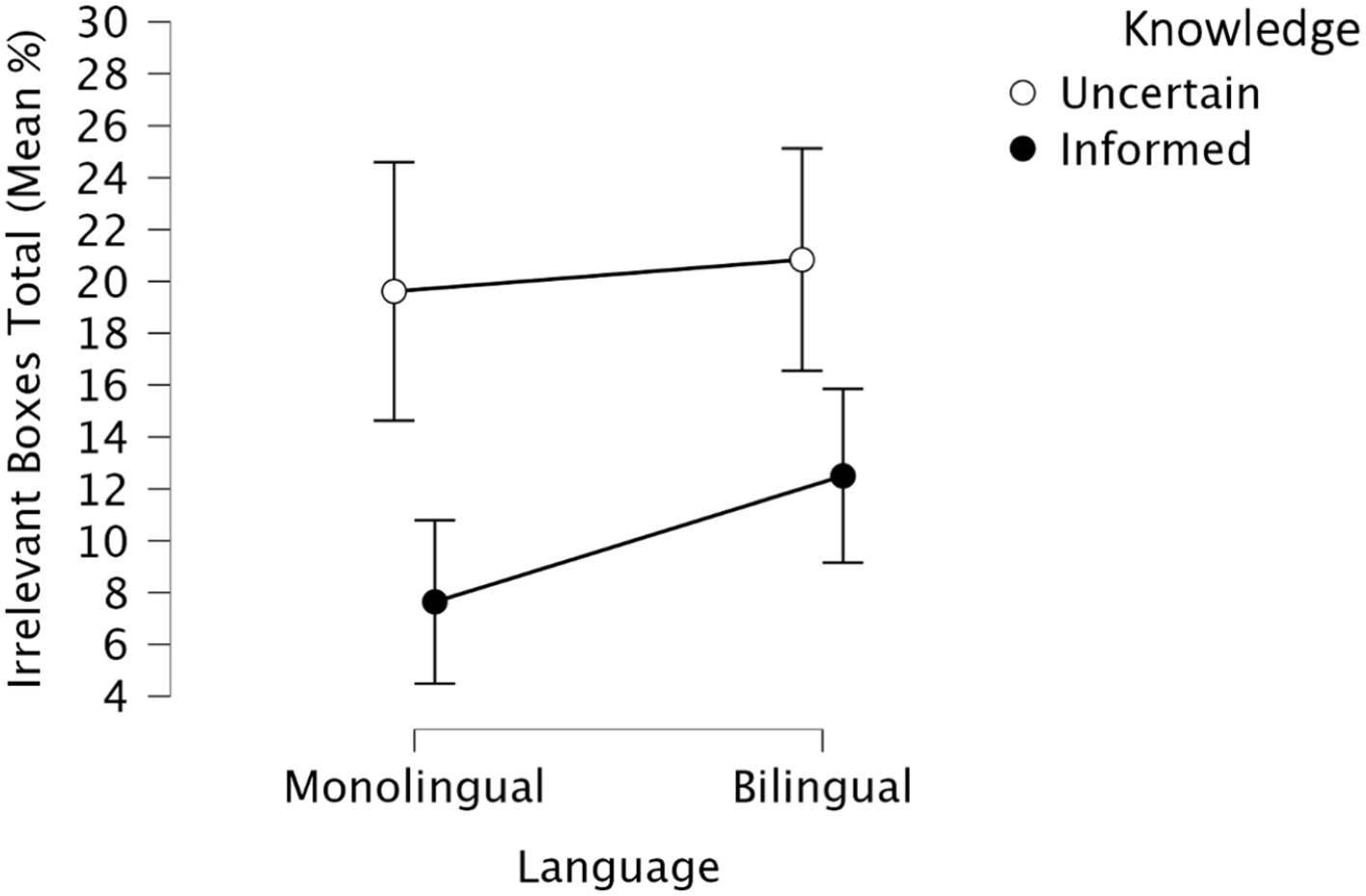
Results of Experiment 4 (analysis by language group), with 95% confidence intervals.
Embodiment
If embodiment enhances perspective taking, then it should attenuate the rise in irrelevant box probability in the Uncertain condition. The results are displayed in Figure 5. A fully between-subjects ANOVA on summed white and black box probability revealed a main effect of Knowledge (MInformed = 10.2%, MUncertain = 20.3%), F(1, 376) = 24.743, p < .001, ηp2 = .062, but no effect of Condition (MControl = 15.4%, MEmbodiment = 15.1%), F(1, 376) = 0.030, p = .86, ηp2 = .0. Crucially, there was also no evidence of an interaction, F(1, 376) = 0, p = .99, ηp2 = .0. Again, the Uncertain condition did lead to higher probability for the irrelevant boxes, suggesting the overextension of participants’ privileged information to the agent. Importantly, embodiment did not attenuate this effect.
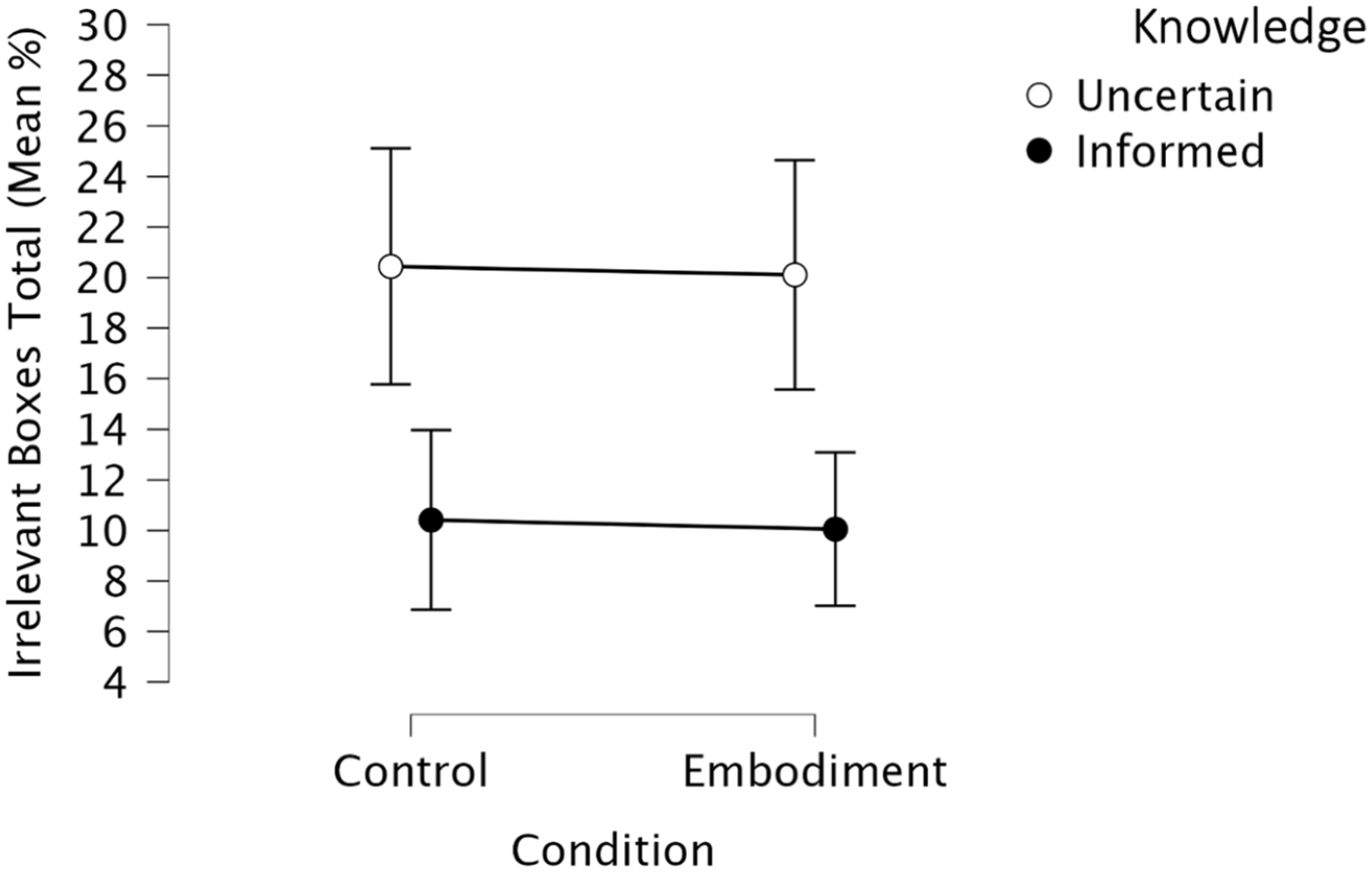
Results of Experiment 4 (analysis by condition), with 95% confidence intervals.
Discussion
Experiment 4 had revealed no evidence for a contrast in Red Box Probability between the Uncertain and Informed conditions, suggesting that knowing the location of the object did not in fact lead participants to attribute this privileged knowledge to the agent. This finding has important ramifications for the interpretations of results from Experiments 1–3, which will be examined in the General Discussion. However, not being informed of the ball’s current whereabouts made participants judge that the agent would be more likely to search in boxes that never held the ball nor occupied its location. Exploratory analyses found no evidence that this bias was attenuated by either bilingualism or embodiment, but a final and confirmatory study was conducted to test this new hypothesis formally.
Experiment 5
The preregistration for this experiment can be found here: https://osf.io/9tsyx
Method
The exploratory tests conducted for Experiment 4 were now planned as confirmatory tests for Experiment 5. These were two fully between-subjects ANOVAs. Underpinning the analysis of bilingualism and embodiment was the expectation that the increase in irrelevant box probability in the Uncertain condition would be replicated here. In the previous ANOVAs the effect size for this contrast was very large (well beyond ηp2 = .25). There is currently no agreed-upon means of computing a required sample size for ANOVA, but this principal contrast can be treated as a between-groups contrast much like an independent samples t-test. For conservatism, the effect size for this power analysis was set at medium (d = 0.5), and power at 90%, meaning 172 participants (86 each in the Uncertain and Informed conditions) were required. The tests of interest would then be whether higher bilingualism and/or the embodiment condition would attenuate this rise, thus evidencing greater objectivity in perspective taking. This should be indexed by an interaction between Language (Bilinguals vs. Monolinguals) and/or Condition (Embodiment vs. Control) on one hand, and Knowledge (Uncertain vs. Informed) on the other.
Differently from the previous experiments, total scores across all four boxes of between 99% and 100% were permitted, rather than 100% alone. This was because some participants had given scores that were not precisely divisible into tens. (e.g., 16.66% three times with a 50%, or 33.3 three times with a 0%). These participants did appear to understand the instructions, and it was decided not to exclude these further on the basis of a technicality.
Participants
A total of 201 participants were recruited. Of these, and as per the preregistration, 2 were excluded for not having English as a first language, 14 for providing an incorrect response to the question of which hand the ball was in/the colour of the protagonist’s hair, and 7 for providing probabilities for the four boxes that did not add up to 99%–100%. A further 6 were excluded due to over-recruitment necessary to ensure at least 43 participants for each Knowledge condition and language group. These exclusions were made in reverse chronological order (last recruited, first removed). Four participants whose scores for the red box exceeded three times the standard deviation for that condition were replaced with participants from the chronological exclusion list where possible, with those who participated earliest and fell into the same experiment and language category used as replacements, or otherwise new participants were recruited. Of the 172 participants remaining (M age = 28 years), 98 identified as female, 66 as male, 4 as nonbinary, and 1 as genderqueer.
Results (confirmatory)
Bilingualism
Mean L2 Proficiency scores for the Monolingual and Bilingual groups were 0.9 and 3.4, respectively. The results are displayed in Figure 6. A fully between-subjects ANOVA revealed the expected main effect of Knowledge, F(1, 168) = 17.449, p < .001, ηp2 = .094, with the irrelevant boxes receiving higher scores in the Uncertain condition (MInformed = 8%, MUncertain = 21%). There was also a main effect of language, F(1, 168) = 4.424, p = .037, ηp2 = .026, with monolinguals assigning higher scores to the irrelevant boxes (MMonolinguals = 18%, MBilinguals = 12%). This was qualified by an interaction, F(1, 168) = 6.488, p = .012, ηp2 = .037. Post hoc tests applying the Bonferroni correction found that monolinguals gave higher scores to the irrelevant boxes than bilinguals in the Uncertain condition (MDiff = 14%, p < .001, d = 0.709), but not in the Informed condition (MDiff = 1%, p = 1, d = 0.068). Monolinguals also gave higher scores to the irrelevant boxes in the Uncertain than Informed condition (MDiff = 20%, p < .001, d = 1.025), but the bilinguals did not (MDiff = 5%, p = 1, d = 0.249).
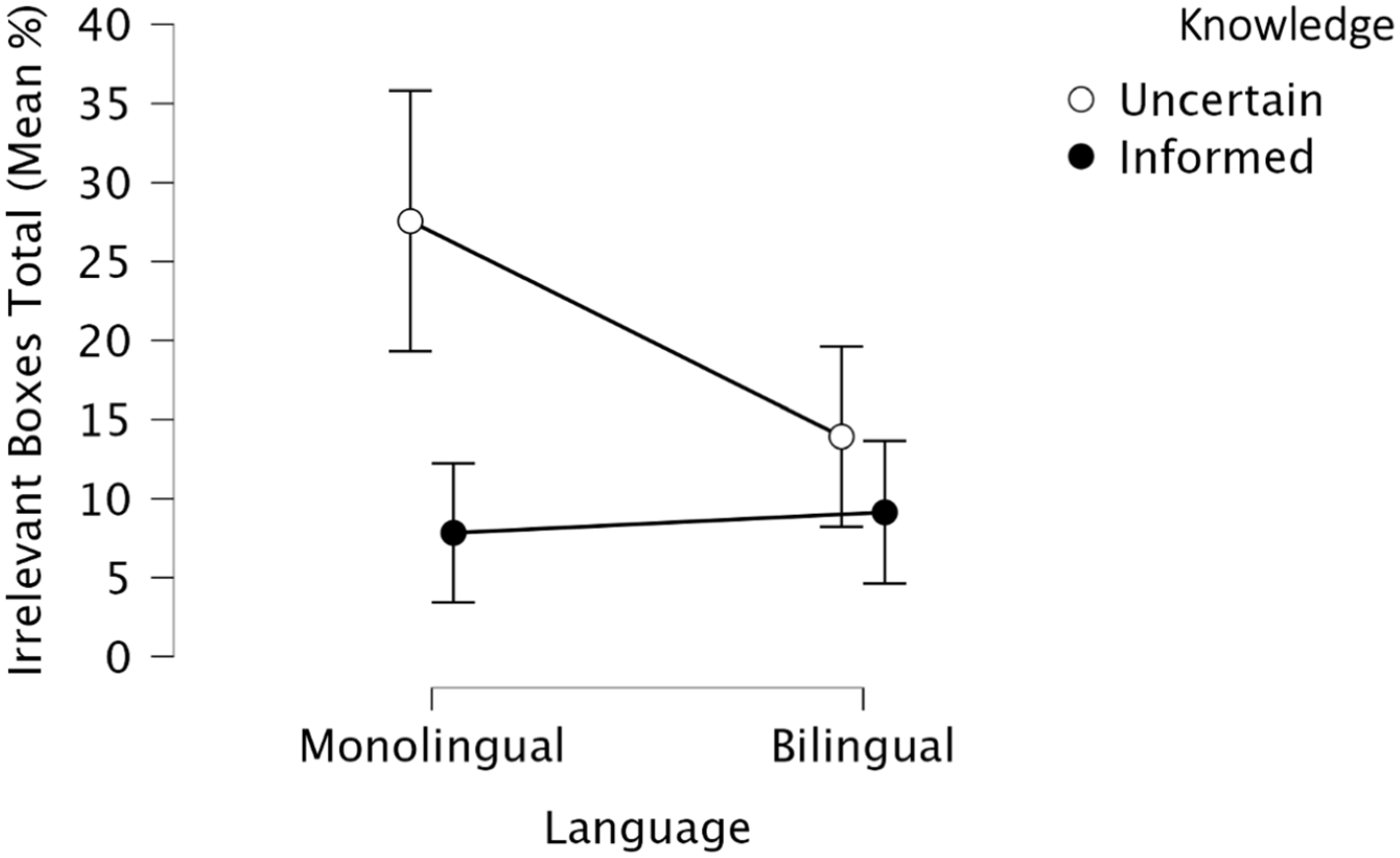
Results of Experiment 5 (analysis by language group), with 95% confidence intervals.
Embodiment
The results are displayed in Figure 7. A fully between-subjects ANOVA revealed the expected main effect of Knowledge, F(1, 168) = 17.116, p < .001, ηp2 = .093, with the irrelevant boxes receiving higher scores in the Uncertain condition (MInformed = 8%, MUncertain = 21%). There was no main effect of Condition (MControl = 13%, MBilinguals = 17%), F(1, 168) = 1.793, p = .18, ηp2 = .011, but there was an interaction, F(1, 168) = 5.310, p = .022, ηp2 = .031. Post hoc tests applying the Bonferroni correction found that higher scores were given in the Uncertain than Informed conditions when the Embodied condition was performed (MDiff = 19%, p < .001, d = 0.983) but not when the Control condition was performed (MDiff = 5%, p = 1, d = 0.280).
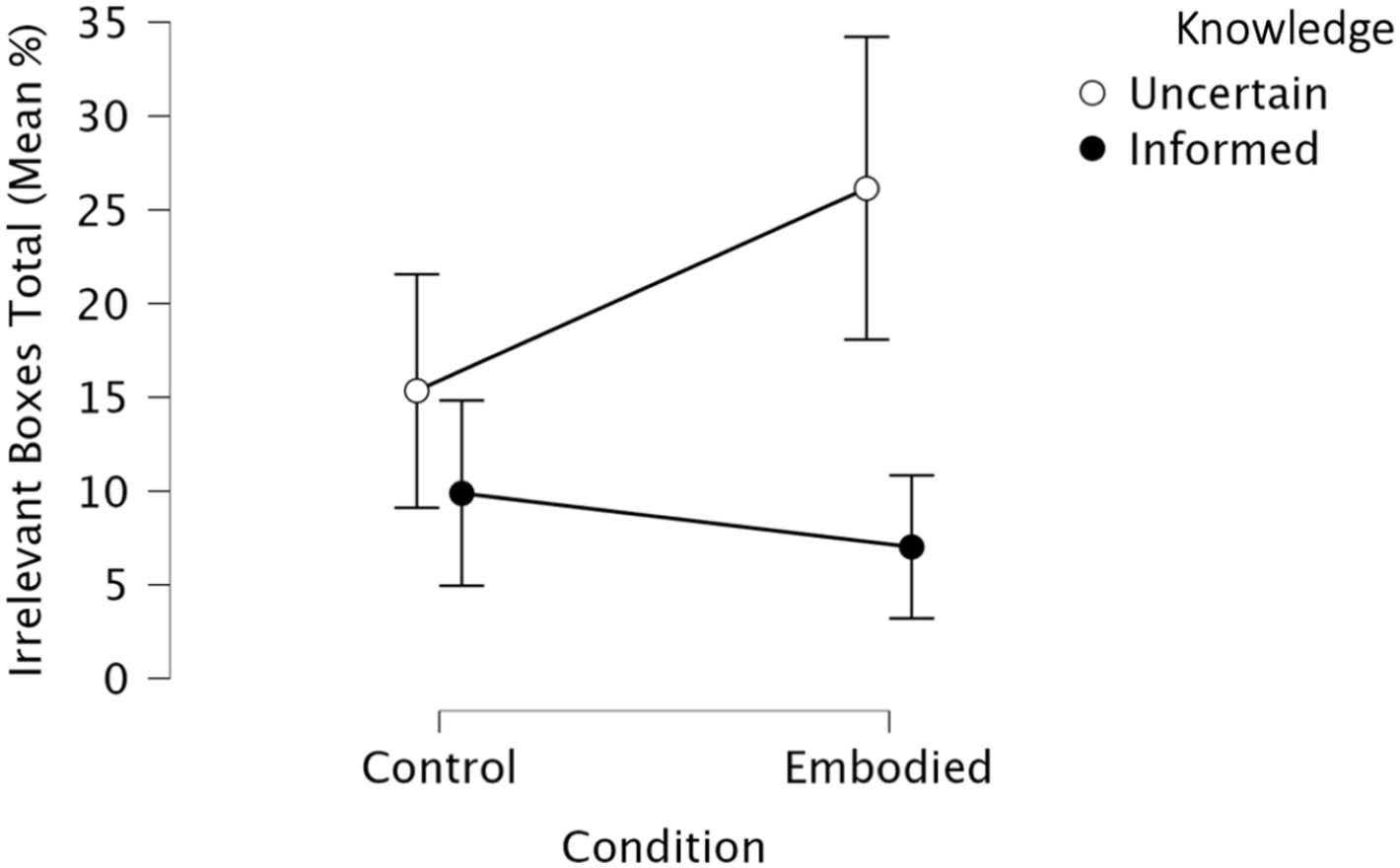
Results of Experiment 5 (analysis by condition), with 95% confidence intervals.
Analysing previous research
The irrelevant boxes effect was replicated here, but has not been reported in other studies with this paradigm. This may be because it was not formally tested. Where possible, data were from previous research were examined to establish whether it had occurred previously but had gone undetected or unreported.
Farrar and Ostojić
Since the data were openly available these were analysed (Farrar & Ostojić, 2018). Probability assigned to the two irrelevant boxes was greater in the Uncertain (“Ambiguous”) than Informed condition in all three experiments: Experiment 1, MInformed = 15.4%; MUncertain = 21%, U(281) = 11,587, p = .017; Experiment 2, MInformed = 15.7%; MUncertain = 23.9%, U(279) = 11,607.5, p = .006, and Experiment 3, MInformed = 19%; MUncertain = 24.6%, U(742) = 7,823, p < .001.
Other studies
Table 3 compiles the results from this article with data from previous research with this paradigm in terms of irrelevant boxes scores, as well as scores for the “red” box (or equivalent for that study). Data for analysis were not immediately available from most of these studies (Birch & Bloom, 2007; Converse et al., 2008; Debska & Komorowska, 2013; Ryskin & Brown-Schmidt, 2014; Sassenrath et al., 2013; Todd et al., 2011). There was a mean +3.2% increase in the total probability for irrelevant boxes in Uncertain over Informed conditions across these earlier studies, rising to 4.4% if the present studies are included.
Compiled results from this article and from the literature.
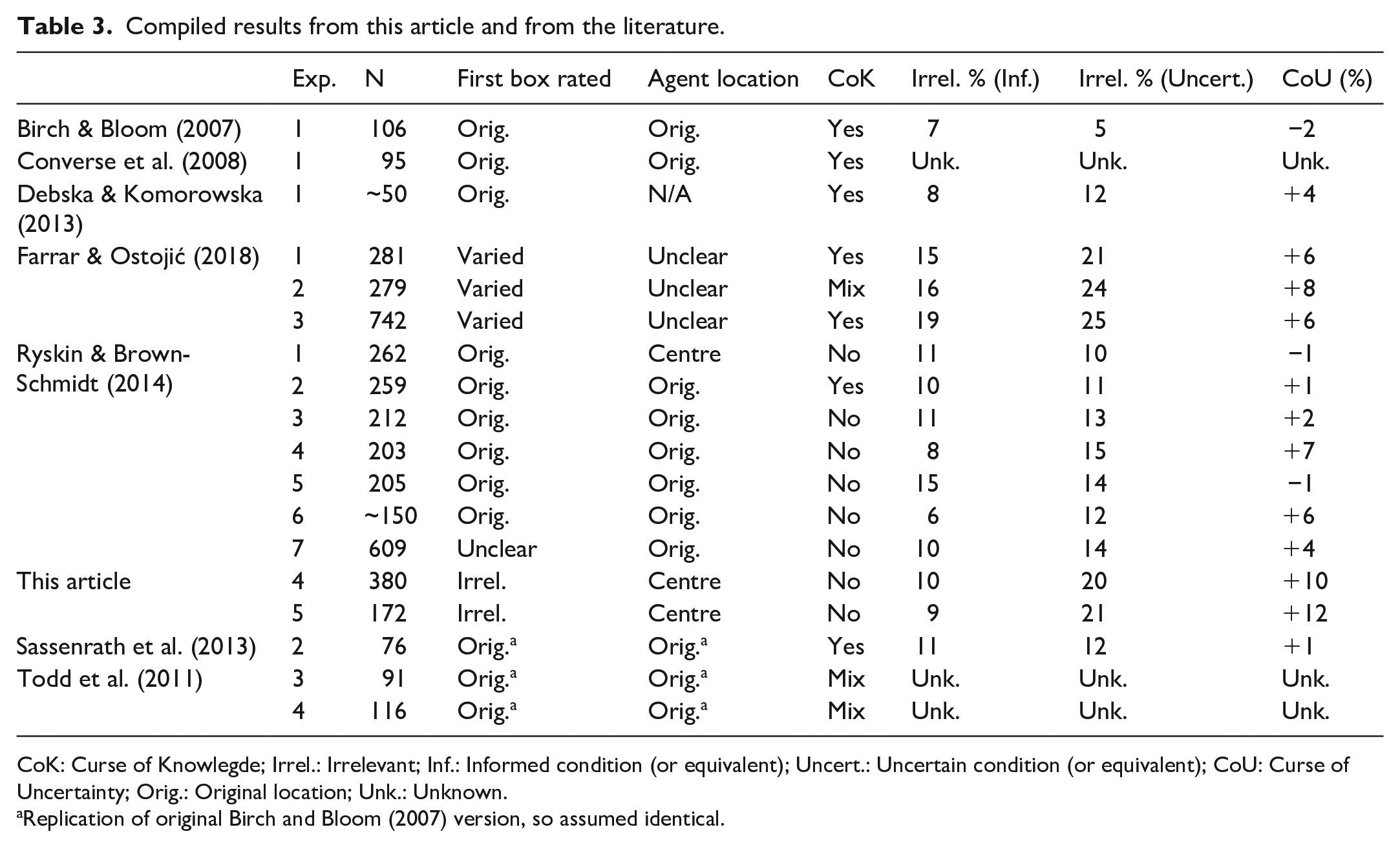
CoK: Curse of Knowlegde; Irrel.: Irrelevant; Inf.: Informed condition (or equivalent); Uncert.: Uncertain condition (or equivalent); CoU: Curse of Uncertainty; Orig.: Original location; Unk.: Unknown.
Replication of original Birch and Bloom (2007) version, so assumed identical.
Discussion
Experiment 5 replicated the principal effect found in Experiment 4, namely that participants judged that the agent would be more likely to first look in one of the irrelevant boxes in the Uncertain than Informed condition. Unlike in Experiment 4, but as hypothesised, bilingualism attenuated this bias, such that it existed only in the Monolingual group. Results pertaining to the embodiment were the opposite to what was hypothesised, as this bias only occurred in the embodied condition. It would appear that there is some evidence for effects of bilingualism and embodiment on this bias, limited by the absence of these effects in the exploratory analyses of Experiment 4.
General discussion
In Experiments 1–3, participants were told a story in which an agent had put a ball in a blue box, but that in his absence the ball had been moved to the red box, and the boxes had been rearranged. Participants then judged how likely Paul was to look for the ball in each of the four boxes in the story. It was hypothesised that predictions for the blue box would be higher (or the red box lower) if participants (1) took the agent’s physical perspective (embodiment) just prior to their judgement, and/or (2) were bilingual. No effect of embodiment was found in these experiments, and despite a hint of a relationship with bilingualism in Experiment 2, this was not replicated in Experiment 3, which was more appropriately powered for the effect.
Experiment 4 then tested whether being informed that the ball was in the red box had successfully elicited egocentric biases. If not, then the expectation that higher probability ascribed to the red box reflected egocentric bias would be incorrect. This was therefore contrasted with an “Uncertain” condition in which participants were informed only that the ball had been moved to “another” box. The results showed no difference in Red Box Probability scores. However, an interesting pattern emerged whereby the two task-irrelevant boxes, white and black, received higher probability scores in the Uncertain condition. This suggested that participants were biased by their privileged information, but not in the expected way. Although no evidence had emerged that this effect was attenuated by either embodiment or bilingualism, the results had come from exploratory rather than confirmatory tests. A fifth experiment replicated the increased scores for the irrelevant boxes in the Uncertain condition, but this time effects of both bilingualism and embodiment emerged; bias was only present in the Monolingual group and those participants who had taken the agent’s physical perspective first.
No evidence for a curse of (specific) knowledge
These experiments provided no evidence that participants were cursed by knowledge of where the ball really was. 3 This is broadly in line with the finding of inconsistent biases and small effect sizes in the most extensive work with the paradigm, by Ryskin and Brown-Schmidt (2014), though not with many others (see Introduction and Table 3). This is not to say that participants experienced no egocentric bias in this condition at all—the fact that they did not restrict their judgements to the blue box is almost certainly due to the knowledge that the ball was moved. 4 In effect, there are two potential curses of knowledge in tasks like these. The first concerns the (vague) knowledge that the ball has moved, and the second the (specific) knowledge of where the ball actually is. What was being manipulated in Experiments 1–4 was the latter, yet there was no evidence for any effect on red box scores. Given the insensitivity of these scores to direct information about the red box, they are likely also insensitive to less direct influences like embodiment or bilingualism, and thus little can be learned from the absences of these influences on this measure. By the same token, probability assigned to the blue box, which was always the place the agent had put the ball, must also an unreliable measure of these potential influences where it was used (namely in Experiments 1–3).
It is important to note that the design of the four-box false belief paradigm varies from study to study, and these differences may explain why no curse of knowledge (in the more specific sense) was found here. Table 3 shows, for example, that the vast majority of studies have presented the red box (the original location) first for rating, but the present studies did not. It could be that asking participants to consider their rating for that box first prompts increased consideration of its significance, leading to higher scores. Moreover, most studies depict the protagonist by the original location, which may prompt participants to expect that they will search there first. Either of these accounts would imply a revision of how “cursed” by knowledge adults are, at least with this paradigm. A further possibility is that participants “think between the lines” of the story. Often, it is the protagonist’s sister who moves the object—a musical instrument—but in the present experiments it is a man’s children. It is possible that participants consider potential hidden contexts, such as why a musical instrument just used by one’s sister was displaced. For example, if the intention was mischievous, it might be thought that the red box is the “clever” option because it allows the hider to claim that they hadn’t really “moved” the object. Further research which directly compares different types of presentation of the scenarios would be useful to test whether the more specific curse of knowledge is to some extent dependent on artefacts of task design. Here, the choice of a father and his children was motivated by the desire to provide an ecologically feasible scenario that is less likely to arouse suspicion of deliberate trickery.
A curse of uncertainty?
The most robust effect here concerned the impact of privileged knowledge on probability assignments to the irrelevant boxes. It appears that participants experience a curse of uncertainty, whereby being told that the ball had moved, but not where, led participants to judge the agent’s first look behaviour differently from those who knew where the ball was. It is important to understand what the higher probability for the irrelevant black and white boxes represents; it is the increased sense that the agent is not convinced that the ball is where he left it, either in terms of the container or the location. If he were, the total of red and blue box probabilities would be 100%. In essence, the participant thus attributes to the agent a greater feeling that the object could now be anywhere and thus a more distributed search, which takes in all options and not just those with some plausibility, is more appropriate. This makes sense given participants’ own feelings in the Uncertain condition.
The effect was reliable, occurring in both the experiments in which it was measurable, and with a large effect size in each case. It was present in all three studies conducted by Farrar and Ostojić (2018), the data from which were available for analysis. Moreover, in 10 of the 13 previous studies where mean scores for the irrelevant boxes were available, scores for these were higher in Uncertain than Informed conditions, though sometimes only by very little. It is difficult to understand why this effect arises in some other studies but not others. The information in Table 3 suggests two possible explanations, both of which are presentational. First, it could be that not asking participants to rate the red box (or equivalent) first suppresses the curse of knowledge, as described above, and this creates the “mathematical space” for the curse of uncertainty to emerge instead. This would appear to be supported not only by the current studies (where the response order was always black, red, white, blue) but also by those of Farrar and Ostojić (2018), who counterbalanced the order with which each box appeared for rating. Second, in the experiments presented here the protagonist did not stand closer to the red box than all other boxes, which could lead participants to be less likely to assume he would look there first, and (again) create the space for the curse of uncertainty. Further research is required to ascertain whether these factors contribute to any rise and fall in each effect, but it could be that the curse of uncertainty is less likely the product of experimental artefacts than the curse of knowledge.
However, a difficulty arises when attempting to understand the mechanism behind the rise in scores for the irrelevant boxes. Two candidates are now discussed.
The overextension of one’s uncertainty
The first candidate explanation for the higher scores for irrelevant boxes is that participants overextended their uncertainty to the agent. This would likely function in the same way as a curse of knowledge. For example, whereas in the informed condition the participant is 100% clear the ball is in the red box and a curse of knowledge would mean this information manifests in higher red box scores, a participant in the Uncertain condition might infer that the ball is now equally likely to be in the black, white, or red box (33.3% each). If this more distributed range of scores rubs off on perspective attributions then we should expect higher scores for the irrelevant boxes here than in the Informed condition. Thus, the curse of knowledge and curse of uncertainty would in effect be two sides of the same coin; participants have an understanding of a situation, and this understanding “leaks” into others’ perspectives.
Overextension can explain why the irrelevant boxes received higher probabilities, but there are two problems which mean that it cannot explain all the results of these experiments. The first problem is that it cannot account for the absence of an equivalent effect of the Informed condition on red box scores; why should only uncertainty be transferred to another agent and not concrete knowledge? The second problem is that it cannot explain the influences of bilingualism and embodiment in Experiment 5, however reliable or unreliable these may turn out to be. To do so, it would need to be true that bilinguals in Experiment 5 experienced less uncertainty, thereby attributing less uncertainty to the agent in the form of lower scores for the irrelevant boxes. The same would need to be true, albeit in reverse, for those in the embodiment condition. There appears to be no a priori reason to predict either of these possibilities. In sum, overextension can explain some findings, but something else should also be happening to explain the broader pattern of results.
Uncertainty and slow thinking
An alternative or perhaps additional possibility is that participants who did not know where the object was were more deliberative and less instinctive than those who had perfect knowledge about its whereabouts. This would fit with a dual-process framework for decision making, with one system being fast, automatic, and based among other things on concrete content (in this case, privileged certainty about the object’s location); the other slow, reflective, and based on more neutral content (in this case, uncertainty; see Kahneman & Frederick, 2002). “Fast” thinking in these experiments would be more likely in the Informed condition, where privileged information favours a more rapid, heuristic-based approach that is more likely to reflect only the most immediately relevant information, namely the blue and red boxes. This would also seem to characterise the egocentric bias typically found in visual perspective taking and referential communication tasks, where responses are rapid (e.g., Apperly et al., 2010; Samuel, Cole, & Eacott, 2020; Wardlow Lane & Ferreira, 2008). Indeed, it could be that a curse of knowledge in the more specific sense, that is, when the participant has concrete information, is more reliable when participants do not stop to think, or do not have time to. The Uncertain condition, on the contrary, is more likely to encourage “slow” thinking which could lead participants to think about the multiple other factors beyond the narrow context of the stories themselves. For example, participants may have thought that the agent, upon discovering that the boxes had been moved, was less likely to assume consistency in other matters, such as which box the ball was in. They may have wondered whether the agent was suspicious of the rearrangement, or if this was a game his children liked to play. They may have drawn upon their own experience of children and how likely they are to put things back where they found them. They may also have engaged in metacognitive awareness, reflecting upon their current experience of deliberation and deciding that it warranted a more cautious, distributed range of scores as a result. All of these could lead to higher scores on the irrelevant boxes.
How far such influences can be considered egocentric biases, which are typically defined as intrusions of one’s own knowledge or perspective, is a difficult question. It is perhaps more accurate to define these as influences of greater rationalisation or rumination, rather than egocentric bias per se. Complicating matters, a more deliberative approach may have allowed more time for egocentrism to “creep into” responses, and now overextension (as described in the section above) might become involved. Egocentric bias could therefore also arise out of slow thinking. The curse of uncertainty could even be a three-step effect; first there is privileged but vague knowledge that leads to uncertainty (the ball has moved), then there is a more deliberative, slow-think approach in response to this uncertainty, then there is egocentric overextension of this uncertainty to the agent in the form of higher irrelevant box scores.
What seems clearer is that slow thinking is the better account for why participants’ own knowledge (bilingualism), or the experience of taking their physical perspective (embodiment), showed some influence only in the Uncertain condition; they would have more scope to intervene during slow thinking than when a fast, heuristic-based approach is taken. The influences of monolingualism and embodiment, where found, are more clearly egocentric biases because they are grounded in individuals’ subjective experience, but may require slower thinking to arise.
Embodiment and the overextension of one’s uncertainty to others
Here, it was hypothesised that taking an agent’s physical perspective prior to taking his mental perspective would make participants more accurate perspective takers. This was because previous research had shown that adults approximate others’ opinions after physical perspective taking (Erle & Topolinski, 2017). There was no evidence that embodiment enhanced perspective taking, in any experiment. However, Experiment 5 found that participants who didn’t know where the object was judged that the agent would show a more distributed search strategy. Thus, the effect of embodying the agent was to make them more rather than less biased by their knowledge that the ball had moved.
Recall that Erle and colleagues (2018) used the term “psychological perspective taking” in reference understanding others’ personality and their answers to trivia questions. In contrast, here participants were making judgements based on that agent’s (false) belief. One way to link these seemingly disparate findings is that participants who first take another agent’s physical perspective may feel more connected to that person, perhaps briefly creating an “in-group” effect. This connection can explain why participants in the studies by Erle and colleagues experience a form of approximation to the other agent. However, it could also lead to egocentric bias. This would fit with research that suggests people are more egocentric when taking the perspective of an in-group than out-group member, including with this paradigm (Todd et al., 2011). This bias may only occur when the conditions are right (i.e., when the approach to the question about the other agent’s perspective is more deliberative and sensitive to influence). There is also some evidence to support this possibility from the research by Erle and colleagues. In one study, when participants first took an agent’s visuospatial perspective and were then quizzed as to how much they trusted that agent, responses indicated greater trust after embodiment than without. However, if participants were also fed additional information that suggested the agent was not a particularly reliable person, the effect disappeared (Erle et al., 2018). In other words, embodiment led to an effect only when participants did not have concrete knowledge that was pertinent to their judgement. This distinction is quite similar to that found in Experiment 5, where the direct information about the ball’s whereabouts in the Informed condition eliminated the effect of embodiment. Nevertheless, this (and any) account of embodiment and egocentric bias in these experiments is subject to two very important caveats. First, the effect found was not the effect that was predicted. Second, the effect arose in one out of two experiments. In sum, the results here are interpreted as suggesting that when making more deliberative judgements, the effect of taking that agent’s physical perspective may encourage the erroneous sense that that agent shares one’s privileged information; that is, embodiment may sometimes prejudice objective perspective taking
Monolingualism and the overextension of one’s uncertainty to others
Unlike the direction of the effect of embodiment, the direction of the effect of bilingualism found in Experiment 5 was as predicted. Only the Monolingual group displayed variable judgements for the irrelevant boxes as a function of the privileged information they received. They also gave higher scores to the irrelevant boxes than the bilinguals in the Uncertain condition. Taking the three potential explanations proposed by Goetz (2003), it appears unlikely that the account by which bilinguals are better at handling multiple representations of the same thing should have much of an effect here, as there was little need to switch between perspectives, and judgements here were made under no time pressure. Instead, Goetz’s two other hypotheses appear best-placed to explain the results. The first of these is a socio-linguistic one; that bilinguals may have a better understanding that one’s own knowledge is not necessarily shared with others, because they have direct experience of this when it comes to knowing a language that others may not. The second is that bilinguals may have enhanced executive control and were thus more able to resist employing their privileged knowledge when perspective taking.
The results of Experiment 5 are consistent with either of these theoretical standpoints. If an independent measure of executive function had been obtained it would have been possible to verify whether the latter possibility received direct support, though the idea that bilinguals have an advantage in executive function has been subject to intensive research over the past decade, with meta-analyses proving inconclusive at best (De Bruin et al., 2015; Donnelly et al., 2015; Grundy, Anderson, & Bialystok, 2017; Lehtonen et al., 2018; Paap et al., 2015; Samuel et al., 2018). The perspective-taking task used here would appear more conducive to tapping the more social effect Goetz describes. However, as with the finding relating to embodiment, the effect of bilingualism occurred once in two experiments, and must be caveated as a result. The Bilingual group was also linguistically very heterogeneous, and variations in the cultural backgrounds of the samples in Experiments 4 and 5 may have played a role (Samuel et al., 2018). These results are therefore interpreted cautiously as suggesting that bilinguals may sometimes be more resistant to egocentric bias when taking perspectives.
It is worth noting that a different effect of bilingualism has also been found to pivot on the context within which decisions are made. The Foreign Language Effect concerns the phenomenon by which bilinguals make different decisions in a foreign language relative to a mother tongue (Gao et al., 2015; Keysar et al., 2012). For example, bilinguals are less likely to exaggerate their income (Bereby-Meyer et al., 2020), and tend to act with fewer intuitive biases and less emotionality in a second- than first-language context (Costa et al., 2014). In one study, Keysar et al. (2012) investigated the “framing effect,” contrasting logically equivalent dilemmas posed as either “gain-frame” (save 200,000 people, or save either 0 or 600,000 according to chance), or “loss-frame” (400,000 people will die, or you could save 0 or 600,000 according to chance). They found that bilinguals were less likely to gamble in the gain-frame than loss-frame scenarios, but only in their mother tongue. They interpreted this as the foreign language reducing “description dependency,” allowing more rational, less biased decisions to be made. This more psychologically distanced, less heuristically-biased form of thinking has been attributed to the fact that an L2 is typically learned in a more formal environment, leading to less affective processing. In the present experiments participants always performed the task in their first language, English, meaning the Foreign Language Effect could not apply. The relevance of the effect is that it shows how decision-making differs according to whether participants take a slower, more deliberative approach (more rational responses) or a faster, more heuristic-based approach (less rational).
Conclusion
Adults overextended to a naive agent the privileged information they received about the displacement of an object. However, this bias only arose in the context of uncertainty, not when it specified the true location of the object. There was some evidence to suggest that not taking the agent’s physical perspective prior to making their judgement, and being bilingual, could eliminate this effect. More generally, it may be that egocentric biases manifest more strongly when participants are uncertain rather than knowledgeable.
Supplemental Material
sj-docx-1-qjp-10.1177_17470218221132539 – Supplemental material for A curse of knowledge or a curse of uncertainty? Bilingualism, embodiment, and egocentric bias
Supplemental material, sj-docx-1-qjp-10.1177_17470218221132539 for A curse of knowledge or a curse of uncertainty? Bilingualism, embodiment, and egocentric bias by Steven Samuel in Quarterly Journal of Experimental Psychology
Footnotes
Acknowledgements
The author is grateful to Thorsten Erle for his insightful comments on the results of these studies. All views expressed in this paper are the author’s own.
Declaration of conflicting interests
The author(s) declared no potential conflicts of interest with respect to the research, authorship, and/or publication of this article.
Funding
The author(s) received no financial support for the research, authorship, and/or publication of this article.
Data accessibility statement
The preregistrations for the experiments can be found here: https://osf.io/cqm7j; https://osf.io/d6jus; https://osf.io/9r2j6; https://osf.io/z6tx5; https://osf.io/9tsyx. All data and analyses (R scripts, JASP files) can be found on the OSF project page: 
Supplementary material
The Supplementary Material is available at qjep.sagepub.com
Notes
References
Supplementary Material
Please find the following supplemental material available below.
For Open Access articles published under a Creative Commons License, all supplemental material carries the same license as the article it is associated with.
For non-Open Access articles published, all supplemental material carries a non-exclusive license, and permission requests for re-use of supplemental material or any part of supplemental material shall be sent directly to the copyright owner as specified in the copyright notice associated with the article.
