




Abstract
It is well established that the more we learn, the more we remember. It is also known that our ability to acquire new information changes with age. An important remaining issue for debate is whether the rate of forgetting depends on initial degree of learning. In two experiments, following the procedure used by Slamecka and McElree (Exp 3), we investigated the relationship between initial degree of learning and rate of forgetting in both younger and older adults. A set of 36 (Exp 1) and a set of 30 (Exp 2) sentences was presented four times. Forgetting was measured via cued recall at three retention intervals (30 s, 1 hr, and 24 hr). A different third of the original sentences was tested at each delay. The results of both experiments showed that initial acquisition is influenced by age. However, the rate of forgetting proved to be independent from initial degree of learning. The conclusion is that rates of forgetting are independent from initial degree of learning.
It is well established that the more we learn, the more we remember (Bahrick et al., 1975; Carpenter et al., 2008). What is less clear is whether the rate of forgetting changes as a function of the degree of initial acquisition. This has both theoretical and practical implications. The lack of influence of the degree of learning on the rate of forgetting is theoretically relevant as it poses a challenge to the manner in which forgetting rates are usually analysed. Many researchers have tried to fit the rates of forgetting to one function (e.g., logarithmic, linear, etc.; for recent discussions see Radvansky et al., 2022; Wixted, 2021). However, forgetting functions that start at different levels of performance and yet are parallel cannot be accounted for by a single function. Finding parallel forgetting rates which start at different levels of performance challenges the idea that all forgetting can be explained by fitting a single function. From a practical viewpoint, the relationship between initial degree of learning and forgetting rates is relevant for studies that perform cross-group comparisons to explore the differences in forgetting rates between groups with different encoding capacity, such as clinical populations relative to healthy controls or older versus younger healthy participants. Frequently, such studies assume that the rate of forgetting depends on initial degree of learning (Kopelman, 1985; Mary et al., 2013; Walsh et al., 2014).). Under this assumption, initial performance is matched through procedures that might add confounding variables. The few studies that explored the relationship between initial degree of learning and rate of forgetting achieved different levels of initial acquisition between groups by varying the number of exposures to the to-be-remembered material (e.g., Rivera-Lares et al., 2022; Slamecka & McElree, 1983). A recent study by Rivera-Lares et al. (2022) found that forgetting curves were independent of initial degree of learning. The aim of this study was to expand on these previous findings and investigate if parallel forgetting curves starting at different levels result only from specific experimental manipulations such as varying the number of learning trials, or if they occur as well when the initial degree of acquisition varies as a result of natural group differences in encoding ability. One variable that naturally results in different degrees of learning is age, which is associated with a decline in the ability to acquire new information (Craik & Rose, 2012; Kausler, 1994). Thus, we compared the rates of forgetting of younger and older adults.
One of the first studies to explore the relationship between initial degree of learning and forgetting rates was carried out by Slamecka and McElree (1983). By varying the number of exposures to lists of verbal material, they manipulated the initial degree of learning of groups of young adults. They tested memory at three retention intervals of 30 s, 1 day, and 5 days after acquisition by means of free recall, associative matching, cued recall, and semantic recognition. A higher performance at initial degree of learning was found after more repetitions of the to-be-remembered material, and performance decreased with each retention interval. Importantly, the rate of decrease across retention intervals did not vary as a function of the initial performance. The authors concluded that the rate of forgetting is independent from initial degree of learning. Later, Kauffman and Carlsen (1989) found a similar pattern comparing the forgetting curves of participants who achieved different levels of initial acquisition of musical excerpts based on their prior musical knowledge. Participants with more musical knowledge achieved higher initial scores than their less-experienced counterparts. However, all groups showed forgetting at a similar rate.
Further evidence of the independence between forgetting rates and initial level of retention comes from a recent study by Rivera-Lares et al. (2022). In four experiments, the authors explored whether the level of initial acquisition influenced the forgetting rates using the Slamecka and McElree method. Participants were exposed to different numbers of repetitions, using two different modalities of presentation, and in two different languages. Participants were tested in person, and remotely by email and telephone at intervals from 30 s to 1 week by means of cued recall. In all four experiments, consistent with Slamecka and McElree (1983) findings, the forgetting curves were parallel for groups with different levels of initial performance.
In contrast, a study by Yang et al. (2016) concluded that higher degrees of initial learning are associated with slower forgetting. Some methodological differences rendered their study difficult to compare with Rivera-Lares et al. (2022) and Slamecka and McElree (1983). To mention a couple of examples, Yang et al. used single words and word pairs, whereas Rivera-Lares et al. and Slamecka and McElree (Exp 3) used sentences. In Experiments 1 and 2, Slamecka and McElree used words and word pairs respectively, but unlike Yang et al., used the same words and word pairs for recognition and recall. These methodological differences could explain why Yang et al. found faster forgetting at some intervals.
Yang and colleagues are not alone in concluding that forgetting rates depend on initial degree of learning. Following the publication of Slamecka and McElree’s (1983) study, a heated debate ensued regarding their conclusions. Loftus (1985) posited that Slamecka and McElree’s method was not appropriate to measure forgetting rates, since the psychological mechanisms that underlie the performance measures (e.g., number of correct responses) could decrease proportionally with time, producing scaling problems. He suggested a different method of comparing forgetting curves that is immune to scaling problems if the psychological mechanism that underlies the observable measure of forgetting follows an exponential function. His method consisted of measuring the time that a given memory requires to drop to a certain level of performance. Instead of comparing two memories at the same time as Slamecka and McElree did, Loftus compared the amount of time it took for two participants or groups to reach a given score. However, this method, referred by Loftus as the “horizontal comparison,” as opposed to Slamecka and McElree’s “vertical comparison,” presents a problem. As noted by Wixted (1990), most forgetting curves reported in the long-term forgetting literature follow a negatively accelerated function that consists of initial rapid forgetting followed by slower, steadier forgetting at longer intervals, a pattern also reported by Ebbinghaus (1885/1964) and many others (e.g., Bahrick & Phelphs, 1987; Murre & Dros, 2015; Roe et al., 2021). According to Wixted (2021), this pattern could be consistent with a consolidation process that underlies forgetting, rendering newer memories more fragile than older memories. This process, consistent with Jost’s (1897) second law of forgetting, implies that memories of different ages have different strengths. The Loftus method requires the comparison of memories of different ages, and therefore, of different strengths, and this is confounded with initial levels of performance following learning. For this reason, in this study, we use the Slamecka and McElree method to compare forgetting rates, which has also been used by Giambra and Arenberg (1993), Tombaugh and Hubley (2001), and Yang et al. (2016).
The objective of this study was to investigate if the rates of forgetting are independent from initial degree of learning also when the latter is a result of natural occurring differences in encoding, and not only of experimental manipulations. For this reason, our approach was to fix the number and length of exposures and compare groups that usually perform at different levels following initial encoding. For this purpose, we compared groups of different ages (Kausler, 1994; Trahan & Larrabee, 1992), not to explore effects of ageing as such, but to take advantage of an expected difference between groups in initial levels of memory performance following encoding.
In a review of multiple studies, Salthouse (1991) compared the rate of forgetting for older and younger adults and found different patterns of forgetting between the groups in half of the studies. Similarly, Kausler (1994) found no consistency in the pattern of forgetting rates based on material or type of test. Rybarczyk et al. (1987) tested participants at 10 min, 2 hr, and 48 hr, and Harwood and Naylor (1969) tested participants at 4 weeks. Both experiments were carried out using line drawings as material to be remembered. However, Rybarczyk et al. found similar forgetting rates, whereas Harwood and Naylor found that older adults forgot faster. Stamate et al. (2022) found that when memory was not refreshed by intervening tests (at 1 day and 1 week), older adults forgot faster than younger adults over the course of 1 month. Whenever a difference in the rate of forgetting was found between age groups, older adults seemed to forget faster relative to the younger adults. Studies comparing forgetting rates in older and younger adults, typically have matched initial levels of memory performance across groups by exposing older adults to more repetitions of the material, or by making their study trials longer. However, using such procedures involves the comparison of memories of different ages, because a longer time had elapsed between the start of encoding and the memory test for the older participants, who required more encoding time or trials, than the younger group. One experiment that did not equate initial degree of learning across age groups was carried out by Giambra and Arenberg (1993, Experiment 1). This experiment, based on Slamecka and McElree’s (1983) Experiment 3, compared the forgetting rates of younger and older adults to examine performance across four retention intervals: 30 s, 3 hr, 6 hr, and 24 hr. A different subset of sentences was tested at each retention interval. Initial degree of learning was significantly higher for younger adults, but this difference had no effect on the rate of forgetting, suggesting that forgetting rate is independent of initial degree of learning when there is no confound with the time elapsed since the start of encoding.
The two experiments reported here have a few differences compared to Giambra and Arenberg (1993) Experiment 1. Since Wheeler (2000) found age-related differences in memory performance as early as at 1 hr, we used a 1-hr interval instead of the 3- and 6-hr retention intervals used by Giambra and Arenberg, and compared this with the 30 s and the 24-hr delays used by Slamecka and McElree (1983). Furthermore, both Slamecka and McElree, and Giambra and Arenberg analysed their data by means of analyses of variance (ANOVAs), which require that the observations be independent from each other. Their repeated measures design violates this assumption, since the same participants were tested at each retention interval. Their dependent variable was treated as a continuous variable. However, at the item level, their dependent variable is a binomial outcome (1 correct, 0 incorrect). Generalised mixed effects models are recommended when dealing with binomial data (Bye & Riley, 1989) as they can account for the multi-level structure of the data (Quené & van den Bergh, 2004). We followed this recommendation for the analysis reported here.
Before carrying out the two experiments reported in this study, we conducted a pilot study to evaluate the memory performance of older adults after a delay of 30 s following encoding. We did not have access to the materials (simple sentences) used by Slamecka and McElree (1983), and so generated our own from the description given in their paper. Each sentence comprised a unique combination of subject, verb, and object. The results of this pilot indicated that, following the same procedure as Slamecka and McElree, even younger adults performed poorly after learning 48 sentences. Therefore, we decreased the number of sentences to 36 (Experiment 1) and 30 (Experiment 2) and tested a different subset of 12 (Exp. 1) or 10 (Exp. 2) at each retention interval to avoid the impact of the testing effect (Rickard & Pan, 2018) known to enhance memory performance when the same material is tested after different retention intervals (Roediger & Butler, 2011).
Sampled testing can influence the retrieval in subsequent tests, either producing retrieval-induced facilitation (Baddeley et al., 2019) or retrieval-induced forgetting (Anderson et al., 1994). Retrieval-induced facilitation occurs when the material has a high degree of integration, such as sentences within a coherent narrative. The sentences in this study cannot be integrated in this way, thereby minimising retrieval-induced facilitation (Baddeley et al., 2019; Chan et al., 2006). On the contrary, retrieval-induced forgetting occurs when different items are associated with one common cue. In this study, there was no overlap in the wording across sentences, and the subject served as a unique cue for the verb and its respective noun in each sentence, thereby minimising retrieval-induced forgetting.
Experiment 1
In this experiment, we compared the forgetting rates of older and younger adults using a list of 36 sentences at retention intervals of 30 s, 1 hr, and 24 hr. Memory performance was assessed via cued recall, using a different subset of the studied material at each retention interval.
Method
Participants
A total of 90 healthy participants were recruited into two age groups: 60 younger adults (Mage = 21.09, SD = 2.44, range: 18–30, 23 men) and 30 older adults (Mage = 65.52, SD = 4.6, range: 60–75, 9 men) 1 . Two participants from the younger group and one from the older adult group were excluded due to a lack of commitment with the task, which was evident in the activities they were engaging with while being tested.
All participants provided their written, informed consent before participation and upon completion received a small honorarium for their time. All were native English speakers with normal or corrected-to-normal vision. All participants scored 26/30 or over on The Montreal Cognitive Assessment (MoCA – Nasreddine et al., 2005). They were not on medications that may affect memory functions and did not report a history of head injuries, medical (e.g., heart attack), neurological (e.g., epilepsy), or psychiatric diseases (e.g., depression). All participants had completed at least 11 years of education. This study was approved by the relevant Research Ethics Committee.
Materials
A list of 36 sentences was created for this experiment, each one with the form of subject-verb-object. Each subject, verb, and object were used only once. The sentences were constructed using objects that were plausible but, to minimise guessing, were not commonly or uniquely associated with the verb. For example, “The musician played a harp” or “The hunter followed the hare.” To minimise the effects of repeated retrieval, the 36 sentences were independent from one another. The complete set of sentences is given in the Supplementary Material.
Memory performance was tested by means of cued recall in written form. It has been demonstrated that repeated retrieval of encoded material slows forgetting (review in Roediger & Butler, 2011). To reduce these practice effects, a different subset of sentences was tested at each delay (Baddeley et al., 2019). The subsets were created by evenly splitting the 36 sentences into three groups to create three different response sheets, using only the subject of the sentences as cues. For example, “The musician” and “The hunter” from the example sentences above. Each subject was followed by a line in which the participants were asked to complete the sentence by writing down the corresponding verb and direct object. For the examples above, the correct responses would be “played a harp” and “followed the hare” respectively. The order of the subjects in each response sheet was fixed.
Design
The dependent variable was the binomial outcome correct (1) or incorrect (0) response to each sentence. The independent variables were age group (younger and older), and retention interval (30s, 1 hr, 24 hr) which was measured within subjects.
Procedure
Participants were tested one by one in a quiet room. Each participant sat comfortably in front of the computer. During the encoding phase, each participant was asked to read the list of sentences that would appear on the screen, and to try to memorise them for further testing. Participants were informed that each list consisted of 36 sentences, which would appear in random order four times. The encoding phase consisted of the presentation of the 36 sentences one by one on a computer screen, written with black letters on a white background. The list of 36 sentences was presented four times, and at each time, the sentences were presented in a randomised order. Each sentence was on screen for 5 s, with a 2 s gap between sentences. Between each list of 36 sentences, the screen remained blank for 15 s. Two seconds after the last sentence of the last study trial was presented, the instructions for a distractor task were shown on screen, asking participants to perform subtractions by sevens from a three-digit number. After 30 s, the screen showed the word “stop,” indicating the end of the encoding phase. The aim of this distractor task was to prevent rehearsal of the sentences, removing the support of short-term memory from retrieval. This task was not scored and was practised once before the encoding phase started, using a different three-digit number for the distractor task for each phase.
The testing phase started immediately after the participant finished the distractor task. Each participant was presented with the first response sheet and was asked to try to retrieve the sentences for at least 5 min, and to leave the response field empty if they could not remember the response. At the end of this first session, the participants were reminded that they would have to return for the second and third tests after 1 hr and after 24 hr. The three response sheets created were counterbalanced across all conditions.
Planned analysis
Each response sheet was scored per sentence with either 1 (correct) or 0 (incorrect). Since all participants and all items were tested at the three retention intervals, the data in this study has a multilevel structure. Generalised linear mixed-effects models are best suited to handle binomial outcomes, data that violate the assumption of independence required for more traditional methods such as ANOVA (Jaeger, 2008), and hierarchical data such as the ones in this study. Moreover, mixed-effects models avoid losing information since the data do not need to be averaged as in ANOVA information (Bliese et al., 2018). Mixed-effects models include random effects of participants and items, so the model accounts for the variance in the data due to the differences in memory capacity of the participants, and the different level of difficulty of the items. As a consequence, these models allow for a better understanding of forgetting over time compared to traditional analyses such as ANOVA.
A Bayesian generalised linear mixed-effects model was fit using the Stan modelling language (Carpenter et al., 2017) and the R package “brms” (Bürkner, 2017, 2018) using the default priors since the information we had from previous studies was not applicable to the data from older adults. Parameter uncertainty is described by the 95% credible interval (CI) of the posterior distribution in addition to the mean parameter value. Substantial in the context of Bayesian inference means that 0 is not within the boundaries of the 95% CI. We used a Bernoulli data distribution. The dependent variable was the binary outcome correct (1) or incorrect (0) response per sentence per participant. Correct responses were defined as the recall of the verb and the direct object that corresponded to the subject presented as cue in the response sheet. A random intercept was modelled over items and participants, as well as a random effect of the retention interval over both items and participants, and a random effect of the age group over items. Age group was a between-subjects factor; hence it was included only as a fixed effect over participants in the model.
Results
Figure 1 depicts the forgetting rates for each age group across the three retention intervals.
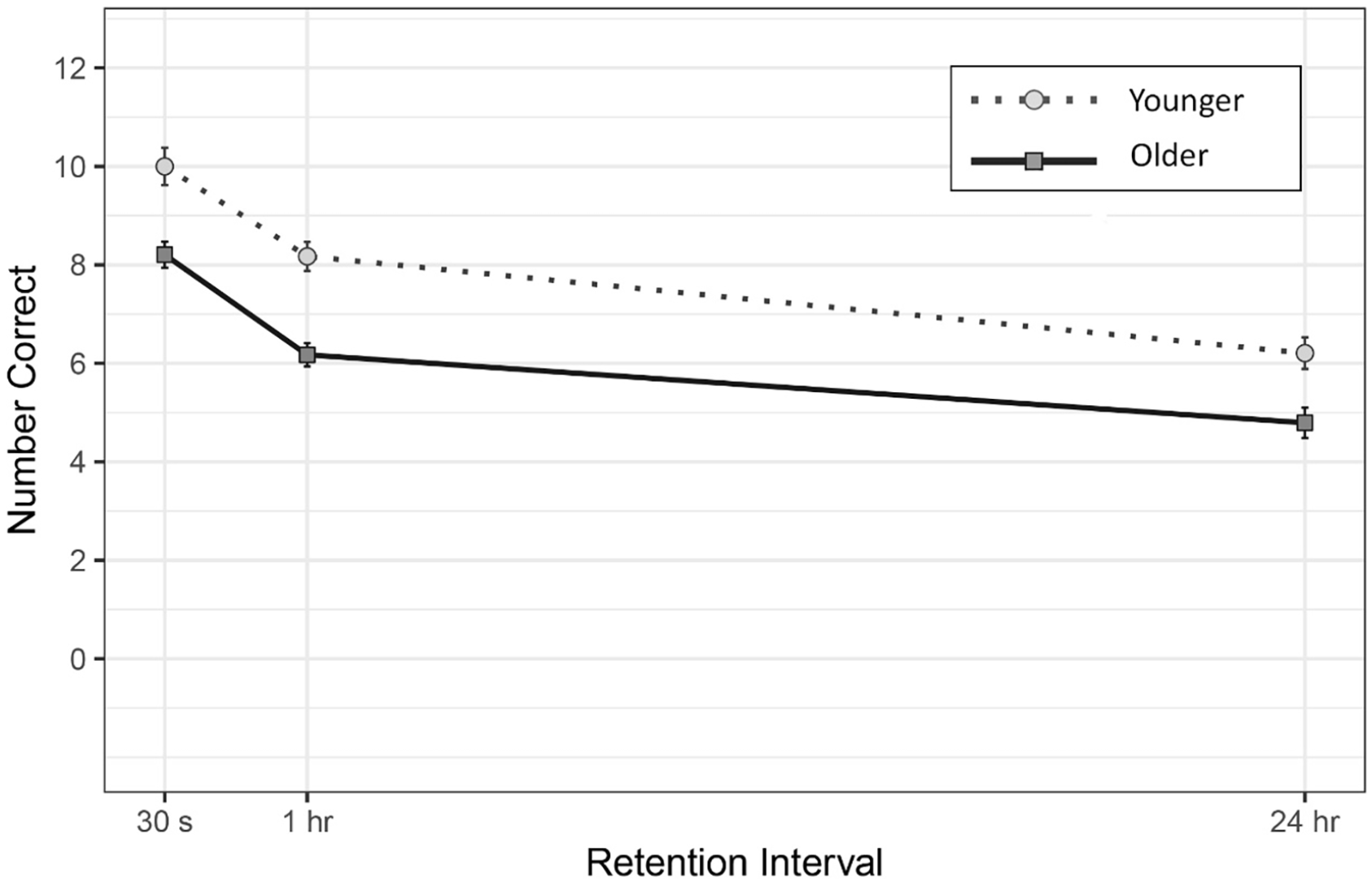
Forgetting rates across retention intervals for younger and older adults in experiment 1.
Age effect of initial degree of learning
There was substantial evidence of an age effect, with older adults presenting a lower probability of correctly retrieving a sentence compared to younger adults at 30 s (b = –0.97, SD = 0.28, CI = [–1.54, –0.43]), at 1 hr (b = –0.9, SD = 0.33, CI = [–1.53, –0.26]), and at 24 hr (b = –0.62, SD = 0.31, CI = [–1.23, –0.02]).
Retention interval effect
There was substantial evidence of an effect of retention interval. The probabilities of correctly retrieving a sentence were lower from 30 s to 1 hr (b = −0.89, SD = 0.18, CI = [−1.25, −0.53]), from 1 hr to 24 hr (b = −0.93, SD = 0.16, CI = [–1.23, –0.63]), and from 30 s to 24 hr (b = –1.82, SD = 0.18, CI = [–2.17, –1.48]).
Effect of the interaction between age group and retention interval
There was no substantial evidence of an interaction between 30 s and 1 hr (b = 0.08, SD = 0.26, CI = [–0.44, 0.6]), between 1 hr and 24 hr (b = 0.28, SD = 0.24, CI = [–0.2, 0.76]), and between 30 s and 24 hr (b = 0.36, SD = 0.27, CI = [–0.17, 0.89]).
Errors
The incorrect responses were classified as omissions, and as intrusions of studied and non-studied verbs and objects. However, the number of errors of each type was too small to allow for any meaningful statistical comparisons, and therefore, were not analysed further.
Summary and comment
As expected, we found a substantial difference in initial degree of learning between age groups. With the same number of exposures to the sentences, older adults recalled fewer sentences at 30 s relative to their younger counterparts. Performance declined with each retention interval. Most of the forgetting occurred during the 1 hr interval, consistent with the classic forgetting curve first described by Ebbinghaus (1885/1964). Importantly, both groups forgot at the same rate despite their initial differences, indicating independence of forgetting rates from the differences at initial acquisition.
The focus of this study was not to explore age-related differences in encoding or forgetting. Rather, the main objective was to investigate if the pattern of parallel rates of forgetting after different degrees of initial retention found in previous studies (Slamecka & McElree, 1983; Rivera-Lares et al., 2022) replicates when the difference in initial degree of learning was not the result of laboratory manipulations during encoding, but resulted from natural differences in encoding capacity due to age. The results of this experiment replicated the pattern found by Slamecka and McElree (1983), and by Rivera-Lares et al. (2022) but are inconsistent with Yang et al. (2016).
To ensure that our results from Experiment 1 were sufficiently robust to replication, a second experiment was carried out with a reduced number of sentences to maximise initial levels of memory performance in both older and younger participants, while avoiding ceiling effects. In Experiment 2, we used the same material from Experiment 1, but excluded the six sentences with the lowest scores at the 30 s retention interval. Again, our focus was on the impact of differential initial memory performance on forgetting rate, taking advantage of an expected initial performance between the two age groups.
Experiment 2
In this experiment, we compared the forgetting rates of older and younger adults using a list of 30 sentences at retention intervals of 30 s, 1 hr, and 24 hr. Memory performance was assessed via cued recall, using a different subset of the studied material at each retention interval.
Method
Participants
Following the same constraints set out in Experiment 1, a further 60 healthy participants were recruited into two age groups. Three younger adults and one older adult were excluded from the final analysis as they failed to engage with the task. The final analyses included the performance of 27 younger adults (Mage = 22.89, SD = 3.46, range: 18–30, 6 men), and 29 older adults (Mage = 69.8, SD = 8.13, range: 60–89, 10 men). None of the participants had taken part in Experiment 1. The criteria for participant inclusion and ethics approval were the same as for Experiment 1.
Materials
The materials were 30 sentences from the 36 used in Experiment 1. Each response sheet was scored per sentence with either 1 (correct) or 0 (incorrect). With 10 sentences tested at each retention interval, the score range was 0 to 10 at each assessment.
Design
The dependent and independent variables are the same as in Experiment 1.
Procedure
The procedure was identical to that from Experiment 1, except that the response sheets were created with subsets of 10 items each (i.e., a third of the original material per response sheet).
Planned analysis
The data from this experiment were analysed in the same manner as Experiment 1.
Results
A depiction of the forgetting rates of each group across the three retention intervals is displayed in Figure 2.
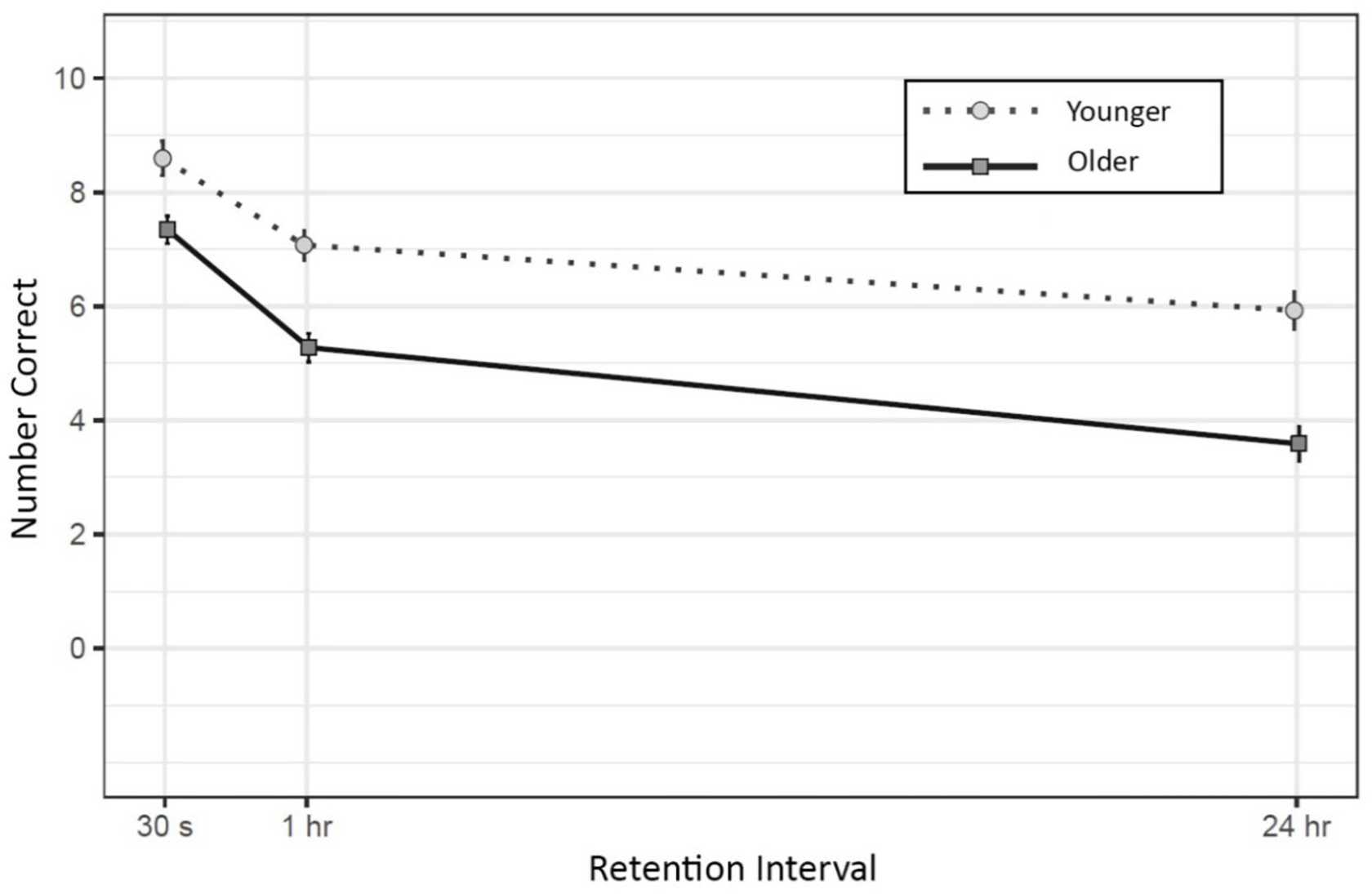
Forgetting rates across retention intervals for younger and older adults in experiment 2.
Age effect of initial degree of learning
There was substantial evidence of an age effect across retention intervals at 30s (b = –1.31, SD = 0.53, CI = [–2.33, –0.27]), 1 hr (b = –1.16, SD = 0.5, CI = [–2.14, –0.2]) and 24 hr (b = –1.32, SD = 0.46, CI = [–2.24, –0.43]).
Retention interval effect
There was substantial evidence of the effect of retention interval. The probabilities of correctly retrieving an item decrease from 30 s to 1 hr (b = –1.4, SD = 0.32, CI = [–2.05, –0.79]), from 1 hr to 24 hr (b = –0.8, SD = 0.31, CI = [–1.42, –0.21]), and from 30 s to 24 hr (b = –2.21, SD = 0.36, CI = [–2.93, –1.52]).
Effect of the interaction between age group and retention interval
There was no substantial evidence of an interaction between 30 s and 1 hr (b = 0.15, SD = 0.38, CI = [–0.58, 0.9]), between 1 hr and 24 hr (b = –0.16, SD = 0.39, CI = [–0.94, 0.61]), and between 30 s and 24 hr (b = –0.01, SD = 0.44, CI = [–0.87, 0.85]).
Errors
The incorrect responses were classified in omissions, and intrusions of studied and non-studied verbs and objects. As in Experiment 1, no further analyses were carried out in these data since the number of errors per category was too little to make any meaningful comparisons.
Summary and comment
In Experiment 1, older adults recalled substantially less than younger adults, and the performance of both groups decreased with each delay at the same rate. Out of 12 sentences, younger adults retained a mean of 10 sentences at 30 s, and older adults slightly above eight sentences. In Experiment 2 with a smaller number of sentences, the difference at 30 s was similar. Younger adults performed better at the initial interval than older adults. This performance decreased rapidly within the first hour, and slower at the second, longer delay, in similar fashion to the Ebbinghaus (1885/1964) forgetting curve. Both groups forgot at a similar rate, showing independence from the different degrees of learning.
General discussion
The objective of this study was to investigate if forgetting rates are independent of the initial degree of learning when the difference at initial recall is given by natural variations in encoding ability, such as the ones produced by ageing. Instead of manipulating the encoding process to create differences in initial acquisition, we tested older and younger adults as it is known that ageing is associated with a decline in the ability to acquire new information (Kausler, 1994). In two experiments, both age groups were presented with four repetitions of a list of 36 sentences in Experiment 1, and 30 sentences in Experiment 2. Participants were tested at intervals of 30 s, 1 hr, and 24 hr by means of written cued recall. As in previous studies with manipulations during the presentation of the material (e.g., Feng et al., 2019; Rivera-Lares et al., 2022; Sinyashina, 2019), a substantial difference between groups was found at the initial test. The correct recall of the sentences decreased with each delay, showing forgetting. Forgetting was faster during the first and shorter interval, and levelled out during the second, longer interval. This pattern matches the classic Ebbinghaus forgetting curve (Ebbinghaus, 1885/1964), a pattern that has consistently been found in several studies with different designs, types of tests, interval lengths, and materials (for a review see Rubin & Wenzel, 1996). Critically, the rates at which information was forgotten were the same for both age groups, in both experiments. Currently, there is no consensus regarding whether the rate of forgetting is independent of initial degree of learning, and the question of whether learning and forgetting are two sides of a similar process is still without a definitive answer. However, the evidence seems to be mounting in favour of the independence of forgetting from initial degree of learning, as the present results are consistent with Slamecka and McElree (1983), Giambra and Arenberg (1993), and Rivera-Lares et al. (2022). Our results are, however, inconsistent with Yang et al. (2016) and with Loftus (1985). The inconsistency with Yang et al. could stem from the different methods used during encoding. Their material consisted of words and word pairs, and during encoding the participants were asked to perform a concreteness judgement task, and to form a sentence with the word pairs, whereas we simply asked participants to read and remember a list of unconnected sentences.
Our results also are inconsistent with Loftus (1985), most likely due to differences in the method for measuring forgetting. Loftus stated that the observable measures of forgetting, such as the number of items correctly recalled, must be related to an unobservable psychological process that will not necessarily have a linear relationship with the observable measure. If the decline of the unobservable measure of forgetting was, for example, exponential, as is the decay of the radioactivity, two forgetting rates should only be compared when both have achieved the same level of the observable variable, such as the same number of correct responses. This method of horizontal comparison is immune to scaling issues because the transformations of the dependent variable would adjust the forgetting slopes in the vertical direction (i.e., y-axis), leaving intact the differences in the horizontal direction (i.e., x-axis). As noted in the introduction, the Loftus method also confounds the age of the memory with the rate of forgetting. A further problem we see with the Loftus method is that although there must be underlying psychological mechanisms of forgetting, to this date there is no strong evidence to suggest that it follows an exponential function. The pattern that has emerged with most consistency in the forgetting literature is a negatively accelerated curve, which describes rapid forgetting at the initial intervals followed by slower forgetting. This pattern is consistent with Jost’s (1897) second law of forgetting, which suggests that older memories are less susceptible to being forgotten than newer ones. It follows that the Loftus method confounds the comparison of memories of different ages, and therefore of different strength, with retention interval and initial levels of performance.
Our results raise an interesting problem. In the quest to find the shape of forgetting, most researchers have concentrated their efforts into fitting a single function, be this exponential, logarithmic, power, or linear (e.g., Fisher & Radvansky, 2019; Loftus, 1985; Rubin & Wenzel, 1996; Wixted & Ebbesen, 1991), which implicitly assumes that there is a unitary source of trace strength. One exception is the model proposed by Bogartz (1990) that assumes that there could be more than one source of the rate of forgetting. Of all the single function proposals, the one that has been reported more frequently is the negatively accelerated curve from Ebbinghaus, with which our data are consistent. The problem that our data present is that it is unclear how forgetting data that start from different levels can result in parallel forgetting slopes that are negatively accelerated. We agree with Rubin and Wenzel (1996) in that psychology could advance as a science if research establishes robust regularities to describe phenomena. Together, the data from Slamecka and McElree (1983), Rivera-Lares et al. (2022) and the data reported in this article, seem to indicate that there is a function of forgetting that has not been described to this date. Although the intention of this article is not to explain this phenomenon, we offer a proposal for future research: since it is unclear how a single function could explain our data, a solution to be explored would be that there are two or more contributions to the initial recall and the subsequent course of the forgetting slopes. One source of forgetting could be represented by a gradual erosion of traces over time following a linear function, and the other one would assume that different kinds of information have different rates of forgetting (Radvansky et al., 2022) due to differences in their resistance to such erosion. This perhaps would depend on the nature of the remembered material, for example, with detail encoded less robustly than gist (e.g., Sacripante et al., 2022), producing a non-linear function.
Although we used groups of different ages to investigate forgetting curves, the goal of this study was to determine the relationship between initial level of acquisition and forgetting rates, and not to examine age-related differences in acquisition or forgetting. Therefore, this discussion will not focus on previous findings related to age differences in forgetting, especially because most of the relevant studies match initial acquisition between age groups, hindering conclusions about the influence of different initial degrees of learning on the rates of forgetting. However, it could be argued that the mechanisms that are affected during learning are the same, or related to, the mechanisms of forgetting. A study that explored individual differences and rate of forgetting was carried out by Zerr et al. (2018). The authors reported differences in forgetting rates after their participants reached criterion through the drop-out method. The forgetting rates, however, did not vary with initial degree of learning, which was identical for all participants, but forgetting rates did vary with the learning rate of each participant. Faster learners retained more information for longer relative to slower learners. Usually, older adults have slower rates of learning for verbal material (Kausler, 1994). In our experiments, after four repetitions of the sentences, there was an initial difference in performance between age groups, which indicates a slower rate of learning in older adults. However, older adults forgot at the same rate than younger adults, regardless of their initial deficit. This study and the results from Zerr et al. are difficult to compare since their focus and the paradigms are different. Due to the nature of our study, an effect of initial degree of learning was essential. In their study, however, initial degree of learning was matched, and the forgetting curves of each participant were compared to each participant’s rate of learning. In this study, individual differences were controlled for in the statistical analyses since the statistical models we employed accounted for individual differences in both initial degree of learning and the forgetting slope. Another important difference between the study by Zerr and colleagues and our design is that to reach criterion and to decide which words needed to be repeated, tests were intercalated between the repetitions of the material. Our study, on the contrary, had only four study trials followed by the tests.
One concern that arises when testing the same participants over multiple delays is the possibility of retrieval-induced forgetting, which occurs when various targets compete during retrieval for their association with a common cue (Anderson et al., 1994). Our material minimised the possibility of retrieval-induced forgetting since the subject used as cue for each sentence was unique to each verb and each object. If retrieval-induced forgetting had been present in our results, we would expect to have seen intrusions of studied items more frequently. However, the intrusions of not-studied items and omissions were the most common errors.
Evidence seems to be accumulating in favour of an independence between initial degree of learning and rates of forgetting. The results of both experiments reported here, together with the data obtained by Slamecka and McElree (1983) and Rivera-Lares et al. (2022) show clearly that forgetting rates remain stable regardless of different initial degrees of learning, even when the difference in acquisition is not the result of manipulations during encoding, but a result of natural changes in encoding ability such as the ones that occur during healthy ageing. It is important to note that the evidence we report in this study is limited to the type of material we used, and material used by other studies (e.g., Cohen-Dallal et al., 2018; Kauffman & Carlsen, 1989) that have also found parallel forgetting curves following different initial levels of performance, and only when forgetting is measures as the number of items forgotten over time. Different results could be obtained if forgetting rates are evaluated using a different measure of forgetting such as proportion of loses (e.g., Loftus, 1985) or if differences in the rate of forgetting are assessed using a different approach such as curve-fitting (e.g., Carpenter et al., 2008). Further research is needed to investigate if the pattern found in the two experiments reported here can be replicated across different materials and to explore possible accounts for the negatively accelerated forgetting function observed here and in a range of previous studies. Moreover, the pattern of forgetting could be different at longer intervals, which is worth exploring in future research, providing that floor effects can be avoided.
Supplemental Material
sj-docx-1-qjp-10.1177_17470218221128780 – Supplemental material for Rate of forgetting is independent from initial degree of learning across different age groups
Supplemental material, sj-docx-1-qjp-10.1177_17470218221128780 for Rate of forgetting is independent from initial degree of learning across different age groups by Karim Rivera-Lares, Sergio Della Sala, Alan Baddeley and Robert Logie in Quarterly Journal of Experimental Psychology
Footnotes
Acknowledgements
The authors thank Sabrina Catemario Di Quadri and Michelle Theodory for their help with some data collection.
Declaration of conflicting interests
The author(s) declared no potential conflicts of interest with respect to the research, authorship, and/or publication of this article.
Funding
The author(s) disclosed receipt of the following financial support for the research, authorship, and/or publication of this article: K.R.L. is supported by a Doctoral scholarship provided by the Mexican National Council for Science and Technology (CONACyT—Becas al Extranjero, CVU: 767799).

Data accessibility statement
Notes
References
Supplementary Material
Please find the following supplemental material available below.
For Open Access articles published under a Creative Commons License, all supplemental material carries the same license as the article it is associated with.
For non-Open Access articles published, all supplemental material carries a non-exclusive license, and permission requests for re-use of supplemental material or any part of supplemental material shall be sent directly to the copyright owner as specified in the copyright notice associated with the article.
