




Abstract
In the last 2 years, governments of many countries imposed heavy social restrictions to contain the spread of the COVID-19 virus, with consequent increase of bad mood, distress, or depression for the people involved. Few studies investigated the impact of these restrictive measures on individual social proficiency, and specifically the processing of emotional facial information, leading to mixed results. The present research aimed at investigating systematically whether, and to which extent, social isolation influences the processing of facial expressions. To this end, we manipulated the social exclusion experimentally through the well-known Cyberball game (within-subject factor), and we exploited the occurrence of the lockdown for the Swiss COVID-19 first wave by recruiting participants before and after being restricted at home (grouping factor). We then tested whether either form of social segregation influenced the processing of pain, disgust, or neutral expressions, across multiple tasks probing access to different components of affective facial responses (state-specific, shared across states). We found that the lockdown (but not game-induced exclusion) affected negatively the processing of pain-specific information, without influencing other components of the affective facial response related to disgust or broad unpleasantness. In addition, participants recruited after the confinement reported lower scores in empathy questionnaires. These results suggest that social isolation affected negatively individual sensitivity to other people’s affect and, with specific reference to the processing of facial expressions, the processing of pain-diagnostic information.
Introduction
In March 2020, more than 1 billion people were under home confinement due to the COVID-19 pandemic. To contain the spread of the virus, many countries closed schools and universities, encouraged homeworking and, in some cases, prohibited people from leaving the house unjustified at the risk of heavy sanctions. Even in those countries where no full-lockdown was implemented, people were nevertheless prompted to maintain social distance and, when this was not possible, to wear facemasks. All these measures had negative social and psychological consequences, such as distress, negative mood, or depression (Brooks et al., 2020; Li & Wang, 2020; Odriozola-González et al., 2020; Pancani et al., 2021; Saladino et al., 2020). This adds to the well-known effect of social isolation, previously measured by studies testing exclusion or confinement in polar/submarine expeditions (Jaremka et al., 2011; Onoda et al., 2010; Palinkas & Suedfeld, 2008), as well as to research documenting the positive influence of strong and long-lasting social interactions on mental and physical health (Cacioppo et al., 2000; Jaremka et al., 2011).
In addition to a wealth of research on the effect of the lockdown on personal well-being, much less is known about how such massive isolation impacted individual social proficiency and whether individuals became less sensitive to other people’s behaviour/reactions following few months of confinement. Indeed, frequent inter-subjective relationships contribute to the development and maintenance of social skills for better understanding others’ actions, intentions, and feelings (Cacioppo, 2002). More specifically, processing accurately facial emotional information is an important ability that guides the way we communicate and interact successfully with others (Niedenthal & Brauer, 2012). To date, only a few studies investigated the consequences of the social restrictions imposed by the COVID-19 pandemic on the processing of others’ affective facial information. For instance, Cao et al. (2020) documented how Chinese individuals exhibited lesser sensitivity to videos of people reacting to electric shocks following the lockdown, an effect that was paralleled by decreased empathic scores from validated questionnaires (Davis, 1980). Instead, Meléndez et al. (2020) investigated the impact of lockdown on emotional facial recognition comparing the performance of Spanish individuals before and after the confinement. Authors found decreased recognition rates of happy expressions and higher sensitivity to sad faces. On the contrary, the lockdown had no effect on the processing of anger, fear, surprise, or disgust. As the same individuals expressed higher level of depressive mood following the confinement, authors interpreted their findings as a mood-dependent effect, whereby individuals might be more sensitive to those facial cues that match their own current affective state (Meléndez et al., 2020). Finally, Scarpina (2020) engaged Italian participants during the lockdown in an online experiment testing early implicit coding of fearful faces, but she found no difference from data of an independent laboratory-based study run before the pandemic. Overall, results from available research provide mixed evidence, possibly reflecting methodological differences between studies, which investigate different kinds of states (e.g., pain, happiness, sadness, and anger) across different tasks and measures (emotional rating, classification, implicit effect). This begs for a systematic investigation of the effect of social isolation on the processing of emotional face cues, to obtain conclusive evidence on which component of the facial response might be influenced by the lockdown.
Indeed, previous studies allow us to speculate that social isolation should not exert a “broad” effect on our social proficiency, but rather could influence only specific aspects of the emotional expression. A wealthy line of research manipulated social exclusion experimentally (through a game or bogus personality tests) and found that this experience shared many properties with that of physical pain (Antico et al., 2018; Bernstein & Claypool, 2012; DeWall & Baumeister, 2006; Eisenberger et al., 2006; MacDonald et al., 2005). Furthermore, exclusion influences the behavioural and cardiac response to subsequent pain (Antico et al., 2018; Bernstein & Claypool, 2012; DeWall & Baumeister, 2006; Eisenberger et al., 2006; MacDonald et al., 2005), an effect that does not generalise to comparably-unpleasant, but painless, events such as disgust (Antico et al., 2018). Although these effects were observed when pain (and disgust) was delivered on one’s own body, it is reasonable to assume that they might be extended also to the appraisal of others’ faces. Indeed, seminal models of social psychology and neuroscience suggest that inference about others’ affect might be partially instantiated in the same mechanisms underlying one’s own firsthand experiences, along with similar neuronal and motor responses (Botvinick et al., 2005; Gu & Han, 2007; Jackson et al., 2005; Morrison et al., 2007; Saarela et al., 2007; Singer et al., 2004). Consistently, being subjected to physical pain can affect one’s sensitivity to the others’ pain expressions (Antico et al., 2019; Coll et al., 2012; Reicherts et al., 2013; Wieser et al., 2014). Within this framework, social exclusion is held to put individuals in a state of psychological sufferance partly similar to that elicited by nociceptive experiences, which in turn might influence the processing of those facial reactions that relate specifically to pain.
In the present study, we capitalised on an ongoing experiment in our laboratory where individuals were excluded socially by means of a virtual ball-tossing game (Antico et al., 2018; Olié et al., 2018) and immediately after they were exposed to painful, disgusting, neutral expressions, or hybrid combination thereof (Antico et al., 2019). Participants were asked either to classify the expressions in terms of state (classification task) or to rate the associated unpleasantness (rating task). This allowed to obtain two independent measures, one probing for state-specific information in facial responses and the other testing supra-ordinal dimensions common between pain and disgust. Critically, data collection was unexpectedly interrupted due to lockdown issued in March 2020 (in Geneva, Switzerland) and started again in September 2020. This gave us an unprecedented opportunity to analyse data, not only in terms of experimentally manipulated exclusion (within-subject factor) but foremost in terms of previous exposure to massive pandemic-related isolation (grouping factor). Based on the literature reviewed above, we expected that social isolation should impact selectively the processing pain-specific facial responses (from the classification task), but not broad face components related to common aspects between the two states.
Materials and methods
Participants
In this experiment we exploited as pre-lockdown group a sample of 80 participants (33 men, mean age 24.30 years ± 4.68 standard deviation [std], age range 18–34) who took part in two studies testing the role of social exclusion in the appraisal of facial expression (Classification Task: N = 50, 25 men, age 23.98 years ± 4.96 std, range: 18–34; Rating Task: N = 30, 8 men, age 24.83 years ± 4.19 std, range: 18–34). Data collection occurred between 6 February 2020 and 12 March 2020, and was pre-emptively interrupted by the lockdown associated with the first wave of the COVID-19 pandemic.
As second post-lockdown group, we aimed at recruiting an equivalent number of participants who reported being subjected to lockdown restrictions during the first wave of the pandemic. Hence, we recruited 108 participants (46 men, age 22.27 years ± 3.01 std, range: 18–34) between 07 September 2020 and 19 November 2020, 28 of which were excluded as they declared to not have been subjected to lockdown restrictions at all, as tested through an ad hoc question in the post-experimental debrief section. Specifically, people were excluded if answered 0 to the question “How many days have you been confined at home?” (see Supplementary Materials). Hence, the final post-lockdown group comprised 80 participants (30 men, age 22.36 ± 3.00 std, range: 18–34; confinement: 68.61 days ± 36.89 std, range: 6–210), who underwent the same two tasks as the pre-lockdown group (Classification Task: N = 50, 25 men, age 22.70 years ± 2.98 std, range: 18–34; confinement: 63.92 days ± 35.16 std, range: 10–210; Rating Task: N = 30, 5 men, age 21.83 years ± 3.04 std, range: 18–32; confinement: 76.43 days ± 38.92 std, range: 6–150).
All participants were recruited through advertisements posted at the University of Geneva. None of them declared any neurological/psychiatric disorder. To maximise the likelihood that the recruited participants were naïve as to the purpose of the experiment, psychology and neuroscience students were excluded. All participants gave their informed written consent and were remunerated for their participation. The experimental protocol was approved by the local ethical committee and carried out in accordance with the Declaration of Helsinki.
Facial stimuli
In all tasks, we used the same database of facial expressions that we validated and implemented for our previous study (Antico et al., 2019). This represented artificial avatars from FACSGen software (Roesch et al., 2011) assuming six different expressions. Three were “pure” expressions, fully painful, disgusted, and neutral (the last characterised by the absence of any facial muscle contraction). The remaining three were “hybrid” expressions, resulting from the weighted mean between each combination of two pure states (Pain vs. Neutral; Disgust vs. Neutral; Pain vs. Disgust). Each hybrid stimulus was optimised to ensure that it was as much ambiguous as possible and that one state was not more easily detectable than the other (see Antico et al., 2019). Each of the six facial expressions was applied on 30 artificial identities (15 males, 15 females), leading to an overall of 180 images.
Classification task
In this paradigm, participants played a virtual ball-tossing game called Cyberball with four confederates, two exhibiting exclusive behaviour towards the participant and the other two with more inclusive attitudes (Antico et al., 2018; Olié et al., 2018; Williams et al., 2000). The parameters of the game were similar to those of our previous study (Antico et al., 2018). A little hand from first-person perspective represented the participant, whereas line-drawings of human bodies referred to the confederates that were identified as “A&B” and “C&D.” Unbeknownst to participants, confederates’ behaviour was computerised so that “A&B” interacted regularly with participants, by throwing the ball to them 46% of all instances (Inclusion condition), whereas “C&D” rarely played with participants, by throwing the ball to them between 0% and 15% of all instances (Exclusion condition). In addition, as non-social control condition, we added a third gaming session, where participants played pinball by him-/herself (condition Pinball). This session was identical to the inclusion condition, with the exception that animations of human players were replaced with flippers and bouncers (see Figure 1a and b).
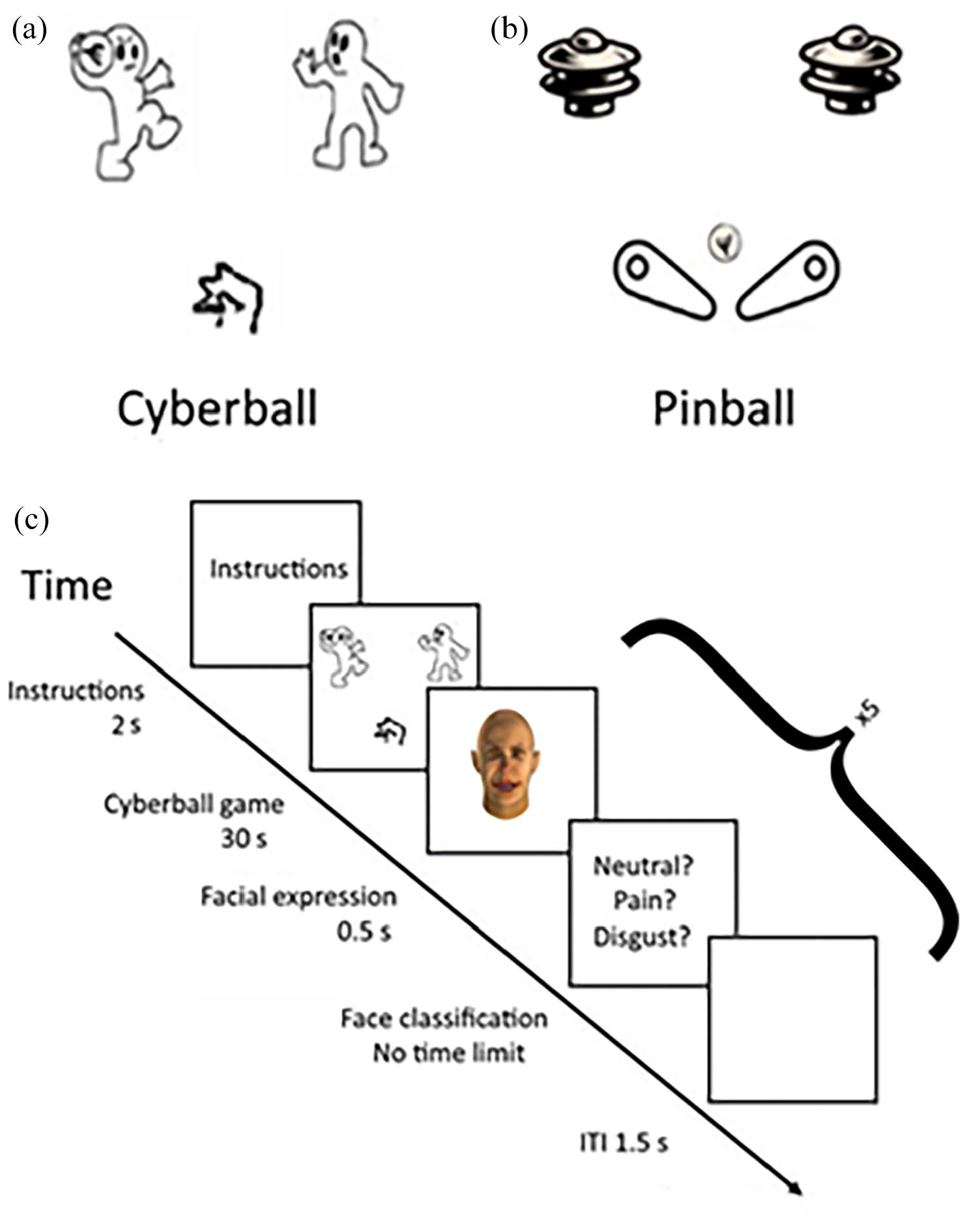
(a) Pictorial representations of Cyberball and (b) Pinball game. (c) Trial structure. Each trial started with the instructions presented on the screen for 2 s, followed by the game (Cyberball or Pinball) for 30 s. Next, a face appeared for 500 ms and at the bottom of the screen with the three response options, namely “NEUTRAL,” “PAIN,” and “DISGUST.” The inter-trial interval lasted 1.5 s before the subsequent facial expression.
More specifically, the task was organised in two blocks of 20 min each. Each block included 18 gaming sessions (each lasting ~30 s), six for each trial of Inclusion, Exclusion, and Pinball. Each gaming event was followed by a rapid sequence of five facial stimuli, corresponding to an overall of 90 expressions for each block (30 following each game condition). As in Antico et al. (2019), each face was presented for 500 ms. At the bottom of the screen, we displayed the three response options, namely, “NEUTRAL,” “PAIN,” and “DISGUST.” Participants were asked to respond as accurately as possible with no limit of response time, with the “1,” “2,” or “3” keys of the keyboard. Before the start of the next facial expression, we showed an empty screen for 1.5 s (see Figure 1c).
Finally, and consistently with our previous study (Antico et al., 2018), the experimental session was introduced by two training blocks: one inclusion (with players “A&B”) and one partial exclusion (where players “C&D” were only moderately ostracising) trial of no interest. Each of these training blocks was followed by five facial stimuli independent from the overall database obtained by two different identities and served prevalently the purpose of familiarising participants with the protocol. Overall, the experiment was controlled using Cogent 2000 (Wellcome Dept., London, UK), as implemented in MATLAB R2012a (Mathworks, Natick, MA, USA).
Rating task
This paradigm was almost identical to the classification task described earlier. The only difference lied in the response provided during the presentation of the facial expressions, as in this case a visual analogue scale (VAS) ranging from extremely unpleasant to extremely neutral was displayed. Participants were instructed to rate the unpleasantness of the emotional facial expression by moving a marker on the position of the VAS that corresponded to their judgement. The selected position was subsequently recoded as a scalar ranging from −5 (extremely unpleasant) to + 5 (extremely neutral), and 0 referring to the middle of the scale. Participants were asked to rate the unpleasantness of the emotional expression as spontaneously as possible.
Procedure
At each experimental session, five participants were welcomed together to the laboratory, listened to the instructions, and signed the consent form. As part of the cover story, they were told that they were identified with a letter of the alphabet and were engaged to play two games: a virtual ball-tossing game, in which they were all expected to interact from different computer stations, and a virtual pinball game, in which each individual played alone. Unbeknownst to participants, they never truly interacted with one another, but faced pre-programmed gaming sessions. They sat in a chair in front of a PC (Dell) that projected visual stimuli from on a screen (1024 × 768 resolution) and recorded keypresses on a keyboard. Subsequently, they went through the main experimental session (two blocks of about 20 min each, separated by a pause of about 5 min). The entire experimental procedure lasted about 1 hr. After the task, participants were asked to fill the questionnaires assessing whether the exclusion manipulation was effective: this included estimates of belongingness, exclusion, inclusion, self-value, co-players pleasantness (i.e., how much the co-players were pleasant to the participants), and self-pleasantness (Antico et al., 2018). In addition, we asked participants to rate to what extent their subjective experience with the two inclusive and exclusive couples matched nine emotional states (anger, fear, relief, anxiety, happiness, stress, boredom, irritation, and disgust), on a scale from 1 (not at all) to 5 (absolutely). Importantly, as these questions probed explicitly participants’ experience towards human co-players, no measure could be taken for the control Pinball condition. Finally, to identify those participants who realised the deceptive nature of the study, we asked them to guess, through an open question, which was the goal of this experiment. At the end, participants were debriefed. Everyone believed in the cover story and we could keep all data.
At home, participants filled out several questionnaires. In particular, given that previous studies reported that trait empathy could influence behavioural responses to emotional expressions (Bauser et al., 2012; Chartrand & Bargh, 1999; Coll et al., 2012; Gery et al., 2009; Wang et al., 2016; Yamada & Decety, 2009), we administered the Interpersonal Reactivity Inventory (Davis, 1980). In addition, we included also the Beck Depression Inventory (Beck et al., 1961) and the State-Trait Anxiety Inventory (Spielberger et al., 1983) to assess respectively their level of depression and stable aspects of anxiety, and the Rejection Sensitivity Questionnaire (Downey & Feldman, 1996) to measure sensitivity to the rejection of significant others.
There was an additional questionnaire administered in the second group, given that it took place after the first peak period of public concern about the coronavirus. Specifically, we asked five questions about the emerging COVID-19 outbreak, for instance, how many days they were subjected to lockdown rules and how many people they were with at home during the lockdown (please see the full list of items in Supplementary Materials).
Data processing
Data analysis was carried out with R 4.0.5 freeware software (https://cran.r-project.org/). As post-experimental measures about the Cyberball game and questionnaires were identical across Classification and Rating Tasks, the population of the two paradigms was combined together into an overall sample of N = 160 (80 pre-lockdown and 80 post-lockdown). Within this framework, we took the 15 Cyberball measures of interest (six probing the effectiveness of the manipulation, nine associated with affective responses) and fed each of them to a separate Repeated Measures analyses of variance (ANOVAs) with Game (Exclusion, Inclusion) as within-subject factor and Group (pre-lockdown, post-lockdown) as between-subject factor. Effects in these ANOVAs were considered significant only under an α error = 0.0033 (corresponding to 0.05/15), thus insuring rigorous Bonferroni-correction for multiple comparisons for all repeated tests.
For all other questionnaire scores, Group differences were assessed through independent samples t-tests. In particular, the direction of the effects associated with the four empathy subscores of the Interpersonal Reactivity Index (IRI) could be well predicted by the previous study from (Cao et al., 2020) which found decreased scores following the lockdown (except for the Personal Distress subscore which increased). As such, we tested “directional” effects under one-tailed significance for any of the four subscores, thus leading to a one-tailed α error = 0.0125 (corresponding to 0.05/4).
In addition, we further explored potential group differences in the post-experimental questionnaires, with a Bayesian analysis, to assess the likelihood of a main differential hypothesis, against an alternative null. This was achieved through the “JZS” t-test from (Rouder et al., 2009), which exploits a non-informative Jeffreys prior on the variance of the normal population, combined with a Cauchy prior is placed on the standardised effect size. Consistently with previous t-tests, group comparison of IRI scores was carried out under directional hypothesis, whereas for all other scores, a two-tailed main hypothesis was implemented. The analysis was carried out as implemented in the BayesFactor package of R (https://richarddmorey.github.io/BayesFactor/).
As for the classification tasks, the analysis was carried out on the 100 participants (50 pre-lockdown and 50 post-lockdown) who took part in this specific paradigm. In line with the analyses described in Antico et al. (2019), we first analysed participants’ ability to classify pure facial expressions and considered as measures of interest the median Response Times of correct responses (the median is less vulnerable than the mean by single-trial outliers) and Accuracy rates associated with each condition. Each of these measures was fed in a separate Repeated Measures ANOVA with Game (Exclusion, Inclusion, Pinball) and Expression (Neutral, Pain, Disgust) as within-subject factors, and Group (pre-lockdown, post-lockdown) as between-subject factors. Effects associated with these ANOVAs were considered significant under an α error = 0.025 (corresponding to 0.05/2). As follow-up analysis, we explored participants proficiency in the task by examining the errors associated to each facial expression. More specifically, for each subject and condition of interest, we counted the overall number of responses of each condition (e.g., how many times pain expressions were classified as “disgust”) and fed it to a generalised linear mixed model with Poisson distribution and Laplace approximation, with participants’ identity specified as random factor (with random intercept and slope for within-subject factors). This analysis was preferred to a standard ANOVA following recommendations which suggest how Poisson regressions are the most suitable tool for the modelling of count data (Nussbaum et al., 2008).
Finally, we analysed participants’ performance for the hybrid expressions. As in this case, there was no correct or incorrect answer, the analysis of Reaction Times was carried out on all trials, regardless of the response, through a similar ANOVA scheme than for the analysis of the pure expressions. Instead, for the analyses of the responses, we counted the occurrence of each classification label for each subject and condition through a generalised linear mixed model with Poisson distribution, with subjects’ identity as random factor (with random intercept and slope for Expression and Game). The mixed model analysis was carried out with the lmerTest package (Kuznetsova et al., 2017). Significance of the estimated effects was assessed though an Analysis of Deviance with Wald χ2 as implemented in the car package.
For the rating task, we analysed the data from the 60 participants (30 pre-lockdown and 30 post-lockdown) who took part in this specific paradigm. Hence, the median unpleasantness rating of each subject/condition was fed to a Repeated Measures ANOVA with Game (Exclusion, Inclusion, Pinball) and Expression (Neutral, Pain, Disgust, and hybrid combination thereof) as within-subject factors and Group (pre-lockdown, post-lockdown) as between-subjects factor.
For all analyses, we used as estimates of effect size the partial eta-squared (η p 2) for ANOVAs, Cohen’s d = t/√n for t-tests. As the recruitment was constrained by the (unexpected) occurrence of the COVID-19 lockdown, the sample size was not optimised to maximise power. We nevertheless ran sensitivity power analyses to assess the minimum effect size detectable for the current sample, with a power of (1 − β) ⩾ 0.80, and α ⩽ 0.05 (two-tailed). For the analysis of group differences in questionnaire scores (based on the sample N = 147 out of the original 160, 73 pre- and 74 post-lockdown, for which questionnaire data were available), we obtained the minimum effect size detectable through an independent sample t-test of Cohen’s d = 0.46. For the four empathy subscores of IRI, we used an alpha error = 0.0125 (corresponding to 0.05/4—one-tailed) and we obtained the minimum effect size detectable through an independent sample t-test of Cohen’s d = 0.51. For Repeated Measures ANOVA, we first considered as relevant tests either the main effect of Group, or the interaction between Group and the other manipulated factors. Furthermore, when relevant, we also considered the effect played by the Cyberball exclusion on the assessment of facial expression, as described by the Game*Expression interaction. For the analysis of the 15 Cyberball post-experimental scores (N = 160, 80 pre- and 80 post-lockdown), we used an alpha error = 0.0033 (corresponding to 0.05/15) and we obtained the minimum effect size detectable through an ANOVA would be η p 2 = 0.07 (for group main effect) and η p 2 = [0.02–0.03] (for within-subjects main effect and between-within interaction). In analysis of the classification task (N = 100, 50 pre- and 50 post-lockdown), we corrected the alpha error (0.05/2 = 0.025) and we obtained the minimum effect size converged around η p 2 = 0.08 (for group main effect) and η p 2 = [0.02–0.03] (for within-subjects main effects and between-within interactions). For the rating task, where the sample was lower (N = 60, 30 pre- and 30 post-lockdown), but only one measure was taken, the minimum values were η p 2 = 0.10 (for group main effect) and η p 2 = [0.03–0.04] (for within-subjects main effects and between-within interactions). The sensitivity analyses were run using G*Power 3.1.9.2 freeware software (Faul et al., 2007).
Results
Cyberball scores
80 participants of the pre-lockdown group and 80 participants of the post-lockdown group rated 15 Cyberball measures of interest after the experimental sessions (six assessing the effectiveness of the manipulation and nine associated with emotional states—see “Methods” section). We ran a repeated measures ANOVA to test whether self-reports of social distress were modulated by the lockdown due to the COVID-19 pandemic and the prior gaming condition. By applying correction for 15 multiple comparisons (critical α = 0.0033), we found a main effect of Game in all 15 measures (Fs ⩾ 48.16, p < .001, η p 2 ⩾ 0.23), reflecting the effective social treatment of the Cyberball manipulation. Indeed, subjects reported higher values of exclusion and lower rates of all other measures (belongingness, inclusion, pleasantness etc.) for the exclusive co-players compared with the inclusive. No other effect in the ANOVAs was found to be significant under the chosen threshold (Fs ⩽ 4.91, ps ⩾ 0.028, η p 2 ⩽ 0.03).
Post-experimental questionnaires
We asked participants to fill out several questionnaires at home. Data for only 147 (out of 160) participants were available (73 pre-lockdown and 74 post-lockdown). In particular, we ran independent sample t-tests on the four subscores of the IRI questionnaire, in the attempt to replicate the effects previously reported by Cao et al. (2020). We found a significant group (pre- vs post-lockdown) difference only for the empathy concern subscale of the IRI (Davis, 1980), t(145) = 2.40, p (one-tailed) = .009, d = 0.20. As visible in Figure 2a, and consistently with what found in Cao et al. (2020), the post-lockdown group displayed lower concern and sympathy for unfortunate others compared with pre-lockdown group. No Group difference was observed neither in the other empathy subscales from the Interpersonal Reactivity Inventory (|t|s ⩽ 0.85,|d|s ⩽ 0.07). Furthermore, when assessing scores from other questionnaires probing for about rejection sensitivity, anxiety, and depression, no difference was found (|t|s ⩽ 0.76,|d|s ⩽ 0.06). Finally, we repeated all group comparison by employing a Bayesian “JZS” t-test from Rouder et al. (2009) to assess the likelihood of a main hypothesis of group difference against an alternative (null) hypothesis. Figure 2b displays the Bayes factor associated with each measure, revealing a moderate preference for the null hypothesis for all cases but the Empathic Concern scale. Overall, these analyses suggest that (with one exception) the two groups were indeed reasonably matched for personal and affective dispositions.
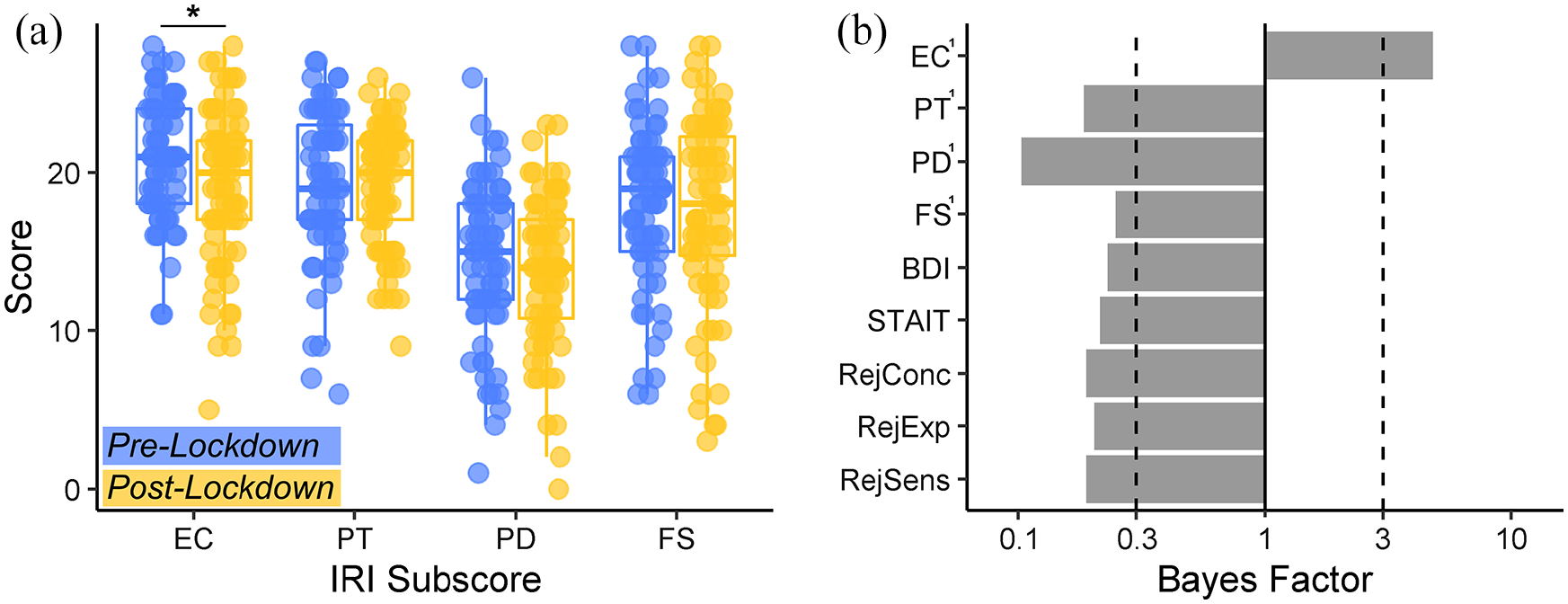
Post-experimental questionnaires. (a) Empathic concern (EC), perspective taking (PT), personal distress (PD) and fantasy (FS) scores associated with each group, pre- and post-lockdown. Each boxplot describes the median value (central horizontal line), the interquartile range (box edges), and extreme points of the distributions (whiskers) without considering outliers. Single subject’s data-points are also plotted over each boxplot as coloured circles. Blue boxplots refer to the scores of pre-lockdown group, yellow boxplots refer to the scores of post-lockdown group. *p < .05 refers to differential scores between the pre- and post-lockdown conditions. (b) Bayes Factor comparing a main hypothesis of group difference in questionnaire scores, against an alternative (null) hypothesis. Values > 3 provide moderate support to the main hypothesis, whereas values ⩽ 0.3 provide moderate support to the null hypothesis.
Classification of pure facial expressions
50 participants of the pre-lockdown group and 50 participants of the post-lockdown group took part in the classification task. We first assessed whether individuals’ ability at discriminating pure facial expressions was modulated by the lockdown due to the COVID-19 pandemic and/or the prior gaming condition. We ran a repeated measures ANOVA on both accuracy rates and response time of correct classifications. We found converging evidence of a main effect of Expression, Accuracy: F(2,196) = 62.20, p < .001, η p 2 = 0.39; Response Times: F(2,196) = 148.81, p < .001, η p 2 = 0.60—with an alpha Bonferroni corrected of 0.05/2 = 0.025, reflecting an overall difficulty at classifying pain and disgust faces with respect to neutral ones (Antico et al., 2019). More importantly, an Expression*Group interaction was observed in the analysis of Accuracy, Accuracy: F(2,196) = 3.94, p = .021, η p 2 = 0.04; Response Times: F(2,196) = 1.57, p = .210, η p 2 = 0.02; all other effects, Fs ⩽ 1.94, ps ⩾ .167, η p 2 ⩽ 0.02. We further explored the interaction of Accuracy through independent sample t-tests, revealing how the lockdown decreased the proficiency at classifying painful faces, t(98) = 2.11, p = .038, d = 0.26, but not of disgust or neutral expressions (t(98)s ⩽ 1.41, ps ⩾ .16, ds ⩽ 0.17).
Subsequently, we ran an error analysis to ascertain whether the lower ability found for pain expressions reflected systematic misclassifications with another label between the two groups pre- and post-lockdown. We found that lockdown influenced selectively the misclassification of pain expressions as “disgusted,” generalised linear model with Poisson distribution: χ2(1) = 4.81, p = .028, but not as “neutral,” χ2(1) = 2.70, p = .100, after the lockdown compared with before the lockdown (see Figure 3c). The lockdown had instead no impact in the misclassification of disgust or neutral expressions, χ2(1) ⩽ 3.04, p ⩾ 0.081.
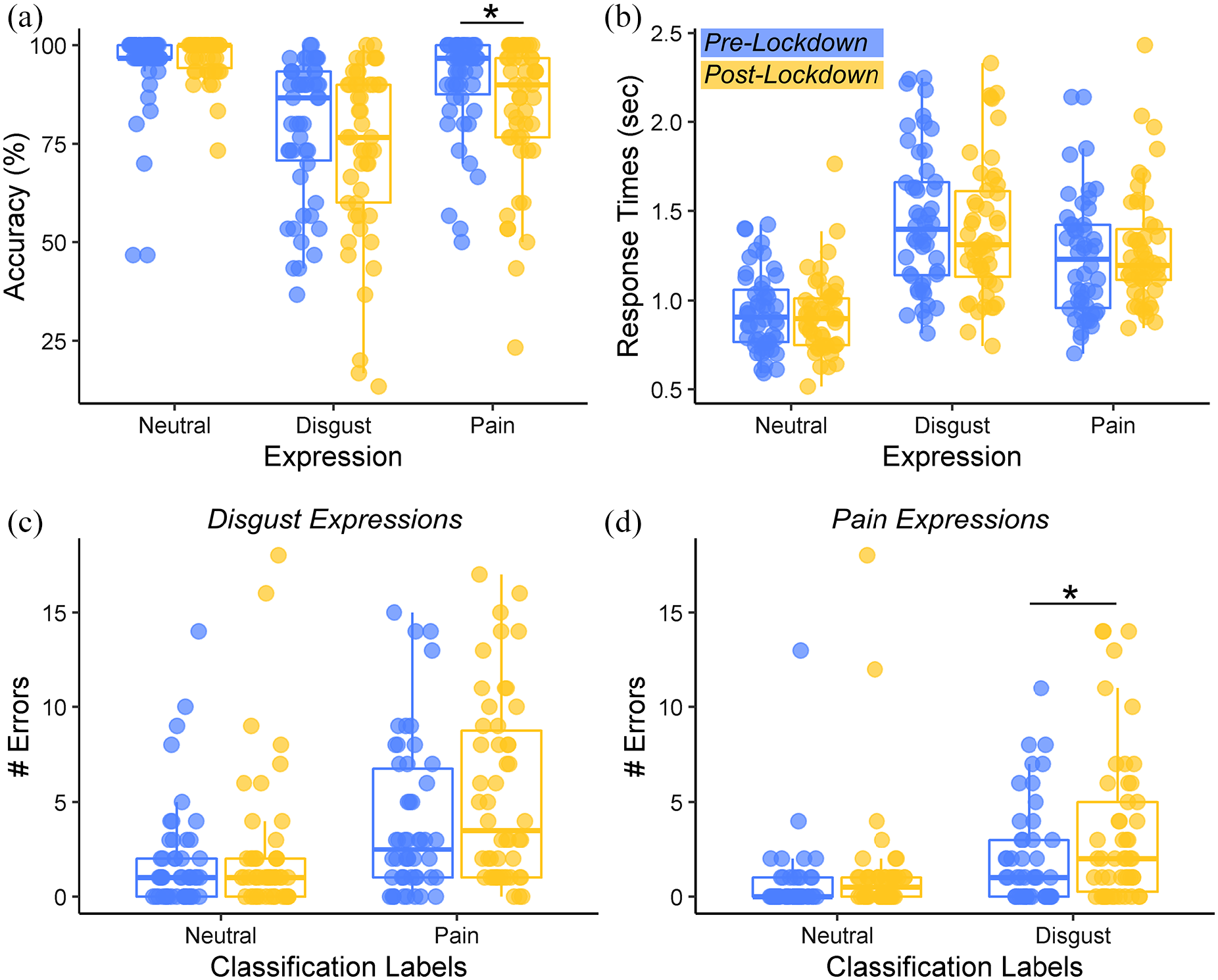
Classification of pure facial expressions. (a and b) Average accuracy rates and response times associated with each of the three expressions—neutral, pain and disgust—pre- and post-lockdown. (c and d) Error analysis: for disgusting (left subplot) and painful (right subplot) expressions, the average amount of cases in which each kind of error occurred. Each boxplot describes the median value (central horizontal line), the interquartile range (box edges), and extreme points of the distributions (whiskers) without considering outliers. Single subject’s data-points are also plotted over each boxplot as coloured circles. Blue boxplots refer to the performance of pre-lockdown group, yellow boxplots refer to the performance of post-lockdown group.
Classification of hybrid expressions
As in Antico et al. (2019), we then focused on the classification of hybrid expressions, which were calibrated to be the most ambiguous between two different states, and for which no correct/incorrect answer exists. A repeated measures ANOVA run on participants’ response times revealed a significant main effect of Expression, F(2,196) = 63.98, p < .001, η p 2 = 0.40. Figure 4 displays the response times across conditions and group, and reveals that, overall, pain–disgust hybrid faces were more challenging than those stimuli combined with neural expressions. A main effect of Game, F(2,196) = 3.34, p = .037, η p 2 = 0.03, was also found, possibly suggesting more speeded responses after inclusion (1,338.57 ms) compared with after exclusion (1,369.50 ms). Finally, we found an Expression*Group interaction, F(2,196) = 4.31, p = .015, η p 2 = 0.04; all other effects, Fs ⩽ 1.58, ps ⩾ 0.214, η p 2 ⩽ 0.02, which was further explored through independent sample t-tests assessing group differences for each hybrid expression separately. For pain–neutral expression, we found marginal faster response times in the post-lockdown group compared with the pre-lockdown, t(98) = 1.73, p = .087, d = 0.21, whereas this was not the case for the other hybrids (ts ⩽ 1.64, ps ⩾ .104, ds ⩽ 0.20; see Figure 4).
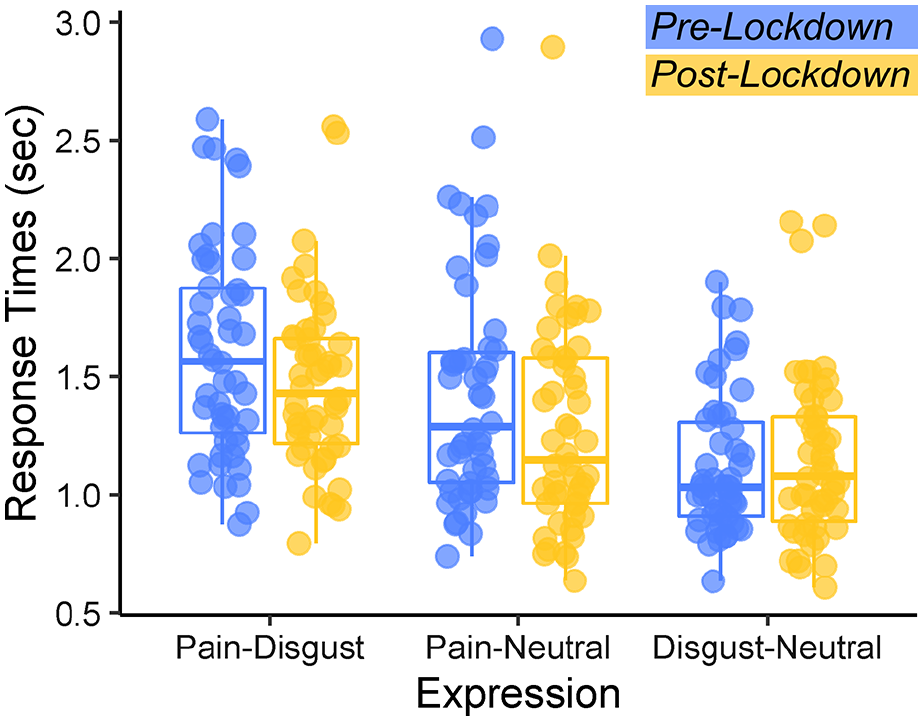
Classification of hybrid facial expressions. Average response times associated with each of the three expressions—pain–disgust, pain–neutral, and disgust–neutral. Each boxplot describes the median value (central horizontal line), the interquartile range (box edges), and extreme points of the distributions (whiskers) without considering outliers. Single subject’s data-points are also plotted over each boxplot as coloured circles. Blue boxplots refer to the performance of pre-lockdown group, yellow boxplots refer to the performance of post-lockdown group.
We then ran a response analysis, aimed at testing whether the amount of each response classification was differentially influenced by the lockdown and prior gaming conditions. For each response classification, we found only an effect of Expression, linear model with Poisson distribution, Neutral: χ2(2) = 370.98, p < .001; Pain: χ2(2) = 282.74, p < .001; Disgust: χ2(2) = 195.93, p < .001, reflecting higher amount of “pain” responses in hybrids derived by pain expressions, higher amount of “disgust” responses in hybrids derived by disgust expressions, and higher number of neutral responses in hybrids derived by neutral expressions. Instead, we found no main/interaction effect associated with group nor the previous game (χ2 ⩽ 5.93, ps ⩾ .204).
Rating of facial expressions
An independent sample of 30 participants in the pre-lockdown group and 30 participants in the post-lockdown group took part in the rating task, where individuals were exposed to the same facial expressions, but rather than classifying each of them according to the state, they were asked to rate the associated unpleasantness. We assessed whether the unpleasantness rating of facial expressions was modulated by the lockdown due to the COVID-19 pandemic and the prior gaming condition. We ran a repeated measures ANOVA on the unpleasantness rating and we found only a main effect of Expression, F(5,290) = 409.45, p < .001, η p 2 = 0.88; all other effects, Fs ⩽ 1.09, ps ⩾ 0.339, η p 2 ⩽ 0.02, reflecting more negative rates in pain, disgust, and pain–disgust hybrids, as opposed to all other faces containing neutral expressions.
Effect of empathic concern on face classification
Up to now, we found that the post-lockdown group displayed both lower empathic concern scores (from IRI questionnaire) and lower ability to recognise others’ pain from facial expressions (classification task). Critically, previous studies found that behavioural responses to the processing affective expressions (including pain and disgust) could be influenced by trait empathy as measures by IRI (Bauser et al., 2012; Chartrand & Bargh, 1999; Coll et al., 2012; Gery et al., 2009; Wang et al., 2016; Yamada & Decety, 2009), including empathic concern scores (Wang et al., 2016). As such, we do not know whether the group effect associated with the classification task underlies a direct effect of the lockdown, or rather an indirect effect of the empathic concern which differed between pre- and post-lockdown cohorts. We therefore repeated all analyses of the classification task which led to Group-effects by including the empathic concern scores as additional covariate of no interest. These analyses confirmed all the main effects of Expression (F ⩾ 57.66, ps ⩽ .001, η p 2 ⩾ 0.39) and Group*Expression (F ⩾ 4.49, ps ⩽ .012, η p 2 ⩾ 0.05) interactions that we have already found. No main/interaction effects of Empathic Concern were found to be significant (Fs ⩽ 1.14, ps ⩾ .289, η p 2 ⩽ 0.01). This follow-up analysis rules out the presence of a confounding role of empathic concern in Experiment 1.
Effect of lockdown restrictions
Finally, we examined whether the effect of group observed in the previous analysis was modulated by scores related to the lockdown restrictions collected in the post-lockdown group (i.e., for how many days participants have been subjected to lockdown, for how many days participants underwent social restrictions, the number of flatmates and their level of suffering felt during lockdown). Hence, for all the analyses which revealed a significant group effect, we ran a follow-up investigation focused on the post-lockdown sample, with the score of one lockdown restriction item added as covariate. For the analysis of the Empathic concern scores from the IRI questionnaire, we did not find any significant correlation (|ρ|s ⩽ 0.18, ps ⩾ .104). Finally, for the analysis of the classification task, we always confirmed the main effect of Expression (Fs ⩾ 24.74, ps ⩽ 0.001, η p 2 ⩾ 0.34), and the main effect of Game in the reaction time analysis of hybrid expressions (Fs ⩾ 4.17, ps ⩽ .082, η p 2 ⩾ 0.08). However, we found no main/interaction effect associated with any lockdown restriction item (Fs ⩽ 2.27, ps ⩾ .130, η p 2 ⩽ 0.05).
Discussion
We investigated systematically the impact of social isolation on the processing of emotional facial cues. To this end, we manipulated the social exclusion experimentally through the well-known Cyberball game (within-subject factor). At the same time, we exploited the fact that data collection was pre-emptively interrupted by the Swiss COVID-19 lockdown in March 2020, which allowed to recruit two groups of participants: before and after the confinement (grouping factor). We found that, independently from the gaming experience, the confinement led to lower proficiency at distinguishing painful expressions from disgusting/neutral ones. This effect was observed in the analysis of both accuracy scores and errors, which revealed that post-lockdown individuals misclassified more frequently painful faces as disgusting. The confinement had instead no effect in the classification of disgust/neutral states, or in a rating task where the same faces were evaluated in terms of a broad component of unpleasantness, common between pain and disgust. This suggests that social isolation operates preferentially on the processing of pain-specific facial information, without affecting significantly other elements of emotional/affective expression.
Social isolation affects pain-specific facial information
Extended literature has proven that social exclusion/ostracism affects the responses to pain (Antico et al., 2018; Bernstein & Claypool, 2012; DeWall & Baumeister, 2006; Eisenberger et al., 2006; MacDonald et al., 2005). For instance, exposing individuals to games or bogus personality tests inducing strong feelings of exclusion or rejection diminished the sensitivity to subsequent physical pain stimulations (hypoalgesia), as observable at the level of both subjective ratings and cardiac response (Antico et al., 2018; Bernstein & Claypool, 2012; DeWall & Baumeister, 2006; Eisenberger et al., 2006; MacDonald et al., 2005). Furthermore, such hyposensitivity appeared specific for pain and did not generalise to other comparably-unpleasant (but painless) experiences such as disgust (Antico et al., 2018). These results have been interpreted in light of “pain overlap theories,” according to which social sufferance recruits neural processes which are partly similar to those implicated in the experience and the regulation of physical pain (Eisenberger & Lieberman, 2004; MacDonald & Leary, 2005). In particular, and similarly to the case of heavy physical trauma (Kandel et al., 2000), severe social exclusions are held to trigger regulatory mechanisms to decrease distress, promote coping strategies, and improve resilience towards subsequent painful stimulations (Antico et al., 2018; Bernstein & Claypool, 2012). Our study converges with, but also extends, previous findings, by showing how pandemic-induced isolation: (1) decreases the appraisal of others’ face (Cao et al., 2020) and (2) influences preferentially pain-specific facial information.
Indeed, a well-established model of social psychology and neuroscience suggests that the assessment of people’s affect is partly achieved through an “embodied” strategy, that is by simulating the event observed in others onto one’s own body (Bastiaansen et al., 2009; Bernhardt & Singer, 2012; Caruana et al., 2011; Gallese, 2003; Goldman & de Vignemont, 2009). This implies that representation of others’ affect shares a representational level with that of basal somatic-affective experiences, possibly including mechanisms for motor reactions (Avenanti et al., 2005) and physiological/interoceptive regulation (Dirupo et al., 2020). More specifically, it has been shown that sensitivity to the others’ pain expressions is heightened by previous exposure to a mild nociceptive stimulation (Antico et al., 2019; Coll et al., 2012; Godinho et al., 2012; Reicherts et al., 2013; Vachon-Presseau et al., 2011; Wieser et al., 2014), whereas it is inhibited by those same analgesic procedures that regulate first-hand pain, such as placebo or hypnosis. Our data fit this framework, as they show how a state of social sufferance, with potential hypoalgesic effect, can impede specifically the evaluation of facial traits which are diagnostic of pain, and not that of traits informative of other affective components (e.g., unpleasantness).
One unclear aspect of our data is that the processing of facial expressions was influenced only by the grouping factor, but not by the Cyberball gaming experience, despite the fact that the same paradigm (under identical parameters) proved effective to induce hypoalgesia in earlier research (Antico et al., 2018). It is possible that the pandemic-related confinement represents a more effective (and ecologically relevant) means to induce social isolation than the Cyberball task, where participants are subjected to ostracising behaviour by computerised avatars. In this perspective, whereas the Cyberball might be sufficiently powerful to influence sensitivity to one’s own pain (Antico et al., 2018), it would fail to influence the appraisal of facial expressions, which usually underlies more subtle effects.
In addition, it is also possible that social isolation (as caused by the confinement) might elicit a different kind of experience than Cyberball exclusion. Indeed, whereas isolation reflects prevalently the limitation of social interactions, Cyberball-induced exclusion is a more heterogeneous experience, which includes evaluations about the others’ behaviour, intentions and morality, and associated emotional responses (Giner-Sorolla et al., 2018; Sharvit et al., 2020). Indeed, the analyses of hybrid expressions reveal a dissociation between Cyberball-induced exclusion and the grouping factor, with the former triggering to a broad slowness in response times, and the latter instead leading to marginally faster choices for pain–neutral hybrids. Although we cannot draw conclusive interpretation of this specific result, in our previous study, pain–neutral hybrids were particularly challenging for participants (Antico et al., 2019), whereas here they were often classified as neutral (Table 1), and at higher speed especially after the lockdown (~1.5 s; see Figure 4). This could be an additional argument that the grouping factor (but not Cyberball-induced exclusion) might explain variations in individual sensitivity to pain facial information, with post-lockdown individuals being more eager to dismiss the hybrid stimulus as neutral. Future research will need to systematically compare the processes underlying social isolation and exclusion, to characterise their potential similarity and differences, and understand which component influences the assessment of facial expressions.
Average classification rates associated with three hybrid expressions (bracket values refer to 95% confidence intervals).

Grey cells refer to hybrid expressions used in the main experiment together with mean values corresponding to the frequency of the chosen labels.
Social isolation and empathic traits scores
We also found that the grouping factor modulated participants Empathic Concern scores, with subjects from the post-lockdown group being less concerned about others’ suffering than those from the pre-lockdown group. To the best of our knowledge, this effect can be interpreted in two possible ways. On one hand, we cannot exclude the presence of involuntary selection bias of the sample. Indeed, we took great care to ensure that the two groups were matched for age/gender, and subsequently to rule out potential differences in traits like depression, rejection sensitivity, and anxiety. However, despite our best effort, it is possible that individuals from the post-lockdown group were by chance associated with low empathic concern scores than those from the pre-lockdown group. Critically, however, we do not consider that a potential inequality in empathy traits threatens the main conclusions of our study on the processing of facial expressions, as follow-up analyses with Empathic Concern scores included as covariate confirmed a reliable effect of Group.
On the other hand, the effect observed could be a direct result of the confinement, as a similar modulation was observed also by Cao et al. (2020) with an independent population. In this view, the likelihood that two independent studies were associated with a similar involuntary selection bias is (in our opinion) low. This interpretation would be reasonable only under the assumption that the IRI subscores should not be interpreted as reflective of stable traits, but rather of a more malleable process which could be influenced across a short period of time following lockdown. In this view, our results are consistent with previous findings reporting that being left out by others impacted negatively other measures of empathic sensitivity, leading to reduced capacity to understand others’ suffering and, in turn, decreased motivation to engage in prosocial acts (Coyne et al., 2011; DeWall & Baumeister, 2006; Twenge et al., 2007). Crucially, DeWall and Baumeister (2006) found that participants exposed to social exclusion showed less empathic concern in response to other people suffering from breaking romantic relationship or physical injuries, indicating that being rejected reduces not only one’s own pain sensitivity but also emotional sensitivity towards others’ physical pain and psychological distress. In the light of the literature reviewed above, the reduced empathic concern scores parallel the effect observed for the classification of pain expressions, suggesting that lockdown might have led to a sort of “numbness” for other’s pain and suffering.
Limitations of the study and conclusive remarks
Data collection was unexpectedly interrupted due to the Swiss COVID-19 first wave, while the number of participants recruited for the unpleasantness rating task was lower (N = 30 pre-lockdown) than that recruited for the classification task (N = 50 pre-lockdown). As such, although our findings are consistent with the theoretical framework in which the study was designed, we are also aware that rating task is the least sensitive (see sensitivity analysis in the methods section). In addition, we limited our investigation to the processing of painful, disgusted and neutral expressions, thus leaving open the question as to whether social isolation might influence the processing of other states. Future studies will need to address this limitation. Finally, none of the group effects observed were modulated by the scores related to social restrictions collected in the post-lockdown group (confinement duration, number of flatmates, subjective feeling of distress evoked by the confinement, etc.—see Supplementary Materials), although these measures are found to influence/mitigate the effect of the confinement on mental health (e.g., Pancani et al., 2021) and were expected to influence our paradigm as well.
Notwithstanding these limitations, this is one of the few laboratory-based studies that investigated in comprehensive way the effect of social isolation on the appraisal of emotional expressions, revealing a preferential influence on face traits of pain as opposed to those informative of other affective properties. These findings could provide a strong support to accounts suggesting that social isolation and pain share some components related to the regulation/coping of one’s pain and sufferance which, in turn, affects also the evaluation of pain in others.
Supplemental Material
sj-docx-1-qjp-10.1177_17470218221094772 – Supplemental material for Far from the eyes, far from the heart: COVID-19 confinement dampened sensitivity to painful facial features
Supplemental material, sj-docx-1-qjp-10.1177_17470218221094772 for Far from the eyes, far from the heart: COVID-19 confinement dampened sensitivity to painful facial features by Lia Antico and Corrado Corradi-Dell’Acqua in Quarterly Journal of Experimental Psychology
Footnotes
Acknowledgements
The authors thank Kimberly C Doell for providing us her paradigm of the Cyberball Game.
Declaration of conflicting interests
The author(s) declared no potential conflicts of interest with respect to the research, authorship, and/or publication of this article.
Funding
The author(s) disclosed receipt of the following financial support for the research, authorship, and/or publication of this article: This research was financed by the Swiss National Science Foundation grant n. PP00P1_183715.

Data accessibility statement
References
Supplementary Material
Please find the following supplemental material available below.
For Open Access articles published under a Creative Commons License, all supplemental material carries the same license as the article it is associated with.
For non-Open Access articles published, all supplemental material carries a non-exclusive license, and permission requests for re-use of supplemental material or any part of supplemental material shall be sent directly to the copyright owner as specified in the copyright notice associated with the article.
