




Abstract
The context reinstatement (CR) effect is the finding that target stimuli are better remembered when presented in the same context as during initial encoding, compared with a different context. It remains unclear, however, whether emotional features of the context affect this memory benefit. In two experiments, we investigated whether the anxiety-provoking nature of a context scene might influence the CR effect. During encoding, participants viewed target faces paired with scenes validated as either highly anxiety-provoking or not, half of which contained other faces embedded within the scene. During retrieval, target faces were presented again with either the same or a new context scene. In Experiment 1, the expected CR effect was observed when the contexts were low-anxiety scenes or high-anxiety scenes without embedded faces. In contrast, the CR effect was absent when the contexts were high-anxiety scenes containing embedded faces. In Experiment 2, to determine whether the presence of embedded faces or the anxiety level of scenes reduced the CR effect, we included an additional context type: low-anxiety scenes with embedded faces. Once again, the CR effect was absent only when the context scene was highly anxiety-provoking with embedded faces: reinstating this context type failed to benefit memory for targets. Results suggest that the benefit to target memory via reinstating a context depends critically on emotional characteristics of the reinstated context.
The context reinstatement (CR) effect suggests that stimuli are easier to remember when encoding and retrieval contexts are matched (Dougal & Rotello, 1999; Godden & Baddeley, 1975; Gruppuso et al., 2007; Hockley, 2008; Macken, 2002; Mandler, 1980; Murnane & Phelps, 1993; Smith, 1988; Smith & Vela, 2001). In particular, there is diverse evidence that CR enhances memory for faces (for a review, see Smith & Vela, 2001). In one study by Krafka and Penrod (1985), store clerks were tested on their ability to identify a customer who had visited their store. By mentally reinstating the context (i.e., attempting to reconstruct the customer’s face and the events of the customer’s transaction) and having contextual cues physically presented to them (i.e., a piece of non-picture identification from the customer), accuracy of identifying the customer from a lineup was significantly enhanced. Similarly, Hammond et al. (2006) asked participants to mentally reinstate the encoding context (i.e., the surrounding environment and one’s thoughts/feelings at the time) of a video of an armed robbery, without providing them any physical contextual cues. Results suggested that mental CR alone was sufficient to enhance memory for details, including what the robber looked like. Lending further support, Wong and Read (2011) found that participants were more likely to correctly identify the culprit from a crime video when participants both encoded and retrieved in the same room. Given the diverse contexts that provide a CR benefit for face memory, it seems reasonable to expect a CR effect regardless of characteristics of the context.
However, various factors related to the target items and their contexts do seem to systematically influence the CR effect. Specifically, prior work has identified that the manner in which items and contexts are presented relative to each other can significantly alter the CR effect. For example, Dalton (1993) demonstrated that failing to reinstate global contexts (e.g., context elements encoded to many items) impaired recognition of unfamiliar faces, whereas failing to reinstate local contexts (e.g., context elements encoded uniquely to one or few items) impaired recognition of faces in general. Moreover, non-incidental contexts (e.g., contexts obviously related to the target memoranda) have been shown to provide an enhanced CR benefit relative to incidental contexts (e.g., contexts not obviously related to the target memoranda; Smith & Vela, 2001). In addition, work by Baddeley (1982) suggests that reinstating an interactive context (e.g., when the context modifies the meaning of a target word, as in the pair cold-ground) enhances recognition, while reinstatement of independent contexts (e.g., when the context and a target word are encoded individually) provides no such CR benefit.
More recently, there has been interest in specific features of the context itself, rather than how the item and context are presented in relation to each other. In one such instance, Skinner and Fernandes (2010) found that displaying an intact face as a context item provided a greater CR benefit to target word memory compared with a context image of a face with its pixels scrambled. As such, it seems that CR fails to boost memory when the context lacks semantic meaning. Furthermore, other researchers have shown that CR effects can be dampened by giving the encoding context a semantic label that is incongruent from the retrieval context (Smith et al., 2014). That is, reinstating a context scene can fail to enhance memory if a semantic feature of the context (e.g., a verbal label) differs at encoding versus retrieval. Given that features of the specific context being reinstated can modulate the CR effect, we investigated how the anxiety-provoking nature of a scene may affect its ability to provide a CR benefit.
Although there is little work directly assessing anxiety-provoking contexts, there is some evidence that high arousal (a potential component of anxious feelings), as provoked by a scene, may reduce the CR effect. For example, Brown (2003) had participants view a slideshow of an encounter between a cyclist and a pick-up truck, which was either neutral (the cyclist passing the truck unharmed) or emotionally arousing (the cyclist lying on the pavement in front of the truck, bleeding). Reinstating the arousing context provided no memory benefit to target information. In contrast, the classic CR effect was found when reinstating the neutral context.
In a similar vein, negative valence (another potential component of anxious feelings) in scenes has been shown to reverse the CR effect, such that reinstated contexts impair memory. For instance, the reinstatement of emotionally negative contexts impairs memory for faces. In a study by Rainis (2001), faces were paired with either a negative, positive, or neutral background scene at encoding. Participants completed a recognition test 6 days later, during which faces were paired with either (1) the exact same context as encoding, (2) a context containing the same subject matter as encoding, or (3) a completely novel context scene. Results showed a deficit in memory for faces when they were paired with negative contexts, relative to positive or neutral contexts. This impairment was found even when the negative context was kept identical from encoding to retrieval (i.e., reinstated).
Overall, evidence supports the idea that emotionally arousing or negative contexts influence the CR effect. What mechanisms might drive these observed effects on CR? Current models suggest that the binding between an item and its context can be weakened by strong emotionality, such that the context’s ability to support memory for its paired item is reduced. According to one account, emotional arousal leads to enhanced processing of high-priority information, but impairs processing of low-priority information (Mather & Sutherland, 2011). In terms of memory performance, this arousal-biased competition model proposes that the shift in prioritisation leads to impaired binding between an item and its context (relative to within-item featural binding) in paradigms where item-context binding is not the participant’s explicit goal. In another framework, negative emotion also disrupts item-context binding through the downregulation of hippocampal activity, which is critical for forming associative memories (Bisby & Burgess, 2017). Anxiety-provoking contexts, due to their tendency to induce high arousal and/or negative valence, present an interesting opportunity to test these models’ predictions in the novel domain of CR.
Notably, existing literature shows that anxiety can affect memory function in a variety of ways. In terms of general anxiety, researchers have found that an individual’s level of trait or state anxiety can modulate memory for threat-related information (Russo et al., 2006; White et al., 2016), or even neutral information encountered in a negative context (Lee & Fernandes, 2018). Similar effects on memory have also been linked to social anxiety: biases for social threat-related information have been well-noted (Krans et al., 2014; Morgan, 2010), including advantages for socially threatening contextual information (Yeung & Fernandes, 2019b). Moreover, meta-analyses have confirmed that while anxiety-related memory biases are robust, more work is needed to identify the conditions under which they do or do not appear (Herrera et al., 2017; Mitte, 2008). Despite this evidence that anxiety can influence memory function, as well as the need for these findings to be generalised to additional paradigms, this work has yet to be extended to classic memory phenomena such as CR.
In the current study, we investigated whether anxiety-provoking context scenes would influence the magnitude of the CR benefit to memory for target faces, given that anxious feelings could induce both high arousal and negative valence. Participants incidentally encoded target faces paired with scenes that were either low or high anxiety-provoking (as confirmed by our validation study). We also systematically manipulated the presence of faces embedded within the context scenes; seeing people and their facial features could make social evaluation especially salient in certain contexts (e.g., a crowd facing towards the observer versus away from the observer), potentially increasing anxious feelings above and beyond those evoked by the nature of the depicted situation alone. At retrieval, participants performed a recognition test for old, target faces (intermixed with novel, lure faces) that were paired with either the same (reinstated) or a new (non-reinstated) context scene. A key feature of our study was the validation of the context scenes to confirm anxiety-provoking quality. Unlike previous work that used fearful or highly arousing situations to investigate the CR effect (Brown, 2003; Hammond et al., 2006; Krafka & Penrod, 1985; Wong & Read, 2011), we confirmed that our scenes were anxiety-provoking to a naïve sample recruited from the same participant pool. Specifically, we adapted items from the Liebowitz Social Anxiety Scale (LSAS; Liebowitz, 1987) to measure the degree to which our context scenes provoked anxiety. Furthermore, participants also reported their current feelings of emotionality in response to viewing the scene, as indexed by the valence and arousal scales of the Self-Assessment Manikin (SAM; Bradley & Lang, 1994).
We hypothesised that highly anxiety-provoking context scenes would provide a reduced CR benefit to face memory. Potentially, embedded faces could be viewed as additional opportunities for social evaluation and, in turn, provoke further state social anxiety. As a consequence, we predicted that the presence of such faces would further reduce the CR effect.
Finally, we measured memory for the context scenes themselves. Previous work has shown that contexts reinstated at test are better recognised (Hanczakowski et al., 2015). As such, we included a recognition test for the context scenes presented alone, following the recognition test for the target faces. We predicted that scenes used in the face recognition test as reinstated contexts would be better remembered. In addition, we anticipated a memory bias for high, in contrast to low, anxiety-provoking scenes.
Experiment 1
Methods
Participants
Fifty undergraduate students enrolled in psychology courses completed the current experiment for partial course credit. Participation was restricted to individuals who reported having lived in Canada and/or the United States for at least 10 years, to ensure that all participants had prior experience with Caucasian faces. One participant was removed from all analyses due to a 0% accuracy score (hit rate minus false alarm rate) in the face recognition phase, leaving 49 participants in the final sample. Of the remaining participants, 73% were women, 27% were men, and the mean age was 21.1 (SD = 6.3) years.
Social Phobia Inventory
Due to our use of social anxiety-provoking contexts as stimuli, we also measured participants’ trait levels of social anxiety (SA) to assess if a general propensity to experiencing SA might be related to memory performance. The Social Phobia Inventory (SPIN; Connor et al., 2000) consists of 17 self-report items that evaluate fear, avoidance, and physiological discomfort related to various social scenarios. Participants indicated on a scale from 0 (not at all) to 4 (extremely) the extent to which a series of problems (e.g., “Being embarrassed or looking stupid are among my worst fears”) tended to bother them in a typical week. Although the established cut-off score of 19 is thought to have some ability to distinguish between individuals with and without social anxiety disorder, formal diagnoses of social anxiety disorder or any other psychopathology were not queried, nor confirmed by a clinician. The SPIN has been found to have good test–retest reliability, internal consistency, convergent and divergent validity, and construct validity (Connor et al., 2000). In the current experiment, mean SPIN score was 26.3 (SD = 14.2).
Materials
Face images
A total of 96 face images, each with a unique identity, were selected from the Chicago Face Database (CFD; Ma et al., 2015). Faces were of Caucasian adults who were young- to middle-aged. Half of the images were of women, and the other half were of men. All face images had a neutral expression, included only the individual’s head and shoulders, and contained no facial accessories such as glasses or hats. All faces were presented in front view, in colour, and on a white background.
Scene images
Context stimuli consisted of 96 pictures of various scenes, presented in colour. Scenes were collected through an internet search of websites that provided public access to their images. Scenes were selected to depict either high anxiety-provoking (e.g., a crowded party, a panel of interviewers) or low anxiety-provoking (e.g., an empty bedroom, a museum exhibit) scenarios. Among the high anxiety-provoking scenes, half contained visible faces with discernible facial features embedded within the scene (henceforth referred to as embedded faces), and the other half contained no embedded faces (see Figure 1). None of the low anxiety-provoking scenes contained any embedded faces. Various properties of the context scenes were assessed in a separate validation study, in which naïve participants rated each scene in terms of anxiety/fear, avoidance, visual complexity, and feelings of arousal and valence.
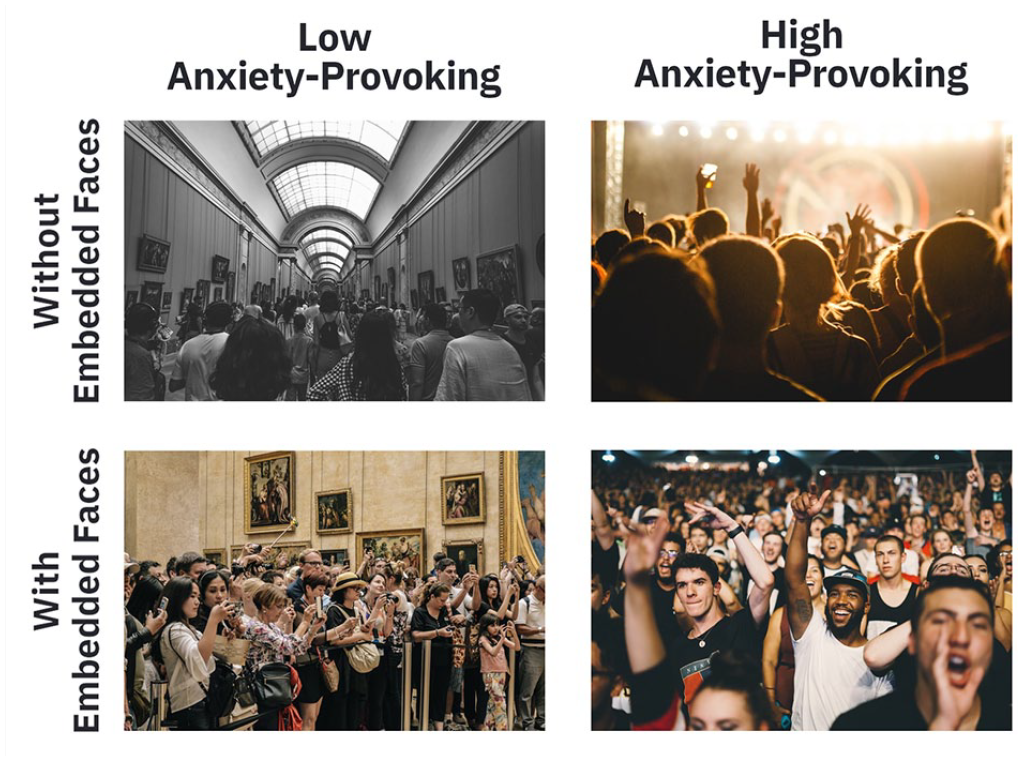
Sample scene images, varied by Scene Anxiety Type (low anxiety-provoking, high anxiety-provoking) and Scene Face Presence (without embedded faces, with embedded faces). To avoid copyright issues, images in this figure are similar to, but not the exact stimuli presented in our experiments.
Scene validation
Participants
A total of 100 naïve undergraduate students at the University of Waterloo were recruited for a 45-min online study. Six participants were excluded from the final analyses due to missing responses for more than 40% of the items (2 standard deviations above the mean; Mmissing = 5.6%, SDmissing = 17.5%). One additional participant was excluded from the final analyses due to invariant responses (i.e., the same responses to 100% of items across all trials). Of the remaining 93 participants in the final analyses, 53% were women, 46% were men, and 1% were non-binary. Mean age was 21.0 (SD = 5.7) years.
Procedure
Participants were shown 120 scene images (all 96 of the scene images from Experiment 1, plus 24 novel scene images used in Experiment 2) and made a series of judgements for each image. On each trial, participants were shown a single scene image (one at a time, in a randomised order) along with five questions below the image. The first question asked how anxious or fearful they felt in the scene (anxiety/fear; 0 = none, 3 = severe), and the second asked how often they avoided the scene (avoidance; 0 = never, 3 = usually) on 4-point Likert-type scales (items adapted from the LSAS; Liebowitz, 1987). The third question asked how visually complex the scene was, also on a 4-point Likert-type scale (0 = not at all, 3 = very complex). The fourth and fifth questions consisted of the arousal and valence subscales of the SAM (Bradley & Lang, 1994), rated on 9-point Likert-type scales.
Scene validation results
For each of the five scales, a 2 (Scene Type: low anxiety-provoking, high anxiety-provoking) × 2 (Scene Face Presence: without embedded faces, with embedded faces) repeated-measures ANOVA was conducted (see Table 1).
Mean ratings for all scene types in the scene validation study (standard deviations in parentheses).
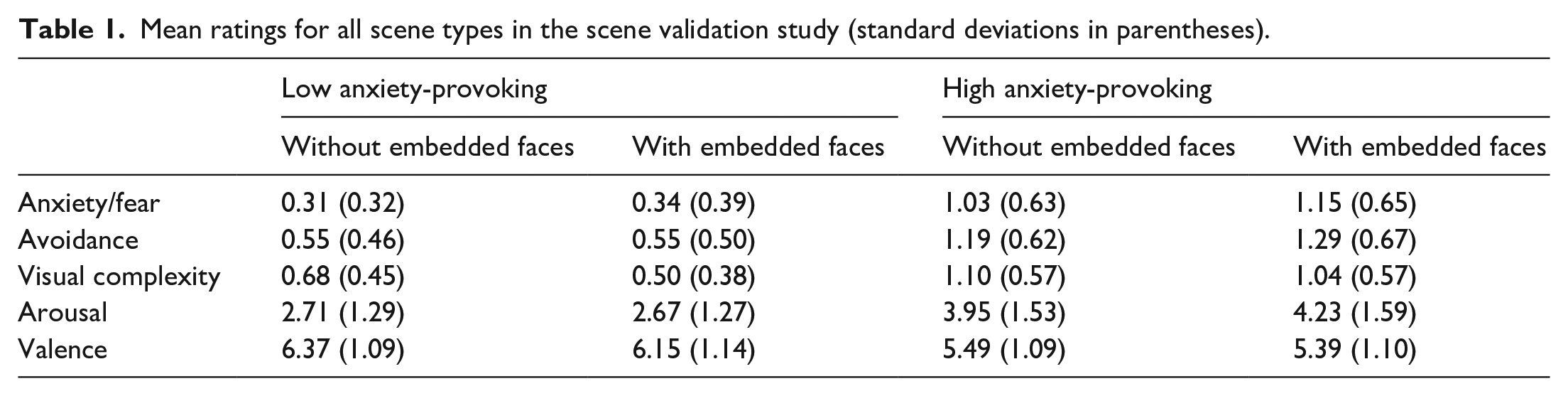
For the anxiety/fear scale, a significant main effect of Scene Type, F(1, 92) = 220.37, MSE = .25, partial ƞ2 = .71, p < .001, as well as a significant main effect of Scene Face Presence, F(1, 92) = 33.12, MSE = .02, partial ƞ2 = .27, p < .001, was found. In addition, the Scene Type by Scene Face Presence interaction was significant, F(1, 92) = 11.78, MSE = .02, partial ƞ2 = .11, p < .001. Post hoc paired t-tests revealed that the presence of faces significantly increased anxiety/fear ratings in high anxiety-provoking scenes, t(92) = 6.49, SE = .02, p < .001, but not in low anxiety-provoking scenes (p = .05).
For the avoidance scale, a significant main effect of Scene Type, F(1, 92) = 174.79, MSE = .26, partial ƞ2 = .66, p < .001, as well as a significant main effect of Scene Face Presence, F(1, 92) = 8.25, MSE = .03, partial ƞ2 = .08, p = .005, was found. In addition, the Scene Type by Scene Face Presence interaction was significant, F(1, 92) = 10.02, MSE = .03, partial ƞ2 = .10, p = .002. Post hoc paired t-tests revealed that the presence of faces significantly increased avoidance ratings in high anxiety-provoking scenes, t(92) = 4.09, SE = .03, p < .001, but not in low anxiety-provoking scenes (p = .96).
For the visual complexity scale, a significant main effect of Scene Type, F(1, 92) = 112.18, MSE = .19, partial ƞ2 = .55, p < .001, as well as a significant main effect of Scene Face Presence, F(1, 92) = 45.82, MSE = .03, partial ƞ2 = .33, p < .001, was found. In addition, the Scene Type by Scene Face Presence interaction was significant, F(1, 92) = 19.56, MSE = .02, partial ƞ2 = .18, p < .001. Post hoc paired t-tests revealed that although the presence of faces significantly decreased visual complexity ratings in both low anxiety-provoking scenes, t(92) = 7.04, SE = .03, p < .001, and high anxiety-provoking scenes, t(92) = 3.25, SE = .02, p = .002, the magnitude of this decrease was greater for low anxiety-provoking scenes.
For the arousal scale, a significant main effect of Scene Type, F(1, 92) = 191.75, MSE = .95, partial ƞ2 = .68, p < .001, as well as a significant main effect of Scene Face Presence, F(1, 92) = 14.01, MSE = .09, partial ƞ2 = .13, p < .001, was found. In addition, the Scene Type by Scene Face Presence interaction was significant, F(1, 92) = 27.42, MSE = .09, partial ƞ2 = .23, p < .001. Post hoc paired t-tests revealed that the presence of faces significantly increased arousal ratings in high anxiety-provoking scenes, t(92) = 7.13, SE = .04, p < .001, but not in low anxiety-provoking scenes (p = .4).
For the valence scale, a significant main effect of Scene Type, F(1, 92) = 84.91, MSE = .74, partial ƞ2 = .48, p < .001, as well as a significant main effect of Scene Face Presence, F(1, 92) = 26.98, MSE = .09, partial ƞ2 = .23, p < .001, was found. High anxiety-provoking scenes were rated as significantly more negative (M = 5.44) than low anxiety-provoking scenes (M = 6.26). Also, scenes with embedded faces were rated as significantly more negative (M = 5.77) than scenes without embedded faces (M = 5.93). No significant Scene Type by Scene Face Presence interaction was found (p = .07).
Experiment 1 design
The 96 face images were randomly divided in half to form two study lists (List A and List B), each consisting of 48 faces (half women and half men). For half of the participants, faces from List A were presented as targets during encoding, whereas the other half saw faces from List B during encoding. Faces from the opposite list were used as lures during the face recognition phase. Lists were counterbalanced across participants.
Similarly, the 96 context scenes were evenly divided into two study lists (48 scenes in each of List 1 and List 2). Each list contained half high anxiety-provoking and half low anxiety-provoking contexts (24 high anxiety-provoking, 24 low anxiety-provoking in each list). Among the high anxiety-provoking contexts, half contained embedded faces and half did not (12 high anxiety-provoking with embedded faces, 12 high anxiety-provoking without). For half of the participants, scenes from List 1 were paired with target faces at encoding, whereas the other half saw scenes from List 2 paired with target faces at encoding. Scenes from the opposite list were used as novel (non-reinstated) context scenes during the face recognition phase. As with the face lists, context lists were counterbalanced across participants.
Experiment 1 procedure
Encoding
Participants were recruited for a single 30-min session and began by providing informed, written consent. Participants then completed an incidental encoding phase, in which they saw 48 faces uniquely paired with 48 different context scenes. During each trial, participants were simultaneously presented a target face alongside a context scene. To ensure that participants were encoding both the face and the context incidentally, participants made two judgements for each face-context pair. First, participants rated the degree to which the person in the face image belonged in the context scene from 1 (very unlikely) to 6 (very likely). Second, participants rated the degree to which they personally belonged in the context scene from 1 (very unlikely) to 6 (very likely). Each judgement was presented as a Likert-type scale beneath the face-context pair (which remained visible). The face-context pair was presented for 2,250 ms regardless of when the Likert-type scale ratings were made, to ensure equal encoding time across all face-context pairs. The Likert-type scales for the judgements were displayed for a maximum duration of 4,000 ms. Following the response to the second judgement, a fixation cross was displayed in the centre of the screen for 500 ms before proceeding to the next trial. All 48 face-context pairs were presented sequentially in a randomised order. Of the context scenes, half (24) depicted high anxiety-provoking scenarios and half (24) depicted low anxiety-provoking scenarios. Of the high anxiety-provoking context scenes, half (12) had embedded faces and half (12) did not.
Retrieval
Following the encoding phase, participants completed the recognition phase for the target faces. Ninety-six face-context pairs were sequentially presented in a randomised order. For each trial, participants made a recognition decision indicating whether the face displayed was old or new using a Remember/Know/New (R/K/N; Tulving, 1985) paradigm. To indicate that a face was old, participants pressed a key labelled either “R” or “K,” representing “remember” or “know.” Although remember and know responses are thought to index different components of memory (recollection and familiarity), both responses reflect recognition of an item as old. Alternatively, participants pressed a key labelled “N” to indicate the face was “new” and not from the study set. Once a response was made, the next face-context pair was presented.
Forty-eight of the face-context pairs contained old faces, 24 of which were presented alongside the exact same context image as during the encoding phase (i.e., context was reinstated). The other 24 old faces were paired with novel context scenes of the equivalent context type (i.e., context was non-reinstated). For example, a target face encoded with a low anxiety-provoking scene would be paired with a new, low anxiety-provoking scene at retrieval. Scene anxiety type and scene face presence was distributed equally across all trials containing old faces (both reinstated and non-reinstated). In other words, of the 24 reinstated trials, 12 trials had low anxiety-provoking scenes, 6 had high anxiety-provoking scenes without embedded faces, and 6 had high anxiety-provoking scenes with embedded faces; this distribution was identical for the 24 non-reinstated trials. The remaining 48 face-context pairs contained new faces (i.e., lure face-context pairs) and were intermixed among the 48 face-context pairs containing old faces. Twenty-four of these lure face-context pairs contained old context scenes, while the other 24 contained new context scenes.
After completing the face recognition phase, participants completed a scene recognition phase. Ninety-six context scenes were presented alone in the centre of the screen in a randomised order. For each trial, participants made a recognition decision using the same R/K/N paradigm as the face recognition phase. Of the 96 context scenes shown, 48 were studied during the encoding phase (old), and the other 48 were never presented previously (new). For both the old context scenes and the new context scenes, 24 were low anxiety-provoking and 24 were high anxiety-provoking. Finally, all participants completed an in-person, computerised version of the SPIN (Connor et al., 2000) as a measure of trait SA. A summary of the procedure is shown in Figure 2. All study procedures were approved by the Office of Research Ethics at the University of Waterloo (Protocol #30730).
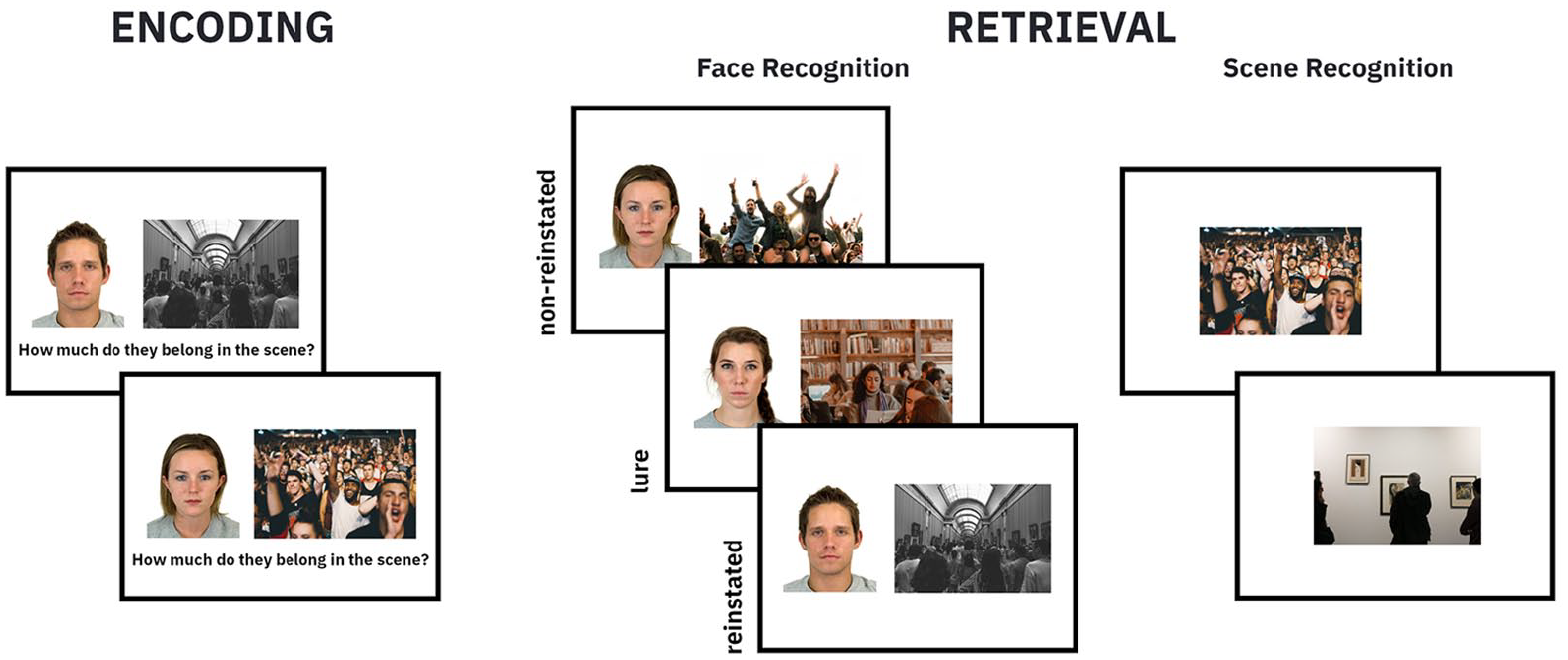
Summary of the experimental procedure. To avoid copyright issues, scene images in this figure are similar to, but not the exact stimuli presented in our experiments.
Results
Face recognition
Accuracy
Hit rate was tabulated at each level of Context (non-reinstated, reinstated) and Scene Type (low anxiety-provoking without faces, high anxiety-provoking without faces, high anxiety-provoking with faces) in each participant by summing the number of correct R and K responses 1 and dividing by 48. False alarm rate was tabulated for each participant by summing the number of incorrect R and K responses and dividing by 48 (see Table 2 for means). Accuracy was calculated for each participant in each condition by subtracting an individual’s false alarm rate from their hit rate. Response bias c was also calculated for each participant in each condition (Makowski, 2018; Rotello & Macmillan, 2007, see the Supplemental Appendix).
Mean hit, false alarm (FA), and accuracy rates for Face Recognition in Experiments 1 and 2 as a function of Context, Scene Anxiety Type, and Scene Face Presence (standard deviations in parentheses).
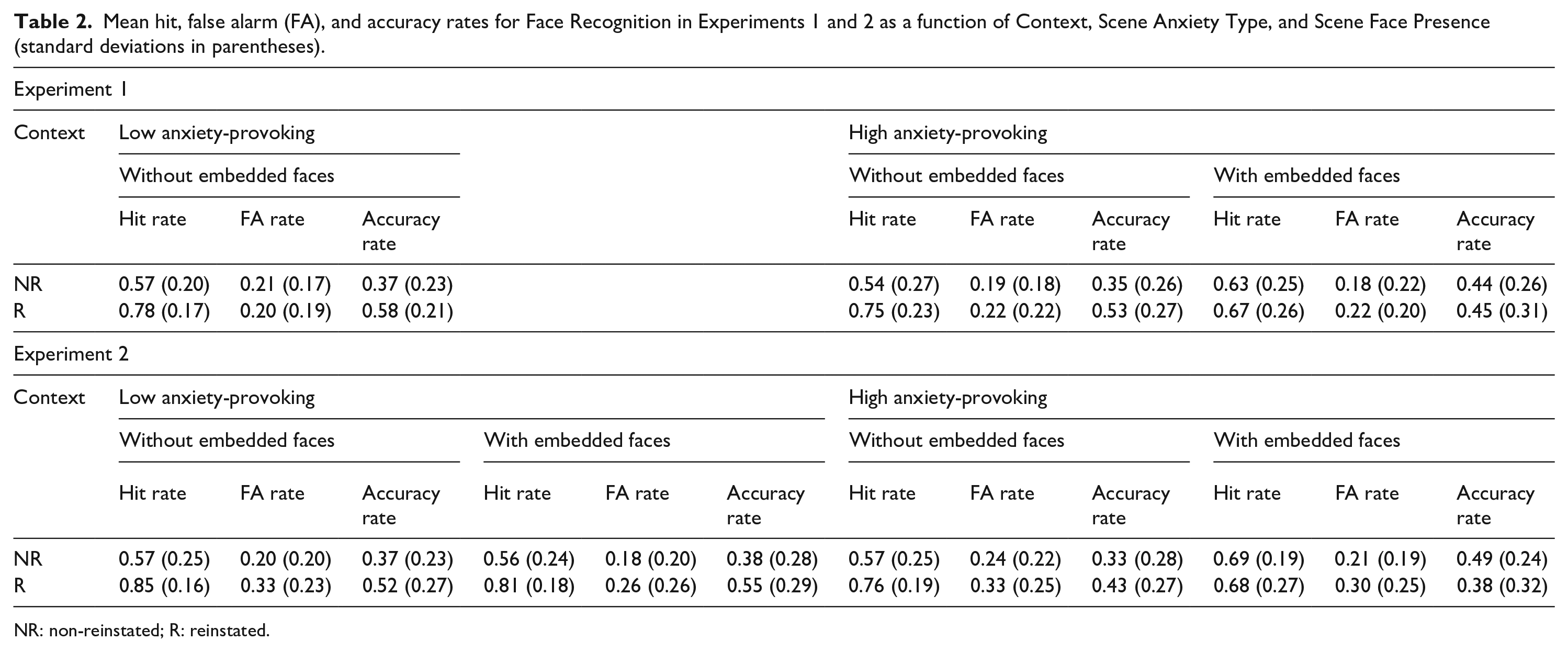
NR: non-reinstated; R: reinstated.
Accuracy data were analysed in a 2 (Context: non-reinstated, reinstated) × 3 (Scene Type: low anxiety-provoking without faces, high anxiety-provoking without faces, high anxiety-provoking with faces) repeated-measures ANOVA (see Figure 3). There was a significant main effect of Context, F(1, 48) = 23.82, MSE = .06, partial ƞ2 = .33, p < .001, such that faces paired with reinstated contexts had significantly higher accuracy (M = 0.52) than faces paired with non-reinstated contexts (M = 0.39). The main effect of Scene Type was not significant (p = .52), but the Context × Scene Type interaction was, F(2, 96) = 7.54, MSE = .04, partial ƞ2 = .14, p = .001. Specifically, memory was enhanced for faces paired with reinstated (M = 0.58) compared with non-reinstated (M = 0.37) low anxiety-provoking scenes without embedded faces, t(48) = 6.29, SE = .03, p < .001. In a similar pattern, memory was also enhanced for faces paired with reinstated (M = 0.53) compared with non-reinstated (M = 0.35) high anxiety-provoking scenes without embedded faces, t(48) = 3.93, SE = .05, p < .001. Importantly, memory was not significantly different between faces paired with reinstated (M = 0.45) or non-reinstated (M = 0.44) high anxiety-provoking scenes with embedded faces, t(48) = 0.15, SE = .05, p = .9.
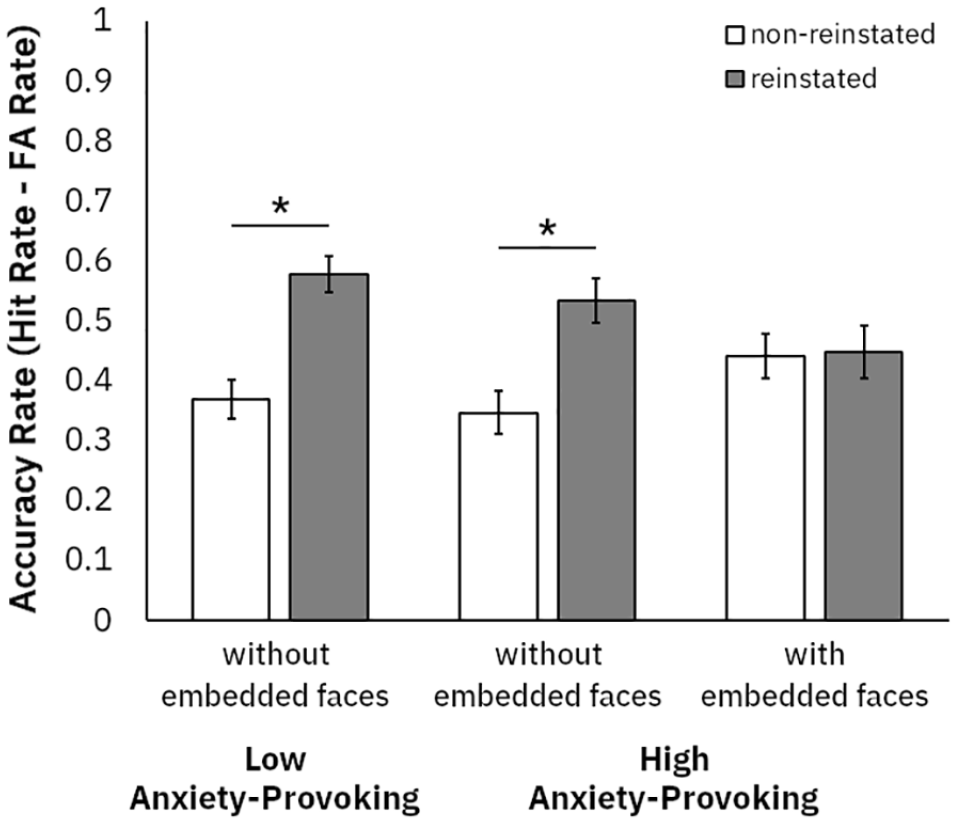
Mean accuracy rate for Face Recognition in Experiment 1 as a function of Context and Scene Type. Error bars represent ±1 standard error of the mean and asterisks represent significance of p < .05.
This Context × Scene Type interaction was further examined using repeated-measures ANOVAs at each level of Context (non-reinstated, reinstated) independently. Memory for faces was not significantly different across scene types when context was non-reinstated (p = .06). Conversely, the main effect of Scene Type was significant when context was reinstated, F(2, 96) = 4.54, MSE = .05, partial ƞ2 = .09, p = .01. Post hoc Fisher’s tests revealed that memory for faces was significantly impaired when high anxiety-provoking scenes with embedded faces were reinstated (M = 0.45), compared with when low anxiety-provoking scenes were reinstated (M = 0.58; p = .007). No other differences were significant (ps > .08).
Scene recognition
Accuracy
Hit rate was tabulated for each scene type, in each participant, by summing the number of correct R and K responses and dividing by 48. False alarm rate was tabulated for each participant by summing the number of incorrect R and K responses and dividing by 48 (see Table 3 for means). Accuracy was calculated for each participant in each scene type by subtracting an individual’s false alarm rate from their hit rate.
Mean hit, false alarm (FA), and accuracy rates for Scene Recognition in Experiments 1 and 2 as a function of Scene Anxiety Type and Scene Face Presence (standard deviations in parentheses).
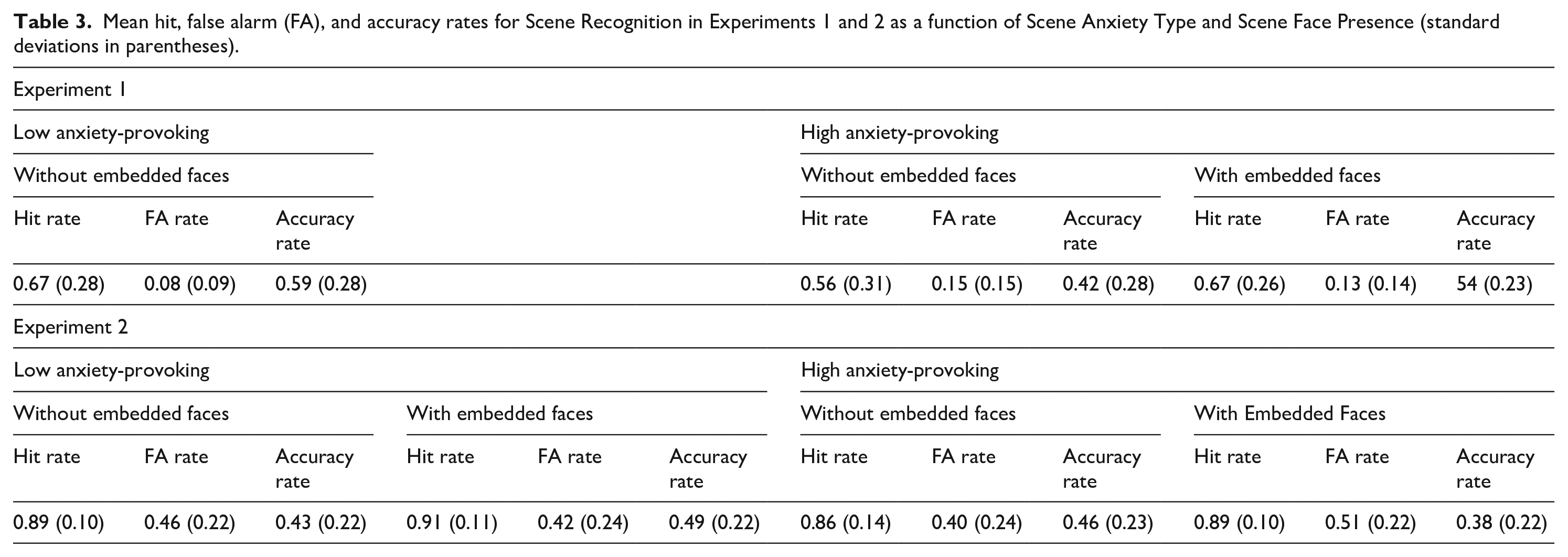
A one-way repeated-measures ANOVA was conducted to compare the effect of Scene Type (low anxiety-provoking without faces, high anxiety-provoking without faces, high anxiety-provoking with faces) on memory for the scenes. Due to Mauchly’s test indicating that the assumption of sphericity had been violated, χ2(2) = 6.07, p = .048, a Greenhouse–Geisser correction was applied when determining significance. We found a significant main effect of Scene Type, F(1.78, 85.62) = 23.71, MSE = .02, partial ƞ2 = .33, p < .001. Post hoc comparisons found that memory for high anxiety-provoking scenes without embedded faces was significantly poorer (M = 0.42) than both low anxiety-provoking scenes, M = 0.59; t(48) = 7.85, SE = .02, p < .001, and high anxiety-provoking scenes with embedded faces, M = 0.54; t(48) = 4.93, SE = .03, p < .001, which were not significantly different from each other, t(48) = 1.60, SE = .03, p = .1 (see Table 3).
Correlations with scene recognition
Face recognition
Three correlations were conducted between memory accuracy for scenes and memory accuracy for faces: one for each of the three scene types (low anxiety-provoking without faces, high anxiety-provoking without faces, high anxiety-provoking with faces). All three correlations were non-significant (ps > .5), suggesting insufficient evidence to claim that participants’ ability to accurately remember a face seen in a given context type was related to their ability to accurately remember its paired context scene.
Correlations with trait social anxiety
Face recognition
Three correlations were conducted between SPIN score and memory accuracy for target faces: one for each of the three scene types (low anxiety-provoking without faces, high anxiety-provoking without faces, high anxiety-provoking with faces). A significant positive correlation was found between SPIN score and memory accuracy for faces that were paired with high anxiety-provoking scenes without embedded faces (r = .32, p = .02). The correlations between SPIN score and memory accuracy for faces paired with low anxiety-provoking scenes (p = .2) and high anxiety-provoking scenes with embedded faces (p = .5) were non-significant.
Scene recognition
Three correlations were conducted between SPIN score and memory accuracy for scenes: one for each of the three scene types (low anxiety-provoking without faces, high anxiety-provoking without faces, high anxiety-provoking with faces). A significant negative correlation was found between SPIN score and memory accuracy for high anxiety-provoking scenes without embedded faces (r = –.30, p = .03). The correlations with memory accuracy for faces paired with low anxiety-provoking scenes (p = .2) and high anxiety-provoking scenes with embedded faces (p = .3) were non-significant.
Discussion
In the current experiment, we investigated how the anxiety-provoking nature of a context might influence that context’s ability to provide a memory benefit via the CR effect. Specifically, we predicted that high anxiety-provoking contexts would reduce the CR effect, whereas low anxiety-provoking scenes would still provide the classic benefit to memory. This was hypothesised given that some past reports have shown that contexts which evoke common components of anxiety (negative valence and high arousal) reduce the typical CR benefit (Brown, 2003; Rainis, 2001). Our current results partially supported this hypothesis. We did find that the CR effect was eliminated for high anxiety-provoking contexts—however, this was only true for the high anxiety-provoking contexts with embedded faces. In contrast, the high anxiety-provoking contexts without embedded faces showed the classic CR effect, much like the low anxiety-provoking contexts (see Figure 3). It would therefore seem that a critical feature of the contexts driving the reduction in CR effect is the presence of embedded faces in the context.
Importantly, our key finding in this experiment could not be explained by a trade-off between face memory and scene memory. Past work suggests that high anxiety-provoking contexts could capture attention (Bar-Haim et al 2007; Cisler & Koster, 2010; Mogg et al., 2000) and therefore be processed locally in detail, at the detriment of globally binding the target face to the context. A trade-off account would therefore expect a memory advantage for high anxiety-provoking scenes, at the expense of memory for the faces paired with them. This was not the case in the current experiment—memory for high anxiety-provoking scenes with embedded faces was not significantly correlated with memory for the faces paired with those scenes. As such, our findings could not support the hypothesis that the observed reduction in CR effect was due to selective processing of high anxiety-provoking scenes.
Experiment 2
Results of Experiment 1 suggest that highly anxiety-provoking scenes fail to confer the expected memory benefit when they are reinstated. Specifically, a reduction in CR benefit was found for target faces paired with high anxiety-provoking scenes with embedded faces. A limitation of this experiment, however, is that the other context types (low anxiety-provoking scenes, and high anxiety-provoking scenes without faces) could not allow us to determine whether the reduced CR effect was due to the presence of faces, or the anxiety-provoking nature of the scene itself. To identify which of these features led to the reduced CR effect, we added an additional context type in Experiment 2—low anxiety-provoking context scenes containing embedded faces. If the presence of faces drove the reduction in CR benefit, we would expect to see both the low anxiety-provoking and the high anxiety-provoking scenes with faces offer diminished CR benefit relative to scenes without faces. Alternatively, the reduction in CR benefit may have been driven by the combination of embedded faces in the context scene, as well as the highly anxiety-provoking quality of the scene. If this were the case, we would predict a reduced CR benefit from high anxiety-provoking scenes with faces, in comparison with high anxiety-provoking scenes without faces or low anxiety-provoking scenes, regardless of whether embedded faces are present.
Methods
Participants
Fifty undergraduate students who had not participated in Experiment 1 completed the current experiment for partial course credit. All recruitment procedures were identical to that of the previous experiment. Of the current experiment’s participants, 82% were women and 18% were men, and the mean age was 19.8 (SD = 2.0) years. Mean SPIN score was 32.8 (SD = 11.4).
Materials
All materials were identical to that of the previous experiment, except for the inclusion of a new context scene type: low anxiety-provoking scenes with embedded faces.
Scene images
Context stimuli were identical to that of the previous experiment, except that 24 of the 48 low anxiety-provoking scenes from the previous experiment were replaced with 24 new, low anxiety-provoking scenes with embedded faces. These new scenes were selected using the same procedure as Experiment 1. As well, the replaced scenes from Experiment 1 were randomly selected from the low anxiety-provoking scenes without embedded faces. In sum, the current experiment contained 24 low anxiety-provoking scenes without embedded faces, 24 low anxiety-provoking scenes with embedded faces, 24 high anxiety-provoking scenes without embedded faces, and 24 high anxiety-provoking scenes with embedded faces. For any given participant, 12 of the 24 scenes of each type were seen as targets in the encoding phase, whereas the other 12 were seen as lures in the recognition phases.
Experiment 2 design and procedure
The design was identical to that of the previous experiment, except for the addition of low anxiety-provoking scenes with embedded faces. In other words, the anxiety-provoking nature of the scene and the presence of embedded faces were fully disentangled in the current experiment. Specifically, 12 target faces were paired with low anxiety-provoking scenes without embedded faces, 12 were paired with low anxiety-provoking scenes with embedded faces, 12 were paired with high anxiety-provoking scenes without embedded faces, and 12 were paired with high anxiety scenes with embedded faces (see Figure 1). The procedure was identical to Experiment 1 (see Figure 2).
Results
Face recognition
Accuracy
Accuracy was calculated using the same procedure as Experiment 1 (see Table 2 for means). Accuracy data were analysed in a 2 (Context: non-reinstated, reinstated) × 2 (Scene Anxiety Type: low anxiety-provoking, high anxiety-provoking) × 2 (Scene Face Presence: without faces embedded in scene, with faces embedded in scene) repeated-measures ANOVA (see Figure 4).
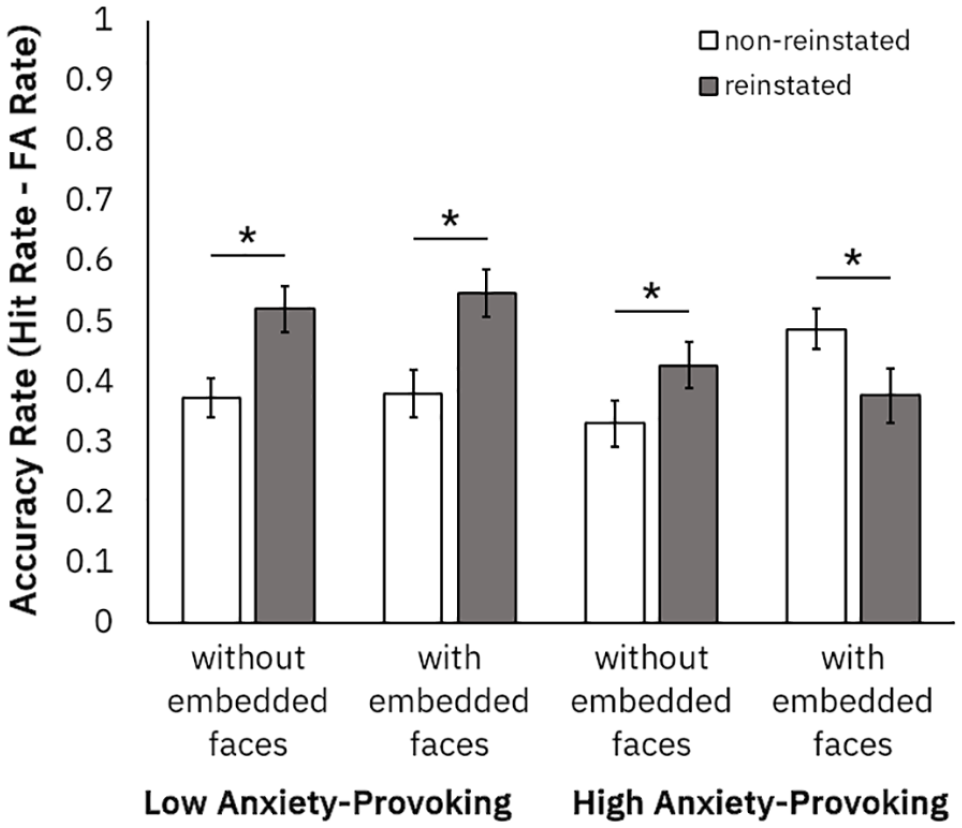
Mean accuracy rate for Face Recognition in Experiment 2 as a function of Context, Scene Anxiety Type, and Scene Face Presence. Error bars represent ±1 standard error of the mean and asterisks represent significance of p < .05.
Similar to Experiment 1, there was a significant main effect of Context, F(1, 49) = 7.78, MSE = .07, partial ƞ2 = .14, p = .008, such that faces paired with reinstated contexts had significantly higher accuracy (M = 0.47) than faces paired with non-reinstated contexts (M = 0.39). The main effect of Scene Anxiety Type was close to significance (p = .052), such that faces paired with low anxiety-provoking contexts showed nominally greater accuracy (M = 0.46) than faces paired with high anxiety-provoking contexts (M = 0.41). The main effect of Scene Face Presence was not significant (p = .2).
Also replicating Experiment 1, we found a significant Context × Scene Anxiety Type interaction, F(1, 49) = 12.15, MSE = .06, partial ƞ2 = .20, p = .001. Specifically, memory was enhanced for faces paired with reinstated (M = 0.53) compared with non-reinstated (M = 0.38) low anxiety-provoking scenes, t(49) = 4.40, SE = .04, p < .001. In contrast, memory was not significantly different between faces paired with reinstated (M = 0.40) or non-reinstated (M = 0.41) high anxiety-provoking scenes, t(49) = 0.19, SE = .04, p = .9.
In addition, a significant Context × Scene Face Presence interaction was found, F(1, 49) = 5.67, MSE = .04, partial ƞ2 = .10, p = .02. Specifically, memory was enhanced for faces paired with reinstated (M = 0.47) compared with non-reinstated (M = 0.35) scenes without embedded faces, t(49) = 3.46, SE = .04, p = .001. In contrast, memory was not significantly different between faces paired with reinstated (M = 0.46) or non-reinstated (M = 0.43) scenes with embedded faces, t(49) = 0.90, SE = .03, p = .4. The Scene Anxiety Type × Scene Face Presence interaction was non-significant (p = .5).
A significant three-way (Context × Scene Anxiety Type × Scene Face Presence) interaction was also revealed, F(1, 49) = 6.35, MSE = .05, partial ƞ2 = .12, p = .02. To examine this three-way interaction further, an additional 2 (Context: non-reinstated, reinstated) × 2 (Scene Anxiety Type: low anxiety-provoking, high anxiety-provoking) repeated-measures ANOVA was conducted at each level of Scene Face Presence (without faces embedded in scene, with faces embedded in scene).
For scenes without embedded faces, a significant main effect of Context was found, F(1, 49) = 11.97, MSE = .06, partial ƞ2 = .20, p = .001, such that faces paired with reinstated scenes (M = 0.47) were more accurately remembered than faces paired with non-reinstated scenes (M = 0.35). The main effect of Scene Anxiety Type was not significant (p = .06). Similarly, the Context × Scene Anxiety Type interaction was not significant (p = .4), indicating that we were unable to find evidence that Scene Anxiety Type had an effect on CR for scenes without embedded faces.
For scenes with embedded faces, no significant main effects were found of either Context (p = .4) or Scene Anxiety Type (p = .4). However, the Context by Scene Anxiety Type interaction was significant, F(1, 49) = 6.35, MSE = .05, partial ƞ2 = .12, p < .001, indicating that Scene Anxiety Type influenced CR for scenes with embedded faces. Specifically, memory was enhanced for faces paired with reinstated (M = 0.55) compared with non-reinstated (M = 0.38) low anxiety-provoking scenes with embedded faces, t(49) = 3.26, SE = .05, p = .002. In contrast, memory was significantly impaired for faces paired with reinstated (M = 0.38) compared with non-reinstated (M = 0.49) high anxiety-provoking scenes with embedded faces, t(49) = 2.57, SE = .04, p = .01.
The three-way (Context × Scene Anxiety Type × Scene Face Presence) interaction was further examined using 2 (Scene Anxiety Type: low anxiety-provoking, high anxiety-provoking) × 2 (Scene Face Presence: without faces embedded in scene, with faces embedded in scene) repeated-measures ANOVAs at each level of Context (non-reinstated, reinstated).
For non-reinstated scenes, a significant main effect of Scene Face Presence was found, F(1, 49) = 6.89, MSE = .05, partial ƞ2 = .12, p = .01, such that faces paired with scenes with embedded faces (M = 0.43) were more accurately remembered than faces paired with scenes without embedded faces (M = 0.35). The main effect of Scene Anxiety Type was not significant (p = .4). However, the Scene Anxiety Type × Scene Face Presence interaction was significant, F(1, 49) = 4.70, MSE = .06, partial ƞ2 = .09, p = .04. Memory was significantly enhanced for faces paired with high anxiety-provoking scenes with embedded faces (M = 0.49) compared with all other combinations of Scene Anxiety Type and Scene Face Presence (Ms = 0.33–0.38, ps < .045). No other differences were significant (ps > .3).
For reinstated scenes, the main effect of Scene Anxiety Type was significant, F(1, 49) = 15.13, MSE = .06, partial ƞ2 = .24, p < .001. Similar to Experiment 1, post hoc Fisher’s tests revealed that memory for faces was significantly impaired when high anxiety-provoking scenes were reinstated (M = 0.40), compared with when low anxiety-provoking scenes were reinstated (M = 0.53; p < .001). The main effects of Scene Face Presence and the Scene Anxiety Type × Scene Face Presence interaction were non-significant (ps > .2).
Scene recognition
Accuracy
Scene memory accuracy was calculated for each participant using the same method as Experiment 1 (see Table 3 for means). A 2 (Scene Anxiety Type: low anxiety-provoking, high anxiety-provoking) × 2 (Scene Face Presence: without faces embedded in scene, with faces embedded in scene) repeated-measures ANOVA was conducted to compare memory performance.
No significant main effects were found for Scene Anxiety Type (p = .07) or Scene Face Presence (p = .7). However, a significant Scene Anxiety Type × Scene Face Presence interaction was found, F(1, 49) = 10.62, MSE = .02, partial ƞ2 = .18, p = .002. Post hoc paired t-tests revealed that memory accuracy was higher for low anxiety-provoking scenes with embedded faces (M = 0.49) relative to those without embedded faces, M = 0.43; t(49) = 2.51, SE = .03, p = .02. Conversely, memory accuracy was higher for high anxiety-provoking scenes without embedded faces (M = 0.46) relative to those with embedded faces, M = 0.38; t(49) = 2.64, SE = .03, p = .01)
Correlations with scene recognition
Face recognition
Four correlations were conducted between memory accuracy for scenes and memory accuracy for faces: one for each of the two scene anxiety types (low anxiety-provoking, high anxiety-provoking), at each of the two levels of scene face presence (with faces embedded in scene, without faces embedded in scene). All four correlations were non-significant (ps > .08), replicating the finding from Experiment 1 that participants’ ability to accurately remember a face seen in a given context type was not significantly related to their ability to accurately remember its paired context scene.
Correlations with trait social anxiety
Face recognition
Four correlations were conducted between SPIN score and memory accuracy for target faces: one for each of the two scene anxiety types (low anxiety-provoking, high anxiety-provoking), at each of the two levels of scene face presence (with faces embedded in scene, without faces embedded in scene). All four correlations were non-significant (ps > .1).
Scene recognition
Four correlations were conducted between SPIN score and memory accuracy for scenes: one for each of the two scene anxiety types (low anxiety-provoking, high anxiety-provoking), at each of the two levels of scene face presence (with faces embedded in scene, without faces embedded in scene). All four correlations were non-significant (ps > .4)
Discussion
The current experiment aimed to specify the context features that might be driving the observed reductions in CR. By including an additional context type (low anxiety-provoking with embedded faces), the current experiment fully disentangled the anxiety-provoking nature of the scenes from the presence of visible faces in the scenes. Our results showed that the combination of both scene anxiety type and scene face presence was critical in reducing the CR effect.
First, we replicated findings from Experiment 1 in that both low anxiety-provoking scenes without embedded faces and high anxiety-provoking scenes without embedded faces showed the expected CR effect: memory for faces was enhanced when their paired scenes were reinstated. Critically, we also replicated the key finding from Experiment 1, where high anxiety-provoking scenes with embedded faces failed to confer the classic CR benefit—further, this effect was even stronger in Experiment 2, such that reinstating these scenes significantly impaired memory for faces. The novel contribution of Experiment 2 was the finding that this elimination or reversal of the CR effect was not observed with the new scene type of low anxiety-provoking scenes with embedded faces. Much like the low anxiety-provoking scenes without embedded faces or the high anxiety-provoking scenes with embedded faces, these new scenes showed the typical CR effect (see Figure 4). This finding argues that the presence of embedded faces in a scene was not sufficient to reduce the CR effect—rather, it appears that the combination of embedded faces and a high anxiety-provoking scenario was needed to influence CR.
Importantly, we also replicated the lack of any observed trade-off between face memory and scene memory found in Experiment 1. A selective attention hypothesis calling for preferential encoding of highly anxiety-provoking scenes, rather than their paired target faces, would necessarily predict a trade-off in recognition performance. Specifically, this hypothesis would be supported if scene recognition and face recognition were negatively correlated, such that scene memory benefitted at the expense of face memory. However, no evidence for a trade-off was observed in Experiment 2: correlations were non-significant between face and scene memory across all scene types. Therefore, as in Experiment 1, we are unable to support that the results were due to the selective processing of either the target faces or their accompanying context scenes.
General discussion
In the current series of experiments, we examined whether emotional features of a context affect the memory benefit conferred by reinstating the encoding context at retrieval. In Experiment 1, the expected CR benefit was observed when the context consisted of low anxiety-provoking scenes, and high anxiety-provoking scenes without embedded faces. In contrast, the CR benefit was significantly reduced when the contexts were high anxiety-provoking scenes containing embedded faces. In Experiment 2, we included an additional context type, consisting of low anxiety-provoking scenes with embedded faces. Once again, the CR effect was shown to be significantly reduced only when the context scenes were high anxiety-provoking with embedded faces: reinstating this context type failed to enhance memory for targets. Results suggest that the benefit to target memory caused by reinstating a context depends critically on emotional characteristics of the reinstated context.
Across both experiments, the reduction in CR only occurred when the context was highly anxiety-provoking and contained embedded faces. In other words, it was only when the context involved both an anxiety-provoking scenario and had visible faces that the CR effect was eliminated; neither component alone eliminated the CR effect. Why might the combined effects of scene anxiety type and scene face presence drive this reduction in CR? Evidence from our scene validation study suggests that the reduction in CR may stem from affective reactions to the emotional features of a context (e.g., whether a scene is anxiety-provoking or not). In particular, our validation study revealed that the context images involving both high anxiety-provoking scenarios and embedded faces induced greater feelings of anxiety/fear, avoidance, and arousal compared with any other scene type. This finding suggests that embedded faces are not necessarily unique in their ability to reduce CR effects. Instead, it is possible that embedding faces into anxiety-provoking scenes increases anxious feelings to some critical point that disrupts CR. Our data show that embedded faces and high anxiety-provoking situations are sufficient to produce negative emotional reactions that, in turn, could be driving the reduction in CR effects.
One potential explanation for why these negative feelings could reduce CR effects is that the emotional reactions to high anxiety-provoking scenes with embedded faces could lead to preferential processing of the context scene, to the detriment of encoding the target face. For instance, highly anxiety-provoking contexts with embedded faces could be capturing attention (Bar-Haim et al., 2007; Cisler & Koster, 2010; Mogg et al., 2000) due to the threat-related feelings evoked by these scenes. As such, one might argue that participants were selectively encoding the anxiety-provoking scenes, instead of processing the target faces within the context of these anxiety-provoking scenes. This hypothesis necessarily predicts a trade-off between context memory and target memory if attention is being directed towards the scenes and away from the faces—that is, as memory for emotionally arousing or anxiety-provoking scenes improves, memory for faces paired with them ought to decrease. However, this pattern was not observed in our data: memory for highly anxiety-provoking scenes with embedded faces was not significantly correlated with memory for the target faces paired with those scenes in either of our experiments. Therefore, a selective attention account seems insufficient to fully explain our findings.
An alternative hypothesis is that the negative feelings evoked by high anxiety-provoking scenes with embedded faces could reduce the CR effect by interfering with the ability to bind target faces to their paired contexts. In other words, rather than impairing memory for any single item in a face-context pair, emotional reactions could have hindered the connections between faces and their contexts in memory. Specifically, the arousal-biased competition model claims that emotional arousal impairs associations between an item and its context when explicit item-context binding is not a high-priority task (Mather & Sutherland, 2011). Given that the encoding of items within their contexts was incidental in our experiments, arousal-biased competition predicts that the most emotionally arousing scenes (i.e., high anxiety-provoking with embedded faces) would cause weaker associations between the target faces and their paired context scenes. Critically, the memory benefits typically conferred by CR are thought to rely on integrated memory traces: CR boosts memory when the context is encoded together with the target items (Smith & Vela, 2001), and CR fails to enhance memory if these strong item-context associations are not formed (Murnane et al., 1999). The high anxiety-provoking scenes with embedded faces could therefore have decreased the strength with which contextual information is associated with the target faces, causing the observed lack of CR effects with this scene type. Our work not only provides new behavioural evidence in line with recent models of emotion and memory function (Bisby & Burgess, 2017; Mather & Sutherland, 2011), but also extends their predictions in novel ways: (1) we demonstrate that their ideas can be generalised to socially relevant, anxiety-provoking stimuli, and (2) we show that these models can inform the CR effect, a previously unexplored area of the memory literature.
In addition to elaborating upon the mechanisms by which emotion interacts with the CR effect, our results may also have implications for the literature on eyewitness memory. Replicating past research, our findings demonstrate that negative or emotionally arousing scenes reduce the boost to memory typically offered by reinstating a context (Brown, 2003; Rainis, 2001). This failure to enhance memory may be particularly troubling for suspect identification, as many crime scenes are inherently negative in valence or highly anxiety-provoking. However, there is research demonstrating benefits to reinstating contexts in crime-related situations (Hammond et al., 2006; Krafka & Penrod, 1985; Wong & Read, 2011). Given the importance and consequences of eyewitness identification, future work should continue to investigate the boundary conditions of reinstating anxiety-provoking contexts, so as to improve the accuracy of eyewitness identification.
Another factor that may have influenced CR effects in the current work is an individual’s trait level of SA. Evidence suggests that one’s level of trait SA is related to altered processing of socially threatening information across many domains of cognition, such as attention (Bar-Haim et al., 2007; Cisler & Koster, 2010; Mogg et al., 2000; Shechner et al., 2012) and memory (Herrera et al., 2017; Mitte, 2008; Yeung & Fernandes, 2019a, 2019b). In the current experiments, we measured trait SA using the SPIN (Connor et al., 2000) to investigate whether trait SA would further influence the CR benefit offered by the context scenes. Specifically, it was possible that participants high in trait SA would experience more intense emotional reactions to the anxiety-provoking context scenes than those low in trait SA. In turn, greater emotional arousal could reduce the CR effect as a function of trait SA. However, we did not find consistent, systematic correlations between trait SA and memory accuracy (in the form of face memory as well as scene memory) across both experiments. We were therefore unable to support that a general propensity to experience SA influenced the observed reduction in CR effect: memory performance was not significantly related to trait SA, regardless of scene anxiety type or scene face presence.
Nevertheless, there are limitations to our findings related to trait SA. First, trait SA was relatively high in both experiments (MExp1 = 26.3, MExp2 = 32.8). Although these SPIN scores were typical for cohorts in our participant pool, a restriction of range may have been present in our samples; future work could investigate how the observed effects might differ in samples with lower trait SA. Second, it remains possible that we may have failed to observe associations between memory performance and trait SA due to the specific stimuli used in the current experiment. To make sure that participants would consistently judge the highly anxiety-provoking scenes as anxiety-provoking, we selected scenes of situations that are very commonly feared by the general population (e.g., preparing to give a presentation or being interviewed). Although we may have ensured that participants would experience emotional reactions to the scenes, this may have blunted our ability to detect differences across levels of trait SA. Given that the highly anxiety-provoking scenes were so unambiguously threatening, any participant—regardless of trait SA—may have felt equally strong emotional arousal in response to the highly anxiety-provoking scenes. Indeed, past findings contend that group differences between those low or high in trait SA are sometimes only observed with ambiguously threatening stimuli, rather than universally threatening stimuli (Amir et al., 2005; Constans et al., 1999). Future work should consider varying the anxiety-provoking nature of scenes with more granularity to further probe the influence of trait SA on the CR effect.
Finally, the role of state SA in our current experiments remains as an interesting open question. Specifically, it is possible that state SA could have acted as a reinstated context cue when high anxiety-provoking scenes were presented at retrieval: because we maintained scene anxiety type across encoding and retrieval, even if the scene was non-reinstated, participants could have used their emotional reactions to the contexts as a memory signal to improve performance. If state SA were supporting memory in this manner, we would expect to see a memory benefit for faces paired with non-reinstated high anxiety-provoking scenes at retrieval—however, such a hypothesis was only partially supported in Experiment 2, and not supported in Experiment 1. Given this evidence, we contend that the same state contextual effects could have been present during low anxiety-provoking trials at retrieval. That is, the same level of low anxiety (e.g., neutral mood) would have been induced during retrieval as was during encoding. This feeling of relative relaxation could, too, have acted as a cue to support later retrieval. Because scene anxiety type was maintained consistently between encoding and retrieval (regardless of whether the scene itself was non-reinstated, reinstated, low anxiety-provoking, or high anxiety-provoking), we believe that this potential state dependency effect is unlikely to have influenced the high anxiety-provoking trial type selectively.
Conclusion
Across two experiments, we observed a reduction in the CR effect when target faces were studied within the context of highly anxiety-provoking scenes. In other words, although reinstating the context from encoding typically enhances memory (Smith & Vela, 2001), high anxiety-provoking contexts with embedded faces failed to improve recognition when reinstated in the current experiments. As evidenced by the lack of a trade-off between face and scene recognition accuracy, our key findings support an arousal-biased competition account (e.g., emotional arousal impairing the binding of low-priority inter-item associations) rather than a selective attention account (e.g., preferential encoding of the emotionally arousing context) of how emotion may influence the CR effect. Our work adds to the growing list of contextual features (Baddeley, 1982; Dalton, 1993; Skinner & Fernandes, 2010; Smith & Vela, 2001) which reduce the CR effect. Furthermore, we extend past research by showing that the combined effects of anxiety-provoking situations and embedded faces can eliminate the CR effect when considering socially relevant scenes as contexts.
Supplemental Material
sj-docx-1-qjp-10.1177_1747021821998489 – Supplemental material for The influence of social anxiety-provoking contexts on context reinstatement effects
Supplemental material, sj-docx-1-qjp-10.1177_1747021821998489 for The influence of social anxiety-provoking contexts on context reinstatement effects by Ryan C Yeung, Christopher M Lee and Myra A Fernandes in Quarterly Journal of Experimental Psychology
Footnotes
Declaration of conflicting interests
The author(s) declared no potential conflicts of interest with respect to the research, authorship, and/or publication of this article.
Funding
The author(s) disclosed receipt of the following financial support for the research, authorship, and/or publication of this article: This work was supported by the Natural Sciences and Engineering Research Council of Canada (NSERC) through an Alexander Graham Bell Canada Graduate Scholarship (CGSD3-535024-2019) awarded to author R.C.Y., an Ontario Graduate Scholarship awarded to author C.M.L., and an NSERC Discovery Grant (2020-03917) awarded to author M.A.F.

Data accessibility statement
The data from the present experiments are publicly available on the Open Science Framework: DOI 10.17605/OSF.IO/VGQU5
Notes
References
Supplementary Material
Please find the following supplemental material available below.
For Open Access articles published under a Creative Commons License, all supplemental material carries the same license as the article it is associated with.
For non-Open Access articles published, all supplemental material carries a non-exclusive license, and permission requests for re-use of supplemental material or any part of supplemental material shall be sent directly to the copyright owner as specified in the copyright notice associated with the article.
