




Abstract
How quickly participants respond to a “go” after a “warning” signal is partly determined by the time between the two signals (the foreperiod) and the distribution of foreperiods. According to Multiple Trace Theory of Temporal Preparation (MTP), participants use memory traces of previous foreperiods to prepare for the upcoming go signal. If the processes underlying temporal preparation reflect general encoding and memory principles, transfer effects (the carryover effect of a previous block’s distribution of foreperiods to the current block) should be observed regardless of the sensory modality in which signals are presented. Despite convincing evidence for transfer effects in the visual domain, only weak evidence for transfer effects has been documented in the auditory domain. Three experiments were conducted to examine whether such differences in results are due to the modality of the stimulus or other procedural factors. In each experiment, two groups of participants were exposed to different foreperiod distributions in the acquisition phase and to the same foreperiod distribution in the transfer phase. Experiment 1 used a choice-reaction time (RT) task, and the warning signal remained on until the go signal, but there was no evidence for transfer effects. Experiments 2 and 3 used a simple- and choice-RT task, respectively, and there was silence between the warning and go signals. Both experiments revealed evidence for transfer effects, which suggests that transfer effects are most evident when there is no auditory stimulation between the warning and go signals.
The speed with which an individual responds to a “go” after a “warning” signal is partly determined by the time between the two signals, called the foreperiod. During a foreperiod, an individual prepares to respond to a go signal. The mechanism that underlies this temporal preparation is still debated. One explanation that has traditionally been thought to explain the reaction time (RT) effects in foreperiod experiments relies on the idea that participants keep track of the hazard function. The hazard function describes the conditional probability that an event will occur at a given moment, given that it has not yet occurred (e.g., Luce, 1986; Nobre et al., 2007). Support for this hypothesis comes from the well-documented finding that response to a go signal is faster in a variable foreperiod task (where the foreperiod duration changes on a trial-by-trial basis) for longer foreperiods (with higher conditional probabilities) than shorter foreperiods (with lower conditional probabilities), namely, the classic variable foreperiod effect (e.g., Niemi & Näätänen, 1981; Woodrow, 1914).
However, an explanation of temporal preparation based solely on the hazard function does not provide a process-level cognitive explanation (Los, 2013). Los et al. (2014) proposed the Multiple Trace Theory of Temporal Preparation (MTP), the foundations of which are in general memory mechanisms. Three processes are central to MTP: inhibition, trace formation, and trace expression. Inhibition refers to the within-trial dynamic whereby a participant must withhold a response after being presented with a warning signal until a go signal is presented and the inhibition released to make a response. This pattern of inhibition followed by activation is stored as a unique episode in memory as a result of trace formation. Trace expression describes the process whereby all memory traces created on preceding trials jointly contribute to preparation on subsequent trials by expressing, during the foreperiod, their current value of inhibition or activation.
Los et al. (2017) investigated whether temporal preparation was, at least partially, driven by the retrieval of memory traces created on previous trials (i.e., MTP) or by the hazard function that applies in the current block of trials. In an acquisition phase, participants were instructed to respond as quickly as possible in two blocks of 120 trials in which a “warning” was followed by a “go” signal. Participants were randomly allocated to one of two groups that were presented with different foreperiod distributions, either exponential (i.e., a majority of short foreperiods) or anti-exponential (i.e., a majority of long foreperiods), such that the two groups generated different memory traces. In this acquisition phase, the RT-foreperiod function was found to be approximately flat for the group with the exponential distribution and strongly downwards sloping for the group with the anti-exponential distribution. In a subsequent transfer phase, both groups received two more blocks with the uniform distribution of foreperiods and evidenced transfer effects indicating that memory traces from the acquisition phase still influenced performance. Specifically, throughout the transfer phase, there was a flatter RT-foreperiod function for the group that had experienced the exponential distribution in the acquisition phase than for the group that had experienced the anti-exponential distribution. Under conventional hazard-based explanations, participants should quickly recalibrate to the current distribution and, therefore, should not exhibit any substantial transfer effects (see Los et al., 2017, 2021, for in-depth coverage). Subsequently, Mattiesing et al. (2017) replicated this finding in a study in which the transfer phase was completed 1 week after the acquisition phase. Despite this long delay, there was still evidence for transfer effects throughout three 120-trial blocks, showing the persistent influence of long-term memory in driving temporal preparation. Taken together, these findings provide strong evidence for the role of memory affecting temporal preparation, which supports a key prediction of MTP.
Because MTP assumes general encoding and memory mechanisms, similar transfer effects would be expected across different modalities of signals. For instance, regardless of signal modality, inhibition and activation should be applied on a given trial and then stored in a memory trace, thus resulting in the same qualitative pattern of results. However, using the exact same design as Los et al. (2017) and Mattiesing et al. (2017), but with auditory stimuli and a simple-RT task, Crowe and Kent (2019) found no evidence for long-term transfer effects, after a 1-week delay, and only limited evidence for short-term transfer, that is, only in the transfer block that immediately followed the acquisition phase. As MTP specifies a general preparatory mechanism, finding differential transfer effects for different stimulus modalities would clearly limit its scope.
Evidence for a modifying influence of stimulus modality in temporal preparation is mixed. Some studies have reported a modifying influence (e.g., Bernstein et al., 1973; Sanders & Wertheim, 1973), whereas others have not (e.g., Karlin, 1959; Los & Van der Burg, 2013; Sanders, 1965; Trumbo & Gaillard, 1975), including a recent study in which highly similar RT-foreperiod functions were revealed for visual, auditory, and tactile stimuli in a simple-RT task, using various foreperiod distributions (Grabenhorst et al., 2019). An alternative explanation for a different qualitative pattern of results in the visual (i.e., Los et al., 2017; Mattiesing et al., 2017) and auditory (i.e., Crowe & Kent, 2019) modalities is differences in the response procedures used by the two studies, which was the only factor (along with stimulus modality) that differed between the initial and replication experiments. Both Los et al. and Mattiesing et al. used a visual choice-RT task (i.e., respond according to the spatial location of the go signal by pressing one of two keys), whereas Crowe and Kent used an auditory simple-RT task (i.e., respond to the auditory go signal by clicking a mouse key). Similar foreperiod effects have been reported previously for both choice-RT and simple-RT tasks (e.g., Frith & Done, 1986; Steinborn & Langner, 2012), which indicates that this task difference should not be responsible for moderating transfer effects. Nevertheless, it could be argued that choice-RT tasks require greater levels of cognitive labour. This may result in strong memory traces, perhaps due to more encoding time, and, ultimately, larger transfer effects.
A final consideration is the use of a filled foreperiod in the experimental task. The filled foreperiod effect describes slower RT when the interval between the warning and target signal is filled, rather than unfilled (e.g., Baumeister & Wilcox, 1969; Steinborn & Langner, 2011; Terrell & Ellis, 1964). One explanation of this, supported by Steinborn and Langner (2011), is the distraction-during-foreperiod hypothesis, which suggests that the participant’s attentional focus is directed away from the task resulting in an increase in RT. As concurrent auditory stimulation is proposed to be particularly detrimental to performance (Steinborn & Langner, 2011), it is possible that a filled auditory foreperiod, as used in Crowe and Kent (2019), may lead to weaker trace formation and ultimately a weaker transfer effect.
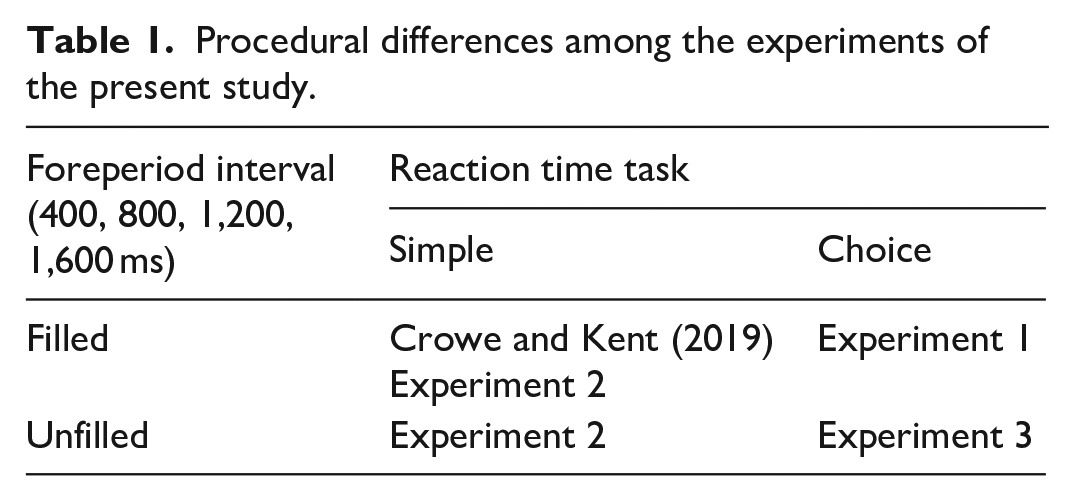
Across three experiments, this article investigated the scope and limitations of transfer effects in temporal preparation to gain insight into the conflicting results reported in the visual and auditory domains. Specifically, using auditory stimuli, we tested whether the type of RT task (choice-RT or simple-RT) and type of foreperiod (filled or unfilled) affected the occurrence of transfer effects. Combined with the data of Crowe and Kent (2019, Experiment 2), we tested all four combinations of RT task and type of foreperiod interval (see Table 1). Taken together, these experiments served to disentangle the modifying contributions of task (simple vs. choice) and type of foreperiod (filled or unfilled) to the transfer effect in auditory temporal preparation.
Procedural differences among the experiments of the present study.
Method
Participants
All participants were undergraduate students from the University of Bristol (Experiments 1 and 2) or the Vrije Universiteit Amsterdam (Experiment 3) who participated in return for course credit or financial reimbursement (eight students in Experiment 3). All participants had self-reported normal hearing. Participants were randomly assigned to one of two groups with the exponential or anti-exponential distribution of foreperiods during acquisition. Table 2 shows the sample sizes used in each experiment. In each experiment, the sample size gave us at least an 80% chance of obtaining an effect size of partial eta-squared of .21 at an alpha level of .05, based on data from Los et al. (2017). All studies were approved by the local ethics committee.
Sample size and group assignment for each experiment.
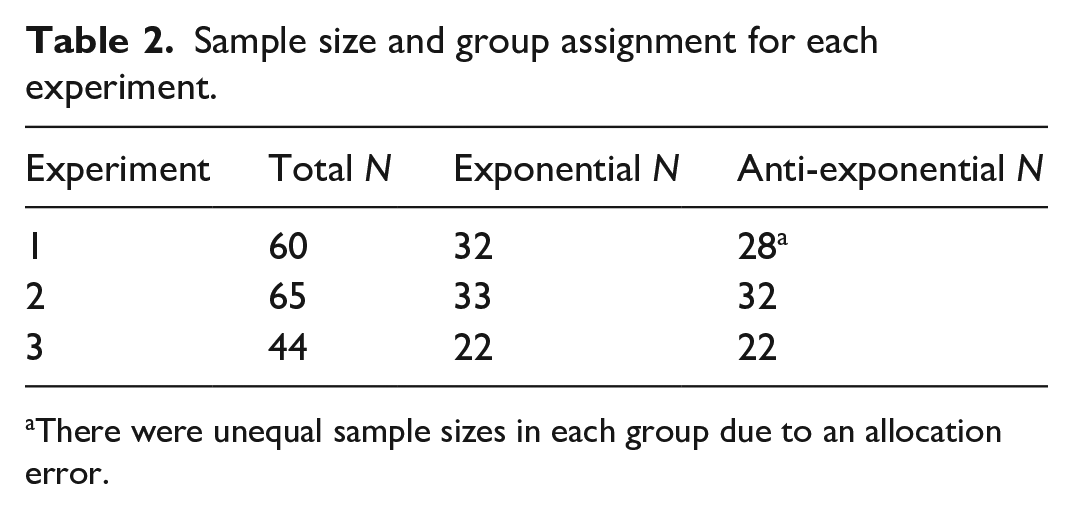
There were unequal sample sizes in each group due to an allocation error.
Design
A mixed design was used; the within-subject factor was foreperiod (400, 800, 1,200, and 1,600 ms) and the between-subject factor was the distribution of foreperiods during the acquisition phase (exponential or anti-exponential). The ratio of foreperiods was 8: 4: 2: 1 (majority short durations) in the exponential condition, and 1: 2: 4: 8 (majority long durations) in the anti-exponential condition. Both conditions consisted of five blocks of 120 trials each (see Table 3). Block 1 contained a uniform distribution of foreperiod durations for both groups. Blocks 2 and 3 consisted of exponentially or anti-exponentially distributed foreperiod durations, dependent on group. After Block 3, participants were informed about the distributions of the previous blocks and that in the next blocks, there would be a change in the distribution whereby short and long foreperiods would occur equally often. Blocks 4 and 5 contained uniformly distributed foreperiod durations.
Distribution of foreperiods that each group was exposed to during the experimental session.
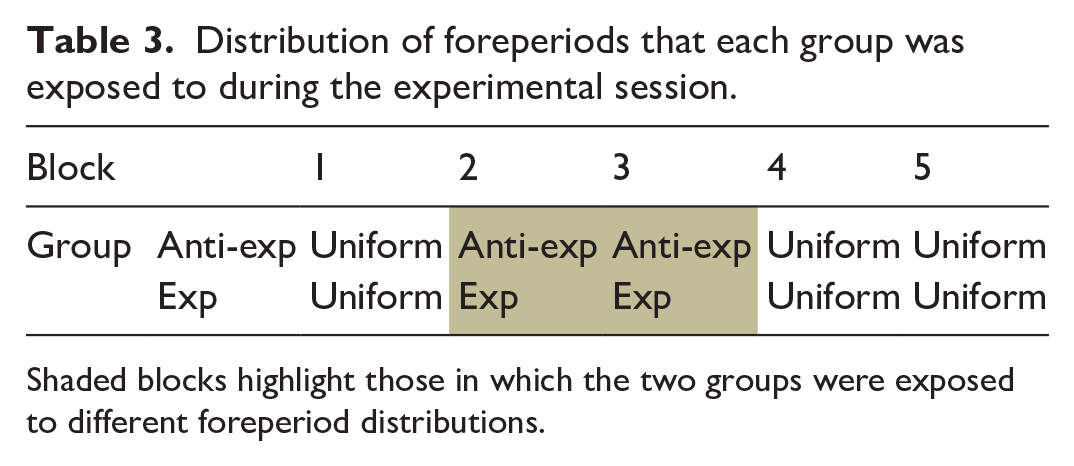
Shaded blocks highlight those in which the two groups were exposed to different foreperiod distributions.
Procedure
Participants were tested in small groups. On arrival, they were given the opportunity to read the information sheet and ask any questions, before they provided informed written consent. Participants sat in front of a monitor connected to a PC running custom written software (ensuring low-latency timings) to present the warning and target signals via Sony MDR-ZX110 stereo headphones at approximately 50 dB. A standard USB mouse was used to collect responses to the target. Sine-wave tones, ramped at onset and offset for 50 ms, were used as stimuli. After each block, the mean RT was presented on the monitor and participants were asked to write it on a piece of paper, to keep them motivated to respond as fast as possible. At the start of the transfer phase (i.e., Blocks 4 and 5), participants were informed about the distributions that they had just experienced and about the (uniform) distribution that would be used in the final two blocks.
Tasks
In the choice-RT task, a trial consisted of a warning signal played binaurally at 540 Hz, followed by a target signal played monaurally at 1,000 Hz. Participants were instructed to press the left mouse button if S2 was played to the left ear, and the right mouse button if it was played to the right ear using the index and middle finger, respectively. In the simple-RT task, a trial consisted of a warning signal (S1) played binaurally at 540 Hz, followed by a target signal (S2) played binaurally at 1,000 Hz. Participants were instructed to click the left mouse button as soon as possible once detecting the binaurally presented S2. In both tasks, the target signal played for 2,000 ms or until response. There was an intertrial interval of 1,500 ms.
Foreperiods
In the filled foreperiod condition, the warning signal remained on during the entire foreperiod. In the unfilled foreperiod condition, the warning signal was turned off after 150 ms (including a 50 ms ramped onset and offset), followed by a silence for the duration of the foreperiod.
Analysis
A mixed analysis of variance (ANOVA), with foreperiod included as a linear (1 degree of freedom) within-subject factor and group as a between-subject factor, was run on each block to investigate the modifying effect of group on the slope of the RT-foreperiod function. If there was no evidence for a modifying effect, we used a Bayesian analysis, which allowed us to draw conclusions about the strength of evidence for the null effect. Analysis was conducted using JASP (JASP Team, 2018) employing the default Cauchy prior (.070, although a robustness test showed our findings did not rely on this choice of prior). We report the Bayes Factor for the null hypothesis (BF01) and for the alternative hypothesis (BF10) where appropriate (note, BF01 = 1 / BF10). We interpret a BF value greater than 3 as evidence in favour of that hypothesis.
Results
Experiment 1
In this experiment, a choice-RT task and filled foreperiod was used. For all participants, the first trial of each block and trials with RTs shorter than 150 ms (1%) or longer than 800 ms (<1%) were removed from analysis. Any incorrect responses were also removed (6%).
For Block 1, as expected, performance was equivalent for both groups, demonstrated by no main effect of group, and no interaction between group and foreperiod (maximum F = 1.95, p = .168). There was a main effect of foreperiod in Block 1, F(1, 58) = 4.91, p = .031,
In Blocks 2 and 3, there was a significant interaction between foreperiod and group, with the weakest interaction in Block 2, F(1, 58) = 23.58, p < .001,
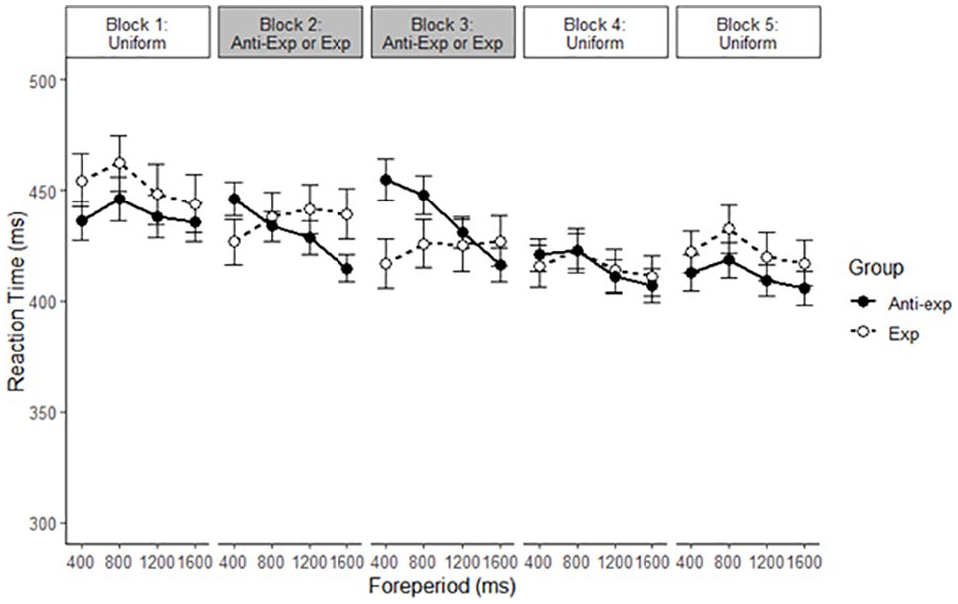
Mean response time as a function of foreperiod (400, 800, 1,200, 1,600 ms), group (anti-exponential or exponential distribution received in the acquisition phase), and block (Block 1 [Baseline Phase], Blocks 2–3 [Acquisition Phase], and Blocks 4–5 [Transfer Phase]).
Experiment 2
In Experiment 2, we used a simple-RT task and unfilled foreperiod. For all participants, the first trial of each block and trials with RTs shorter than 150 ms (5%) 1 or longer than 800 ms (1%) were removed and not analysed further.
As expected, performance was initially equivalent in both groups, demonstrated by no main effect of group, and no interaction between group and foreperiod (max F = 2.02, p = .160). There was a main effect of foreperiod in Block 1, F(1, 63) = 85.79, p < .001,
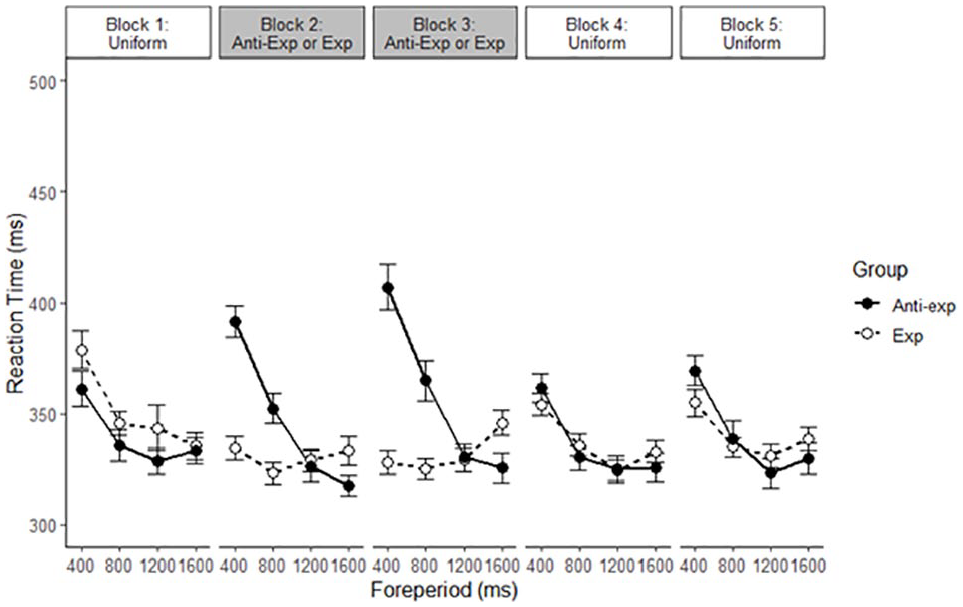
Mean response time as a function of foreperiod (400, 800, 1,200, 1,600 ms), group (anti-exponential or exponential distribution received in the acquisition phase), and block (Block 1 [Baseline], Blocks 2–3 [Acquisition Phase], and Blocks 4–5 [Transfer Phase]).
Experiment 3
In this experiment, a choice-RT and unfilled foreperiod was used. Six participants were removed because they made more than 20% errors indicating that they did not engage with the task. For all participants, the first trial of each block and trials with RTs shorter than 150 ms (<1%) or longer than 800 ms (<1.5%) were removed and not analysed further. Any incorrect responses were also removed (3.5%).
In line with Experiments 1 and 2, performance was equivalent in both groups in Block 1, demonstrated by no main effect of group, and no interaction between group and foreperiod (max F = 0.55, p = .462). There was a main effect of foreperiod in Block 1, F(1, 36) = 17.73, p < .001,
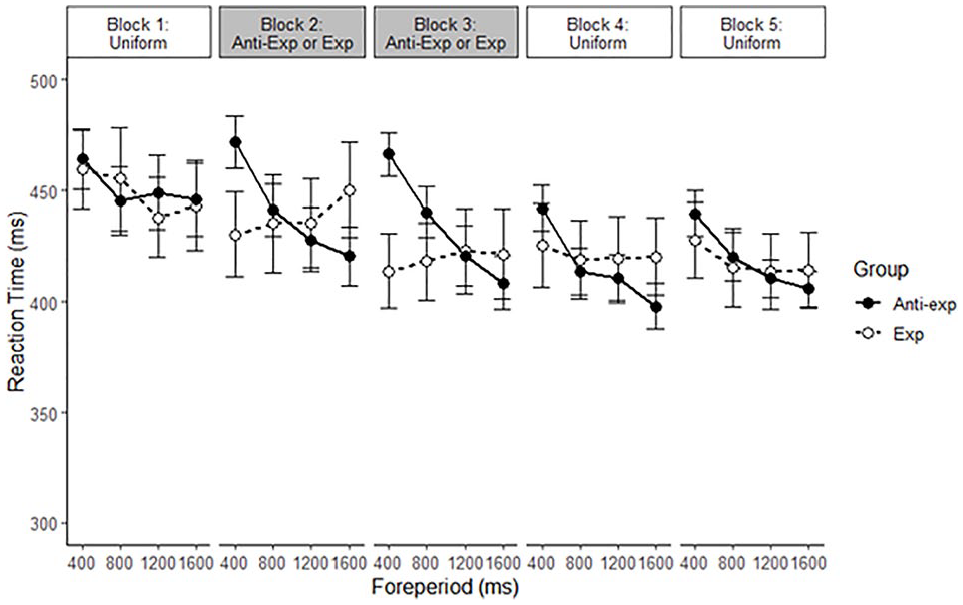
Mean response time as a function of foreperiod (400, 800, 1,200, 1,600 ms), group (anti-exponential or exponential distribution received in the acquisition phase), and block (Block 1 [Baseline], Blocks 2–3 [Acquisition Phase], and Blocks 4–5 [Transfer Phase]).
General discussion
Three temporal preparation experiments were conducted using slightly different procedures to assess the generalisability of MTP to the auditory domain. In previous work, Crowe and Kent (2019) failed to replicate the long-term transfer effects reported by Mattiesing et al. (2017). In a second experiment replicating Los et al. (2017), Crowe and Kent (2019) report some evidence for transfer effects using auditory stimuli, but this was restricted to a single block. One possible explanation for this discrepancy is that Crowe and Kent (2019) used a simple-RT task, whereas both Los et al. (2017) and Mattiesing et al. (2017) used a choice-RT task. Experiment 1 therefore replicated the design used by Crowe and Kent (2019), but participants performed a choice-RT task in which they had to respond according to which ear the target signal was presented in. There was no evidence for transfer effects in Experiment 1, suggesting that the differing results in the visual and auditory domain are not the result of the type of RT task used.
The second consideration that we explored was whether the type of foreperiod used affected the emergence of transfer effects. Experiments 2 and 3 therefore used unfilled foreperiods in both a simple-RT (Experiment 2) and choice-RT (Experiment 3) task. There was evidence for the emergence of transfer effects in both experiments, demonstrating that an unfilled foreperiod is an important contributor to the reliable emergence of transfer effects in the auditory domain. Los et al. (2017) and Mattiesing et al. (2017) used a filled foreperiod and still found evidence for transfer effects in the visual domain. An important consideration is that the auditory filled foreperiod design used in the experiment presented here is more intrusive than the persistence of the visual fixation point used by Los et al. (2017) and Mattiesing et al. (2017). Indeed, the distraction-during-foreperiod hypothesis suggests that auditory filled foreperiods are particularly competitive for participants’ attention, and thus, the effect of a filled foreperiod may be different for visual compared with auditory stimuli. An interesting avenue for future research is to explore whether the type of foreperiod used with tactile stimuli, which we propose are more alerting and intrusive than visual stimuli, also prevents the emergence of transfer effects.
Taken together, the results of Experiments 2 and 3 support MTP. The transfer effects observed cannot be accounted for by models of temporal preparation based on the hazard function alone (e.g., Coull et al., 2011; Cui et al., 2009; Vallesi & Shallice, 2007) because participants used neither the information provided at the start of the transfer session, nor their initial experiences during the transfer session to quickly adjust to the new foreperiod distribution and resulting hazard function. The emergence of transfer effects in the auditory domain does, however, appear to be moderated by the type of foreperiod used. MTP therefore needs theoretical development to fully describe the cognitive processes that underlie temporal preparation. One possibility is that the entire perceptual event is encoded and stored into memory rather than just the inhibition and activation applied on a given trial being stored during the trace formation process. When more attention is placed on the perceptual event itself rather than, for example, being distracted by an intrusive auditory foreperiod, transfer effects are more likely to be observed. This interpretation emphasises the idea that the attended information gets stored in memory, whereas unattended information does not (Logan et al., 1996).
Finally, a more intriguing mechanism is suggested by relating the difference between a filled and an unfilled foreperiod to the distinction made between delay and trace conditioning. Delay conditioning is similar to filled foreperiod designs because the conditioned stimulus (S1) stays on until the unconditioned stimulus (S2) is presented. In contrast, trace conditioning is akin to unfilled foreperiod designs because the conditioned and unconditioned stimuli are separated by an empty interval. Delay conditioning typically promotes faster learning than trace conditioning (Beylin et al., 2001), and therefore, under the assumption that transfer effects indicate learning, we would expect larger transfer effects in filled rather than unfilled foreperiods which was not the case. Another consideration, however, is that trace conditioning is hippocampus-dependent, whereas delay conditioning is not because of the proposed role of the hippocampus to fill the gap between S1 and S2 (Clark, 2002, but see Perruchet, 2015). According to MTP, transfer effects are memory based and, therefore, may require the hippocampus. If filled foreperiod designs are hippocampus-independent, this may therefore reduce the likelihood of observing transfer effects. Investigating the brain structures involved in transfer effects is an interesting avenue for future research that has promise in shedding light into the neural mechanisms underlying transfer effects in temporal preparation.
The experiments presented here investigated the role of procedural factors in the emergence of transfer effects in the auditory domain to gain insight into the generalisability of MTP. The type of RT task (simple or choice) used did not moderate the emergence of transfer effects but the type of foreperiod (filled or unfilled) did, with the use of a filled foreperiod resulting in either no (Experiment 1) or limited transfer (Experiment 2, Crowe & Kent, 2019). As transfer effects are well documented in the visual domain using a filled foreperiod, our results suggests modality-specific consequences result from using a filled foreperiod, with auditory filled foreperiods likely more competitive for participants’ attention resulting in weaker memory traces of the inhibition and activation applied on a given trial. MTP requires theoretical development to account for such modality-specific effects, and investigation into other modalities, such as tactile stimulation, is warranted.
Footnotes
Acknowledgements
We would like to acknowledge Dominic Rigg and Rose Hammal for their assistance with data collection.
Declaration of conflicting interests
The author(s) declared no potential conflicts of interest with respect to the research, authorship, and/or publication of this article.
Funding
The author(s) disclosed receipt of the following financial support for the research, authorship and/or publication of this article: This work was supported by a grant from the Experimental Psychology Society awarded to Christopher Kent.
