



Abstract
There is a general agreement that speaking requires attention at least for conceptual and lexical processes of utterance production. However, conflicting results have been obtained with dual-task paradigms using either repetition tasks or more generally tasks involving limited loading of lexical selection. This study aimed to investigate whether post-lexical processes recruit attentional resources. We used a new dual-task paradigm in a set of experiments where a continuous verbal production task involved either high or low demand on lexical selection processes. Experiment 1 evaluates lexical and post-lexical processes with a semantic verbal fluency task, whereas Experiments 2 and 3 focus on post-lexical processes with a non-propositional speech task. In each experiment, two types of non-verbal secondary tasks were used: processing speed (simple manual reaction times) or inhibition (Go/No-go). In Experiment 1, a dual-task cost was observed on the semantic verbal fluency task and each non-verbal task. In Experiment 2, a dual-task cost appeared on the non-verbal tasks but not on the speech task. The same paradigm was used with older adults (Experiment 3), as increased effort in post-lexical processes has been associated with ageing. For older adults, a dual-task cost was also observed on the non-propositional verbal task when speech was produced with the inhibition non-verbal task. The results suggest an attentional cost on post-lexical processes and strategic effects in the resolution of the dual-task.
Speaking is usually an effortless and efficient ability that was long considered as little demanding in attentional resources. One can, for example, speak while cooking or driving without feeling a need for a greater attentional effort. Experimental results, however, suggest that attention is required during the production of single words (Piai & Roelofs, 2013; Roelofs, 2008) with no consensus on which specific processes involve attention.
Most language production models distinguish a conceptual level (pre-lexical), a formulation level (grammatical, phonological, and phonetic encoding), and an articulation level in utterance production (Dell, 1986; Levelt, 1989; Levelt et al., 1999). Based on Levelt and collaborators’ (1999) model, after defining the conceptual message, the lexical representation of the word is activated and selected among candidates sharing semantic properties. Its syntactic and morphological properties are retrieved (grammatical encoding), as well as the phonological form, allowing for a syllabic representation of the utterance to be built (phonological encoding). A motor programme is finally elaborated (phonetic encoding) that will allow the production of sounds by speech organs (articulation). In addition, monitoring processes take place during phonological encoding and articulation to detect and correct errors. After conceptual processing, the earliest processes of utterance production can be qualified as lexical. At lexical levels, the main process of lexical (lemma in some models) selection is performed as well as the retrieval and/or the encoding of a phonological word. Some studies suggest that the first steps of phonological encoding are still influenced by lexical factors (such as the effect of phonologic neighbourhood density on naming latencies). Consequently, it was proposed that post-lexical processes begin at the syllabification process of phonological encoding (Goldrick & Rapp, 2007). Syllabification refers to the generation of a syllabified phonological representation of the utterance, which represents the linguistic input to motor speech planning and programming (also called phonetic encoding) for speech articulation. According to Goldrick and Rapp’s proposal, we will use the term “post-lexical process” to designate syllabification, phonetic encoding, and motor execution of speech.
Utterance planning was claimed to involve some amount of attentional demand for pre-lexical and lexical processes, such as conceptualisation, lexical selection, and activation of phonological codes (Cook & Meyer, 2008; Ferreira & Pashler, 2002; Roelofs & Piai, 2011; Ye & Zhou, 2009). On the contrary, the attentional load for post-lexical processes is less studied and still debated (see Garrod & Pickering, 2007). Recent findings suggested that phonological and subsequent planning processes are under attention control. Dual-task costs (DTCs) in aphasic patients were found to be more severe in the case of word-form impairment compared with lexical impairment (Laganaro et al., 2019). In another work, it was also demonstrated that sustained attention is related to late processes in picture naming, arising after phonological encoding (Jongman et al., 2015). Finally, the original idea that lexical processes require attention was questioned by the proposal that a response exclusion mechanism happens at a post-lexical level of utterance production instead of competition during lexical selection (see Janssen et al., 2008; Mahon et al., 2007). This proposal is interesting because lexical selection is a target component to explain how attention might intervene during lexical processes (Roelofs & Piai, 2011). In summary, more and more research results challenge the traditional view of post-lexical processes being automatic with a recent interest in studying how attention would intervene at later levels of utterance production.
The present study aimed to investigate if post-lexical processes of utterance production require some attentional control. The attentional demand of utterance production was examined using a classical dual-task paradigm, but we stepped away from the combination of tasks most frequently utilised (picture naming/tone detection). Rather, we used continuous utterance production tasks with high (Experiment 1) or low (Experiment 2) involvement of lexical selection associated with two types of visual stimuli detection tasks. In addition, a group of older adults was investigated (Experiment 3) as increased effort in post-lexical processing has been observed in ageing. In the following sections, we will present the dual-task paradigm, review evidence suggesting that post-lexical processes require attention, and discuss how ageing could contribute to highlight an attentional demand in post-lexical processes.
Dual-task paradigm and interpretation of DTCs
The attentional requirements of cognitive processes have classically been investigated using dual-task paradigms, i.e., in situations where two tasks are performed at the same time. In such a paradigm, it is assumed that if both tasks require attentional resources, performance decreases (slowing of reactions and/or decrease of accuracy) in the dual condition compared with the single condition (Pashler, 1998). The DTC has received various explanations, such as structural incapacity to realise parallel processing (bottleneck theory, Broadbent, 1982) or limitations in attentional capacity when resources must be shared between two tasks (Kahneman, 1973). According to capacity sharing theory, the complexity of the task directly influences the magnitude of the effect: as more attentional resources are recruited by complex tasks, the DTC should be increased (Pellecchia, 2003; Strayer & Johnston, 2001; Vaportzis et al., 2013; Verhaeghen et al., 2003).
Both capacity sharing (Kahneman, 1973) and bottleneck theories (Broadbent, 1982) predict that if utterance production involves attention, speaking while executing a non-verbal attention demanding task should cause a DTC. This prediction means that a poorer performance should be observed in speech (e.g., reduced speech rate or increased errors) and/or on the secondary task. As summarised in the next section, results from studies using dual-task paradigms indicate that a DTC was reliably found when utterance production involves high conceptual and lexical loads. Evidence of a DTC for tasks evaluating exclusively or predominantly post-lexical levels is however less consistent.
When using a dual-task paradigm the presence of cross-talk effects (Koch, 2009; Navon & Miller, 1987) should be considered, meaning that a specific interference or facilitation may arise because of an overlap between task modalities. Cross-talk effects indeed reflect the use of specific neuronal pathways and not a general attentional implication. Thus, caution should be taken to avoid tasks sharing the same input or output codes/modalities (for an example with picture naming, see Fargier & Laganaro, 2016).
Attention during lexical and post-lexical processes
Using tasks that involve complete utterance planning processes (from conceptualisation to articulation), such as naming, narration, or conversation, it was observed that utterance production has a detrimental effect on the concurrent realisation of non-verbal tasks (e.g., Boiteau et al., 2014; Eichorn et al., 2016; Kubose et al., 2006; Raffegeau et al., 2018). As lexical and post-lexical processes are executed in these tasks, it is difficult to infer at which level attention intervenes. The use of other methods or a change of tasks seems necessary to target specific utterance processes.
One of the first studies that investigated the attentional demand of specific processes in utterance production (Ferreira & Pashler, 2002) used the Psychological Refractory Period paradigm (for a description, see Pashler, 1998). Ferreira and Pashler (2002) found that attention was required in lemma and lexeme selection but not in phoneme selection. A further study (Cook & Meyer, 2008) came to different conclusions with the same paradigm, showing that phoneme selection was also under attentional control when task parameters did not generate a slowing of monitoring processes. In the same idea, several eye-tracking studies suggested that attention was required up to phonological encoding processes (Meyer et al., 2003; Meyer & van der Meulen, 2000). In two studies using an individual differences approach, post-lexical processes have specifically been related to attentional performance. Jongman et al. (2015) used a picture naming task and showed that sustained attention performance correlated with the magnitude of the tail of naming latencies distribution (the portion of the distribution associated with slow latencies). This same latency parameter did not correlate with a variable typically related to processes involved until phonological encoding (gaze duration on the pictures). Their results suggest that post-lexical processes might be responsible for the correlation between attention and naming latencies. In another study where participants were asked to produce non-words (diadochokinetic task), the accuracy of non-word production was related to executive (shifting) abilities (Shen & Janse, 2020). These different approaches show that it is not only lexical levels of utterance production but also post-lexical processes that are likely to be related to attention.
To our knowledge, only two studies have tried to investigate if a DTC was observed with non-lexical production tasks (syllables repetition). These studies are interesting because they propose a production task in which lexical processing is absent. They also avoid potential cross-talk effects because an auto-generated speech task is combined with a non-verbal task. One study used walking as a secondary task (Jablecki, 2013) and found that the speech rate was slowed, and the number of pauses was increased in dual condition for both lexical (word) and non-lexical (non-word) production. However, this result could not be replicated in a study using a visuomotor secondary task (Whitfield & Goberman, 2017). Indeed, no significant DTC was observed for the accuracy and duration of the sequences produced. Those contradictory results might be due to different measures. In Jablecki’s study, speech rate showed a DTC when pauses were included in the measure, but this was not the case when they were excluded (articulation rate), as in Whitfield and Goberman’s (2017) study. The DTC found when speech rate measures include pauses suggests that the cost is mainly accounted for by hesitations or errors/repairs rather than by articulation speed.
This hypothesis is supported by the results of a preliminary study (Pernon et al., 2019) where a continuous non-propositional speech task was used to limit the resources attributed to lexical processes. In Pernon et al. (2019) study, speech production was evaluated with a counting task performed simultaneously with a computerised or a paper and pencil visuomotor task. The visuomotor task was an inhibition task, a selective attention task, or a processing speed task. The authors observed that speech rate (including pauses) was significantly slower when performing an inhibition task or a selective attention task. Counting being an overlearned sequence, the implication of lexical processing should be minimised. Consequently, the observed DTC might be interpreted as an impossibility to recruit attentional resources for post-lexical levels of speech production and the non-verbal tasks at the same time. Still, two issues might deserve to be further tested. First, it is unknown whether such a dual-task paradigm is sensitive enough, i.e., whether the DTC usually reported on tasks involving lexical selection arise with such a continuous paradigm. Second, even in counting, some lexical processes take place, as well as monitoring processes. It could therefore be useful to test whether the results are influenced by a factor that reflects more specifically post-lexical processes, for instance comparing groups presenting differences of performance in post-lexical processing.
In summary, performance on tasks involving lexical and non-lexical verbal production can be negatively influenced during dual-tasking and can negatively affect performance in the secondary task. The results are quite unanimous for tasks involving pre-lexical and lexical processes. For verbal tasks where lexical selection is simplified or where only post-lexical processes are involved, research is sparse and shows unclear results. One possible interpretation for those diverging results is that post-lexical processes require limited attentional resources in highly performing young adult speakers. Therefore, it might be informative to study populations presenting decreased performance in post-lexical processes to search for signs of increased attentional demand.
Approaching post-lexical processing via ageing
Studying a population presenting a decreased ability in speech programming or execution may allow a different insight into the attentional demand involved in post-lexical processes. Indeed, if post-lexical processing is more difficult, this should lead to a loading of the attentional system and create a larger DTC. This idea has been supported by data showing an increased DTC with clinical populations presenting an impaired speech, such as hypokinetic dysarthria in Parkinson’s disease (Bailey & Dromey, 2015; Bunton & Keintz, 2008; Ho et al., 2002; Whitfield & Goberman, 2017) or mixed dysarthria in Wilson’s disease (Pernon et al., 2013). One of the major problems when studying clinical populations is that confounding factors might affect the dual-task performance, such as cognitive impairment raising questions about the generalisation of results to healthy populations.
Normal ageing presents modifications in speech production compatible with the idea that motor speech programming and execution are more effortful with age. Older adults tend to show changes in several dimensions of speech, including breathing functions (Huber & Spruill, 2008; Hunter et al., 2012), voice (Hooper & Cralidis, 2009; Linville, 1996; Torre & Barlow, 2009), articulation, and speech fluency (Ballard et al., 2001; Tremblay et al., 2017). Slowing of speech rate was reported using different measures (for an increase of utterance durations, see Bailey & Dromey, 2015; Wohlert & Smith, 1998; or for longer syllables durations, see Quené, 2008). Among those, the most common measure of speech rate calculated with the number of syllables per second frequently showed a slowing for older adults. With this same measure, a speech rate slowing was found in conversation (Jacewicz et al., 2009; Quené, 2008), reading (Harnsberger et al., 2008; Huber et al., 2012; Jacewicz et al., 2009), or sentence repetition (Wohlert & Smith, 1998). Speech rate is slowed even in non-lexical tasks, such as non-word repetition or syllable loop-repetition, indicating a decrease of performance for post-lexical processes (Goozée et al., 2005; Tremblay et al., 2017, 2018). Thus, if post-lexical processes require attention, younger adults might present a DTC during utterance production, but this effect should be even clearer with older adults.
The present study
In summary, there is a consensus in the literature that lexical processes involve attentional resources, while less evidence is found considering post-lexical processes. Classical utterance production tasks (picture naming, conversation) pose methodological challenges, such as cross-talk effects. They also impose high loading onto conceptual and lexical levels of production making it problematic to specifically target post-lexical processes. On the contrary, the use of non-lexical tasks, as non-word repetition, might create a heavy load onto working memory systems. In the present work, we propose to use a dual-task paradigm avoiding cross-talk effects using a verbal and a non-verbal task, and minimising the difficulty imposed on conceptual and lexical processing. Contrary to previous studies, we used a non-propositional speech task. This type of task is frequently used in clinical settings to evaluate automatic speech, as it was reported that performance may be preserved when language is impaired (Lum & Ellis, 1994, 1999). Non-propositional speech thus likely requires fewer resources for lexical selection, while still involving post-lexical processes. It offers several other advantages: it allows an auto-generated production of words, it does not rely heavily on listening or working memory abilities (compared to repetition), and it is purely verbal (no visual stimuli compared to picture naming). The continuous aspect of non-propositional speech also better reflects the natural preparation and execution of speech (as in conversation) compared to discrete tasks (such as picture naming). This work also provides an original attempt to load onto post-lexical processes studying a population known to present a decrease of performance in post-lexical processes: healthy older adults. Indeed, if older adults mobilise more effort for post-lexical processes, the DTC should be greater due to a smaller quantity of available attentional resources.
Three experiments are presented using a classical dual-task paradigm with a verbal and a non-verbal task, both realised in single then in dual condition. To avoid cross-talk effects (Navon & Miller, 1987), the verbal and non-verbal tasks did not share modalities. Thus, the non-verbal tasks (simple manual reaction times: Go task; inhibition: Go/No-go task) involved visual stimuli and manual responses (button press). The verbal tasks (Experiment 1: semantic verbal fluency; Experiments 2 and 3: reciting days of the week) were auto-generated (no elicitation with pictures, as opposed to usual referential production tasks) and involved continuous oral production of single words (nouns). First, this new paradigm was tested in Experiment 1 to verify that the concomitant non-verbal tasks impose enough attentional constraints to interfere with lexical selection in a semantic verbal fluency task. Then, the paradigm was derived with the non-propositional task studying the performance of younger (Experiment 2) and older adults (Experiment 3).
Experiment 1: semantic verbal fluency in dual-task
This experiment aimed at testing whether the dual-task paradigm using continuous auto-generated speech yields the expected DTC on lexical selection in a verbal fluency task. The dual-task paradigm necessitates that the tasks are repeated to compare performance in single and dual conditions. One problem with verbal fluency is the risk for practice effects if the same category is used repetitively, this is why different semantic categories should be preferred as long as performance in single condition is comparable. A preliminary study was run to test which of the different semantic categories would show similar performances.
Preliminary study: method and results
This study was approved by the local ethics committee (Psychology Faculty, University of Geneva) and conducted according to the Declaration of Helsinki (World Medical Association, 2013). This preliminary study was carried out with 41 undergraduate students in psychology at Geneva University (mean age: 23.41 years, SD = 5.46). While being recorded, the participants were asked to cite as many nouns as possible within a semantic category in 60 s. Six semantic categories were tested (animals, food, body parts, clothes, jobs, and sports) with all participants in a randomised order.
A repeated-measures analysis of variance (ANOVA) was used with categories as a within factor. Post hoc comparisons of categories were realised with Tukey’s honest significance difference (HSD) test. A significant effect of category was observed, F(5, 195) = 77.11, p < .001,
Dual-task study: method
Participants
Sixty-one undergraduate students in psychology at Geneva University were enrolled for this study and received credits for participation. Fifty-one were women (10 men), and mean age was 21.23 years old. All were French speakers, native (n = 28), or bilinguals having acquired French as first language or before the age of 6 (n = 33). They all presented no neurological or language disorder.
Tasks and materials
In the verbal task (fluency task), participants were asked to cite as many nouns as they could in a defined semantic category, avoiding repetition of the same word. According to the results of the preliminary study, the two matched easy categories (animals, clothes) and the two matched difficult categories (jobs, sports) were chosen. Instructions were presented on the screen and the verbal category to be used appeared for 4 s before a sound (a beep) announcing the beginning of the task. After 61 s, a beep indicated the end of the task. No training was provided for this task as a short example with a category unused in the study (body parts) was given before the first trial.
Two non-verbal tasks were used, one involving processing speed (Go task) and a more difficult one involving inhibition (Go/No-go task). In the Go task, the participants had to respond to a circle appearing in the middle of the computer screen. A fixation point appeared for 200 ms followed by a random inter-stimuli interval (ISI) before the circle was presented for 200 ms. The participants were instructed to press on the space key of the keyboard as quickly as possible with the index finger of their dominant hand each time a circle appeared. The ISI was introduced to avoid predictability in stimulus apparition and lasted 1,500, 2,000, or 2,500 ms (each duration was attributed to 1/3 of items). The Go task contained 27 items and lasted 61 s. It was preceded by a training block of eight items. In the non-verbal Go/No-go task, the participants had to respond to only one of two types of stimuli appearing on the screen. Compared to the Go task, one of two shapes: an “x” or a “+” could appear for 200 ms. The participant was instructed to press on the space key of the keyboard as quickly as possible with the index of his or her dominant hand each time an “x” appeared and not to respond if a “+” appeared. The two shapes were never verbalised and always visually represented on the screen during instructions. The task contained 27 items (18 go trials “x” and 9 no-go trials “+”) and lasted 61 s. The ISI were the same as the Go Task. The Go/No-go task was preceded by a training block of 12 items (8 go, 4 no-go).
Overall procedure
This study was approved by the local ethics committee (Psychology Faculty, University of Geneva) and conducted according to the Declaration of Helsinki (World Medical Association, 2013). The experiment was programmed on Psychopy 2 version 1.82.01 (Peirce, 2007) and was presented on a PC with an Eizo Flexscan L557 screen. Oral productions were recorded with a micro-headset Sennheiser PC350 and stored as a sound file (.wav).
Participation took place in the neuropsycholinguistics laboratory at Geneva University. Before starting the experiment, oral explanations about the procedure were given and then participants provided written informed consent. The experiment contained six blocks: four involving single conditions (one easy verbal fluency, one difficult verbal fluency, one non-verbal Go, one non-verbal Go/No-go) and two involving dual conditions (one verbal easy or difficult with Go and one verbal easy or difficult with Go/No-go). The experiment began with one block of verbal fluency in single condition (easy or difficult), followed by one non-verbal task in single condition (Go or Go/No-go), then by the combination of the two (same difficulty of verbal fluency and same non-verbal task). After this, the difficulty of verbal fluency and the type of non-verbal task were changed: the other non-verbal task was performed in single condition followed by the dual condition. A final block of verbal fluency in single condition ended the experiment. An illustration of the procedure can be found in Figure 1.
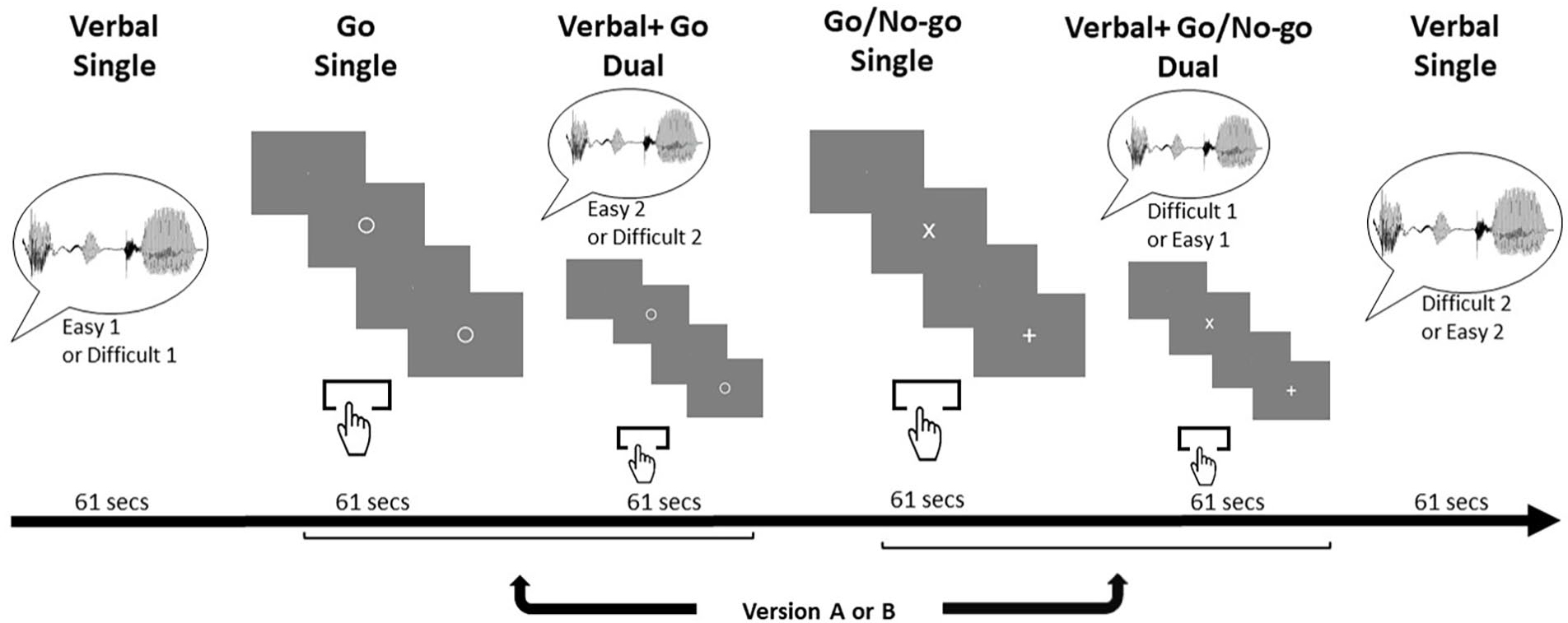
Illustration of the dual task.
The order of presentation of the fluency tasks, as well as the Go and Go/No-go tasks (version A if Go is first, version B if Go/No-go is first), was randomised with half of the participants performing the experiment in version A (n = 30) and half in version B (n = 31). Also, half passed the easy condition of verbal fluency combined with Go while the difficult condition was combined with Go/No-go and half in the other order (the condition single/dual associated with each semantic category was balanced). For dual condition, participants were informed that the two tasks had to be performed simultaneously and were equally important. No other priority instruction was given.
Analyses
The dependent variable for verbal fluency was word rate (the number of correct words per second for the given category) on the 61 s. Errors were defined as non-words, words outside of the category, repetitions, synonyms, or presence of a phonological error. For the non-verbal task, mean reaction times (RT) for correct responses were considered. RTs were cleaned removing times inferior to 150 ms and superior to two standard deviations (by subjects in each task and condition). Manual accuracy corresponded to the ratio of correct answers on the number of trials.
For word rate and manual RTs, a mixed ANOVA was performed using the general linear model with Statistica 13.4.0.14 software (TIBCO Software Inc., 2018). Condition (Single, Dual) was entered as a within factor. Secondary task (Go, Go/No-go) and bilingual status (Monolingual, Bilingual) were entered as between factors. Easy and difficult categories of verbal fluency were analysed separately, 1 and critical p-value was then set at p = .025. As the within factor includes only two modalities (single vs. dual), the sphericity assumption for ANOVA is considered respected. Other assumptions and model fitting were verified using Shapiro–Wilk’s test for normality, Levene’s test for homogeneity of variances, as well as graphical analyses. Verbal accuracy was not analysed because of ceiling effects. Manual accuracy was analysed with the Wilcoxon non-parametric test because of highly skewed distribution. As this test does not allow for several independent variables to be considered, manual accuracy was then analysed separately for Go and Go/No-go tasks.
Dual-task study: results
Manual RTs’ distribution was log-transformed because of positive skewness. Overall, 3.73% of correct manual RTs were removed due to extreme values. Descriptive statistics by category difficulty, secondary task, and condition can be found in the online Supplementary Material A and an illustration of results for word rate and manual RTs is presented in Figure 2 for condition effect by task and difficulty of the verbal fluency. Detailed ANOVA results are described in Table 1.
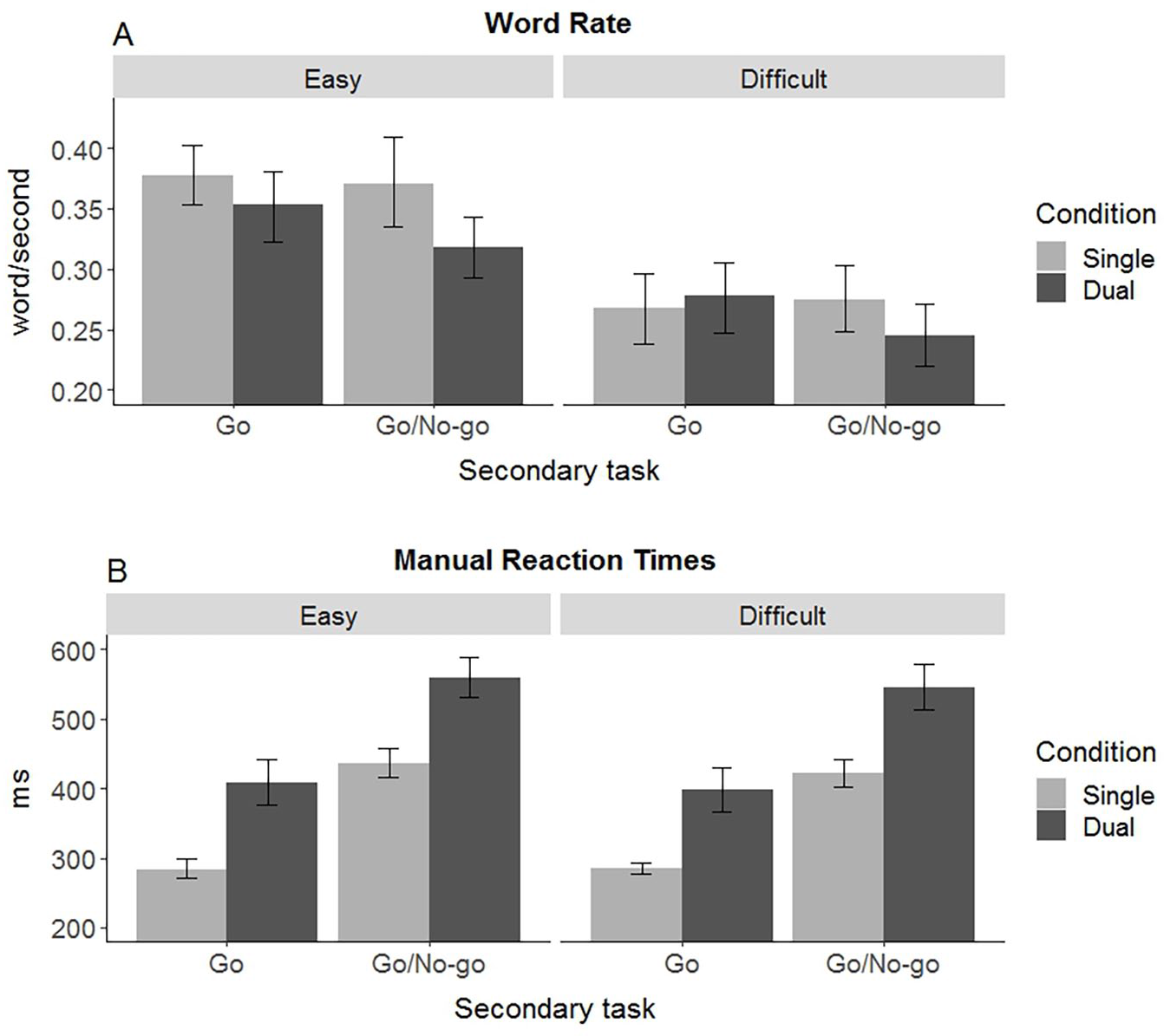
Word rate and manual reaction times in single and dual-task conditions (Experiment 1).
ANOVA results for word rate and manual RTs in the easy and difficult versions of verbal fluency.
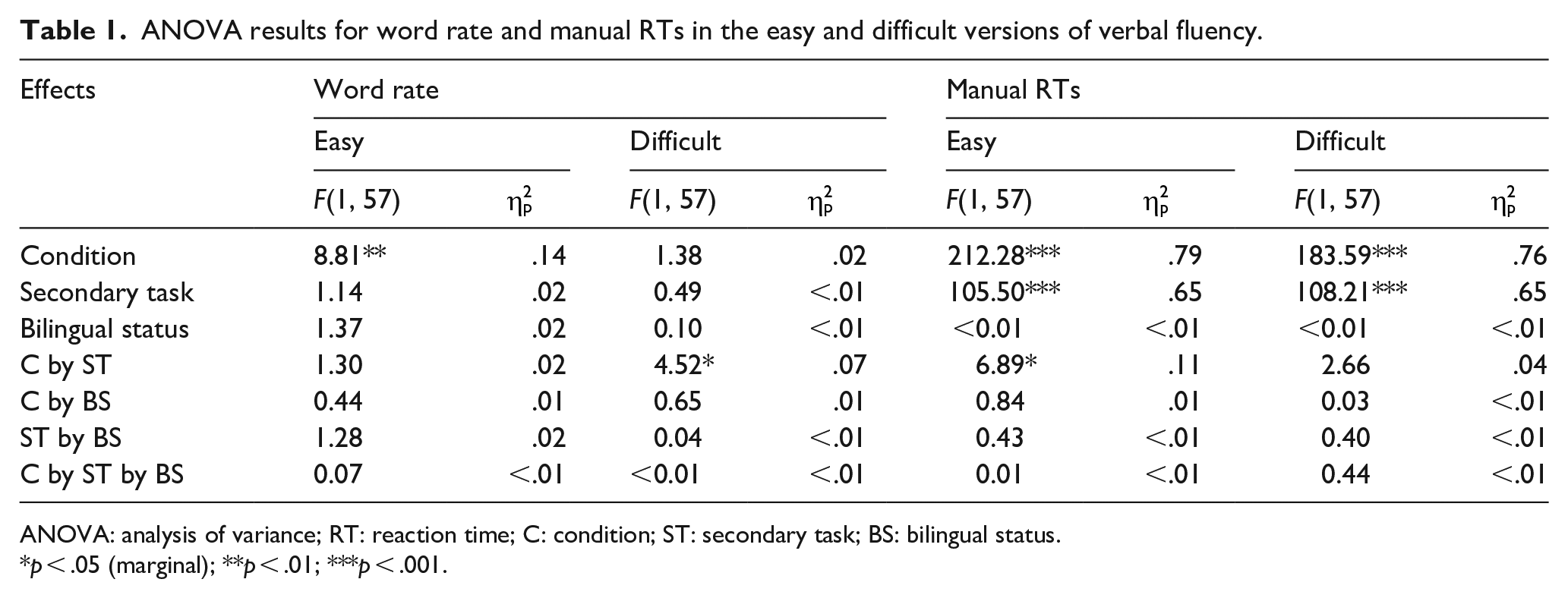
ANOVA: analysis of variance; RT: reaction time; C: condition; ST: secondary task; BS: bilingual status.
p < .05 (marginal); **p < .01; ***p < .001.
Easy categories of verbal fluency
For word rate, the effect of condition was significant, F(1, 57) = 8.81, p = .004,
Difficult categories of verbal fluency
For word rate, no significant result was found but a marginally significant interaction between the condition and the secondary task, F(1, 57) = 4.52, p = .038,
Discussion
Experiment 1 aimed at determining whether our paradigm yields a DTC when the verbal task imposes a high load on lexical processes, known to recruit attentional resources. Results show that a DTC is systematically found not only on the non-verbal concurrent tasks for manual RTs and manual accuracy but also on word rate for easy semantic categories. This indicates that searching for and producing words in a specific semantic category recruits enough attentional resources to disturb some basic processes of attention in a processing speed task and an inhibition task. These results replicate findings demonstrating that language production interferes with the realisation of attentional tasks (Kunar et al., 2008; Strayer & Johnston, 2001). The data also demonstrate that our paradigm is sensitive enough to detect an attentional reduction on language performance, as was found in studies using conversation-like tasks (Kemper et al., 2009), picture naming (Fargier & Laganaro, 2016; Jongman et al., 2015), verbal fluency (Van Rooteselaar et al., 2020), or counting (Pernon et al., 2019).
We could not observe such a DTC when the verbal category was difficult (jobs, sports). One explanation might lie in the properties of easy and difficult semantic categories. In easy categories, a larger number of candidates might be activated in the mental lexicon, imposing higher demand for lexical selection. A previous study showed that language abilities are related to performance in an easy category of verbal fluency, particularly vocabulary size and lexical access (Whiteside et al., 2016). This means that lexical processes would be responsible for at least a large part of the DTC in this experiment.
Finally, we predicted that the secondary task would interact with condition because of the complexity of the Go/No-go task compared with the Go task. A marginal interaction effect was observed in that direction for word rate when the semantic category was difficult, but the effect was significant and reversed for manual RTs when verbal fluency was easy. This contradicts the idea that more difficult tasks will lead to a more severe DTC. One hypothesis would be a different repartition of attentional resources depending on the difficulty of the tasks. For example, when speech is performed with Go, the attention might be focused on speech because the manual task seems more controllable (putting manual RTs at risk for a DTC). On the contrary, when speech is performed with Go/No-go, the attention would be focused on the difficult non-verbal task exposing speech to a greater risk of a DTC. This effect would however need to be replicated in further experiments because the interaction between task and condition is marginally significant on word rate when verbal fluency is difficult.
The Go/No-go task is different from the Go task not only in difficulty but also because it requires inhibitory control. Indeed, Go/No-go tasks are widely used to investigate impairment in inhibition skills, for instance in attention-deficit hyperactivity disorder (Bezdjian et al., 2009), impulsive behaviours (Asahi et al., 2004), traumatic brain injury (Dimoska-Di Marco et al., 2011), and Parkinson’s disease (Jahanshahi et al., 2015). It is also observed that Go/No-go tasks activate a brain network typically related to inhibitory control (Criaud & Boulinguez, 2013; Kawashima et al., 1996; Simmonds et al., 2008). Inhibition is reported to be particularly recruited in Go/No-go tasks when simple visual stimuli are used (Criaud & Boulinguez, 2013) and a low rate of no-go trials (Young et al., 2018), which was the case in this study. Considering that the Go/No-go task is less sensitive to the DTC than the Go task, one can wonder if the inhibition task is mainly supported by other resources than those shared between the semantic verbal fluency and the Go tasks. This interpretation however appears unlikely because previous works have found that word production is related to inhibition (Roelofs & Piai, 2011; Shao et al., 2012; Ye & Zhou, 2009).
Hence, this first study validates that a DTC can be found using our non-verbal secondary tasks and a continuous auto-generated verbal task imposing high resources on conceptual and lexical processing. In the second experiment, the DTC will be evaluated with a verbal task chosen to limit the effort put on those processes using a non-propositional speech task, that is, a task where lexical activation is driven by some degree of automaticity (reciting days of the week).
Experiment 2: recitation of the days of the week with younger adults
Experiment 2 aimed at testing whether a DTC was observed when the verbal task involves limited conceptual and lexical processes using a non-propositional speech task. Under the assumption that post-lexical processes require attentional resources, a DTC should be observed on the verbal and/or the non-verbal task. Moreover, regarding the proposal that attentional resources might be attracted to the verbal or the non-verbal task depending on the difficulty of the non-verbal task, different secondary task effects should be observed depending on the measures. A larger DTC is expected to be found for the Go task compared with the Go/No-go task in non-verbal measures (easy non-verbal task: effort on speech). On the contrary, a larger DTC is predicted when the secondary task is Go/No-go for the verbal measures (difficult non-verbal task: effort on the non-verbal task).
Estimation of required sample size for condition effect
G-power software version 3.1.9.7 (Faul et al., 2007) was used to estimate the sample size of Experiment 2 based on F-value for the condition effect (single vs. dual) in the easy verbal fluency task. Based on a type I error of 0.01, the required sample size was 30 participants. This globally matches the sample size used in the preliminary study of Pernon et al. (2019) that used a counting task instead of reciting the days of the week (27 participants).
Method
In Experiment 2, participants recited days of the week while performing the Go and Go/No-go tasks using the same paradigm validated in Experiment 1. As in Experiment 1, the study was approved by the local ethics committee (Psychology Faculty, University of Geneva) and conducted according to the Declaration of Helsinki (World Medical Association, 2013).
Participants
Thirty participants were recruited for this study. Three participants were excluded: two due to a technical issue during recording and one due to outlier performance (inferior to three standard deviations compared to the sample mean on a dependent variable). All participants in the final sample were French speakers aged between 20 and 46 (M = 30.11, SD = 8.58), monolinguals, or bilinguals with early acquisition of French (before the age of 6 and with no foreign accent). As a reminder, bilingual status did not show any significant contribution in Experiment 1. Participants reported having no history of neurological, language, or speech impairment and did not present performance below 1.65 standard deviations from the normative sample of a categorical verbal fluency test (Chicherio et al., 2016). Education level was considered during recruitment (Level 1: compulsory school or less, Level 2: apprenticeship or technical secondary school, Level 3: high school graduation and higher degrees). Levels 1 and 2 were pooled in the same group because of a reduced number of participants in the Level 1 group. The demographic characteristics of the final sample of 27 participants are detailed in Table 2.
Demographic characteristics of the sample for Experiment 2 (young adults).

F = Female, M = Male.
Education: 1 = compulsory school or less; 2 = apprenticeship or technical secondary school; 3 = graduated from high school and higher degrees.
Tasks and materials
In the verbal task, participants were asked to continuously recite the days of the week at a comfortable speed, allowing for good articulation. The sequence of the days of the week was favoured to other non-propositional speech sequences (e.g., 1–10 counting, recitation of months) because it involves typical nouns production and a smaller number of items to be stored in working memory.
Compared to verbal fluency, we expected week recitation to show a faster speech rate: items being driven by the sequence and repeated through time, conceptual activation, and word retrieval should be faster. Along with a faster speech rate, a possible slowing through time because of motor fatigue/mouth dryness was considered. To prevent motor fatigue from being confounded with post-lexical difficulties, it was decided to analyse only the first 20 s of speech in each trial. Thus, only 20 s of recitation were produced in single conditions. In dual conditions, 55 s were produced (to match the duration of the non-verbal tasks) but only the first 20 s were analysed. Participants were recorded using a Lavalier microphone. All recording samples were pre-analysed using Praat software 6.0.31 (Boersma & Weenink, 2017) using a Praat-script to simplify counting and segmentation of words and store duration of productions.
The non-verbal tasks were as described in Experiment 1 with a slight reduction of the number of items because of a technical issue (24 items), and the task duration was 55 s. The experiment was performed on a laptop.
Overall procedure
The experiment took place at each participant’s home, and the experimenter was present and made sure that the participant was installed in a quiet room. The procedure for Experiment 2 was the same as for Experiment 1, except that the verbal task was always the same throughout the experiment (reciting days of the week).
Analyses
As in Experiment 1, word rate (number of correct words per second) and word accuracy were measured. Each word containing a different phoneme/syllable/ or a completely different word than the target was counted as an error. Errors were classified as lexical (production of a different word than expected or a false start with at least the first correct syllable of another day of the week) or as phonological (one or several transformed phonemes but target identifiable or production of an incomplete syllable). An additional variable was added to explore articulation, which was syllable rate (number of syllables per second, pauses, and breathing excluded). As this was an exploratory measure and to reduce segmentation time, syllable rate was calculated on a portion of words: all Wednesday-Thursday (“mercredi-jeudi”) sequences. 2 Pauses were not counted as errors and should be reflected in the word rate measure. For word rate, syllable rate, and word accuracy, the single conditions (first block and last block of the experiment) were averaged so that training or fatigue effects along the experiment could be reduced. 3 Dependent variables for non-verbal tasks were, as in Experiment 1, mean RT for correct responses and manual accuracy.
All data were analysed using Statistica 13.4.0.14 software (TIBCO Software Inc., 2018). For word rate, syllable rate, and manual RTs, mixed ANOVAs were used with the general linear model. For word rate and syllable rate, the condition was used as a within factor (Single, Dual Go, Dual Go/No-go). For manual RTs, the condition (Single, Dual) and the task (Go, Go/No-go) were used as within factors. Because lower education levels (1–2) were less represented in the sample than Level 3, this factor was entered in the analysis as a between factor. The critical p-value was set at .05. Whenever the sphericity assumption was not respected, p-values were adjusted with the Greenhouse-Geisser correction. Other assumptions and model fitting for ANOVA were verified as in Experiment 1. The non-parametric Wilcoxon test was applied on manual accuracy because of important deviations from a normal distribution. As in Experiment 1, verbal accuracy was at ceiling and was not analysed. Descriptive statistics by condition and secondary tasks can be found in the online Supplementary Material B and complete results of ANOVA in Table 3.
Results of ANOVA for Experiment 2 (n = 27 young adults).
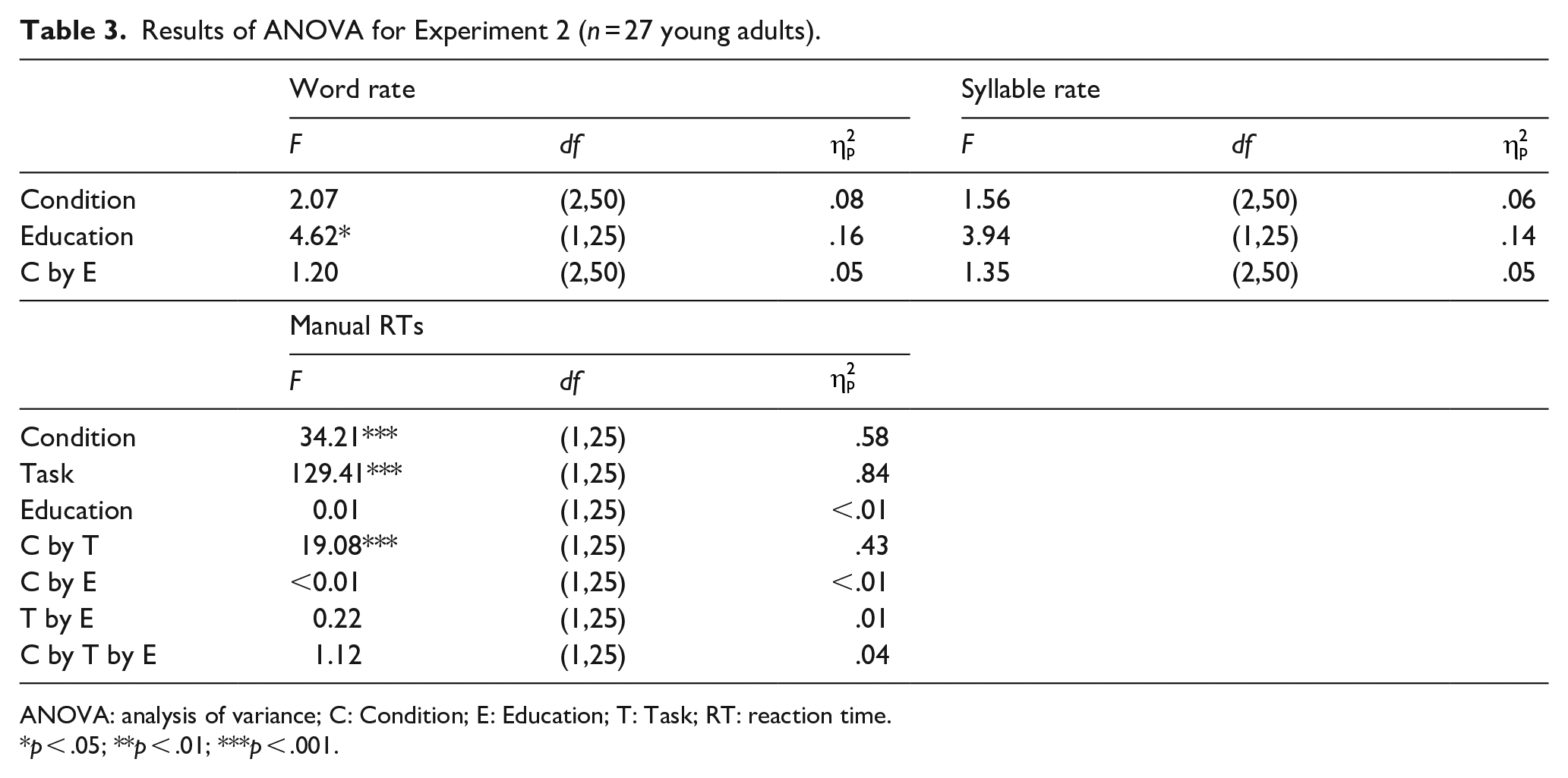
ANOVA: analysis of variance; C: Condition; E: Education; T: Task; RT: reaction time.
p < .05; **p < .01; ***p < .001.
Results
Based on the RTs cleaning criteria exposed in Experiment 1, 3.18% of the responses were removed. DTCs for each secondary task are illustrated in Figure 3 for word rate, syllable rate, and manual RTs.
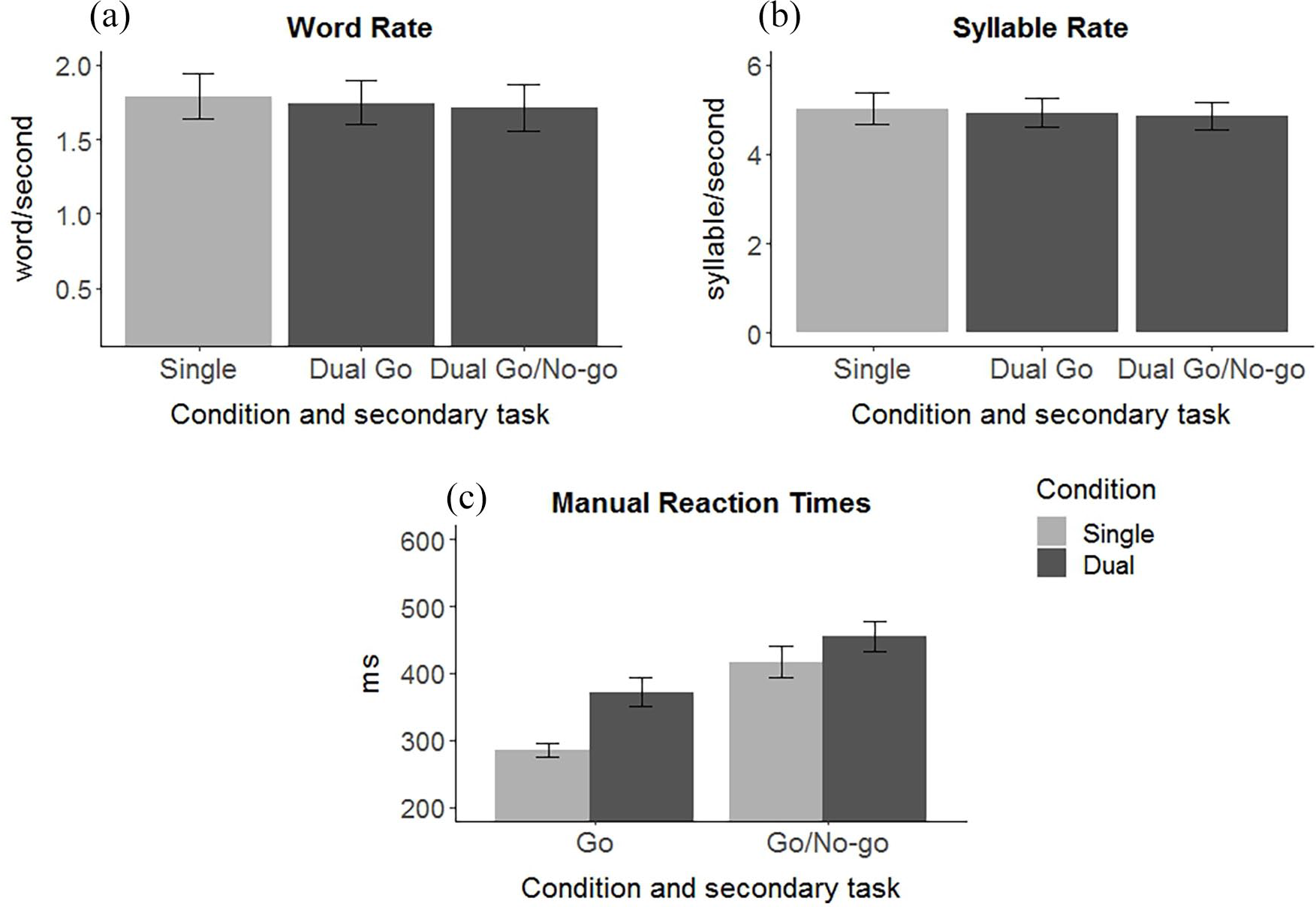
Performance in single and dual-task conditions by task (Experiment 2: young adults).
Word rate and syllable rate showed a moderate positive correlation (r = .51, see Schober et al., 2018, for interpretation of correlation strength). For word rate, a significant effect of education was found, F(1, 25) = 4.62, p = .041,
Condition effect for manual accuracy was analysed separately for Go and Go/No-go tasks with a corrected p-value of .025. For Go task, the difference between single and dual conditions was significant, Z(12) = 2.55, p = .011, and the effect was marginal for Go/No-go task, Z(16) = 2.04, p = .041. To be noted, descriptive statistics demonstrated a cost in dual condition for Go task but an amelioration for Go/No-go task. Word accuracy descriptively showed no DTC.
Discussion
In Experiment 2, the DTCs were tested with a verbal task where conceptual and lexical processes are automatised. Results showed that a significant DTC was observed on the non-verbal tasks but not on the verbal task. As a reminder, it was proposed that reciting the days of the week, as a non-propositional speech task, involves limited high-level language planning processing and reflects more post-lexical levels of production (see general discussion for detailed arguments). A cost was observed only on the manual task which shows that some attention is involved during non-propositional speech production but possibly at a smaller degree than when lexical and conceptual processes are highly present. This interpretation is illustrated, for example, by higher values for DTCs in the manual tasks in Experiment 1 (MGo = 41.85%; MGo/No-go = 29.56%) compared with Experiment 2 (MGo = 30.5%; MGo/No-go = 10.91%). We should mention, however, that no statistical comparison was performed between Experiment 1 and 2 because two different tasks and different participants were involved.
One possible argument for the lack of DTC on the verbal task is a lower difficulty of conceptual and lexical processes in week recitation. This argument would imply that attention mostly intervenes during pre-lexical and lexical levels of utterance production. Before any further discussion on this issue, we propose to perform the same experiment with a group of participants known to present a lower performance on post-lexical levels of production: healthy older adults.
Our results partially replicate those of Pernon et al. (2019) where the same materials were used for the secondary tasks. With a counting task (one to twenty) they observed a DTC on the secondary tasks but also on the speech rate of younger adults. Possibly, the counting task is more complex than week recitation. For example, the counting sequence is longer which forces participants to rely more on working memory capacity, but also a larger number of different words and movements are produced.
Experiment 2 reproduced the differences of costs depending on the secondary task observed in Experiment 1 for manual RTs. A greater cost was observed on Go compared with Go/No-go task, but no modulation was found on verbal measures. We can wonder if the task effect could be found on verbal measures under stronger attentional loading. It was pointed out that the Go/No-go task was specifically challenging for older adults (Rey-Mermet & Gade, 2018). Therefore, the difficulty of the secondary task might create an augmentation of the DTC for older adults on the verbal measure.
On manual accuracy, a cost was also found on the Go task but not on the Go/No-go task with rather a marginal facilitation under dual condition. A speed/accuracy trade-off might be at play in inhibition tasks (Kim et al., 2017) but it was more typically found a decrease of performance for RTs and accuracy measures in Go/no-go tasks (Brown et al., 2013; Brown & Perreault, 2017). As this facilitation for manual accuracy was not found in Experiment 1, one possible explanation could be that participants focus on a better achievement of the Go/No-go task (in respect of accuracy) because the verbal task is easy. This would be consistent with the idea that participants might prioritise the non-verbal inhibition task.
Finally, an unexpected result was observed, which indicated that the speech rate was faster for the lower educated group. Although we could not find convincing explanations for this observation, it may be that participants with lower education control speech to a lesser extent.
Experiment 3: recitation of the days of the week in older adults
As depicted in the introduction, older adults show a reduction of performance on various indicators related to post-lexical processes, notably a slowing of speech rate even during non-word production (Goozée et al., 2005; Tremblay et al., 2017, 2018). A few dual-task studies compared performances of younger and older adults using utterance production and non-verbal tasks and led to inconsistent results. Some studies reported no DTC on acoustic parameters of speech during reading (Dromey et al., 2010) and others observed differential DTCs between age groups with a pseudo-conversation task combined with a visuomotor tracking task (Kemper et al., 2009, 2011). Kemper et al. (2009, 2011) reported that younger adults showed signs of simplification of grammatical structures, whereas older adults, who already tend to use simpler sentences in single condition, showed a larger DTC on speech rate. In a complex task such as pseudo-conversation, a slowing of speech rate might happen due to differences of performance on conceptual, lexical, or post-lexical levels of production (or several of these levels).
The aim of Experiment 3 is to test whether a group of participants with a decreased performance at post-lexical level of processing displays extended DTCs in the same paradigm as in Experiment 2. If post-lexical processes involve attentional resources, it is expected that older adults would show a DTC on manual RTs and on speech, or a globally increased cost than observed in Experiment 2.
Method
The local ethics committee approved this study (Psychology Faculty, University of Geneva) which was conducted according to the Declaration of Helsinki (World Medical Association, 2013).
Population
Twenty-nine participants were recruited with the same criteria as Experiment 2 except for the age that was over 60 (M = 73.59, SD = 8.49). Two participants were excluded because their performance was inferior to three standard deviations compared to the sample mean on a dependent variable. The demographic characteristics of the final sample of 27 participants are detailed in Table 4.
Demographic characteristics of the sample for Experiment 3 (older adults).

F = Female, M = Male.
Education: 1 = compulsory school or less; 2 = apprenticeship or technical secondary school; 3 = graduated from high school and higher degrees.
Material, procedure, and analyses
The materials, procedure, and analyses are the same as in Experiment 2.
Results
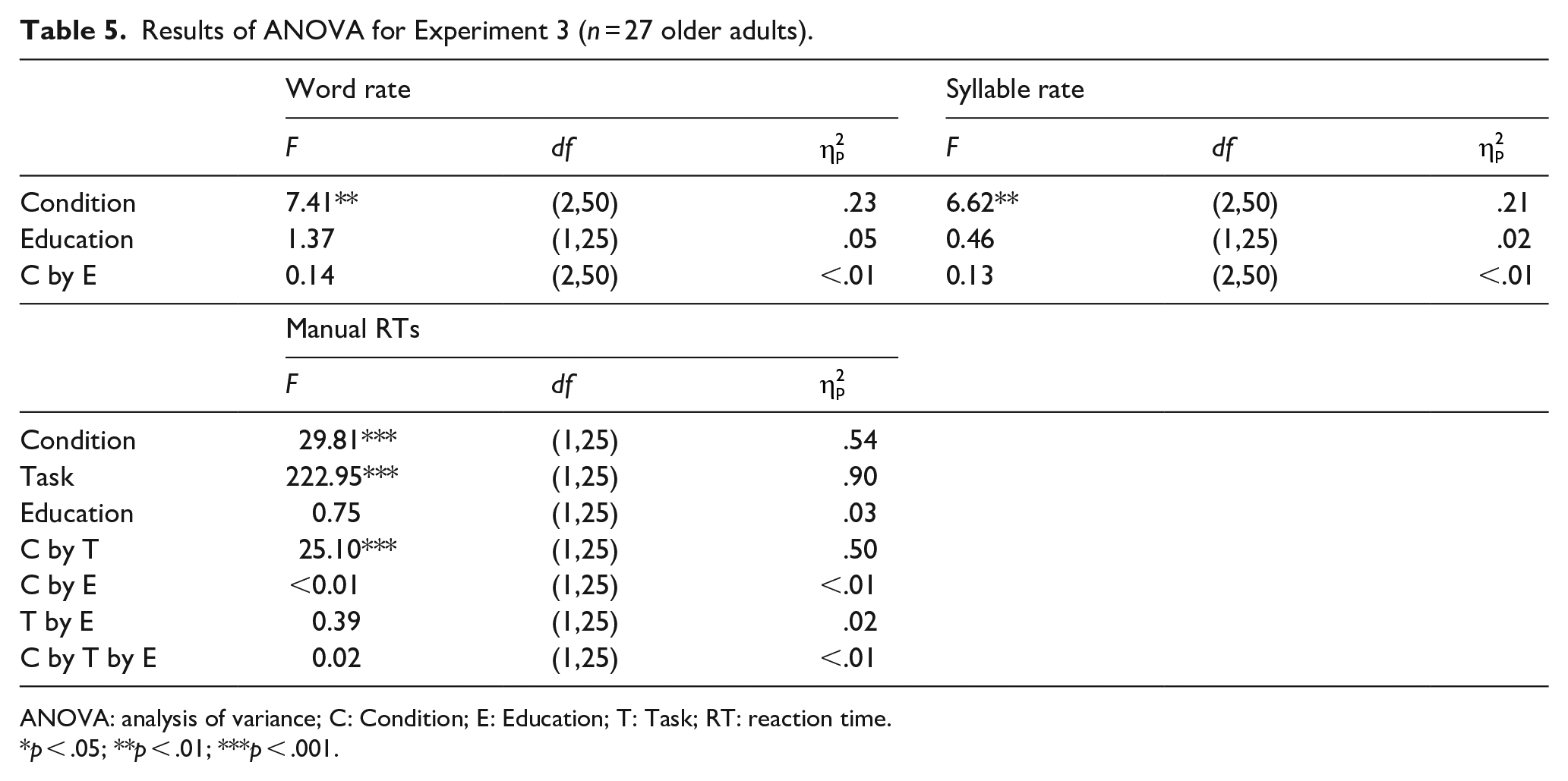
Based on the RT cleaning criteria of Experiments 1 and 2, 4.07% of the responses were removed. Due to deviation from normal distributions, syllable rate and manual RTs were log-transformed. Descriptive statistics by conditions and secondary tasks can be found in the online Supplementary Material C, and results of ANOVA are described in Table 5. DTCs by task are illustrated in Figure 4 for word rate, syllable rate, and manual RTs.
Results of ANOVA for Experiment 3 (n = 27 older adults).
ANOVA: analysis of variance; C: Condition; E: Education; T: Task; RT: reaction time.
p < .05; **p < .01; ***p < .001.
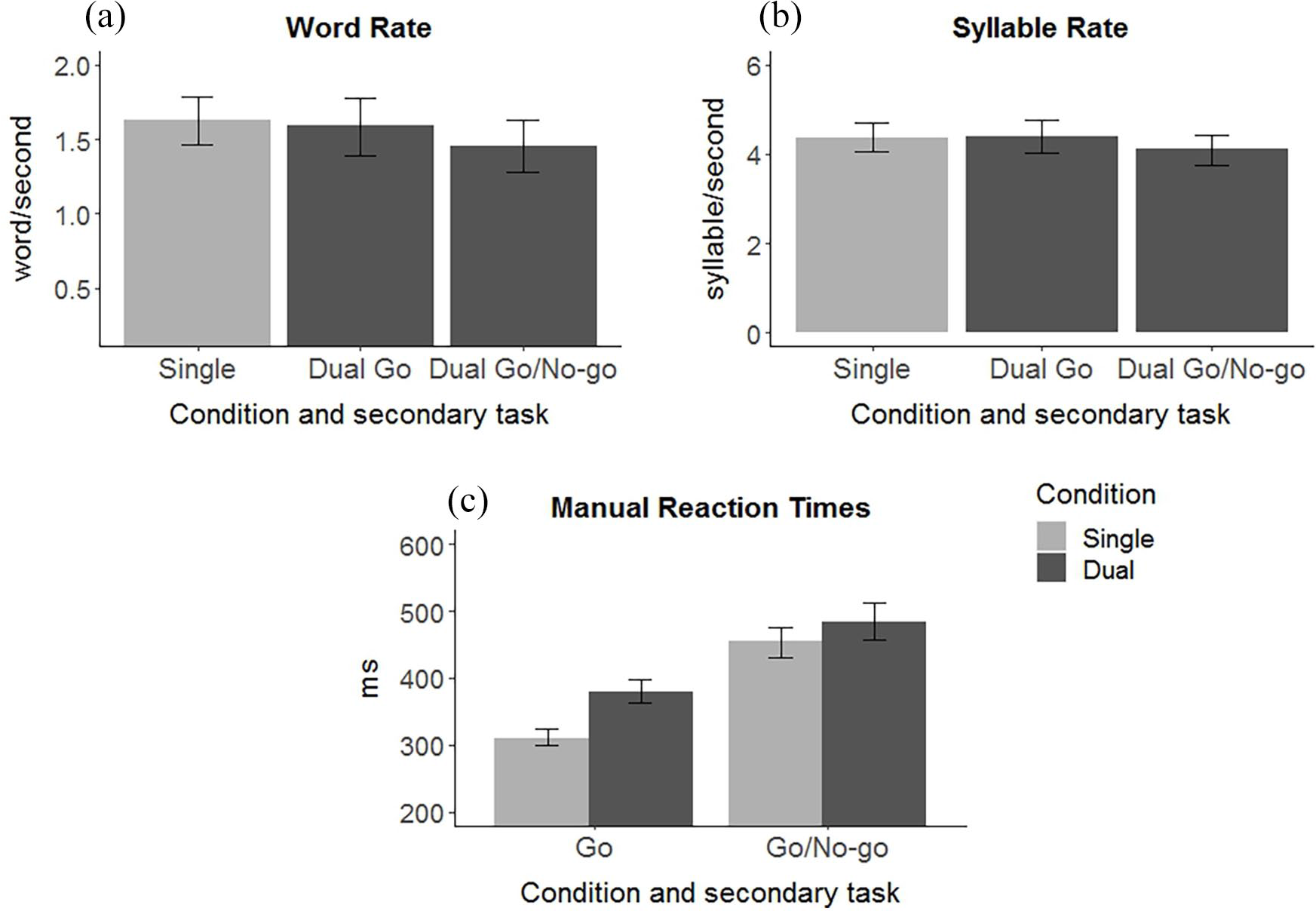
Performance in single and dual-task conditions by task (Experiment 3: older adults).
Word rate and syllable rate were moderately correlated (r = .46). For word rate, a significant effect of condition was found, F(2, 50) = 7.41, p = .002,
The DTC for manual accuracy was analysed separately for Go and Go/No-go tasks. For Go task, the difference between single and dual conditions was significant, Z(27) = 4.54, p < .001, which was also the case for Go/No-go task, Z(27) = 4.54, p < .001. For Go-task manual accuracy was higher in single compared with dual condition, but the opposite effect was observed for Go/No-go task. Word accuracy was at ceiling in every condition and showed descriptively no DTC.
Verification of postulates on older versus younger participants from Experiment 2
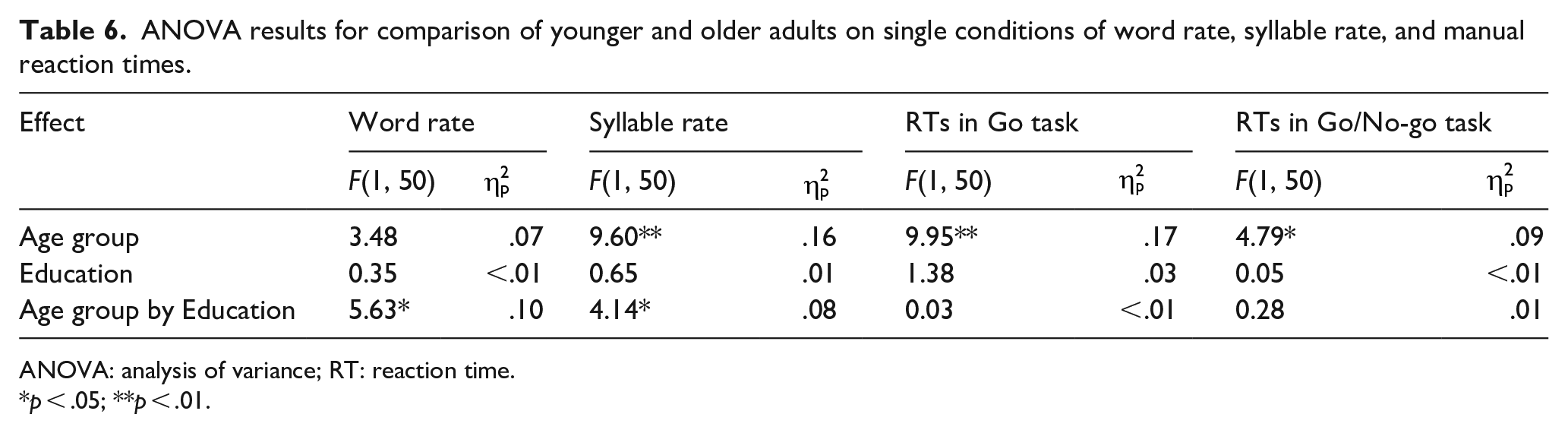
Experiment 3 was based on the postulate that older adults present a slower speech rate than younger adults. It was also expected that the older group would present a lower performance in attention and executive functions. To verify these hypotheses, a 2 × 2 ANOVA with Age (younger, older) and Education (1–2, 3) as between factors was performed on single conditions for word rate, syllable rate, and manual RTs. Results of the ANOVAs are presented in Table 6.
ANOVA results for comparison of younger and older adults on single conditions of word rate, syllable rate, and manual reaction times.
ANOVA: analysis of variance; RT: reaction time.
p < .05; **p < .01.
There was no significant effect of age group on word rate, F(1, 50) = 3.48, p = .068,
Discussion
Comparing samples of Experiments 2 and 3, younger and older adults’ groups were fully matched on gender and version of the task (order of Go and Go/No-go apparition) and were balanced as far as possible on education (see Tables 2 and 4). The results of Experiment 3 confirm that a DTC is observed on manual RTs as in Experiment 2, but also that the DTC extends on speech rates measures with larger costs on speech when the secondary task is Go/No-go. This means that a population presenting a decreased performance in post-lexical processes (slower speech rate) shows a decreased ability to perform an automatic speech task simultaneously with an inhibition task.
In the non-verbal task, the speed/accuracy effect for Go/No-go appeared more clearly than in Experiment 2 with significant cost on manual RTs and significant facilitation on manual accuracy. It was already reported that older adults show a greater tendency than younger adults to reach high accuracy at the cost of slower responses (Smith & Brewer, 1995; Starns & Ratcliff, 2010). This seems to be the case in our experiment as well. It is also possible that older adults prioritise the Go/No-go task more radically than younger adults (see general discussion), leading to a clearer facilitation on the accuracy variable.
The results in the speech task carried out in isolation confirms that older adults’ articulation rate (syllable rate) was slower than in younger adults, supporting previous findings on different tasks (Bailey & Dromey, 2015; Goozée et al., 2005; Jacewicz et al., 2009; Quené, 2008; Tremblay et al., 2017, 2018; Wohlert & Smith, 1998). Age interacted with education level for both word rate and syllable rate showing a significant slowing for older participants compared with younger participants in the case of lower education level. We care to mention that education level was well equilibrated within the older group (60–75 years old: education level 1–2 = 50%; 75–92 years old: education level 1–2 = 54%). Age effects on speech rate in the most educated group might be better compensated by cognitive reserve (Hindle et al., 2016; Stern, 2009; Tucker & Stern, 2011) or a better physical condition during ageing (Ross & Wu, 1996).
The results will be further discussed in the following section along with those of Experiments 1 and 2.
General discussion
This study aimed at investigating whether attention is recruited during post-lexical processing of utterance production. A dual-task paradigm was used with a continuous auto-generated production task that required either a high demand on conceptual and lexical processing (semantic verbal fluency) or a low demand on these levels (reciting days of the week). The verbal task was combined with two types of non-verbal secondary tasks, a processing speed task (Go) and an inhibition task (Go/No-go). The main results of the study are that a DTC is observed on the concurrent non-verbal task whether the verbal task involves high or low demand on conceptual and lexical levels of production. Crucially, however, on the verbal task itself, a DTC is observed in specific conditions only. When the task involves conceptual and lexical processing, a DTC on speech is found at a moderate level of difficulty (Experiment 1). With a non-propositional speech task, a DTC is observed when the speakers are older adults performing speech simultaneously with an inhibition task (Experiment 3). These results will be discussed below in relationship with the validity of the new paradigm and considering the attentional demand of post-lexical processes.
Continuous dual-task paradigm to investigate the attentional demand in utterance production
A new dual-task paradigm was introduced and tested to study attentional processes in utterance production. The paradigm builds on the standard dual-task procedure but makes use of continuous auto-generated words (instead of picture naming). The verbal tasks were combined with two types of concurrent visual tasks (Go and Go/No-go) to avoid cross-talk effects. Experiment 1 brought evidence that a DTC could be observed in a dual-task paradigm on word rate measure, manual RTs, and manual accuracy with a continuous auto-generated verbal task involving lexical selection (verbal fluency tasks). As discussed in Experiment 1, the replication of results previously obtained with single word production tasks ensures that the paradigm is sensitive enough to elicit DTCs (Fargier & Laganaro, 2016; Jongman et al., 2015; Van Rooteselaar et al., 2020).
In Experiment 2, when the speech task had a reduced lexical load, the DTC was observed on the concurrent non-verbal task only. An observation of a cost on the concurrent task has traditionally been taken as evidence that an attentional demand was involved in both tasks (Broadbent, 1982; Kahneman, 1973). This argument would speak for an attentional implication in post-lexical processes. However, in a non-propositional speech task, lexical processes are present even if facilitated. One can wonder to which extent lexical processes might contribute to the DTC on manual RTs observed in Experiment 2. Several findings rather show that the level of implication of lexical processes is minimal in a non-propositional task (Code, 1997; Van Lancker Sidtis, 2006). Indeed, as the sequence (counting, days, months) is overlearned and repeated during the task, the load on conceptual processing is lessened, and word retrieval is facilitated. This idea is supported by results of clinical and neuroanatomical studies. It was, for example, observed that some aphasic patients with severe impairment of lexical production can produce automatic sequences (Lum & Ellis, 1994, 1999) and that a left-brain-damaged patient impaired in non-propositional speech did not present a naming deficit (Marangolo et al., 2008). Also, propositional and non-propositional speech tasks have been described to activate partially different brain areas (Bookheimer et al., 2000; Van Lancker Sidtis, 2006).
Another question is whether other utterance planning processes might contribute to the observed DTC, such as monitoring processes. In this study, a decrease in monitoring efficiency during the dual task was not observed (no increase of uncorrected errors). This is in line with results by Oomen and Postma (2001), who did not observe a DTC on dysfluencies (filled pauses and repetitions) in a narrative task. They proposed that some monitoring mechanisms arise outside of attentional control: dysfluencies would be automatically produced rather than controlled reactions to language planning difficulties. Besides, we would have expected to observe more specifically a DTC on word rate measure (and not/less on syllable rate) if monitoring recruited a high level of attention in the non-propositional task because word rate includes pauses and dysfluencies (Jablecki, 2013; Whitfield & Goberman, 2017). In Experiments 2 and 3, results were consistent between word rate and syllable rate measures which rather suggests that monitoring was not mainly responsible for the DTCs.
The different DTC related to the verbal tasks of Experiment 1 and 2 does not allow to completely conclude on processes to be held responsible of the DTC observed on the concurrent task in Experiment 2. Because lexical processes are present in the non-propositional task, it is not possible to completely exclude that the cost observed in Experiment 2 happens because of the remaining attentional demand of lexical processes. The investigation of a group of participants presenting a decrease in performance for post-lexical processes was a necessary step to verify if attention was recruited for post-lexical processes.
Arguments for an attentional demand in post-lexical processes
Only older adults presented a DTC on both the non-verbal tasks and the non-propositional speech task when the secondary task was Go/No-go. It is important to mention that this result does not seem to be attributed to a general decrease of processing resources in older adults. Decreased processing resources would most likely result in globally more severe DTC in the older group which was not the case in this study. The DTC did not appear to be larger for the older group in general, but an additional DTC was specifically found on the verbal task when the secondary task was Go/No-go. For both younger and older adults (Experiments 2 and 3), the DTC on manual RTs was reduced in the Go/No-go compared with the Go task and manual accuracy on Go/No-go showed facilitation in dual condition (the effect was marginal for the younger group). In that sense, the Go/No-go task seemed to attract the attentional focus for both groups. Importantly, this attraction effect might be stronger for older adults (who show clearer accuracy facilitation) and generates a DTC on speech only in the older group. Thus, we argue that older adults’ speech is sensitive to the DTC because post-lexical levels cannot be efficiently processed when the attentional focus is redirected towards the inhibition task. Indeed, older adults show a post-lexical decrease in performance (see next section for other interpretations) which raises the risk of a DTC when only a low amount of attention is allocated to utterance production. The Go/No-go task was a particular trigger for this effect. One explanation is that inhibition tasks are long described as challenging for older adults (Butler & Zacks, 2006; Hasher et al., 1999; Rey-Mermet & Gade, 2018). The greater effort involved in the inhibition task might demand more attention in general and change the resolution strategy during the dual task. Motivation, task characteristics, or individual differences were mentioned as factors influencing the allocation of resources from one task to another one (Janssen & Brumby, 2015; Raffegeau et al., 2018). In the present study, instructions were clear that no task was more important than the other, but the subjective importance of the task might have played a role in task prioritisation (Valéry et al., 2019). If older adults perceive the Go/No-go task as more difficult, a greater effort might be produced to ensure good performance on the non-verbal task. This effort would make them focus less on the verbal task, putting their speech performance at a greater risk of a DTC. In conclusion, the sensitivity of older adults’ speech to DTC when the secondary task was the inhibition one seems related to post-lexical processes requiring attention and to prioritisation mechanisms due to an overloading of the attentional system. The pattern of results in the older group illustrates the importance of measuring performance not only on the primary task but on the secondary task as well in a dual-task paradigm (Bailey & Dromey, 2015; Kemper et al., 2009).
In the WEAVER++ model (Levelt et al., 1999; Roelofs, 1992), two components of attention are useful during word production. General processing resources allow for activation to spread in the language system from conceptual levels to articulation, and executive control manages the amount and duration of attentional resources allocated to utterance production (Roelofs, 2008). Our study might bring support for the implication of the executive component of attention as speech was affected in older adults when the secondary task involved inhibition.
Speech rate slowing as a decrease of performance in post-lexical processing
An important argument in this work is that older adults present a slower speech rate, as evidence for a decreased post-lexical performance. It seems necessary to bring some argument to support this claim. First, syllable rate was slowed in the older group but the results were less obvious on word rate (exclusively depending on the educational level). Syllable rate represents more purely post-lexical processes in the sense that latencies and errors that may be caused at lexical levels are removed from the measure (false starts, lexical errors for example). Thus, it is more likely that older adults’ syllable rate is slower due to decreased performance in post-lexical encoding. Also, lexical errors were not more frequent in the older group than in the younger one which suggests minimal implication of lexical components in our task.
Second, other explanations might be brought to explain a speech rate slowing (see Linville, 1996) and were found unlikely to affect performance in the non-propositional task. A potential motor fatigue effect inside each block was carefully avoided because of the short duration of the recitation analysed (20 s). Moreover, no sign of general fatigue throughout the experiment was observed. Indeed, the comparison of speech rate between the beginning and the end of the experiment (single conditions) did not indicate a decrease of performance along the task but rather a training effect, Word rate: MBEGINNING = 1.66, SDBEGINNING = 0.40; MEND = 1.76, SDEND = 0.48; F(1, 52) = 9.17, p = .004,
Finally, it might be necessary to consider the possibility that speech rate is more influenced by motor execution constraints, than by other post-lexical processes, such as syllabification, or motor programming. This explanation is however not completely convincing because it has been observed that articulation rate is poorly correlated with tongue strength and endurance (Neel & Palmer, 2012), indicating that motor function is not the only factor influencing speech rate in healthy adults. Various studies also showed that older adults do not only present a slower speech rate compared with younger adults but motor programming difficulties, such as changes in the amplitude and accuracy of productions (Ballard et al., 2001; Bilodeau-Mercure et al., 2015). The present results thus allow us to conclude that post-lexical encoding processes are under attentional demand, but without being able to provide more granularity on the post-lexical processes.
Conclusion
To our knowledge, this study is the first one reporting the performance of younger and older adults in a dual task using continuous auto-generated speech with a reduced implication of lexical processes and a non-verbal cognitive task. Results showed that attention is involved in two different utterance production tasks: a semantic verbal fluency task and a non-propositional speech task (reciting days of the week), although at different degrees. The investigation of a group of older adults, who present lower performance in post-lexical processing, also suggests that some strategic mechanisms might take place in the shifting of attentional focus or in the allocation of attentional resources to the task imposing the greater difficulty. It seems therefore that older adults are less able to protect their speech performance when simultaneously paired with a more difficult task. Reduced performance in post-lexical processes and the difficulty of the secondary task might contribute to this effect. These results would support the idea that our processing system has a limited capacity (Kahneman, 1973) and overall brings evidence that some level of attention is recruited even for an automatic speech task. The study of clinical populations presenting impairment at specific post-lexical processing levels could bring additional information on which post-lexical processes involve an attentional load.
Supplemental Material
sj-docx-1-qjp-10.1177_17470218211034130 – Supplemental material for Attention in post-lexical processes of utterance production: Dual-task cost in younger and older adults
Supplemental material, sj-docx-1-qjp-10.1177_17470218211034130 for Attention in post-lexical processes of utterance production: Dual-task cost in younger and older adults by Maryll Fournet, Michaela Pernon, Sabina Catalano Chiuvé, Ursula Lopez and Marina Laganaro in Quarterly Journal of Experimental Psychology
Footnotes
Acknowledgements
We thank Héloïse Davat, Cassandre Mabut, Alina Miny, and Mathilde Pochat-Baron for their assistance with data collection, and Cécile Fougeron for her help in writing Praat scripts.
Declaration of conflicting interests
The author(s) declared no potential conflicts of interest with respect to the research, authorship, and/or publication of this article.
Ethical approval
This study was approved by the ethical committee of the Faculty of Psychology and Educational Sciences of Geneva University.
Funding
The author(s) received no financial support for the research, authorship, and/or publication of this article.

Notes
References
Supplementary Material
Please find the following supplemental material available below.
For Open Access articles published under a Creative Commons License, all supplemental material carries the same license as the article it is associated with.
For non-Open Access articles published, all supplemental material carries a non-exclusive license, and permission requests for re-use of supplemental material or any part of supplemental material shall be sent directly to the copyright owner as specified in the copyright notice associated with the article.
