




Abstract
The ability to distinguish left from right has been shown to vary substantially within healthy individuals, yet its characteristics and mechanisms are poorly understood. In three experiments, we focused on a detailed description of the ability to distinguish left from right and the role of individual differences, and further explored the potential underlying mechanisms. In Experiment 1, a questionnaire concerning self-reported left–right identification (LRI) and strategy use was administered. Objective assessment was used in Experiment 2 by means of vocal responses to line drawings of a figure, with the participants’ hands in a spatially neutral position. In Experiment 3, the arm positions and visibility of the hands were manipulated to assess whether bodily posture influences left–right decisions. Results indicate that 14.6% of the general population reported insufficient LRI and that 42.9% of individuals use a hand-related strategy. Furthermore, we found that spatial alignment of the participants’ arms with the stimuli increased performance, in particular with a hand-related strategy and females. Performance was affected only by the layout of the stimuli, not by the position of the participant during the experiment. Taken together, confusion about left and right occurs within healthy population to a limited extent, and a hand-related strategy affects LRI. Moreover, the process involved appears to make use of a stored body representation and not bottom-up sensory input. Therefore, we suggest a top-down body representation is the key mechanism in determining left and right, even when this is not explicitly part of the task.
Introduction
The phenomenon of confusing left and right is generally perceived to occur commonly in healthy individuals. However, surprisingly little is known about the characteristics of this phenomenon and what underlying mechanism is involved in distinguishing left from right. Only a very limited number of publications are available on this type of spatial processing. Wolf (1973) was the first to provide quantitative data about confusing left and right, after consideration of his own highly selective problems in this area. A brief questionnaire sent out to 790 physicians and their spouses showed that 17.5% of females and 8.8% of males reported at least “frequent” problems with quickly identifying left and right. This was followed up by Harris and Gitterman (1978), who included both gender and handedness as factors in their analyses. In 364 university faculty members, they established that 44.7% of females and 15.8% of males experience difficulty in quickly identifying left from right at least “occasionally.” They also found that difficulty was higher for left handers, for females in particular. These effects of gender and handedness were confirmed in later studies (e.g., Manga & Ballesteros, 1987; Williams et al., 1993), but the gender effect has been shown to be modulated by age (Ofte & Hugdahl, 2002) or found in the opposite direction, favouring females (Hannay et al., 1990), whereas others have not found an effect of handedness (Jaspers-Fayer & Peters, 2005).
These initial studies provided a first indication that the seemingly simple process of identifying directions on the left–right axis may not be so simple in neurologically healthy individuals with above-average intelligence. Sholl and Egeth (1981) were among the first to address possible causes for this selective difficulty on the left–right axis. They suggest that identifying left and right is linked to verbal encoding, assigning a verbal label to a perceived direction, rather than to perceptual encoding, perceiving the direction. However, others find evidence for perceptual problems in left and right identification, as symmetry detection was somewhat faster in left–right confused individuals (Brandt & Mackavey, 1981). This would also explain why the left–right axis is affected in particular, and not the top–bottom or front–back axis. Alternatively, studies on mental rotation have provided evidence that bodily posture may affect left–right orientation as well. In a judgement of hand identity (e.g., left or right hand shown) experiment, there was a strong correlation between the time it took to execute a movement and the time it took to either explicitly or implicitly imagine the execution of the same movement (Parsons, 1987; Shepard and Metzler, 1971). These studies provided the first evidence that judgement of the identity of a pictured hand was mediated by mentally rotating one’s own limb to match the stimulus. Furthermore, in neuropsychological reports, left–right orientation impairments are traditionally considered part of Gerstmann’s syndrome (Gerstmann, 1924), which also includes finger agnosia, dysgraphia, and dyscalculia. Gold et al. (1995) propose that left–right confusion as described for Gerstmann’s syndrome is the result of a defect in horizontal body-centred orientation. They present a model in which such body-centred spatial orientation consists of horizontal, vertical, and radial representation systems, explaining the selectivity of the left–right identification (LRI) problem. The reliance on the body for left and right decisions is further confirmed by Vingerhoets and Sarrechia (2009), who argue that bodily symmetry is linked to how well left and right can be identified. They show that a stronger bodily asymmetry, as measured by handedness, grip strength, and tactile sensitivity, is linked to fewer problems with left and right.
In short, little agreement currently exists on the process driving the ability to distinguish left from right; it could well concern horizontal body-centred orientation, but may also relate to verbal labelling or lower level perception. In this study, we aim to describe LRI for a large sample of participants. In three separate experiments, we focused on creating a detailed description of the phenomenon and the role of individual differences, for both subjective and objective measures, and further explored the potential underlying mechanisms.
Experiment 1: self-reported LRI ability
In this first experiment, we focused on subjective measures of LRI ability. In the few studies available on this matter, samples were used that were typically very skewed in terms of gender and education level; therefore, we gathered LRI ratings for a large sample of participants, with large variation in age and education level, and a more equal balance in gender. Depending on the precise definition used, a proportion within the range of 9% (Wolf, 1973) to 45% (Harris & Gitterman, 1978) suffering from problems in LRI could be expected; therefore, a closer look at these rates is appropriate.
Given the lack of agreement on what processes may drive LRI, we decided to include a question concerning strategy use. An informal pilot questionnaire revealed there may be multiple common strategies that people use to decide on left and right. Such strategies may help to understand whether LRI relies more on body position, verbal labelling, or basic perception. In addition, we also explored whether specific strategies are related to subjective LRI; we examined whether specific strategies were linked to higher or lower ratings on performance. Gender, age, and handedness were also included to assess their potential contribution to LRI, given the existing discrepancies in the literature.
Methods
Participants
On three separate occasions, 485 individuals participated in Experiment 1 (182 males; age range, 5–69 years; mean age, 26.3 years; SD, 13.4). Participants were recruited at a cultural festival in Utrecht, the Netherlands, at Nemo Science Center, Amsterdam, the Netherlands, and in a formal lab experiment at Leiden University. All participants reported their strategy for LRI; self-reported LRI performance was available for 404 participants (153 males; age range, 5–69 years; mean age, 26.8 years; SD, 14.5) and self-reported handedness was available for 180 participants (47 males; age range, 18–35 years; mean age, 21.7 years; SD, 3.30).
All experimental procedures were executed in line with the Declaration of Helsinki (2013), and signed informed consent was collected for participants in all experiments. For underaged participants, parental consent was required.
Materials
For this experiment, we constructed a brief questionnaire to assess self-reported ability to identify left and right and which strategy a participant applies to identify left and right. Three questions were included with regard to self-assessed ability to identify left and right. On a 10-point scale, participants were asked to rate (1) how well they could identify left and right, (2) how fast they could identify left and right, and (3) how well they could identify left and right from the perspective of a person sitting in front of them, facing them. The 10-point scales ranged from 1 (very poor/slow) to 10 (perfect performance/fast). This scale was selected as in the Netherlands this is the most common numerical way to rate performance and is equally familiar to children and adults. Furthermore, participants could describe their LRI strategy by selecting one of five options or describing an alternative strategy. These options were selected based on a two-step pilot study. First, exploration concerning strategies was performed by informally interviewing individuals to create an inventory of existing strategies. Next, a separate, pilot sample of 104 participants were asked to mark their strategy in a list of possible strategies, including a blank option where they could report their strategy if it was not listed. Based on these outcomes, the following options were included as they were the most common strategies reported: (1) I hold my thumb and index finger in a 90° angle to assess whether this forms the letter “L” for left (or “links” in Dutch) or a mirror image of “L”; (2) I verify which hand I typically write with; (3) I check jewellery I typically wear on one arm/hand; (4) I think about which side of the road I walk, ride, or drive on (right-hand side in the Netherlands); (5) I do not use a strategy, I just know it; (6) Other:. . . . For the participants for whom handedness was available, this measure was based on their own judgement of their dominant hand.
Results
First, for all three questions we assessed the proportion of scores below the centre of the scale used (5.5) to see the proportion of ratings that can be considered “insufficient” (analogous to the grade system used in Dutch education). Table 1 shows the frequencies of each response option per question. Data showed that 59 out of 404 participants responded with a 5 or lower on Question 1 (14.6%); this was 75/404 for Question 2 (18.6%) and 116/404 for Question 3 (28.7%). Table 2 depicts the strategy responses per category. Responses showed that an important factor was formed by whether or not a hand was used; therefore, each response (also the descriptions provided in the “other” response category) was coded as either involving or not involving a hand. Out of all participants, 42.9% reported to use a hand to identify left and right (Options 1, 2, and 3).
Frequencies of response options to the three questions about self-assessed ability to identify left and right.
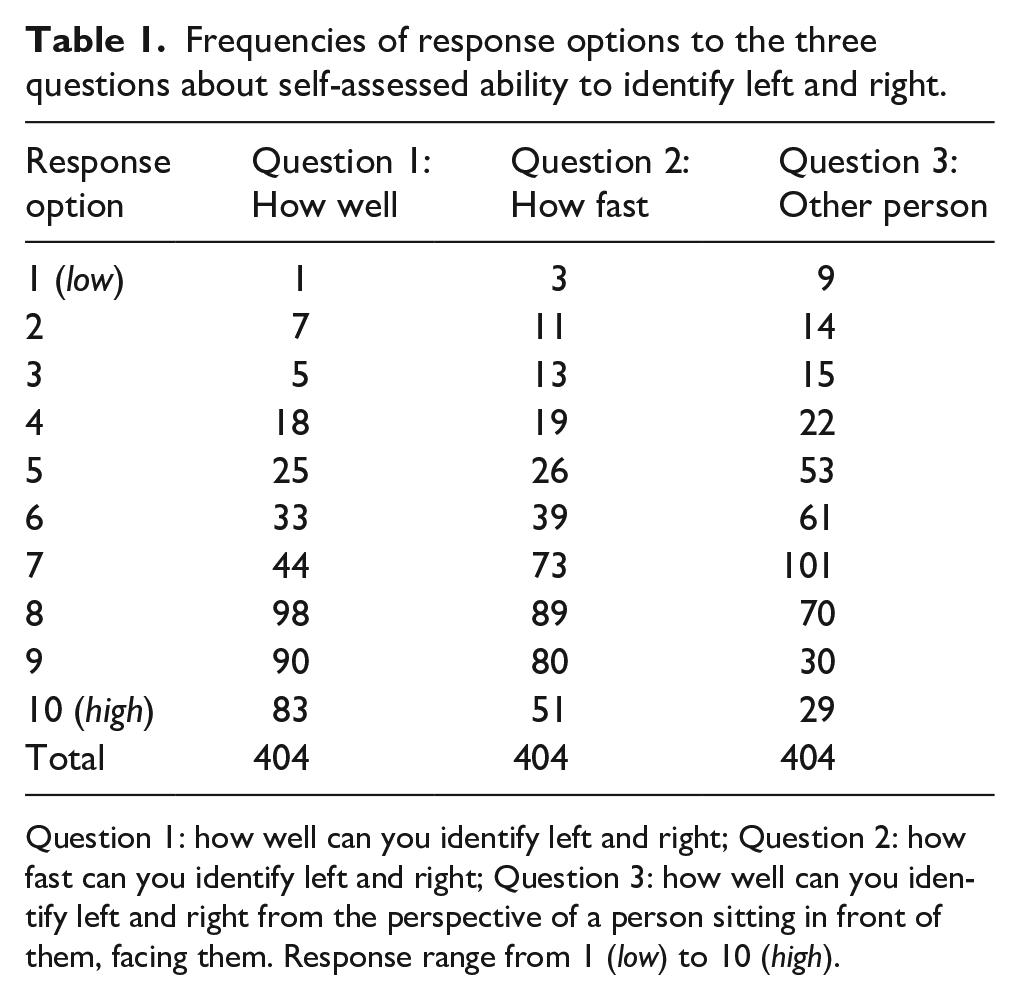
Question 1: how well can you identify left and right; Question 2: how fast can you identify left and right; Question 3: how well can you identify left and right from the perspective of a person sitting in front of them, facing them. Response range from 1 (low) to 10 (high).
Strategy used to identify left and right (N = 485).
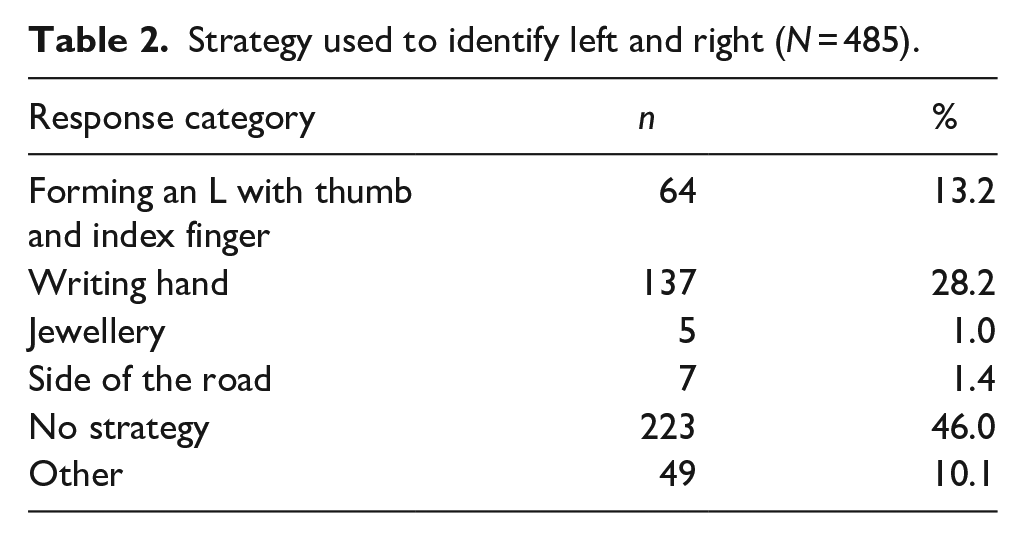
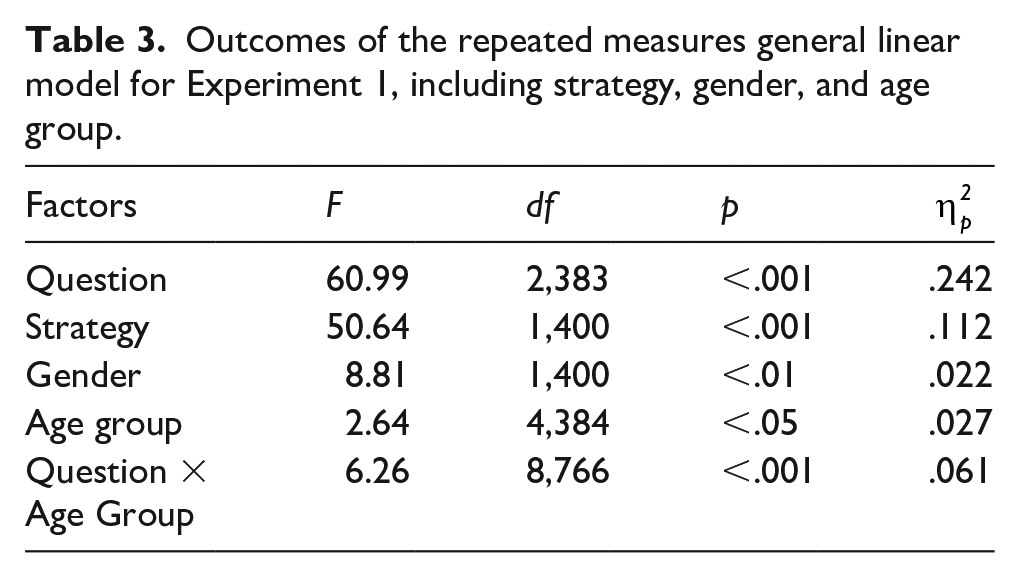
Next, we assessed whether the selected strategy, gender, and age affected the self-reported ability to identify left and right. For age, five groups were created: 5–10 (n = 57), 11–17 (n = 42), 18–29 (n = 229), 30–45 (n = 42), and 46–69 years of age (n = 57). The significant results of the repeated measures general linear model with these between-subject factors and Question (1, 2, 3) as within-subject factor are depicted in Table 3. It showed a significant main effect of Question, where all three questions differed significantly from one another (all ps < .001), with 1 being rated the highest, followed by 2 and finally 3. For strategy, non-hand-related strategy again showed the highest ratings. Furthermore, males reported higher scores than females (see Figure 1b), and post hoc analyses of age did not show significant differences between any of the five age groups. In addition, the significant interaction effect of question and age group indicated that the youngest age group (5–10 years) did not show differences between the three questions. For age groups 11–17 and 46–69 years, Questions 1 and 2 were comparable and both higher than 3 (p < .05), and both age groups 18–29 and 30–45 years showed significant differences between all three questions (see Figure 1c). All other effects did not reach significance. Given that handedness was only known for a limited number of participants, this analysis was performed without handedness as a factor. The analysis including handedness as a between-subjects factor led to very similar results (see Supplementary Materials 1).
Outcomes of the repeated measures general linear model for Experiment 1, including strategy, gender, and age group.
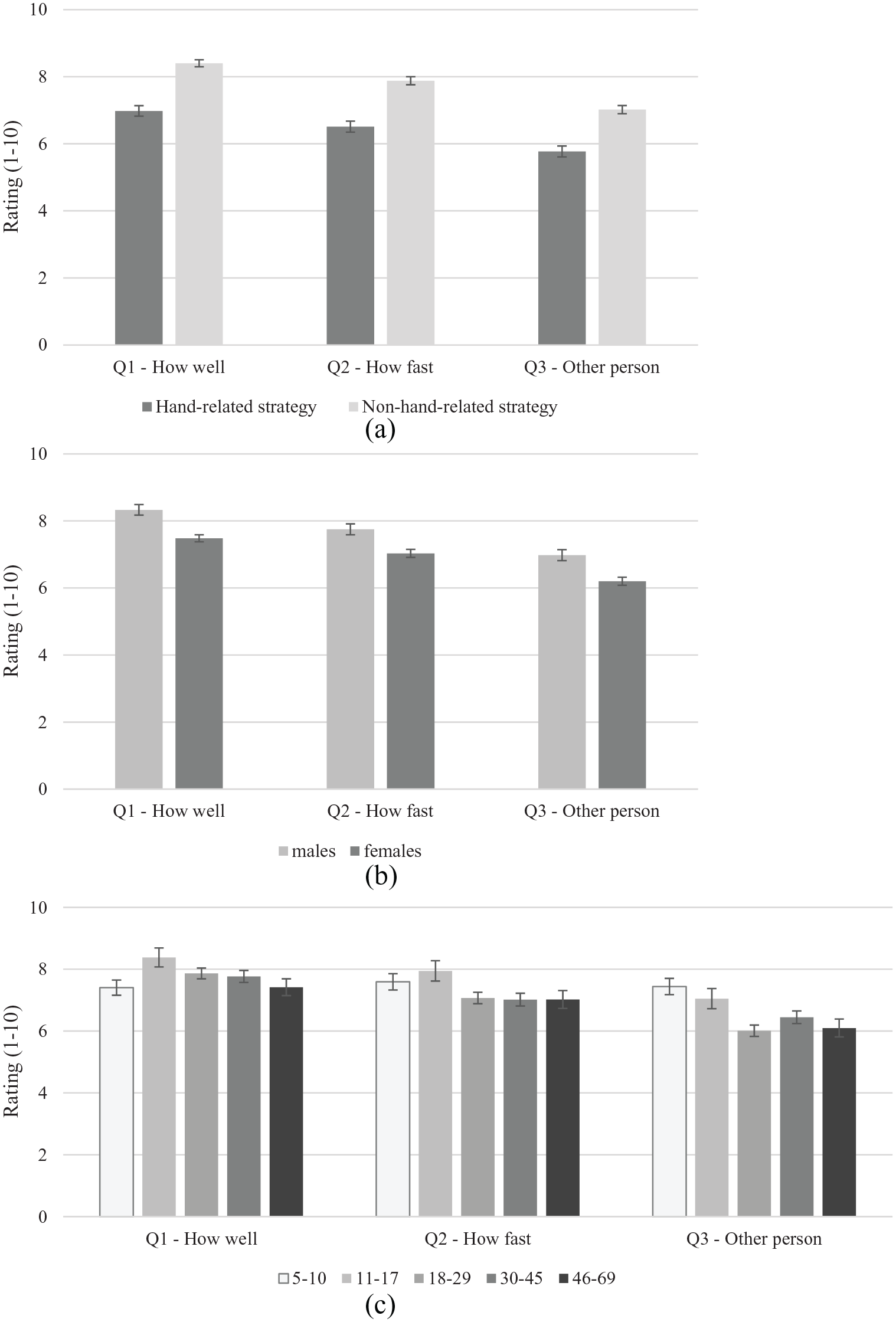
Self-reported ability to identify left and right, on a 1–10 scale. Question 1: How well can you identify left and right; Question 2: How fast can you identify left and right; Question 3: How well can you identify left and right from the perspective of a person sitting in front of you, facing you. Split up by (a) hand-related strategy vs. non-hand-related strategy, (b) males vs. females, and (c) age in years.
Discussion
The subjective estimate of LRI ability showed substantial variation in the healthy sample. A self-reported insufficient level of LRI was present in 14.6%. As participants were tested outside of the traditional laboratory environment on various locations while being individually monitored by experimenters, data from a large sample, representative of the general population, were obtained, which can be considered an improvement compared with some earlier studies. Including strategy use as an additional question was fruitful; there was a clear divide between those using their body, more specifically their hands, to decide on left and right, and those who did not use their body. The vast majority of participants who did not use their body indicated they did not use an overt strategy at all, and they experienced to “just know” left from right. The use of hands to distinguish left from right confirms the importance of the spatial features of the body in LRI, but this effect seems to be limited to 42.9% of the participants. Those not using their hand rated their LRI ability substantially higher in comparison with those who do. It could be possible that LRI may be more internalised and automatic for those individuals, and that resorting to hand cues mostly occurs in people who are intrinsically less certain about left and right. All participants scored lower on the question concerning LRI for another individual opposite from the observer. This finding indicates that the misalignment of the hand positions and/or the body as a whole, increasing the need for mental rotation to solve the task, decreases LRI ability.
Motivated by literature, individual differences caused by gender, age, and handedness were also considered. The data support previous findings of a male advantage on self-reports (Harris & Gitterman, 1978; Williams et al., 1993; Wolf, 1973), whereas age did not affect self-reported LRI. Males in general tend to score higher than females on self-rating scales concerning cognitive performance (e.g., Basow et al., 1989; Daubman et al., 1992). The use of more objective measures to assess whether this difference is also found in actual behaviour is therefore very informative. As also noted by Jaspers-Fayer and Peters (2005), some caution may be appropriate in the interpretation of subjective reports as individual response style, rather than the topic of the questions at hand may play a role in the outcome. Therefore, in Experiment 2, we used objective measures of LRI ability.
Experiment 2: objective LRI ability
In the literature, a limited number of objective tests of LRI are reported. All existing tests make use of the left and right body parts, and most often only the hands. Ratcliff (1979) first provided objective measures of LRI using schematic drawings of a man, with one of the hands highlighted. Similarly, Brandt and Mackavey (1981) used drawings of left and right hands, and Leli and Hannah (1982) used drawings of lateralized body parts. In such tasks, the objective is to identify whether the body part belongs to the left or right side of the body. A very similar approach has been reported by Hirnstein et al. (2009), Hirnstein (2011), and Hjelmervik et al. (2015). They all used photographs of hands, instead of drawings. Left and right hands pointing with the index finger with different orientations (front, back, pointing to left, pointing to right) were shown, with the objective of identifying which hand was displayed. Alternatively, Vingerhoets and Sarrechia (2009) report a more language-based task, in which left or right finger presses were made in response to the written words “left” and “right” displayed on a screen. Here, response times were the main outcome measure.
As we aimed to study the underlying mechanisms of LRI, we chose to use an adaptation of the Bergen right–left discrimination test (BLRDT) as first described by Ofte and Hugdahl (2002). This task makes use of simple line drawings of a person, in which the orientation of the body (front vs. back) and the arms (e.g., above/below the head, not crossing/crossing the body midline) could easily be manipulated. The instruction in the original publication was to mark the figure’s left or right hand, depending on the instruction. This allows for a more detailed analysis of the process involved, as the impact of body and arm orientation can be assessed in isolation. For instance, switching body orientation lowers accuracy, as do arms crossing the body midline (Ofte & Hugdahl, 2002). Both these effects show that mental manipulation of the image impedes LRI performance. Ocklenburg et al. (2011) later report a computerised version of the BLRDT, in which the same stimuli were used, with one of the hands highlighted. Here, participants indicated with button-presses whether this concerned the left or the right hand. This allows for analysis of both accuracy and response times. In this study, the task was used to further examine the male advantage in LRI. It was expected to persist also when rotation is not required, which would mean a gender effect in mental rotation is not the sole explanation for a difference in performance between males and females.
So far, few studies have taken the body of the participant itself into consideration. Given its relevance, as demonstrated by the high rate of people using their own body to determine which is left and right, it may be essential to do so. Evidence for this comes from a study in which participants were asked to imagine a hand in a particular orientation in space and making a laterality judgement (!!! INVALID CITATION !!!) (de Haan & Dijkerman, 2020). Actual own hand posture (in the lap or behind their back) had a strong effect on reaction times. This suggests that the current body position is important for determining left and right. In this study, we therefore used the same digital version of the BLRDT as reported by Ocklenburg et al. (2011), with an adaptation in response modality. Instead of using a motor response, typically executed by one of the hands, we chose a vocal response. This allows both hands to rest on the table in a spatially neutral way (straight ahead), without being involved in the task in any way. In Experiment 2, we assessed general performance on this task in a very large sample.
Taken together, here we tested LRI in a set-up which allowed us to study performance in relation to degree of alignment with the participants’ body, due to the stimuli and response modality used. Based on the existing literature, we expected to find that the performance is highest when the stimuli and the participant were fully aligned, and lowest when the arm position and/or the orientation of the stimuli were incongruent with the participant. In addition, the experimental design could also show whether individual differences found in LRI originate mainly from mental rotation processes or not.
Methods
Participants
In total, 233 participants completed the digital left–right discrimination test. After outlier removal (mean response times >3 SD from grand mean response times), the total sample consisted of 229 participants (68 males, 19 left-handed), with a mean age of 22.0 years (SD = 3.2; range, 18–35 years), mainly university students. All participants had no psychiatric or neurological disorders, had normal or corrected-to-normal vision, and provided informed consent prior to participation.
Digital BLRDT
Stimuli for the left–right discrimination test were received from their original authors. They consisted of line drawings of human figures, in which a white circle indicated viewing the front of the head and a black circle, the back of the head. Legs were always in the same inverted V-shape position, and the arms were either crossed or uncrossed with regard to the body midline. In total, 20 practice trials and 60 experimental trials were included. A single trial consisted of a blank screen for 500 ms, followed by a fixation cross for 1,000 ms and the stimulus, which was presented until a vocal response was given. Stimuli were presented and responses were recorded with E-Prime 2.0 software (Psychology Software Tools), using a computer screen (Dell, 19″, model 1905FP, screen refresh rate of 60 Hz). Participants were asked to say “left” or “right” (“links” and “rechts” in Dutch, as all participants were native Dutch speakers) in response to which of the two hands of the image were coloured in red. Responses were requested to be made as fast and accurate as possible. The experimenter marked the response given on answer sheet, as the microphone would only register response onset time, not the content of the response. The practice trials mainly functioned to train the participants to refrain from making any other noises than the words left or right. A microphone with high temporal resolution (Monacor) was used to register the onset of the response, as a measure of response time, but could also be triggered by coughing or other sounds made in the direct vicinity of the microphone. For each measurement, such potential interferences were closely monitored by the experimenter, and recorded response times for those trials were excluded from analyses.
The 20 practice trials consisted of 10 figures facing to the front and 10 image facing backwards, 5 of each were crossed and 5 uncrossed. Crossed indicates that the left hand was positioned to the right of the right hand, so with at least one hand crossing the body midline. Uncrossed refers to situations in which the left hand was to the left of the right hand. The 60 experimental trials consisted of 30 figures facing to the front and 30 facing backwards, 15 of each were crossed and 15 uncrossed. These stimulus features lead to four different stimulus types: front-uncrossed, front-crossed, back-uncrossed, and back-crossed. Participants were seated with the upper arms parallel to the torso, the lower arms horizontal and perpendicular to the torso, and the hands with the palms flat on the table. Therefore, in only two of the four conditions, the hands of the stimuli were oriented in the same lateral position as the hands of the participant. In the back-uncrossed condition, the participants’ hands were congruent to the stimulus, just as in the front-crossed condition. In contrast, the back-crossed and front-uncrossed conditions were incongruent with the participants’ position. Analogously, the body of the participant was aligned with the stimulus in both back conditions, whereas it was mirrored in the two front conditions (see Figure 2). These factors were taken into consideration in the analyses, with “side” reflecting the orientation of the stimuli and “congruency” indicating whether or not the hands in the stimuli were congruent with the participants’ hands or not.
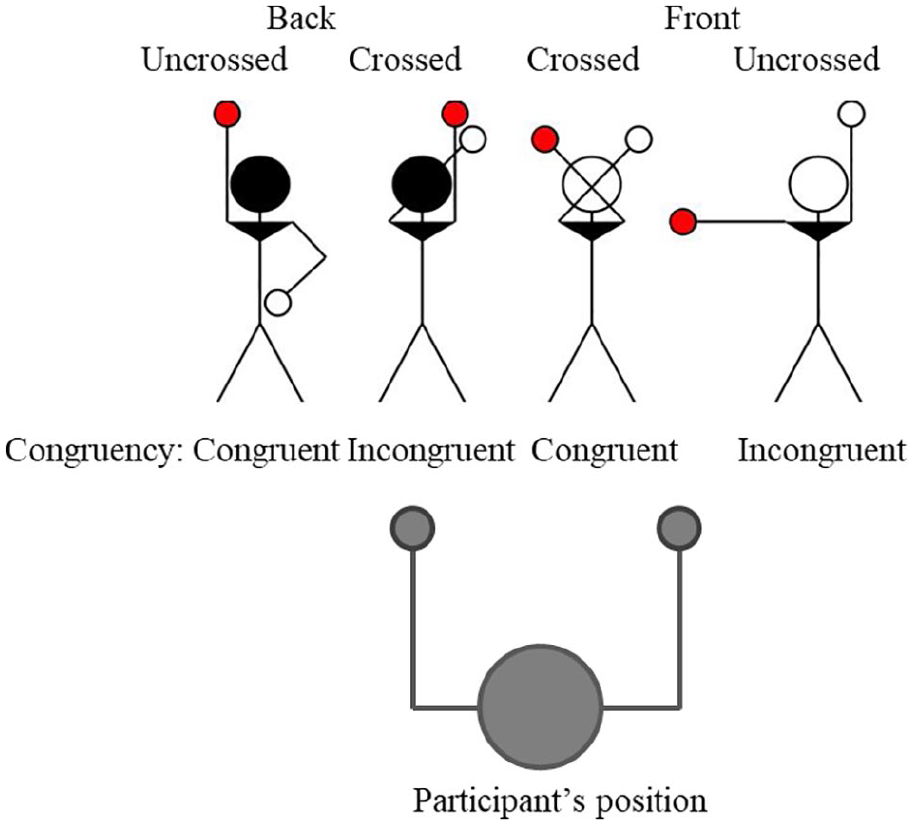
Examples of the four possible stimulus orientations and a schematic depiction of the participant’s position.
Apart from the stimulus features, the large sample of participants also allowed for the examination of individual differences. In particular, the factors showing to be the most relevant in Experiment 1, strategy use and gender, were considered. Therefore, in addition to the basic demographic questions concerning age and gender, also strategy use was asked for, using the same materials as in Experiment 1.
Results
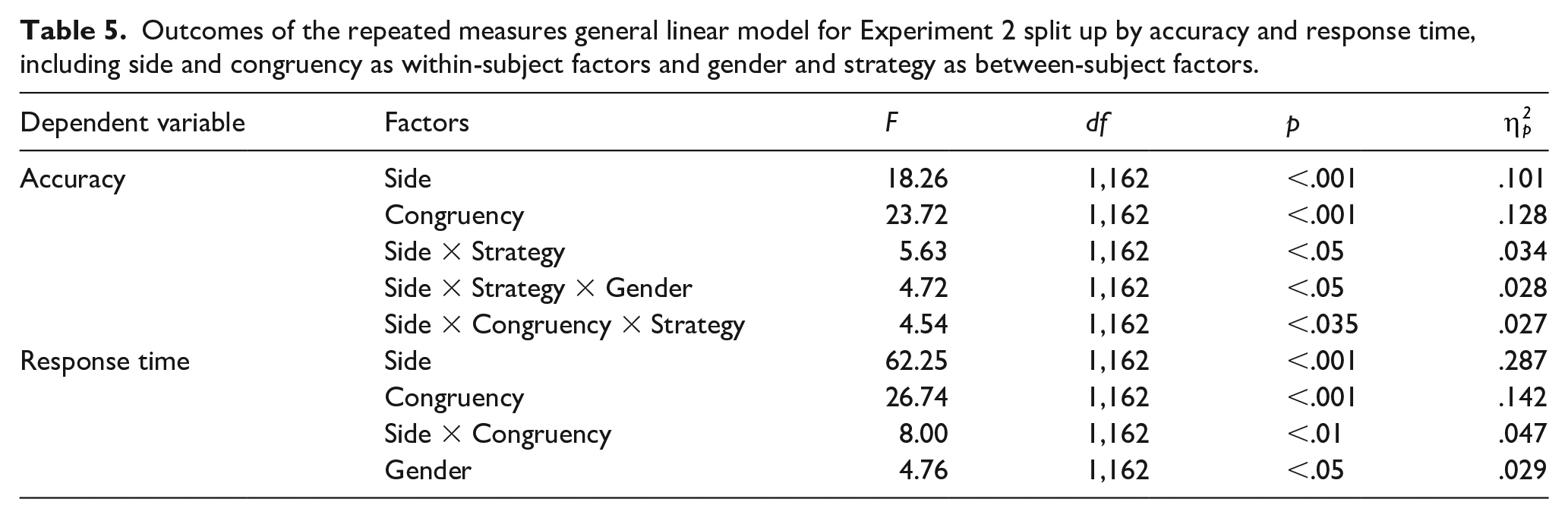
A side (front, back) by congruency (congruent, incongruent) general linear model was adopted for the performance on the BLRDT, with strategy (hand-related, non-hand-related) and gender (male, female) as between-subject variables (see Tables 4 and 5). Bonferroni correction for multiple comparisons was applied to all post hoc comparisons. As depicted in Figure 3a, for accuracy there was a significant main effect of side and congruency; accuracy was higher for stimuli shown from the back and those that were congruent to the participant’s position. In addition, a significant interaction effect of side and strategy; side, strategy, and gender; and side, congruency, and strategy was found. Post hoc analyses show that the effect of side is limited to participants with a hand-related strategy (p < .001) and is at trend level for those with a non-hand-related strategy (p = .095). More specifically, the effect of side is absent only in male participants with a non-hand-related strategy (p = .764), but present for females with a non-hand-related strategy and both genders with a hand-related strategy (p < .01 in all cases). The last interaction effect indicates that the congruency effect (congruent being more accurate than incongruent) is only absent for the front side for those with a non-hand-related strategy (p < .05 in all other cases). The responses in the congruent condition were comparable between strategies, but the incongruent condition is unaffected for the non-hand-related strategy, whereas it is lower for the hand-related strategy. Response times showed a similar pattern (Figure 3b), with significant main effects of side and congruency. Moreover, the interaction of side and congruency reached significance; responses were faster for images shown from the back and those that were congruent to the participant’s position. The interaction effect indicated that the congruency effect was slightly stronger for images shown from the back (p < .001), compared with those shown from the front (p = .009). Also, a main effect of gender was found, with males being faster in comparison with females.
Accuracy and response times for Experiment 2, split up by gender and strategy type.
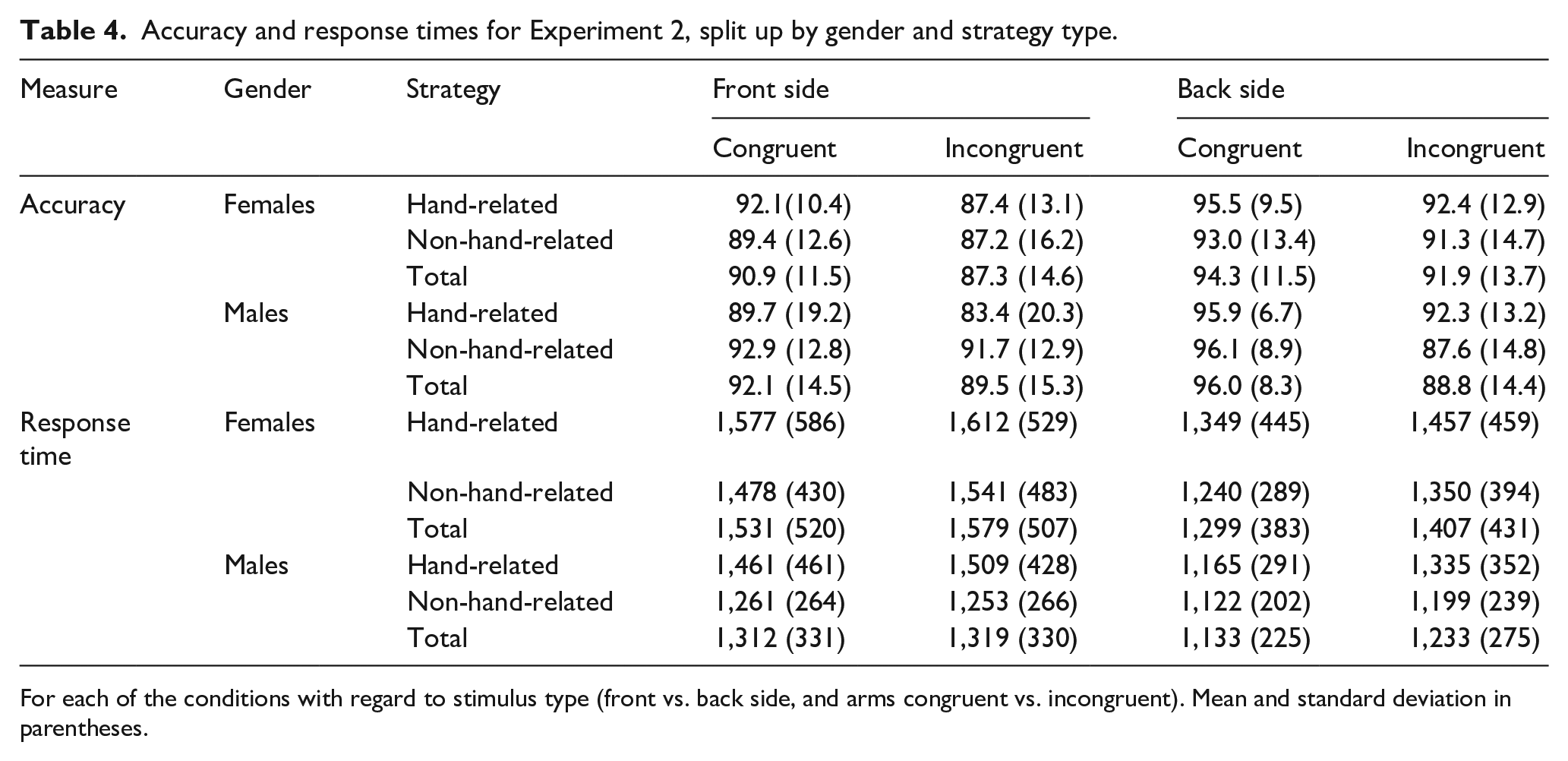
For each of the conditions with regard to stimulus type (front vs. back side, and arms congruent vs. incongruent). Mean and standard deviation in parentheses.
Outcomes of the repeated measures general linear model for Experiment 2 split up by accuracy and response time, including side and congruency as within-subject factors and gender and strategy as between-subject factors.
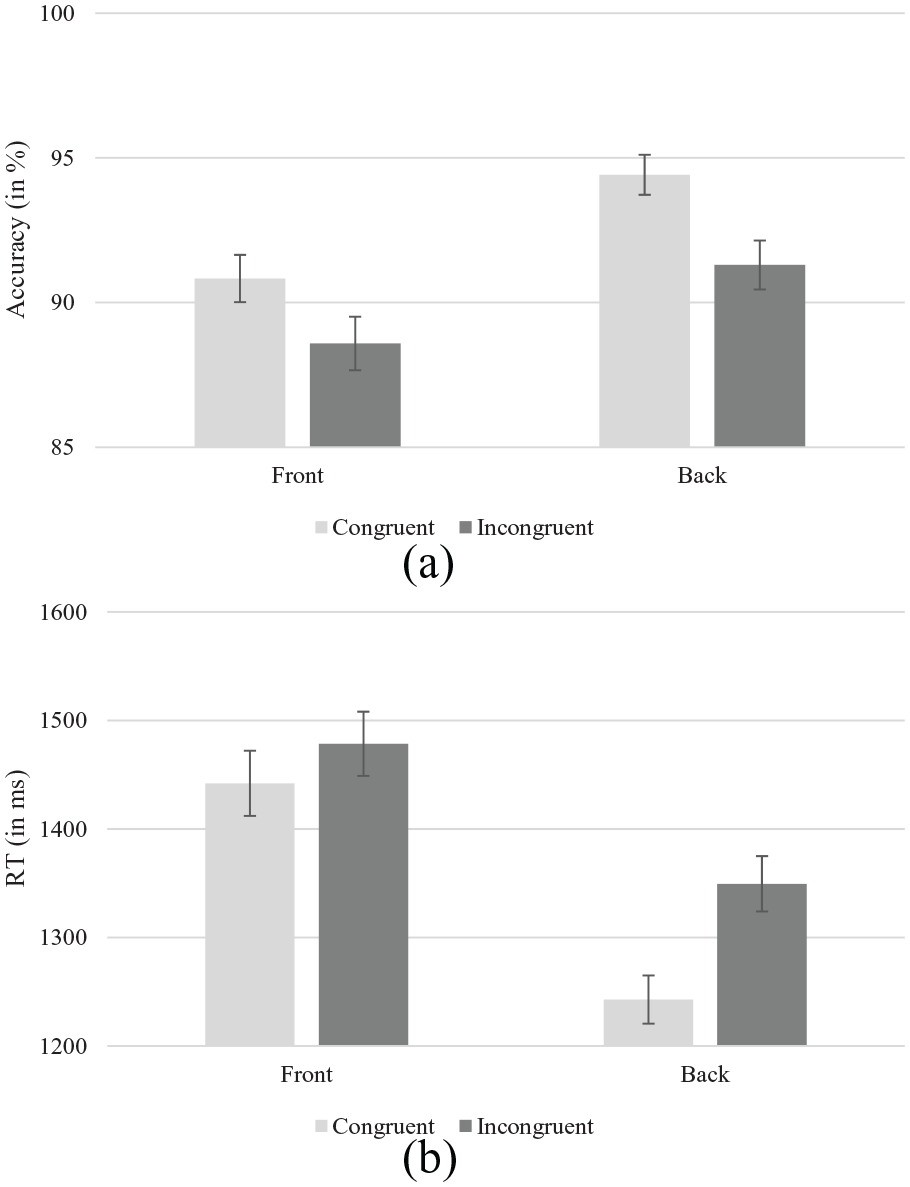
Accuracy and response times (RT) in response to stimuli which where congruent or incongruent with the participant’s position and shown from either the front or the back.
Discussion
Experiment 1 showed that the body itself may play a substantial role in LRI, at least for subjective measures of LRI. Therefore, Experiment 2 was designed to verify whether this can also be found for objective assessment of LRI. As substantial variation between individuals was found for LRI, especially for gender and strategy used, those factors were considered as well.
For the first time, we took into account participants’ alignment with the stimuli; the general orientation of the body was identical (back) or mirrored (front), and the position of the hands was either congruent with the participants’ hands (front-crossed, back-uncrossed) or not (front-uncrossed, back-crossed). The data show that spatial alignment of one’s own body with the stimuli was of importance; both alignment in side (facing the stimuli’s backside) and congruency in hand position increased performance. These effects were found for the sample as a whole. In addition, strategy used and gender also impacted these effects. Alignment effects are most clear for those with a hand-related strategy, especially for female participants. The effect of congruency of hand position is absent when the stimulus is not aligned with body position, for those with a non-hand-related strategy. This finding validates the self-reported strategies; when people say they use their body, their performance is negatively affected when the body and hands are misaligned with the task at hand. Yet, even those reporting not to use the body are still affected by congruency of hand position, but only when the body is aligned. It may be the case that the alignment makes it difficult not to refer to one’s own body. With regard to gender, the data show that males are generally faster in responding than females, regardless of the condition. This is in line with a male advantage in previous reports on LRI (Harris & Gitterman, 1978; Williams et al., 1993; Wolf, 1973). Moreover, the effect of body alignment is not found for male non-hand-related strategy users.
The effect of congruency for both back and front conditions suggests that a visual alignment of hands in space improves performance. The current set-up, however, does not address whether alignment in space is linked to a top-down, static representation of one’s body or that it is influenced by online and dynamic (visual/proprioceptive) input of the current bodily position. Previous studies on laterality judgement have shown that participants tend to imagine their own body part as moving towards the stimulus (Parsons, 1994). This process of mental transformation of body parts (i.e., imagining the body moving) is sensitive to proprioceptive information, meaning that participants need more time to judge the laterality of hand stimuli oriented in anatomically difficult positions. In addition, several studies showed that if participants keep their hands in more awkward postures during mental rotation of hands, their performance is slower with respect to when their hands are kept in more natural postures (Sirigu & Duhamel, 2001), suggesting that mental rotation is sensitive to bottom-up, proprioceptive information (Parsons, 1994; Petit et al., 2003). However, higher order representations of the body may also play a role. Ionta, Perruchoud, Draganski & Blanke (2012) have found, for example, that illusory posture of one’s own body interfered with motor imagery, suggesting that a top-down representation of one’s own body influences motor imagery. Furthermore, a recent neuropsychological study using the same task as this study has shown that impairments on this task after right-hemisphere stroke were related to higher order body representation deficits including finger agnosia and a subjective loss of body (part) ownership (van Stralen et al., 2018). Together, these findings suggest that higher order stored representations, including those related to the structure and ownership of the body (Dijkerman & de Haan, 2007; Haggard & Wolpert, 2005), also play a role when determining left and right. In Experiment 3, we examined whether the beneficial effect of stimuli that are spatially aligned to the body of the participants may be influenced by current bodily posture.
Experiment 3—use of the body in LRI
Experiment 3 was designed to assess in what way the body may be consulted during LRI. Do participants use their stored top-down stable spatial representation of their body, focusing on a stimulus being on where their left or right hand is typically located, or do they use information about where their hands actually are at the time this decision is made, suggesting that peripheral bottom-up information is important (Parsons et al., 1994). And, if they do the latter, does this involve any visual processing of hand position, or is it a more proprioceptive process? To assess this, Experiment 2 was repeated, with a manipulation of hand position and visibility. In four different conditions, the participant was sitting either with their lower arms straight ahead on the table or with their hands crossed placed on the opposite side of their body midline. In addition, the hands were either visible or covered with a black piece of cloth, removing them from the participant’s field of vision. If the actual position of the hands is consulted during LRI, then performance should be negatively affected by a crossed hand position of the participant. And if visual input is part of LRI, then the visible condition should lead to better performance, at least in the uncrossed hand position condition. Yet, if a more general, stable body representation is consulted, then neither the hand position manipulation nor the visibility should affect performance.
Methods
Participants
Of the participants of Experiment 2, 115 participants also performed the additional conditions of the Bergen task, in which hand position and hand visibility were manipulated. Due to technical errors and outlier removal (mean response times >3 SD from grand mean response times), data of 16 participants were incomplete; therefore, the total sample consisted of 99 participants (39 males, 6 left-handed), with a mean age of 23.4 years (SD = 2.7; range, 19–35 years).
Adapted digital BLRDT
The same task design was used as for Experiment 2, but now it was applied in four different conditions. The hands of the participants were placed either straightforward, with the palms flat on the table (uncrossed) or crossed on the horizontal plane (crossed), with the same distance (15 cm) between the little fingers as for the index fingers in the uncrossed condition, resulting in the hands being on the opposite side of the body midline. In addition, the hands of the participants were either covered by a black piece of cloth (invisible) or not (visible). The cloth was positioned over a wooden board, so it would not directly touch the arms. The design of these conditions was made to ensure comfortable seating for the participants, allowing them to complete the experiment without fatigue. Participants were pseudo-randomly assigned to one of the possible orders of these conditions and performed 60 trials for each, in the same way as described for Experiment 2.
Results
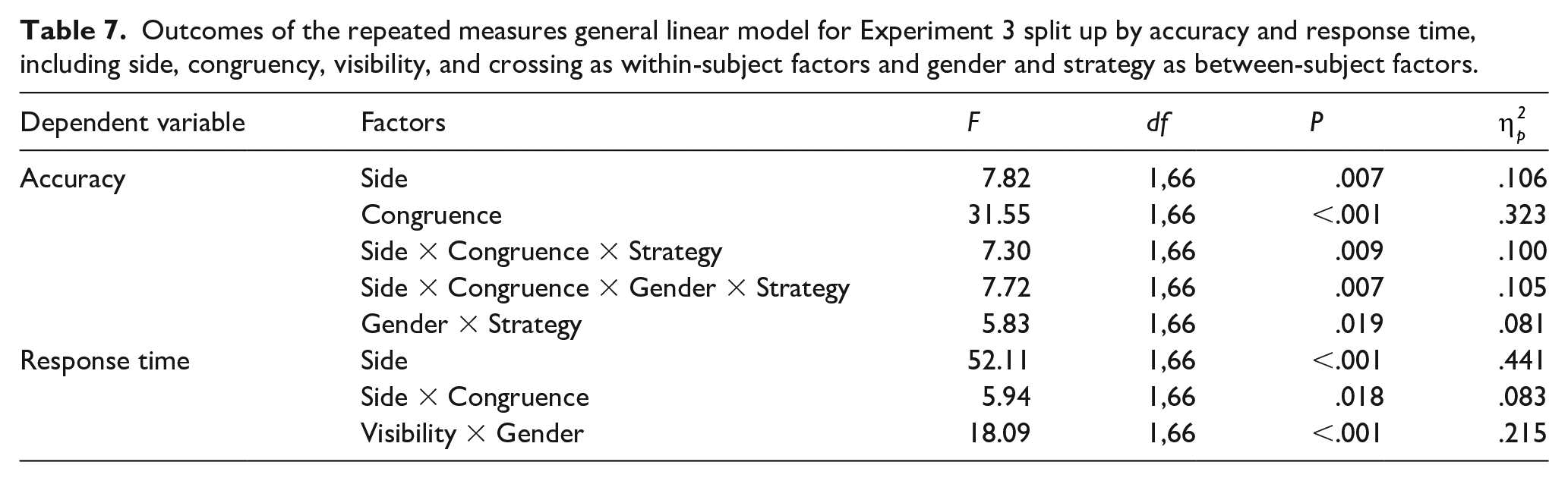
A repeated measures general linear model was performed for accuracy, including visibility (visible, invisible), crossing (uncrossed, crossed), side (front, back), and congruence (congruent, incongruent) as within-subject factors and gender and strategy as between-subject variables. Visibility and crossing refer to the participant’s position, and side and congruence refer to the stimulus features, analogous to Experiment 2. Bonferroni correction for multiple comparisons was applied to all post hoc comparisons. This analysis showed a significant main effect of side and of congruence (see Tables 6 and 7). Performance was higher for stimuli shown from the back and for stimuli in which the hand position was congruent with the hand position of the participant. Furthermore, the interaction of side, congruence, and strategy was significant. Follow-up analyses showed that there were no significant effects of strategy for side and congruence. Furthermore, the interaction effects of side, congruence, gender, and strategy; and gender and strategy were significant. Follow-up analyses showed for those with a hand-related strategy, females were better than males, but only for the front, congruent stimuli. For those with a non-hand-related strategy, females were better than males but only for the back, incongruent stimuli. For females, the non-hand-related strategy users were better than the hand-related strategy users, but only for the front stimuli. For males, the hand-related strategy users were better than the non-hand-related strategy users, but only for the front congruent and the back incongruent stimuli. Finally, for females, the non-hand-related strategy users were better than the hand-related strategy users, whereas for males there was no difference between the two strategy types. The same analysis for response times showed a significant main effect of side and a significant interaction of side and congruence. Responses were faster for stimuli shown from the back. This effect was somewhat smaller for incongruent stimuli, but highly significant for both congruent and incongruent stimuli (p < .001). A significant interaction of visibility and gender was also found. However, follow-up analysis did not show a significant difference between males and females.
Accuracy (Acc) and response times (RT) for Experiment 3, split up by gender (female [F] vs. male [M]) and strategy type (hand-related [H] vs. non-hand-related [NH]).
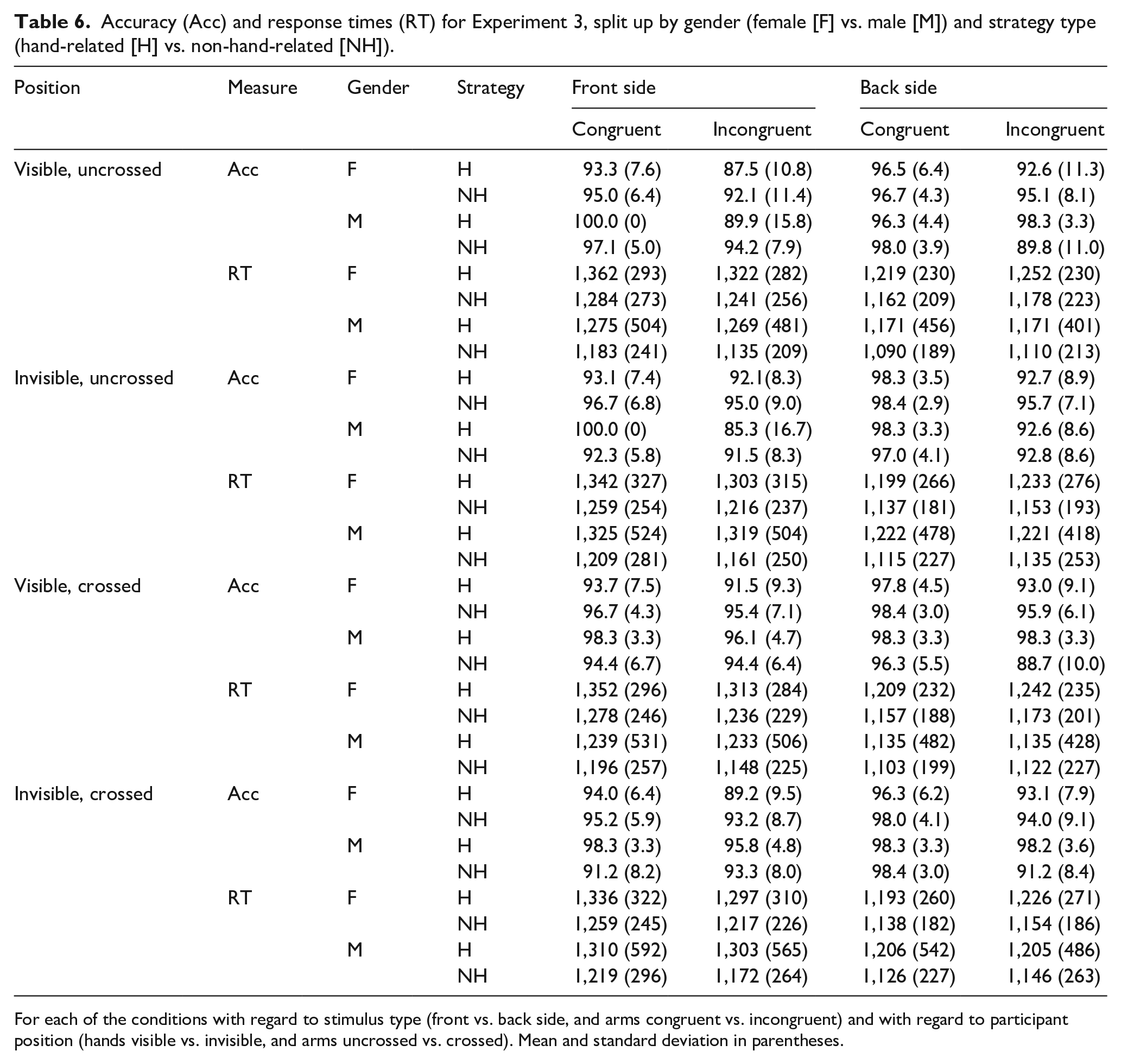
For each of the conditions with regard to stimulus type (front vs. back side, and arms congruent vs. incongruent) and with regard to participant position (hands visible vs. invisible, and arms uncrossed vs. crossed). Mean and standard deviation in parentheses.
Outcomes of the repeated measures general linear model for Experiment 3 split up by accuracy and response time, including side, congruency, visibility, and crossing as within-subject factors and gender and strategy as between-subject factors.
Discussion
With this last experiment, we aimed to examine in what way the body is used to distinguish left from right. It could be a stable stored representation of our body and its midline, with a general sense of the lateral distinction between left and right. On the contrary, it could also be that to make a decision about the visual stimuli, the participant’s own hands are directly consulted. If the former is the case, then temporary changes in the position of body parts should not make a difference. If the latter is true, then they should affect accuracy and/or response times. The data gathered in Experiment 3 showed that only the properties of the stimuli affect performance. The visibility and position of the participant’s hands had no effect on performance. Very similar to the findings in Experiment 2, we found that decisions are easier when the stimuli are aligned with the body in terms of side; when the stimulus is facing away (i.e., back condition) from the participant, decisions were made more accurately and faster. Moreover, when the arms in the stimuli were positioned congruent with the prototypical uncrossed arm positions of the participant, responses were also made more accurately and faster. This means that this prototypical congruency effect was not affected by how the arms of the participant are placed while making such a decision. When strategy use and gender are considered, we observed some more complex effects. Non-hand-related strategy leads to a higher level of accuracy, but only for females. The previously found male advantage was not confirmed in the current data.
General discussion
Healthy individuals are often considered to have difficulty distinguishing left and right. However, this issue has only been addressed in a limited number of studies, and its precise characteristics and the underlying mechanisms are poorly understood. Previous findings indicate that LRI is impaired in a substantial proportion of healthy individuals, and that individual differences such as gender and handedness may play a role in LRI. Three consecutive studies cover (1) the subjective self-ratings of LRI and the impact of gender, age, and strategy use on these ratings; (2) the objective assessment of LRI in relation to strategy use; and (3) body information as a potential mechanism underlying LRI.
The first experiment shows that around 15% of our heterogeneous Dutch sample reports substantial problems in LRI. When asked for strategy, the responses indicate a considerable role for hand-related strategies, such as referring to explicit markers like a watch on one side or dominant writing hand. Moreover, the hand-related strategy appears to be associated with a lower performance in comparison with a non-hand-related strategy or just “knowing” left from right. Therefore, objective assessment of LRI was necessary, which was achieved with a novel computerised version of the BLRDT in Experiment 2. For the first time, the congruence between the layout of the stimulus and the position of the participant was considered and showed to have a substantial effect. That is, responses were faster for images that were congruent to the participant’s position. As the position of the participant was stable throughout the experiment, it could be that either an offline, stable body representation was consulted to generate responses or that the online, current body position was used to respond to determine left and right (Carruthers, 2008). Experiment 3 was designed to identify which of these two options is the most likely mechanism in LRI, by manipulating the position of the hands, and to add visibility of the hands as an additional variable. Data are clearly in favour of the use of an offline, stable body representation, as the variation in arm position when performing the task did not affect performance level; only the layout of the stimuli affected performance.
So what type of offline body representation could be used for performing this task? Offline representations have been considered to contain different characteristics, including structural aspects (such as knowing the left and right of the body, distinguishing between the lower and upper parts of the body, and the order of the fingers), spatial aspects (size of body parts and location), and ownership over a body (part) (Dijkerman & de Haan, 2007; Haggard & Wolpert, 2005). This structural description of the body contains representation “as it usually is like,” with fingers aligned in the anatomical order and sides of the body labelled and hands uncrossed. For the fingers, there is evidence that such an offline structural representation can influence spatial judgements (e.g., Rusconi, Gonzaga, Adriani, Braun & Haggard, 2009, 2011). This study suggests that may also be the case for another aspect of a structural representation—the distinction between the left and right side of the body. Thus, the current findings suggest that a certain offline spatial configuration of the hands is used when determining left and right, something linked to a structural description of the body. Moreover, not only structural aspects of the offline body representation play a role, but also the feeling of ownership over a body part (Ionta et al., 2012; van Stralen et al., 2018) has been found to be related to changes in the ability to distinguish left from right. Therefore, it appears that multiple components of an offline stable body representation are important for the ability to identify the left and right hand on a picture.
While the current findings suggest that only offline body representations affect left–right judgements, other studies also find effects of online bodily signals. When using a different task to probe hand laterality (mental rotation of the hand), an influence of current hand posture was found (Parsons, 1994; Petit et al., 2003; Sirigu & Duhamel, 2001), suggesting that low-level sensory input about the current position of the hand can play a role in left–right judgements. The different pattern of results in this study compared with those that used a hand rotation task may be related to the spatial demands of the tasks. The hand orientation task required larger rotations and also involved more levels of rotation. With these increased spatial demands, it may be beneficial to use additional cues, for example, sensory input about the current position of the own hand, and then mentally rotate this to the orientation of the depicted hand to solve the task. In contrast, in the current task, with fewer spatial demands, it might be sufficient to match the stimulus to a more prototypical posture, without involving proprioceptive input about the current hand position.
One potential confound in the current task design is the use of hand-related stimuli, as these may prime the use of a body-related strategy. It is still unclear whether the same processes would be at play in a non-body-related spatial context. However, in terms of objects, there are very few objects that have such an inherent orientation and layout that left and right can be unambiguously identified.
In short, the results show that 15% of the participants report problems in left–right orientation, with females more frequently reporting difficulties. On the objective measure of left–right orientation, performance was influenced by a combination of gender, age, and strategy. With respect to gender, previous studies found conflicting evidence with some studies reporting no difference (Ocklenburg et al., 2011; Teng & Lee, 1982; Williams et al., 1993), whereas other studies found better performance in men (Bakan & Putnam, 1974; Ofte, 2002; Ofte & Hugdahl, 2002). The observed effect of strategy sheds new light on how participants solve LRI. The finding that hand-related strategies play a role suggests that body representation influences left–right orientation, and the results of Experiment 3 suggest that a stable top-down body representation is of greater influence than bottom-up, proprioceptive information.
Supplemental Material
QJE-STD-19-091.R2-Supplementary_materials – Supplemental material for Distinguishing left from right: A large-scale investigation of left–right confusion in healthy individuals
Supplemental material, QJE-STD-19-091.R2-Supplementary_materials for Distinguishing left from right: A large-scale investigation of left–right confusion in healthy individuals by Ineke JM van der Ham, H Chris Dijkerman and Haike E van Stralen in Quarterly Journal of Experimental Psychology
Footnotes
Acknowledgements
The authors wish to thank Simwayn Tran, Melloney Schenk, Mijke Slagman, Lisanne Visser, Elbrich Wiarda, and Miranda Smit for their help in data collection.
Declaration of conflicting interests
The author(s) declared no potential conflicts of interest with respect to the research, authorship, and/or publication of this article.
Funding
The author(s) disclosed receipt of the following financial support for the research, authorship, and/or publication of this article: This study was supported by an NWO Vici grant (453-10-003) to H.C.D.

References
Supplementary Material
Please find the following supplemental material available below.
For Open Access articles published under a Creative Commons License, all supplemental material carries the same license as the article it is associated with.
For non-Open Access articles published, all supplemental material carries a non-exclusive license, and permission requests for re-use of supplemental material or any part of supplemental material shall be sent directly to the copyright owner as specified in the copyright notice associated with the article.
