




Abstract
This study is the first to demonstrate that a self-defining period (SP) for personally relevant music emerges spontaneously in a public naturalistic setting. While previous research has demonstrated that people tend to have better memory and preference for songs from their teenage years, the theoretical relevance of these studies has been limited by their reliance on forced-choice methodology and a confinement to contemporary popular Western music. Here, we examine the record choices of famous guests (n = 80; mean age = 61.6 years) interviewed for Desert Island Discs, a long-running popular radio programme on BBC Radio 4. Half of all choices were shown to have been most important between the ages of 10 and 30 years, and the most popular reason for their relevance was the song’s link to memories of a person, period, or place. We suggest that music is a defining feature of the SP, intrinsically connected to the developing self.
Keywords
Reminiscing is a natural and fundamental human activity. This ability to reflect on past events nourishes and maintains our connections with other people, enables us to make plans and imagine the future, and supports our sense of self (Conway, 2009). There is now a wide body of research showing that access to these autobiographical memories varies according to which part of the lifespan is being retrieved (Munawar et al., 2018). As a rule, episodic memories become less vivid, less accessible, and more fragmented over time, with the oldest memories (below the age of 2 years) being lost completely, and the most recent memories (the last few days) being particularly clear and easily recalled. One striking anomaly to this monotonic decrease with age is the period of adolescence and early adulthood—memories formed during this time seem to be particularly resilient and remain disproportionately available even in very old age.
This period has been termed the “reminiscence bump” (Rubin et al., 1986). However, this term is atheoretical and simply refers to a region of what Conway (1990) termed the lifespan retrieval curve. Here, instead, we use the term the self-defining period (SP) to refer to the same period and to capture what we consider to be the main theoretical aspect of memories from the SP, which is their enduring relation to self across the lifespan. The term SP is more consistent with the interpretation of its original discoverer Fitzgerald (see Fitzgerald, 1988; Fitzgerald & Lawrence, 1984), who emphasised the relation of memories from the SP to enduring life themes. These theoretical accounts are sometimes referred to as the narrative or identity formation theory of the SP. Apart from identity theory, other approaches point to biases in retrieval process that rely on cultural life scripts (Berntsen & Rubin, 2002) or argue that events taking place during the SP are more likely to be novel, thus enhancing their memorability (Pillemer, 2001). Another suggestion is that there may be better encoding during this time due to optimum neurobiological maturity of the memory system, which gradually improves during childhood (Howe, 2013) and declines throughout adulthood (Henson et al., 2016).
While these explanations are not mutually exclusive, the identity theory may be particularly helpful in accounting for some of the more detailed and nuanced findings. This is especially true for music, which is inherently related to an individual’s sense of personal and cultural identity (e.g., Bryant, 2005; Van Dijck, 2006). Holbrook and Schindler (1989) were the first to demonstrate a preference for music released during the SP. They invited 108 participants to rate 28 popular songs released between 1932 and 1986 and demonstrated an inverted U-shaped curve, such that preference ratings peaked for songs that had been released at the age of 24 years. Numerous studies have found this same pattern of a greater liking of songs released during the SP (e.g., Hemming, 2013; Janssen et al., 2007; Krumhansl, 2017). Other researchers have focussed more specifically on the ability to recognise music from different eras and the extent to which music activates the retrieval of autobiographical memories (e.g., Cady et al., 2008; Schulkind et al., 1999). These show that memories cued by music from childhood and the SP are higher in specificity, vividness, and emotionality. More recently, Rathbone et al. (2017) demonstrated that the SP for music is dependent on the personal significance of the song and argue that this points to an explicit link with identity and self that cannot be explained simply by optimal age-related encoding or an increased occurrence of prototypical events.
Many have demonstrated the tendency for music to attach itself to important moments or periods in our life and, indeed, this contributes significantly to the inherent emotional power of music. A series of studies by El Haj and colleagues (El Haj et al., 2013; El Haj, Fasotti, & Allain, 2012; El Haj, Postal, & Allain, 2012) found that music-evoked autobiographical memories (MEAMs) have unique properties: they are more spontaneously and easily retrieved, have higher emotional content, and contain more episodic details. If music can offer such an important route to access, reinforce, and share memories with others, then maybe this explains why people are drawn so strongly to music from the SP—a time that is full of important self-defining experiences. This is consistent with findings from Krumhansl (2017), showing that MEAMs occurred most often for songs that were popular during the ages of 13 to 29 years.
While the studies above provide strong evidence for a musical SP, they have largely employed methods that assess recognition and preference. Few have used the free recall paradigm that is more typically used to investigate the SP in other domains. In addition, forced-choice methodology necessarily confines investigations to contemporary pop music, simply because the date of release is known. As Rathbone et al. (2017) point out, the age at which a song was important is not necessarily the same as when it was released. Where free choice has been used (e.g., Janssen, Chessa & Murre, 2007), the focus has been on preference and there is no explicit question of why the songs have been selected or to what extent they are consciously related to autobiographical memories. The current study explores free recall of music in a naturalistic setting—a popular and long-standing UK radio show that invites guests to choose eight pieces of music that they would like to keep with them if they were sent to a place of isolation, that is, a desert island. Since the programme has been running for 75 years and involved guests of all ages and cultural backgrounds, this provides a heterogeneous sample and allows for music selections that extend beyond popular Western music. The distribution of song choices across the lifespan is established both in terms of their age of release and age of importance. Finally, we look at the extent to which people’s preferences are based on associated memories that relate to identity and relationships.
Method
Participants
The data reported are derived from a selection of interviews that were recorded for the BBC’s Desert Island Disc series on BBC Radio 4. Most recorded episodes have been archived on the BBC Radio 4 website and are available to the general public to listen or download. Each interviewee was invited by the BBC to participate in a live (circa 1960s) or pre-recorded interview, which was then broadcast at a later date. Given that we were using naturalistic data, it was necessary to make some estimations about numbers of likely data points to calculate sample size. Based on previous knowledge of the radio programme, we estimated that it would be possible to evaluate the age bands for approximately 50% of record choices and that reasons would be given for most song choices. A priori analysis indicated that to compare participant responses across four reasons, we would need a minimum of 70 participants to provide 80% power with a medium-sized effect, employing the .05 criterion of statistical significance. This number of participants would generate an estimated 280 songs that could be dated (70 guests × 8 records × 50% success in dating), which is greater than the number of cases required for 80% power in a goodness-of-fit analysis across eight age bins (n = 253). Taking these calculations into consideration and allowing for our estimations, we chose a sample size of 80 participants.
Participants comprised 40 females (mean age = 61.6 years) and 40 males (mean age = 56.1 years) and were selected via quota/stratified sampling from the Desert Island Discs (DID) Archives, to ensure a broad representation. Selection was pseudo-random but specific efforts were made to include equal numbers of men and women and to represent a wide range of ages, professions, and decade of interview (see Supplemental Appendix 1). Guests below the age of 35 years were excluded, in order to avoid confounds between reminiscence bump and recency effects, and in line with other reminiscence bump studies (Munawar et al., 2018). The eldest participant was aged 95 years, with the majority of guests aged 50 years and above (63.7% of sample). The sample included participants from a range of different occupations, as well as interviews that spanned all decades (see Supplemental Appendix for full list). All interviews were accessed publicly from the British Broadcasting Corporation (BBC) Desert Island Discs Archives, accessed at the following URL: http://www.bbc.co.uk/programmes/b006qnmr
Procedure
DID interviews have been conducted over a 75-year age period. Interviews prior to 1960 were broadcast live, while those after 1960 were recorded ahead of the broadcast date. The duration of each episode is approximately 43 min, though sections in which guests introduce and discuss each musical track can last from 10 s to 3 min. A total of 80 interviews were evaluated with each interview containing eight chosen musical tracks, making a total of 640 choices (see Supplemental Appendix 1 for full list of participants). The relevant sections of each interview were identified and transcribed—these being from the moment the interviewee began to speak about their next choice until the point that the music began. For each musical choice, the rater made an assessment about two aspects of their response. First, we attempted to establish the age at which each song choice was important to the interviewee. Second, we identified the reason that was given for why that choice had been made.
Rating: age at importance
Where possible, the age at importance (AaI) was coded into 10-year age brackets (age: 0–10, 11–20 years, etc.). Due to the naturalistic and unstructured setting, it was not always possible to establish the exact AaI because participants did not explicitly state or describe a specific event or time period in which the song held importance. Nevertheless, where the exact AaI was not explicitly stated it was often possible to make deductions using the extended interview content or through further online research. For example, in the following extract, it was possible to establish the period of time being discussed by seeking out the interviewee’s biographical details: My next piece of music is actually Amazing Grace, and when I first arrived at Sherborne, I didn’t know about priests, and all I could see was all these girls in a hall with a man dressed in black with a white collar, and as far as I was concerned, he was shouting. So it sent chills up my spine, this. (Camila Batmanghelidjh)
Where it was not possible to assess the age to this level of specificity, it was sometimes possible to allocate to broader lifetime periods: Childhood 0–14 years, Adolescence/Young Adult 15–29 years, Mid Adult 30–45 years, and Older Adult 45 years+. For example, the Kenyan activist and Noble Laureate Wangari Maathat said of her first choice, Now, the first piece of music is a song that I had when I was a child. It was very interesting for me that this very young artist, still in his thirties I think, recaptured that song and, in listening to it, made me go back to my childhood. I love it.
Of all 640 discs chosen, 309 provided enough detail to be confidently allocated to 10-year age brackets (48.3%). Of the remaining tracks, 25 more could be allocated to a lifetime period (total = 334; 52.2%).
Rating: “reason for choice”
For each song selected, the host of DID asks interviewees to give a reason for their choice and our aim was to establish to what extent these choices were based on memories (specific or general), as opposed to the aesthetics of the music or a simple emotional response. In line with this investigation, we made an a priori decision, to broadly categorise the reasons into four categories: those that related to (1) a general memory of a person, period, or place; (2) a specific memory of an event (including those that were self-defining moments or first-time encounters); (3) something about the recording itself, for example, the lyrics, performance, or structure of the music; (4) an emotional response that was independent of the above reasons, for example, a song that just made the listener feel happy. Table 1 shows a more detailed breakdown of how the reasons were coded for within these four domains. Occasionally, guests give no clear reason for their choice; so, in these cases, a zero was recorded in all categories.
Categories of reasons given for song choice.
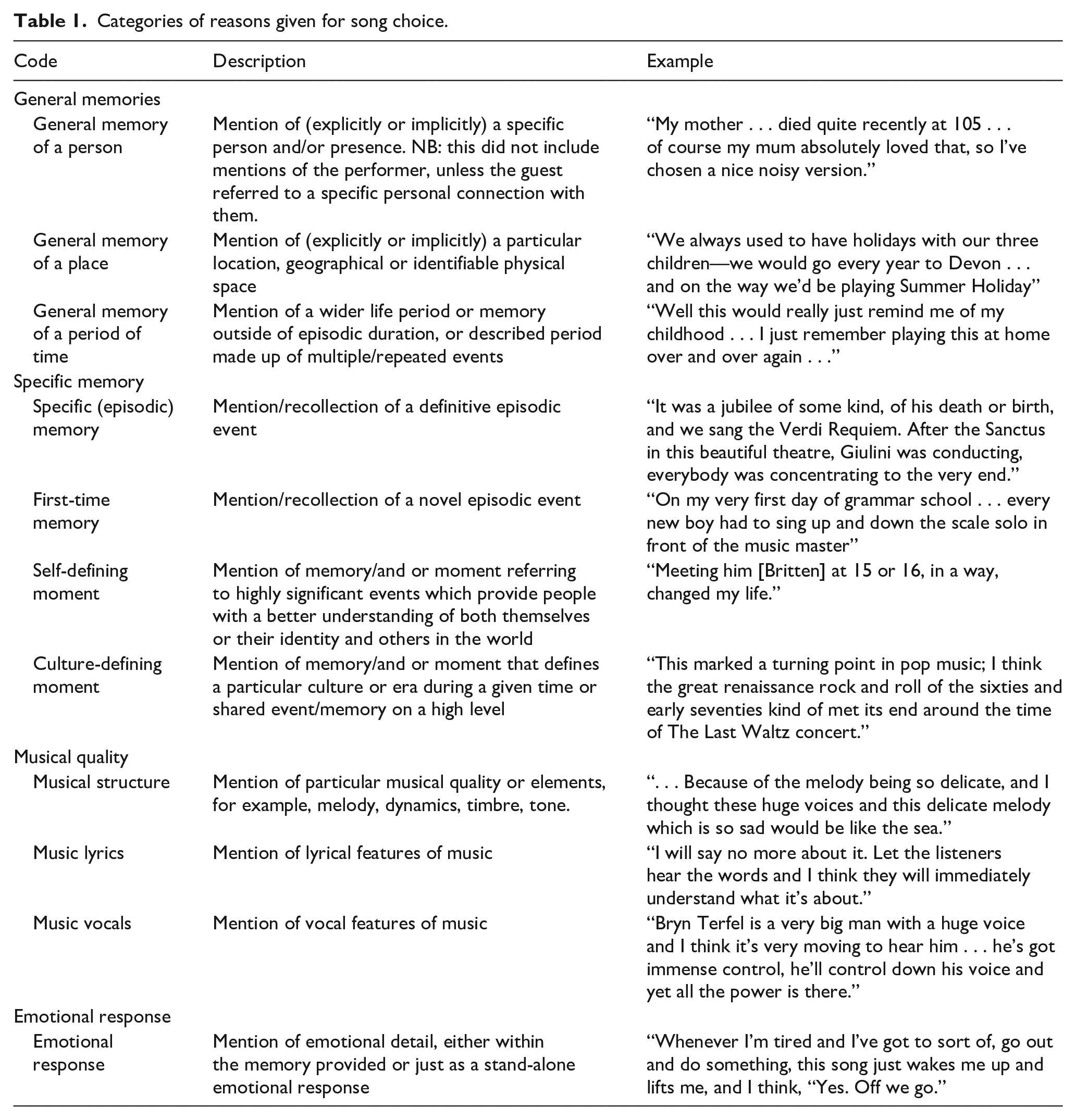
Interviewees sometimes gave more than one discreet reason for choosing a track, and in these cases, all reasons would be recorded. For example, they may have explained that a song reminded them generally of a period of their life, place they often visited, or person they knew. Derek Jameson’s sixth choice reminded him of his father: “My father used to sing this, he looked a bit like Bing and he used to whistle this,” yet Jameson went on to describe a specific event which the song also reminded him of, “I actually saw him [Bing Crosby] in the 21 club in New York, shortly before he died.” However, care was taken not to double code where reasons overlapped, for example, in the following case where the generic period, place, and person are part of the same memory: When I used to go up to London in those early days, he was in the company at the Old Vic and he played Hamlet there, which I think was the first theatrical event that really got through to me. And I don’t know how many times I saw him do Hamlet, but . . . many, many times. (Josephine Barstow)
Here, the song choice would be scored according to the first or most prominent reason as judged by the rater, in this case a generic (repeated) memory of a person. Finally, data collection for this study was approved by the University of Westminster ethics committee. No consent was required since the episodes have been archived on the BBC Radio 4 website and are available to the general public.
Results
Inter-rater reliability
Twenty-five percent of transcripts (n = 20) were scored by A.W. and compared by scoring from one of the two second raters: S.K. or L.R. Cohen’s kappa statistic was administered to determine the level of agreement between the three raters on the reasons given for eight musical choices of 10 participants, respectively. The inter-rater reliability for raters A.W. and S.K. was found to be κ = .771 (p < .05), 95% confidence interval (CI). The inter-rater reliability for raters A.W. and L.R. was found to be κ = .804 (p < .05), 95% CI.
AaI: distribution across the lifespan
The musical choices of each participant were allocated into 10-year age brackets established by AaI, where applicable. As the emphasis of this study focused primarily on the ages that music was important to participants, age of participant at the release date of songs was not considered. These data were considered as frequencies of choices across the whole population. While all participants were potentially able to select song choices within the first four age brackets, only a proportion of the participants could contribute to the older age brackets. For example, while a 90-year-old could have an AaI in any of the age bands, a 38-year-old would be restricted to the first four age bands. We therefore carried out a chi-square analysis of the observed versus expected number of observations, based on our null hypothesis that song choices would be evenly distributed over each person’s lifetime to date. Expected frequencies for each decade were calculated for every individual according to their age (years in decade they have lived/age × number of dateable songs). So, if a 65-year-old had three songs where the AaI was dateable, then the expected frequencies for the first five decades would be 9/65 × 3 = 0.415 and for the sixth decade would be 5/65 × 3 = 0.230. The total expected frequency for each decade was then calculated by summing the individual expected frequencies. These are plotted against observed frequencies in Figure 1, and a chi-squared analysis showed that the observed AaI of songs was significantly different to expected AaI, χ2(2) = 33.9; p < .0001. The two age brackets where the frequency of observed choices exceeded the expected data were age 10–19 years and 20–29 years and 50.01% of choices fell into one of these two age bins.
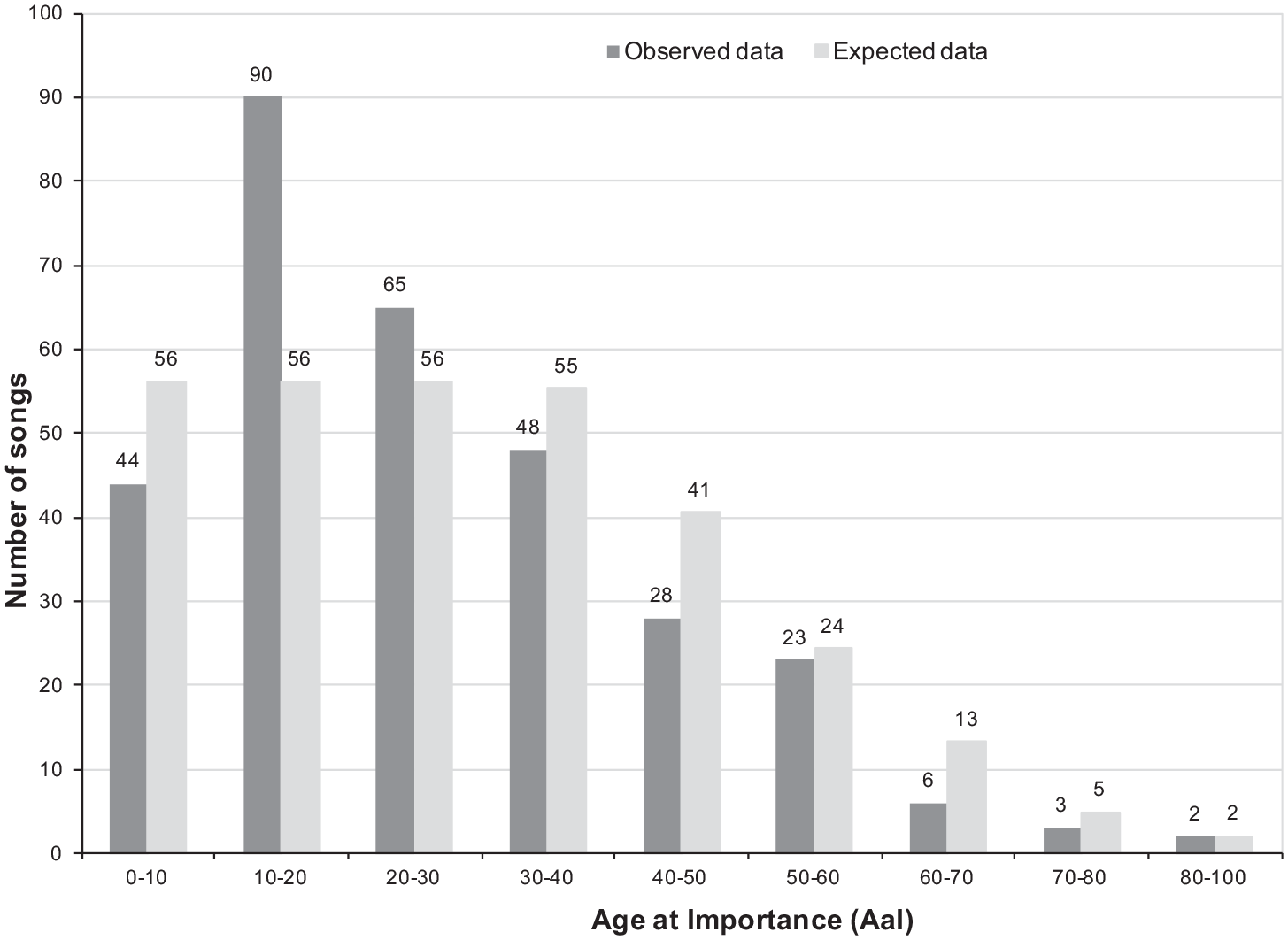
Frequency of song choices at each age band, in relation to expected frequencies.
Since it was possible to allocate more song choices to a broader age bracket (childhood, adolescence/early adult, mid and late adulthood), these data were looked at independently. Analysis focused on the first three age brackets, since all participants were able to select songs from these periods (see Figure 2). Given that some of these data were not normally distributed, they were analysed using Friedman’s test. This found a significant effect of age bracket on number of songs, χ2(2) = 13.724, p = .001. Further pairwise comparisons using Wilcoxon-signed tests and allowing for Bonferonni adjustment for multiple comparisons showed that there were significantly more songs that had an AaI between 15 and 29 than in the 30–44 age range (p < .0001) with a medium effect size (r = .32), but there were no significant differences between the other means.
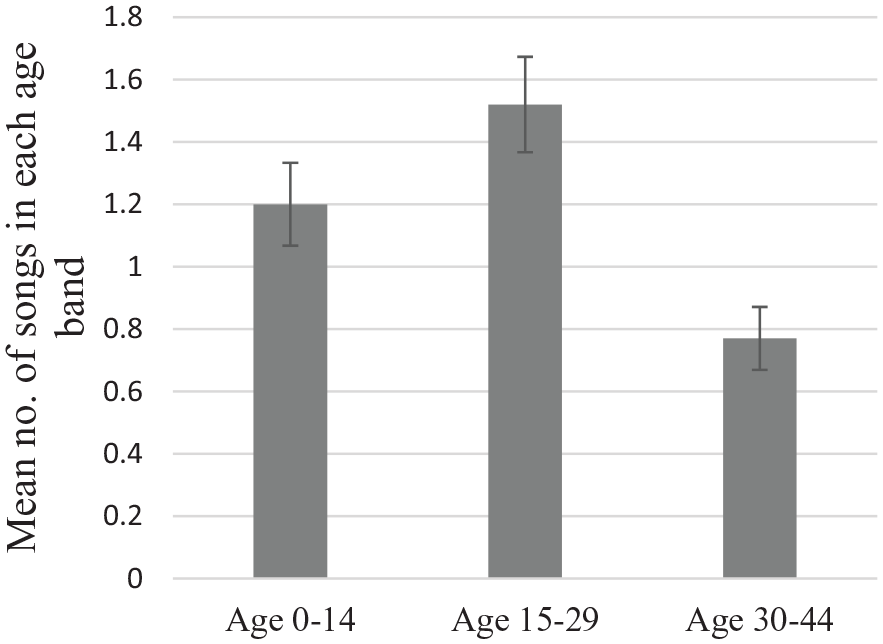
Mean number of song choices in each age period for all participants over the age of 44 years.
Reasons for track choice
Figure 3 shows the mean number of times that interviewees selected a song on the basis of each of the primary categories (general memories, specific memories, musical quality, and emotional response). Once again, the data were not normally distributed, so comparison of the means for the primary reasons was performed using Friedman’s test, and this revealed a significant effect, χ2(3) = 54.150; p < .0001). Further pairwise comparisons using Wilcoxon signed-rank tests and allowing for Bonferroni adjustment for multiple comparisons showed that the interviewees were significantly more likely to associate songs with a general memory than specific memories (p < .0001), musical qualities (p < .0001), or emotional response (p < .0001). These in turn were not significantly different from each other. Effect sizes for these differences were in the medium to large range (r = .34–.47).
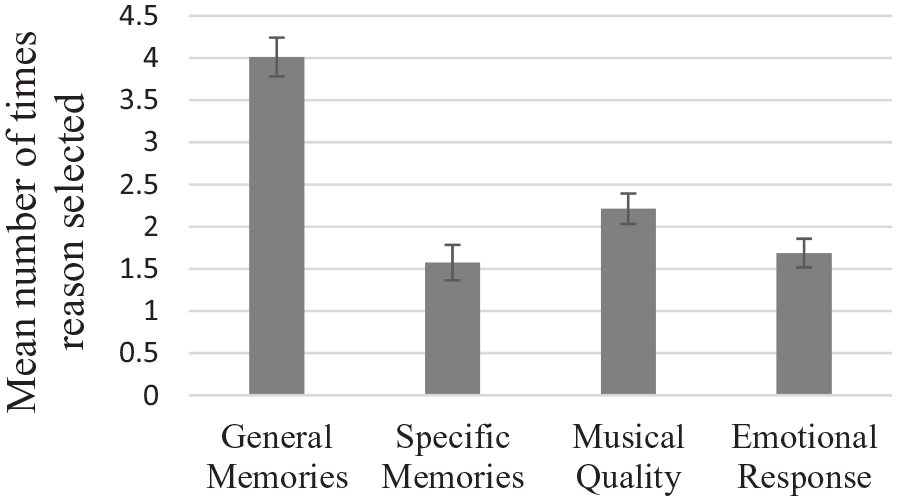
Mean number of times a song was associated with memories, musical quality, and specific emotion.
The detailed breakdown of these choices is shown in Table 2. Reasons that had been identified as self-defining, culture-defining, and first times were grouped together as identity-related memories. Comparison of the repeated measures was performed using Friedman’s test, and this revealed that there was significant variation in the type of reason given, χ2(8) = 88.74; p < .0001. Pairwise comparisons were not carried out as the number of multiple comparisons was judged too high to provide reliable results, but it is interesting to note that the highest frequencies are for general memory of a person or a period of time or for simple emotional responses.
Popularity of reasons given in rank order.
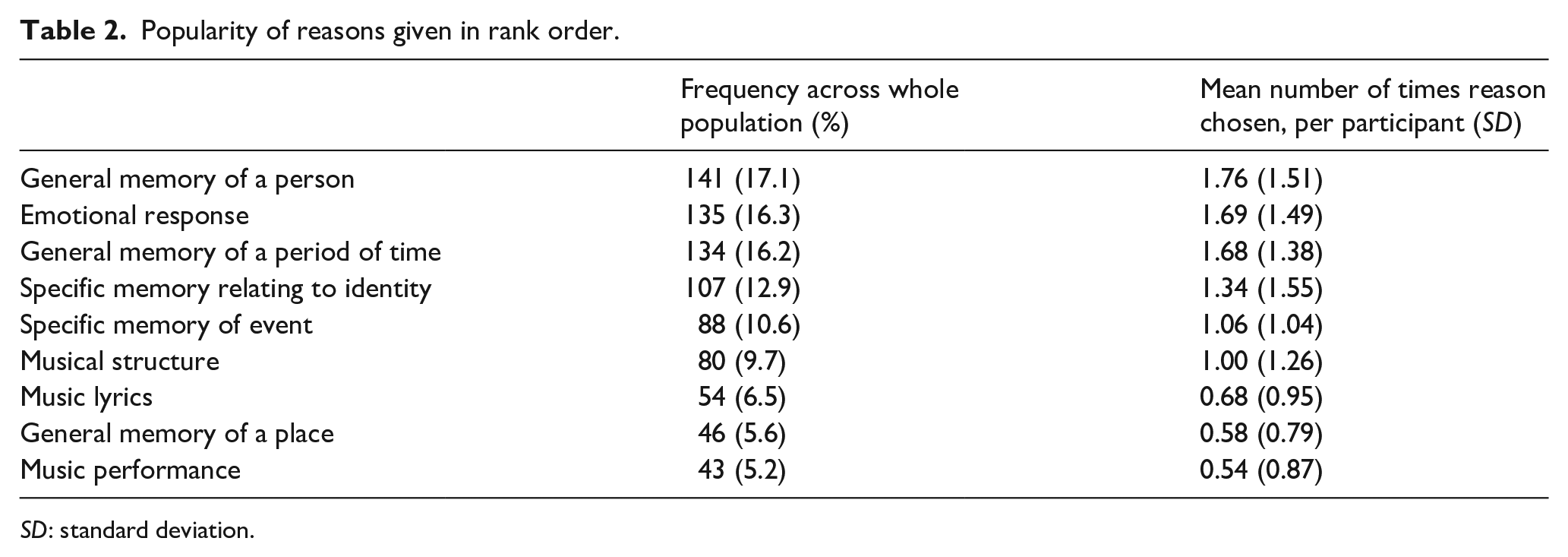
SD: standard deviation.
Discussion
The SP, as noted earlier, is a robust phenomenon in autobiographical memory, and here, for the first time, it has been observed to spontaneously emerge with free choice of music that crosses genres and in a naturalistic rather than laboratory setting. The SP effect is found for films that “define” one’s generation, for books, music, sporting events, even for favourite soccer players (see Munawar et al., 2018, for a recent review). Because of this widespread effect, simple explanations, ones that usually depend on the assumed selective exposure to the material used in a study, for example, people just watch more soccer when they are younger, listen to more music when younger, read more books, see more films, and so forth, do not provide credible theoretical explanations. Unlike other studies here, we are specifically concerned with why people make (spontaneous) selections of music dating to the SP and in particular how that relates to autobiographical memory. The most prominent reasons for people to select a record were general memories of a person, general memories of a specific period of time (e.g., early teens), specific memories relating to self and identity, or because they evoked an emotional response. The first three of these are all types of autobiographical knowledge/memories (Conway, 2009; Conway et al., 2018; Conway & Pleydell-Pearce, 2000) and so demonstrate the interlinking in memory of memories for specific songs with autobiographical memory. Songs were also selected because of an association with other specific autobiographical memories or general memories of a place, or because of a feature of the composition or performance of the music—these reasons were cited significantly less frequently but were clearly of personal importance to the person interviewed.
Music from the SP connects an individual to the people, places, and times that are significant to their identity. To illustrate this, consider the following memories from the DID corpus, all of which come from the SP: Well the first one is American Pie and for me it is related to a particular experience. When my career was about to take off I met a hero of mine, his name was Dick Neisser. He was a generation ahead of me and I visited him at Cornell in his lab. And we clicked. And I had had an idea on a topic in which he was an expert and he said, “let’s go home and think about it.” And we went to his place and he was playing this record. And he played it several times, because I asked him to play it several times. And that’s my memory. Professor Daniel Kahneman, selecting American Pie by Don McLean This is just me and becoming a young woman and jumping around and going out and having fun! Professor Tanya Byron, selecting I Want That Man by Debbie Harry. This was another song that just changed the course of my life. The harmonies were very unusual, it was a very raucous sounding record when it came out of the radio in 1964 and once again I had another shot at the guitar and this time I kept playing it. And it was really the song that inspired me to play rock and roll music, to get into a small band and to start doing some small gigs around town. But it was just a life changing piece of music. Bruce Springsteen, selecting I Want To Hold Your Hand by The Beatles.
It is important to note that guests on DID were generally invited to comment on their choices with an open question: why this disc? Crucially, they were free to say what they liked and were not specifically asked to recall memory information. It is then even more remarkable that they so often spontaneously linked their favourite songs with knowledge and memories from the SP. According to the identity account of the SP (based on the work of Erikson, 1950, 1982) during late adolescence and early adulthood, the individual comes to identify with events that originated from outside the family and then to form personal relationships that may last for many years and/or that found the basis of self-defining themes that may endure for long periods of time, even a lifetime. While earlier studies have found both a preference and a better memory for music from this period, most studies have not systematically explored how these preferences link with autobiographical memory. While the current study does not exclude the possibility that other factors, for example, enhanced encoding due to neuroplasticity during late adolescence, may play a role in shaping people’s choices, it does explicitly show that preferences are driven by important self-relevant experiences. This is in line with a qualitative exploration of the same archive, which revealed “identity” as one of the three core themes for the choices made (Lamont & Loveday, under review).
Music may be a defining feature of the SP, providing material that becomes intrinsically connected to the developing self. The strength of this association may in part be because of the importance of music for the developing selves of adolescents (North et al., 2000) and the role it plays in regulating emotions during this period (Ter Bogt et al., 2017). Songs continue to provide cues that access important self-defining memories (Singer, 2005), memories that when reflected upon or recounted, aim to define who we are. Of course, such memories can be used in the service of strategic self-disclosure to portray the individual in a particular way and this must have taken place with at least some of the choices made by DID guests. But that does not explain why most of what they said about their record choices dated to the period of the SP. Our view is that by-and-large guests made free choices and in so doing naturally gravitated to the people, places, times, and memories from this important period of the emergence of self from childhood and adolescence. Knowledge and memories from the SP perhaps explain who we are, to ourselves and to others.
The enduring popularity of DID lies largely in the power of music as a prompt for interesting and self-defining narratives. It is interesting that although clips of the songs are played on the programme, the relevance of the music is discussed ahead of each sound bite, suggesting that the songs act as conceptual or imagined clues rather than sensory ones. The rules of DID dictate that the guest will be alone, so it is not surprising that the most prominent reason for selecting a song was because of the link with a specific person. This finding has important implications for those working with people who experience reduced contact with significant others.
The naturalistic nature of the study means that there are inherent limitations—it is not always possible to identify the AaI or reason for choices—but it has also provided a unique opportunity to explore the spontaneous link between music and autobiographical memory. We also recognise that the process by which guests were chosen for the show means that this sample may not be entirely representative, but there is, however, in the present study greater ethnic and cultural diversity than in many other studies. Finally, the strong association of music with self through autobiographical memory reported here is, perhaps, most perfectly summed up by George Formby (a famous English highly popular ukulele player from the earlier part of the 20th century) who appeared in the programme in November 1951. When asked which luxury item he would like to take with him to accompany the eight discs he had chosen, he asked to take his ukulele. He said, “I’d take the first one I ever had—the one I serenaded Beryl [his wife] with when we were courting, the one I taught myself to play on first of all.”
Supplemental Material
QJE-STD-19-331.R1-Supplementary_Material – Supplemental material for The self-defining period in autobiographical memory: Evidence from a long-running radio show
Supplemental material, QJE-STD-19-331.R1-Supplementary_Material for The self-defining period in autobiographical memory: Evidence from a long-running radio show by Catherine Loveday, Amy Woy and Martin A Conway in Quarterly Journal of Experimental Psychology
Footnotes
Acknowledgements
We would like to thank James Angus for his guidance in relation to the statistical analysis of the frequency data. We would also like to thank Sarah Kane and Lucy Russell for their contribution to the coding.
Declaration of conflicting interests
The author(s) declared no potential conflicts of interest with respect to the research, authorship, and/or publication of this article.
Funding
The author(s) received no financial support for the research, authorship, and/or publication of this article.

References
Supplementary Material
Please find the following supplemental material available below.
For Open Access articles published under a Creative Commons License, all supplemental material carries the same license as the article it is associated with.
For non-Open Access articles published, all supplemental material carries a non-exclusive license, and permission requests for re-use of supplemental material or any part of supplemental material shall be sent directly to the copyright owner as specified in the copyright notice associated with the article.
