




Abstract
The purpose of this research is to investigate the impact of a foreign language on the causality bias (i.e., the illusion that two events are causally related when they are not). We predict that using a foreign language could reduce the illusions of causality. A total of 36 native English speakers participated in Experiment 1, 80 native Spanish speakers in Experiment 2. They performed a standard contingency learning task, which can be used to detect causal illusions. Participants who performed the task in their native tongue replicated the illusion of causality effect, whereas those performing the task in their foreign language were more accurate in detecting that the two events were causally unrelated. Our results suggest that presenting the information in a foreign language could be used as a strategy to debias individuals against causal illusions, thereby facilitating more accurate judgements and decisions in non-contingent situations. They also contribute to the debate on the nature and underlying mechanisms of the foreign language effect, given that the illusion of causality is rooted in basic associative processes.
Keywords
In daily life, people have to make critical decisions with no room for errors. For instance, politicians need to select the best economic policies, a Wall Street broker must make fast financial decisions, or a general practitioner must judge which one is the best treatment or recommendation for a patient. These examples have something in common. In all three cases, people have to evaluate cause–effect relationships to make the best decision possible. Furthermore, in a world where hundreds of millions of people use a foreign language on their daily lives, it is probable that the politician, the broker, or the general practitioner has to make these decisions in a foreign language. Although people are usually able to assess causal relations quite accurately (Jenkins & Ward, 1965; Shanks & Dickinson, 1987; Wasserman, 1990), it has also been well established that, under certain circumstances, people tend to infer a causal relationship when there is none, giving rise to a cognitive bias known as the causal illusion or the illusion of causality (see, for example, Matute et al., 2015; Vadillo, Blanco, Yarritu, & Matute, 2016). Would this illusion be affected by whether they have to make the judgement in a foreign language? The aim of the present research will be to study the impact of a foreign language on the illusion of causality.
The illusion of causality consists of overestimating the degree of causality between two events, or even believing that two events are causally related when they are not. This bias has serious implications in that it promotes decisions which are based on illusory causal relationships. For instance, people may think that a bogus medical treatment is helping them recover from a certain health problem. This may cause even death, as it may prompt people to not go to the hospital when they need it (Freckelton, 2012). Similar problems can be found not only in health-related areas but also in relation to many other life events. Indeed, previous findings support the idea that the illusion of causality underlies, at least in part, social problems such as financial bubbles (Malmendier & Tate, 2005), social stereotypes (Crocker, 1981; Murphy, Schmeer, Vallée-Tourangeau, Mondragón, & Hilton, 2011), gambling (Orgaz, Estévez, & Matute, 2013), pseudoscience (Matute, Yarritu, & Vadillo, 2011), superstitious thinking (Blanco, Barberia, & Matute, 2015), or the use of alternative medicines (Blanco, Barberia, & Matute, 2014).
Interestingly, other cognitive biases, different from the illusion of causality, have been shown to be affected by the language in which the information was presented. Keysar, Hayakawa, and An (2012) reported that thinking in a foreign language not only changed the decisions that people made but also that these decisions were more systematic and normative. Their experimental participants were less affected by the loss aversion bias when they made decisions in a foreign language. Keysar and his colleagues called this effect the foreign language effect. Costa, Foucart, Arnon, Aparici, and Apesteguia (2014) replicated the effect on the loss aversion bias in a different population and using both the same problem as Keysar and colleagues (a modified version of the Asian disease problem) and an equivalent problem involving money losses instead of human lives (Financial crisis problem). Furthermore, Costa and his colleagues tested the foreign language effect on other biases that involved decision-making under risk and uncertainty, revealing that people show less aversion to risk and to ambiguity, and are more consistent with their choices, when they make their decisions in a foreign language. Since then, a growing body of evidence on the foreign language effect embraces different research areas: from moral judgements (Cipolletti, McFarlane, & Weissglass, 2016; Costa, Foucart, Hayakawa et al., 2014; Geipel, Hadjichristidis, & Surian, 2015b, 2016), where the foreign language effect promotes more utilitarian responses, to decision-making areas like the hot hand fallacy (Gao, Zika, Rogers, & Thierry, 2015). This study is particularly interesting for our present purposes. Typically, people tend to expect a positive outcome whenever a sequence of positive outcomes occurred. Despite the fact that each trial is independent of the previous ones, people expect that positive outcomes will follow positive outcomes. This hot hand fallacy is closely related to causal illusions. Interestingly, the authors reported an attenuation of the effect when people performed the experiment in a foreign language.
A cognitive bias can be defined as a systematic deviation from a rational norm in judgement or decision-making. The inference of causality relies on the assessment of the contingency between the potential cause and the outcome (Baker, Murphy, Vallée-Tourangeau, & Mehta, 2000; Cheng, 1997; Shanks, 2010; Shanks & Dickinson, 1987; Wasserman, 1990). Thus, in causal learning situations, a bias can be defined as a systematic deviation of causality judgements from the actual contingency between the potential cause and the outcome. The most commonly used measure of contingency, the Δp index (Allan, 1980), is calculated as the probability that the outcome occurs in the presence of the potential cause, p(O|C), minus the probability that the outcome occurs in the absence of the potential cause, p(O|no C). When the outcome occurs with equal probability in the presence and the absence of the potential cause, there is no contingency between cause and outcome and, therefore, there is no causal relationship between them. Under certain conditions, people tend to overestimate the degree of contingency between events, particularly when the two events are non-contingent. This overestimation of null contingency is the focus of the present research.
Fortunately, research on the field has identified many of the conditions that promote the overestimation of causality (Matute et al., 2015). People tend to infer causality from coincidences, giving special weight to the probability with which the outcome occurs in the presence of the cause (i.e., trials in which the potential cause and the outcome coincide, even by mere chance; see Jenkins & Ward, 1965; Kao & Wasserman, 1993) instead of taking into account all the information. The illusion of causality is strongest when the contingency is null but the outcome or the potential cause or both occur with high probability (Allan & Jenkins, 1983; Blanco, Matute, & Vadillo, 2013; Hannah & Beneteau, 2009; Matute et al., 2011; Perales, Catena, Shanks, & González, 2005; Perales & Shanks, 2007).
Although not the only theoretical account, most of the evidence that has been published on the illusion of causality supports the idea that people establish their causal judgements, whether accurate or illusory, through associative learning. Associative models of learning predict how causal estimates are progressively acquired as people gain experience with the potential cause and the outcome in a trial-by-trial basis. Variables that increase the formation and strengthening of cause–outcome associations favour the strengthening of causal judgements (whether real or illusory), whereas variables reducing the formation of associations weaken the judgements of causality (whether real or illusory) between a potential cause and an outcome (Baker et al., 2000; Matute et al., 2015; Shanks & Dickinson, 1987; Vadillo et al., 2016).
Simulations of one of the most popular associative models of learning, such as the Rescorla and Wagner model (1972), have been conducted that accurately predict the results of many experiments on the illusion of causality (see Matute et al., 2015; Vadillo et al., 2016). These models predict that variables such as the probability with which the potential cause occurs and the probability with which the outcome occurs will have a significant effect on the illusion of causality. As mentioned above, this result has been confirmed in many experiments showing that the illusion of causality increases when either the probability of the cause or the probability of the outcome, or both, is high (e.g., Allan & Jenkins, 1983; Blanco et al., 2013). Moreover, other variables that are known to influence associative learning, such as, for instance, the existence of alternative potential causes, have also been found to affect the development of causal illusions (Vadillo, Matute, & Blanco, 2013). In sum, there are reasons to believe that the process underlying causal illusions is associative in nature. Nonetheless, and although the mechanisms of how the illusion of causality arises seem to be clear, research on how to reduce these errors has been scarce, as it has been the case with most other cognitive biases (Lilienfeld, Ammirati, & Landfield, 2009).
The accumulated evidence on the foreign language effect suggests that the use of a foreign language promotes more normative responses under certain conditions, supporting an increased-systematicity account (Keysar et al., 2012). The underlying mechanism, however, remains unknown. The tendency to be more normative when using a foreign language could be explained in principle by a greater psychological distance, by cognitive disfluency, or by a reduction in the emotional impact, which is currently the leading explanation of the effect (Hayakawa, Costa, Foucart, & Keysar, 2016). Furthermore, it is also possible that these accounts are not incompatible, and a possibility exists that some of these processes, such as the proposed reduction of cognitive fluency, could also weaken the strength of the acquired associations, thereby reducing the causality bias. In any case, it seems that the use of a foreign language could provide an effective and interesting strategy to reduce other biases, such as the illusion of causality, in which decision-making and judgements are involved.
Thus, taking into account that presenting the information in a foreign language effect has proven effective in reducing many different types of biases (one of them the hot hand fallacy, related to causal inferences; see Gao et al., 2015), we decided to test the impact of a foreign language on the illusion of causality. Causality is often overestimated when assessed on quick intuitions (Kelemen, Rottman, & Seston, 2013; Matute et al., 2015); therefore, finding a way to reduce automaticity in causal judgements would be of high applied value. In addition, it is also of theoretical interest to test whether the use of a foreign language might reduce the illusion of causality. It has been suggested that using a foreign language reduces processing fluency (Costa & Sebastián-Gallés, 2014; Keysar et al., 2012) and that this could promote deliberation and systematicity (Hayakawa et al., 2016; Keysar et al., 2012) and/or reduce the impact of intuition (Costa, Vives, & Corey, 2017). If this is true, presenting the information in a foreign language should attenuate associative phenomena such as the illusion of causality.
Thus, given the potential relevance of this line of research, in the present experiments, we aimed to reduce the illusion of causality through a manipulation that has proven to improve accuracy and to promote more systematic and normative responses in other decision-making problems (i.e., the foreign language effect). Furthermore, our experiments aim to contribute to the discussion on the potential explanations of the effect, since the illusion of causality is rooted in associative principles and is not, at least in principle, an emotional grounded bias. We hypothesised that participants who performed a non-contingent task in a foreign tongue will show a significant reduction of this bias.
Experiment 1
Method
Participants
In total, 36 exchange students (27 women, mean age 20.5 years) volunteered for this experiment. They were all English native speakers, and they were studying Spanish as a foreign language at the University of Deusto. They started to learn Spanish at a mean age of 13 years, mainly in a classroom environment. All volunteers gave their informed consent and were rewarded with €6.
Materials
The materials consisted of a pencil and paper booklet and a standard causal learning task, specifically, a computerised version of the allergy task (Matute et al., 2011; Wasserman, 1990). Although the participants were attending to similar linguistic level classes and were randomly assigned to the experimental conditions, we wanted to ensure that there were no significant differences between groups in some critical variables. Therefore, to test their language proficiency and cognitive ability, we asked participants to fill a booklet that included two self-assessment language tests, a foreign language comprehension test, and the Cognitive Reflection Test (CRT; Frederick, 2005). The two self-assessment language tests included four scales where participants were asked to rate, from 1 to 10, their speaking, writing, reading, and comprehension proficiency in both their native and their foreign language (i.e., English and Spanish). The comprehension test for the foreign language included five statements that could be true or false in relation to a brief story that participants were asked to read. The CRT includes three problems that are designed to measure cognitive ability or cognitive style (Frederick, 2005). Given that the purpose of the booklet was to ensure that there were no differences between groups in some critical variables (i.e., we did not aim to test the impact of the foreign language on these tests), the booklet was written entirely in the participant’s native language (i.e., English) except for the section devoted to the foreign language comprehension test. The computerised causal learning task (originally in Spanish) was translated and back-translated by bilingual speakers to ensure that the meaning was identical in both languages (Brislin, 1970).
Procedure and design
The experiment was conducted across two sessions. In the first session, participants filled in the paper and pencil booklet. In the second session, they were randomly assigned to one of the experimental groups and performed the causal learning task on one of the computers in individual cabins in our laboratory. This second session was conducted entirely in the language of the group to which the participant had been assigned—either the native or the foreign language (Keysar et al., 2012). In this causal learning task, participants were instructed to imagine being a medical doctor who had to learn whether a fictitious drug called Batatrim (i.e., potential cause) was effective in the healing of the crises produced by a fictitious disease (i.e., outcome). On each trial, participants saw information about a fictitious patient (see Figure 1). In the first panel, they saw information on whether the patient had taken the drug or not (i.e., potential cause present or absent). Then the second panel contained a question in which participants had to guess whether that particular patient would feel better. Participants had to answer by clicking one of two buttons, “Yes” or “No.” These responses were required to maintain the participants’ attention during the task. Once their response was emitted, a third panel showed information about the recovery (or not) of the fictitious patient (i.e., outcome present or absent).
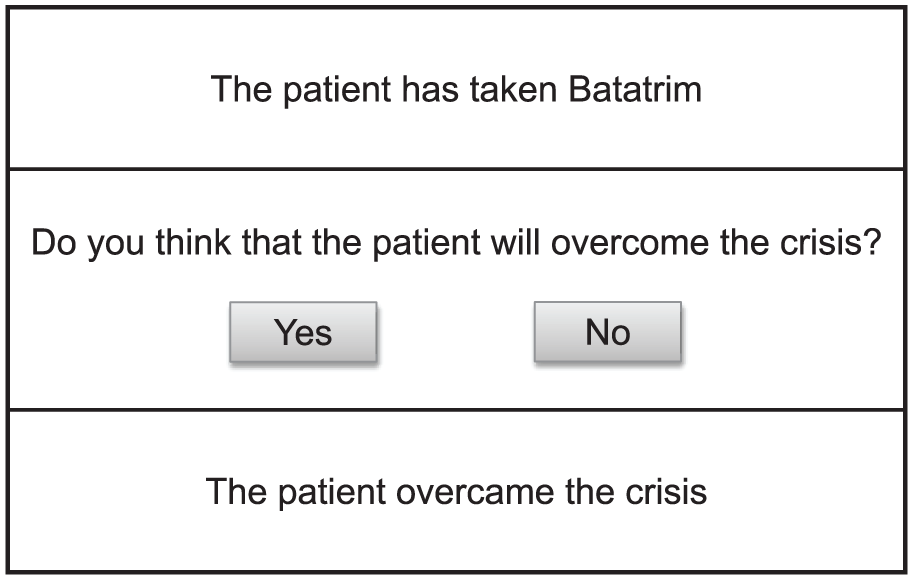
Screenshot of a training trial. In the upper panel, participants saw information about the presence or absence of the potential cause. The middle panel shows the predictive question that was used to maintain their attention. Once participants gave their response, the program showed the lower panel with information about the presence or absence of the outcome.
After 40 trials (one per patient), participants were asked to give a causal judgement by answering the question “To what extent do you think that Batatrim has been effective in healing the crises of the patients you have seen?” This was our dependent variable. The answers were given by clicking on a 0-100 scale, anchored at 0 (“definitely NOT”) and 100 (“definitely YES”). When the experiment was finished, we asked participants to translate verbally one trial to ensure that they had understood the task (Keysar et al., 2012). In case any of them would be unable to translate one trial, their data would be eliminated.
The design summary is shown in Table 1. Two groups of participants saw patients who had taken a drug that was non-contingent with the healing of the crises, one group in their native tongue (N = 16), and the other one in the foreign language (N = 20). Given that the degree of illusion of causality is highly influenced by the probability of the outcome (Allan & Jenkins, 1983; Blanco et al., 2013; Shanks & Dickinson, 1987), we used a high probability of the outcome. The purpose was to replicate the illusion of causality effect in the native language group, thus allowing for a reduction of this bias in the foreign language group. Therefore, the probability of recovery was identical regardless of whether the fictitious patients took the drug or not, that is, p(O|C) = p(O|no C) = .75. The different trial types showing whether the potential cause and the outcome were present or absent were randomly ordered in all conditions.
Design of the experiments.
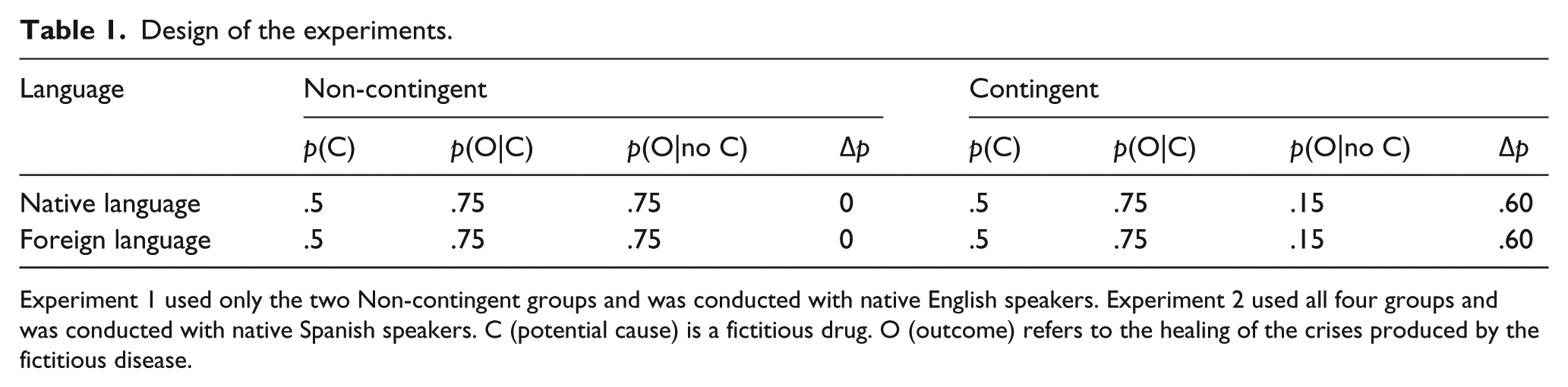
Experiment 1 used only the two Non-contingent groups and was conducted with native English speakers. Experiment 2 used all four groups and was conducted with native Spanish speakers. C (potential cause) is a fictitious drug. O (outcome) refers to the healing of the crises produced by the fictitious disease.
Results and discussion
Before looking at the critical results, that is, the causal judgements, we checked whether there were base-level differences in language proficiency and in cognitive ability. Mann-Whitney tests showed no significant differences between the native and the foreign group on the self-assessment scales, for the native language (U = 148.00, Z = −.636, p = .525, r = −.11), the foreign language (U = 142.00, Z = −.575, p = .565, r = −.10), the comprehension test (U = 153.00, Z = −.232, p = .817, r = −.04), or for the CRT (U = 156.00, Z = −.138, p = .891, r = −.02). Means for each variable are shown in Table 2. No data were eliminated from this experiment.
Language proficiency and cognitive ability in participants from Experiment 1.
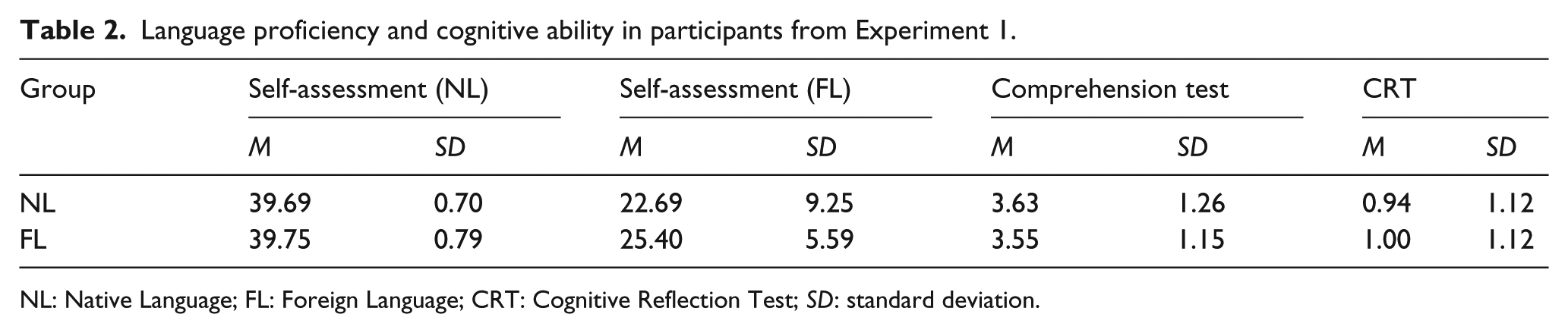
NL: Native Language; FL: Foreign Language; CRT: Cognitive Reflection Test; SD: standard deviation.
Most importantly, participants who performed the task in their foreign language perceived the drug as less effective than those who performed the task in their native tongue (see Figure 2). This was confirmed by a one-way analysis of variance (ANOVA), which yielded a significant main effect of language, F(1, 34) = 17.248, p < .001,
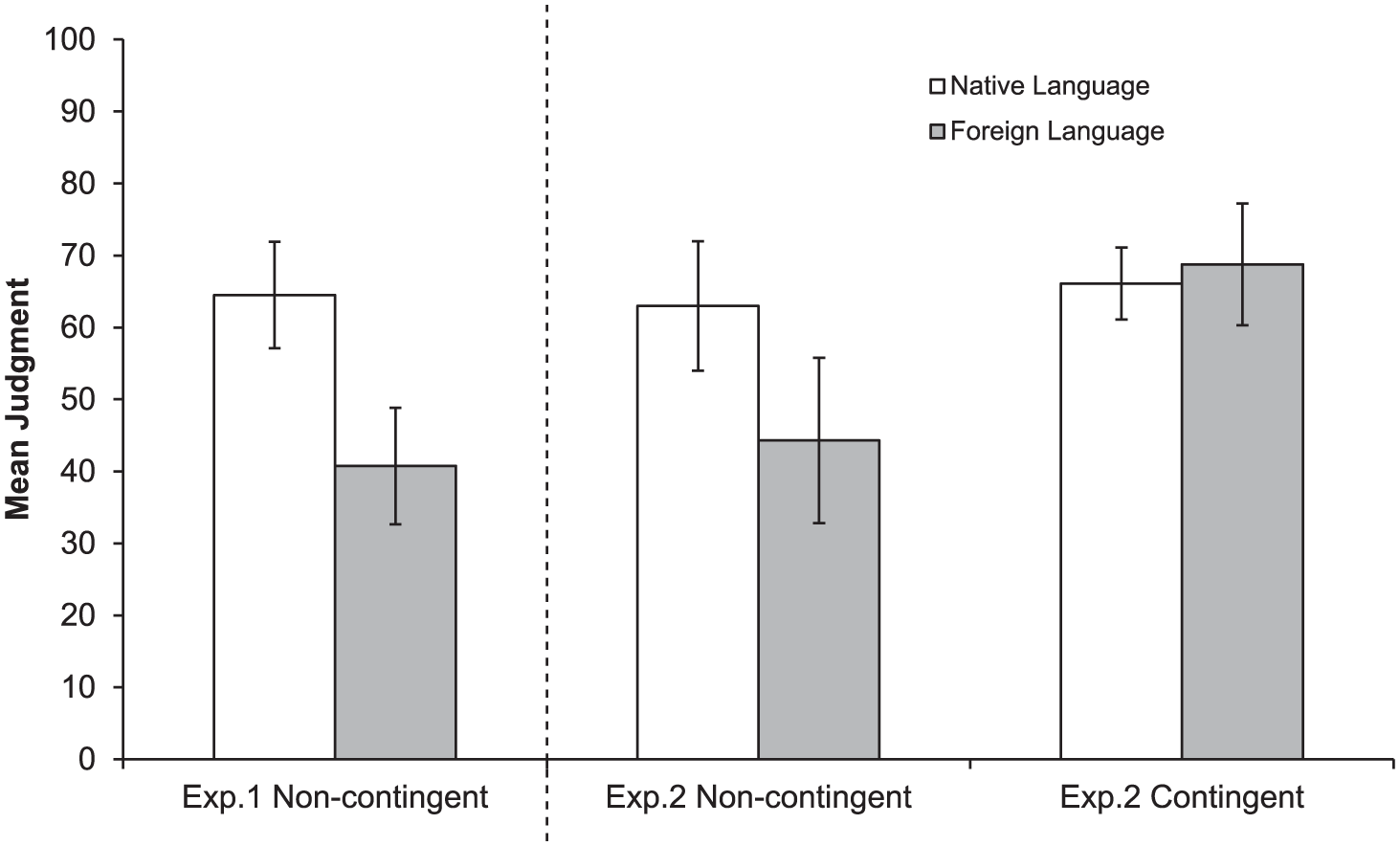
Mean judgement of causality for Experiment 1 (left panel) and Experiment 2 (right panel). Experiment 1 was conducted with native English speakers, and Experiment 2 with native Spanish speakers. Error bars depict the 95% confidence intervals for the means.
One might argue that since the native tongue was always English and the foreign one was always Spanish, the linguistic distance between the two languages and/or some linguistic peculiarities of each one could perhaps influence the results. Therefore, we considered that a second experiment replicating this study with Spanish native speakers was required. In addition, it is possible that participants in the foreign group might experience linguistic problems, and might be more prudent when emitting their judgements (which would lead to a lower judgement and an apparent attenuation of their bias). To address this issue, in Experiment 2, we added two contingent groups that saw a drug that actually worked. Thus, these two groups served as a control condition. If the results of Experiment 1 were due merely to a general reduction in the judgements when using a foreign language, then we should expect a reduction in the judgements even in the contingent task when performed in the foreign language. However, if the foreign language only affects the evaluation of causality in situations that are prone to the illusion of causality (i.e., non-contingent), then the participants of the contingent groups should give a positive and rather accurate judgement, regardless of whether they were assigned to the group performing the experiment in the foreign or native language. Therefore, in a cross-linguistic experiment, we expect to replicate the foreign language effect that we found in Experiment 1 in the non-contingent groups of Experiment 2. We also expect no such effect in the judgements of the contingent groups. This would indicate that the reduction in the responses is indeed a reduction of the illusion of causality rather than a general reduction of judgements.
Experiment 2
Method
Participants
In total, 80 Spanish native speakers (49 women, mean age 23.8 years) volunteered for this experiment. They started to learn English at a mean age of 7 years, mainly in a classroom environment. All of them were students at the University of Deusto and were enrolled on English courses when they performed the experiment. All volunteers gave their informed consent and were rewarded with €6.
Materials
In this experiment, we used the same materials as those employed in Experiment 1—a pencil and paper booklet, and a standard causal learning task. As in the previous experiment, the two self-assessment tests and the CRT were written in the participants’ native language (i.e., Spanish), and the comprehension test in the foreign language (i.e., English). The CRT (originally in English) was translated and back-translated by bilingual speakers (Brislin, 1970).
Procedure and design
We followed as closely as possible the procedure of Experiment 1. Thus, the study was conducted across two sessions. During the first session, participants were asked to fill in the paper booklet. During the second session, they were asked to perform the causal learning task in individual cabins in our laboratory. As in Experiment 1, the second session was conducted entirely in the language to which the participant had been assigned (Keysar et al., 2012). The design of the experiment is shown in Table 1. In this experiment, the two non-contingent groups (native language, N = 20; foreign language, N = 20) were identical to those used in Experiment 1, but we included two additional groups where the drug was contingent with the healings (native language, N = 20; foreign language, N = 20). In these new groups, the probability of the healings was higher when the patients took the drug, p(O|C) = .75, than when they did not, p(O|no C) = .15. Thus, this contingency between the drug and the healings was positive but not perfect (i.e., Δp = .60, see Table 2).
These contingent groups were used just as an additional control. Their purpose was to ensure that the expected reduction of the illusion of causality in the foreign language group exposed to non-contingent events was not due to a general reduction of their judgements due to prudence, or other artefacts when using the foreign language. Therefore, we expected all participants in the positive contingent conditions to accurately perceive that the two events were causally related, thereby approximating their causal judgements to the actual contingency between the two events (i.e., Δp = .60). To avoid carry-over or anchoring effects in the critical, non-contingent situations, the contingency factor was manipulated between participants, that is, half of the participants in each language condition were exposed to a non-contingent problem identical to that used in Experiment 1, whereas the other half was exposed to a positive contingency between the events. The different trial types showing whether the potential cause and the outcome were present or absent were randomly ordered in all conditions.
Results and discussion
We first assessed possible base-level differences in language proficiency and cognitive ability. Mann-Whitney tests comparing the native with the foreign groups yielded no significant differences between them on the self-assessment scale for the native language (U = 665.00, Z = −1.327, p = .185, r = −.15), the self-assessment scale for the foreign language (U = 740.00, Z = −.580, p = .562, r = −.07), the comprehension test for the foreign language (U = 668.00, Z = −1.388, p = .165, r = −.16), or for the CRT (U = 794.00, Z = −.061, p = .951, r = −.01). Table 3 summarises the mean values of these variables for each group. No data were eliminated from this experiment.
Language proficiency and cognitive ability in participants from Experiment 2.
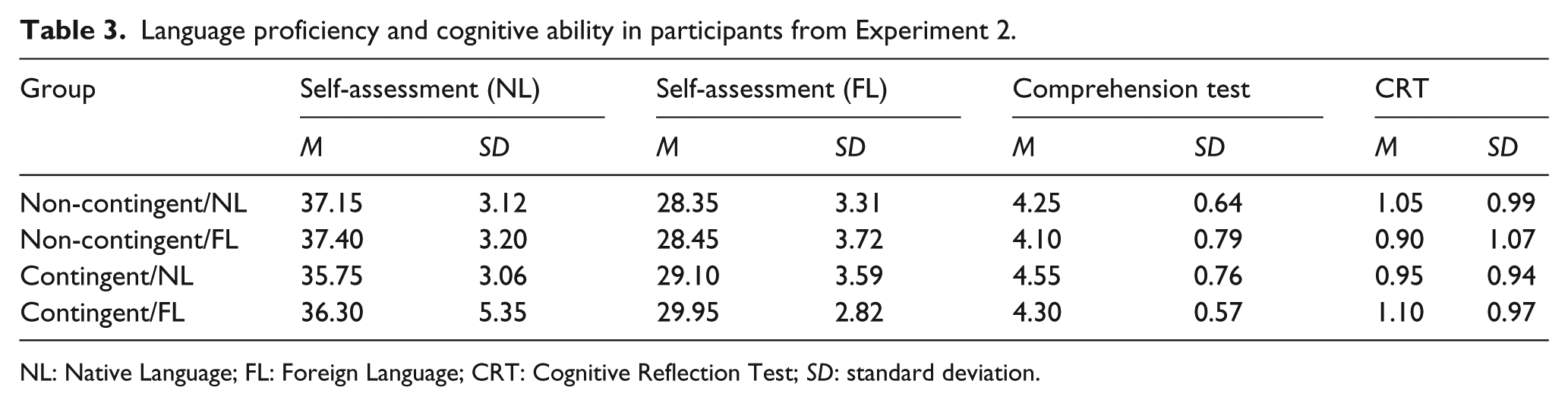
NL: Native Language; FL: Foreign Language; CRT: Cognitive Reflection Test; SD: standard deviation.
The critical results for this experiment are shown in Figure 2, which depicts the mean judgements of causality for each of the four experimental groups. As expected, in the contingent groups, both the native and the foreign language groups perceived the drug as moderately effective (i.e., in accordance with its actual Δp value, which was .60 for these conditions). In the non-contingent group (i.e., that expected to develop the illusion of causality), the causal relationship was also judged as moderately high (i.e., illusory, given that Δp = 0 for this group) in the native language group, and it was markedly reduced when participants performed the task in the foreign language.
This was confirmed by a 2 × 2 (Language [native, foreign] × Contingency [non-contingent, contingent]) between-groups ANOVA.
1
This analysis revealed a significant main effect of contingency, F(1, 76) = 9.439, p = .003,
General discussion
The two experiments presented here show that both the foreign language and the native language groups developed some degree of causality bias. However, when participants performed the task in the foreign language, they were significantly more accurate in their assessment of the null contingency in both Experiment 1 and Experiment 2. That is, as we expected, the illusion of causality was replicated in both experiments, and in both cases, the use of the foreign language reduced the strength of this bias. This is of important applied and theoretical value.
But before discussing the applied and theoretical implications of these results, it is worth noting that, given that in both experiments participants were enrolled in the same proficiency level class of their foreign language and that all of them successfully translated one trial verbally at the end of the experiment, it appears that language proficiency in the foreign language did not hinder their understanding of the task. The lack of statistical differences between the foreign and the native groups in their language proficiency and their CRT scores indicates that the differences in their judgements in the null contingency condition cannot be attributed to differences in language skills or cognitive ability. In addition, both groups judged the contingent condition of Experiment 2 accurately, adjusting their judgements to the actual contingency between the two events (i.e., Δp = .60 in this experiment). This result replicates the findings observed in other studies that used positive contingencies (Alloy & Abramson, 1979; Shanks & Dickinson, 1987, 1991; Wasserman, 1990; Wasserman, Chatlosh, & Neunaber, 1983). This indicates that participants had a correct understanding of the task in both languages and that any differences observed in their judgements of the non-contingent conditions cannot be attributed to a general reduction of the responses due to prudence or any other type of artefact in their use of the foreign language. That is, the foreign language was not a barrier to emit an accurate judgement. Moreover, the replication of the foreign language effect in both Experiment 1 and Experiment 2 supports the idea that the effect is not due to linguistic distance between the two languages and/or linguistic peculiarities of each language that could possibly influence the results.
At first glance, the lack of statistical differences between the two contingent problems (non-contingent vs contingent) in the native language condition in Experiment 2 might seem problematic. As previously mentioned, however, this is a common result in the illusion of causality literature (see, for example, Matute et al., 2011). Appreciate that (a) the contingent problem was positive but not very high (i.e., Δp = .60); (b) the probability of the outcome was very high, a condition that is known to favour the illusion of causality in the non-contingent group (e.g., Matute et al., 2015); and (c) the low number of trials, 40, is also a condition that should promote the illusion in the non-contingent group (e.g., Shanks & Dickinson, 1987). Thus, we expected that people in the non-contingent native condition should give a high judgement and people in the contingent groups should give accurate (moderately high) judgements, so no differences were expected with the parameters that we used except for the reduction of the illusion in the groups performing the non-contingent problem in their foreign language. The lack of differences between the native groups could have been an issue if we had wanted to study how people discriminate between different contingencies. But in that case, we should have used different parameters to increase the differences. Our goal was to reduce the causality bias that was expected in the non-contingent condition by presenting the information in a foreign language, and we designed the study according to this goal. The contingent conditions were added only as a control, to ensure that the lower judgements that we expected in the non-contingent groups when performing the experiment in the foreign language were not due to a general decline in the causal evaluation when using a foreign tongue.
Thus, taken together, the results of both experiments support our hypothesis that using a foreign language helps people reduce their illusion of causality. These findings imply that presenting the information in a foreign language when making a causal inference could be used as a strategy to reduce the causality bias without manipulating the information about the potential cause and outcome. Reducing the probability of the cause and/or the probability of the outcome is a strategy that is known to be effective in reducing the illusion (Allan & Jenkins, 1983; Blanco et al., 2013; Hannah & Beneteau, 2009; Matute et al., 2011; Perales et al., 2005; Perales & Shanks, 2007) but cannot always be used. Using a foreign language could therefore prove to be a very useful strategy in real-life situations in which the probability of the cause and/or the outcome remain uncontrollable. Recall that the illusion of causality occurs precisely in situations in which either the cause or the outcome or both of them occur frequently but independently of the participants’ behaviour (see Matute et al. (2015) for review). Thus, the important practical implication is that using a foreign language to reduce the causality bias could lead to better decision-making in many situations in which the probability of the potential cause and the outcome are given and, therefore, uncontrollable to the decision-maker.
Importantly, the results of the present research not only add to the growing body of evidence for the foreign language effect but could also shed some light on the relevant underlying mechanisms. As in other studies on the field, our experiments show a reduction in a particular bias when the task is performed in a foreign language. Therefore, our data support the increased-systematicity accounts proposed by Keysar et al. (2012) in their original article. However, these accounts encompass different potential hypothesis (Costa, Foucart, Arnon et al., 2014; Hayakawa et al., 2016; Keysar et al., 2012). In particular, there are three theoretical explanations that have been proposed to clarify the processes that may be responsible for this phenomenon.
One possible mechanism to explain the effect is that the foreign language increases psychological distance to the problem which, in accordance to construal-level theory, would give people a more abstract representation, relying on schematic, prototypical information (Fujita, Henderson, Eng, Trope, & Liberman, 2006). In the last term, this high level of abstraction would lead people to pay more attention to ends over means (Hayakawa et al., 2016). This hypothesis fits very well with the evidence that has been reported using moral dilemmas, where participants tended to be more utilitarian when they performed the task in a foreign language.
Another potential explanation, proposed by Keysar et al. (2012), claims that thinking in a foreign language increases the emotional distance, which leads to a reduction in emotional resonance (Keysar et al., 2012; Pavlenko, 2012). Given that the decision-making tasks that they used in their experiments involved risks and losses, it makes perfect sense to assume that reducing the emotional component may alleviate this kind of decision-making bias. Actually, this is the current leading account to explain the foreign language effect (Hayakawa et al., 2016).
The last increased-systematicity account, also proposed by Keysar and colleagues (2012), suggests that since heuristics and biases have been proposed to reflect the use of fast, effortless, and automatic processes typically linked to System 1 in the two-system models of reasoning (Kahneman, 2003), the foreign language effect could be a consequence of a reduction in processing fluency (Costa, Foucart, Arnon et al., 2014; Keysar et al., 2012). Presenting the information in a foreign language reduces processing fluency (Costa & Sebastián-Gallés, 2014), which eventually would lead to a reduction of intuitive processes and/or to a more deliberative and analytical way of processing (Alter, Oppenheimer, Epley, & Eyre, 2007; Costa et al., 2017; Gervais & Norenzayan, 2012; Hayakawa et al., 2016).
The aim of our experiments was not to discriminate between the different theoretical accounts of the foreign language effect, and therefore, they were not designed to meet this purpose. Likewise, different experiments should have been conducted if our purpose would have been to test the potential explanations of the causality bias (see Matute et al. (2015) for discussion on potential explanations). Thus, our results should be interpreted with caution in relation to their support of the different potential explanations. However, it is worth highlighting some interesting features of our experiments. In the present research, we observed the foreign language effect in a passive, trial-by-trial causal learning task, which means that participants were exposed to mere observational, vicarious information. That is, participants did not have to decide whether they administered the medicine to their fictitious patients, as is the case in some other versions of this task (see Yarritu, Matute, & Vadillo (2014) for discussion on passive vs active tasks). In our version of the causal learning task, the life of the fictitious patients did not rely on the participants’ decisions, that is, participants were mere observers. Thus, at least in principle, we believe it is difficult to argue that our experiments involved any emotional component or that they might involve different levels of psychological distance. Furthermore, the causality bias is rooted on basic, associative learning mechanisms, and has been observed regardless of the level of personal involvement of the participant (Matute et al., 2015; Yarritu et al., 2014). This suggests that different levels of psychological distance and emotionality are not, at least in principle, critical factors in the development of this effect. It could be argued that, because to maintain attention we asked participants to answer a predictive question on each trial, the information presented immediately after they responded about the occurrence of the outcome could evoke some emotional reaction. However, when asked to provide some informal feedback upon finishing the experiments, the participants, if anything, tended to mention boredom, rather than emotionality. In addition, the financial reward for participating in the experiment did not depend on their performance, so we believe this indirect feedback could hardly be associated with any relevant emotion, as it is not suggesting that they were performing better or worse. Indeed, we believe that participants simply attend to this feedback and attempt to learn from it, in accordance with the goal of the task as stated in the instructions. They were not asked to heal as many patients as possible, as in other versions of the task, but to learn whether the drug was effective.
We believe our results are more compatible with the processing fluency explanation. Processing fluency affects all kinds of judgements (see Song & Schwarz, 2010). Some researchers suggest that fluency operates directly (Schwarz, 2004). That means that regardless of the information that is being transmitted, if it is presented disfluently, people will infer that the information is less familiar and that the task is more difficult to accomplish (Song & Schwarz, 2010). As previously mentioned, it has also been suggested that processing fluency can affect the selection of processes involved in the resolution of a task, activating deliberative and analytical processes (Alter et al., 2007; Gervais & Norenzayan, 2012; Oppenheimer, 2008). This hypothesis is supported not only by the improvement in reasoning tasks when the information is presented in a disfluent font (Alter et al., 2007) but also by the reduction of cognitive biases such as the Moses illusion (Song & Schwarz, 2008), hindsight bias (Sanna & Schwarz, 2006), conspiracy’s ideation (Swami, Voracek, Stieger, Tran, & Furnham, 2014), as well as a phenomenon that is closely related to the illusion of causality, namely, the sense of agency (Sidarus, Vuorre, Metcalfe, & Haggard, 2017). However, we should also note that the disfluency effect in reasoning tasks has been difficult to replicate (Meyer et al., 2015), and that the debiasing effect in the Moses illusion was not found when using a foreign language manipulation (Geipel, Hadjichristidis, & Surian, 2015a). Furthermore, other researchers suggest that confounded variables, such as the time of reading (Sanchez & Jaeger, 2015) or the cognitive ability of the participants (Thompson et al., 2013), might be playing a key role. Therefore, although there is evidence that shows how disfluency reduces some biases and improves performance under some circumstances, it is not entirely clear how it operates. It is possible that performing a causal learning task in a foreign language decreases fluency, and this could (a) promote a more deliberative way of processing the information, or (b) reduce the use of intuitive processes. Both of these mechanisms would make participants to be more accurate and to make a more effective use of all the information available when judging to what extent the drug has been effective, instead of relying mostly on cause–outcome coincidences. Processing all available information eventually should help participants assess causality more accurately. The available evidence does not allow us to discriminate between the different theoretical proposals. In any case, and regardless of the merits of the different theoretical accounts, the present research shows that a foreign language can provide an effective tool to help people infer causal relations more accurately.
Footnotes
Declaration of conflicting interests
The author(s) declared no potential conflicts of interest with respect to the research, authorship, and/or publication of this article.
Funding
Support for this research was provided by Grant PSI2016-78818-R (AEI/FEDER, EU) from Agencia Estatal de Investigación of the Spanish Government, and the European Regional Development Fund, as well as Grant IT955-16 from the Basque Government, both awarded to H.M. The funders had no role in study design, data collection and analysis, decision to publish, or preparation of the article.
