



Abstract
This study explored whether affect could be an antecedent of synchrony (i.e., the convergence of rhythm and timing) in face-to-face conversations. Although previous studies have failed to illustrate that affective valence causes synchrony, they did not employ experimental manipulation of affective state and did not consider the affective contrast between interacting participants. In this study, two experiments were conducted on dyadic interactions with a same-sex stranger. Experiment 1 focused on affective valence, and Experiment 2 investigated the influence of affective contrast on synchrony. Participants engaged in a 6-min chat. Positive or negative affect was separately induced using a video (Experiment 1) or an affective picture set (Experiment 2) before conversation to stimulate each two conditions: positive versus negative affective state (Experiment 1) or low versus high contrast in affective state (Experiment 2). Synchrony was evaluated using wavelet transform, via calculation of the cross-wavelet coherence (WTC) and relative phasing pattern (i.e., in-phase and anti-phase), as well as cross-correlation. Results showed that cross-WTC and proportion of in-phase patterning were not influenced by affective valence (Experiments 1 and 2); however, they were higher in the low-contrast condition compared with the high-contrast condition (Experiment 2). Cross-correlation, on the contrary, could not find a significant difference in Experiments 1 and 2. These results were discussed from the perspective of cognitive and motivational processes.
Introduction
When interpersonal conversation is well coordinated, people have positive feelings, which lead to rapport (Tickle-Degnen & Rosenthal, 1990) and affiliation (Hove & Risen, 2009). Although some recent studies have shown that higher coordination could result in negative outcomes under complex task situations, such as constructing towers from uncooked spaghetti (Abney, Paxton, Dale, & Kello, 2015) and building model cars (Wallot, Mitkidis, McGraw, & Roepstorff, 2016), a recent meta-analysis has confirmed that coordination has a causal effect on positive affective outcomes (Vicaria & Dickens, 2016). This relationship is bidirectional, with positive affect also leading to interpersonal coordination (for a review, see Chartrand & Lakin, 2013; Lakin, 2013). For instance, affiliative attitude increases behavioural mimicry; when the interaction partner touched one’s face or shook one’s foot, individuals with an affiliative goal performed the same behaviour as their partner (Lakin & Chartrand, 2003). Individuals high in social orientation also showed a propensity to synchronise with others (Lumsden, Miles, Richardson, Smith, & Macrae, 2012). The correlation between interpersonal coordination, or the co-occurrence and synchronisation of behaviours, and affective positivity has been seen in numerous instances and in various relationships (e.g., Bernieri, Reznick, & Rosenthal, 1988; Latif, Barbosa, Vatiokiotis-Bateson, Castelhano, & Munhall, 2014). Still, as an antecedent, the role of affect by itself remains unclear.
Affective valence, affective contrast, and synchrony
Behavioural mimicry, one form of interpersonal coordination, is a phenomenon that two or more people engage in the same behaviour at the same time (Chartrand & Bargh, 1999; Chartrand & Lakin, 2013). Previous studies have shown that affective valence predicts the occurrence of behavioural mimicry. Although individuals in a positive mood mimicked their partner’s behaviour (van Baaren, Fockenberg, Holland, Janssen, & van Knippenberg, 2006), negative mood, especially sad mood, suppressed facial mimicry (Likowski et al., 2011). These studies suggested that the effect of affective valence (i.e., mood) on mimicry might be mediated by cognitive processing style. Positive affect elicits a less effortful and more automatic processing style (e.g., Schwarz & Clore, 1996), which results in adapting automatic behaviour, mimicry. In contrast, negative affect increases self-focused attention (e.g., Wood, Saltzberg, & Goldsamt, 1990), which reduces one’s attention to external stimuli. Owing to reduced attentional capacity, individuals with negative mood are less likely to display mimicry.
Synchrony, the other form of coordination, refers to the convergence of rhythm and timing (Bernieri & Rosenthal, 1991). It does not require the same behaviour, but focuses on the precise timing of movement or behaviours. Although studies of behavioural mimicry have illustrated that affective valence increases/decreases mimicry, previous studies on synchrony have failed to identify a causal effect of affective valence on synchrony. For instance, in a rhythmic repetitive activity (i.e., stepping), participants reduced synchrony when they interacted with a tardy partner who was 15 min late to the experiment (Miles, Griffiths, Richardson, & Macrae, 2010). However, affective state after the extra 15-min wait for the partner was not significantly correlated to their synchrony. As for the findings in dyadic conversation, the influence of situational context (i.e., affiliation vs argument) on bodily synchrony was examined (Paxton & Dale, 2013), and it was revealed that interactants showed less synchrony during argument. Similarly, affective change corresponding to situational change, did not predict the level of synchrony. In another study, positive or negative affect was positively or negatively associated with bodily synchrony (Tschacher, Rees, & Ramseyer, 2014). However, valence was correlated to synchrony as a consequence, not as an antecedent.
As an exception, one synchrony study of a small group (Mønster, Håkonsson, Eskildsen, & Wallot, 2016) has demonstrated that the negative affect prior to the task promotes synchrony in facial expressions during teamwork. Mønster et al. (2016) focused on a group task situation in which three people were not allowed to talk with one another as they constructed origami sailboats. This approach differed from the methods used in previous studies to investigate face-to-face dyadic conversations (Paxton & Dale, 2013; Tschacher et al., 2014). In addition, Mønster et al. (2016) employed an experimental manipulation of affect and used cross-recurrence quantification analysis for psychophysiological measurement (i.e., skin conductance and zygomaticus electromyography) as an index of synchrony. Although their research design was different, Mønster et al. (2016) imply that affective valence can be an antecedent of synchrony even in face-to-face dyadic conversations.
Experimental manipulation may be a possible boundary to determine whether affective valence can be an antecedent of synchrony. This study’s main purpose is not to explain the difference between behavioural mimicry and synchrony; however, it is intriguing that these two aspects have shown different relationships with affective valence. Compared with studies on behavioural mimicry (Likowski et al., 2011; van Baaren et al., 2006), previous studies on synchrony (Paxton & Dale, 2013; Tschacher et al., 2014) measured affective valence before and after face-to-face interaction but did not directly manipulate the affective state. Even in synchrony research (Mønster et al., 2016), affective valence can be a cause of synchrony, especially if the experimental manipulation of affective valence is employed. To obtain a clear consensus on whether positive/negative affect can be an antecedent of synchrony in face-to-face dyadic conversations, experimental manipulation of affective valence should be employed.
Moreover, as a novel approach in this field, the contrast in affective valence in a dyadic pair, as well as each participant’s self-reported valence, has been considered in this study. Interpersonal synchrony, by definition, cannot be accomplished by one individual; it involves two or more interactants. Therefore, the difference or contrast in affective valence, as well as each interactant’s valence, could be informative. Although previous studies have not specifically focused on the influence of similar or differing affective valence on synchrony, it has been found that similarity influences interpersonal coordination. For instance, mimicry is facilitated by group membership (Yabar, Johnston, Miles, & Peace, 2006). This effect is understood to be mediated by motivational processes; individuals are motivated to show imitative behaviour to socially meaningful in-group members. In synchrony research, there is evidence indicating that the lack of common ground (i.e., dissimilarity of prior knowledge) can lower eye movement synchrony (Richardson, Dale, & Kirkham, 2007a). However, the impact of similarity/dissimilarity on synchrony is mixed, for example, differences between group members (i.e., out-group in the minimal group paradigm) increased synchrony (Miles, Lumsden, Richardson, & Macrae, 2011). This is also considered from the perspective of motivational processes; minor interpersonal differences would motivate interactants to diminish these differences. Although previous studies on mimicry and synchrony illustrate two competing pictures, it can be hypothesised that similarity is an antecedent of coordination. In addition, motivational processes would mediate the effect of similarity on synchrony.
Wavelet approach for synchrony research
Over time, synchrony research has focused on the convergence of rhythm and timing or the degree and pattern of synchronisation. Many previous studies have employed cross-correlation to measure synchrony (Paxton & Dale, 2013; Tschacher et al., 2014). However, in a precise sense, cross-correlation is suitable for capturing the convergence of timing or simultaneous behaviour, which is one of the properties of synchrony (Bernieri & Rosenthal, 1991). When it comes to rhythm, a spectrum analysis that deconstructs a complex time-series into its rhythmic components has commonly been used (e.g., Schmidt, Morr, Fitzpatrick, & Richardson, 2012; Schmidt, Nie, Franco, & Richardson, 2014). It might be possible that focusing on the convergence of timing is one reason that explains the failure of previous studies in identifying the causal effect of affective valence on synchrony; it should be examined from the perspective of rhythm.
In this study, the wavelet transform was employed for spectrum analysis. Contrary to the Fourier transform, a well-known type of spectrum analysis, the wavelet transform does not require a stable frequency or a repetitive pattern in each time-series (Issartel, Marin, Gaillot, Bardainne, & Cadopi, 2006). This makes it suitable for application in face-to-face conversation where the rhythmic properties are unstable (Fujiwara & Daibo, 2016). To evaluate the convergence of rhythm, cross-wavelet coherence (WTC) has been used. Figure 1 provides an example where two time-series movement data are plotted onto a time-frequency plane in which the y-axis represents the frequency components, whereas the timeline is illustrated on the x-axis. The WTC, ranging from 0 to 1, is a measure of similarity between the two time-series at each component frequency, which is represented by colour. A WTC of 1 reflects a perfect matching between the two movements, whereas 0 reflects no matching (Richardson, Marsh, Isenhower, Goodman, & Schmidt, 2007b; Schmidt et al., 2014; Schmidt & O’Brien, 1997).
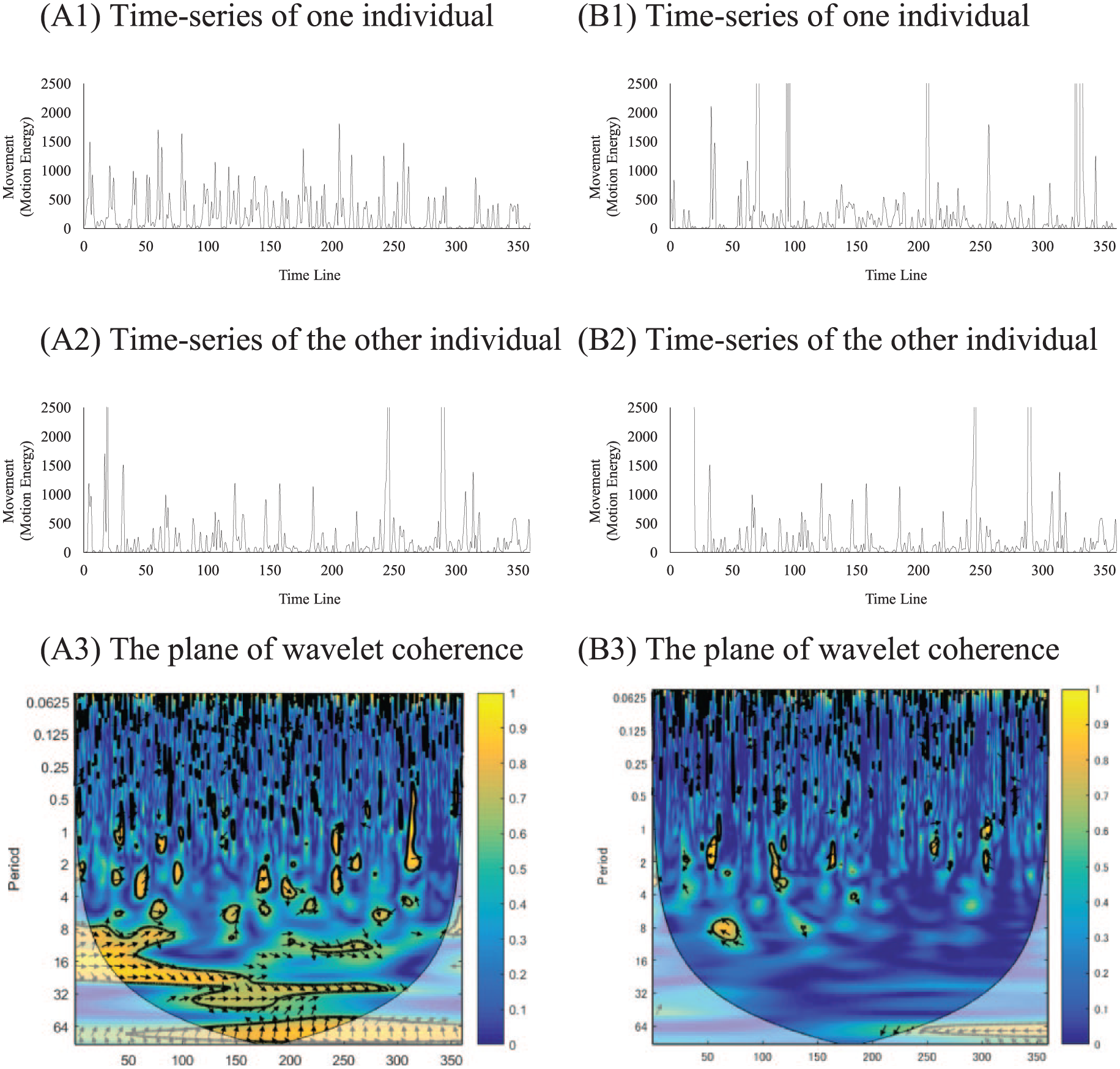
Example of wavelet coherence and relative phase patterning.
In addition, convergence of timing as well as rhythm can be assessed by the wavelet transform (Schmidt et al., 2014). It provides phase information and a relative phase angle that indicates a time lag at the frequency between interactants. A relative phase of 0° indicates movements in the same part of their cycle at a given time and it is called in-phase patterning. In cross-correlation analysis, this pattern is scored as the correlation coefficient of +1. On the contrary, a 180° relative phase indicates movements in opposite parts of their cycles at a given time and it is called anti-phase patterning. This pattern is scored as the correlation coefficient of −1. Studies on coordination dynamics suggest that synchronised movement tends to be stable in in-phase or anti-phase patterning (Haken, Kelso, & Bunz, 1985). Although in-phase patterning consistently affects social variables, anti-phase patterning has provided mixed evidence (e.g., Cirelli, Einarson, & Trainor, 2014; Cross, Wilson, & Golonka, 2016; Miles, Nind, & Macrae, 2010; Sullivan, Rickers, & Gammage, 2014).
The current study
To summarise, we conducted two experiments and investigated whether affect can be an antecedent of synchrony. We focused on affective valence (Experiments 1 and 2) and affective contrast (Experiment 2). Contrary to previous studies, the experimental manipulation of affect was employed before conversation. Moreover, the wavelet transform was used to assess convergence of rhythm and timing, which are the two major properties of synchrony (Bernieri & Rosenthal, 1991). Our hypothesis is that affective valence is correlated with synchrony; whether the WTC, the degree of synchrony, would be higher in dyads with positive affective states was examined. Similarly, we investigated whether the ratio of in-phase patterning, the specific pattern of timing in synchrony, would be higher in dyads with positive affective states. In addition, the possibility that affective contrast increases or decreases synchrony was explored. Because previous studies illustrated competing relationships between similarity and coordination, no hypothesis was set for affective contrast. Likewise, because the function of anti-phase patterning has been unclear, no hypothesis was set for anti-phase patterning and analyses were conducted in an exploratory manner. In addition, cross-correlation analysis was conducted for a comparison with the wavelet transform. All procedures performed in this study were approved by the ethical committee of the Department of Human Sciences in Osaka University.
Experiment 1
In Experiment 1, we examined whether affective valence can be an antecedent of synchrony. In contrast to previous studies on the relationship between affective valence and synchrony (i.e., Paxton & Dale, 2013; Tschacher et al., 2014), affective state was experimentally manipulated in this study.
Method
Participants
A total of 66 Japanese undergraduates participated in exchange for extra course credit. Each participant was randomly paired with a same-sex stranger. Participants in one pair were friends, and another pair did not complete their questionnaire of affective state; therefore, they were subsequently excluded from analysis. In total, 31 dyads from 62 participants (male = 34, female = 28; mean age = 18.71 years, standard deviation [SD] = 1.19) were analysed.
Experimental manipulation of affective contrast
As an experimental manipulation of affective valence, participants were asked to view a 6-min video. They were randomly assigned to a positive or negative affect condition. In the positive affect condition, participants viewed a rakugo film, a comic story told by a professional storyteller. 1 In the negative affect condition, participants viewed a dull interview with a rakugo performer. In this experiment, the story of Kuchiireya performed by two rakugo performers was used. Each participant was assigned to view one of three films (two positive affective films or one negative film), and the dyad viewed the same film. Films were selected via pilot study. Although it was expected that the interview film might not induce sufficient negative affect, we did not use a film inducing intense negative affect for ethical reasons.
Measure of affect
Participants rated their affective states using a 20-item mood scale (Terasaki, Kishimoto, & Koga, 1992) on a 4-point scale (1 = not at all to 4 = very much). This scale was developed from the Mood Adjective Check List (Nowlis, 1965) and consisted of 10 positive affective adjectives (e.g., lively and relaxed) and 10 negative adjectives (e.g., bored and nervous), with α = .70 and .87, respectively. This scale was standardised in Japan and its validity is well documented (e.g., Hayashi, Naruse, & Sakuma, 2009). Each participant’s affective valence was calculated by summing the score of their positive affect adjectives and then subtracting the score of their negative affect adjectives.
Procedures
Participants signed a consent form and were then separated, and the affective induction manipulation was administered. After the affective induction, participants completed the affect measurement. They were then moved and seated opposite their partner, at an 80-cm distance. The dyads were instructed to engage in a 6-min conversation to become acquainted. They did not know the conversation would be analysed from the perspective of synchrony. No specific conversation topics were set. However, participants were instructed not to talk about the film that they had seen. Their conversation was video-recorded using a camera (HDR-HC3; SONY) placed 330 cm away to the right of the participants. After the conversation, they were debriefed about the purpose of this study.
Body movement and synchrony
To generate time-series movement data, body movement was characterised using motion energy analysis (MEA; Ramseyer & Tschacher, 2011; see www.psync.ch for details). This technique is a novel method for analysing body movement in a quantitative manner, instead of using manual observer ratings. Users select a region of interest (ROI) in the video image and the MEA software automatically calculates the change of grey-scale pixels between consecutive video-frames, which can be encoded as movement (see Figure 2). In this experiment, following previous studies (Paxton & Dale, 2013; Tschacher et al., 2014), the entire body of each interactant was covered as an ROI. Sampling frequency was set to 30 Hz, which was equal to the video frame rate.
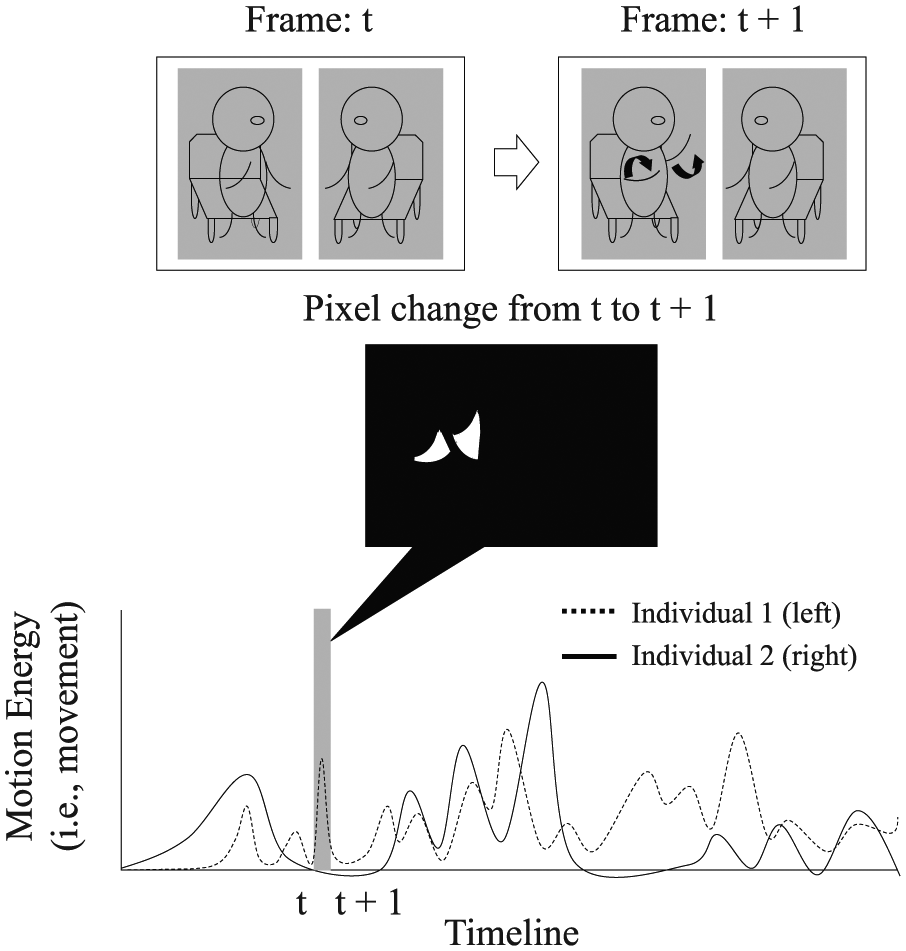
Illustration of motion energy analysis for generating time-series movement data.
To quantify synchrony, the WTC was calculated using the wavelet toolbox (Grinsted, Moore, & Jevrejeva, 2004). The default parameters suggested by Grinsted et al. (2004) were employed and Morlet was used as the mother wavelet. However, following Issartel et al. (2006), the number of the order was set to 8. The cone of influence (COI) area was not included in subsequent analyses. A coherence value under 4 Hz was used for analysis because our participants’ unstructured conversation with a stranger was neither active nor fast (Fujiwara & Daibo, 2016). The average coherence less than 4 Hz across the timeline was standardised using a Fisher Z transformation before statistical analyses.
Additionally, the proportion of relative phase was calculated in nine 20° regions from 0° to 180°. Following previous studies (e.g., Schmidt et al., 2012), the 0° to 20° region was defined as in-phase patterning and the 160° to 180° region was defined as anti-phase patterning. Because the frequency band that should be focused on to extract the relative phase was unclear, the area with significant WTC was targeted (Issartel, Bardainne, Gaillot, & Marin, 2015). In that area, the number of occurrences in each 20° region was counted and the percentage distribution was calculated for each pair. The proportion of in- and anti-phase regions was transformed using arcsine transformation, which was used in the subsequent analysis.
Finally, the cross-correlation coefficient was also calculated. A previous study (Paxton & Dale, 2013) has indicated that the maximum cross-correlation value is obtained at lag 0. Therefore, a cross-correlation analysis with no time lag was conducted.
Results
Manipulation check
To confirm that our manipulation successfully induced positive/negative affect, two types of t-tests were conducted. First, a one-sample t-test revealed that the mean affective score of the positive affect condition (nindividual = 40, M = 5.40, SD = 7.77) was significantly higher than 0 (t(39) = 4.39, p < .001, Cohen’s d = 0.98). However, the mean score of the negative affect condition (nindividual = 22, M = −0.32, SD = 7.50) was not significantly lower than 0 (t(21) = −2.00, p = .844, Cohen’s d = 0.06). Second, the difference in scores between conditions was calculated, which was significantly higher in the positive affect condition than in the negative affect condition (t(44.74) = 2.84, p < .001, Cohen’s d = 0.74).
These results indicated that negative affect induction was weak; individuals who watched a boring video did not report much negative affect before the conversation. However, they reported significantly lower positive affect than individuals who watched a funny video. With this result in mind, we regarded participants’ relative affective positivity as experimentally manipulated.
The influence of affective valence on synchrony
Separate t-tests revealed that there was no significant difference in the WTC (Mpositive = 0.262, SDpositive = 0.035; Mnegative = 0.252, SDnegative = 0.048; t(15.99) = 0.59, p = .560, Cohen’s d = 0.25) or the ratio of in-phase patterning (Mpositive = 0.153, SDpositive = 0.072; Mnegative = 0.169, SDnegative = 0.130; t(13.48) = 0.39, p = .700, Cohen’s d = 0.14). Likewise, the ratio of anti-phase patterning did not differ significantly between conditions (Mpositive = 0.104, SDpositive = 0.063; Mnegative = 0.072, SDnegative = 0.055; t(23.48) = 1.47, p = .156, Cohen’s d = 0.53). The cross-correlation coefficient, similar to the WTC, was not significantly different between conditions (Mpositive = 0.111, SDpositive = 0.115; Mnegative = 0.097, SDnegative = 0.089; t(25.45) = 0.36, p = .722, Cohen’s d = 0.13).
Discussion
In Experiment 1, we investigated whether affective valence can be an antecedent of synchrony: the convergence of rhythm and timing. Results showed that each synchrony measure (i.e., the WTC, in-phase patterning, and cross-correlation) in the positive affect condition was not significantly different from that in the negative affect condition, which did not support our hypothesis. Rather, the results of previous studies (Paxton & Dale, 2013; Tschacher et al., 2014) were replicated with a different synchrony measurement. In contrast to Mønster et al. (2016), who focused on a group task situation, even if affect was experimentally manipulated in this study, it did not increase or suppress synchrony in face-to-face dyadic interactions.
These findings are inconsistent with results of previous studies on behavioural mimicry (Likowski et al., 2011; van Baaren et al., 2006). These differences could not derive from experimental manipulation of affect, but they might derive from the difference in experimental settings. Although previous studies on mimicry employed a film-presentation style of experiment, this study focused on real face-to-face interaction. In the former setting, the cognitive processing style (e.g., self- or other-focused attention) based on affect could mediate the effect of affective valence on mimicry. Moreover, participants experiencing negative affect had fewer opportunities to improve their affective state through the “interaction” because they did not have an actual partner. On the contrary, in the latter situation, participants can remedy their negative affective states through conversation, if it goes well. Individuals experiencing negative affect usually seek to repair their affective state (Frida, 1986), and this might motivate them to use conversation to increase the affiliative attitude, which generates coordination (Lakin & Chartrand, 2003). This motivational process might facilitate synchrony between interactants, which reduced the observable effect of affective valence on synchrony.
However, we should say that the results of Experiment 1 were relatively weak. The affective valence in the negative affect condition did not differ significantly from 0 (i.e., neutral level). Therefore, our results might show that positive affect did not increase synchrony compared with neutral affect, but it cannot be compared with negative affect. Synchrony might be suppressed by a more intense level of negative affect. Or, more simply, affective valence might not be an antecedent of synchrony. To address this concern, in Experiment 2, we employed a different way of inducing positive or negative affect to re-examine whether affective valence can be an antecedent of synchrony while the focus of Experiment 2 is on affective contrast.
Experiment 2
In this experiment, we examined whether affective contrast facilitates or suppresses synchrony. As a complementary analysis, whether affective valence can be an antecedent of synchrony is also examined.
Method
Participants
A total of 74 female Japanese undergraduates participated in exchange for extra course credit. Each participant was randomly paired with a stranger. Two random pairs were friends and were subsequently excluded from analysis. In total, 35 dyads from 70 participants (mean age = 18.53 years, SD = 0.65) were analysed.
Experimental manipulation of affective contrast
To experimentally manipulate affective valence, participants were asked to view an emotional picture set (International Affective Picture System [IAPS]; Lang, Bradley, & Cuthbert, 2008). They were randomly assigned to a positive or negative affect condition. In total, 16 positive or 16 negative affective pictures were presented on a computer monitor (PTFBHF-22W; Princeton). 2 Each picture was presented for 20 s with a 3-s interval between pictures.
These procedures were carried out separately, which allowed us to make two types of dyads differing in affective contrast: a low-contrast dyad where both were in either the positive or the negative affect condition, and a high-contrast dyad where one participant was in the positive affect condition and the other was in the negative affect condition.
Measure of affect
Participants rated their own affective state using a 12-item questionnaire on a 9-point scale (1 = not at all to 9 = very much). Items were selected from the scale used in Experiment 1 (Terasaki et al., 1992) and consisted of six positive affect adjectives (excited, cheerful, lively, relaxed, calm, and pleasant; α = .92) and six negative affect adjectives (tired, boring, distressed, dull, disturbing, and nervous; α = .84). Each participant’s affective valence was calculated by summing the score of their positive affect adjectives and then subtracting the score of their negative affect adjectives.
Procedures
Participants completed a consent form. They were then separated and engaged in the affect-induction manipulation. After affect induction, participants completed the measurement of affect. Next, they were seated opposite one another, at an 80-cm distance. As in Experiment 1, they were instructed to engage in a 6-min conversation and get acquainted, and they did not know that the degree of synchrony was being analysed. While conversational topics were not specifically set, they were not allowed to talk about the pictures that they had seen. Their conversation was video-recorded by a camera (HDR-SR12; SONY) placed 250 cm away to the right of the participants. After the conversation, they were debriefed.
Body movement and synchrony
The methods used to generate time-series movement data and to quantify synchrony were identical to those in Experiment 1.
Results
Manipulation check
To confirm that our manipulation successfully induced participants’ positive/negative affect, two types of t-tests were conducted. First, a one-sample t-test revealed that the mean affective score of participants in the positive affect condition (nindividual = 35, M = 11.60, SD = 13.94) was significantly higher than 0 (t(34) = 4.92, p < .001, Cohen’s d = 1.18). Likewise, the mean score of the negative affect condition (nindividual = 35, M = −14.46, SD = 9.55) was significantly lower than 0 (t(34) = −8.96, p < .001, Cohen’s d = 2.14). Second, the difference between scores within dyads was calculated by using the absolute value of the difference within dyads, which was significantly higher in the high-contrast condition (ndyad = 17, M = 24.06, SD = 15.92) than in the low-contrast condition (ndyad = 18, M = 13.06, SD = 8.90; t(24.81) = 2.50, p = .019, Cohen’s d = 0.86). These results indicated that participants’ affective positivity was successfully differentiated.
The influence of affective contrast on synchrony
A separate t-test revealed that the WTC of the high-contrast condition was lower than that of the low-contrast condition (Table 1). However, this difference was not statistically significant (t(31.89) = 1.97, p = .058, Cohen’s d = 0.66). On the contrary, and more importantly, in-phase patterning differed significantly between the high- and low-contrast conditions (t(31.95) = 2.17, p = .038, Cohen’s d = 0.73). There was no significant difference in anti-phase patterning between the high- and low-contrast conditions (t(22.56) = 0.53, p = .604, Cohen’s d = 0.17). The cross-correlation coefficient, similar to Study 1, was not significantly different between conditions (t(32.51) = 1.19, p = .241, Cohen’s d = 0.41).
The influence of affective contrast and valence on synchrony index.
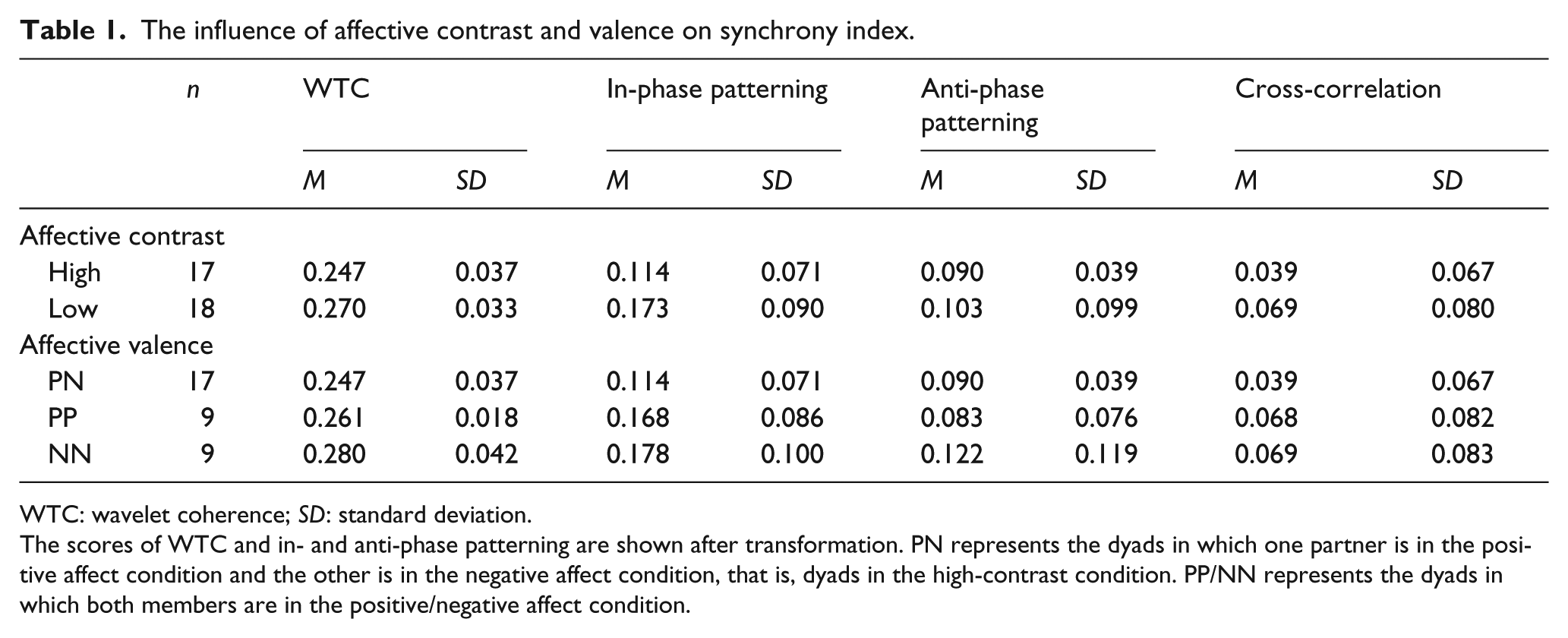
WTC: wavelet coherence; SD: standard deviation.
The scores of WTC and in- and anti-phase patterning are shown after transformation. PN represents the dyads in which one partner is in the positive affect condition and the other is in the negative affect condition, that is, dyads in the high-contrast condition. PP/NN represents the dyads in which both members are in the positive/negative affect condition.
The influence of affective valence on synchrony
In line with Experiment 1, in Experiment 2, we examined whether affective valence could have an influence on synchrony (Table 1). Each synchrony index was submitted to a one-way analysis of variance (ANOVA), which revealed no significant differences between the synchrony scores (Fs(2, 34) < 2.68, ps > .084, η2s < .14). The result of a planned comparison using Holm’s multiple comparison also indicated that the synchrony scores did not differ significantly between dyads with positive or negative affective state (ts(32) < 1.19, adjusted ps > .496, Cohen’s ds < 0.61).
Discussion
In Experiment 2, we examined whether affective contrast inhibited synchrony. Results showed that dyads with highly contrasting affective states displayed lower synchrony. This study is the first to find evidence that affect can be an antecedent to synchrony, not in terms of individuals’ affective valence but rather in terms of the affective contrast between interactants.
Previous studies have illustrated that similarity between interactants influences coordination. Although studies of mimicry and synchrony showed different pictures about their relationships to similarity (Miles et al., 2011; Richardson et al., 2007a; Yabar et al., 2006), it was assumed to be mediated by motivational processes. Individuals are more motivated to show imitative behaviour to similar partners for furthering closeness or to show synchronised movements to different partners to diminish minor differences. The affective contrast would work like similarity or dissimilarity between group members. Our participants did not explicitly know their partners’ affective states, as they were separated, received their experimental manipulation individually, and were not allowed to talk about their conditions (i.e., picture set). However, it is likely that they would be able to sense and infer their partner’s affective states. The participants may have been reluctant to engage in a conversation with a stranger if they perceived a highly contrasting affective state. In simpler terms, their lack of common ground about their affective states may have disrupted synchrony.
While the dyads with similar affective states moved in the same cycle (i.e., in-phase patterning) as well as in a similar rhythm, the anti-phase patterning was not influenced by affective contrast. This might be explained by the different role of relative phase (Cirelli et al., 2014; Cross et al., 2016; Sullivan et al., 2014). In-phase patterning is a function of affiliation, which would be facilitated by motivational processes. However, anti-phase patterning is not related to affiliation, and thus motivational processes would not affect it. Alternatively, this could be attributed to the conversational setting. In a dyadic interaction, individuals take turns, which shows anti-phase patterning. The characteristics of turn-taking might mask the influence of affective contrast.
Contrary to the WTC and in-phase patterning, cross-correlation did not illustrate a significant difference between the high versus low affective contrast condition. In addition, the effect size was relatively low. Although previous research employed cross-correlation to measure synchrony (Paxton & Dale, 2013; Tschacher et al., 2014), the results of the this study suggest that cross-correlation might not be the only way to extract synchrony in unstructured face-to-face conversations.
Affective valence alone was not related to synchrony, which replicated the findings of Experiment 1 and previous studies. However, Experiment 2 was designed to “compare high versus low affective contrast conditions. Therefore, the sample size may not have been large enough for ANOVA and may have been biased through conditions, which might have reduced the power of statistical testing. Although the question of whether affective valence alone can be an antecedent of synchrony remains inconclusive, if findings from Experiments 1 and 2 are collectively considered, it would be reasonable to conclude that affective valence does not cause synchrony.
General discussion
In this study, two experiments with experimental manipulation of affect were conducted to examine whether affect can be an antecedent of behavioural synchrony in dyadic face-to-face conversation. Using the wavelet transform, synchrony was assessed on two major properties: rhythm and timing (Bernieri & Rosenthal, 1991). Cross-correlation used in previous studies (Paxton & Dale, 2013; Tschacher et al., 2014) was also calculated. Results showed that affective valence neither increased nor decreased synchrony (Experiments 1 and 2). This is inconsistent with findings of previous studies on mimicry, which is one form of coordination, but does support studies on synchrony, which is the other form of coordination. On the contrary, affective contrast was associated with synchrony; low contrast or similarity in affective state facilitated synchrony (Experiment 2). These results originated from the wavelet transform, because cross-correlation could not extract any differences in Experiments 1 and 2.
There could be several explanations to why affective valence had no significant influence on synchrony. First, our study might have been a conservative test. Our sample included only Japanese undergraduate students. Studies of cultural psychology have indicated that Japanese people do not experience affective events as intensely as other cultures (e.g., Kitayama, Markus, & Kurokawa, 2000), and their emotional reactions are weaker (Matsumoto, Kudoh, Scherer, & Wallbott, 1988). It is possible that our participants were not very emotionally affected by our experimental manipulation, even if their reported affective state was significantly different from neutral. Perhaps owing to the immovability of affective states, our participants did not display synchrony corresponding to the experimental condition.
Second, as Paxton and Dale (2013) suggested, affect might be too coarsely measured to achieve any significant observable relationship with synchrony. We measured participants’ affective states only one time, which was just after the manipulation and before the conversation. However, the coordination pattern could be self-organised in each pair such that rhythmic similarity might evolve during their interaction. The same applies to phase patterning. Our manipulation and measurement of affect may not have been precise enough to explain these pair-level fluctuations.
Third, motivational processes might have had unobservable effects on our results. Previous studies on affect and mimicry employed a film-presentation style of experiment, and it was demonstrated that positive/negative affect facilitated/suppressed mimicry, respectively (Likowski et al., 2011; van Baaren et al., 2006). It was suggested that the cognitive processing style (e.g., self- or other-focused attention) based on affect would mediate the effect of affective valence on mimicry. Contrary to previous studies, our experimental setting was a real face-to-face conversation, which may have allowed participants to improve their affective state through the interaction, even if they got the negative affect induction. Individuals experiencing negative affect may have sought to repair their affective state and were thus motivated to increase their affiliative attitude towards their interaction, which could generate coordination. This motivational process might have reduced the difference in synchrony between participants in the positive and negative affect conditions.
The reason why this motivational process is considered a promising mediator is that affective contrast influenced synchrony, as shown in Experiment 2. Similarity has been examined as an antecedent of coordination. Although studies on mimicry and synchrony (Miles et al., 2011; Richardson et al., 2007a; Yabar et al., 2006) found different relationships with similarity, they assumed that motivational processes would mediate the relationship. For our participants, affective contrast could be an indicator of similarity. Although they did not directly know their partners’ affective states, they would likely have been able to sense and infer the affective contrast between them. It is plausible that they created an affiliative atmosphere during interactions with a partner who was like them (e.g., Byrne et al., 1971), which could facilitate synchrony. Likewise, they may have been reluctant to engage in a conversation with a stranger who was in a highly contrasting affective state.
Future directions
As a limitation of this study, the sample size should be mentioned. Compared with the previous studies (e.g., Paxton & Dale, 2013; Tschacher et al., 2014), the number of participants/dyads in each condition in each experiment was relatively small. Furthermore, in Experiment 1, the number of dyads in each condition of affective valence was unbalanced. It might be possible to argue that the impact of affective valence was not significant because the power of statistical testing was limited.
We should also note that any mediating processes were not experimentally examined. The results of Experiments 1 and 2 implied that the motivational processes following affective induction instead of the self- or other-focused attention based on affect would increase or decrease synchrony. However, this interpretation remains a matter of speculation. In future, these mediating processes must be experimentally examined.
Moreover, future research should remain open to the possibility that affective valence is not correlated to synchrony at all. This study and previous studies showed that affective valence, as reported before conversation, did not explain synchrony during the interaction. However, this does not mean affective valence never precedes synchrony. Face-to-face interaction should be considered as a self-organised dynamic phenomenon. The coordination pattern, as well as the affective state of interactants, must have changed during conversation. Future research should examine the possibility that affective fluctuations can be related to, or precede, the coordination pattern. To do that, affective state during interaction should be assessed through continuous coding methods (e.g., Sadler, Ethier, Gunn, Duong, & Woody, 2009). Moreover, the wavelet transform, compared with cross-correlation, would be a useful tool for such testing.
Footnotes
Declaration of conflicting interests
The author(s) declared no potential conflicts of interest with respect to the research, authorship, and/or publication of this article.
Funding
This research was supported by the Japan Society for the Promotion of Science (15K17259 and 16H02891). All procedures performed in this study were approved by the ethical committee of the Department of Human Sciences in Osaka University.