




Abstract
This reflection outlines the development of a Terms of Reference (ToR) for equity, diversity, and inclusion (EDI) in a 6-year energy transitions research project spanning 11 institutions and involving 100 researchers across science, technology, engineering and mathematics (STEM), social science, and humanities disciplines. This multi-disciplinary and multi-institutional project involves partnerships with industry and civil society organizations, attempts to center justice-oriented research, and includes communities and users in knowledge co-production in a field of research and practice known for exclusion and marginalization. An EDI ToR is a guiding document that outlines the shared understandings and practices necessary to foster a safe, equitable, and inclusive research environment. Here we describe how 42 researchers across all career stages and 5 time zones co-authored an EDI ToR that reflects the project’s context and goals while attempting to make the writing process inclusive. Using autoethnography, we reflect on the process of developing this ToR and evaluate its effectiveness in meeting project needs, fostering shared values, and supporting the education and training of diverse early career researchers. We found that, given the complexity of the project, our approach offered a valuable pathway for the team to reflect on shared values by encouraging early and continuous dialog and alignment among researchers. The ToR offered a compass to help researchers make decisions ethically and inclusively. Our contribution is to demonstrate how an EDI ToR development process can foster reflexivity and offer space to address the tensions that inevitably arise within research teams and tensions between the team’s needs and justice-oriented energy research in practice. Drawing on our findings, we recommend that other research teams and funders embed EDI goals, benchmarks, and commitments into their grant proposals and that they hold small-group discussions throughout the EDI ToR development and implementation phases to allow for reflection and iteration.
Keywords
Introduction
Energy transitions are essential, since energy use is responsible for 75% of global greenhouse gas (GHG) emissions (International Energy Agency, 2019) and 80% of GHG emissions in Canada (Environment and Climate Change Canada, 2023). Energy transitions necessitate complex socio-technical, political, and societal transformations. These dimensions are reflected in funding opportunities for research that acknowledge the value of collaboration across disciplines, institutions, and jurisdictions. Funders shape research priorities and practices (Shortall and Meredith, 2025), including how projects are structured, through requirements for multidisciplinary, interdisciplinary, and even transdisciplinary approaches across multiple institutions and through incentives for meaningful engagement with a range of communities to broaden the societal impact of research.
Researchers in Canada who apply for federal funding must commit to thoughtfully embedding principles of equity, diversity, and inclusion (EDI) in their research design and applying an EDI lens throughout all research stages. Upon its establishment in 2018, the Canada Research Coordinating Committee (CRCC, n.d.), which advances and coordinates federal research priorities and policies through collaboration across federal funding agencies, prioritized strengthening EDI in the research ecosystem. To shape the development and implementation of EDI initiatives by federal funding agencies, the CRCC consulted with researchers and universities to discuss, identify, and address barriers faced by under-represented groups in research and training. Among the initiatives introduced were a harmonized EDI statement across the agencies, an action plan to increase fair access to research support and more equitable participation in research, increased recognition of systemic racism and better support for Indigenous research and training in Canada, and the integration of EDI principles into the New Frontiers in Research Fund (NFRF) and federal grant application processes (Natural Sciences and Engineering Research Council [NSERC], 2021). In the Tri-Council policy statement: Ethical conduct for research involving humans (TCPS 2; 2022; Canadian Institutes of Health Research, Natural Sciences and Engineering Research Council of Canada, and Social Sciences and Humanities Research Council of Canada, 2022), Chapter 9: Research involving the First Nations, Inuit, and Métis Peoples of Canada, provides guidance on building relationships and making decisions jointly between researchers and community and about how research is conducted with Indigenous peoples and lands.
CANSTOREnergy is a $24 million research project that re-envisions energy systems and energy storage technologies to address the diverse needs and perspectives of urban and remote communities in Canada, with attention to energy access, control, and governance. It is funded through a 6-year NFRF Transformation grant (March 1, 2023 to February 28, 2029), a funding stream that requires project teams to span at least two of the three national Tri-Council funding agencies (the Social Sciences and Humanities Research Council, the Natural Sciences and Engineering Research Council, and the Canadian Institutes of Health Research). Our project involves nearly 100 researchers from a wide range of disciplines and career stages across the physical and applied sciences, social sciences, and humanities from 11 universities across Canada. Although the funder required that we set out explicit commitments to EDI and energy justice at the application stage, such as gender- and other identity-based analyses, recognition of Indigenous rights and data sovereignty, and open science, we did not fully specify the practicalities of implementing these commitments. To help ensure that our commitments to EDI and energy justice were met, the project leadership decided to collectively develop an EDI Terms of Reference (ToR) in the first year of the project.
An EDI ToR is a guiding document that provides an overview of expectations for fostering a safe and inclusive collaborative work and research environment. For institutions, an EDI ToR provides an opportunity to integrate multiple goals and commitments into specific research and institutional contexts, and to implement broad principles into practices. For example, the University of British Columbia Equity and Inclusion Office (2023), the University of Manitoba’s Rady Faculty of Health Sciences (2020), McMaster University’s School of Earth, Environment, and Society (2023), and the Ontario Principals’ Council (2020) have all developed EDI ToRs.
An important starting point for pursuing justice-oriented energy research is to consider these dynamics within research teams and processes. For this reason, reflexivity is an important component of our EDI ToR. In a research context, reflexivity means identifying the researcher’s own assumptions and biases and the influence of their beliefs and behavior on the research process (Ritchie et al., 2014). Despite the need for reflexivity, energy transition research has tended to lead with technology research and development, with citizen involvement usually limited to consultation that often focuses on securing public acceptance and mitigating negative impacts (Galende-Sánchez and Sorman, 2021). The colonial and extractive nature of our economy and the political nature of energy reflect the historical prioritization of techno-economic issues over decolonized frameworks for community inclusion and participation in energy governance (Wahlund and Palm, 2022). This lack of reflexivity and consultation leaves open the question of how to incorporate justice considerations and the views, values, and knowledge of communities (Boudet, 2019; Wahlund and Palm, 2022). Addressing this question requires acknowledging the political nature of energy and sustainability questions and poses particular challenges for research networks that span multiple regions and communities (Schneider et al., 2021; Üzelgün and Pereira, 2020). Although EDI ToRs do not necessarily address this kind of reflexivity, some do. For example, members of Memorial University’s Civic Laboratory for Environmental Action Research (CLEAR) addresses reflexivity in research by collectively creating a living lab book which reflects CLEAR’s commitment to feminist and anticolonial approaches to research methodologies (2021). The CANSTOREnergy team has also committed to a reflexive, justice-oriented approach in order to address this issue.
Through a narrative account and qualitative integration of the experiences of co-authors—a team autoethnography—this paper provides a reflection on the adaptation of an EDI ToR, a resource normally used by single institutions, through collective authorship to apply to the context of our large multi-institutional and transdisciplinary project team. These reflections on the process of developing and implementing this ToR by 42 of the researchers on the CANSTOREnergy—as well as the content of the ToR itself—may provide guidance to other similarly structured projects seeking to put into practice commitments to EDI. Our starting point is to acknowledge that EDI aims and practices require attention to team constitution, institutional settings, research approaches, and forms of knowledge. Like other multidisciplinary projects, ours brings together multiple perspectives on, and degrees of familiarity with, EDI. Developing an EDI ToR in this setting provides an opportunity for reflection on how to integrate multiple goals and commitments into specific research and institutional contexts, and how to put broad principles into practices. This process has been time-consuming and complex, and it was undertaken with attention to uneven power dynamics in and beyond research institutions. Assessing this process at a still-early stage of our research project offers a snapshot of the benefits, challenges, and productive tensions involved in co-developing an EDI ToR in a large team and reveals some of the opportunities that arise for enacting these commitments to justice in research.
Our approach is situated within and informed by an evolving research landscape shaped by three global trends:
The rise of large-scale, collaborative research initiatives that span institutions, disciplines, funders, and national borders, aimed at advancing low-carbon technologies and climate change mitigation strategies. Some of these initiatives require interdisciplinarity, such as all streams of Canada’s NFRF. Some are global partnerships, such as the 2024 NordForsk-Led International Joint Initiative on Sustainable Development of the Arctic. Others involve co-production of knowledge with society, such as the Government of Canada’s International Joint Initiative for Research in Climate Change Adaptation and Mitigation. Some funding opportunities require knowledge co-production, including Canada’s Natural Sciences and Engineering Research Council Alliance funding and the Canada First Excellence Research Fund, Horizon Europe funding, and the National Science Foundation Global Centers program in the United States.
A growing emphasis on community integration in the early stages of research, reflecting a shift toward justice-oriented and inclusive approaches. This trend includes support for community-led research, where communities—not just academic institutions—define research priorities. For example, the actions of the CRCC are reflected in Horizon 2020s calls for research about energy citizenship.
Recognition of persistent diversity gaps across the energy sector, from education and research to technology development and implementation, which continue to limit the full realization of inclusive and equitable research outcomes (Galende-Sánchez and Sorman, 2021; Hoicka, 2023; Hoicka et al., 2023; Smith et al., 2019).
While our work is grounded in the energy sector, these trends are increasingly relevant across disciplines and research contexts. We draw on a range of values and frameworks, including collaborative research processes (Ritchie and Rigano, 2007), communities of practice (Cox, 2005), and institutional Indigenization (University of Alberta Center for Teaching and Learning, n.d.) to guide our efforts.
Literature
Prioritizing equity, diversity, and inclusion in energy transitions research
Energy transitions require a new generation of inspired energy sector leaders who represent a diverse range of perspectives and identities. Yet the science, technology, engineering, and mathematics (STEM) fields face a lack of perspectives from some under-represented groups (Universities Canada, 2019). This is particularly acute in energy-related topics (Hoicka, 2023), which face under-representation of women researchers at every career stage (Smith et al., 2019). A similar pattern is found globally in the under-representation of women and other equity seeking groups across energy industries (Diversio, 2021; Equal by 30, 2022; IRENA, 2019), and across organizations advocating for energy transitions in Canada (Hoicka, 2024; Hoicka et al., 2023). Significant knowledge gaps remain among researchers and broader segments of society about how to integrate inclusion, particularly gender diversity, into the energy sector. These gaps can be observed in narrowly defined, binary understandings of gender diversity that lack reflection on intersectionality (Søraa et al., 2020).
A transition toward incorporating research practices that are justice-focused, decolonizing, and EDI-oriented requires a clear understanding of knowledge, frameworks, and practices that have been historically pushed to the periphery and often willfully ignored (Wergin, 2018). In large interdisciplinary teams, it is vital to recognize the contributions of diverse actors such as international students, academics from under-represented racial and ethnic backgrounds, people with disabilities, and those with non-traditional scholarly backgrounds (Munro, 2011). It remains a novel concept to many that not all researchers bring prior EDI knowledge as principles or frameworks to guide their work (Mullin et al., 2021; Rowe and Schuster-Wallace, 2023).
Guidance and governance for reflexive research in large and diverse teams
Organizationally complex research projects, particularly large, multi-institutional projects, may pose challenges for scholars, students, and community members navigating definitions of terms along disciplinary lines (Hoople et al., 2020). Others face challenges with time constraints and working with multiple stakeholders (Rodríguez-Robayo et al., 2024). The structure and processes of these research projects require thoughtfulness, care, creativity, and innovative methodological approaches (see e.g. Jenkins et al., 2020).
Reflections on multi-institutional and co-created research practices are becoming commonplace in academic scholarship, but often in fields outside of energy transitions and justice, including health research (see e.g. Stokols et al., 2003), global sustainability challenges research (see e.g. Steelman et al., 2021), environmental management (see e.g. Allen et al., 2014), and agriculture (see e.g. Rodríguez-Robayo et al., 2024).
Project teams have approached the challenges of multi/inter/transdisciplinary work through the development of governance mechanisms. Urquhart et al. (2011) reflect on the benefit of deciding on a team approach to governance and communication. They funded a knowledge broker, a team member who is responsible for translating knowledge across disciplines. The knowledge broker helped decision makers (e.g. policy makers) use research findings to inform their work and practice. Chatfield et al. (2022) reflect on the applicability and relevance of the Global Code of Conduct for Research in Resource-Poor Settings (GCC) in two community health projects in India and Pakistan. The GCC was created in 2020 by an EU-funded consortium tasked with creating a novel ethics framework to assist funding agencies, scholars, and communities in “recogniz[ing] and address[ing] potential ethical pitfalls” (Chatfield et al., 2022: 283) in research collaborations between high-income and lower-middle-income countries. The authors offer a critical reflection on how the GCC reduced inequities in research collaborations across varying cultural settings by assessing the two projects’ compliance with GCC principles, confirming that, while it is “too soon to claim that application of the GCC has helped to achieve equity in international research collaborations, [their] analysis from two country studies suggests that it can certainly help to promote equity” (Chatfield et al., 2022: 299).
Other literature offers discussion and reflection on large group collaboration processes of creating new governance tools. Reid et al. (2021) explain how their project about ethics, reflexivity, and multidisciplinarity in global research culminated in a toolkit to support scholars facing the challenges of complex research settings. During the toolkit creation process, Reid et al. (2021) organized several workshops and roundtables in which scholars and students from various disciplinary backgrounds had open discussions about their own experiences with ethical challenges. The first version of the toolkit was a document which “provided case analyses, problem-solving rubrics and reflection guides” tailored to ethical challenges raised in the collaborative workshops (Chatfield et al., 2022: 367). Following feedback from the workshops and roundtables, a web version of the toolkit was created as well as a pocket version which was translated into an additional 11 languages.
Focusing on community involvement and justice in energy transitions research
Energy transitions offer pathways to reduce GHG emissions and rectify longstanding social injustices in communities related to how research on energy and climate change is organized and conducted and how research teams are developed, managed, and governed. Scientific teams working on energy transitions have a responsibility to undertake innovation in the public interest and be mindful of social considerations (Stilgoe et al., 2013). Scholars who call for integration of justice into energy transition research emphasize the need to examine how project impacts are distributed within and across communities (Crespo Montañés et al., 2023; Papineau et al., 2025; Williams and Doyon, 2019) and how research practices inform government and funding practices (Hoicka, 2024; Ravikumar et al., 2023).
Justice-oriented research in energy transitions that centers on historically marginalized and colonized communities and people (Hoffman et al., 2021; Lennon, 2017; Tornel, 2024) and meaningful engagement with communities requires care for those who are involved in energy research outside of universities. Justice is intended to address a history of often unintended, but harmful, consequences from energy policies and infrastructures that have failed these communities and resulted in further exclusion (Das et al., 2022; Teelucksingh and Poland, 2011). An energy justice approach requires attention to the power structures between researchers and non-researchers and demands that researchers develop skill sets that value societal knowledge and priorities, conceptualized as energy justices (Malakar et al., 2019; Sovacool et al., 2023). Explicit attention to justice reveals whether communities are engaged in the development of research questions and knowledge co-production guided by communities’ needs or responding to researcher interests and priorities.
The rights of Indigenous people are often constrained by powerful structural forces, such as racism and social exclusion (Truth and Reconciliation Commission of Canada, 2015). Their participation in research is constrained when there is failure to adequately incorporate Indigenous communities and knowledge into research projects (Mazzone et al., 2023). This injustice is exacerbated by jurisdictional and governing authority conflicts between colonial governments and Indigenous communities in decisions about siting industrial and renewable energy project development (Castillo Jara and Bruns, 2022; Hoicka et al., 2025). Research practices should be rooted in decolonization and EDI dimensions to support just energy transitions (Dunlap and Tornel, 2023), while localized and decolonial approaches can advance energy justice in projects (Tornel, 2023).
To address these complex challenges, community-engaged approaches to energy transitions must be grounded in ethical processes of knowledge co-production between academics and non-academics (Norström et al., 2020). Although defined differently in other literatures, in energy transitions research, co-production and co-creation are used interchangeably (see e.g. Galende-Sánchez and Sorman, 2021).
While promising, such approaches are often difficult to operationalize within contemporary research models (Sillak et al., 2021; Wolbring and Nguyen, 2023). Knowledge co-production has been described as largely “aspirational and methodological,” with the frequent failure of such efforts requiring attention by researchers (Turnhout et al., 2020: 15). Many scholars observe a lack of substantial and empirical information about both the theory and practice of knowledge co-creation in energy transition research, including how to practically implement co-production, collaboration, and incorporate EDI considerations in energy related research (Gjørtler Elkjær et al., 2021; Itten et al., 2021; Sillak et al., 2021). Another way to consider this challenge is that co-production is considered important to sustainability transitions, although tensions can emerge within these knowledge development processes (Chambers et al., 2022). Overcoming tensions within research projects may support overcoming tensions in co-production research.
Acknowledging the tensions involved is critical to advancing inclusive and justice-oriented energy research in practice. This is more complex in larger, multi-disciplinary, multi-institutional research projects with large teams where there are existing dynamics within research teams and processes. The literature indicates the need for tools and processes to incorporate reflexivity and spaces to address these tensions.
Context: Our multi-institution, multi-partner project
CANSTOREnergy composition and organizational structure
The CANSTOREnergy is led by a lead principal investigator and involves 22 co-investigators from 11 institutions across Canada. Since March 1 2023, it has trained 123 highly qualified personnel (HQP), including postdoctoral fellows, undergraduate student researchers, graduate student researchers, and research assistants. CANSTOREnergy researchers hold a wide range of worldviews, methodological approaches, and fields of study. The project is structured into three interdisciplinary subteams:
DIRECT comprises experts in justice, governance, policy design, and community engagement who work to understand multiple community contexts. They liaise with community partners and bring community decision-makers into conversation with technology developers to determine how energy technologies can be designed, developed, and implemented in contextually appropriate ways.
DISCOVER brings together experts in electrochemical systems, processes, and integration to develop CO2 electrolyzer technologies for seasonal electricity storage technology.
DEVELOP includes experts in techno-economic assessment, life cycle assessment, environmental economics, and energy entrepreneurship. They work to evaluate the full social and environmental costs of new energy technologies and better understand how to support businesses and individuals in adopting new energy technologies and governance arrangements to achieve emissions reductions and energy justice.
Methods
For the CANSTOREnergy, an EDI ToR was collaboratively authored by project members. A subgroup then employed autoethnographic methods to reflect on the development process and generate wider insights into the significance, usefulness, and broad applicability of our approach. The research process is illustrated in Figure 1.
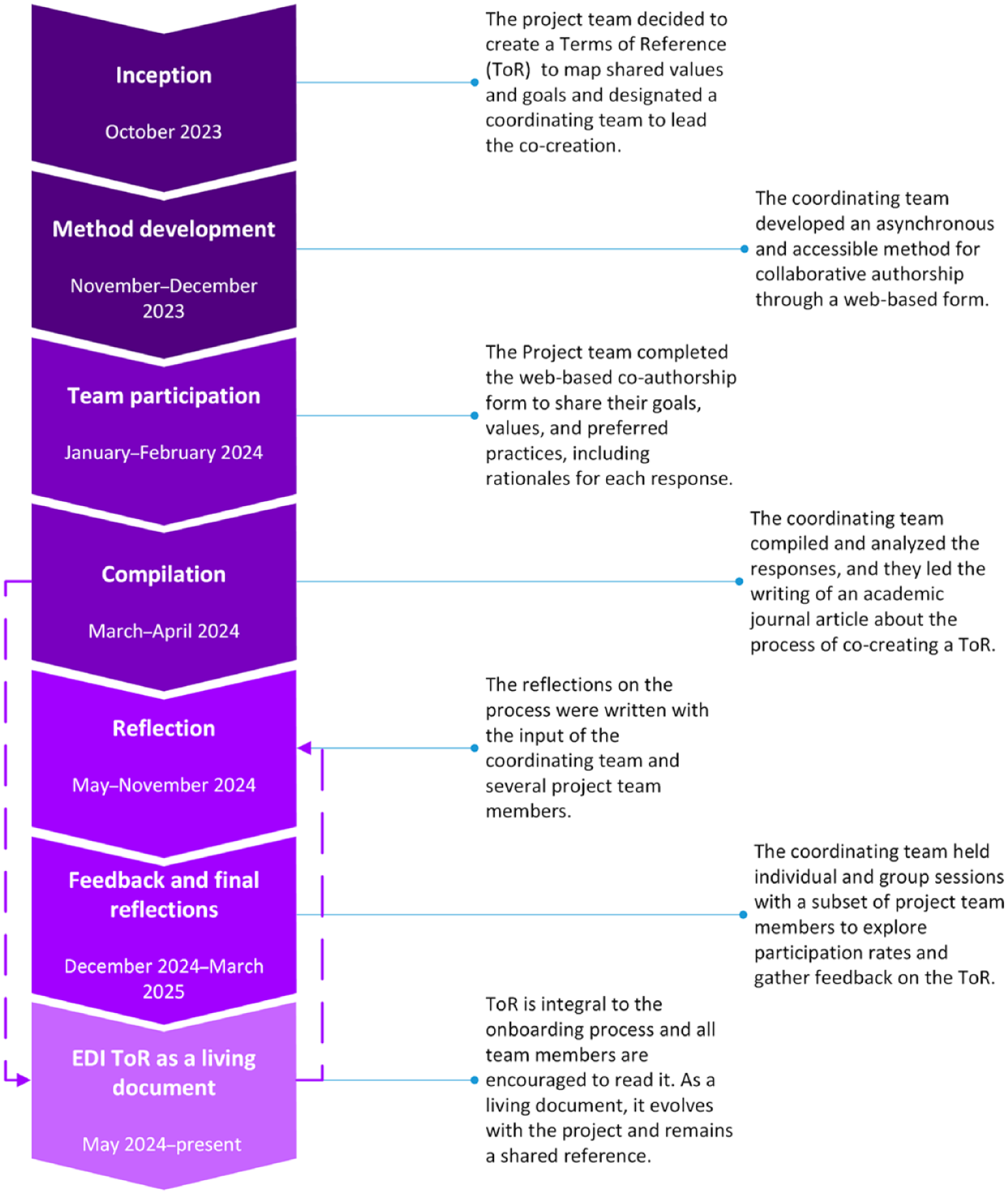
The EDI ToR research process.
Figure 1 provides a timeline of the stages of the development of the EDI ToR that are described in the following sections in the manuscript. The dashed arrows in the figure illustrate that each stage informed the following stage.
Defining an EDI ToR
An EDI ToR provides an overview of what all project collaborators are expected to know and understand to foster a safe and inclusive collaborative research environment (University of British Columbia Equity and Inclusion Office, 2023). EDI ToRs commonly adapt the meaning of EDI within the specific context of a project, delineate the roles and responsibilities of team members, and outline the structure of accountability. This includes stating who will be in charge of leading EDI initiatives, especially regarding the decision-making process (University of British Columbia Equity and Inclusion Office, 2023).
Developing a ToR for the CANSTOREnergy project
The most important aspect of an EDI ToR is that it is tailored to its context. We did not find a standard method or pre-existing model to develop an EDI ToR for a similarly structured project. Consequently, we developed our own method to adapt an EDI ToR to our project.
The co-investigators agreed to develop a ToR to support EDI in the project at the first leadership team meeting held in October 2023. Several leadership team members desired guidance for EDI best practices to adopt and emphasized that the ToR’s principles and philosophy should provide guidance to project members for addressing expected and unforeseen situations that will inevitably arise, while avoiding theoretical, performative, and tokenistic rhetoric. To address these concerns, the leadership team adopted a bottom-up approach by collectively authoring the ToR with all team members as a publication; the result is a pathway for supporting EDI on the project conceived, designed, and implemented by a diverse and collective whole.
The ToR coordinating team was convened, and it initially included a tenured professor who had co-founded and chaired the Women and Inclusivity in Sustainable Energy Research (WISER) network (WISER, n.d.) and advocated for EDI in energy transitions research globally, along with two HQP pursuing PhDs in the humanities and social sciences, one an international student. After the start of the ToR process, the Executive Director of CANSTOREnergy joined the team.
An important objective of the ToR development was participation and ownership by all team members, regardless of career stage or experience with EDI approaches or research. A significant challenge was the geographic distribution of project members, who were spread across 11 institutions and located in five different time zones. This challenge was addressed by designing a collaboration method that was asynchronous and accessible, allowing all project members to participate. A web-based co-authorship form was designed using Microsoft forms (provided in the Supplemental materials). In January 2024, the form was shared with all project members by email, announcements in full project meetings, and within subteams. Assistance was provided when needed. In one case, a coordinating team member met with a project member individually and recorded the member’s oral responses into the form.
The ToR coordinating team communicated to all team members that by using the web-based form, they would be “a co-author on the EDI terms of reference (ToR) to be submitted to a peer-reviewed journal” (see the Supplemental materials, Email communications about EDI ToR). Our emails particularly encouraged HQP to participate: “As HQP, your thoughts and ideas play an important role in shaping the CANSTOREnergy EDI initiatives and best practices.” The form’s introductory text also encouraged participation: “CANSTOREnergy needs an EDI-TOR for the duration of the project, and we would like your help in developing it! The CANSTOREnergy EDI-TOR will be submitted to a peer-reviewed journal and your response ensures your co-authorship on this methods paper.” The form also included definitions of “justice,” “decolonization,” “accessibility,” and “Indigenization” (see Supplemental materials, Definitions) to provide all team members with a shared language for key concepts, as well as for EDI:
•
•
•
Project members were invited to share their goals, values, and principles, to specify practices they wanted to see encouraged and discouraged, and their rationales (see the response form in Supplemental materials). Examples of responses were provided for each question on the form.
The co-author contributions formed the basis for the EDI ToR. Its goals, values, and recommended practices are grounded in their responses, and it is structured according to themes that emerged from overlapping and similar concerns raised by co-authors (see Supplemental materials, Supplemental Tables A–D). In March 2024, the contributions were compiled into an Excel spreadsheet, and responses were paraphrased to maintain meaning while removing unnecessary or repeated details. The coordinating team separated the responses from HQP and from co-investigator and staff contributions for analysis, so that all HQP co-author contributions were carefully considered. Where appropriate, responses were merged and summarized to highlight specific values, experiences, and concerns shared by several project members. The final set of values was derived from an iterative process, involving both the coordinating team and the broader co-authors. Differences in interpretation were identified and collaboratively resolved, with wording chosen to preserve the voice and meaning of each contributor as much as possible. This approach minimized giving preference to senior researchers over junior researchers, which helped ensure that all voices were heard as equally as possible while communicating differences in values, goals, and practices between HQP and co-investigators that highlighted power dynamics.
A smaller team, made up mainly of DIRECT project members from the social sciences, co-authored a contextualization of the project itself that became an introduction to the ToR. The coordinating group integrated all of these parts into a draft EDI ToR that was shared with all co-authors for further input via a shared Google document prior to the first project Annual General Meeting (AGM) in May 2024. All co-authors were invited to provide input and edits into the working version of the EDI ToR. This revised EDI ToR was presented at the first AGM for discussion.
Collaborative autoethnography
Autoethnography is a methodology that incorporates and explicitly acknowledges subjectivity, the emotions of the researcher, and their combined influence on the research (Denshire, 2014). This approach broadens the scope of topics that are important in research, offering space for a range of perspectives, including non-dominant ones, that are based in experience, including perspectives around dis/ability, race, gender, queerness, and neurodiversity (Denshire, 2014). Autoethnography enables researchers to “use personal experience to illustrate facets of cultural experience, and, in so doing, make characteristics of a culture familiar for insiders and outsiders,” often through comparisons to current research and trends (Ellis et al., 2011: 276). Autoethnography has been applied in contexts similar to ours to reflect on tensions in large research projects involving co-production (van der Graaf et al., 2023) and large grant application processes (Shortall and Meredith, 2025).
Many members of the project found that the development of the EDI ToR provided an opportunity to reflect, to reimagine how research is traditionally conducted, and to open up discussions to inform and underpin our research activities with EDI. In November 2024, a subset of members from each subteam attended a 5-day field school in Whitehorse, Yukon Territory. The purpose of the field school was to provide southern-based HQP and scholars an opportunity to learn about northern energy governance and issues, and Indigenous cultural safety, “in place.” Among the attendees were researchers who had contributed to the EDI ToR development, as well as newer members joining the project. The team used this gathering to continue discussions about the ToR and apply an autoethnographic approach to reflect on the process and assess its relevance and utility within the broader project.
The reflection was developed by the widest range of co-authors across experience and career stages:
One international postdoctoral research fellow
Members from DEVELOP and DIRECT
DEVELOP members who joined the project after the ToR was completed
Three of the four ToR coordinating team members
The DIRECT lead
The DISCOVER Lead, who reflected on STEM discipline participation
The DIRECT co-investigator, who led the week-long field school
Two graduate students who co-authored the EDI ToR
Among the group, there was a mix of experiences, such as gender diversity, racialized people, Indigenous scholars, newcomers to Canada, and people who are neurodiverse, as well as intersectionalities among them. All of the co-investigators who participated were supervising several HQP across stages from undergraduate to postdoctoral.
The autoethnography began with a conversation around a kitchen table, where project members were gathered waiting for flights home at the end of the field school. The ToR coordinating team developed a shared document where the lead author recorded responses to the following questions:
How well did this process address (a) the education and training of researchers, (b) ethical issues related to the inclusion of vulnerable populations in research, (c) research integrity, with respect to the project’s practices?
Did the process of developing the EDI ToR meet the needs of the project?
Was this effective given the structure of the project? Would we do it again?
Who did we miss? (Would it have been possible to engage everyone?)
How was it effective or ineffective in allowing us to come together and shape our common values?
The ToR coordinating team synthesized our collective reflections, which were circulated to all co-authors for additional input and reflection in December 2024.
Results
Collectively authored EDI ToR participation, goals, practices and values
All staff members, most co-investigators, and more than a third of the team HQP (21 of 54) co-authored the EDI ToR. Table 1 provides a breakdown of the authors across teams and career stages.
Team composition and career stage of co-author group. a
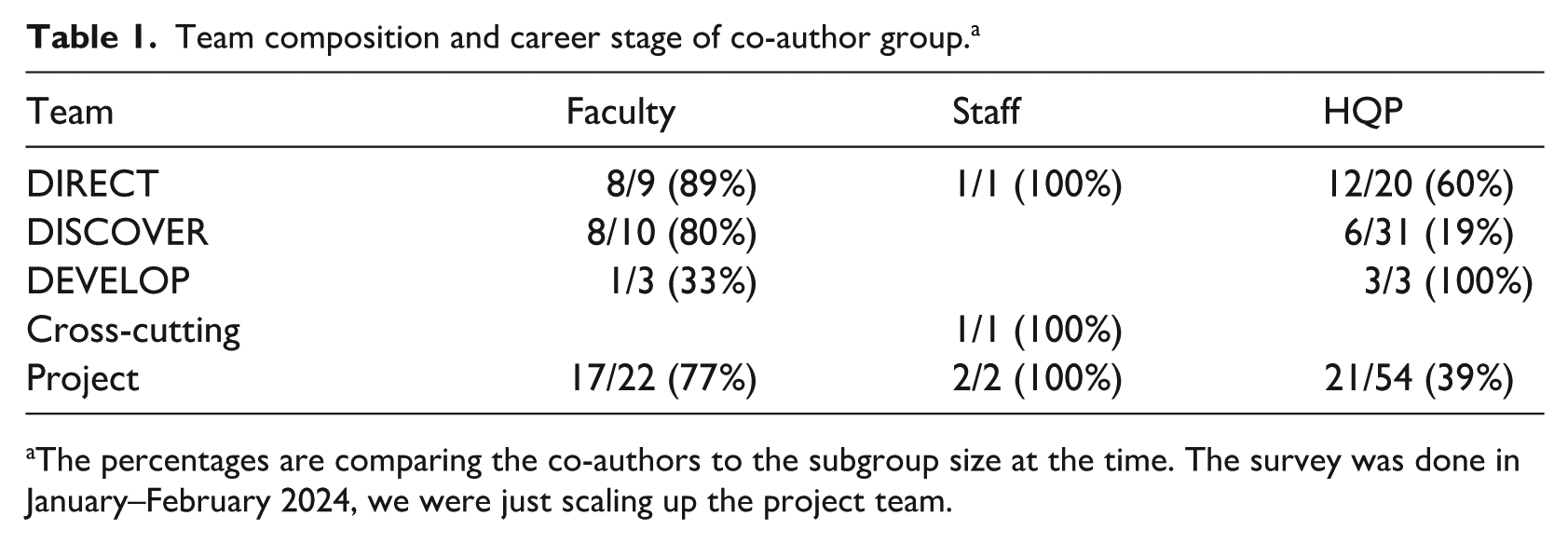
The percentages are comparing the co-authors to the subgroup size at the time. The survey was done in January–February 2024, we were just scaling up the project team.
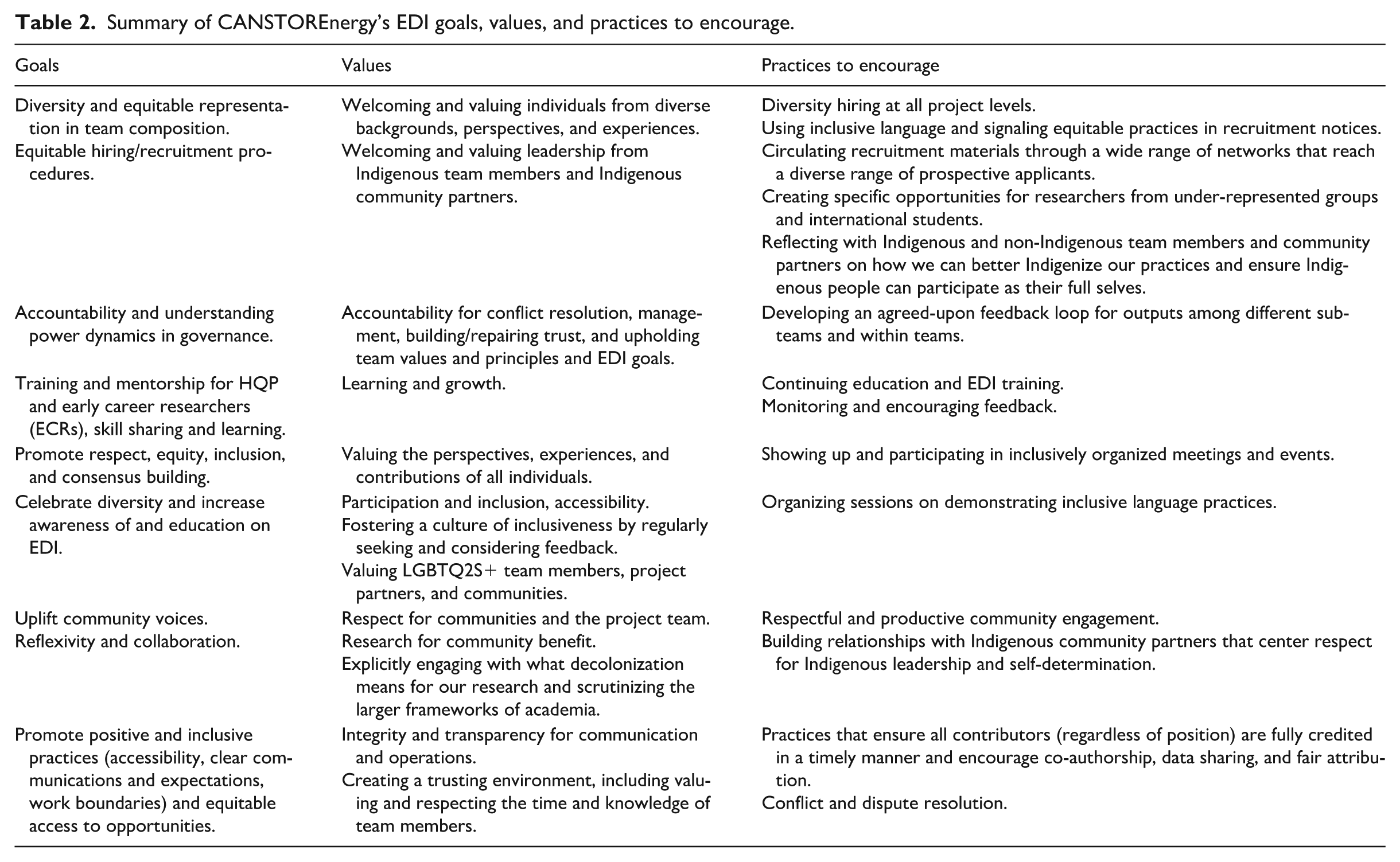
Our shared values, rationales, and encouraged practices are summarized in Table 2 (a more detailed summary of paraphrased responses to each question is provided in the Supplemental materials, Supplemental Tables A–C). These reflect a collective desire to celebrate diversity, uplift team members’ voices, remain accountable to one another, and support training and professional development opportunities. These contributions enabled project members to identify common values and learn from each other’s experiences, and addressed nuances of our research settings and team dynamics which shape and inform our practices. They revealed difficulties that project members have experienced or are concerned about in the CANSTOREnergy project. These findings illuminate the diverse perspectives and needs across the team.
Summary of CANSTOREnergy’s EDI goals, values, and practices to encourage.
Reflections on the EDI ToR process and outcomes
Participation of team members as EDI ToR co-authors
The co-authorship form allowed all team members, regardless of seniority, to contribute equally to the EDI ToR, helping to minimize power dynamics and enable broad participation across our geographically dispersed team. Many HQP found the form very helpful. Despite encouragement from the project leadership in emails, meetings, and conversations, however, not all researchers participated as co-authors. Participation was particularly limited among HQP from DISCOVER and DEVELOP, who are focused on lab-based STEM research. We speculate that there were several reasons for this. Some co-investigators wondered if a “language” barrier between the nomenclature used in the social sciences and in STEM presented a barrier. Each researcher on the project has a different understanding and level of experience with EDI, depending on their discipline, industry or sectoral background, and personal and professional experiences. It could be that not all team members recognized EDI as defined in the co-authorship tool or had experience considering EDI in their work. Several co-investigators have encountered reticence, hesitancy, and discomfort to speak about EDI due to fear about not saying the “right” things, or not saying them in the “right” way in other research contexts. Some HQP may not feel equipped to contribute to this conversation and that their input would not be valuable. There were new HQP who were still trying to understand their place in the research project, get trained in a lab, and get settled as part of the project team. Many HQP in DISCOVER were international students, getting settled into new cities, programs, and research teams. In addition, the concept of a ToR is not common across sub-disciplines, and some of the STEM HQP were not initially familiar with the concept and practice of a research “terms of reference.” These findings align with Rowe and Schuster-Wallace (2023) and Mullin et al. (2021), who note that EDI processes may be less well developed in STEM fields compared to the social sciences and humanities.
Looking back, to increase participation, especially among STEM HQP, we would have provided additional education for the whole team regarding EDI and the purpose of a ToR by hosting additional small-group meetings. Because HQP are less likely to ask questions in large team meetings, the EDI ToR coordinating team did engage directly in smaller meetings with HQP to explain the co-authorship process, such as how to fill in the co-authorship form, and to hold a question-and-answer period, although we did not discuss what a ToR is, or that it is commonly used, in depth. Greater engagement from co-investigators may have encouraged HQP participation, as HQP often prioritize requests from their supervisors. Some co-investigators also did not engage deeply in the process, which may have been due to capacity issues in balancing research, service, and administrative obligations.
The EDI ToR as a decision-making compass
The EDI ToR development process improved the awareness of EDI of many researchers on the project and provided a starting point for addressing differences in worldviews, values, approaches, and expectations. While it may not provide specific answers for every situation, the ToR serves as a guiding framework—an “EDI compass”—to help researchers navigate decision making ethically and inclusively. The ToR is about the spirit and intent of the work we are trying to do together. It outlines how we treat each other and communicate, what roles and responsibilities we each take on, and clarifies our goals and visions about how to collaborate both internally within our team and externally with a range of communities. It also serves as a guide for how the team will operate and be managed and creates protocols for repair when tensions arise.
Reflections during the creation of the EDI ToR encouraged deeper considerations of how to engage with energy-user groups and partners in the development of novel technologies. For HQP, the process provided a meaningful space to contribute to their academic work culture. Many appreciated the opportunity to express needs, consider aspects of the research process they had not thought about, reflect on issues such as work–life balance and setting boundaries on the project, and challenging aspects of academic culture, such as the expectation to work on weekends and holidays. Knowing their concerns would be read by co-investigators helped foster a sense of support and inclusion.
The EDI ToR supports HQP to situate their individual research within the much larger CANSTOREnergy project. CANSTOREnergy is one of the most complex projects that many of the co-investigators have worked on, let alone HQP, who are often working on their first or second research project. The EDI ToR supported HQP in navigating the complexity of the CANSTOREnergy team dynamics and aligning their work with the project’s core objectives. HQP who were hired after the EDI ToR’s development process agreed that having the EDI ToR in place helped to solidify and confirm that their values and intentions of working with communities (including other researchers and co-investigators on the project) in an ethical way are being supported by the project.
International students, particularly those from the Global South, face unique and often under-addressed EDI barriers including systemic racism, harmful stereotypes, and immigration challenges such as additional costs related to visas and resettlement in a new country (Sotiropoulou, 2022). One HQP shared that their past experience with precarity as an international student influenced their decision to join the project, and they were encouraged by the team’s commitment to EDI. Another HQP expressed that knowing the team values inclusion gave them confidence they would be supported in developing both technical and interpersonal research skills.
Several project co-investigators are using the EDI ToR as a decision-making support for team activities, including recruiting, hiring, retention, supervision, and collaboration. For example, when renewing contracts for postdoctoral researchers, the EDI ToR can help to inform decisions beyond institutional and funding agency policies, which has prompted some co-investigators to offer longer contracts to reduce the employment precarity that HQP often feel in academia.
There were limits to its use to support decision making. The project members who joined after the EDI ToR process was finished were encouraged to read it when they joined the project. However, disciplinary differences emerged: some STEM HQP noted that they would have read the EDI ToR if it had been identified as assigned reading, and subsequently did not read it. This reflects the broader cultural differences between STEM and social sciences and humanities.
Did we meet our goals? Would we do it again this way?
We have a range of perspectives on whether and how this EDI ToR process meets our goals. In the context of funder requirements, our ToR meets and in some ways exceeds those expectations. Several co-investigators noted many EDI strategies they have read in proposals are merely cut and pasted from a generic table they found online, as opposed to being created by deliberate and meaningful thought in the context of the specific research program they are leading. In contrast, our collaboratively authored ToR is a foundational document that can evolve with the project, guiding future goals, principles, and practices. However, some team members view the EDI ToR as an important first step that on its own does not meet the team’s needs. While it sets out initial values and aims, it does not yet provide a shared vision or mechanisms for accountability, conflict resolution, or ongoing revisions. A follow-up process is needed to revisit all our goals and move from individual commitments to collective ones.
Concerns were raised among co-investigators about uneven engagement. Some felt that stronger participation from all project leads would have encouraged broader involvement, especially among HQP. One co-investigator suggested integrating this process earlier in the project timeline, with more concrete deliverables and timelines built into the project proposal. Another suggestion is that a budget for EDI ToR development and activities is included in the initial proposal. These recommendations are being considered as we seek deeper engagement and representation moving forward.
What else should we do moving forward?
The collaborative development of the EDI ToR—and the reflection process—created opportunities to identify areas of alignment and tension in the project. It also revealed varying levels of interest in and concern about EDI among researchers. We now have a better understanding of how team members would like to engage in EDI initiatives, which kinds of areas to focus on, and for what reasons, as well as guidance about challenges that need to remain priorities for ongoing discussion and deliberation within team meetings and research subteams.
Through the process of developing the EDI ToR, a number of disciplinary, personal, and professional differences came to light about the project. Some of the goals, practices, and values of researchers and research teams came into conflict with each other, and may need to be addressed through a series of ongoing research mediation and negotiation processes. These range from within-team communication to beyond-team partnership development.
For instance, some team members highlighted the importance of using formal titles for colleagues and partners, as this can indicate and foster respect for experience, knowledge, and professional positions. Using titles can allow team members to maintain a divide between their professional and personal lives in ways that make them more comfortable and make clear the hierarchies and lines of professional power and authority that exist. Some EDI values are enhanced through the use of titles, ensuring that the expertise and training of those from historically excluded groups is recognized by peers and partners. However, and in direct contrast, other team members hoped to reduce the use of formal titles as a way of reducing the emphasis on formal training and credentials as signifiers of knowledge authority and hierarchy. These team members noted the importance of recognizing multiple forms of knowledge and expertise, and they viewed the attachment to formal titles as undermining this broader emphasis on mutual learning. A third option was discussed during a field school workshop, where some team members tailored introductions based on the audience and the context. How the first person introduces themselves at a gathering can have cascading effects and shift group interactions. While all members agreed on the importance of respect and recognition, the pathways to achieving this can change and require continual reassessment.
Even when researchers share values, differing priorities can lead to tension. For instance, researchers might value clarity and transparency in research processes, flexibility, iterative goal-setting, and respect for sensitive information. These are all shared values, but in practice it may not be possible to prioritize them all simultaneously. As an example of the tensions between transparency and confidentiality, in early discussions with potential community partners, there may be need to keep conversations confidential and to limit the sharing of information outside the researchers developing those partnerships. This might come into tension with the commitments in the team to open information sharing. These are not competing values, but the associated practices may need to be staged in time and place.
The tensions between clarity and flexibility emerged for some HQP, since knowing their specific goals, timelines, audiences, and outputs provides the structure they see as necessary for their work and learning and allows them to manage their multiple commitments as students and researchers. For the project team, though, goals, timelines, and outputs might need to be flexible and unspecified, to leave space for goals and projects to be co-developed with partners. Since the project’s community-informed work is led by DIRECT, there may need to be aspects of the work that remain undefined as relationships are built. These values and practices are all important, but may not be readily integrated. These dynamics need to be navigated continually.
Work–life balance presents challenges. Some researchers prefer fixed work hours to protect personal time, while others require flexible schedules (including the ability to work outside of regular business hours and on the weekends) to accommodate caregiving responsibilities. These preferences can conflict when organizing meetings, sending emails, and organizing fieldwork. These challenges are heightened in a team working across five time zones and with multiple types of partner organizations and communities.
CANSTOREnergy has not yet considered how to integrate this EDI ToR with non-academic partners. This is in part due to the evolving nature of the partnerships and the fact that some partners may not be able to engage in academic processes. One pathway for this integration may be through the integration of research ethics and integrity processes, through human research ethics approvals that must adhere to TCPS 2 (2022) – Chapter 9: Research Involving the First Nations, Inuit, and Métis Peoples of Canada (Canadian Institutes of Health Research, Natural Sciences and Engineering Research Council of Canada, and Social Sciences and Humanities Research Council of Canada, 2022), as well as the incorporation of the First Nations principles of ownership, control, access and possession (OCAP®; The First Nations Information Governance Center, n.d.) framework that provide guidance on research with First Nations, and a focus in the EDI ToR on lines of communication and community and industry relationships.
Understandings of Indigenization and decolonization vary among all members of the project, and these differences lead to divergent views on how to integrate and enact these values. To respect our research colleagues and community partners, we have ensured that these values are included and specified in our project commitments; determining what they mean in practice remains part of the project’s work. These ongoing conversations helped researchers and incoming HQP recognize that not everyone on the project will have the same background understanding of EDI, so having this ToR as documentation for team members’ agreed-upon EDI considerations is a useful foundation.
CANSTOREnergy next steps
Our reflection process revealed a number of important next steps. We are taking deliberate action to ensure that EDI work is seen as a shared commitment across the project team. The EDI ToR is a living document which we can continuously return to as a basis for uniting our EDI practices.
The project’s leadership has continued to engage with researchers across the project in EDI activities. We have invited members from each subteam and across career stages to an EDI committee to provide feedback on the EDI ToR and initiatives they would like to see implemented in the project. The committee members will update the EDI ToRs through a collaboratively authored process on an annual basis. We will dedicate time at each AGM to discuss the common values that we identify in the ToR, the revisions we need to make, and actions that need to be taken to ensure that our EDI values underpin all project activities. We will broaden the reach of our EDI values by asking the project’s external advisors, committee members, and partners to read the EDI ToR and offer feedback and guidance to the team from their perspectives.
As CANSTOREnergy approaches its midterm milestone, we will reflect on our progress over the past 3 years, assess lessons learned, and identify areas for improvement. The midterm report will help us chart a clear and intentional course for the second half of the project, ensuring our goals and practices remain aligned with evolving needs. This milestone presents an opportunity to formalize EDI obligations within the project structure, embedding them into timelines and deliverables to ensure accountability throughout the project. We will continue to encourage and engage in discussions about EDI ToR elements that conflict, such as flexibility versus clarity or formal titles versus inclusive informality, and the importance of context.
Guidance for other projects
The process of developing the EDI ToR for our project offers valuable lessons for other organizationally complex and community engaged research projects. We encourage teams at the grant application stage to build an explicit commitment into their project proposals from all co-investigators that they would participate in, and ensure the HQP that they supervise participate in, the development of and revisions to an EDI ToR. This would include a firm commitment from all co-investigators to learn about EDI-based practices through group discussions and meetings, to participate in the development and revision of the EDI ToR, and to ensure that this process is inclusive to diverse views.
To ensure an EDI ToR goes beyond aspiration, we recommend integrating it into the project timelines and deliverables, with explicit objectives and regular review cycles for shared values, principles, and practices. We suggest that funding agencies consider that funding allocations in subsequent project years could hinge on meeting these deliverables. In the same way that reporting is mandatory, the development of and adherence to an EDI ToR could also be explicitly required by funders.
We encourage teams to identify where values and practices come into conflict and to develop an explicit practice of addressing these. Instead of reflecting a single view, the ToR could help define the range of perspectives among project members. While this might not change individual researchers’ views and commitments, it would provide a foundation for navigating differences in worldviews, values, approaches, and expectations, and it could be part of a larger process of conflict negotiation and mediation for the project team.
Conclusion
Although researchers are required to make EDI commitments in funding applications in Canada, in pursuing this goal, we learned that it is less well established how these commitments are incorporated and monitored within projects after funding is received. EDI ToR development is an emerging practice, and must be adapted and expanded as teams grow and change over time.
Our experience has shown that critically reflecting on the EDI ToR process—including democratizing co-authorship, hosting discussions in large and small team settings, and implementing the EDI ToR as part of our onboarding process—may provide helpful insight for leaders of large energy research and interdisciplinary projects to tailor similar initiatives to their own context. Establishing a process early on in a project to communicate and share each team member’s understanding and approaches to EDI can ease communication and collaboration challenges commonly faced in large, interdisciplinary research teams. Turning these values and perspectives into a living document, such as an EDI ToR, can help shape the project’s collaboration methods and support the team in navigating inevitable conflicts and tensions.
We acknowledge that while many values and goals are shared, not all practices are easy to integrate and align. Developing the ToR has helped us operationalize goals set in our proposal, and the process has brought benefits to the project and participants. It is not a complete output or fixed consensus but rather a living document undergoing constant development, not unlike the energy transition on which we work.
Supplemental Material
sj-pdf-2-rea-10.1177_17470161261423564 – Supplemental material for Toward inclusive energy futures: Reflections on the collective authorship of a multi-institutional, interdisciplinary, and community-engaged equity, diversity, and inclusion terms of reference
Supplemental material, sj-pdf-2-rea-10.1177_17470161261423564 for Toward inclusive energy futures: Reflections on the collective authorship of a multi-institutional, interdisciplinary, and community-engaged equity, diversity, and inclusion terms of reference by Christina E. Hoicka, Emily MacCallum, Ahmad Hameed, Lisa Leung, Kate J. Neville, Lila Asher, Tracey Galloway, Drew Higgins, Leela McKinnon, Maya Papineau, Cheryl Teelucksingh, Erika Tizya-Tramm, Zahra Azimi Dijvejin, Aimy Bazylak, Joule Bergerson, Curtis P. Berlinguette, Laurel Besco, Viola Birss, David Boon, Ryan Bullock, Sara Chitsaz, Suzanne Chew, Christopher Fitzgibbon, Amirhossein Foroozan, SiLang Huang, Nicolas Jekill, Tengxiao Ji, Erica Kilius, Heather L. Maclean, Vaidehi Pitre, Shaoxuan Ren, Eric Riep, Jason Riordon, Michael Ross, Dwight S. Seferos, Ali Shayesteh Zeraati, Catherine Shi, Shardul Tiwari, Aubry Williams, Yimin A. Wu, Xue Yao, Mengnan Zhu, Dena Van de. Coevering, Melanie Zurba and David Sinton in Research Ethics
Supplemental Material
sj-png-1-rea-10.1177_17470161261423564 – Supplemental material for Toward inclusive energy futures: Reflections on the collective authorship of a multi-institutional, interdisciplinary, and community-engaged equity, diversity, and inclusion terms of reference
Supplemental material, sj-png-1-rea-10.1177_17470161261423564 for Toward inclusive energy futures: Reflections on the collective authorship of a multi-institutional, interdisciplinary, and community-engaged equity, diversity, and inclusion terms of reference by Christina E. Hoicka, Emily MacCallum, Ahmad Hameed, Lisa Leung, Kate J. Neville, Lila Asher, Tracey Galloway, Drew Higgins, Leela McKinnon, Maya Papineau, Cheryl Teelucksingh, Erika Tizya-Tramm, Zahra Azimi Dijvejin, Aimy Bazylak, Joule Bergerson, Curtis P. Berlinguette, Laurel Besco, Viola Birss, David Boon, Ryan Bullock, Sara Chitsaz, Suzanne Chew, Christopher Fitzgibbon, Amirhossein Foroozan, SiLang Huang, Nicolas Jekill, Tengxiao Ji, Erica Kilius, Heather L. Maclean, Vaidehi Pitre, Shaoxuan Ren, Eric Riep, Jason Riordon, Michael Ross, Dwight S. Seferos, Ali Shayesteh Zeraati, Catherine Shi, Shardul Tiwari, Aubry Williams, Yimin A. Wu, Xue Yao, Mengnan Zhu, Dena Van de. Coevering, Melanie Zurba and David Sinton in Research Ethics
Footnotes
ORCID iDs

Ethical considerations
This paper is a co-authored reflection piece that did not require ethics approval.
Funding
The authors disclosed receipt of the following financial support for the research, authorship, and/or publication of this article: We acknowledge the support of the Government of Canada’s New Frontiers in Research Fund (NFRF), CANSTOREnergy project NFRFT-2022-00197 and Canada Research Chair Secretariat CRC-2020-00055.
Declaration of conflicting interests
The authors declared no potential conflicts of interest with respect to the research, authorship, and/or publication of this article.
Data availability statement
All data is in Supplemental materials.
Supplemental material
Supplemental material for this article is available online.
References
Supplementary Material
Please find the following supplemental material available below.
For Open Access articles published under a Creative Commons License, all supplemental material carries the same license as the article it is associated with.
For non-Open Access articles published, all supplemental material carries a non-exclusive license, and permission requests for re-use of supplemental material or any part of supplemental material shall be sent directly to the copyright owner as specified in the copyright notice associated with the article.

