



Abstract
The purpose of this article is to examine how authorship norms and practices vary across academic disciplines – conceptualised here as “fields” – and how these differences influence research evaluation and the distribution of academic prestige. Drawing on the concepts of cultural capital and symbolic capital, the article argues that authorship order is not merely a reflection of individual contributions but is deeply intertwined with power dynamics and institutional practices within distinct disciplinary ‘fields.’ This theoretically informed discussion highlights substantial variation in authorship patterns across fields, reflecting different forms of value at stake. While some fields favour single authorship or alphabetical listings, others use first-last author emphasis models, making uniform interpretations of author order potentially misleading for evaluation systems. The paper further critiques the growing reliance on performance metrics such as publication counts and citation rates, arguing that, although interconnected with authorship practices, they fail to capture the complexities of collective knowledge production and may indeed incentivise problematic authorship behaviours. It contends that uniform policies risk distorting recognition, particularly in cross-disciplinary settings where field-specific norms differ sharply. In response, the article evaluates contribution-reporting systems as a pathway towards greater transparency and more equitable distribution of symbolic recognition across fields. These issues point to a broader ethical challenge. The conclusion advances the notion of a distributive ethics of academic capital, arguing that equitable authorship practices must account for the unequal structures of symbolic and cultural capital across disciplinary fields.
Keywords
Introduction
Evaluating researchers’ performance ethically is a complex endeavour, as orientations, practices and values vary considerably across disciplines, 1 institutions and countries (Helgesson, 2020). Commonly used metrics include publication records, grants and funding, collaborations, knowledge transfer, commercialisation of findings and the prestige of scientific outputs. However, the pervasive role that bibliometric indicators and journal rankings play in policies for research development is highly debateable. The rise of scientometrics has attracted much attention, with critics pointing to the biases in dominant databases and the detrimental effects of applying bibliometric indexes uniformly across fields. The consequences for knowledge production itself are profound.
Recent literature continues to explore the intricacies of research policy and performance. Troncoso et al. (2022), for instance, analyse the incentives for scientific publications across universities, uncovering disparities in the types of publications being encouraged, who benefits and how much money is allocated. Their findings reveal a lack of harmonisation between fields and call for more cohesive policies that both reflect and promote diversity in academic activities. Similarly, Koch et al. (2021a) examine the transformative impact of internationalisation trends on sociological communities. Their study highlights the tensions between international and local demands, especially in the social sciences, where topics of societal relevance are often overshadowed by dominant views on science. Koch et al. (2021b) shift the focus to the editorial orientation of scholarly journals, tracing the pressures for internationalisation over the past century and a half. They critically assess how language, impact and audience have evolved, leading to tensions between universal scientific values and the need to preserve national contexts. This tension, they argue, has shaped the trajectory of scientific work.
Moreover, Koch and Vanderstraeten (2018) offer further insights, analysing how these pressures have altered collaboration patterns across the humanities, natural sciences and social sciences. Their research underscores how the citation consciousness (Garfield, 2012) promoted by indexes like Web of Science perpetuates cross-national inequalities. These tools, they explain, have institutionalised evaluation mechanisms that push scholars and journals alike towards conservatism, prioritising safe choices over innovative research as a means of survival.
Importantly, adding to the tensions from metrics, 2 the order in which authors are listed on a paper has become an increasingly debated issue in research evaluation. As first-author and single-author publications are held in high regard (Casadevall et al., 2019; Mattoon et al., 2024), Web of Science remains a central focus in scientific culture (Vanderstraeten, 2025). Helgesson and Eriksson (2019) bring attention to the fraught question of authorship order. They challenge the prevailing emphasis on individual contributions, arguing that assigning fixed values or percentages to authorship can be misleading. Instead, they advocate for a more collaborative ethos that rewards collective achievement over individual recognition.
A related issue concerns how authorship order shapes recognition. The literature on authorship order (Larivière et al., 2021; Louis et al., 2008; Marušić et al., 2011; Street et al., 2010) has examined the complexities of assigning credit in various academic fields, each with its own traditions. However, a notable gap remains in understanding how research policies that apply a one-size-fits-all approach to merit may harm different fields. Studies over the past few decades (i.e. Hesselmann et al., 2021; Lewis et al., 2012; Teixeira da Silva and Dobránszki, 2016) have documented practices within specific fields, but fewer have addressed the broader implications of uniform policies from a theoretical perspective to make sense of differential practices within collaborative work. The risk is that these policies overlook the nuances of authorial norms across fields, creating potential distortions in how individual researchers, collaborations and entire academic ecosystems are appraised. Without recognising these differences, the development of fair and nuanced evaluation frameworks is unlikely. This gap is especially important to address if we are to develop policies that capture and accommodate the increasingly cross-disciplinary and collaborative nature of contemporary research.
The critique foregrounded presently of authorship ordering challenges the conventional wisdom on how scientific merit is measured. In the context of performance assessment, it raises a vital question: If evaluation mechanisms fail to reflect the reality of collaborative research, are they not in danger of stifling it? For cross-disciplinary research in particular, policies that ignore variations in practice may become a deterrent, undermining the very collaborations they seek to promote.
We will discuss in Section 2 the theoretical framework used in this paper, with an emphasis on symbolic capital within disciplinary fields. This framework will help illuminate authorial preferences and practices as a contested value, subject to distinct rules specific to each field. Afterwards, Section 3 recapitulates current discussions on authorship conventions reflecting distinct field logics, and how these influence perceptions of merit but can lead to ethically fragile parameters. Section 4 critiques current performative indicators, highlighting how metrics, including author order, interact with authorship practices in performative loops, incentivising behaviours that distort research integrity and recognition. In Section 5 we discuss contribution-reporting systems like CRediT as a way to address the complexities of fairly attributing merit in collaborative research, but which must be adapted to field-specific value structures if they are to redistribute symbolic capital fairly.
Methodologically, we integrate theoretical insights with targeted synthesis of empirical patterns in authorship practices. Our aim being normative as much as diagnostic: to advance a distributive ethics of academic capital that fairly evaluates scholarly work and respects how value is construed in the relevant field.
The result is a field-sensitive approach that decouples recognition from position alone, foregrounds contributorship and proposes procedural safeguards alongside informational standards to support fairer evaluation in both disciplinary and interdisciplinary contexts. Aiming to reconcile fairness with disciplinary diversity, this argument frames the discussion that follows.
Authorship as a form of ‘capital’ within academia
To further understand how the order of authorship is influenced by the values and norms of epistemic communities, it is useful to borrow theoretical frameworks from sociology. In this analysis, we draw on Pierre Bourdieu’s theory of cultural capital, a framework widely used to understand cultural practices. His seminal work Distinction: A Social Critique of the Judgement of Taste (2016) provides a framework for understanding the dynamics of social power. Bourdieu expands the notion of capital beyond its economic definition, encompassing various forms of resources that individuals and groups wield. Central to his theory are the concepts of ‘social capital’, ‘symbolic capital’ and ‘field’, which are particularly relevant in academia. Here, networks and relationships intertwine with scientific culture, shaping the influence and status of academics.
Social capital refers to the networks, relationships and social connections that individuals cultivate. These, in turn, offer access to resources, opportunities and support systems. This capital is forged through social interactions and affiliations within different circles, such as family, friends and professional networks, which within academia can unlock access to funds, datasets, facilities, career chances, peer support, endorsements, mentorship and alliances. There is a reason why Bourdieu refers to this as ‘capital’; it is because it can be inherited, passed down and converted into financial assets (Bourdieu, 2016). In fact, the unequal distribution of these different resources defines a distinct ‘order of coexistence’ within the social space, or a structure of different ‘juxtaposed social positions’ on the basis of a differential allocation of social capital, akin to the distribution of wealth (Bourdieu, 2011: 196). Simply put, this form of capital refers to ‘relations’. According to Bourdieu, individuals and groups strategically accumulate and deploy capital, including a web of social relations, to gain advantages in social life. His theory thus provides valuable insights into the establishment, maintenance and challenge of social hierarchies, illuminating the complex interplay of economic, cultural and social forces in shaping individuals’ life chances and social outcomes.
On the other hand, symbolic capital represents the prestige, honour and recognition that individuals or groups hold within a field. In the context of authorship, symbolic capital can help explain how certain author positions confer esteem and impact academic reputation and career advancement. For example, being listed as the first or last author often enhances symbolic capital within the academic community. While the value of academic publishing lies in its rareness, in the unique and esoteric understanding it provides (which only a small portion of society can offer, and which an equally small portion is able to understand), an author’s symbolic capital increases insofar as their worth is objectified in their type and number of publications. Comparatively, this form of capital can be estimated both as immediate research output and as an accumulation over the course of one’s career (see Bourdieu, 2016), with academic production becoming central to research policy as an ‘institutionalised’ capital (Bourdieu, 1994). Building on Bourdieu’s theory of capital, individuals will tend to either maintain or increase their symbolic capital, as failing to do so would undermine their own interests and the perception of them within their research community.
Importantly, capital is field-specific because each field serves a specific interest. What, then, does ‘field’ mean within this theoretical framework? Bourdieu’s concept of field serves as a fundamental analytical tool for understanding social dynamics. It represents a structured social space, an ‘arena’, where individuals and institutions compete for various forms of capital, and so it becomes a tiered space of social positions. These fields can encompass broad spheres such as the arts, academia, politics or economics and extend to more specific areas like the literary field or the fashion industry, each having its own value that is at stake. Central as it is in Bourdieusian theory, this idea demonstrates that fields, regardless of their degree of differentiation, are similar in structuring and functioning (Bourdieu, 1966; Jourdain and Naulin, 2013). Conceptualising academic disciplines and traditions as fields is important because they are where capital is competed for, and this explains why the possession of capital determines one’s position within a field and the efforts to uphold that position. Eventually, the historical struggles to acquire and protect the specific capital materialise in the set of rules and institutions associated with the field (Jourdain and Naulin, 2013).
In the scientific system, Bourdieu’s concept of field enables a nuanced understanding of authorship dynamics. In discussing intellectual differentiation, Bourdieu himself stated that the concept of field is not for mere analytical contemplation, but to be taken as a useful tool in the analysis of social reality, focusing on the forces at play, on the structure of distribution of capital (Bourdieu, 1999). The scientific system is composed of various disciplines or epistemic communities, each governed by its own values, symbols and hierarchies, forming fields of their own. Institutions such as scholarly journals, scientific societies and research laboratories play a key role in shaping knowledge production and dissemination, as well as setting research agendas and priorities within the respective field. These structural elements influence the distribution of academic capital, including authorships, publications, citations, peer review opportunities, grants and academic positions. Given the finite availability of these resources, scholars compete for symbolic capital within an academic field, akin to competitors in a sports arena, defined by its unique internal values and logics. As explained above, accumulating and converting symbolic capital, just as much as social capital, is vital for building scholarly reputation and advancing one’s career in academia.
Thus, applying Bourdieu’s concept of field as a tool to understand authorship in academia uncovers how scholars use various strategies to deal with the competitive mechanisms of academic recognition. Within this framework, securing authorship and co-authorship is not solely about contributing to research – important though it is – but also about positioning oneself within the academic field. Similarly, the order of authors on a publication can reinforce their standing and influence within their communities, reflecting broader power dynamics and institutional norms. Authorship and its ordering thus serve as markers of standing and trust in academe, influenced by factors such as institutional endorsements, individual reputation and reciprocal relationships. For instance, an established scholar might be invited to co-author a journal article due to their recognised expertise, which can both further enhance their influence and visibility in the field and facilitate upwards mobility of the inviter.
In this way, a form of value displacement occurs: academic activity becomes increasingly structured around globalised metrics of scientific ‘excellence’. As emphasised elsewhere in this article, these metrics often overlap with – yet sometimes contradict – the epistemic and collaborative aims of scientific production; for example by incentivising minimal collaboration or inflated team sizes. The expansion of scientometrics and the tightening of evaluation regimes can intensify tensions between disciplinary norms and institutional demands, particularly in interdisciplinary research where conventions of authorship differ markedly.
Struggles for capital and for more favourable positions within academic hierarchies introduce variation into social practices, including the production of scientific knowledge. In intellectual fields – whether scientific or artistic – social and cognitive relations are intertwined. Within these shifting relations, broader societal power structures legitimise certain fields over others, reinforcing existing hierarchies – and creating new ones – between ‘dominant’ and ‘dominated’ fields, as seen in distinctions between ‘fine’ and ‘popular’ art forms or between established scientific fields and other emerging or declining ones (Schirone, 2023). These dynamics closely mirror the disparities in recognition, visibility and prestige highlighted in contemporary research policy debates.
Because of their financial and institutional implications, academic output aligned with dominant publication policies has become a key performance criterion for researchers. Yet Bourdieu emphasises that practices are ‘collectively organised’. Academic publishing is therefore no longer merely an individual communicative act that secures the credibility of research; it becomes a communication process shaped – consciously or not – by social structures and directed to meeting the expectations of universities, funding bodies and governmental agencies (Padmalochanan, 2025). This institutionalisation of metrics generates ethical tensions between the intrinsic aim of scholarly work and the market-driven mechanisms used to measure its value. Consequently, power struggles arise among scientists over prestige, career advancement and access to economic resources, affecting both the intellectual and social structure of academic fields. Although economic capital remains an important dimension of the scientific system, intangible forms of capital also play a decisive role in organising academic life. Among these is symbolic capital, understood as recognition-based resources grounded in knowledge and esteem. While not easily convertible into monetary assets, symbolic capital manifests in scientific awards, ranks and citation indices – frequently treated as the most ‘objective’ indicators of scholarly worth (Schirone, 2024).
All in all, this perspective of capital and field (Bourdieu, 1999, 2011, 2016) highlights just how important it is to understand the behavioural aspects and preferences within which academic knowledge is produced and assessed, with each disciplinary community establishing the rules of its own ‘game’ within its field. Both behaviour and choice are intricately linked to the ethicality of research. As we will see in the following analysis, preferences and decisions vary significantly across scientific fields, which has implications for research policy and management regarding interdisciplinary science.
This conceptualisation allows us to treat authorship as a moral question of distribution: who receives symbolic capital, under what rules and according to which field-specific hierarchies? The concept of a distributive ethics of academic capital thus reframes authorship not only as a sociological mechanism but as an ethical system of value allocation. We return to this distributive framing in Sections 4–5.
Differential ‘games’ across scientific fields
Standardising policies on authorship order are likely to lead to unintended consequences for researchers’ behaviours. The order of authorship in research articles varies significantly across fields and even within different groups in the same field or department (Helgesson and Eriksson, 2019). While most fields order authors by their level of contribution, alphabetical order is sometimes used as a standard practice. Notably, fields where more than 50% of publications opt for alphabetical ordering include business and finance, economics, mathematics, and physics, particles and fields (Weber, 2018). While alphabetical and contribution-based lists are the two primary norms in science, some research teams forgo both methods, instead using random mechanisms (as in coin tosses) to determine author order when contributions are deemed equal (Whetstone and Moulaison-Sandy, 2020).
However, distinct disciplinary practices come to the fore when looking more closely, which become clearer during transitions. More specifically, engineering and medicine see a higher proportion of co-authored papers compared to fields such as the humanities, philosophy, social sciences and computer science, which exhibit lower levels of co-authorship (Tian et al., 2024). However, the shift from single author to co-authored papers in the latter fields has raised two key questions: (a) who qualifies for authorship or contributionship, and (b) what significance does a position in the author list hold? Otherwise stated, how is symbolic capital allocated in authorship across fields?
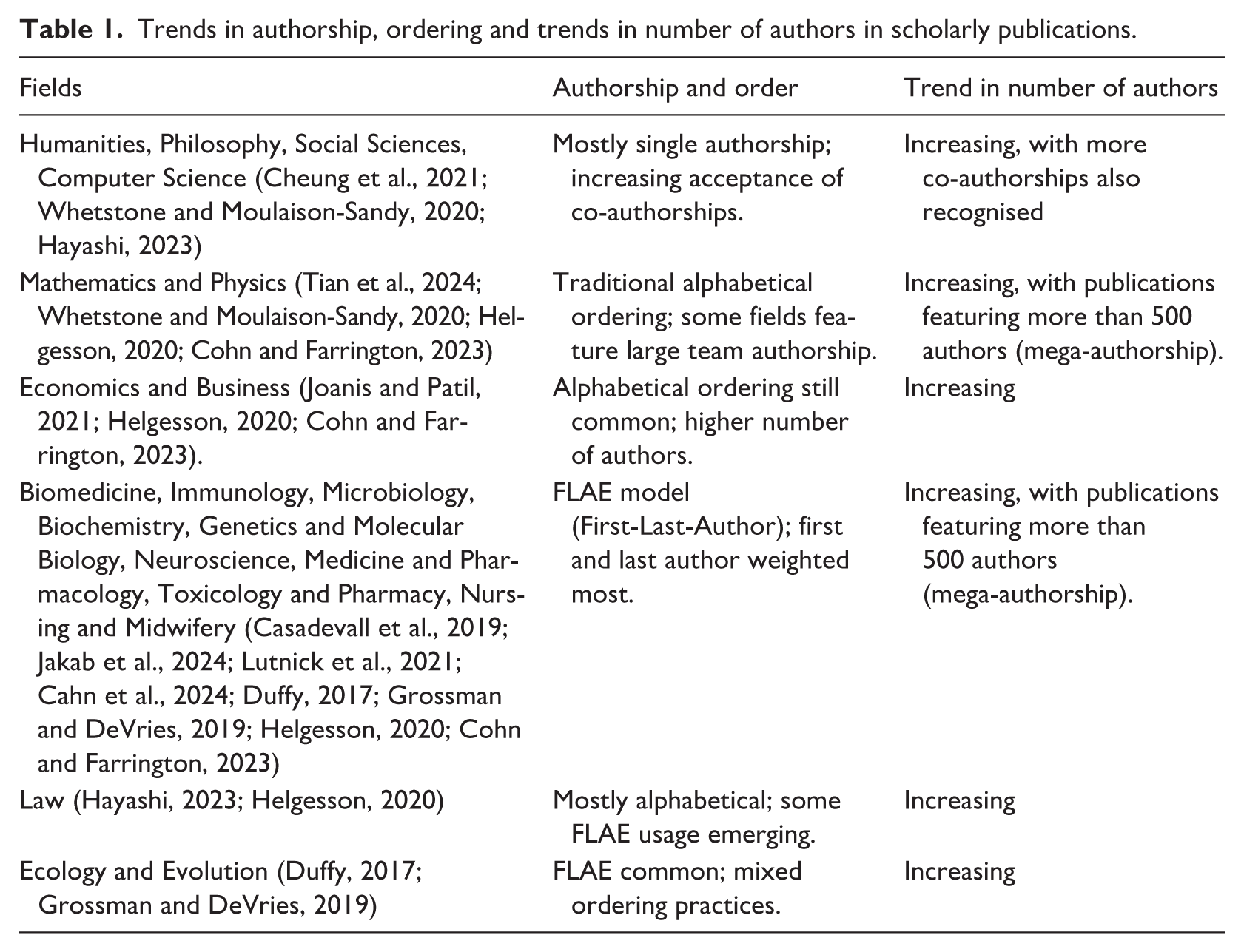
Although not intended to be topic-representative, Table 1 illustrates disciplinary trends in authorship, author order and authorial practices across academic fields (Barta, 2022; Cahn et al., 2024; Casadevall et al., 2019; Cheung et al., 2021; Cohn and Farrington, 2023; Duffy, 2017; Grossman and DeVries, 2019; Hayashi, 2023; Helgesson, 2020; Jakab et al., 2024; Joanis and Patil, 2021; Lutnick et al., 2021; Tian et al., 2024; Whetstone and Moulaison-Sandy, 2020). For instance, in the social sciences and humanities, single authorship remains prevalent, although there is a growing recognition of co-authorship. In contrast, fields such as mathematics and physics increasingly feature lengthy alphabetical author lists, with publications often involving mega-authorship (over 500 contributors). Economics and business show a decline in alphabetical listings due to the field’s preference for fewer co-authors, which can discourage extensive teamwork. Conversely, fields such as biomedicine and ecology predominantly use the FLAE (First-Last-Author Emphasis) system, reflecting an upwards trend in large-scale collaborative efforts. Law also adopts both alphabetical listings and the FLAE model, while ecology and evolution embrace the latter approach, indicating a shift towards more structured authorship in these fields. By examining the patterns of authorship across fields, shifts towards more collaborative and extensive research practices become apparent, which is relevant for interdisciplinary endeavours as well as research policy.
Trends in authorship, ordering and trends in number of authors in scholarly publications.
Although this paper focuses primarily on disciplinary variations, geographic and cultural differences also shape authorship practices. Several countries and supranational entities – such as the UK, Australia, China and the EU – have national research integrity codes that offer explicit guidance on author order. These frameworks may diverge from disciplinary norms, creating additional layers of expectation. Moreover, Global South contexts often negotiate different collaborative hierarchies due to inequalities in funding, infrastructure and access to high-impact journals, which can influence both authorship choices and recognition (Koch et al., 2021a; Troncoso et al., 2022). Incorporating geography thus deepens the analysis of how symbolic capital circulates unevenly in global knowledge production.
These contrasts have ethical implications. A universal standard of authorship credit would therefore reproduce, rather than mitigate, existing asymmetries because it would impose a single hierarchy of valued positions onto fields whose symbolic economies differ substantially. What counts as valued labour in one field – for example first authorship in biomedicine or alphabetical listing in economics – does not carry the same meaning in others; universal rules therefore reward some fields’ norms while devaluing others.
As Table 1 shows, in some fields such as humanities or philosophy, solo authors are very common, likely because of the prestige traditionally assigned to them, whereas in others, it is conferred upon large teams and collaborations, practices that probably no standardising policy or consensus can be applied across fields to define co-authorship. If someone comes from a field that uses alphabetical authorship and collaborates with a field that assigns authorship by relative contribution, the perceived merit may depend on their surname, which, of course, has no bearing on their actual contribution (Helgesson, 2020), leading to misrepresentations. Differing norms and practices in authorship order can thus be understood as part of the broader struggle for academic capital within distinct fields – or misconstrued if these cultural aspects of fields are not adequately comprehended.
Therefore, drawing a priori conclusions about authorship order and its implications becomes very problematic. If we moved beyond attributing credit to the authorship ordering and acknowledged that this is a mere agreement between the authors, then policymakers would become more interested in the details of the authors’ contribution, which, indeed, are now often shared with journal editors when submitting a manuscript (Das and Das, 2020; Duffy, 2017). And theoretically framing this as institutionalised practices helps understand symbolic struggles inherent in the academic fields, which, as explained, are not homogeneous.
Recognising this diversity turns authorship ethics into a distributive challenge: ensuring that symbolic rewards correspond to actual contributions within each field’s rules of the game.
Performativity in research: Interdependent indicators
Not just research outputs but also authorship preferences and decisions have been influenced by the increased focus on metrics. The rise in multiple authorship reflects several factors: growing collegiality, methodological sophistication, multidisciplinary research and expanding opportunities for international collaboration enabled by the Internet and globalisation (Borgman, 2017; Fortunato et al., 2018; Wuchty et al., 2007).
Additionally, intensifying competition – driven by performative pressures – has also played a role. Many institutions rely on publication-based metrics in decisions about tenure, promotions, grant funding and academic rewards (Weisshaar, 2017). Audit regimes have amplified productivity demands through ranking systems and incentive schemes, making academic publishing central to defining career success (Macfarlane, 2017). Interestingly, co-authorship does not appear to decrease in any field (see Table 1), while collaboration across fields continues to collide with tensions over author ordering, particularly when tied to evaluation systems that interpret author position as a proxy for contribution (Helgesson and Eriksson, 2019; Smith et al., 2020).
We distinguish between two interrelated but distinct ethical dimensions of authorship. The first concerns authorship order, which reflects how symbolic capital is distributed among contributors. The second concerns questionable authorship practices that distort the same capital dynamics. While both reveal how recognition circulates unevenly, the discussion here lies on the implications of authorship order within this broader ethical landscape.
The introduction of performance metrics, alongside the hyper-competitiveness of contemporary academia, has produced several unanticipated consequences. These affect not only individual academics but also institutions. Scientists have adjusted their behaviour to directly influence metrics rather than that which the metrics supposedly reflect (i.e. research quality). In this recent ‘corporatisation’ of science, author order interacts with two particularly influential indicators – publication counts and citations (Barta, 2022). When symbolic capital is converted into quantifiable metrics, its distribution becomes distorted.
Furthermore, questionable authorial practices add to the problem. For example, ghost authorship excludes legitimate contributors from the author list (often graduate students), whereas honorary (or ‘gift’) authorship includes individuals who made little or no contribution (Elliott at al., 2017; Pruschak and Hopp, 2022). Although distinct, both practices distort the fair distribution of symbolic capital and often intersect with disputes over author order. Moreover, Barta (2022) suggests that honorary authorship can lead to the formation of ‘cartels’ or publication clubs in which members reciprocally include one another without substantive contribution. Because evaluation systems count co-authored papers as full publications for each listed author, publication cartels enable the artificial inflation of productivity and reputation. Of course, ghost and honorary authorship differ from the authorship order issue, but intersect with it. And both reflect imbalances in the distribution of symbolic capital. Understanding these distortions is essential because they frequently spill over into further disputes among authors.
Against this backdrop, the question of how author order is interpreted within evaluation systems becomes especially consequential. In the current academic environment, the pressure to publish and secure grant funding is ubiquitous. A survey by Fong and Wilhite (2017) showed that the number of publications is taken as the most influential parameter in performance assessment. In contrast, journal metrics and author ordering were considered the second and third most important factors, respectively. These parameters form a directed network of interdependency of usual criteria within research evaluation, involving three key nodes: ‘Number of publications’ representing the absolute volume of research output alone, regardless of any other criteria (i.e. multiple co-authorship); then ‘Journal impact factors’, meant to signify the quality of the work by using the relative prestige of the journals where research is published; and lastly ‘Author order’, which although generally focused on an individual’s contribution, is more community-dependent in its significance. These normative parameters further contribute to questionable authorship practices (Bouter, 2024; Hofmann and Holm, 2019).
Yet, this normative view also has a structural dimension. As Schrag (2010) and others note, STEMM fields often set dominant standards for research integrity and ethics (i.e. ‘ethical imperialism’), shaping norms even in fields where such standards do not align with epistemic practices. These structural inequalities – funding concentration, journal prestige systems and methodological hierarchies – create asymmetric pressures that privilege certain authorship norms over others. A distributive ethics approach must therefore account for these entrenched imbalances when evaluating authorship and contributionship.
Likewise, focusing on authorship ordering as a reflection of relative contribution adopts an individualistic and competitive view of publishing and science more broadly. Recent research (Smith et al., 2020) shows that authorship disagreements are not isolated incidents but are widespread across career stages, often arising from differing interpretations of contribution and author order, underscoring how fragile and contested these evaluative conventions have become. Disputes over authorship and author ordering can fuel distrust and disrupt research relationships, thereby creating obstacles for collaboration and research. Key issues include authorship versus recognition, confusion regarding collaboration, author ordering, the role of research students as co-authors, equitable credit among authors and the need for explicit guidelines (Barta, 2022; Jakab et al., 2024; McCann and Polacsek, 2018).
On the whole, addressing these issues requires a shift towards a collective ethos in research. Connecting the handling of authorship and contribution to the discourse on ‘open science’ (Lin, 2025) could promote greater recognition of joint achievements and their significance for science and society (Helgesson and Eriksson, 2019). While moving away from prescriptive metrics continues to be a challenge, a more equitable system for recognising researchers’ work is essential. This system could then reflect more accurately the complex and varied nature of scholarly contributions and address eventual shortcomings in authorship practices.
These issues highlight the need for an ethics of redistribution – one capable of addressing how academic capital circulates across the diverse economies of recognition that exist between fields. By distinguishing between authorship order and unethical authorship behaviours, we can better locate the central ethical problem: how symbolic capital is fairly distributed among legitimate contributors within specific disciplinary fields.
The following section presents some alternatives that can facilitate timely and equitable recognition of authorship and contributionship.
Contribution reporting systems: Charting a distributive ethics
Given the complexities surrounding co-authorships, its relevance for academics’ respectability and the challenges of fairly attributing credit in collaborative research, contribution reporting systems have emerged as a solution for enhancing transparency and ensuring that each author is accurately given credit.
Contributor Roles Ontologies and Taxonomies (CROT) have become increasingly essential in detailing individual contributions to academic research. The Contributor Roles Taxonomy (CRediT), recently formalised as an ANSI/NISO 3 standard, exemplifies this trend. CRediT’s framework encompasses a list of defined roles aiming to address the persistent issues in standardising contributor information (Allen et al., 2019; Hosseini et al., 2023, 2024; Silva and Vanz, 2022). As such, contributor taxonomies may help resolve the unrealistic expectation that every author is fully accountable for every part of a complex project. CROT frameworks help clarify differentiated expertise – particularly where contributors have highly specialised roles – which aligns strongly with a distributive ethics approach.
Yet, from a distributive perspective, systems like CRediT must do more than document labour: they should actively redistribute symbolic recognition in proportion to contribution, while respecting field-specific hierarchies of value. While CRediT represents a significant step forward, challenges remain, particularly in expanding role definitions to accommodate diverse research fields (Helgesson and Eriksson, 2019; Vasilevsky et al., 2021). For example, ‘data curation’ or ‘software’ may yield high prestige in computational sciences but little symbolic return in the humanities. Likewise, specialist contributors such as community partners, Indigenous elders, industry collaborators or biostatisticians occupy ambiguous positions in many authorship guidelines. Different fields vary widely in whether these contributors are included as authors, acknowledged or omitted. A distributive ethics approach requires recognising these contributors explicitly and allocating symbolic capital in ways that reflect their epistemic and practical significance within the research.
Certainly, there is no easy solution to the authorship order issue. As Ferguson et al. (2014) noted, ‘there are almost never technical solutions to social problems’ (p. 482). Despite the widespread adoption of ICMJE criteria, the logics of the fields and the inequalities in merit remain anchored in gradational quantification – on who occupies which position in the authorship order – rather than on each author’s contributions and their relevance to a given scientific output. To improve matters, there is a case for incentivising teamwork and adopting contribution-based author ordering across all fields. Although focused on business journal articles, these findings could be applicable across academia (Joanis and Patil, 2021). Such measures could align more closely with how fields function, where norms and values are negotiated and can be redefined to better reflect collective contributions and reduce inequalities.
Given that many journals have yet to adopt CROT, likely due to the absence of suitable or well-developed CROT for their field or types of research objects, we may begin by reporting underrepresented roles (e.g. those currently not included in the existing list of roles) in the acknowledgement sections of their publications. We also suggest that editors share contribution sections publicly under open-access licences instead of publishing them solely in acknowledgement sections that may be behind a paywall (Hosseini et al., 2023, 2024; Silva and Vanz, 2022).
Although contribution statements clarify the roles of the authors, there are also drawbacks. Sauermann and Haeussler (2017) found that these statements, while detailing task types, often fail to convey the extent and criticality of each contribution, especially when multiple authors perform the same role. Another issue is that the statements do not usually provide information on how critical each role is to the success of the research (Sauermann and Haeussler, 2017) and thus fail to account for the unique requirements of each project’s roles. The variability in statement formats between journals further underscores the issue (Sauermann and Haeussler, 2017). However, this lack of comprehensiveness across journals is also very telling of the differing norms and practices, and the ongoing struggle for fair recognition across academic fields. In this sense, linking CRediT to Bourdieu’s concept of field clarifies its ethical potential: it is not merely a bureaucratic record of labour; it is a credit allocation device embedded in disciplinary norms and power relations. If adapted reflexively, contributionship systems could transform recognition practices from hierarchical accumulation to equitable redistribution.
While a ‘percentage solution’ – measuring merit based on relative contribution – has been proposed, this also seems flawed. Debates over proportional credit may eventually fuel deeper struggles over capital, precisely because the value of each contribution is inherently field-dependent. Aligning contributionship categories with these field-specific structures would allow recognition to be redistributed in ways that mirror the actual symbolic economy of each field.
We propose a system grounded on redistributive ethics (Nussbaum, 2011; Rawls, 1999). Analysing academic prestige systems from a distributive perspective allows us to shift the focus from ‘who appears first or last’ to what was contributed. This would also include with what significance and under which rules of justice. As discussed, authorship and merit are only loosely connected, with the degree of this disconnect varying by field and seniority. This makes an urgent case for moving from position-centeredness towards verifiable accountability, while remaining sensitive to the ethical norms of each field. A distributive approach therefore requires contextualised evaluation, assessing academic output in light of flexible norms and hierarchies (Bourdieu, 1975).
In normative terms, three axes are central to an alternative assessment system based on academic capital. First, distributive justice: assigning credit according to each performed role (e.g. conceptualisation, methodology, analysis, software, data curation), the importance of each role to the outcome and its relative value to its field. Current systems make it difficult to infer this division of labour, whereas contribution statements improve the traceability of merit (Sauermann and Haeussler, 2017). But this is only one dimension of it. The issue is not quantifying contributions, but assuming a universal formula.
The second is procedural justice: the climate of authorship matters. Perceptions of fairness correlate with more satisfactory experiences – especially for early-stage researchers and marginalised groups – and promote ethical practices in authorship decisions. Measures such as ex ante agreements, milestone reviews and mediation mechanisms may therefore be integral to addressing these challenges (Douglas et al., 2024).
And third, informational justice: making individual contributions transparent through interoperable standards (akin to CRediT), so that reviewers can accurately assess contributions without relying on assumptions based on author order.
A distributive perspective also highlights other systemic inequalities in the allocation of prestige. Authorship, as a primary form of symbolic capital in science, exhibits gendered patterns in communication, disagreements and recognition, which influence key positions (first/corresponding authorship) and, consequently, funding and career trajectories. Incorporating equity assessments and authorship climate audits is not optional – it is essential to prevent the prestige system from perpetuating existing disadvantages.
Finally, accepting plurality across fields means recognising differentiated metrics and signals: where alphabetical order is standard, equity requires basing evaluation on roles; where FLAE predominates, the ‘symbolic premium’ per position is limited, and evidence of intellectual or group leadership is necessary. This approach preserves comparability, enhances integrity and aligns prestige with actual contribution – a core requirement of distributive ethics applied to academic authorship.
Current systems can certainly promote a fairer and more redistributive understanding of researchers’ merit and impact. While assessment systems will remain useful to evaluate – with more or less success – the impact of a single publication on others, individual performance would be more accurately reflected by indicators that break down the nature and criticality of contributions. This is particularly relevant for cross-disciplinary and international research outputs, where author ordering will likely remain ambiguous.
In sum, the alternative proposed in this paper is not a universal rule for ordering authorship but a field-sensitive contributorship model grounded in distributive ethics. This model relies on transparent contributorship statements (aligned with CRediT but adapted to the customs and conventions of the various fields), evaluation systems that recognise contribution rather than position, procedural safeguards such as authorship agreements and milestone reviews and redistributive mechanisms that ensure fair recognition for marginalised contributors and specialists whose labour is essential albeit undervalued. In this system, author order becomes secondary to clearly documented roles, allowing contributions to align with the norms of each field.
Conclusions
Authorship order, while familiar, is an unreliable proxy for contribution across different academic fields. In this article, we have proposed a distributive ethics of academic capital as a framework for understanding and improving authorship recognition. Grounded in Bourdieu’s theory of field and capital, it treats scholarly credit as a matter of just distribution of value. We contend that authorship, co-authorship and author ordering – though widely used – are ethically fragile criteria for assessing research performance. Examining co-authorship through Bourdieu’s concepts of capital and field reveals deep implications for research policy and the conduct of research. As shown, the wide variability in ordering conventions across fields demonstrates that no single ordering rule can serve as a universal or ethically neutral indicator of merit.
Along with the notion of field, Bourdieu’s concepts of cultural and symbolic capitals further illuminate how authorship norms reflect power relations, disciplinary hierarchies and institutional expectations. Because author order operates as symbolic capital, dominant views can amplify inequities, disproportionately affecting early-career researchers, marginalised groups and contributors whose labour is essential but less symbolically valued.
Contribution taxonomies like CRediT can help, but they must be extended and weighted to reflect field-specific value, the extent and criticality of labour and the roles of often undervalued contributors (e.g. community partners, industry collaborators or statisticians). In short, ethics should work through redistribution, not homogenisation.
Research policy therefore has an ethical obligation to intervene. The integration of contributionship frameworks shows how ethics can work through redistribution rather than rigid standardisation. This means valuing contributions according to the capital structures and norms specific to each field rather than treating authorship order as a one-size-fits-all approach to merit. Implementing systems which detail specific roles and contributions can be a stepping stone towards greater fairness.
These reforms must also be designed to prevent unethical authorship behaviours. While advocates have pleaded for policy convergence, the policy would be more appropriate if it paid serious attention to differences and variations. Ethical research policy must therefore stipulate clear, enforceable authorship guidelines, accompanied by mechanisms for mediation, monitoring and accountability within and across research teams.
In the competitive contemporary research environment, institutions need, more than ever, to cultivate a culture that supports equitable recognition, rather than reinforcing positional hierarchies. Aligning research policy with a nuanced understanding of disciplinary norms and the dynamics of co-authorship ensures that collaborative labour is recognised in ways that enhance fairness and maintain the integrity of the scholarly record.
Ultimately, a distributive ethics approach moves beyond procedural fairness to substantive justice, ensuring that scholarly recognition flows in accordance with the structure of each field, rather than through historically contingent conventions of merit. Such a shift is not only ethically justified – it is necessary to sustain a credible system of academic evaluation. A distributive ethics approach offers a viable foundation for fairer recognition across fields.
Footnotes
Acknowledgements
We wish to thank Fundação para a Ciência e a Tecnologia (Portugal) and Universidad de las Américas (Chile) for funding it. We are deeply grateful to the two anonymous reviewers for their exceptionally careful and professional feedback. In an era when peer reviewers face increasing pressures and journals often struggle to secure volunteers, their thoughtful comments and constructive suggestions were especially generous and have certainly improved the clarity and rigour of this manuscript. Any remaining errors are our own.
Ethical considerations
This study did not involve human participants or animals; therefore, informed consent was not required. The study also does not use publicly available information in ways that could compromise the data sovereignty of protected communities.
Funding
The authors disclosed receipt of the following financial support for the research, authorship, and/or publication of this article: This article arises from two projects: ‘Reconfiguração das missões da Universidade na Europa do conhecimento: a emergência da ’Universidade do Futuro’ (2022.04049.PTDC  ) and the UDLA project ‘Semi-profesiones: Formación, disciplina y sociedad’ (Project DI 37/23).
Declaration of conflicting interests
The authors declared no potential conflicts of interest with respect to the research, authorship and/or publication of this article.