



Abstract
This article introduces Writing-With as a relational ethical orientation in qualitative inquiry, one that foregrounds presence, attunement, and responsibility in the act of writing. Rather than addressing research ethics as a matter of procedural compliance or misconduct prevention, we attend to the subtle, everyday decisions researchers make as they interpret, cite, paraphrase, and co-author. These quiet moments, often unspoken, unmeasured, are where ethics becomes lived. Through reflexive engagement with our own writing practices, we explore how Writing-With invites a shift from rules to relations, from surveillance to care. Writing becomes not only a site of knowledge production but a practice of ethical becoming, responsive, situated, and open to the tensions it carries. This stance does not replace existing frameworks of research integrity, but it expands them by insisting that how we write is inseparable from how we relate.
Introduction
We have been taught to see research ethics as a threshold: a set of forms to complete, committees to satisfy, boxes to tick before “real” research can begin. In this framing, integrity is secured once the protocol is approved and the consent forms are signed. Yet the moments that stay with us as writer-researchers rarely occur in ethics applications. They surface instead when we decide whose words to quote and whose to paraphrase, when we soften a participant’s anger to make a manuscript more “publishable,” when we hesitate over whether to name a place, when we borrow a phrase that is not quite ours. These are not merely questions of style. They are scenes in which power, relation, and responsibility are negotiated in and through writing.
Feminist, queer, Black, Indigenous, and decolonial scholars have long insisted that research is never ethically neutral and that knowledge is always situated, entangled with histories of racism, colonialism, gendered violence, and dispossession. They have taught us to understand ethics not as compliance, but as response-ability: an ongoing, embodied practice of being in relation with others, with texts, and with the conditions that make research possible (e.g. Glissant, 1997; Guillemin and Gillam, 2004; Haraway, 1988; Tuck and Yang, 2014). At the same time, the everyday labour of writing that enacts these commitments (e.g. the small decisions on the page where we cite, describe, anonymise, translate, or remain silent) often remains under-described in discussions of research integrity.
This article introduces Writing-With as a way of naming and tracing that labour. Writing-With is not a new method that replaces existing traditions of relational and decolonial ethics, nor is it a branded framework that claims novelty over feminist, queer, Black, Indigenous, and decolonial scholarship. Rather, it is a stance that keeps writing itself at the centre of ethical inquiry. Writing-With attends to the micro-moments in which ethical tensions accumulate on the page: choosing a citation that troubles racialised hierarchies of authority, sitting with a participant’s opacity instead of “filling in” their silence, resisting pressure to smooth over disagreement between co-authors, or acknowledging how precarious employment, language politics, and institutional metrics shape what we dare to write.
We develop Writing-With from within the uneven terrains of contemporary academia, where researchers are urged to be both reflexive and productive, critical, and compliant. Many of the dilemmas we describe are structured by academic hierarchies and geopolitics: by who is cited and who is footnoted, whose English is treated as legitimate, which journals are considered “central,” whose safety and livelihood are most at risk when stories are published. Writing-With does not promise to resolve these conditions. Instead, it offers a way to stay with the tensions they produce, to make them legible in our writing, and to treat them as sites of ethical work rather than individual failure.
The article unfolds in four movements. We begin by tracing the limits of institutional ethics frameworks and compliance-oriented understandings of integrity, arguing that they are ill-equipped to address the quiet ethical negotiations that occur in acts of writing. We then describe how Writing-With emerged from our own co-writing practices, outlining its lineages in feminist, queer, Black, Indigenous, and decolonial thought and introducing the spiral of Writing-With as a way of mapping the recursive nature of these negotiations over time. Next, we turn to concrete scenes of writing (e.g. moments of citation, paraphrase, silence, refusal, and authorship) to show how Writing-With invites different responses for supervisors, students, co-authors, and reviewers. We close by considering what it might mean to cultivate research integrity not as perfection or purity, but as an ongoing, situated practice of being answerable in and through our writing.
We offer Writing-With, then, as a living practice that continues to change as we write with different collaborators, texts, and communities rather than as a universal solution. In opening up our own struggles on the page, we invite readers to attune to their writerly decisions as ethical sites in their own work, and to consider how, under conditions of precarity, surveillance, and uneven power, a relational practice of writing might move us a little closer to what we are calling integrity.
Beyond compliance: The limits of institutional ethics frameworks
In most academic settings, conversations about research ethics begin and often end with institutional frameworks (e.g. Gkeredakis et al., 2024; Guillemin and Gillam, 2004; Hammersley, 2009). These structures, codified through ethics committees, review boards, plagiarism policies, and authorship guidelines, define the ethical boundaries of acceptable practice. They are, in many ways, necessary protections: mechanisms to ensure informed consent, protect vulnerable participants, prevent fabrication and falsification, and uphold academic integrity. They provide a shared vocabulary through which ethical accountability can be articulated and enforced. At the same time, these frameworks arise from particular historical and geopolitical contexts: most notably biomedical scandals and legal responses in Euro-American settings (Haggerty, 2004; Stark, 2011), and they carry with them those assumptions about risk, harm, and who needs protection. Like all forms of standardisation, they do not merely protect, but they also prescribe. They outline what is permissible and, in doing so, often obscure what is relationally and politically complex.
This model of ethics relies on what might be called a logic of compliance. Ethics, under this regime, is understood as a set of procedural tasks to be completed before the real work of research begins: securing consent, anonymising data, avoiding plagiarism. Once these boxes are checked, researchers are typically seen as ethically cleared, their conduct sanctioned. This view reduces ethics to paperwork. It collapses ethical practice into a bureaucratic temporality, something frontloaded at the beginning of a project rather than lived throughout its duration. It fosters an illusion that ethical risks can be anticipated and mitigated in advance, that one can fully map the terrain of ethical complexity before stepping into it. As critical scholars of ethics creep have noted, such regimes can expand their reach while narrowing what counts as ethical concern, privileging what can be documented over what is lived (e.g. Haggerty, 2004).
Yet qualitative research rarely follows such linear paths (Denzin, 2008; Zelčāne and Pipere, 2023). Our encounters with data, participants, texts, and even our own writing selves unfold unpredictably. A quotation may take on new weight in context. A co-author may become ambivalent about shared ownership. A researcher’s interpretation may shift as they read a participant’s words through different lenses. These are constitutive features of qualitative inquiry (Langer, 2016), not procedural anomalies. Under conditions of ongoing coloniality, racialisation, and precarity, they are also shaped by uneven distributions of safety and risk, such as who can afford to be fully transparent, who can speak back to power, whose name on an article might invite surveillance or repercussion (Smith, 1999; Tuck and Yang, 2014). Such moments are ethically charged in ways that no checklist can pre-empt (Layder, 2021).
Moreover, institutional ethics frameworks tend to foreground visible forms of misconduct, such as plagiarism, data fabrication, and authorship disputes (Bhaskar and Ola, 2024), while overlooking more subtle yet pervasive breaches of relational responsibility. Paraphrasing that strips affect from a participant’s voice may pass unnoticed. Citation practices that erase the influence of Black, Indigenous, and other minoritised scholars, or that treat Global North theorists as universal and others as “contextual,” may remain unchallenged. The pressures of precarious employment and performance metrics may encourage early-career researchers to accept authorship arrangements they experience as unjust. Tone, rhythm, and even punctuation carry ethical implications that lie beyond the reach of institutional scrutiny, yet they help determine who is recognisable as a “proper” academic writer and whose modes of expression are marked as deviant or unprofessional.
This is not to dismiss the value of institutional ethics. These systems matter. They have emerged, in part, from communities demanding protection from abuse, extraction, and exploitation. But they are insufficient on their own. They delineate the outer limits of ethical behaviour yet say little about the inner life of ethical becoming. They identify misconduct after the fact but rarely support researchers in dwelling within ethical tensions as they arise. They tend to conceptualise harm at the level of individual human subjects rather than structural violence or historical injustice. And crucially, they cast writing, the act of composing, shaping, and relating through language, as merely representational rather than ethical in itself.
What gets lost, then, is a sense of ethics as relational, situated, and ongoing. What we need is an ethics that is not merely about compliance, but about care, and not only about what is done to others in research encounters, but about how we remain in relation with them through the texts we create, circulate, and archive. Here, we draw on feminist, queer, Black, Indigenous, and decolonial traditions that frame ethics as response-ability and insist on opacity, refusal, and collaborative authorship as ethical practices rather than obstacles to be overcome (Glissant, 1997; Haraway, 1988; Smith, 1999; Tuck and Yang, 2014). This is the space where Writing-With begins to take form, not as a replacement for institutional ethics, but as a quiet refusal to believe that ticking boxes is enough. It emerges as a response to what institutional protocols cannot name: the ambiguity, attunement, and affective labour of writing research that does not betray the relationalities and struggles upon which it rests.
The quiet labour of ethical negotiation
If institutional ethics offer a topography of compliance, mapped out in applications, forms, and protocols, then the everyday realities of research require a different kind of navigation. They call for an ethics of attunement: a felt awareness of the silences, hesitations, and negotiations that permeate our writing lives. These moments are rarely dramatic. They do not present as obvious breaches of conduct. Rather, they unfold as minor dilemmas, half-spoken uncertainties, or quiet decisions made at the margins of method sections, author contribution statements, and citation lists. And yet, they are ethically saturated, particularly for those who write from racialised, Indigenous, queer, precarious, or geopolitically marginal positions, for whom the stakes of being named, cited, or exposed are unevenly distributed.
Consider the moment when we paraphrase a participant’s words to make them fit more smoothly into a theme, or the choice to omit an emotional aside from an interview transcript because it disrupts the flow of analysis, or the decision to place our name first on an article despite the deep intellectual labour of a junior collaborator. Consider, too, the decision to rely on familiar, institutionally valorised theorists from the Global North, while citing Black, Indigenous, and other scholars of colour primarily as “context” rather than as theorists, or the hesitation to cite colleagues whose safety might be compromised by visibility in certain regimes of surveillance. These acts do not violate any formal code. They are not punishable or reportable. But they shape the moral terrain of our research (Vasist and Krishnan, 2025). They influence whose labour is recognised, whose voice is preserved, whose worlds are legitimised as knowledge, and whose stories get told, in which language, and on whose terms (Ahmed, 2012; Mott and Cockayne, 2017; Smith, 1999).
This is the quiet labour of ethical negotiation. It is performed not in formal meetings but in moments of writing and rewriting. It often goes unacknowledged because it operates in the space between intention and action, between awareness and articulation. It is not ethics as doctrine, but ethics as disposition: the way a researcher pauses before finishing a sentence, listens again to the echo of a quotation, wonders whether a citation adequately honours its source, or considers what a particular phrasing might do in the life of a participant, a community, or a junior co-author. It is an embodied, affective work of noticing how power, risk, and responsibility are carried in the texture of prose.
These decisions are rarely easy. They are entangled in structures of power, including academic hierarchies, citation economies, language politics, immigration regimes, performance metrics, and precarious employment, that do not reward slowness or uncertainty. Scholars on temporary contracts, racialised scholars, Indigenous scholars, queer and trans scholars, and those writing from the Global South often confront additional pressures: to conform to Euro-American writing norms, to demonstrate “excellence” through particular kinds of publication, to avoid being marked as “too political” or “too personal” when they write about their own communities (Ahmed, 2012; Smith, 1999). The quiet labour of negotiating ethics often happens in private, as researchers sit alone with their drafts, unsure how to balance care for participants with the demands of publication, or how to resist reproducing whiteness and coloniality as the default centre of scholarly conversation. And yet, it is precisely in these moments that ethics becomes most alive, not as certainty, but as hesitation, and not as rule-following, but as relational discernment.
This labour is made heavier by the fact that it often goes unshared. There are few venues in which scholars speak openly about these ethical negotiations, especially when institutional cultures of “excellence” and productivity make vulnerability risky. Method sections valorise clarity. Institutional reports demand resolution. The publishing process rewards coherence, not ambiguity, and confidence, not doubt. For many early-career and precariously positioned researchers, especially those in minoritised or colonised locations, there can be little room to admit that an analysis was softened to protect a participant, that a citation list was rearranged to satisfy a reviewer who questioned the legitimacy of certain thinkers, or that an authorship order reflects survival in a hostile environment more than an ideal of justice. And so the messy, affective, and unresolved dimensions of ethical practice are swept aside, made invisible by the very forms that structure scholarly legitimacy.
Writing-With is, in many ways, an attempt to reclaim that space. It emerges from the recognition that ethical questions do not end with consent forms or citation formats. They reverberate through the texture of writing itself. Who do we write with? Who do we paraphrase, translate, or simplify, and who do we allow to remain opaque? How do we signal uncertainty or disagreement without rendering our work illegible within dominant conventions? How do we cite in ways that do not simply reproduce existing racialised and colonial hierarchies of authority, but instead practice conscientious engagement and solidarity? These are not stylistic choices. They are ethical stances.
To write with integrity, then, is to engage in this quiet labour, to name it, dwell in it, and make it visible without flattening it into doctrine. Writing-With invites us to treat our writing not as an ethically neutral container but as a relational act under conditions of unequal power. It is in the sentence, the footnote, the decision to keep a participant’s pause or delete it for fluency, to include or omit a risky citation, that ethics becomes material. And it is in our willingness to stay with those decisions, not to perfect them, but to remain accountable to their complexity and to the histories and structures they echo, that a different kind of research integrity becomes possible.
What is Writing-With?
The quiet ethical negotiations described in the previous section could easily be read as mere questions of craft. For us, they became something else: recurring moments in which we felt answerable to more than style or coherence. Over time, we began to recognise a pattern in how we were responding to these moments, and in how our responses were shaped by relations with participants, co-authors, supervisors, reviewers, and institutions. We came to call this way of working Writing-With.
Writing-With is a relational ethical stance that keeps the act of writing at the centre of inquiry. It names writing as a primary site where ethical and political questions are negotiated, and where responsibility is enacted through ordinary decisions about wording, structure, citation, translation, and omission. Writing-With offers a way of staying with the question of what our writing is doing in relation: whom it renders visible or vulnerable, whose knowledge it elevates or brackets, what it fixes in place, and what it allows to remain unfinished. In this sense, Writing-With is less a technique than an orientation: a commitment to treat writing as ethical practice rather than as the final packaging of research. It provides a vocabulary for noticing these negotiations and a discipline of returning to them, rather than treating them as incidental.
To say that Writing-With is “indebted” to particular traditions is not to cite them as a backdrop and move on. These traditions shape what we permit ourselves to do on the page. From situated knowledges, we learn to write from somewhere rather than pretending a view-from-nowhere, and to treat partiality as an ethical condition rather than a flaw. From Glissant (1997), we learn to resist the demand that people and places be made fully knowable for scholarly consumption, recognising opacity as a form of relation rather than a failure of description. From decolonial and refusal traditions, we learn that not all knowledge is ours to extract, stabilise, or translate, and that the call for “clarity” can function as a demand for exposure. From citational politics and from feminist, queer, Black, and Indigenous scholarship, we learn that citation is not neutral bookkeeping but a practice of alignment and responsibility: one that can reproduce inherited hierarchies of authority, or interrupt them through deliberate engagement. Writing-With takes these lessons seriously at the scale where they are most often tested: in the everyday labour of drafting.
Writing-With remains in conversation with reflexive and relational ethical traditions, while naming something more specific: the page as the recurring threshold where these commitments either hold, or are quietly compromised, under institutional and geopolitical pressure. Therefore, Writing-With should not be mistaken for a step-by-step method, nor for a simple synonym of reflexivity or relational ethics. Reflexive traditions have taught us to turn the gaze back on ourselves and to make visible our positioning in the research process. Relational ethical frameworks foreground responsibility, care, and vulnerability in encounters with participants and communities. Writing-With is in conversation with these traditions, but it names something more specific: the insistence that the page is where these commitments either hold, fracture, or are quietly compromised under institutional and geopolitical pressure.
As a stance, Writing-With attends to at least three intertwined dimensions. First, it foregrounds micro-textual decisions: how a participant is introduced, how we describe our own expertise or ignorance, whether a citation reinforces or unsettles racialised and colonial hierarchies of authority, when we choose to translate, and when we do not. Second, it insists that these decisions are not only interpersonal but also structural, shaped by academic hierarchies, language politics, precarious contracts, and the metrics that govern whose writing is legible or rewarded. Third, it treats writing as recursive, returning again and again to the same moments of discomfort, re-reading them from different positions and with different companions over time.
We visualise this recursivity in the spiral of Writing-With (Figure 1). Each point on the spiral marks a distinct moment in our co-writing: (1) our first encounters with teacher reflection, (2) the emergence of the article idea, (3) the search for a shared vocabulary, (4) the adoption of a key metaphor, (5) shifts in our roles as co-authors, supervisors, and teachers, (6) tensions between scholarly critique and institutional demands, and (7) what is yet-to-come in this evolving practice. We name “teacher reflection” and “anonymising a school” not to narrow Writing-With to educational research, but to acknowledge one of the concrete sites from which this stance emerged: collaborative writing in qualitative, practice-near inquiry where naming, place, and voice carry uneven risk.
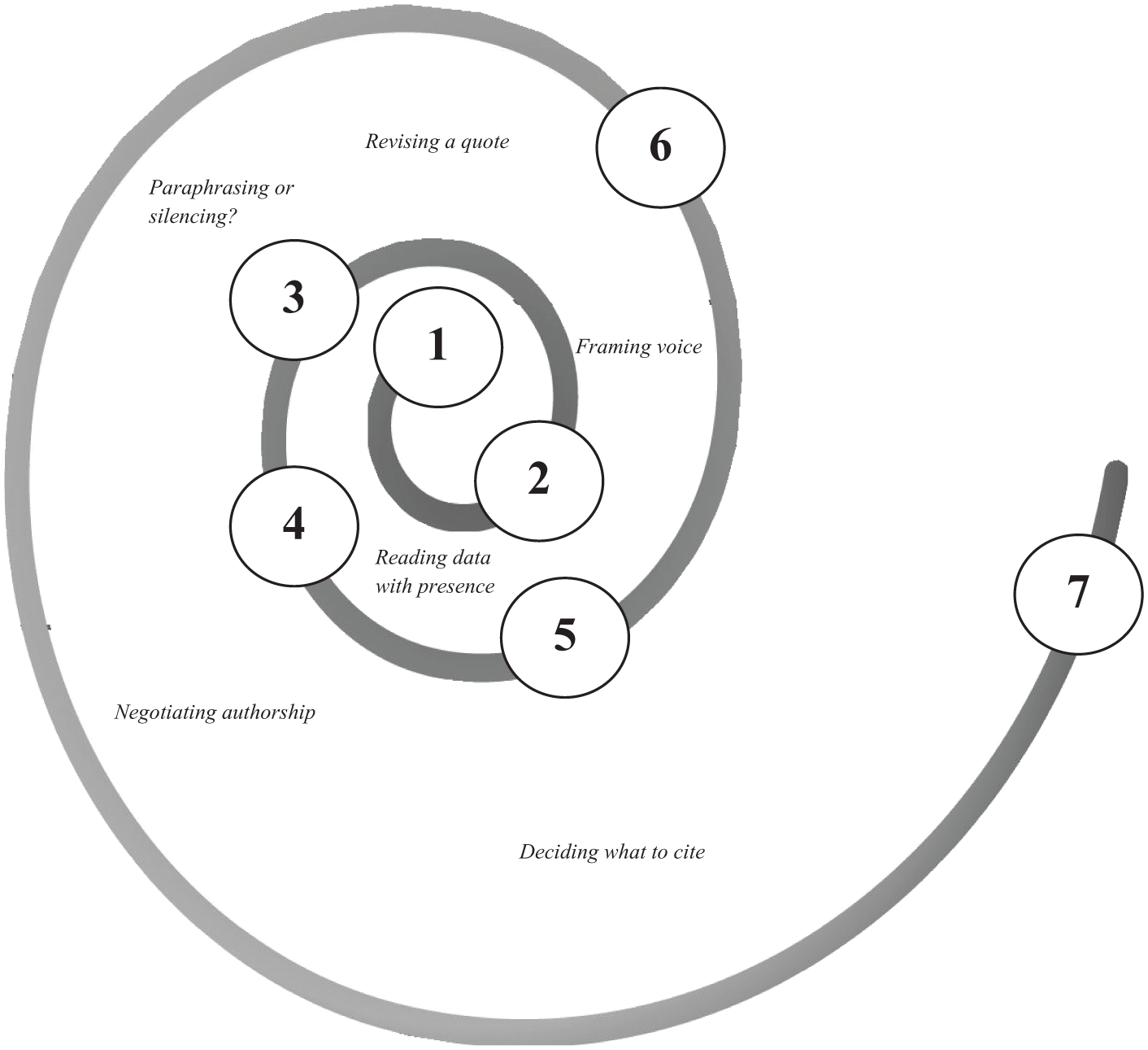
The spiral of Writing-With: Ethics as recursion and relation.
Rather than a linear sequence, the spiral shows how we are drawn back to earlier moments as new ethical questions arise. A decision we once framed as a matter of style (e.g. how to anonymise a school) returns later as we confront the politics of naming, or as a collaborator voices discomfort with the way their story is being told. We name teacher research and the dilemmas of anonymisation not to narrow Writing-With to educational inquiry, but to acknowledge one concrete site from which this stance emerged: practice-near collaborative research where writing is never merely representational and where what is named, withheld, or translated carries uneven consequences. The spiral thus functions not only as an evocative image, but as a methodological tool for tracking how ethical concerns surface, fade, and reappear across drafts, projects, and relationships.
Silence and ambiguity occupy a particular place within this spiral. As writers, we experience them as tension: a sense that there is more we could say, or that something crucial remains unspeakable. Writing-With asks us to read these moments not only as internal dilemmas but also as responses to wider conditions. Participants may withhold details to protect themselves or others. Collaborators may refuse certain forms of exposure, or choose opacity over transparency. Under regimes of surveillance, precarity, or censorship, not speaking can be a political strategy rather than an absence to be corrected. To write with is to recognise these silences as ethically significant in their own right and to resist the urge to resolve them simply to satisfy academic norms of completeness.
This is also why, when indicating that our articulation of Writing-With arises from particular disciplinary, institutional, and geopolitical locations, we do not mean that Writing-With belongs only to those locations. We mean that it matters from where, and in relation to whom, we speak. We do not write from neutrality. We write from within qualitative inquiry and collaborative writing relationships that have included teachers and students, and from institutions shaped by language politics, audit cultures, and uneven publication economies that make some forms of visibility safer than others. Our roles in these relationships have not been stable: we have moved between positions such as supervisor and doctoral researcher, teacher and teacher-educator, and senior and junior co-author, and those shifts shape what we can risk on the page, what we hesitate to name, and what we choose to hold back. Our writing has also been shaped through transnational academic relations where language, authority, and risk are unevenly distributed, and these relations condition what can be said safely, what must remain partial, and what it would be unethical to render fully legible. We encounter feminist, queer, Black, Indigenous, and decolonial scholarship not as resources we can simply “apply,” but as bodies of work to which we are accountable as learners. Part of Writing-With, for us, is staying alert to when our citational and representational habits might turn these traditions into ornament rather than relation. Positioning, then, is not a performance of disclosure but an ethical accounting of relation: a way of acknowledging that our invitations to opacity, refusal, or relational care are never made from outside power.
Importantly, Writing-With is not confined to co-authorship or to a particular discipline, language, or modality. It can emerge in the solitary labour of revising a thesis chapter, in a supervisor’s comments on a draft, in collaborative autoethnographic writing, in multimodal research-creation projects, or in community reports that may never be published in journals. In each of these sites, the question is the same: what kind of relation is our writing enacting, and for whom does it open or foreclose possibilities? Writing-With offers a way of staying with that question across contexts, without assuming the answers will look the same in every geopolitical or institutional setting.
Writing-With as ethical relation
If the previous sections traced how institutional frameworks often silence the ethical labour embedded in everyday decisions, this section asks a deeper question: what if writing itself is where ethics most fully lives, not just in what we write about or whose voices we include, but in the gestures of language: how we position ourselves in relation to others, how we cite, how we frame, and how we listen through our prose? What if writing is not only a method of dissemination but a site of ethical practice?
Writing-With begins here, not as an abstraction or a post-hoc rationalisation, but as a mode of ethical relation that is enacted through the act of writing. To write with is to acknowledge that writing always implicates others: our participants, our colleagues, our readers, our past selves. It is to understand that writing is never solitary, even when done alone. Every sentence carries traces of dialogue, heard, remembered, or anticipated. And every textual decision enacts a stance towards those voices.
In this sense, writing is not simply representational, but it is relational. It does not merely communicate findings, but it arranges proximity. It decides who is centred and who is footnoted, whose voice is preserved in quotation and whose is paraphrased for expedience, which epistemologies are treated as foundational and which are framed as context. These are not stylistic or structural choices alone, but they are ethical declarations, whether we name them as such or not.
Writing-With invites us to approach these choices with a different kind of attention. It encourages us to write as if relation mattered, because it does. This does not mean all writing must be dialogic in form or collaborative in authorship. It means recognising that all writing involves response-ability (Barad, 2007): the ability to respond, to remain in relation, to be shaped by what we carry into language. This is not a matter of simply writing more kindly or citing more broadly. It is about inhabiting writing as a space where ethics is not an add-on but a pulse and a rhythm that lives beneath the surface of our prose.
To adopt a Writing-With stance is to slow down, to listen, not just to what our participants say, but to how their words live in our texts, to notice when our own voice overwhelms, and to consider what it means to share credit, not only through authorship but through narrative weight. It is to become attuned to the silences that structure our writing: the stories untold, the edits unspoken, the hesitations that do not make it into the final draft but haunt it nonetheless.
Importantly, this is not about being ethically pure or morally superior. Writing-With is not a badge. It is a practice, a commitment to staying with the tensions of language rather than resolving them too quickly, a willingness to let our prose show where we are still learning, and a refusal to pretend that clarity always means correctness or that coherence always means truth. Sometimes, the most ethical thing we can do is to let ambiguity remain and to allow the writing to breathe, not as a performance of completion, but as a trace of encounter.
And so Writing-With does not offer a clear protocol. It is not a method that can be replicated or a checklist that can be applied. It is a disposition and a way of being with texts, with others, and with ourselves that refuses to sever writing from the ethical demands of relation. It is, in this way, a form of care, not sentimental care, but rigorous, recursive, and relational care. It is a way of asking: who do we carry in our writing, and how do we carry them?
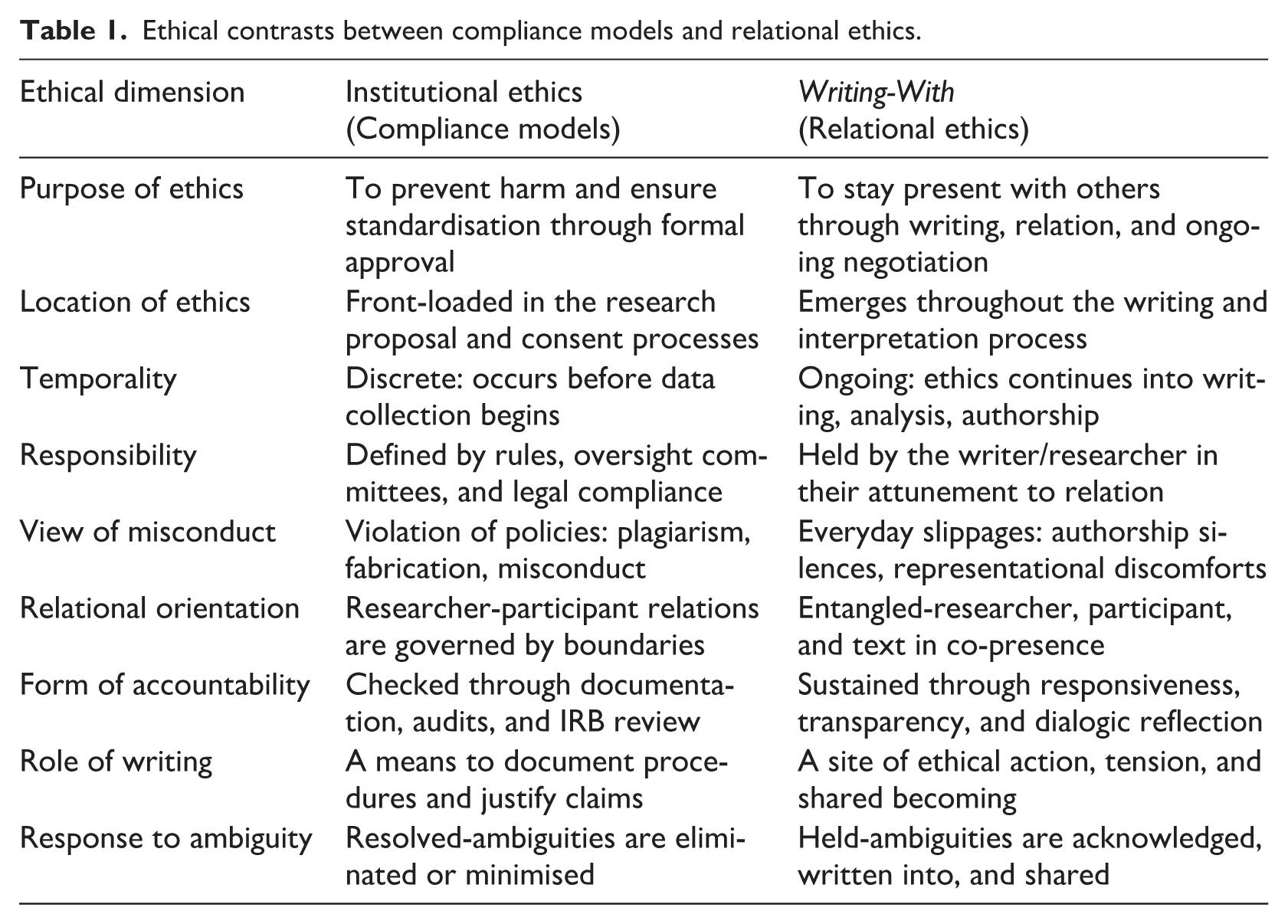
Taken together, if traditional ethics frameworks emphasise rules, approvals, and preemptive safeguards, Writing-With invites a more situated form of attentiveness, one grounded not in compliance, but in co-presence. Table 1 below offers a comparative synthesis, not as binary opposition, but as a generative contrast: a way to notice where ethical labour lives differently in relational writing.
Ethical contrasts between compliance models and relational ethics.
Practicing relational ethics: Writing-With in action
If Writing-With is an ethical stance enacted through language, then it must also be an invitation and an opening towards what might be possible when we write not to conclude, but to remain in relation. Ethics, in this view, is not something we possess but something we practice. And like any practice, it asks for repetition, improvisation, and attention to the small gestures that accumulate into a posture under uneven conditions of power, precarity, and surveillance.
This section is not a blueprint. It offers no framework for ethical perfection. Instead, it names possibilities and ways of being in research that emerge not from rulebooks, but from a sensitivity to how writing shapes relation across different geopolitical and institutional locations. These invitations will look and feel different in a doctoral thesis written under strict institutional regulation, in a community report that must circulate safely under censorship, or in a multimodal project combining text, image, and sound. They are not mandates. They are doorways.
One such possibility is to begin treating writing itself as data, not only the polished article, but the drafts, the comments, the tracked changes, the emails and messages between co-authors. Co-writing logs, marginalia, and version histories can be read as traces of how knowledge is constructed and how power moves: whose suggestions are taken up, whose comments are softened, whose hesitations are erased in the final version. Making these processes visible can be an ethical gesture, a way of staying accountable to how our writing becomes. At the same time, Writing-With asks us to attend carefully to consent and risk when treating such traces as data. Not all co-authors or participants can safely have their backstage negotiations rendered public, especially where employment is precarious or criticism of institutions is not tolerated. Sometimes, the ethical response is to attend to these traces privately, as a site of accountability, rather than to publish them.
Another possibility is to linger with difficulty. Rather than rushing to explain away contradiction or smooth over tensions, Writing-With invites us to write them in, not as problems to be solved, but as conditions to be honoured. A participant’s ambivalence, a co-author’s silence, a sentence that resists closure, these are not merely obstacles to clarity but openings for reflection. Silence and opacity may be protective or resistant strategies rather than gaps to be filled. To stay with a fragment rather than paraphrase it into thematic neatness, or to let a pause stand where a conclusion might go, is to recognise that people sometimes refuse full legibility for good reason. Under conditions of surveillance, racism, and coloniality, not saying everything can be a form of survival and care. Writing-With asks us to attend to these refusals politically, not simply as writerly tension.
This form of writing also invites us to rethink authorship, not just whose names appear on the byline, but how authorship is enacted in tone, structure, and epistemic positioning. In collaborative projects marked by hierarchies of seniority, contract security, race, gender, or geography, Writing-With may mean foregrounding tensions rather than masking them, writing with each other’s uncertainty rather than resolving it offstage. It may mean acknowledging when an early-career or precariously employed co-author takes on invisible labour to make a piece “publishable” in Euro-American venues, or when Global South scholars’ expertise is quietly routed through Global North theorists. It may also mean attending to the ghosts in our writing: the voices we do not cite but carry, the readings that shaped us but go unnamed, the community knowledges that inform our interpretations yet are not easily accommodated in journal formats.
For mentors and supervisors, Writing-With can offer a different way of accompanying novice researchers. Rather than focusing solely on writing as product, it calls us to notice writing as relation: how feedback is delivered, how voice is cultivated, how vulnerability is made safe. A mentoring relationship grounded in Writing-With does not aim simply to correct, but to co-journey. It creates space for revision not as failure but as recursive emergence, and it recognises that students and early-career researchers may be differently exposed to risk when they write critically about their own institutions, communities, or governments. Here, relational ethics includes asking what can safely be written, under what name, in which venue, and at what cost.
These are not novel propositions. Feminist, queer, Black, Indigenous, and decolonial scholars, as well as participatory and community-based researchers, have long called for more relational, reflexive, and structurally aware forms of inquiry. Writing-With does not claim to originate this call or to speak for these traditions. It joins them from a particular institutional and geopolitical location, and it asks us to listen again, not just to what we say about ethics, but to how our writing enacts it in concrete settings: who is cited, who is anonymised, which languages and modalities are legitimised, and which must remain at the edges of the text.
In all of this, the core question remains: what kind of relation does our writing perform, not just what arguments we make, but what stance we take towards our collaborators, our participants, our readers, and ourselves? Writing-With is not the only way to answer that question, but it is one way to stay with it, particularly when ethical tensions are heightened by hierarchy, racialisation, colonial histories, and precarity.
Conclusion: Writing-With integrity
We began with a question that rarely makes it into published methods sections: not “How do we follow the rules?” but “What does it mean to write with integrity when the rules fall short?” Across the preceding sections, we have traced the limits of institutional ethics frameworks, the quiet labour of everyday negotiation, the recursive spiral through which ethical tensions return, and the invitations that emerge when we treat writing as a space of ethical encounter. We have suggested that research integrity cannot be secured solely through compliance with institutional procedures, but it is also enacted, precariously and imperfectly, in the sentences we craft, the citations we choose, the silences we honour, and the relations we sustain.
Writing-With is not offered here as a corrective or a replacement for existing guidelines, nor does it resolve the complexities of authorship, representation, or accountability. Rather, it names a shift in posture: from writing as delivery to writing as relation, from ethics as pre-emptive risk management to ethics as ongoing response-ability, from individual reflexivity to an attention to how structural conditions, such as academic hierarchies, racialised citation practices, colonial knowledge orders, precarious contracts, and regimes of surveillance, press on our choices as writers. Its distinctive contribution is to keep the ethical and political stakes of writing itself at the centre of integrity work, showing how micro-textual decisions and macro-structural forces are entangled rather than separate.
To write with integrity, in this view, is not to avoid error, but to remain attentive to how our prose carries the weight of our decisions. It is to notice how citation can either obscure or acknowledge the lineages we draw on, how paraphrasing can either preserve or dilute participants’ affective and political force, how voice can either flatten or open space for multiplicity, how silence can either erase or protect. It is to allow hesitation into our texts, not as a flaw, but as a form of humility, and to recognise that sometimes the most ethical response is to leave something unsaid, to respect opacity or refusal rather than insisting on full disclosure.
The work of Writing-With is slow, recursive, and sometimes uneasy. It resists the urge for resolution. It remains open to being unsettled as we encounter new collaborators, participants, and publics. But in that openness lies its ethical promise: to hold complexity without collapsing it, to write not only about relation but through it, and to acknowledge that our own positions, as supervisors or students, as scholars in the Global North or Global South, as precariously or securely employed, as writing in dominant or marginalised languages, shape what Writing-With can look like. We do not offer a universal template. Our articulation of Writing-With arises from particular disciplinary, institutional, and geopolitical locations, and we expect and welcome that it will be taken up, reworked, and contested elsewhere.
Such a stance may be especially resonant for early-career researchers learning to navigate reflexivity under pressure to publish, for collaborative teams negotiating voice and authorship across inequalities of status and safety, and for interdisciplinary scholars working across epistemological and linguistic borders. It may also speak to those engaged in multimodal and community-based projects where the risks of exposure and the politics of representation are sharp. Writing-With does not offer answers, but it keeps the ethical questions alive and locates them in the everyday labour of writing.
As we close, we do not conclude. Instead, we leave a trace and a sentence, perhaps unfinished, and a gesture towards the page as a shared space where meaning is never fully owned, but always becoming. If there is integrity in this practice, it lives not in what we claim, but in how we keep showing up to the work of writing, again and again, with others, with care, and with an awareness of the histories and structures that make such writing both possible and fraught.
Footnotes

Ethical considerations
Not applicable.
Funding
The authors received no financial support for the research, authorship, and/or publication of this article.
Declaration of conflicting interests
The authors declared no potential conflicts of interest with respect to the research, authorship, and/or publication of this article.