



Abstract
Responsible research practices are critical to maintaining integrity in research and the provision of institutional trainings is an important means of promoting research integrity. However, studies show contrasting results on the efficacy of institutional training and that these approaches may not be fully effective in promoting research integrity among individuals and improving the overall climate in research integrity. Therefore, a more comprehensive multi-dimensional learning strategy seems to be needed. This includes continuous and tailored training at different institutional levels, the incorporation of training sessions focusing on the development of the moral character of researchers, and the use of different mentoring practices. With this comprehensive approach, research institutions can foster a culture of integrity in research, improve the overall research integrity climate and promote responsible research practices by individuals.
Background
The European Code of Conduct for Research Integrity and recent European Commission (EC)-funded research activities highlight the important role that research institutions have in providing adequate research integrity (RI) education. In addition to recommending RI trainings for all career levels and for all stakeholders involved in research-related activities, it is also emphasised to provide adequate training sessions and responsible mentoring practices (primarily by research supervisors) to educate doctoral researchers and early career researchers (ECRs). This is crucial to train future professionals to properly design, structure, analyse, disseminate and communicate their research activities and foster a culture of integrity in research (All European Academies (ALLEA), 2023; Forsberg et al., 2018; Mejlgaard et al., 2020). The general recommendations for organising RI training at the institutional level can be summarised as follows: institutions should be responsible for providing training on RI and adapting it according to discipline or research area and career stage (ALLEA, 2023; Forsberg et al., 2018). Further studies suggest that RI training should start at an early stage, using proactive teaching approaches and focusing on developing the moral character of researchers (Inguaggiato et al., 2023; Pizzolato and Dierickx, 2021). In line with the suggestion regarding commencing RI training as early as possible, the EU-funded project Path2Integrity and Integrity focused their studies on the development of training materials tailored for high-school students and undergraduates. In addition, in relation to the suggestion to create training materials focusing on the development of researchers’ moral character, another EU-funded project, VIRT2UE, developed an entire programme based on the virtue-ethics approach.
The organisation of institutional trainings is one of the most effective strategies that research institutions have to effectively foster responsible research and achieve RI-recommended goals (e.g. raising awareness, improving knowledge and skills, theoretical attitudes and practical behaviour) (Antes and DuBois, 2014; Kalichman and Plemmons, 2007). The usual strategy of institutions to promote individual and collective RI competencies is generally based on the delivery of training sessions covering general and broad RI topics (Abdi et al., 2021a).
Institutional training sessions on RI provide theoretical and general knowledge on the subject with the aim of stimulating discussions on general RI-related issues. But this may not be sufficient to address RI at a detailed and discipline-specific level and to translate theoretical competences into daily practice. Although various trainings have been developed over the past decades (Abdi et al., 2021a; Pizzolato et al., 2020), studies on their effectiveness provides contrasting opinions. While some of them show little or no impact (Abdi et al., 2021b; Marusic et al., 2016; Than et al., 2020), some others provide encouraging results (Katsarov et al., 2022; Todd et al., 2017; Watts et al., 2016). Assessing the efficacy of this typology of training is challenging due to the fact that RI practices can be defined as a mixture of knowledge, skills, the right attitude and responsible behaviour of researchers. Having the right learning strategy seems to be crucial to promote RI. Moreover, most of the training provided by universities and research institutions is done by senior academics. In this case, the flow of information is provided in one way, from the seniors to the juniors. This unidirectional top-down approach seems insufficient to promote individual responsible research practices and to improve the overall RI climate (Eisen and Berry, 2002; Haven et al., 2019; Hofmann and Holm, 2019). One possible way to increase the overall efficiency of RI training is to propose a learning strategy in which the usual unidirectional flow of RI-related information can be complemented by the simultaneous use of different learning strategies and training approaches at different levels.
This article aims to provide a set of recommendations on how universities and research institutions can promote and support a strategy based on complementing and blending different educational practices already in use in different institutions and at different levels (e.g. faculty, department, doctoral school). To develop these recommendations, we have considered empirical articles, commentaries and reviews published in recent years and developed within the framework of projects funded by EC and the authors’ research team. These papers were developed and analysed during the 5-year collaboration between the authors. The recommendations were firstly conceptualised while analysing the different studies and finalised only when a broad overview of the matter was available. The recommendations in this publication are developed from and based on research conducted in the European setting, and they are primarily relevant for European research institutes. Although these recommendations may be relevant outside of the European setting (e.g. in North America, Asia and Australia), cultural and organisational factors might render them less valuable and implementable. Outside the European context, different studies have been carried out on the same issue (Phillips et al., 2018; Robishaw et al., 2020; Sefcik et al., 2020; Yi et al., 2019). In the next section, we present each recommendation by highlighting the published paper(s) from which it originated.
How can different training approaches and practices complement each other?
This section aims to provide recommendations and suggestions on how different training practices and approaches can complement each other at different levels. At an overarching level, universities and research institutions should promote the organisation of RI training focusing on providing general knowledge about RI to raise awareness of the topic. This is typically done by universities in the northern part of Europe by providing face-to-face or online sessions (Abdi et al., 2021a). These trainings are organised especially to address PhD and early career researchers (ECRs) who may not yet be familiar with the topic. This approach has been recommended multiple times by experts on the topic (ALLEA, 2023; Forsberg et al., 2018; Mejlgaard et al., 2020). Such training can initiate discussions about responsible research practices and foster a collective culture of integrity. In addition, RI training sessions can provide opportunities to start learning about RI-related issues in research, develop ethical thinking and problem-solving skills and promote the adoption of best practices and guidelines for responsible research practice. Overall, general training in RI can serve as a foundation for promoting responsible research practices and developing a culture of integrity within research institutions. This approach has been using for several years now by different European universities (Lerouge and Hol, 2020).
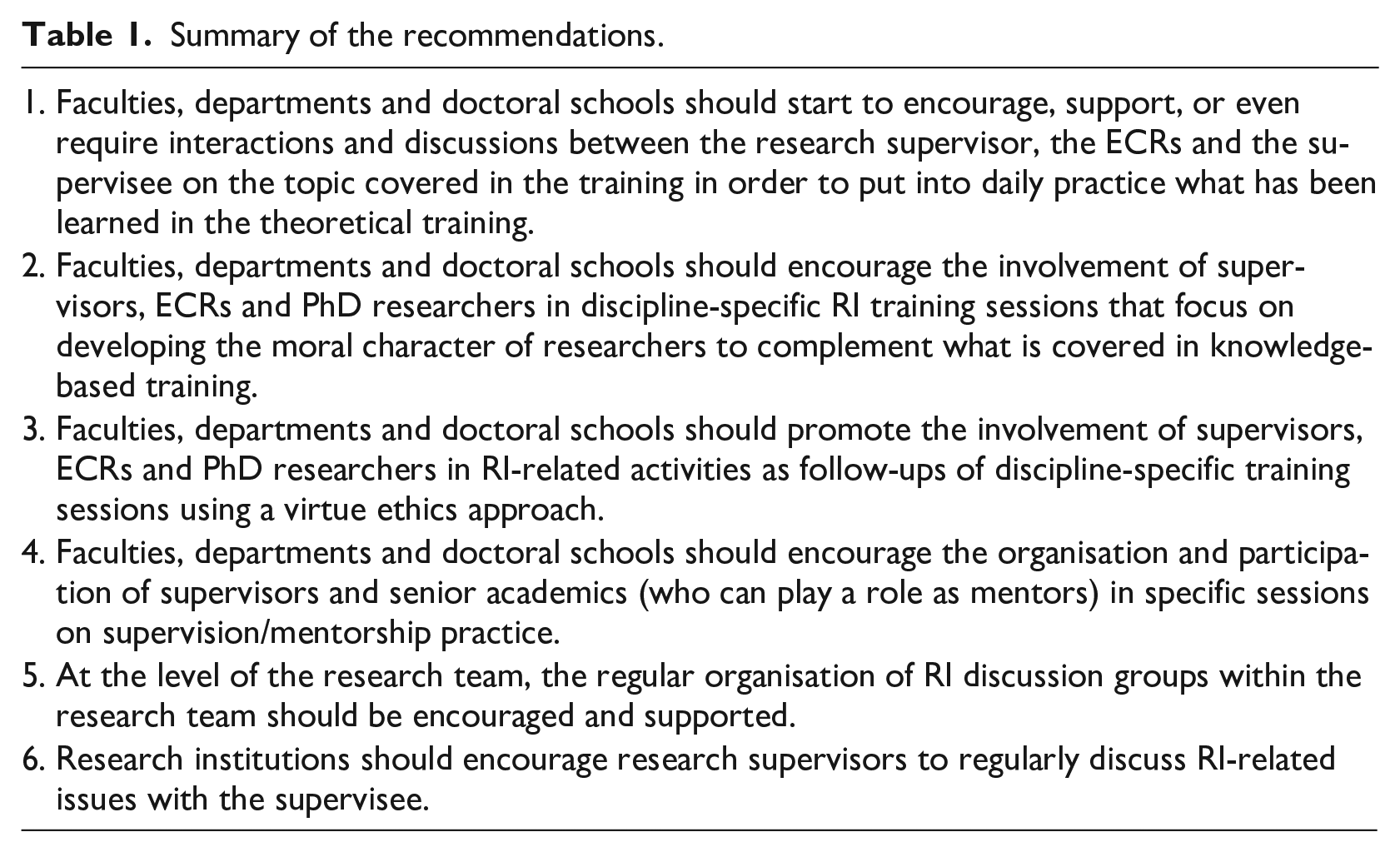
Although this approach has the benefit of increasing awareness and providing general knowledge on the topic of RI, it might be insufficient to address the many facets that the topic can have depending on the specificity of the academic discipline, field, or typology of research study. Therefore, at the levels of the faculty, departmental and doctoral schools, where the specificity of the scientific domain increases, training sessions should focus on continuous and tailored training according to discipline and career level to make responsible research practices more relevant to daily research activities. Such training can also help to clarify possible differences in the way researchers perceive responsible research practices. The information provided in such training can be supplemented by research supervisors who can help to transfer what is learned in departmental sessions into daily practice. At this level, faculties, departments and doctoral schools should start to encourage, support, or even require interactions and discussions between the research supervisor, the ECRs and the supervisee on the topic covered in the training in order to put into daily practice what has been learned in the theoretical training. A similar approach is already in use at the Amsterdam UMC, where PhD researchers are asked to organise a meeting with their supervisors to start a dialogue about RI (Inguaggiato et al., 2023).
At these levels, training sessions should focus on providing more specific competencies by incorporating in this some elements that focus on the development of researchers’ moral character (Evans et al., 2023; Inguaggiato et al., 2023). Besides providing information concerning rules, codes and policies, training sessions should take into consideration strategies acting on researchers’ moral behaviour and the development of professional virtues (Pennock and O’Rourke, 2017; Pizzolato and Dierickx, 2021; Tomić et al., 2022). This type of training is important to address discipline-specific RI issues and for the development of researchers’ moral character and ethical thinking and can have a positive impact on researchers’ theoretical attitudes and practical behaviour. This training includes discussions on general and discipline-specific cases to foster critical thinking in relation to the topic of RI. Utilising actual or hypothetical scenarios involving ethical dilemmas can enhance students’ understanding of the intricacies involved in making rule-based decisions (Wolpe, 2006). Faculties, departments and doctoral schools should encourage the involvement of supervisors, ECRs and PhD researchers in discipline-specific RI training sessions that focus on developing the moral character of researchers to complement what is covered in knowledge-based training. After the completion of the training, it is important that the ones involved in it should also start discussing specific (first-hand) real-life cases to understand each other viewpoints. Faculties, departments and doctoral schools should promote the involvement of supervisors, ECRs and PhD researchers in RI-related activities as follow-ups of discipline-specific training sessions using a virtue ethics approach.
Besides being promoted by providing RI training sessions, RI can be fostered by ensuring responsible supervision and mentorship practices (Gray and Jordan, 2012; Pizzolato and Dierickx, 2022a). It is important for research supervisors, and academics who can play the role of mentors, to develop specific skills to avoid irresponsible supervision/mentorship that can be detrimental to RI (Gray and Jordan, 2012; Krishna and Peter, 2018). In addition to focusing on RI, faculties, departments and doctoral schools should encourage the organisation and participation of supervisors and senior academics (who can play a role as mentors) in specific sessions on supervision/mentorship practice. An example is the ‘Superb Supervision’ training, where supervisors can follow a 3-day training on supervision practices (Haven et al., 2022).
Training sessions can also be organised at the research team level, where the entire research team can discuss precise and work-related RI issues. This approach, known as group mentoring, can overcome the normal one-to-one relationship between the supervisor and the supervisee to expose PhD researchers, but also ECRs and research supervisors, to different viewpoints (Haven et al., 2020; Whitbeck, 2001). In terms of teaching responsible research practices, all supervisors and senior members of the team act as mentors and influence ECRs and PhD researchers. In addition, peer mentoring and reverse mentoring can play a crucial role in elevating research team awareness and competences in terms of responsible research practices (Farid et al., 2022; Pizzolato and Dierickx, 2022b). In this way, ECRs and PhD researchers can proactively contribute to the discussion and bring new insights related to responsible practices and open science. At the level of the research team, the regular organisation of RI discussion groups within the research team should be encouraged and supported. A similar approach has been already described by Peiffer et al. (2011) in their work ‘Ethics in 15 min per week’.
Although discussing RI with peers and multiple supervisors has its advantages (Peiffer et al., 2011), the role and influence of primary supervisors in teaching responsible research practices and modelling the moral character of supervisees as researchers is crucial (Lee et al., 2007; Pizzolato and Dierickx, 2022a). Research institutions should encourage research supervisors to regularly discuss RI-related issues with the supervisee. Responsible supervision is more than supporting and transferring RI practices (intellectually and behaviourally); it is also acting as role models, supporting supervisees in management issues (e.g. during doctoral/research trajectories), helping supervisees in creating a research network, providing emotional support to supervisees and monitoring supervisees’ stress levels (Brown and Treviño, 2014; Lee et al., 2007; Pizzolato and Dierickx, 2022a).
Multi-dimensional learning strategy
In the previous section, we have shown how different training practices with different approaches and objectives can complement each other to deepen and broaden RI competencies. A multi-dimensional learning strategy refers to an approach that incorporates various dimensions or aspects to optimise the learning experience and outcomes (Astleitner, 2018). The proposed multi-dimensional learning strategy is made by different training approaches organised at different levels to provide more customised RI skills (Table 1). Training sessions for large audiences, training sessions with different learning objectives and training sessions that are increasingly individualised and discipline-specific can all be part of the same institutional strategy to promote responsible research practices and a collective RI climate.
Summary of the recommendations.
At different levels, researcher supervisors, senior academics, ECRs and PhD researchers can constructively discuss and interact with each other and develop common RI competencies. Constructive dialogue between senior and junior academics can complement traditional unidirectional top-down learning to better promote individual responsible research practices and the collective RI climate. This idea of a multi-dimensional learning strategy emphasises the active participation of all academics (senior and junior) involved in research in various learning activities. This multi-dimensional learning strategy aims to promote RI by developing a system consisting of training sessions (e.g. RI content, moral character and supervision/mentorship practice) and different typologies of mentorship approaches (e.g. normal mentoring, reverse mentoring, peer mentoring, group mentoring). The focus of this approach is on complementing traditional learning and on the exchange of knowledge, competences, viewpoints and ideas between all parties involved in the research endeavour (Loyens and Gijbels, 2008). This approach can create a dynamic learning environment in which all parties are actively involved and which goes beyond the traditional one-way flow of information from teachers to students. ECRs and PhD researchers are encouraged to take the initiative and play an active role in enriching the discussion on RI. This learning strategy can help create a more inclusive and diverse learning environment by fostering empathy, respect and mutual understanding and encouraging constructive dialogue.
Footnotes
Acknowledgements
We would like to thank the reviewers for their valuable comments and suggestions in improving this manuscript. We are grateful to all the colleagues who collaborated with us in the past years and who were part of all research activities that inspired this manuscript.
Author contributions
DP and KD contributed to the conceptualisation and drafting of the manuscript.
Funding
All articles in Research Ethics are published as open access. There are no submission charges and no Article Processing Charges as these are fully funded by institutions through Knowledge Unlatched, resulting in no direct charge to authors. For more information about Knowledge Unlatched please see here:  .
.