




Abstract
While the need to protect vulnerable research participants is universal, conceptual challenges with the notion of vulnerability may result in the under or over-protection of participants. Ethics review bodies making assumptions about who is vulnerable and in what circumstance can be viewed as paternalistic if they do not consider participant viewpoints. Our study focuses on participant vulnerability in Scholarship of Teaching and Learning (SoTL) research. We aim to illuminate students’ views on participant vulnerability to contribute to critical analysis of the role and processes of ethics review. Additionally, we aim to highlight the importance of seeking the views of participant communities, especially in research environments beyond ethics review’s medical origins. Thirty-four students from a health-related faculty at a university in Aotearoa New Zealand, participated in five focus groups. Participants discussed factors affecting their potential participation in research drawing upon a series of vignettes based on examples of published SoTL projects. Themes, generated using reflexive thematic analysis, built a participant-informed picture of vulnerability. Findings indicate that students do not generally consider themselves vulnerable and instead consider participation in SoTL research through an agentic lens. Students expect that participation will be voluntary, not negatively impact their grades, and not single them out so that others could judge them. Our study also highlights the value students place on relationships with one another and teaching staff and the implications these have for SoTL research participation and future professional practice. This research challenges research ethics committees to think further about vulnerability in the context of SoTL whilst highlighting the importance of providing opportunities for research participants more broadly to explore and vocalize their views as members of participant communities.
Keywords
Introduction
Participant vulnerability is a ubiquitous concern within ethics review processes. With a legacy established in medical research of the potential for research participants to experience actual or perceived harm, the consideration of participant vulnerability by researchers is an important one. There are arguments that vulnerability is a vague concept (Kipnis, 2001), but literature drawing on participants’ perspectives of vulnerability is limited. Ketefian (2015) claims that vigilance is required to ensure the vulnerable, “who are least able to speak on their own behalf,” are adequately protected (p. 165). However, Neville and Haigh (2003) caution against making too many assumptions about types of protection participants may need or want without seeking their views, echoing calls for participant perspectives on vulnerability to be included in research ethics policy and practice (Bracken-Roche et al., 2017).
In this paper we explore students’ perspectives of participant vulnerability, positioning our research specifically within the Scholarship of Teaching and Learning (SoTL). We begin by examining participant vulnerability within a broader research context before considering SoTL as a distinct research setting. Drawing from focus group discussions with tertiary students within a university health faculty in Aotearoa New Zealand (NZ), we aim to illuminate the extent to which students may feel vulnerable participating in SoTL research and the nature of that vulnerability. By offering students an opportunity to share their views, we seek to understand how students consider adequate protection as SoTL research participants. Exploring concepts inherited from biomedical research ethics, such as vulnerability, can enhance understanding of the appropriateness of ethics review beyond its medical origins. Assessing the effectiveness of ethics review bodies is an important endeavor (Tsan, 2019), yet evaluative studies have often excluded participant perspectives (Nicholls et al., 2015). We aim to demonstrate the importance of participant perspectives in informing expectations of ethics review and ethical conduct in SoTL research.
Background
Participatory vulnerability has been linked to various ethical principles such as respect for persons, beneficence and justice, concerning several elements of participation, from recruitment and consent to balancing the benefits and harms of participation (Racine and Bracken-Roche, 2019). While there is consensus on the need to identify and protect subjects of human research who may be harmed or wronged through participation, there is concern that this is challenging when vulnerability, as a term, remains vague (Hurst, 2008; Kipnis, 2001; Schroeder and Gefenas, 2009). Within a research ethics context, numerous categorizations of vulnerability exist, from membership in a specific population, such as minors or minorities and those affected by their circumstances, for example, a lack of education, poor health or exploitation (Chadwick et al., 2011; Silvers, 2004), to context (Kipnis, 2001), and whether the nature of the vulnerability is persistent or variable (O’Neill, 1996). Others question whether the notion of vulnerability is a principle in its own right (Ten Have, 2015). Critique about the utility of “vulnerability” as a concept is widespread. There are claims that vulnerability has “lost force” (Levine et al., 2004: 44) with “muddled usage” (Silvers, 2004: 57) amid concerns in the social sciences that vulnerability is “an imaginary label” (van Den Hoonaard, 2018: 305). As a result, the practical and conceptual challenges of vulnerability may result in the under or over-protection of participants by ethics review bodies. In recognizing the need for balancing participation opportunities with participation protection, Moreno (2004) calls for an ethics review policy that is “just inclusive enough” (p. 53). We are interested in learning from students about what “just inclusive enough” might look like in SoTL research.
Ethics review bodies draw on various global and local documents when considering participant vulnerability. In NZ, the context of our study, the National Ethics Advisory Board – Kāhui Matatika o te Motu (National Ethics Advisory Committee [NEAC], 2021), guides institutional ethics review. NEAC draws on the World Health Organization (WHO) and the Council for International Organizations of Medical Sciences (CIOMS), a non-governmental, non-profit group established by WHO and the United Nations Educational, Scientific and Cultural Organization (UNESCO) to guide health research. They define vulnerability in Section 6 of their National Ethical Standards as: a substantial incapacity to protect one’s own interests owing to impediments such as lack of capability to give informed consent, lack of alternative means of obtaining medical care or other expensive necessities, or being a junior or subordinate member of a hierarchical group (NEAC, 2021).
The World Health Organization (WHO, 2011) provides specific instances of participants who are likely to hold junior or subordinate roles: “Examples are members of a group with a hierarchical structure, such as medical, pharmacy, dental, and nursing students” (p. 41). Hierarchies contain unequal relationships and research participants in unequal relationships may be unable to protect their interests and be over-researched, resulting in harm or wrongdoing (Rogers and Ballantyne, 2008). Therefore, it is plausible that the teacher-student hierarchy potentially creates vulnerability for student participants of SoTL research. This assumption invites further examination. From around the mid-1960s, medical students began to be considered vulnerable research participants (Dyrbye et al., 2007). However, it appears that rather than vulnerability coming from classroom-based research opportunities, the nature of this vulnerability stemmed from pressures from their teachers to participate in their clinical research. Examples include “experiments involving the use of radioactive materials” (Christakis, 1985: 2) and students collecting and testing their genetic material (Klitzman, 2022). In these situations, a perception or reality of having to participate may have placed the student under duress and in a vulnerable position in relation to their health, resulting in the WHO voicing concerns about classroom coercion and the harms of hierarchical relationships.
Radioactive and genetic materials aside, it is important to consider how vulnerability manifests across learning and teaching settings. Do student participants suffer from a “substantial incapacity to protect their own interests,” as NEAC cautions? Alternatively, has the original concern for protecting nursing, medical and dental students from being cajoled into their teacher’s clinical research spilt over into a blanket concern for classroom-based research activities and researcher-instructor dual-roles more broadly? The main thrust today of ethics review bodies’ concern for student participants of SoTL research focuses on the nature of the teacher-student relationship. The common narrative is that the teacher’s dual role as teacher and researcher risks actual or perceived issues of coercion (Aycock and Currie, 2013). Dual roles potentially create a power imbalance which may unduly influence participation decisions (Comer, 2009; Lumley and Jasinski, 2013) which in the context of SoTL, are due to a perceived relationship between participation and grades (Clark and McCann, 2005; Ferguson et al., 2004; Loftin et al., 2011). However, students are “generally healthy, and clear thinking” (Cleary et al., 2014: 93), reflecting a competence to consent (Anderson, 2011). Labeling student participants as vulnerable may appear condescending, and members of a participant community may want to demonstrate that they can make their own decisions about whether they are vulnerable (Iphofen, 2009). In addition, students in many disciplines learn about consent processes, especially in health-related degree programs. While pressure to participate can be a factor that creates vulnerability, there are suggestions that knowledge of consent processes may mean that students are less likely to feel pressured into participation (Christakis, 1985).
Studies specifically seeking students’ perspectives in SoTL research are scarce, with most studies from medical education settings in the United States of America (US). For example, medical students canvassed by Forester and McWhorter (2005) reported not feeling coerced or violated (experiences often linked to participant vulnerability) when participating in education research, provided the research was voluntary and anonymous. The authors noted that these findings were in contrast to perspectives in the literature at the time and positions held by institutional review boards that such participants needed protecting. As a result, the researchers concluded that aspects of the review process may be “both unnecessary and inappropriate” (p. 785). A subsequent study of US-based medical students by Sarpel et al. (2013) also found that students did not feel undue coercion or compulsion to participate.
More recently, Innocente et al. (2022) analyzed data from 42 students from two Canadian universities representing diverse disciplines and stages of tertiary study. They found that students recognized a potential vulnerability in SoTL participation relating to a risk to their grades, the coercive nature of research incentives and a desire to present themselves in a positive way to their teacher. However, participants in their study did not consider students to be a vulnerable population. Furthermore, they found that, on balance, “students may not view the ethical dilemmas of SoTL with as much concern as the existing literature suggests” (p. 124). There is a clear rationale to examine the extent to which vulnerability is balanced with the opportunity to participate in SoTL research and what is foregone when students are deemed vulnerable.
Positioned within the health and biomedical-related histories and debates of ethics review and set within tertiary health education, the aims of our study are two-fold. Firstly, to illuminate students’ views on participant vulnerability in SoTL research and thereby contribute to critical analysis of the role and processes of ethics review. Secondly, we aim to highlight the importance of seeking the views of participant communities as part of an ongoing critical analysis of ethics review processes, especially in research environments beyond the medical research origins of ethics review. In doing so, the study’s findings have the potential to educate ethics committees regarding the views of SoTL participants.
Methods
This study adopts a qualitative case study methodology informed by the work of Stake (1995, 2005). Our study reports original research findings from a health-related faculty in a NZ tertiary institution. The study was part of a broader international multi-site, nested case exploring ethical conduct and ethics review within SoTL research. A case study is a comprehensive research strategy in the social sciences: “an in-depth exploration from multiple perspectives of the complexity and uniqueness of a particular project, policy, institution, programme or system in a ‘real-life’ context” (Simons, 2009: 21). Common to case study research is the notion that the case can be viewed as a contained unit (Thomas, 2016), a system bound by time, place and context (Stake, 2006) with the complexity within becoming the focus of what is studied. Bounded or contained within the NZ university site, this nested case study focused specifically on understanding students’ perspectives of ethical conduct in SoTL research as members of the SoTL participant community. All participants were students studying undergraduate degrees within a health-related faculty and included students from the disciplines of paramedicine, oral health, public health, coaching, and general health or sports science. Data was collected between 2020 and 2021, with some interruptions due to local COVID-19 restrictions. We opted not to collect demographic data. Not only was our study exploratory in nature, given the scarcity at the time of studies reporting students’ views of vulnerability but with varying class sizes and a diverse student body, we were also mindful of ethical considerations in terms of protecting the identity of participants, especially given our focus was on vulnerability.
Recruitment
We chose weeks in the semester when students were more likely to have time to consider the invitation to participate, for example, during periods of low assessment load. Students were self-selecting but ineligible to participate if they were current students of the primary researcher. With the permission of lecturers, the primary researcher attended a range of in-person classes to introduce the study and disseminate participant information. A box was left for interested students to submit contact details. The primary researcher returned to the class later to answer any questions and collect participant contact details. We recruited a total of 34 students. Five in-person focus groups ranged from four to ten participants, and discussions ranged from 42 to 64 minutes. Focus groups were conducted following a scheduled class and comprised class-specific participants. Refreshments were available to participants, and on completion of the focus group, a $20 store voucher was given as koha. 1
Data collection
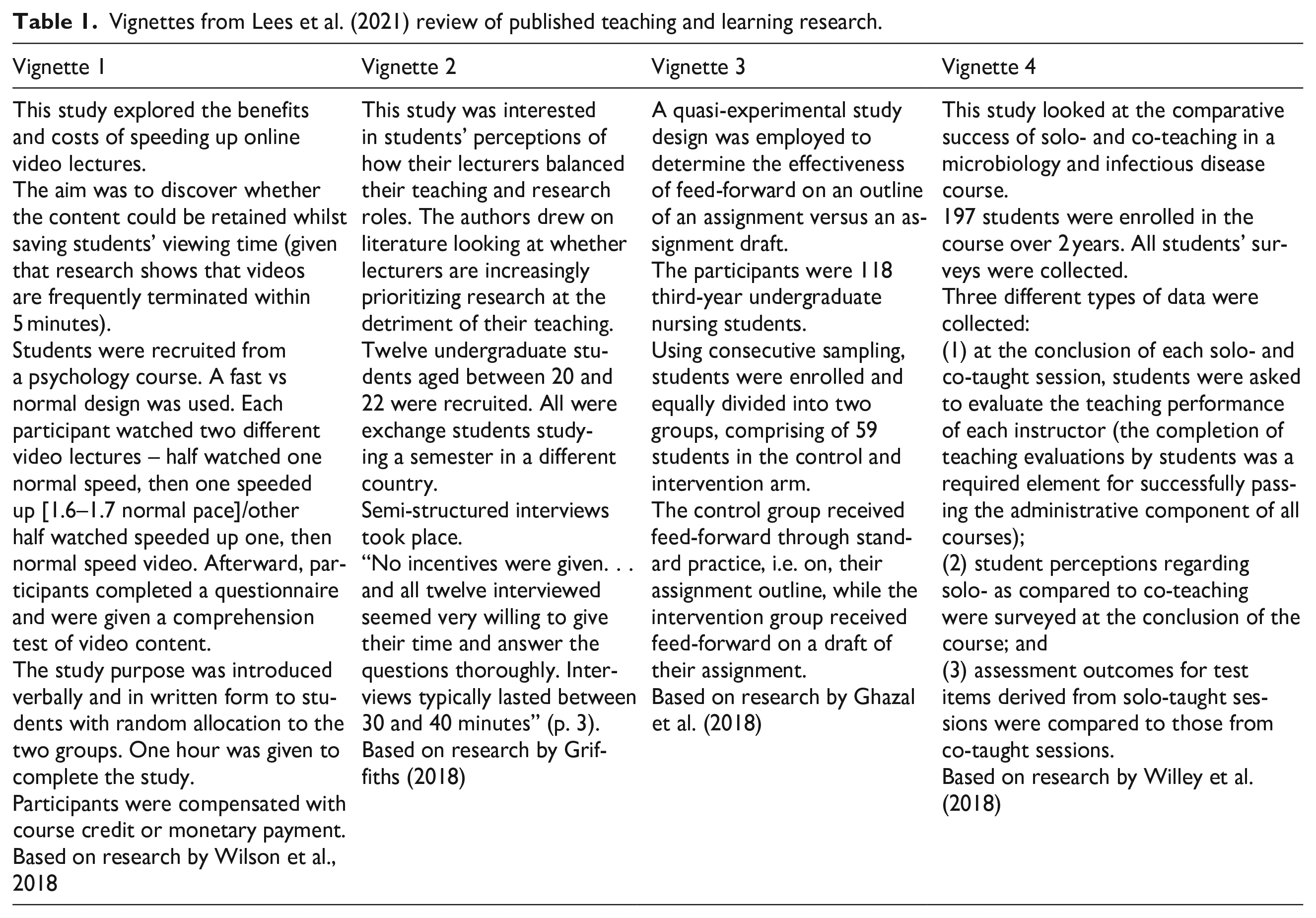
Vignettes provided discussion prompts during the focus groups (Table 1). Vignettes can be effective irrespective of participants’ knowledge of the topic under discussion (Hughes and Huby, 2002). Experience as a SoTL research participant was not an eligibility criterion, so using vignettes provided all participants with shared scenarios on which to base their responses. The scenarios comprised a range of research designs utilized in SoTL research: an anonymous questionnaire, individual interviews, quasi-experimental design and educational intervention with grade correlation drawn from an earlier cross-sectional review we conducted (Lees et al., 2021). Initially, we chose six vignettes but reduced these to four because of a pilot study in which we observed that fewer vignettes enabled sufficient discussion within a more appropriate time frame. During each focus group, the primary researcher provided the participants with a written summary of each vignette while also verbally describing each scenario. Participants were invited to consider each vignette from the perspective of a hypothetical potential participant and the likelihood of them being interested in participating. Participants were asked to consider why they might feel comfortable or uncomfortable with the prospect of participating in each study, including whether their perspective might change depending on whether the researcher was known to them. Interspersed in the discussion of each vignette were semi-structured questions about the relevance of specific terminology traditionally used by ethics review bodies for research in SoTL settings, for example, consent, power imbalance and vulnerability. An open-ended focus group design enabled the nature of student responses, interactions among participants, and follow-up questions from the researcher to shape the conversation. Focus groups were recorded using a smartphone and an audio recorder as a backup and transcribed using the speech-to-text application otter.ai.
Vignettes from Lees et al. (2021) review of published teaching and learning research.
Reflexive thematic analysis
Our reflexive thematic analysis was based on phases of familiarization, clustering, coding, refining, naming and report writing (Braun and Clarke, 2021). The primary researcher undertook the early phases of familiarization, clustering and coding, with all researchers contributing to refining, naming and report writing. A single coder is considered “normal practice, and indeed good practice” in reflexive thematic analysis (Braun and Clarke, 2021: 55).
Before analyzing data, the recordings were listened to by the primary researcher for initial familiarization and accuracy checking. Transcripts were anonymized, replacing participant names with a coded identifier capturing the specific focus group and the participant. To further ensure confidentiality, references students made to particular lecturers were removed. The primary researcher examined transcripts for instances where students spoke about vulnerability, or the conversation reflected common ideas from the literature on participant vulnerability. For example, they noted where students discussed apprehension about research participation potentially impacting their grades. Our choice to focus on semantic, or more overt meaning-based, coding stemmed from our interest in participants’ perspectives and our desire to adhere closely to their explicit viewpoints (Braun and Clarke, 2021). Staying close to their voices seemed especially important when little literature portrayed students’ perspectives of vulnerability in SoTL research participation.
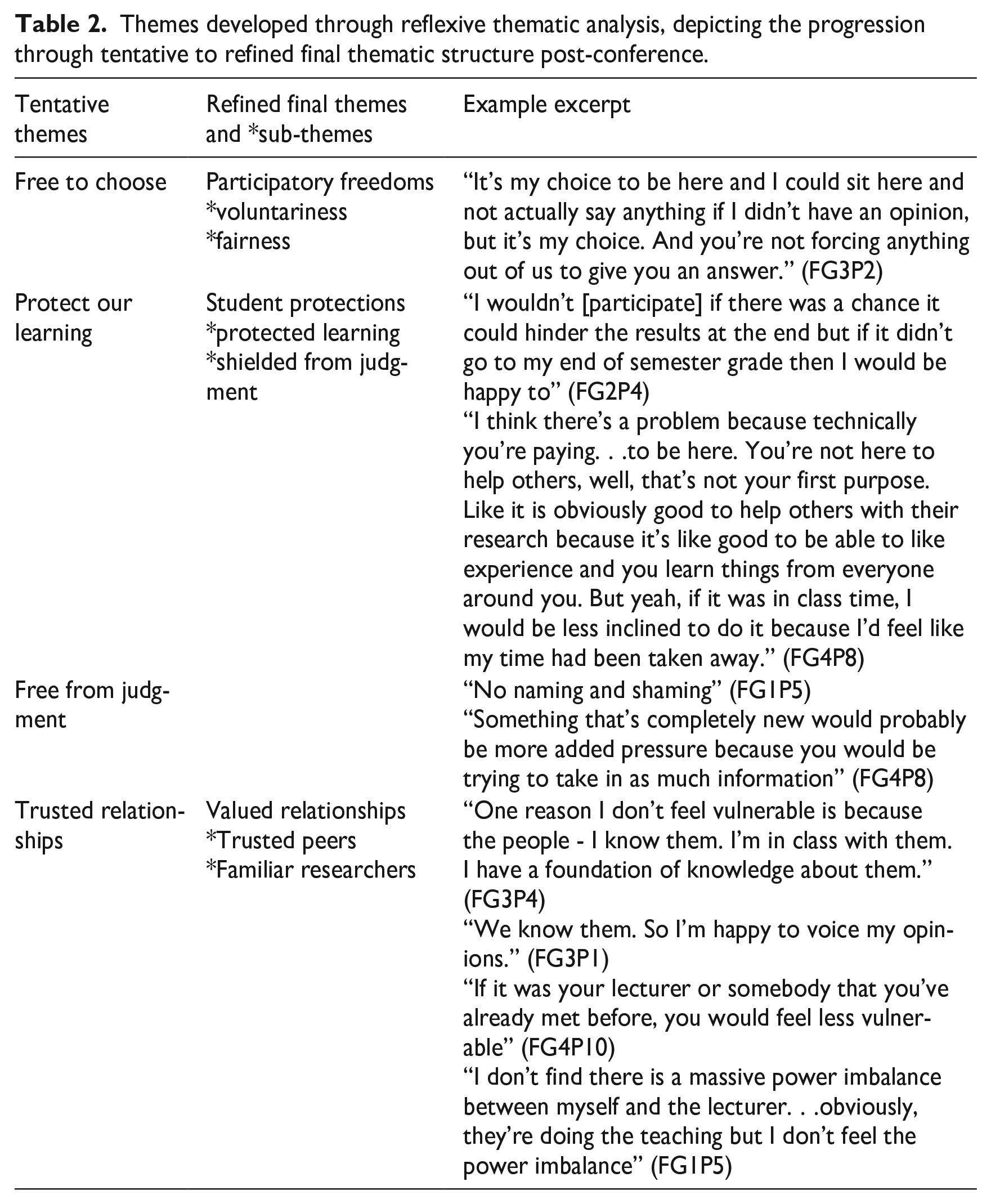
During the analysis, the primary researcher presented early themes to academic peers at an international research ethics conference. The process of presenting to conference delegates, fielding questions and subsequently reflecting on the experience with the research team, afforded additional focused opportunities to consider the “generative role” researchers play (Braun and Clarke, 2022: 9). Post-conference discussions as a team helped us recognize nuances within preliminary themes. For instance, we revisited the theme of “Trusted relationships” as the conference experience had helped the primary researcher to identify subtle differences between the way students discussed their relationships with peers and lecturers, leading to a clearer delineation of their views in the refined theme of “Valued relationships” (see Table 2). The peer review and reflexivity afforded by the conference presentation also helped cement our interpretation that student participants primarily considered SoTL research participation through an agentic lens rather than necessarily feeling like they were part of a vulnerable group. Through regular discussions as a group, we revisited earlier phases, reordering, amalgamating, refining and renaming before settling on the thematic structure, demonstrating the non-linear nature of reflexive thematic analysis (Braun and Clarke, 2021). The analysis developed over time generated three higher-order themes: participatory freedoms, student protections, and valued relationships.
Themes developed through reflexive thematic analysis, depicting the progression through tentative to refined final thematic structure post-conference.
Using reflexive thematic analysis meant our primary goal was not probabilistic generalizability (Braun and Clarke, 2022). An emphasis on generalization is also problematic for case study as such an aim “is to miss the point about what certain kinds of inquiry may offer, which is exemplary knowledge. The articulation and exegesis of that exemplary knowledge rests in the phronesis of the researcher—and its understanding in the phronesis of the reader” (Thomas, 2011: 33). In our case study research, we interpreted how students view participant vulnerability. Our interpretations enable the reader to make broader links to research ethics and ethics review concerning the wider SoTL community through connections with their own tacit experience and practice context. This reflective process of the reader relating the similarities and differences in the findings to inform their own context reflects a naturalistic generalization (Smith, 2018; Stake, 1995) and a form of transferability (Braun and Clarke, 2021).
Reflexivity
Our research design interwove what Guillemin and Gillam (2004) describe as procedural ethics and “ethics in practice” (p. 262). Procedural ethics relates to an institutional ethics review process, while ethics in practice encompasses ethical issues arising during research. Auckland University of Technology Ethics Committee, the institutional ethics review body of the primary author, approved our study. From an “ethics in practice” perspective, reflexivity underpinned the entire project from initial planning to execution, analysis and dissemination. The nature of this reflexivity was two-fold. Firstly, it enhanced research quality from an epistemological perspective, providing a mechanism to assess our positionality and its role in knowledge production. Our role was to understand students’ views better. Thomas (2011) describes researchers as the tools of analysis. As such, our context and experiences shaped our analytic lens. As an international research team, we previously worked as colleagues at the same NZ university. This mutual background provided us with a foundation for contextual reflexivity (Olmos-Vega et al., 2023), given our shared appreciation of the NZ context of the study, while also bringing a diversity of perspectives given our present practice locations.
We brought our experiences conducting SoTL research to this study and our growing curiosity for the variation in how scholars and ethics review bodies considered this type of research. Collectively, we work at two institutions where ethics review is required for all human participant research, including all SoTL projects involving student participants. However, our previous cross-sectional review and ongoing observations indicate that all institutions do not require ethics approval for SoTL research. Being exposed to variations in ethics review requirements has facilitated us first to notice and then challenge the practice, impact, and, in some cases, absence of ethics review along with the way ethics review now has a broader reach. By engaging in honest reflexive conversations within the research team, we aimed to normalize constant critical reflection, helping to recognize our responsibilities and biases as insider researchers with dual roles as teachers and researchers and with specific experiences in ethics review. Embedding reflexivity provided a platform for transparency, a way for us to share design decisions with the reader, thus contributing to the credibility of our evidence (Avis, 2005).
Secondly, reflexivity took on an ethical role. A pilot served as an ethical steerage for the project and a significant part of our “ethics in practice,” complementing the formal, point-in-time procedural ethics review before conducting the main study (see Lees et al., 2022 for more details on the pilot study). The pilot provided opportunities to assess several facets of the proposed research, including recruitment, data collection, and analysis methods. Within the pilot, for example, we compared focus group discussions with individual interviews, tested semi- and unstructured discussions with various vignettes, and trialed concept mapping and thematic analysis methods. As a result of this testing, we elected to use semi-structured focus groups as the primary data collection method with reflexive thematic analysis. In addition, we amended the choice and number of vignettes.
Findings
The following three themes were developed from the focus group data: participatory freedoms, student protections and valued relationships. Our analysis draws on the assumptions of qualitative reflexive thematic analysis and, in doing so, reflects our interpretations of the data (Braun and Clarke, 2021). Emphasizing that “reflexive TA does not equate frequency with importance,” Braun and Clarke (2022: 20) explain that “A large number of participants may say or write things that are not relevant to the research questions, while a small number may say or write things that are crucial” (p. 20). As a result, we present themes as dominant ideas we have interpreted where dominant does not necessarily equate to the frequency of that idea being discussed. Where the data reflect an outlier’s perspective, we have tried to clarify this. Participant extracts also include references to the specific focus group for additional contextualization.
Participatory freedoms
A sense of agency underpinned participatory decisions. Participants valued voluntariness and wanted the ability to choose whether or not they take part in learning and teaching research. In their decision to participate in this study, participants made it clear that they had exercised choice; they did not feel coerced or compelled to participate.
“It’s my choice to be here, and I could sit here and not actually say anything if I didn’t have an opinion, but it’s my choice. And you’re not forcing anything out of us to give you an answer” (FG3P2).
In some kinds of research, participants were more reticent to participate. Research, where the whole class was automatically enrolled in a study and then randomly allocated to a control or intervention arm, was unanimously seen as undesirable. A specific example was Vignette 3, where one group within the study received the usual teaching method. However, the intervention group received something different. For some in our study, what they perceived as the unfairness of the research design impacted their interest in participating. Any initial consideration of participation was potentially marred, especially if the lack of choice in an experimental design meant the benefit was unclear.
“You’ve kind of been forced into something you may not want to actually be doing. . . and then I’m going to be feeling pretty crap or pretty down about something I’m not really keen on actually doing myself especially if there’s no point, not beneficial to anything for myself” (FG3P1).
Others agreed, reflecting the constraints to freedom when studies either do not allow for voluntary participation or when participation might be voluntary, but one has no control over allocation if control groups are part of the study design: “I think as soon as you are put it into a box, you’re vulnerable because that choice is gone” (FG3P4). “Personally, I think if I was in the study, I would be quite upset. . .like everyone else I think it can be quite unfair” (FG2P2).
Student protections
While participants reported having agency when considering potential SoTL participation, they were also mindful of situations where their agency was at risk, which are presented as two sub-themes: protected learning and shielded from judgment. Participants shared concerns about wanting to protect their grades and scheduled teaching time. They also raised concerns about instances where their participation may make them feel judged, creating unwanted pressure or discomfort and wanting to avoid these situations.
Protected learning
Participants articulated concern should their participation in some way impact their grades. Such a situation might arise if the research involved material that might then form part of a summative assessment. In these situations, participants felt this was unfair. However, if this obstacle could be removed and participation could occur in a way that did not make them feel that their grades were at risk, they would be much more likely to participate.
“I wouldn’t [participate] if there was a chance it could hinder the results at the end but if it didn’t go to my end of semester grade then I would be happy to” (FG2P4).
For some, participation was problematic if the eventual research findings were that the intervention was not beneficial, including if this had affected their grades.
“I don’t want to put in the hard yacker if it’s pointless” (FG1P5). “You’re a bit of a guinea pig, and what if it doesn’t go right and you have wasted your time or potentially got a worse grade?” (FG3P2).
Some participants felt that allocating class time for research participation was an intrusion on time they had paid for, rather like a breach of contract. This seemed to produce a degree of tension for one participant because they simultaneously recognized the value of helping the research process. They recognized the complexity of their dual role in terms of them being a paying student and then, at the same time, undertaking research within learning time.
“I think there’s a problem because technically you’re paying. . .to be here. You’re not here to help others. Well, that’s not your first purpose. Like it is obviously good to help others with their research because it’s like good to be able to like experience and you learn things from everyone around you. But yeah, if it was in class time, I would be less inclined to do it because I’d feel like my time had been taken away” (FG4P8).
Shielded from judgment
When considering opportunities to take part in learning and teaching research, several participants raised concerns about their performance being judged negatively by the researcher or their peers. One participant’s priority for feeling comfortable participating was simply “No naming and shaming” (FG1P5).
To counteract this concern, when weighing up whether to take part in a study, participants thought they would want clarity that data would be de-identified before being shared. While it would be rare for data within SoTL to identify students by name, it was important enough for them to state that anonymity was something they valued and without it may feel vulnerable.
“I think that how easy it is to identify students determines the vulnerability of the students” (FG5P4).
When asked what conditions or principles should be in place to feel comfortable being a participant, they unanimously voiced their preference for anonymity.
“Being anonymous, absolutely. 100%” (FG5P1).
Vulnerability was associated with the discomfort of not fully understanding research instructions or tasks and, as a result feeling the researcher or their peers might make judgments. One participant expressed this association between research participation and performance by suggesting they worried they might struggle with the contents of a research task in terms of “fully understanding what was going on and the implications. What if we didn’t test very well or were not able to retain the information?” (FG4P4).
Their classmate agreed: “[Vulnerability] is all about the content that you know” (FG4P6).
The student continued to describe the ways a group setting could dissipate some of their feelings of pressure to perform.
“Vulnerability is more about being like singled out. . .so in a bigger group like this I wouldn’t feel as vulnerable” (FG4P6).
Participants in other groups shared this sentiment, with participants especially keen to avoid a situation as depicted in Vignette 2, where semi-structured interviews with the lecturer meant “they’re looking at you, sitting across from you” (FG1P3).
“I don’t know if I would feel comfortable with the lecturer” (FG5P4). A classmate responded supportively, “That could make people feel nervous” (FG5P3).
Within discussions on performance, some participants indicated a greater reluctance to participate if the research involved a task that seemed incongruent with the purpose of their course. Learning new content as part of research participation could create additional pressure on them to perform. As a result, they were more interested in participating in teaching and learning research if the research focused on what they were already doing in class and involved a course-based topic. For example, Vignette 1 described a study where student participants had to recall content from a video lecture delivered at different speeds. The study aimed to discover the impact and limits of the uptake and recall of information. In this scenario, some of our participants said they would want the content to be related to the course content rather than unrelated. In this way, they felt they could alleviate the pressure of trying to understand material over and above content already within the course curriculum.
“[Having to do] something that’s completely new would probably be more added pressure because you would be trying to take in as much information” (FG4P8).
Ensuing discussions revealed other types of study where the participants could anticipate undue pressure. One example was participation which might involve them having to speak out loud, taking them out of their comfort zone. Even with more familiar content, some students were still cautious about “public” performance anxiety within the class setting.
“Like if they wanted me to speak on the lecture content, that’s when I would start to like forget things. Whereas if they just got us to do like a little test, I wouldn’t find that as bad” (FG4P10).
As a result, these participants felt they would be less likely to take part in studies where they might be required to engage in an activity where they might not perform well and for others to know of their apparent poor performance.
Valued relationships
Participants highly valued the relationships within the teaching, learning and research community, whether these were relationships with peers or with the lecturer. Through these relationships, there was the potential for trust and familiarity to develop, which had positive repercussions for their development as future graduates of caring professions. These relationships also provided a potential barrier against vulnerability as a participant in SoTL research.
Trusted peers
Concerning participation in learning and teaching research, students overwhelmingly talked about their preference for participating alongside others in their class. While their views on participation varied on some fronts and aligned in other areas, the fact that they belonged together as a class created a bond, giving them a sense of familiarity and trust. Despite conversations about wanting to be shielded from judgment, discussions commonly focused on the protective nature of the class. There was a clear preference for having familiar people within a focus group to allay feelings of vulnerability.
“One reason I don’t feel vulnerable is because the people - I know them. I’m in class with them. I have a foundation of knowledge about them” (FG3P4).
A classmate in the same focus group agreed: “We know them. So, I’m happy to voice my opinions” (FG3P1).
Responding to a peer’s comments on the potential vulnerability of participating with strangers, a participant recounted a recent focus group in which unfamiliarity may have contributed to their vulnerability. On this occasion, a fellow focus group member they did not know disagreed with something they had said. The student was taken aback as they had merely been sharing an opinion.
“She was disagreeing, but it was like, it’s not a wrong or right answer. We both could have been right. So, you might start to feel vulnerable if someone’s sort of starts just disagreeing with you” (FG3P2).
Not everyone agreed that vulnerability was always associated with a lack of familiarity. An insightful dialog ensued within one focus group where the students shared their perspectives on the links between personality, familiarity and vulnerability. There was an appreciation that feeling vulnerable was an individualized experience rather than something all students had in common.
“I think when you’re put into a group of strangers vulnerability is more because maybe you’re a bit withdrawn especially if you’re an introverted personality naturally” (FG3P4). “Not me personally, but I can see how some people with kind of introverted personalities or shyness or anxiety could kind of be put off by having to interact with people they aren’t familiar with” (FG3P5).
“I feel like vulnerability comes down to like your personal opinion” (FG3P1).
Familiar researchers
Many participants expressed a preference to undertake research with someone familiar to them. Almost all students highly valued their relationship with their teacher. For some, an existing relationship with their lecturer was almost a prerequisite for participation if one wanted to avoid feeling vulnerable.
“If it was your lecturer or somebody that you’ve already met before, you would feel less vulnerable” (FG4P10). “I don’t think I’d put my hand up to volunteer if a random person came into the classroom” (FG5P4). “Well, it’s kind of like you don’t feel comfortable if it’s a complete stranger as you don’t know anything about them. If it was a stranger, I’d have to look more into it” (FG5P1).
With research participation, where dual roles exist, such as the researcher-lecturer, vulnerability has often been linked to a power imbalance. Participants indicated an awareness of the potential for a power imbalance between students and lecturers, but commonly, they did not sense it affected their own relationships.
“I don’t find there is a massive power imbalance between myself and the lecturer because a lot of time we do discuss things and nothing’s black and white. So, there’s a lot of discussions through all the papers, through everything. So, obviously, they’re doing the teaching, but I don’t feel the power imbalance” (FG1P5).
Some students, however, raised concerns about participating in their teacher’s research, especially if this might affect their ongoing relationship.
“I feel like it could also be easier with someone else because. . .if anything went wrong. . .it wasn’t something that would reflect back on that relationship with someone” (FG4P8).
Students also commented on a sense of vicarious trust of researchers with whom they did not have an existing relationship. If students could overtly see a positive relationship between their lecturer and an unknown colleague, it may be more likely that these “strangers” would be accepted as trustworthy and so students may be more likely to participate. To illustrate this point, one participant recounted how the participant’s lecturer introduced the primary researcher in this study and how this impacted their decision to participate.
“So, for me the deal was trust in [the lecturer] because we’ve had two and a half years of exposure to them. And then you were validated by [the lecturer] who is someone we trust, therefore, it’s a lot easier to get on board with that sort of scenario.” (FG3P4).
Discussion
Regrettably, the term “vulnerable” too often gets played as a bioethical trump card, summarily tossed on the table in the course of debate, sometimes with the stern admonition that it would not be decent to exploit such subjects. Given the absence of agreed-upon standards for identifying and responding to vulnerability, such a move too often serves as a conversation-stopper, abruptly ending dialogue rather than furthering it. It may be possible to do better (Kipnis, 2001: 3).
The aim of our study has been met, as we now have a better understanding of how participants view vulnerability. Reflecting Kipnis’ call, we believe involving the participant community in exploring vulnerability is a step toward doing better. Our research suggests that in relation to vulnerability, ethics review bodies appear misaligned with the perceptions of the student participant community. A sense of agency prevails over any sense of belonging to a vulnerable population. We point to students valuing some protective measures embedded in ethics review processes and implemented by researchers; however, they are unlikely to consider themselves vulnerable to the same degree depicted in most ethics review processes.
A vulnerable population, or does participation make them so?
Iphofen (2009) argues that the focus of review bodies and researchers should shift. Rather than trying to identify who might be a vulnerable participant and in what circumstances, which have both proven challenging, the role of the researcher should be to ensure participation does not cause a greater risk of vulnerability than participation in usual daily activities. Poor research design is known to engender participant vulnerability (Bracken-Roche et al., 2016). How the researcher designs and implements their study determines whether students develop feelings of vulnerability or are empowered to reduce any vulnerability. Participants we spoke with helped us understand the relevance of Iphofen’s delineation.
Protecting grades was a specific concern for our participants when considering vulnerability. While interested in contributing to the research process, our participants were cautious about being “guinea pigs” in studies where outcomes were uncertain. Several students voiced concern that they might be required to test out teaching strategies that might be ineffective, which might have a knock effect on their summative grades. Our study adds weight to the scarce literature in this area, reinforcing the ethical concerns of comparative effectiveness trials in education (Connolly et al., 2018), and further illuminating the findings of Innocente et al. (2022), where students were similarly concerned about experimentation negatively impacting grades. Like our participants, those students valued SoTL research, where control of their success was not at risk.
A fear of being judged, especially in relation to public speaking, is known to create anxiety in many students (Grieve et al., 2021). This fear was a source of concern for some of our participants, relating to them feeling judged by others, and for some, this was linked to having to undertake tasks that might require them to have a speaking role. Importantly, students might have a similar dislike for participating in in-class activities with speaking roles, so while this may seem an issue less specific to research, it does indicate that SoTL research designed around “public speaking” class activities may not result in participation interest. Participants did voice an appreciation for research that employed focus groups as they felt a sense of ease being with peers. Comer (2009) advocates for not using interviews when conducting faculty-based research, given that students can feel this blurs the boundaries between student and teacher, especially if personal information is being shared. While many students in our study indicated a sense of comfortableness with their lecturer being the researcher, they recognized the increased potential for vulnerability should the research involve one-on-one interviews. A further primary consideration for students in our study was that participation should be voluntary. Students in our study wanted information on opportunities to participate in SoTL research and, with that information, felt they then had the capacity to decide whether or not to take part. Our findings reinforce notions that students do not generally feel compelled to participate (Forester and McWhorter, 2005; Sarpel et al., 2013).
Listening to the views of the SoTL student community clarifies important links between participatory vulnerability and ethical principles. Removing controlling influences, a condition for autonomy asserted by Beauchamp and Childress (2001), can be achieved by researchers proactively separating the act of SoTL research participation from a student’s ability to succeed. This separation enhances student autonomy and creates a better balance of benefits and harms, given that students may want to participate in SoTL research yet are concerned by negatively impacted grades and feeling judged. Upholding voluntariness would also help address students’ sense of vulnerability concerning their grades. The ability to volunteer and, more importantly, to refuse to participate are cornerstones of ethics review and are “absolutely essential” (Annas, 2018: 43). Researchers being transparent about SoTL research aims and providing adequate information reflects respect for student autonomy, equipping them to feel in control of their learning and any participatory decisions. For them, like Kipnis (2001), consent is “an ethical power” (p. G4). Whether a formal ethics review process is in place, participants wanted transparency, information and the freedom to choose.
Factors such as negatively impacted grades, judgment or a lack of voluntariness potentially create a greater risk of vulnerability for SoTL research participants than in their daily activities as students. In NZ, culturally responsive tertiary teaching excellence standards rest upon various factors, including fostering welcoming environments where students feel empowered through respectful teacher-student relationships and student-centeredness (Rātima et al., 2022). When students are engaged, they are more likely to be motivated and want to act in an agentic manner (Zapke et al., 2009). Removing the choice to participate in SoTL research may potentially demotivate students and be at odds with local teaching best practice expectations. Designing SoTL research that avoids students being concerned about their grades, is voluntary, and without the threat of anxiety-inducing activities may help ensure students can participate with no more significant degree of vulnerability than had they not participated, as Iphofen (2009) advocates.
Power in balance
Our findings suggest that SoTL relationships may be less hierarchical than envisaged by ethics review bodies or that students recognize the hierarchy, but their agency trumps any sense of subordination. NEAC warns of hierarchical relationships. However, many students in our study indicated that having a positive relationship with the lecturer would be a factor in deciding to participate. They linked familiarity with the researcher as contributing to them not feeling vulnerable. Having an existing relationship with the researcher could help validate the researcher’s intention beyond the information disseminated during the recruitment process. Students who perceive their lecturers as caring and benevolent seem more likely to trust them; building on this, students are more likely to want to reciprocate care which can lead to enhanced engagement and improved student outcomes (Pachler et al., 2019). Students recognize and value the interrelationships of academic staff and in our study, participants intimated that there can be a sense of vicarious trust of outside lecturers as researchers if there is evidence of trust and camaraderie between their lecturer and the outside lecturer-researchers. Developing more visible communities of practice within SoTL could be one avenue to enhance levels of vicarious trust by students of academic staff.
The dominant narrative in the literature, as reflected, for example, in Aycock and Currie (2013), Comer (2009), and Loftin et al. (2011), views the student-lecturer relationship as concerning within a research context and potentially one that places students in a vulnerable position. Ethics review processes have long linked power relationships to participant vulnerability. Whether such relationships have universal applicability is questionable. Criteria to assess the nature of relationships may apply differently outside of clinical research. In social science research, van Den Hoonaard (2018) argues that power relationships are not “as stark” (p. 307). Our study illuminates complex relationships between students and their lecturers concerning SoTL research. Students’ decisions to participate in SoTL research are often linked to positive relationships with lecturers and were grounded in the value of reciprocity, offering fresh perspectives on the dominance of the power imbalance narrative. Most desired to reciprocate helpfulness when they had experienced their lecturers’ benevolence. Rather than associating their lecturer with being authoritarian or coercive, they saw their relationship as modeling what their lecturer had taught them and how they would want to act as graduates of professions with public-facing roles providing health-related services to individuals and communities. Developing competencies to foster therapeutic relationships is a key graduate objective for degree programs in the caring professions (King and Hoppe, 2013). Interpersonal communication skills directly impact patient or client outcomes (Rider and Keefer, 2006). As a result, the curricula of our participants contain foci on the importance and ability to create and nurture relationships with others, which may have guided their responses.
It has been suggested that students may agree to participate in research due to an overt or inadvertent desire to uphold their relationship with their teacher (Ferguson et al., 2006). Our findings align more closely with Forester and McWhorter (2005), who found that medical students did not seem overly influenced by a lecturer in whether or not to participate. Our findings indicated that students, in the main, have the capacity for participatory decisions, a finding shared by Innocente et al. (2022). These decisions may model the trust the public will expect to experience in their relationships with them as graduates. Trusting relationships are fundamental to the therapeutic relationship and professional practice (Kelly, 2018). Graduates with public-facing roles must act in ways that garner the public’s trust. Trust is pivotal in relation to health-related roles given that the patient, client or community seeking help must expose elements of themselves, whether their bodies or their information, to be understood by the health professional in order to receive the appropriate treatment. With an insufficient ability to care for themselves, they must be able to feel the practitioner will act in their best interests (Hurst, 2008). In other words, trust reflects an acceptance of vulnerability (Baier, 1986). Vulnerability and trust are at the heart of human encounters, whether as students or graduates. In order to develop trust, one must take the risk to trust (Carter, 2009). Students feeling comfortable participating in SoTL research may reflect elements of a graduate profile that many degree programs aim to achieve.
Vulnerability creep?
Much of the ethics review process stems from the mid to late 20th century and from a medical context. It is clearly important to examine the extent to which the remit of ethics review remains relevant in new and modern contexts. Dingwall (2016) argues that ethics review today remains poorly suited for research beyond its medical-based historical roots. Our research helps build a participant-informed picture of vulnerability. However, as a concept within SoTL research, we argue that vulnerability only partially aligns with traditional research protocols. Mirroring former scholars who have promoted the notion of “ethics creep” in relation to the uncritical expansion of ethics review (Haggerty, 2004; Israel, 2005; White, 2007), our findings illuminate a “vulnerability creep.”
We recognize that there must be a balance between offering adequate protection for participants who need it without unnecessarily curtailing the freedoms of those who do not (Bracken-Roche et al., 2017). Scholars such as Whitney (2016) warn of “regulatory overprotection” (p. 88), arguing that provided research benefits and risks are reasonable and consent is informed, there is little evidence that further protections over and above what is universally available to potential participants are warranted. Almost 20 years ago, there were calls for discussions involving participants to understand vulnerability better in terms of its usefulness but also where it “misses the mark” (Levine et al., 2004: 48). To date, discussions involving vulnerability with participants are limited in general and scarce within SoTL research. While there is recognition that some students may feel a sense of vulnerability as SoTL research participants (Pool and Reitsma, 2017), there is an acceptance that participant vulnerability is much lower in educational settings than in medical research (Eikelboom et al., 2012). However, much of the literature on student vulnerability in SoTL does not draw directly from students’ perspectives. Where researchers have focused on student perspectives, there is a growing consensus that students have views on vulnerability that differ from the dominant ethics review narrative depicted in the literature (Forester and McWhorter, 2005; Innocente et al., 2022; Sarpel et al., 2013).
Our findings suggest that students do not necessarily consider themselves a vulnerable population within SoTL research as long as there are provisions for voluntariness, protection of grades, and not having their competence undermined through concerns of being judged. These would provide protective reassurance as potential SoTL research participants. With these conditions met, we suggest that NEAC’s (2021) concerns that students experience vulnerability when they experience a “substantial incapacity to protect one’s own interests” would be mitigated. Students in our study predominantly framed their overall view of SoTL research through an agentic lens, empowered and with a safe and trusting environment, open to participating.
Many students have beneficial regard for familiar SoTL relationships and have mechanisms for assessing the trustworthiness of these relationships. The value our participants placed on these relationships, coupled with the role such relationships play in mitigating feelings of vulnerability, is a novel finding. Our research is especially noteworthy given the dominant narrative from participant vulnerability’s origins in medical research and within SoTL research ethics literature that dual relationships are concerning. Ries and Thomson (2020) call for an unsettling of vulnerability within bioethics. We argue for an unsettling of what vulnerability might mean in SoTL research. We do not dismiss the need and duty to protect student participants. Instead, we advocate a more widespread commitment to enhancing understanding of the SoTL environment and its latent potential for greater integration of learning, teaching and research.
Strengths and limitations
A strength of the study was our use of vignettes based on published SoTL research, thus providing all students with the same hypothetical experiences to consider and discuss as a group. Our choice of vignettes provided students with a realistic array of frequently published SoTL research designs, given that we chose them from a published point-in-time cross-sectional review of learning and teaching studies (Lees et al., 2021). The breadth of scenarios allowed us to better understand the nuances of students’ participatory decisions. A reflexive methodology was another strength of our research in integrating procedural ethics with ethics in practice (Guillemin and Gillam, 2004), along with mechanisms to reveal and discuss our researcher positionality. These strategies helped us center our research ethically. By considering the historical context of participant vulnerability within a medically originating ethics review process, we have made synergistic linkages between seeking research participant perspectives to enhance ethical research practices and the critical analysis of ethics review. Situating our research within a health-related faculty provided a clear bounded system for our case study, illuminating the value afforded by students to the importance of relational trust within education, research participation and their eventual areas of practice.
Indicating an interest in participating in SoTL research was a dominant view across the focus groups. This finding could be considered a study limitation because only students with this interest chose to participate. We do not know why students opted not to participate, but students have been shown to opt out of SoTL research opportunities if they lack the time (Bartsch, 2013) or do not understand the purpose of SoTL research (Felten et al., 2013). It is also possible that students who participated differed from non-participating students in the extent to which the prospect of SoTL research participation made them feel vulnerable. We did not ask students to define vulnerability specifically. Therefore, it is possible that students’ notions of vulnerability differed, something Seedhouse (2004) refers to as the “illusion of shared meaning” (p. 31). We chose not to collect student demographic data, such as age and gender identity, so we cannot comment on the impact of these factors on views of vulnerability. At the time, very few studies had examined student perspectives of vulnerability. As a result, we wanted to explore perspectives more broadly. Our findings provide future opportunities to explore specific factors in more depth.
Conclusion
This study sheds light on students as a specific participant community. It contributes to an enhanced understanding of how well the concept of participant vulnerability has transferred to the SoTL research environment from the medical research origins of ethics review. Literature presents vulnerability as a nebulous concept. At the same time, ethics review bodies frequently categorize student research participants as vulnerable populations, thus needing special protection. The student voice has provided insights into whether they consider themselves vulnerable as participants in SoTL research and, if so, in what specific circumstances. There are claims that the ethics frameworks employed by institutional ethics review bodies are unnecessarily rigid (Fox et al., 2022), with a culture of research within the academy that is “over zealously paternalistic” (Neville and Haigh, 2003: 549). Our research provides an avenue for informing ethics review bodies about participants’ views, especially in the context of SoTL research.
For some scholars, the notion of vulnerability is “archaic and outdated” (van Den Hoonaard, 2020: 577). Our findings suggest that in SoTL research, vulnerability may not be entirely outdated but may not be seamlessly transferable from its clinical origins. Racine and Bracken-Roche (2019) argue that ethics criteria for clinical and non-clinical research may differ or at least apply “less squarely” (p. 33). Our findings suggest that participant vulnerability may exemplify one such criterion. Some participant perspectives aligned with ethics review bodies’ concerns for SoTL research, such as the importance for students that participation in SoTL research is voluntary and does not negatively impact grades. Students can feel vulnerable if, through research participation, their learning or grades are at risk. Ensuring students can voluntarily participate enables students to exert agency and retain control of their learning. These findings reinforce other student centered SoTL research.
However, most of our participants did not share the concerns of ethics review bodies for the potential impact of power imbalances and risks of coercion. Our study demonstrates students’ ability to act with a high degree of agency, partly developed from their sense of trustworthiness within specific teacher-student relationships. In particular, the way teachers treat students is influential. Students make participatory decisions based on the nature of their relationships and rely on positive relationships to develop trustworthiness as future members of helping professions. Refocusing vulnerability as a researcher’s responsibility rather than categorizing students as a vulnerable population is an example of ethics in practice (Guillemin and Gillam, 2004). Equally important is to ensure students can have opportunities to participate in SoTL so that epistemologically SoTL knowledge integrates their practical wisdom and experience. Seeking students’ perspectives has affirmed Lumley and Jasinski’s (2013) argument that research involving students warrants a unique approach to research ethics. Centering their views has acted as a catalyst for re-conceptualizing how vulnerability features in SoTL research.
Footnotes
Acknowledgements
The authors would like to acknowledge the students who participated in the study.
Funding
All articles in Research Ethics are published as open access. There are no submission charges and no Article Processing Charges as these are fully funded by institutions through Knowledge Unlatched, resulting in no direct charge to authors. For more information about Knowledge Unlatched please see here: 
Ethical approval
This research was reviewed and approved by the Auckland University of Technology Ethics Committee (Approval reference 19/48).