




Abstract
Research consent processes must provide potential participants with the necessary information to help them decide if they wish to join a study. On the Oxford ‘A’ Research Ethics Committee we’ve found that current research proposals mostly provide adequate detail (even if not in an easily comprehensible format), but often fail to support decision making, a view supported by published evidence. In a previous paper, we described how consent might be structured, and here we develop the concept of an Information and Decision Aid (IDA) that can support decision making and be used to guide the dialogue between researcher and potential participant. Our proposal requires limited changes to current processes or paperwork and would provide an easily accessible document for others that the potential participant might approach for advice. It could later be integrated with the Informed Consent Form to ensure all matters of concern to the individual participant have been addressed before consent is formally signed off.
Introduction
Research consent processes must provide potential participants with the necessary information to help them decide if they wish to join a study. On the Oxford ‘A’ Research Ethics Committee (REC), which is part of the Health Research Authority (HRA)’s body of RECs that review research projects involving patients or staff in the National Health Service (NHS), we’ve found that current research proposals mostly provide adequate detail (even if not in an easily comprehensible format), but often fail to support decision making, the central purpose of consent, a view supported by published evidence (Castillo et al., 2021. Gillies and Entwistle, 2012; Gillies et al., 2014.). As Gillies et al have written: “Current guidelines regulation sand practice intended to ensure that consent is informed put more emphasis on the information provided to potential trial participants that on the understanding these people achieve”. And patients are dissatisfied (Anderson et al., 2017).
In a previous paper (Davies and the Oxford A REC, 2022), we described how consent might be structured, and here we develop the concept of an Information and Decision Aid (IDA) that can support decision making and be used to guide the dialogue between researcher and potential participant to meet these criticisms. It might be seen to have similarities with the ‘consider an offer’ to screening described by Entwistle et al. (2008) and then developed as ‘consider an invitation’ to join a clinical trial. It fits current guidance. The United Kingdom Research and Innovation, Medical Research Council and Health Research Authority have written: ‘The Participant Information Sheet (PIS) should support the consent process. . .. In most circumstances it should be used to support conversations with potential participants, rather than being the sole source of information being made available to them’ (United Kingdom Research and Innovation, Medical Research Council and Health Research Authority, 2020). The IDA is a suggested further tool to meet this.
Our proposal requires limited changes to current processes or paperwork and would provide an easily accessible document for others that the potential participant might approach for advice. It could later be integrated with the Informed Consent Form to ensure all matters of concern to the individual participant have been addressed before consent is formally signed off. As a study summary it might be of value for when clinicians introduce the possibility of a study to their patients.
Methods/Development
The Oxford A REC committee chair (HD) and committee wrote the first draft, building on previous applications to the REC and current examples of decision aids (Juraskova et al., 2014; Politi et al., 2016) (Figure 1). A recently reviewed research project investigating Chimeric Antigen Receptor T cell (CAR T) therapy was used to create a practical example (in the supplementary material). Following feedback from all authors, the IDA was taken to the research team and a local patient group (Oxford Blood Group) prior to final editing.
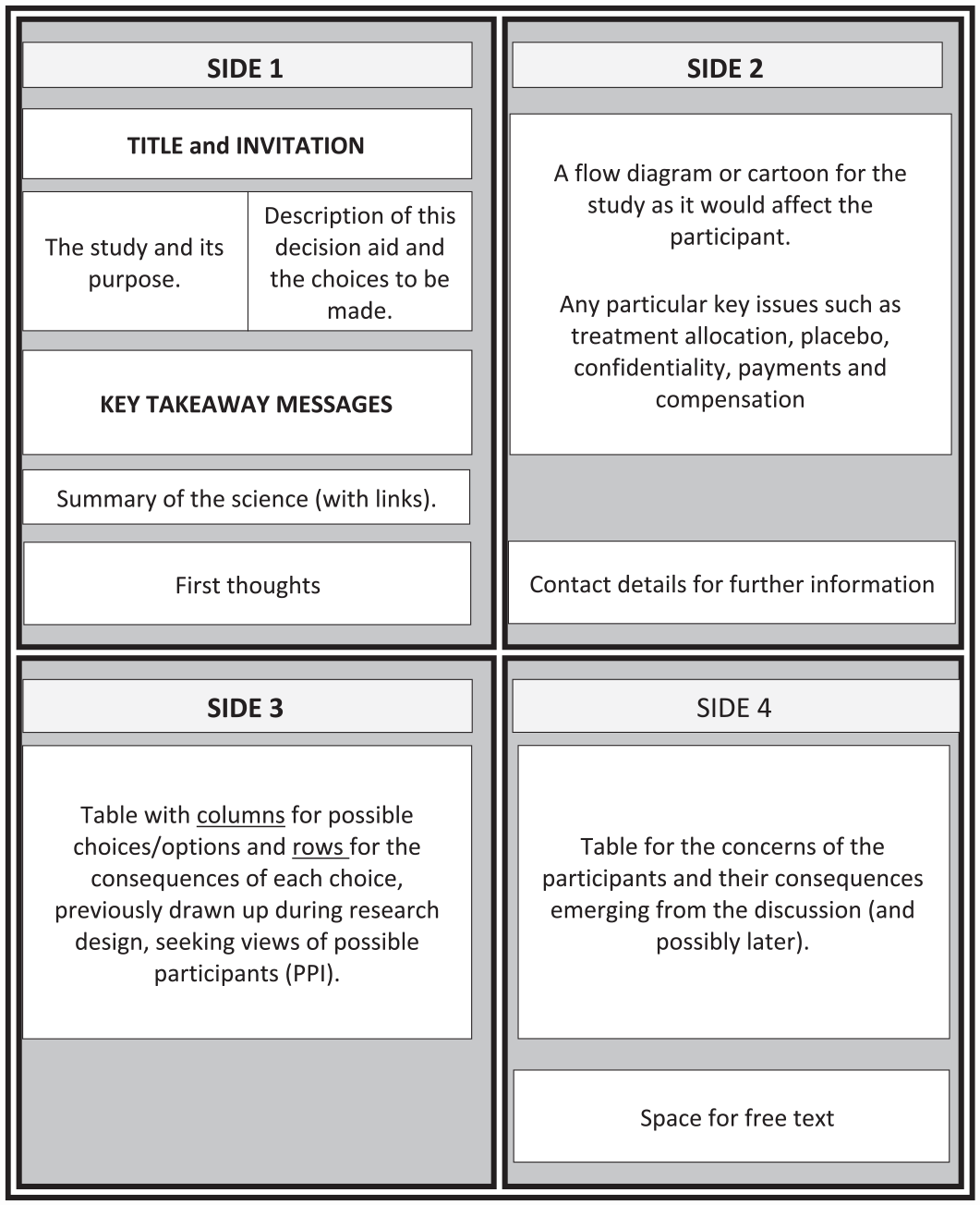
Structure for an Information and Decision Aid.
The IDA was founded on the four principles for decision making described in the Ottawa Decision Support Framework (https://decisionaid.ohri.ca/odsf.html).
The IDA would be a template for the conversation that is the most important part of the consent process, giving the opportunity for potential participants to describe and discuss their concerns.
The title would be a simple invitation, immediately followed by what is being asked of the potential participant, so that they are empowered to decide whether to join the study. Key facts, set out early in the document, would help to frame this decision.
The IDA would present an ideal opportunity to seek Input from patient groups (PPI) and would ensure the IDA meets such needs.
The structure of the IDA would allow information to be presented in the best way to support understanding and decision making and would be a template to guide the consent conversation, prompting both parties to work together.
Space is provided for this and if used when recording consent, it would be a tool to check understanding.
The second table would allow potential participants to record their concerns so that they can be recorded and discussed.
The decision to be made would be laid out clearly at the very beginning.
The document can be photocopied or scanned so the potential participant might use this when talking to others. Links to more details could easily be built in.
The purpose of the IDA is to support the four steps of seeking consent (Davies and the Oxford A REC, 2022).
Results: The Information and Decision Aid (IDA)
The purpose of this tool would be to guide the discussion between the researcher and potential participant, so it is specifically limited to four A4 sides (i.e. two double-sided pages). A longer document would be unwieldy and difficult to use within a consultation. More detailed material would be in links, including the full Participant Information Sheets.
SIDE 1
This would be headed by an easily understood title as an invitation to join the study, essentially highlighting the decision to be made. This would be followed by a description of the study’s purpose, the possible choices involved, an explanation of how the IDA might help this choice, and the key facts to provide orientation for later, more detailed deliberation. There would then be a short summary of the underpinning science and a space for first thoughts.
SIDE 2
This would summarise the study’s appointments and procedures, essentially a description of the study from the perspective of the participant. It might best be presented as a diagram.
SIDE 3
This would be a table of the key consequences for the possible choices (their benefits, burdens and harms) in a way that can be easily matched and compared.
SIDE 4
A second table would provide space for potential participants to record their own concerns. Researchers should address these during the consent conversation.
An example developed for a study recently reviewed by Oxford A REC is in the supplementary material.
Discussion
Creating an introductory summary for potential research participants is not new (http://www.hra-decisiontools.org.uk/consent/content-sheet-invite.html); however, here we have tried to better define its purpose and provide an appropriate structure. Although little work on the effectiveness of decision aids for research participants is as yet available, Juraskova et al. (2014) have shown (guarded) benefits. We propose that the IDA would improve the consent for the patient or volunteer by:
●
We have added to existing guidance by bringing the fields of research ethics and decision making together to create a practical decision-making aid that places a conversation and any consequent questions at the centre of the consent process. This makes explicit the well-recognised problem that it is not the paperwork (i.e. the participant information sheet or ‘PIS’) that best helps potential participants to make an informed decision (Flory and Emanuel, 2004; Houghton et al., 2020; Kirkby et al., 2013; Raynor et al., 2007).
●
The IDA presents information in a way that will help individual potential participants from as wide a range of backgrounds as possible start thinking about the necessary decisions to be made. A journey of a thousand miles should start with a map rather than a single step. We hope the IDA will provide this.
●
Western culture and research ethics places emphasis on individual autonomy (Gillon, 2003) yet the different concerns and requirements of those being asked for consent are poorly accommodated in current practice. The same PIS is routinely used for all while their concerns are left to (undocumented) conversation. The IDA would be a record of these and how they were resolved, putting the individual at the centre of the consent process.
●
The consequences (potential benefits, harms and burdens) of participating (or not) will be the key issues on which a decision rests, and hence our emphasis on laying them out together and clearly (Svobodova et al., 2022).
We would also propose other potential uses, such as to start a record of the conversation and add support for later deliberation. This approach could use this in conversations with relatives, friends and their health care professionals. It would certainly be far easier than the standard full PIS.
We recognise possible criticisms and consequent difficulties yet to be addressed. We present this article to seek feedback. The knowledge, skills and attitudes of those facilitating the consent process are of crucial importance. What we suggest here can only build on the professional attitude and knowledge of the research team and implementing decision aids will require staff to be trained in their use and integrated into current systems. Nevertheless, we would propose the IDA will help the skilled and less skilled alike. Our proposal is also not a comprehensive script and full details of the research study must be in other links and/or the full PIS but the summary provided by the IDA will make the potential participants’ reading much easier. It will provide a life raft to ensure that the potential participant does not drown in detail!
Supplemental Material
sj-docx-1-rea-10.1177_17470161231176932 – Supplemental material for Reshaping consent so we might improve participant choice (II) – helping people decide
Supplemental material, sj-docx-1-rea-10.1177_17470161231176932 for Reshaping consent so we might improve participant choice (II) – helping people decide by Hugh Davies, Rosie Munday, Maeve O’Reilly, Catriona Gilmour Hamilton, Arzhang Ardahan, Simon E Kolstoe and Katie Gillies in Research Ethics
Footnotes
Declaration of conflicting interests
The author(s) declared no potential conflicts of interest with respect to the research, authorship, and/or publication of this article.
Funding
All articles in Research Ethics are published as open access. There are no submission charges and no Article Processing Charges as these are fully funded by institutions through Knowledge Unlatched, resulting in no direct charge to authors. For more information about Knowledge Unlatched please see here: 
Ethical approval
Not applicable.
Supplemental material
Supplemental material for this article is available online.
References
Supplementary Material
Please find the following supplemental material available below.
For Open Access articles published under a Creative Commons License, all supplemental material carries the same license as the article it is associated with.
For non-Open Access articles published, all supplemental material carries a non-exclusive license, and permission requests for re-use of supplemental material or any part of supplemental material shall be sent directly to the copyright owner as specified in the copyright notice associated with the article.
