



Abstract
Research involving and impacting Indigenous Peoples is often of little or no benefit to the communities involved and, in many cases, causes harm. Ensuring that Indigenous research is not only ethical but also of benefit to the communities involved is a long-standing problem that requires fundamental changes in higher education. To address this necessity for change, the authors of this paper, with the help of graduate and Indigenous community research assistants, undertook community consultation across their university to identify the local and national ethical needs of Indigenous researchers, communities, and Elders. This paper provides an overview of the consultation process, the themes that emerged from the consultations, and a model of the Wholistic Indigenous Research Framework that emerged.
Keywords
Introduction
Research involving and impacting Indigenous Peoples is often of little or no benefit to the communities involved and, in many cases, causes harm (see Battiste, 2015; Bull et al., 2019; Goodman et al., 2018; Hayward et al., 2021; Kovach, 2010; Merton and Chilisa, 2018; Riddell et al., 2017; Shell-Weiss, 2019; Smith, 2021). These harms include lack of reciprocity such as extracting knowledges from Indigenous Peoples and communities without any benefit to the community; lack of informed consent and consultation with the community(ies) before research dissemination; and misinterpretations of Indigenous research ethics and protocols, to name a few.
Ensuring that Indigenous research is not only safe, but also of benefit to the communities involved and impacted, requires fundamental changes in how academic research is conducted. To address this issue the authors of this paper, with the help of graduate and Indigenous community research assistants, undertook community consultation across their university to identify the ethical needs of Indigenous researchers, communities, and Elders. This undertaking forms part of the authors’ university’s commitment to fulfilling the Truth and Reconciliation Commission (TRC) of Canada’s Calls to Action (2015) and is a critical component of their strategic plan toward Indigenous reconciliation. The ultimate goal of this initiative is to create Indigenous research ethics guidelines, protocols, and processes that can be used at the central administrative level of the university for furthering reconciliation, safe and beneficial research, supporting Indigenous research governance, data sovereignty, and self-determination. This paper provides an overview of the consultation process, the themes that emerged from the consultations, and a model of the Wholistic Indigenous Research Framework that emerged.
Background
For most universities in Canada, the administrative policies and guidelines for Indigenous research and ethics reviews are largely informed by two main sources: (1) Chapter 9 of the Tri-Council Policy Statement (TCPS2) and (2) OCAP® principles, which are Ownership, Control, Access, and Possession (OCAP). Although these guidelines represent an improvement on previous ones (which were largely non-existent), concerns remain about how these principles are interpreted and taken up in the ethics review process, and how they are enacted during the research project (Robson et al., n.d.; Kilian et al., 2019; Schnarch, 2004). To help ensure that Indigenous research is both safe and beneficial, it is imperiative that university Indigenous research policies build on these existing guidelines.
In response to the Truth and Reconciliation Commission of Canada (2015) in Canada, many universities developed an Indigenous strategic plan that makes specific reference to the importance of revising Indigenous research ethics processes and guidelines. For example, as articulated in one major Canadian University’s Indigenous Strategic Plan (2017), “[i]t is essential that [name of university] not only advance Indigenous-related research, but also that the University considers how best to educate the [name of university] community on what constitutes ethical conduct of research with Indigenous people and the importance of building respectful and collaborative relationships” (University of Toronto, 2017: 60).
In this same report (University of Toronto, 2017) it is also stated that the university needs to “establish and declare ethical Indigenous-related research as a [name of university] priority” (p. 22).
Many other Canadian universities have similar statements of commitment to help ensure that Indigenous research is conducted collaboratively with Indigenous communities from the start, while highlighting the need for respectful relationship building and early stage (pre-research development) community engeamgent.1,2 Such initiatives have the potential to contribute Indigenous reconciliation, increased research governance and data sovereignty.
Findings from the literature
As stated in the introduction, research involving and impacting Indigenous Peoples continues to be conducted in ways that cause harm (see Battiste, 2015; Bull et al., 2019; Goodman et al., 2018; Hayward et al., 2021; Kovach, 2015; Merton and Chilisa, 2018; Shell-Weiss, 2019; Smith, 2021). The main issues identified as contributing to research harms include:
A lack of reciprocity (McGregor and Marker, 2018; Tobias et al., 2013).
Gaps in research ethics protocols and guidelines for Indigenous research, and not placing the protection of Indigenous communities and community members front and center of the research ( Glass and Kaufert, 2007; Snow et al., 2016).
A lack of information and training for academic researchers and ethics review committee members about Indigenous histories, methodologies and knowledges (Huria et al., 2019; Lavallée, 2009; Morton-Ninomiya and Pollock, 2017).
Misinterpretation of Indigenous ethical principles and their practical applications, such as OCAP® for example, which can have a negative impact on Indigenous research and the communities involved (e.g. Kilian et al., 2019; Moore, 2015).
A lack of understanding about the importance of self-determination and the simultaneous loss of control over research in their own communities that some academic researchers and existing university policies enable (Kilian et al., 2019; Roach and McMillan, 2022).
Inadequate timeliness and time devoted to engagement with communities, and the building of trustworthy relationships (e.g. Brunger and Wall, 2016; Castleden et al., 2012; Hayward et al., 2021; Huria et al., 2019; Sylvestre et al., 2018).
An absence of respectful integration of Indigenous knowledges and worldviews into research practices that accurately represent the diversity within and between Nations, throughout the research process. Not all Nations have the same needs or protocols (Glass and Kaufert, 2007; Roach and McMillan, 2022).
Inadequate anti-colonial frameworks to guide Indigenous research and relationship building (Brown and Smye, 2002). The use of anti-colonial frameworks to guide research can be a powerful tool in preventing harms and to help break down deeply entrenched hierarchies between research institutions, academic researchers and Indigenous communities.
There are two key documents providing guidance on Indigenous research policies that have gained national recognition in Canada (see Riddell et al., 2017). These are: Chapter 9 of the Tri-Council Policy Statement (TCPS2) for Indigenous Research, and the principles of OCAP®. These guidelines have contributed to important changes over the last few years, however, they sometimes pose other challenges that require attention (see Schnarch, 2004; Stewart, 2018). For example, there are variations in how these policies and principles are interpreted and operationalized at each institution, as well as by each research ethics committee (Stewart et al., 2021a). This can lead to inconsistencies in ethical review and research that causes harm because the guidelines are not well understood and/or adhered to in meaningful ways.
Research ethics in Canada
Tri-Council Canada is an umbrella term referring to the three distinct federal government funding bodies: (1) Canadian Institute for Health Research (CIHR), (2) Social Sciences and Humanities Research Council (SSHRC), and (3) Natural Sciences and Engineering Research Council (NSERC). The Tri-Council Policy Statement (TCSP): Ethical Conduct for Research Involving Humans was introduced in 2010 (Canadian Institutes of Health Research, Natural Sciences and Engineering Research Council of Canada, and Social Sciences and Humanities Research Council of Canada, 2010). In 2010, Chapter 9 of the TCPS second edition (TCPS2), entitled Research Involving the First Nations, Inuit and Métis Peoples of Canada, which provides a framework for research involving First Nations, Inuit and Métis (FNIM) Peoples in Canada, was revised, as the previous 1988 version was deemed inadequate (Moore, 2015; Taniguchi et al., 2012). The TCPS2 Chapter 9 was developed as a guide for academic researchers and is not meant to supersede the Indigenous communities’ or organizations’ own ethical guidelines for research (Mi’kmaw Ethics Watch, Six Nations Research Ethics). The new TCPS2 guidelines are aimed at helping ensure that research involving Indigenous Peoples is underpinned by the principles of respectful relationship building, reciprocity, and collaboration as well as extensive community engagement between academic researchers and Indigenous participants (Canadian Institutes of Health Research, Natural Sciences and Engineering Research Council of Canada, and Social Sciences and Humanities Research Council of Canada, 2010). It has also since been enacted at the institutional level that all post-secondary institutions must act in accordance with the TCPS2 to comply with research agreements between Universities and Tri-Council regarding research.
The OCAP® principles were originally developed by the National Steering Committee of the First Nations and Inuit Regional Longitudinal Health Survey in 1998 (First Nations Information Governance Centre, 2014) to help ensure a community’s rights and control over their own information. The principles are built on First Nations commitments to engage in research that benefits the community, while causing no harm; they help ensure that research involving Indigenous Peoples (specifically First Nations) is governed in ways that promote the protection and control over of Indigenous knowledges, as well as research data, how it is used, interpreted and stored by the communities involved (Mashford-Pringle and Pavagadhi, 2020). Ultimately it is meant to foster First Nations information governance and data sovereignty (First Nations Information Governance Council (FNIGC), 2021). OCAP® principles were created as a means to prevent knowledge extraction and misrepresentation in research (Mashford-Pringle and Pavagadhi, 2020). The principles are also meant to help protect Indigenous communities from further trauma by helping to ensure that Indigenous research is undertaken in collaboration with Indigenous communities, honoring data sovereignty guidelines (Mashford-Pringle and Pavagadhi, 2020). However, the ways in which these principles are applied in research can be problematic (Schnarch, 2004); they are not always adhered to in the ways that were intended and academic researchers are generally not held accountable after they have received ethics approval.
Further, as noted by Robson et al. (n.d.), the OCAP® principles were created to address the research process in a health/bio-medical context and is specifically a First Nations initiative. Questions still exist over the applicability of these guidelines to the social sciences and humanities, as well as how well they fit for all First Nations communities, and for non-First Nations communities (e.g.Inuit and Métis). Additionally, questions have been raised about how adaptable OCAP® principles are to both rural and urban contexts (Snow et al., 2016). For example, do all First Nations across Canada know about OCAP® principles? Do they mean the same thing to all First Nations? Do all communities have the capacity to ensure OCAP® principles are being followed or the capacity to store data? (Robson et al., n.d.). These important questions need to be explored more deeply.
Robson et al. (n.d.) also note that often a “strong disconnect exists between community practices and policies and practices” (p. 3). Further complicating matters is that how communities are defined and bounded is a complex matter. For example, in their report, Walking Together Applying OCAP® to College Research in Central Alberta, Robson et al. (n.d.) confirm the potential for inconsistencies and complexities in how community is defined, particularly in urban Indigenous settings. They draw our attention to the complexities of who the appropriate members in the Indigenous urban community would be to consult with for appropriate community engagement and consent, for example.
Another voiced concern is about how “ownership” and “stewardship” of research is interpreted by academic researchers and the ethics review board (Stewart et al., 2021a). This is important because once a research project has been approved by the ethics committee there are often no formal processes in place to ensure compliance with the relevant ethics principles throughout the lifespan of the study (Stewart et al., 2021a).
In a recent study, Kilian et al. (2019)argue that current TCPS2 and OCAP® principles set the bare minimum standard for assessing and conducting ethical Indigenous research. Relatedly, Brunger et al. (2014) state that Indigenous defined concepts of ethical research need to be front and center, rather than just an “add on”to existing protocols. Additionally, the naturalization of Western epistemologies, ethics and values (Battiste, 2015), as the gold standard for evaluating research and ethics processes at universities must be critically examined and unpacked, otherwise much of ethics reviewers’ internalized biases may be merely perpetuated as they remain unconscious, and thus unlikely to change (Battiste, 2008; Ermine, 2004; Grande, 2008; Hayward et al., 2021). These biases include valuing Western approaches to knowledge, ethics and values over Indigenous worldviews and ways of knowing. Revisions of institutional Indigenous research policies must include bringing Indigenous ethics and customs front and center into academic institution research policies. Universities must embrace Indigenous knowledges, values, and principles meaningfully otherwise they will continue as white, privileged spaces that perpetuate the status quo in research, which in turn can contribute to research harms (Battiste, 2008; Grande, 2008; Kilian et al., 2019; Smithers-Graeme, 2013: 513).
Revisers of Indigenous research ethics policies and processes must also be mindful of the distinctiveness of different Indigenous Peoples and nations to avoid pan-Indigenous or standardized research ethics guidelines and protocols; this cannot be a “one size fits all” exercise (Glass and Kaufert, 2007). Furthermore,how community is defined off-reserve and in urban settings, and who represents the community in the context of urban settings needs to be addressed. Developing more comprehensive, inclusive Indigenous ethics review guidelines and protocols, informed by a diversity of nations and communities, is a critical step in making sure that Indigenous research is undertaken in a manner that places the rights and safety of Indigenous Peoples and communities at the forefront (FNHA,n.d.). Given the wide variety of contexts between and within nations, this is no small task.
Methodology
To address some of concerns about the Indigenous research ethics guidelines and processes, the authors of this paper held extensive community consultations (N = 50) at their university. They sought the experiences and opinions of Research Ethics Board members, faculty, staff, Elders, and Traditional Knowledge Holders in relation to Indigenous research ethics, with a focus upon the strengths and challenges of Indigenous research ethics review at the institution. The overarching goal of the work was to create Indigenous ethics review processes and protocols, at the central administrative level of the Division of Vice-President of Research and Innovation, to help ensure Indigenous research is not only safe, but also beneficial to all involved. Developing recommendations for culturally based and culturally safe Indigenous ethics policies, protocols, and guidelines for research involving and impacting Indigenous Peoples/communities was paramount to this work.
Informal consultations were employed to gather data, rather than a more formal research approach, as this work was intended to facilitate naturalistic dialog. Each consultation was attended by at least three people, two guiding the conversation, with the help of a Traditional Knowledge Keeper, and the invited contributor. The consultations took place over the course of 9 months.
To meet the initiative’s objectives, the authors engaged in a three step process: (1) a review of the literature regarding Indigenous research ethics, guidelines, and practices within the context of universities, (2) consultations with existing university REB committee members, (3) consultations with Indigenous and non-Indigenous researchers involved in research that impacts Indigenous Peoples within the university, and (4) making recommendations for Research Services Policy and Programs that included an Indigenous framework for the REB to use as a guide to evaluate ethics applications for research with Indigenous populations.
Consultation process
This initiative was guided by Indigenous knowledges, worldviews, and methodologies. Indigenous knowledges are broadly defined as the various forms of local knowledge that Indigenous communities accumulate over generations of living in a particular environment (Estey et al., 2009: 1). During the consultation process, Indigenous knowledges were embedded via Indigenous evidence-based literature, community collaboration, and meaningful, ongoing engagement and guidance from Traditional Knowledge Holders. Our community collaboration also included an Elders Advisory Council and Traditional Knowledge Holders from diverse Nations who were involved in this work during the entire process. The Elders Advisory Council and the Traditional Knowledge Holders helped determine what questions were used during the consultations and helped guide the development of the Wholistic Indigenous Research Framework. The authors included a Traditional Knowledge Keeper at every stage of the project who provided guidance to ensure the process honored local Indigenous knowledges and practices.These stages included the planning and development stage of this work, as well as its dissemination in the form of a written report, recommendations to the university, and this academic paper. The Traditional Knowledge Holders also provided spiritual support through an opening and closing prayer before each meeting.
To meet the objectives of the initiative, the following consultation questions were developed by the authors and Traditional Knowledge Holders:
What has your experience been like with Indigenous ethics Research Ethics Board (REB) reviews?
What would make an Indigenous Ethics Framework at the REB successful from your perspective?
What are some of the things that could create problems or failures with Indigenous ethics reviews?
How might we measure the success of an Indigenous Ethics Review process?
Participants were recruited through a targeted email to all Indigenous faculty and staff, as well as all faculty and staff involved in Indigenous research, or who sit on an ethics review committee. To ensure diversity of representation, Indigenous Peoples from a range of First Nations, Inuit, as well as Métis Peoples at the university were invited to contribute.
Throughout this process and toward revision of Indigenous research ethics processes and protocols, the university must continue to learn from the guidance of Elders and other Indigenous community members. An evaluative process of the changes to the Indigenous research ethics processes and protocols is planned to ensure these changes are meeting the goals as defined by the community consultations. This work is grounded in Indigenous knowledges and spirit.
Consultation results
The consultation responses were analyzed through a process of inductive qualitative analysis, rooted in Indigenous knowledges, developed by Stewart (2008) and refined in later work (Stewart et al., 2014, 2021b). Four recommendations, presented as the Wholistic Indigenous Research Framework (Figure 1), emerged from the analysis. These recommendations include (1) Indigenous Research Strategic Plan, (2) Spirituality, (3) Indigenous Research Policies, and (4) Indigenous Research Ethics Board Committee. Guidance from the Traditional Knowledge Holders and the university’s Elders Advisory Council was also embedded in this analysis. The consultation team, which included the authors of this paper, as well as the Elders Advisory Council and Traditional Knowledge Holders, looked at the data together and went over the themes that emerged. The subsequent cocreated recommendations were then put forth to the university. Before finalizing the report and recommendations, we revisited the main themes and recommendations with the Elders Advisory Council and the Traditional Knowledge Holders to make sure we were capturing the essence of the recommendations. In this paper we highlight three of the four recommendations proposed: (1) Spirituality, (2) Indigenous Research Policies, and (3) Indigenous Research Ethics Board Committee.
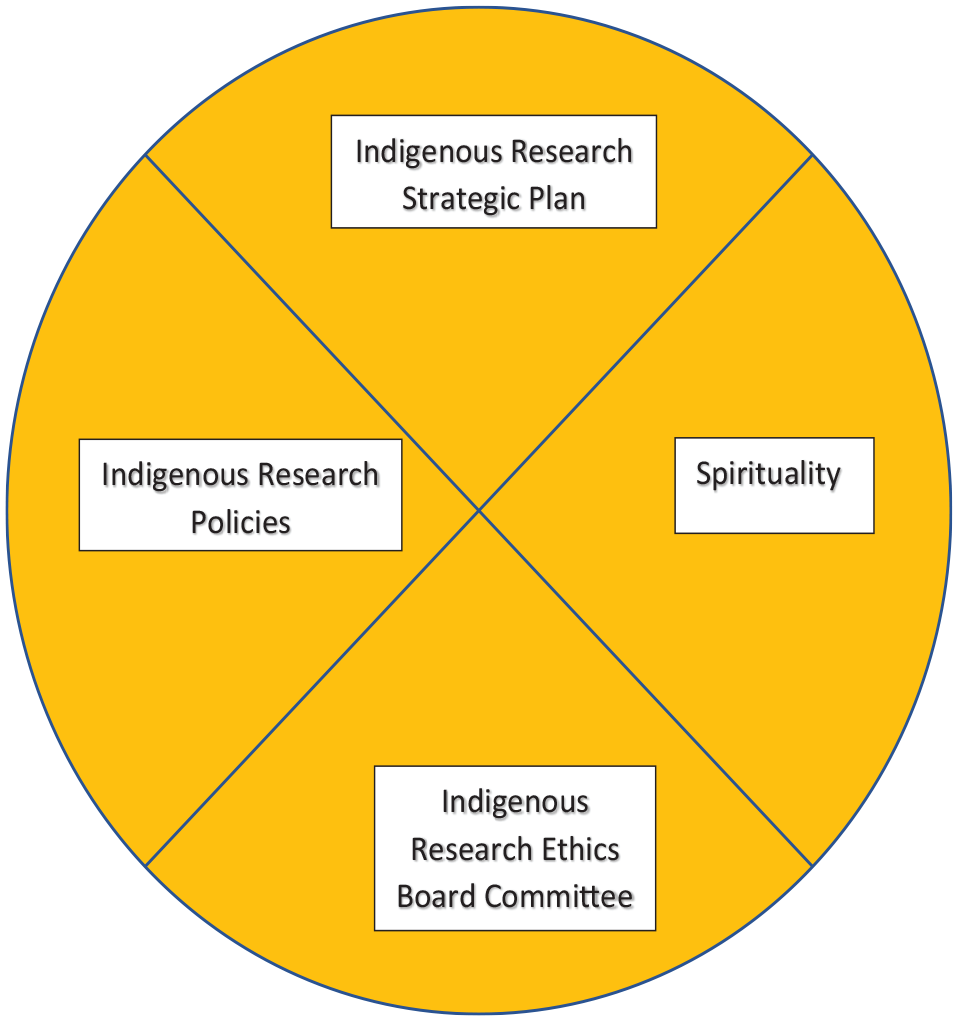
Wholistic indigenous research framework.
Spirituality
There was consensus that infusing spirit into research processes by acknowledging and looking at how research impacts humans and the natural environment was integral to enactment of the recommendations of those consulted. The act of using a spiritual framework involves the inclusion of Traditional Knowledge Holders and Elders in all functioning of research services concerning Indigenous Peoples, and embedding ceremony in senior leadership activities concerning Indigenous research ethics and contracts. Representation from diverse Indigenous Peoples is ensured through the existing Elders Advisory Council who represent various First Nations, Inuit, and Métis Peoples. Working from a spiritual framework also requires examination and deconstruction of Western values and ethical principles, and development of research ethics protocol and guidelines informed by Indigenous values, principles and ethics. Further, use of a spiritual framework means honoring and valuing Indigenous knowledges, ethical principles, and guidelines from a diversity of nations at the university as a whole. It also means holding Indigenous knowledges in equal regard with Western knowledges so that they are embedded meaningfully in systems and processes. Diversity is upheld by ensuring that different Indigenous Nations are represented on the ethics review committee, and there is consultation with at least one Indigenous person from the Nation involved in the research. For instance, if research involves a Six Nations community, the ethics review committee will include someone who is Haudnosaunee.
Indigenous research ethics board committee
An Indigenous Research Ethics Board (REB) committee should be created to review all applications that are identified as involving Indigenous individuals, communities, on-reserve lands and water. 3 It is suggested that the guidelines for ethical evaluation of research proposals with an Indigenous REB committee should be created by a group of Indigenous stakeholders from within and outside the university, such as researchers (staff and faculty), students, Elders/Traditional Knowledge Holders, and community members from a diversity of Nations. As a minimum, criteria will stipulate that research projects include information about their community engagement process, how Indigenous knowledges will be protected, and how research will benefit the community or organization.
These recommendations do not preclude the necessary ethical approval by local Indigenous communities/governments/organizations, ethical review boards, or other outside of the university. For example, if the research involves Mi’kmaw Peoples and lands then the research would also need to seek ethics approval from the Mi’kmaw Ethics Watch. 4 Key aspects of an Indigenous committee are that it is guided by Indigenous ethical principles, values, and knowledges; it remains part of the REB process with adaption of the ethics application forms and systems to reflect Indigenous values and principles.
Another key purpose of an Indigenous committee would be to oversee adherence to revised policies and procedures. This contributes to transparency and increased accountability of researchers involved in research involving Indigenous Peoples, which in turn will help ensure safety and benefit the Indigenous community(ies) involved.
Indigenous research policies
Indigenous research ethics policies need to be developed for a decolonized model of ethics. The revised policies should clearly outline specific guidelines for Indigenous research ethics, research agreements and partnerships with Indigenous communities. The guidelines should also outline community-specific consent and vulnerability requirements, highlight the importance of involving spirit, appropriate spiritual practices and Elder engagement, as well offering clear descriptions about what community driven, community engaged and community-based research involves.
Decolonizing research ethics policies requires examinion and mitigation of the impacts of colonization on Indigenous knowledges, and expanding the knowledges and perspectives that are considered legitimate in the context of academic research activities. Specifically, this means putting the needs and interests of Indigenous peoples upfront, and beginning to systematically deconstruct colonial structures that inform current university policies and protocols. However, it must be remembered that decolonizing colonial institutions, such as universities, is an uphill process, and it will take time to achieve the changes needed for Indigenous communities to be completely safe from harm in research. Moving toward decolonization also involves creating comprehensive and clear parameters around what is considered Indigenous research. For example the Social Sciences and Humanities Research Council, a component of the Tri-Council in Canada, defines Indigenous research as, Research in any field or discipline that is conducted by, grounded in or Engaged with First Nations, Inuit, Métis or other Indigenous nations, communities, societies or individuals, and their wisdom, cultures, experiences or knowledge systems, as expressed in their dynamic forms, past and present. Indigenous research can embrace the intellectual, physical, emotional and/or spiritual dimensions of knowledge in creative and interconnected relationships with people, places and the natural environment. (SSHRC, n.d.)
There must be consideration, not only for research that directly involves and impacts Indigenous Peoples and communities, but also research that might, by the geographical location, subject matter, or demographics, involve or impact Indigenous Peoples, communities and their land and water in an indirect manner. This would require an inclusive model of indigeneity, one that considers the diversity within and between nations, as well as the continued impact of colonization on Indigenous lands, lives and identities. There is not one way to be Indigenous and culturally based parameters should be established to ensure that Indigeneity is not being essentialized.
One example of decolonizing university structures includes adjusting research timelines to adapt to the particularities of Indigenous community needs. This means making sure timelines for research processes, such as community engagement and relationship building are realistic and outlined in the ethics application. It takes time to build relationships, and ethical research with Indigenous Peoples must include careful consideration and time, as well as acts of kindness and reciprocity on the part of academic researcher. Indigenous ways, such as for consent and relationship building, must also be respected. Many academic researchers are not educated in knowledges or practices of Indigenous cultures in general, nor in Indigenous research specifically; becoming appropriately educated is fundamental to decolonizing research. Academic researchers must take the time and space needed to learn and practice Indigenous ways of being and doing to conduct ethical and appropriate research with Indigenous Peoples.
Universities whose faculty engage in research that involves or impacts upon Indigenous Peoples need to provide training and appropriate guidance for researchers about Indigenous histories, cultures, and cultural and community informed approaches to research. Findings from the consultations conducted for this initiative suggest that training for all REB committee members and researchers engaging in Indigenous research should be a priority (Stewart et al., 2021a), the content of which would require consultation with an Elders advisory council and other Indigenous community members.
Consultations also highlighted the need to engage with Elders about Indigenous research ethics processes at the university, in a respectful and ongoing manner. This includes consideration of their time, effort, and commitment and providing appropriate compensation. Specifically, Elders should be involved in informing Indigenous research policy decisions, as members of REB committees, and be paid for their expertise and time.
Summary and conclusion
In Canada, the revised TCPS2 Chapter 9 guidelines and the development of OCAP® principles has helped to ensure that research involving and impacting Indigenous Peoples is safe and beneficial. However, as discussed in this paper, there is room for improvement. An Indigenous-led community consultation process at a Canadian university led to the creation of an Indigenous REB Wholistic Research Framework to redress ongoing colonial harms to Indigenous peoples, lands and communities from involvement in academic research. The specific recommendations for addressing the rights and ethical needs of Indigenous peoples discussed in this paper stem from these consultations, with a commitment by the university to implement them. Centering community-specific Indigenous ethics and values in Indigenous research policies and processes at universities is vital for increasing trust between Indigenous Peoples, communities, and university researchers, and for ensuring that research is safe and beneficial. The specific details of how this should be approached needs to be developed and implemented in close consultation with Elders and a diverse range of Indigenous Peoples and communities at each university. This may be a complicated task as there are many Indigenous communities that need to be included. It is the responsibility of each university to ensure that representatives from the appropriate communities or Nations are consulted. Universities must have clear goals and guidelines based on Indigenous values and principles, as set forth in the recommended Wholistic Indigenous Research Framework, to ensure accountability and transparency. It is hoped that the recommendations in this paper can contribute to more robust Indigenous research ethics guidelines and protocols at the university level to support ethical Indigenous research governance, self-determination, and data sovereignty.
Footnotes
Funding
All articles in Research Ethics are published as open access. There are no submission charges and no Article Processing Charges as these are fully funded by institutions through Knowledge Unlatched, resulting in no direct charge to authors. For more information about Knowledge Unlatched please see here: 
Ethical approval
Not applicable.