




Abstract
While ethical norms for conducting academic research in the United Kingdom are relatively clear, there is little empirical understanding of how university research ethics committees (RECs) themselves operate and whether they are seen to operate well. In this article, we offer insights from a project focused on the Scottish university context. We deployed a three-sided qualitative approach: (i) document analysis; (ii) interviews with REC members, administrators, and managers; and (iii) direct observation of REC meetings. We found that RECs have diverse operation and vary in terms of what members understand to be the remit of their REC and what should constitute the content of ethics review. Overall, though, most participants perceive university RECs as operating well. When asked what they consider to be areas for further improvement, most commented on: implementation of an online system; more experience with how to evaluate various kinds of research projects; best practice exchange and training opportunities; more accurate reflection of the REC role as part of the university’s workload allocation model; and greater recognition of the importance of research ethics governance in the university’s research environment, and, for the members themselves, their career advancement. Based on our findings and subsequent discussions during an end-of-project roundtable with stakeholders, we propose a model of collaboration that can address some of the identified areas that could benefit from further improvement. This model would facilitate a heightened awareness of the importance of supporting REC members in their own effort in assisting students and staff alike in undertaking as ethically robust research as possible.
Keywords
Introduction
It is now common practice across the United Kingdom (UK) that university academic researchers, staff and students alike, who propose to involve humans, their tissue, or their data in a research project must first submit an application to one or several committees for institutional ethics review. 1 These committees then assess the ethics of the proposed research either solo, in pairs, or some other combination, with the primary aim being to protect the dignity, safety, rights, and wellbeing of all actual and potential participants, as well as to protect researchers themselves. Universities have delegated to these committees, known as research ethics committees (RECs), the authority to decide, through a regulatory ‘event licensing’ system (Schneider, 2015), whether the proposed research project is ethical and consequently appropriate to undertake (or to continue, in the case of an amendment or ongoing review). To this end, we may say that RECs engage as regulators of research: they reflect a pragmatic system of ‘social control’ by researchers’ academic and community peers, and aim to steer behaviour of researchers in a socially desirable, ethically robust, and legally compliant manner (Dove, 2020, 2021).
University RECs (URECs) have been in existence at UK universities for a number of years, though many were established only around the start of the new millennium (Tinker and Coomber, 2004), in response both to meet research funders’ requirements, such as those from the Economic and Social Research Council (ESRC), and to address institutional pressures of ensuring some form of oversight was in place with respect to research that was not otherwise approved or reviewed by another body (e.g. an NHS REC). 2 Yet, despite many URECs existing now for some time, there remains a lack of clarity and consensus about the principles governing the ethics of academic research and the standards by which the ethics of academic research should be assessed. While the ESRC’s original (2005) Research Ethics Framework played a major role in the proliferation of URECs (Hunter, 2008), there is still little oversight on its part in standardising and assuring consistency across these relatively diverse bodies. Some research has looked at URECs from various perspectives, such as REC knowledge of reviewing research involving social media (Sellers et al., 2020), how biomedical epistemologies and methodologies influence the institutional ethics review processes applied to socio-legal research in UK law schools (Noorani et al., 2017), and case studies illustrating concerns about academic freedom and research ethics review (Hedgecoe, 2016). Fewer studies, however, have investigated URECs across an entire region in the UK (cf. Tinker and Coomber, 2004), much less from a qualitative perspective investigating the regulatory practices they embody and enact. Relatedly, no research has been conducted to date on the extent to which harmonised UREC processes exist that promote proportionality, accountability, efficiency, and transparency – principles that many would agree comprise ‘good regulation’ across all sectors (Regulatory Horizons Council, 2022). Nor has research been conducted on the extent to which harmonised UREC processes exist that adhere to emerging principles of ethics review, being identified from one recent policy document as comprising independence; competence; facilitation; and transparency and accountability (UK Research Integrity Office (UKRIO) and Association of Research Managers and Administrators (ARMA), 2020).
General guidance for RECs has been published by research councils, research organisations, and professional associations, such as the Economic and Social Research Council (ESRC, 2022); the now-defunct Association of Research Ethics Committees (AREC) (2013)); Universities UK via its Concordat to Support Research Integrity (Universities UK, 2019); and the Association of Research Managers and Administrators (ARMA) alongside the UK Research Integrity Office (UKRIO) (UKRIO and ARMA, 2020). However, the guidance may apply only to a small portion of research, set high-level aspirational principles of practice, or otherwise lack mechanisms and tools that promote procedural and substantive consistency within and across university RECs.
We consider all of this to be problematic for several reasons. Lack of understanding regarding the governance 3 of ethics review within universities can hinder the conduct of sound research and undermine the credibility of ethics review itself. We know little about the extent to which URECs regulate the ethical conduct of researchers and how regulations in turn governing RECs’ activities and decision-making are brought to bear on their day-to-day interactions between members, as well as their meetings and review of applications. This has led to long-standing concerns about ‘ethics creep’ and the social costs of increasingly unchecked bureaucracy and burdens imposed on researchers with little added value (Dingwall, 2016). It has also led to concern about possible knock-on effects manifesting in multiple ways: from impacting the consistency and efficiency of research ethics review to open questions about the robustness of research participant protections; from frustrating the promotion of scientifically and socially valuable research to threatening the quality of research that is undertaken in universities (Brown et al., 2020; Carey, 2019; Dingwall, 2008, 2012; Haggerty, 2004; Hoecht, 2011; Hunter, 2008; Vadeboncoeur et al., 2016). This raises questions not only about how ethics decisions are made, but also about the kind of institutional mechanisms that RECs have in place for reviewing applications and offering appropriate support to researchers that facilitate rather than obstruct innovation, and respect rather than demean research participants.
In this article, we offer insights from a recent empirical study that sought to offer deeper understanding of these important issues, focusing on the intricacies of research ethics governance across Scottish universities. The study’s principal objective was to look at the regulatory nature of ethics review in Scottish universities, investigating what works well and not so well, and charting how ethics review can be done better.
In what follows, we discuss our three-sided qualitative approach, our findings, and how far, if at all, URECs and school RECs (SRECs) 4 within these universities operate in ways seen by some of those involved in their processes as ‘good’. To the extent that they are not seen as ‘good’, and where this hinders otherwise sound research, we offer ways of reimagining the ‘regulatory spaces’ of RECs at universities where and when they are found to be under-delivering in what they set out to achieve. Through theoretical insight and empirical investigation, we thus recommend what regulation and those within and around universities who influence regulation can do to stimulate meaningful research oversight without adding to any burden of pre-existing regulatory measures—including, we suggest, the introduction of new models of collaboration in ethics governance across Scottish universities and beyond into the wider higher education sector more generally.
Methods and methodology
The study employed an ‘anthropology of regulation’ methodology, which was developed for previous empirical research investigating the regulatory dimensions of NHS RECs (Dove, 2020). The methodology is influenced by regulatory theory and the anthropological concept of liminality. Liminality is a universal human experience that involves processes of transition and change (Thomassen, 2014; van Gennep, 1909). In moving from childhood to adulthood or well-being to illness, humans experience liminality as a sense of in-betweenness: neither one thing nor another. Research has shown that ethics review is also a liminal experience – with distinct moments of transition, from research idea ultimately to an ethically approved protocol (Dove, 2020). A liminal lens helps us to understand the dynamics of these transformative processes and the importance of ‘stewards’ to help guide researchers through these moments of transition and transformation.
Anthropology of regulation comprises a trinity of empirical research methods, which we applied to this study. Specifically, we undertook (1) qualitative document analysis of regulatory sources covering RECs within universities (focusing on the UK context), which provided context and historical tracing of how these RECs emerged, and tracing how regulations governing them have developed and been applied over time. We also undertook both (2) interviews and (3) observations, which provided empirical evidence of the behaviours and experiences of RECs.
Among the documents we analysed were guidelines and recommendations from major funders and professional associations. We also analysed all Scottish universities’ public websites that listed various information and resources related to ethics governance and ethics review. Some universities had more publicly available information than others; several in our study kept many documents ‘hidden’ within a private intranet available only to university staff and students. The document analysis provided an understanding of how these ‘regulations’ (defined broadly) and guidance may shape and contribute to the hetero- or homogeneity of ethics governance across universities. Additionally, we wanted to learn how internal regulations are mandated; how resources for RECs and applicants are formulated, made available on public domains, or circulated internally; and whether they align with or diverge from external regulators’ frameworks.
From October 2021 to April 2022, we conducted 23 in-depth interviews with various REC members (e.g. REC chairs/convenors; academic staff members and external/lay members; administrative and managerial staff), many of whom, as academic researchers, also had experiencing submitting applications to RECs for their own research. Through these interviews, we aimed to capture how individual REC members’ subjectivities might shape the regulatory system by exploring their motivations and overall experience of serving in this capacity; how they learned to fulfil the role’s putative requirements and conduct ethics reviews; their perceptions of the system, including challenges and difficulties; and their views of areas that need improvement and potential solutions (if any). Each interview had a duration of between approximately 40 and 75 minutes.
Concurrent with these interviews, we also observed 6 REC meetings at 6 different Scottish universities via virtual (online) attendance. While attending, we took detailed notes of the topics that were discussed and observations regarding the conversations and interactions among the members. During these meetings, we adopted the passive/non-intervening role of observants, keeping our camera and microphone off, although in almost all meetings the chair reminded members at the beginning of the meeting of our presence and occasionally asked us to introduce ourselves. However, our presence did not, in our view, interfere with the usual decision-making process of the meetings.
In terms of recruitment, the Principal Investigator (ESD) sent an initial email invitation to participate to a listed ethics governance contact email address (often the UREC chair). Following discussion, the contact would then disseminate the email to REC members. Participation was voluntary and those who were willing to participate were encouraged to contact the PI directly, who then sent the Participant Information Sheet and Informed Consent form, in order to avoid forfeiting identity disclosure of other participants at the same university. Out of the 14 universities contacted, 5 12 agreed to participate, and we note these in the following as Universities A through L. Two universities declined participation on the grounds that they were in a process of significantly restructuring their ethics governance and did not consider the time right to engage in our study.
Data analysis
We conducted all interviews using either Microsoft Teams or Zoom, depending on participant preference. All our participants were familiar with these platforms. Most interviews were conducted by us both, and we took alternate turns in asking sets of questions. All interviews were audio recorded using the platform recording procedure and subsequently transcribed verbatim using a professional transcribing company, which operated under contractual obligations of confidentiality. We anonymised all transcripts prior to starting the data analysis.
All but one of the observed REC meetings were attended by both of us, and we took separate notes to ensure we had a thorough coverage of the issues discussed, as we did not record any of the meetings or have access to recordings if these were done internally.
Both of us independently coded all transcripts and field notes for quality assurance and consistency. One of us coded the transcripts and field notes using NVivo and the other coded them using Microsoft Office software. This dual approach in our view enabled a broader range of findings. We cross-compared findings to ensure consistency, reliability, and reconciliation of any discrepancies.
We considered an inductive thematic analysis approach as the most appropriate for in-depth interviews (Braun and Clarke, 2021; Guest et al., 2012). We re-familiarised ourselves with the interviews by reading them before starting the thematic analysis as a way of getting a sense of themes. We proceeded with the thematic analysis by initially coding three interviews that we regarded as more complex, covering participants whose REC roles were different. We then discussed the framework and, once we reached a general consensus, we open-coded the remaining interviews. Each theme was supported by and illustrated with various representative quotes.
Ethical considerations
The study was reviewed and approved by Edinburgh Law School’s Research Ethics and Integrity Committee. Informed consent was obtained from all participants prior to the interview and REC meeting observations. All participants were assured of confidentiality and informed of how their data would be used. The research was funded by the Carnegie Trust for the Universities of Scotland, an independent charitable trust that provides grants to undergraduates, postgraduates, and academic researchers at the Scottish universities. The University of Edinburgh was not invited to participate in our study due to potential or perceived conflicts of interest.
Each participant received a detailed Participant Information Sheet and was invited to ask for more details or clarifications as needed. For the observed REC meetings, once the REC chair agreed for us to observe one or more of their meetings, they circulated an announcement email about our presence and asked members to express their consent/dissent in being observed. We were then advised by email, in advance of the meeting, which members (if any) did not consent to being observed, which we made a note of and, during the meetings, we did not take any notes when the respective member made any interventions.
Results
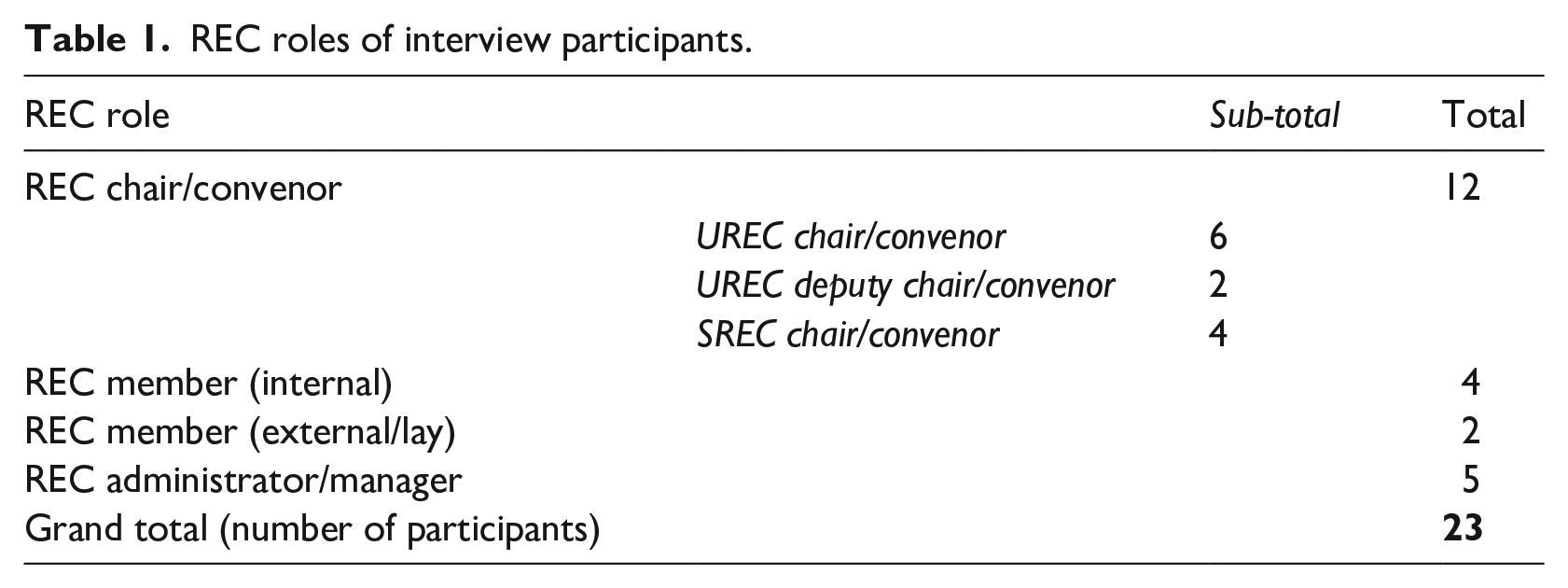
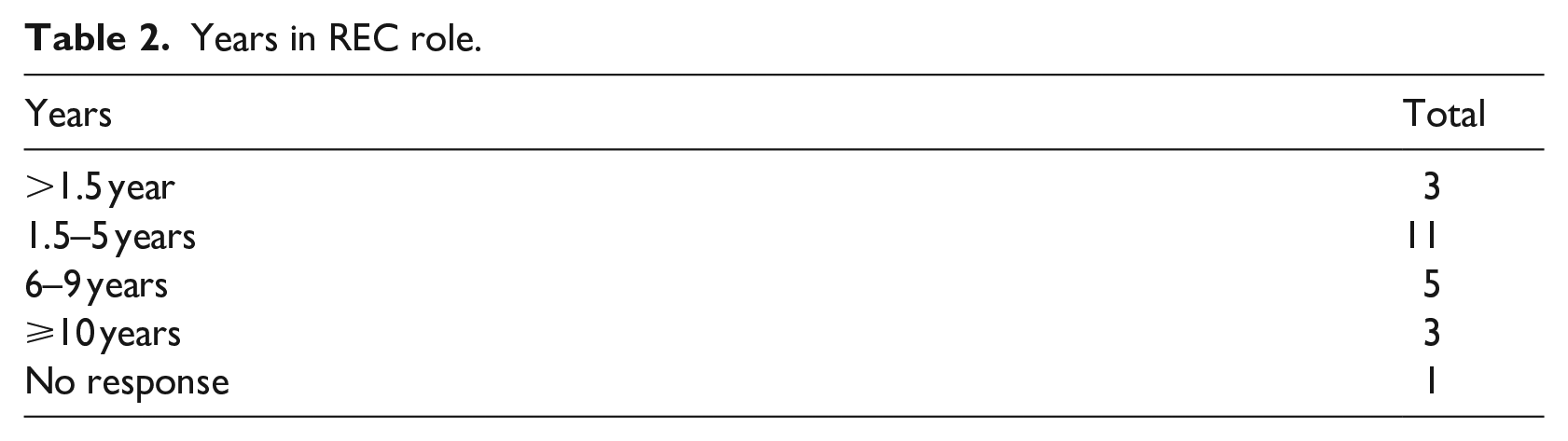
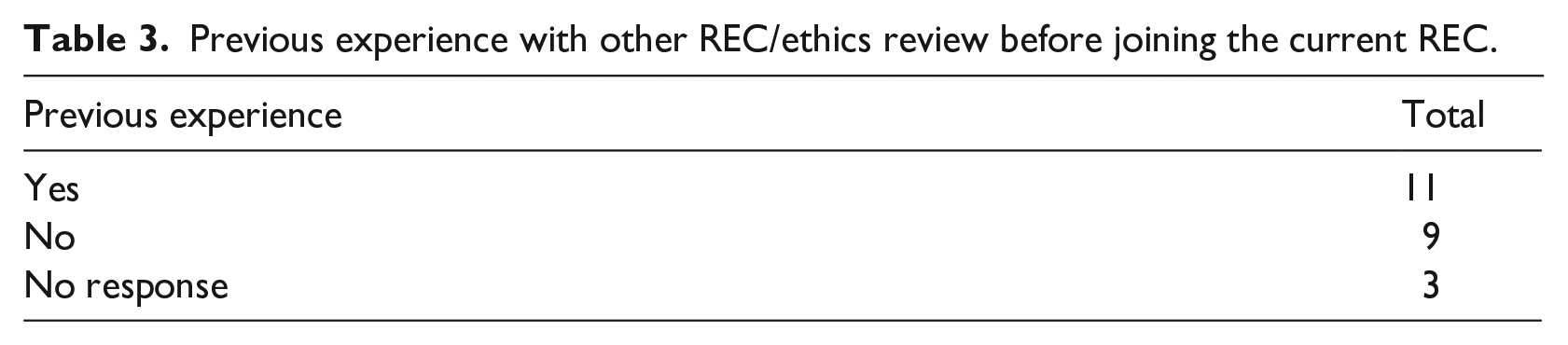
As reflected in Table 1, our interview participants held various roles within their REC. The SREC chairs/convenors were also UREC members, as most URECs are composed of SREC chairs across the university’s different schools. With a few exceptions, UREC chairs/convenors had previous experience or were currently also involved in application review one way or another (e.g. supporting reviews of higher-risk applications). As reflected in Table 2, most participants were in their role between 1.5 and 5 years, with some serving in this capacity for more than 6 years and, in a few cases, for more than 10 years. In terms of previous experience with ethics review before joining the REC they were currently part of, as reflected in Table 3, our participants had nearly equal previous experience or no experience. However, some of those with no previous experience as ethics reviewers said they had previous experience as applicants, either to their university or to NHS RECs. Similarly, many of our participants were also active researchers who continued to apply for ethics review for their own projects.
REC roles of interview participants.
Years in REC role.
Previous experience with other REC/ethics review before joining the current REC.
REC membership
Recruitment of REC members
The first theme we identified relates to becoming a REC member. Our interviewees told us that, generally, they joined their current REC either because they were asked or selected, most of the time given their professional interest in ethics and ethics-related matters or due to their previous experience with ethics review at the same or another institution. At times, the specific role was being built into the new position they transitioned into or because this position was previously held by someone who also served as a REC member; therefore, there was an implicit expectation that the new occupant would also serve in a REC member capacity.
This transition into various roles within ethics governance structures, with members ending up serving in different capacities for longer periods of time, was perceived as having a potential double-edged effect. On the one hand, in terms of the REC’s internal dynamic brought up by new members, serving for ‘too long’ was seen as potentially negative, with a risk of ossified ways of working, which might have a detrimental impact on ethics reviews. On the other hand, the potential retention of expertise gained as a result of serving in various REC roles, as well as knowledge and communication sharing between different levels of RECs through an individual member’s migration ‘up the ladder’, was regarded as a positive effect: more years of experience meant more wisdom and a more considered view of ethics applications. Serving for a longer time on RECs was also perceived as an indication of the satisfaction that this role might bring.
At a system level, the retention of members for a longer period was seen to create a form of stability and guarantee of at least some form of consistent ethics oversight; at a basic level, the regulatory function of ethics review would be fulfilled. Yet within an institutional culture of little recognition for the voluntary, unpaid REC member role in terms of career advancement or workload (which we discuss below), not to mention concerns about growing time pressures within academe, we were told of constant anxieties experienced by chairs and administrators around finding new members willing to serve in this capacity. Thus, longer retention of members is seen as an imperfect solution for reassuring stakeholders across and beyond the university that ethics review would be dealt with in an adequate manner. Conversely, the loss of members (through, for example, retirement, end of term of service, or moving to other universities) might weaken the system of ethics oversight and offer opportunities to escape robust REC scrutiny for those applicants who might perceive the process as an unnecessary bureaucratic burden.
More infrequently, there was an open call in universities for expressions of interest for joining a REC. This strategy was regarded as not always the most suitable since there were worries that this might attract candidates with questionable motivations (e.g. those only seeking self-promotion or accumulation of academic capital) rather than a genuine interest in research ethics and facilitating ethical research. Similarly, those who do not have a deeper understanding of a REC’s particular way of functioning and their ‘cultural practice’ and are seen as too eager to make radical changes – when not perceived by current members as really needed – were regarded as potentially unsuitable candidates. At the same time though, a good response to an open call for interest was viewed as expanding the possibility of ‘releasing’ members seen as too long in the tooth, as well as refreshing REC membership by replacing those who were not (pro)actively involved in ethics review.
The added value of external/lay members
The UKRIO-ARMA guidance on best practice for research ethics review processes and structures advises that REC SOPs should stipulate that membership ‘include at least one appropriately trained external member (typically referred to as a “lay” member – normally reimbursed for out of pocket expenses) with no affiliation to the department, university or research institution’ (UKRIO and ARMA, 2020: 24). Our interviewees held a consensus view that these members bring added value to the overall performance of RECs—provided they had some experience or expertise to bear on research ethics. This was reinforced in our meeting observations as well. At times, the external role could be characterised by asking questions about how the system works, which puts under further scrutiny how certain things (and cultural practices) are done and might push for further clarifications or improvements in the applications; other times, this could be commenting on a specific disciplinary or methodological area, given the external/lay member’s past professional experience in, say, pharmacology or law.
Many interviewees spoke to us about the challenge of recruiting external or lay members; as all REC members in universities are unpaid, many REC chairs and administrators in particular lamented about the difficulty of finding people willing to serve in this capacity. Yet these interviewees were well aware that as public involvement in research becomes increasingly a norm of good research practice, representation of the public within REC memberships is seen as creating more of a balance in terms of research relevance and approach, as well as a fulfilment of the principle of independence. Although when we observed REC meetings, we did not always have access to each participant’s status (i.e. academic or external/lay), it seemed that only one UREC that was also performing ethics review had an external/lay member in their attendance. This could suggest that external/lay members are seen as adding more value to the process of review itself as opposed to contributing to shaping the ethics governance across an entire university, which would usually fall under a UREC’s remit.
Learning how ‘to do’ the regulatory work of ethics review
Generally, participants described learning how to do their role – be it as chair, member, administrator, or otherwise – as falling under one of the following categories: harnessing their previous experience, either (or both) as serving in a previous REC membership capacity at other institutions or as research ethics applicants themselves; observing other members or being instructed or trained into the role by the previous occupant; and ‘learning by doing’, in a mix of observing or shadowing others, using their experience of reviewing research-related work (e.g. peer review of research articles) or addressing issues as they came along according to their knowledge and solution-finding skills. In general, most members informed us that they did not have formal education or qualifications in ethics or research ethics; REC members tended to have educational qualifications only in their area of academic expertise, which they supplemented with personal interest and learning in research ethics-related matters. A relatively small number of our participants had formal education in bioethics (one participant), moral philosophy (one participant), and medical ethics (one participant), which represented one of the motivations for being asked to join a REC. However, this formal education did not seem to significantly influence how, in their view, the ethics review process should look like or what should constitute the content of the REC’s review. Interestingly, formal or specifically designed training for the role of being an ethics reviewer was not common, although many noted that new REC members nowadays either must complete mandatory training or are strongly encouraged to do so. Participants tended to describe the extant training offered as limited or only in recent times becoming standard and of better quality.
REC members described how they were expected to use their own judgement, built on previous experience, knowledge, and an inner sense of what is ethical. UKRIO-ARMA’s guidance states that ‘RECs should focus their reviews on matters of ethics’ and ‘RECs should adopt structured approaches to review drawing on appropriate moral theory’ (UKRIO and ARMA, 2020: 29), yet our observations of REC meetings and discussions with members indicated that much of the actual work RECs do is procedural, with detailed attention to the forms and information provided by applicants and commenting on those forms and information. We observed relatively little work that seemed to reflect a deep-dived, dialogical exploration of ethical issues a proposed project might raise, much less with reference to a reviewing framework underpinned by accepted moral theory or theories. This focus on the procedural aspects of applications was identified by our interviewees as a shortcoming of the system and a need for further improvement through more training and experience exchange, which in turn was seen as potentially leading to better designed research and enhanced protection of participants. In other words, if REC members were trained in research ethics and guidance was developed for substantive analysis of ethical issues across a swathe of disciplines (with nuance and granularity in each), this in turn could foster a shift in how REC members do their work, focusing more on key ethical issues and ethics as commonly understood, foremost protection of participants: . . . there was training offered and I went through that basic training. . . . I would say the training is quite processed-based training. So it’s “Here’s what you look for, here’s how you review, have they filled in the informed consent, the consent form? Do you think that they’ve given enough information?” I don’t think that the training is really focused on the ethical issues per se. And that same training is now rolled out, all members of the school ethics committees need to take that. . . .And there are much more interesting questions that are real proper ethical issues. (Participant 16; REC chair; University F)
The creation of checklists and standardised review forms were usually seen as potentially beneficial in terms of efficiency and consistent decision-making,
6
but some expressed concern about a sense of loss of the very nature of ethics review, namely the nuances and complexities that go into discussions and comments related to ethical aspects of research: . . .perhaps one of the difficulties of the checklist is it becomes a bit of a tick-box exercise, you know? The nuanced comments or feedback or suggestions that often reviewers would make in the past when it was more open, has virtually disappeared. (Participant 20; REC chair; University K)
At times, understanding how to do the role was described as a ‘learning curve’, pointing to the complexities involved in the role given each Scottish university governance’s entanglement with other structures within a much wider picture of ethics regulation. Fitting into the role means, sometimes, that the member becomes familiarised with the structures that map the ethics landscape beyond the university’s boundaries. There is, therefore, a constant awareness of RECs – and of each of its members – being part of a wider ecosystem that regulates research ethics despite and yet beyond its immediate accountability to a single university authority.
Overall experience of serving as a REC member
Generally, our participants described their experience of serving as REC members using positive terms such as ‘rewarding’, ‘intellectually challenging’, ‘fascinating’, ‘enjoyable’, ‘worthwhile’, ‘very happy’, and nurturing collegial relations among members through ‘mutual support’, ‘collaboration’, and acting as part of a ‘community’ (reflecting in part the concept of communitas, which we discuss below). Ethics review was perceived as a privileged position of learning first-hand about new trends in research, about ‘colleagues’ (i.e. applicants) and their work, and about the highly innovative ideas and the complexities they might bring, both scientific and ethical. This learning opportunity was extended, in some limited cases, by inviting applicants to REC meetings to talk about the ethical issues raised in their research, imbricating researchers’ and REC members’ experience and expertise and thus serving as a mutual learning opportunity. Our interviewees holding an administrative position also described their role as rewarding through reading applications and appreciating the nuances of ethics and, at times, developing an interest in it.
Sometimes, being a REC member was regarded as an opportunity to occupy an epistemic and communicative space not only for learning new things and expanding knowledge, but also as a networking opportunity across a university’s separate schools, departments, or disciplines that otherwise would not know about each other’s work. The role of REC membership as a means of fostering good relations with colleagues and applicants might be especially helpful in harnessing various researchers’ expertise when applications might be challenging or REC members might not have sufficient knowledge in a particular area.
At the same time though, serving as a REC member was not only spoken about in positive terms, even though on the whole, interviewees seemed to cherish their role and work. Our interviewees also deployed more negative terms, with the role and work characterised as being ‘frustrating’, ‘challenging’, or ‘stressful’, even more so due to the research landscape becoming more complex with new guidelines and legislation that regulates research, such as the UK General Data Protection Regulation (GDPR). 7 Overall, REC membership for academic staff was described as being time-consuming and additional work to build into an already busy schedule since, in most cases, REC work was perceived by most as not recognised adequately or at all in their institution’s workload allocation model or for career advancement. Interestingly, although most of our participants said that being a REC member can be frustrating at times, this was rarely commented on in relation to reviewing the ethics issues in an application or in managing relations with colleagues. Most often, the frustrations arose from perceived structural or system-level weaknesses, applicants’ dismissive attitude of ethics and the REC’s decision, or when the committee was perceived by applicants as overly-bureaucratic, ‘pedantic’, ‘prescriptive’ or even ‘obstructive’’, thus being criticised for holding back what applicants consider valuable research that would benefit participants and wider communities. However, as our observations of those RECs that performed ethics review indicate, having a limited (unpaid) time to spend on discussing each application, which includes checking compliance of various non-ethical aspects as well, adds to frustrations about the REC’s ‘core’ mission becoming watered down.
Although not as frequently noted as the feeling of frustration, some participants noted the potentially ‘stressful’ nature of the role when there was non-compliance with the university’s procedures or a REC favourable opinion and research protocol that the REC approved. Despite ‘trusting’ researchers to not harm participants, concern about deviation from ‘rules’ in terms of either conducting fieldwork without prior approval or not sticking to the approved procedure (e.g. not obtaining signed consent from participants) became stressful as researchers or institutions could become liable, and also because RECs were potentially faced with having to decide whether the researcher could subsequently use the data or not regardless of its quality – something that might be seen as a waste of both researchers’ and participants’ time and energy.
In relation to more recent changes in data protection legislation noted above, our participants commented that being part of REC and having to look into ostensibly non-ethical issues that might have legal consequences also could bring a lot of anxiety. Equally, our interviewees felt uneasy when there was insufficient assurance that these aspects would be addressed by other departments in the university, making the review of non-ethical issues a grey area of devolved responsibility. Although some RECs have tried to address these shortcomings by offering training to their members on the new legislation or internal guidelines, sometimes by bringing experts to their meetings (e.g. data protection or information governance officers), as our observations of REC meetings indicate, REC members still felt they had inadequate knowledge and worried that they might miss or not address appropriately issues that were falling outwith their ethical expertise.
The issue of lack of clarity in devolving responsibilities, especially when these could be addressed by specialists in a simple manner of ‘yes/no’ or cross-documentation consistency, was a recurring theme in our interviews. This was commented on not only as frustrations or anxieties related to being a REC member, but also when we asked our interviewees about their REC’s remit and what they looked at when reviewing an application. This lack of clarity negatively impacted not only on members, but also REC administrators who often felt they were caught between different structures, as well as between reviewers and applicants.
We proceed to elaborate this key issue below.
REC system
REC structure and remit: ethics versus governance?
Most RECs at our participating universities were hierarchically structured into an overarching university REC (UREC) and local school RECs (SRECs). In some cases, a middle layer exists where a cross-school ‘college REC’ also exists to discuss policy and review cross-disciplinary applications. In a few universities, there was only a single REC with responsibility for all schools and units, reflecting its more recent direction towards research as compared to their historical education/teaching orientation. For these universities, the UREC had all responsibilities related to ethics governance, which would otherwise be divided between the UREC and several SRECs. Generally, the UREC’s remit would be policy-orientated: the focus would lie on creating guidelines and training materials; guaranteeing cross-SREC consistency and quality assurance by monitoring their activity through annual reports or, when the system allowed, through random audit of approved applications; checking or making notice of multi-site research projects that would be ethically approved at another sponsoring institution; resolving appeals of REC decisions and, at times, reviewing higher-risk applications or applications raising challenges that went beyond one single SREC’s expertise (e.g. interdisciplinary research).
The SRECs’ remit, on the other hand, covered mostly ethics review of applications, and this was usually performed by two members (occasionally three or, when lower or no risk was seen as present based on the forms submitted, a single member). In most cases, which SREC would perform the review would be decided by default through the applicant’s affiliation with the school/college/department, rather than depending on the level of risk posed by research. In some universities, which REC should review an application was also dependent on the applicant’s status: while postgraduate and undergraduate research would be reviewed by the SREC, externally funded and staff applications would fall under a college REC’s or UREC’s remit. The type of work that would need ethics approval often was described as ‘research involving human subjects’. However, this has been complicated not only by what conceptually might fall under ‘human subjects’ (e.g. data or archival research and use of open data sources), but also on how ‘humans’ might be involved not necessarily in research, but rather as test-users or in improving services/teaching modules, indicating the thin line between research and service evaluation. At one university, all research, regardless of its disciplinary affiliation, is submitted and assessed by one or two reviewers to determine whether it requires formal ethics review or not. At this university, research deemed ‘sensitive’ (according to set criteria) gets sent to two reviewers (and also triggers a more extensive version of the online application to open to the applicant), while research deemed ‘non-sensitive’ (e.g. literature-based research involving a non-controversial topic) gets sent to a single reviewer only. If the single reviewer deems that the applicant has misclassified their research, it will simply be sent back requiring them to reclassify it as ‘sensitive’. By use of a single reviewer for non-sensitive research, this university has further reduced the administrative load (for both applicant and reviewers) that a ‘submit all research’ requirement might otherwise generate. Thus, applying for ethics approval at this university is positioned as an educational opportunity and awareness raising about a culture of ethics early in one’s career, while at the same time ensuring that no research would fall through the system’s cracks without undergoing proper ethics review or being purposefully avoided. As the REC chair of this university explained: . . .we have this system of ethical review where we basically triage everything. We decided at the very start to put all research applications, including from undergraduate students, through the process of applying for ethical review because we wanted everybody to be aware as part of their education, that there is this thing called ethical review, rather than leave judgements to either, you know, supervisors who might not even tell the students or students might judge their project work not to require ethical approval. . . .then we’ve got a record and you’ve got ethical approval and everyone’s happy. And I think that actually works really well. (Participant 14, REC chair; University H)
In a few cases, RECs were used as a one-stop-shop for research documentation. Thus, the REC system stored not only ethics applications, but also documents related to data storage, confidentiality statements/privacy notices, and health and safety and risk assessments. This centralisation of research-related documentation, which would otherwise usually be dealt with within research governance structures, seems to have contributed at times to confusing REC members on what documents and information they should review; who should devolve the responsibility of reviewing these documents, and which departments are responsible for reviewing; how they should make sure that these have been appropriately reviewed and approved; in which order they should be reviewed; and how this should be noted in the system. As we discussed above, this lack of clarity can end up not only obscuring the REC’s remit and contribute to much-maligned ‘mission creep’ or duplication of reviews, but also creating anxiety and confusion among their members around their lack of expertise or lack of overview of non-ethical aspects of an application.
Although most of our participants felt that there is a certain kind of overlap between ethics issues and other aspects more related to research governance, thus ‘muddying the water’ of what should be reviewed by a REC, there was an overall consensus that an application should not be rejected based (solely) on non-ethics issues. One arguably non-ethics issue (or less clearly ethics-focused issue) that our participants mostly talked about was in relation to health and safety, as they felt that they have a commitment in protecting not only research participants, but also researchers themselves. Most often, our participants debated whether these should be reviewed despite raising concerns and, at times, trying to seek more details and reassurance from applicants themselves in order to understand how risks will be managed. At one REC meeting we observed, this issue was raised not only about physical health and safety, but also regarding the mental health implications of more subtle aspects of trauma that might emerge during fieldwork. The potential implications of research for the mental health of those involved (i.e. participants and researchers alike) were widely commented on and seen as being more a matter of the REC’s oversight than physical health and safety. The issue of trauma was discussed not only in terms of potentially re-traumatising participants through explorations of sensitive topics, but also in terms of secondary trauma that might affect the researchers themselves. This was regarded as the UREC’s responsibility in assuring that the university would provide appropriate support and that this could be easily sourced by researchers and participants. Overall, it was clear in our observations and interviews that the boundary between ethics issues and other aspects more related to research governance is often porous. An argument could be made that under the research ethics principle of non-maleficence, at least some aspects of health and safety matters ought to be viewed as ethical issues, with a duty on the REC to ensure participants, researchers, and research organisations are protected from harm.
At one university, the risk assessment has been built into the online application system and, once approved by the appropriate department, the application is forwarded for ethics review. This reassures the RECs about non-ethics aspects of the application already being addressed and, when there could be concerns about them, the committee can check whether these have been reviewed accordingly. Having a system where responsibilities are devolved in a transparent and accessible manner was regarded as a way of re-thinking the REC’s original mission and allowing it to go back to reviewing the ethical implications of an application.
Similarly, our interviewees talked about the need to apply a sensible approach in not extending their review into methodology and research design when assessing an application. However, they insisted on needing to have sufficient information about these aspects in being able to understand the ethical implications in the context of ‘what is being done’ and what this would imply for research participants. Thus, many REC members said that they might occasionally make suggestions to applicants about improving the methodology and research design, especially when they considered they have the necessary expertise. As our observations indicate as well, these kinds of suggestions were done with precaution and asked from participants in the form of needing more details, even when the reviewers considered the methodology and research design not robust enough. More infrequently, our participants said that they might take the initiative of directly contacting the supervisor when reviewing a PhD ethics application if they felt there were serious gaps in methodology/research design and the research would fail as a result of it – thus, wasting participants’ time as well, which all REC members regarded to be their responsibility to safeguard against. At times, and in the student-led research context, REC members complained about poor design and methodology as being an indication of poor supervision, ending up in low-quality research that would pose a risk to the university’s reputation, which they also felt it was their duty to protect.
Operating system: paper-based versus electronic/online
The RECs we observed operated either using an online system or a paper-based system primarily reliant upon emails with attached documents. Although there was no single predominant online system used by RECs, members of those which adopted online systems commented on its overall efficiency compared to the clunkiness and time-consuming nature of the paper-based approach. The RECs that did not operate using an online system were either in the process of developing or acquiring one or having the intention of doing so in the near future, often depending on how much buy-in and support the university’s central administration was seen as putting towards research ethics governance.
In most cases, the online system was developed at the initiative of a chair or administrator or, as in a few cases, by applicants themselves with an IT background who were dissatisfied with the previous system and who, through continuous correspondence with the REC, understood that a lot of difficulties and delays were due to the clunkiness of the extant system rather than a consequence of the REC’s review or members’ tardiness. When the online system was developed through a third-party (and typically commercial) vendor, our participants spoke about the many iterations and, at times, difficulties in getting an operating system that was fit-for-purpose as vendors did not understand the specificity of the university’s ethics governance. Indeed, during REC meetings, which themselves were held online, we observed that not all online REC systems were equally efficient, but compared to those operated using the paper-based system, they made the meetings smoother to run. We suspect this is due (1) to the automated nature of the system, which made keeping track of meeting agenda items and papers easier to track, display, and maintain (as well as recording the meeting, thereby improving the minute taking); (2) to the system allowing more members to join than they might otherwise due to possible logistic challenges of travelling to a physical meeting place (i.e. online meetings mean easier access and increased attendance); and (3) to the improved connection between members, enabling them to chat in text boxes or raise their virtual hand (i.e. increased opportunity for different kinds of contributions). The efficiency of the online system was commented on not only in terms of ease in allocating reviewers (and doing so equitably) and reviewing the application and communicating the decision, but also in terms of centralising all the research documentation while being reviewed by different departments (e.g. aspects related to data confidentiality or health and safety) and, once completed, becoming available for the relevant people and committees to review. Thus, the online system was seen as beneficial not only for ethics governance, but also for applicants and, more importantly, for implementing robust research governance structures with clearer division of responsibilities. Furthermore, the online system was regarded by URECs, whose remit covered audit, consistency, and quality assurance across university SRECs, as facilitating straightforward and transparent access to applications and opinions/decisions.
At times, the acquisition of an online system was repeatedly requested to be approved by higher-up university committees or from IT departments as a way of improving the overall system of research approval. However, this was not always considered a priority by those in charge—a situation that was reported as becoming further postponed, somewhat ironically, during the COVID-19 pandemic when online work became the necessary norm. This was perceived by some of our participants as a source of frustration for serving as a REC member, but also as a much-needed higher awareness of the importance of REC work and of developing a research ethics culture among managerial staff within the university.
However, it should be noted that participants did not find that the acquisition of an online system was a panacea to resolving all issues. They commented on the equal importance of the governance system needing to change and be adaptable to adequately encompass the complexity of the ever-evolving nature of the research environment, as well as timely addressing recurrent glitches in the system, which might strain the relation between RECs and applicants.
Overall ethics governance soundness
Despite difficulties mostly related to having to operate still through analogue, paper-based systems, our participants expressed the view that their ethics review system at their own university worked relatively smoothly. Unless previously serving at other Scottish universities’ RECs, our participants highlighted that their perception of the REC system might not be an indication of, or generalisable to, (Scottish) higher-education ethics governance overall. When speaking of their own university REC, though, interviewees perceived that the system is, all things considered, fit for purpose. At the same time, they also identified ways of addressing the ‘hiccups’ in the system by improving communication channels with applicants and supervisors, creating more training and experience exchange opportunities for REC members, and working towards a higher awareness of the importance of ethics in the research ecosystem. Thus, radical transformational change was not regarded as something that the system needed; indeed, several participants expressed the view that they were quite reluctant about this and regarded suspiciously those who were too ‘evangelical’ about change. Rather, participants felt that minor improvements were seen as the way of solving potential shortcomings. However, there was an awareness of the research landscape as being subject to constant transformation, reflecting more general societal shifting, often with ethical implications that would fall under the REC’s consideration (e.g. climate change and institutional responsibility on CO2 emissions and travel involved in a research project; EDI and widening participation in research). This was often perceived as correlated with an over-regulation of the sector, impacting negatively upon the otherwise cordial, respectful REC-applicant relationship wherein REC members (including administrators) see themselves as facilitators of ethical research: . . . it feels like there seem to be more and more aspects that we’re having to police because more and more requirements are set upon us as a sector, and therefore we have to pass those down to academics, where we would actually just like to them to get on with their research (Participant 18; REC external/lay member; University G)
This ‘interface’ position that RECs, and in particular URECs, seem to have between different regulators and researchers was not always regarded, though, as culminating in ‘scope creep’ or ‘mission creep’. Indeed, at times, this was perceived as the REC being facilitative of research and the REC itself fulfilling its role of regulator of research as set by norms and expectations across different bodies – thus, linking researchers, their research, RECs, their members, and the review they performed to a wider environment characterised by dispersed regulation.
Having presented our principal findings, we now turn to situate these in the larger regulatory picture of ethics governance and discuss how the system may benefit from certain improvements.
Discussion
Peer review, ethics culture, and communitas
Our research suggests that many RECs have a more community-orientated peer-review – but also variegated – approach to ethics review than, for instance, NHS RECs. Most REC members, after all, work with and know a good number of the applicants on a professional and personal level. This raises a connected issue of potential or perceived conflicts of interest: although when ethics reviews were undertaken, reviewers sometimes might declare a potential conflict of interest when they personally knew the applicant, this did not always appear to be the case. We remain agnostic as to whether this is problematic and warrants further consideration.
Our observations indicate that some RECs have considerable interest in using applicants’ expertise in certain areas of ethical issues (e.g. research involving vulnerable participants) in training their own members. This indicates a significant difference between ethics committees that govern different sectors of research. Hedgecoe (2020), for instance, comments on the lack of employing external reviewers by NHS RECs when the committee’s expertise might be shorthanded, despite guidelines and recommendations on how to make use of them. Within the university environment, however, applicants might not only feed back into RECs’ work by serving as members directly involved in ethics reviews, but also by potentially training and expanding REC members’ knowledge in areas where they might not be so familiar. However, Bell and Wynn’s (2020) findings after surveying applicants twice, one decade apart (2009 and 2019), allude to lingering discontent in university RECs due to perceptions of inherent epistemological tensions between reviews as currently performed and certain disciplines and methodologies (e.g. ethnography) that are seen as not understood and wrongly criticised as failing to fit within a predominant biomedical research ethics paradigm. Yet our findings that RECs are open to harnessing applicants’ specific expertise where this comes in handy can be regarded as a regulatory innovation that should be encouraged not only for creating opportunities of experience exchange and training for REC members, but also as a way of bridging collaborative relations between RECs and researchers and of heading towards a more self-regulatory system.
We think the anthropological concept of communitas can help make sense of what is going on here. RECs may be seen as a specific form of communitas that perform regulation in the liminal space created by ethics applications prior to research being allowed to take place. Our findings also suggest that communitas might emerge from REC members at times feeling uneasy because of the uncertainty surrounding their roles and functions. We explain what we mean by this.
Our methodology of anthropology of regulation integrates subsequent extensions of van Gennep’s idea of liminality, from ritual in ‘traditional’ societies to more modern processes of transition as theorised by Turner (1967), such as graduation, starting new employment, moving location, and so on. Turner developed the concept of communitas (Turner, 1967, 1969; see also St John, 2008), which we found of particular relevance to RECs in previous research (Dove, 2020). Communitas refers to spontaneously arising groups or communities of people who are in the same liminal status and who share a common experience, usually a rite of passage, which in the ethics governance context, may be an ethics application. While the communitas that Turner (St John, 2008; Turner, 1969, 1982) describes follows a staged process of potential ossification from spontaneous to ideological to normative, our findings indicate that RECs remain open to innovation and flexibility (to a certain degree) that could benefit the wider ethics culture and their performance as research ethics regulators. In other words, their openness to regulatory innovation – brought up by applicants’ expertise, external/lay members’ input, and expert members’ questioning about their remit and return to the original mission of RECs – all can be seen as a form of turning the normative back towards the spontaneous nature of such communities of peer reviewers.
We also see communitas as applicable to RECs’ history, largely from the early 2000s to today: initially, they were born, as some of our participants told us, more or less ‘spontaneously’ out of a necessity to address issues regarding the regulation of research ethics and were, at least to start with, based on academic colleague peer review. As Turner (1969) points out, though, communitas can become more normative, ideological, or prescriptive and run the risk of rigidification and over-bureaucratisation when their structures become exaggerated (for instance, political and cultural revolutions might morph into totalitarian regimes; for a more modern understanding of communitas in the modern cultural performance, see St John, 2008). However, at the same time, communitas have a regenerative potential, re-emerging as spontaneous when new challenges might trigger new liminal situations (for instance, new ethical issues such as a researcher’s and institution’s responsibility towards global warming and the ethical issue of reducing research-associated travel). By being permanently attuned to these sensibilities that shape the social ecosystem of research, RECs do not conduct mere static or rigid review, but rather undertake dynamic, performative regulation that has the potential to permanently regenerate (read: ‘improve’). While this communitas might keep the work of REC in the liminal space marked, at times, by uncertainty as we note above, it is, at the same time, a testament to the possibility of RECs as regulatory bodies open to further improvements, serving in their capacity as regulatory stewards (Dove, 2020; Laurie et al., 2018) whose mission is to facilitate ethical research.
Relatedly, our findings also suggest that REC members are open to increasing inter-disciplinary collaboration, both within existing REC membership and in terms of the research they review. Here there may be scope for a new model of ethics governance that actively seeks to bring different disciplines together to support mutual learning and perhaps, even more broadly, cross-institution learning for those that do not have, say, a medical school or law school, or an art and design college. This form of networking could be used as a kind of bridge across different universities and disciplines.
On the less positive side, our findings also indicate that many academic staff members feel overwhelmed and frustrated by the lack of time they have to properly dedicate to their otherwise cherished role of ethics review. This accords with recent scholarship that has highlighted anxiety and frustration about increasing workloads and the speed at which university academics are expected to operate (Berg and Seeber, 2016; Carrigan, 2015). Here, our findings suggest the importance of universities properly building REC membership into workload allocation models and as an aspect of professional recognition, self-worth, and career advancement. REC membership ought not to be perceived as merely an administrative task, but rather as a component of teaching and research. If future Research Excellence Framework (REF) exercises 8 mandated universities to include statements about research ethics governance as part of the ‘research environment’ statements, we suspect much better support (including resources) would be provided to those involved in the work of ethics review and alleviate to some degree the feelings of anxiety and frustration.
Fostering a deeper research ethics culture was a key theme that emerged from our study. Our participants want this to commence from the earliest stages in one’s academic career, ideally from the undergraduate level and above. This can be achieved either through development of more research ethics and integrity modules for students and staff alike, as well as through encouraging all students and staff to become ethics reviewers at some stage, which can serve as a kind of ‘experience exchange’. Additionally, and as part of a feedback loop that comprise research regulatory systems (Taylor-Alexander et al., 2016), RECs could build into their system a post-approval feedback form, which can help them understand the successes and difficulties encountered by applicants during the application process, whether these are recurrent or structural, and whether they can be integrated to improve RECs’ work.
Triage, governance and online systems
In terms of larger, structural issues, three themes emerged.
First, most REC members do not want to be perceived as police officers that patrol and sanction students and fellow academic colleagues, but they do acknowledge they necessarily must play some role in monitoring – and also trusting – applicants to conduct research that has the appropriate approvals in place, and to carry out their research as stipulated in the ethics application and protocol (unless amended and re-approved by REC). Monitoring work once approved is seen as a key problem and difficult to accomplish. The specific nature of this regulatory role varies to a fair degree across the 12 universities that participated in our study. The nature of the monitoring and oversight role is similarly problematic in the pre-approval stage, as some projects that raise ethical issues might fall through the cracks. This might be better structured through a system in which all research projects are submitted as a simple, one-page self-referral and are filtered either to go for ethics approvals or not, depending on the issues and level of risk presented, with a subset of approved projects randomly audited or subject to periodic follow-ups with the researcher. We recognise that such a triage approach carries drawbacks, but nonetheless it might go some way to ensuring fewer gaps emerge and consistency is maintained across schools and institutions.
Second, the concern about conflating research governance and research ethics is not easily resolved. The regulatory spaces between these areas cause considerable anxiety among REC members (and, we suspect, applicants) and each university appears to adopt a different way of ensuring – to greater or lesser degrees – how governance and ethics ought to be satisfied. Bridging these regulatory spaces is crucial to ensuring ethical research and research that satisfies legal, regulatory, and professional requirements, to say nothing of upholding the reputation of the university (and here we acknowledge that ‘reputation management’ within universities is an issue beyond the scope of much REC work, yet is not a pure governance matter either). While we see added value in universities maintaining a register of research being conducted by staff and students, which likely would include a lot of work that is not covered by ethics review, we also have some concern about the temptation to use that register and ethics review processes to censor certain topics. Auditing of university RECs by independent auditors might be a possible solution to this concern. For the larger issue of research governance and research ethics, we suggest that the creation of robust research governance structures, clearly developed with a view to operating in synch with research ethics structures in each university, will help address much of the apprehension felt by REC members. This could be addressed by working on the robustness of research governance processes and in developing a clear devolution of responsibilities among different departments, such as the prior evaluation of all governance-related aspects of a project (e.g. data protection, insurance, health and safety) by the research office or governance officers before it proceeds to be assessed by a REC. Part of the ways in which this can be accomplished is by better joining up the different reviews and offices that can communicate with each other in an integrated, one-stop-shop online system, which brings us to the third and final structural theme.
There was a unanimous view that online ethics application systems bring significant added value to the system and are beneficial for all parties. Universities therefore ought to dedicate sufficient resources into building and maintaining an online system and ensuring it is fit for purpose. This would not only save time, but also demonstrate commitment by the university to supporting the research agenda by facilitating efficient ethics reviews and approvals. As an incidental effect, this might also improve the relations between RECs and applicants. One example that appears to be operating successfully, outside the Scottish context, is the University of Southampton’s integrated online application system, recently referenced favourably in the independent Tickell review of research bureaucracy in government and the wider sector (Department for Business, Energy & Industrial Strategy, 2022). Its system for ‘Ethics and Research Governance Online’ (ERGO) is a standalone web-based platform, developed in-house for the ethics review of research projects undertaken by the university’s staff and students. It joins up the review of legal compliance, insurance, financial probity, health and safety, information management, cultural heritage, security sensitivity, human tissue, and the environment, and also includes a dynamic questionnaire that helps researchers determine whether ethics approval is needed and categorises their projects by risk to calculate the number of reviewers required in the appropriate committees. The system automatically allocates reviewers based on availability and the risk category of the project, thereby reducing waiting times, especially for lower-risk applications. According to the Tickell review, the system has saved academic and administrator time valued at over £150,000 annually.
Ways forward for ethics governance in Scottish universities
The nuances and complexities of what ‘human subject’ or ‘research participant’ might mean, and the ethical implications of research regardless of directly involving participants, muddles which project should undergo ethics review and the level of rigour such projects should be subject to, depending on risk or another metric or category. By prematurely exempting some categories from ethics approval through conceptual triage frameworks, universities run the risk that some projects that carry intricate – and serious – ethical implications may fall through the system’s cracks. Yet we found REC members have a profound commitment to ethics as a social value rather than merely ethics as administrative performance and as an added layer of bureaucracy, which RECs often have been criticised for. As most of our participants stated that the system works well on the basis of self-referral (or supervisor-referral in case of undergraduate or postgraduate research), there was a certain level of trust in researchers’ appreciation and understanding of ethics issues, but also in valuing the REC’s opinion and role in facilitating ethical research. However, this was seen as a potential shortcoming when researchers did not see the REC’s work as an added value to their research and dismissed their role, potentially creating difficulties down the track if (in rare cases) participants complained about being asked intrusive or unethical questions, researchers asked for retrospective ethics approvals, or researchers were unable to publish their research in journals that requested proof of ethics approvals.
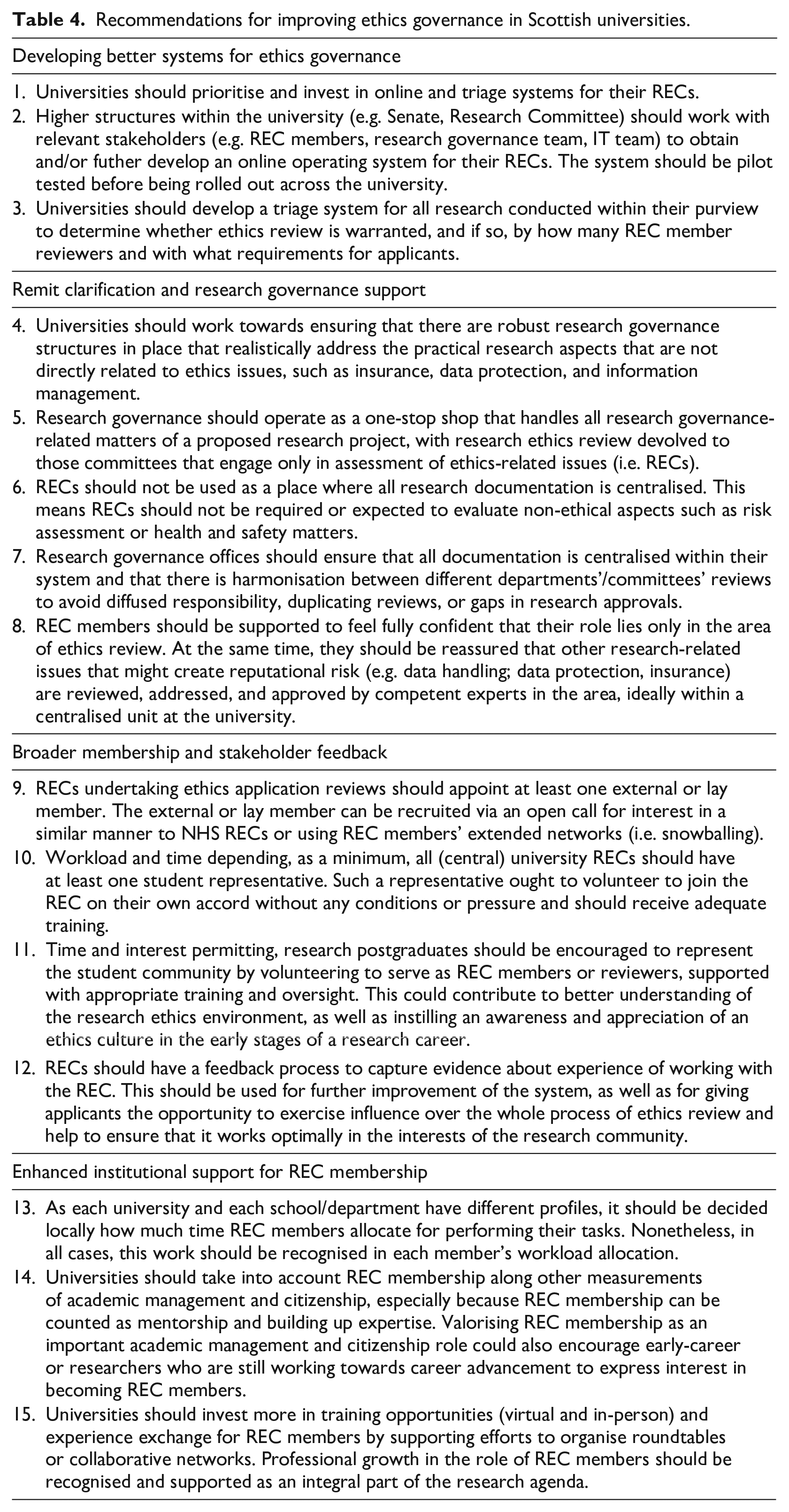
In sum, although our study found that at least from the perspective of those whom we interviewed and observed, RECs across Scottish universities perform well overall, there are nevertheless areas of improvement that can make the process of ethics review smoother and more efficient, and which can make REC membership more equitable and supported as a core part of professional growth. We formulate these 15 recommendations below in Table 4.
Recommendations for improving ethics governance in Scottish universities.
In addition to the above recommendations, building on the findings from our methodological approach, we propose a collaborative network of REC members and research governance officers across Scottish universities, what we call a Scottish Universities Alliance for Research Ethics Governance (SUAREG). Ideally, this would build on existing informal networks (e.g. the Scottish Research Integrity Network) and become more formalised through ongoing support and funding from an organisation that represents all Scottish universities through funding and policy development, such as the Scottish Funding Council or Universities Scotland. The collaborative network that we propose has the benefits of:
being supportive rather than prescriptive as its agenda would be decided by its members rather than external decision-makers;
offering examples of good practice;
identifying mutual learning opportunities – although we fully acknowledge that more training related to ethics does not necessarily result in more ethical reviewers or a higher awareness of the research ethics culture; and
openly sharing templates of supporting research documentation such as Participant Information Sheets or Informed Consent forms, as some universities might have more experience with certain categories of participants.
In addition, the network that we propose can help address the improvements we identified and recommendations that we have made above: e.g. create a pool of prospective external or lay REC members as they can be difficult to identify; offer opportunities for experience and expertise exchange; discuss various models of building REC membership in workload allocation at various universities. Such a collaborative network could be the first of its kind that would offer a model of peer-academic support across Scottish universities and beyond. It would also further instantiate the REC’s role as an ethical research facilitator and regulatory steward in assisting applicants in the early lifecycle of their proposed research. Finally, such a collaborative network would help bridge the regulatory spaces of ethics and governance, enabling universities to better map and address the various components that comprise a ‘good’ research project, from the standpoint of, inter alia, ethics, law, governance, and research design (Figure 1).
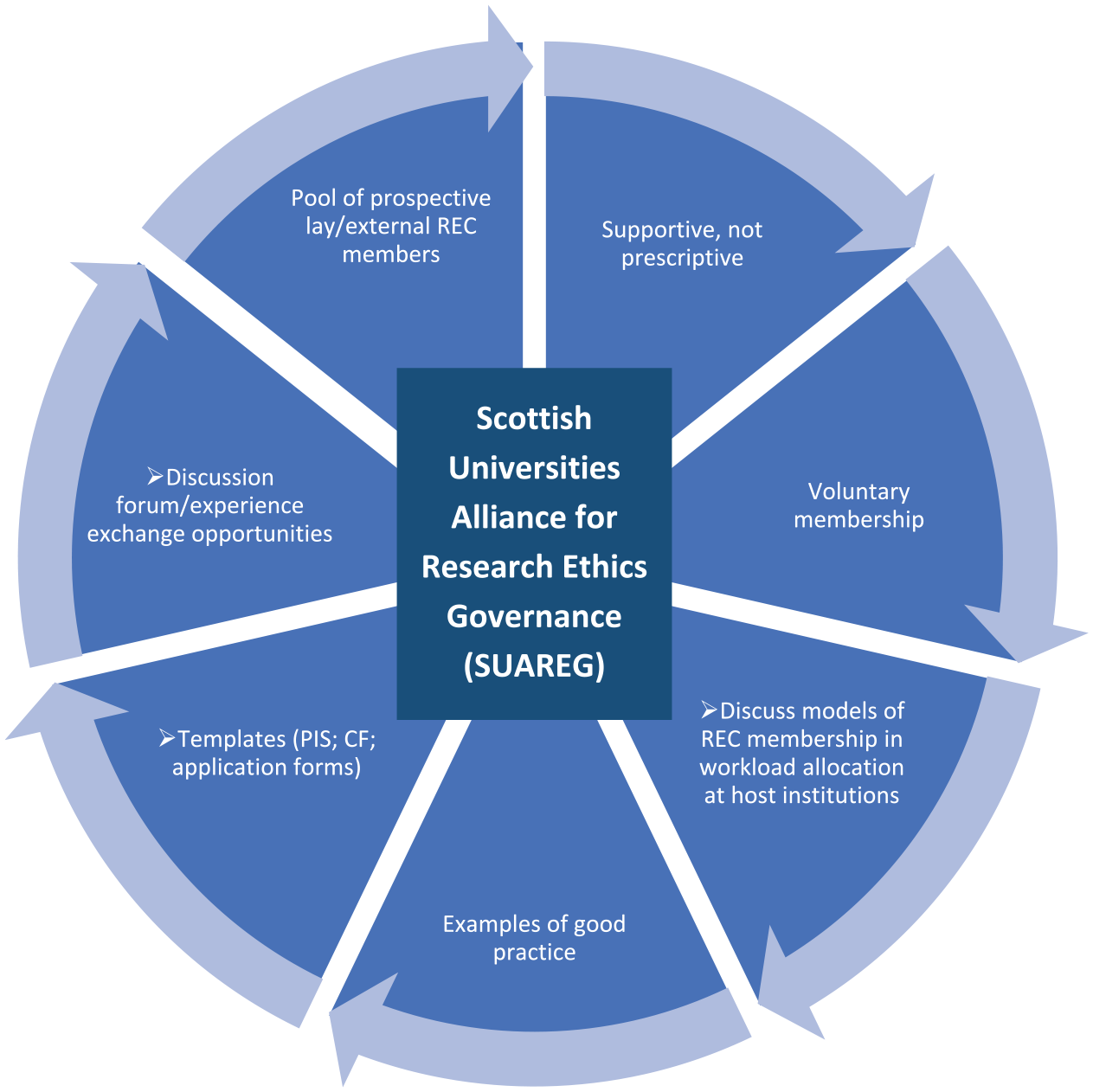
Proposed collaborative network for Scottish universities.
Limitations
Our study has some limitations. First, our observations did not include any SREC meetings. Although two of the URECs at different universities that we observed also performed ethics applications review, most other UREC meetings had a higher-level policy-focused agenda regarding the development of an online system, data protection and management, training materials, annual reports, etc. Thus, observing how ethics review is being ‘done’ was limited – not only in terms of COVID-19-related travel constraints that made face-to-face interaction impossible – but also because this meant we relied more on what our interviewees have commented on. We did not include extensive discussion of how the review is performed and we chose to label these comments as how REC members perceive it rather than how it may be in reality. Second, as Hedgecoe (2020) notes, it is valuable to observe REC meetings not only at different institutions across the higher education sector, but also the same REC across time. Given our limited funding time allocated for our empirical data collection, we were unable to attend multiple UREC meetings. Finally, we acknowledge the importance of understanding how the system works not only by looking at it from the perspective of RECs and their members, but also from applicants. Applicants’ own experiences and perceptions of the system could offer the same (if not more) level of suggestions – not to mention, we suspect, criticisms and concerns–on what works well, what doesn’t work so well, and what can be improved. However, including applicants as participants would have been, given the above-mentioned constraints, a laborious and time-consuming process outwith the scope of this study; yet, as this remains an open research area, we would value and welcome any additions in this area which would complement the picture of ethics governance at Scottish universities.
Conclusions
In this article, we presented our findings from a year-long qualitative study investigating how RECs at Scottish universities operate, and whether they operate in ways seen by those involved in their processes as ‘good’. Overall, we found that RECs have a varied operation, which in part may be a reflection of the different profiles of autonomous Scottish universities. It is questionable the extent to which each REC instantiates, much less instantiates well, principles of ‘good’ regulation and adheres to UKRIO-ARMA’s principles of ethics review, and how much we should be concerned about this, if at all. It is clear enough that universities enact autonomous ways of working in all facets, and divergence or variation of application of some or all of the principles from UKRIO-ARMA or otherwise is the norm rather than the exception. This does not mean in turn that ethics review is chaotic, haphazard, or otherwise poorly run. It does mean, however, that top-down measures to drive standardisation and consistency may run into difficulty as compared to NHS RECs or IRBs at US universities, the latter of which must adhere to a common framework by law, viz. the Common Rule (US Department of Health & Human Services – Office for Human Research Protections, 2019).
Despite the variegated operation, we also found that RECs demonstrated a good amount of consistency in terms of how their members describe how they learned their role and their motivation for becoming a REC member; how they learn to review applications and make decisions; and their perceptions of the system and applicants’ attitudes more generally. Our participants described their role as rewarding for its intellectual challenge; RECs are regarded as imbued with a sense of collegiality and, quite often, friendship and appreciation of other members’ deep dedication. At times, however, REC membership also has been perceived as frustrating, born out of external, more structural aspects such as trying to fit REC commitments alongside busy academic schedules and the lack of an appropriate online system to support the role.
The value of implementing a well-run and well-resourced online system cannot be overstated in helping RECs (and members therein) as well as governance officers at universities serve as ‘regulatory stewards’ that help applicants through the liminal stages of the research lifecycle, bringing their research to fruition, and in a manner that not only satisfies regulatory requirements, but also helps inculcate a sense of ethical awareness in their projects. Connected to this, we recommend the deployment of more resources dedicated to training REC members on how to evaluate various kinds of research projects, and facilitating best practice exchange and training opportunities, both for applicants and for reviewers. While we acknowledge that this might be an imperfect recommendation that does not always achieve the aim of creating more ethical reviewers or researchers, it is, nonetheless, a starting point of making research ethics more visible. For university administrators, we encourage reassessment of the university’s workload allocation model to ensure that it accurately reflects and respects the work and time academic staff put into ethics review; we also encourage greater recognition of the importance of research ethics governance in the university’s research environment and research culture (which in turn has training implications for the wider research community).
Given the relatively geographically confined limits of Scotland, we see great potential for the value of a collaborative network. Such a network would be the first of its kind as it would operate in a professional-supporting capacity and its agenda would be set up by its own members rather than dictated from above. A collaborative network would create the space for discussing how practical issues have been successfully addressed at other members’ host universities. Additionally, the network could meet for future roundtables for experience and best practices exchange – a need identified by most of our participants. Such initiatives could be sponsored by several funders. This would be not only a fruitful recognition of the importance of RECs within the university research landscape and a way of guarding against actual or perceived mission creep, it would also help facilitate a heightened awareness of the importance of supporting REC members in their own effort to assist students and staff alike in undertaking as ethically robust research as possible.
Footnotes
Acknowledgements and declaration of competing interests
The authors thank each of the interview participants, participating Scottish university RECs, and May 2022 roundtable participants in Edinburgh for their generous time and effort in contributing to this qualitative research project. The authors thank the Carnegie Trust for the Universities of Scotland for their generous funding support. The authors also thank Carol Ball, Robert Dingwall, Adam Hedgecoe, Graeme Laurie, Ian Neal, Charlotte Smith, Kevin Smith, and Philip Winn for their insightful comments on a previous draft of this article.
Edward Dove was formerly the Director of Ethics and Integrity at Edinburgh Law School and a member of the College of Arts, Humanities and Social Sciences’ Research Ethics Committee (2020–2022). The University of Edinburgh was not included in any of the interviews or observations. Edward Dove was an Associate Editor of the journal Research Ethics at the time of this manuscript submission. He was not involved in any handling of the manuscript submission process, including peer review.
Author contributions
Both authors contributed equally to the data collection and analysis, as well as the writing of the manuscript.
Funding
All articles in Research Ethics are published as open access. There are no submission charges and no Article Processing Charges as these are fully funded by institutions through Knowledge Unlatched, resulting in no direct charge to authors. For more information about Knowledge Unlatched please see here:  . The author(s) disclosed receipt of the following financial support for the research, authorship, and/or publication of this article: This study is supported by a Research Incentive Grant (RIG009887) awarded to Edward Dove from the Carnegie Trust for the Universities of Scotland. For the purpose of open access, the authors have applied a Creative Commons Attribution (CC BY) licence to any Author Accepted Manuscript version arising from this submission.
Availability of data and materials
Anonymised datasets analysed during the current study are available from the corresponding author on reasonable request.
Ethics approval and consent to participate
This research was reviewed and approved by Edinburgh Law School’s Research Ethics and Integrity Committee (date of approval: 25 August 2020). A copy of the approval letter has been submitted to the journal. Informed consent was obtained from all participants prior to interview and REC meeting observations. All participants were assured of confidentiality.