



Abstract
Across disciplines there is a large and increasing number of research projects that rely on data collection activities in low- and middle-income countries (LMICs). However, these are accompanied by an extensive range of ethical challenges. While the safeguarding of study participants is the primary aim of existing ethics guidelines, this paper argues that this “do no harm” principle should be extended to include research staff. This study is a comprehensive review of more than 80 existing ethics guidelines and protocols that reveals a lack of safeguarding research staff regarding the ethical challenges faced during data collection activities in LMICs. This is particularly the case when it comes to issues such as power imbalances, political risk, staff’s emotional wellbeing or dealing with feelings of guilt. Lead organizations are called upon to develop guiding principles that encompass the safeguarding of research staff, which are then to be adapted and translated into specific protocols and tools by institutions.
Keywords
Ethics guidelines: History and blind spots
There has been a steep increase in the number of research projects taking place in low- and middle-income countries (LMICs) across disciplines in recent years (Haug et al., 2021), triggered in part by calls for more evidence-based policies (Kaplan et al., 2020; Reddy, 2019; White, 2019). This trend has been accompanied by a growing popularity of primary qualitative and quantitative data collection activities in LMICs by disciplines such as political and economic sciences, but also global health (Humphreys, 2015). Just as is the case globally, data collection activities in LMICs can involve an extensive range of ethical challenges that transcends academic disciplines, and these challenges vary between and within countries (Abimbola, 2019; Bhutta, 2002; Bradburd, 1998; Scheyvens et al., 2003). Overall, there is a lack of ethics training across disciplines that adequately prepares researchers to prevent or deal with ethical challenges, although some sciences have a longer history of “field research” and being better equipped (Chiseri-Strater, 1996; Jacobs-Huey, 2002). 1
Historically, to “do no harm,” fundamental ethics requirements have been developed that are enacted via guidelines such as the Nuremberg Code (1947), the World Medical Association’s Declarations of Geneva (1948) and of Helsinki (1964), as well as the Belmont Report (1978). Though the principle of “do no harm” is not without limitations (Hugman et al., 2011; Kaplan et al., 2020), it has contributed to the adoption of ethics standards by institutions worldwide, and helped to promote ethical research. However, these requirements often fail to address the complexities of today’s international research collaborations and the specific context of research in LMICs (Schroeder et al., 2018). Furthermore, they focus mainly on safeguarding research participants (Morris, 2015). While it is of utmost importance to consider how best to “do no harm” for the study population, one should not forget the other major actors when thinking about safeguarding: the research staff. Particularly when working in LMICs, research staff can be exposed to substantial physical safety threats due to inadequate infrastructure, harsh weather conditions or insecurity in post-conflict settings (Bachmann, 2011; Canavati et al, 2017), and experience emotional distress particularly when working with survivors of sexual or physical violence where research staff is listening to traumatic narratives and stories (Rothman et al., 2018; Wood, 2011). In highly deprived research settings, research subjects might seek help from the research staff which often leads to difficult role conflicts (Kamuya et al., 2014), and feelings of guilt and shame (Mayan and Daum, 2016).
Safeguarding (beyond the legal frameworks for workers’ rights) is a critical ethical concern. 2 However, there are often unclear policies in place for the protection of personnel working “in the field,” or those that are not regularly employed. Research staff might include, for example, co-authors, data enumerators, gatekeepers, cooks, and drivers, who are an integral part of every research project, yet do not all enjoy the same level of protection. Due to differences in culture, institutional norms, and intersectional identities, there are varying, and at times competing, expectations and interests in international research projects (Reid et al., 2021). In addition to disparities in employment conditions, experiences of working and safety in the field also vary greatly depending on an individual’s race, gender, sexuality, and age. Given the stark power imbalances and differing expectations within some research teams, even seemingly simple management problems may evolve into ethical challenges (e.g., too-short time frames for data collection), with spillover impacts on the physical and emotional wellbeing of research staff. Contextual factors, such as working in geographically remote areas with little infrastructure or in politically unstable regions, can give rise to further challenges. Coupled with inadequate working conditions, these factors often increase risks for staff’s physical and mental wellbeing (Vlassenroot et al., 2019).
This paper argues that beyond emotional and physical safety and working conditions, ethical issues also extend to the complexities of academic ownership and care for whose voices are acknowledged (Morton et al., 2022). Field research staff come from high-income countries (HICs) as well as LMICs. Within global research consortia, field data collection is often led by researchers from HICs, along the lines of global power inequities (Ong’era et al., 2021). 3 There has been a policy shift toward promoting the local ownership of the research process in keeping with the Paris Declaration on Aid Effectiveness, though in practice this remains to be seen in many research disciplines. The trend toward research being funded by international and national development organizations may further aggravate matters by reproducing structures of donor and recipient and imposing funding cycles that focus on short-term outcomes (Ashuntantang et al., 2021).
This research paper contributes by highlighting the ethical challenges faced by research staff collecting primary data in LMICs and identifies the vacuum of comprehensively addressing these in ethical guidelines. While safeguarding issues can arise in all countries and are of utmost importance at a global level, this paper focuses on LMICs as their contextual setting often pronounces ethical challenges (Steinert et al., 2021). Here, some challenges have received more attention, others have hardly been mentioned. This paper proposes solutions and concrete steps to prevent and deal with ethical challenges at an institutional and individual level and we call upon lead institutions to develop a comprehensive set of guidelines for safeguarding research staff. Since there are no one-size-fits-all solutions, we urge individual organizations to develop more specific guidelines that address the persistent gap of safeguarding research staff conducting work in LMICs. This call for action is critical since ethics review processes often do not meet minimal standards (Aguilera et al., 2022; Sambiéni, 2018) or do not exist at all (Chin, 2013). This paper is structured as follows: after describing our methodology, an overview of the most important ethical challenges faced by research staff working in LMICs is provided and corresponding safeguards are presented. This is followed by a discussion that outlines further solutions and a call for action.
Needs versus practice: Gap analysis of ethical challenges in guidelines
Methodological approach
We employed an internet-based search strategy to identify existing guidelines which address ethical challenges encountered by research staff contributing to “field research.” From June 2019 to December 2020 a Google-based search was conducted using a wide range of keywords and combinations (see Supplemental Table A1 for more details). Beyond universities, we reviewed humanitarian and funding institutions as well as journalist networks. In order to help mitigate for bias associated with non-publicly available institutional guidelines, an additional hand-based search of internationally well-known organizations was conducted, which the authors followed up through direct institutional contacts. It should be noted that this search was limited to English and German language guidelines, and these guidelines are predominantly from organisations based in HICs.
Research findings
In a previous systematic review, Steinert et al. (2021) identified nine types of ethical challenges that researchers may be exposed to during fieldwork (role conflicts, physical safety threats, emotional distress, power imbalances, work conditions, feelings of guilt, sexual harassment, political repression, issues concerning institutional review boards). Building on this work, we identify intersectional identities of field research staff as an additional challenge (Figure 1). In the following, we discuss each of these challenges in turn explaining the issue and how existing guidelines address it. We then present a brief summary of the solutions that the guidelines provide and identify the gaps in what is covered. These challenges are not unique to fieldwork in LMICs, but they are aggravated by contextual factors such as poverty, inequality, and the uneven power dynamics between researchers and participants. For a more comprehensive list of specific guidance on how to address each challenge, please refer to Supplemental Table A2.
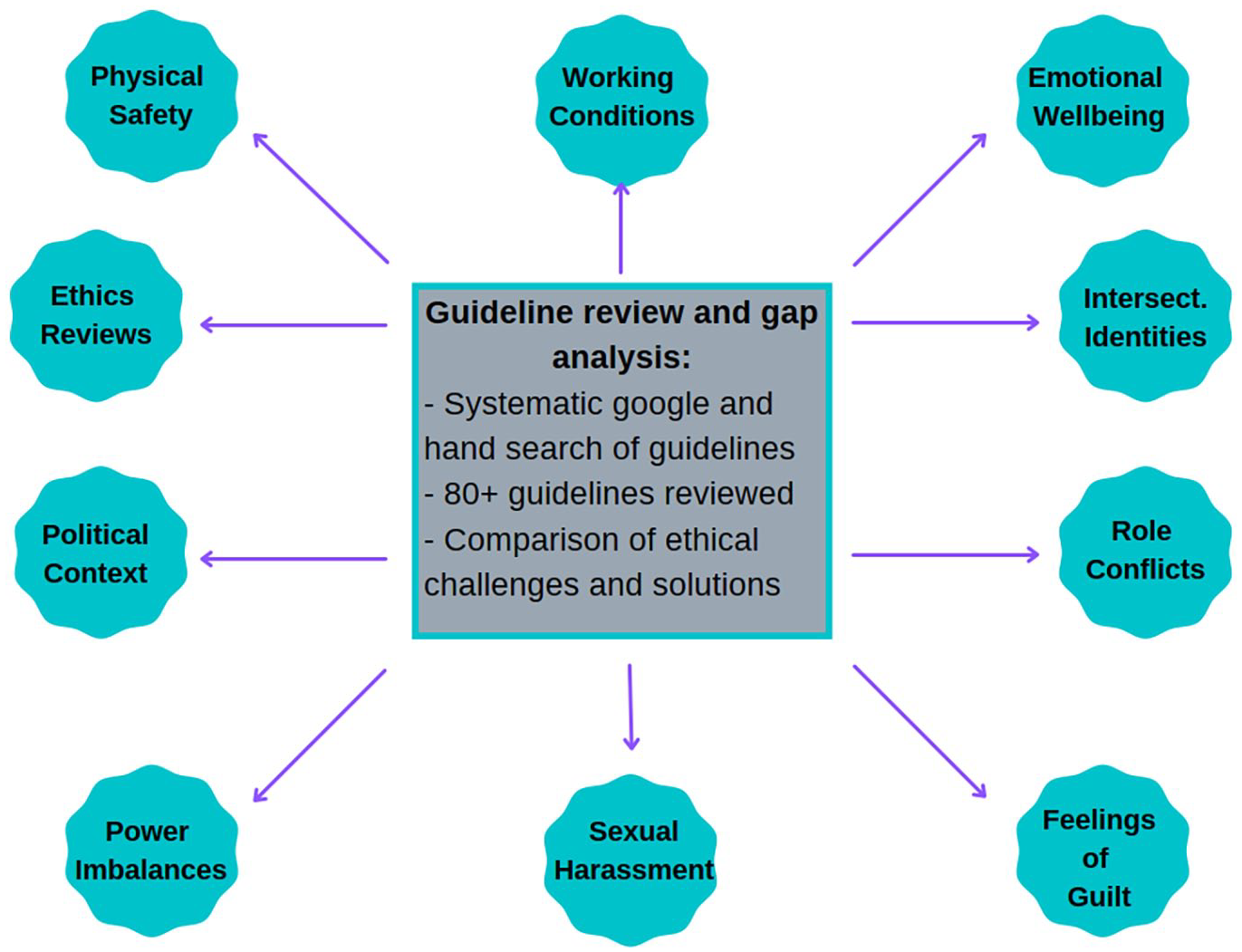
Overview—gap analysis.
Physical safety
The physical safety of field research staff working in LMICs is at risk in different ways and for various reasons. The World Bank projects that more than 50% of the world’s poor will live in fragile countries by 2030 (World Bank, 2020) meaning that a significant proportion of global development research is focusing on conflict-affected and unstable states. This imposes security risks, including crime, unsafe travel modes, harsh weather conditions, and exposure to diseases, which threaten researchers’ health and life. Security issues for foreign and domestic research staff are aggravated by strict project timelines and ambitious interview targets, leaving insufficient room for planning and safety buffers, while budget constraints may impose cuts on travel arrangements and proper housing.
Physical safety is discussed in a large number of guidelines focusing on preparedness, including risk management plans, awareness building (e.g., Tennessee Tech, 2017; Trust, 2018; University of California, 2019; University of Texas at Austin, 2010), clear management responsibilities (e.g., UN, 2006), and most importantly, training (BERA, 2018; J-PAL, 2022). Guidelines, particularly from development practice (CARE International, 2014; UNESCO/Reporters Without Borders, 2015), provide specific guidance on personal conduct during violent events (bombing, assaults, land mines, etc.). Many guidelines promote working in teams, whilst also acknowledging that team members can be a potential threat or source of harassment (IADB, 2012). To counteract this risk, guidelines highlight the importance of proper reporting and information sharing (CARE International, 2014; European Commission, 2004; IFRCC, 2009; University of Bristol, 2012; World Food Programme, 2018), including “Incidence Management Hotlines” in larger organizations (World Food Programme, 2018). In general, physical safety is one of the challenges which is addressed well by guidelines.
Alcohol and drug use can have adverse effects on personal safety. Despite this, there can be immense pressure to engage in risky consumption of drugs and/or alcohol during fieldwork (e.g., Posselt and Nuñez, 2022; Schneider et al., 2021), especially if related to the research topic. The guidance for alcohol consumption for personnel doing field data collection is inconsistent and unclear ranging from “socially appropriate” (ISS, 2016), “healthy” (Dart Centre, 2007), “minimize” (WHO, 2011b) through to “avoid completely” (University College Dublin, 2015). While “avoid completely” is clear and appears superficially to be the ethical pinnacle, it lacks acknowledgment of the widespread role of alcohol and drugs across societies, and the expectations that field research staff may face to ensure recognition or credibility when collecting data in certain “milieus.” Staff care (IASC, 2014) and peer-to-peer support (UNHCR, 2013) offer a starting point to tackle excessive alcohol consumption.
Working conditions
Working conditions comprise topics like working hours and rest periods which invariably impact upon the physical and mental demands of work tasks (International Labour Organization (ILO), 2021). However, we discuss those issues separately from physical safety and security as well as emotional wellbeing. This is also due to the fact that working conditions also touch upon other matters, including, for instance, fairness concerns with respect to wages. Budget and time constraints can limit the working conditions, and negative outcomes can be compounded by researchers’ inexperience or institutional barriers (Bahn, 2012). Often, the hiring of research staff takes place under informal circumstances, where teams are paid cash-in-hand and lack the formal protection of contracts and insurance. With respect to risks, guidelines frequently mention low wages, high workload, no breaks, lack of insurance, and conflicting demands, as well as unclear expectations (CARE International, 2014).
Guidelines that relate to working conditions for research staff largely focus on the physical wellbeing of staff and the security aspects of the work (e.g., University of Toronto, 2011). Challenging working conditions are mentioned, for example, long working hours. While existing guidelines discuss these issues for institutional staff members, there is little reference to working conditions that specifically relate to local staff. 4 Very few state that fair wages and insurance should be provided to local research staff, or, at a minimum, that realistic expectations about employment conditions should be set clearly and in advance (CUREC, 2017; Trust, 2018). Beyond security-related conditions, some guidelines discuss exposure to distressing situations, yet, instead of addressing the root causes imposed by working conditions, only coping mechanisms such as personal and organisational stress management are suggested (Antares Foundation, 2012; WHO, 2011b). Most guidelines related to working conditions are from humanitarian organisations; only a few universities and other research institutions have published such guidance.
Emotional wellbeing
Research work can expose staff to situations where they feel lonely or isolated, particularly if they are working far from home. This can provoke emotional reactions such as anxiety and fear, stress, insomnia, depression or burnout during, and after, fieldwork (Klocker, 2015; Simon and Mosavel, 2010; True et al., 2017). The emotional burden may be further increased if, for example, the research involves sensitive topics, includes vulnerable or severely deprived populations, is located in disaster- or war-affected settings, and/or includes participants who have survived physical or sexual violence (Cordisco Tsai and Tsai, 2018). When researchers interact closely with study participants and encourage them to disclose the potentially traumatic narratives, stories, and images, they are susceptible to substantial emotional distress and secondary (vicarious) trauma (Steinert et al., 2021). There is a harmful culture in academic fieldwork where fieldworkers may feel that they are expected to endure hardships and overcome them themselves in order to reach their full potential as researchers (Dominey-Howes, 2015; and authors’ own experiences).
Against this backdrop, the emotional wellbeing of research staff is hardly addressed in existing guidelines. Research institutions tend to acknowledge the issue of emotional harm and the responsibility of institutions for good staff care, but without providing specific ideas or solutions to address this challenge (e.g., BERA, 2018). The exceptions are some British universities that provide online resources on culture shock, on giving regular debriefings after fieldwork, and on secondary (vicarious) trauma (e.g., University of Oxford, 2020). There is more mention of emotional wellbeing in guidelines from humanitarian organizations as there seems to be a higher sensitivity to the increased risk of depression, anxiety, and burnout among humanitarian workers. These guidelines focus primarily upon stress and burnout caused by distressing activities in disaster- or war-affected zones. Further guidelines from the field of journalism (e.g., Antares Foundation, 2012; Dart Centre, 2007) address emotional distress and trauma, particularly the potentially adverse emotional impacts from interviewing traumatized persons. The World Health Organisation (WHO) (2011b) offers advice for psychological first aid (PSA) for researchers. Several guidelines mention regular debriefing meetings during fieldwork so that research team members can discuss experiences and feelings induced by the data collection. Frequent supervision and additional external support structures, such as mental health therapy and training, are also mentioned.
Intersectional identities
In the field, researcher characteristics such as gender, sexual orientation, race, religion, marital status, disability, and pregnancy can affect researchers’ wellbeing in different ways (Mwambari, 2019). Cultural norms can impact upon how one is perceived and treated and can induce threats to physical safety as well as stigmatization and discrimination. There might also be impacts from legal restrictions, for instance, in countries where homosexuality is illegal (Orr et al., 2019; Pillay et al., 2022). Researchers’ experiences may reflect the intersection of multiple factors, rather than single distinct factors (Hankivsky, 2014). Intersecting identities shape lived experiences and wellbeing, whether they are visible and perceived by others (e.g., race, physical disability, gender) or not (always) visible (e.g., sexual orientation).
How one is perceived and treated may be at odds with how one identifies, and intersecting identities can influence how a research project as a whole is perceived by participants and local communities (ISS, 2016). LGBTQI+ field research staff may have to contend with conflicts between their actual and perceived identity, and/or their sexuality being locally unacceptable, or even illegal, and then assess how to minimize the resulting risk. Many researchers have worked in areas where they did not feel safe because of their identity, expression, or presentation, and some individuals are excluded from fieldwork in particular contexts because it is too dangerous (Olcott and Downen, 2020). The heterogeneity of security concerns for different identities might, however, be used as an excuse to exclude particular groups from the research process. In this respect, gender affects treatment in the field, both in terms of in cultural norms, acceptable behaviours and power dynamics, as well as risks of sexual harassment (see following section). It is also important to consider (gendered) cultural norms around behavior. In some places, it may be frowned upon for women (or men) to be seen consuming alcohol, engaging in romantic flirtation (even “off the clock”) or even speaking loudly (Porter and Schänzel, 2018; Schänzel and Porter, 2022; authors’ own experiences).
Many guidelines do not address how researchers’ intersectional identities affect their safety and wellbeing in the field and fail to raise awareness about how researchers’ experiences and their treatment by respondents and other staff can vary widely. Where mentioned, most pertained to gender and sexuality, with few referencing race or other characteristics. However, race plays an important part in fieldwork interactions; field team members may experience racism and/or xenophobia, depending on the context in which they are working, and one’s ethnicity in relation to that of the participants can bias social interactions and their responses (Adida et al., 2016).
Some institutional codes of conduct demand that researchers do not perpetrate acts of discrimination (see e.g., ASA, 2018), but do not address how researchers themselves may deal with discriminatory behaviour or attitudes. Others make broad references, such as “safety and security briefings should take into account the varying needs within a team, bearing in mind that staff of a particular race, ethnicity, caste, gender or sexual orientation may be especially vulnerable to threat.” (Antares Foundation, 2012, p. 11), but do not go into specifics about how to safeguard team members.
Role conflicts
Role conflicts during field data collection arise from the positionality of field researchers in relation to the research participants and communities. Researchers can feel tension between their need to collect data and a perceived duty of care. Particularly, in situations where respondents and target populations are in need, field researchers might often be unsure whether and how to make use of their privileged position to support communities (Bachmann, 2011; Canavati et al., 2017). Offering support has been discouraged for “objective” research, and the researcher’s role as a passive observer. However, when even small gestures of kindness can make a big difference to the lives of those affected by poverty, doing nothing can lead to moral and emotional distress (J-PAL, 2022).
Guidelines strongly emphasize the need to protect research participants to avoid undue intrusion in communities (ASA, 2018; Government of Canada, 2018) and to serve communities through reciprocity and solidarity (WHO, 2016). However, there is little explanation of how this should be done, although one guideline suggests briefing researchers on how to communicate benefits and manage expectations (J-PAL, 2022). Another discusses the difficulty of raising safeguarding concerns about research participants that may be detrimental to the research, for example, when talking to researchers may cause harm in previously traumatized communities (DFID, 2016). Moreover, knowing how and whether to report safeguarding concerns of participants, and local community members, might be further complicated where there are unclear legal or regulatory processes.
Guidelines predominantly advocate that the safety, mental health, and welfare of researchers is paramount and should have precedence over project goals (AAG, 2009; IASC, 2014; Oxfam, 2020; Trust, 2018; University of Otago, 2006; WHO, 2011b, 2016, 2017). However, it is not clear what level of risk to the researcher is acceptable in pursuit of research, or in meeting an ethical responsibility towards research participants.
Feelings of guilt
Feelings of guilt, while being closely linked to emotional wellbeing, are particularly problematic in HIC-LMIC research collaborations where there are wide differences in living conditions between researchers and research participants (Bachmann, 2011; Steinert et al., 2021). Combined with the potential stressors of culture shock, (secondary) trauma and risks to personal safety, feelings of guilt can contribute to destabilizing field research team relationships (Gouda et al., 2016; Pollard, 2009; and authors’ personal experiences).
While discussing the potential of feelings of guilt arising during field data collection, there is a lack of nuance offered to explain or normalize such feelings in ethics guidelines (despite being relatively well-explored in the peer-reviewed literature). Guilt is noted as a symptom of poor mental health (IASC, 2014; UNHCR, 2013) including post-traumatic stress disorder (PTSD) (Antares Foundation, 2012) and stress (ISS, 2016). The Dart Centre (2007) guidelines talk about two different types of guilt: “observational” what one sees during fieldwork, and the guilt of leaving loved ones behind. However, specific guidance on how to manage feelings of guilt are absent in ethics guidelines.
Sexual harassment
Sexual aggression is common everywhere in the world and can affect people of all genders (Abrahams et al., 2014), yet there are few relevant codes of conduct and sexual harassment policies (Clancy et al., 2014). Incidents of sexual harassment, discrimination, and violence in the field are under-reported, including those perpetrated within field teams themselves (Clancy et al., 2014). Researchers may find themselves in positions where they feel pressure to engage in sexual dynamics to maintain relationships with colleagues, superiors, or research communities/participants (see e.g., Groes-Green, 2012).
Most guidelines frame these issues around protection from sexual exploitation, abuse and harassment (PSEAH) for participants (UKCDR, 2019; World Food Programme, 2018), and ensuring that researchers do not perpetuate sexual misconduct (Oxfam, 2020), or exploitative sexual relationships (APA, 2017). There are, however, some specific guidelines which address sexual harassment towards researchers. These tend to focus on taking steps to reduce personal risk, such as avoiding traveling alone at night and covering up with layers of clothing, as well as what to do if one is harassed (e.g., ISS, 2016). Many advise that researchers familiarize themselves with cultural norms around gender and sex before undertaking fieldwork (e.g., UNESCO/Reporters Without Borders, 2015). Some research institutions are also taking steps to provide training and support to prevent sexual harassment when their researchers undertake fieldwork (e.g., University of Washington, 2018). Yet, the existing material contains insufficient guidance around boundaries, the definition of sexual exploitation/misconduct (especially beyond the researcher-participant relationships), management of expectations, and for recovery from incidents of sexual harassment.
Power imbalances
Unequal power dynamics between research partners from HICs and LMICs are an inherent ethical challenge in the majority of research collaborations (Herman et al., 2022; Schroeder et al., 2018). Institutions and individuals from HICs dominate most parts of the research process by setting the agenda, defining methods and tools, owning the data and often having the sole right to the data collected (Odjidja, 2021; Trisos et al., 2021). Oftentimes, this builds on and further protracts existing global power imbalances. These inequities can lead to safeguarding concerns when they produce adverse circumstances for research staff. For instance, researchers in LMICs may have limited leverage to negotiate adequate access and ownership of the data collected or recognition that may be vital for their careers (Sibai et al., 2019).
Often, there is no credit given to local contributions and knowledge even though they play a major role that goes beyond data collection efforts (Lansford et al., 2019). This fosters asymmetric knowledge production processes where local contributions are not adequately acknowledged and authorship is limited to HIC researchers. When not considering the vast diversity of LMICs and local perspectives, this may induce context-insensitive research and risks increasing research fatigue (Jumbam, 2020). There has been a recent increase in acknowledgment of these problems in academia (Liverpool, 2021); voices from LMICs are contributing to the growing debate on decolonizing research practice (Ong’era et al., 2021).
The challenges associated with power imbalances that lead to adverse conditions for research staff are addressed in ambiguous ways or mostly not at all. Some mention it as a problem, and highlight the importance of local knowledge production (e.g., CIRAD, 2017; DFID, 2016; UKCDR, 2019). However, the collected guidelines do not provide solutions or suggest tools. There seems to be greater sensitivity towards the topic in social anthropology and in sociology guidelines with mention of some of the challenges (e.g., Association of Social Anthropologists of the UK and the Commonwealth, 2011). Larger organizations such as the AFDB (2018), describe the abuse of power in hierarchies more generally, including how this can affect lower-level staff negatively, and how to counteract the problems. There are a few guidelines that focus explicitly on the topic of power imbalances and provide a comprehensive list of problems with potential solutions (e.g., COHRED, 2016; KFPE, 2018).
Political context
Over the past decades academic freedom improved globally as measured by expert surveys. However, recent years indicate a reversal in several countries, including several examples from the Global North (Coppedge et al., 2021). Research in politically unstable or authoritarian settings may be subject to political repression, which ranges from allegations of being a spy, attempts of intimidation and harassment by police officers or local authorities, to the confiscation of IDs or imprisonment (Steinert et al., 2021). While foreign researchers have the option to leave the host country, local staff are particularly at risk of mistreatment (Mwambari, 2019). Political repression may hamper research in terms of access to the field (e.g., travel bans, restrictions of permits, data seizure), but more importantly impair the wellbeing of research staff (relating also to physical and emotional wellbeing).
Given the large amount of research in authoritarian or politically fragile settings, as well as on sensitive political topics, there is remarkably little guidance on how to handle these situations, and with it, potential political repression. Guidelines from the academic sector highlight the importance of conducting rigorous research and safeguarding respondents in those settings (Association of Social Anthropologists of the UK and the Commonwealth, 2011). More applied guidelines for safeguarding can be found in journalism and the NGO sector with links to political violence and the highlighting of digital security issues (UNESCO/Reporters Without Borders, 2015). However, these guidelines focus upon protection of the (international) researchers rather than the team as a whole, or the LMIC research staff in particular.
Ethics reviews
There is consensus that research with humans carries risks and benefits that require independent ethical review, as stated in foundational codes like the Nuremberg Code (1947), the Helsinki Declaration (1964), or the Belmont Report (1979). Institutional review boards (IRBs), which are oftentimes associated with universities and research institutes, have a responsibility to conduct these ethical assessments. However, review boards from HICs may not be able to consider the ethical concerns that apply to a diverse set of partner LMICs sufficiently and may impose conditions which are simply not practicable on the ground. Many research projects still only rely on ethics reviews from the country that funds the research (Sieber and Tolich, 2012, and authors’ personal experience). This leads to a lack of representation and consideration of ethics assessments from local ethics bodies. Additionally, review boards in LMICs, if they exist at all, can suffer from a lower regulatory capacity, which induces concerns that HIC researchers might deliberately conduct research in LMICs in order to engage in “ethics dumping” (Schroeder et al., 2018; Wassie et al., 2019). Even if ethics boards from both countries are involved, international research projects run the risk of getting lost in diffuse accountability processes. Thus, contradictory demands can impose barriers for research, harming, rather than assisting the research staff (Makhoul et al., 2014). This is compounded by the fact that, in some institutions, safeguarding research staff is narrowly considered as physical health and safety, but not broadly addressed in ethics review processes.
In general, guidelines address the need to seek appropriate local ethics approval with respect to human participants research in LMICs only in a very limited manner. An exception is the Global Code of Conduct which explicitly states the importance of seeking ethical approval in the country where the research is carried out, even if the project has already been approved by the home country (Trust, 2018). University-specific regulations in most instances only mention the general need for an application for ethics approval at the respective university (e.g., UCLA, 2020; University of Oxford, 2020) but not a call to seek approval from a review board (or other relevant authority) in the country of research. This is in line with guidelines and requirements for ethics approval by different funding bodies, including the National Science Foundation (2020), the European Commission (2019), and World Health Organization (2011a, 2011b) as well as from research journals (e.g., BMJ, 2009). The safeguarding of research staff is usually a minor part of these ethics processes; they have a clearer focus upon safeguarding with respect to the study participants.
Discussion and call for action
The need for clear ethics guidelines that address the safeguarding of research staff is critical since formal ethics reviews seldomly adequately consider the protection of research staff, particularly partners from LMICs. For this reason, guidelines often remain the only benchmarks to prevent and assess ethical challenges with respect to research staff.
From our challenge-specific gap analysis, it is clear that there are certain challenges that are more prominently addressed in ethics codes and guidelines than others. The securing of physical safety of staff during “field research” is the most established area in the reviewed guidelines. Here, specific solutions are provided and institutional support offered. This can also be seen with respect to ensuring adequate working conditions of research staff; however, the focus is disproportionally on physical wellbeing (i.e., safety concerns) rather than covering the diverse issues relevant to the broad field of working conditions. While stress management is more prominent in several guidelines, it is often regarded as an individual responsibility. A more rounded view of the emotional wellbeing of research staff (also considering changing working conditions) is lacking, and guidelines offer few potential solutions at the institutional level. As implicitly revealed in various guidelines, by shifting the responsibility to individual staff, institutions risk adoption of unhealthy coping mechanisms, including drug/alcohol use or sex (along uneven power lines). While the problem of power imbalances is mentioned in some guidelines, solutions or tools are rarely presented to address them. Some guidelines mention the importance of preventing discrimination and harassment, but do not provide concrete advice about how to anticipate and avoid them. A more general discussion of the challenges arising from the positionality of the research staff is missing in guidelines. Also, challenges such as the political context, context-insensitive demands from institutional review boards, and feelings of guilt are hardly addressed at all.
In many instances, the responsibility to safeguard is placed on the individual researcher explicitly (e.g., University of Bristol, 2012) by leaving it to the individual to, for example, judge whether it is safe to go into the field, or by not referring to the ethical challenges of research staff at all. Some, but few, guidelines describe institutional solutions (mostly in the field of physical safety and security) and discuss responsibilities around staff hierarchies and legal liabilities. On one hand, this makes sense as individual researchers may be expected to know the context better than their central institution. As a result they benefit from flexibility to carry out their research with a degree of responsibility for field research staff and self-care. This is particularly important for those team members who are managing others and/or have more experience and relative power due to their position in the research team and in society. On the other hand, (especially early career and more inexperienced) researchers may lack the capability to undertake a thorough risk assessment when working in new and unfamiliar contexts. Institutions should differentiate between aspects that the individual researcher or project should consider, and at the same time take responsibility for issues that can, and should, be borne at the institutional and legal level.
Most guidelines have been identified from humanitarian organisations, with fewer from journalism and international organizations. In general, study participants remain the predominant focus of ethical guidelines and principles. For those acknowledging challenges with respect to research staff, a strong focus on institutional research staff, who are usually formally employed and originate from HICs, was evident from our analysis. Local research staff, sometimes working without formal contracts, are mentioned only in a few instances and safeguards are very limited, leaving this group as a blind-spot to be covered by future guidelines.
Overall, we did not find any set of guidelines that addresses all the ethical challenges under consideration in this paper comprehensively. We recognize that there is a need to strike a balance between the proposal of comprehensive and concrete mechanisms for addressing ethical challenges while leaving room to react to the specific characteristics of the work. Therefore, we maintain that there is a need for the development of a comprehensive set of guiding principles that covers the wide range of ethical challenges local and international research staff in different positions might face. Lead organizations are called upon to provide such an encompassing set of guiding principles. Here, the KFPE’s 11 principles and 7 guidelines (KFPE, 2018) but also the codes coming from journalism (e.g., Dart Centre, 2007) or guidelines developed by humanitarian organizations (e.g., CARE international, 2014) serve as good examples among the reviewed guidelines. As there is no “one size fits all” solution, due to the particularities of the research conducted, organizations could adapt these more general principles to their specific research and country contexts. Concrete steps and solutions should be taken to clarify, and strengthen, the responsibility of institutions in safeguarding field research staff, instead of it leaving it solely with the individual researcher. Guidelines and principles in the country, or community, of research should be taken into consideration as they might help to adequately localize the ethical challenges and solutions faced by research staff (e.g., Callaway, 2017).
This paper stresses the need to acknowledge and address ethical challenges faced by research staff engaged in data collection efforts in LMICs and gives an overview of the tools and solutions mentioned in various guidelines. As our search for guidelines was limited to English and German language guidelines, researchers are advised to also search for further guidelines in their country as well as the country where data collection takes place.
Overall, guidelines do not make up for the need to generally raise awareness about the consideration of research staff when thinking about safeguarding. A research project is only ethical if it also considers the protection and safeguarding of all of the research staff who are involved.
Supplemental Material
sj-docx-1-rea-10.1177_17470161221131494 – Supplemental material for Safeguarding research staff “in the field”: a blind spot in ethics guidelines
Supplemental material, sj-docx-1-rea-10.1177_17470161221131494 for Safeguarding research staff “in the field”: a blind spot in ethics guidelines by Lennart Kaplan, Jana Kuhnt, Laura E Picot and Catherine Fallon Grasham in Research Ethics
Footnotes
Appendix
Acknowledgements
The authors would like to express our deep gratitude to the two reviewers for their unpaid work in providing critical feedback that has improved the quality of this research paper. We thank Milan Jacobi and Bahia Amellal for their intensive support in the guideline identification as well as Robbie Lämmel for proof reading.
Declaration of conflicting interests
The authors declare no competing interests.
Funding
All articles in Research Ethics are published as open access. There are no submission charges and no Article Processing Charges as these are fully funded by institutions through Knowledge Unlatched, resulting in no direct charge to authors. For more information about Knowledge Unlatched please see here:  . Laura Picot is funded by a Natural Environment Research Council (NERC) Doctoral Training Partnership (Grant Code NE/L002612/1). Catherine Fallon Grasham is funded by the REACH Programme, funded by UK Aid from the UK Foreign, Commonwealth and Development Office (FCDO) for the benefit of developing countries (Program Code 201880). Moreover, we acknowledge funding by the Federal Ministry of Economic Cooperation and Development (BMZ) through the project “Social Cohesion in Africa,” for research assistance. However, the views expressed and information contained in the paper are not necessarily those of or endorsed by BMZ, FCDO, or NERC, which can accept no responsibility for such views or information or for any reliance placed on them.
Ethical approval
Given that no animals and humans were subject of this research, the authors did not go through an ethical review.
Supplemental material
Supplemental material for this article is available online.
Notes
References
Supplementary Material
Please find the following supplemental material available below.
For Open Access articles published under a Creative Commons License, all supplemental material carries the same license as the article it is associated with.
For non-Open Access articles published, all supplemental material carries a non-exclusive license, and permission requests for re-use of supplemental material or any part of supplemental material shall be sent directly to the copyright owner as specified in the copyright notice associated with the article.
