




Abstract
Child co-research has become popular in social research involving children. This is attributed to the emphasis on children’s rights and is seen as a way to promote children’s agency and voice. It is a way of putting into practice the philosophy, common amongst childhood researchers, that children are experts on childhood. In this article, we discuss ethical complexities of involving children as co-researchers, beginning with an analysis of the literature, then drawing on data from interviews with researchers who conduct child co-research. We identify six ethical complexities, some of which are new findings which have not been mentioned before in this context. In light of these possible ethical complexities, a key finding is for researchers to be reflexive – to reflect on how the research may affect child co-researchers and participants before the research starts. A separate overriding message that came out in responses from the researchers we interviewed was the need for support and training for child co-researchers. We conclude by providing a list of questions for reflexive researchers to ask of themselves when they use child co-research methodology. We also provide important questions for human research ethics committees to ask when they review projects using child co-research.
Introduction
Using research participants as co-researchers is a growing trend in social research in a range of research methodologies and research types such as participatory research and action research. Here we discuss ethical complexities of involving children as co-researchers, beginning with an analysis of the literature, then drawing on data from interviews with researchers who conduct child co-research.
What is co-research?
A preliminary search of the literature shows that researchers sometimes refer to research participants as co-researchers to signal that they are involving participants in the research process in a meaningful way – that research is being conducted ‘“with” rather than “on”’ people (Tee and Lathlean, 2004). Our focus is the more typical view of co-research where research participants are ‘joint contributors and investigators’ who have an active role in gathering data (Boylorn, 2008), where the co-researcher’s role is more than that of informant, consultant or member of an advisory group. The clearest example is participants collecting data by interviewing other participants. This is sometimes called peer-interviewing (Warr et al., 2011). The co-researcher’s role may also include accessing or recruiting other participants (Jarg and Stefan, 2012: 16).
Where does the child co-researcher fit into the literature and into the research landscape?
Child co-research sits primarily within the research with children literature, but it also features in the literature on co-research (Figure 1). Co-research is generally part of participatory research, but a project involving co-researchers may fail to fulfil the ‘basic criterion for classification as participatory research’, e.g. if the ‘co-researcher’ has no control over research decisions (Jarg and Stefan, 2012: 9) (Figure 2). Child-led research is, for the most part, a subset of co-research, but child-led research does not necessarily involve children collecting data from people (Figure 3).
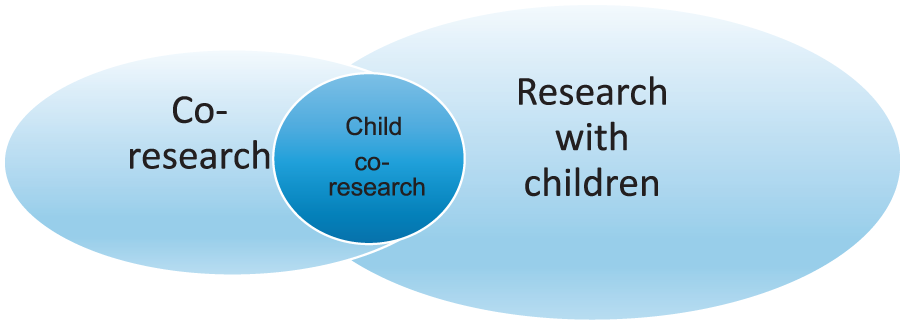
Research literature.
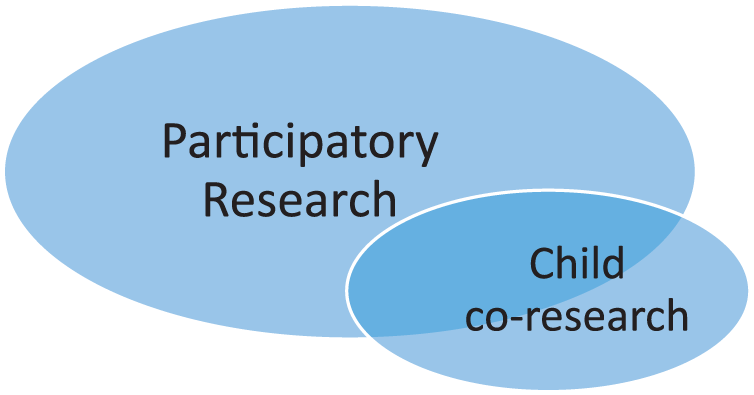
The relationship between child co-research and participatory research.
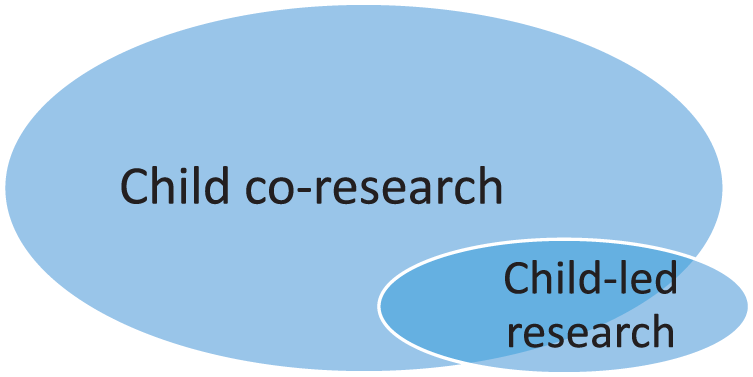
The relationship between child co-research and child-led research.
Claimed benefits of co-research
The expressed rationale for using research participants as co-researchers is respect and inclusiveness. It is research that is for and by people, not just on or about them (Alderson, 2001: 140). It includes getting an ‘insider perspective’ that is usually not available to an ‘outside researcher’ (Boylorn, 2008: 600). The use of co-researchers can provide access to hard-to-reach populations such as those who are disenfranchised, vulnerable or stigmatized (Warr et al., 2011: 338). Peers conducting research with their peers ‘encourages closer intimacy’, which can lead to ‘fuller discussion’ and ‘fuller understanding of the data’ (Alderson, 2001: 140). In these ways, the use of co-researchers can add credibility to the research (Boylorn, 2008: 600).
Engaging co-researchers is a way of meeting the requirements of some funding bodies. For instance, the Australian National Health and Medical Research Council (NHMRC) encourage researchers when applying for funding to ‘consider the benefits of actively engaging consumers’ in research (National Health and Medical Research Council, 2017: 10). The use of co-researchers is also consistent with the joint Statement on Consumer and Community Involvement in Health and Medical Research produced by the NHMRC and Consumers Health Forum of Australia. This document refers to the added ‘value’ that consumers or end-users can make to health and medical research, as well as their ‘right’ and their ‘responsibility’ to do so (National Health and Medical Research Council and Consumers Health Forum of Australia, 2016: 8).
Co-researcher methodology is sometimes presented as a way to address the marginalization of disadvantaged groups because it allows ‘a less hierarchical relationship’ between the researcher and those who are being researched (Alderson, 1995, 1999; Schäfer and Yarwood, 2008: 121–122).
Co-research with children
Co-research has become particularly popular in social research involving children. This is attributed by some to the emphasis on children’s rights, and their ‘participation rights’ as ‘enshrined in the UN Convention on the Rights of the Child’ (Alderson, 2001: 141). It is also attributed in part to the recognition of children as ‘consumers or “users” of products and services’ (Kellett, 2010: 195). In the existing literature, child co-research is a way to promote children’s agency and voice: ‘To involve children more directly in research can rescue them from silence and exclusion, and from being represented, by default, as passive objects’ (Alderson, 2001: 142). It is a way of putting into practice the philosophy (common amongst childhood researchers) that children are experts on childhood (Kellett, 2010: 197; Marr and Malone, 2007: 4). According to some childhood researchers, children are able to get responses (data) from other children which are inaccessible to adult researchers because of ‘power and generational issues’ (Alderson, 2001: 141; Kellett, 2010: 197). These researchers view this as adding to a body of knowledge about children ‘from a genuine child perspective’ (Kellett, 2010: 197). Advocates of this approach claim that it is a positive experience for child co-researchers and that it produces better quality outcomes (Alderson, 2001; Kellett, 2010).
Concerns about co-research with children
There are also critiques of child co-research in the literature. Mostly these focus on methodological issues, but some also focus on practical and ethical issues (Bradbury-Jones and Taylor, 2015; Conolly, 2008; Hunleth, 2011; Kim, 2016; Willumsen et al., 2014). In our view, the concerns identified are all ethical in nature. Methodological and practical issues have ethical implications; all come under the ethical concern about the need for children to be protected and not exploited.
There are two main articles in this area (Bradbury-Jones and Taylor, 2015; Willumsen et al., 2014). The article by Willumsen and colleagues specifically identifies the ethical issues, whereas the focus of the other is circumventing or working around the ethical issues (Bradbury-Jones and Taylor, 2015: 183). Based on the points Willumsen et al. (2014) make, we group the main concerns as follows:
(i) The emphasis on a child’s right to participate at the expense of other considerations
In the literature on child co-research, one of the ideas that dominates, which is also one of the main justifications for this methodology, is the idea of a child’s participation rights. Nevertheless, this emphasis on a child’s right to participate comes at the expense of consideration for a child’s ‘right to refuse to participate and their right to protection from all forms of exploitation’ (Willumsen et al., 2014: 341).
(ii) Competing interests and lack of reflexivity
Concern has been expressed that the competing interests of researchers can take precedence over the interests of child co-researchers (Willumsen et al., 2014: 345). Examples of competing interests include career advancement and a determination to justify the use of child co-researchers. A related concern in the literature is the claim that researchers’ use of child co-research is sometimes ‘unreflexive’ – it is accepted and used ‘uncritically’ (Bradbury-Jones and Taylor, 2015: 162; Conolly, 2008; Hunleth, 2011: 82; Kim, 2016: 238–239; McLaughlin, 2006: 1407).
(iii) Difficulties faced by the child
In the literature, little attention is being paid to ethical difficulties faced by child co-researchers in the conduct of child co-research. According to Willumsen and colleagues, despite the ‘greater involvement of children as co-researchers’ brought about by ‘changes in childhood research’, there are few publications discussing ‘the practical and ethical issues involved in researching with children’ (Willumsen et al., 2014: 333). And, a key advocate of child co-research concedes that researchers’ accounts of research by children ‘gloss over the numerous inevitable difficulties during the research process’ (Alderson, 2001: 150). The literature is, in the main, written by researchers who conduct research with children, and generally the audience is other social researchers. Identifying or dealing with ethical complications that children may face during the research process seems not to be a priority.
There is nothing in the existing literature that guides human research ethics committees (HRECs) by identifying the questions HRECs should be asking when faced with projects involving child co-researchers, and there is little guidance for researchers on the things they could be reflecting on in their interactions with child co-researchers and other participants. This article addresses these gaps. The significance of our empirical data is that it tells us what researchers who use this method say about it. And, what they say can help inform the ethics review of child co-research studies.
Methodology
The project
The data reported in this article come from a larger study on the ethical considerations of using research participants as co-researchers. This is a study funded by the University of Melbourne Office for Research Ethics and Integrity (OREI). The aim of this overall study, which investigates the use of co-researchers from a range of different participant groups, is to help facilitate research involving co-researchers in a way that does no harm to the co-researcher or other participants. The main project outcome will be a set of questions that HRECs should ask when reviewing this type of research. Ethics approval (Ethics ID: 1544259.1) was obtained from the University of Melbourne, School of Population and Global Health Human Ethics Advisory Group (MSPGH HEAG). This article deals with child co-research, which is a specific aspect of the overall study. The results of the overall study are to be published elsewhere.
Definition of child co-research
Prior to interviewing key informants for this study, recruitment showed us that there is a lack of clarity, and some complexity, in defining child co-research. One researcher responded that most of her work is research with children and young people but they are the researchers. She maintained that they are being supported to conduct their own research and that that is different from being a co-researcher. Nevertheless, children collecting data from other children fits our definition of child co-research.
In the literature, child co-research is not precisely defined, and the nature of the child’s role is ‘sometimes ambiguous’ (Kim, 2016: 230). The terms ‘child co-research’ and ‘child co-researcher’ are used interchangeably with descriptive terms such as ‘research by children’, ‘children doing research’, ‘active researchers’, ‘participant researchers’, ‘peer research’ (Alderson, 2001: 139; Bradbury-Jones and Taylor, 2015: 161; Kellett, 2010: 195), ‘active involvement’ in research, and ‘involving children as researchers’ (Conolly, 2008: 201, 203). It should also be noted that Willumsen et al. question the theoretical basis of the term ‘co-researcher’ because of children’s ‘immature status’ and their ‘limited autonomy’ which makes it ‘difficult to avoid adult supervision and control’ (Willumsen et al., 2014: 345–346). These authors suggest that the term ‘co-researcher’ is ‘misleading’, and terms such as ‘participants’, ‘consultants’ or ‘advisors’ may be ‘more appropriate’ (Willumsen et al., 2014: 345).
For this project, our definition of a child co-researcher has the following two key features:
The child meets the criteria for participating in a study or is a peer of the participant population; and
the child actively collects data from other participants (their peers).
The child may also recruit other participants. Co-researchers are not the initiators of or responsible for the research project.
Data collection and recruitment
This was qualitative research involving key informant interviews. We used a purposive sampling strategy in order to recruit researchers who conduct research using co-researchers and chairs of HRECs (or their representatives) who review studies in which researchers use co-researchers. In this article, we are reporting on data from interviews with researchers only.
We identified researchers by using publicly available information, e.g. information on researchers who have published or hold a grant in this area. Some researchers were identified by word of mouth. Participants were invited to take part in a semi-structured interview at a time and place of their convenience. Interviews were face-to-face, but where distance was an issue, interviews were conducted by phone. Interviews were audio-recorded and transcribed verbatim.
The key questions we asked of researchers were:
Why do you use co-researchers?
What are the challenges?
What works well and what does not work well?
When would you not use this method?
Data analysis
We analysed the responses to our questions by using interpretive content analysis to clarify content categories (Hansen, 2006) and thematic analysis to identify main conceptual issues and themes (Charmaz and Henwood, 2017; Grbich, 2013).
Results
We interviewed ten researchers who use co-researchers in their research. Six of the ten did co-research with children and young people. Some of these were in settings related to indigenous people, and some in disadvantaged or disaster contexts. Three researchers talked exclusively about child/young people research, whereas for others the focus was not exclusively children/young people. Three researchers talked about co-research with young people amongst other participant groups, e.g. sex workers, people from refugee backgrounds and people from disadvantaged communities. Four of the ten talked about using only adult participants as co-researchers, but some of these results (e.g. co-research with people with physical or intellectual disabilities) are comparable and relevant to issues that arise when using children as co-researchers, and some of those data are reported here.
Of the ten researchers, at least three were members of an HREC or a HEAG. Interviews were conducted by MS.
Why they do it
We asked researchers why they use co-research methodology. We have noted already the perceived benefits of using child co-researchers. Our participants had similar views to those which are in the literature, but they articulated their reasons for using co-research in greater detail and cited additional reasons and benefits for using child co-research.
The use of child co-researchers was described as ‘important’ for being ‘inclusive’ and giving children ‘the opportunity to self-determine’ (1R), and for supporting a ‘recognition of children as being competent and capable of contributing to decisions that affect them’ (19R).
One researcher suggested that the peer-to-peer interviewing method was a culturally appropriate method when doing research with Aboriginal children because it was compatible with a ‘yarning approach’ (16R). Co-research with Aboriginal children using ipads, ‘made the reciprocity arrangement [required by the Australian Institute of Aboriginal and Torres Strait Islander Studies (AIATSIS) guidance for researchers] so much more visual and child friendly and consistent with children’s rights to get something back as a result of being in research’ (16R). This interview method made the research ‘more compelling and interesting and child friendly’ (16R).
According to another of our informants, the relevance of the knowledge created by child co-researchers is that it ‘gives us a more holistic view of what’s going on in the world for all of the people in society, not just a proportion’: … it provides a really valuable set of data that can be used sometimes on its own but that’s also not very useful just like any set of data on its own is limiting, but it’s a set of data that we can put together with data that’s constructed by adults. (1R)
Co-research was described as being ‘more truthful’ (11R) and ‘relevant’ (19R) and ‘better research’ because of the better ‘engagement’ (14R, 11R). It was claimed that research ‘done by peers for peers’ is ‘powerful’ in terms of the way it is received (11R). The community tends to be ‘invested’ in the outcomes (11R), and it is more likely that outcomes will be ‘sustainable’ (19R).
Participants also report practical benefits for recruitment. Co-researchers can access other participants because they are trusted by their community (15R). And during interviews the ‘level of comfort of the participants was quite different … conversations were much more casual’ (11R).
Ethical complexities described by participants
The focus in this section is on what researchers say about possible difficulties or risks for child co-researchers. One key informant was particularly experienced and was particularly insightful and reflective, so we have drawn heavily on that person’s comments in this section
1. A hidden rationale: Taking advantage of children’s relationships/networks
According to one researcher, part of the reason for using co-researchers is that we assume that other participants are more likely to talk to them, so in a ‘very knowing way’ researchers are taking advantage of co-researchers’ relationships and their ‘cache and their legitimacy’ for the research: … that’s partly why you do it … you think that peers are much more likely to say yes … so it’s funny that we then pretend that that’s not going on … that’s part of the benefit of using co-researchers … we are mining relationships. (11R)
Two problems are alluded to here. One problem is that researchers are not being honest with themselves about what is a significant reason for using co-researchers. The second problem is that the child’s relationships can be disrupted.
2. Child co-researchers may gain access to knowledge they would not otherwise have about people in their network
Unlike the typical researcher, a co-researcher is not a stranger who comes in and then leaves again. Co-researchers can find themselves with competing loyalties and obligations: interviewing people who they have a past or a future with … hearing something that might have implications for family or other community members that they, in a normal circumstance, would act on and here they are with really two loyalties … are they a researcher or are they community member or family member in that context and how they negotiate that. I think that’s quite difficult, we certainly had some examples where people were gaining access to knowledge that they wouldn’t otherwise access and what do they do with that. (11R)
3. Child co-researchers pressuring participants to take part
The child co-researcher’s relationship with other children means that the child co-researcher could pressure other child participants to take part (11R).
4. Participants pressuring child co-researchers
As well as the possibility of co-researchers pressuring potential participants, there are ways that participants (peers) could put pressure on the child co-researcher. It can be difficult for a child co-researcher to say no, if, for example, a participant asks for a favour or something from them in return for taking part in the research. According to one researcher: an adult researcher can easily say no, but ‘for young people who are members of that community, that’s a really difficult thing’ (11R). Again, this may change the child’s relationship with their peers or community.
5. Child co-researchers’ exposure to distressing information
Exposure to distressing information from peers can cause difficulties for child co-researchers. For instance, co-researchers may feel unsafe after hearing other people’s stories (14R). It may also lead to stress and worry. As well as worrying about participants, co-researchers can feel responsible for helping participants (R6; 15R). An example is a co-researcher feeling ‘really sad with the situation’ of a participant she was interviewing and deciding to give money to the participant (15R).
6. Possible burdens for child co-researchers
The time-consuming nature of children’s involvement can be a burden: ‘… time is a really important issue in that a child’s life or childhood is a short time … the effects of the research take longer than the childhood so I think that didn’t work so well’ (1R). This participant also notes that being a child co-researcher may not be a priority for the child: … we put a lot of time and effort into this group of children and young people and they absolutely enjoyed it and did some great research. I guess our expectation as a service and as adults was that they would then just go on and forever be researchers now that we’ve imparted all of this knowledge. I’ve continued to stay in touch with many of them and some of them just went ‘you know, that was a great experience and I learnt so much and it was really great and yeah, I might do it again, but actually not right now … there are other things happening in my life’. (1R)
Children may feel obliged to remain involved because of the importance adult researchers place on the research and children’s participation in research. In terms of these unintentional expectations, another researcher reports: ‘… it seems obvious, but our co-researchers have other lives outside of our research [laughs] … some of them have part-time work … it’s fitting in around all of those’ (12R).
How to address these challenges
We also identify what researchers say could be solutions or ways to address the challenges encountered in child co-research. One of the overriding messages that came out in the responses from the researchers we interviewed was the need for support and training for child co-researchers:
(i) Support
Information from researchers on the things that ‘worked well’ provide ways to avoid some of the ethical difficulties faced by child co-researchers. These include ‘careful planning’ (5R) and very intensive, close supervision of co-researchers in the initial stages of the research (15R). Another claimed it is ‘critical’ – that it is a ‘very guided and supported process’ (14R).
According to one researcher, … if children are going to run their own research, they absolutely need to be supported by adults because research is an adult endeavour, so if they’re not supported by adults then they’re actually not going to be able to communicate or run rigorous valid research. (1R)
Another researcher said she would not use the method early on in the research until she was satisfied that the children were comfortable in the research setting: I wouldn’t use that method straight away because it required a lot of explanation … I would use that later, towards the latter half of the research once children feel competent as researchers and feel as though they have been given the appropriate training in order to do that well. (16R)
Finally, one researcher emphasizes the importance of children having access to support and resources, and that without those, the research should not be done because it will not be ‘done well’ and it will be ‘open to criticism’ (1R).
(ii) Training
More than one researcher talked about training with vignettes or ethics scenarios as an effective way to prepare co-researchers before they interview their peers (11R, 14R, 6R, 15R). They suggest role-playing and talking about things such as confidentiality (1R). There were also suggestions for role-playing or anticipating situations where co-researchers have competing loyalties to the community, their peers, to adult researchers or the research project (11R, 15R).
One researcher cited a lack of ‘time and money’ as a situation where she would not use the co-researcher method: ‘it’s a heavy investment … there’s a lot in the front end I think that you’re having to do before you get to the point where you’re doing data collection (11R). She also suggested that ‘there are advantages and losses [of using co-researchers] and, and I think some of the losses can be mediated by good training.’ (11R).
Another said, ‘it doesn’t work well if you don’t really have the resources to make sure that they are well trained’ (15R). This participant talked about a project that had limited funding and limited training (only 3 hours). That project has some ethical problems which were deemed to be a ‘reflection of the lack of training of the young people’ (15R).
Finally, the concern that co-researchers could pressure participants (peers) to take part in research can be avoided by training co-researchers to follow the ‘standard informed consent’ process and by training them around ‘how far’ it was acceptable to ‘push’ or not push people (11R).
Discussion
(i) How these findings compare with the literature
Our study has produced new findings. Two have been alluded to only in passing or in one or two articles:
The child co-researchers’ exposure to distressing information is described in the literature but only in passing and in a superficial way. The main identification of this issue in the literature is in relation to adult co-researchers (Warr et al., 2011), but it can also be a problem for child co-researchers.
One of the possible burdens for child co-researchers, the burden of unspoken adult expectations, features in the literature but it is acknowledged as something that is not widely recognized or articulated (Michail and Kellett, 2015: 393). The importance of giving children opportunities to exit the research is highlighted by our findings about the existence of unintentional adult expectations and a report in the literature about child co-researchers asking an adult researcher if they ‘would be asked to present on their research and experience indefinitely’ (Michail and Kellett, 2015: 393). Researchers need strategies in place so that children do not feel under pressure by real or perceived adult expectations.
Furthermore, the recognition that child-co-researchers may regard it merely as an interesting but short-term and enjoyable activity is an important reminder about the nature of children. The risk is that researchers may fail to respect the limited extent of children’s insight beyond the enjoyable activity of a specific project. Expecting otherwise is potentially coercive.
Four of the six ethical complexities for child co-research we have identified in this study are new findings that have not been mentioned previously.
(ii) New findings
1. The hidden rationale of taking advantage of children’s relationships or networks
First of all, as noted earlier by one of our participants, this indicates a problem with researchers not being honest. It also indicates a lack of researcher reflexivity. It might be suggested that this concern could be addressed by simply alerting child co-researchers about how their relationships are indeed being used. However, we believe this is not effective, because the child is unlikely to have the capacity to protect their relationships or understand the significance of this issue. The problem is that the child’s relationships can be disrupted, and the onus should be on the researcher to protect children from this. The child exists within a network of relationships (Munford et al., 2005: 235), and using the child as a co-researcher can cause ethical complications when these relationships are altered.
2. Child co-researchers gaining access to knowledge they would not otherwise have about people in their networks
Although there is recognition of the need for confidentiality on the part of child co-researchers in the literature (Bradbury-Jones and Taylor, 2015), what is missing is recognition of the difficulties this can cause for child co-researchers. It has the potential to change a child co-researcher’s relationship with their peers, their family or their community. What is new in this context is the need for researchers to assess the capacity of children to understand this. In some cases, their age and maturity may mean that they cannot.
3. Child co-researchers pressuring or coercing child participants to take part
It is surprising that this possibility does not figure in the literature on child co-research, but it seems connected to the pretence that goes on around the reason for using co-researchers: ‘… that’s partly why you do it … you think that peers are much more likely to say yes … so it’s funny that we pretend that that’s not going on’ (11R). Training for co-researchers is suggested as a way to address overt pressure or coercion of potential participants, but the kind of pressure described here is not something that training is likely to prevent.
4. Participants pressuring child co-researchers
Child co-researchers may find it difficult to say no to participants who they have an existing relationship with and who have agreed to take part in the research. That could cause difficulties for the child co-researcher and may change their relationship with their peers or community. Our participants had something to say about this, and suggest that these kinds of problems can be addressed with close guidance and support (14R) and ‘intensive, close supervision’ (15R).
(iii) Reflexivity
In addition to the need for support and training for child co-researchers, a key message from this article is for researchers to be reflexive. That includes researchers reflecting on how their research may affect child co-researchers before the research commences.
Reflexivity is a concept known to and used by qualitative researchers, to ensure rigour in their research. It is an active ongoing process of critical reflection whereby researchers scrutinize and interrogate the data they collect, the knowledge produced and their role in generating the knowledge (Lincoln et al., 2011). Some commentators argue that researchers’ scrutiny of themselves and their role should encompass the ‘whole research process’ to include ‘critical scrutiny’ of participants and the research context (Conolly, 2008: 212; Guillemin and Gillam, 2004: 275). In other words, reflexivity is not just relevant to the creation of knowledge. It can have an ethical purpose as well in the sense that it entails being sensitive to interpersonal and ethical aspects of the research. The reflexive researcher would reflect, before the research commences, on how it might affect child co-researchers and participants. This is illustrated in the literature, where one qualitative researcher reports that being reflexive through the whole research process with a particular group of young people enabled her to react appropriately to the challenges and still obtain rich data through their active participation (Conolly, 2008). For this project, the researcher decided that it would be ‘at best unfeasible and at worst, somewhat unethical’ to engage socially excluded young people as co-researchers. This was judged from the point of view ‘of their own safety’ and from the point of view of ‘those with whom they may have conducted research’ (Conolly, 2008: 205). This is not to suggest that the practice of using child co-researchers should be abandoned, but simply that in this specific context it was not ethically justifiable. The researcher’s report illustrates the need to assess whether the use of co-researchers is ethically appropriate in a specific setting.
In the literature, there is also a suggestion that the supposed benefits of child co-research (empowerment and learning benefits) which are appealed to by researchers as an additional justification may be a product of researchers’ lack of reflexivity ‘about their own influence upon the children’ (Kim, 2016: 238).
The level of reflexivity in the literature on child co-research varies from high to almost none. Willumsen and colleagues claim that some researchers simply take it for granted ‘that involving children in research is a good thing’ without reflecting on the ‘dilemmas inherent in this approach’ (Willumsen et al., 2014: 333). These commentators suggest a need for more ethical awareness because ‘researcher’s interests’ involve an ‘inherent risk’ of exploitation when they involve children as co-researchers (Willumsen et al., 2014: 346).
The researchers in our study demonstrate reflexivity when they talk about the importance of support and training for child co-researchers; when they think ahead and anticipate situations the children may face and support them in ways to respond appropriately. Reflexivity also includes scrutiny about why child co-researchers are being used, as illustrated by the particularly reflective researcher mentioned earlier.
Conclusion
This study identifies a range of possible ethical complexities which make reflexivity by researchers vital. In Table 1, we suggest questions the reflexive researcher can ask in order to make sure that their use of child co-researchers is ethically appropriate. These questions, which have been developed from our data, indicate how basic ethical principles of beneficence and maleficence play out in this specific research context.
Questions the reflexive researcher can ask.
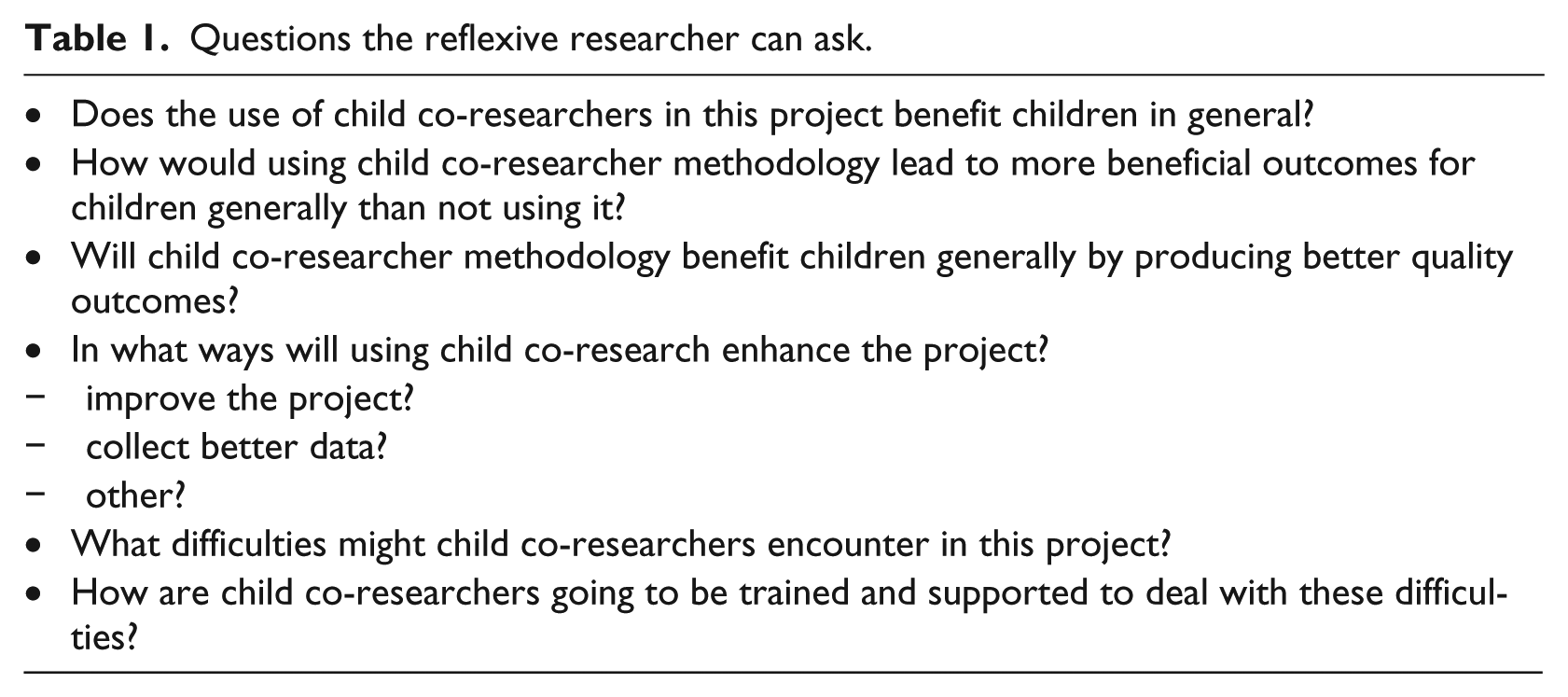
Researcher reflexivity should help ensure ethical research practice as well as rigorous research practice. Research that is not ethical is not rigorous research.
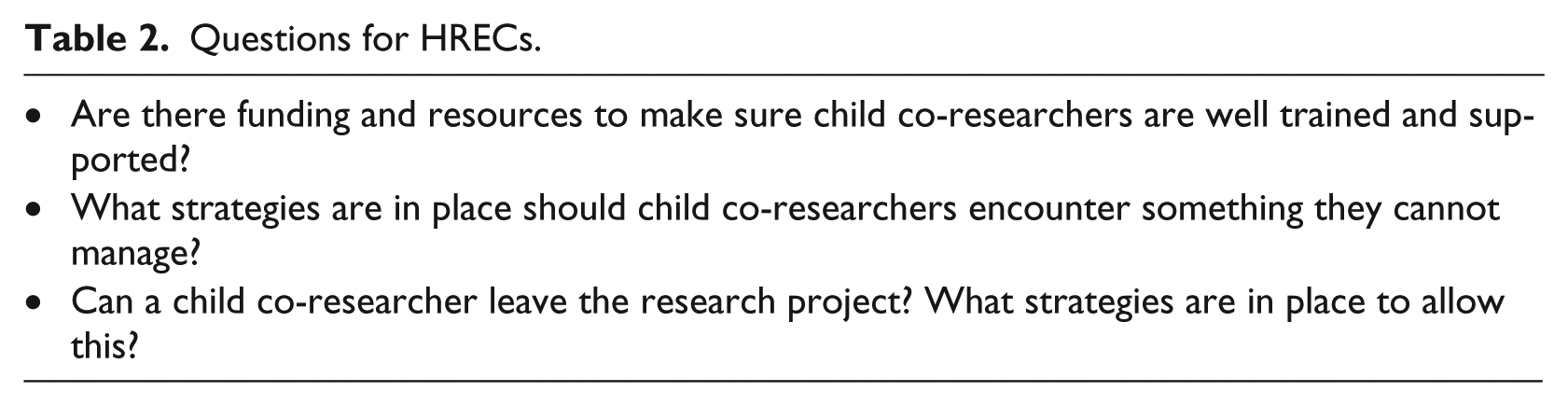
In light of our findings, there are also important questions for human research ethics committees to ask. Again, these questions connect basic ethical principles of beneficence and respect for persons to the specifics of this research methodology. In Table 2, we list these questions.
Questions for HRECs.
The overall message from this article is to do child co-research well or not at all, and doing it well requires resources. A final key recommendation is for researchers to get resources in place, and that should be included in grant applications and argued for in the strongest possible ethical terms.
Footnotes
Declaration of conflicting interests
The authors declared no potential conflicts of interest with respect to the research, authorship and/or publication of this article.
Funding
All articles in Research Ethics are published as open access. There are no submission charges and no Article Processing Charges as these are fully funded by institutions through Knowledge Unlatched, resulting in no direct charge to authors. For more information about Knowledge Unlatched please see here:  .
.