




Abstract
Conducting or overseeing research in correctional settings requires knowledge of specific federal rules and regulations designed to protect the rights of individuals in incarceration. To investigate the extent to which relevant groups possess this knowledge, using a 10-item questionnaire, we surveyed 885 IRB prisoner representatives, IRB members and chairs with and without experience reviewing HIV/AIDS correctional protocols, and researchers with and without correctional HIV/AIDS research experience. Across all groups, respondents answered 4.5 of the items correctly. Individuals who have overseen or conducted correctional research had the highest scores; however, even these groups responded correctly only to slightly more than half of the items. These findings emphasize the need for ongoing training in federal guidelines governing correctional research, particularly for those individuals who are embarking on this type of research.
Introduction
At 750 incarcerated persons per 100,000, the United States has the world’s highest incarceration rate (Hartney, 2006; Pew Center on the States, 2008). The United States also has the largest number of individuals incarcerated, with 2,266,800 individuals incarcerated in federal, state and local prisons in 2010, or approximately one of every 100 Americans (Pew Center on the States, 2008; U.S. Department of Justice, 2011). All told, with approximately 5 per cent of the world population, the US houses one-quarter of the world’s prisoners.
Compared to the general population, incarcerated people have higher rates of substance abuse and dependence (National Center on Addiction and Substance Abuse at Columbia University, 2010), HIV/AIDS and other communicable diseases (Hammett et al., 2002; Maruschak, 2012; US Department of Justice, 2009), and psychiatric disorders (Boone, 1995; Teplin, 1994; Teplin et al., 1996; Veysey and Bichler-Robertson, 2002). These public health issues are further compounded by poverty, low educational levels, and lack of resources and services in the community before and after release. A continuous stream of individuals enter custody and are released every year, resulting in approximately 7 million releases annually (Hammett et al., 2002; Rapposelli et al., 2002), and incarcerated individuals bring existing problems back into their communities upon release (Centers for Disease Control and Prevention, 2001; Leh, 1999).
Given the many public health issues and their impact on the general population, correctional settings have considerable potential for meaningful and beneficial research. However, the history of prisoner research is rife with examples of abuse. Although the more egregious violations of prisoners’ rights have been reported in other countries, violations of prisoners’ rights have also occurred in the US. Examples of these violations include testing drugs without proper consent and using inducements (e.g. food and medical care) that may be coercive for individuals in correctional settings (Dubler and Sidel, 1989; Hammett and Dubler, 1990; Lazzarini and Altice, 2000). Intentional and unintentional abuses are possible considering that prisoners, compared to the general population: have greater potential for limited ability to provide informed consent; present with increased likelihood for impaired ability to understand risks, benefits, and harms of research participation; and are more readily denied access to the benefits of research. Given these vulnerabilities for incarcerated people, additional federal rules and regulations were instituted to provide extra safeguards for the protection of prisoners as research participants (Institute of Medicine, 2006).
The purpose of this study was to determine the degree to which individuals conducting or overseeing research in correctional settings are knowledgeable about the special rules and regulations developed to protect prisoners who serve as research participants. To accomplish this, we conducted a survey with HIV/AIDS researchers and IRB chairs, members, and prisoner representatives.
Method
Participants
Participants were selected from among five nationwide population pools: (i) researchers who conducted HIV/AIDS research in correctional settings; (ii) researchers who conducted HIV/AIDS research in non-correctional settings; (iii) IRB chairs and members who reviewed HIV/AIDS research protocols in correctional settings; (iv) IRB prisoner representatives; and (v) IRB chairs and members who reviewed HIV/AIDS research protocols in non-correctional settings. To identify correctional HIV/AIDS researchers, we searched electronic databases for recent research funding, scientific literature, and convention presentations using specific search terms to identify HIV/AIDS research studies conducted with adult correctional populations in the US. To identify non-correctional HIV/AIDS researchers, we searched electronic databases for scientific literature using specific search terms and delimiters to identify non-correctional HIV/AIDS research studies conducted with adults in the US. From these searches, we retained authors who had two or more HIV/AIDS-related publications since 2000, from whom we randomly selected potential participants. To identify IRB chairs, members, and prisoner representatives, we obtained a listing of all federally recognized IRBs from the Office of Human Research Protections (OHRP). From this listing, we selected the IRBs associated with our sample of correctional researchers as well as a random sample of 570 additional IRBs. For as many of these IRBs as possible, we obtained contact information for all chairs, members, and prisoner representatives. To identify prisoner representatives, in addition to those selected through the IRB search, we selected all remaining individuals included on a separate OHRP listing of prisoner representatives. Finally, we requested individuals who participated in our survey to recommend names and contact information for individuals they believed would be eligible and interested in participating in this study. This snowball sampling yielded an additional 163 potential participants. Contact information was gathered through online sources, and potential participants were retained if this information was available.
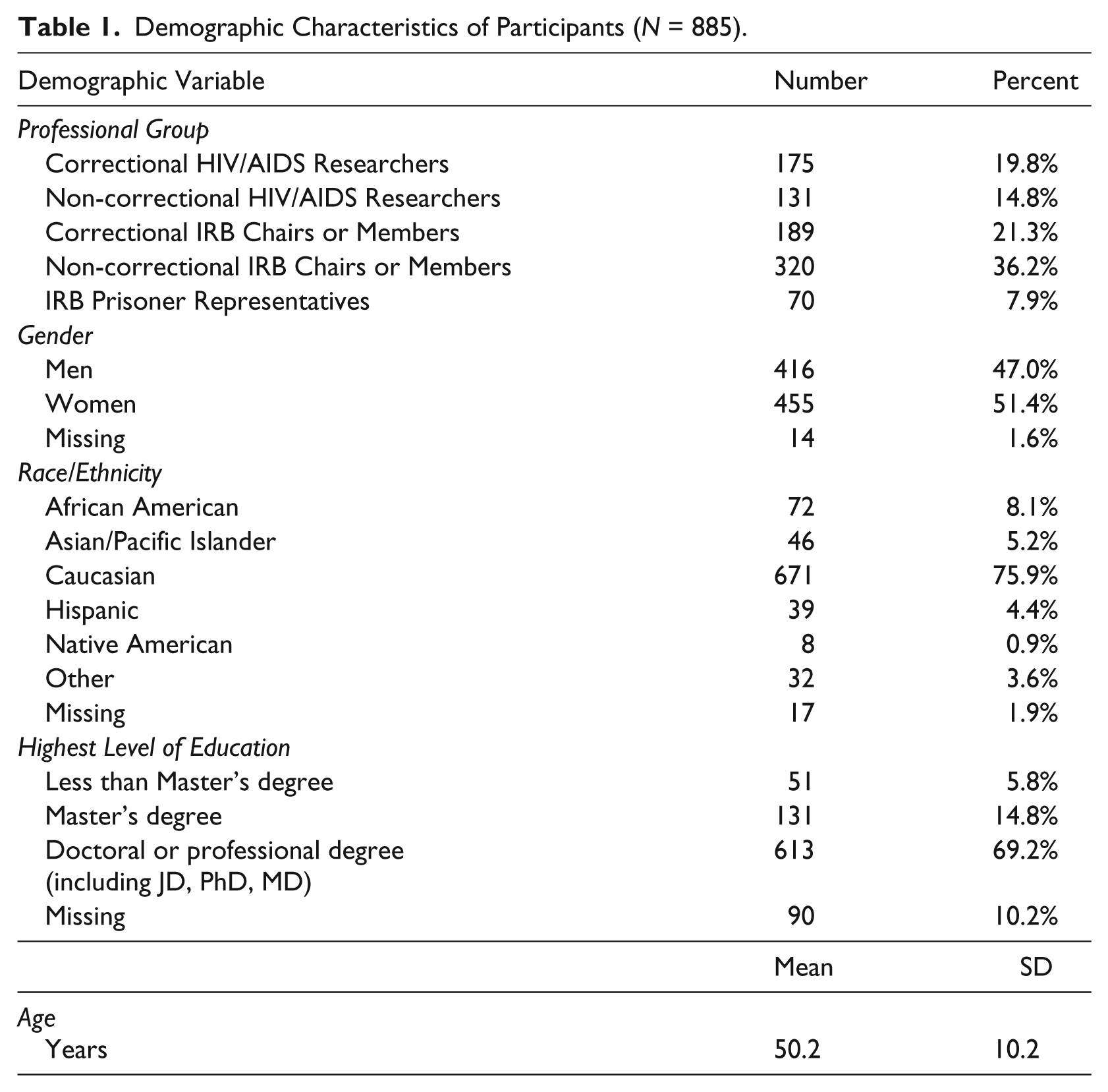
Through these efforts, we developed a final pool of 714 correctional HIV/AIDS researchers, 702 non-correctional HIV/AIDS researchers, 388 correctional IRB chairs and members, 1529 non-correctional chairs and members, and 268 prisoner representatives. Based on initial contacts, 1055 names of potential participants were removed because of having undeliverable addresses, or being deceased or retired, leaving a final sample of 2546. Of these 2546 individuals, 948 participated by completing our survey, for an overall response rate of just over 37 percent. Of these respondents, 885 provided usable data in response to the survey section related to knowledge of rules and regulations governing correctional research. Table 1 provides the demographic characteristics of individuals who provided knowledge data.
Demographic Characteristics of Participants (N = 885).
Instrumentation
The survey used was developed as part of a NIDA-funded study designed to explore ethical challenges and barriers in conducting HIV/AIDS research in correctional settings. This survey consisted of 10 sections. Of interest to this article is the section on knowledge of rules and regulations governing correctional research. This section includes 10 statements (see Table 2) developed based on federal rules and regulations for overseeing biomedical and behavioral research involving prisoners (45 CFR 46, Subpart C; ww.hhs.gov/humansubjects/45crf46.html). For each statement, respondents answered true, false, or unsure.
Percentage of Correct Responses, by Group.

Procedures
After receiving approval by the University of Alaska Anchorage Institutional Review Board, survey procedures were implemented following the general recommendations of Dillman (2007). Specifically, the survey process began with a pre-letter notifying potential participants that they would soon receive an email requesting their participation in an online survey. This letter was followed two weeks later by the email consisting of a cover letter and a link to an informed consent form, payment form, survey, and non-participation form. Relying on individualized code numbers for tracking purposes, up to four reminder emails were sent at approximately two-week intervals to individuals who had completed neither a survey nor a non-participation form. A letter was mailed approximately one week prior to the last email reminder. As our final contact, to address concerns that emails may have been identified by email hosts as spam and not delivered properly, we sent a paper version of the survey to all potential participants who had yet to complete the survey. Respondents who completed the survey received $60 compensation and had the option of entering a raffle for prizes.
Statistical analysis
A total knowledge score was calculated for each participant by determining how many items were answered correctly. Data were included if a participant answered six or more of the 10 questions. For the 15 participants who answered at least six of the 10 items but skipped one or more item, the skipped items were scored as ‘incorrect’. Additionally, answers of ‘unsure’ were scored as ‘incorrect’. Preliminary analyses revealed that years of professional experience, educational level, gender, and professional setting were not significantly related to the total knowledge score. Thus, these variables were not included in further analyses. Using the total knowledge score, a one-way ANOVA was conducted with participant group as the independent variable. Significant ANOVA results were followed by Duncan’s multiple range tests to determine which groups differed significantly from one another.
Results
Table 2 provides the percentage of correct responses to each of the 10 knowledge items, separately by group. Across all five groups, the mean score was 4.50 (SD = 2.08). Mean score was highest for prisoner representatives (M = 5.73, SD = 1.77), followed by IRB chairs/members with corrections experience (M = 5.11, SD = 1.64), HIV/AIDS researchers with corrections experience (M = 4.71, SD = 1.89), IRB chairs/members without corrections experience (M = 4.24, SD = 2.06), and HIV/AIDS researchers without corrections experience (M = 3.31, SD = 2.33).
Results of the one-way ANOVA revealed a significant effect for Group, F(4,881) = 25.31, p < .001. Post hoc analyses using Duncan’s multiple range tests revealed that: knowledge scores for prisoner representatives were significantly higher than scores for all other groups; scores for IRB chairs/members with corrections experience and HIV/AIDS researchers with corrections experience did not differ from one another but were significantly higher than IRB chairs/members without corrections experience and HIV/AIDS researchers without corrections experience; and IRB chairs/members without corrections experience scored significantly higher than HIV/AIDS researchers without corrections experience.
Discussion
Results indicated that prisoner representatives, whose involvement is required for IRBs to review prisoner-related research proposals, had the highest scores among the five groups surveyed. IRB members and HIV/AIDS researchers with experience in overseeing or conducting correctional research were the next two most knowledgeable groups. The lowest-scoring groups were IRB members and researchers who reported no experience overseeing or conducting correctional research. Although these findings are not unexpected, it is noteworthy that even though they had the highest scores, the individuals required to be familiar with the guidelines for protections of prisoners as research participants still only answered approximately half of the questions correctly.
To protect the rights of individuals in incarceration, a clearly defined set of federal guidelines for research with prisoners have been developed. As knowledge of these guidelines appears to be low even among groups directly involved in conducting or overseeing correctional research, increased educational efforts may need to be launched to teach and practically interpret these rules. In these educational efforts, it is not enough just to identify prisoners as one of several vulnerable groups; instead, more detailed information needs to be presented to ensure that the in-depth knowledge required for prison-based research is acquired by those who need it. Further, IRBs will be well-advised to develop strategies that ensure that their members have the requisite knowledge prior to conducting reviews of prisoner-related research. IRB Chairs cannot assume that just because a particular member has been through such a review previously or is a prisoner representative that she or he has the requisite in-depth knowledge that leads to correct interpretations and decision-making. Instead, IRBs need an avenue to provide and refresh this knowledge regularly and assess its acquisition and retention.
Researchers interested in beginning work in prison settings may benefit from consultation with IRB prisoner representatives and other researchers who have a history of successfully carrying out corrections-based research. When projects are moved forward to IRBs, it is important to assess if the particular IRB in question has dealt with prison-based research. If not, preliminary education may be necessary to ensure appropriate review. Members of such IRBs may benefit from consultation with IRBs who have reviewed prison research and from consultation with individuals who have served as prisoner representatives, provided they have a firm grasp on the specialized knowledge related to protections for incarcerated individuals as research participants. Appointment of a prisoner representative is, of course, required for review of a study involving incarcerated individuals, and careful choices of prisoner representative are essential to ensuring a quality review. However, merely having the ‘appropriate background and experience’ as described by the federal guidelines is insufficient; representatives must also have detailed knowledge of the guidelines. Indeed, as their IRBs may rely on them to a great degree, it is imperative that prisoner representatives have extensive and deep knowledge and clarity about the interpretation of the guidelines. The same can be said for IRB chairs.
When reviewing the findings of the current study, several limitations must be considered. First, with a response rate of approximately 37 percent, over half of the potential participants declined to participate. However, given the fact that the individuals targeted were busy professionals and that the survey took up to an hour to complete, the response rate is adequate. This is particularly true given that response rates to surveys in general have been declining for at least two decades (Tourangeau, 2004). Second, nearly 100 survey participants skipped the knowledge section of the survey. HIV/AIDS researchers without correctional experience (the group with the lowest mean score) were significantly more likely than other groups to skip the items, and IRB members with correctional experience were more likely to complete the items. This pattern of non-completion suggests that participants who were less likely to have this knowledge were more likely to skip the items, perhaps skewing our results toward an overestimate of knowledge levels. Third, we could find no instrument that assesses knowledge of OHRP guidelines related to prison settings. Thus, we developed our own knowledge test and no reliability data are available. Further, with an overall mean score of 4.5, we cannot be certain if items selected for the knowledge survey were overly difficult or nuanced or whether knowledge truly was limited even among groups expected to have high scores. Fourth, we examined level of knowledge but did not explore whether such knowledge is related to actual ability to interpret and apply information in research design and IRB oversight. It may be that although researchers or IRB members at a given time do not know all of the specific federal guidelines, when such knowledge is required they seek it out from readily accessible resources.
Limitations notwithstanding, our findings suggest that knowledge (and perhaps practical interpretation) of OHRP guidelines needs to be augmented. This is particularly true for IRB members and researchers encountering or engaging in prison-based work given that even these groups responded correctly only to approximately 50 percent of the knowledge items. Future research should further explore the nuances of researcher and IRB member knowledge regarding prison protection regulations and the behavioral correlates of this knowledge, including the impact of knowledge on decisions to conduct or approve particular research studies, as well as researchers’ and IRB members’ metacognition regarding this important knowledge base and their actions to improve relevant knowledge when needed.
Footnotes
Acknowledgements
This work would not have been possible had it not been for the many busy professionals who gave of their time to complete our survey. We also wish to express our gratitude to the following: Dr Jesse Metzger and Ginger Mongeau for assisting with data management; Sherilyn Romanik for helping with the online survey; and our consultants who provided invaluable assistance throughout this project − Dr Karen Cropsey, Dr Laura Roberts, Dr David Seal, Dr Faye Taxman, and Mr Barry Zack.
Declaration of conflicting interests
The author declares that there is no conflict of interest.
Funding
This research was supported by the National Institute on Drug Abuse (grant number R01DA020357).