



Abstract
Public participation is increasingly an aspect of policy development in many areas, and the governance of biomedical research is no exception. There are good reasons for this: biomedical research relies on public funding; it relies on biological samples and information from large numbers of patients and healthy individuals; and the outcomes of biomedical research are dramatically and irrevocably changing our society. There is thus arguably a democratic imperative for including public values in strategic decisions about the governance of biomedical research. However, it is not immediately clear how this might best be achieved. While different approaches have been proposed and trialled, we focus here on the use of public deliberation as a mechanism to develop input for policy on biomedical research. We begin by explaining the rationale for conducting public deliberation in biomedical research. We focus, in particular, on the ELS (ethical, legal, social) aspects of human tissue biobanking. The last few years have seen the development of methods for conducting public deliberation on these issues in several jurisdictions, for the purpose of incorporating lay public voices in biobanking policy. We explain the theoretical foundation underlying the notion of deliberation, and outline the main lessons and capacities that have been developed in the area of conducting public deliberation on biobanks. We next provide an analysis of the theoretical and practical challenges that we feel still need to be addressed for the use of public deliberation to guide ethical norms and governance of biomedical research. We examine the issues of: (i) linking the outcomes of deliberation to tangible action; (ii) the mandate under which a deliberation is conducted; (iii) the relative weight that should be accorded to a public deliberative forum vs other relevant voices; (iv) evaluating the quality of deliberation; and (5) the problem of scalability of minipublics.
Introduction
Different methods for engaging publics are increasingly being used in many areas of social policy. Reasons for seeking public input vary but at minimum involve the observation of a democratic imperative to involve those affected by a particular policy in the development of that policy (Goodin, 2007). This reasoning is particularly pertinent in cases where social policy decisions are made in the bureaucratic sphere with no direct involvement of wider publics or their elected officials (MacKenzie and O’Doherty, 2011). While many areas of social policy may be argued to require public input, there are limits to the number of issues for which public input can be sought. Warren (1996) suggests a distinction between political (contentious) vs settled issues, with scarce democratic resources being allocated primarily to the former. While settled issues can be dealt with more routinely, Warren argues that it is in the case of contentious issues that meaningful public input is necessary. And it is in such contexts that public deliberation has an important role in enabling the development of collective public opinion that can be used to inform social policy.
In spite of much work in Science and Technology Studies and related fields, science arguably is still perceived widely as proceeding largely independently of social and political processes. Science is not supposed to be about values, but about uncovering the Truth. However, in a very real sense, science is a social practice. For example, research funding is influenced by national priorities; academic fashions may dictate to some extent whether biological or social accounts of human behaviour are favoured at any given time, and so influence research directions; and on a more fine grained level, many sociologists of science argue that the very production of scientific facts relies on social processes such as negotiations about what constitutes appropriate evidence (Latour and Woolgar, 1979). More important for the present context is that in many instances social values are implicated in particular research directions (e.g. national policies regarding stem cell research). A case can thus be made that many areas of science policy are not fundamentally different from other areas of social policy in that they involve controversy and opposing sets of values, and in which social and political processes are implicated in arriving at societal decisions. As such, at least in some circumstances, public input in the development of policy seems warranted. The case for public involvement becomes even stronger if one considers arguments that there has been a breakdown in trust between publics on the one hand, and those involved in the governance of science on the other (i.e. scientists, corporations, governments: Wynne, 2001).
We argue that biomedical research is one such area in which ethical norms should be informed at least in part by meaningful public input. Indeed, different forms of public engagement are being used increasingly to involve publics and/or patients in health research and policy decisions. There are good reasons for this:
Biomedical research relies to a large extent on public funding.
Biomedical research relies on the participation of patients and the wider public, yet there are limited avenues for publics to inform the social values that govern the use of such biospecimens and associated information.
The outcomes and products of biomedical research are dramatically changing the material and social landscape of society (e.g. genetic testing, new therapies, personalized medicine etc.).
Technological advances and changes in the assessments of research ethics review systems suggest that the balance between research subject protection and facilitating biomedical research needs to be recalibrated (Meslin and Cho, 2010).
In other words, the nature of biomedical research is such that the norms of democratic society seem to require greater incorporation of public interests in research governance (Burgess and Tansey, 2008). If one accepts this reasoning, then the primary question is how to create legitimate and practical mechanisms for representing public interests and discourse in the governance of biomedical research. The translation of democratic ideals into specific mechanisms to foster public engagement is not straightforward, and different approaches have been trialled. While much has been achieved, significant work remains to be done both in terms of developing theoretical frameworks and practical guidelines for implementation of specific processes that allow for public input in biomedical research. In this article we focus specifically on the process of public deliberation and its role in informing one aspect of biomedical research: human tissue biobanking. In particular, we draw on a series of public deliberations that were conducted on the topic of biobanking in three different jurisdictions: Canada, the USA and Australia. The purpose of the article is to outline the main lessons as well as the main challenges still remaining in the use of public deliberation as a viable mechanism for developing social norms in biobank governance. The section on ‘lessons learnt’ draws partly on published material to give guidance on those aspects of conducting public deliberation on biobanks that are now relatively well accepted; we also highlight some theoretical and practical tensions in this section, that we feel are now reasonably well understood. The section on ‘challenges remaining’ is more critical and reflective in seeking to identify problems that have not yet been fully resolved, either practically or theoretically, or both. Although we refer to substantive ethical issues in the area of biobanks, the main focus of this article is on the theoretical and procedural challenges of using public deliberation to inform ethical norms in biobanking research; where relevant, we provide references to the associated literature dealing with analysis of more substantive ethical concerns.
Human tissue biobanks
Biobanks are large collections of human tissue samples and associated information. Various distinctions have been made between different types of biobanks (e.g. population-based biobanks vs disease-based biobanks: Watson et al., 2009). Irrespective of type, biobanks have arguably become an important component of biomedical research. At the same time, they have raised many questions regarding their ethical, legal and social implications (ELSI). Some of the key ethical concerns include: (i) it is not clear how best to obtain informed consent from participants when their tissue samples are collected for future research that may not yet have been conceived (Caulfield and Kaye, 2009); (ii) long term storage of tissues and data, data sharing mandates, and increasing technological capacity to identify individuals based on genomic data challenge guarantees of privacy that have traditionally been a requirement for many REBs to approve biomedical research studies (Fullerton et al., 2010); (iii) there is uncertainty with regard to conceptualizing ownership of both individual samples and entire collections (Cambon-Thomsen et al., 2007); (iv) issues surrounding the return of research results and incidental findings are further complicated through secondary use of samples (Wolf et al., 2012); as large scale research projects and platforms in themselves, biobanks raise important questions regarding their governance (Gottweis and Lauss, 2012).
Although much progress has been made in thinking through these issues, the field is still characterized by much uncertainty and Research Ethics Boards (Institutional Review Boards) lack common guidance (Gibson et al., 2008). From an ELSI perspective, the problem with biobanks is thus neither that they are somehow unethical, nor that they exist in a regulatory vacuum. Rather, the problem is that there is a lack of clarity regarding appropriate social norms that should guide their governance, and ‘reasonable people’ disagree about the best possible resolution of these uncertainties. This is evident, for example, in the trade-offs between different social norms that are necessary to consider in setting up biobank governance. For example, as a society we tend to value health and health research; we also tend to value privacy. The existence of biobanks sets up a situation in which these two norms are potentially opposed to each other (Cambon-Thomsen et al., 2007). Specifically, the more privacy is protected, the more health research is constrained (e.g. through making only aggregate level data available to researchers), and the more health research is promoted, the more privacy is threatened (e.g. through making individual level data widely available). As such, biobanks have been identified as a specific area of biomedical research requiring public input (Burgess et al., 2008), and public deliberation has received considerable attention as a particular mechanism for developing this input.
Public deliberation
Deliberation can be considered a particular kind of conversation which is characterized by participants exchanging views in a respectful manner and being willing to revise their preferences based on new information and discussion with other participants (Chambers, 2003). Hamlett explains that ‘deliberations, ideally, do not reflect the position of any particular interest group but rather express a reasoned, informed, consensual judgment forged out of the initially disparate knowledge, values and preferences of the participants, as these have evolved through the deliberative experience itself’ (Hamlett, 2003: 122). In addition, public deliberation generally involves lay participants.
Deliberations are particularly useful as an instrument for developing and documenting public input on a topic such as biobanks for a number of reasons. First, most people are not aware of biobanks (Fullerton et al., 2010). In contrast to methods such as surveys, polls or focus groups, deliberation offers a mechanism to inform participants in a meaningful way about the issues they are being asked to comment on. Second, even if respondents were aware of the existence of biobanks, given the complexity of the topic and associated ethical challenges, it seems unwise to base policy on unconsidered ‘top of the head’ responses of members of the public. Deliberation offers a mechanism to develop informed input from a lay public. Third, the public is not one monolithic entity with homogeneous opinions and values. A mechanism or structure is thus required that allows for the representation or at least consideration of diverse points of view; even better would be a mechanism that allows for dialogue between such different points of view with the potential for resolution. Deliberation provides such a mechanism. Finally, again in contrast to traditional social scientific instruments for the measurement of public opinion, deliberation offers a potential avenue for more direct involvement of publics in the formation of policy.
There is now an extensive literature on deliberative democracy and the norms that should inform public deliberation (Dryzek, 2001; Gastil and Levine, 2005; Gutmann and Thompson, 2004). There is also a solid theoretical foundation for the construction of deliberative forums in the form of minipublics and their use in developing policy input (Goodin and Dryzek, 2006) and a growing literature about the implementation of deliberative dialogue (Carcasson and Christopher, 2008). In spite of this, however, the task of designing and implementing a deliberative public engagement on the subject of human tissue biobanks raises theoretical and practical challenges.
Our discussion below is based on experiences in the design, implementation and analysis of public deliberation events in the area of biomedical research. While we recognize that much good work has been conducted on implementing public deliberation in various areas of biomedical research – for example: on the ethics of surrogate consent for research see De Vries et al. (2010); on pharmagenomics see Corradetti and Bartlett-Esquilant (2011); on the storage and use of new-born blood spots for research see Fleck et al. (2008); on xenotransplantation see Einsiedel (2008) – we focus here primarily on our involvement with several public deliberations in the area of human tissue biobanking.
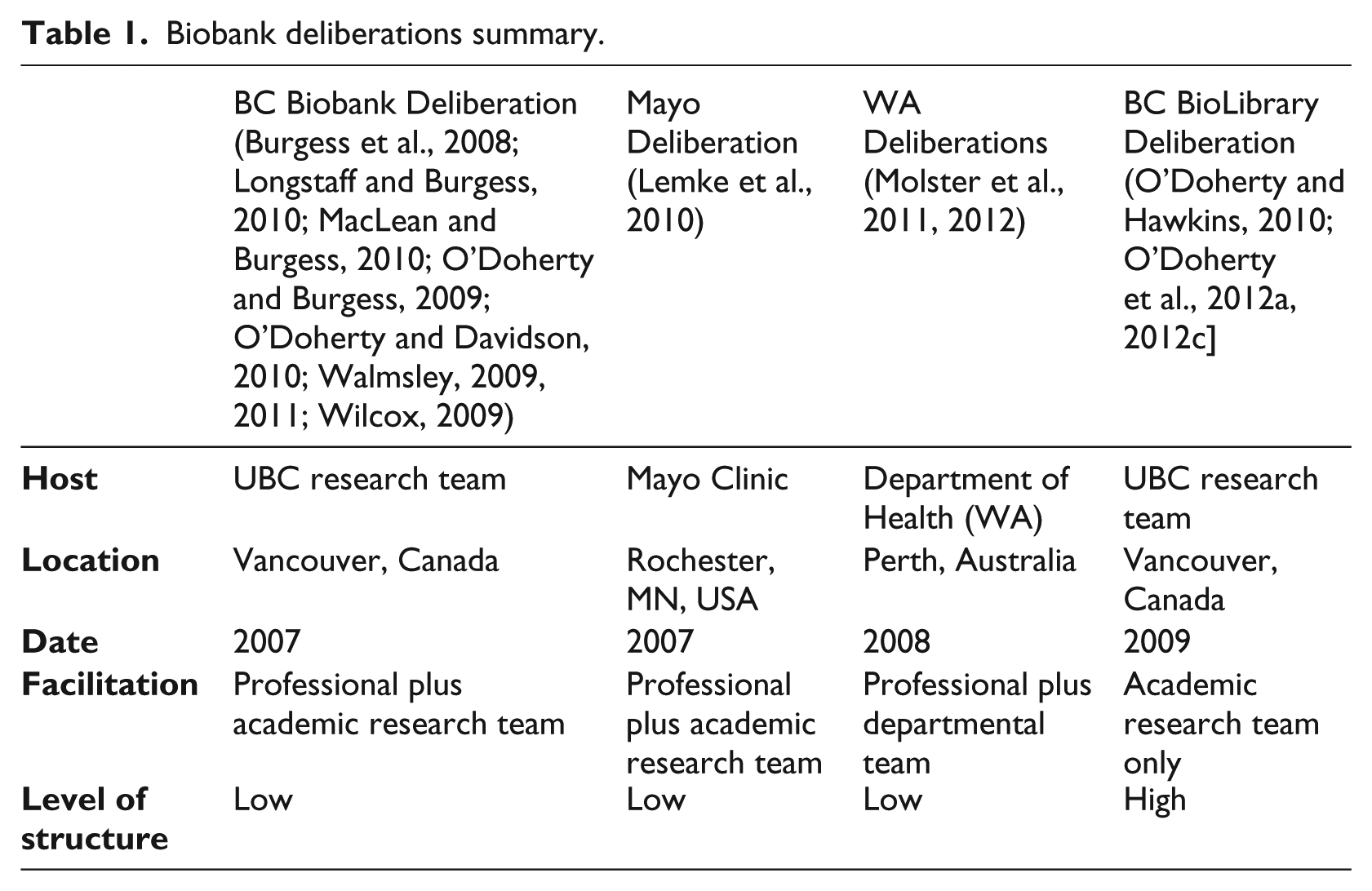
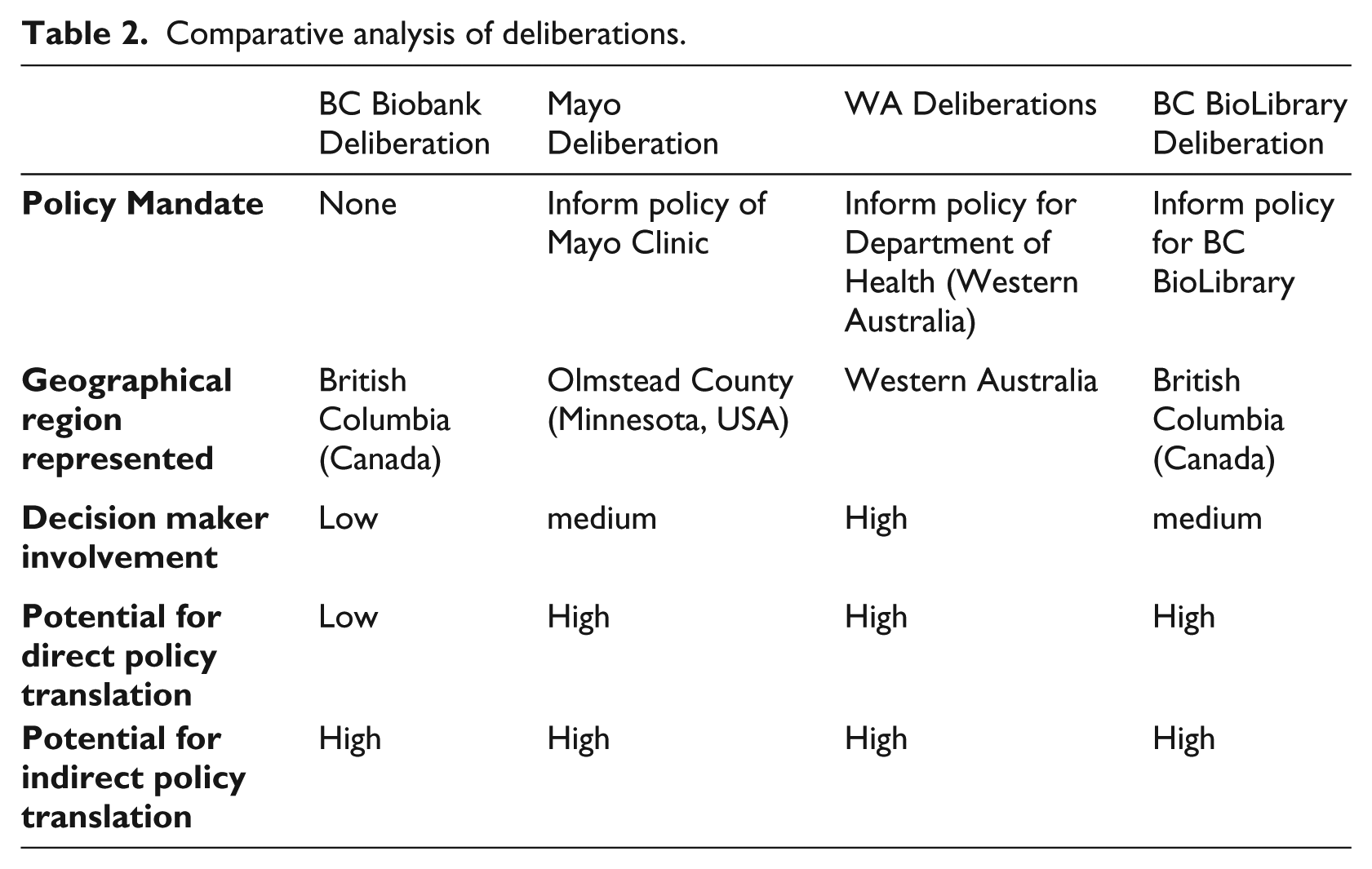
The deliberations were all based broadly on similar principles. All were conducted over four days (two separate weekends), involved around 25 diverse participants, included an information provision component, and allowed for facilitated deliberation in small and large groups. There were some differences, such as a much more constrained structure of the deliberation in the case of the BC BioLibrary Deliberation compared to other events. Most importantly, the deliberations differed with regard to the mandate under which they were conducted. These differences are summarized in Table 1 and Table 2 and are discussed in more detail below.
Biobank deliberations summary.
Comparative analysis of deliberations.
Lessons learnt about conducting deliberation on biobanks
Representation and recruitment
A key question to address in implementing deliberation is who to involve in the conversation and how. Ideals of participatory democracy may require involving anyone who is (potentially) affected by an issue (Young, 2000). In the case of biobanks or health research more broadly the number of people affected or potentially affected is far too large to involve in meaningful dialogue in line with the principles of deliberation outlined above. The deliberations considered here thus relied on the construction of minipublics – small forums constituted specifically for the purpose of deliberating a given issue (Goodin, 2006).
In the context of biobanks (in particular, large scale cohort studies), the potentially affected community is essentially the broader public. In this context, random sampling with attention to maximizing the diversity of participants seems to offer the best option for constituting a deliberating minipublic (Longstaff and Burgess, 2010). Random selection can best be achieved by inviting participants through either random digit dial or letter mail-outs to random households. While no recruitment method is entirely capable of avoiding some degree of self-selection, these methods avoid attracting mainly those individuals who might already have strong vested interests. In addition to random invitation, demographic stratification (usually in approximate proportion to population prevalence) can help to ensure diversity. In the Canadian deliberations, both random digit dial and letter mail-outs provided satisfactory samples, with the letter method providing somewhat better control over the final constitution of the sample (O’Doherty et al., 2012a). Finally, the use of minimum representation thresholds for particular groups can help to ensure the incorporation of important voices that might be missed if relying solely on random selection. In the case of the BC and Mayo deliberations, individuals with genetic disabilities and indigenous communities were deemed to be groups that may be disproportionately affected by the ethical norms governing biobanks; ensuring the presence of individuals from these groups was found to increase the scope of the deliberation in important ways (O’Doherty and Davidson, 2010).
Forum design and facilitation
The logistical details of organizing deliberative forums have been well documented elsewhere (O’Doherty et al., 2012b; Kadlec and Friedman, 2007). However, additional characteristics need to be taken into account in structuring deliberation on the topic of biobanking. Most notably, the relative complexity and public’s lack of familiarity with the topic need to be considered at all stages of the deliberation design.
Participants need to be provided with sufficient time and opportunity to engage with the information and each other. A useful design element of forums is therefore to conduct deliberations in both small and large groups. Small (break-away) group discussions can be very useful to maximize individual speaking time, for deliberants to become familiar with a new issue, and to share personal stories with each other that can help build understanding and common ground. However, there can be problems in shifting from small to large group discussions. In both the initial BC Biobank and in the Mayo deliberation, problems were experienced in attempting to reconcile the conclusions participants had reached in three respective small group discussions in a final session involving the entire group. Participants expressed frustration, and the high level of detail and nuance present in the conclusions of each group were lost in the abstract and high level compromise positions that were achieved in the final discussion session. The fact that this problem manifested in both instances in almost the same way suggests that this was indeed a design flaw. The subsequent BC BioLibrary Deliberation was restructured to address this problem by constraining small group discussion to only an exploration of the issues, leaving the formulation of collective recommendations exclusively to the large group in which all participants were present. This design seemed to have been successful in that participants did not express the frustration in large group discussions that was evident in previous deliberations.
Next, facilitators occupy a key role. This is the case for all deliberations but, again, the complexity of the topic of biobanks requires additional considerations. Particularly when it comes to the facilitation of break-out groups, it may be tempting to have individual deliberants act in these roles. However, this puts these individuals in a conflict of interest, between moderating other participants and having their own opinions heard. Moreover, facilitation is itself a technical skill – deliberation facilitators should be screened and prepared, and receive appropriate training in advance. The selection of facilitators in the deliberations considered here varied across events and is summarized in Table 1. The biobank deliberations predominantly involved hiring an external consultant as the main facilitator, assisted by several facilitators for the small group discussions recruited internally. This had the advantage of creating some distance between the deliberation process and the hosts of the deliberation. One can speculate that this was important, in particular, for the Australian deliberations since they were organized by a government department, to avoid the perception that the organizers of the deliberation were guiding the outcomes of the deliberation in a particular direction. However, in the other cases the deliberations were organized primarily by academic research teams and it was found that some content expertise on the part of the facilitator was essential. Without this, the facilitator is too likely to miss important contributions of participants, and to lack the ability to situate participants’ positions in the wider legal and ethical debates on the issue.
Finally, the social and ethical challenges surrounding biobanks and other forms of biomedical research are sufficiently complex that questions pertaining to these issues can be framed in countless different ways. The main tension here lies in how much leeway to give participants to define issues for themselves vs giving them specific questions to discuss (O’Doherty and Hawkins, 2010). The Mayo and Australian deliberations, as well as the initial BC Biobank Deliberation, were all framed openly, allowing participants to take the discussion in any direction they thought appropriate. In contrast, the BC BioLibrary Deliberation was constrained according to particular issues laid out in a workbook that was used to guide the deliberation. Participants were asked to provide recommendations on particular issues that had previously been identified as ‘areas of ethical ambiguity’ in an analysis of the BioLibrary’s governance and operating procedures (O’Doherty and Hawkins, 2010). The main lesson here is that if questions are framed narrowly, the final results of deliberation may be easier to integrate into policy frameworks. However, narrow framing of questions also constrains deliberation, limiting the ability to gain understanding about unanticipated views that might be held by members of the public. If deliberants feel too constrained from expressing core values, the legitimacy of the deliberation may be challenged (Petersen, 2007). On the other hand, if questions are framed broadly participants are free to discuss issues as they choose. However, conclusions may be too general to be acted upon, may fail to address relevant areas of ethical concern, or may not take into account practical limitations such as laws or protocols, making the results difficult to take up in policy (Ankeny and Dodds, 2008). Far from being a limitation, these considerations demonstrate the versatility of deliberation and the importance of being clear about objectives. In the case of biobanks, broad framing of tasks is probably most appropriate in circumstances where little public discourse exists and social norms need to be developed (Burgess et al., 2008). Narrower framing of questions may be more appropriate when reasonably well developed policy frameworks are already in place and public input is required to implement particular governance structures.
Technical information and framing
Owing to participants’ lack of familiarity with the topic, there needs to be some process of information provision for meaningful deliberation to occur. Information needs to be presented in ways that are accessible, unbiased, and not overwhelming in scope or content. Importantly, information provision needs to be seen as an enabling element for legitimate deliberation, rather than an end in itself. In line with criticisms of deficit models of public understanding of science (Wynne, 1992), the purpose of public deliberation should not simply be to inform members of the public, but rather also to involve them in direct ways in social decision making.
For many controversial topics, ‘neutral’ information may not be available. Framing considerations are thus critical to avoid placing undue emphasis on a subset of perspectives relating to biomedical research. These considerations are also crucial in ensuring the legitimacy of a deliberative forum by not allowing the deliberation to be captured by partisan or vested interests (Walmsley, 2009, 2011). This may be best addressed by presenting the perspectives of multiple stakeholders. All of the biobank deliberations used information materials and invited expert and stakeholder presentations to illustrate this range of perspectives. The precise line-up of speakers varied across deliberations, but typically included a scientist/biobanker, a privacy advocate and/or ethicist, an indigenous perspective, and a disabilities advocate. Analysis of transcripts from the BC Biobank Deliberation suggests that deliberants were able to take into account conflicting perspectives presented to them as well as challenge expert testimonies provided to them (MacLean and Burgess, 2010). Finally, the use of multiple modalities including speakers, booklets, web sites, video, and teaching aids or physical models (Wilcox, 2009) can be effective in helping participants with different learning styles to assimilate information.
Synthesis and presentation of results
In cases where deliberation is framed around a question with dichotomous or discrete options, the result of deliberation may be envisaged simply as an answer to that question. Examples of such a question might be ‘Should we allow for the creation of a provincial biobank in British Columbia?’ or ‘Should new-borns automatically be enrolled in hospital-based biobanks, subject only to parental opt-out?’. However, in the case of biobanks, these questions are embedded in far broader and complex ethical considerations and governance frameworks. Indeed, defining the most important questions may itself be a task for deliberation, as may be identifying critical value trade-offs, and relevant contextual factors. However the deliberation is structured, the discourse produced by participants over the course of the deliberation will be rich with a range of arguments, reasoning, opinions and conclusions. In analysing earlier deliberations, it became clear that selecting among these to produce the official outcome of deliberation is a non-trivial task.
There are many ways that deliberative discourse can be analysed, but it is useful to differentiate between the deliberative output of the forum and analysis performed on data emerging from the deliberation (O’Doherty and Burgess, 2009). We define the deliberative output as a set of statements or recommendations that are explicitly a collective position arrived at through a process of deliberation. Ideally, these statements should also be ratified by deliberants. These statements may or may not represent a consensus of the forum. In the case of a majority position, rather than a consensus, the minority position(s) and reasoning may also be important to include in the deliberative output. Additional post-hoc analyses of transcripts or summaries prepared by facilitators can provide many important insights, although they should not be seen as having the same political legitimacy as deliberative outputs.
Guidance on substantive issues
A comprehensive analysis of the similarities and differences in substantive guidance on the ethics of biobanks is beyond the scope of this article. However, it is worth highlighting some key points. Across all the deliberations, there was broad agreement in principle that biobanks are worth supporting. There was usually a call for strong independent governance of biobanks. A consistent concern with the efficient operation of biobanks was also evident. That is, participants generally recognized the resource commitment required to support biobanks and argued for efforts towards increased standardization such that biobank resources might be used optimally. While there were many differences on particulars across the deliberations in different jurisdictions, the most striking differences in the format of the outcomes was evident in comparing the results of the unstructured deliberations with the more structured BC BioLibrary Deliberation. The latter, utilizing a workbook structure to guide deliberation, tended to provide guidance on issues that were more directly relevant for policy translation in the local BC context. For example, the BC BioLibrary Deliberation resulted in relatively clear guidance regarding management of the process of introducing potential donors to biobanks, prior to consent processes (O’Doherty et al., 2012c).
Challenges remaining for the effective use of public deliberation to inform biobank governance
Much has been accomplished in developing theory and methods for conducting public deliberation in the area of biomedical research. Perhaps more importantly, both in the case of the biobank deliberations, as well as other studies cited above, conducting the public deliberations provided meaningful public input in social policy in various jurisdictions and contexts. However, in contrast to the methodological rigour that has come to characterize the implementation of at least some public deliberations, such tasks as managing the translation of the outcomes of deliberation into policy seem to have been managed in a much more ad-hoc fashion. This is not to say that such translation has not occurred, or that it has occurred in ways that might be criticized, but rather that we observe a relative lack of theory and best practice guidance in how to link deliberation to various policy frameworks. Below we thus discuss five challenges that we feel require particular attention in moving forward. We focus in particular on: (i) linking the outcomes of deliberation to tangible action; (ii) the mandate under which a deliberation is conducted; (iii) the relative weight that should be accorded to a public deliberative forum vs other relevant voices; (iv) evaluating the quality of deliberation; and (v) the problem of scalability of minipublics. The purpose of this discussion is thus not to provide answers to the challenges highlighted, but to articulate those issues in need of systematic empirical and conceptual inquiry.
Implementation and translation of deliberation outcomes
Assuming legitimate and successful development of deliberative public recommendations, several questions arise with regard to the implementation of conclusions and the translation of recommendations into policy. In particular, who acts or should act on the deliberative conclusions, and in what capacity might they act? And how might one incorporate mechanisms for accountability and evaluation of resulting policy in the long term? Considerable variation exists as to how public deliberations are acted upon in various jurisdictions in the context of health and otherwise. However, to our knowledge there is little theoretical work addressing these questions in a more systematic fashion.
With regard to the question of who should act to implement deliberative conclusions, potential candidates include the organizers of the deliberation, a policy making body, a governing body of a biobank, or an appropriately situated ‘knowledge broker’. In each case, there are important considerations with respect to the relationship that such persons or entities have to (i) the deliberative forum, (ii) potential policy frameworks into which recommendations might be incorporated, and (iii) other potentially affected stakeholder groups.
Across the biobank deliberations there were different degrees of involvement of eventual decision makers and policy implementers in the process of deliberation (see Table 2).The precise degree of involvement seems to be a key factor in the translation of deliberative recommendations. The highest potential for translation into policy or practice seems to be associated with the WA and BC BioLibrary Deliberations. In the WA deliberation, the results were incorporated (together with other inputs) in a policy document prepared by the WA Department of Health. In the BC BioLibrary Deliberation, the results were used to help guide the governance and operating protocols of the BioLibrary. In both cases, eventual implementers were intimately involved in the deliberation process (Department of Health employees in the former case, and biobank personnel in the latter). The lowest potential for direct translation into policy seems to be associated with the BC Biobank Deliberation, in which there was only limited direct involvement of eventual decision makers.
There are, however, other more indirect avenues of translation whereby the social and ethical norms developed in deliberation can have broader impact. One such avenue is that participants from the deliberations themselves can become important representatives in roles allowing them to connect the values developed in the deliberative forum with more concrete actions. For at least three of the deliberations (BC Biobank Deliberation; Mayo Deliberation; BC BioLibrary Deliberation) individual deliberants subsequently became members of governance or ethics advisory boards based on their participation in the public deliberation. These individuals possess unique qualities that make them valuable representatives of broader public values: they have engaged in depth with the technical and social aspects of the problem, and they are intimately aware of a wide range of expert and lay perspectives on the issues.
The potential for translation of public values through the peer-reviewed literature should also not be underestimated. To date, the complete deliberative conclusions have been published for the BC Biobank Deliberation (O’Doherty and Burgess, 2009), the WA deliberations (Molster et al., 2012) and the BC BioLibrary Deliberation (O’Doherty et al., 2012a). The impact of such work on biobanking governance may be difficult to assess. However, in contrast to more direct translation of deliberative conclusions, published public recommendations arguably have the potential to be taken up more broadly than just in the jurisdiction in which the deliberation was originally conducted.
Several theorists note the risk that public engagement can be used to manufacture legitimacy and provide stamps of approval for policies without providing genuine opportunity for public input (Petersen, 2007; Wynne, 2006). Therefore, consideration needs to be given to how those charged with the translation of deliberation outcomes might be held accountable and how transparency might be achieved. Although direct translation of the deliberative recommendations of a minipublic may not be warranted in all cases, even (or especially) in cases where recommendations are not taken up, some accounting of how these recommendations were considered seems appropriate. Given that a fundamental purpose of public deliberation is to increase the legitimacy of a decision through the inclusion of public discourse, it seems critical that the process whereby decision makers consider deliberative public conclusions is itself also open to scrutiny. Finally, even in ideal cases where decision makers act in full accordance with deliberative conclusions, some evaluation of the long term effects of particular policy choices seems important.
With increasing reliance of policy bodies on the results of public engagement, and particularly in the context of biomedical research where policy is closely intertwined with normative ethical considerations, questions such as these will inevitably become more pressing and in need of sound theoretical treatment.
Mandate for policy influence
A question that has been raised is whether public engagement with science is best conducted from within or from outside existing governance structures. Engagement from within existing governance may be considered a kind of policy practice, whereas public engagement held outside governance structures may be considered a social movement, especially in the sense of ‘grass roots’ type movements (Plows, 2012). Arguably a case for the importance of both kinds of public engagement activities can be made, but the usefulness of public deliberation for informing policy as well as for building civic commitment and legitimacy has led to its being considered for more systematic adoption into governance structures, blurring this dichotomy. Empirical and theoretical work is required to examine not only the implications of the abstract dichotomy of change from within or outside existing governance structures, but also on the implications of specific policy mandates on the processes and outcomes of deliberative engagement.
In the case of the biobank deliberations, we can observe at least three different types of mandate motivating the implementation of public deliberation events:
The 2007 BC Biobank Deliberation was conducted almost entirely without a formal policy mandate (Burgess et al., 2008). Although there was a commitment from a biobank manager to take seriously any recommendations of the deliberative forum and to use them where appropriate to shape professional standards of practice, there were no formal mechanisms for accountability. The deliberation was conducted by an independent group of researchers with the primary avenue for reporting being the academic literature.
The 2009 BC BioLibrary Deliberation (O’Doherty et al., 2012a) and the Mayo biobank deliberations (Lemke et al., 2010) were conducted with strong institutional mandates. In both instances, the deliberation was motivated by institutional recognition of the inadequacy of current ethical and policy frameworks for dealing with the challenges posed by biobanks. In both cases, senior members of the host institutions attended parts of the deliberation, and were instrumental in translating the outcomes of the deliberation into institutional policy (O’Doherty et al., 2012c) and establishing a role for deliberation participants to serve as community representatives in the governance structure of the respective biobanks.
Finally, the Australian deliberations were conducted with a formal mandate from an office within a government department (Molster et al., 2011, 2012). The results of the deliberation, together with input from stakeholder groups, experts and a larger public consultation, were used to revise an OECD policy document (OECD, 2001). The deliberative participants were among the audiences that were asked to review the policy document before its final revision and adoption (Government of Western Australia, 2010).
Together, these cases illustrate the operation of different types of mandate, both from within and outside existing governance structures. However, longer term and more systematic inquiry is required to assess the implications that different mandates have on the implementation and translation of deliberation outcomes into social actions.
Normative weight of deliberative conclusions
We have argued that the deliberative outcomes of an appropriately constituted minipublic represent a certain political legitimacy that deserves to be considered in the development of policy. This case has been made repeatedly in general (Gastil and Levine, 2005; Goodin and Dryzek, 2006; Warren, 2009) and specifically for biobanks (Avard et al., 2009). However, there is no straightforward way to define the degree of importance that should be assigned to the conclusions of a public deliberation relative to other inputs into policy or practice. The implementation of any kind of recommendations into practice or policy has associated costs that are complex and need to be assessed. Deliberative engagement of minipublics is intended to supplement, not displace, existing institutional structures and sources of public input. In the case of biobanks, several obvious perspectives can be envisaged that should be heeded, including those of various experts (e.g. biobank managers, biomedical researchers, ethicists), patient and other advocates (e.g. privacy advocates, representatives of patient organizations or individuals with genetic disabilities), and citizen bodies or public consultations other than the particular public deliberation under consideration.
Ideally the outcomes of public deliberation take into account a wide range of perspectives and represent a situated but widely inclusive generation of practical knowledge. The biobank deliberations considered here obtained a diverse sample, provided participants with information from a broad range of perspectives, and supported extensive deliberation in which the issues were considered from the various perspectives. Deliberative engagement can be understood as co-production of policy and practice advice. Always imperfect and fallible, the normative weight of any deliberation depends in part on the extent to which the deliberation incorporated wide knowledge and perspectives to forge advice that reflects group agreement in response to challenges provided by those who have the legitimate responsibility to implement policy or practice changes. Once again, however, we have here presented only case studies, and further empirical and theoretical work is required to provide more generalizable guidance.
Quality of deliberation
Much of the foregoing discussion presumes that the outcomes of a particular deliberation can be considered ‘legitimate’ for the purposes of public input into policy. As discussed above in the context of lessons learnt, the legitimacy of different aspects of a public deliberation may be evaluated based on various criteria (i.e. legitimacy of sample based on criteria for recruitment; legitimacy of information presented to deliberants based on criteria for framing etc.). However, in spite of the presence of these structural elements, factors related to the process of deliberation may lead one to question the legitimacy of the outcomes of deliberation in particular cases. For example:
It may become evident that a deliberation was captured by a particular set of vested interests. For instance, the outcomes of a deliberation might be evidently slanted towards corporate interests in using biobanks for drug development, while disregarding appropriate privacy protections.
It may be deemed that the facilitator of the deliberation was biased towards one particular perspective and used his or her role to provide greater opportunity to speak to those deliberants supporting this perspective while silencing those opposed.
Some participants in the deliberation may have been disproportionately forceful in discussions, marginalizing others, and had their opinions pushed through owing to greater emphasis rather than more convincing arguments.
Thus, the process of deliberation might unfold in ways that suggest that the outcomes do not represent a balanced or unbiased set of public recommendations. Critical questions are thus who gets to decide if the deliberation was legitimate, and what criteria might be used to make such an assessment. With regard to criteria to assess legitimacy, normative guidelines relating to process seem to be necessary to evaluate deliberation. Examples that have been considered include whether deliberants were respectful of each other, whether they took each other’s contributions seriously, and whether reasoning was provided to substantiate positions (Abelson et al., 2003; MacLean and Burgess, 2010; Webler, 1995). Indeed, there is a recognized need not only for criteria to assess the legitimacy of deliberation, but to assess whether a particular conversation constitutes deliberation at all. In other words, what criteria might one use to determine whether a particular dialogue (irrespective of good intentions and structural elements) actually is deliberative, and how might one distinguish different degrees of ‘deliberativeness’ (Black et al., 2009)? Several attempts have been made to approach these questions analytically, either by involving expert evaluators or by developing fine grained analytical codes for the analysis of deliberation transcripts (Steenbergen et al., 2003). However, to date the approaches that have been trialled are time and labour intensive, making it difficult to envisage how they might be employed in a routine fashion in public engagements conducted to inform policy. There is thus a need to develop theoretically sound models for evaluating deliberation that can be implemented with some ease in real world contexts.
Scaling of minipublic models
A commonly stated goal for deliberative democracy is to foster broader public engagement and discourse. However, minipublic models of public deliberation usually involve only a relatively small number of participants. The biobank deliberations involved no more than 25 participants each, and even public deliberations on other topics would struggle to manage more than a few hundred participants at most. One reason for this is that the notion of deliberation, as typically envisaged, requires conversation and dialogue, which is difficult to implement for larger groups. This raises important questions about the scalability of minipublic models as mechanisms to inform normative ethics for biomedical research.
Given that the minipublic deliberations are intended to add a ‘public voice’ to policy, there are considerations with regard to the representativeness of the conclusions of the minipublic relative to the broader public. In the case of the Mayo deliberation, the public deliberation was followed by a survey that was administered to a much larger sample of Olmstead County residents (Lemke et al., 2010). However, the use of surveys to generate public input on an issue like biobanks carries a risk that such input is developed on the basis of limited or no knowledge on the topic. On the other hand, surveys with larger sample sizes allow for the polling of public sentiment independent of the information and discussion that shape the outcomes of public deliberation. In some instances, this may be more useful to policy makers if the goal is, say, to gauge the acceptability of a particular policy direction rather than gain input in its development.
An important and attractive extension of face-to-face public deliberations is to conduct on-line deliberations. This potentially allows for much larger populations to take part in deliberation of a different kind, at relatively low cost, but with potential loss of control with regard to who participates. One promising development involves on-line platforms that allow for the experimental study of different choice architectures in understanding public norms on a particular issue (Danielson, 2012). Once again, however, further conceptual and systematic empirical work is required to understand how best to link large scale surveys or on-line platforms with face-to-face minipublic deliberations. In particular, in the context of the above discussion on the normative weight to be assigned to deliberative conclusions, it is by no means obvious how to weight the informed input of a small public forum against the comparatively uninformed input of a much larger public sample. In part such decisions need to be based on local and situational context, but theoretical principles underlying best practice guidelines for the general case should be a goal to work towards.
Another promising avenue for leveraging the public discourse produced in minipublics is via media coverage of the public engagements. Both media coverage and subsequent study thereof is hampered, somewhat ironically, by a competing ethical imperative. Since both BC deliberations were conducted under the auspices of an academic centre, they were subject to the university’s ethical oversight. Among other restrictions, this meant that the privacy of participants had to be protected, which all but prohibited media coverage of the deliberative event or participants’ later reflections on the event. Though understandable, this restriction acts contrary to the mandate of the deliberation in the sense of promoting wider social dialogue. In contrast, the Mayo deliberation was conducted as a quality assurance project and, as such, was not subject to the same ‘ethical’ restrictions. More generally, when deliberative events are organized outside of academic institutions to inform policy, the privacy of participants is less of an issue and media contact is a less contentious issue. However, in particular in the context of studying the process of disseminating knowledge of public deliberations on biomedical issues via the media, and using the media to extend the minipublic deliberations into broader social discourse, conducting independent academic research seems desirable. Clarity thus needs to be developed in conducting public deliberation under the auspices of academic ethics oversight to allow for media involvement, while respecting participants and relevant ethical norms.
Finally, the biobank deliberations were conducted in particular jurisdictions and geographical regions (see Table 2). In the context of using public deliberation to develop ethical norms for biomedical research, this needs to be considered when attempting to generalize the outcomes of a particular deliberation to other jurisdictions. In the context of biobanks there is an additional complication. A key purpose of biobanks is to make biospecimens and health information widely available to researchers, often across national and other jurisdictional boundaries. The problem of how to develop appropriate governance of biobanks across different jurisdictions, though unresolved, is well recognized (Kaye and Stranger, 2009). The problem of how to reconcile or even address the political tensions between potentially conflicting mandates and recommendations of deliberative public forums has yet to be grappled with.
Conclusion
Public deliberation offers a powerful mechanism for developing and incorporating meaningful public input at different levels of governance. It also offers a way to develop social norms in areas of ethical ambiguity. Our purpose in this article has been to provide an overview of lessons learnt from developing models of deliberation specifically suited to the context of the governance of biobanks, as well as to identify several challenges we feel require further attention. The strength of deliberative public engagement is the inclusion of diverse perspectives and life experiences to construct informed group decisions. However, in spite of much that has been achieved in the development of this methodology, critical areas remain in need of theoretical and empirical inquiry. We have here explored five issues that we believe most require further attention. These issues lie mainly on the interface between the deliberative forum and the ultimate translation of such deliberations, and include considerations of policy mandates, normative weights assigned to conclusions, assessment of deliberation quality, and the scaling of minipublic processes. We intend to continue working on these issues in our own research, although we hope that this overview serves as a call for wider engagement with these issues from an interdisciplinary perspective.
Footnotes
Acknowledgements
We would like to thank the research teams and our collaborators at UBC, the Mayo Clinic, the BC BioLibrary, and the OPHG for their warm collegiality and all the hard work that went into conducting the public deliberations. We also want to express our deep appreciation to the individuals and their families who participated in the public deliberations. Our gratitude goes to two anonymous reviewers for very helpful comments on an earlier version of this article. Finally, we gratefully acknowledge support from the conference organizers to present this work at New Patient-Centric Perspectives in Medical Research: Ethical and Governance Challenges, in Rome, 2011.