




Abstract
Introduction
Generally, the establishment of university research ethics committees (RECs) is not a novelty, although many university RECs and devolved committees are still in their infancy. The modus operandi of these bodies is thus evolving and they may be seen as ‘learning institutions’, revising and rearranging practices over time (Schon, cited in Fry et al., 2009). Tinker and Coomber (2005) reported that nearly half of the RECs in their survey had been set up since 2000 and ‘half of the university RECs and one-third of the devolved committees provided training for their members’ (p. 7). They recommended inter alia that more guidance and support on research ethics training should be in place for researchers, students and REC members. In considering the framework within which the activities of a university REC are undertaken, we noted the questions about who is involved in the review and what type of research is examined. We explored the issue of decision-making and diversity of membership and noted that the structure of ethics review within a university does not in itself explain the success or otherwise of a university ethics review system. Rather, the efficacy or otherwise of a REC may be seen to relate to its effective decision-making processes and how these are informed by the knowledge brought by members to the meetings of the REC.
Kimmell, concluding his work on ethics and values in applied social research, states that: [g]iven that individuals differ in the ways they formulate their ethical appraisal of research, perfect consensus regarding the ethicality of a particular investigation cannot be expected. However, if the relative importance of the many factors that influence judgments pertinent to ethical decision making can be enumerated, clarified and weighed in subsequent research … social researchers may then be better able to deal effectively with their ethical dilemmas and obtain a fuller understanding of their differences through reasoned and informed discussion (1988: 136–137).
His conclusion constitutes the starting point for our consideration of one aspect of the decision-making activities of RECs; specifically, we reflect on how the learning arising from the review of research undertaken by a university REC – a central part of its business – is captured and used by its members to support effective decision-making, and, as a further concern, how this process can be supported by a particular training methodology, that of case-based facilitated training.
The essential point is that the ‘whole is greater than the sum of the parts’, i.e. that the decision-making process is enhanced by capturing the collaborative learning of the members of the university REC. The way in which collaborative learning is captured and acted upon by members of university RECs is a neglected issue within the available literature, although Edwards, in an earlier volume of Research Ethics, discusses precedent and considers the ways in which an REC can capture and use this precedent in decision-making (Edwards, 2009). In directing attention to this process, we wanted to engage analytically with the issue of learning and decision-making, ethics and politics, standpoints, and values and their relationship to training and education needs of members. One reason for doing this is to reflectively engage with our practice. The background to this article is the observation that, over the course of its work, committee members learn together. The knowledge produced by this collaborative learning is often explicitly referred to in the process of decision-making, with members making reference to past decisions and related discussions. We consider that making explicit or rather codifying the often implicit or tacit knowledge of members is an important step in promoting effective decision-making.
The knowledge produced by this collaborative learning also points to the need for diversity of members. This diversity of membership is founded on the idea that the committee needs and benefits from diverse and sometimes different points of view in the decision-making process which seeks consensus. There is broad agreement in the literature and amongst practitioners that a university REC should seek to reflect a diversity of standpoints (cf. Edwards, 2009) and experiences, hence the role of lay representatives is important – a point that Economic and Social Research Council emphasises in its Framework for Research Ethics (ESRC, 2010). However, the extra-academic knowledge that such lay members bring to the committee is rarely reviewed.
We draw on the literature associated with educational practice in identifying the SREC as a particular example of a ‘learning community’; such a community is defined as: a supportive group of people who come together to collaborate and learn together, they are usually facilitated or guided to achieve a specific outcome or agreed learning objective (Lewis and Allan, 2005: 8)
In addition, such learning communities support ‘deep’ learning (Fry et al., 2009: 11), a mode of learning which is fundamentally reflective. Reflective practitioners are those who are: continually involved in the process of reflecting on experience and [are] capable of continually learning from experience to the benefit of future actions (Fry et al., 2009: 509).
In what follows, we attempt to illustrate our ideas about the need for education and training to meet the needs of members of a university REC, with the presumption that our experience of a particular university REC is typical. We consider the following: firstly the committee’s decision-making practices, and secondly the types of knowledge that are brought to bear on these practices. This second section considers the needs of members of an REC in respect of formal, codified, knowledge: for example, the rules relating to data protection and informal, tacit, knowledge, i.e. the learning that accrues to members of the REC in and through the routine decision-making undertaken in REC meetings.
Decision-making
As part of their role in the university REC, members take ethical decisions that affect others. Following Kimmel (op. cit.) there is need for clarity as to the basis on which those decisions are taken and as to whether the bases of decisions are explicit or implicit.
The question arises as to whether it is desirable to be explicit about the factors informing decisions – which Kimmell affirms – and relatedly, the issue of whose rules/philosophical rules do we draw on and enunciate in our decision-making. We consider, again following Kimmel, that this is a legitimate aim for a REC to pursue as the full explication of factors influencing decisions: … social researchers may then be better able to deal effectively with their ethical dilemmas and obtain a fuller understanding of their differences through reasoned and informed discussion (op. cit.)
The issue raised by Kimmel’s comment relates to the knowledge required of committee members and also how this knowledge is used in decision-making. The implications for the education and training requirements of committee members are considered.
The decision-making procedure of the City University London Senate Research Ethics Committee does not operate according to a defined, codified, set of rules, nor does it explicitly espouse particular values relating to ethics and morality. Members participate in collective discussions without being bound to a formal institutional/institutionalized code/set of rules. Of course, the ethics forms which researchers are required to complete enunciate the university’s requirements, including data protection arrangements and these guide discussion. These forms are not randomly designed but are based on a wide and deep experience of many researchers – both members of ethics committees and applicants – and as such come close to an explicit statement of the categories of potential problems that the committee wishes to review, although there is no guidance on how dilemmas should be resolved, except for an overwhelming presumption that the rights and wellbeing of participants are paramount.
The range of themes formally addressed in the Ethics Review form used in City University London is outlined in Table 1. The listing relates broadly to the wider issue of whether researchers ought to operate according to well-defined research ethics checklists or according to a more general sensibility of ‘do no harm’ (Kellehear, 1989). Both approaches are based on philosophical foundations which are rarely explicated but inform both the construction of checklists (i.e. what is included as core ethics) and the general sensibility approach.
Ethical themes covered in the ethics review form.
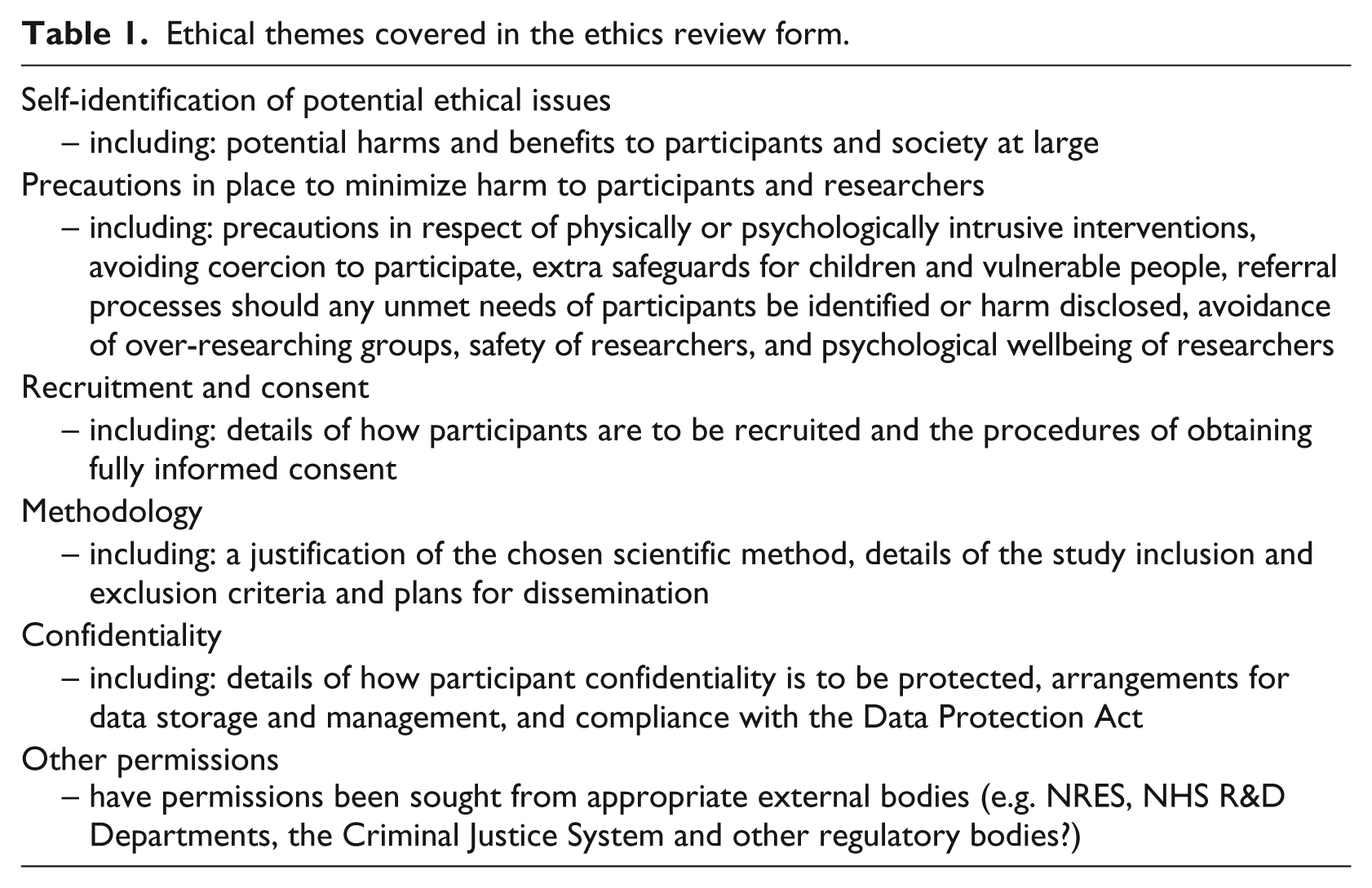
A third dimension however, irrespective of which approach is used, is the tacit knowledge produced and reproduced in and through the decision-making practices of the REC. The listing of key themes included in the Ethics Review in place in City University London, in line with ethics forms used in other universities, illustrates the range of knowledge required in the decision-making of a university REC. We note that where extra-ethical issues are raised, these indicate the infusion of wider research governance matters in ethics decision-making – in particular, aspects relating to sponsorship, indemnity and the protection of institutional reputation. Ethics falls within the broader framework of research governance and the reputational protection of the institution. Hence, topics requiring the attention of university RECs are often beyond the traditional understanding of ethics, i.e. beyond considering the ‘do no harm’ dictum (Kellehear, 1989), and include decisions relating to data protection, to liability (of the institution and individual researcher) and to wider legal issues. For example, the ESRC in its Framework for Research Excellence (ESRC, 2010) clearly identifies the need for ethics reviews to explicitly consider the position of funders in its deliberations. This latter issue is not explored, being beyond the scope of this article (but see Haggerty, 2004, for a discussion of regulatory control and ethics review systems).
Training and education: Responding to different knowledge needs
Two approaches to training and education are identified. The first concerns what might be determined a ‘superficial approach’: as REC members we need to know about rules and regulations and how the wider research ethics community deliberates; this is broadly a didactic training model, allowing the transmission of the basic concepts of ethical theory and principles, amongst other things. The second approach, which we term a ‘reflective approach’, aims to capitalize on the knowledge and experience of individual members as well as the collective knowledge and experience of the committee as a body in its own right. This model is much more concerned with deep learning and might be better described as education rather than training. Such an approach could use case studies to facilitate group explication of the application and practice of our reasoning, attempting to identify the values informing our practice. This process is a key feature of reflective practice (Fry et al., 2009).
These two models of learning have been identified as a highly desirable aspect of the knowledge base of clinical ethics committees (Gillon, 2010), but we suggest that these are also of relevance to general RECs. These two models are connected: the reflective approach to training helps to make explicit our own decision-making processes and to bring an external lens to our own learning, and the superficial approach provides the basic information upon which the decisions taken are based.
It is important to clarify that the principalist approach to ethics (which, broadly speaking, provides a general guide to ethics using the principles of respect for autonomy, non-maleficience, beneficience and justice to guide decisions) and the causist approach (which argues that ethics decisions should be based on concrete examples) are not aligned to the models of education and training presented here (the reflective and the superficial approaches). While the former uses case-based training – concrete examples – and the latter, requiring transmission of facts, may involve didactic approaches, a simple equation of reflective/case-based training and superficial/didactic approach is not presumed. We acknowledge, however, that these approaches are not necessarily mutually incompatible (see Figure 1).
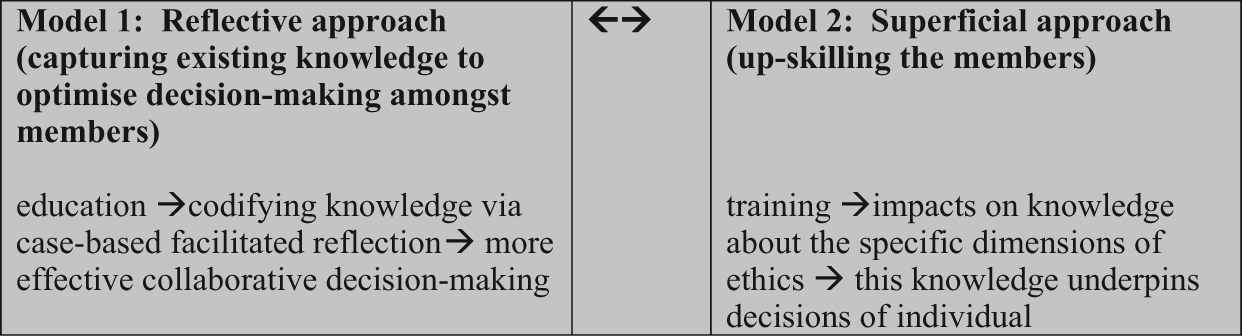
Approaches to training and education.
Model 1: Reflective approach (capturing existing knowledge to optimise decision-making amongst members)
The model supposes the following sequence: education involves codifying knowledge via case-based facilitated reflection, and this will lead to more effective collaborative decision-making.
The late Lord Bingham, formerly the Senior Law Lord, said in 2000: ‘it’s a judge’s professional duty to do what he reasonably can to equip himself to discharge his judicial duties with a high degree of competence’ (Bingham, 2000: 71). The activities of the members of RECs may be considered judgmental, and applying, by analogy, the words of Lord Bingham to the members of the REC it is clear that such members have a professional duty to ‘do what they reasonably can to equip themselves to discharge’ their REC judging duties. We acknowledge that a REC is not a legal decision-making body; however, we are struck by the number of REC ethical issues that arise that have legal implications: data protection, safeguarding of vulnerable adults, child safeguarding and researcher health and safety to name the most obvious. It is almost certainly true that most REC members are not lawyers by background or training, but we have looked to law to see what lessons there might be on the business of judging, since the REC is tasked with judging all applications before it fairly, and for many applications the effect of law and its regulations is of significance.
Drawing on the example of law training for the REC, it is suggested that it should be case-study-based and give REC members a chance to apply the law to the case study facts and together make a judgement.
A lecture with no attendee participation, aimed purely at imparting knowledge about, for instance, the complex, hotchpotch of legislation and common law around confidentiality and data protection, would be not only deeply dull but also unmemorable for members of the REC. If it is true (and it probably is, otherwise lawyers would be out of jobs) that ‘most of us are only vaguely aware of what is legal and what is not’ and ‘researchers, and others, are left confused about what the law really says’ (Warlow, 2005:22, 24), then, REC members should be trained in the relevant law. Law training for a REC, indeed any training for a REC, ought to include case-based examples of the sort of issues that RECs face, and then provide an opportunity to debate and decide, followed by reflection and feedback. Bespoke, case-based training for a university REC committee would provide an opportunity for the members of that particular REC to improve their knowledge of a particular relevant subject area, law or otherwise, and also to learn how to apply it and together reach a judgement on a particular application.
Model 2: Superficial approach (Up-skilling the members)
This model assumes that didactic training will impart formal knowledge about dimensions of ethics and legal requirements, e.g. the Mental Capacity Act (2005), and this formal knowledge will underpin the decisions of individual members.
Legal issues relating to data protection, confidentiality, consent and health and safety (to name a few) frequently arise when an application for ethical approval is being considered. But the law rarely provides the answer to a REC concern about an aspect of the research project. Rather, the law provides the REC with a framework which must be applied to the particular facts of that application and then the REC must use its collective judgement.
Take, for instance, principle seven of the Data Protection Act, 1998 (‘the Act’), which mandates ‘Appropriate technical and organizational measures shall be taken against unauthorized or unlawful processing of personal data and against accidental loss or destruction of, or damage to, personal data.’ The Act does not specifically tell the REC if it would be lawful for a researcher to store on an unencrypted laptop research data about individual children’s reading ages as compared to their chronological ages. The Information Commissioner’s website advises us that ‘There is no ‘one size fits all’ solution to information security. The security measures that are appropriate for an organization will depend on its circumstances, so you should adopt a risk-based approach to deciding what level of security you need.’ And so the REC looks to the circumstances and adopts a ‘risk-based’ approach, whatever the REC thinks that might be. Presumably it means that the security steps the REC requires should be proportionate to the risks involved and reasonable in all the circumstances.
When confronting an issue such as what is appropriate in the circumstances, individual REC members each bring their own perspectives and approach. As individuals they can, and often do, judge applications differently. The primary role of the REC chair is to ensure that these views are aired and the committee reaches a collective judgment on the application. It helps if the committee members have opportunities to attend training together in order to better appreciate each other’s perspective and develop a shared approach to judging an application. REC training can help, but there is training and then there is training, as our two-part model of training and education (Figure 1) illustrates.
Conclusion
In this reflective article we have attempted to explore the different sets of knowledge and the related training and education requirements of the diverse membership of RECs. On the one hand, what we have termed formal knowledge (i.e. the knowledge of legal requirements and procedures, such as those relating to the Data Protection Act, 1998 or the Mental Incapacity Act, 2005) can be transmitted to participants via formal training, using traditional didactic modes of instruction. However, an oft-neglected category of knowledge refers to the knowledge generated by the committee in the course of its deliberations – what might be called ‘learning knowledge’/internal learning; this knowledge is tacit – it is rarely codified. It draws on and consolidates the pre-existing knowledge and experience of the diversity of experience and knowledge of the different members. Exploring and attempting to codify this tacit knowledge requires specific methodologies; we suggest that case-based facilitated training approaches already in use to train legal personnel might offer a viable approach.
RECs are learning communities and can collaboratively identify and capitalize on the collective knowledge of membership for the purpose of more effective decision-making with clear values. Transparency of the REC decisions is an important element: Kimmell’s argument, which emphasizes the rationale for seeking such transparency, is apt: if the relative importance of the many factors that influence judgments pertinent to ethical decision making can be enumerated, clarified and weighed in subsequent research … social researchers may then be better able to deal effectively with their ethical dilemmas and obtain a fuller understanding of their differences through reasoned and informed discussion (Kimmell, 1988: 136–137).
Exploring the values that inform the decisions of individual members via a collaborative process can, we suggest, be useful in supporting the effectiveness of an individual REC. Clarity about the bases of ethics review decisions will further clarify the role and function of ethics review committees, reinforcing the legitimacy of decisions taken and prompting ethical reflection amongst the research community of the REC’s institution.
Footnotes
Acknowledgements
The authors would like to thank the anonymous reviewers for their helpful comments. Our comments are the result of reflection on the decision-making practices of a university research committee (the City University London Senate Research Ethics Committee) by three of its members. However, while the authors are all members of the City University SREC, the reflective account of our experiences represents our personal views, not those of the SREC nor of City University London.