




Abstract
Integral to the animation and visual effects (VFX) industry are graduates with industry focused skills. Yet, the industry is rapid and ever changing, almost defying attempts to define it. How then should animation/VFX, and indeed any subject of a similar nature, be taught to best prepare industry-ready graduates? This article describes Animation/VFX industry perceptions (N = 18) of current Animation teaching in further and higher education. Findings show that a large ‘gap’ in the ‘skills’ required exists, but with multitudinous perceptions and understandings of what this ‘skills gap’ is. The authors suggest approaches to plug this gap through attributes and aptitudes that could be developed in students, lecturers and industry opportunities for students. Further, they outline how closer industry and education sector collaboration may be achieved. However, they stress that, without government policy initiatives and investment, the prospects for the sector, and by extension for those in a similar situation, appear bleak.
Introduction
The importance of strong connections between education and industry (Tennant et al., 2015) and between the education sector and the Animation industry has always existed. Traditionally, this has been part and parcel of the contentious and often inflammatory issue of whether the ‘tail wags the dog’; in other words, whether education is in the service of industry, or whether education stands alone and independent of industry (see Crespo and Dridi, 2007). However, with the increasing emphasis on ‘employability’ (Succi and Canovi, 2020) and the push through the neoliberal agenda of courses of ‘value’, governments worldwide, and the UK included (Olssen and Peters, 2005), have prioritized the idea that education should provide degrees that graduates can take into the workplace and easily find high-paying jobs. Regardless of such debates, it is arguable that education in Animation has always been keen to provide the skills and knowledge to give its graduates knowledge that is cutting edge and at the forefront of what is known, both for its educational value but also to give them easy access to the ever-changing world of employment. Notably, as Ward (2013) observes, in ‘animation studies’ the relationship between industry and education is extremely nuanced, with industry influencing education, making the notion of who should ‘serve’ whom somewhat disingenuous. Rather, it is the case that both (should) work together to develop each other dialogically and synergistically. This is a process with much provenance and history. Indeed, the University for the Creative Arts (UCA – formerly West Surrey College of Art), is credited in 1972 as being the UK’s first course to take an academic approach to Animation (University of the Creative Arts, 2019). Delivered by Academy Award winner and Animator Bob Godfrey, who provided industry knowledge and expertise, the university continued to emulate Godfrey’s example, with prominent guest lecturers from the Animation industry delivering course content. The maturation of bespoke Animation courses in the UK continued with the Royal College of Art forming a separate Animation course in 1985, also under the direction of Bob Godfrey. With UCA and RCA setting precedents for UK Animation courses, the release of commercial software such as Photoshop in 1990 and Maya in 1998 influenced and contributed to future courses, by allowing individual users and educational institutions access to industry software.
Nevertheless, despite these initiatives, Creative Scotland stated in their recent ‘Review of the Scottish Animation Sector’ (Creative Scotland, 2017: 4) that, although universities and colleges in Scotland deliver award-winning courses, a sizeable training gap exists in the development of talent for the Animation/VFX industry in Scotland. This is despite the existence of award-winning courses and industry software being available to institutions and students alike since the 1990s, as well as Bob Godfrey’s Animation course model from 1972, focusing on industry knowledge and expertise. It is perhaps possible that the Animation industry lacks the clear branches seen in fields like Engineering, such as auto-engineering or civil engineering. Potentially this is because the industry itself has not been clear enough in relation to its requirements. Indeed, a key question in the context of Animation education in Scotland may well be: is there a growing need for specialized education in areas like Animation Production and Lighting Artistry? These sub-specialties reflect the industry’s evolution over the decades and would arguably better prepare students for the diverse roles within the Animation/VFX sector. Is the lack of delineation an attribute to the evolving nature of the Animation industry and, if so, should there be regular reviews of new information and technology with any perceived gaps in skills or knowledge?
In this article, we attempt to answer questions such as these through drawing on empirical data from in-depth interviews specifically with industry professionals (N = 18) occupying various roles within the Scottish Animation industry. We highlight the disjunction between what industry expects and requires of graduates, and what these professionals perceive is being taught in Animation courses in colleges and universities in Scotland. We argue that a possibly effective strategy would be to aim for a ‘recontextualization’ (Bernstein, 2000) of the Animation taught and a greater inclusion of and collaboration with professionals from industry to address this disjunction. However, for this to succeed, universities, colleges and the Animation/VFX industry need to move closer together in terms of their expectations and requirements. In addition, without significant government policy initiatives and considerable investment and leadership, it is difficult to envision how the Animation/VFX industry, or the education sector, can achieve this.
The remainder of our article is structured as follows. We first briefly outline the development of the Animation industry in the UK and Scotland, specifically. Secondly, we consider ways in which Animation can be seen to be a subject, and some pedagogical aspects of the teaching of Animation. We also consider some of the issues related to possible disjunctions between industry expectations and academic approaches. Next, we outline our approach to data collection. We then present and analyse our data, specifically focusing on the nature of any perceived ‘Skills Gap’. Following this we discuss the complexities and potential challenges involved with moving the industry and education forward. Finally, we conclude by suggesting ways in which the government could, if it is willing and able to do so, explore ways to develop the Animation/VFX sector.
The Animation/VFX sector in Scotland
The Animation/VFX industry in Scotland could be defined as being a developing sector, with a formed trade body (Animation Scotland) announced at the Move Summit in February 2019. The MOVE Summit is an event that has grown over the past three years to be Scotland’s largest Animation gathering. The estimated value of the sector supplied by Animation Scotland was £15.4 million in 2018 (Mortimer, 2018) and the sector has Scotland’s own Animated Women UK chapter (Animated Women UK, Scotland, 2019). Scotland has seen the development of four notable animated feature films: Sylvain Chomet’s Academy Award-nominated masterpiece The Illusionist (2010); Sascha Hartmann’s computer-animated adventure comedy Sir Billi (2012); Piet De Rycker’s Princess Emmy (2019); and Axis Studios’ Scrooge: A Christmas Carol (2022). It is worth noting that Scrooge was produced and completed remotely by Axis Studios during the Covid-19 lockdown. Marking one of many Netflix properties, Axis Studios has contributed to products such as Happy! (2017–2019), creating the computer-generated flying unicorn, and contributed to three episodes of the series Love, Death & Robots (2019), with Helping Hand (season 1) winning a BAFTA Scotland (2019).
Scotland’s Animation/VFX industry has gained more international notice with the growth of Animation events such as the previously mentioned MOVE summit, and by appearing in the Animation World Network (AWN), an online publishing group that specializes in news and resources for professional animators and Animation enthusiasts. Scotland’s hard work to showcase Animation has been praised by respected Animation journalism (Denney-Phelps, 2019), with events such as the MOVE summit in its third and most ambitious year, and with the formation and launch of Animation Scotland in 2019, an industry-led body created to showcase, represent and develop the Animation/VFX industry in Scotland, in partnership with Animation UK.
In terms of the history of Animation in Scotland, Norman McLaren (1914–1987), is a pre-eminent name within Scottish Animation, self-experimenting with Animation techniques during his time studying at Glasgow School of Art. Nevertheless, there is arguably little to no Animation legacy left behind in Scotland from past animated projects such as The Illusionist. This arguably could have been used to build or inspire local talent (Fraser, 2015; Mortimer, 2018). Fraser (2015) suggested The Illusionist could have been the catalyst for building and capitalizing on investment opportunities for the Scottish Animation talent pool and cites the failed opportunity as a combination of systemic neglect and an absence of vision from public funders. Unknown at this time is the true extent that The Illusionist had on the sector. Despite its critical acclaim, it performed poorly at the box office, which is perhaps why it failed to have a larger impact on the industry.
The Animation sector in Ireland is often cited as an example of good practice and what can be accomplished by an Animation sector in a small country. Indeed, in Scotland, the Animation Research Network Scotland’s (2022) ‘Small Nations’ Symposium, featured guest speakers Dr Yvonne Hennessy and Dr Pedro Serrazina, who examined a spectrum of themes, ranging from the socio-political and cultural significance of Animation to the nuanced exploration of (de)colonial practices within the medium. However, at this juncture in time, the Animation/VFX industry in Scotland, whilst undoubtedly showing significant performance and significant potential, is still arguably in a developmental and, as we argue below, consequently fragile, phase. One challenging aspect regarding the sector is how to define it and, importantly, how to teach it, especially if the difficulty in defining it impacts how it operates as a subject.
Identifying the subject of Animation
Whilst it can be suggested that the Animation/VFX industry has been established for a significant number of years, Izushi and Aoyama (2006: 1844) suggest that any new industry does not initially emerge as being new and fully complete as it needs to draw skills and knowledge from pre-existing industries, or else create them on its own. They argue that, before a new industry can be recognized, there need to be several identified skills and a ‘formalized job description’. Once established, they claim that a ‘specialized labour market emerges through formal education programmes specifically designed to cater to the skill requirements of the new industry’.
Indeed, when viewed through the lens of Ivor Goodson’s (1993) three hypotheses related to how subjects establish themselves, it is arguable that Animation in Scotland can be justified as having been established. Goodson’s first hypothesis is that ‘subjects, far from being monolithic entities, are comprised of shifting sets of sub-groups, “delicately held together under a common name at particular periods in history”’ (p. 184). This arguably rings true for Animation, with those teaching on Animation programmes in HE being ‘also engaged in studies that embrace other – broadly related – fields or subjects’ (Darley, 2007: 64). While, classically, Animation is taught in Film Studies and the creative industries, the definition of ‘Animation’ has been challenged to become more fluid resulting in it being taught in games design and other programmes of study, and consisting of a number of what Ward (2003) would refer to as different ‘nodes’.
Goodson’s (1993) second hypothesis relates to three major traditions: the academic, the utilitarian and the pedagogic, and that subjects would ‘show a progressive movement away from stressing utilitarian and pedagogic versions of the subjects towards increasing promotion of more academic versions’ (pp. 184–185). This hypothesis is arguably confirmed through Animation’s increasing establishment and linkage with academic journals (e.g. animation: an interdisciplinary journal) and funding bodies (e.g. Screen Scotland). Goodson’s (1993) third hypothesis is that ‘we would expect established subjects to defend their own academic status at the same time as denying such status to any new subject contenders’ (pp. 189–190). Those who are engaged in teaching Animation argue for it to be seen as a legitimate field (Darley, 2007), but do not always consider themselves to be Animation studies specialists. Indeed, Ward (2003) considers Bernstein’s (2000) concept of recontextualization in terms of the teaching of Animation and how the same skills may be re-contextualized according to where these skills are being taught. These sites of teaching could include an actual Animation course, a film-related course, or a multimedia-related course.
Nevertheless, some voices highlight how Animation has not yet fully established itself as a subject. For example, Wells (2011: 30) bemoans the fact that Animation as an academic discipline ‘is not respected in higher education’ and is not considered academically rigorous. He goes on to suggest it is ‘(erroneously) understood by many as being nothing more than children’s fantasy media that sells sugar-soaked breakfast cereal, or it is pop-cultural pablum that includes butt-slap jokes’. Interestingly, there are others who are engaged in teaching Animation and arguing for its legitimacy (Darley, 2007), but who do not consider themselves Animation studies specialists: as Darley has written, ‘I suspect that I am not alone in this and that currently many, if not most, of those teaching on Animation programmes in higher education are also engaged in studies that embrace other – broadly related – fields or subjects’ (p. 64).
Indeed, the definition of what constitutes the study and teaching of ‘Animation’ is ambiguous and may not necessarily correlate with the definition used by the Animation industry. Wells (2011: 12) considers this by stating that ‘after over ten years of teaching in higher education, I was not surprised to learn that Animation theorists and scholars cannot, or will not, formally define Animation.’ This may in fact be a positive, with Ward (2013) noting that although Animation Studies is a field as such, it is not necessarily a discipline, given its many different nodes (Ward, 2003) of application and usage in the film industry and elsewhere, for example the games industry.
Pedagogy and the issue of proximity to industry
According to Comninos et al. (2009: 3), the teaching of elements of computer graphics and Animation techniques started to appear in several university courses in the mid to late 1970s and the early 1980s. They go on to argue that the Animation industry has been limited by an absence of dedicated Animation courses (with a few exceptions) and by a lack of ‘graduates with well-rounded education who could meet the needs of industry’. At the same time, Kennedy (2016: 94) suggests that the issue should not be whether or not to prepare students for industry but specifically how to prepare students for industry. Kennedy argues against preparing students to be technicians, rather, to prepare them to be creative leaders and ‘visionary creatives’. The area of industry links with education can have a significant impact upon either industry or education. This is seen positively by some: Linkages to existing institutions (for example, universities, government agencies) are either newly formed or reorganised both at the firm and at the industry levels (for example, through trade associations). This whole process gives rise to different patterns of cross-sectoral fusion of creative talent in the same industry in different countries. The different trajectories of skill formation also in part shape the competitiveness of the emerging sector. (Izushi and Aoyama, 2006: 1,846)
In terms of the considerations of Animation as a pedagogy and knowledge area, Ward (2013) highlights Animation’s ‘exponential’ growth in recent years, which he attributes very much to the increase in digital technologies in the two areas of games and visual effects industries, ‘both of which offer a massive range of employment options to animators’ (Ward, 2013: 317). Ward highlights the concept of vocationalism and draws on the work of Nils Lindahl-Elliot and Antonio Gramsci, the work of both of whom inform the ideas of the importance of the different vocations of practice that Animation operates in, to the value of the teaching and theory of Animation. Lindahl-Elliot underlines the importance of both a ‘market-oriented’ vocationalism but also a ‘critical vocationalism’ where individuals can make decisions about the critical and social value of their decisions as well as the importance of them to the market. Gramsci sees theory as being classical and vocational as well as being instrumental, but subdivides the technical into being both developmental as well as market oriented. Here, then, the relationship between industry and education in Animation is highly nuanced given the relationship of Animation to so many different applications, or ‘nodes’ (Ward, 2003). Critically, ‘it is important that animation teaching and learning is never simply put into the service of meeting industry needs’ (Ward, 2013: 335), rather, communication with and working with industry helps develop Animation Studies and its content.
The picture becomes even more nuanced if the Animation industry in other parts of the world is considered. For example, Wu (2010) investigates the British Animation industry with the desire to seek inspiration for the Chinese Animation industry. He suggests that, for China, the focus on ‘the high-tech’ (p. 1065) has led to Animation teaching in China deviating from creativity, in turn leading to a lack of creative talents. This, he argues, means that the ‘professional personnel’ or graduates account for less than 1 percent in the Animation industry. Kennedy (2016: 94) concurs, asking why in the UK ‘are we preparing most of our students to be technicians when countries like China are keen to become creative leaders and coming to the UK to find out how to do this?’ Although Wu (2010) uses the characteristics of the British Animation industry, especially creativity, and teaching as examples of good practice, Kennedy (2016: 96) bemoans the almost exclusive focus on the teaching of technical skills and that there appears to be ‘little respect for academia and its role, particularly in the arts, think of phrases like “Oh it’s all academic” which infers it is just idealistic, without any grounding or reference to reality.’ Kennedy suggests that one of the reasons for this may be from the students themselves who feel they ‘cannot afford to fail’ as what they really want is a high grade in order to enter the workplace.
One area of concern for students may be with the relevance (Ward, 2006) of their degree to their future employment. For example, creativity may be good, but will creativity alone offer solid employment prospects? The nature of the teaching of subjects in some current courses, including Animation, can lead to some blurring of the boundaries of what constitutes education and what constitutes training. Comninos et al. (2009: 9) give the example of a student with an art-bias trying to enter the industry as an Animation artist who ‘may express an antipathy towards the more mathematical or programming content of the programme and to question the relevance of this content to their chosen career path’. There is arguably therefore an urgency to highlight a need to not only better inform students of the various roles within the Animation industry, but also to develop students’ better appreciation of their own skills and how these map to specific roles.
Finally, there is also the issue of the extent to which industry should, could, or is even allowed to, take the initiative in determining course content. For example, Boden and Nedeva (2010: 43), suggest that the competencies that graduates needed to acquire were often determined by the professions. Here they consider the traditional professions such as law and engineering yet, the same concepts can be applied to the developing professions, including the Animation industry. They go on to suggest that ‘even within these vocational fields, academics had considerable influence over defining the knowledge and skills considered appropriate as preparation for employment; universities and employers did not operate within entirely disconnected trajectories’. Franz (2007: 2) discusses the design industry in Australia with reference to industry expectations of graduates and argues that industry wants HE to produce graduates equipped with ‘employable skills, graduates who can easily fit into the organizations/companies so that such interior designers can benefit companies by being creative and productive’.
Parallels can be drawn from other relatively new professions and associated courses such as tourism, for example, where Wang et al. (2010: 10) suggest that, while tourism academics agree that a university degree and the content of this degree are relevant to industry, in contrast, industry practitioners are ‘less than enthusiastic about the relevance of a degree and current curricula’. There are thus several issues of relevance to Animation in Scotland, to the Animation industry as a whole and to the issues of the interaction of HE and industry as well. How Animation is defined and how such a definition is understood is arguably key. This will form the foundation and grounding of any approach to the skills that are developed and taught. Not only this, but the question of what skills should be taught is also arguably key; for example, whether the focus should be on creativity or practicality being an important issue here. It is questions such as these that we considered in our interviews, which aoutlined in the following method section.
Method
Interviews and data collection
Our data is from interviews (N =18) that explored Animation industry professionals’ thoughts on how they perceive Animation is taught in Scotland. A qualitative research paradigm was chosen given the desire to gain insights into how individuals in the Scottish Animation context understood the key issue (see Biggerstaff and Thompson, 2008). Loosely structured interviews rather than methods were selected given their ability to explore issues through dialogue to gain meaning (Bakhtin, 1981) and because we wanted to ask about the in-depth experiences and knowledge of individuals (King et al., 2018). Participants were selected according to if they were currently working in the Animation/VFX sector in Scotland or if they had been educated in Scotland and had experience of working in the Animation/VFX sector outside of Scotland. In order to gather perceptions on how Animation is taught in Scotland, participants with wide-ranging specialisms were selected, including writers, animators, studio leads and producers.
Interviews were conducted either face to face or using Skype, they were digitally recorded and transcribed by the authors. All interviews were reflexive and active (Holstein and Gubrium, 1995) to encourage discussion and transcribed by the authors both to start the process of analysis (Bird, 2005) and to enhance validity and ethical approaches through ensuring only the authors heard the interviews. The transcripts were then first sent to the interviewees for approval and later analysed using an approach like Braun and Clarke’s (2006) thematic analysis by using a combination of ‘top-down’ deductive analysis to identify themes we assumed would arise and also ‘bottom-up’ inductive type analysis to look for emerging themes. All procedures were ethically approved by the relevant ethics committees and all data is anonymized (Christians, 2011).
Results and analysis
In this section, we present and analyse the results under several broad themes or categories before later discussing them. We present the interviewees’ thoughts on the nature of the gap as being one of knowledge or skills, thoughts on precisely where the gap is located, on the need to inform students of industry opportunities and, finally, participants’ thoughts on what is lacking in the HE Animation curriculum and what they suggest should be included in it.
Skills gap or knowledge gap?
Skills gap, training gap or structural unemployment can be characterized for the Animation/VFX sector as a mismatch between the skills that graduates can offer and the skills demanded of workers by studios. Overall, the interview data indicates that industry wants students with multidisciplinary skills who are creative, technical and team players in many different roles, specifying it was necessary not only to focus on skills and aptitudes in students, but also in tutors and lecturers, and on the opportunities offered in industry for student experience. Almost three quarters of participants felt there was more of a knowledge gap rather than a skills gap. They felt it was necessary to inform students about the many different roles within the Animation/VFX sector, thereby illustrating the huge number of disciplines within Animation. In the words of one participant: ‘there are [a] huge amount of different disciplines within Animation, layout, there’s layout artists, background artists, concept art, 3D artists, riggers, painters, FX artists, there’s all sorts.’ However, students may not know about this range of possibilities, instead starting an Animation degree simply with the aim of fulfilling one role in the industry, having ‘the idea that well I’m going to be this fantastic top character animator, that’s my reasoning.’
While there was a lot of discussion and obvious concern at the existence of a skills gap in Scottish graduates, there was little discussion of approaches to narrowing the skills gap being the responsibility of all stakeholders rather than just the colleges, universities and government bodies. One interviewee did discuss the limitations of an industry which was described as being in the ‘baby stages of becoming an Animation industry’ and how this limited the ability of the industry to provide training and attract ‘co-productions and things because . . . we’ve not got big enough director names’. However, most focused on the provision of teaching in colleges and universities as the main reason for the gap, and that this prevented them from recruiting in Scotland, instead turning to recruiting overseas. One participant felt this was because graduates were not industry ready, commenting that they felt ‘it’s sometimes quite hard to get production-ready people out of Scottish unis’ and that in their experience Scottish graduates ‘hadn’t been quite as production ready as some students from France . . . or Spain.’
Another participant highlighted a need for more individuals with industry experience teaching and the knowledge being taught to be more cutting edge, commenting that ‘maybe there’s a need to have more practitioners teaching in colleges and bringing in the latest learning and knowledge and experience to the students’. For this participant, and for many others, there was a strong feeling that there was a gap whereby many of the soft skills of working were not being taught, this participant feeling it would be good ‘yeah if we can equip them with the social skills and abilities to, to get on within any organization that would be a bonus.’ There were, however, a number of examples of ‘good practice’ provided from courses elsewhere in the UK and internationally. These strongly suggested approaches that did not currently exist in Scotland’s Animation education but were considered to be effective. One participant, for instance, praised the example of the Film Academy Baden-Württemberg in Stuttgart for almost shadowing industry in their course set-up, saying that ‘the great example they set is that the structure for the course is the structure of the industry.’ This participant felt that this Film Academy was in a region ‘which has more money than the Pope and they pour money’ into the Academy. In addition, many participants commented on the example of Gobelins, l’École de l’image, in Paris.
Identifying the location of the gap
The nature of the skills gap as being one that extended beyond graduates was a theme that frequently arose. The gap could be in the lecturers (see Tennant et al., 2015) rather than the students, one participant feeling the gap was ‘lecturer based . . . lack of needed skills’ and another commenting that, ‘the lecturers here in Scotland from my own personal . . . knowledge they were from different backgrounds, so they didn’t have that knowledge or skill.’ Another participant suggested that the skills gap was more of a ‘creative and vision gap’ and argued that the Animation industry was not going to grow until ‘we develop genuine creativity, originality and vision, which is attached to leadership skills, the ability to inspire and lead a crew’. Further to this, a knowledge gap was also identified where it was perceived that there was a lack of ‘giving people advice about what to do and how to approach people. Reaching out, making connections within the industry and clients.’
Many identified a significant gap related to a lack of industry input into Animation courses in Scotland and a gap in opportunities for students to learn from industry. There were skills discussed that some professionals felt students were either unaware of, or which were taken for granted, such as ‘proper naming conventions for files, the soft skills of work practice. Addressing production/studio conventions.’ Other gaps identified included the lack of access to networking opportunities such as getting seen and ‘getting your work out there’, both of which were seen to be essential and that ‘communication skills are fundamental’. The ability to work in teams and awareness of the multiple roles in industry were considered key, with one participant highlighting that at a recent Move Summit ‘the speakers all kept mentioning the fact that it’s . . . all about teamwork and being able to communicate effectively with each other and finding out what your niche is and not being a generalist.’
Informing students of industry opportunities
Concerns were raised by industry professionals in relation to a gap whereby students wanting to prepare themselves for a job lacked information and guidance on available roles. Students were considered not to know, but needed to know, of the challenges and limitations of work that some positions may cause. As one participant noted of the bias towards students wanting to become character animators when few such positions existed in the industry: if you want to be a character animator, it’s good up to a point, but it behaves as though that’s the only skill and it’s been responsible for creating in my view a big international traffic jam of wannabe character animators for whom there is not space in the industry.
Participants felt it was better to inform students of the reality of following a career within the Animation/VFX sector, to better enable them to make an informed choice when choosing their specialism. As one participant commented of the gap in awareness that students on courses had of the reality of the Animation industry: ‘I think courses could do more to develop an awareness at least of industry. Perhaps train . . . or instigate more techniques in different parts of the production pipeline.’
One industry professional, who engaged in the portfolio reviews for the Move Summit, commented that some graduates’ portfolios showed great talent and promise. However, he felt unable to ‘see’ their place in the studio as they had not identified their primary focus, saying that each portfolio ‘should be focused to the type of work that you’re interested in doing’. However, this individual felt that each studio would be looking for a particular element that they focused on. Indeed, another professional described the ideal employee for them as being a ‘T-shaped person’; ‘a student/artist who has a broad set of skills which makes up the arm/cross stroke of the T shape, while a specific skill and interest makes up the stem.’ Here then, the ‘gap’ was in the nature of knowledge and skills a graduate had.
This suggests a need for Animation students and graduates to identify (or be guided on how to identify) their primary and secondary skills within their field of interest. This would better enable them to engage in any conversation of their future interests at an interview stage, while making their skillset clear to potential employers – allowing them to be placed in the studio setting.
Specific gaps in the higher education Animation/VFX curriculum
Almost half the participants indicated their concern that Animation students and graduates were not being properly informed or taught about how to construct a portfolio or show-reel in order to engage with industry. A number of points were raised by Animation professionals in relation to what they would like to see brought into the curriculum of how Animation is taught in Scotland. One was there being a gap that graduates, when they came out of Animation courses, needed to be able to fit in at any stage of the production pipeline. For example, that the studios in Scotland ‘need people that can come in out of courses and do the work that’s required to contribute to production pipelines . . . at what’s involved at every stage of TV or Animation production.’ However, it was felt that currently this needed to be done, that students needed to cover all aspects of Animation production, but this is not happening at the moment, whereas ideally students should be on courses with ‘the first year spent explaining all the aspects of Animation production from concept to idea, writing, storyboarding, and then obviously a bit from design’. It was even felt by some that, rather than using names such as FINAL1 or FINAL3 for their files, students needed to be taught industry standards for naming conventions.
One area that many felt was noticeable as a gap was that of the need to teach students the appropriate soft skills of the workplace to help them work effectively with others and in teams. As one participant commented: Coming back to your question on skills gaps . . . I’d say teaching them sort of the soft skills would be great you know, understanding what it means to work within a workforce, what it means to be a leader within an organization.
This could involve addressing production or studio conventions and Animation production coordination, particularly given the range of different personalities that it may be necessary to manage. As one participant noted, this would involve ‘having to deal with personalities because . . . most of your team they’re not all going to be happy days . . . You’re going to have to negotiate with different people’s personalities.’
Related to the idea of this gap in industry relevance, participants made a number of suggestions that would help to bridge the gap between what is taught and what is actually required from graduates in industry. Most argued for greater involvement from industry as guest lecturers even though one interviewee suggested that not everyone in industry ‘wants to teach, and it can be difficult for an institution to attract the right talent. But perhaps courses could be more flexible to allow more industry professionals to come into the University to deliver content’ and to help by identifying and filling in the gaps in lecturer knowledge. Others felt that academics needed to deliver their field of specialism but would nevertheless expect them to ‘keep on top of researching new ideas or discovery within the field’.
The Animation professionals highlighted the need for students to be informed of the variety of roles in the sector including ‘layout, there’s layout artists, background artists, concept art, 3D artists, riggers, painters, FX artists, there’s all sorts’. One interviewee discussed this from a producer’s perspective, arguing that students should be taught a number of different techniques so that they then understand ‘that there are other avenues to work in and probably easier areas’. Students need to research and be aware of the studios they are applying to and what they are known for, ‘does the studio create stylized or photorealistic work?’ and ensure that graduates’ portfolios showcase the desired skills from that studio. A number of participants recounted experiences where students had come to show them a portfolio or show reel but feel that they just ‘don’t know where to place them’ as the portfolios ‘are so general, not to a certain standard. No idea how or where they fit into the studio’.
For most participants, it was important that students should be given advice and taught how to best present themselves to industry through the creation of film reels and portfolios. This also followed on from the discussion of the need for flexibility in that the more variety an applicant’s portfolio has, ‘as long as it has quality, the more useful they are to a department or studio for a graduate position’. Some participants observed that each studio can be looking for something different in a student’s graduate portfolio and that consideration needs to be given to the portfolio created for each individual studio as some who have a ‘broader range are seen as generalists . . . [and] . . . may be more attractive to a smaller studio’.
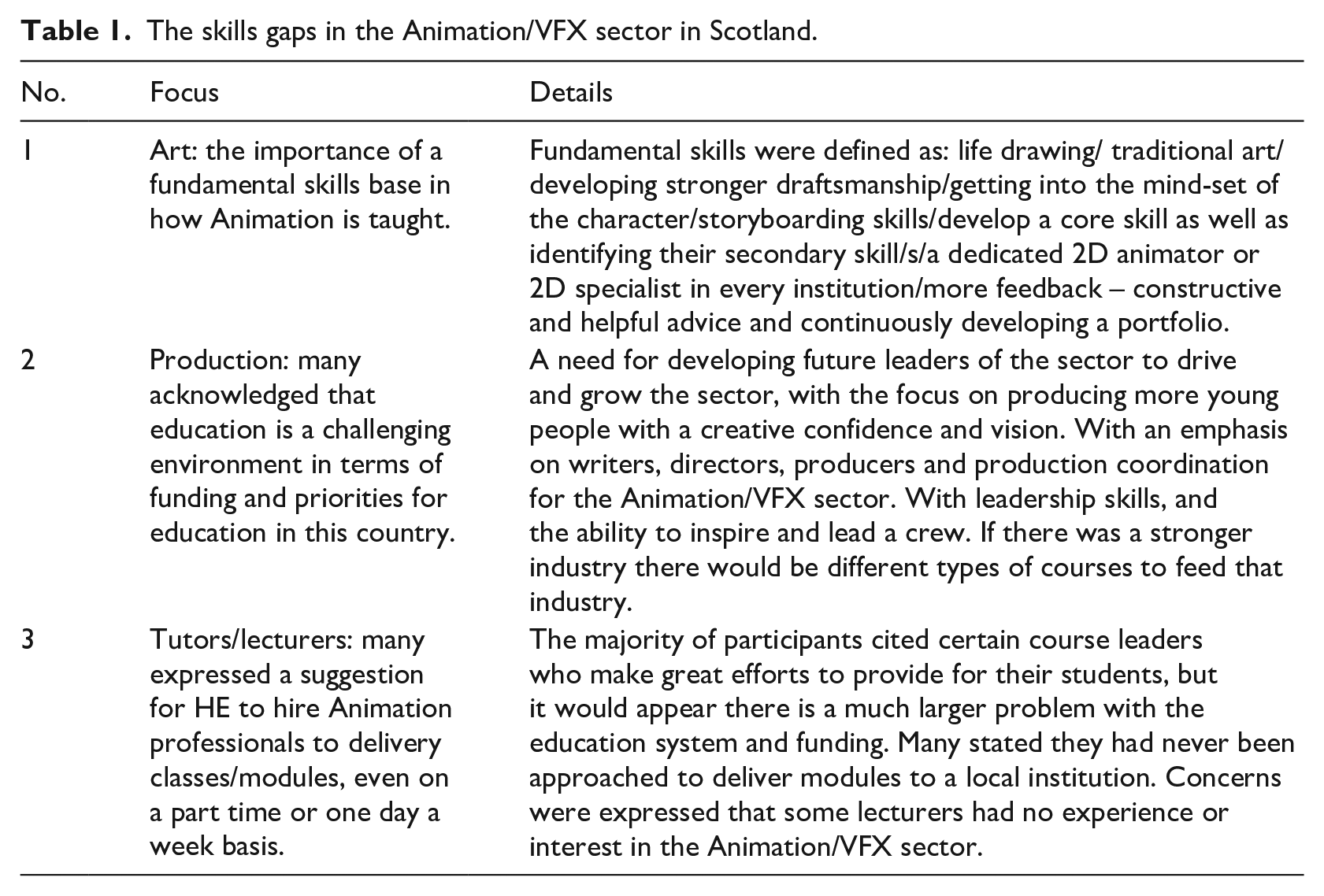
It was further recognized that there needed to be opportunities to have portfolios reviewed in some form and that ‘universities and art colleges do not offer this support to the level needed.’ Others agreed and discussed the Move Summit as an example of a one-time event in the year where students, graduates and others can get ‘a portfolio review, a talk off a Pixar guy then they will have something worthwhile’. It was suggested that the MOVE Summit team saw the need for the development of the Emerging Talent (ET) and student day due to being asked the same questions concerning portfolios and so on every year. The importance of the MOVE Summit was emphasized by many for providing students with a direct link to industry for at least a few days per year. Others also highlighted the role of Animation Basecamp Scotland 2016. In addition to the narrative presented above, Table 1 below draws together the three main foci of the participants’ thoughts regarding the skills gap: art, production and tutors/lecturers.
The skills gaps in the Animation/VFX sector in Scotland.
Discussion
Arguably, these results would suggest that, for Animation/VFX to be successful in relation to how it produces Animation/VFX industry graduates, there do indeed need to be close links with industry (see Izushi and Aoyama, 2006; Ward, 2013). It is also arguable there is a need to challenge current curriculums and educational models for Animation/VFX, to respond to and be informed by the requirements of a dynamic industry. It is further arguable, given the time and passion with which the individuals interviewed spoke, as well as the development of the MOVE Summit to promote Animation, that there is a real drive and desire to make the industry work, and that education is clearly integral to this. Furthermore, there are large studios in Scotland, where Animation undertaken there is winning awards and is central to many companies in fields outside movie making, such as the Computer Games industry.
Yet, numerous complexities remain in relation to the industry. Firstly, it is relatively small by comparison with other countries. As a result, there are only a few (perhaps only one) large studios, instead, numerous small studios exist focusing on niche aspects of Animation. Consequently, as the results show, different talents are sought from graduates, thereby making the industry hard to define and identify (see Wells, 2011), and thus making the subject of Animation, and any ‘Skills Gap’, hard to identify (see Goodson, 1993; Ward, 2003). Further, this makes it a challenge to recontextualize any education undertaken as it is not possible to identify what actually needs recontextualizing unlike, as is the case, with a larger subject such as Engineering (Bernstein, 2000). This makes it hard to decide whether there should be a focus on creating technicians – as some of the above individuals felt – rather than focusing purely on creativity (Kennedy, 2016; Ward, 2006). As the results show, there is both a perceived skills gap in relation to lecturer skill sets and a perceived knowledge gap in relation to what graduates know about the industry in terms of the jobs available and the skillsets required. Not only this, but lecturers were felt to require training or industry experience, and the field itself is continually developing.
Ultimately, a key issue is arguably that the Animation sector in Scotland is, as one participant noted above, in the ‘baby stages’ of becoming an industry. Consequently, it is hard to identify what it is and, as a result, it is hard to delineate the many different possible roles that graduates could go on to in the industry. To draw an analogy, if we were considering the subject engineering, then in FE and HE, students would follow courses that directed them to a specific route, for example auto-engineering, electrical engineering, or mechanical engineering. Animation in its current form does not have these routes as it is hard to define precisely what it is. The question of accessibility of the UK Animation sector is part of a much larger and somewhat uncomfortable discussion, with ScreenSkills (2022) ‘Accessibility in Animation’ reporting a bleak 74 percent of disabled animators in the UK industry believing that the sector discriminates against people with disabilities. This inevitably poses the (possible rhetorical) question of whether the industry is missing out on talent due to being perceived as inaccessible to some.
What is more, it is arguably very hard to justify, in the current funding climate in the UK, that sufficient investment be allocated to it. Current funding restrictions – and the requirement for HE to demonstrate it is performing well (Boden and Nedeva, 2010) – focus on measurability and metrics (Muller, 2018) that necessitate measurable indicators of success or failure. This is not conducive to an ability to allocate sufficient funds to develop the education for a sector which is only in the baby stages of development. In Animation UK (2018) skills report (We Need to Talk about Skills), 58 percent of respondents said that they did indeed hold particular educational providers in high regard, for instance Bournemouth University and Les Gobelins, and suggested a partnership between the Animation industry and education providers to ensure that young skilled talent directly feeds into and supports the Animation sector in the UK: Universities in the UK generally (but not always) do not teach or produce students with relevant Animation skills or techniques to enter at an industry standard. More focus on Animation principles and less on a full movie solely produced by an individual student means they could concentrate on better learning. TV Animation is a team-based field and specific skill areas are required to fulfil each task. More joint projects from universities creating better quality productions and government led apprenticeships to help people ascertain the jobs that they want. (p. 33).
Without the luxury of having ‘more money than the Pope’ as one participant felt the case in Stuttgart to be, it is difficult to see how Animation can develop. Ultimately, until these impasses can be resolved there is a real danger of losing Scottish talent, or perhaps of losing Animation/VFX in education.
Conclusion
The Animation/VFX industry in Scotland is a fledgling and, as the above results show, very much a developing industry. Navigating the rapid evolution of technology, particularly within the Animation industry, presents a formidable challenge for designing and administering Higher Education (HE) courses. Although the rapid growth of cloud services has disrupted linear correlations between localized hardware/software and computing capability, this growth arguably does not negate the CPU demands on the different software required for a studio pipeline. Moore’s Law (Moore, 1965) arguably remains relevant, helping understand the exponential progress in technology that has reshaped numerous sectors, including Animation. This relentless technological evolution catalyses ongoing innovation, efficiency gains and collaborative endeavours within the animation domain, essential for meeting the demands of a dynamic and competitive market landscape. Given this context, the question arises: how can educational institutions, operating within the current funding frameworks in the UK, justify substantial investments in Animation education?
This possibility is made even more distant when, as the above shows, it is considered that the nature of the Skills Gap between industry and education is extremely complex and consists of gaps in the form of a skills gap in lecturers, either in terms of creativity, or technically, and a knowledge gap in student awareness when preparing for employment in the many ‘nodes’ (Ward, 2003) of the Animation/VFX industry or across the CreaTech (Creative Technologies) sector. Not that such courses and industries will cease to exist, but that the training and education of them could well transpire to develop elsewhere. In these cases, as noted above, recruitment will be of graduates from overseas. Arguably, in the long-term, education in these areas will only be sustainable in countries where it is both informed by industry and produces industry-prepared graduates, and it is surely only a matter of time before students realize this.
What then, in an ideal world, will plug the gap between the industry and HE? The above suggests there needs to be wider discussions between educators and industry professionals in Scotland to discuss possible solutions. One of the recommendations in the recent ‘Skills gaps in the Irish Animation sector’ (Animation Ireland, 2022) was to develop close links between industry and institutions, even proposing a committee from both sectors to offer solutions to skills gaps and talent retention.
Further research would also help, maybe of a comparative nature between national and international academics, perhaps considering a unified approach to training. Also, it would be useful to investigate tutor/lecturer training (CPD) opportunities within the Animation/VFX industry in Scotland. For example, to ask lecturers to engage with industry training, or to research Animation lecturers’ views on the challenges and issues they face, providing their unique perspective. In addition, to undertake a study that gathers the views of many different stakeholders (for example students currently in HE, recent graduates, lecturers and others) would provide a more wide-ranging and contextualized view for how these industry insights presented here could be integrated. Furthermore, to investigate means for better informing the education sector and students of the necessary skills and demands of the Animation/VFX sector: for example, studio-focused training opportunities for students, lecturers and teachers. Yet, as noted above, this will not happen by itself and not without government policy initiatives and, critically, sufficient funding.
What then if nothing is done? If nothing is done, students may start to disengage with further and higher education in how it relates to the Animation/VFX sector and turn to online training or even going abroad. The Animation/VFX Industry’s impression of education in Scotland may deteriorate further to a point that it is extremely hard to recover from. The time to plug the gap is arguably now while there is still a chance do so. The Animation/VFX industry in Scotland and the UK is developing and evolving as this is being written. Fundamentally, as the above literature and interviewee perspectives both show, it is necessary for education to consult more with industry, but also for industry to inform education more about what is required, i.e. for there to be greater collaboration. Illustrating a model of exemplary collaboration between education and industry, the renowned French art school, Gobelins, serves as a prime example. Each year, Gobelins undertakes a meticulous review of its curriculum, actively engaging with the local Animation industry to solicit invaluable input. This collaborative process ensures alignment with the latest industry developments and emerging trends, enriching the educational experience and enhancing graduates’ readiness for the professional landscape.
In this context, at the ‘Routes into Industry’ panel during the MOVE Summit 2024, Axis Studios (2024) introduced their Education Outreach booklet, marking a significant launch. This resource offers invaluable insights for students and graduates interested in pursuing a career within the Animation/VFX industry, providing unprecedented access and information about a UK-based Animation/VFX studio in a manner never seen before – highlighting foundation-level knowledge and core skills for each department. This booklet provides a blueprint for any Animation/VFXs studio/s to follow suit and document their own perspective and encouragement for students, and arguably represents what could be taken to be an ‘olive branch’ by the education sector and to help align what they do as well as leading to greater collaboration between education and industry. Although applying only to this ‘node’ of Animation, it nevertheless represents a prime exemplar of how industry can help education develop. Indeed, to enhance understanding of the Animation/VFX sector among students and educators, improved collaboration between Animation education and industry is imperative, not so that animation teaching and learning are ‘simply put into the service of meeting industry needs’ (Ward, 2013: 335), but so that real collaboration helps develop both.
Footnotes
Declaration of conflicting interests
The authors declared no potential conflicts of interest with respect to the research, authorship and publication of this article.
Funding
The authors received no financial support for the research, authorship and publication of this article.
Author biographies
Address: Edinburgh Napier University, Edinburgh EH11 4BN, UK. [ email:
Address: as Kendall Richards. [ email: