




Abstract
This paper presents a framework for a phenomenology based on pure transcendental phenomenology that examines the nature of both the experience of viewing and creating animation. The technological innovation of film and cinema in general is based upon two overarching principles. The first is the phenomenon of the captured frame and the second is the spectator’s phenomenological experience of sequences of such captured frames. It is argued among animation and film theorists alike that the insights offered by the consideration of the phenomenon of the cinematic frame should form the nexus of all film theories.
This paper argues that a complete theory of film and cinema should start by explaining this fundamental conceptual bedrock, and that the ‘already-created’ frame of film restricts insight into the phenomenology of cinema spectatorship. The article also shows how the practice of animation is instrumental to the proposition and elaboration of a phenomenology of animation.
Introduction
This article aims to introduce a pure phenomenology of animation: a novel perspective on film theory through the lens of animation practice. This phenomenology is built upon six dimensions afforded by the study of animation practice, namely: eternity, living lines, grace, sympathy, the canny and the rupture. These dimensions are all derived from the pure transcendental phenomenology of Edmund Husserl articulated in terms of Henri Bergson’s temporal vitality known widely as ‘duration’.
The phenomenon of cinema possesses two scholarly principles that form the basis of this analysis. One in its creation and the other in the experiences afforded by it. I will start with a short discussion that sets the phenomenological context for the consideration of the basic unit of cinema, the frame, followed by a discussion of the phenomenological nature of the experience afforded by cinema. This begins with a presentation of the historical context of the dogmatic importance placed on the photochemical frame (and the ongoing debates between animation theorists and film theorists therein) followed by a more focused consideration of the nature of the frame itself. The distinction is then made between outward facing (hermeneutical) and inward facing (transcendental) phenomenology, recognizing that existing scholarly engagements with phenomenology have all followed a hermeneutical pathway. The Husserlian pure transcendental phenomenology is then explained and proposed as an appropriate means for this analysis. Finally, the article arrives at a paradox, by transforming the views of one of cinema’s greatest critics into the framework of a meaningful phenomenology of animation.
The main body of the article concerns the articulation of this framework that, I argue, underpins the fundamental nature of our experience of cinema, specifically through the phenomenological nature of the frame. This approach situates the practice of animation itself as a suitable scaffold upon which to explore the spectator’s experience of the frame. As an animator, I have found this framework to be central in both my practice and my pedagogy of animation. The framework is then explained in terms of six inter-dependent compounding conceptual layers forming the phenomenology of animation, using the practice of animation as the foundational basis. The six proposed dimensions consolidate Husserl’s pure transcendental phenomenology with Bergson’s temporal vitalism, providing a realm of essences from which we can build the fundamental structure of cinematic spectatorship and our pure phenomenology of animation.
Theoretical underpinnings
In creating a framework for a phenomenology of animation, we must first contextualize the importance of the frame as a phenomenological unit of cinematic experience and substantiate why, namely, the animated frame is best placed to formulate such a theoretical framework. Husserl’s phenomenology, a rigorous science of consciousness, employs bracketing as its primary tool of analysis. In creating a framework for a phenomenology of animation, it is helpful to first bracket the frame itself within existing theories of cinema.
Bracketing out the photochemically captured frame
Bracketing is a technique used in phenomenology to distil ideas to their purest essence. To bracket is to rigorously exclude dimensions of a phenomenon in order to reduce it down to the pure concept itself. I argue that the photochemical/captured nature of the frame may be bracketed from our phenomenology. The advent of cinema was heralded as the little marvel of ‘animated photographs’ (Borgé et al., 1985: 99). Yet, since Mitry (1997) initiated film theory, the predominant discourse has overlooked animation’s role and significance within cinematic theories. Traditionally, debates surrounding cinema have centred on the production and content of the photochemically captured frame. Cinema has been closely associated with the photochemical process, a perspective Gilles Deleuze accentuates by contending that the technological lineage of cinema is elusive, emphasizing that the medium relies on ‘photographic snapshots’ of ‘privileged instants’. The emphasis on cinema as a photographic medium has historically sidelined animation within film theories epitomized by Cavell’s (1979: 168) assertion that ‘Cartoons are not movies’ primarily due to their technological divergence. However, Cholodenko (2022) challenges this perspective by highlighting that the very first projected cinema screenings were in fact animations, in colour and with sound. The Théâtre Optique of Emile Reynaud with its hand-painted colour frames demonstrated a mastery of the aesthetics and technology of cinema that chemical photographic approaches took decades to equal. Reynaud, whose public cinematic projections predate those of the Lumière Brothers by three years, created coloured cinema with sound synchronization and a carefully crafted score to enable live synchronized spoken and sung performances. Despite animation’s seminal role, film theory demarcates the birth of cinema in alignment with the technical innovation of photography as ‘the first and basic ingredient of cinema’ (Andrew, 1976: 111). Nonetheless, Gunning (2014) proposes that cinema and animation belong to the realm of the ‘already filmed’, underscoring a fundamental connection between the two mediums. In the digital age, Manovich (2002) contends that, as cinema has evolved beyond its traditional association with photography and the photochemical process, it can no longer be articulated or understood in terms of the filmed, photographs or photochemical processes. Cinema is now a thing to be created from a mix of raw component digital layers, generated 3D or AI elements bound by digital processes forming the complex composite of the digital age. Such a context adequately brackets away the captured nature of the frame, yielding access to a deeper theoretical engagement with the nature of the frame itself.
The nature of the frame itself
Having bracketed the already photochemically filmed captured frame, we now turn our analysis to the nature of the frame itself. Cubitt (2005: 92) neatly summarizes 1 the battle lines of this analysis by stating that ‘photographic frames reproduce, but animated frames produce’. Building on this idea, Frank (2019) in her book Frame by Frame emphasizes the fundamental importance of the production of the frame as both the basis of animation and the embodiment of the creative and practical historical statement that lies behind every frame. Culhane (1956: 40) further elaborates that, unlike the live-action frame that captures ‘life’, the animated frame is ‘created’. The live-action frame captures a particular already preconfigured world of which the cinematic spectator is inherently an integral part. As such, their experience of the filmed photographic frame depends upon a prior life-long experience of having ‘already experienced’ frames captured from this particular world. The animated frame, however, must create a new world with every new frame. The animator is free to create any world, at any time and in any frame. However, if faced with a particular cinematic spectator of a particular world, the animator is burdened with a particular worldly task. All artists who create, create before a spectator: the other who experiences the creation. Animation, as an art form, is unique in its challenges as it calls upon visual spatiotemporal creativity. Alexeïeff (1970) describes animation as an art situated between the visual spatiality of painting and sculpture, and the temporality of dance and music. Unlike the painter or the sculptor, however, the animator must undertake this worldly act of creation – every frame – and unlike the dancer or musician, the animator must create a world that is coherently experienced within the moment of the frame as well as temporally between worldly moments of frames, as a ‘cinematic synthesis’ (p. 1). Norman McClaren’s reflection that animation is what takes place ‘between the frames’ emphasizes not only the process and techniques of animation, but importantly the nature of the life subsumed by the frames themselves. McLaren asserts that ‘animation is not the art of drawings that move but the art of movements that are drawn’ (cited in Sifianos, 1995: 62).
Cholodenko (2022) goes further, suggesting that animation is the basis of the very experience of life and motion that underpins the cinematic experience, making animation the ‘core essence of cinema’, based upon which he asserts that ‘cinema is animation’. Animation is the representation of particular worldly movements belonging to the nature of a particular world behind and of a particular conscious experience, i.e. the pure phenomenological nature of cinema experience.
Hermeneutical phenomenology of animation
Prior to our discussion on the phenomenological nature of the cinematic experience, it is first important to have a cursory understanding of what phenomenology means in the context of this article. In scholarly engagement with phenomenology, there are two divergent readings of phenomenology. The first and original is an inward-facing pure transcendental phenomenology, rooted in the work of Husserl (2012[1913]), which seeks to understand consciousness, experience and the essence of phenomena. The second is an outward-facing method called hermeneutical phenomenology, rooted in the work of Heidegger (2013[1927]), Husserl’s student, concerned with the interpretation of lived experience in terms of cultural and historical contexts, which is interested in the process of meaning-making. Many film and animation theorists have engaged with the hermeneutical dimension of animation phenomenology. Hermeneutical phenomenology applied to animation examines the expansive nature of animation in its capacities to create new immersive lifeworlds (see Bissonnette, 2019; Marks, 2000; Shaviro, 1993), evoke existing as well as new sensory responses (see Barker, 2009; Cubitt, 2005; Marks, 2000) and convey inaccessible subjective experiences (see Annett, 2024; Bissonnette, 2019; Marks, 2000). When viewed through the lens of lived experience and embodiment, animation’s freedom to modulate time, space and form has been used to explore conceptions of reality and subjectivity, and how a viewer’s experience shapes meaning (see Annett, 2024; Bainbridge, 2008; Marks, 2000; Pollmann, 2017; Rodowick, 2003; Shaviro, 1993; Torre, 2017). With its outward-facing orientation, hermeneutical phenomenology is often applied to analyse questions of immersion in virtual space, tool use and spatial extensions of cognition (see Bissonnette, 2019; Marks, 2000; Torre, 2017) often employed in animated media and processes such as virtual reality, games and interactive media. All of these perspectives are however intrinsically outward facing and seek to use these dimensions of the animation medium to modulate and engage with a spectator’s already-lived experience. But this does not help with our inward-facing task of understanding the pure phenomenological nature of cinema experience.
Pure transcendental phenomenology
The project of transcendental phenomenology was to create a rigorous science of experience. Phenomenology concerns the study and appreciation of how we come to have experiences, how we are conscious, how we feel and how we have awareness. Husserl sought to explain the structure of consciousness and the process of knowledge acquisition. In formulating his phenomenology, Husserl recognized that conscious experience has two distinct sides. The first side he called the ‘transcendent’ experience: the immediate, unjudged, unfiltered sensory givens. It is our primal exposure to the world and has no quality of knowledge or sense. It is the chaos from which order is to be made. The second side he called the ‘immanent’ experience: the accumulated, modulated, judged and structured attention and sense. The order made from chaos. Husserl’s pure phenomenology was based on the interplay of these two kinds of experience. The transcendent informs the immanent and the immanent derives what sense there is to be made of the transcendent. The immanent is one’s own most accumulated life-experience, from which ‘a consciousness of’ emerges in the presence of a particular transcendent experience.
Typically, film theory since the 1960s has not embraced transcendental phenomenology (Sobchack, 1992: xiii), preferring Lacanian and Marxist theories to explore the nature of spectatorship and their related ideologies. Yet, the nature of film itself as a phenomenon revolves primordially around the construct of experience. Another well-known phenomenologist, Maurice Merleau-Ponty’s (1968: 155) own words on philosophy circumscribe this construct, where a phenomenology of film is like ‘an expression of experience by experience’. A pure phenomenology of the already-filmed entails both the expression of the transcendent experience – the frame and the experience by experience, i.e. the immanent experience, the illusion of life and motion as cinema, experienced by the living and moving spectator. This pure phenomenology of the already-filmed thus underwrites all other outward-facing hermeneutical phenomenology of the cinematic experience. Photographically derived cinema, the ‘filmed’, due to its automated process and its capture of already-living subjects, however, transparently skips over this experiential bedrock of a cinema-centric phenomenology. 2 The frame is the pure phenomenological unit of cinema yet, due to it being predominantly ‘captured’ from already-living entities, the nature of which gives the life within the frame the transcendent experience, it is largely overlooked. Similarly, the phenomenon of the magical illusion of life and motion inherent to cinema, engendered by the experience of viewing a sequence of captured frames, the nature of which elicits this immanent experience of life between the frames, also tends to be overlooked. A phenomenology of animation would give clarity to this overlooked dimension of a pure phenomenology of film (rather than a philosophy of the ‘already-filmed’). Relevantly, Cholodenko (2014: 99), argues that cinema is the ‘stepchild’ of animation, asserting that notions of the living movement of animation and the live action of cinema both carry a sense of life in some capacity (p. 101, emphasis added), namely the sense of the spectator’s own most immanent cinematic experience.
The immanent nature of cinematic experience
For a spectator to derive an experience of motion, or indeed life, from the ‘static’ frames of an animation, the animator must craft phenomenological frames. A great deal of intellectual and creative investment is made by the animator in the crafting of such frames, as there are no ‘givens’ in animation. Both photochemically/digitally captured and crafted frames afford the spectator with a transcendent vitality, but the captured frame tells us nothing of the nature of their transcendent vitality. The frames themselves, in Kuntzel’s (1977) account, are not what we watch; rather, ‘in the unrolling of the film, the photograms which concern us “pass through,” hidden from sight: what the spectator retains is only the movement within which they insert themselves’ (p. 56, emphasis added). This aspect of self-insertion is fundamental to the nature of the pure phenomenology of spectatorship. The what and how of the living experience are the domain of the immanent experiencer – not the transcendent experienced. To this end, cinema has no less of a vital transcendent experience to offer than, say, the immanent appreciation of a statue, or a painting. In the experience of the statue, the painting or the cinematic frame, the vital transcendent mechanical matter, affords an immanent intuition – what Cholodenko (2014: 110) would call an ‘illusion of life’. At what point does Rodin’s lump of marble become Rodin’s kiss? The sculptor, the painter, the animator must all perform this miracle of vital transcendence with their work. The burden and privilege of the artist is to craft transcendence. The cinematograph is blind to its already-captured vital dimension of transcendence.
The cinematic paradox of Bergson
Henri Bergson was not a phenomenologist and his philosophy of process is rarely associated with it. He was, however, very interested in consciousness and vitality (see, in particular, Bergson, 1988[1896], 2001[1889]). As a witness to the dawn of cinema, Bergson was a vocal opponent of its fragmented nature which, he felt, in its breaking down of time into discrete frames, did not capture the true essence of lived experience. Bergson’s unlikely contribution to the phenomenology of animation is through his particular perspective on time. He viewed time in terms of experience, namely time as a lived vital experience, which he called duration (rather than time). For Bergson, our experience of duration is a continuous indivisible flow. Bergson’s philosophy pivoted around this living duration; the subjective time 3 tied to the intuition of the spectator. For Bergson, however, duration was incompatible with cinema. Cinema embodied the antithesis of duration in its mechanical creation, static frames and analytical sequencing. For Bergson it was far removed from the vital nature of human experience and consciousness. As Bergson states in his original treatise on the cinematograph in ‘Creative Evolution’, there is no cinema of the frame if we do not see the frames ‘animated’. This seeing of the animated is the seeing of the eternal. Bergson (1998[1907]: 331) situates the frame as having a ‘becoming’ that is ‘supposed to flow, hidden from our view’. Curiously, Bergson himself inadvertently acknowledges the difficulties faced by the animator in capturing this transcendent sense of the living and the eternal. ‘We should need to spend on this little game [animation] an enormous amount of work . . . and even then . . . how could [animation], at its best, reproduce the suppleness and variety of life?’ (p. 331).
Bergson instead recognizes the advantage of the captured photograph as it already ‘reconstitutes the mobility’ of the frame. He goes on, however, to recognize that in so doing we are not ‘attaching ourselves to the inner becoming of things’, rather we ‘place ourselves outside them in order to recompose their becoming artificially’ (Bergson, 1998[1907]: 332). Despite Bergson’s stance, it is self-evident that cinema is capable of not only capturing the vitality of human experience, but it can also amplify it. I think that Bergson’s qualms with cinema perhaps originated from his views on cinema-as-experience. Experience is fluid and vital, and the cinema unto itself is mechanical and dead. Bergson’s paradox is that experience is always transcendentally vital: only the living can immanently experience life. So, paradoxically, the mechanical and dead cinematograph has capacity for a transcendent vitality that elicits an immanent experience in the living spectator. Bergson’s cue to see frames ‘animated’ gives us the necessary perspective for a pure transcendental phenomenology of cinematic experience. The seeing of the animated is the seeing of the indivisible – the eternal.
Proposed phenomenological framework
To initiate this phenomenological framework, I will first consider the nature of the experience of the frame – the basic unit of cinema and animation. I reason that the process and intellectualization behind the ‘life-giving’ of animation is this inner becoming of cinema. This fundamental quality of the inner sense of life as cinematic experience can be clearly articulated through the practice of animation as animation, unlike the filmed, and is tasked with both the creation and understanding of what Plato’s book Timaeus (1996 [360 BC] calls God’s ‘moving image of eternity’). To attribute to animation (or indeed to any form of cinema) the illusion of life is to call into question the nature of experience as this illusion, from a phenomenological standpoint, is no different from any other experience derived from a transcendent sensory given. It is this very capacity to carry this sense of life that is of interest to this phenomenology. In Matter and Memory, Bergson (1988[1896]) articulates a conscious sense of life as an image. Bergson’s image speaks not of the gathering frame of the filmed, rather of the image as a ‘consciousness of’. To start a philosophy considering the ‘filmed’ frame is akin to shutting the gate after the horse has bolted. The photographic camera gives only the visual immediate as automata as a transcendent flow of givenness to the phenomenologically blind chemical net of the film frame. Bergson’s image is an image built upon duration and Bergson’s expressions of duration, such as grace, sympathy and eternity. The image is an interdimensional entity that expresses its temporality through duration and not abstract time. Found within the image are intersections of a multitude of dimensions, each in their own right a creative flow. The flow of growth, objectives, culture and an immeasurable number of other related flows intersect and spell out duration ‘all at once’. There is no need for the next frame in a filmed sequence as it is ‘already there’, within the image. The dimensions of the duration are namely that which gives the image its immediate sense of ‘history’ without any need for an empirical spatialized time. Bergson’s key contribution herein is in this rejection of spatialization, ‘no time, no space nor objects’ which, as an overarching rebuttal, opposes many other associated ‘common-sense’ modes of thinking. This sense of history is shared by Plato, Bergson, Deleuze and Spinoza as the essence, the relation, or the in-between-ness. To me, the idea that the artist must, in every frame, create a vital totality that speaks to all other frames was my awakening as an animator.
The six Bergsonian dimensions of animation
Eternity: The first dimension
In developing a phenomenology of animation, we are first faced with the problem of the experience of motion as expressed in the otherwise static frame. Bergson spoke of Zeno’s paradox in his own treatise of motion, which becomes a paradox within a paradox when applied to animation. Zeno’s paradox of motion asserts the non-existence of motion as any distance can be infinitely subdivided, thus taking an infinite time to traverse, making movement theoretically impossible. Despite this troubling paradox, we are then met with yet another equally troubling paradox inasmuch as movement, as divided into the animated frame can also capture movement ‘all at once’, that is to say in no time, with no division whatsoever. This is what I will coin to be Bergson’s own paradox – the eternity of the frame. Bergson had the view that there was a sense of temporality linked with life that goes beyond both time and temporal experience. He referred to this as eternity – a sense of time that is accessed through intuition, the immanent experience. In terms of a phenomenology of animation, this is fundamental as it underpins all cinematic spectatorship. Deleuze (1986: 4), an ardent supporter of Bergson, explained that this movement ‘was no longer recomposed from formal transcendental elements (poses), but from immanent material elements (sections)’, the ability to experience motion conveyed by the individual image. The capacity for the experience of motion, however, entirely revolves around the presence of a spectator capable of experiencing such a sense of eternity. In transcendental phenomenology, as expressed by Husserl, such a capacity for an experience of any phenomenon ‘all at once’ falls into the category of the intuition or the idea. It is the phenomenological construct of the immanent – an experiential expression of that which makes sense, a capacity for attention to something, or as Bergson would say, to have a ‘consciousness of’.
The immanent is here defined as an experiential ability to judge instantaneously the temporality and historicity of a single divided expression of a moment. For the already-captured ‘filmed’ frame, no thought or reflection goes into this as this sense of the eternal is implicit due to the subject in the frame already having transcendent ‘worldly’ motion. For animation, however, this sense of the eternal in the frame has to be imagined and crafted. The animated frame, like the ‘captured’ frame, does not require an awareness of the eternal for there to be an experience of motion. However, if we aspire to have an experience of worldly motion, the animator must master this sense of the eternity of the frame.
Base-level persistence of vision is inadequate when speaking of a phenomenology of animation. Behind the experience of movement in the eternity of the frame is a matching immanent eternity of experience in the observer – duration. To observe motion requires experience of the observance of motion on behalf of the spectator. This is the immanent, the phenomenological sense of motion. For the animator, this means being able to express such a sense of temporality using the constraints of the immediacy of the image itself. What we see here is the intersection of the immanent of the experience of the animator/artist with the immanent experience of the spectator as recipient of the experience of movement. The animator as the phenomenological origin of the frame has the capacity to express the inherent eternity of the motion of the frame. This does not, in any way, indicate that the animator may be successful in such an endeavour, I merely suggest that, if this endeavour were successful, this would be the means by which such an expression of the phenomenology of movement may arise.
As an approach to teaching animation, the idea of the eternity of the frame is an ideal worth aiming at as it encompasses the fundamental nature of the phenomenology of the cinematic experience. In the creation of the isolated frame, the animator must imbue in all motile experienceable entities a sense of temporal connectedness both in their dynamic physical sense and in their intentional psychological presentation. To illustrate this further, Lewis (2008) expresses this sense of the eternity of the present moment (the frame) in his reflections on how the temporal man can come to understand the divine, ‘for the present is the point at which time touches eternity’ (p. 75). For Lewis, life in time is the experience of eternity in the present moment, the idea that everything is always present, not in the past or the future, but in the immediate experience of now. Here eternity is expressed as the intersection between the immanent experience of the spectator and the vital transcendent of the frame and, indeed for animation, it is through eternity that the frame is imbued with the experience of motion as the intersection between the vital transcendent of the frame and the living immanent of the spectator. This sense of everything being always present, not in the past or the future but in the immediate experience, can be appreciated in the experience of the crafted line: living lines that mesh together to form an expression of eternity.
Living lines: The second dimension
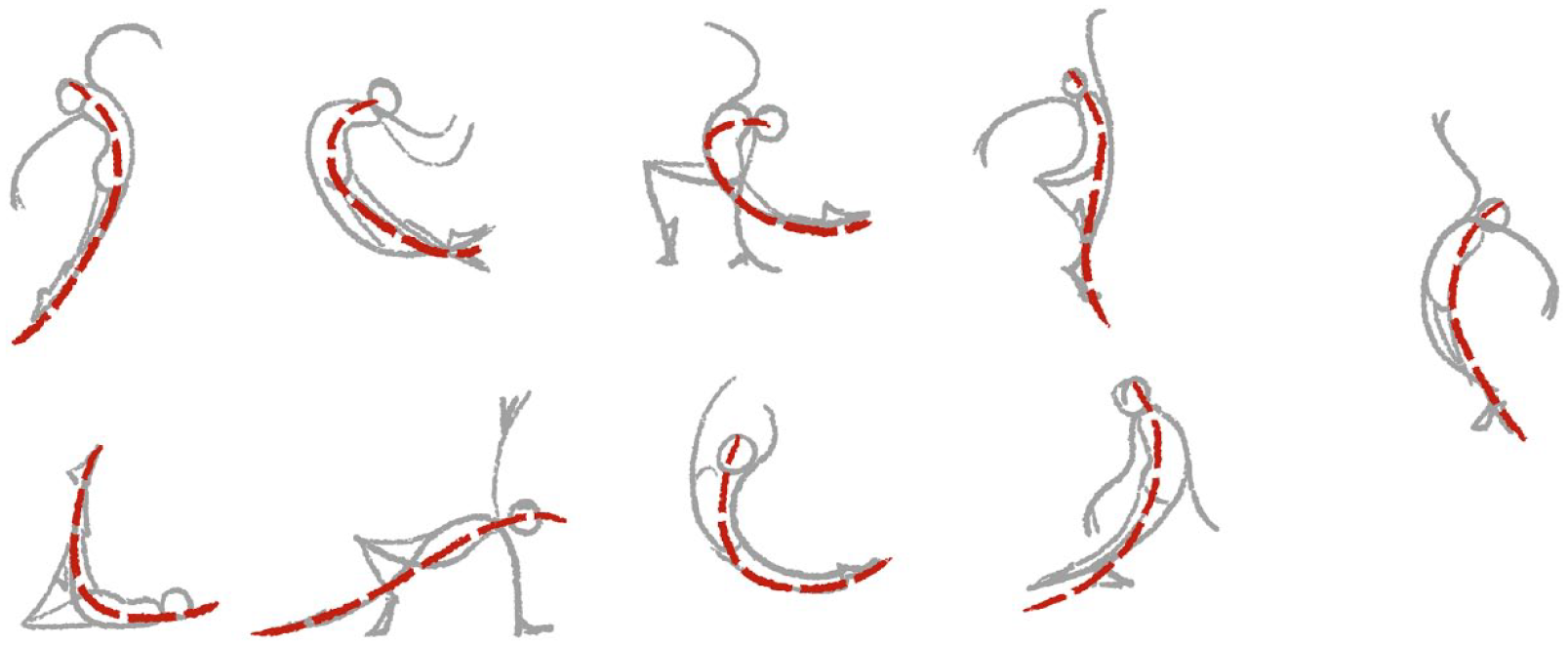
In this framework, the pedagogy and practice of animation have no straight lines. The curved line is the living line and it is through the curved line that the artist gets the first sense of the eternity of the frame (Figure 1). As Frank (2019: 118) observes, ‘a line should have life, a line should move’, moving freely, as Klee (2000: 16) describes, an ‘active line on a walk, moving freely’. The animator creates a vital curve with spontaneity and sensitivity.
Seeing the living line. © 2024 Jack Parry. Reproduced with permission.
Frank (2019: 118) comments how, in the linework of the Disney animation Pinocchio, ‘the animators had captured the storm’s essence’, the vitality of performance, noting also that a ‘traced line is impoverished in comparison, static, dead’. The great animator, Milt Kahl, concurs, stating that: ‘It’s awfully hard to trace a drawing and get any vitality into it, especially when the tracing is being done by people who really don’t have an appreciation for the mechanics of [animation] drawing’ (cited in Barrier, 1976). Another great animator, Ken Anderson, noted that ‘when you had an inker make a tracing of your drawing . . . it lost some of the life’ (cited in Peri, 2008: 139–140). The living line speaks of its own history. In succession, each line of action speaks to the prior line and announces the next one. Figure 2 shows how living lines speak to each other across time, without time – rather with their eternity.
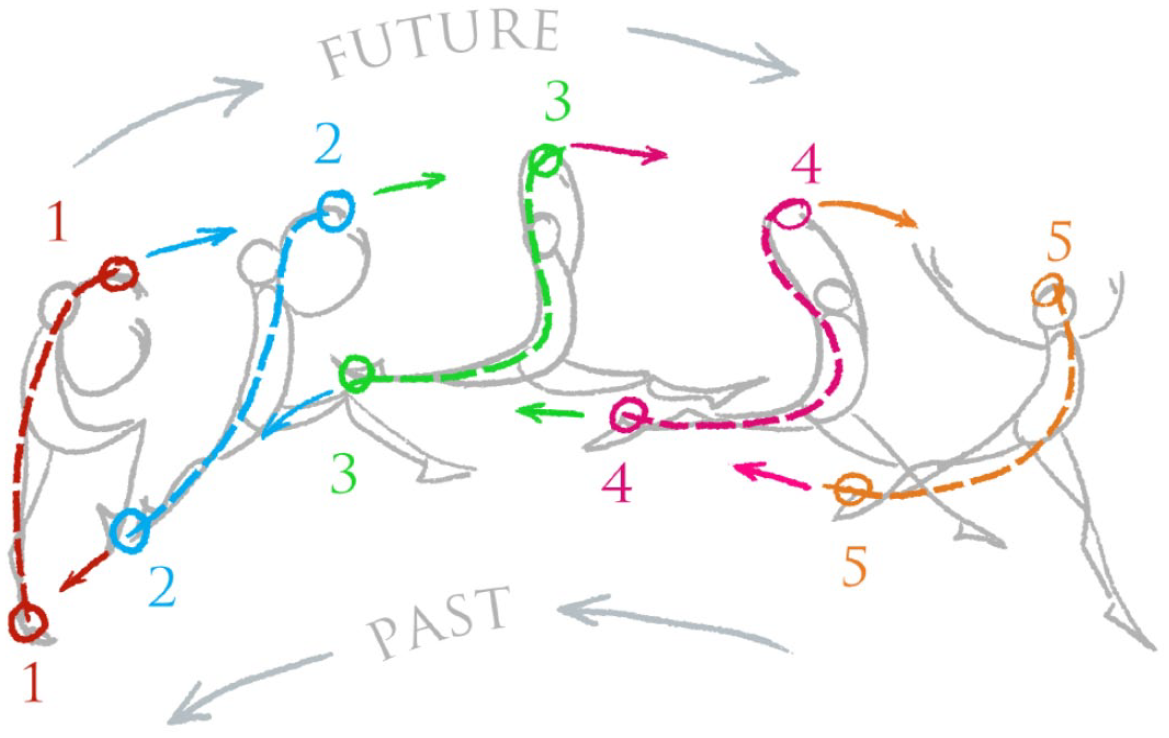
The living line speaks of its own eternity. © 2024 Jack Parry. Reproduced with permission.
This vitality of line is not just an abstract sense of vital historical flow, it is everywhere across the animated frame where lines live. Figure 3 shows that this sense of the eternal is present across all vital presentations in a frame: here the spine, the arms, the legs, anything living.
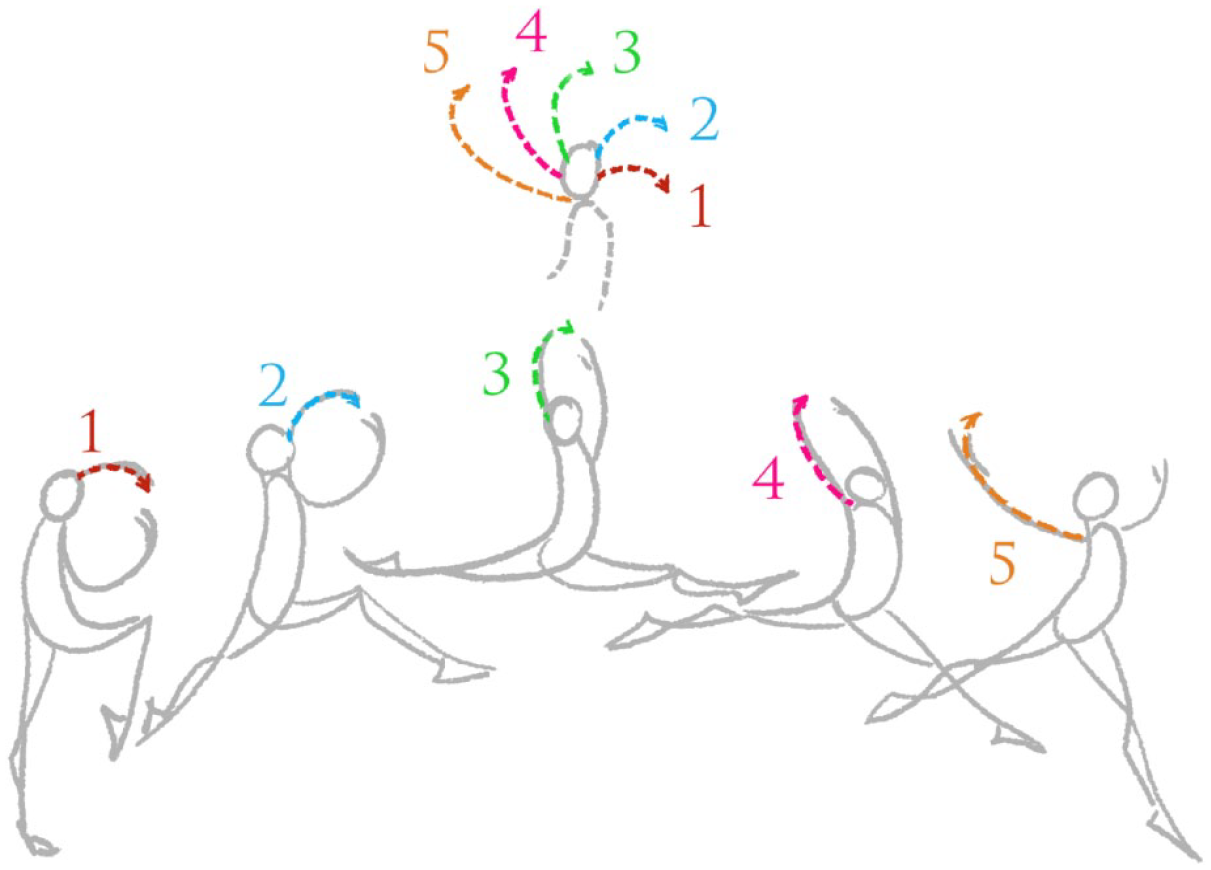
Complex living lines speaking of their own eternity. © 2024 Jack Parry. Reproduced with permission.
Grace: The third dimension
The key to understanding the role of duration in Bergson’s (2001[1889]) image is through his own description of ‘grace’ that he uses to explore aesthetics in ‘Time and Free Will’. The following use and exploration of this word takes on a dimension beyond the everyday understanding of the word ‘grace’. Bergson’s grace has its familiar everyday interpretations that relate to ‘divine assistance’ or ‘pleasing aesthetic qualities’ which this grace includes, but it frames them more in terms of their temporal effortlessness. The effortlessness in question is not in the graceful entity itself but in the ‘consciousness of’ grace. As a practising animator and pedagogue, I recognize grace to be of primordial importance to the expression of duration and the image: At first [grace] is only the perception of a certain ease, a certain facility in the outward movements. And as those movements are easy which prepare the way for others, we are led to find a superior ease in the movements which can be foreseen, in the present attitudes in which future attitudes are pointed out and, as it were, prefigured. If jerky movements are wanting in grace, the reason is that each of them is self-sufficient and does not announce those which are to follow. If curves are more graceful than broken lines, the reason is that, while a curved line changes its direction at every moment, every new direction is indicated in the preceding one. Thus, the perception of ease in motion passes over into the pleasure of mastering the flow of time and of holding the future in the present. (Bergson, 2001[1889]: 6)
Grace is the very quality of the image that constitutes its sense of movement and life. Grace is to movement what form is to matter. It is the embodied sense of flow that can be experienced ‘all at once’, as a self-sufficient expression of eternity. The image is the intersection of the flow of grace and the flow of the materials of the frame. Grace is the higher order expression of vitality that prepares the ease of the lower order movements.
As an animator, I have found Bergson’s grace to be central in both my practice and my pedagogy of animation. I see grace as a meeting, insomuch as it is an intersecting interdimensional quality of the image, fundamental to all cinema seen as animation. Every aspect of the image with grace answers all questions of temporality, all at once. To illustrate this, consider the following images in Figure 4. As images unto themselves they appear abstract in representation, but they all exude temporality both in themselves and between themselves. We can see here that their grace is a quality that can be identified apart from the physical. We can observe this ‘all at once’ as we have a ‘consciousness of’ it. From the animator’s perspective a mere ‘consciousness of’ is inadequate. The animator needs to be the master of grace and consequently requires a concrete awareness of its nature. The historicity expressed in the image effortlessly situates the ‘consciousness of’ to its immediate past, its future leaning, all intrinsic forces, efforts and intentions. Grace is present wherever there is a sense of life. The master animator is the master of grace. Glen Keane’s NEPTHALI, 4 for example, evidences such grace not from his ‘graceful’ reference subject, but from his life-long creative development in the mastery of living lines that express grace and a sense of eternity.
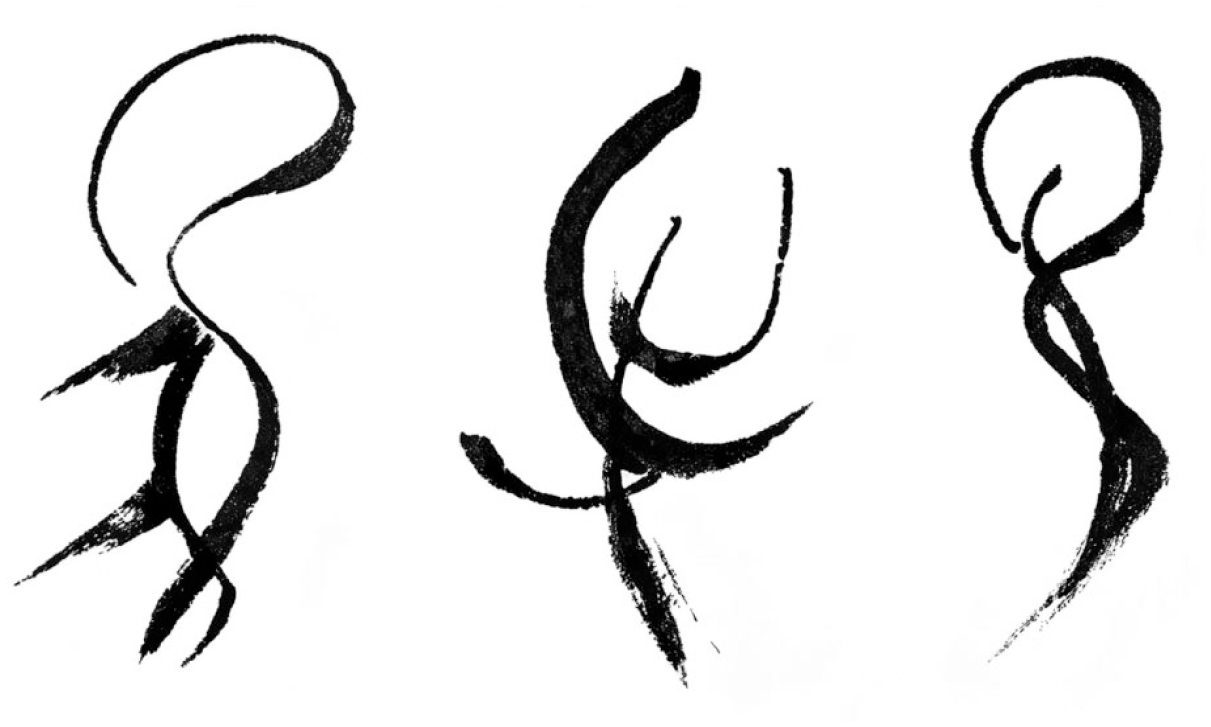
Grace in the animated image. © 2024 Jack Parry. Reproduced with permission.
Grace is the pleasure of being experientially masterful. Grace is phenomenological, not extensive, it is as a ‘consciousness of’, not an extrinsic quality of space. This is why the photographic automata are blind to the fundamental philosophy of grace. They are as ‘gatherers’ of images that are inherently graceful as they are transcendent vital images of the already-living. Duration is not a quality of spatial temporality as Einstein would like it, in the realm of spatialized clocks; rather it is a quality of in-between-ness, as an intersection of flows.
This idea of grace shares the ontological foundation of Aristotle’s form and Husserl’s immanent. Aristotle’s book Physics (1995[c.100 BCE) argues that form (as compared to matter) is the ‘nature’ of the thing (physis/φύσις). Through physis we can distinguish objects of nature from an object of function. Objects of function ‘have no innate impulse of change’ (p. 19). It is this nature of a thing that is captured as grace in duration and, as such, through animation, the functional object can be granted freedom from its frozen world of function and released into the playground of grace. The real is only real as an in-between ‘consciousness of’ but not an object in space. Time is only time as an in-between ‘consciousness of’ but not a spatialized time. Thus, we are left only with a ‘consciousness of’, the interdimensional intersection as ‘consciousness of’ form. Duration forms the structural interdimensional fabric of the image and, in so doing, gives us its sense of temporality in our ‘consciousness of’. Grace is this expression of life in duration woven into the image. It is the quality of the image that is experienced as ‘living’. We know this, as animators and artists, as we are tasked not just as the midwife of the image: we give birth to the image.
In my pedagogy of animation, the lesson of grace is the moment of awakening for the apprentice–animator. In learning to see grace in the image, the apprentice also learns of the eternity of the frame: the frame’s capacity to articulate duration without the need of a cold and dead time. The term ‘key’ frame has lost its deeper meaning (Mealing, 1998; Whitaker and Halas, 2002; White, 2023). Digital animation has stolen this sacred child and put it into an empty idealized box that can contain anything. But the true key frame is the frame of grace. It grasps the interdimensional duration and the eternity of the frame. The importance of this frame of grace is well known to the master animator. One of the great pedagogues of animation practice, Williams (2001: 60), said that it is not unheard of for the master animator to disappear from the studio for days or weeks only to return with a single drawing: I was shocked . . . Wow! That was the first time I ever saw anyone working so hard on a single drawing. How was he ever going to get the scene done? Finally, the penny dropped. ‘Of course, stupid, it’s his key!’ It’s the most important thing in the scene!
The other great pedagogue of animation practice, Stanchfield (2009: 215), reaffirms the interdimensionality of the drawn frame of an animation: ‘Making one drawing is no different than producing a whole animated feature’. But this is not just a drawing. It is ‘THE’ drawing (Figure 5).
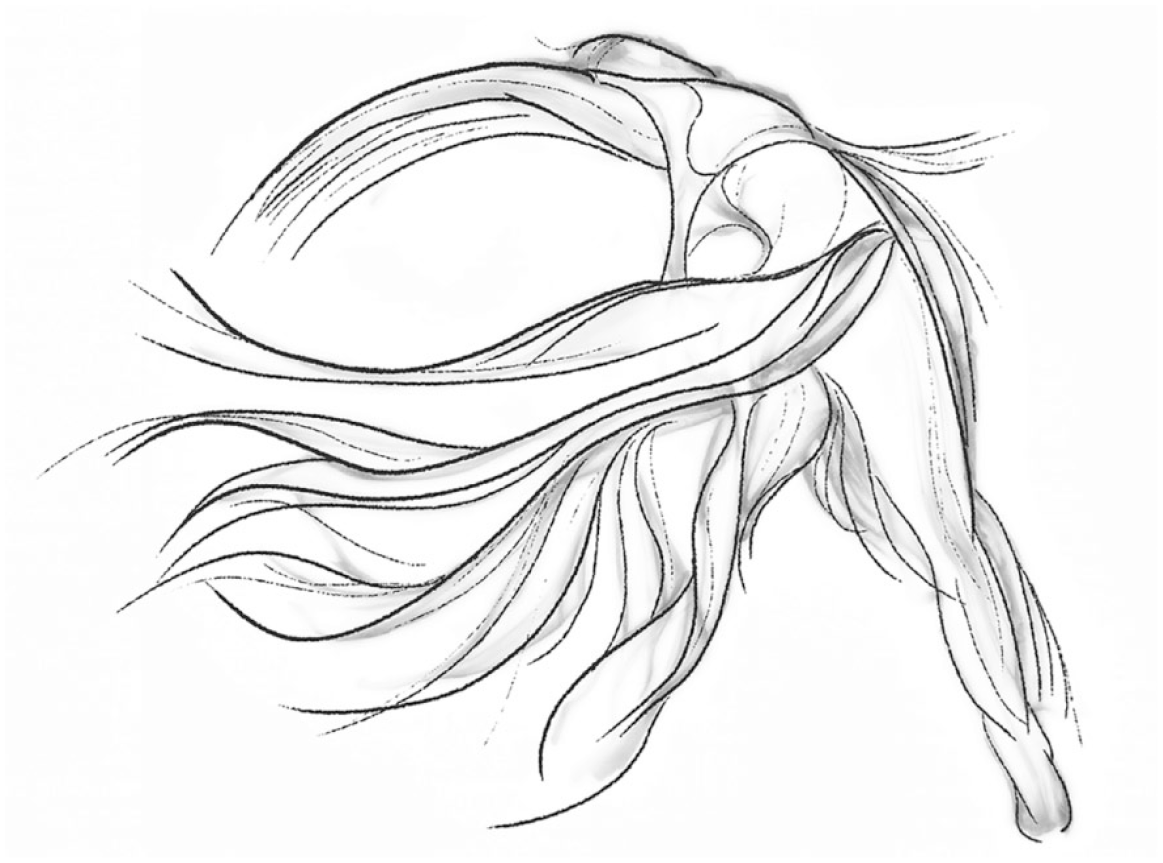
Grace is ‘THE’ drawing. © 2024 Jack Parry. Reproduced with permission.
This is the drawing that in itself offers a map to all dimensions of the experience, as animation, without empirical time. In the birth of the frame of grace, the animator creates the fundamental interdimensional substrata of the cinematic experience. The frame of grace holds historicity and intentionality in all dimensions. The animator/artist is the creator of grace, the ‘filmed’ frame merely captures grace, with little appreciation for its origin. As Bergson (2001 [1889]) states, it contains in its immediacy a ‘prefigured future’. This is expressed by the master animator in a plethora of dimensions. None more so than the ‘pose’. The pose is a nexus for grace. The masterful pose has grace. The pose is not an anatomical configuration, nor is it limited to an anatomy. The pose contains an interconnectedness. A pose is of a different dimension to the physical. A graceful pose is mediated through matter, but it is not of matter. It is the in-between-ness from the intersection of the transcendent material flow through the scaffold of the immanent. The quality of their relational friction is this interdimensional meeting, its living nature, its grace. Grace lives through this interconnectedness, giving the cinematic experience of the ‘key’ frame as the experience which resonates as the next dimension we will now explore – sympathy.
Sympathy: The fourth dimension
It is thanks to grace in the image that we find sympathy with teapots, trees, flowers, dragons and lumps of clay. When conscious of phenomena, our totality of experience – the immanent part of our consciousness – resonates a sense of historicity, whereby the awareness of a particular present meets the transcendent flow of givens as an ‘already experienced’. With this transcendent flow comes a resonant sense of situation that gives rise to a conscious feeling for the future leaning of the phenomenon. Put simply we feel a sympathy. Sympathy is how duration resonates within the other. Figure 6 contrasts the dead matter of the carpet with the living sympathy that resonates when the form is given living lines of grace.
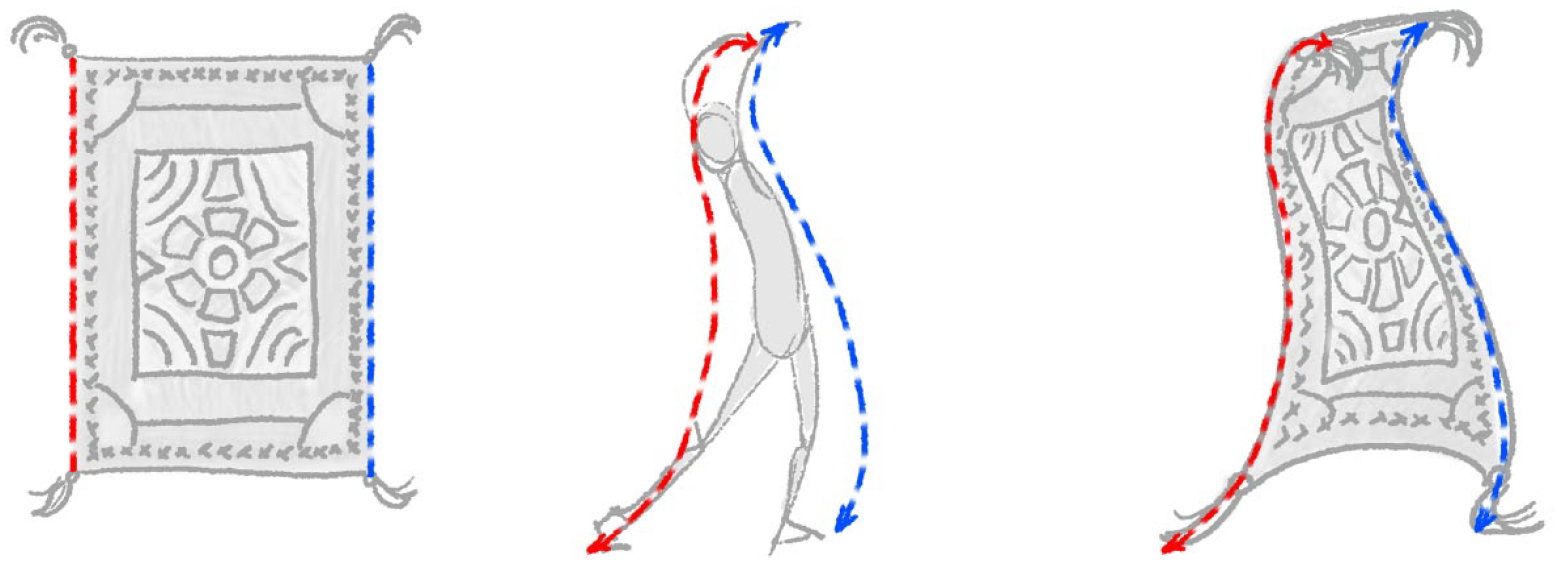
Sympathy resonates life into the inanimate. © 2024 Jack Parry. Reproduced with permission.
Unlike empathy that relates one to an experiencing ‘other’, the sympathy of the image offers a cleaner and more elegant expression of the cinematic experience. It respects Husserl’s phenomenological bracketing and does not pretend that it is, in any way, a reflection of actual experience, nor consciousness of an ‘other’. As Bergson clearly states above, it is to be found in the enjoyment of the ease and facility of all kinds of experienced movements, which, in their grace, phenomenologically prepare the way for other movements. How this is enjoyed by the observer is phenomenologically bracketed. All I can say is that if there is an experience of grace, there is an experience of sympathy. Again, it should be stressed that this use of the word ‘sympathy’ focuses on the image as a ‘consciousness of’. Like duration, sympathy is a dimensionless quality that connects images in immanent experience. Grace is within the frame and it is grace that connects the frames, not spatially but inter-dimensionally. Through the experience of the frame of grace, the observer enjoys sympathy with its duration. The experience of the frame of grace elicits in the viewer a sense of this prefigured future and, when it comes to being, the viewer ‘enjoys’ this resonance of outcome. In psychoanalytic film theory, this enjoyment is attributed to ‘identification’ either as viewer or as object-of-the-viewed (the gaze). This is based on Lacan’s (2006: 75–81) theory of the ‘mirror stage’. From Bergson’s perspective, however, identification and to ‘identify’ in general, in the cinematic experience, is an abstract intellectualization that evaporates in the face of his anti-spatialization stance. One can, however, frame this identification aesthetically, as an affective sense of sympathy in the cinematic experience, where sympathy should be seen as a meeting. It is how the experienced meaning of the frame of grace transcends to the immanent experienced in cinema. Framed as such, the sympathy of the image could be seen as a fundamental principle of cinema spectatorship.
Animation, unlike the filmed, has no constraint in the matter used to articulate grace. Unlike the world of the observer, the world of the animation is only constrained by the frame. Each frame, each image, has the freedom to be a new independent worldly creation and expression. The filmed, however, captures each image as a pre-existing predetermined configuration of grace. It is for this reason that the creation of every frame is an act of transcendence for the animator. It is also for this reason that there are relatively few masters of animation – and comparatively fewer great works of animation compared to the domain of the filmed – where grace is a given fully, in all its dimensions, including the canny as discussed below.
The canny: The fifth dimension
My choice to define the next dimension as ‘the canny’ is a deliberate negation of the more commonly used term in animation of ‘the uncanny’. Definitions of ‘the canny’ vary considerably from source to source so I will define my reading of the term for the avoidance of doubt. For this article, I will employ the old English cunnan (‘to know’ or ‘to recognize’) so, in my perspective on the phenomenology of animation, canny means ‘pleasant in its familiarity’. This adds a new layer to our phenomenological construct built upon eternity, living lines, grace and sympathy. The canny is again a given in the filmed as the filmed subject enjoys this experiential familiarity by being a part of the same world. In our phenomenological engagement of cinema, our sense of the canny is only challenged by the visually horrific depiction, such as in science fiction or horror genres, but the true test of the phenomenologically canny lies hidden within the heart of animation. The awareness and presence of grace in the image is a measure of the animator’s skill. This is especially apparent when grace is absent. The uncanny ghost of cinema hides in its discord with duration and grace. In animation, the world is free to transform from image to image in terms of its matter. The phenomenology of animation, however, should flow uninterrupted from image to image. To break the flow of grace is to throw oneself into the uncanny valley. In my teaching I see this all the time in the work of nascent animators. It is also evident in the capacities of nascent disciplines of cinema, 5 notably photorealistic 3D animation and motion capture. Herein the observer acutely feels the rupture and the ‘wanting of grace’ that leads to the experience of the uncanny.
The animator performs a balancing act when crafting the grace of an image. The pleasant sense of the canny must match phenomenological grace with representational complexity. A simple image imbued with a simple sense of grace can elicit a strong pleasant experience of sympathy and a sense of the experientially familiar – a more sophisticated image that, despite its complexity, will afford an unpleasant experience if the phenomenological sense of grace is unmatched. The immanent experience is unknown and is intuited as unfamiliar, untrustworthy and unpleasant. It is truly astonishing just how sensitive a viewer is to this phenomenological sense of the canny. This poses a problem to both animation and other domains plagued by the uncanny, such as robotics. Our phenomenological capacity to experience the moving, living, relatable and knowable builds the overarching scaffold upon which this phenomenology of animation is built. Now that it stands confidently by itself, we demonstrate its final dimension, rupture, by breaking it.
The rupture: The final dimension
Having developed something of a tentative theory of a phenomenology of animation, I will now stop and consider how rupture, another important Bergsonian construct works in tandem with my existing stratified model of the phenomenology of animation. All dimensions of this phenomenology, eternity, living lines, grace, sympathy and the canny are made to be mastered but, once mastered, they beg to be broken. As with all good rules, they should be carefully obeyed by the apprentice, but creatively broken by the master. In a full understanding of the phenomenology of animation, the animator can start to recognize how, through their art, they connect with the experience of the viewer. All the Bergsonian dimensions described above express an inherent interdimensional connectedness that can be seen as a flow of sorts. This flow has its own inertia and a certain eternal sense of rigidity. Bergson was aware of this rigidity and presented this inflexibility as the target for creative exploration. It is through this imbalance or rupture of grace that animation has such facility, especially with genres such as comedy. Bergson’s (2008[1900]) essay ‘Le rire/laughter’ frames the phenomenology of comedy in his own language of duration. The nature of the comic is fundamentally in the meeting of ways. It is to be found in both the intersection and the rupture of experiential flows. It is namely in stiffness that a rupture will be found. An animated stumble, but one where the spectator still enjoys their own phenomenological plenitude. Seeing an uppity character trip over their own shoelaces into a muddy puddle is the source of amusement and pleasure for some. With our phenomenology of animation, we can make sense of this experience. As immanent experiencers, we derive pleasure from watching the canny act as we know this character, in terms of the living lines, as we get a sense of his eternity, and when he trips and falls (quite ungracefully), we as spectators get a resonant dose of sympathy as we experience a guilt-free burst of experiential mastery (grace), knowing full well what will happen next. This is the traditional rupture, as explored by Bergson: the detached pleasure of the rupture that only the cinematic spectator can enjoy. 6 But if, at that moment as the businessman falls through space, he carefully re-negotiates his terrain, gracefully somersaults, confidently lands and continues his walk unblemished, the event loses its comic appeal. 7 However, the animator has the power, namely at that very moment of rupture, to hijack phenomenology. The businessman could sprout wings and fly away, the muddy puddle could expose its teeth and swallow the man whole. Similarly, the animator can monopolize on this moment of rupture and instead change the nature of the rupture. An eagle flies past, snatching the man to feed its starving chicks. The chute of the businessman serves to trip up a mugger, fleeing from a robbery. In the same way that animation enjoys freedom of worldliness, the animator is also free to masterfully navigate and manipulate the world of immanent experience. Herein is the basis of animation’s preeminence for comedy, magic. This approach can be seen in the well-known and over-used devices and gags enjoyed by Chuck Jones, particularly in the roadrunner. Jones heavily relies on hijacking phenomenology by rupturing everything from our immanent experience of physics 8 right down to our phenomenological connection to music. 9 ‘There is . . . an art of throwing a wet blanket upon sympathy at the very moment it might arise, the result being that the situation, though a serious one, is not taken seriously’ (Bergson, 2008[1900]: 43b).
It is through this careful use of the rupture and stiffness that comedy is engineered. This is why the magical freedom enjoyed by animation has so many comical devices. They are great at rupturing and hijacking our phenomenology. This may also be why so many animations are built around ‘the chase’. The rupture of the hunter and the hunted. Watching cats hunt and kill mice hardly seems a good structure for comedy, yet an entire industry has been built around this intersecting rupture. The rupture herein keeps the cat Tom from eating the mouse Jerry and the roadrunner safely on the road.
Conclusion
In this article, I have presented a basis for a phenomenology of spectatorship in cinema, raising the issue of how the living and the moving are captured in the basic image unit of cinema, the frame. This phenomenology is built upon the inherent requisite sense of eternity given by the filmed but arduously created by the animator frame-by-frame. In my analysis of this sense of life in the frame, I have proposed and elaborated six dimensions of a Husserlian phenomenology of animation, based on Bergson’s vital lived duration. I have shown how the phenomenology of animation is grounded upon the expression of duration and movement within the frame – in its sense of eternity. The eternity of the frame is the bedrock of the phenomenology of animation. Grace is an extension of the eternity of the frame inasmuch as through grace we can experience the ease, pleasure and mastery of having a sense of the ‘already anticipated’ before it actually happens. Living lines form the historical structure from which grace can be experienced all at once. Sympathy builds upon grace as it provides something of a reality agnostic framework upon which we can experience grace without the need for a living empathetic subject. It is thanks to sympathy that we experience true feelings for the animated representation of the discarded fedora, the shameful carpet, or the indignant teapot, among others. My experience though is measured against the fifth dimension of our phenomenology, our sense of the canny that grants the trust and love of a child to an animated disproportionate anthropomorphic talking blue dog (Bluey) but has the same child screaming and hiding under the bed when the animated train conductor offers free hot chocolate (The Polar Express) to unsuspecting children – truly terrifying.
Finally, I have also given a brief glimpse into the avenues of the rupture of these dimensions when the aesthetics of the animated form calls for the artistic disruption of the experience of life within the frame. If done properly, such ruptures can be engineered to do anything from simple amusement to the formulation of sophisticated comedy. These six fundamental contributions of Bergson’s philosophy and Husserl’s phenomenology provide us with a useful way of comprehending cinematic spectatorship, seen as the immanent basis of the cinematic experience itself.
Footnotes
Declaration of conflicting interests
The author declared no potential conflicts of interest with respect to the research, authorship and publication of this article.
Funding
The author received no financial support for the research, authorship and publication of this article.