




Abstract
In recent years, many studies in the field of animation aesthetics have recognized that puppets’ materiality in stop-motion animation films is a powerful narrative tool. Starting from these premises, this article explores stop-motion films performed by fabric-skinned puppets and suggests that textile materials convey meta-narratives about loss and nostalgia. The analyses of the anthropological and expressive–sensorial dimensions of fabric indeed allow us to investigate the concepts of melancholy and nostalgia as intellectual and emotional experiences made possible thanks to the material characteristics of an artifact. To validate this hypothesis, three stop-motion short films are considered: the Japanese film Komaneko’s Christmas: The Lost Present (2009) by Tsuneo Goda and produced by the Dwarf studio; Christopher Kezelos’ film The Maker (2011); and Marionette (2012) by Thomas Tanner and Frayah Humphries. In these films, puppets’ materiality enhances either the melancholy aspects or the positive consequences of nostalgia and this interpretation can be formulated by looking at the ‘stories’ narrated by puppets’ fragile fabric skin as a manifestation of wistfulness. After providing an interdisciplinary overview of the main theoretical studies that explore concepts such as craftsmanship, puppets’ materiality and nostalgia from either animation, design or psychanalytical perspectives, the article defines three phenomenological dimensions of nostalgia suggested by fabric-skinned puppets’ material surface. Nostalgia is analysed as an emotion that proactively allows us to face the present by remembering the past, as an unconscious relational feeling that manifests human beings’ need to connect and as a pessimistic reaction to an inconsolable and irretrievable loss.
Introduction
Artistic and design disciplines have investigated the significances evoked by materials from different perspectives, acknowledging that the aesthetic qualities, the physical–chemical characteristics and the history of uses and manufacturing processes of a material make it a protagonist of narratives inscribed in its DNA (see Maselli, 2019). In the late 1980s, the Italian designer Manzini (1986) observed the values that materials play in the craft practice, recognizing their technical properties and examining how matter supplies cognitive tools and cultural reference.
In recent years, studies about materials’ meanings have increased exponentially and the intangible aspects of the relationship between materials and human beings have become one of the main topics in artistic and creative fields. This has generated a heated debate around concepts such as objects’ inscribed memories, material significances and anthropological interpretation, and superficial traces emphasizing the creations’ authorship. In 2002, designers Ashby and Johnson (2002: 73) stated that a material is ‘like an actor, it can assume many different personalities, depending on the role it is asked to play’. Investigations have continued, conducted by scholars such as the anthropologist Eleonora Fiorani, the designers Elvin Karana, Valentina Rognoli and Marinella Levi, and the film and animation scholars John Sundholm, Suzanne Buchan, Jane Batkin, Jennifer Barker and Jayne Pilling, 1 who – analogously to the previously mentioned acting ability of materials advocated by Ashby and Johnson – addressed matter as an actor in puppet animation films as its performance overlaps with the one expressed in the diegesis in a sort of hierarchical order. The connection between material experience and stop-motion film analysis recalls the idea of ‘aesthetics of materiality’ applied to the indexical filmic image by film scholar Sundholm (2005: 56), 2 as it stems from the belief that material creates new levels of reading and ‘discourses that will foster images and stories about a [personal or collective] past triggered by the present’.
These thoughts question the meaningful value of animated objects’ material features revealing stop-motion animation techniques to be a powerful expressive medium and constitutes the premise of this article as they validate the idea that the physical properties and sensory characteristics of puppets’ skin materials provide unprecedented symptomatic interpretations. 3 In the following paragraphs, I will outline the close relationship between fabric-skinned animated puppets and different ‘dimensions’ of the emotion of nostalgia, and I will argue that fabric evokes them by stimulating viewers’ sensory perception and psychological reality. The article therefore aims to explore the possible meanings of nostalgia that can be communicated by fabric puppets by constructing a bridge between the psychoanalytic theory of nostalgia retained by transitional objects, the material dimension of nostalgia formulated in a design field and the idea of meta narratives provided by materials’ aspects in stop-motion films staging puppets fabricated with fabric. With its web of weaving and sewing lines and its imperfect texture, its warm touch and its use as cover and protection, fabric will be interpreted as a symbol of vulnerability and manifestation of humanness, as a communicating surface between the personal world and the social dimension, and as an unconscious manifestation of the attempt of human beings to give life to something lifeless.
Fabric objects as vehicles of nostalgia
Much has been written about nostalgia, and with nostalgia. It has been described as an emotion close to sadness, provoked by the lack of something, since it makes us think about what was in the past and is now absent. As a result, it blends the fulfilment derived from what has been with the acceptance that it will not return.
The Swiss physician Johannes Hofner coined the term nostalgia in the 17th century by joining the Greek words nostos (returning home) and algia (pain) (Davis, 1979: 1). Initially, the term was used to address a physical disease caused by long periods of distance from home and provoking symptoms such as anxiety, pain, weeping and anorexia. Over time, this condition has been related to other kinds of losses, approached from other fields of study and perspectives, and the word nostalgia has been used metaphorically as a sort of homesickness for a lost and idealized past that will never be again but that we yearn to revive (Pickering and Keightley, 2006: 922).
Freud associated this emotion with the physiologic loss of the mother, whose image and presence will always persist, although the happiness associated with it will no longer endure (see Freud, 1955[1919], 1959[1925]). The psychanalytical tradition broadened the scope and causes of nostalgia, and the object evoking nostalgia has started to be considered different from the one that originally caused it, as if human beings unconsciously look for a surrogate object that symbolizes their childhood among their belongings (see Drąg, 2014). Objects, therefore, are invested with symbolic meanings stemming from an implied and interiorized absence for which they compensate, and awaken memories or fantasies of an idealized past by eliciting a sense of warmth, security and acceptance. By retaining memories and images, objects act out a performance that Bennett (2004, 2009) has defined as ‘thing-power’ and ‘vitality of matter’. This idea is rooted in philosophical and proto-scientific theories developed in western culture by Spinoza, Thoreau, Deleuze and Guttari – among others – and recognizes that objects hold a force that is always there, a quasi-agency that is somehow activated by the closeness and intimacy between subject and object. The medium of this intimate connection is the skin of the object, the external surface with which we interact. Objects can of course be fabricated with different materials, and those arousing memories of childhood are conventionally made of soft and warm materials such as fabric (Winnicott, 1953). In the 1950s, the paediatrician Donald Winnicott affirmed that fabric dolls and stuffed animals hold an important role during children’s psychological development as they are a surrogate of the maternal presence, and children interact with them when they are first separated from their mothers; he named them a ‘transitional object’ (p. 89). Even from a phenomenological perspective, fabric dolls have been acknowledged as holding high symbolic values in the human process of growing up because of their aesthetic and material features: according to Caggiano (2015), they are morphologically aligned with the feminine and, thanks to their softness, convey a sense of being embraced and protected.
Visual storytellers 4 from different perspectives have recognized the effectiveness of the use of fabric objects as storage of childhood memories and a vehicle of nostalgia by stressing their tactile and material qualities. In the 1950s, in the comic strip Peanuts, Charles Schulz portrayed a young, wise and insecure Linus van Pelt constantly carrying over his shoulder a certain object, a blue blanket that helps him deal with his shy and unconfident personality. The emotional attachment of the boy to this object makes clear its symbolic value: by projecting a sense of security onto the soft blanket, he becomes confident. It is not a coincidence that Schulz depicted a character whose transitional object is a blanket, a fabric object, warm and soft.
In a more general scenario, fabric has been related to humanness since its manufacture is an expression of craftwork and craftsmanship. The art historians Constantine and Reuter (1997: 116) write: ‘What is fabric? We weave it, sew it, we shape it into forms . . . Fabric is our covering and attire. Made with our hands, it is a record of our souls.’ The anthropologists Schneider and Weiner (1998) outline the communicative value of this material as it can be imbued with political, social and ritual powers, giving information about background, family traditions, social class and the self: sex, age, status, political affiliation. The philosopher Ricoeur (2004: 21) describes marks left on textiles as archives of our existence, treasures and ‘mnemonic phenomena’ capable of furnishing pictures of the past. More recently, the artist Akpene Amenuke (2012) associates fabric with the concept of humanity by considering physical features of this material: its flexibility, its physical adaptability and its use as soft covering. According to Amenuke, fabric carries personal narratives, it is an expression of subjectivity, ‘memory, nostalgia, loss, [and it is] an optimistic yearning toward a more expanded space of possibility’ (p. 96). The Italian scholar Eleonora Fiorani has delved into the topic and has associated fabric with human vulnerability, intrinsic fragility, ephemeral nature and a need for protection, since human beings cover and protect their bodies with it. In her book Leggere i materiali (Fiorani, 2000: 103), she writes: ‘[Fabrics are] the most “human” materials. Like man . . . they are not made to last and are intrinsically subject to decay.’ The closeness between human and fabric is not only symbolic, but also practical: ‘Fabrics – Fiorani adds – are the materials closest to man, who wears them, like a second skin.’ What about animated puppets covered with a soft fabric skin? Can their material qualities be a vehicle for narratives about human desire, vulnerability and storage of nostalgic memories, either running parallel to or reinforcing the narrative conveyed by the diegesis? I will try to answer these questions in the following sections by leaning on the analysis of film scholars who address stop-motion animation as a privileged medium for exploring complex human emotions – as nostalgia – spotlighting puppets’ materiality.
Stop-motion puppets’ materials and nostalgia
Stop-motion animated objects’ power to emphasize a sense of nostalgia, vulnerability and childhood has been unconsciously exploited by numerous animators, especially in the early history of stop-motion animation cinema. In James Stuart Blackton and Albert Edward Smith’s (1897) film Humpty Dumpty Circus – the first documented stop-motion film (Harryhausen and Dalton, 2008: 39) – dolls and toys with moveable joints are put on the scene and animated. From Arthur Melbourne Cooper’s Dream of Toyland in 1907, to the series of films produced by the Russian director Wladyslaw Starewicz between the 1930s and 1940s, to Jiří Barta’s more recent Toys in the Attic (2009), many stop-motion films have staged animated toys and have narrated stories of lifeless objects belonging to a nostalgic dimension of childhood and purity. In Starewicz’s (1933) stop-motion film, The Mascot, a sick girl’s stuffed toy dog, Fétiche, is brought to life by a teardrop that is absorbed into the puppet’s fabric, turns into a beating heart and the toy then embarks on an adventure with the sole aim of fulfilling the wish of its sick owner to procure her an orange. The plush Fétiche reconstructs spectators’ memories and fulfils a ‘nostalgic desire for childhood innocence’ (Varga, 2009: 79). Nostalgia is the memory of something desired and now missing, and is accompanied by actions that aim to compensate for this lack.
In animation studies, the concept of nostalgia has been outstandingly explored by several scholars such as Vivian Sobchack, Adam Whybray, Rachel Moseley, Birgitta Hosea and Ewan Kirkland. 5 In the chapter ‘Made by hand’, Hosea (2019: 33) states that ‘Aside from production technique, the physicality of the materials used in animation can also be invoked for nostalgic purposes’, acknowledging and strengthening a path of research and analysis that relates matter and nostalgia, and that has been investigated with different approaches and purposes. Rachel Moseley in her book Hand-Made Television: Stop-Frame Animation for Children in Britain, 1961–74 (2016) focuses on British stop-motion television production between the 60s and the 70s. She argues for a connection between stop-motion animated objects encountered in children’s television – in particular toys – and nostalgia, and finds the seed of this relation in the political, industrial and technological changes experienced by British society in the 1960s and 1970s. According to Moseley, toys animated in television programmes, because of their handmade appearance, the pastoral settings they perform in and the themes their narratives deal with (ecology and old-world traditions), become a symbol of ‘the troubled encounter of the pre-industrial pastoral idyll with the modern technological world’ (p. 25). A similar idea has been addressed by Adam Whybray (2014) who discusses the gesture of nostalgia by addressing fictional actions performed by puppets in several animated films directed by Jiri Trinka, Jan Svankmajer and belonging to the Czech puppet animation tradition. In Whybray’s analysis of Svankmajer’s productions, puppets’ performance is interpreted as a cultural metaphor of the new ‘Czech national identity against the Western capitalist system that through advertising creates “unified consumers” devoid of free-will’ (p. 46). By analysing the third episode of the film Dimensions of Dialogue (1982), for instance, he corroborates the point of view expressed by Anderson (2005), who interprets puppets’ actions as critics against the process of market under capitalism and the attitude of conformism. The two protagonists of the episode, in fact, exchange consumer goods, and Whybray (2014: 50) suggests that these objects awaken nostalgia for rural, family-based industry, which was successively undermined by industrialization.
However, nostalgia has not been necessarily viewed as reactionary and melancholic, ‘a defeatist retreat from the present, and evidence of loss of faith in the future’ (Pickering and Keightley, 2006: 919). If, in Svankmajer’s film, nostalgia is conceptually opposite to progress, the nostalgic plush Fétiche mentioned above arouses an emotional engagement, evokes memories of childhood and reminds viewers of a phase of life that might help to cope with the present and the future. In their attempt to reconfigure this term, Pickering and Keightley argue that nostalgia can be the desire ‘to recognize aspects of the past as the basis for renewal and satisfaction in the future’ (p. 921), to remember something precious that happened in the past and that influences the present, or the memory of something desired and now missed, involving actions that depend on this feeling.
In puppet animation, therefore, nostalgia is both a feeling of melancholic reaction, regressive and damaging, and it is potentially productive and progressive. In the following section, I will analyse three stop-motion short films and focus on how in these films animated puppets’ fabric skin conveys either of these perspectives, as the material itself both allows focusing on the past, emphasizing a feeling of absence and encourages critical insights, desires – and then efforts – to restore what has been lost or to conquer what we aspire to possess or experience, although not always possible.
The nostalgia of fabric-skinned puppets
Padded dolls made of soft materials such as fabric and felt can be used in stop-motion animation, not just because of their lightness and ease of manufacture, but also due to the emotional engagement they elicit. In this section, I will analyse three puppet films in which nostalgia and melancholia are narrated by both the diegesis and – as I suggest – by puppets’ skin material, made of fabric: Tsuneo Goda’s Japanese short film Komaneko’s Christmas: The Lost Present (2009), Christopher Kezelos’ film The Maker (2011) and Thomas Tanner and Frayah Humphries’ film Marionette (2012). These films belong to a narrative genre that Wells (2002: 67) defined as deconstructive narrative because they ‘reveal the premises of [their] own construction’, and stage puppets that behave as puppet makers and animators, and bring inert matter to life. The protagonists of these films, indeed, at a diegetic level, are puppet makers showing a nostalgic attitude towards something absent and missed, that they replace by fabricating a surrogate.
Komaneko: The proactive nostalgia
Komaneko is a Japanese series of stop-motion films about a little female cat living with her grandfather, making stop-motion films with two small knitted puppets portraying her parents (Figure 1). The meaningful name, in fact, means ‘cat who shoots a movie frame-by-frame’. 6 Komaneko’s Christmas: The Lost Present is an episode of the series produced in 2009 and set during Christmas time, when the protagonist is waiting for her parents to come home. At the beginning of the narrative, a Christmas card in which her parents communicate that they won’t be there for Christmas, is delivered with a present, a fabric doll. Komaneko gets upset, and on Christmas Eve decides to go on a trip to join her parents. During the journey, the sleigh breaks and she feels lost, and the two puppets are her only consolation. Unexpectedly, the little doll gifted by Komaneko’s parents appears and, along with her appearance, hope and the Christmas spirit return (Figure 2).
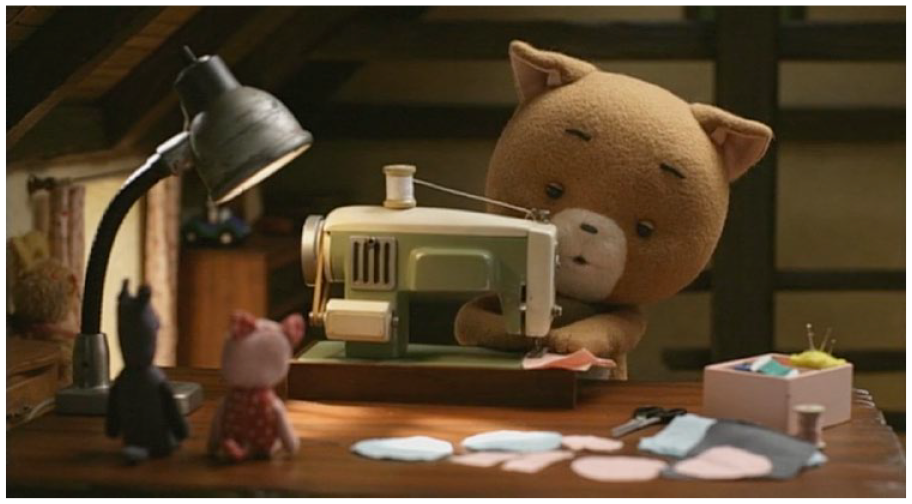
Still from short film Komaneko’s Christmas: The Lost Present (2009) © TYO/dwarf-Komaneko Film Partners; © Amis de Komaneko. Reproduced with permission.
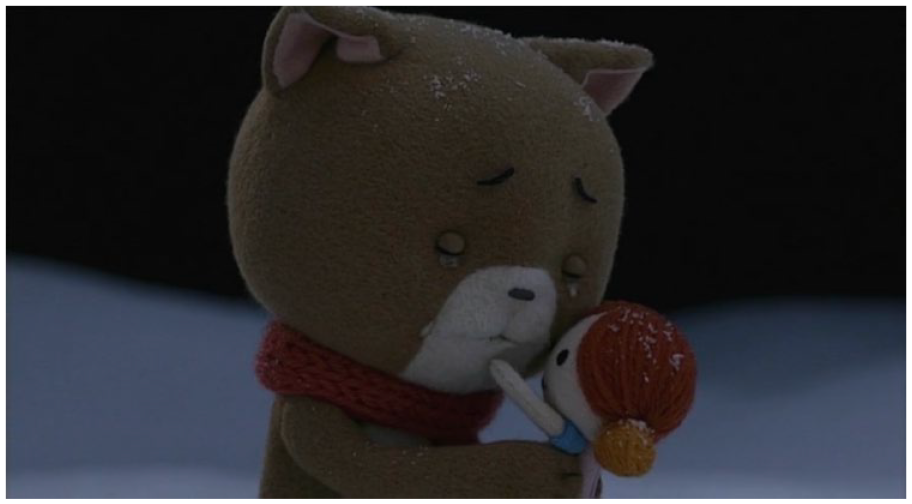
Still from short film Komaneko’s Christmas: The Lost Present (2009) © TYO/dwarf-Komaneko Film Partners; © Amis de Komaneko. Reproduced with permission.
I suggest that in this short film both the characters’ actions and material qualities express a feeling of melancholic nostalgia that helps the protagonist to proactively face the difficulties of the present. At a diegetic level, the film stages the nostalgia and sadness of the little cat for her parents’ absence. The protagonist fabricates two stitched puppets representing her parents and these puppets come alive when she gets lost during the blizzard, keeping the protagonist company. In the same way, the puppet gifted by Komaneko’s real parents, which she throws into the fireplace at the beginning of the film, comes alive and helps the protagonist find her way home. Komaneko’s relationship with objects of nostalgia has multiple positive effects: they save her from jeopardy, they remind her of the love of her parents, and they carry on and sublimate emotions elicited by nostalgia.
The transitional objects and the characters are puppets fabricated by using soft upholstery foam covered with fabric and this quality supports the idea of childhood nostalgia as a melancholic view on the past, and places the ‘narrative’ of the material as a reinforcement of the diegesis. The soft quality of fabric, indeed, evokes one of the ‘earliest precursor forms of nostalgia’ (Phillips, 1985: 70) by substituting the lost and still longed-for relationship with the parents. In this perspective, fabric reveals what psychologists Baumeister and Leary (1995) named ‘the need to belong’ and to be loved. Puppets’ material quality also reveals a proactive and positive effect as it contributes to encouraging human interpersonal behaviour. From this point of view, it seems that nostalgia driven by puppets’ materiality pushes towards the search for greater affective contact, as nostalgic memories of companionship and sharing with other people demonstrates. By reminding us of meaningful relationships, ‘nostalgia’, according to Wildschut et al. (2006: 986), ‘bolsters social bonds and renders accessible positive relational knowledge structures’. The positive effect of nostalgia driven by material, therefore, comes to a collective and social dimension.
While some critics and sociologists restrict the power of nostalgia to the attempt to escape from an intolerable present by anchoring oneself in a past to which it is impossible to return, I would like to address what Hutcheon and Valdés (2000) and Boym (2001) believe about nostalgia’s positive effects in postmodern culture. The three scholars portray nostalgia as having multiple and crucial meanings to understand and face the present. In their essay ‘Irony, nostalgia, and the postmodern: A dialogue’, Hutcheon and Valdés (2000) focus on the critical and social function of nostalgia as a means to acquire consciousness about the present. By addressing the action of ‘feeling’ nostalgia in the surrounding material world, they write: Nostalgia is not something you ‘perceive’ in an object; it is what you ‘feel’ when two different temporal moments, past and present, come together for you and, often, carry considerable emotional weight . . . It is the element of response – of active participation, both intellectual and affective – that makes for the power. (p. 22)
Svetlana Boym (2001) provides different views on nostalgia by privileging aspects ranging from the imaginative impetus to the thoughts it arouses. In her study, beneficial potentials emerge when she argues for a distinction between reflective and restorative nostalgia, and she writes: ‘Restorative nostalgia puts emphasis on nostos and proposes to rebuild the lost home and patch up the memory gaps. Reflective nostalgia dwells in algia, in longing and loss, the imperfect process of remembrance’ (p. 41). Boym’s characterization of nostalgia echoes some insights of this emotion that I argue are shown in the film under analysis through the use of fabric. Reflective and restorative nostalgia are complementary as the necessary relationship between the present and the past reveals. By proactively overlaying memories of the lost past, we consciously face the difficulties of the present and this effort strengthens a sense of belonging to it. The use of fabric in the film materializes this beneficial value. Both characters and Komaneko’s handmade transitional objects are fabric-skinned puppets, and the visually perceived similar texture of these objects can be interpreted as the demonstration of the consciously crafted connection between memories of a yearned past – i.e. fabric which manifests reflective nostalgia for Komaneko’s parents – and the effort to restore these memories by using a similar material, Komaneko’s handmade fabric puppets. Fabric suggests that she has proactively accepted the absence of her objects of desire and has found a way to transform her feeling of sadness in a beneficial activity that helps her to live in the present without forgetting her precious past.
The Maker: Relational nostalgia
Christopher Kezelos’ short film The Maker (2011) is set in a fantasy world where a creepy anthropomorphic fabric-skinned rabbit builds another creature and gives life to it. The determined creator works on his project without distractions and meticulously chooses the necessary components. The first half of the film concerns the process of puppet making by following the instructions of a sort of ‘Book of Creation’: the puppet sculpts the face by modelling a piece of clay; he cuts, shapes and stitches the fabric to cover the creature’s body (Figure 3); he stuffs the body with wadding; and, finally, he places the eyes. Soon the maker finishes his creation, but he has to figure out how to instil life in it. Time is running out and only when the sand of a giant clepsydra is almost finished does he understand that the secret for making his creature come alive is to play a magical melody on his violin. The new creature starts moving and opens its eyes, and they hug each other before the maker disappears. The time is reset and the new creature must repeat the process.
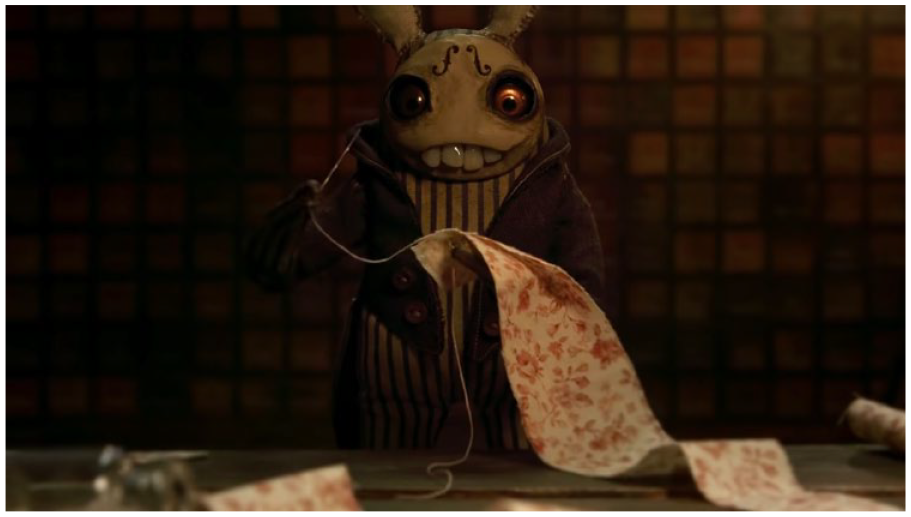
Image from short film The Maker. © Zealous Creative, 2023. Reproduced with permission.
In the analysis of the previous case study, I argued that nostalgia for something lost (Komaeneko’s parents) and substituted by a transitional object is a trigger that stimulates growth or in any case a reaction. In The Maker, in addition to its proactive quality (the protagonist’s desire moves the story), nostalgia can be interpreted as an unconscious condition of longing for the unknown but powerful feeling of love. The protagonist, after accomplishing his task and before disappearing, hugs his new puppet, his son or his partner (Figure 4). This is a crucial moment: through this action he not only passes his knowledge and the weight of a task that the new-born creature is supposed to accomplish in turn, but he also expresses appreciation for their relationship and for the short but satisfying time they have been allowed to spend together. The melancholic connection between the two characters suggests a relational dimension of nostalgia expressed by both the diegesis and the material elements that inhabit the space of the story. There is relational nostalgia in the loneliness of the protagonist building another puppet, giving it his own appearance, and carrying out by himself the duty to perpetrate his life and breath in another creature. There is relational nostalgia in the hopelessness of the character who fights against the passing of time to bring his creature to life. There is relational nostalgia in the brief moment of intimacy in which the two characters, hugging each other, suggest ‘the preciousness of our moments on earth, the short time we have with loved ones, and the enjoyment of one’s life’s work and purpose’ (Kezelos in Australian Academy of Cinema and Television Arts [AACTA], 2021). There is relational nostalgia in the search for a mythical object of a satisfaction that has arguably never directly been experienced in the past (see Lacan, 1997[1957]). The French psychoanalyst Jacques Lacan revised the concept of loss, or lack, and converted it from the yearning for reviving specific objects, events and feelings, experienced personally or collectively, to a ‘transcendental condition of desire’ (Ricciardi, 2003: 67). This nostalgia expresses a profound yearning for an idealized future, a desire for something that was never there in the first place. By deeply exploring this different scope of nostalgia, Bassin (1993: 429) formulates the concept of nostalgic fantasy for a utopian past, meaning that nostalgia defines a path of searching for something that is not supposed to exist at all or that existed but has never been experienced by the subject. The ‘nostalgia for a time [the subject has] never known’ (Koening, 2021: 166) has been named anemoia by John Koening in The Dictionary of Obscure Sorrows. This imaginative condition justifies the nostalgic feeling expressed in the film by the crafting character during the intimate and physically mediated connection with the desired partner. The medium of this feeling is again the material manipulated by the character – fabric – that becomes a symbol of the character’s need to connect. Fabric, in fact, connotes a precise physical constitution of the character who experiences the vulnerability of the human condition as he is made from a fragile and thin layer of fabric. By using fabric-skinned puppets, Kezelos, therefore, seems to talk about modern humans, aware of their vulnerability and loneliness, but moved by the search for a connection (Evans et al., 2022). Furthermore, fabric recalls the reception of the breast and the softness of the transitional object of childhood, thus emphasizing the desire to establish physical contact. The carefully performed actions of Kezelos’ protagonist compose a sort of romantic ritual, a meaningful connection that provides satisfaction through the act of creation itself, that is through the artisanal approach to manipulate the fabric skin of someone else, regardless of the commitment and the time the two characters are effectively going to spend together. By romantically manufacturing the other puppet, cutting pieces of fabric, assembling them together, sewing them and filling them with cotton, the maker shows nostalgia for an intimate relationship with someone/something that has yet to be created but that he feels he lacks. The nostalgic otherness has been discussed in relational terms by Nicholas Evans who empirically and quantitively proves nostalgia to be a feeling that improves the quality of the relationship and that can be induced by mental associations elicited by objects, events, places, written narratives, music and materials (Evans et al., 2022).
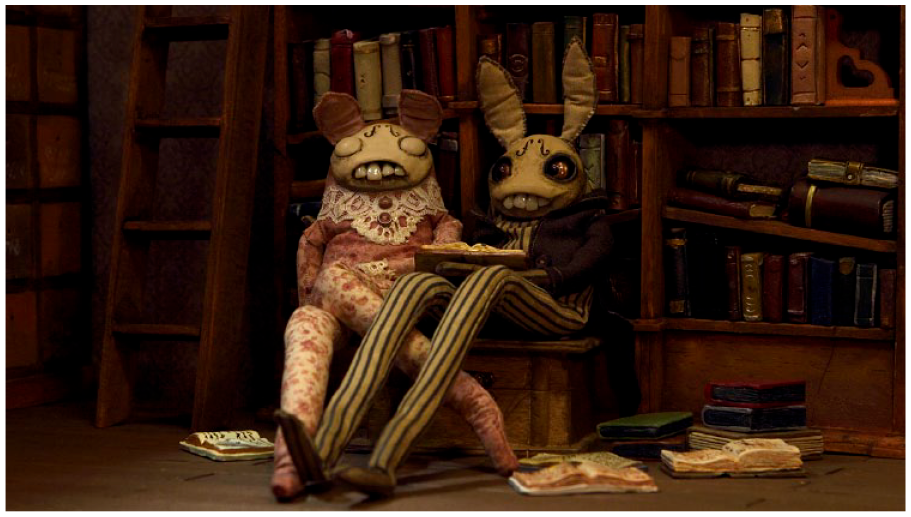
Image from short film The Maker © Zealous Creative, 2023. Reproduced with permission.
Finally, in The Maker there is another dimension of relational nostalgia underlying the messianic sacrifice performed by the protagonist at the end of the narrative and embodied by the myth of the Golem. The film stages several elements that bring to mind this mythological figure coming from Jewish folklore. This myth first appears in the late 12th-century Jewish ‘Book of Creation’ (Sefer Yetzirah), where it is described as a clay, soul-less creature built by rabbis in a human shape (Cohen, 2015). In the film, the protagonist consults a book with the necessary instruction for his enterprise and, similarly to the process of the Golem’s fabrication, he models a piece of clay to build the creature’s face before putting it in in the oven to make it solid. This myth encompasses a sense of nostalgia at a profound level, as it embodies, as argued by Quercioli Mincer (2015: 57), the nostalgia of Eastern European Jewish culture. In the Talmud, 7 it is written that the Hebrew culture uses this multifaceted feeling in different situations ‘to refer to the longing of a father for his son and that of a son for his father’, and, by emphasizing this idea, to the human nostalgia for God (Quercioli Mincer, 2015: 58), or in a more general sense, the sentimentalist wistful feeling for the absence of something and for the longing of somewhere, that is the very root of the feeling of nostalgia. The yearning for God/homeland is the common meaning of nostalgia in many cultures, but the Jewish folklore anthropomorphized this feeling in a monster (the Golem) that symbolized the distorted, painful and often rancorous relationship between a father who wants to conform his son to himself and the latter’s anger and destructive rebellion (Bertolone, 2012: 33). The golem maker, therefore, plays God, passing his own life to another creature and, in so doing, he annihilates himself, proving himself a vulnerable clumsy puppet controlled by someone else. Christopher Kezelos’ monstrous fabric puppet follows the same hard path experienced by the Jewish rabbi but the epilogue of the film differs from the dramatic awareness of pointless longing described in the Jewish tale and provides an optimistic and romanticist view of nostalgia. Kezelos’ puppet accepts his role as he peacefully sacrifices himself in order to allow the manufactured creature to repeat the same process of creation, and with this sacrifice he reaches a bigger objective: an intimate connection with something/someone he yearns for.
Marionette: The uncanny nostalgia
Marionette is a stop-motion film directed by Thomas Tanner and Frayah Humphries in 2012. The narrative takes place in a puppet maker’s studio, full of inanimate dolls, materials and tools, and starts when he is completing his latest creation, a fabric female puppet, and detailing it with a pair of glass eyes, which remind him of someone he loved (Figure 5). A panoramic view of the space lets the spectator realize that the puppet maker’s passion has turned into obsession, and that it took him a long time to create the puppet suitable for the eyes. But, when he finally creates it, an omniscient puppeteer takes the female puppet away from the protagonist, brings her to life and makes her perform a delicate dance with the puppet-maker in an empty space. During this romantic moment, the omniscient puppeteer cuts the strings and, by causing the female puppet to lose her eyes, he takes away her life, leaving the puppet maker alone once again.
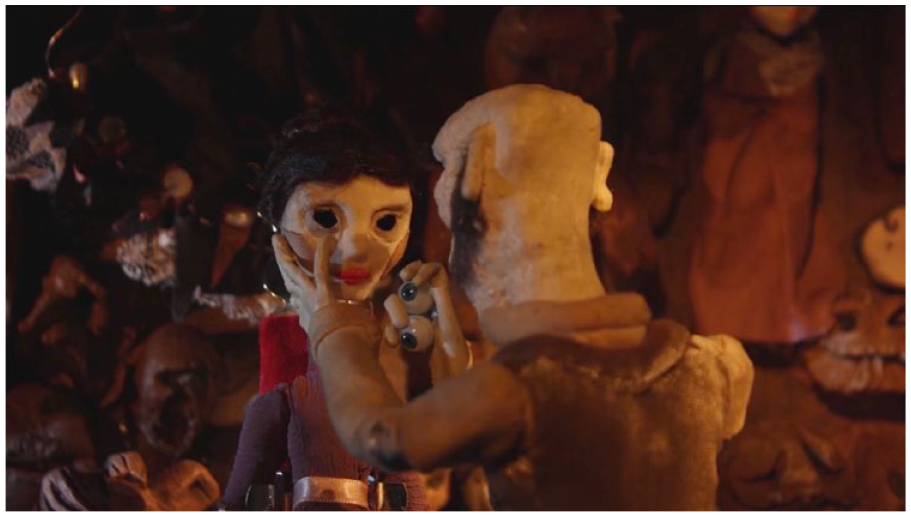
Still from short film Marionette. © Thomas Tanner, 2012. Reproduced with permission.
The film has several elements inspired by the Hoffmann (1885[1817]) story, The Sandman. In both the film and the novel, the protagonist (the puppet-maker in the first, Nathaniel in the latter) has an obsession. In the film, the protagonist’s love has been lost, although he desperately tries to re-build it artificially, and he falls in love with his last puppet, projecting a soul and a life onto it. In the novel, instead, the protagonist falls in love with Olympia, an automaton, but he doesn’t realize it until Professor Spalanzani reveals to the young man that Olympia is not his daughter and not even human. A further common element consists in the importance of the eyes. In the film, the pair of glass eyes gives life to the inanimate female puppet. In the novel, the eyes are both a relevant element in the tale of the Sandman that obsesses young Nathaniel, and the first element he notices on the floor when Dr Coppelius and Professor Spalanzani are fighting for the ownership of the automaton Olympia. The dance is the final relevant common element – it is the moment of maximum emotional involvement of the film and the event during which Nathaniel first meets Olympia in the novel.
There are multiple levels of nostalgia in the story: the nostalgia of the crystallized memories of the male puppet who obsessively searches for something irreversibly lost and symbolically attributes its essence to a pair of glass eyes; the other is the nostalgia felt by the female puppet who, in her delicate dance, seems to profoundly aspire to life but to be inexorably negated. In the former case, nostalgia is again a form of desire for a relationship – or better to restore one from the past – in the latter a yearning for severing the string of control and experience freedom. The narrative, however, ends with the disillusionment of these desires, and the protagonist remains alone with no hope that the object of his labour could ever be the new object of his feelings. In the film, therefore, nostalgia is experienced in its significance of melancholy absence and reveals dark truths about the reality of time for which it yearns, thanks to both the narrative and the materials used for manufacturing the two protagonists. I name this melancholic side of nostalgia as ‘uncanny’ after Sigmund Freud’s homonymous theory. According to the psychologist, the uncanny results from different elements of Hoffman’s mentioned story, The Sandman:
(1) the despair and anxiety the protagonist, Nathaniel, feels when repeatedly encountering Coppelius/Dr Coppola, whom we realize at the end to be the Sandman, a man who steals children’s eyes and whom Nathaniel associates with the murder of his father;
(2) the fear for the eyes stolen by the Sandman associated with the castration complex towards ‘the dreaded father at whose hands castration is awaited’ (Freud, 1955[1919]: 223);
(3) the doll coming to life. The uncanny and the feeling of nostalgia relate since ‘dolls happen to be rather closely connected with infantile life’ (Freud, 1955[1919]: 225) and, rather than fearing the idea of a living doll, children’s souls desire and wish for it. The contradiction found by Freud between adult fear and childhood desire can be explained by addressing the duality of nostalgia and its being both reaction and melancholy, both impetus and weakness.
I suggest that the uncanny nostalgia evoked by puppets’ materiality stems from this dualism as the different materials used for manufacturing characters drive it and highlight the ontological duality animate–inanimate already expressed by the diegesis. The male puppet, covered with latex milk, is the one who builds, gives life to inert matter and lives an autonomous life. The female character, on the other hand, is an inanimate puppet, even in the narrative, and fabric skin makes her more vulnerable. Liquid latex, with its glossiness and similarity to human skin, is used for the life-simulating puppet. Soft fabric, with its recognizable texture, is used in the construction of the character who remains, in the end, a life-less object with no wish, power and thought, an unmistakable expression of uncanniness (Freud, 1955[1919]: 239–241). The threat of nostalgia, therefore, lies in fabric puppet materiality that retains an intrinsic weakness and makes staying alive impossible without the strings of the puppeteer and the glass eyes that the male puppet jealously protected but ultimately lost, therefore losing the chance to see and dance with his beloved. This pessimistic view of nostalgia has been explored by philosopher Lyotard and critic Jameson who, despite different accounts, emphasize the negative consequences of nostalgia when it lacks meaningful insights that can help to overcome a past perceived as inescapable, and change the perception of the present (see Jameson, 2005; Lyotard, 1979). In Marionette, textile materials enhance this dramatic perspective of nostalgia as fabric – as previously mentioned – captures the inescapability of the condition experienced by the female character who, by virtue of her material ontology, seems to be dramatically condemned to death with no power to disengage from the present. Symbolic fabrics serve as visual and material reminders of the human condition and highlight an ontological paradox regarding the self: fabric skin covers – thus protects – but makes the character weak and vulnerable, then freedomless and in need of being manipulated. The material retains the memory of both conditions and becomes a metaphoric cage that the character cannot escape from as she is unable to remove or change her destiny of death. This third analysed short ends with this exactly pessimistic view, as the fabric female puppet encounters an inescapable destiny of death inscribed on her skin (see Figure 6).
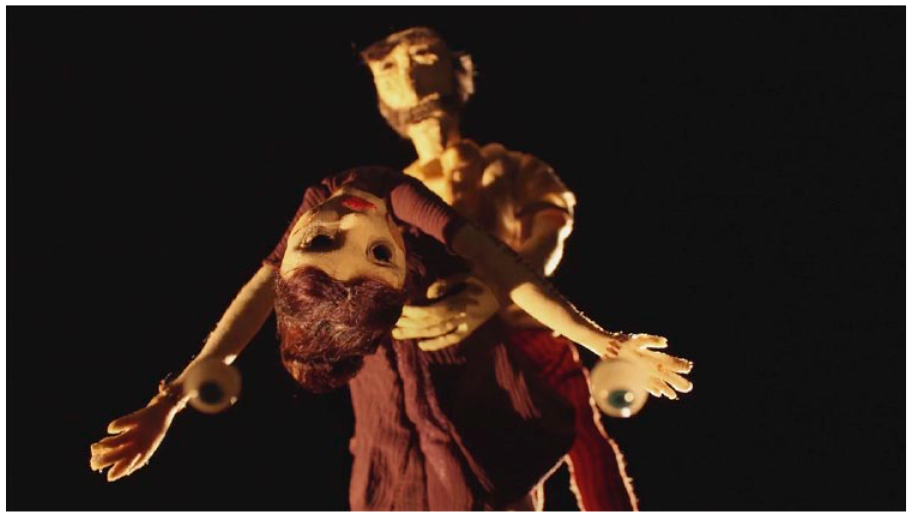
Still from short film Marionette. © Thomas Tanner, 2012. Reproduced with permission.
Conclusion: Manufacture process interpretation
The idea of materials evoking emotions and invisible significances, and providing new levels of narratives is not new. Studies about materials’ invisible qualities have been mentioned as having their roots in the experiments conducted in the design field and across the analytical approach of other disciplines, including animation.
The explorations of material details as meaningful elements in stop-motion animated films show a common premise: physical and aesthetic features of the materials used in puppets’ manufacturing perform. According to Lilly Husbands (2015), these thoughts reveal a paradox about spectatorship’s experience of material features: materials evoke memories and anthropological meanings without necessarily claiming to be seen. This awareness has stimulated philosophical speculations that recall what Ian Bogost (2012) names ‘alien phenomenology’. Bogost’s philosophical approach – according to Husbands (2015) – gives value and emphasizes ‘the unknowable irreducibility at the heart of all things, and it respects them, maintaining a sense of awe at their very separate yet equal existence’.
A similar approach has been applied in this article to describe fabric features as meaningful phenomena haptically and unconsciously experienced by watching a puppet film. The description of selected films, indeed, is far from reaching the objective to collect the many possible interpretations and significances related to the explored material. The discussed topic attempted to provide an example of how, by merging different disciplines ranging from psychology to material science and applying them to filmic interpretation, an alternative analysis of stop-motion puppets’ skin material qualities is possible, intriguing, and open to wider evaluations. As Karana (2010: 282) states: ‘No simple rules exist for explaining meaning–material relationships. [It is difficult] to locate a method that will guarantee material “x” will evoke meaning “y” in product “z”.’ What’s next in this path of study and film interpretation based on material qualities? Experimental approaches to animation production continue, and explorations seem to converge in the analysis of the atomic quality and crystalline structure of materials. These studies suggest the need to formulate a new method that includes another dimension of puppets’ materiality, such as their manufacturing process, by looking at the traces left by the animator’s work on puppets’ material surface. This aspect describes technical features of the process rather than those of the material used. The craftsmanship dimension of stop-motion animation production process is a fundamental aspect not just in a technical perspective for defining morphological and aesthetic attributes to the object (Jacucci and Wagner, 2007), but also for spotlighting new narratives, as in these films we can experience the indexical traces of the animator’s work as meaningful performative elements (Ruddell and Ward, 2019). This dimension is extremely useful for the interpretation of the narrative of puppets’ skin material as it evokes the series of operations that occur before the final configuration of the object which affect the final look of its material surface. The results of manufacturing operations are fingerprints, traces and marks that depend on both the physical and chemical quality of materials and on the process of fabrication and human interaction with it. The examination of puppets’ manufacturing qualities opens up diverse possibilities of interpretation as these objects can be the outcome of processes of assembling, modelling, carving, layering and casting materials, and each of these techniques significantly affects their shape (see Maselli, 2019: 2020).
Footnotes
Declaration of conflicting interests
The author declared no potential conflicts of interest with respect to the research, authorship and publication of this article.
Funding
The author received no financial support for the research, authorship and publication of this article.