




Abstract
This article defines and explores the history of ‘useful animation’. Animation has found frequent application as a powerful practical and conceptual tool in professional fields requiring a versatile instrument for a variety of representational needs, from science and medicine to education and advertising. Today, forms of useful animation populate our television news, social media and urban environments in ways that are no less consequential for their having become second nature. But how did we get here? This tradition is distinct from entertainment or art and its investigation requires a revision of existing animation history, prompting new research questions and methodologies. This article presents such a framework for further work in this field. In doing so, it has three main aims. First, the authors establish the intellectual context and consider the historiographic implications of prior research in this area. Second, they ask three key theoretical research questions that can guide the investigation of the history of useful animation: How did useful animation build upon existing graphic traditions? What were the professional and institutional contexts for useful animation and how did these develop? and What impact did animation have on professional fields and their understanding of the world? Finally, the authors present three case studies from the first decades of film history that illustrate how these questions can be answered, and they suggest methods and research resources available to scholars of useful animation. These address Jean Comandon’s public health films in post-WWI France, animated maps made by the Austro-German Institut für Kulturforschung in the inter-war period and the animated film Unemployment and Money made in Britain illustrating Michael Polanyi’s economic theories in the 1930s. This article provides a basis for future research into this topic.
Existing histories of animation have focused overwhelmingly on its historical role in art and entertainment. But, from its inception, animation also appealed to experts working in other professional fields, from science and medicine to education and advertising. As a form of frame-by-frame filmmaking, drawn animation became particularly useful in a wide variety of disciplines because its graphic forms, unlike the photographic image, simplified the detail of the natural world and offered abstract models of it. Animation could guide spectators’ attention. It could visualize relations and show things that could not be photographed or seen with the naked eye. Its ability to render change in an instant, often through metamorphosis, provided visual metaphors that could lead to new associations and understandings. It thereby offered a powerful means of knowledge production and transmission, of psychological and emotional persuasion, and of perception and attention management. Hence, it is hardly surprising to learn that animation found frequent application as a powerful practical and conceptual tool in fields requiring a versatile instrument for a variety of representational needs.
Today, forms of useful animation populate our television news, social media and urban environments in ways that are no less consequential for their having become second nature. Animated visualizations inform and direct our decision-making in elections, financial investments, healthcare and leisure consumption. But how did we get here? Investigating this moment requires a revision of existing animation history, prompting new research questions and methodologies. This article presents such a framework for further work in this field. In doing so, it has three main aims. First, we establish the intellectual context and consider the historiographic implications of prior research in this area. Second, we ask three key theoretical research questions that can guide the investigation of the history of useful animation. Third, we present three case studies from the first decades of film history that illustrate how these questions can be answered, and suggest methods and research resources available to scholars of useful animation.
The umbrella term ‘useful animation’ allows us to cast a wide interdisciplinary net in the exploration of all uses of animation for research, education and communication. At first glance, the typical definition of animated documentary seems to cover our examples below and most useful animation in general. However, this approach cannot account for all forms of useful animation, notably advertising and public relations, where truth value is a secondary concern. Rejecting ontological definitions (truth/fantasy; photographic/graphic), we instead focus on historiographical questions about the particular times and places when animation was put to functional purpose beyond direct profit.
Applied uses of animation have received some attention in two intersecting subfields within Film and Media Studies: animation studies and ‘useful cinema’. While the study of animation within Film Studies has emphasized its role as art and entertainment, the emergence of the study of the use of motion pictures outside of these realms has led scholars to redress this imbalance. The recent scholarly interest in animated documentary, which includes a range of activist and educational work bearing affinities with the tradition of useful cinema, is an example of this trend (Formenti, 2022; Honess-Roe, 2013; Murray and Ehrlich, 2018). At the same time, the rise of ‘big data’ has stimulated a keen interest, among media theorists, in the widespread use of animated data visualizations (Drucker, 2014; Manovich, 2011), as well as a class of computer-generated images often described as ‘operational’ (as opposed to ‘representational’) on account of their role in facilitating instrumental actions upon the world, e.g. in military operations (Elsaesser, 2004). New digital applications reshape useful animation almost daily, but its early development in a period of similar media transformation still needs to be investigated to understand the legacy it has left us.
Parallel to the growth in studies in animation history, another subfield of Film Studies that has expanded rapidly in recent years is that of so-called ‘useful cinema’ (Acland and Wasson, 2011), also referred to as ‘films of fact’ (Boon, 2008), ‘non-theatrical film’ (Slide, 1992), ‘sponsored film’ (Prelinger, 2006), or ‘commissioned film’ (Hediger and Vonderau, 2009), and some initial connections with animation have been explored (Bieberstein and Feyersinger, 2022). Scholars today are uncovering numerous histories of previously overlooked sectors of film production beyond art and entertainment, including films for industrial production (Hediger and Vonderau, 2009), education (Orgeron et al., 2011), advertising (Cook and Thompson, 2019; Cowan, 2013b; Florin et al., 2016) and science (Boon, 2008; Curtis, 2015; Gaycken, 2015a). Animation was central to all of these sectors of useful cinema, but this ‘other’ history of animation requires new approaches and methods to properly account for it. Moreover, this will not only uncover a previously ignored strand of animation and useful cinema history, but more profoundly recognize the way the mutual interaction between the two shaped each in fundamental ways, especially in the first half of the 20th century when they were being defined and developed.
Investigating useful animation is necessarily an interdisciplinary endeavour as it incorporates methods and knowledge from intersecting fields, including the histories of science, advertising and education. These fields have recently witnessed an upsurge of work devoted specifically to the role of visual culture, examining the rhetoric of images in knowledge construction, persuasion and education. In the history of science, visual cultures during the industrial period have received much scholarly attention in recent years (Anderson and Dietrich, 2012; Hentschel, 2014; Pauwels, 2006). Within the field of advertising studies, research was once limited to providing applied tools for practitioners. But recent work has expanded to encompass broader questions about the history and culture of advertising, indicated by recent monographs (Ciarlo, 2011) and the founding of the Journal of Historical Research in Marketing (published by the Emerald Group, 2009). The history of education has a longer tradition and there is already an extensive body of work on visual aids, design and media technologies in classroom books (Cuban, 1986; Howard et al., 2013; Saettler, 1990) and journals (British Journal of Educational Technology, 1971). Recent work has focused more specifically on the use of film and visual media (Gaycken, 2015b).
One of the greatest challenges in researching and critically analysing useful animation is in the expert knowledge that it engages. While much useful animation was produced for scientific popularization, public education and outreach, other instances were more ‘exclusive’, intended for professional training, the communication of specialist knowledge, or as experimental methods and forms of documentation. The methodological difficulty of attending to these different domains has undoubtedly contributed to the neglect of the subject. For disciplinary experts and professionals working in the present day, these films may represent superseded principles or lack the media fluency expected today. For Film, Animation and Visual Culture scholars, historic useful animation may appear arcane in its frames of reference, or ‘primitive’ in its lack of the established standards expected of the art form, in qualities such as movement or liveliness. Yet these challenges of studying useful animation also open up significant opportunities.
In rethinking canonical expectations about what animation is and how it has been produced, we can understand how it has shaped knowledge and our ways of seeing the world. Animation Studies has always been an interdisciplinary endeavour and the study of useful animation connects it with an even wider field of reference and relevance: education, science, government and industry. Expanding our frame can help us to understand how animators were supported and shaped by working in these applied fields. Furthermore, through the study of useful animation we can recognize how the aesthetics and techniques of animation were often determined by longer traditions of visual representation, far beyond the cartoon heritage that animation is most commonly associated with. Below, we propose three key theoretical research questions that engage with these areas to stimulate new understanding of them.
Iconography and visual practice: How did useful animation build upon existing graphic traditions?
Like most elements of early cinema, animation drew upon 19th-century practices that predated cinema’s arrival. Since many, if not most, early animators had trained as illustrators, they naturally looked to established graphic traditions and associated iconography in creating their work. While these include entertainment forms such as comic strips and print cartoons, they also include professional practices such as scientific illustration, graphic design and visual statistics. Examining these intermedial relations can help us uncover the pictorial conventions that made early useful animation possible. How did early advertising and public service films, for example, take up conventions of poster design? What existing practices of cartography informed the creation of early animated maps (precursors to today’s computer-generated maps)? What traditions of visual statistics informed the creation of early statistical films (anticipating today’s data visualizations)? Animation did not merely copy these established practices, but also helped to transform them. For instance, while animators for scientific film drew upon conventions for producing scientific figures, charts and tables, the new ability to show processes in motion also had a feedback effect on the work of scientific illustrators, who sought to devise new ways of depicting process on the printed page.
Space and infrastructure: What were the professional and institutional contexts for useful animation and how did these develop?
A second key area for attention when studying useful animation is the importance of professional spaces and infrastructure (both material and conceptual) that made the production of useful animation possible. Early animation production was hybrid by necessity, given the limited number of skilled animators and the financial need to produce projects for a variety of clients. While the thriving industry for entertainment cartoons in the US provided more employment opportunities, elsewhere the restricted marketplace necessitated flexibility and diversity. Conversely, alongside these adaptable animators and studios, the interwar period witnessed the rise of specialized teams, housed in cultural institutes, advertising units, scientific laboratories and similar organizations. While further research is needed, it would seem this complexification of animation infrastructure enabled the professionalization of animation by offering an expanding range of spaces where animators could train and work. This changing production context demands attention to the economic, technological and institutional contexts around useful animation to better understand the circulation – both national and transnational – of techniques, conventions and expectations of useful animation. Such histories will not only recognize the importance of useful animation to well-known studios and animators (e.g. Emile Cohl, Lotte Reiniger, Halas and Batchelor), but also a wide range of forgotten professionals who moved within this diverse landscape of useful animation production, as well as self-taught animators who were primarily employed as teachers or scientists. Taken together, the spaces where useful animation was produced functioned as points of exchange around which various clientele, disciplines and traditions circulated and coalesced.
Knowledge and disciplines: What impact did animation have on professional fields and their understanding of the world?
Our third question approaches useful animation in the context of a history of knowledge and disciplines, investigating how animation interacted with the evolving professional fields – and concomitant forms of expertise – in which it operated. The conventional assumptions about the motivation for creating animation, such as the direct economic interest for theatrical entertainment cartoons, may not be applicable for useful animation. We must instead consider the specific factors that made animation such a useful representational tool for fields that otherwise might have been suspicious of the ‘trick film’ tradition and its cultivation of illusion. Equally, the impact animation had on those who adopted it needs assessment. We must ask how animation itself might have helped to transform these disciplines and fields by challenging pedagogical, commercial and scientific approaches to their respective tasks. If animation exemplified and solidified emerging trends, it also offered new ways of seeing, which became part of the conceptual vocabulary of each discipline. There is a need to chart these interrelations, showing how animation not only helped to visualize existing disciplinary knowledge, but also contributed to the evolution of that knowledge.
With these three questions – iconography, infrastructure and impact – in mind, we use this article to outline three specific cases of useful animation that allow us to flesh out some of the methodological questions and implications of useful animation research. All three case studies come from the early decades of useful animation (roughly 1910s to the 1930s), since this is the period when conventions of useful animation were taking shape. They are not intended to be exhaustive (for example, we have left advertising out of the present list), but rather exemplary of the kinds of research questions and challenges outlined above. At the same time, each case study is unique; not every programmatic question above will be foregrounded in each case, and every historical context naturally brings its own set of contingencies that must be attended to.
Case study 1: Comandon’s cartoons: Animation and public health in post-WWI France
Our first case study re-examines an example from the fields of science, medicine and public health: the health education films supervised by Jean Comandon while he was in the military during WWI. We can thank French scholars Béatrice de Pastre and Thierry Lefebvre for rediscovering these films and completing much of the initial historical research (De Pastre, 2012; Lefebvre, 1991, 1996, 2009, 2012). This section will draw upon the French-language literature, but will focus on the campaign – in this case, a public health campaign – as a potential organizing framework for our questions about infrastructure and iconography (Bonah et al., 2018: 11–14). If we are interested in a prosopographic approach to useful animation – how groups of people come together to produce a visual culture – then a campaign might be a logical place to start (on historiography, see Hentschel, 2014). A campaign, whether commercial, military, or educational, brings together a group of people around a common, urgent goal with clear deadlines and decision-making hierarchies. It therefore provides a motivating force and historiographical entryway to the specific character and production context of these animated films. We will further suggest that this public health campaign provided not only the organizational structure, but also the iconography: the figures and mode of address of these animated films appear to borrow many rhetorical devices from the range of media used in the campaign, especially posters. Finally, the ubiquity of these films even years after the campaign suggests that they had a significant impact on public understanding of hygienic behaviour after WWI.
The campaigns in question concerned tuberculosis, the incidence of which had reached unprecedented levels in France by the start of WWI. Tuberculosis was by far the most significant cause of death in France, with conservative estimates at 100,000 fatalities annually between 1890 and 1914 (Mitchell, 1988: 215). The war, which weakened both the population and the government’s ability to respond, made the situation even worse, especially as infected soldiers returning from the trenches spread the disease to their communities. By 1915, the French rolled out a campaign with pamphlets and posters that provided hygienic advice targeting returning soldiers. In early 1917, the Rockefeller Foundation (1918: 173) sent an expert to France to study the situation. The Foundation already had a track record of helping countries with their public health crises, including Brazil and South America, where they conducted campaigns against hookworm disease, malaria and yellow fever (Farley, 2004: 44–58; Rockefeller Foundation, 1918: 33–41). The Foundation’s recommendation for tuberculosis in France proposed an ambitious approach: to target the entire civilian population, rather than just soldiers, and to divide the labour between education (assigned to the Rockefeller Foundation) and relief (assigned to the American Red Cross) (Farrand, 1917). The French government accepted the proposal and the Rockefeller delegation arrived in July 1917; by September, the campaign was underway (Rockefeller Foundation, 1918: 173). The French were grateful for the financial aid, but Americans saw their contribution as ‘a demonstration of organised team-play’, given the competing bureaucracies that characterized the French approach up to that point (Rockefeller Foundation, 1919: 23; on France’s ineffectual response to the disease compared to its neighbours, see Mitchell, 1988). Specifically, the mission coalesced around three main areas: organizing and equipping dispensaries (specialized clinics for treating and preventing the disease); training nurses; and educating the public (Rockefeller Foundation, 1920: 236). Eventually reaching most parts of France, including rural regions where literacy was not as high, the campaign relied heavily on films to disseminate its message about proper hygiene and disease prevention.
The Americans were careful not to disparage French national pride in medical expertise. In fact, the French seemed to consign American expertise to advertising, which they saw as a uniquely American skill. The connection between public health education and advertising was not lost on the French authorities, who were eager to exploit American know-how in this regard. Public outreach was quickly becoming a Rockefeller Foundation specialty, having accomplished similar goals in its fight against the hookworm in the American South (Ostherr, 2012). Hence, the Rockefeller delegation included Selskar ‘Mike’ Gunn, who had long experience treating public health campaigns as advertising operations (Litsios, 2008). Gunn organized the educational mission around travelling vans equipped with pamphlets, posters, a 42-panel exhibit, films and even Punch-and-Judy shows. At each town, the team met with city elders and audiences, put up posters and distributed reading material, and gave 40-minute lectures followed by screenings (Dittrich, 2021: 391; see also Miraben, 1920). By the end of 1918, three vans and teams had visited 141 towns, given 875 lectures and distributed 2,115,708 pieces of printed matter (Rockefeller Foundation, 1919: 28–29). Gunn aimed primarily to encourage schoolchildren to adopt hygienic habits that might also rub off on their parents (Litsios, 2008: 27). The films were not the only part of this plan, but they were certainly the main attraction.
Jean Comandon’s expertise was part of this plan early on. Before the war, he was a celebrated and sought-after microcinematographer whose connections to Pathé Frérès, the studio that hired him and distributed his science films before the war, were intriguing to the authorities. Since the outbreak of war, he served as a ‘Médecin aide-major 2nd classe’, which is akin to a lieutenant in the medical corps, and in March 1917 he screened some of his pre-war films to an audience of military brass and public health officials, who already envisioned a role for films in their own hygiene campaign (De Pastre, 2012: 424; Lefebvre, 2012: 28). In civilian life, Comandon demonstrated his facility with public health subjects for Pathé, including films made in cooperation with La Ligue sanitaire Française (French Sanitary League), such as Les Poux (Lice) (1910) and Les Moustiques (Mosquitos) (1912). He had also made popular science films, such as Le Microscope de Jacques (Jack’s microscope) (1911), that helped to establish common tropes in health education films, such as shots of someone looking through a microscope followed by microcinematographic footage. Hence, Comandon was in a good position to help these campaigns. In April 1917 he was assigned to the Comité national d’assistance aux anciens militaires tuberculeux (National Committee for Former Servicemen with Tuberculosis) to lead the cinematographic component of the French campaign.
In May, he started shooting a series of 12 live-action documentaries or actualités for the Committee’s hygiene campaign, which offered general overviews of the topic of tuberculosis and provided views of treatment centres across the country. These films gave virtual tours of the sanitaria but also glimpses of diagnosis and treatment. The point, apparently, was to reduce as much as possible the stigma of going to a sanatorium by showing the clean and beneficial conditions of these centres (De Pastre, 2012: 436; Lefebvre, 2012: 28). Comandon then worked with film director Camille de Morlhon on a second series: 10 brief, humorous live-action sketches designed to educate the public on sanitary habits, such as Ne crachez pas par terre (Don’t spit on the ground) (1918), Lavez-vous les mains avant le repas (Wash your hands before eating, 1918) and Les ongles en deuil sont les repaires des plus dangereux microbes (Dirty nails are hideouts for the most dangerous germs) (1918) (Lefebvre and De Pastre, 2015). Les ongles provides an example of Comandon’s signature trope, which he used in other films from this series and even in some of the cartoons, such as On doit le dire (It must be said) (1918): someone looks into a microscope and the film cuts to an insert of a microscopic view of the offending microbes. On one hand, this provided, within a comic sketch, documentary evidence that functioned as a shock to inspire good hygienic behaviour (De Pastre, 2012: 433). But we must also consider that most people at the time were not aware of the germ theory of disease, so these inserts were a vivid introduction to a crucial goal of public health education, especially of tuberculosis, as articulated by Boon (2010: 34) ‘to replace lay narratives of disease with medical ones’.
Comandon also supervised a series of animated films: four short cartoons on tuberculosis, four on alcoholism, one on venereal disease and one on hygiene and the pesky housefly. It is difficult to say how, where, or even precisely when these films were made; the secondary literature is not clear on these questions. 1 However, it appears that the 10 live-action sketches and the first 8 cartoons were something of a matched set, given that they are all approximately the same length. The surviving sketches range from 25 to 50 metres, averaging around 31 metres in length, while the cartoons are between 38 and 60 metres long, averaging around 47 metres. These are unusual lengths that translate to only about 2 to 4 minutes of screen time. By comparison, the actualitiés average 268 metres long and the last two cartoons on venereal disease and on hygiene are around 130 metres long. It is likely, then, that work on the lighter (in terms of both weight and tone) sketches and cartoons began with the travelling vans in mind, sometime in the second half of 1917, after the Rockefeller delegation arrived in July but before the first van rolled out in late 1917/early 1918. We do not know precisely when or if Gunn intervened to assign duties to Comandon, but the shift in tone and purpose from the actualités to the sketches and cartoons gives Gunn a plausible role in their conception. The short films, perhaps made between late 1917 and late 1918, were probably intended for the vans, while the actualités and longer cartoons were possibly intended for theatrical release.
Gunn might also account for the shift in topic from tuberculosis to anti-alcoholism. Anti-alcoholism as a movement was never as successful in France as it was in the US, but its French forces picked up momentum during the war (Kudlick, 1985). And alcoholism, along with tuberculosis and venereal disease, was considered one of the three ‘grand fléaux’ – or great plagues – of French society (Lefebvre, 1996; Rénon, 1905). But in the publicity around the Rockefeller campaign in France, Gunn (1919: 768–769) insisted, citing a well-known French specialist in tuberculosis on the connection between two of the plagues, that ‘it is necessary to add the insidious work of alcoholism, which, as Landouzy said, continues to “make the bed of tuberculosis”.’ 2 One cartoon, La tuberculose se prend sur le zinc (Tuberculosis caught at the pub) (1919), underlines Gunn’s link.
For the cartoons, Comandon worked closely with two animators who would become pillars of French commercial animation after the war: Marius Rossillon, also known as ‘O’Galop’ and Robert Collard, who was known as ‘Lortac’. Neither animator had an extensive filmography before this assignment, but they had both worked with Emil Cohl in the years before he went to the US in 1912. They worked as illustrators for children’s books and as caricaturists for the popular press so, like Cohl, they were already steeped in both didactic and grotesque approaches to their subjects, which we can see in the films. 3 Also, both followed Cohl’s reliance on hinged cutouts for their animations, which was to be a particularly French affectation in that country’s animation throughout the 1920s (Neupert, 2011: 45).
The infrastructural context of the Rockefeller campaign prompted many of the creative decisions for the animated films beyond, as we have noted, their length and their alternative distribution method via the travelling vans. For example, the first three animated films on tuberculosis, made by Lortac, feature a recurring character: a mischievous skeleton, representing death. Pour résister à la tuberculose soyons forts (To resist tuberculosis, let’s be strong) (1918) proposes that a strong constitution is the best protection against disease. The skeleton enters the hovel of a writer, who is (of course) thin and weak, and gleefully sprays him with a bellows clearly labelled, in the style of editorial cartoons, ‘tuberculosis’ while looking to the audience and silently cackling as the writer succumbs (see Figure 1). In the next scene, the skeleton tries the same thing with an obviously well-fed athlete, but Death is defeated by the man’s boxing skills. It ends with a brief scene of people bicycling and running, boating and swimming, because ‘To be strong, partake in sports in the fresh air’. The skeleton symbol has a centuries-long history, but it cannot be coincidental that many of the Rockefeller posters and pamphlets for the campaign also used this figure, suggesting a link between infrastructure and iconography in the animated films (see Figure 1b). The recurring character in these films functions as more than a looming symbol of death, however; its pantomimed delight in spreading disease and its constant looks to the audience – beckoning young viewers to join the fictional space, which is a common trope of children’s entertainment – make it something of a gruesome mascot, as in an advertising campaign. The approach also matches the direct address of other elements of the campaign, such as the posters, pamphlets, or even the Punch and Judy shows. That the skeleton is a feature of only the Lortac cartoons also indicates an authorial consistency and perhaps that they were made in a batch with Gunn’s input. Indeed, the Lortac cartoons are much more playful and the animation much livelier than the O’Galop films on alcoholism, indicating that they were probably intended to be the first animated volley in Gunn’s youth-centred campaign.
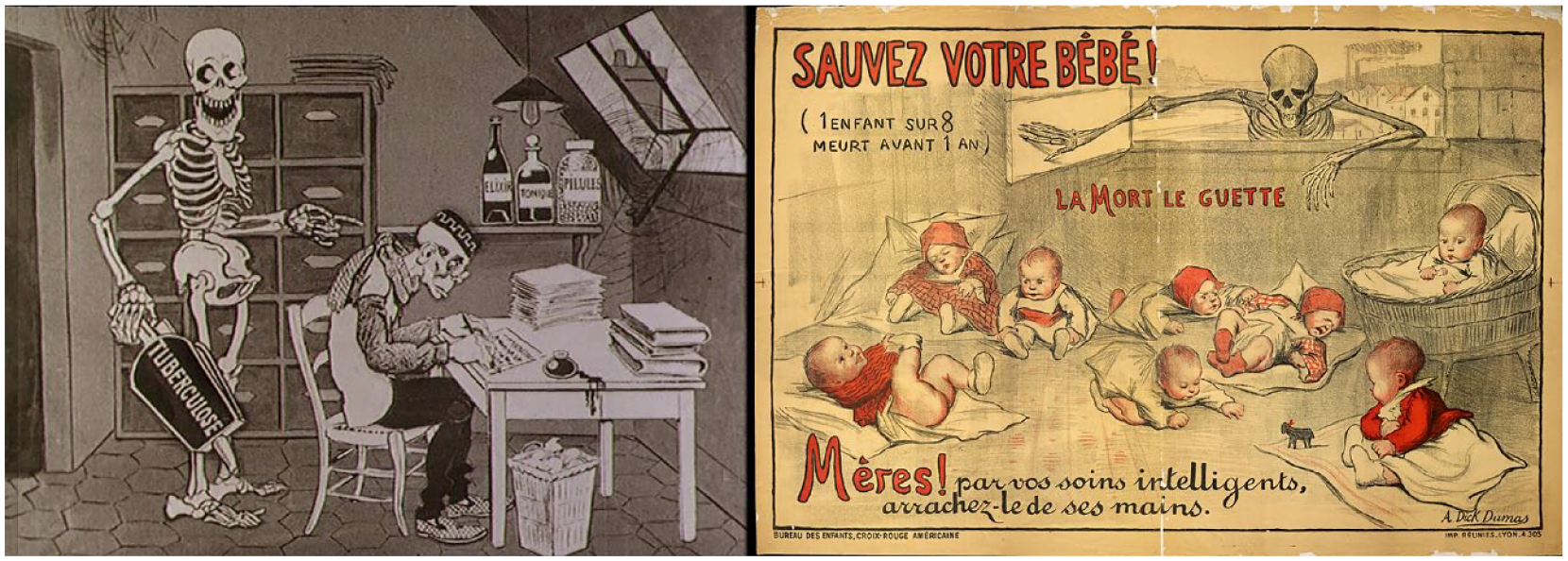
(a) (left) Pour résister à la tuberculose soyons forts (To resist tuberculosis, let’s be strong) (1918). The skeleton motif was very common in Rockefeller media for the anti-tuberculosis campaign. Screen grab from DVD [Le Meilleur de Retour de Flamme, Lobster Films]; compare to (b) (right) Mères, sauvez votre bébés! (Mothers, save your babies!) Tuberculosis prevention poster by the American Red Cross/Rockefeller Foundation (1918) (Rockefeller Archive Center).
O’Galop’s animation style is very different. He used holds – moments when the entire image is still – much more often and rarely animated more than one element at a time. The backgrounds are not nearly as detailed nor the character designs as complex as those in the Lortac films. Hence the O’Galop films feel somewhat stiff in comparison. But O’Galop brought his skills in poster design and children’s book illustration to the project; he was already at that time well known for his design of the Michelin Man mascot. Like his posters and magazine covers, the cartoons’ spare backgrounds and simplified animation and drawing style get the idea across quickly and efficiently. If O’Galop (1921) made a distinction in one of his essays between posters and animated cartoons – he claimed, not very helpfully, that animated films move and are in black and white, while posters do not move and have colour – his cartoons do not move that much yet manage to capture some of the flavour of the Rockefeller posters, which often condensed the narrative into a telling moment, like a tableau vivant, or encapsulated the message into an allegorical symbol. For example, O’Galop’s Petite cause, grands effets (Small things lead to big problems, 1919) rather graphically fantasizes children of alcoholics as dwarfs, epileptics and degenerate murderers headed for the guillotine before depicting a man in a straitjacket experiencing delirium tremens (see Figure 2)! The gruesome or explicit depictions are not only in keeping with Cohl’s grotesque aesthetic as described by Vignaux (2011), but also a feature of many tuberculosis campaign posters (see Figure 2b). Shocking the spectator into good hygienic behaviour has been a time-honoured tradition in health education media.
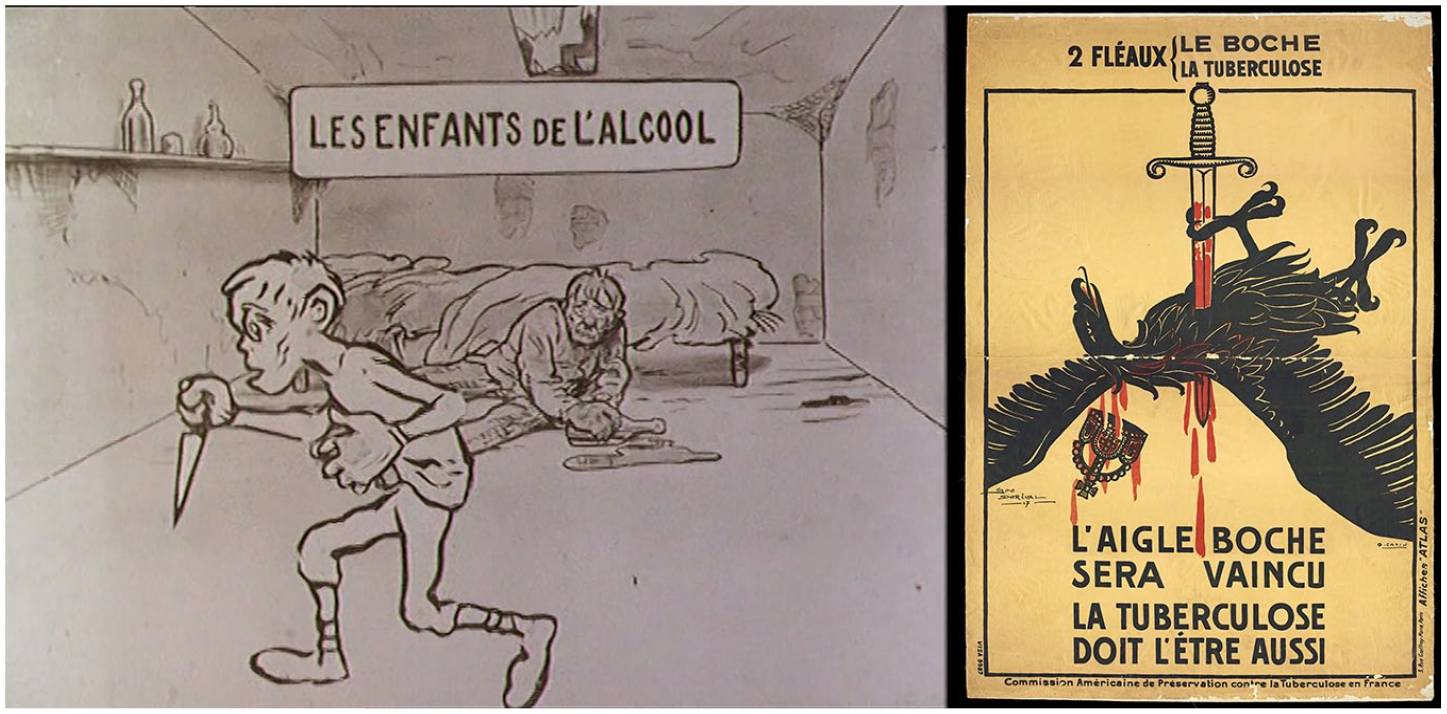
(a) (left) Petite cause, grands effets (Small things lead to big problems, 1919). O’Galop’s gruesome sensibility is at least partly attributable to the shock techniques of posters in the Rockefeller Foundation’s anti-tuberculosis campaign. Screen grab from DVD (Le Meilleur de Retour de Flamme, Lobster Films). (b) (right) ‘The German eagle will be defeated. Tuberculosis must also be.’ Tuberculosis prevention poster by the Rockefeller Foundation (1918) (Rockefeller Archive Center).
His films also share another feature of poster design: the encapsulation of an idea in simple, visual, often metaphorical terms. Le Circuit de l’alcool (The cycle of alcohol, 1919), for example, humorously envisions the exchange of money for drinks as a diagrammatic circuit between a seated patron, head back to better receive the wine directly into his mouth, and a bistro owner pouring the bottle as coins flow from the patron’s pocket to complete the circle (see Figure 3). The scene vividly depicts in a single image the exploitation of alcoholics, their own ready submission and the process of financial and physical decline associated with alcoholism – while perhaps poking fun at animations that scientifically depict such processes. Through their efficient, stark and sometimes shocking design, O’Galop’s films acted like ‘living posters’.
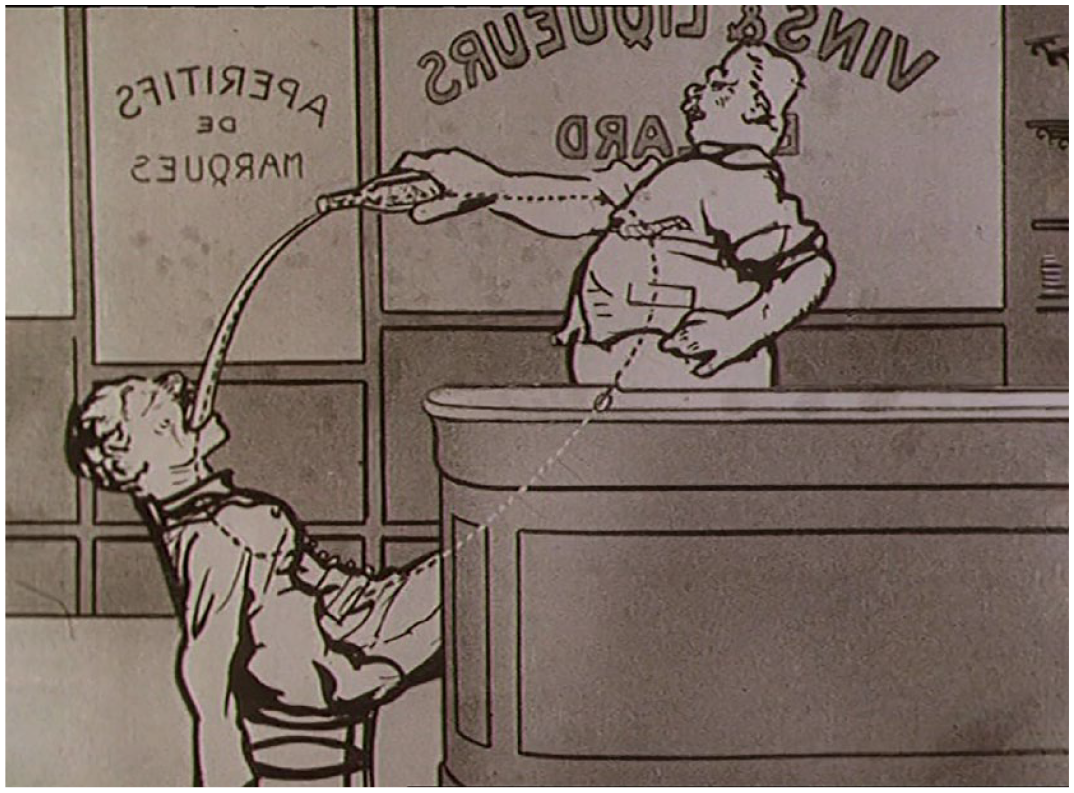
Le Circuit de l’alcool (The cycle of alcohol) (1919). O’Galop’s almost poster-like visualization of an idea: the co-dependence of tavern owner and patron. Screen grab from DVD (Le Meilleur de Retour de Flamme, Lobster Films).
The case of Comandon’s cartoons demonstrates the sometimes close relationship in useful animation between infrastructural context and iconography. The aims of the campaign, the alternative distribution method in the travelling vans, and perhaps Gunn’s direct intervention, account for the message, length and even design of the films. As part of a media ensemble, the films share with their cousins, especially posters, design features such as the use of allegory, symbol, humour and shock to attract audience attention and to change hygienic behaviour. Some of the symbols, such as the skeleton, are found in all elements of the campaign, but in the films, it is transformed into a playful if macabre advertising mascot or recurring character across three films. It therefore functions as a villain to root against in the fight against disease. In terms of impact, the pervasiveness of this campaign helped to solidify the role of animation in education, health care and science in France after the war. Health education and advertising were consistently entwined in the interwar period; Lortac and O’Galop made their living primarily through advertising films until the 1940s (Neupert, 2011: 45–54). Even Comandon continued to use animation in his research films, especially Recherches de chimiothérapie dans le domaine des urées complexes (Chemotherapy research in the field of urea complexes, 1924), which animated chemical symbols to illustrate formulas (Lefebvre and Lafont, 2013). Combining the rhetorical power of posters and motion pictures, animated films proved to be a potent tool for health education campaigns during and after WWI.
Case study 2: Animated maps: The Institut für Kulturforschung from scientific popularization to propaganda
Whereas the first case study examined how useful animation could develop within the framework of a public health campaign, this case focuses on an institute as a space where forms of useful animation emerged from the meeting of academic experts, visual artists and experimental filmmakers. Focusing on the Austro-German Institut für Kulturforschung (Institute for Cultural Research, founded in 1915), this section also shifts our attention from the tradition of posters and pamphlets to cartography, whose development was overdetermined in the context of WWI and its ensuing geopolitical transformation of Europe. While examining questions of visual practice, infrastructural conditions and the production of knowledge, this section shows how the same institute’s animated maps could promote cultural understanding and projects of nationalist persuasion. 4
As a visual technology, cartography has always been imbricated with questions of power and control, whether it be the rational control over natural elements or the legitimation of imperial conquest through the visual division of territories into ‘self’ and ‘other’. Today, we are surrounded by animated maps: from the weather maps of daily news programmes to flight maps to information visualizations of all sorts. But these digital maps have analogue precursors stretching back to the early decades of cinema, when researchers in several fields sought ways to visualize spatial movement in time. As early as the 1910s, scientists recognized the potential of animation for dynamic weather maps and geological maps, with the first filmic experiments following by the end of the decade (Goetz, 1912: 73; Richter, 1913: 146–147). Another major catalyst for the rise of animated maps was linked to mass warfare. Even before WWI, early experiments in filmic battle maps such as Emile Cohl’s Battle of Austerlitz (1909) – which appeared just a year after his pioneering Fantasmagorie – were touted as new tools of training in military strategy (Gardette, 1909) (see Figures 4a and b). 5 But the onset of the Great War created a mass market for such maps, which came to populate weekly newsreels as a means of explaining to civilians the complex dynamics of global warfare, and – after the war’s end – of re-telling the war in ways that justified or challenged the post-war settlement (see Figure 5).
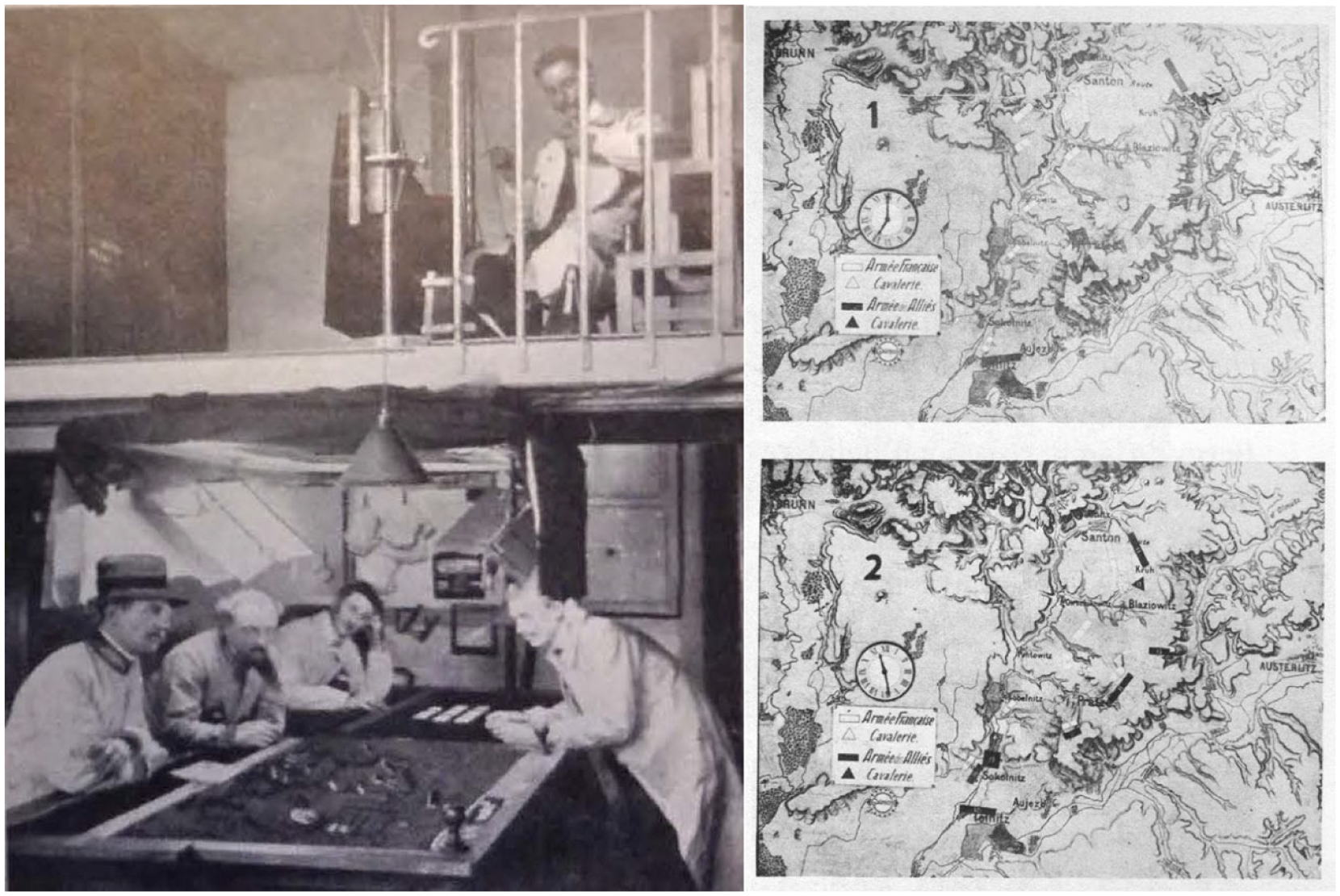
(a) (left) Production of animated maps in the Pathé Frères studio; (b) (right) Still from The Battle of Austerlitz (1909). Stills taken from Fritz Seitz, ‘Die Schlacht von Austerlitz im Film’, Film und Lichtbild (1912) 1(4): 33–34.
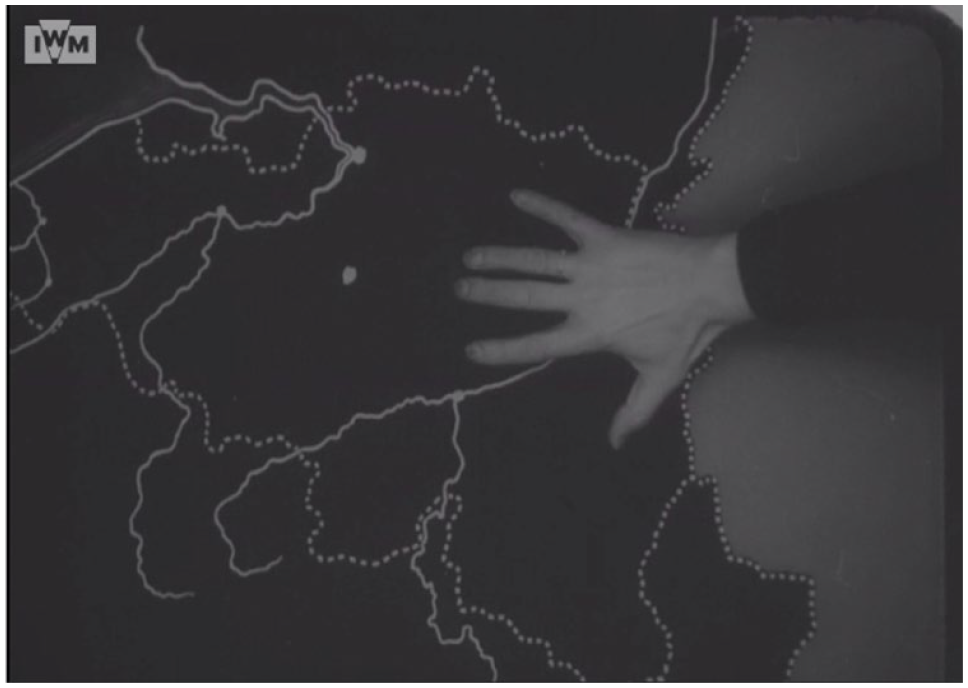
Still from A la gloire du troupier belge (1919) Screen grab from online video available at: https://www.iwm.org.uk/collections/item/object/1060023366.
The global war also catalysed animated maps in a different sense: namely, as part of an increased preoccupation with questions of global peace and conflict more broadly. As we know, such questions informed thinking about cinema’s calling as such in the wake of WWI, when emerging film theorists, along with institutions such as the League of Nations, sought to promote cinema as a tool for intercultural understanding through the power of photographic empathy (Druick, 2008; Grieveson, 2018: 198–199). 6 These questions also informed the development of animated cartography, and the Institut für Kulturforschung (hereafter IfK) offers an excellent case study in the way that animation could be used to intervene into global geopolitics. Today the IfK is remembered primarily as the place where well-known experimental animators such as Lotte Reiniger and Berthold Bartosch got their start in the early years of the Weimar Republic. But the IfK in fact has a more complex transnational history dating back to 1915 Vienna and encompassing other types of filmmaking. Animated maps played a central role here, and this section will trace their development and changing function at the IfK within the context of the tumultuous global politics of the early 1920s.
Like other spheres of useful animation, the IfK’s animated maps grew out of existing visual practices. In fact, the institute began not as a filmic venture, but as an outfit for the production of print maps. Its Viennese founder, Erwin Hanslik, was a well-known university lecturer in the field known as Anthropogeographie, which sought to understand the development of human societies in relation to the environment. Hanslik was particularly interested in the visual power of maps, which he believed could help prevent future wars by fostering a better understanding of the history and characteristics of global populations among the public. This was, one should note, hardly an innocent project, as Hanslik’s understanding of populational development adopted many of the colonialist presuppositions of his field; among other things, he believed that the populations that drove human cultural development had arisen only in select temperate zones, where pockets of humanity had learned to tame nature (see Figure 6). This restriction of historical agency becomes even more pronounced in the modern era, limited to the peoples of Europe, India and East Asia, and Hanslik continued to posit a fundamental difference between Western and Eastern populations, the former characterized by a kind of Faustian striving (evidenced by its colonial activity) and the latter by a stasis and lack of developmental possibilities. Today, Hanslik is remembered above all for his theory of the ‘cultural border’ separating ‘Western’ and ‘Eastern’ peoples, which the institute’s maps also sought to convey (see Figure 7). 7
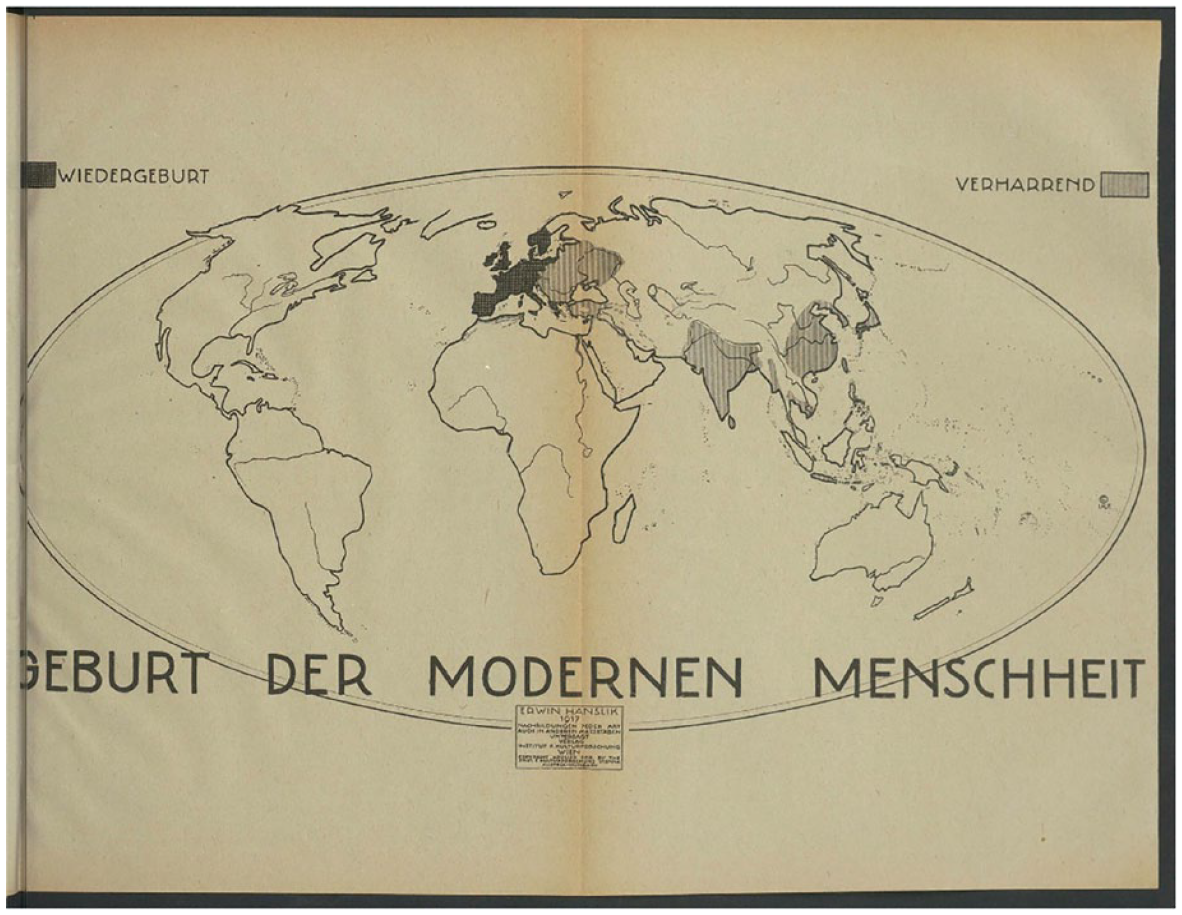
Page from Erwin Hanslik, Wesen der Menschheit (Vienna: Institut für Kulturforschung, 1917), insert between pp. 50 and 51. Image copied from ÖNB Digital, the digital collections of the Austrian National Library. Available at: https://digital.onb.ac.at/RepViewer/viewer.faces?doc=DTL_7398119&order=1&view=SINGLE.
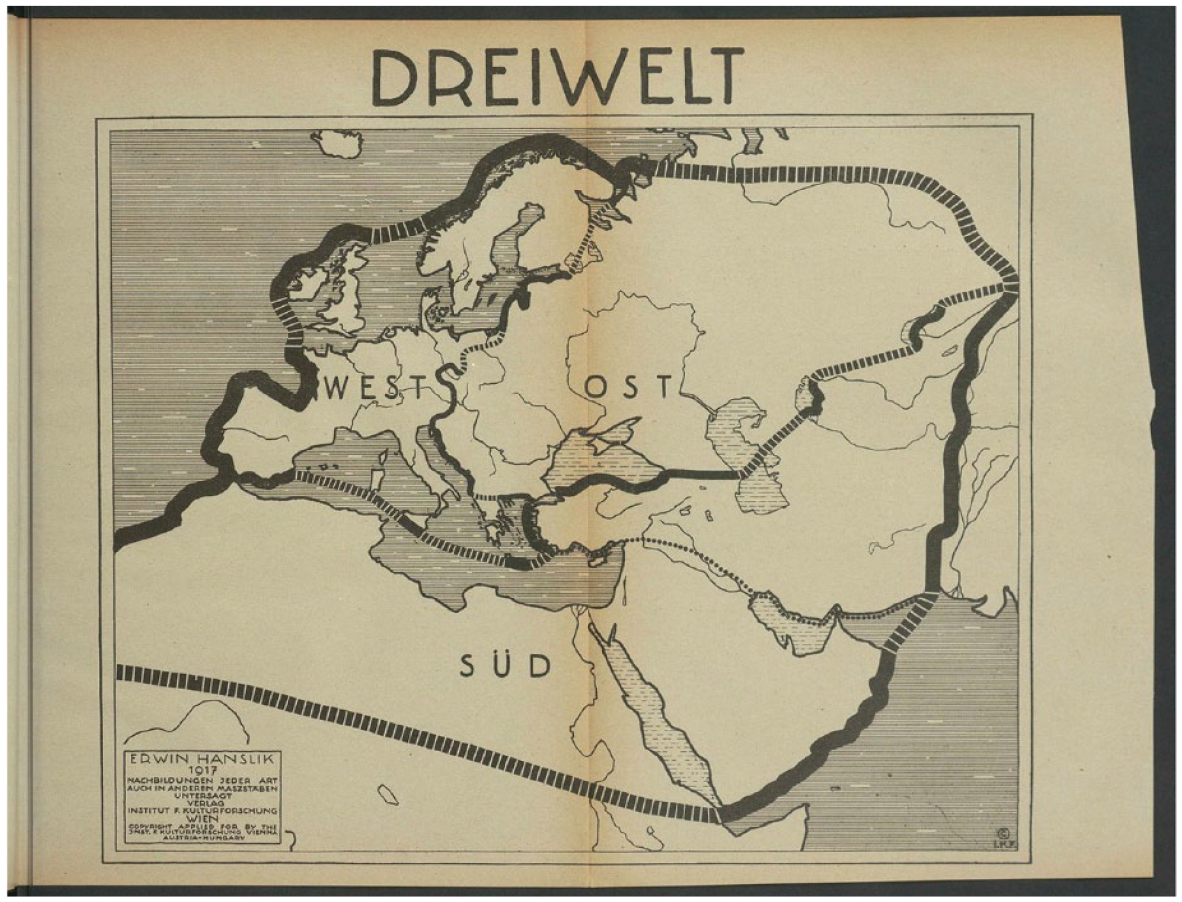
Page from Erwin Hanslik, Wesen der Menschheit (Vienna: Institut für Kulturforschung, 1917), insert between pp. 112 and 113. Images copied from ÖNB Digital, the digital collections of the Austrian National Library. Available at: https://digital.onb.ac.at/RepViewer/viewer.faces?doc=DTL_7398119&order=1&view=SINGLE
Fundamental to Hanslik’s project for the institute was a desire to bring Anthropogeography out of the ivory tower to the masses, particularly through the ‘universal’ visual language of maps like the ones published in his 1917 treatise Wesen der Menschheit (Essence of Humanity). 8 In practice, this insistence on independence meant that Hanslik’s institute – privately funded and housed in a small room in the Viennese Mölker Bastei building – was plagued by unstable finances and precarious infrastructural conditions. 9 But Hanslik did manage to secure the collaboration of such prominent Viennese artists as Gustav Klimt, Oskar Kokoshka, Adolf Loos, Otto Wagner and Egon Schiele. 10 This desire for mass appeal through the visual also explains one of the central attractions of film for Hanslik’s undertaking and, in 1918, he hired another Viennese artist – his former student Berthold Bartosch from the School of Fine Art – to collaborate on a series of animated cartographic films, which appeared under the global title Menschheit (see Figure 8). Those films are now lost and there are few if any descriptions of the process used to make them. But we can speculate that this was – like other contemporaneous ventures in scientific animation – a learning process, since neither Bartosch nor Hanslik had any experience in animation techniques before making them. 11
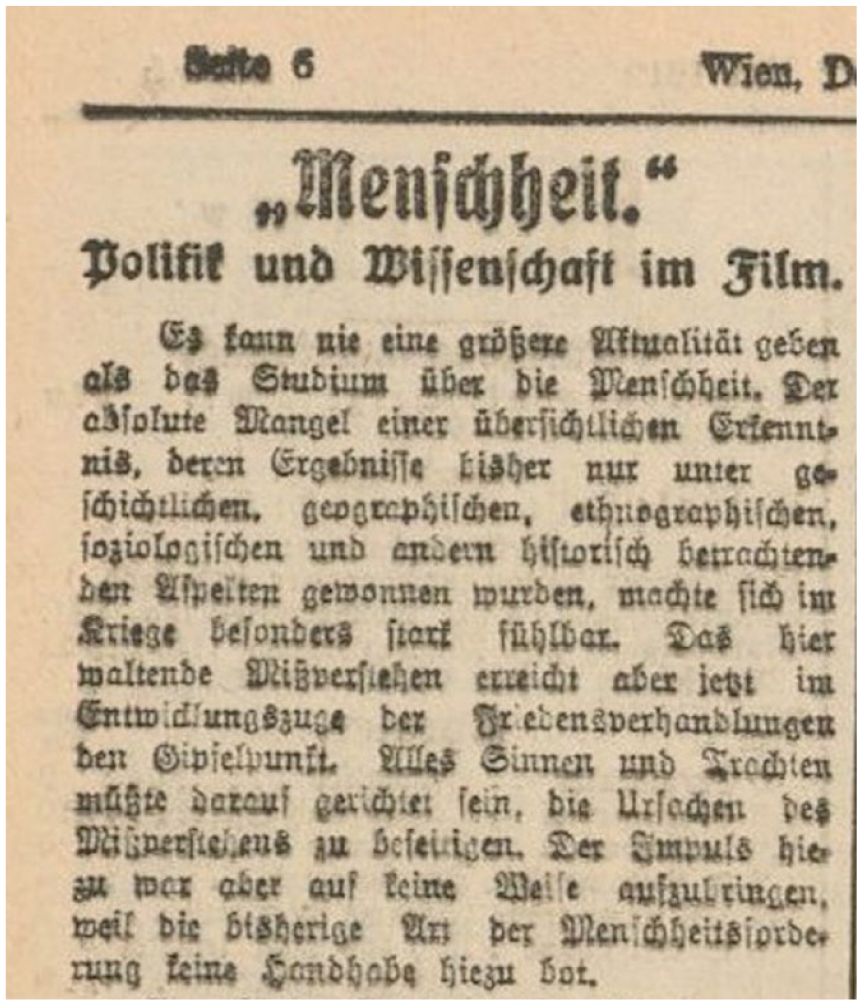
Report on a screening of Menschheit from the Neues Wiener Journal, 1919. ‘Menschheit’: Politik und Wissenschaft im Film, Der Neue Tag, 22 May 1919: 6. Image taken from ANNO: Historische Zeitungen and Zeitschriften (The Austrian National Library’s digital repository of historical newspapers).
In addition to its mass reach, animated film almost certainly held out another appeal for Hanslik: namely its ability to depict the kind of developmental arguments his anthropogeographical theories espoused, thus exemplifying the relation of useful animation to developments in knowledge. This dynamic aspect was foregrounded in most of the contemporary reports on screenings of Menschheit (usually accompanied by lectures). One journalist, for instance, after attending a screening at the Viennese Urania Institute, described it this way: The films consist mainly of maps showing development of cultural history from its beginnings into the present and the foreseeable future. They demonstrate clearly how culture spreads from the first ‘oases’ along paths into various regions . . . and how, since the Age of Exploration, Western and Eastern cultures exist side by side, separated, as Professor Hanslik shows, by a borderline running through Vienna. From here, there finally develops a world culture, whose spiritual basis combines the rationality and economy of the white race, the social sense of the Chinese, and India’s longing redemption from the condition of individuality. Undoubtedly, this film lesson . . . will make a powerful contribution to the understanding and mutual rapprochement between peoples. (Die Weltkultur im Film, 1921: 7)
Accounts like this suggest that Hanslik saw animation as a means of presenting his theories of populational history in motion in order to demonstrate his arguments about humanity’s development along different tracks.
But Hanslik’s film cycle also coincided with another major political development, namely the Versailles settlement, which radically altered the political geography of Central Europe, when both the Habsburg and German empires were dissolved into smaller nation-states. Within this context, the Menschheit cycle included not only films depicting the deep history of humanity, but also films about the contemporary political situation with titles such as Das Werden des polnischen Staates (The Development of the Polish States) and Die neuen slawischen Staaten (The new Slavic States). It was this contemporary subject matter that resonated most strongly with Hanslik’s audiences (Wissenschaftliche Films, 1919: 3). And here, at a time when political borders seemed to change by the day, Hanslik’s model of the cultural border between East and West promised to simplify the complex questions of nation states, former empires and territorial claims. Thus, another journalist, reporting on a special screening of Menschheit at the Viennese Konzerthaus in May 1919, praised the film’s ability to bring order into the ‘raging wave’ of rapidly morphing political borders in Central Europe: The scientific results of this discipline rest principally on the idea that the entire life of peoples is determined not, as erroneously assumed to date, by as many forces as there are peoples in the European territory, but only by two great populational forces: one coming from the East and another coming from the West. Accordingly, there are only two Europes, a western and an eastern. And these opposed powers meet up more or less on the line leading from Danzig to Trieste. (‘Menschheit’: Politik und Wissenschaft im Film, 1919: 6)
12
This promise of intellectual simplification dovetailed, in such descriptions, with the film’s simplified graphics. As the same journalist went on to say: ‘All of these developments play out concretely – and naturally schematically – before our eyes’ (‘Menschheit’: Politik und Wissenschaft im Film, 1919: 6).
This promise of clarity (intellectual and visual) also made Hanslik and Bartosch’s animated cartography attractive for projects of propagandistic persuasion, and this is precisely the turn that these cartographic films took as the Institut für Kulturforschung moved from Vienna to Berlin in 1919 under the aegis of the German film producer Hans Cürlis. Exactly how Hanslik and Cürlis met is not entirely clear, but most accounts suggest that Hanslik sought out Cürlis’s aid on account of financial difficulties, and he may well have thought that his films had a better chance in the German context, where popular educational films – or Kulturfilm, as they were called – had a stronger state backing than in Austria (Kulturelle Aufklärungsfilme, 1920: 8). At the time, Cürlis was already a major proponent of Kulturfilm, but his work here also dovetailed centrally with the development of post-war propaganda. Since 1917, Cürlis had overseen film projects in the German Foreign Office, where he sought to promote pro-German film in the wake of the war. As he put it in a 1919 document at the Foreign Office: ‘The war has demonstrated that film is the strongest and most effective means of propaganda’ (cited in Döge, 2005: 12).
Cürlis’s statement here is also indicative of a larger transformation in the post-war years, marked by the rise of an industry of experts in the science of advertising and propaganda. 13 In founding the Berlin IfK in 1919, Cürlis sought to position himself as one such expert in the domain of animated film. While his institute often described itself as an outfit for Kulturfilm (with a mission ‘to engage in scientific research into the culture of all peoples and to disseminate the results in word and image’) it was also interested in the use of film for political persuasion, and it adapted Hanslik’s maps specifically to this purpose (cited in Döge, 2005: 19). Maps were already a key part of German nationalist propaganda outside the cinema in the context of post-war reparations and territorial losses (for example in the debates over maps in German schools, see Kopp, 2012: 134–135). And, by all appearances, Cürlis saw a similar use for animated maps in film, producing a spate of nationalist cartographic films aimed, for example, at swaying public sentiment against the post-war Versailles settlement or to defend Germany’s place within the history of colonialism. 14 These films, some of which were financed by right-wing groups such as the League for the Protection of German Culture and the German Colonial Society, served directly propagandistic purposes. For example, his films Kohlennot und Friedensvertrag (Coal Shortage and Peacetime Settlement, 1920) and Die wirtschaftliche Bedeutung Oberschlesiens und der Friedensvertrag (The Economic Importance of Upper Silesia and the Peace Settlement, 1921) were both used to influence a plebiscite of residents of Upper Silesia in March 1921 to decide if they wanted to belong to Germany or Poland. 15 His 1926 Kulturfilm Die Weltgeschichte als Kolonialgeschichte uses a complex system of animated maps using directional lines and shading to illustrate the history of German colonies in Africa and their loss due to the Versailles settlement (see Figure 9).
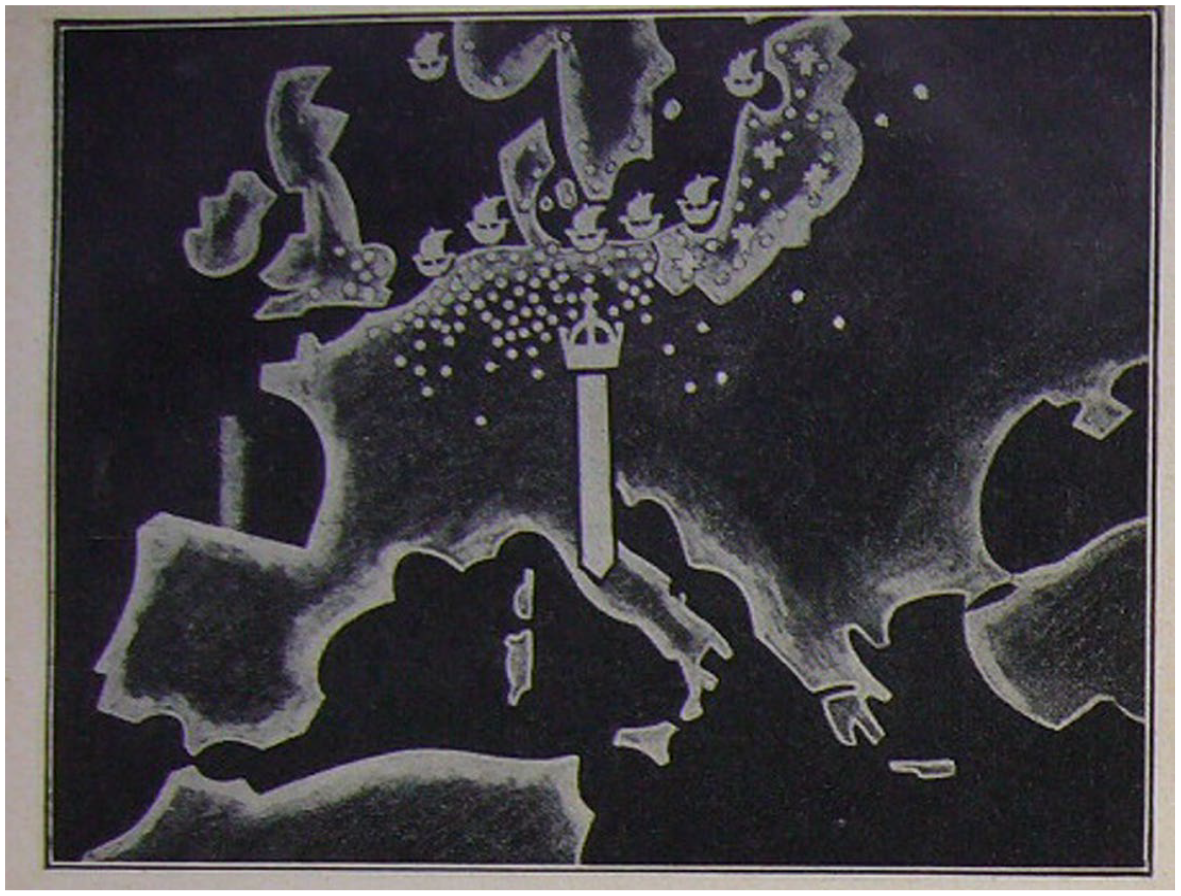
Still from from Hans Cürlis, Die Weltgeschichte als Kolonialgeschichte (film book) (1926), Berlin: Sachers & Kuschel, 1926.
Other scholars have examined the formal qualities of maps in these films and we cannot expound on that here (Braun and Foster, 2012). But it is worth emphasizing how a broader thinking about animation and propaganda informed the IfK’s use of maps. A number of factors suggest this link. First was its focus on graphic forms, a good example being the silhouette. 16 Today, the ‘silhouette film’ is mainly identified with the ornate work of Reiniger, but Cürlis in fact hired several silhouette designers in the initial founding of the institute (including Bartosch, who oversaw most of the cartographic sequences produced at the institute). Indeed, the institute’s animated maps were themselves commonly understood as silhouettes; for example, a 1920 article from Der Film argued that the film on coal shortages was the first to use ‘silhouettes’ in the institute (Das Institut für Kulturforschung, 1920: 55). In another article on the Institute’s cartographic films, the geographer Arthur Dix explained: ‘An especially appropriate form for showing the movements of a changing map is the so-called silhouette film [Schattenfilm], which allows an actively expanding state to appear in stark contrast to the white map through the gradual or sudden enlargement of its shaded surface’ (cited in Braun and Forster, 2012: 405). This emphasis on visual clarity echoes a larger discourse on silhouettes in advertising and propaganda in the early 1920s, where silhouettes came to be seen as a powerful mode of simplified perceptual design, capable of seizing visual attention and communicating messages in the blink of an eye through high-contrast black and white (Cowan, 2013a: 798–802). Cürlis quite likely understood the silhouette’s potential at least partly in these terms, and one can see a similar simplification of the visual language of maps in the films of the IfK. Employing high-contrast black and white outlines, the films were intended to imprint easily assimilable images of a ‘national body’ – and its various truncations after the war – on audiences.
Another factor suggesting that the potential of useful animation for projects of mass propaganda and persuasion informed the Institute’s move to Berlin is the way in which Cürlis thought about film distribution. Unlike Hanslik’s Vienna films, which showed only in specialty venues (such as the Viennese Urania Institute and the Konzerthaus) accompanied by lectures, Cürlis’s short films were distributed to cinemas for screening during the preliminary programme. But, more importantly, he also intended these films to screen outside the cinema in situations reminiscent of contemporaneous advertising film. Indeed, one of Cürlis’s key backers for the Berlin IfK venutre was the most prominent company for mobile film screening devices: the Petra manufacturer of portable ‘daylight’ projection systems. These daylight systems were understood widely as vehicles for advertising, but they were also marketed for use in schools, exhibitions and political assemblies, as one can see from a Petra catalogue published c. 1920, which gives labels such as ‘Versammlungsapparat’ (apparatus for assemblies) suggesting the intended usage of their portable projectors (see Figure 10). Cürlis understood them in precisely this sense, as he put it in one article for Hanslik’s journal Die Erde: ‘With these screens, one can show films in any teaching space, lecture room, meeting space, in any café, restaurant or hall, and even outdoors and in the streets’ (cited in Döge, 2005: 20). And such projectors were in fact used during the aforementioned plebiscite for Upper Silesia, as one can see from an image placed on the cover of the Hamburger Illustrierte Zeitung in December 1920 showing a daylight screen placed in front of Berlin’s Brandenburg Gate and broadcasting ‘images from Upper Silesia’ to an assembled crowd on the street (see Figure 11). 17 Although Cürlis’s contract with the Petra company was short-lived (the company itself folded in 1921), the fact that he accorded a central role to their model of film distribution tells us a lot about the thinking at work in the founding of the Berlin branch of the IfK, where propaganda film was meant to reach mass spectators ‘on the go’, in contexts far beyond the darkened movie theatre.
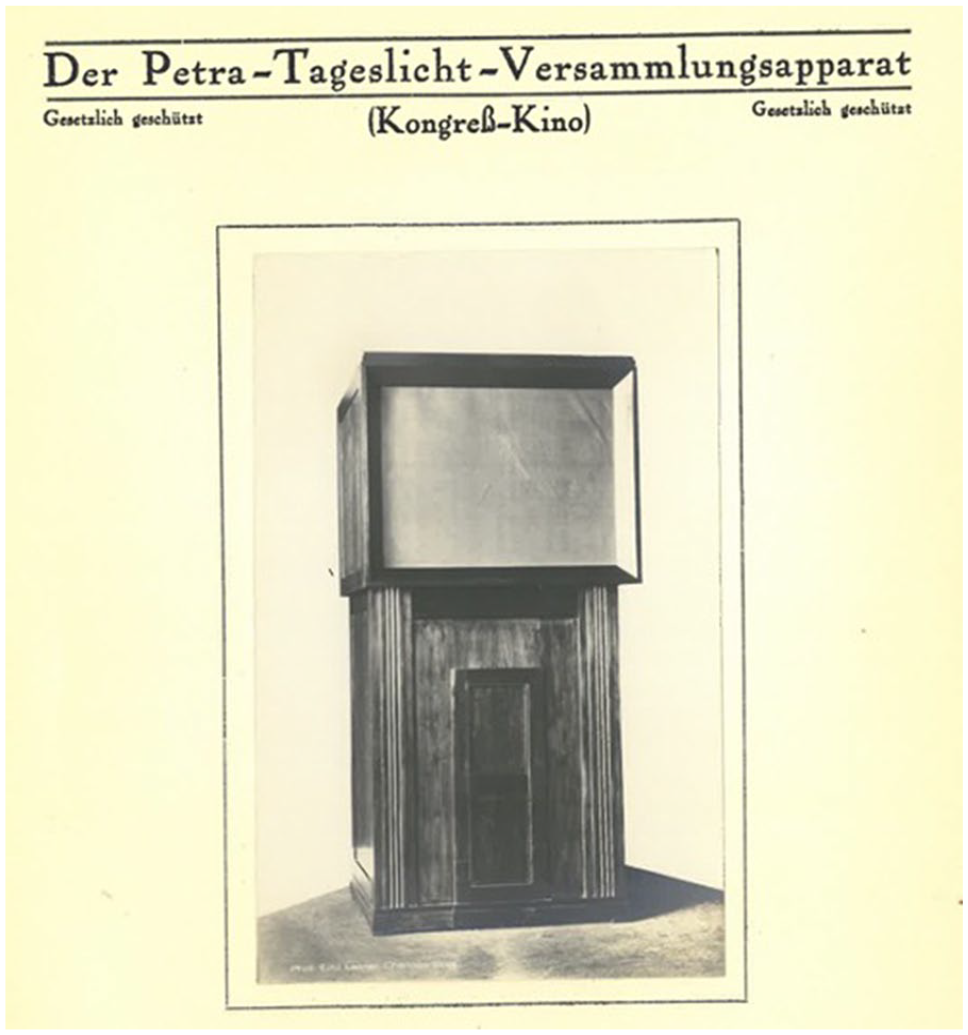
Illustration from untitled sales catalogue of the Petra Company for Electronic Technology (nd, c. 1920, np). Copy obtained from the library of the Technical Museum in Vienna.
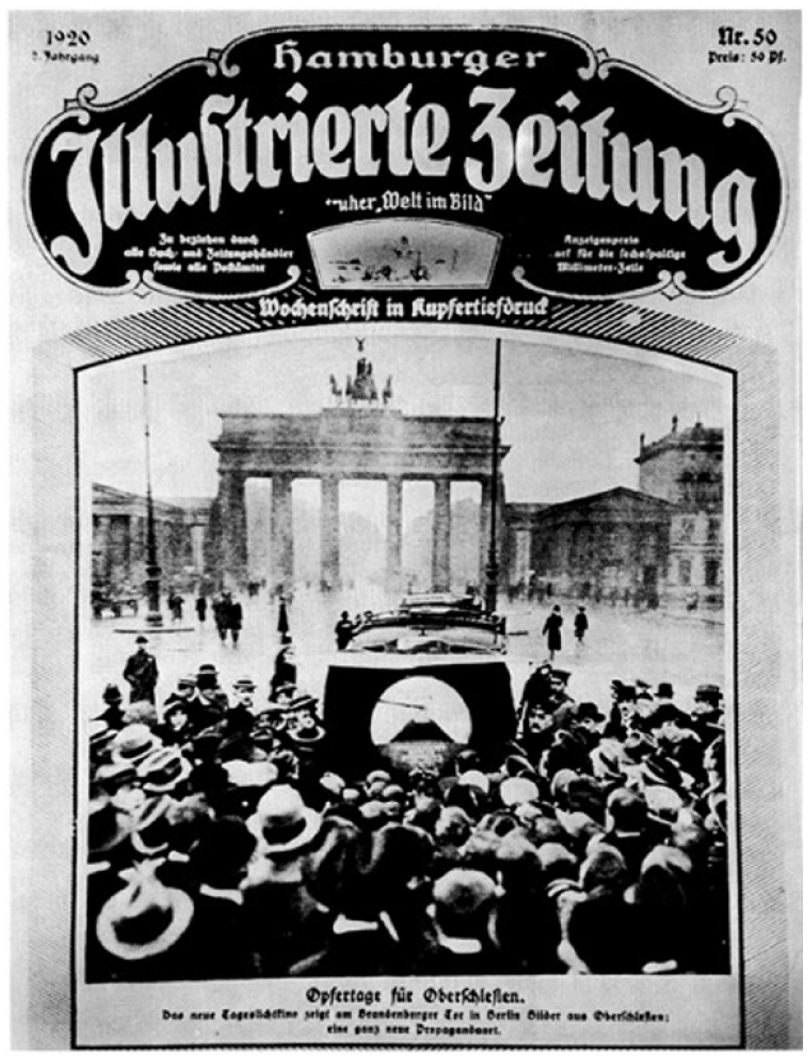
Outdoor screening of propaganda film on the Silesian plebiscite using a daylight screen, 1920. Image taken from Hamburger Illustrierte Zeitung (December 1920) 2(50), cover page.
Of course, Cürlis’s cartographic propaganda films hardly exhausted the activity of the Berlin institute, which produced not only Reiniger’s fairy-tale films, but also a long-running series of artistic portraits under the title Schaffende Hände. However, attention to these cartographic films can help to complicate our understanding of ‘experimental film’ culture in the 1920s, which was still part of a ‘strategic convergence’ (to adapt a concept from Malte Hagener) that included many types of filmmaking and competing interests beyond what that term now implies (Hagener, 2007: 78). The concept of ‘strategic convergence’ can also help us to understand the infrastructural development of useful animation, which – as Hanslik’s experience in Vienna demonstrates – still needed the support of a larger umbrella organization like the Berlin IfK to develop. In the case of Hanslik’s cartographic project, those infrastructural conditions meant that a form of animated cartography originally intended to promote intercultural understanding could end up serving the opposite purpose: recruiting audiences to a nationalistic cause.
Case study 3: Economics by motion symbols: Michael Polanyi and the animation of financial systems
Our final case study centres on the British film Unemployment and Money, which was initially released in 1938 and revised in 1940. This film, which puts forward the economic theories of Michael Polanyi, is exemplary of the way our three research questions can help illuminate previously ignored useful animation films. The infrastructure of the film’s production was a product of geographic and disciplinary transference, Polanyi having immigrated to Britain from Hungary and his collaborators having extensive prior experience in scientific and informational films. The film’s iconography was also a result of intermedial exchange, as the film drew heavily on diagrammatic forms from chemistry, applying scientific visual tools to another discipline and extending them through motion. That motion enabled new forms of knowledge by creating a dynamic and experimental model producing a new understanding of economic systems.
Unemployment and Money was the brainchild of Michael Polanyi and was based on his economic theories, heavily influenced by the economist John Maynard Keynes. 18 Polanyi was born in Hungary, undertook research in Berlin and then moved to Britain in 1933 after the Nazis rose to power (‘A famous chemist for Manchester: Dr. Polanyi accepts a university chair’, 1933). His film was funded by private subscription, with initial philanthropic donation from Sir Samuel Turner of Rochdale, and the longer 1940 version completed with assistance from the Rockefeller Foundation (Economics on the Screen, 1940). The film was produced with the assistance of Gaumont British Instructional and a number of its employees. It was directed by Mary Field, who had a distinguished career making the Secrets of Nature and Secrets of Life educational film series. The animation work was designed by Reginald Jeffryes who had an established career animating diagrams and maps for many Gaumont films, indicating the thriving demand for useful animation in the UK at a time when entertainment animated cartoons were scarce due to the dominant position of US animation in the local market (Cook, 2018: 252, 257). Unemployment and Money was primarily distributed as a 16mm film to non-theatrical venues, such as schools, colleges and specialist organizations. 19 In terms of infrastructure, this film is thus quite typical of useful animation, as opposed to better-known entertainment animated cartoons: funded independently outside of the film industry (ironically bypassing the market economics depicted by the film itself), it was the result of geographical and disciplinary movement of personnel, and it relied on alternative distribution circuits and technology.
The instigator of the film is listed on the title cards as Professor M. Polanyi, which may initially seem misleading because at the time he was a Professor of Chemistry at the University of Manchester, not an economist. However, this information is not merely tangential, but is central to understanding Polanyi’s approach to economics generally, and in the film in particular. As a chemist Polanyi was concerned with dynamic systems, with the fluctuations that occur as additions and subtractions are made to a process, the causes and effects of change. In Unemployment and Money his desire to measure, understand, experiment and control are transferred from physical systems of chemistry, biology and hydrodynamics to the social and political organization of the flow of money. A way of thinking from one discipline is applied to another field, generating a new understanding and way of looking at the world.
Polanyi’s understanding of political economy through an analogy with nature or under the influence of the sciences has some precedent. Philip Mirowski has shown that 19th-century physics provided the dominant model for economists of that period. In his book More Heat Than Light, Mirowski (1989: 3) writes ‘neoclassical economic theory boldly copied the reigning physical theories in the 1870s.’ Likewise, the collection Natural Images in Economic Thought: Markets Read in Tooth and Claw edited by Mirowski (1994) brings together a range of examples of the way the social and political organization of the economy has been naturalized through these types of metaphor and analogy.
The same impulse is evident in Michael Polanyi’s economic theories, and the Unemployment and Money film. For instance, in an article published in 1940 at the time of the film’s production, titled simply ‘Economics by motion symbols’, Polanyi (1940) repeatedly uses natural terms to describe the movement of money in the capitalist system, with their biological and environmental connotations. For example, he describes a moment in the film where ‘the invested money flowing out at the top of the Bank is steadily drained back at the bottom into the deposits of business men in receipt of Windfall Profits’ (p. 9). ‘Flowing’, ‘drained’ and ‘deposits’ here all suggest a natural process akin to hydrodynamics, also evident in his discussion of ‘liquid funds’, ‘floods’, ‘overflowing’, ‘ebbing’ and ‘drought’ conditions in markets (pp. 17, 19). ‘Circulation’ is also repeatedly used in this article, evoking cardiovascular analogies. Here Polanyi shows his debt to Keynes, as this circulatory analogy allows not only for observation of the flow of the money and its importance to the health of the overall system, but also advocates for intervention. Polanyi writes ‘it is only when the supreme usefulness of monetary circulation is well understood that its dangerous dispositions – and possible remedies against these – will be given the right sort of attention’ (p. 19). Here a doctor/patient relationship from medicine provides an analogy for the way an understanding of a system allows the trained expert to make interventions to correct pathologies. Bíró (2017) has further documented the extensive use of terms from chemistry in Polanyi’s (1945) book Full Employment and Free Trade, with terms such as ‘percolate’, ‘sucking’ and ‘squirting’ used frequently (pp. 32–33).
There is more that could said about Polanyi’s writing, but our primary interest here is in the way this analogous thinking occurred not only linguistically, but also graphically, drawing on a longer history of visual representation of dynamic systems. Morris and Gotel (2006), investigating the history of flow diagrams, indicate that chemists and chemical engineers were early adopters of flow diagrams for planning and documenting complex physical processes. Various forms of graphical representation of physical flows had existed for hundreds of years, with Morris and Gotel highlighting examples by Leonardo da Vinci as archaic precursors (p. 131). In the early 20th century flow diagrams became a standard tool of scientific management; for instance, in 1921, leading time and motion studies experts Frank and Lillian Gilbreth presented their paper ‘Process Charts: First Steps in Finding The One Best Way To Do Work’ at the annual meeting of the American Society of Mechanical Engineers (Gilbreth and Gilbreth, 1921). By the 1930s, such diagrams had become a regular part of chemistry publications, and Polanyi was undoubtedly familiar with this form. 20
Central to this history of flow diagrams is their development from the documentation of physical systems, with diagrams that resemble their referent, to the documentation of processes in a purely abstract manner. Morris and Gotel’s (2006: 131) example of Da Vinci’s images of water flow has a likeness to the original physical mechanism. Later chemical engineering diagrams introduced more simplification and abstraction, but continued to incorporate images that look like the laboratory and industrial equipment used in the processes. Later, some diagrams became entirely abstract, representing the steps in the chemical transformation, but not the physical circumstances (Morris and Gotel, 2006: 133–135). In terms of Peirce’s (1998[1894]: 5) typology of signs, the flow diagrams move from an iconic resemblance to an arbitrary symbolic signification.
Unemployment and Money encompasses a similar development over the course of the film. The opening sequence adopts a caricatured cartoon style that maintains a strong correspondence and resemblance with the physical actors and institutions in the economic processes – workers and shoppers, factory buildings and bank offices, even if they are stylized through the flattening of perspective, the absence of human facial features and inconsistent scale between people and objects (see Figure 12). Later sequences of the film adopt an increasingly abstract representation, where money is represented as moving lines and a label ‘Bank’ is needed to recognize basic geometric shapes as a financial institution (see Figure 13). Peirce’s other type of sign, the referential index, is present in the use of arrows to make connections between different elements, their pointing function making meaning only through their indication of a relationship between parts. Arbitrary white boxes represent different functions within the economic system, while a continuously moving band represents the flow of capital. We can see that, as well as adopting language from physical and life sciences, Polanyi’s film clearly adopts the diagrammatic methods of visual representation used in those fields. As in those disciplines, he starts with a representation of physical organization and a resemblance to the real-world actors and institutions, but moves to an entirely abstract symbolic depiction. Nevertheless, the system remains understood as a rational and rules-based process that can be investigated in a scientific manner.
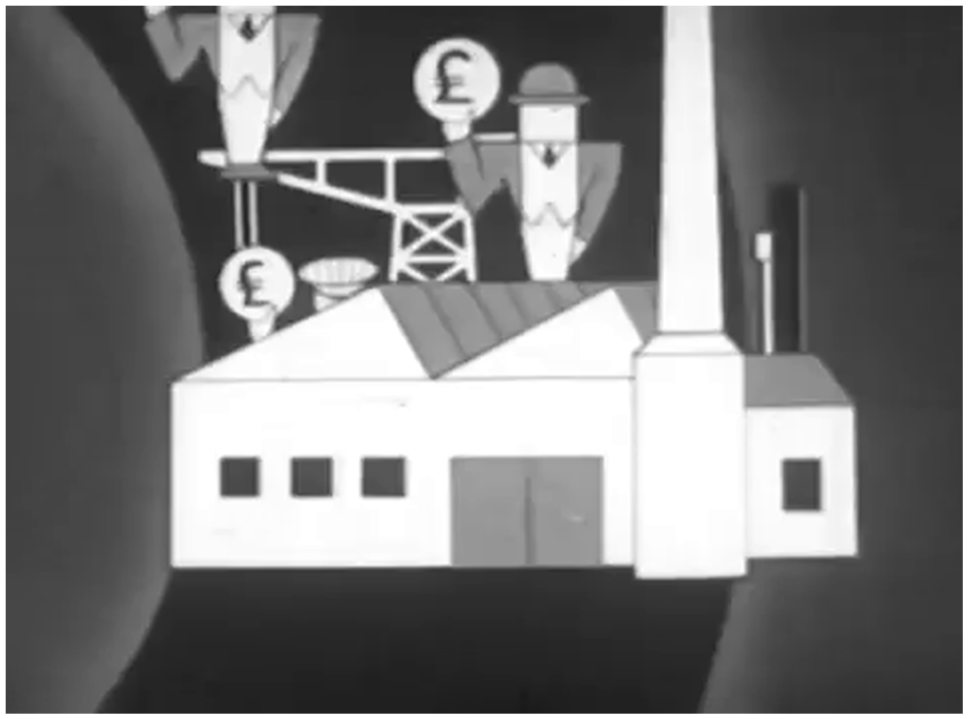
Iconic representation of financial systems in Unemployment and Money (1938/1940), animated by Reginald Jeffryes. Screen grab from online video, available at: https://www.youtube.com/watch?v=wFm_ORFfp9U
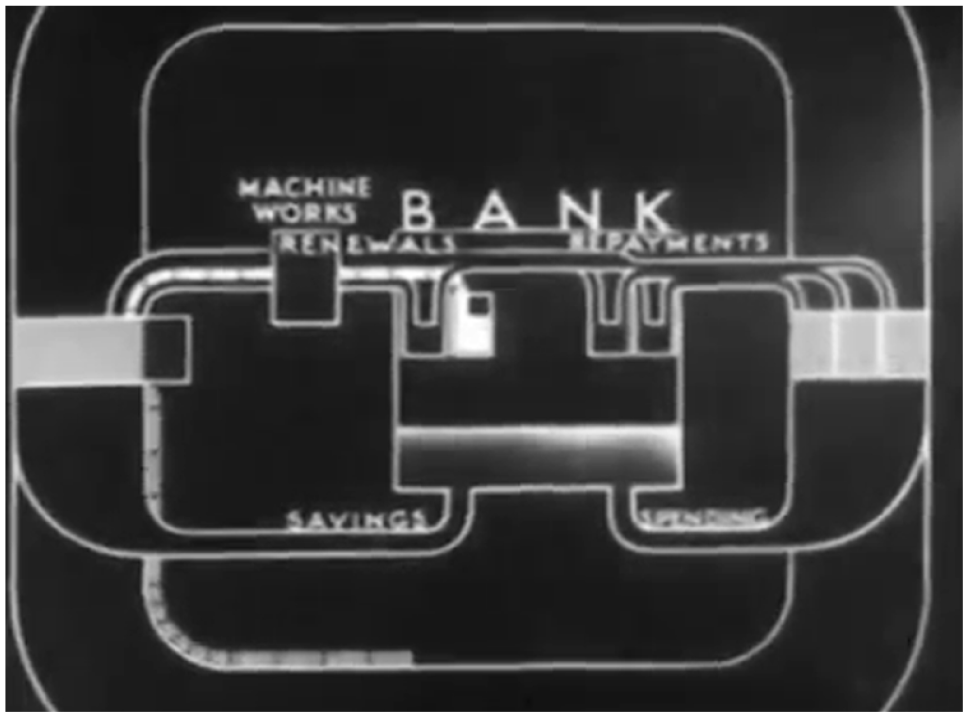
Symbolic representation of financial systems in Unemployment and Money (1938/1940), animated by Reginald Jeffryes. Screen grab from online video, available at: https://www.youtube.com/watch?v=wFm_ORFfp9U.
While Polanyi was not alone in adopting new methods for symbolic representation of economic theories, it is important to recognize that the analogous model he adopted between physical sciences, especially liquid dynamics, could not be fully represented in this diagrammatic form. Despite their name, flow diagrams are of course static, relying on those indexical arrows to stimulate the viewer to imagine and animate the dynamic process signified. However, Polanyi was especially concerned with the dynamic elements of the economic system and the effect that various interventions could have on it. In his ‘Economics by Motion Symbols’ article he admits that he was less interested in ‘the nature of economic equilibrium maintained, and constantly re-adjusted, by the mechanism of prices and profit’ and that instead his film ‘focuses entirely on dynamic features’ (Polanyi, 1940: 2).
Film, and especially animation, offered an apposite form for extending these economic theories into a dynamic form of representation. In the broadest sense, of course, these forms shared in the process of adopting natural metaphors for their naming – early moving pictures were called vita or bio, and the etymology of ‘animation’ links it with breath or life. Furthermore, the use of animation to depict dynamic systems, especially natural or biological ones, was well established by the time Polanyi came to make this film. With his scientific background, Polanyi had no experience or knowledge of filmmaking, especially the complex and time-consuming process of animation. He collaborated with two established figures in the educational film industry, Reginald Jeffryes and Mary Field who both worked for Gaumont British Instructional at this time.
While the film is credited as ‘by’ Polanyi, Field can rightly be considered the producer–director of this film. Her distinguished career in film began in 1925 when, as a trained historian, she served as an adviser at British Instructional Films. She went on to collaborate with cinematographer Percy Smith on the Secrets of Nature series, which extensively used Smith’s timelapse and microscopic photography, as well as animated sequences, to create educational films about natural life (Field, 1941). The series became Secrets of Life when Field and Smith moved to Gaumont British Instructional in 1933, and Field (1941) also directed and produced a range of other films for GBI. Many of these factual films incorporated animated diagram sequences created by animator Reginald Jeffryes. Jeffryes had also worked on many natural science films, such as the films Blood, Breathing and Circulation, each of which offered diagrammatic representations of the biological processes their titles described. Field and Jeffryes collaborated on a range of films for GBI, including a series of travel films on Udaipur, Bikaner and Katmandu (Jaikumar, 2011). Other films included accounts of the coal and railway industries, and Changes in the Franchise since 1832 which discussed the 1832 Reform Bill and subsequent Acts (‘New GBI Films’, 1937).
As well as the extensive practical assistance and experience in the filmmaking and animation process, Field and Jeffryes brought to Polanyi’s Unemployment and Money film a visual analogy for his economic theories, and offered a model for how they could be represented and developed. Field and Jeffryes’ earlier work started with diagrammatic representations of biological or natural systems, such as circulation in the human heart depicted through moving arrows and grey-shaded contrasts (see Figure 14). Their work developed to use the same diagrammatic forms to represent industry and social infrastructure and then finally political and ideological organization in Unemployment and Money, where similar use of arrows and shading are seen (see Figure 15). These were all dynamic systems that could only be fully understood through motion, with animation proving the ideal representational tool. The iconography of the film is thus a prime example of the way useful animation incorporated iconography and visual conventions from other media and disciplines, and extended them through motion. Crucially, this form of diagrammatic animation not only helped translate Polanyi’s ideas into visual form, but shaped and changed them in the process. In his article about the film, Polanyi (1940: 4) wrote ‘the film presentation of economic dynamics forces us to consider some novel concepts, as it requires a more definite formulation of changes in monetary circulation than is hitherto available.’ Animation not only provided an efficient way to represent existing knowledge, but produced new knowledge from this new mode of dynamic representation.
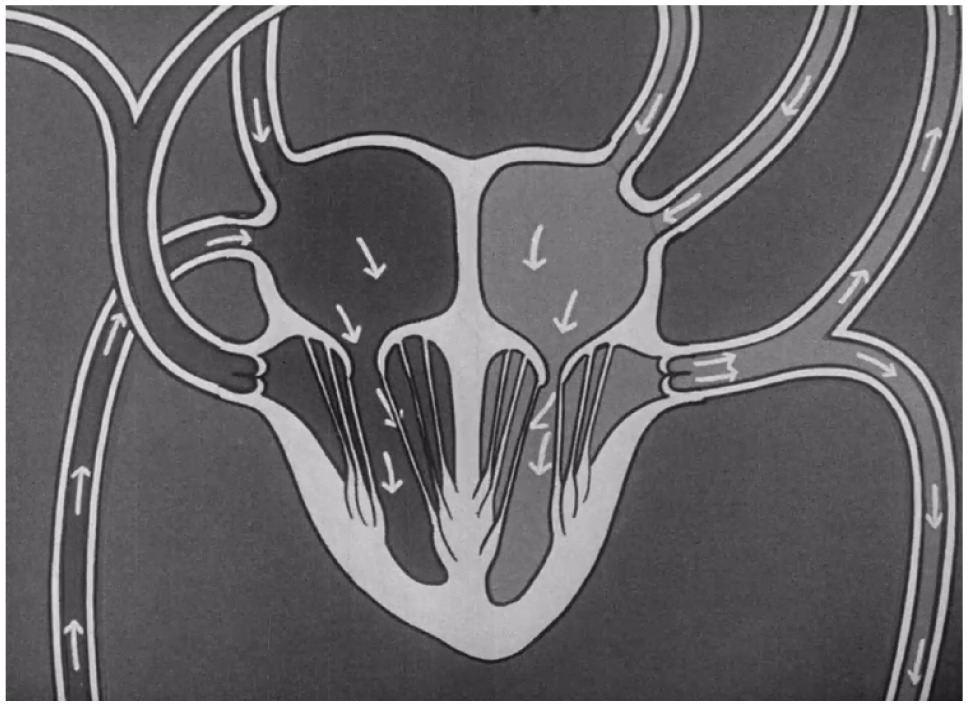
Diagrammatic representation of biological flow in Circulation (1935), animated by Reginald Jeffryes. Screen grab from online video, available at: BFI Player https://player.bfi.org.uk/free/film/watch-circulation-1935-online
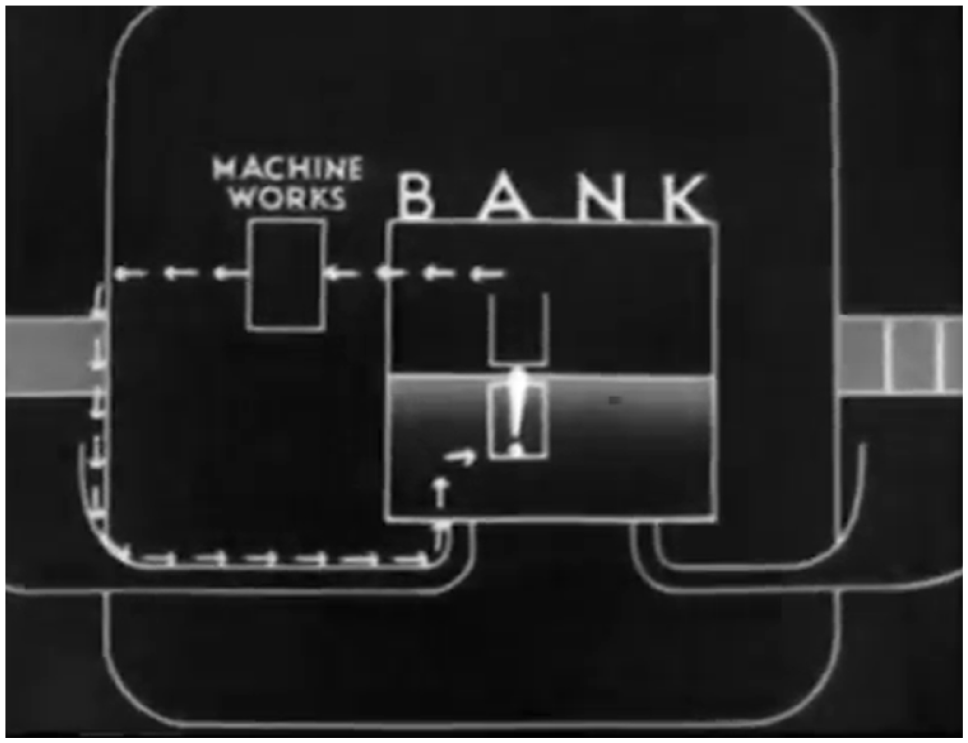
Diagrammatic representation of financial flow in Unemployment and Money (1938/1940), animated by Reginald Jeffryes. Screen grab from online video, available at: https://www.youtube.com/watch?v=wFm_ORFfp9U
Polanyi’s film was widely shown in non-theatrical contexts. For instance, the initial version of the film was screened at the Manchester Statistical Society in March 1938 (Economics on the Screen, 1938) and subsequently at the Manchester branch of the Historical Association, as well as the Association for Education in Citizenship (‘On With the Money Film’, 1938). Likewise, it was screened in 1947 in the US at the Third Annual Conference on the Teaching of Economics (‘Trends’, 1948) as well as significant private screenings for economists in Paris in 1938 and New York in 1940 (Bíró, 2017: 26). The general consensus of economists was that the film was too simplified to inform economic theory and policies, and was better suited to school or college education where it could help students grasp basic principles before being shown the full complexities of the topic. Polanyi himself concluded his article on ‘Economics by Motion Symbols’ by highlighting omissions in the film and ways it might be developed in the future (Polanyi, 1940: 19).
The film trade response was similarly ambivalent about the film, but for different reasons. A London University lecturer reviewing the film in 1940 for Documentary News Letter, the leading publication for the British documentary movement at the time, criticized the film. They advocated for ‘something less abstract which can be treated by pictures more nearly akin to documentaries proper’, and a desire for ‘more vivid and realistic pictures’ (Economics on the screen, 1940). Here we find an explanation of the absence of Polanyi’s film, and useful animation more generally, from the established history of British cinema in this period. The value discourse being established in this review defines cinema by its iconic resemblance to the world, rooted in the image’s photochemical indexical trace of that world, which underpinned the celebrated British documentary movement. Animation, especially highly abstracted symbolic forms seen in the latter half of Polanyi’s film, constituted a radical departure from that orthodoxy.
From the present moment, Polanyi’s film looks remarkably prescient despite its limitations. We have seen how Polanyi was heavily influenced by his understanding of the natural flow of liquids in developing his economic theories. In a comparative discussion of later developments in fluid dynamics and economics, Bausor, writing in 1994, observed that the scientific field has been able to utilize laboratory conditions and empirical means to test theories about hydrodynamics (Bausor, 1994). In contrast, economists have had no equivalent means to experiment and test the dynamic systems they are concerned with, until the advent of real-time computing technologies only starting to appear when Bausor was writing, and more recently addressed in work on ‘operational images’ (Parikka, 2023). In his attempt to use animation to create an economic analogue of his chemistry laboratory equipment, Polanyi was aspiring to establish experimental conditions that would allow the testing of different economic theories and interventions in the system. As is always the case, aspiration precedes invention and his film does not fulfil everything he hoped for it, not least because the time-consuming and labour-intensive process of animation could not allow for rapid adjustments to the system. Nevertheless, the film anticipates later computer tools used for managing and hypothesizing economic scenarios and, as such, serves as a media archaeological antecedent for present-day real-time dashboards that pension managers and hedge funds use to track investments, or the capacity of spreadsheets and analytical systems to run speculative ‘what if?’ scenarios. Polanyi’s film may not have been able to predict the economic future, but it did anticipate the growth of useful animation.
Conclusion
The use of animation to educate, persuade and explore covers a vast swath of animation history, but its historiography has focused almost exclusively on aesthetics, entertainment and the fiction filmmaking industry. We see useful animation as a necessary corrective: the term emphasizes not whether animation is fiction or fact, not aesthetic evaluation, but how animation has been utilized within a variety of fields that saw in it a unique and compelling tool and form of communication. Useful animation often shares configurations of production and distribution, such as sponsorship and non-theatrical venues, with other kinds of useful media. Yet, highlighting animation brings into relief some features that receive less attention in histories of other forms of useful media. Specifically, useful animation is often the product of interdisciplinary collaboration between animators, sponsors and field specialists, because the difficulty and labour inherent to animation production meant that this kind of alliance was necessary to the workflow of any given film. As methodological avenues, infrastructure, iconography and impact expand upon the useful film literature by underlining the importance of collaboration, cross-pollination and mutual influence that such interdisciplinarity implies. We hope that adopting the research questions and methodologies highlighted in this article can open new areas of inquiry for the history and historiography of animation.
Footnotes
Correction (December 2023):
Article updated to delete redundant text in the captions of Figures 4 to 10 since its original publication.
Funding
Research undertaken by Malcolm Cook for this article was assisted by a Visiting Researcher Stipend from the Bill Douglas Cinema Museum, University of Exeter. The remainder of this research received no specific grant from any funding agency in the public, commercial, or not-for-profit sectors.