




Abstract
Animated documentary has at its core the tension of the filmmaker attempting to represent and speak about the historical world while working in a medium that is wholly constructed and lacking in evidentiary indexicality. Reflexivity – the revelation of animation’s constructedness – is considered by many scholars to be a key element in resolving this tension and granting animation documentary legitimacy. In this article, the author reflects on the reflexive strategies he used in making the animated documentary, Polonia (2023). He posits that the film is the result of the dynamic between the processes of reconstruction – the piecing together of the historical narrative through the collection of testimony and gathering of evidence – and construction – the building of the filmic world. These processes are manifest in the film as distinct aesthetics and a spatial taxonomy – ‘archival’ and ‘cinematic’ spaces that embody the tension between actuality and creative interpretation.
Keywords
Introduction
This article discusses the making of my (2023) film Polonia (‘the Polish diaspora’) – an animated documentary about Polish refugees set in the early 1980s – using processes of reconstruction and construction that are manifest within the film as distinct archival and cinematic spaces. According to Nichols (2017), documentary can be understood as ‘neither a fictional invention nor a factual reproduction’ in that it ‘draws on and refers to historical reality while representing it from a distinct perspective’. By presenting this analysis of an animated documentary through the material lens of a spatial taxonomy, my hope is that it may afford a new consideration of how animated documentaries, particularly those that make overt use of archival materials, shape the relationship between indexical and constructed elements in order to communicate their ‘distinct perspectives’ and how this might be done reflexively in order to highlight rather than obscure the subjective nature of documentary narrative.
The article begins with an overview of the notion of reflexivity and how scholarly understandings of it, both in relation to animated documentary and animation as a whole, have evolved in response to technological advances that afford an ever-increasing degree of verisimilitude to real-life referents. These technological advances, set in the context of our current ‘post-truth’ world, highlight the need for greater transparency in documentary truth-claims, which reflexive non-fiction animation can afford. This leads to a discussion of Polonia and how the process of the film’s creation – a reconstruction of the historical narrative and construction of the filmic world – are made manifest as distinct archival and cinematic spaces. I argue that the significance of this spatial taxonomy lies in its reflexive delineation of how both archival material and the historical narrative are shaped to communicate the subjective memories and viewpoints of both me, as the filmmaker, and those on whose testimony the film is based. The properties of the archival and cinematic spaces are then enumerated, and the various reflexive strategies that Polonia employs, built on the interaction between its archival and cinematic spaces, are discussed. Finally, the inclusion of ‘fake’ archival materials in the film is analysed. These elements represent an extreme blurring of boundaries between the archival and the cinematic, and a case is made for how their inclusion, rather than compromising the film’s transparency, may serve as yet another form of reflexive revelation of the film’s constructedness.
Realism and constructedness
The tension between the wholly constructed and the real lies at the heart of all animated documentaries. Despite a history of nonfiction animated film production spanning over 100 years, a sharp rise in the popularity and prevalence of animated documentaries in the new millennium and extensive academic discourse on the animated documentary form that stretches back to the late 1990s, animation’s status as a credible medium for depicting reality (or what Nichols, 2017, terms ‘the historical world’) 1 will perhaps always be somewhat precarious, lacking as it does the indexical link with the physical world that many still consider to be the legitimating element in documentary realism. Photography and live action footage, in their capacity to act both as index and icon of the physical world, have long been considered the de facto documentary media. However, since the 1970s, photography’s evidentiary status has been challenged with legitimate arguments regarding how the medium’s truth-claims are compromised both through the subjectivity, fallibility and agendas of those who capture photographic images, as well as through its technical limitations in depicting the physical world (Ehrlich, 2021: 38, Honess Roe, 2013: 32).
Many animation scholars have considered reflexivity – the deliberate foregrounding of animation’s constructedness – to be key in resolving animation’s status as a legitimate documentary medium. Hannah Frank (2019: 49) provides a useful schematic for reflexivity when she discusses the differences between the indexical photographic image and what she refers to (after Sergei Eisenstein) as the ‘phantasmagoric’ properties of animation, which she likens to a painting inside a frame: The frame of a painting is centripetal, pulling us inward, toward a world found only within its borders; the photograph, by contrast, is centrifugal, pushing us outward, beyond its bounds: a window. Thus live-action cinema offers us one thing, a view of the world, and cel animation offers us something different, a world governed by a physics all its own, a plasmatic and limitless world where bodies never bruise and anvils are always falling from the sky.
The notion of centripetal and centrifugal forces is a useful one, creating a vivid schematic of two diametrically opposing tendencies. What Frank refers to as the ‘phantasmagoric’ can be substituted here for ‘hyperreal’, where both are understood to refer to a self-contained world that does not acknowledge its own constructedness. Animation that is reflexive belongs to a different category, one that knowingly reveals the seams of its construction, reminds the viewer not to confuse it with reality and, in doing so, points back to the distinction between the real and its alternatives. When animation is reflexive, these centripetal and centrifugal forces do not act in opposition, but in tandem with one another, where we are pulled into the world of the animation, only to be pushed back out by it towards the real.
However, the notion of what reads as reflexive is in constant flux. In early writing on animated documentary, the notion was put forward that animation was inherently reflexive, a form of ‘metacommentary’, always self-reflexively revealing its own construction, creating ‘a rupture between the signifier and the signified’ and allowing for an element of ‘epistemological doubt’ regarding what is being shown on screen to enter into the viewer’s experience (DelGaudio, 1997: 192). Ward (2006: 89) later echoed this claim in his assessment of animation as a documentary medium. Wells (1998: 24–25), in Understanding Animation, acknowledged that animation is ‘a medium . . . informed by self-evident principles of construction’, but distinguished between hyper-real approaches to animation, which he defined as ‘neither a completely accurate version of the real world nor a radical vindication of the animated form’; a form of heightened realism which is ‘essentially overdetermined . . . simultaneously realistic but beyond the orthodoxies of realism’ (p. 25); and more explicitly reflexive forms of animation (pp. 43–46).
Manovich (2001: 300) heralded the arrival of digital cinema and the resultant plasticity of the live action image resulting, in his view, in live action having become another form of animation. Fore (2007b: 124) pointed out that there was an increased breakdown between the categories of ‘live action’ and ‘animation’, owing to the growing photorealism of CGI animation, destabilizing claims of animation’s inherent reflexivity. While Fore went on to note that CGI animation at that time still had not managed to achieve perfect verisimilitude, particularly in its rendering of human characters, compromised as they were by the ‘uncanny valley’ effect, subsequent advances in photoreal CGI animation, coupled with the emergence of DeepFakes, have further blurred the boundaries between indexical live action images and constructed ones (Ehrlich, 2021; Fore, 2007a; Sample, 2020).
Indeed, this blurring of boundaries is a key element of what Ehrlich (2021) refers to now as ‘an ontological anxiety about the loss of the real through the loss of indexicality’, a condition of what she claims is the post-truth world we now inhabit, defined by fake news, extreme and entrenched political and cultural positions, ‘truthiness’ 2 and public mistrust of the media, and skepticism regarding the truth-claims of photographic images (p. 29). Ehrlich points out that this mistrust runs parallel with greater public acceptance and popularity of animation as a documentary and non-fiction medium (pp. 28–30). Whereas images that look photoreal are treated with suspicion, those that fall under the category of what she terms ‘precarious aesthetics’, that is, low resolution or blurred images, are perceived as being more authentic (p. 38). She proposes that, if such images are seen as existing along ‘a continuum between photorealism and the abstract’, their acceptance by the public means that non-mimetic images – including animation – are now considered more credible (p. 39). In her view, animation currently occupies a unique ontological position as a medium for representing reality, a position that is by no means permanent or fixed, but one that has grown out of the point we find ourselves in our current media landscape. As she explains, ‘animated documentaries are masked, self-reflexive documentary aesthetics that both hide and expose information, and foreground issues of truth verification versus disinformation, and thus they act as a perfect form of representation for the zeitgeist’ (p. 201). Ehrlich sees ‘realism’ as a pluralistic term: a ‘believable articulation of the real’ that can refer both to ‘a close approximation of . . . the world exterior to representation’ and to that which meets the standards of what has already been deemed ‘realistic’ (such as certain kinds of cinematography) (p. 201). What is considered to be realistic is contingent upon direct perception, technology and ideology, therefore ‘realistic representation must always be in flux’ (p. 201). Based on this view, the framing of realism as the basis for documentary truth-claims in terms of familiarity and defamiliarization becomes central to Ehrlich’s argument for animation’s documentary validity (pp. 204–212). Where the ‘familiar’ carries negative associations, implying a passive, uncritical reception of content, ‘defamilarization’ becomes a means of encouraging critical engagement with media (p. 206). Seen in this light, both photorealism and animation hyperrealism hide their constructedness and are each in their own way unsuited to documentary representation. Photorealism, by seamlessly blurring the distinction between the real and the fabricated, denies viewers the choice to make up their minds about what is true and what is false. Hyperreal animation, meanwhile, fosters uncritical spectatorship by lulling its audience into a comfortable acceptance of the ‘familiar’.
In reframing realism as dependent on a questioning critical viewer engagement over the passive acceptance of the familiar, truth claims based on fidelity and an indexical link to a referent, Ehrlich argues for reflexive nonfiction animation as a means of ‘defamiliarization’ and as the ideal medium for engaging with ‘the real’ in this present historical moment and media landscape: Since realism is so intertwined with ideas of transparency, opacity and therefore also deceit, it may be animation’s overt constructedness that is more rather than less realistic . . . animation’s unique and endless visual potential affords it the ability to destabilise existing conventions and expectations, if used imaginatively. (pp. 206–207)
Materiality, reconstruction and construction
Polonia – an animated documentary that I began in 2015 and completed in 2023 – depicts the emigration of two families, the Paters and the Strzelecs, from Poland in the early 1980s. Set against the backdrop of Poland’s political upheavals and the rise and repression of the Solidarność (Solidarity) labour union and its challenge to the Polish Communist government’s political hegemony, it traces the arrest and incarceration of the two families’ patriarchs, and the families’ subsequent journeys to find a new home in the West. The film falls under the classification of what Formenti (2023: 228) has termed ‘the contemporary animated documentary’, which she defines as the dominant type of animated documentary post-1985, often interview-based and characterized by the use of ‘first-person narration, imbued with subjectivity’ and focusing on ‘the feelings that the real-life events portrayed elicited in chosen people that have experienced those facts first-hand’. Using a combination of recorded audio interviews, archival material, 2D animation and live action footage, Polonia’s creation served as a testing ground for me to explore the tension between the historical narrative and the creative interventions that give it form. The result of this creative practice conceives the film as a construct, comprised of physical, digital, visual and auditory processes, a tangible structure that both holds and is constructed in response to the historical narrative, emerging from the dynamic between the processes of reconstruction and construction. This conception of the film aligns with the notion of the reflexive foregrounding of constructedness as the authenticating factor granting animation its documentary veracity. It allows one to consider the film in material terms, as a spatial construct, where space is used to represent different orders of materials (indexical, archival and those wholly manufactured for the film) and to maintain an awareness in the viewer of the ‘seams’ of the film’s construction, through the juxtaposition and blending of archival and cinematic space. This is significant in relation to Ehrlich’s notion of the post-truth media reality we now inhabit: by creating a visible spatial and material taxonomy within the animated documentary, viewers are given a clearer view of how archival and purely constructed elements have been combined to create the documentary narrative and convey the filmmaker’s subjective commentary on and interpretation of historical events, as well as the subjective memories and viewpoints of the film’s subjects.
‘Reconstruction’ denotes the rebuilding of something that was broken, making whole that which had been fragmented. It calls to mind the work of the surgeon, artisan or engineer, but also places the documentarian in the role of historian and detective, gathering first-hand accounts through interviews and the corroborating evidence of various archival materials. Bill Nichols’s (2017) choice of referring to the real world as ‘the historical world’ suggests that reality is always receding away from us, a wake trailing behind the awareness of the present moment, the traces of which are waiting to be uncovered and reconstituted into a facsimile of what was. Implicit in the notion of reconstruction is that that which has been reassembled will never quite match the original – seams and fissures may still be visible, with perhaps entire pieces of the whole still missing. The reconstructed narrative may even differ significantly from historical fact, contingent as it is upon available evidence and memory, which is often unreliable, susceptible to omission, suggestion and change. Walden (2019: 82) regards memory as ‘a slippery thing . . . better understood as always in a state of becoming, as related to the present as much as the past, and as a creative, networked process rather than a simple transmission of data.’ In their Introduction to Animation and Memory, the authors state that memory is intrinsically less about remembering past events than creating a personal narrative, which goes beyond recollection and becomes a ‘performative practice mediated through various modes of recounting such as places, rituals, as well as a variety of textual, visual and other sensory media’ (Van Gageldonk et al., 2020: 1–2). In this sense, a reconstruction can also be understood as an accurate-as-possible facsimile of the original.
The second part of the creative process, ‘construction’, indicates the building of something new or adding to an existing thing. Both reconstruction and construction carry connotations of material and materiality, and speak to physical processes of collecting, assembling, analysing, categorizing, reconstituting and shaping materials. In the case of Polonia, while the film as historical narrative and the film as a constructed vehicle for that narrative can be conceived of as being separate, they are, in fact, both occurring at once. It is neither the case that the visual elements of the film simply ‘illustrate’ the spoken narrative, nor that the narrative has an autonomous existence outside of the materiality of the film. While it is true that the individual accounts from which the film’s narrative was constructed exist as memories in the minds of each of the film’s interviewees, what the film presents are individual instances of those memories materialized as audio recordings, thereafter edited together to create a single, new collective narrative. Memories become the material for a collective interpretation of past events. It is also worth stressing that, while interviewees were granted access to the audio recordings from the interviews and were shown several cuts of the film during its production, all the creative decisions – selecting what material to leave in and what to leave out, its sequencing and structuring (what to juxtapose, where to highlight synchronicities and parallels) – were the work of a single author. The various documentary modes, as conceptualized by Nichols (2017), cover a full spectrum of creative approaches to engaging with a subject, from those that emphasize narrative (the expository mode) to those with more overtly formalist concerns (the poetic mode). As Honess Roe (2013: 2) has pointed out, animated documentaries are usually created by animators,
3
who interpret the world graphically and kinetically, and who approach their subject matter with a formal bias. This approach is not unique to animators: there are many examples of live-action film directors with formalist preoccupations. Chabon (2013: 22), in likening Wes Anderson’s work to the boxed assemblages of artist Joseph Cornell, arrives at the same defence of the director’s use of artifice as that put forth by Ehrlich and other theorists regarding animated documentary. Though Anderson is not a documentarian, Chabon’s argument applies with equal resonance to all filmmaking: The things in Anderson’s films that recall Cornell’s boxes – the strict, steady, four-square construction of individual shots, by which the cinematic frame becomes a Cornellian gesture, a box drawn around the world of the film; the teeming, gridded, curio-cabinet sets at the heart of Life Aquatic, Darjeeling, and Mr. Fox – are often cited as evidence of his work’s ‘artificiality’, at times with the implication, simple-minded and profoundly mistaken, that a high degree of artifice is somehow inimical to seriousness, to honest emotion, to so-called authenticity. All movies, of course, are equally artificial: it’s just that some are more honest about it than others. In this important sense, the hand-built, model-kit artifice on display behind an Anderson box is a guarantor of authenticity; indeed I would argue that artifice, openly expressed, is the only true ‘authenticity’ an artist can lay claim to. (p. 23,)
Likewise in Polonia: by reflexively highlighting the reconstructed/constructed nature of the documentary narrative, I reveal the fallibility and inconsistencies of memory and foreground the creative interpretation and responses to testimony.
A taxonomy of materials and space
The processes of reconstruction and construction that drove the creation of Polonia are manifest in the film both as distinct aesthetics and as a spatial taxonomy. The first of these, the archive, is broadly representative of the process of reconstruction and is comprised of those elements that are directly imported from the historical world and are inherently indexical of it: official documents, family photographs, newspaper clippings, various objects, audio recordings of interviews and archival audio, including radio and television broadcasts, and old music recordings. Taken together, they manifest as a distinct archival space within the film. The second category within this spatial taxonomy is cinematic space, representative of the process of construction. The elements that comprise this space include visual and audio elements that have been in part or wholly manufactured. Some of these materials carry an indexical link to the real world in that they are photographs of external locations and objects, scanned textures and so on. However, despite their indexical qualities, they are materials that were created as part of the film’s production and hence the evidentiary properties of their indexicality are in the order of what Jacques Rivette referred to when saying that ‘every film is a documentary of its own making’ (cited in Zoller Seitz, 2013: 62–63). I have labelled this part of the film the cinematic space as it functions in a way that is analogous to reenactment in a live action documentary and in some respects adheres both to the laws of perspective and continuity editing. This space is inhabited by the cartoon avatars of the narrators and other persons included in the narrative. Live action footage in Polonia belongs to either the film’s archival or cinematic spaces, depending on its content.
While these two spaces signify ontologically distinct layers or orders of representations of reality, they should not be considered as entirely separate from one another. For most of the film’s duration, these two taxonomic orders – the indexical and the manufactured, the archival and cinematic – blend to create hybrid forms and are nested inside one another, only occasionally represented as entirely distinct. Taken in totality, they can be seen as a single, reflexive construct that represents and interprets a historical geopolitical narrative.
Archival space
As Wood (2006: 134) has noted, space in cinema is often considered ‘indirectly’, not as a subject of attention in itself, but ‘representationally and expressively’. It is ‘representative’ in the way it locates action and creates continuity, and ‘expressive’ in providing information important to character and plot, part of what Wood refers to as ‘the triadic relationship between character, space and action’ (pp. 134–137). The archival space in Polonia exists primarily in order to present real-world ‘evidence’ that supports the documentary narrative and, in that regard, fulfills an expressive function. In the same way that, in the opening sequence of Alfred Hitchcock’s Rear Window (1954), the camera’s slow movement through the mise en scène establishes James Stewart’s character as a photographer and provides a backstory for his injury, so do the archival materials in Polonia provide information about both narrator and narrative.
The archival ‘space’ refers both to the totality of archival materials present in the film and to the environments constructed from and for archival materials photographed or scanned and digitally assembled into compositions that re-present these materials as objects within a simulated environment. Such compositions exist temporally within the eternal present of the film, including both legitimate archival materials and ‘props’ that assist in the ‘narrativization’ of particular compositions or act as overt signifiers of the film’s constructedness.
An example of the ‘expressive’ function of the archival space, where the images on screen both represent what the narrator is describing and add additional contextual information, is seen when my father, Kazimierz Pater, speaks of the circumstances that led to his arrest as we are presented with a tableau of archival materials within a digitally constructed faux-real ‘space’ (see Figure 1). The point-of-view framing of the shot and the inclusion of narrative ‘props’ – a spyglass, ashtray – suggest that the materials are being examined by an in-film off-screen presence (perhaps a member of the State secret police) that also serves as both proxy for the film’s creator and for the audience themselves (a form of self-figuration that will be discussed later in this article). The tableau is both a narrative device and the portrait of an individual: we see Kazimierz’s medical diploma, a photograph of him with co-workers at the hospital, a photo of his wife (also a medical doctor) and, beneath these, the documents for his arrest, all in top-down view, arranged on a background that alludes to the wooden surface of a table. These items clearly support and provide background material to his narration of his professional life. At the centre of the composition is his pocket atlas that, when animated in stop frame, facilitates a direct transition to the next shot in the sequence. In the top-right corner of the frame is a photo of Polish Siberian refugees, sourced from the Public Domain, a reference to Kazimierz’s status as a Sybirak, forcibly transported with his family as a child to Siberia when Russia invaded Poland at the start of the Second World War – an event not covered in Polonia, making the photograph’s relevance to the film’s narrative opaque for most viewers. This blending of material that is overtly evidentiary with that which is more difficult, perhaps even impossible, to decipher, establishes the archival space as a dense, layered reconstruction, comprised of both material that points towards a cogent narrative, but also to the deeper, fainter, recesses of memory that cannot be accessed and of information that is intentionally withheld.

An example of the archival space in Polonia (Lukasz Pater, 2023) This tableau serves as both a biographical portrait of the author’s father and as an animation space for the enactment of the film’s narrative. Screen grab from digital video file. © Copyright Lukasz Pater. All rights reserved.
The inclusion of material that does not directly contribute to the film’s narrative also speaks to the secondary function of the archival space, one which is textural, denoting both the aesthetic and tactile quality of surfaces, and referring to the property that archival materials possess to evoke the tone of specific eras of history and geographic location. As physical objects, ‘archival materials’ are repositories of information both in their content and form. We may think of a typed memorandum as primarily a textual artefact containing written information, but its formal qualities – its texture, colour, shape, weight and smell of the paper, tears and folds, the irregularities in the letterforms and the colour and opacity of the ink – all carry layers of evidence and meaning as to its age, place of origin and how it was transported and kept. Taken in totality, the letter becomes a capsule of a moment in time and place.
Useful here is Hannah Frank’s (2019) meticulous analysis of thousands of individual frames of archival cartoons as historical documents and indexes containing the traces of the labour and processes that went into their creation. Frank demonstrates how animation can be read both intrinsically and extrinsically, both as content and form: To look at animation as photography is to find the world that has been cropped out of frame. This is the Bazinian axiom of the ‘film as a window to the world.’ But it is also to find the world within the image, to study the windowpane as well as the view beyond it. (p. 72)
In a filmic context, as they are foregrounded and framed by the screen, archival materials often function as signifiers of meaning through their formal qualities as much as they do through their content. Printed matter is particularly potent in its formal and ‘textural’ properties when shot in extreme close-up. Here the grain and texture of the substrate, the organic irregularities of ink pressed into paper, all act as potent indexes of physical processes that signify the world ‘out there’, beyond the screen. Frank’s analysis often focuses on the incidental and the accidental details of the frames she examines: wear and tear on a substrate, dust and scratches, all become weighted with significance when seen as evidence of physical processes and markers of the passage of time.
While these textural details add layers of meaning, an emphasis on the formal properties of archival materials, over their content, can result in an ‘aestheticization’ of the archive. Here, the danger is that materials are not presented for their contextual significance to the case being made by the filmmaker, but only act as superficial signifiers of ‘evidence’, for pure cinematic effect. As with many aspects of documentary production, the line between substance and spectacle can be a fine one.
Polonia’s treatment of archival materials is both textual and textural. The materials are mostly clear in their formal presentation, arranged compositionally on screen in such a way that they can be identified, often shown whole, in wide shot, either before or after being shown in close-up as fragments. In most instances, text is present on screen long enough to be read. There is also, in most instances, a cogent link between the materials shown on screen and the audio narration. However, parts of the film shift the emphasis more heavily towards aestheticization, using archival materials more for their textural properties and cinematic effect over content. This is mostly evident in shots comprised of faster edits, where the materials are on screen only long enough to create a general aesthetic impression, rather than contributing meaningfully to the narrative. Apart from these overt instances of aestheticization, the film also contains elements that blur the line between that which is purely aesthetic and that which contextually contributes to the narrative. This is evident where materials have been included as background elements, located in the periphery of a composition, ostensibly to aesthetically ‘fill-out’ a particular shot, but also available to provide meaningful content on repeat viewing.
Cinematic space
As a counterpoint to Polonia’s archival space, its cinematic space is the site for the animated reenactment of events recounted by the film’s narrators. Where the archival space mostly simulates the experience of viewing materials on a flat surface, the cinematic space is perspectival, simulating a world of three dimensions. It is, in part, hyperreal, that is, an internally cogent, self-contained world that acts as a representation of the historical world. However, this hyperreality is consistently undermined by the inclusion of materials and elements that emphasize its constructedness. The resulting tension between perspectival depth and flatness speaks to Frank’s notion of the dynamic between a centripetal movement towards a self-contained filmic world and the centrifugal ‘pointing out’ towards the real world beyond the filmic frame. Polonia’s cinematic space creates a strong centrifugal force by emphasizing the materiality of surfaces, foregrounding textures, making paint strokes visible. Traces of the art-making process in the form of partly erased images and tape on board are foregrounded in the composition as overt signals of constructedness. Hyperreality is further undermined through aesthetic incongruity, with significant stylistic differences in the design of characters and the juxtaposition of photographic and painted elements, as well as overt referencing of different art styles as a means of evoking various geo-temporal locations within the film’s narrative.
The tension between hyperreal illusionism and the reality of the animation space as a construct was naturally articulated in the pre-digital era of animated film production, when – in the case of 2D animation – cels were inked, painted, then layered on top of painted backgrounds and photographed under the rostrum camera, resulting in what Manovich (2006: 2) refers to as the ‘two-and-a-half dimensional space’ of the cell animated cartoon. All of these component parts existed as physical objects that were directly acted upon by human hands and were in constant contact with their environment. This resulted in ‘traces’ of the physical world entering into the hyperreal world of the animated film, visible evidence of the materials that were components in that world’s creation (see also Frank, 2019). In the hyperreal world of animation, the viewer’s attention is diverted from this materiality by the performance of the characters, editing styles that mimic those of live action film and, in some cases, depth-of-field effects created using a multi-plane camera. When a viewer’s attention is drawn back to the painted or drawn surface, the hyperreal illusion is broken and the constructedness of the animated space becomes apparent.
Watching old cel-animated cartoons, we witness the animated figures remain intact within the illusion generated by frame rate and the consistency of their forms over time but, by shifting our attention to the textural and stylistic contrast of the backgrounds to the smooth, flat forms of the characters, the cinematic illusion is broken. We experience a dual perception, a disjuncture between two orders of reality that are concurrently visible: the hypperreal illusion of the ‘aliveness’ of the animated characters, behaving as if they were inhabiting a three-dimensional world and the grain and texture of a visibly flat, painted surface – the watercolour brush marks in the backgrounds of Disney’s Snow White (1937) or thick gouache dabs of the Monument Valley-inspired landscapes in a 1950s Warner Bothers Road Runner cartoon. By shifting one’s focus, one can switch between the hyperreal and the reflexive view of the animation in much the same way as the perspective of a trompe l’oeil painting can be disrupted and reconstituted by shifting one’s vantage point.
As with the film’s archival space, Polonia’s cinematic space is defined by its tactility, the sense that its surfaces are tangible and organically aged, though in reality it is a digital/analog hybrid, not entirely authentically ‘handmade’. Its evocation of the world of the early 1980s, created through a combination of a traditional paper-based 2D animation process, photography, and scanned and digitally retouched acrylic paintings and analog textures, could only be facilitated by present-day digital software, and embodies what Manovich (2006: 6) refers to as metamedia, or ‘the remixing of working methods and techniques of different media within a single project’, combining multiple operations which previously only existed within distinct physical or computer media (see Figure 2). This visual design strategy of importing images of physical and handmade elements resists the genericness that can result when these workflows remain hermetically sealed within the digital workspace, cut off from the physical world which offers infinite and varied surface textures, gradations of colour and tone, and the imperfections, errors, unpredictability and extraneous variables of physical art techniques and processes. Images constructed purely within the digital space lack the spontaneity of physical materials colliding with one another. The defunct photographic cel animation technology that Frank describes allowed for a greater degree of the physical world to intrude into the animation process than is possible today: ink could be smudged, colours mixed incorrectly, cels could warp, dust and hair could enter the photographic lens. The sterility of the digital environment has produced a palpable nostalgia for the handmade, evidenced by artists’ posting of ‘natural’ textures and thousands of ‘brush’ plugins online, designed to mimic the marks made by various physical media.
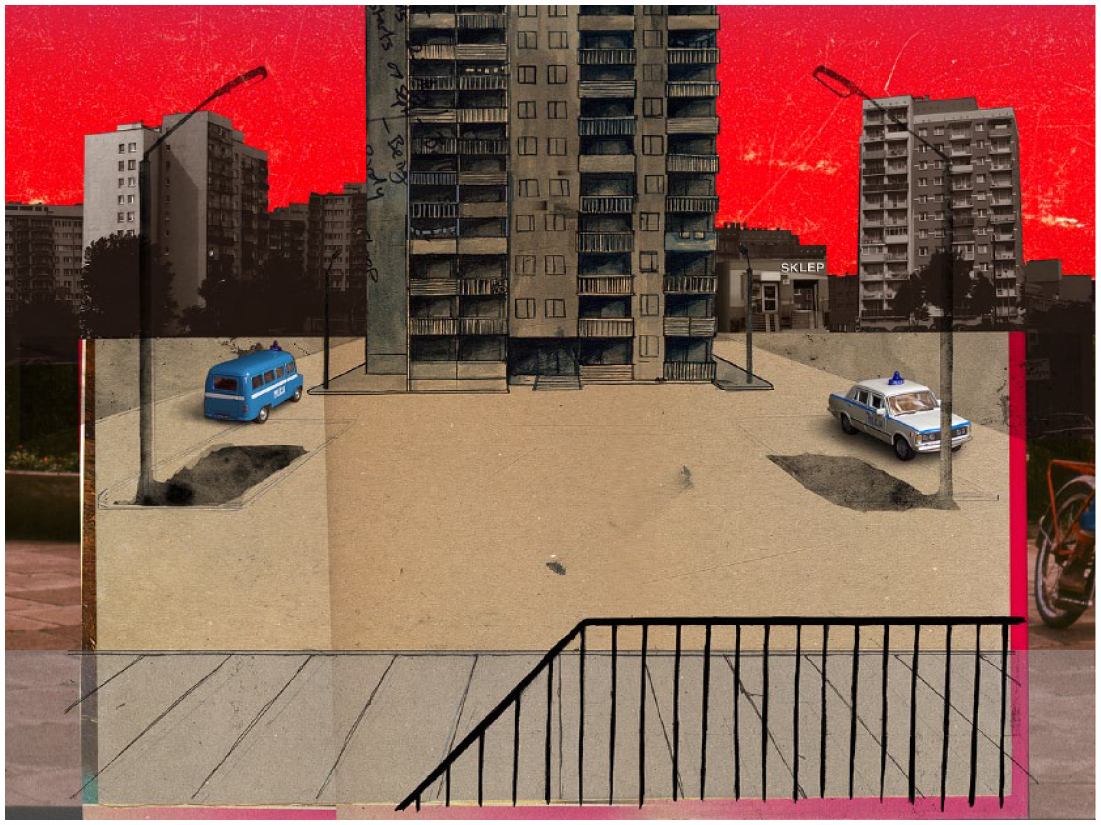
An example of the construction of Polonia’s cinematic space. This set was created using a combination of drawings, scanned cardboard and book textures, photographs and toy cars. Polonia, Lukasz Pater (2023). Digital artwork. © Copyright Lukasz Pater. All rights reserved.
Spatial dynamics
Citing Stephen Heath’s observation that space is ‘used up’ in conventional cinema narrative, Wood (2006: 137) notes that ‘space begins to gain meaning of its own when it no longer solely serves a supporting role by giving meaning to the actions of characters.’ She proposes that animation allows for a re-interrogation of space beyond the cinematic model, as a ‘reverberating’ space, capable of being fluid and mutable, unhampered by either physical or temporal consistency (Wood, 2006: 136). Rather than merely acting as a container or backdrop for character action or narrative, animated space draws attention to itself through distortions and ruptures, appearing and behaving in ways that break with the hyperreal notion of spatial stability and continuity. What is implicit in Wood’s analysis of ‘reverberating’ animated space is that, by breaking with the hyperreal cinematic mode, it acts as a strong indicator of animation’s reflexivity, something that has important implications in a documentary context. Polonia exploits this unique freedom that animation possesses to ‘challenge the limits of the photographic and traditional filmic space’ (Serrazina and Woolf, 2021: 4) by juxtaposing and blending the archival and cinematic spaces to draw attention to the film as a construct.
At times, the cinematic and the archival are directly contrasted. In one of the film’s early scenes, an animation of the 2D avatar of my father putting on his coat is followed immediately by a live action sequence of the actual coat, presented in a quick succession of police ‘mug shots’, revealed to be located in a photographer’s studio (see Figure 3). This sequence not only allows the viewer to see the connection between the archival item of clothing and its cartoon simulacrum but provides a clue to understanding the film’s strategy and ontology as a whole – using the animation and archival material to both reconstruct and construct a historical narrative.
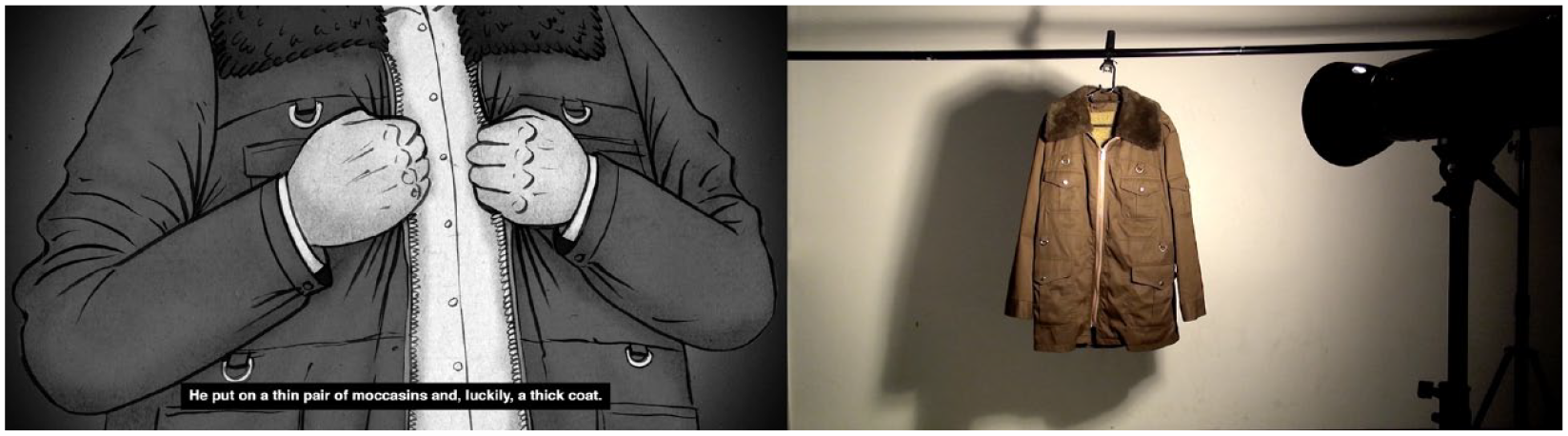
An item from the family archive depicted in both the film’s cinematic and archival spaces, as constructed and indexical–photographic image. Polonia, Lukasz Pater (2023). Composite of screen grabs from digital video file. © Copyright Lukasz Pater. All rights reserved.
In other instances, elements from the archival and cinematic spaces are merged and demonstrate animation’s ability to compress both space and time. Honess Roe (2013: 22) notes that animation, operating outside the indexical limitations of ‘conventional documentary, has the capacity to represent temporally, geographically and psychologically distal aspects of life beyond the reach of live action’. Polish animator Zbigniew Rybczyński contends that time compression can be seen throughout the history of art, from Egyptian hieroglyphs to the Gothic period, where all the stages in the life of Christ were depicted in one image and is a visual representation of ‘how the thought process works’ (Rybczynski, cited in Kremski, cited in Rogoff, 2021: 101). The use of temporal and spatial compression in Polonia is evident in a scene where a postcard of Kurheim Vitagena – a spa resort located near the town of Bad Soden-Sälmunster in West Germany that acted as a waystation for Polish refugees where the Pater and Strzelec families stayed for several weeks in 1982 after leaving Poland – serves as an archival matrix, with each of its windows providing an entry into a cinematic space depicting an animated reconstruction of a historical event. The scene also acts as a ‘call back’ to an earlier point in the film, where the postcard was shown in its original, unadulterated form. Even though the two scenes are not directly juxtaposed, they are framed in a sufficiently similar fashion so that one echoes the other, drawing parallels between indexical images of actual historical spaces and their reconstructed simulacra.
A variation on this and an example of an even more direct merging of cinematic and archival elements is a scene depicting the Pater family’s journey from West Germany to the USA. As with other archival spaces in the film, the ‘set’ is comprised of an assemblage of various archival materials – two Public Domain maps of the USA and California, an aerial illustration of Seattle, an English phrasebook and my father’s 1960 Czech pocket atlas. These items read simultaneously as physical objects and as the volumetric cinematic space of a self-contained ‘world’. The pocket atlas lies open on a spread of the European continent, with the line denoting the border between East and West Germany having been extruded into a rendering of a literal ‘Iron Curtain’, modelled on similar depictions in Cold War-era political cartoons. The extruded wall and the animated characters walking across the atlas’s flat surface result in a conflation of two perspectival views – top-down and orthographic. This conflation of perspectives and orders of space continues as the camera moves over the orthographic landscape to a surfer churning up the water of the Pacific Ocean on a map of California. The discrepancy between spatial categories and perspectival views is resolved in the final shot of the scene, where the map of Seattle, which is both a drawing and an archival document, brings back a single perspective.
The merging of the archival and cinematic spaces also takes the form of a repeated motif of cartoon renderings of narrators’ and non-speaking characters’ hands appearing in frame to directly interact with archival materials. In those moments, the archival object simultaneously exists as an index of the real world and becomes part of the animated film space. This motif also acts as a self-aware reference to Crafton’s (1993: 11) notion of ‘self-figuration’, which he defines as ‘the tendency of the filmmaker to interject himself into his film’, noting that this interjection can be both direct or indirect. In tracing the early history of animation, he observes that self-figuration was at first ‘obvious and literal’, but later developed into a phenomenon that ‘was subtle and cloaked in metaphors and symbolic imagery designed to facilitate the process and yet to keep the idea gratifying for the artist and the audience’. While self-figuration can be understood as having emerged in the earliest days of animation as a consequence of the novelty of the medium and the apparently magical power of the animator to ‘create life’ through motion, in the context of animated documentary it acts as a powerful means of foregrounding animation’s constructedness by signalling the meta-presence of the filmmaker. This presence, even if manifested subtly, acts as a centrifugal force by calling viewers’ attention to a world outside the frame of the screen.
In Polonia, various permutations of self-figuration are used as a reflexive strategy and form part of the broader dynamic between the archival and cinematic spaces, the indexical and the constructed. In instances where cartoon hands interact directly with archival materials, they can be understood literally as the intrusion of elements from the film’s cinematic space into its archival space, but also act as a proxy for the hands of the filmmaker and allude to the symbolism of hands as tools of industry and creation. At two other points in the film, the self-figuration is literal: when the film introduces the town of Bad Soden-Sälmunster and the Vitagena spa, the filmmaker’s digitally-composited live-action hand enters the frame, placing one postcard over another and, in an earlier scene, when Solidarity internees are shown arriving outside a prison located in surreal fashion on the moon, a photograph of the filmmaker’s hand – using a digital version of the paper cut-out animation technique – reaches down and lifts up the roof of the prison to remove its inmates (see Figure 4). In the first instance, the interjection signifies a literal ‘breaking of the fourth wall’. In the second, the signification is more complex, as the hand is an animated element and, in the context of a fantastical scene, serves both as a means of self-figuration and as a symbol of Poland’s authoritarian government manifesting as a god-like entity with the power to literally reach down and forcibly act upon its citizens.
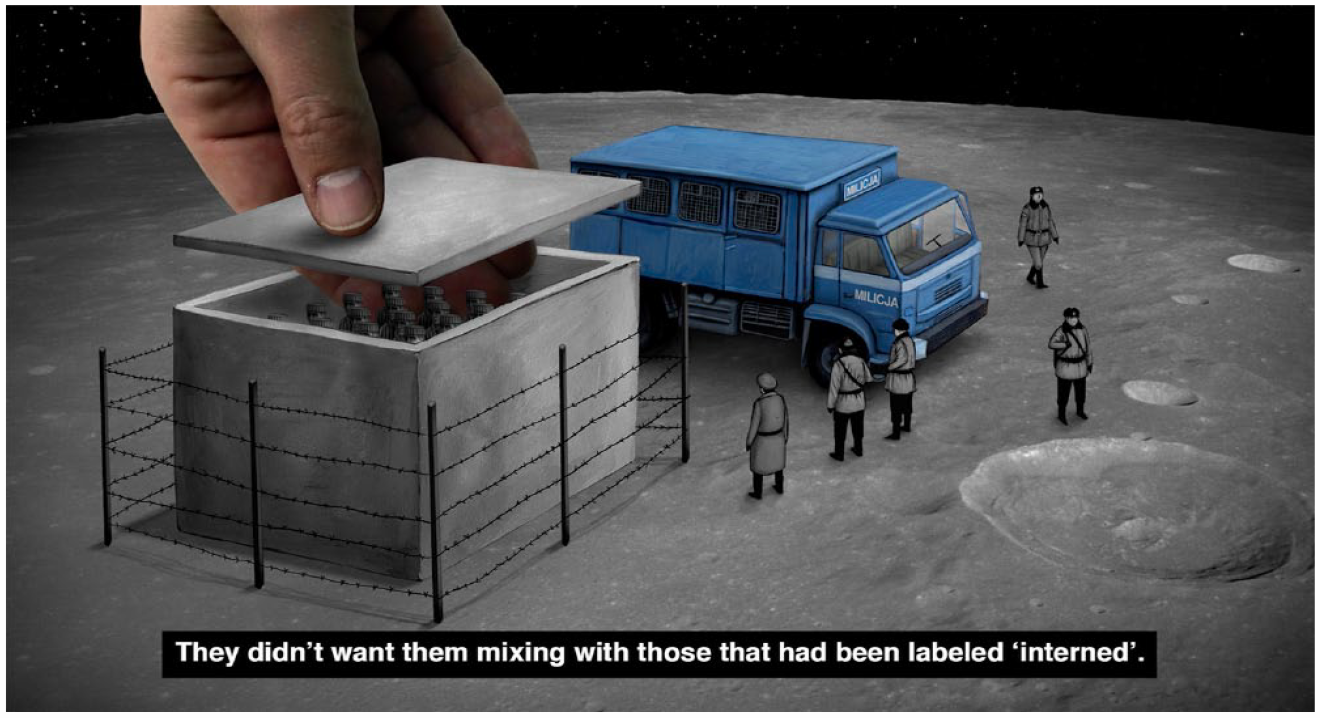
An example of self-figuration in Polonia. Polonia, Lukasz Pater (2023). Screen grab from digital video file. © Copyright Lukasz Pater. All rights reserved.
Other instances of what may be considered a form of self-figuration that blurs the boundaries between the ontology of the cinematic and archival spaces is the seemingly autonomous movement of some of the archival materials. While, for most of the film’s duration, its archival materials remain inert, there are a few instances in which they spring to life and move of their own volition, interacting with one another and moving so as to reveal new information on-screen. This destabilizes the notion of the archival space as ‘real’: while it is comprised of indexical images in the form of both photographs and scans of real objects, the space itself is subject to the same limitations and possibilities as any other part of the filmic construct. By investing the materials with a self-propelling animus, the archival space ceases to be a mere display of evidentiary material and announces itself as a living, dynamic part of the broader filmic space.
Mimicry and fakery
The distinction between archival and cinematic elements blurs further with the introduction of a category of artefacts in Polonia that photo-realistically mimic period-specific printed matter. This goes beyond mere stylistic allusion and includes artefacts that might at a glance be confused with genuine archival material. Each of these ‘fakes’ represents a liminal space that sits between the archival and cinematic spaces, and can be understood to exist along a spectrum from ‘photoreal’ to ‘transparently manufactured’. Their position along this spectrum is not fixed and is subject to individual viewers’ perceptions, dependent on their knowledge of language, culture and digital image manipulation.
These ‘fakes’ fall into two distinct categories. The first of these are designs that almost exactly mimic extant archival materials. These were created in order to substitute genuine archival images that could not be used either due to copyright restrictions or a lack of availability of images in the public domain at a sufficiently high resolution. They are analogous to a drawing of a branded item (such as a can of Coca Cola) in a comic book, or perhaps a realistic prop in a live action film. Their purpose is to communicate iconically within the context of the film’s narrative world and to help accurately recreate the visual tone and feel of an era. If they are mistaken for actual archival material, they do not carry enough weight as ‘documents’ or ‘evidence’ for this to have any ethical bearing on the film’s documentary veracity. They also lack the grain, texture and blemishes of genuine archival materials.
The second category comprises artifacts that modify extant archival materials to alter their content. These designs blur the distinction between the film’s archival and cinematic spaces by taking existing archival materials and altering their content while maintaining their overall aesthetic and textural qualities, with the change in content serving a narrative and/or semiotic function. One example of this is an old Polish People’s Republic-era paperback novel shown during a sequence where my father speaks about the prison library in Ostrowo Prison, where he was interned. The book was chosen for its weathered appearance and evocation of Communist-era Poland and was digitally altered with a new cover illustration and title (see Figure 5). Throughout the film, several other archival books were similarly altered to serve an aesthetic and narrative function. The choice to use books as the artefacts being altered alludes to the notion of documentary as narrative and the narrativization of memory referred to by the authors of Animation and Memory (Van Gageldonk et al., 2020: 1–2).
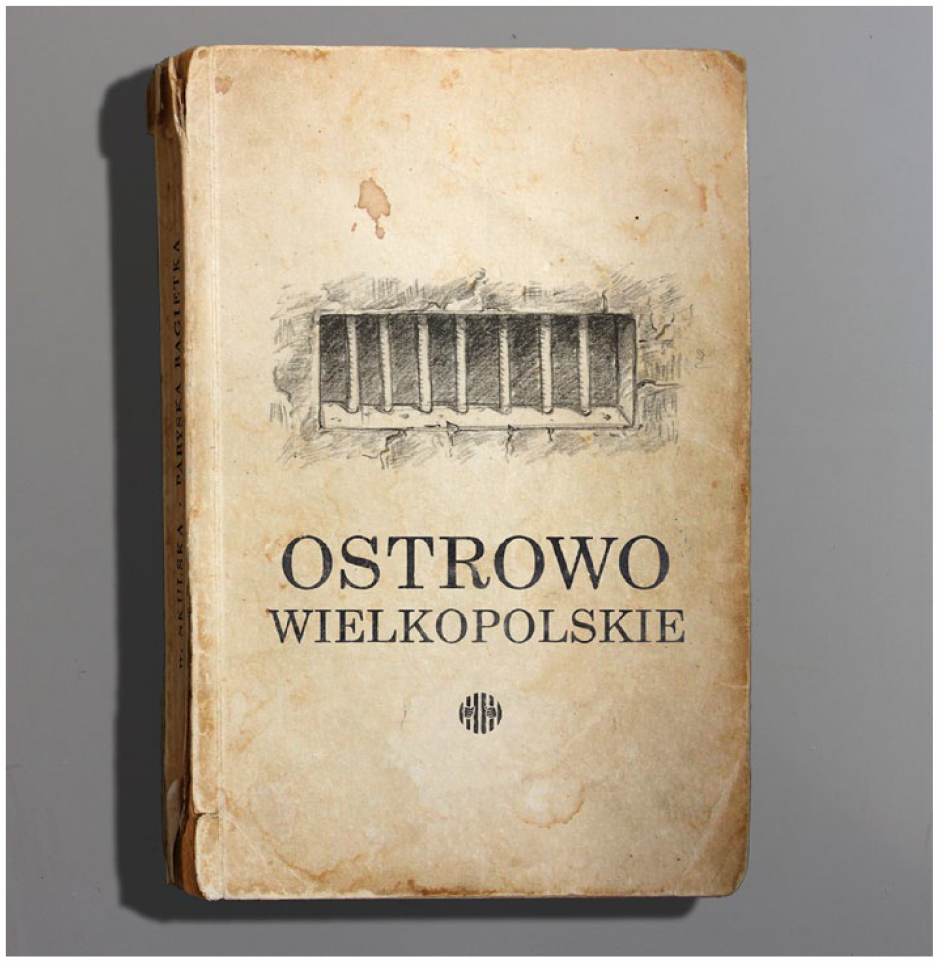
An archival ‘fake’. The book’s title, OSTROWO WIELKOPOLSKIE, is the name of the prison where my father was interned as a political dissident during Poland’s period of Martial Law. Polonia, Lukasz Pater (2023). Digital artwork. © Copyright Lukasz Pater. All rights reserved.
While the altering of archival materials to serve a narrative and iconographic function may be justified, the seamless mimicking of the grain, texture and aesthetics presents a challenge to the film’s ontology that must be addressed. ‘Fakery’ as a semiotic strategy has precedence in the documentary genre, albeit mostly in what are termed ‘mockumentaries’. In 1978, Eric Idle – a founding member of the Monty Python comedy group – wrote and co-directed All You Need Is Cash, a mockumentary that traced the fictional biography of ‘the Rutles’. It was an obvious spoof of the Beatles, but also of the documentary genre itself, particularly as it manifests in its expository mode. The film created an alternate world for this fictitious group that in minute detail paralleled that of the Beatles, with songs, album covers, memorabilia, newsreels and television interviews all presented as genuine archival material, each a comedically-intentioned simulacrum of a real-world referent from the Beatles archive. An example of how the film uses artifacts that mimic the form of specific archival materials but alters their content can be illustrated by a scene where the group announces the formation of ‘Rutle Corps’, an obvious analog for the Beatles’ Apple Records, with the Rutle Corps logo of a peeled banana on a black ground a clear stylistic reference to and subversion of the Apple Records logo of a green apple. Besides creating this comedic version of the real world, the film blurred the line between reality and fantasy even further by conducting ‘serious’ interviews with Mick Jagger and Paul Simon about their experiences with the Rutles and included George Harrison – an actual member of the Beatles – in the role of a television reporter.
It may seem unsuitable to use mockumentary as a benchmark for what material can be included in a documentary as its very denotation implies a falsification or distortion of fact, but I would argue that the subgenre is premised on being inherently reflexive. All You Need Is Cash is only effective as comedy if the audience is already familiar with the biography of the Beatles. The deeper the knowledge of the referent, the more comedic details can be identified and enjoyed in its manufactured spoof. The more stylistically accurate and ‘texturally authentic’ the elements of the mockumentary, the more humorous are the changes made to them in order to poke fun at the genuine article. If a documentary provides the correct context for its use of simulacra of archival materials for the audience to understand that what they are seeing is not real, then meaning can be generated without sacrificing documentary veracity.
Including artifacts in Polonia that blur the boundaries between authentic and altered or manufactured archival materials was done in a spirit of play and experimentation, testing the limits of how blurry these boundaries could be while still maintaining documentary veracity through a highlighting of the film’s constructedness. I believe that, in most instances, the ‘fake’ archival materials in Polonia can be identified as being inauthentic. Each one, either on the face of it, or on closer inspection, has a ‘tell’, some detail that reveals it to be manufactured, a digital manipulation, part of Polonia’s fantasy element and not its actuality. More importantly, context often reveals that the item is a manufactured prop. In the case of the book shown in Figure 5, it opens to reveal an illustration of a prison guard which then crossfades into an animated sequence of that same guard, showing the book to be a manufactured element functioning as staging for cinematic action (see Figure 6). While a casual or inattentive viewing of the film may result in a mistaking of the manufactured items for genuine archival materials, closer inspection will reveal them to be constructed narrative devices.
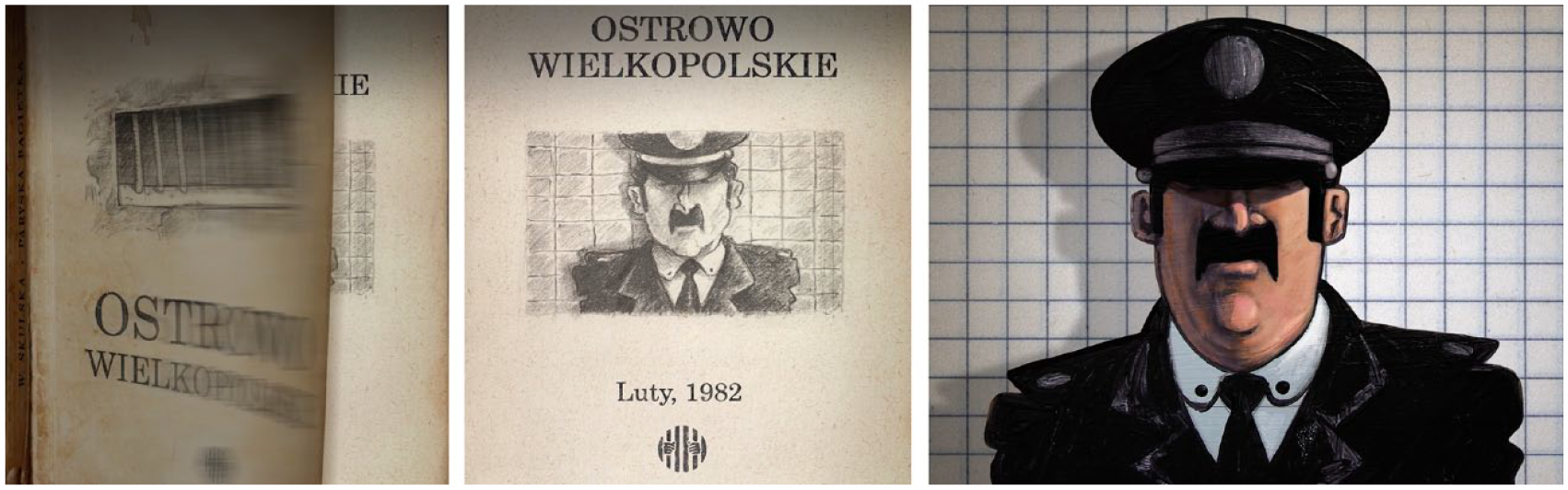
Details from the animated sequence of the OSTROWO WIELKOPOLSKIE library book. Polonia, Lukasz Pater (2023). Composite of screen grabs from digital video file. © Copyright Lukasz Pater. All rights reserved.
According to Nichols (2017: 19), ‘documentaries are what the organizations and institutions that produce them make.’ He claims that, by satirizing the formal conventions of documentaries, mockumentaries can reveal how these institutional frameworks guide the production of documentaries and thus allow audiences ‘to gain new insight into taken-for-granted conventions’ (Nichols, 2017). In a similar way, including ‘falsified’ archival materials (that nevertheless can, in most cases, be spotted as manufactured through various ‘tells’) highlights the potential superficiality of archival material as evidence or proof, when used aesthetically rather than substantially and can, when executed correctly, act as a form of ‘defamiliarization’, encouraging critical spectatorship.
Conclusion
As noted by Ehrlich (2021: 200), animation finds itself in a unique position due to the conditions of our current media and technology landscape, with audiences seemingly willing to consider it as a legitimate documentary medium like never before. This openness towards animation is predicated both on animation’s ability to clarify complex information and on the medium’s reflexive highlighting of its own constructedness. Implicit in this self-reflexivity is animation’s admission of its limitations in representing objective truth. The trust that audiences place in non-fiction animation challenges filmmakers to respond both creatively and responsibly in the ways they use this medium to represent and speak about our world.
The delineation of the processes of reconstruction and construction, manifested here as the taxonomic order of archival and cinematic ‘spaces’, is relevant not only to animators directly engaging with archival materials, but provides a useful matrix for anyone working within the animated documentary form, if one considers ‘archival material’ as any audio-visual element with an indexical link to the historical world. This taxonomy assists in identifying how the historical world is represented within an animated documentary and how archival and wholly manufactured elements combine in communicating a non-fiction narrative, reflecting Grierson’s (1933: 8) notion of documentary as ‘the creative treatment of actuality’. In this schema, archival elements are the basis for animated documentary’s credibility, serving as indexical evidence of events that occurred in the historical world, while its cinematic aspects narrativize these events. Conceptualizing a film’s archival and cinematic elements as ‘spaces’ both acknowledges that the film creates a virtual world into which audiences enter and inhabit, while emphasizing the film’s materiality and constructedness. A clearly defined taxonomy allows the filmmaker to maintain boundaries between those elements of the film that are evidentiary and those that are interpretative, granting them the freedom to experiment creatively, resist hyperreal immersion and maintain documentary integrity.
Footnotes
Declaration of conflicting interests
The author declared no potential conflicts of interest with respect to the research, authorship and publication of this article.
Funding
The author received no financial support for the research, authorship and publication of this article.