




Abstract
VFX (visual effects) breakdowns are short ancillary videos that advertise the digital animation work undertaken by a VFX company for a particular film or television programme. Claiming to take viewers ‘behind the magic’ of VFX, breakdowns disassemble a wide variety of shots and sequences, and point to the extensive use of computer-generated imagery in contemporary blockbuster cinema. But, as much as breakdowns reveal some illusions, they conjure others. Breakdowns operate in a register of speed, fluidity and efficacy, showing neither the many people nor the extensive periods of time that it takes to painstakingly generate all these VFX. In this article, the author reveals how the omission of labour and duration in VFX breakdowns both reflects and contributes to a broader (mis)understanding of digital effects as immaterial, instantaneous and magical. His case study is Spider-Man: Far From Home (2019), a film that links VFX with magic, evokes the breakdown in some of its spectacular visuals, and even outright villainizes those effects artists who seek fair recognition for their work.
In the finale of Spider-Man: Far From Home (2019) our hero must run a gauntlet of illusion to stop the villain and halt his evil plan. A small army of airborne drones stands between Spider-Man and Mysterio, each one equipped not only with deadly machine guns but even deadlier holographic projectors. As a cavalcade of visual deceptions stream forth from these drones, Spider-Man’s only hope of survival is to trust his nascent ‘spidey-sense’ instead of his eyes. Ploughing into visual chaos, he tears through mirage and machine in a dazzling, kaleidoscopic display of acrobatics and destruction.
Viewers who might wish to know more about this spectacular scene can consult a VFX breakdown released by visual effects studio Sony Pictures Imageworks to showcase its work on the film (ImageworksVFX, 2020). In this two-minute breakdown – subtitled ‘Drones’ and available on the Imageworks website (Anon, n.d.) as well as YouTube – shots from the sequence are interspersed with glimpses at the production process, in particular the various stages and processes of digital animation. We witness a flurry of digital image components being generated, layered atop one another and detailed with an array of textures. Spider-Man’s run down the corridor from the finished film is here supplemented with onscreen swipes through which earlier iterations of the shot and its various digital elements appear and disappear, and the overall shot disassembles and re-assembles. The result is an apparent revelation of the scale of the work that goes into such an intricate piece of VFX imagery.
This VFX breakdown is typical of the form: it is a short supplementary video which effectively deconstructs images from a final released text in order to communicate the skills of a given VFX company. Circulated in corporate boardrooms and shortlisting meetings, the purpose of such videos is primarily client generation and awards solicitation (Cram, 2012: 171). But breakdowns have a life beyond these relatively narrow contexts. They are not only accessible through corporate websites, but also as added ‘special features’ on DVDs, Blu-rays and online libraries such as iTunes and Apple TV, and appear in force on streaming sites like YouTube and Vimeo. In these latter online venues, they are not so much about celebrating the companies responsible for the VFX work (say, Industrial Light and Magic) than they are about advertising the media texts to which they are appended. Accompanying a vast majority of contemporary blockbusters, they point to the extensive use of digital effects in these films and the importance of these effects in cinema’s visual economy of spectacle. Whether watched by Awards committees or general audiences, they purport to take their viewers ‘behind the magic’ of VFX, revealing the way these tricks are achieved.
Despite being a key site in which VFX become visible as effects, breakdowns have received little academic scrutiny (Jones, 2021). Certainly, they are often referenced as sources that reveal how certain VFX have been completed, but an analysis of the specific ways in which breakdowns conceive of VFX and the fundamental work processes of creating VFX is absent. This is like taking a film trailer as a true and accurate picture of the film itself – useful in a pinch, but potentially very misleading. I aim to redress this deficiency of academic attention here, placing breakdowns in the context of other ‘making-of’ material, then exploring their aesthetic approaches and the impacts these approaches have on our cultural understandings of digital effects and digital effects labour. VFX breakdowns use techniques like wipes, freeze frames, layering and rotating digital models to demonstrate various facets of the digital effects that are present within a particular shot or sequence. But if they pull back the magician’s curtain by showing us what is VFX animation in an image and hinting at the processes that have produced these VFX, they nonetheless perform another magic trick they are not even telling us about, as the mode of delivery adopted by the breakdowns vanishes away the people, places and labour time required to undertake VFX work. I explore this territory through a look at the longer history of ‘making-of’ supplements, and then at VFX practices today, taking up Life of Pi (2012) as a key example of fraught working conditions. This then leads me to return in the article’s final sections to Spider-Man: Far From Home, a film which is oddly reflexive about these issues. Through explicitly villainizing the figure of the VFX labourer seeking credit for their work, Far From Home engages with the visuality of VFX breakdowns as well as the conditions of VFX production and common (mis)perceptions about the role of animators. But by placing these concerns centre stage, this piece of spectacular and Manichean entertainment also conceals their cultural and industrial importance.
Now you see it
Digital VFX are not always visible as such, but they are not always exactly invisible either. Their use in contemporary cinema is highly varied: VFX are both marauding alien armies in a blockbuster, and digital set extensions or the erasure of signs of modernity in a contemplative period drama. Yet, whether grandiose or subtle, additive or subtractive, their presence in any given film can be rendered visible through their discussion in extra-textual material. Audience awareness of effects as effects may vary according to a range of factors (including media literacy and levels of interest in digital processes), but the presence and scale of effects become explicit in a range of ancillary texts. These include reviews and video essays which comment on their success (or failure); extra-textual clips like interviews with filmmakers; on-set photography and footage (which reveals greenscreen stages and wires); specialist magazines and websites (such as Cinefex and fxguide); and, of course, promotional VFX breakdowns. All these sources are useful to scholars for exploring the use of VFX and their visual, narrative and economic functions in 21st- century filmmaking.
Nonetheless, as sources circulated by and through journalistic and industrial networks, the claims made by these sources need to be approached with a critical eye. In her research on print periodicals like Cinefantastique, Michele Pierson (2002: 2) notes how these commercial magazines were crucial ‘in the social formation of cultures of special effects connoisseurship, appreciation, and fandom’, not only providing information but creating, nurturing and boosting certain forms of effects production and ways of thinking about them throughout the 1990s. Pierson’s extended study usefully investigates how it is somewhat problematic to apply knowledge gleaned from such sources without considering exactly what kind of knowledge is being offered and how it has been structured to emphasize certain factors and downplay others. Yes, these publications make effects work visible, but they do so in culturally proscribed and historically contingent ways.
This claim is recapitulated in more recent work by the likes of Barbara Klinger, Dan North and Chuck Tryon, who all show how ancillary making-of materials not only inform audiences of technical processes and trivia, but also, in the process, steer our interpretation of these processes. In such content, the viewer is addressed as an ‘insider’ with access to specialized knowledge (Klinger, 2006: 72–73). However, this address invariably places greater emphasis upon ‘aesthetic appreciation’ than on ‘critical engagement’ (Tryon, 2009: 18). It also ‘craft[s] a particular reading of [a] film’, one sanctioned and indeed usually controlled by the production studio or related industry structures (North, 2008: 179). As Klinger (2006: 73) in particular sums up, the revelations found in making-of content, far from demystifying production work, instead
produce a sense of the film industry’s magisterial control of appearances. Rather than inciting critical attitudes toward the industry, then, behind-the-scenes ‘exposés’ vividly confirm Hollywood as a place of marvels brought to the public by talented film professionals . . . Viewers do not get the unvarnished truth about the production; they are instead presented with the ‘promotable’ facts, behind-the-scenes information that supports and enhances a sense of the ‘movie magic’ associated with Hollywood production.
For Klinger, ‘promotable facts’ are key talking points that echo across the various making-of supplements for a particular film or franchise, reinforcing themselves ad nauseam (the proclaimed authenticity of Andy Serkis’s mo-capped portrayal of Gollum in the Lord of the Rings trilogy, 2001–2003, for instance, or statements about the hyper-detailed flora and fauna of Avatar’s, 2009, entirely digital Pandora).
Take The Matrix (1999), for instance. A significant moment in VFX history, this film was also a watershed text in terms of its use of DVD special features and in-film interactivity, with the initial DVD release offering promotional interviews and a series of short on-set clips accessible via the film itself. This material features a range of visible bodies (actors, directors, stunt choreographers, camera operators, gaffers, etc.), the sound of people calling ‘action’ and ‘cut’, and a sense of the general ambience and logistical challenges of an action film set. The promotable facts here include the use of greenscreen, the complexity of the stunts and, in particular, the use of a ‘bullet-time’ camera rig for key shots. More generally, though, what is promoted here are the film’s cutting-edge qualities and its integration of new digital processes with on-set stunt work. We are invited to interpret The Matrix as a technical challenge, brilliantly accomplished by dedicated individuals, and as a pioneering suture of digital imagery and on-set photography.
This kind of making-of makes clear claims about the production of a specific media text. But we can broaden this concept of ‘promotable facts’ beyond the use of, say, bullet-time by a specific film, and use it to think instead about the processes and labour of production itself. As Klinger (2006: 73) implies, behind the scenes footage such as that which accompanied The Matrix treats the viewer like a visitor lurking on set, or a privileged individual getting direct knowledge via interviews with key personnel. As such, it situates revelations as originating behind the camera, around the margins of the production process and from above-the-line creative workers. VFX are made visible as the result of labour undertaken by many people, labour which involves not only computer programming but also greenscreen shooting, actors, stunt people and designers.
While still a key part of film promotion, this sort of material is now supplemented, and often greatly overshadowed, by the VFX breakdown. A product of the increasing importance of visual effects in blockbuster filmmaking, the rise to prominence of the breakdown traces the shift from predominantly analogue to predominantly digital mainstream commercial filmmaking (and effects). This shift displaces what were often highly visible auteur effects creators in the 1970s and 1980s (such as Douglas Trumbull, Stan Winston and Phil Tippett), replacing them with a less human-centred view of the now computational production process, a view that is seemingly more suitable for the digital age. 1 This change also aligns with transformations in animation generally, as the hand-drawn, implicitly artisanal production methods of the 20th century are replaced in mainstream feature films with digital workflows and aesthetics (Sobchack, 2009). This is another step in what Scott Bukatman (2010: 139) has described as the receding presence of the animator, who is ‘superseded by increasingly autonomous characters’. Digital animation, from its inception, did in some ways seek to retain impressions of craft achievement and human agency: as Holliday (2019: 160) notes, early computer-enabled animated films ‘emerged out of a particular industrial context that framed revolutionary digital processes as nonetheless rooted in the kinds of pre-digital labour skilfully produced by hand’. And yet, he goes on, the computer also ‘interpolates and obfuscates the animator’s expertise and talent too forcefully, with its resultant images too seamless and “well-crafted” to be considered the product of craft at all’ (Holliday, 2019: 164). Darlington (2018: 1247) agrees, stating that ‘an aesthetic of [craft] concealment has become directly synonymous with quality in 3D [computer] animation’, a phenomenon which he rightly notes has significant consequences for cultural understandings of work, labour and artistry in relation to this medium.
So, while breakdowns are related to making-ofs, they operate in quite a different way, and exist within a digital animation environment of displaced or invisible authorship. Moreover, they appear concurrently and within the related rise of online digital spaces for the promotion and discussion of mainstream media (such as YouTube), and so circulate within a streaming ecology geared around a ‘snack culture’ of briefer, snappier, more visually eye-catching content (Tryon, 2009: 153). They still propagate a series of ‘promotable facts’ and conjure discourses of the ‘magic’ of film production, but the increasing prevalence of digital animation in cinema has created a slightly different kind of magic, one whose ‘marvels’ seem self-perpetuating. Breakdowns reveal the tremendous amount of work that goes into contemporary digital image production, but they also vanish away the people, places and labour time required to undertake this VFX work.
Now you don’t
VFX breakdowns do not consist of behind-the-scenes footage, as it would traditionally be described, and do not orient their material through visible or aural human agents: they have no host, rarely use onscreen text or voiceover and offer no talking heads. Instead, they take finished images and explode them for scrutiny like diagrams. Swipes which glide across the image add and subtract layers of information, reveal digital elements like characters and atmospherics, and revise textures. Actors glimpsed on greenscreen stages wearing motion-capture suits are dropped into VFX surroundings, their mo-cap suits visibly replaced by a digital costume of some sort. Objects with apparent physical weight turn into translucent wireframes and the various pieces that make up their final form are isolated, removed and/or rotated. The finished shot’s camera positioning and movements may be retained, or the breakdown may freeze the shot in order to turn it into a kind of three-dimensional digital space, with the virtual camera now swooping through and around computer-generated objects in the manner of virtual cinematography (Jones, 2013). All of this shows us the presence and scale of VFX in a given text.
For instance, in the VFX breakdown for Digital Domain’s work on Black Widow (2021), various shots from the climax in the ‘Red Room’ are unpacked (FilmIsNow Movie Bloopers & Extras, 2021). This airborne facility is shown to be a complex digital effect thanks to depictions of it as a wireframe schematic and a pre-textured model, as shown in Figure 1. Four panels are included onscreen at once in order to show the various stages of the model’s creation, including a white polymer version, a more detailed iteration, something close to the final render and a separate explosion which will be superimposed onto the model in the final shot. All of these rotate in a kind of abstract computational void represented by the black background (if the structure ever existed as a physical model for either filming or digital scanning, this is not shown). As this part of the breakdown continues, visual wipes add smoke and fire effects to this model, and insert a background of blue sky and clouds. Explosions erupt upon the surface of the Red Room, then freeze, the virtual camera of the breakdown subsequently moving through the scattered, hovering rubble; the textures and detailing of this debris are swiftly stripped away, then re-imported before the shot plays through again. Actors Scarlett Johansson and Florence Pugh are shown running and jumping on green and bluescreen stages, their faces and bodies then composited into these spectacular VFX environments.
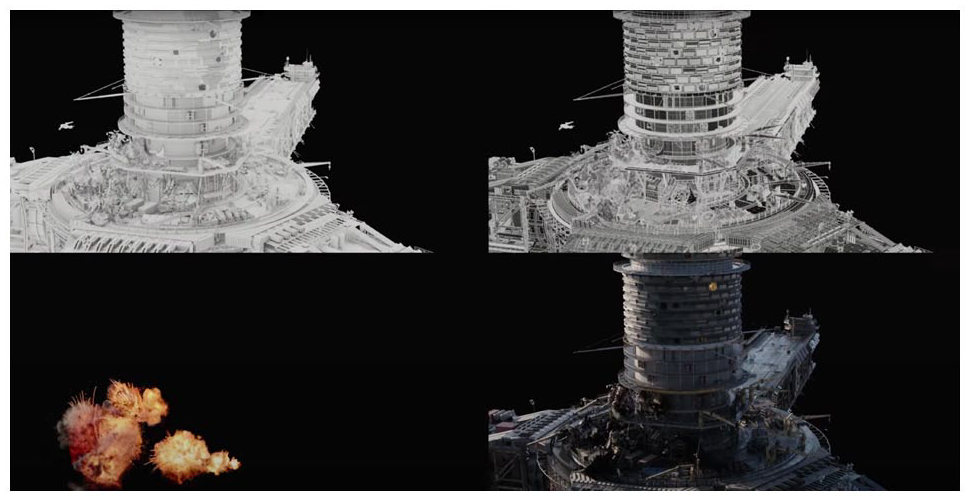
The ‘Red Room’ facility in Black Widow (2021) is broken down in a VFX breakdown of Digital Domain’s work on the film. Frame grab from FilmIsNow Movie Bloopers & Extras (2021).
For all that is revealed of Black Widow’s VFX in this short video, this breakdown is typical of the form in that it does not show viewers any of the people involved in the creation of these images. As Figure 1 demonstrates, what is visualized are models, schematics and digital elements alone. Is this an inevitable consequence of this form, which focuses on these digital processes rather than their enactment? Perhaps, but even these processes themselves are in some ways elided, as the breakdown also avoids showing many other aspects related to the design and implementation of VFX imagery, most obviously the use of drop-down menus and numerical instructions when undertaking any work in a software package. Rendering time – a major factor in any complex and bespoke VFX work – is also conjured away: all these fragmentations, rotations and swipes occur quickly, often too fast to really grasp the information that seems to be delivered in any particular segment of the breakdown.
While it is always risky to argue from a negative, these elisions lead me to suggest that, as a textual form, the breakdown asserts that all the information needed to understand the visual effect is contained within this final composite’s many layers, not in some surrounding production environment or infrastructure. If making-of material zooms out from the finished image to show the work that produced this image (the wires, the lights, the camera crew, the soft mats), the VFX breakdown zooms into the image to show the digital work of which it consists, a subtle but important distinction. Screen space replaces workplace as the focus of interest and, while viewers may be hailed as insiders of sorts, the absence of commentary or annotation means that these images alone guide how we are to read them. In this context, the speed and grace of the images implies a rapidity of production, while the relentless movement towards a final version implies relatively simple accretion of detail. 2
This seems to be a kind of autonomous digital universe, one that assembles and reassembles itself at will, and instantly. The promotional context of breakdowns may seem to demand this kind of presentational mode – they are spectacular exhibitions of digital possibility after all, not Warholian depictions of mind-numbing render times. Nonetheless, these representations do shape perception of effects production more generally. Breakdowns show the presence of VFX, but they also perform the creation of VFX, a performance which is a kind of posthuman rollercoaster of speed and algorithmic processing.
Before addressing the consequences of such purported autonomy on the actual labour of VFX production, it is necessary to address how this presentation aligns with ideas of the digital image’s apparent or presumed virtuality. Digital effects, detractors so often complain, are not real. Reviewers disparage the weightless fakery of CGI, in comparison to practical alternatives (see Rehak, 2018: 193–194). An animatronic dinosaur is something that actors can touch and respond to, and which viewers can perceive is a material creature, albeit a prosthetic one; a digital dinosaur, no matter how convincing, might seem to be from a separate, non-physical realm (Rodowick, 2007: 177). When contrasted to the material realities of actors, sets and practical stunts, digital effects apparently lack concrete grounding, which changes the perception of them as objects. This presumed virtuality of VFX relates to broader discourses that juxtapose the concreteness of physical shooting and analogue media on the one hand, with the apparent ephemerality and non-materiality of digital imagery on the other. As Wood (2020: 78) argues in her own work on VFX, ‘designations of realness are often contoured around physical reality’, meaning that digital effects, because they are not physical objects captured by the camera, are inevitably associated with the virtual. Likewise, for Hye Jean Chung (2017: 25), digitization ‘is all too often regarded as a process of dematerialization because the object no longer retains its physical form’. The tension this creates for understanding (and crediting) digitally-enabled or -augmented performances is described by scholars such as Mihailova (2016) and Bode (2017), who chart the negotiations of agency between actors and animators that play out in popular discourses around film franchises like Lord of the Rings, Planet of the Apes (2011–2017) and Avatar.
If VFX seem to evade materiality, scholarship can amplify this presumption: witness an influential piece by phenomenological film scholar Vivian Sobchack originally published in 1994 on electronic and digital imagery which emphasizes the immateriality and weightlessness of such media. Proposing that they lack gravity and a situating sense of the body, Sobchack (2004: 152, 159) questions the potential for ethical and emotional investment in digital effects and digital media more generally. A statement about the aesthetic signature of then-emerging digital media, we can see how such a commentary might also propagate an idea that these images require little material or human investment.
This perspective, much expanded upon in the following decades, disregards not only the ‘objectness’ and materiality of digital effects themselves, but also the labour and infrastructure required to produce them (Wood, 2020). Wood pushes against this by thinking of VFX images as ‘transcalar objects’, a model which seeks to highlight in part the materiality of their production:
[VFX] are created within a wide-reaching framework, which takes in the changing dynamics of labour in studio pipelines, a global spread of software-based industries, the environmental costs of high computational loads for simulations and render farms, the development, design and implementation of software, the agencies of digital objects, as well as the narrative possibilities of digital images. (p. 96)
It is easy to ignore much of this framework thanks to the virtual nature of VFX. The result is a problematic perception of VFX work. In Chung’s (2017: 27) description, ‘the assumption of dematerialization becomes a high stakes issue for all when the abstraction of material objects into numeric symbols that occurs in the digital process is transferred to the abstraction of human labor.’ Equating the absence of onscreen labour – the work of an actor, the exertion of a stunt performer, the practical efforts of a set constructor – with the absence of labour tout court, the digital effect’s apparent lack of materiality erases the work involved in the effect’s manufacture, as well as the people undertaking this work. 3 As Chung stresses, these digital images and the digital files that hold them are ‘still embedded in, and [have] repercussions on, the historically and geopolitically specific material conditions of media production, distribution, exhibition, storage, and maintenance’ (p. 25).
If ideas of virtuality and ephemerality allow these conditions to be ignored, then so does a certain kind of magical thinking. The slippage between VFX and magic is always near at hand, from the name of leading company Industrial Light and Magic to the thousands of articles published in the popular press which praise VFX ‘wizardry’. This association may seek to furnish these effects with a sense of wonder and enchantment, and even to connect them to cinema’s earliest trickster the magician-turned-filmmaker George Méliès, but such a manoeuvre is ultimately detrimental to VFX artists (Chung, 2017: 26). Thinking of VFX as sorcery veils the conditions of VFX production, changing computer-generated imagery from something produced by people over time to conjurations that are instant and inexplicable.
Breakdowns contribute to all this. Wood (2020) explores the creation of the toxic storm sequence in Mad Max: Fury Road (2015), an effect which was achieved in part using a particle animation software appropriately called Houdini. Quoting several IndieWire and Cinefex interviews with the film’s artists and designers, Wood reveals the many creative decisions involved in generating and finessing these digital effects, including the writing of entirely new software programs. While not unusual for a large-budgeted film, this is framed by the interviewees from relatively small effects house Iloura as a (thrilling) challenge (pp. 91–92). 4 However, in Iloura’s VFX breakdown for their work on the film, this work is not foregrounded. Moving quickly between shots – giving each less than a second on screen – the breakdown shows glimpses of pre-textured storm elements and occasional bursts of particle clouds against a black background, but tends to switch between footage captured on greenscreen stages and the film’s finalized imagery (FilmIsNow Movie Bloopers & Extras, 2016). 5 The storm becomes just another iterative digital element, the creative decisions and time-intensive work that led to its manifestation being elided or shown at best in an extremely truncated, purely gestural and hardly enlightening fashion.
Again, this might not be surprising: breakdowns are not designed to provide their viewers with a detailed explanation of the way specific software programs have been employed on a particular production. They do not seek to explain the decision-making involved in the use of this software, or the hours of work required to do everything from simple compositing to fine-grained visual finessing. Breakdowns, in short, are not tutorials, nor are they documentaries. Nonetheless, breakdowns do claim to shed light on the composite nature of digital imagery and, in their mode of address, they conjure a world in which these time-consuming and complex parts of the process of VFX creation are of no significance.
Presto chango
The breakdown for work undertaken by Rhythm & Hues on Life of Pi (2012) shows familiar content: actors perform on green-and blue-screen stages; oceans and storms slide into the image from the top or bottom of the frame; various layers of atmosphere and rendering detail appear one after in quick succession; a virtual camera swoops in a graceful, quick arc around a frozen digital model (Tuts+ Motion Graphics, 2013). Most likely seen by members of Academy Awards as part of their shortlisting and voting process, this breakdown is partly responsible for the film winning the Oscar for Best Visual Effects in February 2013 – mere days after Rhythm & Hues laid off nearly a third of its employees and filed for chapter 11 bankruptcy.
This much-discussed concurrence revealed for many outside the industry the precarious place of VFX houses and the challenges of working for them. As Leon Gurevitch (2016: 190) discusses, bankruptcy is not unusual in this sector, partly because of the high costs and risks of extensive software research and development. But the industry is also marked by its economic and political conditions of emergence, conditions which impact its workers:
As an offshoot of the software industries, this deregulated, post-Keynesian occupation was born into an environment of insecurity, ‘flexploitation’, and outsourcing of employment to the semi-self-employed ‘creative class’. Consequently, like many other arms of the information technology (IT) industry, the VFX industry accepted operational instability to some degree as the norm. (p. 191)
What does this environment have to do with the strategies of VFX breakdowns described above?
In explaining the company’s bankruptcy, former Rhythm & Hues employees point to the sometimes fraught, sometimes exploitative and sometimes misguided relationships between VFX houses, film studios and above-the-line creative personnel. In an interview for the collection Voices of Labor (2017), Rhythm & Hues VFX artist Dave Rand outlines how he spent three months using Houdini to add rain to 12 shots in Life of Pi; director Ang Lee then asked for the rain to be removed, a job tackled by another employee; then, later, upon seeing a dry version of the scene, Lee asked for half of it to be put back. ‘So there you go’, Rand (2017: 222) states. ‘That’s three months of my time making that rain, fine tuning it, making it just right. And then two months of [another employee’s] time taking it out. And I don’t know how long it took to put half of it back in.’ This is not a case of poor management, bad VFX artistry, or a questionably run company – indeed, Rhythm & Hues was a prestigious VFX house, awarded Oscars for previous work on Babe (1995) and The Golden Compass (2007), and known for providing pay and benefits that were above average in the sector. It is, rather, evidence of misconceptions about the speed of VFX production.
Similar requests for instant changes abound. In another interview in Voices of Labor, VFX artist Mariana Acuña-Acosta (2017: 231) describes how for a single shot on the film Surrogates (2009) she was required to do 97 iterations on a single shot of Bruce Willis by the film’s studio:
It was relentless: add more hair, make less hair, put the hair up, put the hair down, make the cheekbones smaller, make the cheekbones more concave, make the cheekbones stand out, make him blush more, no that’s too much blush, plump his lips more, now plump them less. Make his ear smaller, make his ear bigger, make it more manly – whatever that means. Jesus Christ, it was never-ending . . . Then at some point the studio people said, ‘It’s not you. It’s just that we don’t like Bruce Willis’s face.’
As in the Life of Pi example, each iteration required considerable work and time. Yet directors and studios are hardly dissuaded from making such demands thanks to the nature of VFX contracts. If on-set photography over-runs thanks to drastic changes requested by directors or other personnel, the studio foots the bill (Ross, 2017: 213–214). In contrast, thanks to the outsourcing of VFX work and the current absence of VFX labour unions (Curtin and Vanderhoef, 2015: 231–233), these companies usually have to cover any costs that arise thanks to do-overs or unexpected re-iterations, despite these changes being externally imposed, and sometimes the result of creative indecision. As Michael Curtin and John Vanderhoef sum up,
effects companies must fashion competitive bids that nevertheless allow leeway for the inevitable revisions that take place during filming or post-production. Such revisions can result from the creative choices of the director, or decisions made by producers or studio executives attached to the project. Yet, contracts rarely include a clause for cost ‘overages,’ nor do they include a profit participation clause that might bring additional revenue in to a VFX company that contributes to box office success. (p. 226)
The challenges posed by these overages and revisions are passed on to employees not only in the form of Bruce Willis’s troublesome ears, but also in long hours of overtime and a highly precarious employment environment. As such, it is not surprising that Rhythm & Hues’ bankruptcy led to protests outside the location of the 2013 Academy Awards, as VFX artists sought to raise awareness of these issues (Curtin and Vanderhoef, 2015: 223).
Such fraught project management dynamics suggest that external partners do not fully understand the nature of work being undertaken by vendors, or perhaps are wilfully blind to the time and labour required to produce VFX. Ang Lee commented after the Academy Award ceremony that he wished VFX were cheaper, a statement which, for many, ‘was tantamount to blaming the victims of an industry in which artists delivered an Oscar-winning film only to find themselves out of a job on the eve of winning the prestigious award’ (Gurevitch, 2016: 192). VFX are expensive because they require so many people and so many labour hours to produce: some shots can take years, and many of the personnel involved in the most rudimentary digital tasks to create these shots are not even to be found in the lengthy credits of a given production because no union exists to assert their inclusion (Acuña-Acosta, 2017: 237; Gurevitch, 2016: 193). 6 But, as Acuña-Acosta (2017: 232) states, studios ‘think a computer does the work – that you just click a button and it’s done. They don’t know what it takes.’
Breakdowns must be seen as at least partly contributing to this misperception. Their rhetorical assertion that changes are instant, that effects essentially compile themselves, provides a fertile ground for thinking that this is how VFX get produced. Add to this those presumptions of virtual immateriality described above, not to mention the only partial visibility of VFX artists in the credits of major releases, and the trick of vanishing VFX labour is complete.
Mysterio’s ways
This brings us back to the blockbuster with which this article began. Spider-Man: Far From Home, with its plotline of a disgruntled VFX artist and deadly CGI, pulls some of these concerns out of the hat for all to see. In the film, the villain Mysterio’s powers stem not from alien parentage, mystical artefacts, or mutated DNA. Once a corporate software programmer working for Stark Industries, at the start of the film he commands nothing more and nothing less than a team of digital effects artists (although through their efforts across the narrative he gains access to military technology). This forces the film to confront ideas of unappreciated VFX labour, even as its visual design offers the same speedy perfection found in the breakdown and its narrative dynamics demonize those creative workers who wish to receive fair compensation for their work.
As featured in the Amazing Spider-Man comic books, the character of Mysterio is a flamboyant trickster. A stuntperson and illusionist, he uses these skills for crime when the film industry casts him out. In Far From Home, he is played by Jake Gyllenhaal and is initially presented as a magical hero from another universe. Donned in cape and bulbous opaque helmet, flying through the air shooting green lasers, he recruits Spider-Man (Tom Holland) to help him fight giant monsters who are terrorizing European landmarks. Several major battles follow and the photorealism of digitally-produced smoke, fire, water effects and splintering buildings is balanced with the inherent outlandishness of anthropomorphized water-giants clobbering Venetian architecture, or a lava monster melting Prague Ferris Wheels. Indeed, to create the complex patterns of falling rubble and drifting smoke in many shots, and to manage the interaction of all these elements in convincing ways, the visual effects houses working on the film utilized the aforementioned software Houdini (Frei, 2019). The appeal to this famous magician conflates software with sorcery and collapses immense skill and effort into a seemingly effortless conjuring of visual material. It is also entirely appropriate given that the film features the same old Mysterio. Far from a supernatural sorcerer, he is former Stark Industries employee Quentin Beck, and the monstrous ‘Elementals’ are not supervillainous forces, but real-time virtual illusions created by his team of VFX artists and fleet of high-tech holo-projector drones. 7
Beck’s merging of VFX and magic is so commonsensical as to barely deserve comment in the film. Cinematic special effects have often been equated at the most superficial level with the work of illusionists and, as already noted, this has hardly been troubled by the era of CGI. As Colin Williamson (2015: 131) states in his history of magic and cinema, ‘CGI promotes the striking sense that what appears before our eyes has literally been conjured out of thin air.’ 8 Elsewhere in the MCU (Marvel Cinematic Universe), the magic of Doctor Strange and other superheroes and villains is frequently depicted in sequences of VFX spectacle. But Far From Home is unique in pointing out that what we are seeing are VFX – the work of programmers, algorithms, projectors.
Beck’s deception methods are even outlined in a scene in which he and his team test holographic combat and fine-tune it for the following day’s duplicitous deployment (‘I’m not in love with the choreography, but it’ll do’). The temp imagery is frozen and sped up, and, when tweaked, the meticulous textures of conjured forms wipe away to reveal the wireframes beneath. This is, of course, entirely familiar from VFX breakdowns, including those produced in relation to this particular film by effects companies Luma, Imageworks, Scanline and Framestore. The intriguing formal overlaps between Far From Home and its own meta-textual material is particularly visible in the breakdown by Imageworks regarding their work on the drone sequences, in which the display of digital holograms is almost indistinguishable across the two media. In the finale of the film, Spider-Man ruptures the virtual façade of an enormous Elemental besieging London Bridge. Its digital interior workings are revealed as a mass of throbbing blue and orange pixel-like cubes. In Figure 2, a shot from slightly below him shows Spider-Man looking up at this sight, observing an enclosing and shimmering environment which is noticeably digital thanks to its geometric aesthetic. In the Imageworks breakdown, this shot from the film is repeated. The final image freezes, and the layers of digital effects that make up the holographic effects are stripped away and built back up one by one. As shown in Figure 3, the viewer is given information regarding the spatial layout of the hologram through cues of colour and reduced detail. What was blue and orange becomes green and red, and slightly less fine-grained, allowing us to better perceive the shape of the ethereal threat at which the on-screen Spidey gazes. Beyond the chromatic variation between the images and slight divergence of detail, however, there is little aesthetic difference between finished film and unfinished composite. As these comparative images show, both adhere to the same visual logic of spatialized digital layering.
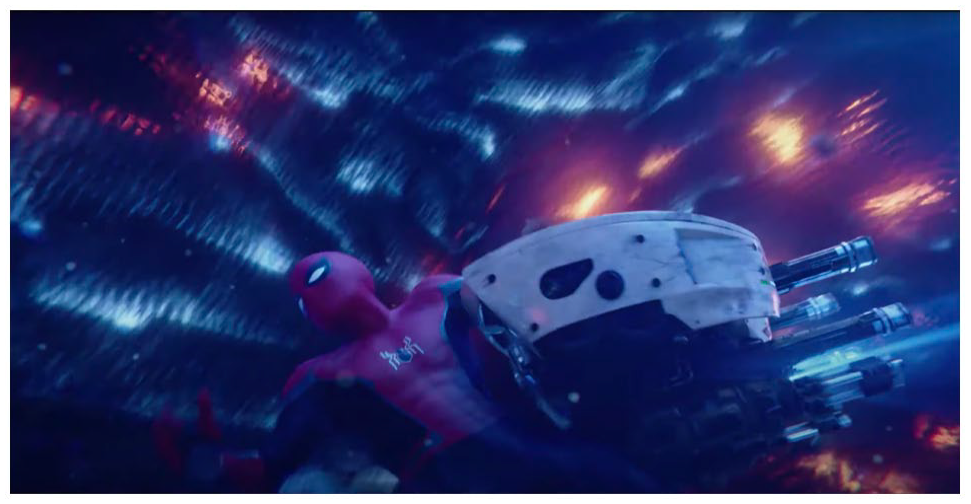
The interior of a holographic ‘Elemental’. Blu-ray frame grab from Spider-Man: Far From Home (2019, Sony Pictures Entertainment).
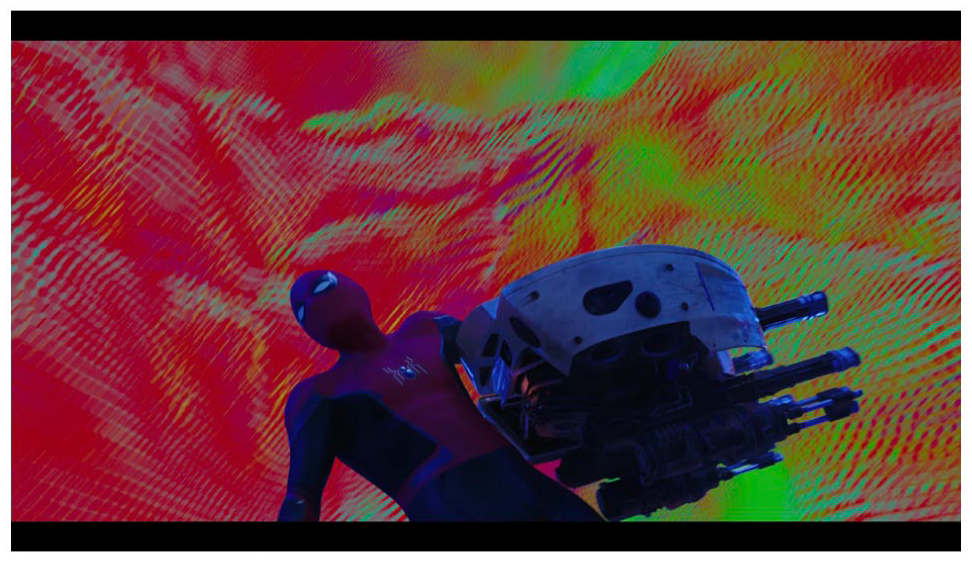
The VFX breakdown by Imageworks indicates the creation of this Elemental through digital layering. Screenshot from ImageworksVFX (2020).
This breakdown also deconstructs the extended digital take from the finished film in which Spider-Man attacks Mysterio. In the final text, a virtual camera swoops around our hero as he violently disables various projectors in his path; layers of holographic deception appear and disappear, wireframes flicker and short out, illusionistic darkness appears then wipes away to reveal the real world beneath. A rotating kaleidoscope of digital effects deconstruction, this shot is itself then deconstructed in the Imageworks breakdown, and while the latter may add swiping narrow white lines to indicate the layering procedures of VFX manufacture, it is again effectively indiscernible from the final version. The spectacles of diegetic effect and VFX compositing here combine so fluidly that they become interchangeable.
Finally, this same breakdown offers the sight of actor Gyllenhaal performing on a greenscreen stage while digital composites of increasing visual veracity are layered over him – only for his grey fractal suit to remain oddly unaltered in the final render. These mocap suits are often worn by actors when performing scenes on greenscreen stages, to be later replaced by VFX renderings of their costumes. In Far From Home, the suit enters the diegesis, with the film showing how Beck’s Mysterio outfit is a composite of digital model and carefully prepared physical costume. As a result, it also features in the final shots featured in the VFX breakdown, even though we would normally expect it to be buried beneath photorealistic layers of digital imagery.
These formal echoes and overlaps reveal how the visuality of the VFX breakdown circulates in a wider range of contexts. Intriguingly, Far From Home is to some extent upfront about this borrowing, at least in terms of broader ideas regarding VFX spectacle. Beck seeks, in his words, an ‘“Avengers” level threat’ that he can overcome in order to cement his false status as a superhero and reap the rewards. Like the ILM artists who created the VFX for The Avengers (2012), he deploys dazzling imagery in order to generate the possibility for entertainment heroics. Unlike The Avengers, the illusion is diegetically acknowledged, resulting in the employment of breakdown-like imagery: since the audience are apparently being given access to the constituents of VFX production by Spider-Man’s disabling of the drones, it makes sense that the resulting images align with the similar access provided by the breakdown.
There is, though, more to it than this. Beck is a disgruntled VFX worker, using his skills against an employer who disregarded him. Tony Stark (Robert Downey Jr), a billionaire industrialist whose journey from playboy weapons manufacturer to universe-saving martyr is the spine of the first decade of the MCU, used to be his boss. But Stark saw little value in the cutting-edge holographic technology Beck created, offensively naming it Binarily Augmented Retro-Framing, or BARF, and using it as little more than a throwaway gimmick. The glimpse in Far From Home that we see of BARF’s application (in a scene partly excerpted from another Marvel film, 2016’s Captain America: Civil War) employs extensive and detailed effects work to de-age Downey Jr. in the context of a therapeutic simulation. This is not cheap or easy work and Beck’s in-world labour producing this simulation is inevitably tied to the real-world effects companies that developed de-aging software for Civil War, as well as the living, breathing artists who carefully fine-tuned its application in this brief scene. Stark, it seems, is content to vomit on both. A flashback reveals that the billionaire knew the holographic illusion tech cost his company $611m but, nonetheless, he expresses no regard for the human labour involved in creating it. Onstage at a tech demo, Stark is shown casually tossing BARF aside as a meaningless novelty in front of hundreds of people, while Beck watches aghast from the wings, a digital creator who is figuratively and literally side-lined.
If here, through the figure of Beck, VFX are snubbed, then this eerily resembles the treatment of Bill Westenhofer at the 2013 Oscars. Accepting the Best Visual Effects award for Life of Pi (2012), Westenhofer thanks studio executives, director Lee, production personnel and his family. He then begins discussing the financial difficulties of Rhythm & Hues, at which point the Jaws (1975) theme starts playing, urging him to finish his speech. Speeding up his delivery, Westenhofer pleads ‘I urge you all to remember’, but before he can go on his mic is cut off (Oscars, 2013). A palpably metaphorical moment, this was made all the more potent for the fact that Life of Pi’s victory was declared seconds before by an assembled team of high-profile Avengers actors, including Downey Jr, Chris Evans and Samuel L Jackson. Downey’s pre-announcement teleprompter badinage even asserted the need to give VFX companies the respect they deserve.
In his truncated speech, Westenhofer sought (unsuccessfully) to remind global TV viewers that VFX artists are indeed artists, not technicians, and that VFX work takes time and creative labour (Desowitz, 2013). As already noted, former Rhythm & Hues employees and others from the VFX industry in Los Angeles pursued the visibility denied Westenhofer by mounting a peaceful protest in urban space. In contrast, Beck seeks not awareness but aggressive revenge, gathering a group of like-minded former Stark employees whose contributions to the company, while seemingly vital, were also ignored. Beck’s villainy is assured through his ultimately homicidal actions and Gyllenhaal’s charismatic but maniacal performance. Stark’s younger self may have been cavalier and uncaring, but at this point in the MCU he is an unproblematically heroic figure, all of which removes any potential ambiguity over Beck’s (re)actions. Nonetheless, the film makes highly suggestive claims regarding the treatment of VFX artists and visibility of this work, claims that raise rather than entirely eradicate these issues.
If the erasure of VFX labour has led to Beck’s rage, then he is able to turn these tables and use the same misperceptions about VFX when getting revenge. Playing on the equation of digital effects with magic, he employs the frame of the latter to get what he sees is due compensation for his prowess in the former. If the global public will insist on being over-awed by effects without thinking about their origins and materialities, Beck seems to argue, then they will have to reap the consequences of this magical thinking. The city-smashing Elementals are absurd but convincingly deadly, a fitting proscenium for his VFX-enabled heroism to take centre stage.
However, for all its foregrounding of VFX labour, the film undertakes many of the same elisions as VFX breakdowns. We may see a rehearsal and some backstage mechanics, but Far From Home inevitably adheres to ideas of speed and immateriality in digital production, with Mysterio’s magical effects made by a small team who can adapt to feedback with instant re-iterations. If magic is revealed to be little more than VFX in the narrative, then the reverse is also true, with the magical and miraculous nature of VFX being reasserted through their easy spectacle, scale and responsiveness. The penultimate scene may show Beck’s death in his unadorned grey fractal suit, but the shots immediately after this provide audiences with the thrilling sight of a digital Spider-Man web-slinging his way through New York, a reassertion of VFX as an unproblematic part of the film’s visual economy.
Emptying the hat
Writing in 2002, Pierson (2002: 11–12) described how ‘computer-generated visual effects are not only a major attraction of Hollywood blockbuster cinema but one that, despite being produced within an industrial context that is more highly rationalized than ever before, continues to be presented to contemporary audiences as magic.’ Digital VFX may have become even more ubiquitous since then, of course, but they are still persistently framed as magical not only in presentation but also in production, their creators inevitably called ‘the magicians of the film world’ (Failes, 2015: 10). Chung (2017: 26–27) decries this tendency because, for all that such a comparison codes effects work as alluring and exciting (who doesn’t want to be a magician?), it also ‘erases the material realities of labor-intensive processes of film production’. This magical thinking then contributes to what Darlington (2018: 1260) calls an ‘overall mystification of work within digital [animation] workflows’. For Darlington, this mystification is to some extent inevitable thanks to the skilled nature of digital animation as well as its machinic qualities.
VFX breakdowns might offer an opportunity to unveil all this invisible work. Breakdowns seem to reveal the composite nature of digital effects imagery and the way this imagery is generated. But the way they do this indulges another kind of sorcery. If breakdowns stress the amount of work and detail required to produce digital effects, they also at the same time insinuate that this work is automatic and instantaneous, erasing labour and labourers in much the same fashion as a director’s requests for instant changes, the curtailing of awards speeches and the absence of onscreen credits for many workers. They must, therefore, be seen in the context of a wider ongoing debate regarding VFX, labour and working conditions, a debate which is increasingly breaking into the popular discussion of films like Far From Home and related Marvel content (Bisset, 2022).
This does not even account for those erasures which occur when even breakdowns are absent. The breakdowns for mega-blockbuster Justice League (2019), for instance, contain no mention of the extensive, expensive – and by many accounts not very successful – last-minute effects work needed to remove a moustache from star Henry Cavill. Grown for another role, the actor sported this facial hair during extensive reshoots on the superhero film and its digital removal for many scenes results in an oddly smeared and uncanny mouth which caught the eyes of many fans (Alexander, 2018). Its omission from the breakdowns by the effects companies that worked on the film – including that by Scanline VFX, who reportedly undertook the questionable digital grooming in 10 days – indicates how this unwelcome 11th-hour effects work, while no doubt requiring great skill and care, has no place in the official promotional narrative of the film (even as it occupies a significant place in the unofficial narrative, with multiple YouTube videos claiming to analyse and ‘fix’ this errant CGI (VFX Geek, 2019). Similarly, despite being a major studio release, there is no VFX breakdown for the musical Cats (2019), presumably thanks to the film’s negative critical and commercial performance – part of the blame for which was laid on the digital effects. VFX artists who worked on the film were keen to point out on social media that deficient or even unfinished effects shots in the final film were the result of unusual and highly questionable production choices (for instance, the lack of mo-cap markers on the actors), as well as a punishing post-production schedule (Hoffman, 2020). Even so, the absence of a breakdown delegitimizes the work undertaken by the companies and artists involved in this and many other films.
All of this is not to say that VFX breakdowns are not useful tools for better understanding the creation of digital imagery in a popular cinema awash with such visuals. But they need to be approached with caution: they speak from a certain cultural position, use a particular tone of voice and propagate ‘promotional facts’ about VFX work which can have significant industrial consequences. Like the performances of any illusionist, they conceal as much as they reveal and we must begin to pay attention to where we are not supposed to be looking in order to have any chance of seeing the whole trick.
Footnotes
Acknowledgements
I wish to sincerely thank the anonymous peer reviewers for their helpful suggestions and support, as well as editor Chris Holliday for his responsiveness and enthusiasm.
Declaration of conflicting interests
The author declared no potential conflicts of interest with respect to the research, authorship and publication of this article.
Funding
The author received no financial support for the research, authorship and publication of this article.