




Abstract
The leading Portuguese modernist José de Almada Negreiros (1893–1970) often interacted with cinema and was particularly captivated by animation. While Almada’s stay in Madrid – from 1927 to 1932 – was marked by a magic lantern show and echoes of cut-out animation in his visual works, his presentation on Disney at the premiere of Snow White and the Seven Dwarfs in Lisbon is a milestone of the reception of animation in Portugal. Drawing upon current art historiographical debates, this article addresses the case of Almada as a way to reconstruct the history of the reception of animation in peripheral countries. Simultaneously, it highlights the importance of interdisciplinarity, the intertwinement between history and theory, as well as the support of archival research.
Keywords
Introduction
In this article, I expand the field of inquiry into animation by invoking current art historical debates – while acknowledging attempts to revise and reshape methods and narratives of art historiography, and recognizing that those inputs can lay the ground for rewriting a critical history of animation. In so doing, I will conflate theory, history and archival research to address an episode of the reception of animation by a Portuguese artist. Moreover, I will advocate the pertinence of crossing art history with animation studies to approach artists who dealt with animation.
When Timo Linsenmaier (2008) remarked on the neglect of historiography at the expense of the focus on the definition of animation, which often requires a theoretical exercise, he implied a false dichotomy between history and theory. We can question this divide by simply asking: Why could we not combine theory with historical research to write a history of the definitions of animation? Animation scholars, such as Esther Leslie (2004) and Kristian Moen (2013), have already written histories of animation intertwining historical context with sophisticated theoretical frameworks. I argue that a careful application of this kind of scholarship to more peripheral geographies can be a way of rewriting a critical history of animation. As I shall demonstrate, peripheries play a significant role in ongoing art historical debates.
Although far removed from the animation canon, the writing and art of José de Almada Negreiros (1893–1970) amply demonstrates the advantages of an interdisciplinary approach to animation. His essay Desenhos Animados: Realidade Imaginada (Animated Drawings: Imagined Reality) (De Almada Negreiros, 1938, 2019), published during the exhibition of Snow White and the Seven Dwarfs (Hand, 1937) in Portugal, is the keystone of the artist’s praise of animation that was both idiosyncratic and of its time. Yet, it is difficult to pigeonhole it into an easy disciplinary analysis. How to recuperate it as a working document in animation studies?
Centre, periphery and art historiographical narratives
Snow White and the Seven Dwarfs premiered in Lisbon at the Tivoli Cinema on 21 November 1938. On that day, the newspaper Diário de Notícias reported that ‘the most representative figure of modern art in Portugal’ would present the first Disney feature film (Diário de Notícias, 21 November 1938a: 3). 1 However, several interferences from the audience forced José de Almada Negreiros (hereafter referred to as Almada) to interrupt the talk (Diário de Notícias, 22 November 1938b: 5), which was eventually published as a 12-page book entitled Desenhos Animados: Realidade Imaginada (Animated Drawings: Imagined Reality) (De Almada Negreiros, 1938, 2019: 95–108).
In 2017, the Calouste Gulbenkian Foundation in Lisbon hosted an exhibition that addressed Almada’s modernity and underlined the artist’s relationship with cinema and graphic narrative. In so doing, the curator Mariana Pinto dos Santos also drew attention to ongoing historiographical debates (Dos Santos, 2017a: 10–11).
In response to the canonical geographies of Art Since 1900 (Foster et al., 2007), critical inclusiveness lies at the heart of current revisions in art historiography that encourage decentred (Mitter, 2008), non-hierarchized, horizontal narratives (Piotrowski, 2009) to address the centre/periphery divide (Vlachou, 2016, 2019). On the one hand, Thomas DaCosta Kaufmann (2004; Kaufmann et al., 2016), Piotr Piotrowski (2009), Catherine Dossin and Béatrice Joeux-Prunel (2016) propose a critical geography of art based on earlier historiography or on quantitative methods in order to address art circulations and cultural transfers in a transnational approach, rather than national or international. On the other hand, Keith Moxey (2013) and the Greek art historian Foteini Vlachou (2016, 2019) have highlighted the category of time. 2 As Vlachou (2019: 196–197) observed, the depreciation of the artistic peripheries – which are expected to passively receive and follow a canon marked by notions of stylistic originality defined by the centres – is often expressed in terms of passivity, lack and delay (Vlachou, 2016: 11–14). 3 Thus the current challenges to write more inclusive art historical narratives consist of questioning models of time, finding alternatives and operative models that resist a linear, teleological narrative. According to Vlachou (2016: 11), the study on circulations must consider the uneven powers of distribution – centres have stronger political, institutional and economic conditions to disseminate their culture than the peripheries – and that theory is mainly produced in the centres (Vlachou, 2019: 197).
The notion of ‘active reception’, coined by the Polish art historian Piotr Piotrowski at the conference ‘The Global Art History and the Peripheries’ in Paris in 2013, can be particularly relevant to this article. As reported by Vlachou (2013), Piotrowski’s notion de-emphasizes the passivity attached to the term ‘reception’ and treats peripheral cultures ‘as actively shaped through choices, rejections, appropriations’.
I believe the focus on reception can enrich the discussions on modernism and animation in Portugal, given the few surviving Portuguese animated films. Perhaps a thorough investigation on reception might lead to unexpected materials. When it comes to Almada and animation, the pertinence of reception is twofold. Like other Portuguese artists, such as Amadeo de Souza-Cardoso, Almada is often judged according to a scheme of a (passive) reception of dominant artistic inputs. Additionally, Almada is a key figure in the reception of animation in Portugal. The way he appropriated animation demonstrates how active the process of reception can be.
Almada’s artistic appropriations of animation
A leading figure in 20th-century Portuguese art, Almada distinguished himself by his versatility. 4 As a visual artist, he worked on caricature, comics, illustration, drawing and painting, and other mediums, such as murals, stained glass, and bas-reliefs. 5 As a writer, he experimented with several genres (poetry, prose, manifestos, lectures, theatre plays). He also performed as a dancer, and, episodically, as an actor in the lost Portuguese silent film O Condenado (The Condemned) (dir. Mário Huguin, 1920).
His work is often marked by a childish dimension, praising vision and ingenuity, humour, and joy. Beyond his status of a living legend of the first decades of Portuguese modernism, he kept rethinking his work and carrying on dialogues with younger generations of Portuguese artists throughout his life, as his relationship with the versatile artist and art critic Ernesto de Sousa (1921–1988) demonstrates.
Apart from Almada’s lectures and essays that I will discuss in the next section, Portuguese scholars have already addressed the traces of cinema in the artist’s poetry and fiction (Baptista, 2017: 65–66; Frias, 2014: 35–47; Guerreiro, 2015: 152–154). Recently, an anthology revealed his script for a documentary on Amadeo de Souza-Cardoso (De Almada Negreiros, 2019: 113–126) and a sketch for an unknown script (De Almada Negreiros, 2019: 149–151). Animation, in a broader (non-filmic) sense, invades Almada’s writing as well. This is particularly evident in the short play Antes de Começar (Before Starting), which deals with the self-awareness of the animate condition of both a male and a female doll and the way humans manipulate them (De Almada Negreiros, 2017: 15–31). 6 Whereas Almada’s echo of animation in his dramatic work is probably a symptom of the widespread modernist interest in puppets (Segel, 1995; Taxidou, 2007: 10–42), he carried on a dialogue explicitly and implicitly with the animated film in his visual works.
Almada claimed to have tried to make a film ‘with animated cards’ in 1913 (De Almada Negreiros, 2019: 130). Yet there has been no evidence of that attempt so far. In that decade, he was a proliferous avant-garde writer in close contact with Fernando Pessoa. The 1910s were especially marked by his interactions with the circle of the modernist journal Orpheu, including the writer Mário de Sá-Carneiro and the artist Guilherme de Santa-Rita Pintor, among others. 7 After having met Robert and Sonia Delaunay during their brief stay in Lisbon, Almada kept corresponding with the couple, who settled in Vila do Conde in the north of Portugal in 1915 and 1916, and he was part of the Corporation Nouvelle, a group of artists from Delaunay’s circle. 8
In the late 1910s, Portuguese avant-garde events became more frequent, such as Amadeo de Souza-Cardoso’s exhibitions in 1916, the publication of manifestos and Almada’s novels K4 O Quadrado Azul (K4 the Blue Square) and A Engomadeira (The Ironing Lady), the futurist conference in spring 1917, the welcoming of the Ballets Russes, 9 and Almada’s work as costume designer, choreographer and dancer for A Princesa dos Sapatos de Ferro (The Princess with Iron Shoes) composed by Ruy Coelho in 1918. Most unfortunately, the deaths of Santa-Rita in April 1918, and of Amadeo, victim of the Spanish flu in October 1918, drastically altered these dynamics, which had already been affected by the loss of Sá-Carneiro in 1916.
Unlike Sá-Carneiro, Santa-Rita and Amadeo, who shared a strong bond with Almada and had experienced a stimulating time in Paris, Almada’s 1919 stay in the French capital did not meet his expectations. His stay in Madrid was quite positive, though. From 1927 to 1932, the young artist felt integrated among the writer Ramón Gómez de la Serna’s circle that usually gathered at the Café del Pombo (Ferreira, 2010: 290). Often nicknamed ‘El Portugués Almada’, he was by then an assiduous illustrator, having collaborated with leading journals, such as La Gaceta Literaria, Revista de Ocidente (edited by Ortega y Gasset) and El Sol, among other publications. 10
Almada’s plans for an experimental film with the painter Francisco Cossío, who later collaborated with Buñuel in L’Âge d’Or (1930), probably coincide with his stay in Madrid (Aranda, 2019: 130). Despite this failed attempt, Almada carried out other projects linked to pre-cinema and cinema architecture in the Spanish capital.
Together with the poet Manuel Abril, recognized by his burlesque and infantile literature, and the composer Salvador Bacarisse, a member of the ‘Grupo de los Ocho’, Almada made six magic lantern slides for a show entitled La Tragedia de Doña Ajada (The Tragedy of Doña Ajada). 11 It was composed for a big orchestra, a narrator and a singer, and premiered on 29 November 1929 at the Palacio de la Musica. Whereas Abril’s poem remains lost, and the original score is incomplete, the original glass slides appeared during the exhibition José de Almada Negreiros: Uma Maneira de Ser Moderno (José de Almada Negreiros: A Way of Being Modern) at the Gulbenkian Foundation. Thanks to the discovery of the slides (Figures 1a and 1b), it was possible to confirm that they were photographs of Almada’s drawings (Figures 2a and 2b) painted afterwards and projected in a magic lantern apparatus (Dos Santos, 2017b: 130). The original slides appeared just in time to be used again in a magic lantern screening session at the Cinemateca Portuguesa – Museu do Cinema (Portuguese Cinematheque – Museum of Cinema) in May 2017. 12 They were then displayed in the exhibition José de Almada Negreiros: o Desenho em Movimento (José de Almada Negreiros: Drawing in Motion), at the Museu Nacional Soares dos Reis (Soares dos Reis National Museum), in Porto a few months later (Dos Santos et al., 2017d).
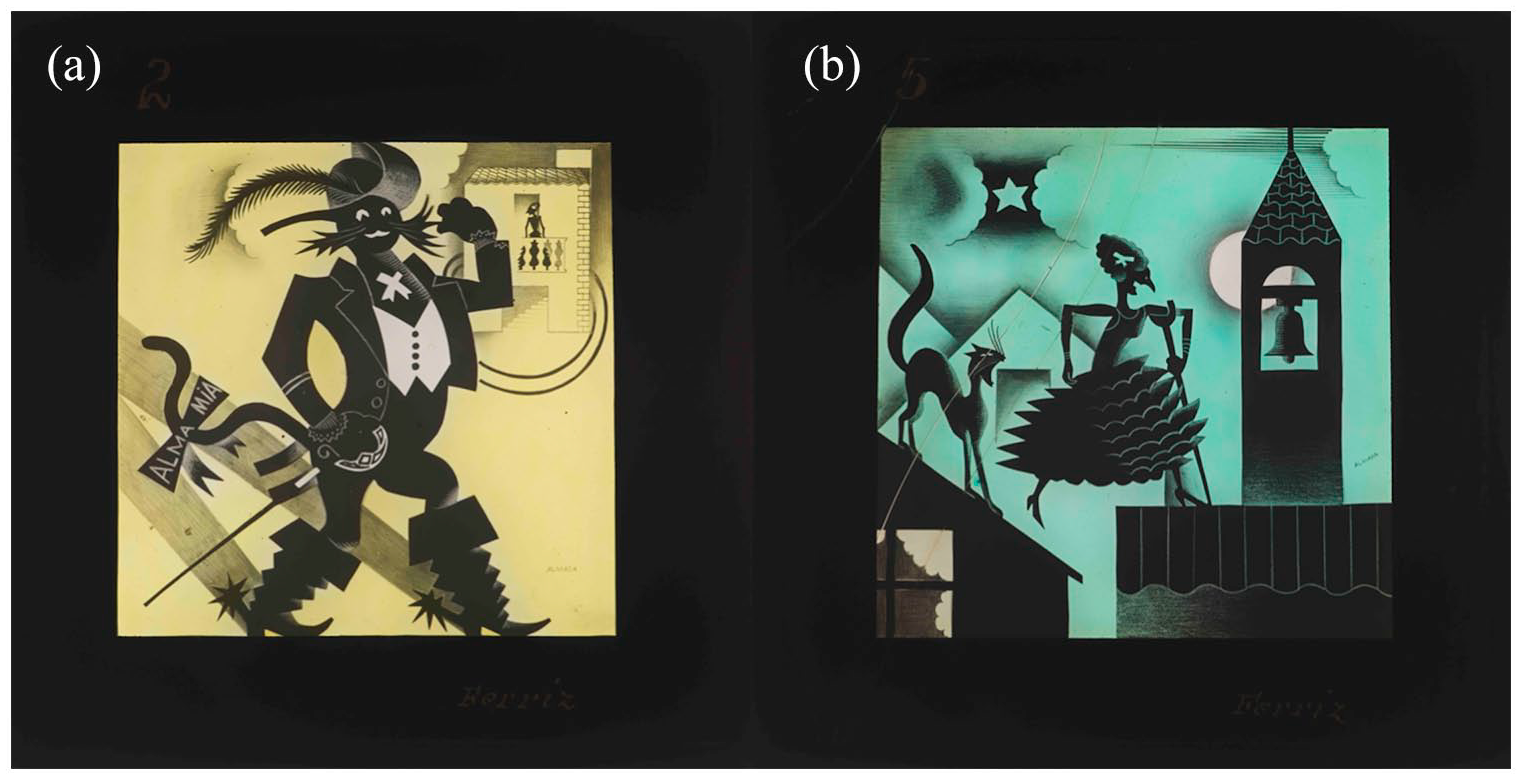
Two of the six magic lantern slides for La Tragedia de Doña Ajada (The Tragedy of Doña Ajada) (Almada Negreiros, 1929): Figure 1(a) (left) II. Pasa el Galán (The Gallant passing by); Figure 1(b) (right) – IV. La Luna Rota (The Broken Moon). © The Heirs of Almada Negreiros © Carlos Azevedo/CAM Photo Archive – Calouste Gulbenkian Foundation, Lisbon. Private Collection. Reproduced courtesy of the CAM – Fundação Calouste Gulbenkian, Lisboa (Calouste Gulbenkian Foundation).
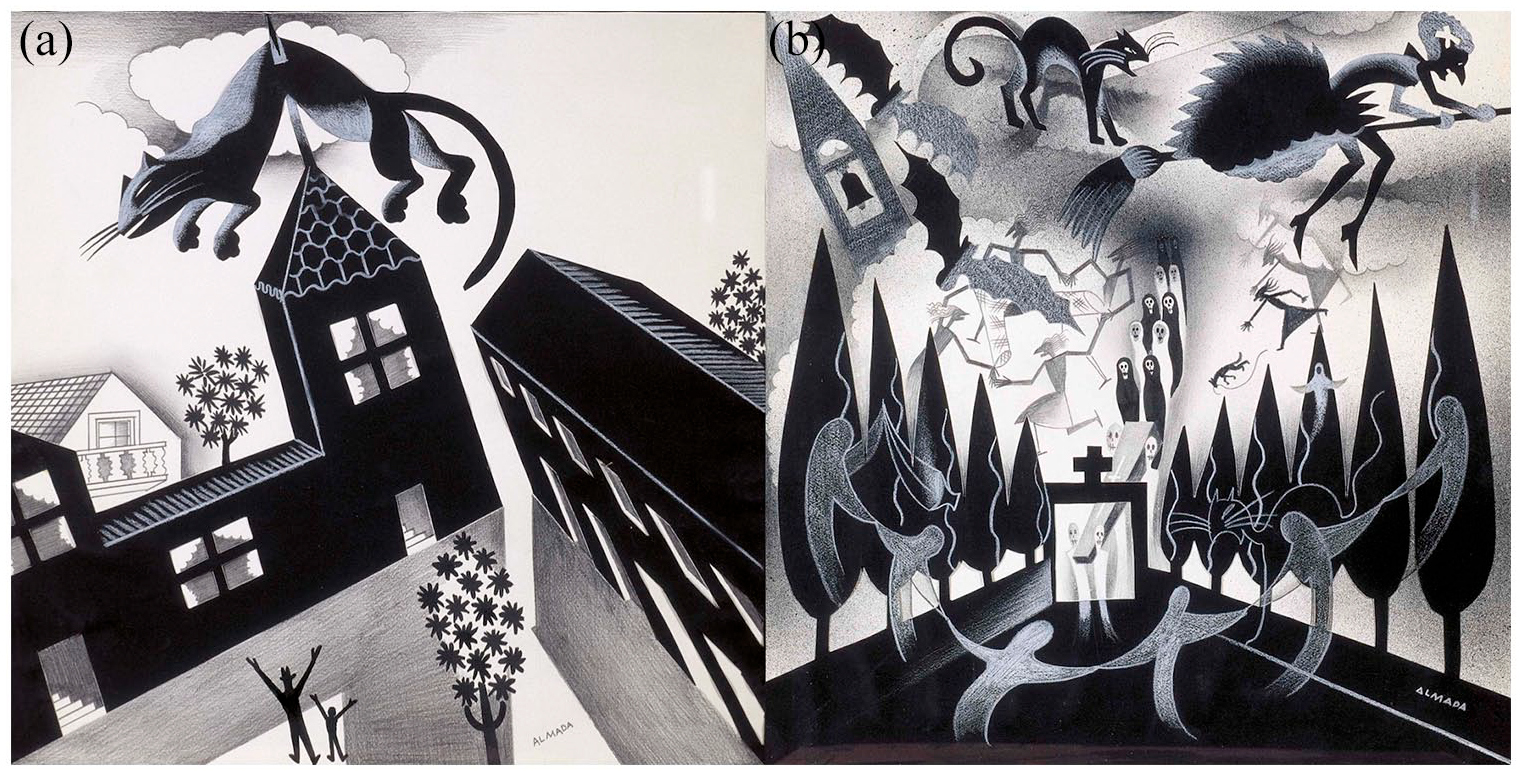
Two of the six drawings for La Tragedia de Doña Ajada (Almada Negreiros, 1929): Figure 2(a) (left) V. El Crimen de las Furias (The Crime of the Furies); Figure 2(b) (right) VI. Alma en Pena (The Suffering Soul). © The Heirs of Almada Negreiros © Carlos Azevedo/CAM Photo Archive – Calouste Gulbenkian Foundation, Lisbon. Salvador e Jennifer Bacarisse’s collection. Reproduced courtesy of the CAM – Fundação Calouste Gulbenkian.
Bethencourt Pérez (2009: 594) compared Almada’s first drawing – El Tocado (The Headdress) – (Figure 3b) to Hasta la Muerte, a vanity scene from Goya’s Los Caprichos album published in 1799, whereas Mariana Pinto dos Santos suggested that Almada’s silhouettes implied articulations and a focus on the hands (Figure 3b) that could be alluding to Lotte Reiniger’s cut-out figures (Dos Santos, 2017c: 184). In addition to these interpretations, I would argue that Almada might also evoke the magic lantern graphic tradition. The female character’s long nose echoes a frequent trope in the magic lantern burlesque repertoire, where the nose is more commonly depicted in men and gains phallic overtones (Figure 3a). 13 Likewise, the last slide full of ghosts – Alma en Pena (Suffering Soul) – fits into the phantasmagoria genre (Figure 2b). Surprisingly, Almada’s slides do not enable simple motion techniques usually performed in magic lantern shows (for instance, slides with long noses often animated the enlarging or cutting of the nose).
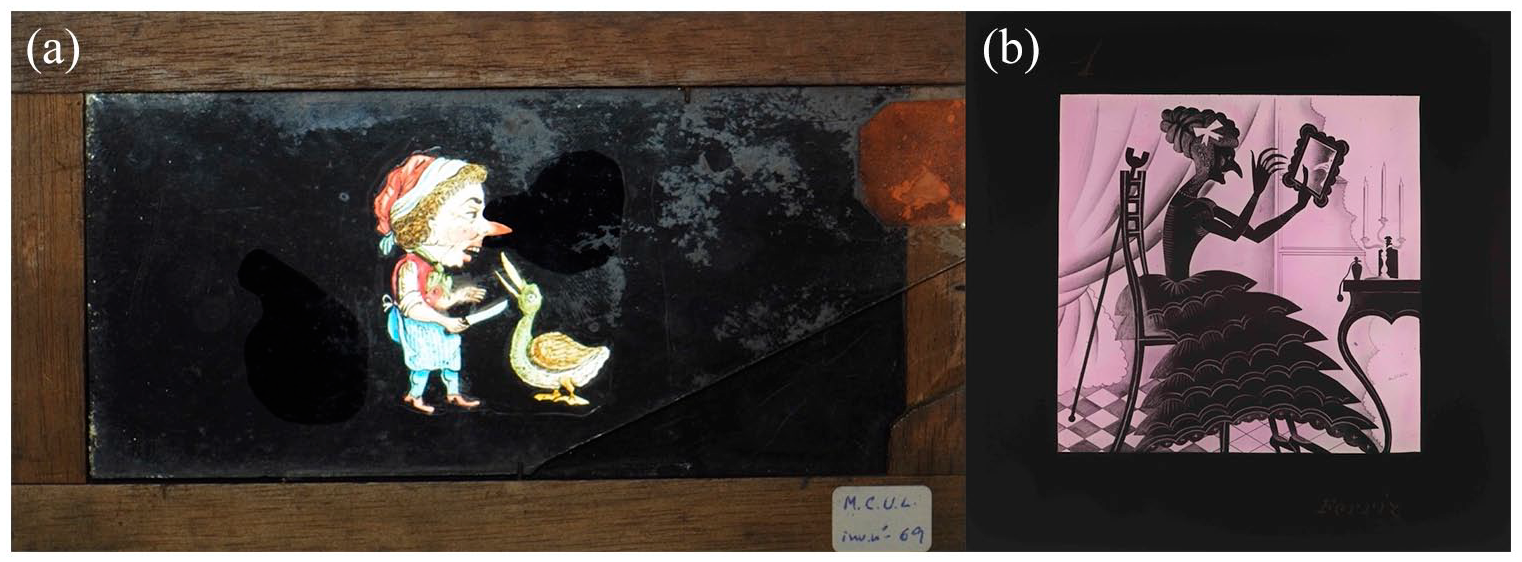
Long noses in magic lantern slides:
Well acquainted with a group of architects that used to gather at the Granja El Henar café (Iraizoz García, 2017: 54), Almada eventually decorated two cinemas in Madrid – Cine San Carlos (architect Eduardo Lozano Lardet, 1928–1929) in Calle Atocha and Cinema Barceló (architect Luis Gutierrez Soto, 1931) in Calle Barceló (Figure 5a). Right after Almada’s death in 1970, Ernesto de Sousa investigated Almada’s stay in Madrid and coordinated the ‘rescue’ of the panels of Cine San Carlos with the assistance of Isabel Alves and Isaac Jorge, and the financial support of the art dealer and collector Manuel de Brito.
Other modern artists, such as the sculptors Ossip Zadkine and Edward Bainbridge Copnall, also decorated cinemas. Whereas Zadkine’s bas-relief for Cinema Métropole in Brussels in 1932 and Copnall’s plate-glass etchings for Odeon Leicester Square in 1937 14 are easily framed by the Art Deco style typical of cinema architecture in the interwar period, Almada’s panels for Cine San Carlos are more difficult to classify. Furthermore, Almada’s combination of stylized figures with ornaments poses a challenge to discourses on modernist cinema architecture that criticized ornate decoration (McGuire, 2007: 63–64).
Almada made a series of plaster panels (eight for the façade and four destined for the entry hall) when the film theatre was being equipped for sound. 15 The exterior panels were practically left in puzzle pieces after being replaced by marbles, while most of the interior panels were damaged by various layers of paint and covered with film posters (De Sousa, 1983: 41). Luckily, the panel dedicated to Felix the Cat (Figure 4) was completely recovered and it was possible to partly repair the other interior panels. Thanks to old photographs (Figures 5–8), it is now possible to reconstruct Almada’s exterior panels that paid tribute to cinema, depicting Westerns, car chases (Figures 5b and 6a) 16 and movie stars (Figures 7a and 7b). 17
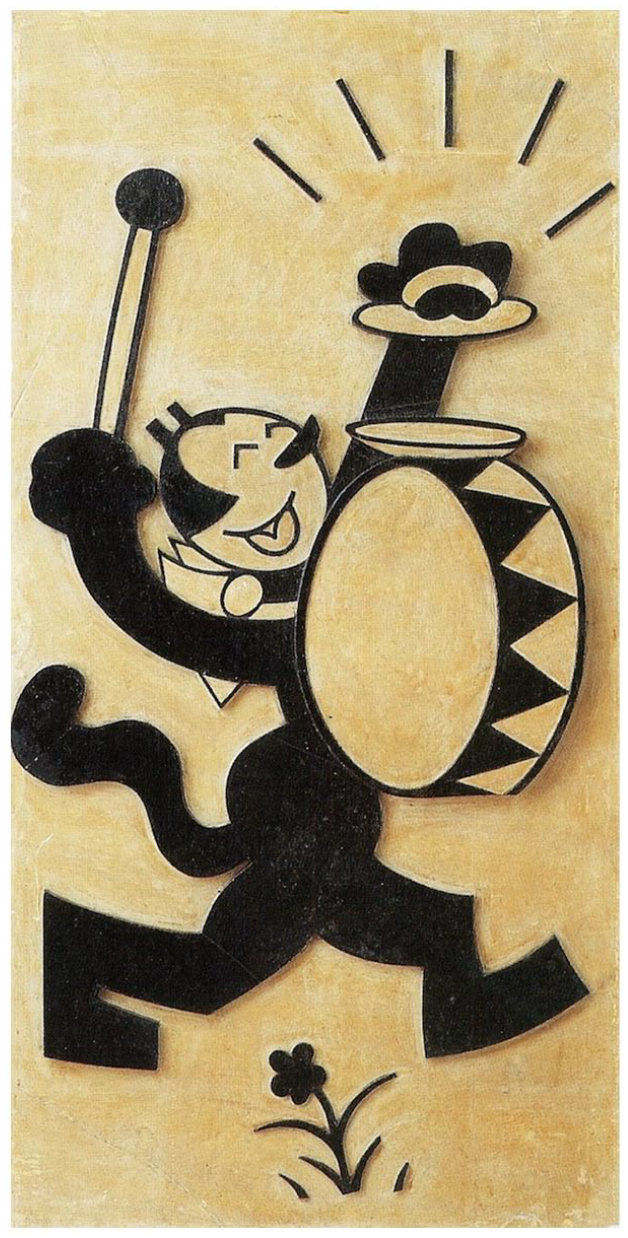
Cine San Carlos hall panel El Gato Felix (Felix the Cat) (Almada Negreiros, 1929). © The Heirs of Almada Negreiros. Manuel de Brito’s collection.
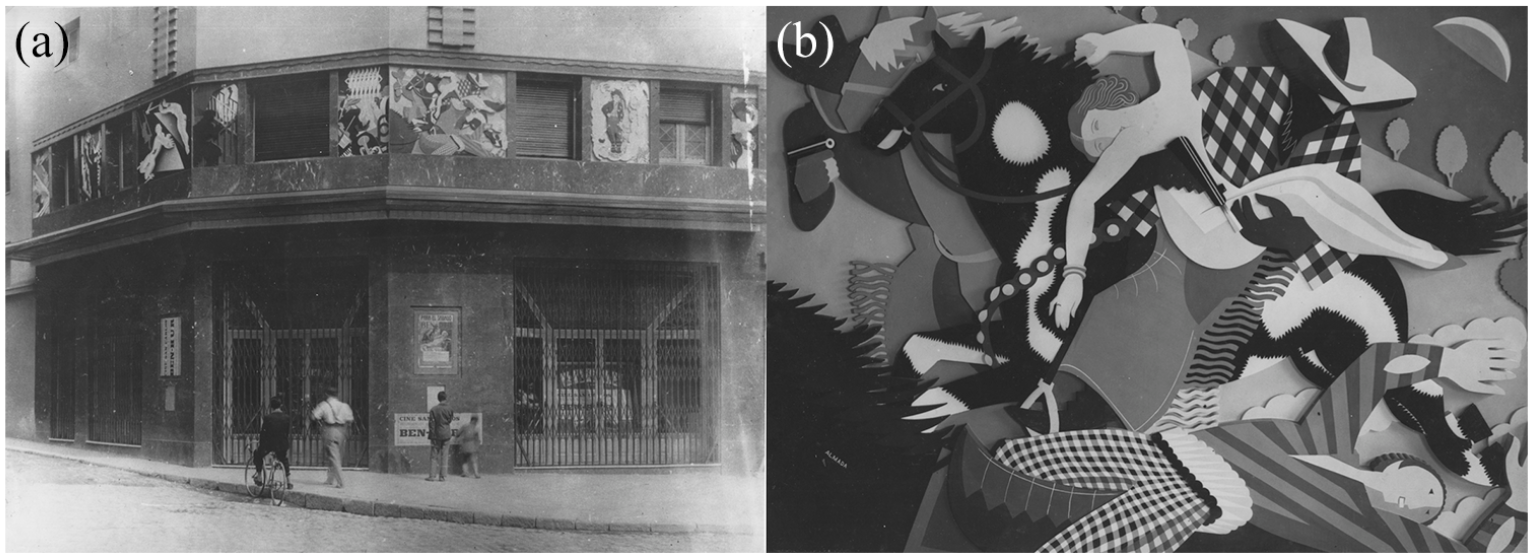
Ancient photographs of Cine San Carlos:
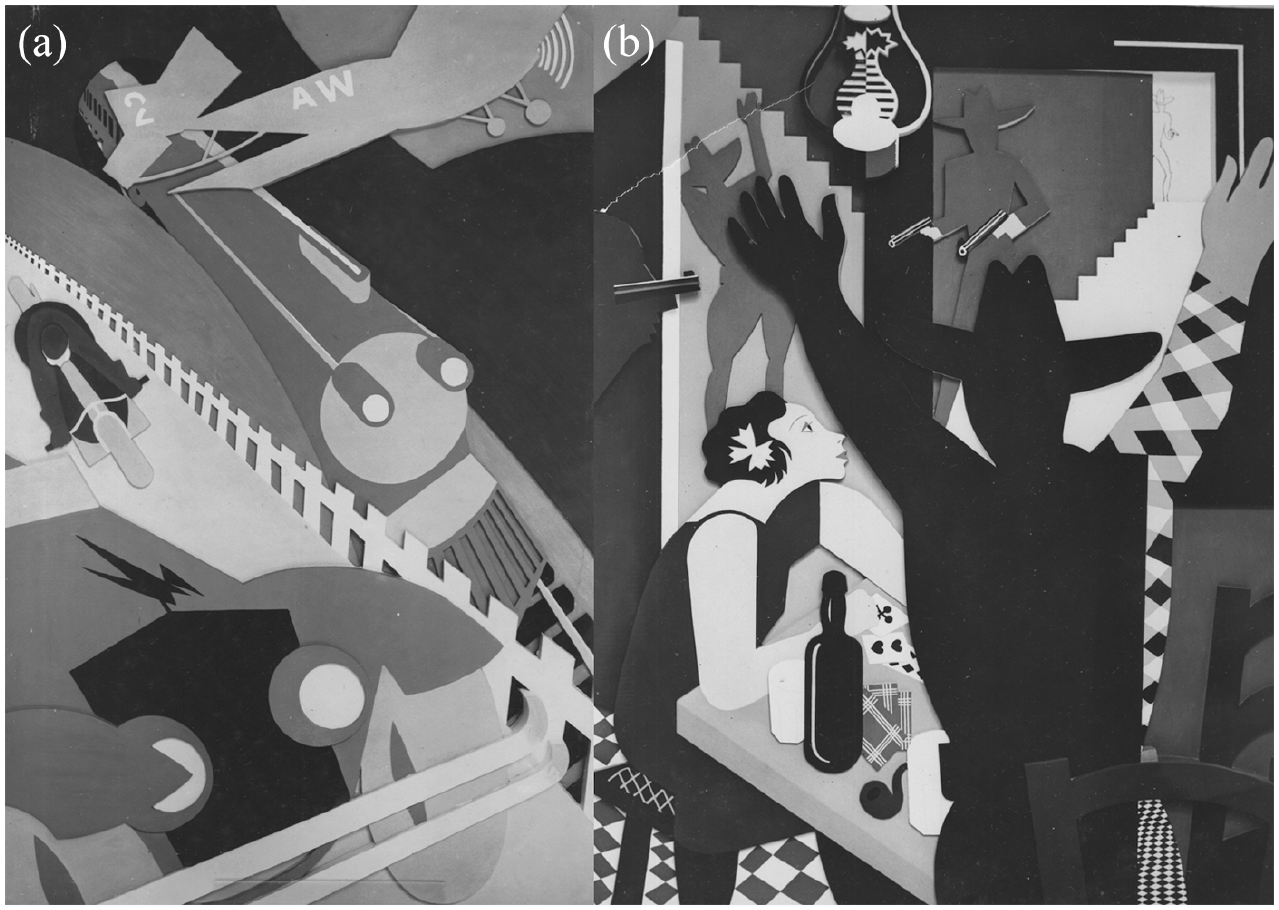
Cine San Carlos façade panels (Almada Negreiros, 1929): Figure 6(a) (left) Perseguição (Chase); Figure 6(b) (right) Hands Up. © The Heirs of Almada Negreiros. Manuel de Brito’s collection; Isabel Alves and Ernesto de Sousa’s photo collection. Reprodued courtesy of Isabel Alves.
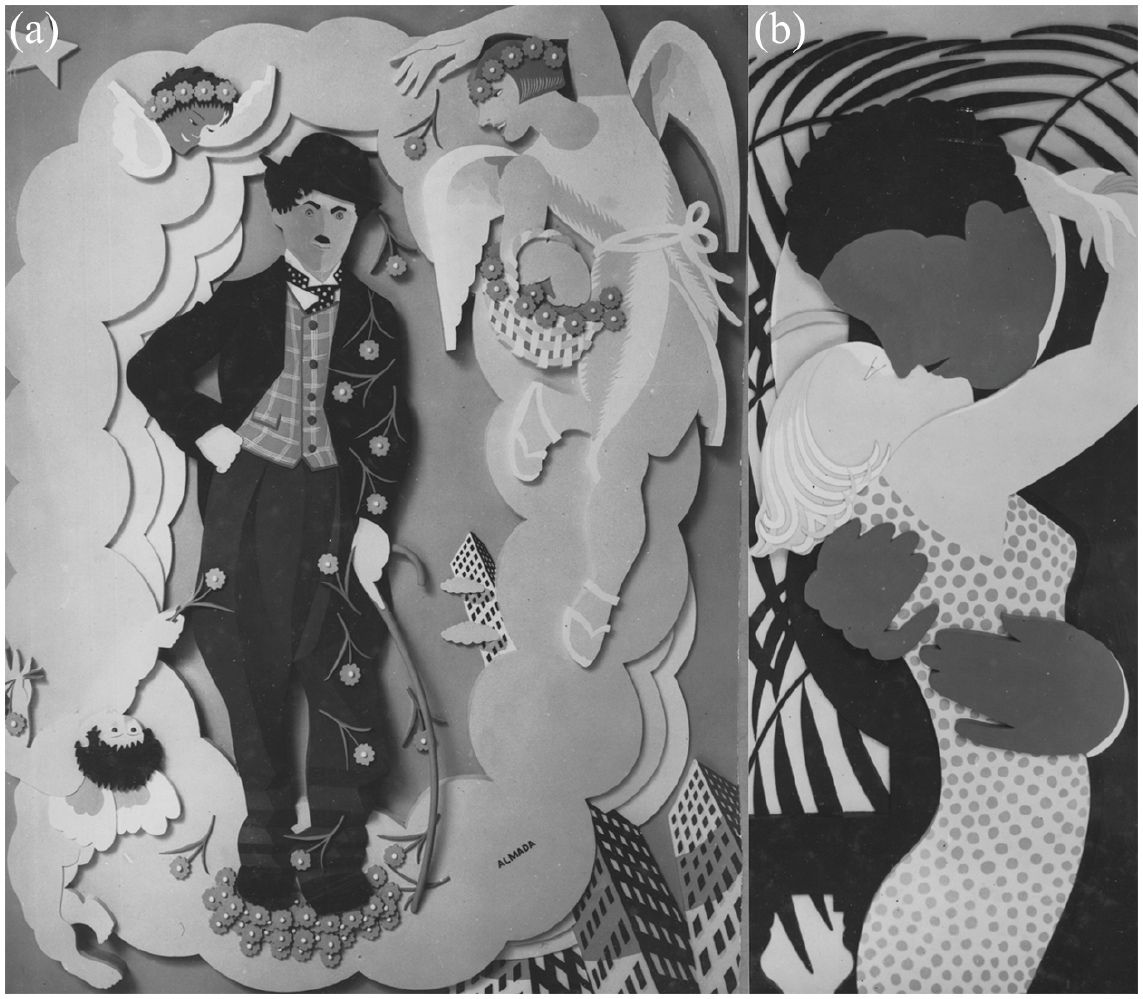
Cine San Carlos façade panels (Almada Negreiros, 1929): Figure 7(a) (left) Charlie; Figure 7(b) (right) Kiss. © The Heirs of Almada Negreiros. Manuel de Brito’s collection; Isabel Alves and Ernesto de Sousa’s photo collection. Reproduced courtesy of Isabel Alves.
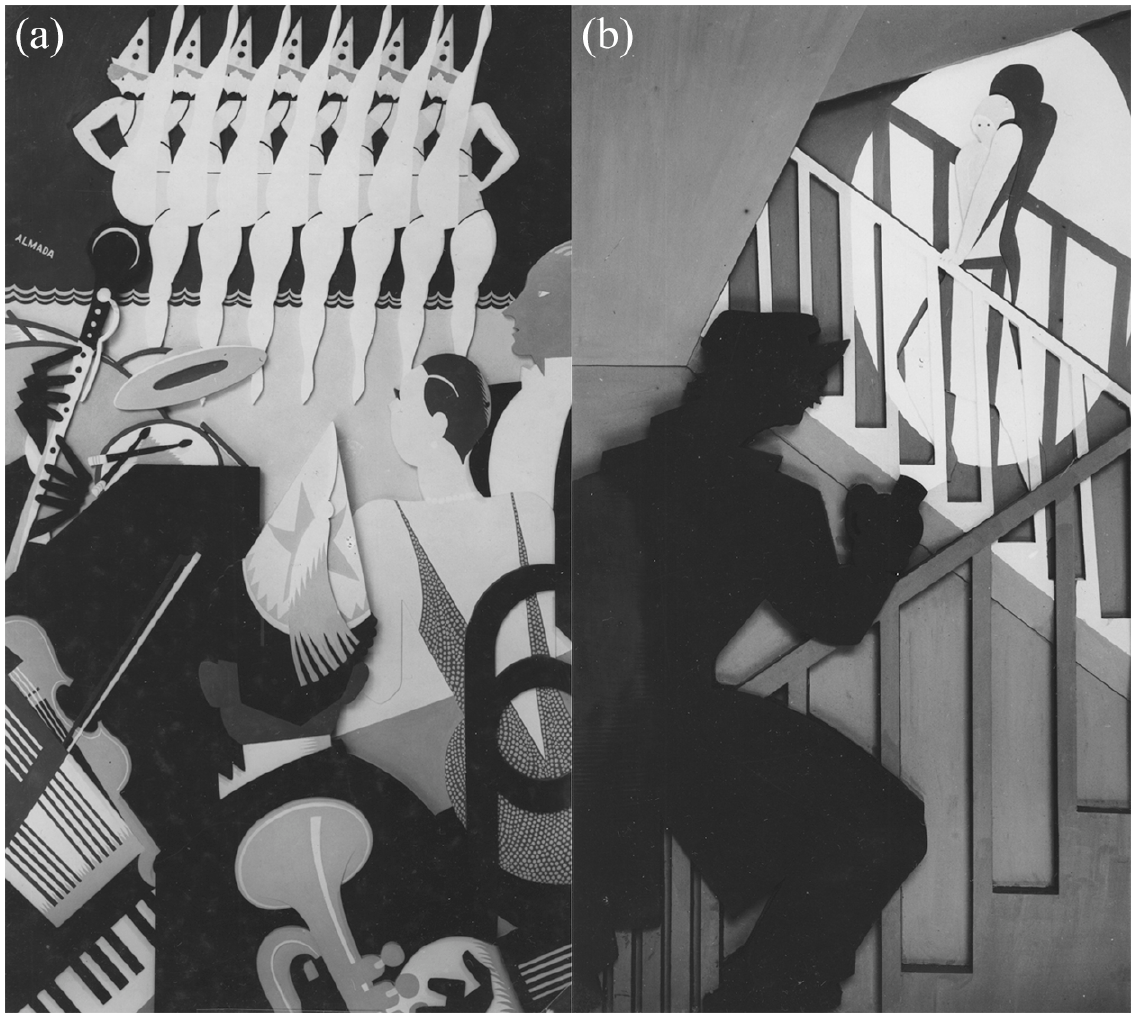
Cine San Carlos façade panels (Almada Negreiros, 1929): Figure 8(a) (left) Dancing; Figure 8(b) (right) Policial (Detective Story). © The Heirs of Almada Negreiros. Manuel de Brito’s collection; Isabel Alves and Ernesto de Sousa’s photo collection. Reproduced courtesy of Isabel Alves.
I find the texture of some of these panels quite similar to the cut-out animation technique, which was frequent by then (Lutz, 1926: 84–91), particularly in panels, such as Dancing (Figure 8a), where the characters seem fragile like flat paper figures. In short, Almada might be filtering live-action cinema through the lens of animation. Akin to La Tragedia in Doña Ajada, where Mariana Pinto dos Santos saw the echo of Lotte Reiniger’s cut-out animation, the panels of Cine San Carlos could be a formal appropriation of an animation technique. The Chaplin sequence from Léger’s Ballet Mécanique (Mechanical Ballet, 1924) was also an appropriation of cut-out animation.
In 1934, back in Portugal, after his wedding to the Portuguese artist Sarah Affonso (1889–1983), Almada entertained vacationers during an amusing evening at Moledo beach, in Minho (Dos Santos, 2017c: 139). On that occasion, the artist made a series of 64 drawings including ‘film intertitles’ that narrated a real story about a storm during a boat trip to the Ínsua island (Figure 9). Almada not only entitled the series O Naufrágio da Ínsua (The Sinking off Ínsua island), but also ‘promoted’ it as a film by advertising it and inventing the ‘Moledo Films, Ltda.’ production company. 18 The show caricatured cinema and the community of vacationers, including Almada and Sarah. Right at the beginning, there was a satire on censorship.
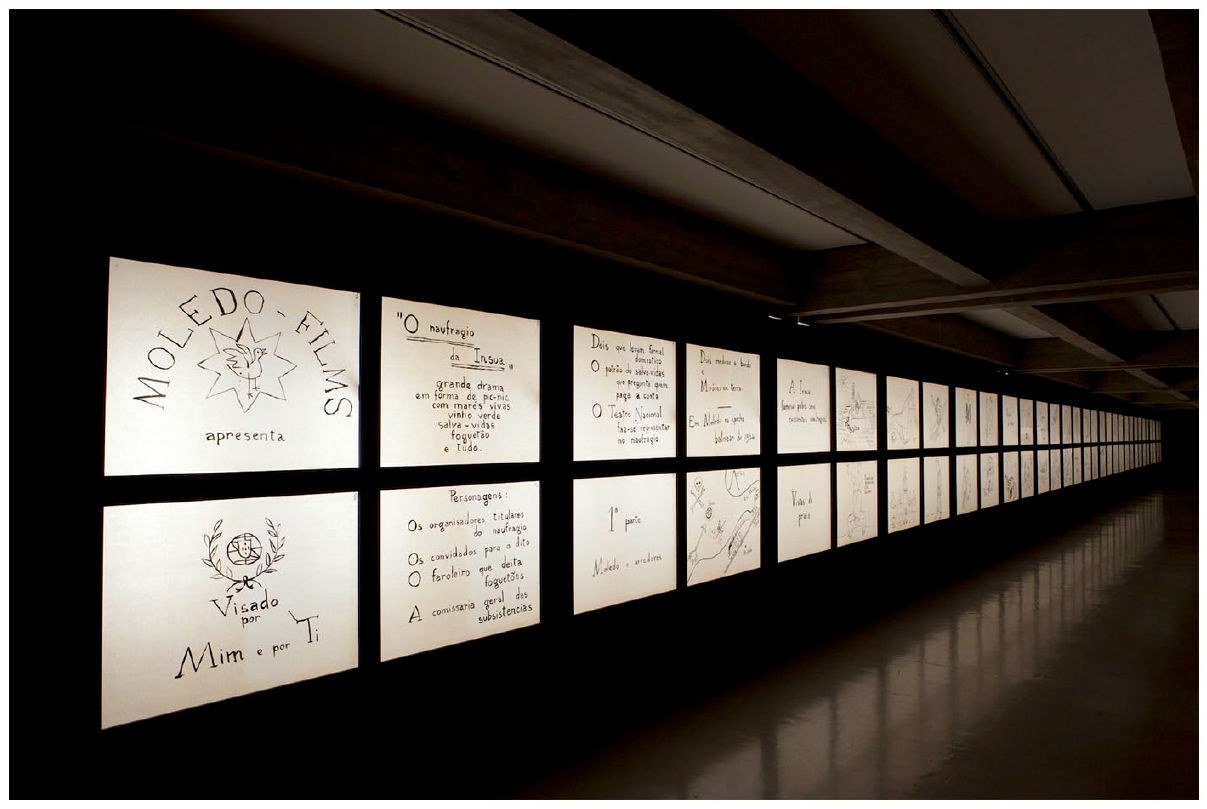
O Naufrágio da Ínsua (The Sinking off Ínsua Island) (Almada Negreiros, 1934), displayed in José de Almada Negreiros: uma Maneira de Ser Moderno (José de Almada Negreiros: A Way of Being Modern). Calouste Gulbenkian Foundation, 3 February 2017 to 5 June 2017. © The Heirs of Almada Negreiros © CAM Photo Archive – Calouste Gulbenkian Foundation, Lisbon. Reproduced courtesy of the CAM – Fundação Calouste Gulbenkian.
Made with very simple resources, Almada placed each piece of paper on wooden rods combining a parody of cinema with a live performance. In this serial work, he did not depict a nuanced sequence of movements. Instead, the drawings for La Tragedia de Doña Ajada and O Naufrágio da Ínsua create atmospheres (burlesque, phantasmagorical or comic) in combination with a narrated text or music. Yet a careful look at Almada’s graphic work reveals sequences more attentive to poses, like some parts of his infantile comics O Sonho de Pechalim (Pechalim’s Dream) and A Menina Serpente (The Serpent Girl) which were published in the magazine Sempre Fixe (Always Cool) in 1926, as well as two series of drawings, one depicting a maternity scene and the other a couple fighting, both dating from 1948.
Almada’s discourse on animation
Presented and published a few years after António Ferro’s remarks on Fleischer’s cartoons (Ferro, nd: 200–202), 19 Almada’s short book Desenhos Animados: Realidade Imaginada (Figures 10a and 10b) welcomed the potentialities of the animated film in an enthusiastic and subtle way.
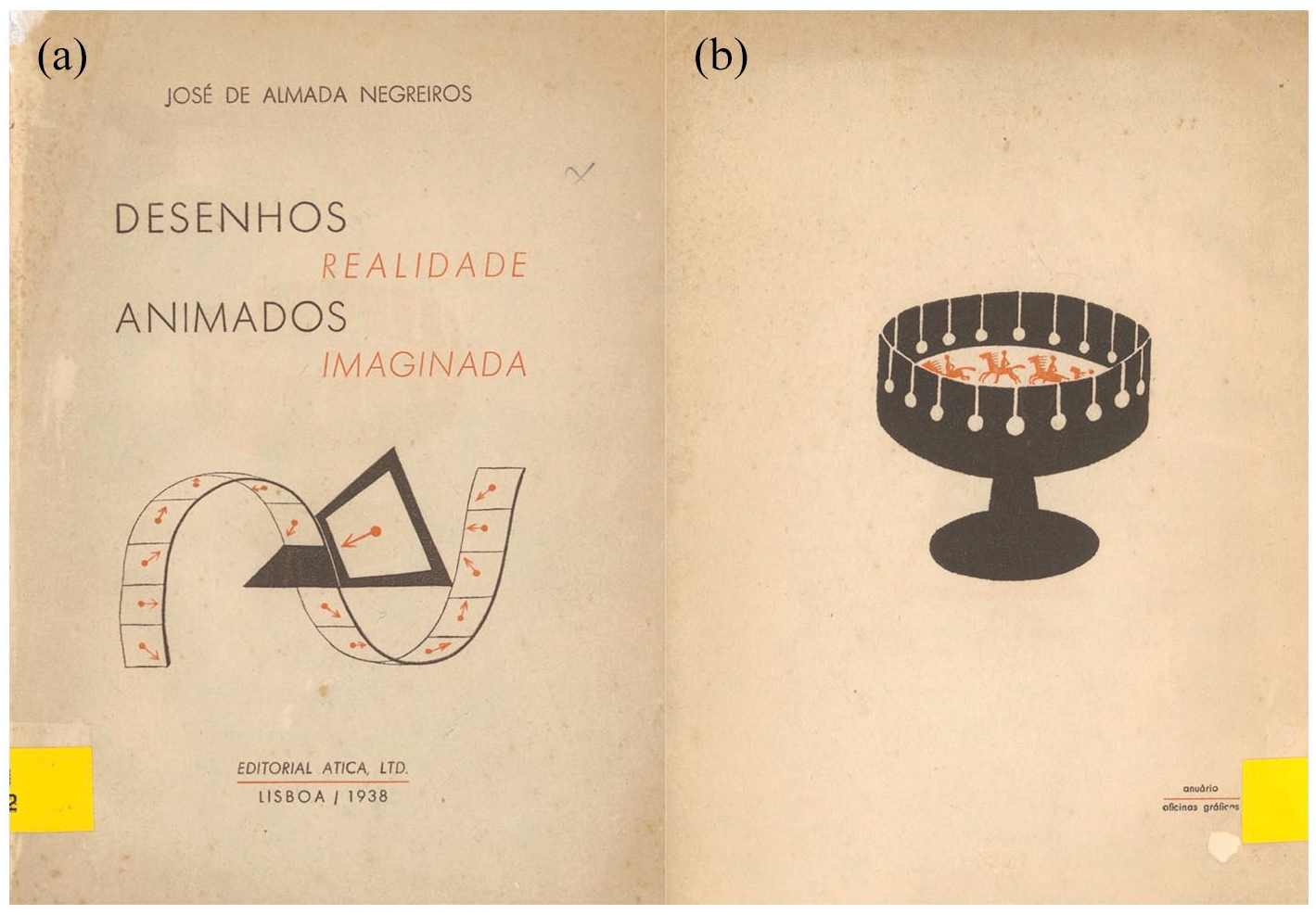
Desenhos Animados: Realidade Imaginada (Animated Drawings: Imagined Reality) (Almada Negreiros, 1938): Figure 10(a) (left) cover; Figure 10(b) (right) back cover. © The Heirs of Almada Negreiros. Reproduced with permission.
In contrast with Sergei Eisenstein, Almada does not think of drawing in connection with metamorphosis and animism (Eisenstein, 2012; Leslie, 2004: 233–240), or drawing as expression of the soul, like a journalist from the Portuguese newspaper Diário de Lisboa (22 November 1938: 3). Unlike Epstein, who cherished the transformation of plants recorded on film (Epstein, 2012: 349), Almada praised documentaries about vegetal life for their educational functions and for stimulating spectators’ imagination (Baptista, 2017: 69), but denied its artistic value in the lecture ‘O Cinema é uma Coisa e o Teatro é Outra’ (‘Cinema is One Thing and Theatre is Something Else’) (De Almada Negreiros, 2019: 73). Differing from Elie Faure, who criticized theatre (Faure, 2010: 19–24), Almada recognized the modern potentialities of theatre and placed it above cinema (De Almada Negreiros, 2019: 77–79).
As Rudolf Arnheim (1957: 8) put it, many of his contemporaries who were ‘reasoning from the analogy of painting’ denied the artistic legitimacy of film, due to its mechanical reproduction of reality. Such is Almada’s case. As Fernando Guerreiro (2015: 157–159) has pointed out, the Portuguese artist’s negative response to live-action film stems from Baudelaire and Riciotto Canudo’s denial of the artistic value of photography. However, Almada’s negative response to live-action turns into a positive reception of animation because it is based on drawing.
Whereas recent readings have addressed, among other aspects, Almada’s positive appraisal of Disney (Baptista, 2017: 70; Guerreiro, 2015: 167–168), I find his picture of Disney more subtle. In that sense, I am closer to José-Augusto França (2020: 247), who spotted that Almada saw Disney more as a ‘discoverer’ and a ‘vulgarizer’ than as an artist. In order to locate Almada’s discourse within the national context, I investigated the reception of Snow White and the Seven Dwarfs in Portuguese newspapers and cinema magazines throughout 1938. As I shall demonstrate, the reception of the film by the Portuguese press not only shares traits with the international advertising and reception, but also makes the contrast with Almada’s praise of Disney more evident.
A thorough analysis of the 1938 cinema magazines also reveals an interest in animation beyond Disney and Snow White and the Seven Dwarfs. In February 1938, director António Lopes Ribeiro wrote an article paying tribute to Georges Méliès and Émile Cohl (Ribeiro, 1938a: 7), the Cine-Jornal magazine published illustrated articles explaining the production processes of industrial animation (Cine-Jornal, 7 February 1938: 8–9) and, at the end of the year, director Fernando Garcia (1938: 30, 1939: 6) wrote a brief history of animation covering key films produced in Europe and in the United States. Unlike in France (Moen, 2013: 17), this attempt to write a history of animation shows no signs of interest in promoting a national history of animation, which is completely ignored by Fernando Garcia. Despite the context of a nationalist dictatorship, which was favourable to Disney’s cartoons (Xavier, 2004: 11), these articles published in 1938 showed no interest, nor memory of the animation produced in Portugal. I will return to this topic at the end.
The reception of Snow White and the Seven Dwarfs by the Portuguese press was very positive in general, marked by the celebration of Disney and the film industry (Da Costa, 1938; Ribeiro, 1938b). As in the United States (Frome, 2013: 465, 470) and in France (Moen, 2013: 11–12), several of the Portuguese articles promoted it as the ‘miracle’ of cinema, following RKO’s advance advertising strategy (Smoodin, 2012: 37–38). Thus, a blurring between ‘information’ provided by Disney’s advertising machine and ‘evaluation’ (Frome, 2013: 463) in the assessment of the film is also valid for the Portuguese press. Likewise, a Portuguese article praising the variety of genres and styles included in the film – ‘drama, comedy, mystery, joy and music masterfully combined’ (Diário de Notícias, 1 November 1938c: 9) – highlights criteria of value that were common among 1930s film criticism (Frome, 2013: 470).
Almada celebrates Snow White and the Seven Dwarfs as a landmark in film history. He puts the feature film at the top of the hierarchy of animation, considering the previous Disney short films ‘below the mission they represented’ (De Almada Negreiros, 2019: 97). According to him, earlier animation was limited to comedy and predictable schemes of fantasy. By introducing other genres and modes of depiction (drama, in addition to the comic and caricatural slapstick), Snow White and the Seven Dwarfs enlarged the possibilities of animation and its depiction of human characters. In absolute contrast with Al Hirschfeld (1938: 4) and Erwin Panofsky (1947: 25), who condemned the realistic depictions of Snow White, the prince and the queen,
20
Almada appreciated these characters, as well as the animals: You will be surprised to see in Snow White and the Seven Dwarfs characters closer to us than you are used to in cartoons. Even the human characters, in spite of being drawn, appear to be more similar to us than to the actors in the cinema. (De Almada Negreiros, 2019: 104)
In spite of being a modernist and having made many stylized caricatures, just like Hirschfeld, Almada surprisingly cherished the characters that lacked deformation and stylization. In short, he admired the characters more incompatible with modernism. As a matter of fact, deformation, stylization and the mechanization of the human figure in modern art lie at the core of the famous essay ‘The dehumanization of Art’ by Ortega y Gasset (2003). Quite different from that thesis was Almada’s lecture ‘Cuidado com a Pintura!’ (Be Careful with Painting!), which expounded on the role of the painter and expressed how the human was central to his vision of modern art: The exact expression of the modern artist is, more than ever, that of the human protagonist! Neither the religious nor the profane, neither the mystical nor the pagan, neither the scientific nor the inspired, neither the political nor the anarchic, neither the heretic nor the believer, the human, strictly and profoundly human. (De Almada Negreiros, 2006: 235)
At the end of Desenhos Animados: Realidade Imaginada, the human resurfaces conflated with drawing, poetry and imagination, which triumph against the machine and the ‘tyranny of the real’ (De Almada Negreiros, 2019: 108). As Fernando Guerreiro has rightly observed, Almada’s attack on photography and praise of imagination echoes Baudelaire’s critique of the artistic legitimation of photography (Baudelaire, 1999). For an artist from the Orpheu circle, which had a strong symbolist vein, the impact of Baudelaire is not surprising at all. Moreover, two editions of Le Fleurs du Mal and Le Peintre de la Vie Moderne in Almada’s private library support this association.
21
The notion of imagination that Almada praises in the animated film is a bit vague and most likely a free appropriation of the Baudelairian notion.
22
Almada hints that the imagination he values in Snow White and the Seven Dwarfs (in contrast with the previous Disney shorts) means moving away from excesses of fantasy and approaching reality, without merging with it as in live-action cinema (De Almada Negreiros, 2019: 101): As you can see, Walt Disney comes closer to reality. He only approaches it, he does not intend to be confused with it. Art is always a transposition of reality and begins when reality is not copied but imagined. Even today, photographic cinema can hardly separate these two realities: the copied and the imagined one. Reality or a photograph of reality, even if it is in motion, is one and the same. It still needs to be transposed to create art. The great element of cinema, photography, is at the same time its weakest point. It seems a paradox but the biggest obstacle to the representation (re-present, make present) of reality is the presence of reality itself. . . . The Greeks had reason to put masks on the faces of their actors: the faces are reality, and this is symbolized in the masks; the symbol is the imagined reality, it is with symbols that art is expressed. (De Almada Negreiros, 2019: 104–105)
If the attack on photography seems rather incompatible with a predictable modernist worship of the machine, this excerpt points to a primitivist layer that was also pervasive within modernism. In this regard, it is important to consider the symptoms of primitivism that Fernando Guerreiro (2015: 160) and Mariana Pinto dos Santos (2017e: 187) have diagnosed. 23 Almada not only alludes to the origin of theatre – the Greek mask, a common trace of neo-Hellenism in the primitivist discourses on theatre (Taxidou, 2007: 148–179) – but also points to the origin of cinema – the magic lantern – that lies with projection and drawn images (De Almada Negreiros, 2019: 100).
Based on drawing, ‘the mother of all arts’, the animated film could bring artistic autonomy to cinema (p. 101). Moreover, the statement that ‘an animated scene is more sensible to the spectator than the same cinematographic scene directly captured from reality’ (p. 105) 24 and the idea that animation is closer to poetry, i.e. closer to art, seem to favour an artistic legitimation of animation.
Nevertheless, Almada’s artistic recognition of animation is not achieved as automatically as one would expect. What is at stake is more a question of the artistic potentialities of animation revealed by Snow White and the Seven Dwarfs, a film that ‘is not art’, but a ‘tribute to art’ (p. 107). Additionally, Almada anticipates problems, if animation becomes incapsulated in the format of the Disney’s feature: ‘I hope neither he [Disney] nor others use these moulds’ (p. 105). He also recalls that Disney is not an author, a creator, but rather an entertainer: Walt Disney served his own discovery, and at the same time no one can deny his extraordinary role as a vulgarizer; now, however, others should bring art into his discovery. Since animated drawings have just been discovered, they have not yet found the aesthetic and poetic language that will be natural and beloved in our century. And I hope that creators know how to serve art as Walt Disney knew how to serve as a discoverer of animated drawings. (De Almada Negreiros, 2019: 107–108)
After stressing that art should be exclusively for authors and creators, ‘not for traders, nor for intermediaries’ (p. 106), Almada recognizes the merit of Disney, who had the courage to go ahead with this project without having the ‘gift of creation’, the fundamental characteristic of authorship (p. 107). Almada’s use of the words ‘creation’ and ‘creator’ is connected to the etymology of poetry (poesis, to make) and it surpasses the conventions of the literary genre (De Almada Negreiros, 2006: 289–292). For instance, he equally applied ‘creation’ and ‘poetry’ to the writer Mário de Souza-Carneiro and the painter Amadeo de Souza-Cardoso, who, according to him, were at the top of the pyramid of the Orpheu artistic circle (De Almada Negreiros, 1965: 9).
According to Almada, Disney is praiseworthy, anyway. Even though he did not invent animation, he ‘discovered it’ (De Almada Negreiros, 2019: 103), 25 opened new paths, and displayed a ‘formidable artistic discipline’ (De Almada Negreiros, 2019: 105). The Snow White and the Seven Dwarfs project required the skills of an ‘author above his strength’ and the coordination of a huge team comparable to a Renaissance art workshop. 26
The most interesting reaction to Almada’s publication was its review by the writer, critic and historian João Gaspar Simões, who is widely associated with the modernist journal Presença, based in Coimbra, and his biography of Fernando Pessoa. In line with the commitment of the Presença journal to the artistic legitimacy of cinema (Frias, 2014: 49–71), Gaspar Simões (1938: 16) respectfully disagrees with Almada, by drawing attention to the selectivity of live-action cinema and distinguishing live-action from animation: Walt Disney’s innovation is indeed wonderful. My enthusiasm for it, however, is not in the same direction as that of Almada Negreiros. I do not believe that animated drawings have given cinema what cinema did not have – the imagined reality. I even think that photographic cinema and animated drawings follow opposite paths. If, on the one hand, cinema must always rely on reality, animated drawings must always rely on unreality . . . Instead of imitating the model, the director of the animated film outlines his [sic] vision of reality. Therefore, the more expressive the animated drawings are . . . the less imitative their figures will be. Snow White, the Queen and the Prince are the only false notes in Snow White and the Seven Dwarfs. They are the only expressionless figures in the film. Why so? For being the only ones in which there was a concern to make it real. All other things are unreal. At least they are frankly deformed . . . as all creations of art must be. This is why I think that the path of photography-cinema is different from that of drawing-cinema. For me, both are manifestations of art. For that, it is enough to be carried out by artists. This slight disagreement with Almada’s thought . . . does not prevent me from admiring the malleability with which he, as a salamander, passes through the ideas without getting burned. Almada knows how to give thought to the plastic of images. Hence, the exuberance of his words, the wide and overflowing design of his style. Desenhos Animados: Realidade Imaginada is the first serious reflection that the wonderful art of Walt Disney provoked among us. (Simões, 1938: 16)
Gaspar Simões’ review was, thus, closer to Hirschfeld’s and Panofsky’s known attacks on the visual realism of Snow White, the queen and the prince. In this regard, he distances himself from the Portuguese press, which predominantly valued those characters. 27 If the Portuguese art critic’s distinction between live-action and the animated film seems closer to Kracauer’s concept of the ‘cinematic’ attachment to the real (Kracauer, 1997: 37–39), it is more likely that he decried those characters for their lack of deformation. In fact, Gaspar Simões (1935) had previously advocated deformation as the basis of all art. As Joana Matos Frias (2014: 60–65) explained, deformation, the grotesque and expressionism – particularly German expressionism – were very much appreciated by the Presença circle. In this regard, the journal moves away from Kracauer’s idea of ‘cinematic’.
Always absent from these discussions is the role of photography in the production of the animated film. As a matter of fact, traditional animation relied on the photographic record of each drawing and the animators of Snow White and the Seven Dwarfs occasionally resorted to rotoscopy (Barrier, 2003: 195–197). 28 Does this affect Almada’s argument? I would argue that these uses of photography are compatible with Baudelaire’s idea of photography as ‘a humble servant of the arts’ (Baudelaire, 1999: 4) since they work as auxiliary tools. They are a means to achieve an end – drawing in motion or a realistic depiction of dance. Furthermore, Almada’s statement that ‘an animated scene is more sensible to the spectator than the same cinematographic scene directly captured from reality’ (De Almada Negreiros, 2019: 105), implies that drawing, even when closely based on live action, operates as a translation that enhances the artistic potential.
In spite of being a modern artist, Almada admires a film that often displays illusionist representations attacked by the modernists. In fact, I believe he never considered Snow White and the Seven Dwarfs modernist. When he states that ‘animated drawings have just been discovered and have not yet found the aesthetic and poetic language that will be natural and beloved in our century’ (De Almada Negreiros, 2019: 108), he suggests that the animation produced by then did not coincide with modernism. Yet, in contrast with Hirschfeld and Gaspar Simões, Almada did not condemn the visual realism of Snow White and the Seven Dwarfs.
Moreover, when Almada compared the Disney studio to a Renaissance art workshop, he seemed to project Disney into a different time. Almada insinuates, then, that animation can evoke different temporalities, an idea that fits into French discourses on animation acknowledging that ‘animation could be part of a history of visual forms which might go back centuries’ (Moen, 2013: 17).
Almada was also quite interested in ancient art. As one self-portrait filled with citations reveals (Figure 11), he was drawn to classical artists, such as Homer and Francisco de Holanda, and was especially committed to geometric studies about canonical proportions that he applied to Portuguese painting (Palmeirim and Freitas, 2021). As Mariana Pinto dos Santos (2020: 445) pointed out, Almada’s versatility and response to commissioned works resonate with the idea of a Renaissance artist.
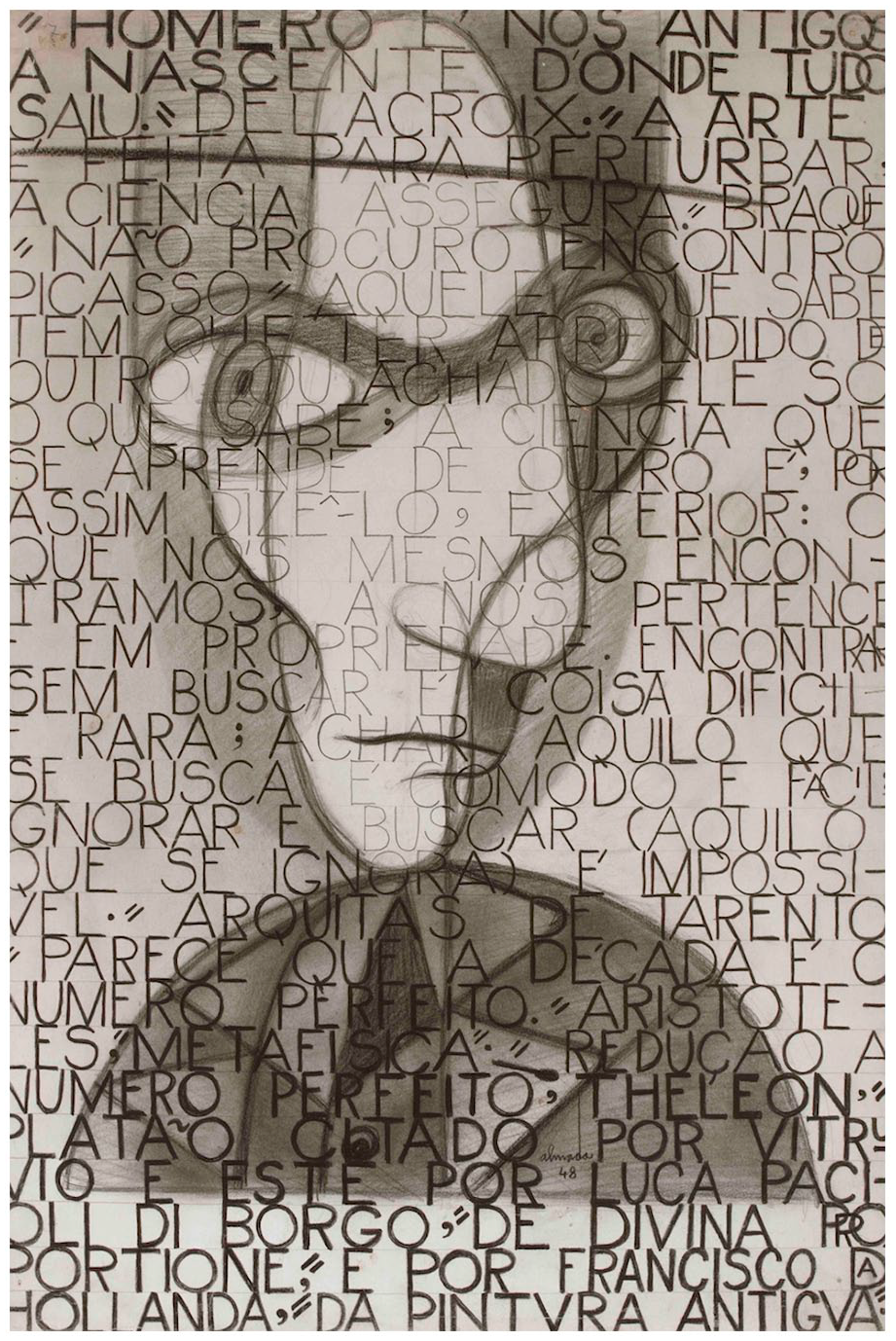
Self-Portrait (Almada Negreiros, 1948). © The Heirs of Almada Negreiros. © CAM – Fundação Calouste Gulbenkian, Lisbon, collection. Reproduced courtesy of the CAM – Fundação Calouste Gulbenkian.
As mentioned earlier, director Fernando Garcia published his first article on the history of animation in December 1938. Garcia (1938: 30) not only claimed animation as the highest medium to express fantasy and imagination, but also emphasized its animistic and poetic qualities. His chronology started in 1908 with Émile Cohl, then introduced Winsor McCay, Pat Sullivan, Max and Dave Fleischer, Ub Iwerks and Walt Disney, Victor Bergdahl’s Kapten Grogg (1916–1922) and Bud Fisher’s Mutt and Jeff (1916–1926) (Garcia, 1938: 30). The second article (Garcia, 1939: 6) was structured according to nationalities and revealed his knowledge about modernist animated films, such as Une Nuit sur le Mont Chauve (A Night on the Bald Mountain) (Alexeieff and Parker, 1933) and Komposition in Blau (Composition in Blue) (Fischinger, 1935). I reckon that Almada would easily recognize the artistic quality and modernity of Une Nuit sur le Mont Chauve and Oskar Fischinger’s abstract films. Thus, it is important to research animated film screenings in 1920s and 1930s Portugal to find out if Fernando Garcia’s narrative is based on a Portuguese context, or on personal experiences abroad.
Completely absent from Garcia’s narrative were the pioneer Portuguese animated shorts, such as O Pesadelo do António Maria (António Maria’s Nightmare) (Joaquim Guerreiro, 1923), TIP-TOP (António Lourenço, c. 1925), Os Camelos (Camels) (João Rodrigues Lopes, 1930), A Lenda de Miragaia (The Legend of Miragaia) (Raul Faria da Fonseca and António Cunhal, 1931) and Semi-Fusas (Hemidemisemiquavers) (Hernâni Tavares, 1934). Apart from O Pesadelo do António Maria, which was partially reconstructed with drawings discovered in 2000, these films remain lost (Gaio, 2002: 12–19). 29 Thanks to a few surviving film stills of A Lenda de Miragaia, which was based on a popular folk story, it is possible to grasp its dialogue with Lotte Reiniger’s cut-out silhouettes. These stills can be seen in an online database on Portuguese cinema (CINEPT) and in a brief post on a blog on Portuguese animation authored by Jeanete de Novais. Her remark on the inferiority of the Portuguese silhouette film – for resorting to a typical technique of northern countries that was mastered by Reiniger – offers a clear example of how biased an approach to artifacts produced in the peripheries can be (De Novais, 2006). The fact that it is impossible to watch the film in question makes this even more startling.
Conclusions
Drawing upon debates that critically reassess the complex dynamics between centre and periphery in the narratives of art history, Piotr Piotrowski’s notion of ‘active reception’ can be pertinent to address art produced in the periphery, as well as studies on reception. This is the case of José de Almada Negreiros, a Portuguese modern artist who also lived in Paris and Madrid and played a major role in the reception of animation in Portugal.
In Madrid, Almada was able to collaborate with projects related to cinema that reveal direct and indirect appropriations of animation. His experiment with the magic lantern not only displays knowledge of the magic lantern show graphic repertoire, but also echoes Lotte Reiniger’s cut-out silhouettes. The cut-out animation technique seems to resurface in his panels for the Cine San Carlos façade and the artist’s depiction of an animated character in an interior panel devoted to Felix the Cat.
Back in Portugal in the 1930s, Almada’s major engagement with animation coincides with his presentation at the premiere of Snow White and the Seven Dwarfs, which he praised for opening the animated film to other genres beyond comedy. Hardly compatible with contemporary film theory that was engaged in the artistic recognition of the medium, Almada’s negative opinion of live-action cinema turns into a positive reception of animation.
Echoing Baudelaire’s attack on photography, Almada advocates a hierarchy between drawing and photography that is not operative nowadays, especially in a hybrid medium such as animation. However, Desenhos Animados: Realidade Imaginada makes sense within a primitivist layer of modernism that was fuelled by an interest in the origins, the archaic (in this case, pre-cinema and drawing) rather than an engagement with the technological and mechanical side of modernity. Almada’s hint about the past temporalities evoked by animation might also be pertinent. The birth of the animated film was indeed contemporary with modernism. Yet, the animated films from that period do not have to be judged according to modernist standards.
Thanks to unprecedented research on the reception of animation in Portugal in 1938, it was possible to provide a more critical context for Almada’s discourse on Disney and to understand how the international history of animation was being written in Portugal in the late 1930s. Even though Almada celebrates Disney’s achievement, he does not promote Snow White and the Seven Dwarfs as a work of art – but as an ‘homage’ to art (De Almada Negreiros, 2019: 107) – and expounds on the artistic potentialities of animation.
By tracking Almada’s interactions with animation, one goes beyond the boundaries of individuality and nationality, which usually frame conventional historiographies. Almada’s versatility asks for interdisciplinary approaches and his circulation between Lisbon, Paris and Madrid stimulates the revision of art historical master narratives. When the history of animation follows a canonical art historical perspective, including artists like Léopold Survage or Hans Richter, it might miss several histories of peripheral modern artists equally interested in animation (as a medium with direct or indirect impact on their artistic practices, or as an object of reflection). Likewise, art history should also resort to animation studies. If a modernist artist addresses Snow White and the Seven Dwarfs, the film’s production and reception should be taken into account by art historians who deal with this subject.
Moreover, this case reveals that one can assess the impact of animation in materials beyond the filmic medium. It also reminds us of the merit of the people who save materials in danger (for instance, Ernesto de Sousa’s recovery of Cine San Carlos panels) and that lost materials can reappear (Almada’s magic lantern slides). Therefore, exhibitions and their associated activities, such as concerts and film screenings, play a key role in provoking research and reconstructing history.
I strongly believe that the next step is to write a critical world history of animation that conflates theory with history. It is time to promote a historiography of animation more committed to interdisciplinary inputs, which help reassessing its narratives, an historiography self-aware of its methods, its choices, its objects and the voices that shape history. As Piotr Piotrowski stated: ‘A critical analysis should reveal the speaking subject: who speaks, on whose behalf, and for whom?’ (Piotrowski, 2009: 54)
Footnotes
Acknowledgements
This article was written in the context of the project Iberian Modernisms and the Primitivist Imaginary (PTDC/ART-HIS/29837/2017) – co-financed by COMPETE 2020, Portugal 2020 and the European Union (European Fund for Regional Development) – and the author benefited from PRISC, the Portuguese Research Infrastructure of Scientific Collections.
I would like to express my gratitude to those who assisted me in many ways: Pedro Almeida, Ana Vasconcelos, Marta Areia, Carlos Azevedo, Isabel Alves, Rita Almada, Mariana Pinto dos Santos, Joana Cunha Leal, Giorgia Casara, Antonio Sáez Delgado, Márcia Vilarigues, Ângela Santos, Raquel Henriques da Silva, Ana Tostões, Joana Gouveia Alves, Sónia Moura, Rui Brito, Arlete Alves da Silva, Branca Moriés, Ana Barata, Ana Cristina Macedo and Ricardo Marques. I would also like to especially thank the editors Rada Bieberstein and Erwin Feyersinger, and the reviewers
Funding
This work was supported by the FCT-MCTES – Portuguese Foundation for Science and Technology (PhD grant SFRH/BD/114990/2016) – and there is no conflict of interest.